

Submitted:
07 September 2026
Posted:
08 September 2026
You are already at the latest version
Abstract
Acromegaly is an endocrine disorder predominantly resulting from a benign pituitary adenoma that causes excessive growth hormone secretion. The current study was designed to investigate the percentage of the 95A>T polymorphism in acromegaly patients. This study was conducted on 80 whole blood samples from acromegaly patients, which were collected from Al-Mustansiriyah University, Specialist Center for Diabetic National, and 40 samples from healthy controls. a targeted region of the GHRH gene was amplified via conventional polymerase chain reaction (PCR) in all samples. Sequence analysis revealed a novel single nucleotide polymorphism (SNP), 95A>T, which was detected in 67.5% (54/80) of patients and 25% (10/40) of controls. Statistical analysis demonstrated a significant association between the 95A>T SNP and the risk of developing acromegaly.
Keywords:
acromegaly
; growth hormone
; endocrine diseases
Introduction
Acromegaly is an uncommon chronic neuroendocrine disorder that develops due to hypersecretion of growth hormone after epiphyseal closure, which leads to an elevation of insulin-like growth factor-1 [1,2]. Approximately 95% of cases are attributed to the hypersecretion of GH caused by a benign pituitary tumor known as a somatotroph adenoma [3]. The global prevalence of acromegaly is estimated to be around 60 cases per million individuals, with an annual incidence of 3 to 4 new cases per million [4,5,6]. The disease often has an insidious onset, and its clinical manifestations typically emerge slowly, leading to a substantial diagnostic delay that averages 10–11 years [7].
The common clinical signs of acromegaly include respiratory complications, hypertension, cardiomyopathy leading to heart failure, hypogonadism, and diabetes mellitus[8]. The major hormone dysregulated in acromegaly is growth hormone [9]. In this disorder, GH, alongside IGF-1, exerts pivotal roles through both direct and indirect mechanisms. Excessive secretion of growth hormone by the pituitary gland promotes the overproduction of IGF-1 by hepatic cells, and the excess IGF-1 stimulates abnormal growth of bones and soft tissues [10]. Importantly, the mortality rates in acromegaly patients with high levels of GH and IGF-1 are 2.6–3.5 times higher than in the normal population [11]. Conversely, normalization or effective suppression of GH and IGF-1 levels significantly reduces mortality risk to near-normal values [12]. Accordingly, clinical studies evaluating therapeutic efficacy in acromegaly commonly utilize GH and IGF-1 as key biochemical endpoints.
Growth hormone–releasing hormone (GHRH), a hypothalamic neuropeptide predominantly synthesized in an arcuate nucleus, plays a critical role in regulating GH secretion. Its receptor (GHRH-R), primarily expressed on somatotroph cells of the anterior pituitary, mediates GHRH-induced GH synthesis and release. Beyond this classical hypothalamic–pituitary axis, GHRH and its receptor have been identified in extrahypothalamic sites, including various human cancer cell lines and surgically resected tumors, indicating potential broader physiological and pathological functions [13]. The GHRH gene is located on chromosome 20 at position 11.23 [14].
A subset of acromegaly cases is resistant to conventional therapies targeting GH-secreting pituitary adenomas; these cases, referred to as ectopic acromegaly, result from elevated GHRH secretion. In such cases, somatotroph adenoma cells may acquire the capacity to produce GHRH, making this hormone an important diagnostic marker [15]. Circulating GHRH concentrations serve as a valuable biomarker for identifying ectopic acromegaly and monitoring disease activity post-surgery, as well as a sensitive indicator of recurrence [16]. Ultimately, the primary therapeutic goal in acromegaly is to normalize GH and IGF-1 concentrations, thereby inhibiting tumor progression or at least achieving significant tumor shrinkage [17].
Methodology
Collection of Blood Samples
All blood samples from acromegaly patients were collected from the National Center for Diabetes at Al-Mustansiriyah University during the study period spanning January to March 2025.
DNA Purification
DNA extraction was performed using the GeneAid kit (GENEAID, USA) according to the manufacturer’s protocol. A NanoDrop spectrophotometer was used to assess the purity and concentration of the extracted DNA, with the absorbance ratio set at 260/280 nm.
Primer design:
The primer was designed based on the methodology reported by Thualfiqar and Khadija in their preprint (Version 1), published on February 27, 2025, and available on Research Square. This primer targets a conserved region within the GHRH gene and was also employed by Thualfiqar and Nadim to detect a different SNP located within the same 971 bp fragment [18,19].

Table 1.
Primer sequences and expected amplicon sizes for the GHRH gene [18].
Table 1.
Primer sequences and expected amplicon sizes for the GHRH gene [18].
| Reference | PCR product sizes | Primer | Gene |
| (Thualfiqar and Khadija,2025) | 791 bp | F-CTGCAGGGTGTGGGAAGAAA | GHRH |
| R-GCTCCATCACGCCCATTCTA |
PCR master mix preparation: primers were obtained in lyophilized form from BIONEAR (Korea). PCR amplification was carried out using the PCR Master Mix supplied by BIONEAR (BIONEAR, Korea). Each reaction was conducted in a final volume of 25 μl.
Statistical Analysis: SPSS software (version 26; IBM Corp.) was used to perform statistical procedures. in combination with Microsoft Excel. Data were assessed for significance employing the appropriate parametric or non-parametric tests, based on the distribution characteristics of the variables.
Ethical Approval: The protocol of this research, along with the participant information sheet and informed consent documentation, was developed in accordance with the ethical standards outlined in the Declaration of Helsinki and received formal approval from the Institutional Ethics Committee of the Al-Diwaniyah Technical Institute, Al-Furat Al-Awsat Technical University.
Results
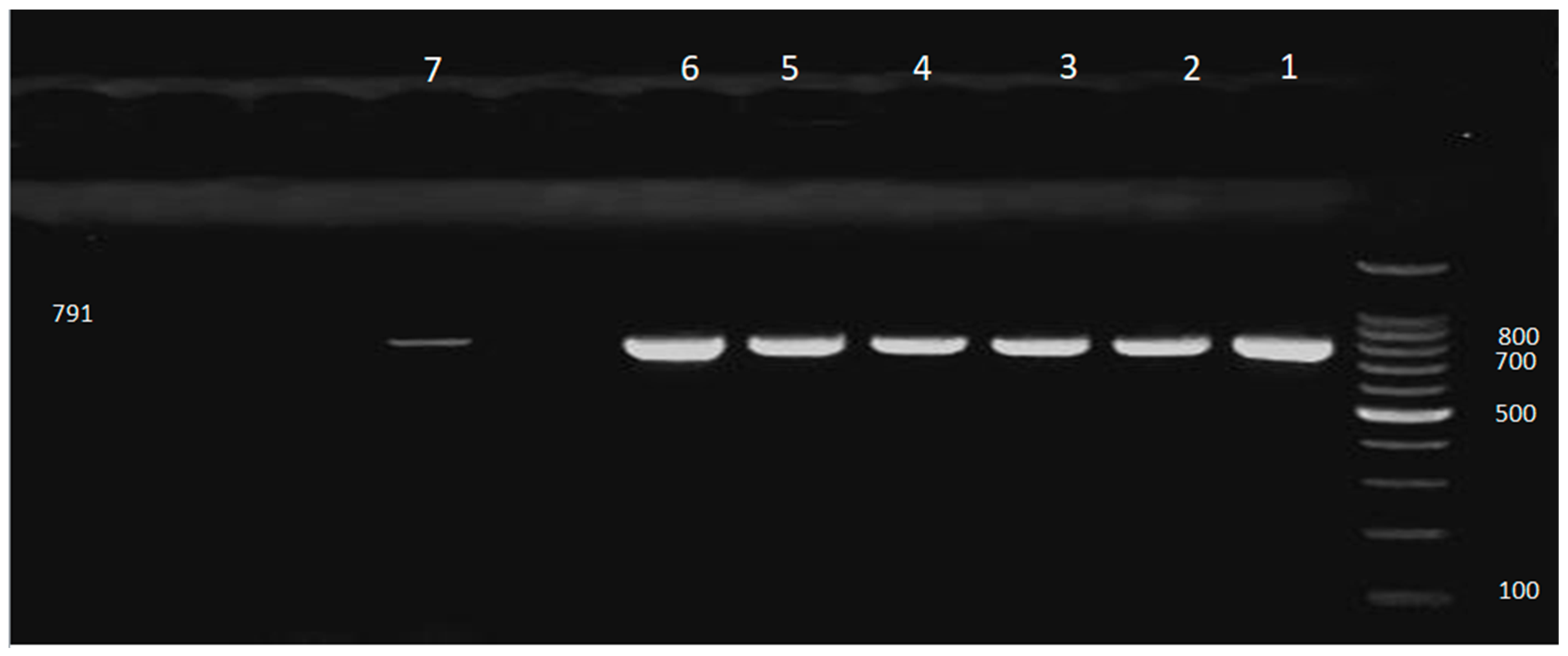
The electrophoresis results of PCR-amplified products from both patient and control samples revealed a clear 791 bp band and are shown in Figure 1.
BLASTn analysis confirmed up to 99% identity between the 791 bp GHRH amplicons and reference sequences in the NCBI database.
Figure 2.
The SNP annotations for GHRH polymorphisms were checked using the dbSNP server. The blue color indicates identified known SNPs. The identified SNPs in the GHRH gene were positioned based on the GenBank accession number NC_000020.11.
Figure 2.
The SNP annotations for GHRH polymorphisms were checked using the dbSNP server. The blue color indicates identified known SNPs. The identified SNPs in the GHRH gene were positioned based on the GenBank accession number NC_000020.11.
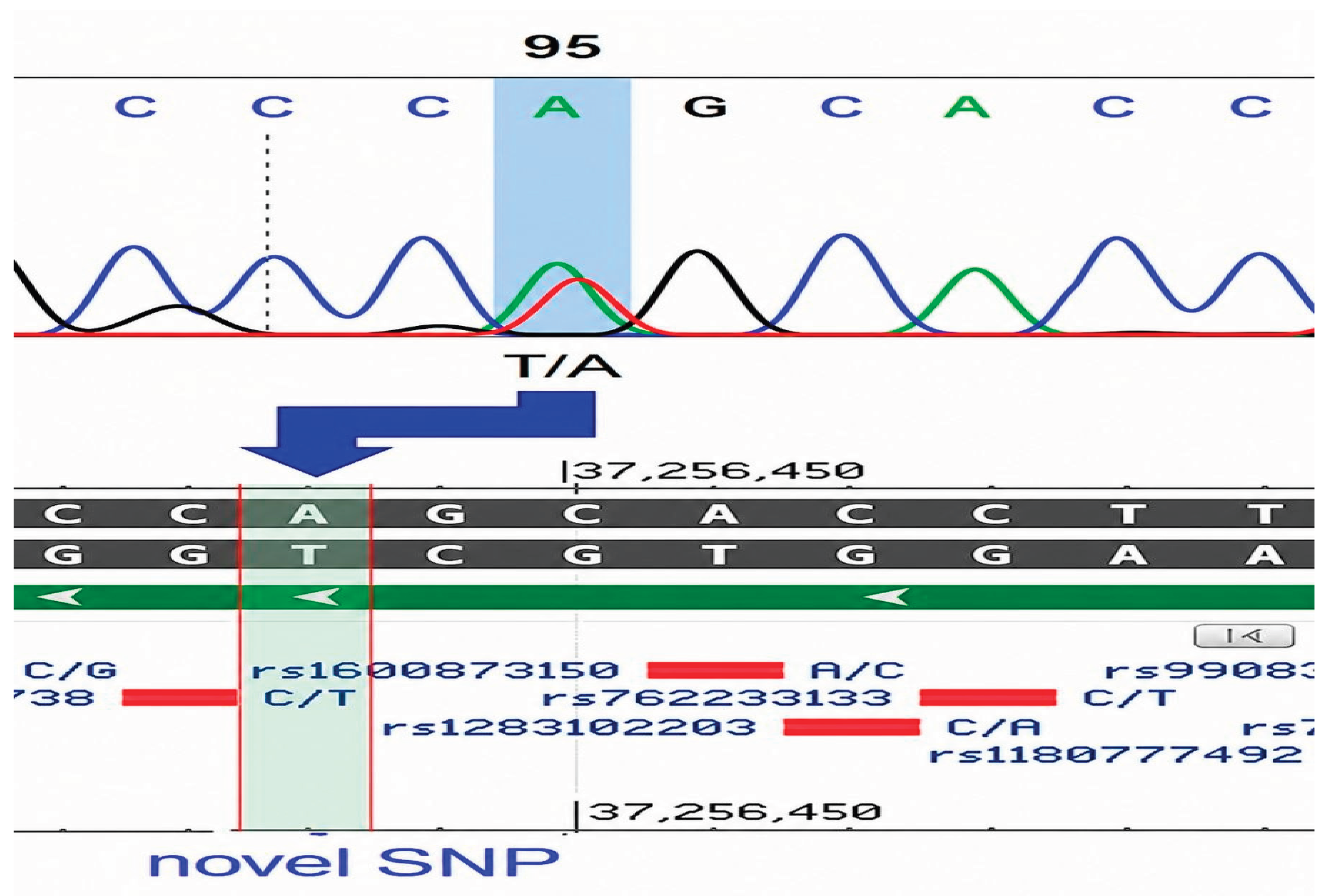
Table 2.
Genotypic and allelic distribution of the novel 95A>T SNP in the GHRH gene.
| Genotype | Patients No.=80 | Control No.=40 | X2 | P-value | OR | Etiological fraction | 95% CI | ||
| No. | % | No. | % | ||||||
| AA | 26 | 32.5 | 30 | 75 | 19.35 | 0* | 0.16 | 0.24 | 0.0683 to 0.3774 |
| AT | 54 | 67.5 | 10 | 25 | 19.35 | 0* | 6.23 | 0.26 | 2.6497 to 14.6516 |
| TT | 0 | 0 | 0 | 0 | 0 | 1 | 0.51 | 0 | 0.0098 to 25.82 |
| Alleles | |||||||||
| A | 106 | 66.25 | 70 | 87.5 | 12.32 | 0* | 0.28 | 0.33 | 0.1339 to 0.5873 |
| T | 54 | 33.75 | 10 | 12.5 | 12.32 | 0* | 3.57 | 0.15 | 1.7028 to 7.4682 |
* Significant difference at P<0.05.
Table 2 presents the distribution of genotypes and allele frequencies for the 95A>T polymorphism within the GHRH gene, derived from genetic analysis of 80 patients with acromegaly and 40 apparently healthy control subjects. The sequencing results indicated that allele A had a frequency of 70 (87.5%) in the control group, while the frequency in the ACM patient group was 106 (66.25%). Conversely, allele T was observed with a frequency of 10 (12.5%) in the control group and 54 (33.75%) in the ACM patient group. In the control group, the distribution of genotypes was as follows: AA in 30 individuals (75%), AT in 10 individuals (25%), and TT in 0 individuals (0%). In contrast, the ACM patient group exhibited the following genotype distribution: AA in 26 individuals (32.5%), AT in 54 individuals (67.5%), and TT in 0 individuals (0%). For the AA genotype, a significant difference was observed between the control and ACM groups (75% vs. 32.5%; OR = 0.16, 95% CI = 0.0683 - 0.3774, X² = 19.35, etiological fraction = 0.24, P<0.05). Similarly, a significant difference was noted for the AT genotype between the two groups (25% vs. 67.5%; OR = 6.23, 95% CI = 2.6497 - 14.6516, X² = 19.35, etiological fraction = 0.26, P<0.001).
Discussion
Previous studies have established a clear link between pituitary adenomas and the development of acromegaly. In particular, Dineen et al. (2017) demonstrated that acromegaly arises from GH-secreting pituitary tumors, which drive sustained elevations in circulating growth hormone levels. This hormonal excess, in turn, stimulates the overproduction of insulin-like growth factor-1 (IGF-1), culminating in progressive somatic disfigurements. Among the most prominent clinical features are skeletal overgrowth and soft tissue hypertrophy, manifesting as frontal bossing, mandibular prognathism, jaw malocclusion, overbite, and pronounced thickening of the skin. [19]. Additionally, these findings align with those of Minuto et al. (2012), who reported that 13% of acromegaly patients undergoing long-acting octreotide (LAR) treatment had normal GH levels, while 87% exhibited abnormal GH concentrations [20].
Regarding the 95A>T novel SNP (Fig. 2), the analysis revealed that this variant induces a missense mutation in the encoded protein, specifically resulting in the p.L45Q amino acid substitution. The study found that the alternative T allele was present in 53.3% of the study population. Notably, this high frequency of the T allele was not the only significant finding, as the study also identified other novel SNPs with comparably high frequencies.
Conclusions
The novel SNP—95A>T was identified in a fragment encompassing exons 2 and 3 and intron 2 of the GHRH gene. This study demonstrated the impact of these novel SNPs on the GHRH gene and protein sequences, revealed that some of these mutations have significant statistical associations with the occurrence of acromegaly.
References
- Ershadinia, N.; Tritos, N. A. Diagnosis and Treatment of Acromegaly: An Update. Mayo Clin. Proc. 2022, 97(2), 333–346. [Google Scholar] [CrossRef]
- Ganapathy, M. K.; Tadi, P. Anatomy, Head and Neck, Pituitary Gland. In StatPearls; StatPearls Publishing, 2023. [Google Scholar]
- Lavrentaki, A.; Paluzzi, A.; Wass, J. A.; Karavitaki, N. Epidemiology of acromegaly: review of population studies. Pituitary 2017, 20(1), 4–9. [Google Scholar] [CrossRef]
- Fernandez, A.; Karavitaki, N.; Wass, J. A. Prevalence of pituitary adenomas: a community-based, cross-sectional study in Banbury (Oxfordshire, UK). Clin. Endocrinol. 2010, 72(3), 377–382. [Google Scholar] [CrossRef]
- de Herder, W. W. The History of Acromegaly. Neuroendocrinology 2016, 103(1), 7–17. [Google Scholar] [CrossRef]
- Zahr, R.; Fleseriu, M. Updates in Diagnosis and Treatment of Acromegaly. Eur. Endocrinol. 2018, 14(2), 57–61. [Google Scholar] [CrossRef]
- Caron, P.; Brue, T.; Raverot, G.; Tabarin, A.; Cailleux, A.; Delemer, B.; Renoult, P. P.; Houchard, A.; Elaraki, F.; Chanson, P. Signs and symptoms of acromegaly at diagnosis: the physician's and the patient's perspectives in the ACRO-POLIS study. Endocrine 2019, 63(1), 120–129. [Google Scholar] [CrossRef]
- van Esdonk, M. J.; van Zutphen, E. J. M.; Roelfsema, F.; Pereira, A. M.; van der Graaf, P. H.; Biermasz, N. R.; Stevens, J.; Burggraaf, J. How are growth hormone and insulin-like growth factor-1 reported as markers for drug effectiveness in clinical acromegaly research? A comprehensive methodologic review. Pituitary 2018, 21(3), 310–322. [Google Scholar] [CrossRef]
- Katznelson, L.; Laws, E. R., Jr.; Melmed, S.; Molitch, M. E.; Murad, M. H.; Utz, A.; Wass, J. A.; Endocrine Society. Acromegaly: an endocrine society clinical practice guideline. J. Clin. Endocrinol. Metab. 2014, 99(11), 3933–3951. [Google Scholar] [CrossRef]
- Holdaway, I. M.; Rajasoorya, R. C.; Gamble, G. D. Factors influencing mortality in acromegaly. J. Clin. Endocrinol. Metab. 2004, 89(2), 667–674. [Google Scholar] [CrossRef]
- Famini, P.; Maya, M. M.; Melmed, S. Pituitary magnetic resonance imaging for sellar and parasellar masses: ten-year experience in 2598 patients. J. Clin. Endocrinol. Metab. 2011, 96(6), 1633–1641. [Google Scholar] [CrossRef]
- Muñoz-Moreno, L.; Bajo, A. M.; Prieto, J. C.; Carmena, M. J. Growth hormone-releasing hormone (GHRH) promotes metastatic phenotypes through EGFR/HER2 transactivation in prostate cancer cells. Mol. Cell. Endocrinol. 2017, 446, 59–69. [Google Scholar] [CrossRef]
- Busto, R.; Schally, A. V.; Varga, J. L.; Garcia-Fernandez, M. O.; Groot, K.; Armatis, P.; Szepeshazi, K. The expression of growth hormonereleasing hormone (GHRH) and splice variants of its receptor in human gastroenteropancreatic carcinomas. Proceedings of the National Academy of 17 Sciences of the United States of America 2002, 99(18), 11866–11871. [Google Scholar] [CrossRef]
- Busto, R.; Schally, A. V.; Varga, J. L.; Garcia-Fernandez, M. O.; Groot, K.; Armatis, P.; Szepeshazi, K. The expression of growth hormonereleasing hormone (GHRH) and splice variants of its receptor in human gastroenteropancreatic carcinomas. Proc. Natl. Acad. Sci. USA 2002, 99(18), 11866–11871. [Google Scholar] [CrossRef]
- Kyriakakis, N.; Trouillas, J.; Dang, M. N.; Lynch, J.; Belchetz, P.; Korbonits, M.; Murray, R. D. Diagnostic challenges and management of a patient with acromegaly due to ectopic growth hormone-releasing hormone secretion from a bronchial carcinoid tumour. Endocrinol. Diabetes Metab. Case Rep. 2017, 16–0104. [Google Scholar] [CrossRef]
- Tutuncu, Y.; Berker, D.; Isik, S.; Ozuguz, U.; Akbaba, G.; Kucukler, F. K.; Aydin, Y.; Guler, S. Comparison of octreotide LAR and lanreotide autogel as post-operative medical treatment in acromegaly. Pituitary 2012, 15(3), 398–404. [Google Scholar] [CrossRef]
- Turki, T. G.; Ammar, J. W. Role of Gonadotropin-Releasing Hormone, Leptin Hormone, Luteinizing Hormone, Follicle-Stimulating Hormone, and Obesity in Polycystic Ovarian Syndrome. Int. J. Sci. Res. Biol. Sci. 2024, Vol, 11(4). [Google Scholar]
- Turki, Thualfiqar Ghalib; Sahan, Khadija abbas. The Potential Roles of 77C>T Variant and Growth Hormone-Releasing Hormone Elevation in Pituitary Adenoma Cases Associated with Acromegaly. PREPRINT (Version 1) available at Research Square. 2025. [Google Scholar] [CrossRef]
- Turki, T. G.; Hashim, N. M. Association between a high level of growth hormone-releasing hormone (GHRH) and GHRH genetic polymorphism (rs566092278) with acromegaly cases. Med. J. Babylon 2025, 22(2), 400–405. [Google Scholar] [CrossRef]
- Dineen, R.; Stewart, P. M.; Sherlock, M. Acromegaly. QJM Mon. J. Assoc. Physicians 2017, 110(7), 411–420. [Google Scholar] [CrossRef]
- Minuto, F. M.; Resmini, E.; Boschetti, M.; Rebora, A.; Fazzuoli, L.; Arvigo, M.; Giusti, M.; Ferone, D. Biochemical diagnosis and assessment of disease activity in acromegaly: a two-decade experience. Pituitary 2012, 15(2), 215–221. [Google Scholar] [CrossRef]
Figure 1.
PCR amplification products of a 791 bp fragment from the GHRH gene. The Lanes 1–4 represent samples from acromegaly patients, while lanes 5–7 correspond to samples from healthy controls.
Figure 1.
PCR amplification products of a 791 bp fragment from the GHRH gene. The Lanes 1–4 represent samples from acromegaly patients, while lanes 5–7 correspond to samples from healthy controls.
Disclaimer/Publisher’s Note: The statements, opinions and data contained in all publications are solely those of the individual author(s) and contributor(s) and not of MDPI and/or the editor(s). MDPI and/or the editor(s) disclaim responsibility for any injury to people or property resulting from any ideas, methods, instructions or products referred to in the content. |
© 2026 by the authors. Licensee MDPI, Basel, Switzerland. This article is an open access article distributed under the terms and conditions of the Creative Commons Attribution (CC BY) license (http://creativecommons.org/licenses/by/4.0/).
Copyright: This open access article is published under a Creative Commons CC BY 4.0 license, which permit the free download, distribution, and reuse, provided that the author and preprint are cited in any reuse.