

Submitted:
05 September 2026
Posted:
08 September 2026
You are already at the latest version
Abstract
To address the issue of insufficient low-temperature performance in asphalt modified with Direct Coal Liquefaction Residue (DCLR), this study developed a direct addition DCLR composite modifier (DCLAM). The DCLAM-modified asphalt was prepared by blending DCLR with SBS, crumb rubber, activated nano-CaCO3, and aromatic oil to systematically optimize its high- and low-temperature performance and rheological characteristics. A four-factor, three-level orthogonal experimental design was adopted. Key parameters of the modified asphalt mastic, including the complex shear modulus (G*), phase angle (δ), rutting factor (G*/sin δ), creep stiffness (S), and creep rate (m), were analyzed using a Dynamic Shear Rheometer (DSR) and a Bending Beam Rheometer (BBR). The results indicate that DCLAM markedly improves the high-temperature stability and low-temperature cracking resistance of asphalt. At 64℃, the optimal formulation (5% DCLR, 1% SBS, 15% crumb rubber, 3.5% nano-CaCO3, 2% aromatic oil) achieved a G* of 17,749 Pa, which represents an increase of approximately 65% compared to the base asphalt. The rutting factor reached 75.2 kPa, showing an improvement of about 48%, while the phase angle decreased to 34.9°, indicating a stronger elastic response. At -12℃, the creep stiffness was reduced to 167.3 MPa, and the creep rate increased to 0.383, meeting the low-temperature specifications of the Superpave system. This composite modifier demonstrates promising engineering applicability, offering a novel approach for the efficient utilization of coal-based asphalt.
Keywords:
direct coal liquefaction residue
; composite asphalt modifier
; rheological properties
; orthogonal experiment
1. Introduction
Direct coal liquefaction residue (DCLR) is a complex substance primarily composed of heavy oil, asphaltenes, pre-asphaltenes, and tetrahydrofuran insoluble matter (THFI) [1]. Among these components, THFI significantly deteriorates the ductility of asphalt, while asphaltenes and pre-asphaltenes contribute to increasing asphalt hardness, enhancing high-temperature stability, and raising the softening point [2,3]. Studies have shown that when the DCLR content is 3%, its aging behavior differs markedly from that of the base asphalt. Increasing the content to 6%–9% does not lead to a decline in aging performance, and further increases do not induce hardening of the modified asphalt [4,5]. As the DCLR content increases, the high-temperature performance of asphalt improves, but its low-temperature ductility correspondingly decreases [6,7]. To enhance the low-temperature performance of DCLR-modified asphalt, researchers have employed SBS for composite modification. Upon swelling within the asphalt, SBS forms a three-dimensional network structure, which can effectively compensate for the low-temperature performance loss induced by DCLR [8]. However, the dosage of SBS has an optimal range. Excessive SBS can adsorb the light components of asphalt during the shearing process, inhibiting the formation of the network structure and thereby adversely affecting low-temperature properties such as ductility [9]. The modification effectiveness of DCLR is also influenced by the form of its components and the preparation process. When the insoluble matter exists as discrete particles or clusters, its impact on asphalt performance is limited. However, if THFI acts as an active component in the modification, the DCLR content becomes a critical factor [10]. Some studies recommend grinding DCLR into a fine, uniform powder before blending it with the base asphalt, which can improve its adhesion to aggregates and result in performance superior to that of conventional 90# base asphalt [11,12].
Research indicates that crumb rubber from waste tires can synergistically improve the high- and low-temperature performance and aging resistance of asphalt. Building on this, researchers have further combined it with DCLR to prepare DCLR-crumb rubber composite modified asphalt. In this composite system, the incorporation of DCLR significantly enhances the high-temperature stability of the asphalt. Furthermore, it works synergistically with the crumb rubber to collectively improve elastic recovery and low-temperature cracking resistance [13].
While DCLR demonstrates excellent high-temperature stability as a road asphalt modifier, its low-temperature performance is often unsatisfactory [14,15]. Consequently, most research favors its combination with materials such as SBS and crumb rubber to compensate for this deficiency, involving systematic optimization of the dosage for each component. An appropriate amount of DCLR can effectively increase the high-temperature viscosity and hardness of asphalt. However, as its dosage increases, it tends to disrupt the colloidal structure of the asphalt, leading to enhanced heterogeneity within the system, which is detrimental to low-temperature ductility [16]. Therefore, it is recommended that the DCLR content should not exceed 10% of the mass of the base asphalt [17].
The overall performance of DCLR-modified asphalt is comparable to that of asphalt modified with 5% SBS [18]. Consequently, the resulting composite DCLR-modified asphalt mixture exhibits equivalent performance to SBS-modified asphalt mixtures in terms of high- and low-temperature properties and moisture susceptibility [19]. Furthermore, dynamic modulus test results and master curve fitting based on the CAM model demonstrate that this mixture possesses excellent deformation resistance across a broad frequency range. This indicates its potential as an effective pavement modification material, contributing to enhanced service performance and extended service life of road surfaces [20].
Due to the significant differences in molecular structure between SBS, crumb rubber, and base asphalt, their compatibility within the asphalt matrix is poor, making them prone to segregation and phase separation [21]. To address this issue, studies have shown that aromatic oil can serve as an effective compatibilizer, promoting the swelling and dispersion of either crumb rubber or SBS [22]. Aromatic oil is a hydrocarbon rich in aromatic ring structures, characterized by high aromatic content, a high flash point, and environmental friendliness. The aromatic and light components it contains contribute to the formation of a stable colloidal structure, thereby enhancing the compatibility between the modifiers and the asphalt [23,24,25]. Furthermore, the incorporation of aromatic oil can significantly improve the low-temperature performance of DCLR-modified asphalt [26].
While existing studies have verified that DCLR can enhance the high-temperature performance of asphalt and improve its low-temperature properties by blending with modifiers such as SBS and rubber powder, current research has mainly concentrated on single- or binary-modification systems. A systematic exploration of the multi-component synergistic mechanisms is still inadequate, especially regarding the formulation design and rheological performance optimization of direct addition composite modifiers. Furthermore, the compatibility problem between DCLR and polymer modifiers in asphalt has not been fundamentally solved, which restricts its engineering application. Therefore, this study intends to develop a direct addition DCLR composite modifier (DCLAM) by establishing a multi-component composite system that includes SBS, rubber powder, nano-CaCO3, and aromatic oil. Through orthogonal experiments and rheological methods, the high- and low-temperature performance and microscopic interaction mechanisms will be systematically explored, offering a new approach for the balanced performance improvement and engineering application of DCLR-modified asphalt.
2. Materials and Methods
2.1. Materials
The materials used in this study included DCLR asphalt, with its performance indices listed in Table 1 and main chemical components provided in Table 2. A linear SBS modifier, YH-791, with a styrene-butadiene block ratio of 3:7 was employed; its basic properties are summarized in Table 3. Aromatic oil (Grade 4#8) was added at a dosage of 2% [27,28,29], and its technical specifications are presented in Table 5. The nano-modifier used was activated nano-CaCO3, whose technical indicators are given in Table 6. The base asphalt was Haiyun Brand 90#, with its measured technical properties shown in Table 7. Asphalt mastic was prepared using limestone mineral filler at a filler-to-asphalt ratio of 0.8 [27]. The basic technical properties of the mineral filler are listed in Table 8.

Table 1.
Performance indicators of DCLR.
| Technical indicator | Density (g/cm³) | Penetration at 25°C (0.1 mm) | Ductility at 10°C (cm) | Softening point (°C) |
|---|---|---|---|---|
| Test result | 1.24 | 4.8 | 1.8 | 175 |
Table 2.
Main components of DCLR.
| Component | Heavy oil | Asphaltene | Pre-asphaltene & THF-insoluble substances |
|---|---|---|---|
| Content (%) | 34~37 | 17~22 | 43~46 |
Table 3.
Basic properties of SBS.
| Grade | Structure | Block ratio (S/B) |
Volatile content (%) | Ash content (%) | Tensile strength (MPa) | Elongation at Break (%) | Permanent set (%) | Shore A hardness | Melt flow rate (g/10min) |
|---|---|---|---|---|---|---|---|---|---|
| YH-791 | Linear | 30/70 | ≤ 0.7 | ≤0.2 | ≥15 | ≥700 | ≤40 | 68 | 0.5~2.5 |
Table 4.
Physical and chemical test results of crumb rubber.
| Test item | Unit | Technical requirement | Test result | |
|---|---|---|---|---|
| Physical indicators | Sieve residue | % | <10 | 8 |
| Relative density | / | 1.10-1.30 | 1.20 | |
| Moisture content | % | <1.0 | 0.55 | |
| Iron content | % | <0.03 | 0.02 | |
| Fiber content | % | <1.0 | 0.04 | |
| Chemical indicators | Ash content | % | ≤8 | 6 |
| Acetone extract | % | ≤16 | 11 | |
| Carbon black content | % | ≥28 | 32 | |
| Rubber hydrocarbon content | % | ≥48 | 56 | |
| Solubility | % | ≥16 | 18 | |
Table 5.
Technical specifications of aromatic oil.
| Technical indicator | Kinematic viscosity (m2/s) | Open flash point (°C) | Ash content (%) | Aromatic content (%) | Appearance |
|---|---|---|---|---|---|
| Test result | 26 | 220 | 0.01 | 80 | Yellowish-green |
Table 6.
Technical specifications of active nano-CaCO3.
| Model | CaCO3 content (%) | Specific gravity (g/cm³) | Average particle size (nm) | Specific surface area (m²/g) | Oil absorption (%) | Surface treatment agent | Appearance |
|---|---|---|---|---|---|---|---|
| 303 | 98 | 1.99~2.01 | <100 | 2.1 | 28 | Composite treatment | White powder |
Table 7.
Technical specifications of 90# base asphalt.
| Test item | Unit | Technical requirement | Test result |
|---|---|---|---|
| Penetration (25℃,100g,5s) | 0.1mm | 80~100 | 88 |
| Softening point (Ring & Ball) | °C | ≥43 | 45 |
| Kinetic viscosity (60℃) | Pa·s | ≥140 | 155 |
| Ductility (5/cm,10℃) | cm | ≥30 | 35 |
| Residue after TFOT (or RTFOT) | |||
| Mass loss | % | ≤±0.8 | 0.018 |
| Penetration ratio | % | ≥57 | 60.9 |
| Ductility (10℃) | cm | ≥8 | 10 |
Table 8.
Basic technical indicators of mineral filler.
| Technical Indicators | Unit | Test result | Technical requirement | |
|---|---|---|---|---|
| Apparent Density | kg/m³ | 2.694 | ≥2.5 | |
| Moisture Content | % | 0.54 | 1 | |
| Particle Size Range | <0.6 | % | 100 | 100 |
| <0.15 | % | 95.4 | 90~100 | |
| <0.075 | % | 76.7 | 75~100 | |
| Appearance | / | Free from agglomeration | Free from agglomeration | |
| Hydrophilic Coefficient | / | 0.67 | <1 | |
| Plasticity Index | % | 2.2 | <4 | |
| Heating Stability | / | Free from deterioration | Measured | |
2.2. Orthogonal Experiment Design
According to previous studies and compatibility optimization results by relevant scholars [30,31], the dosage of aromatic oil was fixed at 2% to effectively promote the swelling and dispersion of SBS and rubber powder, improve system compatibility, while avoiding excessive softening of the asphalt caused by overdosage. An orthogonal experimental design with four factors and three levels was subsequently employed to explore the impacts of DCLR, SBS, crumb rubber, and activated nano-CaCO3. The factors and their corresponding levels are presented in Table 9, while the specific orthogonal test matrix is shown in Table 10.
2.3. Preparation of DCLAM Modifier
For each formulation, the masses of DCLR, SBS, crumb rubber, activated nano-CaCO3, and aromatic oil were calculated as percentages by mass of the base asphalt. Taking the optimal formulation based on 1000 g of base asphalt as an example, the modifier consisted of 50 g DCLR, 10 g SBS, 150 g crumb rubber, 35 g activated nano-CaCO3, and 20 g aromatic oil.
2.4. Preparation of DCLAM-Modified Asphalt Mastic
Five hundred grams of 90# base asphalt and limestone mineral filler (with a filler - to - asphalt ratio of 0.8, which means 400 g of filler) were pre-heated separately in an oven at 160 °C for 1 hour. Subsequently, the mineral filler was added to the asphalt in five installments. The mixture was mechanically stirred at 160 °C and 1500 r/min until it became homogeneous (approximately 15 minutes). Then, the temperature of the system was increased to 180 °C. The previously prepared DCLAM modifier, with a total addition of 26.5% by mass of the asphalt (that is, 132.5 g), was added in three installments. High-shear mixing was carried out at 3500 r/min for 30 minutes until a uniform mixture without visible air bubbles was obtained. Finally, the modified asphalt mastic was poured into pre-determined molds and left to cool and solidify statically for subsequent testing.
2.5. Experimental Methods
2.5.1. Dynamic Shear Rheometer (DSR) Test
The high-temperature rheological properties of the base asphalt mastic and nine groups of DCLAM-modified asphalt mastic were systematically evaluated by means of a DHR-I Dynamic Shear Rheometer (TA Instruments, USA) via strain sweep and temperature sweep tests.
(1) Strain Sweep: Strain sweep tests were carried out at four specific temperatures, namely 46°C, 52°C, 58°C, and 64°C. A 25-mm parallel-plate geometry was utilized, with a strain range spanning from 0.1% to 100% at a constant frequency of 10 rad/s. Before commencing the tests, the base asphalt mastic and the DCLAM samples were heated to 165°C and 185°C respectively, accompanied by gentle stirring to guarantee homogeneity and eliminate air bubbles. The test points were logarithmically spaced so as to ensure uniform data collection throughout the entire strain range.
(2) Temperature Sweep: Temperature sweep tests were carried out over a temperature range from 46°C to 82°C with an interval of 6°C. By employing the 25 mm parallel plate geometry, a sinusoidal oscillatory load was applied at a frequency of 10 rad/s to assess the rheological response of the mastics in relation to temperature.
2.5.2. Bending Beam Rheometer (BBR) Test
According to the specifications of the American Strategic Highway Research Program (SHRP), the BBR test was utilized to assess the low-temperature performance of the asphalt, with creep stiffness (S) and creep rate (m-value) as the crucial indicators. In line with the Superpave performance grading requirements, the test results at a loading time of 60 seconds were selected, and the acceptance criteria were S ≤ 300 MPa and m ≥ 0.3. In this study, BBR tests were carried out at -6°C, -12°C, and -18°C to measure the S and m values of the different asphalt mastics, thus systematically evaluating their low-temperature rheological behavior. S and m are calculated using the following formulas, respectively:
where:
P — constant load;
L — beam span length (mm);
b — beam width (mm);
h — beam height (mm);
δ(t) — mid-span deflection at loading time t.
3. Results and Discussion
3.1. Analysis of DSR Tests
3.1.1. Strain Sweep Test
Figure 1 depicts the high-temperature strain sweep results for the ten groups of asphalt mastics. At temperatures of 52°C, 58°C, and 64°C, the strain sweep curves exhibited a relatively flat trend, which suggests that within this temperature range, the mastics retained a linear viscoelastic response throughout the applied strain range from 0.1% to 100%. Nevertheless, at 46°C, the complex shear modulus in the low-strain region did not decline by more than 10% of its maximum value. Once a certain critical strain was exceeded, the modulus attenuation intensified significantly, indicating the transition of the material from the linear to the nonlinear viscoelastic region.
As the temperature rises, the linear viscoelastic strain range of the asphalt mastics gradually expands. Conversely, under lower temperatures, it correspondingly narrows. This is mainly because the material gradually transitions to a glassy state. Figure 1 shows that at 46°C, there are considerable variations in the linear viscoelastic strain limits among different asphalt mastics, and the specific values are summarized in Table 11. According to the data in Table 11, the strain limits within the linear viscoelastic range vary significantly across mastics with different formulations. At a strain of 1%, all mastics stay within the linear viscoelastic region. Therefore, a strain level of 1% is selected as the controlled condition for the subsequent temperature and frequency sweep tests in this study.
3.1.2. Temperature Sweep Test
Figure 2 illustrates the variations in the complex shear modulus (G*), phase angle (δ), and rutting factor (G*/sin δ) with temperature for both the base asphalt mastic and the asphalt mastics modified with the DCLAM modifier. G* and δ jointly characterize the viscoelastic response of the material, where G* can be decomposed into the storage modulus (G' = G*∙cos δ) and the loss modulus (G'' = G*∙sin δ). A smaller δ value indicates a more pronounced elastic character and consequently superior high-temperature deformation resistance. A higher G* combined with a lower δ signifies enhanced rutting resistance.
As shown in Figure 2(a), G* exhibited a monotonic decreasing trend for all asphalt mastics with increasing temperature. At any given temperature, the G* values of the DCLAM-modified mastics were consistently higher than those of the base asphalt mastic, indicating that the DCLAM modifier effectively increased the stiffness of the mastic. Figure 2(b) shows that the δ values gradually increase as the temperature rises, indicating an increase in the viscous component and a decrease in the elastic component of the material. Significantly, the addition of the DCLAM modifier substantially reduces the phase angle at the same temperatures, thus enhancing the elastic response of the system. Based on the combined trends of G* and δ, it can be concluded that DCLAM effectively enhances the high-temperature deformation resistance of the asphalt mastic. The mastic modified with the formulation from Group 2 exhibits the most favorable elastic recovery and high-temperature stability.
A higher rutting factor indicates that the asphalt mastic has better high-temperature rutting resistance. As shown in Figure 2(c), it is clear that the rutting factor of all groups decreased continuously as the temperature increased, which means that the rutting resistance also declined accordingly. The rate of decrease in G*/sin δ was more pronounced in the lower temperature range, followed by a sharp decline as the temperature increased further. This phenomenon is mainly ascribed to the weakening of intermolecular forces within the asphalt at high temperatures. This weakening leads to a higher proportion of viscous components and a decreased elastic response. Under high-temperature conditions, the increased fluidity of the material causes a reduction in resistance to permanent deformation, thus significantly impairing rutting performance.
At the same temperatures, the rutting factors of all DCLAM-modified asphalt mastics were higher than those of the base asphalt mastic. This confirms that the incorporation of the DCLAM modifier effectively enhanced the deformation resistance and high-temperature stability of the asphalt. In summary, the results presented in Figure 2 indicate that modification with DCLAM can significantly improve the high-temperature performance of asphalt mastics.
3.2. Analysis of BBR Tests
The BBR test results are presented in Figure 3. The orthogonal experimental results indicated that the effectiveness of different DCLAM formulations in improving the low-temperature performance of the asphalt mastic varied significantly. In the temperature range from -18°C to -6°C, the creep stiffness S values of the modified mastics in Groups 1 to 7 were all lower than those of the base asphalt mastic, and their creep rate m values were higher. This indicates that these modified mastics have better low-temperature cracking resistance.
The results demonstrate that the creep stiffness of all mastics gradually increased as the temperature decreased [Figure 3(a)]. A higher creep stiffness implies that the material is more likely to undergo brittle cracking under low-temperature and loading conditions. Therefore, a lower S value is indicative of better low-temperature performance. An increase in the S value at low temperatures restricts the strain response of the material under constant stress, which is unfavorable for its low-temperature cracking resistance.
To enhance the cracking resistance of pavement, asphalt mastics should display low creep stiffness and a high creep rate. As depicted in Figure 3(b), the m-values for all mastics declined as the temperature decreased. A higher m-value indicates better low-temperature performance, and the variation in m-values among the DCLAM-modified mastics at different temperatures also reflects their low-temperature susceptibility.
Based on the BBR test results at -6°C, -12°C, and -18°C, all asphalt mastics showed a consistent trend: the creep stiffness S increased as the temperature decreased, while the creep rate m-value decreased correspondingly. The relationship between the S value of each mastic group and temperature conforms to the following equation:
where:
S represents the creep stiffness (MPa),
SAS is the creep stiffness index,
T denotes the temperature (°C),
C is a regression constant.
The parameter SAS characterizes the rate of change of the logarithm of creep stiffness (lg S) with temperature, i.e., the material's temperature susceptibility at low temperatures. As shown in Table 12, the fitting results for the low-temperature susceptibility of the ten mastic groups show distinct differences. Among them, the lg S values for modified mastic Groups 4 and 8 change most rapidly with temperature, indicating the most pronounced low-temperature susceptibility. In contrast, the SAS values for the base asphalt mastic and the modified mastic Groups 9, 2, 3, 6, 1, 5, and 7 decrease sequentially, reflecting a gradual reduction in their temperature susceptibility.
Comparative analysis reveals that the SAS values of modified mastic Groups 9, 2, 3, 6, 1, 5, and 7 are all lower than those of the base asphalt. This indicates that these groups exhibit lower temperature sensitivity and better stability under low-temperature conditions. Furthermore, examining the trend of lg S variation with temperature in Figure 3, the SAS values for modified mastic Groups 1, 5, and 7 are 28.5169, 28.4587, and 26.5183, respectively. Their rates of change are the most gradual, further verifying that these three modified mastic groups exhibit the optimal low-temperature stability.
3.3. Analysis of Orthogonal Experimental Results for Rheology of DCLAM-Modified Asphalt Mastic
In the orthogonal experiment analysis, the mean values of each indicator at different factor levels were first analyzed individually to systematically screen for the optimal proportion scheme. An orthogonal experiment analysis table of means and ranges was constructed by integrating the experimental data, upon which range analysis was conducted. Here, A1 represents the mean value of the test results corresponding to factor A at level 1, and similarly, A2 is the mean at level 2.
(1) Complex shear modulus
Figure 4 depicts the range analysis results of the complex shear modulus in relation to temperature. In the temperature range from 46 to 82 °C, factor C (crumb rubber content) showed the largest range, and its mean value corresponding to level 2 was the highest, which implies that this factor had the most substantial influence on the complex shear modulus. The sequence of influence of each factor was as follows: C > A > D > B. Based on a comprehensive analysis of the ranges and level means, the recommended combination is C2, A1, D1. However, factor B had two effective levels: B1 showed a more pronounced influence within the 46–70°C range, suggesting a recommended combination of A1B1C2D1, whereas B3 became more prominent within the 76–82°C range, leading to a recommended combination of A1B3C2D1.
(2) Phase angle
Figure 5 depicts the range analysis results of the phase angle in relation to temperature. The impact of each factor on the phase angle showed distinct variations over different temperature intervals. In the temperature range of 46–58°C, factor B (SBS content) had the largest range, and its level B1 produced the highest mean value, suggesting its most substantial influence. The order of factor significance was determined as B > A > C > D, with the recommended combination being A1B1C1D1.
In the higher temperature range of 64–82°C, factor A (DCLR content) showed the greatest range, with level A1 being the most influential. The significance order shifted to A > B > C > D. Although the influence of factor D (nano-CaCO3 content) was relatively minor, both levels D1 and D3 exhibited certain significance within this interval: the combination A1B1C1D1 is recommended for 64–70°C, whereas A1B1C1D3 is recommended for 76–82°C.
(3) Rutting factor
Figure 6 showcases the range analysis results of the rutting factor as a function of temperature. It was discovered that the degree of influence exerted by each factor varied significantly across different temperature intervals. In the 46–58°C range, factor C (crumb rubber content) had the largest range, and its level C2 corresponded to the highest mean value, which implies that it had the most significant impact on the rutting factor. The order of factor significance was established as C > A > D > B. Based on the analysis of the ranges and level means, the recommended combinations are A1B1C2D1 for the 46–52°C interval and A1B3C2D1 for the 58–82°C interval. In this case, the level of factor B changes from B1 to B3 as the temperature rises.
(4) Creep stiffness
Figure 7 depicts the range analysis results of the creep stiffness in relation to temperature. As the test temperature dropped from -6°C to -18°C, the extent of each factor's influence on the creep stiffness changed significantly. At -6°C, factor A (DCLR content) had the most substantial range, with level A3 corresponding to the highest mean value. At -12°C, the influence of factor C (crumb rubber content) became the most pronounced. When the temperature was further reduced to -18°C, factor D (nano-CaCO3 content) showed the largest range, with level D3 having the most significant effect. Based on a comprehensive analysis of the ranges and level means across the tested temperatures, the recommended combinations are A3B3C2D3 for the temperature range from -12°C to -6°C and A3B2C2D3 for -18°C. This indicates the dynamic adjustment needed for the optimal content of each factor under different low-temperature conditions.
(5) Creep rate
Figure 8 depicts the range analysis results of the creep rate in relation to temperature. Within the temperature range of -12°C to -6°C, factor A (DCLR content) showed the largest range, and level A1 attained the highest mean value, thus identifying it as the primary influencing factor. The significance order of the factors was A > C > D > B, resulting in a recommended combination of A1B2C3D1. When the temperature dropped to -18°C, factor A still had the greatest range, and level A1 continued to show the optimal effect. At this temperature, the recommended combination is modified to A1B1C3D2. The analysis reveals that factor A consistently exerted a dominant influence on the creep rate under low-temperature conditions, while the optimal levels of the other factors changed correspondingly as the temperature decreased.
3.4. Analysis of Optimal Formulation Based on DCLAM-Modified Asphalt Mastic
Based on the analysis of the data presented in the aforementioned figures, the orthogonal experimental results for each performance indicator of the DCLAM-modified asphalt mastic are summarized in Table 13. A comprehensive analysis of Table 13 shows that factor level C2 had the highest significance in influencing both the complex shear modulus and the rutting factor, whereas B1 had the most significant effect on the phase angle. The variations in creep stiffness were mainly governed by the combined influence of A3, C2, and D3, and the creep rate was significantly affected by A1. Therefore, the key factor levels influencing the high- and low-temperature performance of the DCLAM-modified asphalt mastic are identified as A1-3, B1, C2, and D3.
Based on the analysis of factor significance, two candidate formulations were obtained: A1B1C2D3 and A3B1C2D3. A comparison of the rheological properties corresponding to levels A1 and A3 revealed that under high-temperature conditions, A1 exhibited a higher complex shear modulus and rutting factor, along with a lower phase angle. At low temperatures, A1 led to lower creep stiffness and a higher creep rate. The comprehensive analysis shows that A1 not only retains excellent high-temperature performance but also demonstrates more remarkable low-temperature cracking resistance, indicating a more balanced overall performance in both high- and low-temperature ranges. Therefore, the optimal formulation is determined to be A1B1C2D3.
The optimal formulation combination (A1B1C2D3) was verified via temperature sweep and BBR tests, and the results were presented in Table 14 and Table 15 respectively. This formulation has a similar compositional structure to Groups 1–4 in the orthogonal experiment. Figure 9 shows a comparison of key rheological indicators among this optimal formulation, the base asphalt mastic, and the modified asphalt mastics from Groups 1–4.
As depicted in the comparative results presented in Figure 9, the optimal formulation (A1B1C2D3) demonstrates the highest complex shear modulus (17,749 Pa) and rutting factor (75.2 kPa) within the high-temperature region (e.g., 64 °C), accompanied by the lowest phase angle (34.9 °). This suggests that its high-temperature deformation resistance and elastic recovery performance are notably superior to those of the other groups. In the low-temperature region (–12 °C), this formulation also exhibits the lowest creep stiffness (167.3 MPa) and the highest creep rate (0.383), which reflects the best low-temperature crack resistance. All these parameters comply with the Superpave specification requirements, indicating an excellent balance between high- and low-temperature performance.
A comprehensive analysis reveals that the optimal formulation combination displayed a higher complex shear modulus and rutting factor, accompanied by a lower phase angle, under high-temperature conditions. At low temperatures, it showed lower creep stiffness and a higher creep rate, leading to overall superior performance in comparison with the other groups. Therefore, A1B1C2D3 is verified as the optimal formulation, corresponding to the following composition: 5% DCLR, 1% SBS, 15% crumb rubber, 3.5% nano-CaCO3, and 2% aromatic oil.
4. Conclusions
This study systematically evaluated the high- and low-temperature performance of DCLAM-modified asphalt mastic by means of orthogonal experimental design in combination with DSR and BBR rheological tests. The optimal formulation was determined based on the range analysis of key performance indicators. The main conclusions are as follows:
(1) DSR tests demonstrated that the DCLAM modifier remarkably enhances the high-temperature performance of the asphalt mastic. At 64°C, the optimal formulation (5% DCLR, 1% SBS, 15% crumb rubber, 3.5% nano-CaCO3, 2% aromatic oil) achieved a complex shear modulus of 17,749 Pa, which represents a 65.1% increase compared to the base asphalt mastic (10,752 Pa). Its rutting factor reached 75.2 kPa (a 47.8% improvement), and the phase angle decreased to 34.9°, which indicates a substantially enhanced elastic response.
(2) BBR test results demonstrated that the DCLAM modifier can effectively enhance the low temperature cracking resistance of asphalt. At -12°C, the optimal formulation showed a creep stiffness of 167.3 MPa, which was lower than that of the base asphalt (254.6 MPa), and a creep rate of 0.383, which was higher than that of the base asphalt (0.298). These values satisfied the Superpave specification requirements (S ≤ 300 MPa, m ≥ 0.3). Low temperature susceptibility analysis indicated that this formulation had an SAS value of 28.52, lower than the 35.01 of the base asphalt, suggesting lower temperature sensitivity and better low-temperature stability.
(3) Through a comprehensive range analysis of both high- and low-temperature rheological indicators, the optimal DCLAM formulation was determined to be: 5% DCLR, 1% SBS, 15% crumb rubber, 3.5% nano-CaCO3, and 2% aromatic oil. This combination not only enhances the high-temperature rutting resistance but also significantly improves the low-temperature cracking resistance, achieving a synergistic optimization of the performance of DCLR-modified asphalt over a wide temperature range and demonstrating promising potential for engineering applications.
Author Contributions
Conceptualization, Yongxiang Li; methodology, Yongxiang Li; software, Zhizhong Chen; validation, Chaoyang Guo; formal analysis, Qi Qi; investigation, Xin Luo; resources, Liqing Zhang; data curation, Jing Li and Hongyin Yu; writing—original draft preparation, Qi Qi, Xin Luo, Liqing Zhang, Jing Li and Hongyin Yu; writing—review and editing, Yongxiang Li, Zhizhong Chen and Chaoyang Guo; visualization, Yongxiang Li; supervision, Zhizhong Chen; project administration, Chaoyang Guo; funding acquisition, Yongxiang Li. All authors have read and agreed to the published version of the manuscript.
Funding
The research is supported by the funds of the Technology Major Special Project of the Inner Mongolia Autonomous Region (2026ZD0111) and Inner Mongolia Transportation Group Science and Technology Project (JTJT-2024-04) (JBGS). The Author gratefully acknowledges its financial support.
Informed Consent Statement
Not applicable.
Data Availability Statement
All data generated or used during the study appear in the submitted article.
Conflicts of Interest
The authors declare no conflicts of interest.
References
- Tian, B.; Yang, C.; Yang, Y.; et al. Research Progress on Treatment Process of Direct Coal Liquefaction Residue. Mod. Chem. Res. 2022, 110(09), 144–149. [Google Scholar]
- Song, Z.; Sun, M.; Huang, Y.; et al. Modified Petroleum Asphalt with Extract Fractions from Shenhua Direct Coal Liquefaction Residue. Chem. Ind. Eng. Prog. 2017, 36(9), 3273–3279. [Google Scholar]
- Yang, J.; Wang, Z.; Liu, Z.; et al. Novel Use of Residue from Direct Coal Liquefaction Process. Energy Fuels 2009, 23(10), 4717–4722. [Google Scholar] [CrossRef]
- Ding, H.; Qiu, Y.; Rahman, A.; et al. Low-temperature reversible aging properties of coal liquefaction residue modified asphalt. Mater. Struct. 2018, 51(3), 1–11. [Google Scholar] [CrossRef]
- Wang, Z.; Wang, Z.; Guo, S.; et al. Influence of Coal Liquefaction Residues as Fine Aggregate Replacement on Asphalt Mixture Performance and Adsorption Characteristics. Sci. Rep. 2025, 15, 12116. [Google Scholar] [CrossRef] [PubMed]
- Wang, Z.; Yang, J.; Liu, Z. Preliminary Evaluation of Direct Coal Liquefaction Residue as a Modifier for Paving Asphalt. J. Fuel Chem. Technol. 2007, 35(1), 109–112. [Google Scholar]
- Ji, J.; Wang, Z.; Li, P.; et al. A review on direct coal liquefaction residue applied in asphalt pavements. J. Clean. Prod. 2023, 395, 136273. [Google Scholar] [CrossRef]
- Luo, H.; Zheng, C.; Yang, X.; et al. Development of technology to accelerate SBS-modified asphalts swelling in dry modification mode. Constr. Build. Mater. 2022, 314, 125703. [Google Scholar] [CrossRef]
- Zhao, Y. Study on the Performance of Asphalt and Its Mortar Modified by Direct Coal Liquefaction Residue. In Beijing: Beijing University of Civil Engineering and Architecture; 2015. [Google Scholar]
- Wu, M.; Yang, J.; Zhang, Y. Comparison study of modified asphalt by different coal liquefaction residues and different preparation methods. Fuel 2012, 100, 66–72. [Google Scholar] [CrossRef]
- Zhu, W. Study on Direct Coal Liquefaction Residue Modified Asphalt. Shenhua Sci. Technol. 2009, 7(6), 68–71, 85, 22. [Google Scholar]
- Zhang, D.; Luo, R.; Chen, Y.; et al. Performance Analysis of Direct Coal Liquefaction Residue Modified Asphalt Based on Surface Free Energy. China J. Highw. Transp. 2016, 29(01), 22–28. [Google Scholar]
- Feng, L.; Zhao, P.; Qin, Y. Preparation and Performance Study of Composite Modified Asphalt with Coal Liquefaction Residue and Crumb Rubber. Road Mach. Constr. Mech. 2017, 34(9), 46–50. [Google Scholar]
- Gao, Y.; Hao, Z.; Zhang, X. Interaction, rheological and physicochemical properties of emulsified asphalt binders with direct coal liquefaction residue based geopolymers. Constr. Build. Mater. 2023, 384, 131444. [Google Scholar] [CrossRef]
- Li, Y.; Kang, X.; Gao, Q.; et al. Rheological properties of composite modified asphalt with direct coal liquefaction residues. Lect. Notes Civ. Eng. 2022, 235, 59–74. [Google Scholar] [CrossRef]
- Liu, Y.; Wang, Y.; Ru, Y.; et al. Rheological properties study of high-viscosity asphalt based on direct coal liquefaction residue. Front. Built Environ. 2025, 11, 1619524. [Google Scholar] [CrossRef]
- Zhang, Y. Study on the Process and Performance of Petroleum Asphalt Modified by Direct Coal Liquefaction Residue. In Taiyuan: Taiyuan University of Science and Technology; 2021. [Google Scholar]
- He, L. Preparation and Performance Study of Composite Modified Asphalt with Coal Liquefaction Residue. In Xi'an: Chang'an University; 2013. [Google Scholar]
- Wang, D. Research on Application Technology of Direct Coal Liquefaction Residue Modified Asphalt Mixture in Road Engineering. In Beijing: Beijing University of Civil Engineering and Architecture; 2018. [Google Scholar]
- Wang, W.; Duan, S.; Zhu, H. Research on Improving the Durability of Bridge Pavement Using a High-Modulus Asphalt Mixture. Materials 2021, 14(6), 1449–1449. [Google Scholar] [CrossRef] [PubMed]
- Ji, J.; Huang, C.; Ma, T.; et al. Evaluation of compatibilizers for improving compatibility between direct coal liquefaction residue and asphalt. China J. Highw. Transp. 2023, 36(06), 1–13. [Google Scholar]
- Tan, Y.; Guo, M.; Cao, L. Influence of Common Modifiers on Viscoelastic Properties of Asphalt. China J. Highw. Transp. 2013, 26(04), 7–15. [Google Scholar]
- Gao, Q. Study on Performance of Composite Modified Asphalt with Direct Coal Liquefaction Residue. In Hohhot: Inner Mongolia Agricultural University; 2013. [Google Scholar]
- Yang, L. Development and Performance Study of Composite High-Viscosity Modified Asphalt with Direct Coal Liquefaction Residue. In Inner Mongolia Agricultural University; Hohhot, 2023. [Google Scholar]
- Ji, J.; Liu, H.; Yao, H.; et al. Influence of compatibilization methods on the compatibility between asphalt and DCLR components with molecular dynamics (MD) method. Constr. Build. Mater. 2024, 431, 136474. [Google Scholar] [CrossRef]
- Li, H. Study on Low-Temperature Characteristics of Asphalt Modified by Direct Coal Liquefaction Residue. In Beijing: Beijing University of Civil Engineering and Architecture; 2020. [Google Scholar]
- Ji, J.; Wang, Z.; Han, B.; et al. Development and Application of Direct Coal Liquefaction Residue Modified Asphalt Material [M]; China Communications Press Co., Ltd: Beijing, 2021; pp. 102–107. [Google Scholar]
- Ji, J.; Yuan, Z.; Wei, J.; et al. Improvements of Low-Temperature Properties of Direct Coal Liquefaction Residue Modified Asphalt. J. China Univ. Pet. 2019, 43(04), 166–173. [Google Scholar]
- Ji, J.; Li, H.; Wang, J.; et al. Effect of Compatibilizer on Low-Temperature Performance of Modified Asphalts from Direct Coal Liquefaction Residue. J. Fuel Chem. Technol. 2019, 47(08), 925–933. [Google Scholar]
- Ru, Y. Development of Direct-Coal-Liquefaction-Residue-Based Composite Modifier for Direct Incorporation. In Hohhot: Inner Mongolia Agricultural University; 2024. [Google Scholar]
- Zhang, J.; Huang, W.; Zhang, Y.; et al. Evaluation of the terminal blend crumb rubber/SBS composite modified asphalt. Constr. Build. Mater. 2021, 278, 122377. [Google Scholar] [CrossRef]
Figure 1.
High-temperature strain sweep curves for the 10 asphalt mastic groups.
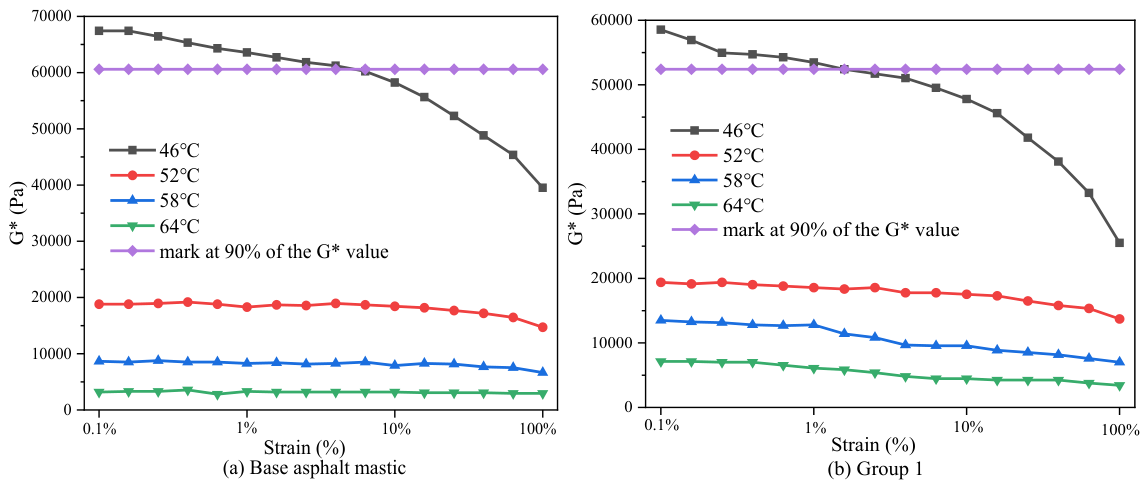
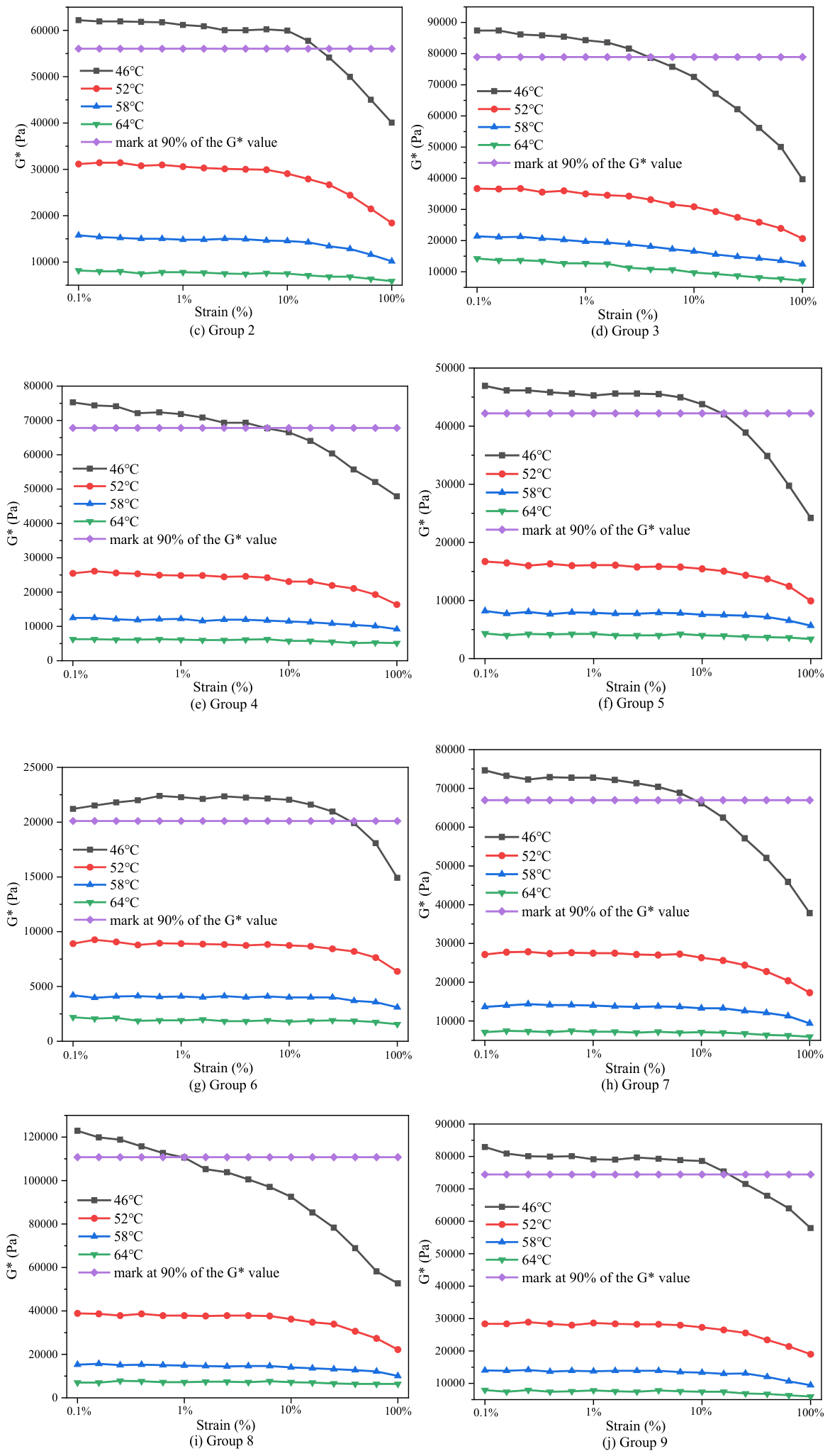
Figure 2.
Temperature sweep test results for the 10 asphalt mastic groups.
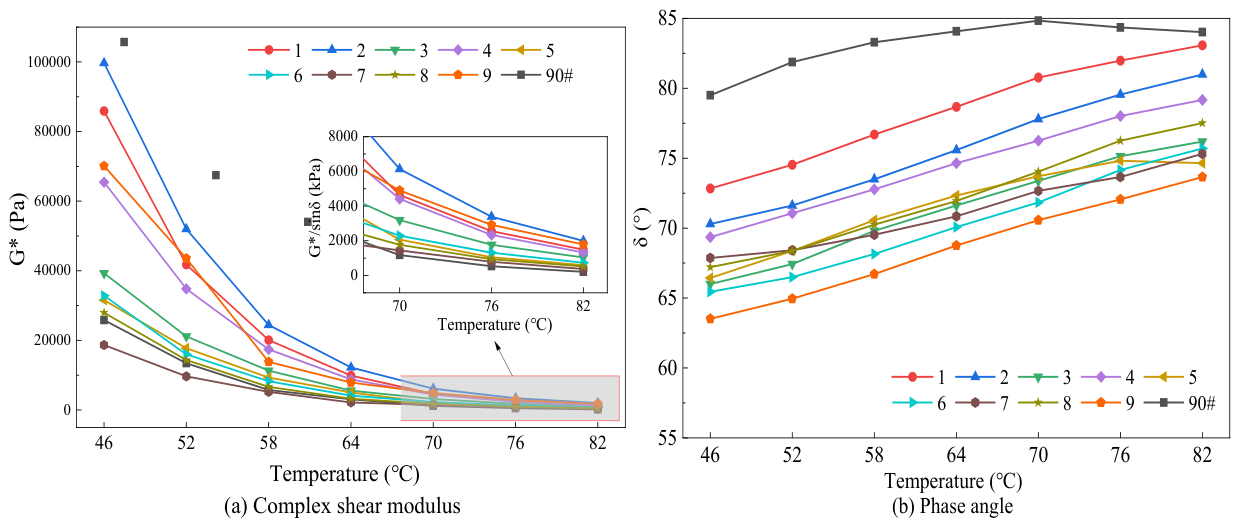
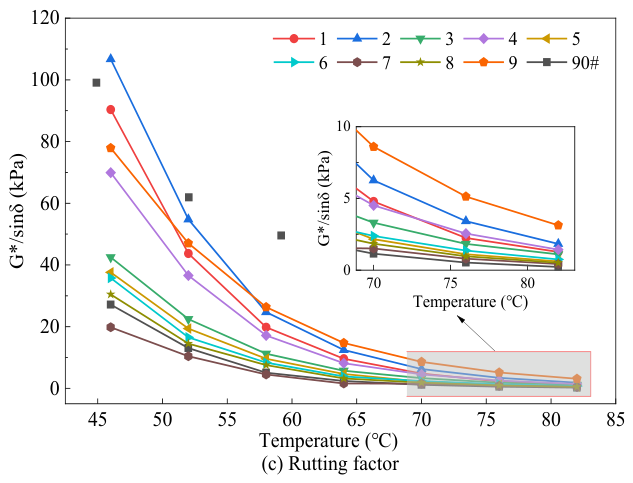
Figure 3.
BBR test results and their fitting with temperature for the 10 asphalt mastic groups.
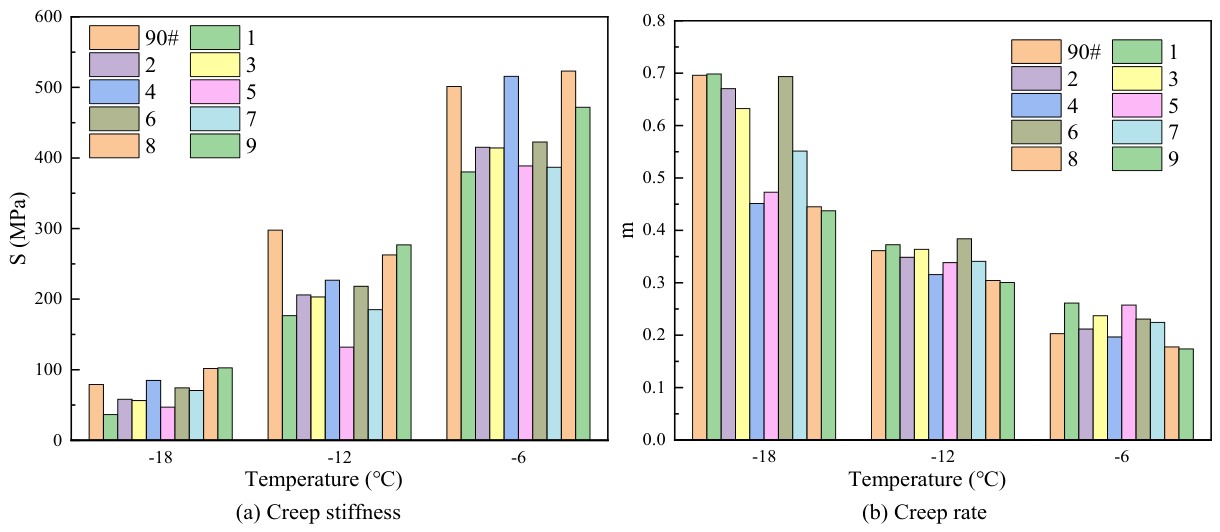
Figure 4.
Range value of complex shear modulus variation with temperature.
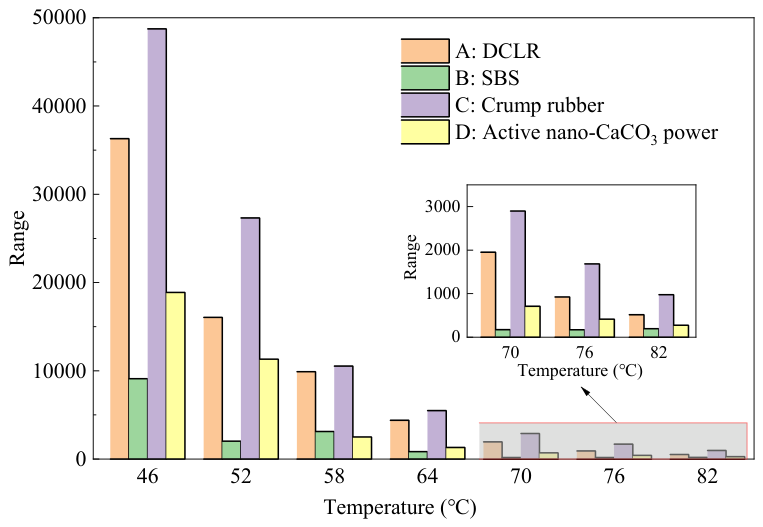
Figure 5.
Range value of phase angle variation with temperature.
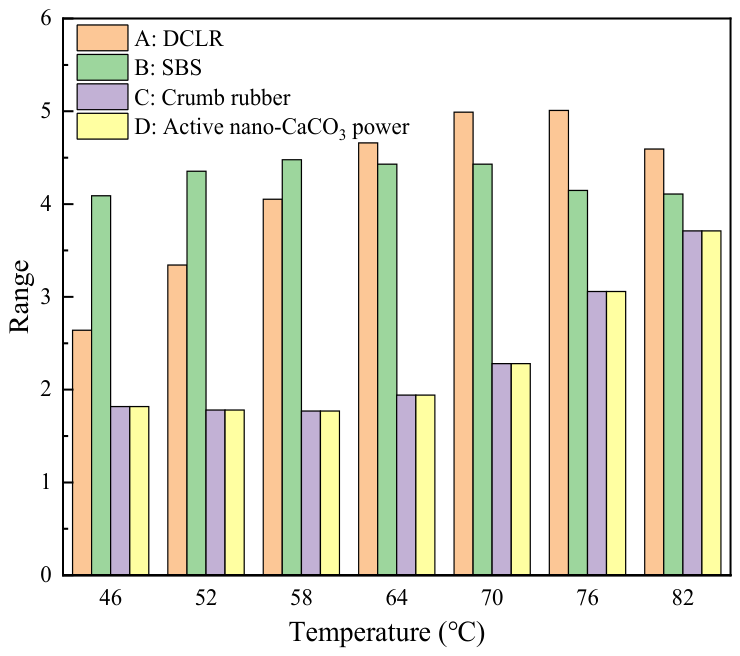
Figure 6.
Range value of rutting factor variation with temperature.
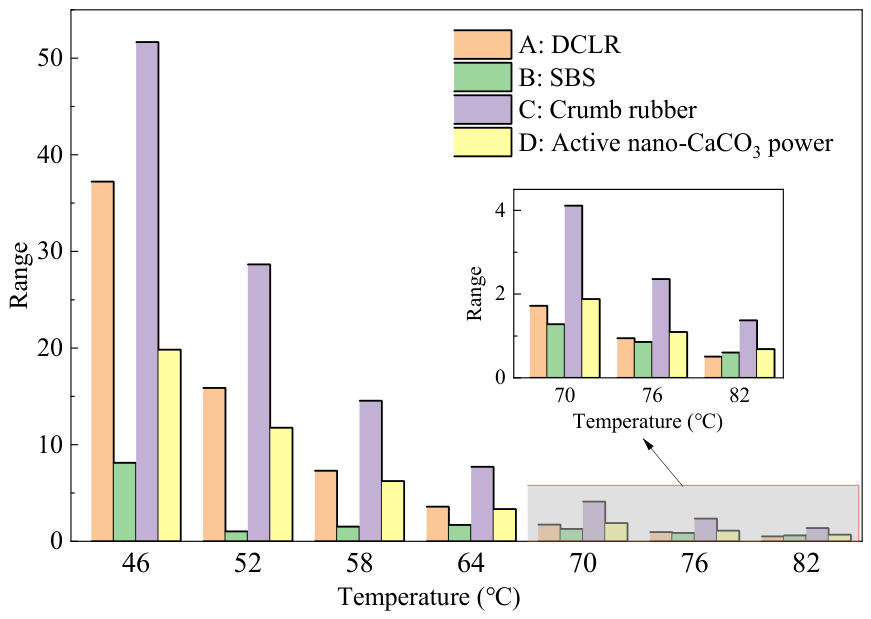
Figure 7.
Range value of creep stiffness variation with temperature.
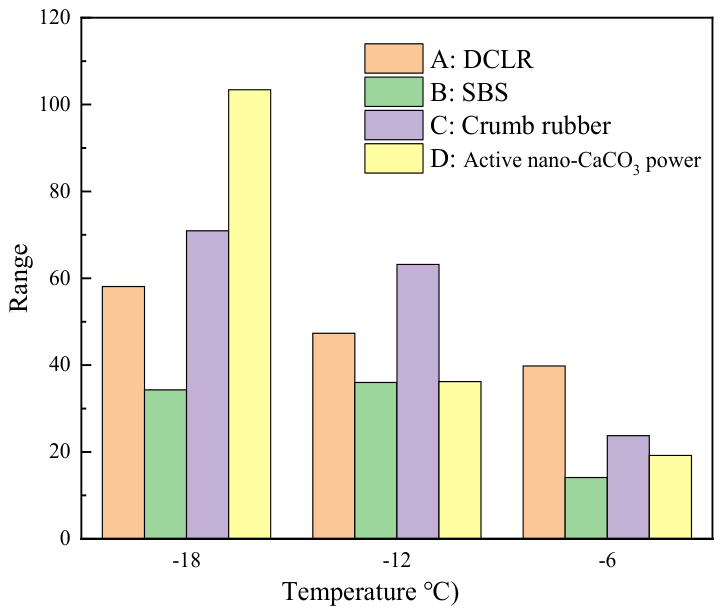
Figure 8.
Range value of creep rate variation with temperature.
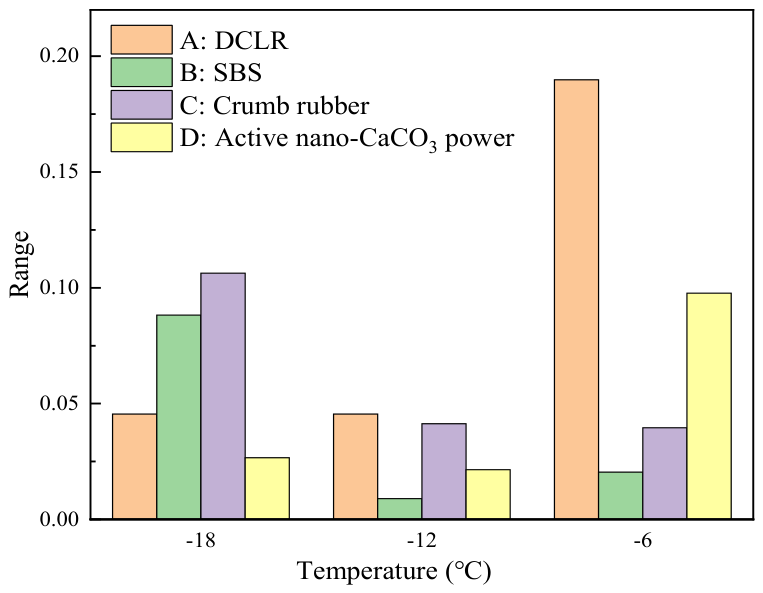
Figure 9.
Comparison of temperature sweep and BBR test results between the optimal formulation combination and other asphalt mastic groups.
Figure 9.
Comparison of temperature sweep and BBR test results between the optimal formulation combination and other asphalt mastic groups.
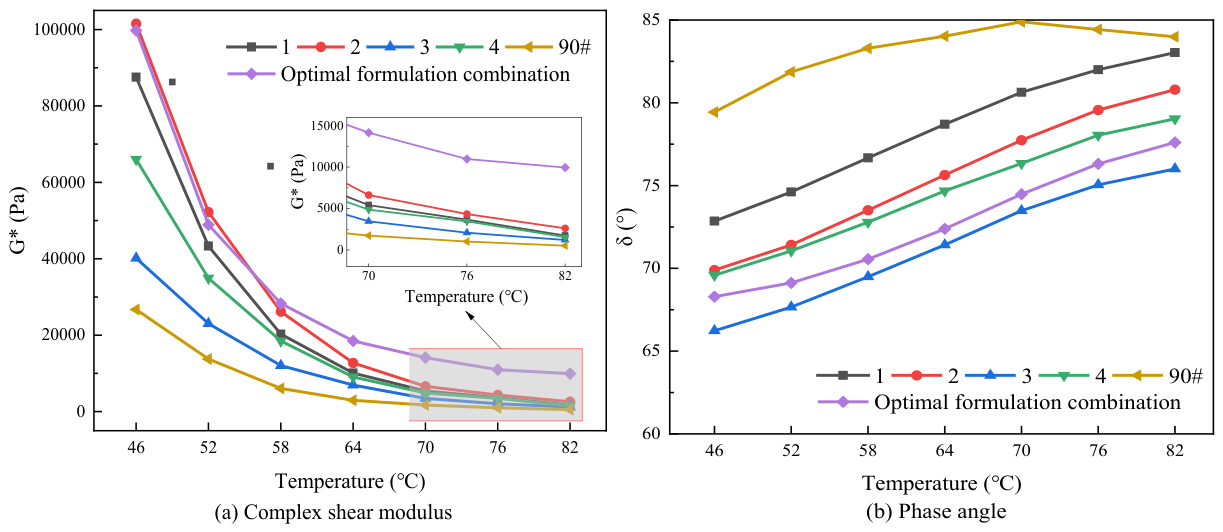
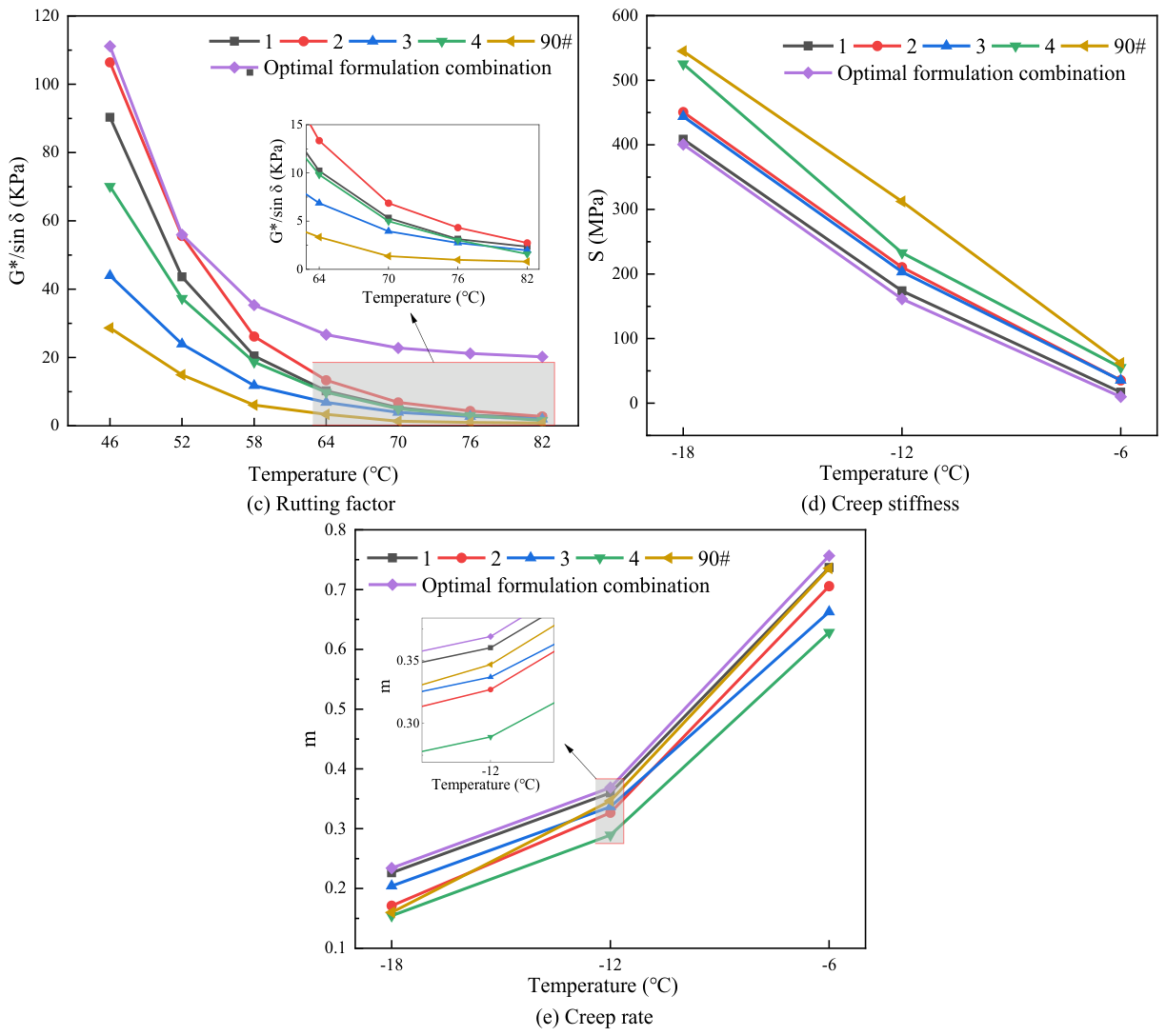
Table 9.
Factors and levels for the orthogonal experiment design.
| Level | DCLR content (%, by mass) |
SBS content (%, by mass) |
Crumb rubber content (%, by mass) |
Active nano-CaCO3 powder content (%, by mass) |
|---|---|---|---|---|
| 1 | 5 | 1 | 10 | 2.5 |
| 2 | 7 | 2 | 15 | 3.0 |
| 3 | 9 | 3 | 20 | 3.5 |
Table 10.
Orthogonal experiment array.
| Test No. | Level combination | A: DCLR content (%, by mass) |
B: SBS content (%, by mass) |
C: Crumb rubber content (%, by mass) |
D: Active nano-CaCO3 powder content (%, by mass) |
|---|---|---|---|---|---|
| 1 | A1B1C1D1 | 5 | 1 | 10 | 2.5 |
| 2 | A1B2C2D2 | 5 | 2 | 15 | 3.0 |
| 3 | A1B3C3D3 | 5 | 3 | 20 | 3.5 |
| 4 | A2B1C2D3 | 7 | 1 | 15 | 3.5 |
| 5 | A2B2C3D1 | 7 | 2 | 20 | 2.5 |
| 6 | A2B3C1D2 | 7 | 3 | 10 | 3.0 |
| 7 | A3B1C3D2 | 9 | 1 | 20 | 3.0 |
| 8 | A3B2C1D3 | 9 | 2 | 10 | 3.5 |
| 9 | A3B3C2D1 | 9 | 3 | 15 | 2.5 |
Table 11.
Critical strain limits for each asphalt mastic group within the linear viscoelastic region.
Table 11.
Critical strain limits for each asphalt mastic group within the linear viscoelastic region.
| Test No. | Base asphalt | 1 | 2 | 3 | 4 | 5 | 6 | 7 | 8 | 9 |
|---|---|---|---|---|---|---|---|---|---|---|
| Strain (%) | 5.8 | 1.7 | 20.0 | 4.1 | 6.8 | 15.8 | 36.6 | 8.7 | 1.0 | 17.0 |
Table 12.
Low-temperature susceptibility fitting results for the 10 asphalt mastic groups.
| Type of asphalt | Fitted equation | R2 | SAS |
|---|---|---|---|
| Base asphalt mastic | y=-35.0136x-128.7607 | 0.9995 | 35.0136 |
| Group 1 | y=-28.5169x-144.9606 | 0.9874 | 28.5169 |
| Group 2 | y=-29.7045x-130.3870 | 0.9893 | 29.7045 |
| Group 3 | y=-29.6675x-132.1410 | 0.9893 | 29.6675 |
| Group 4 | y=-35.7972x-154.4876 | 0.9638 | 35.7972 |
| Group 5 | y=-28.4587x-152.7666 | 0.9218 | 28.4587 |
| Group 6 | y=-28.8340x-108.8520 | 0.9903 | 28.8340 |
| Group 7 | y=-26.5183x-105.2153 | 0.9754 | 26.5183 |
| Group 8 | y=-35.0204x-125.2353 | 0.9801 | 35.0204 |
| Group 9 | y=-30.8511x--87.3426 | 0.9985 | 30.8511 |
Table 13.
Summary of orthogonal test results for various test indicators of DCLAM.
| Test indicator | Temperature (℃) | Significance order of influence | Recommended combination |
|---|---|---|---|
| G* | 46~70 | C>A>D>B | A1B1C2D1 |
| 76~82 | C>A>D>B | A1B3C2D1 | |
| δ | 46~58 | B>A>C>D | A1B1C1D1 |
| 64~70 | A>B>C>D | A1B1C1D1 | |
| 76~82 | A>B>C>D | A1B1C1D3 | |
| G*/sin δ | 46~52 | C>A>D>B | A1B1C2D1 |
| 58~82 | C>A>D>B | A1B3C2D1 | |
| S | -6 | A>C>D>B | A3B3C2D3 |
| -12 | C>A>D>B | A3B3C2D3 | |
| -18 | D>C>A>B | A3B2C2D3 | |
| m | -6~-12 | A>C>D>B | A1B2C3D1 |
| -18 | A>C>D>B | A1B1C3D2 |
Table 14.
Temperature sweep test results for the optimal formulation combination (A1B1C2D3).
| Test indicator | 46℃ | 52℃ | 58℃ | 64℃ | 70℃ | 76℃ | 82℃ |
|---|---|---|---|---|---|---|---|
| G* | 99101.5 | 48553.9 | 27397.7 | 17749 | 13116.4 | 10481.9 | 8814.83 |
| δ | 48.5196 | 43.7369 | 38.8951 | 34.8876 | 31.52 | 39.1574 | 33.4616 |
| G*/sin δ | 178.946 | 120.392 | 92.2231 | 75.2168 | 64.8878 | 20.9533 | 22.7774 |
Table 15.
BBR test results for the optimal formulation combination (A1B1C2D3).
| Test indicator | -6℃ | -12℃ | -18℃ |
|---|---|---|---|
| S | 36.625 | 167.312 | 374.236 |
| m | 0.7115 | 0.3825 | 0.2647 |
Disclaimer/Publisher’s Note: The statements, opinions and data contained in all publications are solely those of the individual author(s) and contributor(s) and not of MDPI and/or the editor(s). MDPI and/or the editor(s) disclaim responsibility for any injury to people or property resulting from any ideas, methods, instructions or products referred to in the content. |
© 2026 by the authors. Licensee MDPI, Basel, Switzerland. This article is an open access article distributed under the terms and conditions of the Creative Commons Attribution (CC BY) license (http://creativecommons.org/licenses/by/4.0/).
Copyright: This open access article is published under a Creative Commons CC BY 4.0 license, which permit the free download, distribution, and reuse, provided that the author and preprint are cited in any reuse.