

Submitted:
04 September 2026
Posted:
08 September 2026
You are already at the latest version
Abstract
Over 1 billion metric tons of food are wasted globally and over half of that is generated in households. While composting can be an effective strategy to manage household food waste, there are many barriers, including lack of knowledge, time, and space. A potential solution may be electric composters, which are advertised as odorless, effortless, and quick. Our research objective was to survey the electric composters currently available on the market in the US. We collected publicly available online data about the product attributes to understand the types of machines for sale and customer reviews to assess how users are experiencing them. We found 25 models available for purchase as of February 2024, and we identified the price, interior and exterior volume, noise level, cycle time, and percent food reduction for each. We also found most machines included 'composter' in their name or website, yet only one-third refer to the output as 'compost.' This may reflect that the process and output is distinct from traditional compost and composting. Additionally, we found ease of use as a frequent positive theme in customer reviews. Yet there was also high variability in reviews, with several factors identified as both positive and negative themes, potentially reflecting variability across models. Understanding electric composter attributes and reviews can help researchers and policymakers understand if and how these technologies can play a role in reducing waste sent to landfills and help address the larger complex global challenge of reducing wasted food.
Keywords:
compost
; food waste
; electric composter
; organic waste
; kitchen waste
Introduction
Food loss and waste is an urgent global environmental and social challenge. Food loss and waste is the "decrease, at all stages of the food chain from harvest to consumption in mass, of food that was originally intended for human consumption, regardless of the cause" (Timmermans et al. 2014). Several different terms to discuss food waste are sometimes used by organizations and researchers (see Table 1). Wasted food is a broader term, referring to any food not used for its intended original purpose (US EPA 2025). This rhetorical shift is also often used to emphasize that food is valuable and not a waste product (e.g. Bonneau 2023).
Table 1 caption: Key terms used in the article to discuss food loss, food waste, composting, and electric composters.
Over 1 billion metric tons of food is wasted per year, including 13.3% after harvesting and an additional 19% in retail and consumer settings (UNEP 2024).This amount represents food grown on over 1 billion hectares, almost 30% of the world's arable land (FAO 2013). Globally, an estimated equivalent of $1 trillion dollars is lost as a result of food waste every year (UNEP 2024). Large amounts of that wasted food end up in landfills. In the United States (US), an estimated 24% of material sent to landfills is food (US EPA 2021). Once there, decaying wasted food in landfills is responsible for large amounts of methane and carbon dioxide emissions (US EPA 2023a). Overall, food waste causes annual greenhouse gas emissions that constitute 8% of all global anthropogenic emissions (FAO 2015).
Beyond the enormous environmental impacts, addressing food waste is also critical for humanitarian reasons. Food that is lost or wasted during growing, processing or at other stages of the food chain reduces the food available for human consumption. An estimated 22.9% of surveyed countries had widespread acute food insecurity in 2025 (FAO et al. 2026). The urgency of food waste as a global challenge is highlighted by its incorporation into Goal 12 of the global Sustainable Development Goals (SDGs) (UN n.d. a). Target 12.3 aims to "halve per capita global food waste" by 2030 (UN n.d. b). Reducing food waste thus can also serve to address other SDGs, including Goal 2 to eliminate food insecurity and Goal 13 to take action on climate resilience and adaptation (Lopez Barrera and Vieira 2025).
Much of this waste is generated by individuals and households. Approximately 60% of food was wasted in households per 2022 global data (UNEP 2024). In the United States (US), 33.5% of surplus food is generated in households, and of that surplus, 85% ends up wasted (ReFED 2026). The reasons people waste food as individuals and households are also complex. Psychological, cultural, and economic factors all contribute to food waste generation by consumers and households, including personal and social norms, attitudes and awareness, availability of time and tools, and knowledge (Vittuari et al. 2023). Households create wasted food through many different pathways, including poor planning, cooking too much, food spoilage, and date label confusion (Thyberg and Tonjes 2016). Younger people, people living alone, and families with children were found to be wasting more food than others (Thyberg and Tonjes 2016). Yet a global systematic review found many more and multi-faceted underlying reasons for food waste in households, with no specific demographic factors able to explain food waste generation (Schanes et al. 2018). On average, levels of household food waste are similar for countries of all different income levels (UNEP 2024).
There are strategies to help prevent and manage food waste in homes. Preventing wasted food is the preferred way to reduce environmental impacts (US EPA 2025). This is because when food is wasted, all the resources that went into growing and producing the food are also wasted. For example, every year in the US the amount of water and energy put into the production of food that is later lost and wasted could serve more than 50 million households (US EPA 2021). Simple steps can be taken to prevent and reduce waste. Eating leftovers, better understanding food expiration and date labels, and shopping practices are all behaviors associated with reduced household food waste (Schmidt and Matthies 2018). People's motivations, opportunities, and abilities connect to their food waste generation and in turn can be levers to potentially reduce wasted food (Vittuari et al. 2023). For example, a desire to save money or concern about the environment can be motivations that help reduce wasted food. A qualitative study in the United Kingdom found that people were motivated by concerns over waste and doing the 'right' thing (Graham-Rowe et al. 2014).
Yet prevention of all food waste by individuals and households is not possible. Food waste may be unavoidable, such as from food preparation when peeling or removing seeds and pits from fruits and vegetables. Food waste may also be unplanned, such as from food going bad before it's all eaten. When food waste is created in a household, there are many ways to potentially manage it. Edible food scraps can be upcycled (US EPA 2025). This could include making vegetable stock from vegetable scraps. Some food trimmings or plate waste could also be fed to animals (US EPA 2025).
Composting is one way to manage household food waste. Composting is the biological decomposition of organic material through mixing or piling, and compost is the material that results from the composting process (AAPFCO 2019). In composting, microorganisms decompose organic matter. While this can be done by aerobic (organisms requiring oxygen) or anaerobic (organisms that do not require oxygen) microbes, household composting is most often aerobic. The combination of heat, air, and decomposition transforms food waste and other organic matter into compost. Controlling oxygen, nutrient ratios, and moisture helps produce optimal conditions to create mature compost (US EPA 2025c). Compost is a soil amendment with multiple benefits; adding compost can increase the moisture and organic content, add beneficial organisms, and increase the carbon sequestration potential of soil (US EPA 2025d). Composting can be done by individuals and households at small scales. Large-scale composting can also be used to process large volumes of waste from neighborhoods, communities, organizations or institutions like universities. If more organic waste was composted through large-scale centralized composting, it is estimated that up to 50% of greenhouse gas emissions from landfills could be avoided (Project Drawdown, n.d.).
There are several common types of home composting methods that can be done both outdoors or indoors. Often people compost at home in their yard with an outdoor pile or bin (US EPA 2025d). Outdoor composting piles can include trenches, sheet composting, windrows, static piles - while bin styles include on-ground, partially buried, underground, or off-the-ground tumbling bins (Tours Ai Inc. 2026). Indoor composting approaches may include vermicomposting using worms (US EPA 2025d), or starting the composting process with Bokashi method, which ferments materials in a sealed bucket and would require being finished elsewhere to make mature compost (Tours Ai Inc. 2026). Regardless of the specific method, composting at home often involves alternating or layering food waste and other organic materials in the bin or pile to achieve the conditions that enable decomposition.
While composting can be an effective strategy to manage wasted food, most households are not currently utilizing it. Only an estimated 3.7% of American households compost, while the majority of food waste is sent to landfills (US EPA 2023b). Households may not be adopting composting as a waste management strategy for a number of different reasons. Composting can be time consuming, depending on the physical and chemical properties of the materials and the microbial ecology of the system (Ayilara et al. 2020). In addition, some people have concerns about potential for mess, odor, and pests from composting, and individuals' perception of that "yuck factor" was significantly negatively correlated with intent to separate household food waste (Oehman et al. 2022). Household composting challenges also include lack of knowledge about composting techniques, space constraints, contamination with other waste, and the perception that composting requires a lot of time and effort (Lv and Zhang 2026). Even when survey participants in a Greek study expressed interest in home composting, many cited the lack of time and space as obstacles to home composting (Kotrotsou and Gareiou 2024). Another recent study in Mauritius similarly found that participants cited lack of time and space limitations as barriers to recycling food waste, as well as lack of awareness and inadequate policy (Nunkoo et al. 2021). In New York City, an investigation into household composting initiatives found that 48% of residents surveyed in a pilot program area said they did not compost because it was too challenging, in part due to drop-off locations, timing, advance planning, or confusion over the materials allowed (Riazi 2019).
A potential solution to some of these barriers may be household electric composters. These are small, often tabletop machines designed for managing food waste. People can add food scraps, plate waste, and other materials to the machine, start the machine, and run it passively while attending to other tasks. Some brands instruct users to just add food scraps, while others require or provide the option of adding microbial agents to aid in decomposition (e.g. Lomi n.d., Reencle n.d.). Many brands specifically advertise their machines as addressing some of the barriers to composting, such as neutralizing odor, finishing quickly, and requiring minimal effort (e.g. Pursonic n.d., Lomi n.d. b, NutriChef Kitchen n.d.). Others are positioning themselves as a solution to urban living constraints, such as not having a yard for an outdoor bin, or local policies that incentivize or limit municipal waste pick up (e.g. FoodCycler n.d.). Electric composters may also have some advantages compared to other methods of home composting. A recent study found electric composters required less space and may be easier to operate than three traditional composting methods (DeFelice and Stack Whitney 2024). Composting at home with the assistance of machines that chop and heat food waste to facilitate faster breakdown may help reduce household waste sent to landfills (Zaman et al. 2021).
Yet the recent expanded commercial availability of these machines for households has not been without controversy. Some experts have argued that although the machines are useful and can help reduce perceived barriers to diverting food waste from the landfill, the machines are also not technically composting and the resulting product is not compost, based on the aforementioned technical definitions of composting and compost (Alexander 2023, Brown 2023, Pavlis 2021). This is because many of the machines seem to heat and physically break down food waste, similar to a large dehydrator or grinder. Dehydrators and grinders have been available for decades as part of a suite of large scale pre-processing technologies of food waste (US EPA 2021b). Pre-processing means that food waste may be partially broken down but that it is not yet compost. For example, a study at Loyola Marymount University, an urban university located in Los Angeles, California, concluded that simply dehydrating and physically breaking down food scraps did save waste hauling space and costs - but did not result in a suitable, stable amendment that could be applied to soil and plants (Rasmussen and Bergstrom 2011).
We wanted to understand the range of household electric composters and peoples' experiences with them. Our research objective was thus to survey the electric tabletop composting machines currently available on the market in the US. We collected publicly available online data about the product attributes to understand the types of machines for sale. Additionally, we collected and reviewed publicly available online customer reviews to assess how users are experiencing them as a potential strategy for managing their food waste at home. The resulting synthesis provides a snapshot of the expanding marketplace and marketing claims for this consumer technology. The information and analyses can inform potential purchasing decisions, as well as provide basis for future empirical testing of the advertised features and proposed advantages.
Understanding the machines and how people experience them can help researchers and policymakers understand if and how these technologies can play meaningful roles in reducing waste sent to landfills, food waste management at home, and the larger complex global challenge of reducing wasted food.
Methods
Machines Available for Sale
We conducted internet searches on a large e-commerce platform (Amazon) and a large internet search database (Google) for electric tabletop composting machines in January 2024. Amazon is a large technology company, which includes an e-commerce platform (Amazon News, n.d.). As of fiscal year 2023, it was considered the world's largest retailer by market capitalization (Deloitte 2025). Google is a large technology company, which includes a major web search engine (Hall and Hosch 2026). As of June 2026, it was considered the world's most popular internet search engine, with over 90% of search engine market share globally (StatCounter, n.d.). We compiled all the resulting machines in a list. For each machine, we found the Amazon sale page. Additionally, we also searched for the seller's own website, where available. Products listed as no longer available for sale as of February 7, 2024 at the start of data collection were removed from the dataset.
Product Attributes
We then collected product attributes about each machine available for sale including: brand, model, price (US dollars), machine dimensions (inches), internal volume (liters), cycle times (hours), voltage (volts), power usage (kilowatt hours), noise (decibels), food reduction (percent volume), and what the machine output was called (using direct quotes from copy). We also recorded the product dimensions (length, width, and height), measured in inches and calculated the volume in cubic inches and litres. We obtained these publicly available data from the Amazon page listing or the company's product website. Information was collected between February 7, 2024 and June 7, 2025. Product prices and attributes were then checked again and updated as necessary on June 7, 2025, to ensure all machine attributes represented a snapshot on the same date.
Customer Reviews
To understand the customer experience of the machines, we observed existing, public comments reviewing the electric tabletop composting machines for sale. Customer reviews can serve as a kind of electronic word of mouth (Zhang et al. 2010) and have become a resource for potential customers who are seeking insights from individuals with experience (Katyal and Sehgal 2025). Examining public online reviews of goods and services on customer reporting websites is one standard way of capturing and understanding consumer perspectives and satisfaction. This approach has been used in research ranging from dermatology practice reviews (e.g. Smith and Lipoff 2026) to AI-enabled smart devices (e.g. Gunasekar et al. 2023).
First, we reviewed comments posted on each of the product sale pages on the Amazon website. Platform users can submit reviews of products sold on the e-commerce platform (Amazon, n.d. a). The platform uses a variety of methods to try to screen for authentic reviews from customers, such as only allowing accounts to submit reviews and using automated and manual screenings to identify and remove compensated or fraudulent reviewers (Amazon, n.d. b). We recorded the total number of reviews each product received. We also recorded each product's star rating (scored out of 5 stars). One star is the lowest possible score, indicating a negative review, and five stars is the highest possible score, indicating a positive review. The overall star rating is the output of a proprietary weighted, machine-learning model and is not a simple average of all reviews (Amazon n.d. b).
We also recorded the keywords listed in the "customers say" review highlights portion of the product sale page. These keywords are part of the highlights summary produced from sentiment analysis of written customer review comments using artificial intelligence (Amazon n.d. b). Amazon integrated artificial intelligence into its customer reviews in 2019 (Amazon News n.d. b). While the specific algorithm used is not shared publicly, sentiment analysis generally refers to analyzing text to try to determine if the tone corresponds to positive, negative, or neutral emotions (Amazon Web Services n.d.).
We also recorded if the keywords were categorized as positive or negative. Whether a keyword was captured as positive or negative was previously determined by the sentiment analysis algorithm and indicated by a check mark (positive) or minus sign (negative). If no positive comments were shared, this was left blank, and similarly, if no negative comments were shared, that area was left blank.
We also reviewed customer ratings and comments posted about the machines on company product websites, where available (n=15). If the company had no stand-alone website, no product page, or no reviews posted on their website, we recorded this information (n=10). If the product webpage included customer reviews for the product, we recorded the number of reviews and the overall reported star rating (also scored out of 5 stars). Product webpages reviewed did not include algorithmic summaries or sentiment analysis. Using the positive and negative keywords identified in the previous process described above, we read the individual 1-star, 3-star, and 5-star reviews. If the same positive or negative keywords were included, we noted and recorded those. Comments posted on the e-commerce platform and business websites were shared on public websites that do not require a log in or account to view. No individual responses or any associated data about commenters was recorded. Observations were also made between May 6 and May 21, 2025.
Results
Machines for Sale
Using our search strategies, we identified 25 models of electric tabletop composters for residential use available for purchase online at the time of our study. The models were sold by 24 different brands. All models were listed as available for sale on the e-commerce platform (n=25), while most (n=15) also had stand-alone webpages on company websites at the time of our data collection. For example, one machine model had an Amazon sales page (e.g. Amazon n.d. c) and a webpage on their company website (Lomi, n.d. b) while another had only an Amazon sales page (e.g. Amazon n.d. d).
Machine Attributes
Price
Across the machines surveyed, we found a wide variety of listed sale prices for electric tabletop composting machines (Figure 1). The minimum price observed was $137.38 (n=1), while the maximum price observed was $899.00 (n = 1). Across all models (n=25), the average price was $346.24 and the median price was $299.99 (n=3).
Volume
We observed a narrow range of variability in the listed volumes of machines surveyed (Figure 1). Across all models in the dataset (n=25), the majority had a listed volume between 2L and 4L (n=22). A small number of machines observed (n=3) had very high volumes, with listed volumes of 12L,14L, and 19L, respectively.
Cycle Time
Of the machines in the study (n=25), the minimum cycle time advertised was 2 hours (n=8), and the maximum was 48 hours (n=1) (Figure 2). The median cycle times for machines in the dataset (n=14) ranged between 4 and 8 hours (Figure 2). This was assessed by calculating the medians of the minimum and maximum cycle times for each composter.
Food Reduction
Almost all websites selling the machines provided an estimate of the volume of food waste reduced after the machine run was completed (n=24). Of those, most electric tabletop composting machines surveyed reported reducing the volume of food waste by 90% (n=16) (Figure 2). The reported minimum amount of food reduction by volume was 50% (n=1), and the reported maximum food reduction by volume was 95% (n=2) (Figure 2).
Counter Space
Noise Level.
Name of output
Of the machines surveyed in the study, almost all had the term 'composter' included in the name or sales copy on the selling webpage (n=24). Yet only 8 referred to the machine output as compost (Figure 4). Other terms used were dirt (n=3), pre-compost (n=6), fertilizer (n=6), and Lomi-earth (n=2) (Figure 4).
Customer Reviews
There was high variability in the number of reviews and comments from customers for each machine. Of the machines surveyed (n=25), all had reviews on the e-commerce platform. The number of reviews per machine at the time of data collection ranged from 12 to 2,557. The median number of reviews on the platform was 74.
Overall, electric tabletop composting machines received positive ratings from customers, as indicated by the star rating system on the e-commerce platform. Of the machines surveyed (n=25), the median star rating was 3.8 (out of a possible maximum of 5). Ratings ranged from 2.4 to 4.9. Almost half (n=11) had a star rating of 4 or higher. Only two models had a star rating below 3.
Many fewer product websites included ratings and reviews from customers. Of the machines surveyed (n=25), only 11 included star ratings and reviews. Of those, the median star rating was 4.74 (out of a possible maximum of 5). Ratings ranged from 4.0 to 5.0. The number of reviews on the product websites was also highly variable, ranging from 1 to 3,748 (n=11). The median number of reviews was 69.
By compiling synthesized online customer comments on a major e-commerce platform, we identified 12 keywords categorized as positive in reviews of the electric tabletop machine models assessed in this study (n=25). In alphabetical order, these were: capacity, compost quality, design, durability, ease of cleaning, ease of use, efficiency, functionality, noise level, odor, size, and value (Figure 5). The most frequently reported positive theme in the customer reviews was ease of use (Figure 5). Other frequently recurring positive themes in the reviews were functionality, capacity, efficiency, and noise level (Figure 5).
The analysis of online customer comments on a major e-commerce platform also identified 12 keywords categorized as negative in reviews of the electric tabletop machine models assessed in this study (n=25). In alphabetical order, these were: durability, ease of use, efficiency, functionality, grinding, heat level, leakage, moisture level, noise level, odor, size, and value (Figure 6). The most frequently reported negative theme was durability (Figure 6). While no other negative theme was reported with nearly as high a frequency, other recurring negative themes in the reviews included value, functionality, noise level, odor, and size (Figure 6).
Most of the keywords identified in comments coded as positive or negative overlapped. Of the 12 keywords included in our analysis, 8 of them appeared in both positive and negative customer reviews (Figure 5, Figure 6). In alphabetical order, those themes were: durability, ease of use, efficiency, functionality, noise level, odor, size, and value.
Discussion
Overall, we found that there were over two dozen electric composters available for sale in the US during the study period. While they displayed a range of attributes, our findings indicate some general trends. Home electric composting machines generally cost hundreds of dollars to acquire and required approximately 30L volume of space for set up. This is similar to the monetary investment and counter space requirements of some premium rice cookers and bread machines. The machine cycling times listed ranged on average from 4 to 8 hours and through processing, reduced food waste volume by 90%. The median interior volume was 3L, or just under 1 gallon. The noise level reported was around 45 decibels, similar to a dishwasher (e.g. Whirlpool n.d.). Additionally, we found that most machines included 'composter' in their names or sales websites, yet only one-third refer to the output as 'compost.' This may reflect that the process and output is distinct from traditional compost and composting. Finally, we found that customer reviews reported ease of use as a positive attribute and durability as a negative attribute.
Our findings are in line with and build upon previous studies on reducing barriers to composting and the nascent but growing body of research on household electric composters. Research indicates that opportunity and knowledge are a bigger influence than motivation on food waste behavior (Heidig et al. 2025). These machines may help reduce barriers by providing a tool to address opportunity and lowering the knowledge and ability barriers to compost, as indicated by the frequency of 'ease of use' positive customer review comments. Additionally, design research on electric composters found customers reported user friendliness as their top priority (Madsanide et al. 2022).
Yet critical questions remain about household electric composters, including if any or all of the machines are technically composting and if the output can truly be called compost. Our results seem to indicate that while electric composters are advertising themselves as a household appliance for composting many are using careful language to differentiate the product from compost. Several previous studies have found that the nutrient ratios from electric composter outputs are different from compost resulting from common indoor and outdoor methods (Kucbel et al. 2019; Voběrková et al. 2020; Azis et al. 2023). Yet some companies are claiming that their machines and methods used are significantly different and do include the necessary elements of traditional composting (e.g. Reencle 2024). If so, the similar names being used by the variety of machines may be causing confusion. Our study did not assess the quality of the machines' outputs or address whether it matches the properties of compost produced with more traditional methods. Nor did our research independently investigate the validity of the claims made about individuals machines product attributes – such as noise, odor reduction or cycle time. Further empirical research is needed to comprehensively test all the available machines, using a range of food waste materials, and to compare the results to other composting processes and to the product claims.
There are several future areas of research beyond the scope of our study. These findings are a snapshot of the machines on the market during the study. Different or additional models may be available now or if a similar study was conducted in the future, with potentially different attributes and customer review feedback. Recent inflation and global supply chain impacts may mean the prices are different, which may impact customer perception of the value or if price is a positive or negative attribute of the machine. Further research would also be needed to assess all the claims from the sellers and advertising websites and verify if the listed information matches the experience of users for attributes such as noise levels and energy usage.
Our study also did not attempt to verify the authenticity of the customer reviews analyzed, and it is theoretically possible for online customer reviews to be faked or to be sponsored reviews. Additionally, we do not know how the reviews are influencing other potential buyers. Consumers perceive reviews of items with higher sales and higher prices to be associated with higher brand strength and less suspicion (Ko and Bowman 2023). Future surveys and controlled studies could test if and how different reviews shape consumer willingness to buy or try electric composting machines for home food waste management. It is also important to acknowledge that people who leave customer reviews don't represent all people or viewpoints. It would also be critical to conduct studies with people who do not yet own or don't want to purchase the machines to understand their perspectives.
While our study indicates that many people are buying composters and many types of machines are available, more research is needed to understand how people are using these machines. The reviews analyzed did not give insight into whether the composters are introducing new people to composting, increasing diversion from landfills - or whether the machines are replacing another method people previously used. Additionally, we do not know the full life cycle assessment of the environmental impacts of these machines. While an earlier study compared the energy sources and cost of two electric composters compared to traditional composting methods (DeFelice and Stack Whitney 2024), we do not know if the results were comparable for all of the machines available for sale in this study - or the energy requirements of building, maintaining, and eventually recycling the machines.
Even if household electric composters succeeded as a technology to fully eliminate barriers to home composting and divert waste from landfills, all composting only addresses mitigation of wasted food and nutrient recycling. The best strategy for addressing food waste is to prevent it. Electric tabletop composting machines are a back-end tool that may not impact the overall amount of wasted food. There's some recent evidence that in the US people are adopting strategies like meal planning, which reduce and prevent waste, in response to pressures like higher food prices (Watkins and Meyer 2026). Those strategies may in turn reduce wasted food in homes, potentially lessening demand for technologies to manage wasted food, like electric tabletop composting machines.
In conclusion, this study was a systematic analysis of household electric compost machines currently available for purchase in the US, along with their technical attributes. We found electric composters require upfront investment and their small internal volume may require frequent cycles; yet their indoor installation and space needs are similar to other kitchen appliances, and may help reduce some perceived barriers to composting. Moreover, our incorporation of analysis of customer reviews added a real-world perspective on machine traits and experience, beyond manufacturer specifications and advertising claims. We found that consumers reported ease of use as a positive theme in reviews, while also reporting durability as a concern. Our findings could support consumer decision-making, as together these two analyses provided a picture of the existing electric composter market options and firsthand experience of users. Ultimately, electric composters may play an important role in lowering adoption barriers for composting and diverting household waste from landfills. Insights from this study and future empirical research with both machines and people can serve to inform scholars and policymakers in understanding how these technologies might support mitigating food loss and waste in households.
Acknowledgments
Thank you to Lauren Walter and Ben Carnes for data collection assistance. Thank you to Dr. Todd Pagano and Dr. Pepsi Holmquist for their support. This work was supported by NSF Grant # 2115405 SRS RN: Multiscale RECIPES (Resilient, Equitable, and Circular Innovations with Partnership and Education Synergies) for Sustainable Food Systems. Findings and conclusions reported here are those of the authors and do not necessarily reflect the views of the National Science Foundation.
Conflicts of Interest
The authors declare no competing interests.
References
- Alexander, R. (2023, September 25). Electric kitchen “composter” confusion. BioCycle. https://www.biocycle.net/electric-kitchen-composter-confusion/.
- Amazon. (n.d.-a). Submit a review—Amazon customer service. https://www.amazon.com/gp/help/customer/display.html?nodeId=GL4WJF8BGV8VL6B8.
- Amazon. (n.d.-b). Understanding customer reviews and ratings—Amazon customer service. https://www.amazon.com/gp/help/customer/display.html?nodeId=G8UYX7LALQC8V9KA.
- Amazon. (n.d.-c). Lomi 1.3 – 3L, electric composter (45 cycles), world’s first smart waste that turns waste into natural fertilizer with a single button, indoor compost - kitchen food recycler (White, Lomi 1.3) [Product page]. https://www.amazon.com/Lomi-1-3-Electric-Composter-Fertilizer/dp/B0D3VQRB13.
- Amazon. (n.d.-d). Vitamix FC-50 - Convenient home food processor and recycler - Kitchen countertop compost bin alternative - Electric waste disposer - Odorless garbage disposal - 2.5L capacity [Product page]. https://www.amazon.com/Vitamix-068051-FoodCycler-FC-50-Capacity/dp/B08BQYXVNT/.
- Amazon News. (n.d.). What we do. https://www.aboutamazon.com/what-we-do.
- Amazon News. (n.d.-b). How Amazon continues to improve the customer reviews experience with generative AI. https://www.aboutamazon.com/news/amazon-ai/amazon-improves-customer-reviews-with-generative-ai.
- Amazon Web Services, Inc. (n.d.). What is sentiment analysis? Sentiment analysis explained. https://aws.amazon.com/what-is/sentiment-analysis/.
- American Association of Plant and Food Control Officials. (2019). AAPFCO product label guide. https://www.aapfco.org/pdf/product_label_guide.pdf.
- Ayilara, M. S., Olanrewaju, O. S., Babalola, O. O., & Odeyemi, O. (2020). Waste management through composting: Challenges and potentials. Sustainability, 12(11), 4456. [CrossRef]
- Azis, F. A., Choo, M., Suhaimi, H., & Abas, P. E. (2023). The effect of initial carbon to nitrogen ratio on kitchen waste composting maturity. Sustainability, 15(7), 6191. [CrossRef]
- Bonneau, A. M. (2023, March 30). Food waste isn’t a thing. Wasted food is. Zero-Waste Chef. https://zerowastechef.substack.com/p/food-waste-isnt-a-thing-wasted-food.
- Brown, S. (2023, March 14). Connections: What is not compost. BioCycle. https://www.biocycle.net/not-compost/.
- DeFelice, H., & Stack Whitney, K. (2024). Understanding electric composting machines as a potential household food waste management strategy. Food-Fueled, 1, e00004. [CrossRef]
- Deloitte. (2025, March). Global powers of retailing 2025: Improving efficiency and unlocking growth in the year ahead. https://www.deloitte.com/content/dam/assets-shared/docs/industries/consumer/2025/deloitte-global-powers-of-retailing-2025.pdf.
- Food and Agriculture Organization of the United Nations. (2013). Food wastage footprint: Impacts on natural resources (Summary report). https://openknowledge.fao.org/handle/20.500.14283/i3347e.
- Food and Agriculture Organization of the United Nations. (2015). Food wastage footprint & climate change. https://openknowledge.fao.org/handle/20.500.14283/bb144e.
- Food and Agriculture Organization of the United Nations, World Food Programme, & Global Network Against Food Crises. (2026). 2026 global report on food crises: Joint analysis for better decisions. [CrossRef]
- FoodCycler. (n.d.). FoodCycler expands proven food waste diversion programs to U.S. communities. Retrieved August 20, 2026, from https://foodcycler.com/blogs/news/foodcycler-expands-proven-food-waste-diversion-programs-to-u-s-communities.
- Graham-Rowe, E., Jessop, D. C., & Sparks, P. (2014). Identifying motivations and barriers to minimising household food waste. Resources, Conservation and Recycling, 84, 15–23. [CrossRef]
- Gunasekar, S., Ray, S., Dixit, S. K., & Pa, M. R. (2023). AI-enables product purchase on Amazon: What are the consumers saying? Foresight, 25(2), 185–193. [CrossRef]
- Hall, M., & Hosch, W. L. (2026, July 29). Google. In Encyclopedia Britannica. https://www.britannica.com/money/Google-Inc.
- Heidig, W., Dobbelstein, T., & Mason, R. B. (2025). Beyond the bin: The influence of motivation, opportunity, and ability on food waste behavior in households. Sustainable Development, 33(2), 3151–3169. [CrossRef]
- Katyal, P., & Sehgal, R. (2025). Unraveling the impact of online consumer reviews on consumer buying behavior. International Journal of System Assurance Engineering and Management, 16, 330–345. [CrossRef]
- Kotrotsou, M., & Gareiou, Z. (2024). Opinion of citizens about home composting. E3S Web of Conferences, 585, 10006. [CrossRef]
- Kucbel, M., Raclavská, H., Růžičková, J., Švédová, B., Sassmanová, V., Drozdová, J., Raclavský, K., & Juchelková, D. (2019). Properties of composts from household food waste produced in automatic composters. Journal of Environmental Management, 236, 657–666. [CrossRef]
- Lomi. (n.d.-a). LomiPods—180 pack. Retrieved August 20, 2026, from https://lomi.com/products/lomi-pods-180-cycles.
- Lomi. (n.d.-b). Kitchen countertop food recycler. Retrieved August 20, 2026, from https://lomi.com/.
- Lopez Barrera, E., & Vieira, D. (2025). The global convergence of food waste: A growing sustainability challenge. Cell Reports Sustainability, 2(9), 100496. [CrossRef]
- Lv, Z., & Zhang, T. (2026). Existing challenges and opportunities in composting on different scales. In R. K. Singh, H. Trindade, J. R. Sousa, A. Sæbø, V. D. Rajput, & T. Zhang (Eds.), Composting of farm residues by nature-based solutions (Chapter 14). Springer. [CrossRef]
- Madsanide, C., Jun, A., Godoy, N., Laws, L., & Nugroho, E. (2022). Down to earth: The electric food processor. https://scholars.spu.edu/lance/wp-content/uploads/sites/58/2022/04/annotated-DR1.120Final.docx.pdf.
- Microsoft Excel for the web. (n.d.). Microsoft. Retrieved May 28, 2026 from https://excel.cloud.microsoft/en-us/.
- Nunkoo, R., Bhadain, M., & Baboo, S. (2021). Household food waste: Attitudes, barriers and motivations. British Food Journal, 123(6), 2016–2035. [CrossRef]
- NutriChef Kitchen. (n.d.). 3L electric kitchen composter—Odorless, automatic, white. Retrieved August 20, 2026 from https://nutrichefkitchen.com/products/ncvk9112bwh.
- Oehman, J. M., Babbitt, C. W., & Flynn, C. (2022). What predicts and prevents source separation of household food waste? An application of the theory of planned behavior. Resources, Conservation & Recycling, 186, 106492. [CrossRef]
- Pavlis, R. (2021, December 8). Electric composters—An eco win or unnecessary appliance? Garden Myths. Retrieved August 14, 2026 from https://www.gardenmyths.com/electric-composters/.
- Project Drawdown. (n.d.). Increase centralized composting. Retrieved August 14, 2026 from https://drawdown.org/explorer/increase-centralized-composting.
- Pursonic. (n.d.). Food waste composter. Retrieved August 14, 2026 from https://pursonicusa.com/products/food-waste-composter.
- Rasmussen, J., & Bergstrom, B. (2011, December 19). Food waste diversion at urban university. BioCycle. https://www.biocycle.net/food-waste-diversion-at-urban-university/.
- Reencle. (n.d.). Reencle home composter | Turn food waste into real compost. Retrieved August 14, 2026 from https://reencle.co/.
- Reencle. (2024, November 3). Let’s talk dirt. Traditional vs electric composting. https://reencle.co/blogs/news/lets-talk-dirt-traditional-vs-electric-composting.
- ReFED. (2026). Progress on the plate: 2026 U.S. food waste report. https://refed.org/food-waste/refed-us-food-waste-report-2026/.
- Riazi, M. (2019). Manhattan’s growing pains: A culture of convenience. In Composting the Big Apple (Chap. 2, “Barriers”). https://projects.newsdoc.org/compostingthebigapple/barriers/#cultural-barriers.
- SankeyMATIC. (n.d.). SankeyMATIC [Web application]. Retrieved May 28, 2026, from https://sankeymatic.com/.
- Schanes, K., Dobernig, K., & Gözet, B. (2018). Food waste matters—A systematic review of household food waste practices and their policy implications. Journal of Cleaner Production, 182, 978–991. [CrossRef]
- Schmidt, K., & Matthies, E. (2018). Where to start fighting the food waste problem? Identifying most promising entry points for intervention programs to reduce household food waste and overconsumption of food. Resources, Conservation and Recycling, 139, 1–14. [CrossRef]
- Smith, R. J., & Lipoff, J. B. (2016). Evaluation of dermatology practice online reviews: Lessons from qualitative analysis. JAMA Dermatology, 152(2), 153. [CrossRef]
- StatCounter. (n.d.). Search engine market share worldwide: June 2025 – June 2026. Retrieved July 29, 2026, from https://gs.statcounter.com/search-engine-market-share.
- Timmermans, A. J. M., Ambuko, J., Belik, W., & Huang, J. (2014). Food losses and waste in the context of sustainable food systems. High Level Panel of Experts on Food Security and Nutrition of the Committee on World Food Security. https://openknowledge.fao.org/server/api/core/bitstreams/b1949fae-23d4-473c-8b87-8c4359b74d6c/content.
- Thyberg, K. L., & Tonjes, D. J. (2016). Drivers of food waste and their implications for sustainable policy development. Resources, Conservation and Recycling, 106, 110–123. [CrossRef]
- Torus AI Inc. (2026). Composting field guide: Choose the right composting method. Retrieved August 15, 2026 from https://www.torusai.org/composting (Retrieved August 15, 2026).
- United Nations. (n.d.-a). 12 Responsible consumption and production—Ensure sustainable consumption and production patterns. Retrieved August 5, 2026 from https://unstats.un.org/sdgs/report/2022/goal-12/.
- United Nations. (n.d.-b). Goal 12: Ensure sustainable consumption and production patterns. Retrieved August 5, 2026 from https://sdgs.un.org/goals/goal12#targets_and_indicators.
- United Nations Environment Programme. (2024). Food waste index report 2024: Think eat save: Tracking progress to halve global food waste. https://wedocs.unep.org/items/dbe2cd4c-8384-4636-8359-5847f42b9711.
- United States Environmental Protection Agency. (2025a, December). Wasted food scale [Infographic]. Retrieved August 14, 2026 from https://www.epa.gov/system/files/images/2024-01/epa-wasted-food-scale-detailed.png.
- United States Environmental Protection Agency. (2025b). Environmental value of applying compost: Improving soil health for stormwater management, contaminated site remediation, ecosystem restoration, landscaping and agriculture. https://www.epa.gov/system/files/documents/2025-01/environmental-value-of-applying-compost.pdf.
- United States Environmental Protection Agency. (2025c). Approaches to composting. Retrieved August 14, 2026 fromhttps://www.epa.gov/sustainable-management-food/approaches-composting.
- United States Environmental Protection Agency. (2025d). Composting at home. Retrieved August 14, 2026 from https://www.epa.gov/recycle/composting-home.
- United States Environmental Protection Agency. (2021). Emerging issues in food waste management: Commercial pre-processing technologies (EPA 600-R-21-114). https://www.epa.gov/system/files/documents/2021-09/commercial-pre-processing-technologies_508-tagged_0.pdf.
- United States Environmental Protection Agency. (2021). From farm to kitchen: The environmental impacts of U.S. food waste (EPA 600-R-21-171). https://www.epa.gov/system/files/documents/2021-11/from-farm-to-kitchen-the-environmental-impacts-of-u.s.-food-waste_508-tagged.pdf.
- United States Environmental Protection Agency. (2023a). Quantifying methane emissions from landfilled food waste (EPA-600-R-23-064). https://www.epa.gov/system/files/documents/2023-10/food-waste-landfill-methane-10-8-23-final_508-compliant.pdf.
- United States Environmental Protection Agency. (2023b). 2019 wasted food report: Estimates of generation and management of wasted food in the United States in 2019 (April 2023). https://www.epa.gov/system/files/documents/2024-04/2019-wasted-food-report_508_opt_ec_4.23correction.pdf.
- Vittuari, M., Garcia Herrero, L., Masotti, M., Iori, E., Caldeira, C., Qian, Z., Bruns, H., Van Herpen, E., Obersteiner, G., Kaptan, G., Liu, G., Mikkelsen, B. E., Swannell, R., Kasza, G., Nohlen, H., & Sala, S. (2023). How to reduce consumer food waste at household level: A literature review on drivers and levers for behavioural change. Sustainable Production and Consumption, 38, 104–114. [CrossRef]
- Voběrková, S., Maxianová, A., Schlosserová, N., Adamcová, D., Vršanská, M., Richtera, L., Gagić, M., Zloch, J., & Vaverková, M. D. (2020). Food waste composting—Is it really so simple as stated in scientific literature? A case study. Science of the Total Environment, 723, 138202. [CrossRef]
- Walkins, M., & Meyer, A. G. L. (2026). American households in 2026: Grocery spending, behavior change, and food waste reduction. ReFED. https://refed.org/downloads/american-households-in-2026-grocery-spending-behavior-change-and-food-waste-reduction/.
- Whirlpool. (n.d.). What decibel is a quiet dishwasher? Retrieved August 20, 2026 from https://www.whirlpool.com/blog/kitchen/what-decibel-is-a-quiet-dishwasher.html.
- Zaman, B., Hardyanti, N., & Purwono, P. (2021). Fast composting of food waste using thermal composter. IOP Conference Series: Earth and Environmental Science, 896(1), 012013. [CrossRef]
- Zhang, J. Q., Craciun, G., & Shin, D. (2010). When does electronic word-of-mouth matter? A study of consumer product reviews. Journal of Business Research, 63(12), 1336–1341. [CrossRef]
Figure 1.
Price and volume of electric tabletop composting machines available for sale online. Figure 1. The price (US dollars, shown with red squares) and internal volume (liters, shown with blue diamonds) of the different models of electric tabletop composters in this study (n=25). The median volume of machines observed was 3L, and the median sale price observed was $299.99. Figure made using Excel software (Microsoft n.d.). Figure 1 image description: This is a plot graph with two y-axes, showing some features of the electric tabletop composting machines included in the study. The x-axis is titled 'Model Names' and shows the names of each model in the study. The left side y-axis is titled 'Volume (L)' and shows the volume, measured in litres, ranging from 0 to 20 and represented with blue diamonds. The right side y-axis is titled 'Price (USD)' and shows the price measured in US dollars, ranging from $0 to $1,000 and represented with red squares. In total, there are fifty data points on the graph, split equally by the blue and red shapes. Most machine volume data (blue diamonds) on the graph were between two to four liters. Most machine price data (red squares) were between $100 and $600.
Figure 1.
Price and volume of electric tabletop composting machines available for sale online. Figure 1. The price (US dollars, shown with red squares) and internal volume (liters, shown with blue diamonds) of the different models of electric tabletop composters in this study (n=25). The median volume of machines observed was 3L, and the median sale price observed was $299.99. Figure made using Excel software (Microsoft n.d.). Figure 1 image description: This is a plot graph with two y-axes, showing some features of the electric tabletop composting machines included in the study. The x-axis is titled 'Model Names' and shows the names of each model in the study. The left side y-axis is titled 'Volume (L)' and shows the volume, measured in litres, ranging from 0 to 20 and represented with blue diamonds. The right side y-axis is titled 'Price (USD)' and shows the price measured in US dollars, ranging from $0 to $1,000 and represented with red squares. In total, there are fifty data points on the graph, split equally by the blue and red shapes. Most machine volume data (blue diamonds) on the graph were between two to four liters. Most machine price data (red squares) were between $100 and $600.
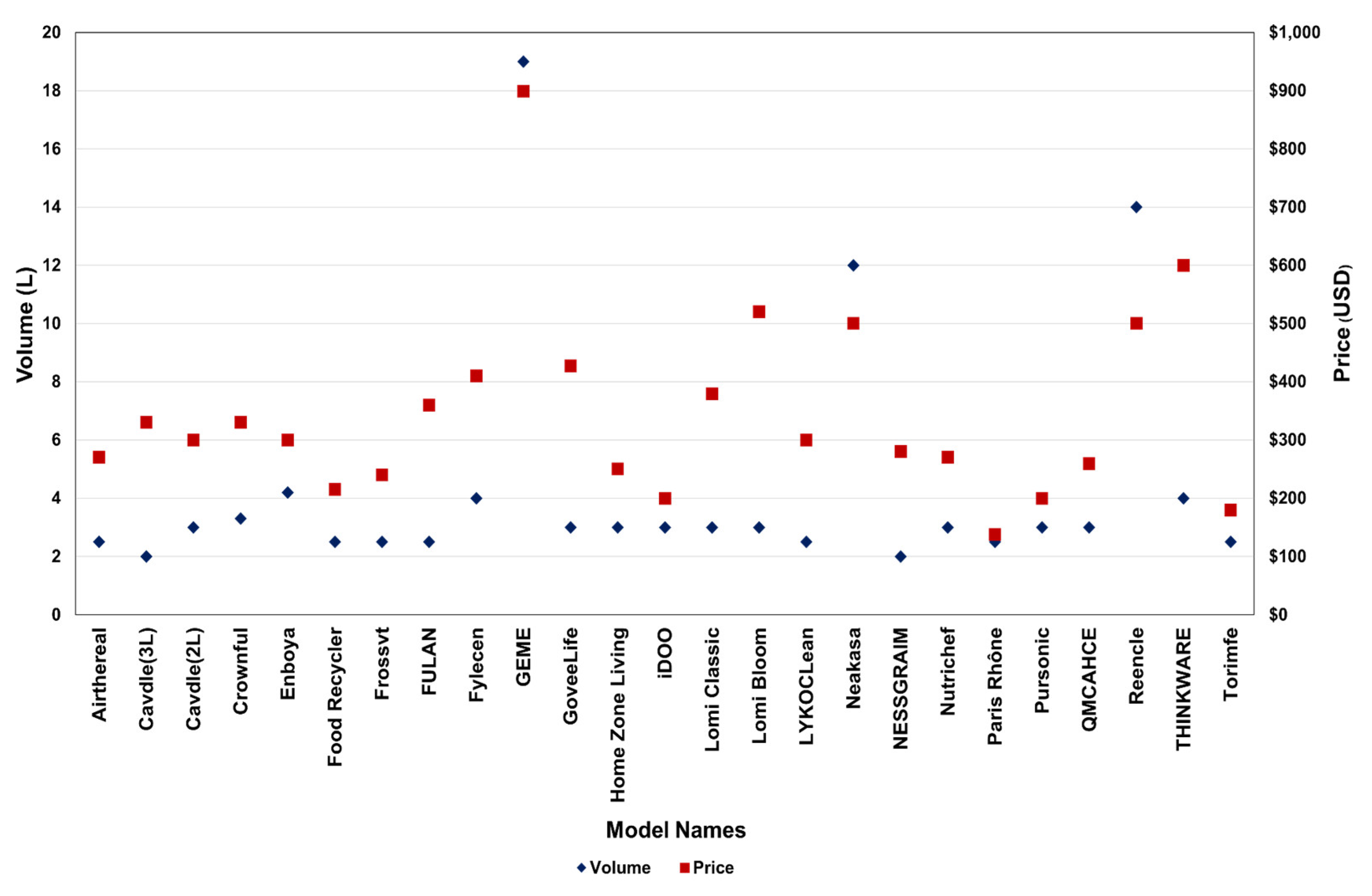
Figure 2.
Cycle time and percent food reduction of electric tabletop composting machines available for sale online. Figure 2. Graph showing range bars with the listed cycle time (hours, black bars) and plot points with the food reduction (percentage, red triangles) of the different models of electric tabletop composters discussed in this study (n=25). The median cycle time observed ranged from 4 to 8 hours. The median food reduction was 90% of the volume of the food waste. Figure made using Excel software (Microsoft n.d.). Figure 2 image description: This is a plot graph with two y-axes, showing some features of the electric tabletop composting machines included in the study. The x-axis is titled 'Model Names' and shows the names of each model in the study. The left side y-axis is titled 'Time (hrs)' and shows the range of minimum to maximum cycle times listed for each machine, represented with black bars. The right-side y-axis is titled 'Food Reduction (%)' and shows the percent volume in food reduction listed for each machine, ranging from 0% to 100% and represented by red triangles. In total, there are forty-nine data points with twenty-four red triangles and twenty-five black bars. Most of the machines had an observed percent food reduction (red triangles) of 90%. The minimum cycle time (bottom of black bars) observed for machines in the study was 2 hours or more. The maximum cycle time (top of black bars) observed for most machines was 10 hours or less, with a few machines with significantly longer maximum cycle times.
Figure 2.
Cycle time and percent food reduction of electric tabletop composting machines available for sale online. Figure 2. Graph showing range bars with the listed cycle time (hours, black bars) and plot points with the food reduction (percentage, red triangles) of the different models of electric tabletop composters discussed in this study (n=25). The median cycle time observed ranged from 4 to 8 hours. The median food reduction was 90% of the volume of the food waste. Figure made using Excel software (Microsoft n.d.). Figure 2 image description: This is a plot graph with two y-axes, showing some features of the electric tabletop composting machines included in the study. The x-axis is titled 'Model Names' and shows the names of each model in the study. The left side y-axis is titled 'Time (hrs)' and shows the range of minimum to maximum cycle times listed for each machine, represented with black bars. The right-side y-axis is titled 'Food Reduction (%)' and shows the percent volume in food reduction listed for each machine, ranging from 0% to 100% and represented by red triangles. In total, there are forty-nine data points with twenty-four red triangles and twenty-five black bars. Most of the machines had an observed percent food reduction (red triangles) of 90%. The minimum cycle time (bottom of black bars) observed for machines in the study was 2 hours or more. The maximum cycle time (top of black bars) observed for most machines was 10 hours or less, with a few machines with significantly longer maximum cycle times.
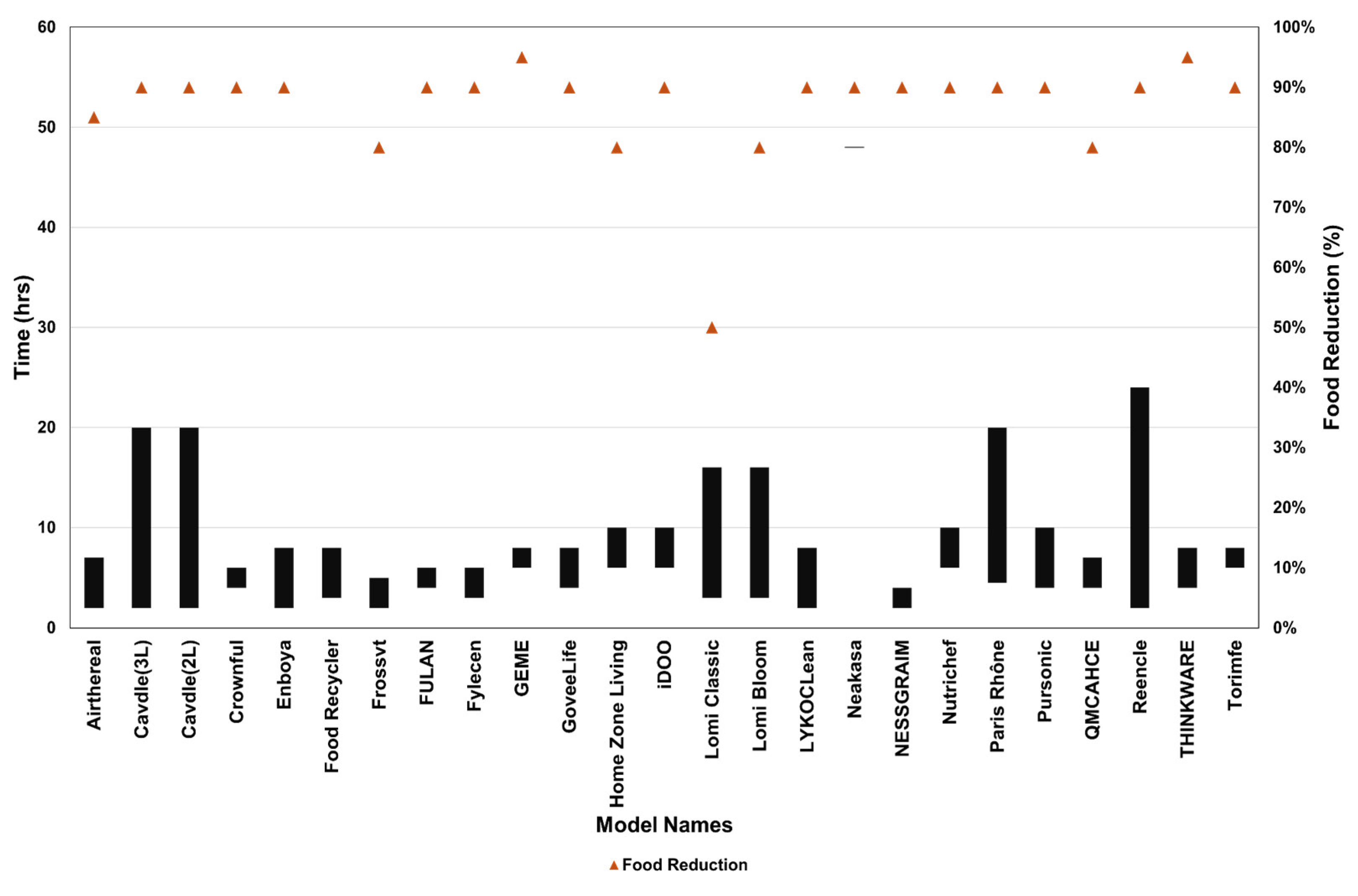
Figure 3.
Counter space volume and noise level of electric tabletop composting machines available for sale online. Figure 3. Graph showing the counter space volume, measured in liters, shown with purple lines, and noise level, measured in decibels, shown in green squares, of the different models of electric tabletop composters discussed in this study (n=25). Only 20 of the machines provided noise data. The median counter space volume was 30.94 L, and the median noise level was 45 decibels. Figure made using Excel software (Microsoft n.d.). Figure 3 image description: This is a plot graph with two y-axes, showing some features of the electric tabletop composting machines included in the study. The x-axis is titled 'Model Names' and shows the names of each model in the study. The left side y-axis is titled 'Counter space (L)' and shows the overall machine volume, measured in liters, ranging from 0 to 120 and represented with purple horizontal lines. The right-side y-axis is titled 'Noise Level (dB)' and shows how loud the machines are when running, measured in decibels ranging from 0 to 70 dB and represented with green squares. In total, there are 45 data points; twenty are green squares, while twenty-five are purple lines. Most of the machines had an observed counter space volume (purple lines) between 20 and 50 L. Most machines had listed noise levels (green spaces) between 35 and 60 dB.
Figure 3.
Counter space volume and noise level of electric tabletop composting machines available for sale online. Figure 3. Graph showing the counter space volume, measured in liters, shown with purple lines, and noise level, measured in decibels, shown in green squares, of the different models of electric tabletop composters discussed in this study (n=25). Only 20 of the machines provided noise data. The median counter space volume was 30.94 L, and the median noise level was 45 decibels. Figure made using Excel software (Microsoft n.d.). Figure 3 image description: This is a plot graph with two y-axes, showing some features of the electric tabletop composting machines included in the study. The x-axis is titled 'Model Names' and shows the names of each model in the study. The left side y-axis is titled 'Counter space (L)' and shows the overall machine volume, measured in liters, ranging from 0 to 120 and represented with purple horizontal lines. The right-side y-axis is titled 'Noise Level (dB)' and shows how loud the machines are when running, measured in decibels ranging from 0 to 70 dB and represented with green squares. In total, there are 45 data points; twenty are green squares, while twenty-five are purple lines. Most of the machines had an observed counter space volume (purple lines) between 20 and 50 L. Most machines had listed noise levels (green spaces) between 35 and 60 dB.
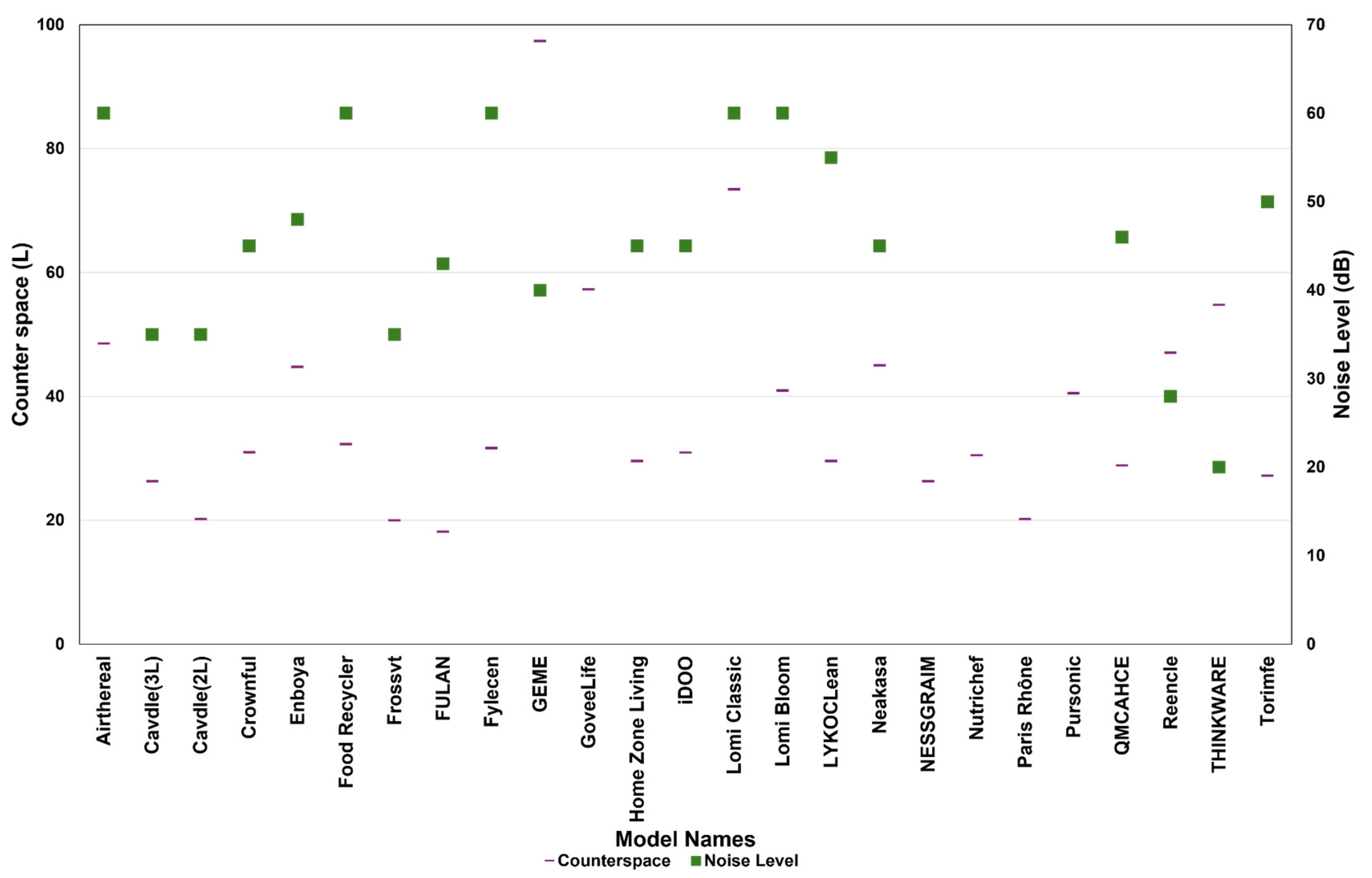
Figure 4.
Terminology associated with electric tabletop composting machines available for sale online. Figure 4. Alluvial diagram showing the terminology used with the different models of electric tabletop composters in this study (n=25), including both the names of the models as marketed to consumers (left side) and how machine output is described (right side). Most machines observed were listed as "composters" (n=24). Yet only ~33% (n=8) describe the machine output as "compost," while others instead refer to the resulting material as "pre-compost" (n=6), fertilizer (n=6), dirt (n=3), or used up a brand-specific term (n=2). Figure made using SankeyMATIC software (SankeyMATIC n.d.). Figure 4 image description: This is a flow diagram showing terminology choices associated with the electric tabletop composting machines included in the study (n=25). The left side of the flow diagram shows the machines represented as 2 groups, a top one labeled 'Composters' (n=24) and a small bottom one labeled 'Food Recycler' (n=1). These labels refer to the terms used on the purchasing websites to describe the machines. The diagram has a central question label overlaid on a yellow bar in the middle 'What is the output called?' (n=25). The right side of the diagram shows 5 different colored groupings with different labels, indicating how the machine output is referenced. From the top on the right side, the groups and number of machines with the corresponding output names are: "dirt" (n=3) shown in red, "fertilizer" (n=6) shown in blue, "compost" (n=8) shown in orange, "pre-compost" (n=6) shown in green, and "Lomi-earth" (n=2) shown in pink. Although most machines are referred to as composters (as indicated by left side of the flow diagram), a minority (8 of 25) use the term "compost" to refer to the machine output (as indicated by the right side of the flow diagram).
Figure 4.
Terminology associated with electric tabletop composting machines available for sale online. Figure 4. Alluvial diagram showing the terminology used with the different models of electric tabletop composters in this study (n=25), including both the names of the models as marketed to consumers (left side) and how machine output is described (right side). Most machines observed were listed as "composters" (n=24). Yet only ~33% (n=8) describe the machine output as "compost," while others instead refer to the resulting material as "pre-compost" (n=6), fertilizer (n=6), dirt (n=3), or used up a brand-specific term (n=2). Figure made using SankeyMATIC software (SankeyMATIC n.d.). Figure 4 image description: This is a flow diagram showing terminology choices associated with the electric tabletop composting machines included in the study (n=25). The left side of the flow diagram shows the machines represented as 2 groups, a top one labeled 'Composters' (n=24) and a small bottom one labeled 'Food Recycler' (n=1). These labels refer to the terms used on the purchasing websites to describe the machines. The diagram has a central question label overlaid on a yellow bar in the middle 'What is the output called?' (n=25). The right side of the diagram shows 5 different colored groupings with different labels, indicating how the machine output is referenced. From the top on the right side, the groups and number of machines with the corresponding output names are: "dirt" (n=3) shown in red, "fertilizer" (n=6) shown in blue, "compost" (n=8) shown in orange, "pre-compost" (n=6) shown in green, and "Lomi-earth" (n=2) shown in pink. Although most machines are referred to as composters (as indicated by left side of the flow diagram), a minority (8 of 25) use the term "compost" to refer to the machine output (as indicated by the right side of the flow diagram).
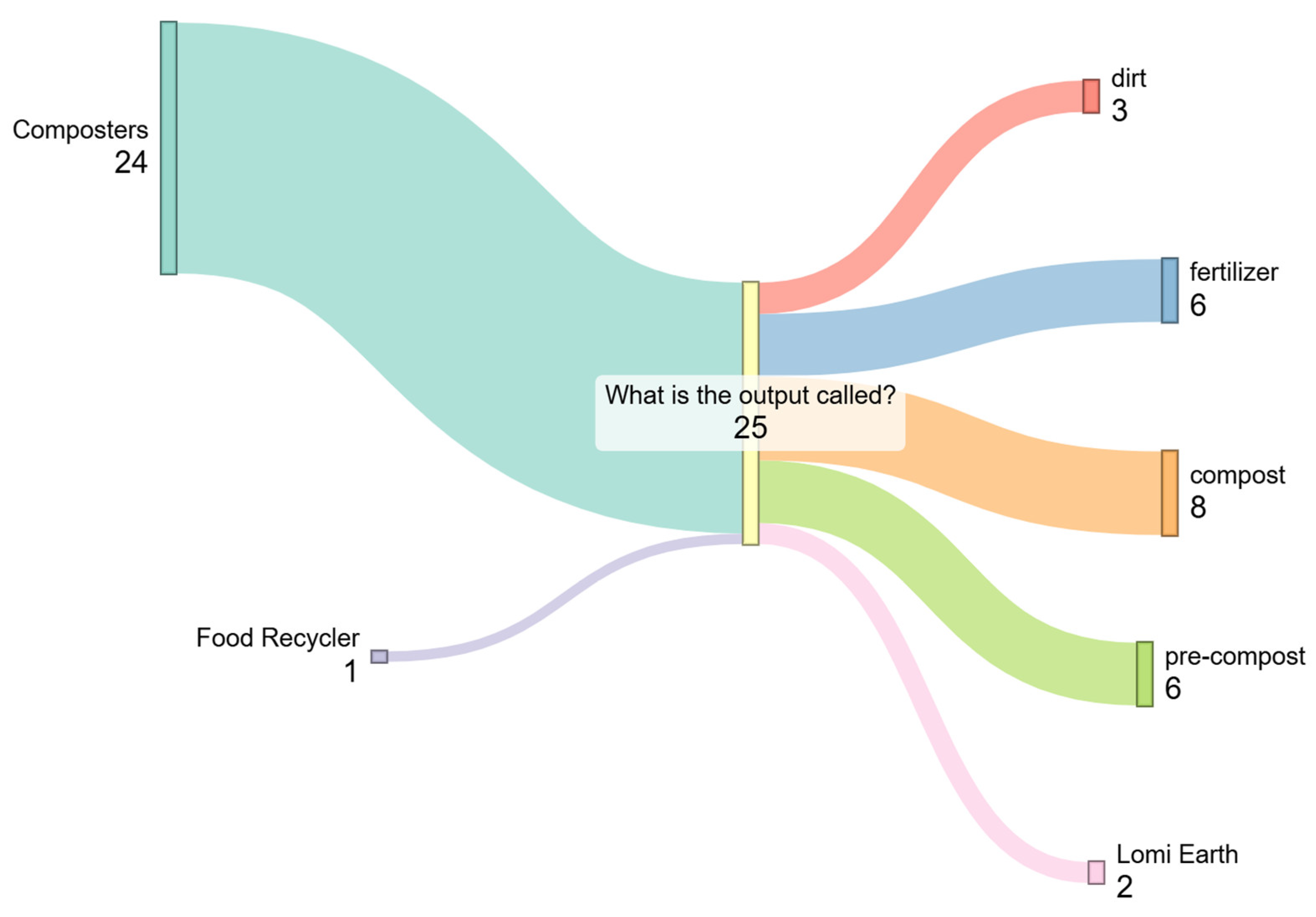
Figure 5.
Frequency of positive themes in online customer reviews of electric tabletop composting machines available for sale online. Figure 5. Bar graph showing positive themes in reviews of the electric tabletop machine models assessed in this study (n=25), as compiled from synthesized online customer comments on a major e-commerce platform. Frequently recurring positive themes were ease of use, functionality, capacity, efficiency, and noise level. Figure made using Excel software (Microsoft n.d.). Figure 5 image description: This is a horizontal bar chart showing themes from customer feedback about the electric tabletop machine models assessed in this study. The x-axis is titled 'Frequency of Positive Themes' and ranges from 0 to 20. The y-axis is labeled 'Positive Themes,' and the themes are listed in alphabetical order. From top to bottom, the y-axis bars shown correspond to: Capacity, Compost Quality, Design, Durability, Ease of Use, Efficiency, Functionality, Noise Level, Odor, Size, and Value. The positive themes with the highest frequency (represented by the longest black bars) were ease of use and functionality.
Figure 5.
Frequency of positive themes in online customer reviews of electric tabletop composting machines available for sale online. Figure 5. Bar graph showing positive themes in reviews of the electric tabletop machine models assessed in this study (n=25), as compiled from synthesized online customer comments on a major e-commerce platform. Frequently recurring positive themes were ease of use, functionality, capacity, efficiency, and noise level. Figure made using Excel software (Microsoft n.d.). Figure 5 image description: This is a horizontal bar chart showing themes from customer feedback about the electric tabletop machine models assessed in this study. The x-axis is titled 'Frequency of Positive Themes' and ranges from 0 to 20. The y-axis is labeled 'Positive Themes,' and the themes are listed in alphabetical order. From top to bottom, the y-axis bars shown correspond to: Capacity, Compost Quality, Design, Durability, Ease of Use, Efficiency, Functionality, Noise Level, Odor, Size, and Value. The positive themes with the highest frequency (represented by the longest black bars) were ease of use and functionality.
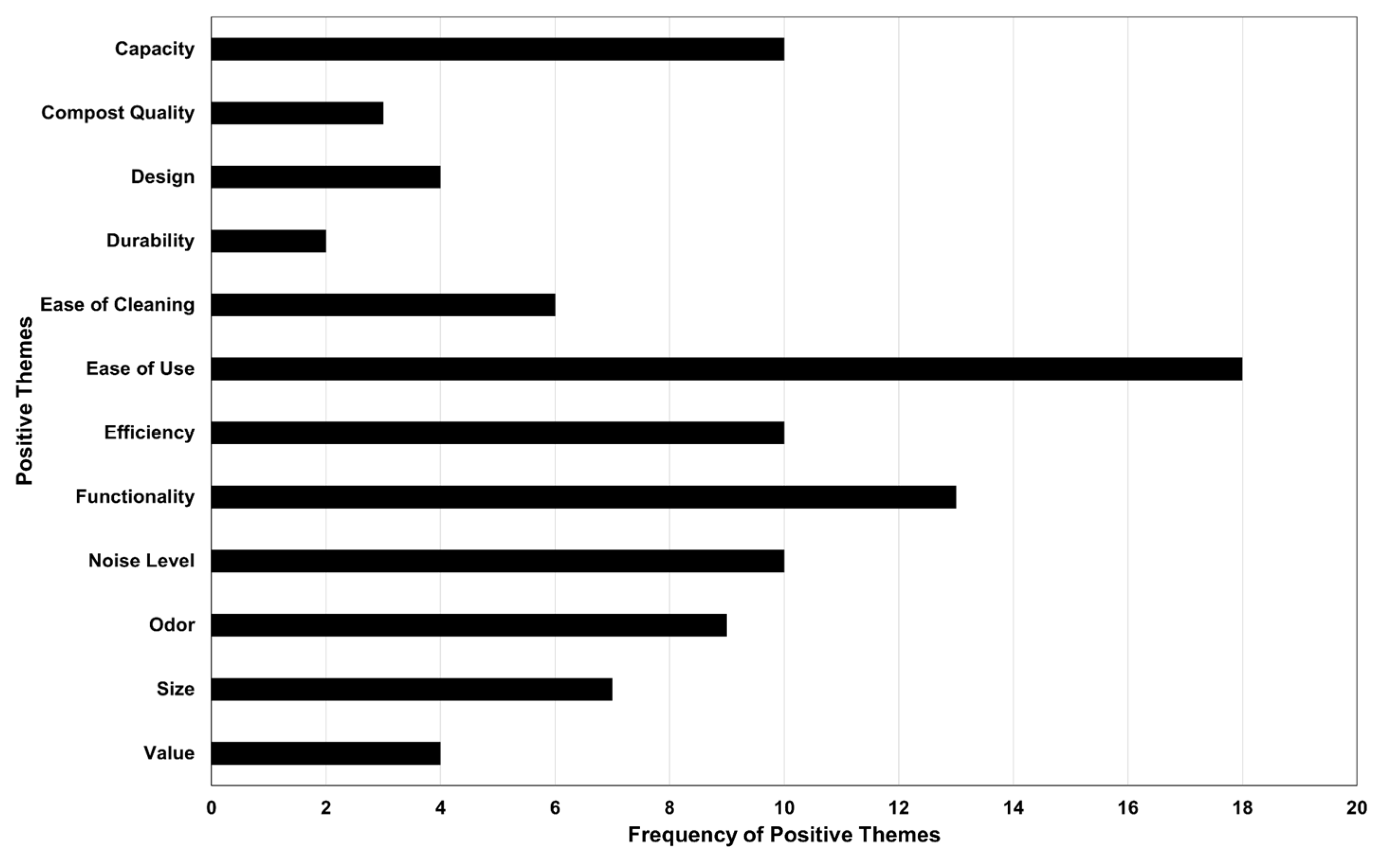
Figure 6.
Frequency of negative themes in online customer reviews of electric tabletop composting machines available for sale online. Figure 6. Bar graph showing negative themes in reviews of the electric tabletop machine models assessed in this study (n=25), as compiled from synthesized online customer comments on a major e-commerce platform.The most frequently recurring negative theme was durability. Figure made using Excel software (Microsoft n.d.). Figure 6 image description: This is a horizontal bar chart showing themes from customer feedback about the electric tabletop machine models assessed in this study. The x-axis is titled 'Frequency of Negative Themes' and ranges from 0 to 20. The y-axis is labeled 'Negative Themes,' and the themes are listed in alphabetical order. From top to bottom, the y-axis bars shown correspond to: Durability, Ease of Use, Efficiency, Functionality, Grinding, Heat Level, Leakage, Moisture Level, Noise Level, Odor, Size, and Value. The negative theme with the highest frequency (represented by the longest black bar) was durability.
Figure 6.
Frequency of negative themes in online customer reviews of electric tabletop composting machines available for sale online. Figure 6. Bar graph showing negative themes in reviews of the electric tabletop machine models assessed in this study (n=25), as compiled from synthesized online customer comments on a major e-commerce platform.The most frequently recurring negative theme was durability. Figure made using Excel software (Microsoft n.d.). Figure 6 image description: This is a horizontal bar chart showing themes from customer feedback about the electric tabletop machine models assessed in this study. The x-axis is titled 'Frequency of Negative Themes' and ranges from 0 to 20. The y-axis is labeled 'Negative Themes,' and the themes are listed in alphabetical order. From top to bottom, the y-axis bars shown correspond to: Durability, Ease of Use, Efficiency, Functionality, Grinding, Heat Level, Leakage, Moisture Level, Noise Level, Odor, Size, and Value. The negative theme with the highest frequency (represented by the longest black bar) was durability.
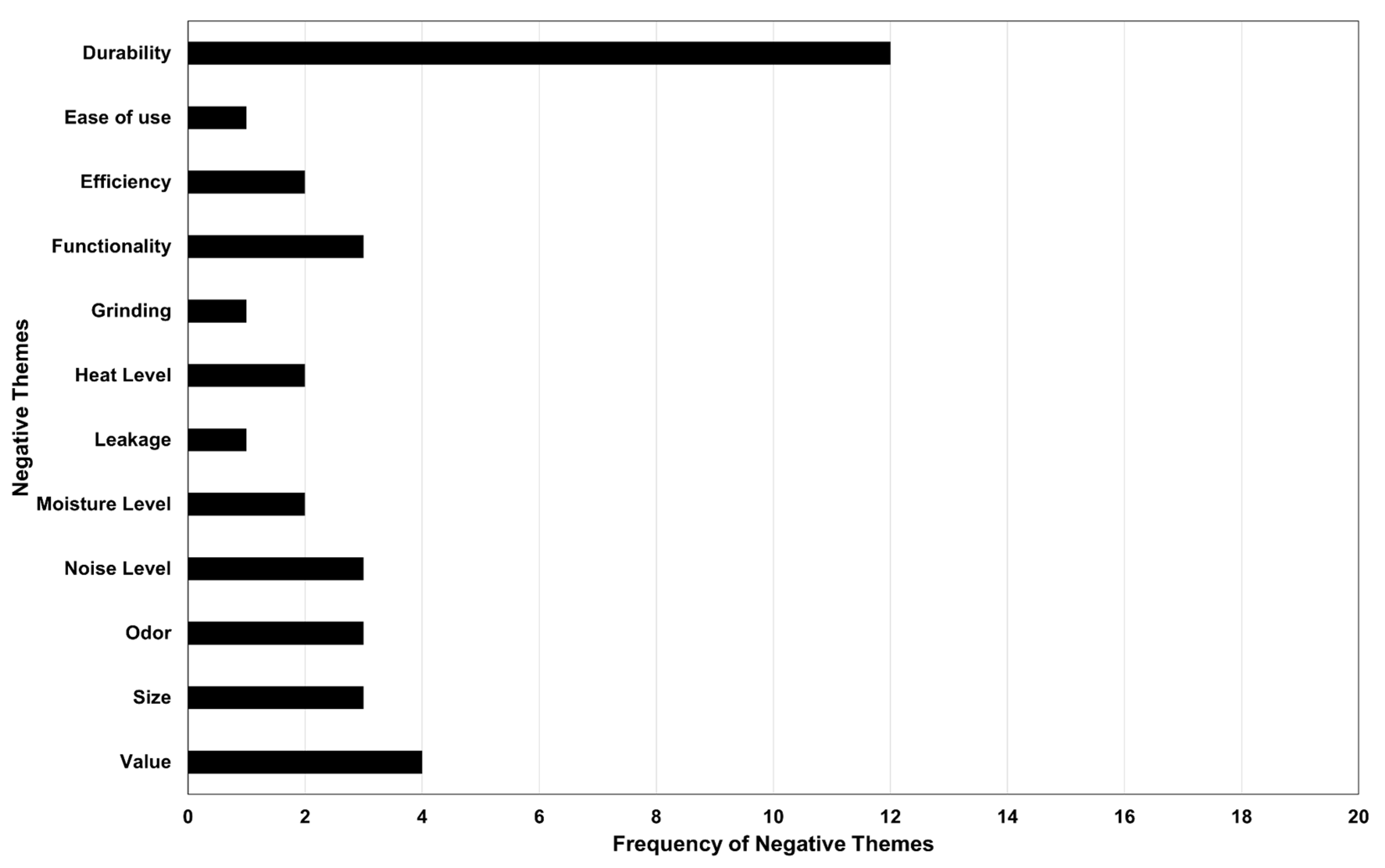

Table 1.
Glossary of key terms.
| Term | Definition | Source and further reading |
| Food loss | Food intended for people to eat that is not, due to reasons that happened before it could make it to consumers Examples: crops that did not get harvested, scraps or spills in food processing plants |
Timmermans et al. 2014 |
| Food waste | Food intended for people to eat that is not, for any reason at the consumer level Examples: leftovers on someone's plate, waste from home or restaurant food preparation, food spoiling in someone's refrigerator or in a grocery store |
Timmermans et al. 2014 |
| Food loss and waste | Food intended for people to eat that is not, for any reason, in any part of the food chain | Timmermans et al. 2014 |
| Wasted food | Food intended for people to eat that is not used for its intended original purpose | US EPA 2025 |
| Compost | Mature and stable soil amendment that results from composting process | US EPA 2025c, US EPA 2025d |
| Composting | Controlled decomposition of organic material using microorganisms, along with heat, moisture, and often oxygen | AAPFCO 2019, US EPA 2025c |
| Electric composter | An electric kitchen appliance for processing food scraps. Many involve drying and grinding; there is debate over which, if any, of the machines are following the process of composting and if the output is equivalent to compost. Other common terms used in a similar way: electric tabletop composting machine, food recycler | Alexander 2023, Brown 2023 |
Disclaimer/Publisher’s Note: The statements, opinions and data contained in all publications are solely those of the individual author(s) and contributor(s) and not of MDPI and/or the editor(s). MDPI and/or the editor(s) disclaim responsibility for any injury to people or property resulting from any ideas, methods, instructions or products referred to in the content. |
© 2026 by the authors. Licensee MDPI, Basel, Switzerland. This article is an open access article distributed under the terms and conditions of the Creative Commons Attribution (CC BY) license (http://creativecommons.org/licenses/by/4.0/).
Copyright: This open access article is published under a Creative Commons CC BY 4.0 license, which permit the free download, distribution, and reuse, provided that the author and preprint are cited in any reuse.