
Submitted:
06 September 2026
Posted:
08 September 2026
You are already at the latest version
Abstract
The increasing penetration of photovoltaic (PV) generation, battery energy storage systems (BESS), and electric vehicles (EVs) creates a need for coordinated energy-management strategies that operate across the household and community scales. This paper presents a reproducible benchmark for tariff-aware, peak-constrained battery dispatch in a residential energy community. The study uses an open dataset representing 250 households with 15-minute PV, demand, BESS, EV, tariff, and grid-limit information [1]. A linear program aggregates the community profiles and optimizes battery charging, discharging, state of charge, grid import, and grid export. The model enforces power balance, charge and discharge limits, battery efficiency, initial and terminal state-of-charge equality, a small throughput penalty, and an import cap equal to the unmanaged baseline peak. On the representative day supplied with the dataset, the optimized dispatch reduces modeled operating cost from EUR 724.15 to EUR 537.22, corresponding to a 25.81% reduction. Grid import decreases from 4364.71 kWh to 3622.13 kWh, direct PV utilization increases from 1770.58 kWh to 2390.86 kWh, and the maximum grid import remains fixed at 453.85 kW. The result demonstrates the value of coordinated storage for increasing PV self-consumption without increasing the feeder peak. The work is deliberately positioned as a transparent benchmark rather than a final claim of annual performance. Future extensions should include household-level battery constraints, flexible EV charging, multi-day validation, stochastic forecasts, and carbon-intensity signals.
Keywords:
photovoltaic energy
; battery storage
; electric-vehicle charging
; energy communities
; microgrid scheduling
; linear programming
; robust optimization
; maximum power point tracking
; PV self-consumption
1. Introduction
The transition toward distributed renewable generation is changing the operating conditions of low-voltage networks. Residential PV systems can reduce grid demand during daylight hours, but their production is intermittent and often misaligned with evening consumption. Battery storage can shift electricity across time, while EVs introduce additional flexible demand and, in some configurations, a potential source of distributed storage. The resulting problem is not limited to maximum-power-point tracking or converter control; it also requires decisions about how multiple assets should be coordinated under tariffs, technical limits, and uncertainty.
The user’s previous research provides a relevant foundation for this direction. Fergani and co-authors studied PV pumping with a permanent-magnet synchronous motor and compared PSO, GWO, and CSA-based MPPT strategies 4. Other work examined a PSO-tuned ANN for maximum-power extraction from a DC microgrid under changing irradiance 3. The user’s group has also investigated efficient EV battery charging in a DC microgrid in Ain El Ibel, Algeria 2, as well as advanced PV and wind control strategies. Those studies focus primarily on energy harvesting, control, and device-level optimization. The present paper complements them by considering community-level coordination between PV generation, flexible storage, and grid exchange. The broader publication record also covers ANFIS control of grid-connected PV inverters 6, hybrid whale-optimization and cuckoo-search MPPT for PMSG wind systems 7, modified bacterial-foraging MPPT under partial shading 8, quantum marine-predator optimization for PV 9, advanced PMSG control 10, adaptive neural-network wind-energy control 12, and a second formulation of the hybrid whale–cuckoo-search wind MPPT method 16. The record further includes PV hotspot diagnosis using RT-DETR and YOLOv8 5, secure partial-shading detection under adversarial attacks 13, a Kitsune optimizer 14, FOPI–ANN PV extraction for the Ain El Ibel case 15, and a broader metaheuristic PV-control study 17. These works are cited here to connect the present scheduling benchmark with the author’s wider research program; they are not treated as direct methodological inputs to the present LP model.
The objective of this preliminary study is to establish a technically transparent benchmark that can be extended into a full robust optimization paper. The central research question is:
Can coordinated battery dispatch reduce the cost of operating a PV–EV energy community and increase PV self-consumption without increasing the community’s unmanaged feeder peak?
The main contributions are fourfold. First, an open energy-community dataset is converted into a reproducible community-scale optimization instance. Second, a linear-programming formulation is given for tariff-aware battery dispatch with a terminal state-of-charge condition. Third, a grid-import cap is introduced so that the economic comparison does not hide a worsening feeder peak. Fourth, the paper reports a complete baseline and optimized benchmark, together with limitations and a roadmap for stochastic and EV-aware extensions.
2. Related Work and Research Gap
Energy-management research has addressed PV self-consumption, battery scheduling, demand response, energy communities, and EV charging through mathematical programming, metaheuristic optimization, model predictive control, and machine learning. The appropriate method depends on the decision horizon, uncertainty, asset coupling, and whether the goal is real-time control or day-ahead scheduling. Linear programming is attractive for an initial benchmark because it is transparent, globally optimal for the stated linear model, and easy to reproduce across datasets.
At the device level, PV controllers seek to extract the maximum available power despite changing irradiance and partial shading. The user’s PSO-tuned ANN study 3 and comparative PV-pumping study 4 are examples of this control-oriented perspective. At the microgrid level, the problem includes energy balance, battery charging, and EV operation. The user’s DC-microgrid and EV-charging publication 2 provides a direct application context for the present community-scale formulation.
The open dataset used in this work was created specifically to support energy-community simulation. It combines household consumption and PV production profiles with BESS, EV, charging-station, tariff, and contractual-power information 1. Its structure makes it suitable for a reproducible benchmark, but it also imposes a methodological responsibility: conclusions must distinguish what is directly measured from what is generated or allocated within the dataset construction. Reviews of microgrid energy management emphasize that uncertainty in PV, load, EV availability, and battery behavior should be represented explicitly when moving from deterministic benchmarks to operational strategies 21–24. Stochastic optimization and predictive-control formulations are therefore natural next steps for this study 22,23,25.
The research gap addressed here is therefore methodological rather than a claim of a new optimization algorithm. Many studies report sophisticated controllers or metaheuristics, but reproducibility can be limited when source data, constraints, or parameter choices are not released together. This work provides a baseline against which future robust optimization, model predictive control, and metaheuristic methods can be compared. The resulting benchmark is especially relevant to the user’s research trajectory because it links PV extraction and EV charging studies to system-level coordination.
3. Materials and Methods
3.1. Dataset and Study Horizon
The study uses the Zenodo record A complete energy community dataset with photovoltaic generation, battery energy storage systems and electric vehicles 1. The dataset describes a European energy community with 250 households. According to the dataset documentation, 200 community members are assigned PV generation and 150 are assigned a BESS. The workbook includes a representative 96-period day with 15-minute resolution, corresponding to 24 hours because each period is 0.25 hours and the horizon contains 96 periods.

Table 1.
Extracted study parameters and results.
| Dataset element | Value | Interpretation |
|---|---|---|
| Community size | 250 households | Aggregate residential community |
| Time resolution | 15 min | 96 periods in the supplied day |
| Aggregate load | 6135.30 kWh | Sum of the Load table over the day |
| Aggregate PV | 2390.86 kWh | Sum of the PV table over the day |
| BESS capacity | 1587.00 kWh | Sum of positive household capacities |
| Maximum charge/discharge | 769.40 kW | Aggregate power limit |
| Weighted efficiency | 0.9612 | Capacity-weighted value from BESS table |
| Initial and terminal SOC | 793.50 kWh | Terminal equality avoids end effects |
The household profiles are aggregated for this first benchmark. This choice makes the optimization small, transparent, and suitable for independent replication. It also means that the model does not yet preserve every household’s individual SOC, inverter, or contractual-power constraint. Those constraints are addressed as future work rather than being silently approximated as household-level behavior.
3.2. Baseline Operation
The unmanaged baseline directly consumes PV when it is available. For each period, positive residual demand is imported from the grid and positive PV surplus is exported. No battery dispatch is allowed. If L_t is aggregate load and P_t^("PV") is aggregate PV generation, net load is
n_t = L_t - P_t^("PV").
The baseline imports g_t^0 = max(n_t,0) and exports e_t^0 = max(-n_t,0). Its energy cost is
C_0 = sum_(t=1)^T Delta t (p_t^b g_t^0 - p_t^s e_t^0)
where p_t^b and p_t^s are the dataset purchase and sale prices, respectively, and Delta t=0.25 h.
3.3. Linear-Programming Dispatch Model
The optimized model uses five decision variables in each period: charge power c_t, discharge power d_t, state of charge s_t, grid import g_t, and grid export e_t. The community power balance is
g_t - e_t + c_t - d_t = n_t.
The SOC dynamics are represented by
s_t = s_(t-1) + eta c_t Delta t - (d_t Delta t)/eta
where eta=0.9612 is the capacity-weighted efficiency parameter. The bounds are
0 <= s_t <= S^("max"), quad 0 <= c_t <= C^("max"), quad 0 <= d_t <= D^("max")
with S^("max")=1587.0 kWh and C^("max")=D^("max")=769.4 kW. The initial condition is s_0=793.5 kWh and the terminal condition is s_T=793.5 kWh.
The objective is
min C = sum_(t=1)^T Delta t (p_t^b g_t - p_t^s e_t + lambda(c_t+d_t))
where lambda=0.01 EUR/kWh is a small throughput penalty used as a transparent proxy for battery wear. The model does not claim that this single coefficient is a validated electrochemical degradation model.
To avoid an economic schedule that increases the feeder peak, the optimized grid-import variable is capped at the unmanaged baseline peak:
0 <= g_t <= P^("cap"), quad P^("cap") = max_t g_t^0 = 453.85 "kW".
The optimization is solved using a standard linear-programming solver. Since the formulation is linear and all variables are continuous, the solution is globally optimal for the stated aggregate model and parameter set.
3.4. Evaluation Metrics
The following metrics are reported: operating cost, imported energy, exported energy, direct PV utilization, peak grid import, peak grid export, and battery throughput. Direct PV utilization is calculated as total PV generation less exported PV energy. Battery throughput is the sum of charging and discharging energy over the horizon. The study does not estimate emissions because an hourly carbon-intensity signal is not included in the selected input tables.
4. Results
4.1. Energy and Economic Performance
The unmanaged baseline has a daily operating cost of EUR 724.15. After coordinated battery dispatch, the modeled cost is EUR 537.22, representing a reduction of 25.81%. Grid imports decline by 742.58 kWh, while export declines from 620.27 kWh to zero under the optimized schedule.
Table 2.
Extracted study parameters and results.
| Metric | Baseline | Optimized | Relative change |
|---|---|---|---|
| Operating cost (EUR/day) | 724.15 | 537.22 | −25.81% |
| Grid import (kWh/day) | 4364.71 | 3622.13 | −17.01% |
| Grid export (kWh/day) | 620.27 | 0.00 | −100.00% |
| Direct PV utilization (kWh/day) | 1770.58 | 2390.86 | +35.03% |
| Peak grid import (kW) | 453.85 | 453.85 | 0.00% |
| Peak grid export (kW) | 296.31 | 0.00 | −100.00% |
| Battery throughput (kWh/day) | 0.00 | 3094.60 | Not applicable |
The increase in direct PV utilization is the most direct operational effect of storage. In the baseline, PV surplus is exported whenever it exceeds instantaneous household demand. In the optimized schedule, the battery absorbs sufficient surplus to eliminate modeled export while maintaining the terminal SOC condition. The result is consistent with the role of storage as a temporal-shifting resource rather than as a generator.
4.2. Peak Constraint and Dispatch Behavior
The peak-import constraint is binding as a policy safeguard rather than as a claim that the battery necessarily reduces peak demand in every tariff setting. The baseline and optimized peak are both 453.85 kW. Without the cap, a purely cost-driven formulation can charge the battery during inexpensive periods and temporarily increase instantaneous grid import. The cap prevents that behavior and makes the economic comparison compatible with a feeder that cannot accept a higher maximum import.
Figure 1.
Aggregate load, PV generation, grid exchange, and optimized battery state of charge.
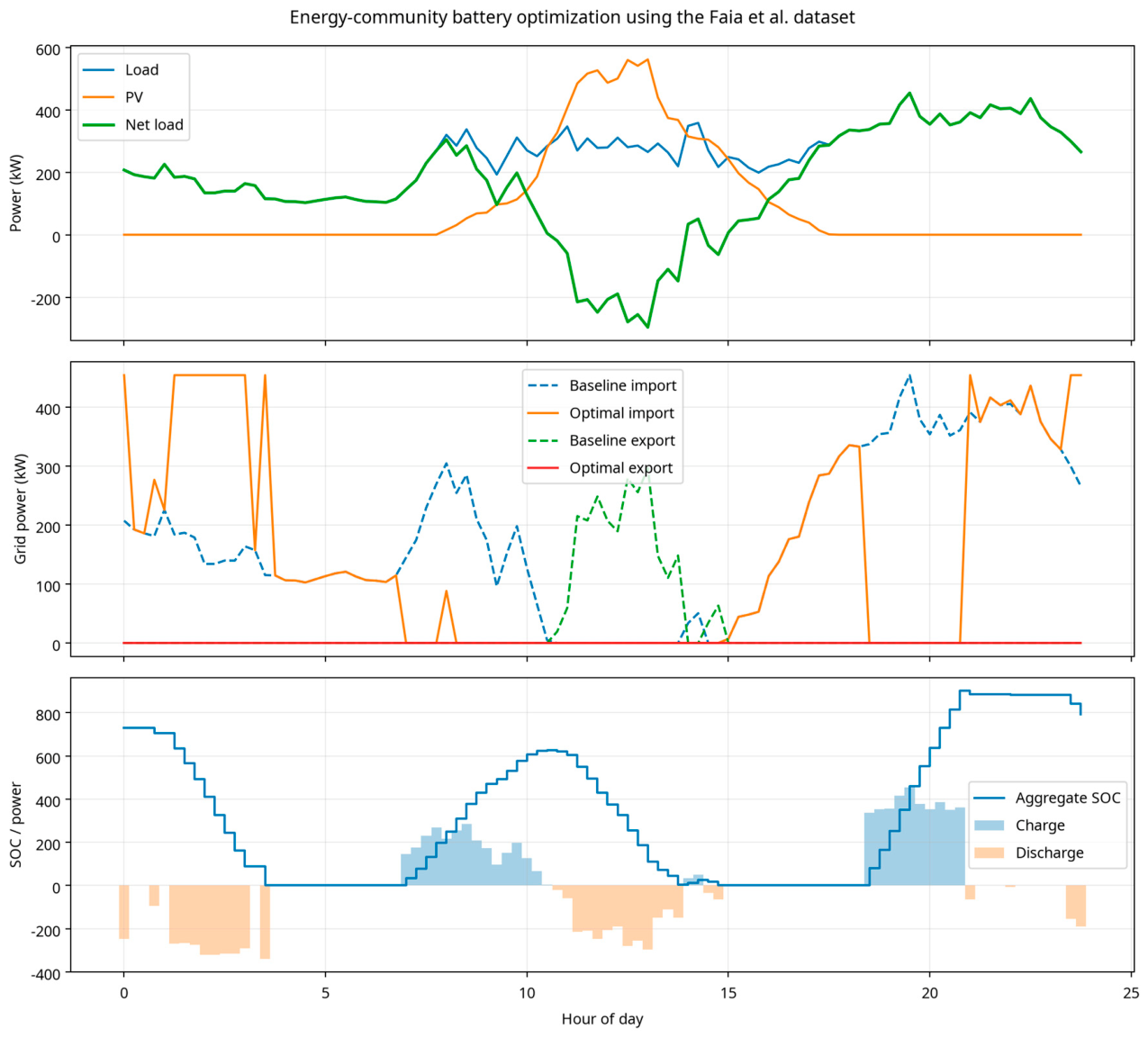
The optimized schedule produces 3094.60 kWh of battery throughput over the representative day. This value is material relative to the aggregate capacity and should be examined in future work with a more rigorous degradation model. The result also demonstrates why reporting only energy cost would be insufficient: cost, peak import, PV self-consumption, export, and cycling must be interpreted together.
4.3. Sensitivity Interpretation
The current result depends on the dataset’s purchase and sale prices, battery efficiency, throughput penalty, and terminal SOC. The difference between purchase and sale prices creates an incentive to avoid exporting PV and to shift energy across tariff periods. The terminal SOC condition prevents the optimizer from treating the initial battery inventory as free energy. The throughput penalty discourages economically artificial cycling but is not intended to calibrate battery lifetime.
For a full journal-ready revision, the next sensitivity analysis should vary the throughput penalty, terminal SOC requirement, export remuneration, grid cap, and forecast error. The most informative extension would compare deterministic dispatch with scenario-based dispatch under multiple PV and load trajectories.
5. Discussion
The simulation provides three main insights. First, the selected open dataset is sufficiently rich to support a reproducible energy-community benchmark rather than a purely synthetic case. It combines load, PV, BESS, EV, tariff, and contractual-power information in a common workbook 1. Second, the community-level LP provides a clean reference point for more complex controllers and metaheuristics. A new method should be evaluated against this benchmark rather than only against a hand-designed rule. Third, a peak constraint changes the interpretation of cost savings: storage can reduce energy expenditure and PV export without being permitted to increase the maximum feeder import.
The relation to the user’s prior work is direct. The user’s MPPT and PV-pumping studies seek to increase harvested PV energy under dynamic operating conditions 4,8,9,15. The present model assumes that the available PV profiles have already been generated or measured and addresses what happens after generation is available to a community. The user’s DC-microgrid EV-charging study 2 and PV-to-EV comparative study 11 provide device and microgrid perspectives, whereas this paper aggregates those assets into a scheduling problem. The user’s work on UAV PID control 18 and the two incomplete profile entries involving broader engineering collaborations 19,20 are included in the bibliography for completeness but are not used to support claims about energy-community optimization. The two levels can be combined in a future hierarchical architecture: a supervisory optimizer schedules community power, while local MPPT and converter controllers track the setpoints.
A possible architecture for the next paper is therefore hierarchical. At the upper level, a robust or model-predictive scheduler would determine battery and EV charging trajectories using forecast distributions. At the lower level, local PV controllers and converters would track those trajectories subject to electrical constraints. This would allow the user’s established MPPT expertise to remain central while broadening the scientific contribution to system-level energy management.
6. Limitations
This study has important limitations. The evaluation covers one representative 24-hour profile rather than a year of operation. The battery is aggregated, so individual household allocation and network constraints are not preserved. EV charging is not yet optimized, despite EV-related fields being available in the dataset. The model uses a linear efficiency representation and a scalar throughput penalty rather than a validated battery-aging model. The tariff is taken from the dataset and is not treated as a stochastic or market-clearing variable. No power-flow model is included, so voltage, line loading, and phase imbalance are outside the scope of the current benchmark. Finally, because no carbon-intensity time series is used, the paper does not claim a reduction in operational emissions.
These limitations define the next experimental stage rather than invalidating the benchmark. A full extension should preserve household identity, add EV departure and arrival constraints, use rolling-horizon forecasts, test multiple days and seasons, and report confidence intervals across scenarios. It should also compare LP, mixed-integer formulations, model predictive control, and the metaheuristic approaches relevant to the user’s prior publications.
7. Conclusions
This paper presented a reproducible linear-programming benchmark for tariff-aware, peak-constrained battery dispatch in a PV–BESS–EV energy community. Using an open 250-household dataset, the optimized schedule reduced modeled daily operating cost by 25.81%, reduced grid imports by 17.01%, increased direct PV utilization by 35.03%, eliminated modeled export, and maintained the unmanaged peak-import limit of 453.85 kW.
The contribution is best understood as a baseline for a stronger preprint, not as a final universal performance claim. Its value lies in connecting the user’s prior work on PV MPPT, PV pumping, DC microgrids, and EV charging to a transparent community-scale optimization problem. The recommended next version is a robust, EV-aware, multi-day formulation with household-level constraints and forecast uncertainty. That extension would provide a stronger novelty claim and a more defensible basis for journal submission.
Author Contributions
Conceptualization, methodology, software, formal analysis, visualization, and writing—original draft preparation: Okba Fergani. The computational workflow and manuscript structure were prepared for author review and should be verified and revised by the author before submission.
Funding
No funding information was supplied for this preliminary manuscript. The author should add the relevant grant, institutional, or project information before submission if applicable.
Institutional Review Board Statement
Not applicable. The study uses an openly available energy dataset and does not involve new human-subject data collection.
Informed Consent Statement
Not applicable.
Data Availability Statement
The source dataset is openly available from Zenodo at DOI 10.5281/zenodo.7602546 and is described in the associated Data in Brief publication 1. The simulation script, processed result tables, and figure are included with this manuscript package. The author should publish the final code repository and exact software environment alongside the preprint.
Conflicts of Interest
The author should confirm and complete this statement before submission. Based on the information available for this draft, no conflict of interest has been declared.
References
- Faia, R.; Goncalves, C.; Gomes, L.; Vale, Z. Dataset of an energy community with prosumer consumption, photovoltaic generation, battery storage, and electric vehicles. Data Brief. 2023, 48, 109218, Dataset record: https://doi.org/10.5281/zenodo.7602546. [Google Scholar] [CrossRef]
- Younes, B.; Ait Abbas, H.; Laroussi, K.; Bousbaine, A.; Fergani, O.; Mazari, A. Optimizing DC microgrid systems for efficient electric vehicle battery charging in Ain El Ibel, Algeria. Int. J. Eng. 2024, 37, 1891–1900. [Google Scholar] [CrossRef]
- Fergani, O.; Bouzid, A.; Tkouti, N.; Mechgoug, R. A PSO Tuning ANN for Extracting the MPP from a DC Microgrid System under Changing Irradiance. In Proceedings of the 24th International Carpathian Control Conference; 2023; pp. 130–134. [Google Scholar] [CrossRef]
- Fergani, O.; Mechgoug, R.; Afulay, B.A.; Tkouti, N. Revolutionizing PV Pumping Systems with PMSM Machine and Advanced MPPT Algorithm Integration: A Comparative Study of PSO, GWO, and CSA Techniques. NeuroQuantology 2023, 21, 1852–1862. Available online: https://www.researchgate.net/publication/373639973_Revolutionizing_PV_Pumping_Systems_with_PMSM_Machine_and_Advanced_MPPT_Algorithm_Integration_A_Comparative_Study_of_PSO_GWO_and_CSA_Techniques.
- Achit, M.; Yassa, N.; Bouzida, A.; Mazari, A.; Fergani, O. Enhancing PV panel diagnosis: RT-DETR vs YOLO v8 for real-time hotspots detection. Stud. Eng. Exact. Sci. 2024, 5, e8390, Google Scholar record. Available online: https://scholar.google.com/citations?view_op=view_citation&hl=en&user=6YNqTL4AAAAJ&citation_for_view=6YNqTL4AAAAJ:eQOLeE2rZwMC. [CrossRef]
- Mechgoug, R.; Tkouti, N.; Fergani, O. A Adaptive Neuro-Fuzzy Inference System (ANFIS) Controller for a 9-Level Inverter for Grid-Connected PV Systems. NeuroQuantology 2023, 21, 1120–1134, Google Scholar record. Available online: https://scholar.google.com/citations?view_op=view_citation&hl=en&user=6YNqTL4AAAAJ&citation_for_view=6YNqTL4AAAAJ:9yKSN-GCB0IC.
- Mazari, A.; Laroussi, K.; Fergani, O.; Ait Abbas, H.; Rezk, H. A Hybrid Whale Optimization—Cuckoo Search Algorithm for Maximum Power Point Tracking in PMSG-Based Wind Turbine Systems. Int. Trans. Electr. Energy Syst. 2025, 7411272. [Google Scholar] [CrossRef]
- Fergani, O.; Mechgoug, R.; Afulay, B.A.; Tkouti, N.; Mazari, A. A New Modified Bacterial Foraging MPPT Technique with Dynamic Mutation Rates for Photovoltaic Systems under Partial Shading Conditions. Int. J. Eng. 2024, 37, 1569–1579, Google Scholar record. Available online: https://scholar.google.com/citations?view_op=view_citation&hl=en&user=6YNqTL4AAAAJ&citation_for_view=6YNqTL4AAAAJ:qjMakFHDy7sC. [CrossRef]
- Fergani, O.; Himeur, Y.; Mechgoug, R.; Atalla, S.; Mansoor, W.; Tkouti, N. Quantum marine predator algorithm: A quantum leap in photovoltaic efficiency under dynamic conditions. Information 2024, 15, 692. [Google Scholar] [CrossRef]
- Billel, N.; Kamel, A.; Hamou, A.A.; Ali, M.; Fergani, O. Evaluation of advanced control strategies for PMSG in wind turbines: Backstepping fuzzy logic control and adaptive neural network control approaches. Stud. Eng. Exact. Sci. 2024, 5, e7321, Google Scholar record. Available online: https://scholar.google.com/citations?view_op=view_citation&hl=en&user=6YNqTL4AAAAJ&citation_for_view=6YNqTL4AAAAJ:YsMSGLbcyi4C. [CrossRef]
- Belhadjer, Y.; Ait Abbas, H.; Laroussi, K.; Fergani, O.; Naceri, B. Comparative studies of several modern control techniques to harvest the maximum energy from a PV system in order to charge the battery of an electric vehicle under different conditions. In Proceedings of the 1st International Conference on Renewable Solutions for Ecosystems, 2023; Google Scholar record. Available online: https://scholar.google.com/citations?view_op=view_citation&hl=en&user=6YNqTL4AAAAJ&citation_for_view=6YNqTL4AAAAJ:Tyk-4Ss8FVUC.
- Billel, N.; Kamel, A.; Hamou, A.A.; Ali, M.; Fergani, O. Advancing Wind Energy: Adaptive Neural Network Control for Optimized Permanent Magnet Synchronous Generators. In Studies in Engineering and Exact Sciences; Google Scholar record, 2024; Available online: https://scholar.google.com/citations?view_op=view_citation&hl=en&user=6YNqTL4AAAAJ&citation_for_view=6YNqTL4AAAAJ:W7OEmFMy1HYC.
- Teta, A.; Kouzou, A.; Fergani, O.; Belabbaci, E.O.; Elbar, M. Robust Framework for Secure Partial Shading Detection in Photovoltaic Systems Under Adversarial Attacks. In Proceedings of the 6th International Conference on Power Electronics and their Applications, 2025; Google Scholar record. Available online: https://scholar.google.com/citations?view_op=view_citation&hl=en&user=6YNqTL4AAAAJ&citation_for_view=6YNqTL4AAAAJ:roLk4NBRz8UC.
- Fergani, F.; Mechgoug, R.; Afulay, A.B.; Tkouti, N.; Mazari, A.; Hamou, A.I. Kitsune Optimiser Algorithm. Authorea 2024, 0324. Metadata should be verified by the author before formal submission. Google Scholar record. Available online: https://scholar.google.com/citations?view_op=view_citation&hl=en&user=6YNqTL4AAAAJ&citation_for_view=6YNqTL4AAAAJ:IjCSPb-OGe4C.
- Fergani, O.; Mechgoug, R.; Tkouti, N.; Laroussi, K.; Bouzid, A.; Belhadjer, Y. MPPT Based Artificial Neural Network Employing FOPI To Harvest The Maximum Power From A PV System Under Changing Irradiance of The City Ain El Ibel, Djelfa. In Proceedings of the 1st International Conference on Renewable Solutions for Ecosystems, 2023; Google Scholar record. Available online: https://scholar.google.com/citations?view_op=view_citation&hl=en&user=6YNqTL4AAAAJ&citation_for_view=6YNqTL4AAAAJ:zYLM7Y9cAGgC.
- Mazari, H.R.A.; Laroussi, K.; Fergani, O.; Ait Abbas, H. A Hybrid Whale Optimization—Cuckoo Search Algorithm for Maximum Power Point Tracking in PMSG-Based Wind Turbine Systems. International Transactions on Electrical Energy Systems;Google Scholar record. 2025. Available online: https://scholar.google.com/citations?view_op=view_citation&hl=en&user=6YNqTL4AAAAJ&citation_for_view=6YNqTL4AAAAJ:_FxGoFyzp5QC.
- Fergani, O. Intelligent control of Photovoltaic System Based on Metaheuristic Algorithm Title spelling and publication type should be verified by the author before submission. Faculté des Sciences et de la Technologie; Google Scholar record. 2025. Available online: https://scholar.google.com/citations?view_op=view_citation&hl=en&user=6YNqTL4AAAAJ&citation_for_view=6YNqTL4AAAAJ:ufrVoPGSRksC.
- Belhadjer, Y.; Naceri, B.; Ait Abbas, H.; Haroun, S.; Laroussi, K.; Fergani, O. Dynamic Modeling and Control of an S500 UAV Using Proportional-Integral-Derivative (PID) Algorithm. In Proceedings of the 1st International Conference on Renewable Solutions for Ecosystems, 2023; Google Scholar record. Available online: https://scholar.google.com/citations?view_op=view_citation&hl=en&user=6YNqTL4AAAAJ&citation_for_view=6YNqTL4AAAAJ:Y0pCki6q_DkC.
- Bouzid, A.; Carvajal Barboza, E.; Dadvandipour, S.; Dudas, L.; Dumani, D.; et al. Publication record beginning “Alsabaawi, Omar Arvai, Laszlo Bartok, Roland Bodnár, István”. Bibliographic metadata incomplete in the public profile; author verification required. Google Scholar record. Available online: https://scholar.google.com/citations?view_op=view_citation&hl=en&user=6YNqTL4AAAAJ&citation_for_view=6YNqTL4AAAAJ:d1gkVwhDpl0C.
- Fergani, O.; Iskandar, A.; Varga, I. Publication record beginning “Rabab Benotsmane, Zsofia Forgacs, Ahmad Mahmod, Nicolae Alexandru Botezatu, Hazim Ghafil...”. Bibliographic metadata incomplete in the public profile; author verification required. Google Scholar record. Available online: https://scholar.google.com/citations?view_op=view_citation&hl=en&user=6YNqTL4AAAAJ&citation_for_view=6YNqTL4AAAAJ:u5HHmVD_uO8C.
- Cabrera-Tobar, A.; Massi Pavan, A.; Petrone, G.; Spagnuolo, G. A review of the optimization and control techniques in the presence of uncertainties for the energy management of microgrids. Energies 2022, 15, 9114. Available online: https://www.mdpi.com/1996-1073/15/23/9114. [CrossRef]
- Liang, H.; Zhuang, W. Stochastic modeling and optimization in a microgrid: A survey. Energies 2014, 7, 2027–2050. Available online: https://www.mdpi.com/1996-1073/7/4/2027. [CrossRef]
- Khan, M.R.; Haider, Z.M.; Malik, F.H.; Almasoudi, F.M.; et al. A comprehensive review of microgrid energy management strategies considering electric vehicles, energy storage systems, and AI techniques. Processes 2024, 12, 270. Available online: https://www.mdpi.com/2227-9717/12/2/270. [CrossRef]
- Esparza, A.; Blondin, M.; Trovão, J.P.F. A review of optimization strategies for energy management in microgrids. Energies 2025, 18, 3245. Available online: https://www.mdpi.com/1996-1073/18/13/3245. [CrossRef]
- Srithapon, C.; et al. Predictive control and coordination for energy community operation with photovoltaic generation and electric vehicles. Applied Energy. 2023. Available online: https://www.sciencedirect.com/science/article/pii/S0306261923008644.
- Hebrail, G.; Berard, A. Individual Household Electric Power Consumption. In UCI Machine Learning Repository; 2006. [Google Scholar] [CrossRef]
- Fergani, O. Google Scholar profile and publication list. Available online: https://scholar.google.com/citations?user=6YNqTL4AAAAJ&hl=en.
Disclaimer/Publisher’s Note: The statements, opinions and data contained in all publications are solely those of the individual author(s) and contributor(s) and not of MDPI and/or the editor(s). MDPI and/or the editor(s) disclaim responsibility for any injury to people or property resulting from any ideas, methods, instructions or products referred to in the content. |
© 2026 by the authors. Licensee MDPI, Basel, Switzerland. This article is an open access article distributed under the terms and conditions of the Creative Commons Attribution (CC BY) license (http://creativecommons.org/licenses/by/4.0/).
Copyright: This open access article is published under a Creative Commons CC BY 4.0 license, which permit the free download, distribution, and reuse, provided that the author and preprint are cited in any reuse.