

Submitted:
04 September 2026
Posted:
08 September 2026
You are already at the latest version
Abstract
Prostate cancer (PCa) is among the most diagnosed malignancies and is a leading cause of cancer-related mortality worldwide, with clinical management complicated by important biological heterogeneity. Epigenetic alterations (including DNA methylation, histone modifications, chromatin remodeling, and non-coding RNA regulation) are increasingly recognized as key drivers of PCa initiation, progression, and therapeutic resistance. In early-stage disease, hypermethylation of promoter regions silencing tumor suppressor genes represents one of the earliest oncogenic events, offering opportunities for early detection. During progression to castration-resistance, epigenetic mechanisms modulate androgen receptor signaling through chromatin remodeling complexes, DNA demethylation regulators, and histone-modifying enzymes, all contribute to therapy resistance. In therapy-induced neuroendocrine prostate cancer (t-NEPC), an even more aggressive form of PCa, dynamic epigenetic reprogramming, driven by chromatin-modifying enzymes and metabolic-epigenetic crosstalk, underlies lineage plasticity and transdifferentiation from adenocarcinoma. Pharmacological targeting of epigenetic regulators has been explored across multiple drug classes and clinical settings, though development remains limited compared to other malignancies; certain inhibitor classes are more clinically advanced than others, while dedicated trials in particularly NEPC remain scarce. Epigenetic biomarkers, detectable in tissue, blood, and urine, show promise for diagnosis, prognosis, and risk stratification, with multi-marker signatures outperforming individual markers. Translational advances (including bisulfite-based methylation assays, liquid biopsy platforms, single-cell/multi-region sequencing, and transcriptomic classifiers) are progressively enabling clinical application. Despite this progress, intratumoral heterogeneity, lack of standardization, and insufficient prospective validation continue to hinder routine implementation, underscoring the need for integrated multi-omic approaches in future PCa precision medicine.
Keywords:
prostate cancer
; epigenetics
; castration-resistant prostate cancer
; therapy-induced neuroendocrine prostate cancer
; clinical trials
; biomarkers
1. Introduction
Prostate cancer (PCa) represents one of the most frequently diagnosed malignancies and one of the leading causes of cancer-related mortality among men worldwide [1]. Despite significant improvements in screening strategies and therapeutic approaches, the clinical management of PCa remains challenging due to its marked biological heterogeneity. While some tumors follow an indolent course, others progress rapidly to an aggressive metastatic form of disease [2]
Increasing evidence indicates that epigenetic alterations play a crucial role in PCa initiation, progression, and therapeutic resistance [3]. Epigenetic mechanisms are changes in gene expression that occur without altering the underlying DNA sequence. These include DNA methylation, that typically suppresses gene expression by blocking transcription factors, histone modifications, which loosen or tighten DNA packaging and thereby affect gene accessibility, chromatin remodeling, which is the physical repositioning of nucleosomes by protein complexes to open or close off genomic regions, and non-coding RNA-mediated regulation [4]. Notably, in cancer, such epigenetic alterations are increasingly recognized as early events that can predispose cells to those genetic mutations traditionally linked to cancer growth [5].
Among solid tumors, PCa exhibits one of the most well-characterized epigenetic landscapes [6]. Aberrant DNA methylation, particularly the hypermethylation of promoter-associated Cytosine-phosphate-Guanine (CpG) islands, represents one of the earliest and most described molecular events in prostate carcinogenesis [7].
Additionally, dysregulation of histone-modifying enzymes and non-coding RNAs contributes to alterations in chromatin structure and transcriptional programs involved in tumor development and progression [8,9]. Some epigenetic alterations not only contribute directly to the development of PCa, but are also involved in promoting lineage plasticity. This process supports the emergence of therapy-resistant phenotypes, including castration resistant prostate cancer (CRPC) and t-NEPC [10].
Epigenetic biomarkers have been studied in tissue sample and with minimally invasive liquid biopsy approaches for more diagnostic and prognostic purpose [11]. Epigenetic alterations are potentially reversible, making them attractive targets for therapeutic applications [12]. As a consequence, pharmacological agents directed against epigenetic regulators are being actively investigated ad innovative therapeutic approaches for advanced PCa, either as single agent treatments or in combination therapies.
This comprehensive review provides an overview of the major epigenetic mechanisms involved in PCa, their role in tumor initiation and progression, and their potential clinical applications as biomarkers and therapeutic targets.
2. Epigenetic Mechanisms Driving Prostate Cancer Progression
Epigenetic regulation represents a dynamic layer of PCa biology that evolves throughout disease progression (Figure 1) [2,3,10]. Unlike genetic alterations, epigenetic changes are potentially reversible and allow tumor cells to adapt to environmental and therapeutic pressures.
2.1. Early Stage Prostate Cancer
Epigenetic dysregulation represents one of the earliest molecular events involved in prostate carcinogenesis, occurring before or alongside the accumulation of genetic alterations and contributing to tumor initiation and early clonal evolution [7]. Early PCa exhibits a complex and heterogeneous epigenomic landscape, particularly among low-grade tumors. Conversely, high-grade tumors display reduced epigenomic variability, with enrichment of transcription factor binding sites associated with prostate lineage specification, including FOXA1, HOXB13, and CDX2, suggesting the emergence of more defined regulatory programs during tumor progression [13].
Aberrant DNA methylation represents one of the most extensively characterized early epigenetic alterations in PCa. Global DNA hypomethylation contributes to genomic instability, whereas focal promoter hypermethylation leads to transcriptional silencing of tumor suppressor genes involved in cell cycle control, DNA repair, apoptosis, and differentiation pathways [2,7,14]. The GSTP1 gene represents the best-established example of early epigenetic silencing in PCa, with promoter hypermethylation occurring in the majority of tumors and detectable in precursor lesions, supporting its potential role as an early biomarker of malignant transformation [15,16]. Similar mechanisms contribute to the inactivation of additional tumor suppressor genes, including RASSF1A, APC, MGMT, RARB2, DAPK, and HIC1 [2,17]. Moreover, a genome-wide analysis of DNA methylation patterns comparing PCa and normal prostate tissues identified EZH2 as a key epigenetic regulator associated with hypermethylated regions in PCa [18].
Beyond DNA methylation, non-coding RNAs represent an additional layer of epigenetic regulation in early prostate carcinogenesis by modulating transcriptional and post-transcriptional gene regulation [2]. The early onset of these epigenetic alterations provides opportunities for biomarker development and supports the potential application of epigenetic-based approaches for early detection, risk stratification, and prevention.
2.2. Advanced Prostate Cancer
During PCa progression, epigenetic alterations progressively shift from early oncogenic events to dynamic mechanisms supporting tumor adaptation, therapeutic resistance, and lineage plasticity. Although most evidence regarding epigenetic regulation in advanced PCa has been generated in CRPC and t-NEPC, accumulating evidence suggests that epigenetic alterations are established early during disease evolution and may contribute to treatment adaptation and metastatic progression before the development of castration resistance [2,5].
The androgen receptor (AR) remains the central transcriptional regulator driving PCa progression, and multiple epigenetic mechanisms contribute to modulation of AR activity during disease evolution. Alterations in DNA methylation and chromatin remodeling can influence AR expression, genomic binding patterns, and transcriptional output [2,3]. CHD1, one of the most frequently altered chromatin remodelers in PCa, regulates AR chromatin occupancy and transcriptional programs. Loss of CHD1 promotes redistribution of AR binding toward alternative genomic sites enriched for lineage-associated factors such as HOXB13, resulting in altered AR transcriptional activity and acquisition of oncogenic signaling properties [19]. Beyond AR regulation, CHD1 deficiency contributes to genomic instability, impaired DNA repair, transcriptional reprogramming, and increased lineage plasticity, highlighting the importance of chromatin architecture in therapeutic adaptation [20,21]. Reduced expression of the DNA demethylation regulator TET2 has been associated with increased AR activity, metastatic progression, poorer clinical outcomes, and resistance to androgen deprivation therapy (ADT), suggesting a role for epigenetic dysregulation in sustaining AR-dependent tumor growth [3]. Genome-wide analyses in CRPC have demonstrated widespread alterations in DNA methylation landscapes, including hypermethylation of promoters associated with androgen-responsive genes such as AR, KLK3, NKX3-1, and FOLH1, together with global hypomethylation contributing to genomic instability [2,22].
Histone-modifying enzymes also contribute to CRPC progression and resistance mechanisms. The lysine demethylase KDM1A (LSD1) is frequently upregulated in advanced PCa and participates in transcriptional regulation, chromatin remodelling, and maintenance of aggressive tumor phenotypes [3]. Similarly, KDM4B has been implicated in adaptive responses to androgen deprivation by regulating alternative splicing events that favor the generation of constitutively active AR variants, including AR-V7, thereby promoting resistance to AR-directed therapies [2].
Non-coding RNAs represent an additional epigenetic layer involved in advanced PCa progression. Several long non-coding RNAs, including GAS5, PCAT1, HOTAIR, and PCA3, modulate AR signaling through interactions with chromatin remodeling complexes, transcriptional regulators, and post-transcriptional pathways. These mechanisms contribute to tumor growth, invasion, and resistance to ADT [23].
Epigenetic mechanisms may also influence response to chemotherapy. For example, loss of the AR-regulated gene KDM5D has been associated at a preclinical level with enhanced AR signaling and reduced sensitivity to docetaxel, suggesting that epigenetic alterations may contribute to broader mechanisms of treatment resistance [2].
Beyond mechanisms directly involved in therapy resistance, epigenetic regulation also influences clinically relevant biomarkers, including PSMA expression. Increasing evidence suggests that epigenetic mechanisms influence PSMA expression by modulating chromatin accessibility and transcriptional regulation of the FOLH1 locus. Alterations in DNA methylation and histone modifications may contribute to changes in PSMA expression, affecting tumor heterogeneity and potentially influencing response to PSMA-targeted imaging and radioligand therapies [24,25]. Pharmacological inhibition of histone deacetylases (HDACs) reversed the epigenetic silencing of PSMA and re-established its expression in both in vitro and in vivo models [25]. Understanding the epigenetic regulation of PSMA expression may provide insights into mechanisms underlying variable PSMA positivity and help identify strategies to optimize patient selection for PSMA-directed treatments.
2.3. Therapy-Induced Neuroendocrine Prostate Cancer
t-NEPC represents an aggressive PCa subtype that emerges under the selective pressure of prolonged AR pathway inhibition, as a result of lineage plasticity and transdifferentiation from CRPC [26,27]. According to a recent meta-analysis, the overall incidence of t-NEPC following exposure to ADT and androgen receptor pathway inhibitors (ARPIs) is approximately 16% [28]. t-NEPC displays a distinctive molecular landscape characterized by alterations in tumor suppressor pathways, including TP53 and RB1 loss, with frequent PTEN alterations, attenuation of AR signaling and its downstream transcriptional program, together with overexpression of MYCN and AURKA [3,27]. The development of t-NEPC is characterized by profound lineage plasticity, driven by the progressive loss of AR dependency and activation of alternative transcriptional programs that promote neuroendocrine differentiation from luminal adenocarcinoma cells [27,29]. Dynamic epigenetic remodeling is increasingly recognized as both a molecular hallmark and a mechanistic driver of ADT- and ARPI-induced cellular plasticity, enabling tumor cells to adapt to therapeutic pressure and acquire a neuroendocrine phenotype [10,29].
Integrated analyses of DNA methylation profiles and AR/neuroendocrine transcriptional signatures have identified distinct epigenetic patterns capable of discriminating CRPC from NEPC, highlighting DNA methylation-mediated AR silencing as a key event in NEPC biology [30]. Consistently, altered expression of epigenetic regulators involved in DNA methylation dynamics, including DNMT and TET2, has been reported in t-NEPC compared with CRPC. Furthermore, NEPC and CRPC exhibit distinct patterns of histone modifications, including differential H3K27 acetylation landscapes [29]. Additional layers of transcriptional reprogramming involve lineage-determining factors such as FOXA1, an AR co-factor whose loss promotes androgen independence, epithelial–mesenchymal transition, and neuroendocrine differentiation through activation of the IL8–ERK signaling axis [29].
Loss of TP53 and RB1 contributes to the upregulation of EZH2 and SOX2, thereby promoting AR suppression and facilitating lineage plasticity [2,3,27]. Recent preclinical studies have further demonstrated a functional interplay between DNA methylation and EZH2-mediated H3K27me3 deposition in regulating PC cell plasticity. EZH2 and DNMT1 cooperate to reshape chromatin landscapes and transcriptional programs, facilitating the acquisition and maintenance of a neuroendocrine phenotype [31].
Beyond EZH2-mediated chromatin repression, additional epigenetic mechanisms involving chromatin remodeling complexes and metabolic reprogramming contribute to NEPC evolution. Increased SMARCA4 activity, a component of the SWI/SNF chromatin remodeling complex, promotes luminal-to-neuroendocrine lineage transition by enhancing chromatin accessibility and H3K27 acetylation at the PROX1 locus, identifying the SMARCA4-PROX1 axis as a potential therapeutic vulnerability in enzalutamide-resistant prostate cancer [32]. Moreover, metabolic adaptation contributes to epigenetic plasticity, as AR inhibition-induced glycolysis promotes lactate-driven histone lactylation and activation of LHX2, which cooperates with DNMT1 to sustain neuroendocrine differentiation and tumor progression [33].
Given the dynamic and potentially reversible nature of epigenetic alterations, targeting epigenetic vulnerabilities associated with lineage plasticity represents a promising therapeutic strategy for preventing or treating t-NEPC. However, the substantial heterogeneity of the epigenomic landscape across PCa subtypes and even within individual tumors remains a major challenge for the clinical translation of epigenetic therapies [10].
3. Epigenetic Drugs and Therapeutic Strategies in Prostate Cancer
3.1. Clinical Trials in Prostate Adenocarcinoma
Epigenetic plasticity, which refers to reversible changes in epigenetic marks on DNA, histone and non-histone proteins, may be involved in primary and acquired resistance to anticancer therapies, through modulation of tumour cells and their microenvironment [34]. Evidence from preclinical models indicates that the combination of epigenetic therapies with conventional anticancer treatments can potentiate therapeutic outcomes and attenuate the onset of drug resistance [4]. Combination strategies include association of epigenetic drugs or epi-drug with other treatment options (AR-targeting drugs, radiotherapy, targeted therapy, chemotherapy, immunotherapy), with the aim to try to overcome resistances [12,34]. Despite the mechanistic rationale outlined above, epigenetic drug development in PCa remains disproportionately limited relative to other malignancies: across all cancer types, only 2.57% of 2254 registered epigenetic-agent trials have enrolled PCa patients, a figure that rises only to 5.50% even when DNMT inhibitor-dominated hematologic programs are excluded [35]. Within this complex landscape, clinical trial representation and development vary by disease setting and drug class.
In the early-stage/localized PCa setting, the EZH2 inhibitor tazemetostat has been incorporated into a large neoadjuvant phase II regimen combining it with AR-targeting agents, chemotherapy and immunotherapy (apalutamide, abiraterone, prednisone, docetaxel, niraparib, atezolizumab, capivasertib), choosing pathologic complete response and minimal residual disease as study primary endpoints [36]. This strategy is consistent with the role of EZH2 in regulating hypermethylated genomic regions, as discussed in Section 2.1. A parallel neoadjuvant monotherapy study of tazemetostat before radical prostatectomy was voluntarily withdrawn [37]. In biochemically recurrent disease, 5-azacitidine combined with all-trans retinoic acid showed feasibility and increased the PSA doubling time in a small completed phase II study [38].
In metastatic hormone-sensitive PCa (mHSPC), data remain limited but promising. The EZH2 inhibitor mevrometostat combined with enzalutamide is under investigation in a large ongoing phase III trial using Radiographic Progression-Free Survival (rPFS) as the primary endpoint [39], positioning that as the most advanced epigenetic therapeutic drug in PCa and the only one extending beyond CRPC into hormone-sensitive disease. A dual EZH1/2 inhibitor, tulmimetostat (DZR123), is currently under evaluation in a phase I/II trial combined with enzalutamide or abiraterone in mHSPC [40].
The majority of trials have been investigated in metastatic CRPC (mCRPC), encompassing all five drug classes and consistently pairing epigenetic agents with AR-pathway inhibitors, in accordance with the epigenetic mechanisms sustaining AR signaling (as discussed in Section 2.2). HDAC inhibitors (SB939, panobinostat, entinostat, vorinostat, belinostat) were frequently terminated for insufficient activity. SB939 [41] and vorinostat/temsirolimus [42] both showed no efficacy signal justifying discontinuation, whereas panobinostat/bicalutamide produced a relevant rPFS at 6 months in a notable proportion of patients and an impressive PSA decline in two of seven patients [43] and belinostat/talazoparib showed a favourable safety profile, but without evidence of efficacy [44]. DNMT inhibitor decitabine was discontinued before reaching conclusion of the trials [45,46]. BET inhibitors form the largest and most attrition-prone group: ZEN-3694 combinations with enzalutamide (± pembrolizumab) are the most advanced, with acceptable/favourable safety reported [47,48] and further phase II evaluation ongoing [49,50]. Several other agents were terminated for limited efficacy or dose-limiting adverse events, i.e. exposure-dependent thrombocytopenia which constitutes a recurring, class-defining toxicity [51,52,53]. EZH2 inhibitors represent the most clinically advanced class overall: beyond the ongoing mevrometostat phase III programs [54,55,56], the EZH2 inhibitor tazemetostat has shown more limited activity in mCRPC. In the randomized phase Ib/II CELLO-1 study, tazemetostat combined with enzalutamide or abiraterone/prednisone did not demonstrate a statistically significant improvement in the primary endpoint, with only a modest extension of median rPFS (2.8 months) [57].
Tazemetostat combinations in mCRPC have not progressed further into late-stage clinical programs. In a phase Ia/Ib trial, the combination of tazemetostat and talazoparib showed an acceptable safety profile characterized by expected myelosuppression, with preliminary signals of antitumor activity observed in a subset of patients [58]. A dual EZH1/2 inhibitor, tulmimetostat (DZR123), is under evaluation in a basket phase I/II trial combined with enzalutamide, reporting a safety profile consistent with prior data and preliminary ORR signals in non-prostate cohorts (ovarian, endometrial, mesothelioma [59].
Despite a strong biological rationale, LSD1 inhibitors remain at an early stage of clinical development in PCa, with no dedicated prostate cancer-specific programs currently established. This represents a notable translational gap given LSD1’s recognized role in AR pathway regulation, lineage plasticity, and the maintenance of aggressive tumor phenotypes, particularly in neuroendocrine prostate cancer [60,61].
In summary, across different settings in PCa, three clinical trials patterns recur: (i) frequent combination with AR-pathway inhibitors; (ii) predominantly small, single-arm, early-phase designs with safety as the primary endpoint; (iii) discontinuation for non-efficacy reasons (futility, funding, sponsor decision) which limiting interpretation of the true biological activity of epi-drugs . Among different epi-drug classes, EZH2 inhibitors have progressed most, including into phase III [39], whereas BET inhibitors show the highest attrition, mainly due to hematologic toxicity rather than absence of anti-tumour activity [51,52,53]. Clinical development also remains almost entirely confined to AR-driven adenocarcinoma, despite compelling mechanistic evidence that epigenetic alterations drive the lineage plasticity underlying transdifferentiation to NEPC [62]. This imbalance, together with the relative paucity of LSD1 inhibitor trials, marks a clear gap between biological rationale and clinical research.
Table 1. summarizes the already reported and other relevant clinical trials evaluating epigenetic drugs in prostate adenocarcinoma, prioritizing studies registered from 2015 onward.
3.2. Clinical Trials in Neuroendocrine Prostate Cancer
As mentioned before, epigenetic reprogramming is implicated in the lineage plasticity underlying differentiation from adenocarcinoma to NEPC, positioning epigenetic agents as biologically rational candidates in this setting. However, no clinical trial identified in this analysis particularly targets prostatic NEPC; the limited available information comes from basket studies enrolling neuroendocrine, small cell, or genitourinary malignancies in general, in which prostatic NEPC would be eligible.
Regarding LSD1 inhibitors, CC-90011 (pulrodemstat) was evaluated in a phase I basket trial of advanced solid tumors combined with rifampicin and itraconazole, establishing a recommended phase II dose of 60 mg weekly before termination for business reasons [80]; the same agent later advanced specifically into mCRPC [81]. Iadademstat combined with paclitaxel was tested in small cell lung cancer and extrapulmonary high-grade neuroendocrine carcinoma, but the trial was closed early for insufficient efficacy against the prespecified threshold [82]. Recently, the selective LSD1 inhibitor EXS74539 (REC-4539) entered a phase I basket trial explicitly including a prostate/high-grade neuroendocrine cohort, currently recruiting [83].
Among EZH2 inhibitors, valemetostat (DS3201) combined with ipilimumab, has reported preliminary activity specifically in refractory genitourinary tumors, with acceptable tolerability in heavily pretreated patients — a signal of possible relevance to NEPC, though the genitourinary basket is not further stratified by histology in the available data [75].
If we consider HDAC inhibitors, belinostat combined with cisplatin and etoposide is under evaluation in an ongoing pharmacogenomic-focused phase II trial, based on earlier phase I data establishing this same combination specifically in neuroendocrine and small cell lung cancers [84]— a chemotherapy backbone shared with standard NEC treatment, reinforcing the biological rationale for HDAC inhibition in high-grade neuroendocrine disease generally, including NEPC.
Among BET inhibitors, birabresib was studied in the same basket solid-tumor trial discussed for its mCRPC cohort, terminated for limited efficacy rather than safety concerns, again without histology-specific reporting for any neuroendocrine subgroup [67].
Overall, the NEPC-relevant evidence base is characterized by a nearly total lack of dedicated trials, a reliance on basket designs that infrequently report histology-stratified outcomes, and a preponderance of early termination—for funding, efficacy, or strategic reasons. This gap contrasts with the strong mechanistic rationale and represents the area of greatest unmet need for future trial design in epigenetically-informed prostate cancer therapy.
Table 2. summarizes the relevant clinical trials evaluating epigenetic drugs in NEPC.
4. Epigenetic Biomarkers in Prostate Cancer
Despite significant advances in PCa diagnosis and risk stratification, the clinical distinction between indolent and aggressive disease remains a major challenge. Current diagnostic approaches based on PSA, imaging, and histopathological evaluation may not fully capture the biological heterogeneity of PCa, highlighting the need for molecular biomarkers capable of improving early detection, prognostic assessment, and therapeutic decision-making. Epigenetic alterations represent attractive biomarker candidates due to their dynamic and potentially reversible nature, as well as their ability to reflect tumor-specific biological states across different stages of disease evolution. Importantly, epigenetic biomarkers can be detected not only in tumor tissue but also in blood and urine specimens, expanding their potential clinical applicability [2,7].
4.1. Epigenetic Biomarkers for Early Detection and Diagnosis
Epigenetic biomarkers have attracted considerable interest for their potential to improve the discrimination between malignant and benign prostate conditions, particularly in patients with diagnostic uncertainty.
Aberrant DNA methylation represents one of the most extensively investigated epigenetic biomarker classes in PCa. The tumor-specific nature of promoter methylation changes and their early occurrence during malignant transformation have supported their evaluation as diagnostic biomarkers [7,14]. These findings have led to the development of methylation-based diagnostic assays aimed at improving discrimination between malignant and benign prostate conditions [17] . The best-characterized example is GSTP1 promoter hypermethylation [15,16], while genome-wide methylation studies have identified additional candidates, including APC, RARb2 and RASSF1A as promising tissue-based diagnostic biomarkers [17]. Moreover, hypomethylation of TFF3 has shown promising diagnostic performance in distinguishing prostate cancer from benign prostatic hyperplasia [85].
Beyond DNA methylation, non-coding RNAs, particularly microRNAs (miRNAs), have emerged as promising biomarkers. Several miRNAs have demonstrated diagnostic potential across different biological specimens. For example, miR-182-5p has shown promising performance in both tissue and plasma samples [86], whereas urinary miRNAs such as miR-222-3p, miR-24-3p, and miR-30c-5p have also demonstrated encouraging diagnostic accuracy [87]. Long non-coding RNAs (lncRNAs) have also gained clinical interest. Among them, PCA3 represents the best-established example and is currently incorporated into urinary diagnostic assays to support repeat biopsy decisions in selected patients [88,89] .
4.2. Epigenetic Biomarkers for Prognosis and Risk Stratification
Beyond diagnosis, epigenetic signatures may provide relevant information regarding tumor aggressiveness and disease evolution. DNA methylation profiling studies have identified molecular patterns associated with pathological features, biochemical recurrence, and metastatic potential, suggesting that epigenomic signatures may complement traditional clinicopathological parameters [7,22]. In particular, high methylation of CDO1, CRMP4, PITX2, ZNF660 and MEIS2 in tissue samples were shown to increase the risk of biochemical recurrence [2]. Beyond DNA methylation, dysregulation of epigenetic enzymes has also been associated with clinical outcome. Increased expression of the histone demethylase KDM5C and the DNA dioxygenase TET1 has been correlated with poor prognosis, further supporting the role of epigenetic alterations in disease progression [90,91].
Given the marked molecular heterogeneity of PCa, integrating multiple classes of epigenetic biomarkers may improve prognostic performance compared with individual markers alone. Supporting this concept, a large cohort study including more than 700 patients undergoing radical prostatectomy demonstrated that a combined tissue-based signature comprising nine miRNAs and three DNA methylation markers (the miMe score) was independently associated with an increased risk of disease progression [82]. Similarly, lncRNA-based signatures have shown the ability to identify patients at increased risk of progression during active surveillance, highlighting their potential to refine patient selection and personalize surveillance strategies [92].
5. Translational Techniques for Epigenetics in Prostate Cancer
5.1. DNA Methylation as a Biomarker: Detection Methods and Liquid Biopsy Applications
Among epigenetic biomarkers, DNA methylation remains the most clinically advanced. Detection has traditionally relied on bisulfite conversion, whereby unmethylated cytosines are deaminated to uracil while methylated cytosines remain unaffected [93], underpinning major efforts such as The Cancer Genome Atlas [86] and widely used platforms including methylation-specific polymerase chain reaction (PCR), pyrosequencing, digital droplet PCR, and bisulfite sequencing on arrays or next generation sequencing (NGS) [94] . However, bisulfite can degrade DNA and introduce PCR-related bias, performing sub-optimally with formalin-fixed paraffin-embedded (FFPE) tissue and cell-free DNA (cfDNA), prompting growing interest in enzymatic [88] and affinity-based conversion-free alternatives.
These approaches have been particularly impactful in liquid biopsy, offering a minimally invasive strategy for disease monitoring in PCa [17]. An affinity-based circulating tumor DNA (ctDNA) methylation assay has been used to detect tumor burden and track dynamic changes during treatment: in a pan-cancer study, methylation-based tumor fraction changes predicted long-term benefit from immune checkpoint inhibitors [95] , while in PCa specifically, methylation status has been linked to abiraterone response [96] and, across three cohorts, to poor progression-free and overall survival independent of clinical variables [97].
Genome-wide cfDNA methylation and fragmentomic profiling, historically limited by small cohorts, was recently scaled via cfMeDIP-seq, an antibody-based, conversion-free approach, to the largest pan-cancer resource to date (1,294 plasma methylomes across 11 cancers, including PCa). Integrating methylation with fragmentomic features improved classification, reaching mAUCs up to 0.974 for cancer detection and 0.996 for distinguishing primary from metastatic castration-resistant Pca [98], underscoring why liquid biopsy is becoming central to precision oncology by enabling longitudinal, real-time monitoring of tumor evolution and resistance.
5.2. Beyond DNA: Extracellular Vesicles and Plasma Proteomics
While not epigenetic markers per se, RNA- and protein-level readouts capture the functional consequences of epigenetic reprogramming and provide complementary non-invasive biomarkers. Tumor-derived circulating extracellular vesicles (EVs) carry molecular cargo, including extracellular vesicle RNA (EV-RNA), that reflects the transcriptional state of the cells of origin, complementing ctDNA for real-time disease characterization [99]. EV-RNA has also been explored in urine, where lncRNAs enriched in urinary EVs have enabled diagnostic classifiers for high-grade PCa [92].
At a further downstream level, mass spectrometry-based proteomics enables profiling of protein abundance and post-translational modifications (phosphorylation, acetylation, ubiquitylation) across disease progression, capturing the functional output of epigenetic reprogramming [100], and underpins epigenetic drug discovery through target validation and deconvolution [101]. Proximity extension assay-based platforms have similarly enabled scalable pan-cancer blood proteome profiling from limited plasma volumes, including in Pca [101]. Integrating EV-RNA and plasma proteomic profiling may thus enhance the resolution of multi-omic liquid biopsy approaches beyond DNA methylation alone.
5.3. Capturing Heterogeneity: Spatial and Transcriptomic Approaches
Beyond bulk profiling, single-cell and multi-region sequencing have revealed substantial intraindividual epigenetic heterogeneity in advanced PCa: phenotypic subtypes, including AR-driven and neuroendocrine-like states, can coexist and evolve independently across metastatic sites, underscoring the limitations of single-site biopsies [102]. Transcriptome-wide expression classifiers, capturing the downstream consequences of epigenetic reprogramming, are increasingly explored to predict treatment sensitivity by integrating AR-dependent and AR-indifferent expression signatures, bridging epigenomic biology with clinical decision support [103].
Overall, the integration of methylation-based assays, liquid biopsy platforms (ctDNA, EV-based, and proteomic), single-cell/multi-region sequencing, and transcriptomic classifiers is progressively translating epigenetic biology into clinically actionable tools. Standardization of analytical platforms and validation in adequately powered prospective trials remain essential steps toward routine clinical implementation of epigenetic-based precision medicine in PCa.
6. Conclusions and Future Direction
Although predictive epigenetic biomarkers have not yet entered routine clinical practice, increasing evidence suggests that DNA methylation signatures, chromatin remodeling profiles, and epigenetic regulators associated with lineage plasticity may help to identify patients more likely to benefit from targeted therapies or at higher risk of developing treatment resistance and neuroendocrine differentiation.
Despite these promising findings, several challenges continue to limit the clinical implementation of epigenetic biomarkers. Major obstacles include intratumoral heterogeneity, the dynamic nature of epigenetic alterations during disease progression, variability in sample collection and analytical platforms, the lack of standardized bioinformatic pipelines and clinically validated cut-offs, and the need for large prospective validation studies. Future strategies will likely rely on integrating epigenomic biomarkers with genomic, transcriptomic, and clinicopathological data to generate multidimensional predictive models. In parallel, advances in liquid biopsy technologies and longitudinal monitoring of epigenetic alterations may facilitate real-time assessment of disease evolution and treatment response.
Author Contributions
Conceptualization, I.T., A.R, S.M., M.R. and F.Z.; methodology, I.T.; validation, I.T., A.R, S.M., M.R. and F.Z.; data curation, S.P. and E.T.; writing—original draft preparation, I.T., A.R, S.M., M.R. and F.Z; writing—review and editing, all authors; supervision, F.Z., and A.Z. All authors have read and agreed to the published version of the manuscript.
Funding
No funding.
Acknowledgments
Michele Rota is supported by Adi F. Gazdar Fellowship Grant from the International Association for the Study of Lung Cancer (IASLC); Francesca Zacchi is supported by Fundació La Pedrera - VHIO MD-PhD fellowships program.
Conflicts of Interest
I.T.: Travel and accommodation fees for scientific meetings from Bayer and Ipsen, all unrelated to the present work. M.R.: Lectures and educational activities: AstraZeneca; Travel, accommodations, and expenses: Johnson & Johnson, MSD, all unrelated to the present work. C.L.: Honoraria as a speaker or for advisory boards from MSD, Ipsen, BMS, Astra Zeneca and Johnson & Johnson; Travel and accommodation fees for scientific meetings from MSD, Ipsen and Merck, all unrelated to the present work. Francesca Zacchi: Travel, accommodations, and expenses from Exelixis, MSD, Light Chain Bioscience, all unrelated to the present work. All other authors declare no conflict of interest.
Abbreviations
The following abbreviations are used in this manuscript:
| ADT | Androgen Deprivation Therapy |
| AR | Androgen Receptor |
| ARPI | Androgen Receptor Pathway Inhibitor |
| cfDNA | Cell-free DNA |
| CpG | Cytosine-phosphate Guanine |
| CRPC | Castration Resistant Prostate Cancer |
| ctDNA | Circulating Tumor DNA |
| EV RNA | Extracellular Vesicle RNA |
| EVs | Extracellular Vesicles |
| FFPE | Formalin-Fixed Paraffin-Embedded |
| HDAC | Histone Deacetylase |
| lcnRNAs | Long Non-Coding RNAs |
| mCRPC | Metastatic Castration Resistant Prostate Cancer |
| mHSPC | Metastatic Hormone Sensitive Prostate Cancer |
| miRNAs | MicroRNAs |
| NEPC | Neuroendocrine Prostate Cancer |
| NGS | Next Generation Sequencing |
| ORR | Objective Response Rate |
| PCa | Prostate Cancer |
| PCR | Polymerase Chain Reaction |
| PFS | Progression Free Survival |
| rPFS | Radiographic Progression Free Survival |
| t-NEPC | Therapy-induced Neuroendocrine Prostate Cancer |
References
- Bray, F.; Laversanne, M.; Sung, H.; Ferlay, J.; Siegel, R.L.; Soerjomataram, I.; Jemal, A. Global Cancer Statistics 2022: GLOBOCAN Estimates of Incidence and Mortality Worldwide for 36 Cancers in 185 Countries. CA Cancer J. Clin. 2024, 74, 229–263. [CrossRef]
- Constâncio, V.; Lobo, J.; Sequeira, J.P.; Henrique, R.; Jerónimo, C. Prostate Cancer Epigenetics — from Pathophysiology to Clinical Application. Nat. Rev. Urol. 2025, 22, 447–469.
- Ge, R.; Wang, Z.; Montironi, R.; Jiang, Z.; Cheng, M.; Santoni, M.; Huang, K.; Massari, F.; Lu, X.; Cimadamore, A.; et al. Epigenetic Modulations and Lineage Plasticity in Advanced Prostate Cancer. Annals of Oncology 2020, 31, 470–479. [CrossRef]
- Rossi, A.; Zacchi, F.; Reni, A.; Rota, M.; Palmerio, S.; Menis, J.; Zivi, A.; Milleri, S.; Milella, M. Progresses and Pitfalls of Epigenetics in Solid Tumors Clinical Trials. Int. J. Mol. Sci. 2024, 25.
- Wang, J.; Xiang, L.; Zhang, H.; Zhang, X. SETD2 and EZH2: Two Epigenetic Drivers of Prostate Cancer. J. Cancer 2025, 16, 3673–3683. [CrossRef]
- Stelloo, S.; Nevedomskaya, E.; Kim, Y.; Schuurman, K.; Valle-Encinas, E.; Lobo, J.; Krijgsman, O.; Peeper, D.S.; Chang, S.L.; Feng, F.Y.-C.; et al. Integrative Epigenetic Taxonomy of Primary Prostate Cancer. Nat. Commun. 2018, 9, 4900. [CrossRef]
- Rafikova, G.; Gilyazova, I.; Enikeeva, K.; Pavlov, V.; Kzhyshkowska, J. Prostate Cancer: Genetics, Epigenetics and the Need for Immunological Biomarkers. Int. J. Mol. Sci. 2023, 24, 12797. [CrossRef]
- Deng, T.; Xiao, Y.; Dai, Y.; Xie, L.; Li, X. Roles of Key Epigenetic Regulators in the Gene Transcription and Progression of Prostate Cancer. Front. Mol. Biosci. 2021, 8. [CrossRef]
- Paleati, N.; Munirathinam, G. Role of Chromatin and Epigenetic Dysregulation in Prostate Cancer: From Development to Progression and Therapeutic Response. Cancers (Basel). 2023, 15, 5638. [CrossRef]
- Chakraborty, G.; Gupta, K.; Kyprianou, N. Epigenetic Mechanisms Underlying Subtype Heterogeneity and Tumor Recurrence in Prostate Cancer. Nat. Commun. 2023, 14, 567. [CrossRef]
- Robaczyńska, J.; Maj, M.; Kiljańczyk, A.; Pastuszek, B.; Reducha, E.; Nurkiewicz, A.; Kiljańczyk, M. Epigenetic and Liquid Biopsy Biomarkers in Prostate Cancer: Bridging Tumor Heterogeneity and Clinical Implementation. Cancers (Basel). 2026, 18, 389. [CrossRef]
- Yu, X.; Zhao, H.; Wang, R.; Chen, Y.; Ouyang, X.; Li, W.; Sun, Y.; Peng, A. Cancer Epigenetics: From Laboratory Studies and Clinical Trials to Precision Medicine. Cell Death Discov. 2024, 10, 28. [CrossRef]
- Eksi, S.E.; Chitsazan, A.; Sayar, Z.; Thomas, G. V.; Fields, A.J.; Kopp, R.P.; Spellman, P.T.; Adey, A.C. Epigenetic Loss of Heterogeneity from Low to High Grade Localized Prostate Tumours. Nat. Commun. 2021, 12, 7292. [CrossRef]
- Majumdar, S.; Buckles, E.; Estrada, J.; Koochekpour, S. Aberrant DNA Methylation and Prostate Cancer. Curr. Genomics 2011, 12, 486–505. [CrossRef]
- Jeronimo, C.; Usadel, H.; Henrique, R.; Oliveira, J.; Lopes, C.; Nelson, W.G.; Sidransky, D. Quantitation of GSTP1 Methylation in Non-Neoplastic Prostatic Tissue and Organ-Confined Prostate Adenocarcinoma. JNCI Journal of the National Cancer Institute 2001, 93, 1747–1752. [CrossRef]
- Henrique, R.; Jerónimo, C. Molecular Detection of Prostate Cancer: A Role for GSTP1 Hypermethylation. Eur. Urol. 2004, 46, 660–669. [CrossRef]
- Barletta, F.; Bandini, M.; Cirulli, G.O.; Zaurito, P.; Lucianò, R.; Giannese, F.; Scotti, G.M.; Oneto, C.; Tenace, N.; Scarfò, F.; et al. DNA Methylation Alterations in Prostate Cancer: From Diagnosis to Treatment. Transl. Androl. Urol. 2025, 14, 454–462. [CrossRef]
- Kirby, M.K.; Ramaker, R.C.; Roberts, B.S.; Lasseigne, B.N.; Gunther, D.S.; Burwell, T.C.; Davis, N.S.; Gulzar, Z.G.; Absher, D.M.; Cooper, S.J.; et al. Genome-Wide DNA Methylation Measurements in Prostate Tissues Uncovers Novel Prostate Cancer Diagnostic Biomarkers and Transcription Factor Binding Patterns. BMC Cancer 2017, 17, 273. [CrossRef]
- Augello, M.A.; Liu, D.; Deonarine, L.D.; Robinson, B.D.; Huang, D.; Stelloo, S.; Blattner, M.; Doane, A.S.; Wong, E.W.P.; Chen, Y.; et al. CHD1 Loss Alters AR Binding at Lineage-Specific Enhancers and Modulates Distinct Transcriptional Programs to Drive Prostate Tumorigenesis. Cancer Cell 2019, 35, 603-617.e8. [CrossRef]
- Li, H.; Gigi, L.; Zhao, D. CHD1, a Multifaceted Epigenetic Remodeler in Prostate Cancer. Front. Oncol. 2023, 13. [CrossRef]
- Diossy, M.; Tisza, V.; Li, H.; Sahgal, P.; Zhou, J.; Sztupinszki, Z.; Young, D.; Nousome, D.; Kuo, C.; Jiang, J.; et al. Frequent CHD1 Deletions in Prostate Cancers of African American Men Is Associated with Rapid Disease Progression. NPJ Precis. Oncol. 2024, 8, 208. [CrossRef]
- Zhao, S.G.; Chen, W.S.; Li, H.; Foye, A.; Zhang, M.; Sjöström, M.; Aggarwal, R.; Playdle, D.; Liao, A.; Alumkal, J.J.; et al. The DNA Methylation Landscape of Advanced Prostate Cancer. Nat. Genet. 2020, 52, 778–789. [CrossRef]
- Misawa, A.; Takayama, K.; Inoue, S. Long Non-coding RNAs and Prostate Cancer. Cancer Sci. 2017, 108, 2107–2114. [CrossRef]
- Bakht, M.K.; Beltran, H. Biological Determinants of PSMA Expression, Regulation and Heterogeneity in Prostate Cancer. Nat. Rev. Urol. 2025, 22, 26–45. [CrossRef]
- Sayar, E.; Patel, R.A.; Coleman, I.M.; Roudier, M.P.; Zhang, A.; Mustafi, P.; Low, J.-Y.; Hanratty, B.; Ang, L.S.; Bhatia, V.; et al. Reversible Epigenetic Alterations Mediate PSMA Expression Heterogeneity in Advanced Metastatic Prostate Cancer. JCI Insight 2023, 8. [CrossRef]
- Pedrani, M.; Salfi, G.; Pecoraro, G.; Puglisi, M.; Turco, F.; Tortola, L.; Urechie, V.; Leone, G.; Lin, H.-M.; Vogl, U.; et al. Prognosis and Treatment Response in Aggressive-Variant Prostate Cancer and Treatment-Related Neuroendocrine Prostate Cancer: A Systematic Review and Meta-Analysis. Eur. Urol. Oncol. 2026, 9, 673–689. [CrossRef]
- Giunta, E.F.; Schepisi, G.; Bleve, S.; Serra, R.; Brighi, N.; Torresan, I.; Tassinari, E.; Zanuccoli, S.; Lolli, C. Neuroendocrine Prostate Cancer (NEPC) in Focus: State of the Art and Future Prospectives. Discover Oncology 2026, 17.
- Séguier, D.; Parent, P.; Duterque-Coquillaud, M.; Labreuche, J.; Fromont-Hankard, G.; Dariane, C.; Penel, N.; Villers, A.; Turpin, A.; Olivier, J. Emergence of Neuroendocrine Tumors in Patients Treated with Androgen Receptor Pathway Inhibitors for Metastatic Prostate Cancer: A Systematic Review and Meta-Analysis. Eur. Urol. Oncol. 2025, 8, 581–590. [CrossRef]
- Keo, V.; Lu, X.; Zhao, J.C.; Yu, J. Genetic and Epigenetic Mechanisms Underlying Treatment-Induced Neuroendocrine Prostate Cancer. Journal of the National Cancer Center 2025. [CrossRef]
- Beltran, H.; Prandi, D.; Mosquera, J.M.; Benelli, M.; Puca, L.; Cyrta, J.; Marotz, C.; Giannopoulou, E.; Chakravarthi, B.V.S.K.; Varambally, S.; et al. Divergent Clonal Evolution of Castration-Resistant Neuroendocrine Prostate Cancer. Nat. Med. 2016, 22, 298–305. [CrossRef]
- Singh, R.; Venkadakrishnan, V.B.; Imada, E.; Yamada, Y.; Brady, N.J.; Dunmore, K.E.; Garner, R.; Booker, M.A.; Hanratty, B.; Haffner, M.C.; et al. Crosstalk between EZH2 and DNA Methylation Mediates Neuroendocrine Prostate Cancer Lineage Plasticity. Nat. Commun. 2026, 17. [CrossRef]
- Wu, C.; Luo, M.; Wu, C.; Yuan, Y.; Li, Y.; Liao, Y.; Zhang, Y.; Huang, X.; Wang, M.; Lv, S.; et al. SMARCA4 Promotes Lineage Plasticity and Enzalutamide Resistance in Prostate Cancer by Regulating PROX1 via H3K27 Acetylation. Cell Death Discov. 2026, 12. [CrossRef]
- Jiang, J.; Liu, S.; Xu, C.; He, L.; Li, H.; Zhou, Y.; Li, Z.; Li, Y.; Yang, F.; Wei, Y.; et al. LHX2 Rewires the Metabolic and Epigenetic Landscape to Drive Tumor Progression in Prostate Cancer. Cancer Res. 2025. [CrossRef]
- Morel, D.; Jeffery, D.; Aspeslagh, S.; Almouzni, G.; Postel-Vinay, S. Combining Epigenetic Drugs with Other Therapies for Solid Tumours - Past Lessons and Future Promise. Nat. Rev. Clin. Oncol. 2020, 17, 91–107. [CrossRef]
- Mesiakaris, K.; Kontogianni, E.; Logotheti, S.; Tzelepi, V. Epigenetic Approaches to Prostate Cancer: Present Landscape and Future Prospects. Crit. Rev. Oncol. Hematol. 2026, 218, 105083. [CrossRef]
- https://clinicaltrials.gov/study/NCT04812366 access on 25Aug26.
- https://clinicaltrials.gov/study/NCT05567679 access on 25Aug26.
- Patel, V.G.; Singh, D.K.; Joshi, H.; Sherpa, N.; Liaw, B.; Tsao, C.-K.; Galsky, M.D.; Diamond, L.; Lopez-Anton, M.; Sosa, M.S.; et al. A Pilot Study of the Combination of 5-Azacitidine and All-Trans Retinoic Acid in Biochemically Recurrent Prostate Cancer 2025.
- https://clinicaltrials.gov/study/NCT07028853 access on 25Aug26.
- Shore, N.D.; Fizazi, K.; Sweeney, C.; Saad, F.; Li, Y.; De Santis, M.; Galli, G.G.; Deng, X.; Thakur, A.; Agarwal, N. TulmiSTAR-02: A Phase I/II Open-Label Study of Dose Escalation and Expansion of Tulmimetostat in Combination with Darolutamide versus Darolutamide, and Tulmimetostat with Abiraterone in Patients with Metastatic Hormone-Sensitive Prostate Cancer (MHSPC). Journal of Clinical Oncology 2026, 44. [CrossRef]
- Eigl, B.J.; North, S.; Winquist, E.; Finch, D.; Wood, L.; Sridhar, S.S.; Powers, J.; Good, J.; Sharma, M.; Squire, J.A.; et al. A Phase II Study of the HDAC Inhibitor SB939 in Patients with Castration Resistant Prostate Cancer: NCIC Clinical Trials Group Study IND195. Invest. New Drugs 2015, 33, 969–976. [CrossRef]
- https://clinicaltrials.gov/study/NCT01174199 access on 25Aug26.
- Ferrari, A.C.; Alumkal, J.J.; Stein, M.N.; Mayer, T.M.; Torneten, S.; Babb, J.; Taplin, M.-E.; DiPaola, R.S.; Beer, T.M. LBH589 (LBH) and Bicalutamide (Bic) in Castration-Resistant Prostate Cancer (CRPC) Patients (Pts) Progressing on Second Line Anti-Androgen (AA): NYU-08479/PCCTC. Journal of Clinical Oncology 2015, 33, 5050–5050. [CrossRef]
- Burness, M.L.; Vaishampayan, U.N.; Kidwell, K.M.; Egloff, H.; Sahai, V.; Cobain, E.F.; Zalupski, M.; Schott, A.F. Phase 1 Dose-Escalation Trial of Talazoparib in Combination with Belinostat in Select Advanced Solid Tumors. Journal of Clinical Oncology 2025, 43, 3043–3043. [CrossRef]
- https://clinicaltrials.gov/study/NCT03709550 access on 25Aug26.
- https://clinicaltrials.gov/study/NCT05037500 access on 25Aug26.
- https://clinicaltrials.gov/study/NCT06922318 access on 25Aug26.
- https://clinicaltrials.gov/study/NCT04986423 access on 25Aug26.
- Jindal, T.; Han, H.; Deshmukh, P.S.; De Kouchkovsky, I.; Kwon, D.; Borno, H.T.; Koshkin, V.S.; Desai, A.; Bose, R.; Chou, J.; et al. 1404P A Phase II Study of ZEN-3694 (ZEN), Enzalutamide (ENZ), and Pembrolizumab (P) in Metastatic Castration Resistant Prostate Cancer (MCRPC): Interim Safety Results. Annals of Oncology 2022, 33, S1187. [CrossRef]
- Aggarwal, R.R.; Schweizer, M.T.; Nanus, D.M.; Pantuck, A.J.; Heath, E.I.; Campeau, E.; Attwell, S.; Norek, K.; Snyder, M.; Bauman, L.; et al. A Phase Ib/IIa Study of the Pan-BET Inhibitor ZEN-3694 in Combination with Enzalutamide in Patients with Metastatic Castration-Resistant Prostate Cancer. Clinical Cancer Research 2020, 26, 5338–5347. [CrossRef]
- https://clinicaltrials.gov/study/NCT02607228 access 25Aug26.
- https://clinicaltrials.gov/study/NCT02431260 access 25Aug26.
- https://clinicaltrials.gov/study/NCT02711137 access 25Aug26.
- https://clinicaltrials.gov/study/NCT06629779 access on 25Aug26.
- https://clinicaltrials.gov/study/NCT06551324 access on 25Aug26.
- https://clinicaltrials.gov/study/NCT07592910 access on 25Aug26.
- Abida, W.; Appleman, L.J.; Taplin, M.-E.; Juárez, Á.; Zhang, L.; Chen, Y.; Gupta, N.; Saltzstein, D. 1603P Updated Safety and Efficacy of Tazemetostat (TAZ) plus Enzalutamide (ENZ) in Patients with Metastatic Castration-Resistant Prostate Cancer (MCRPC). Annals of Oncology 2024, 35, S967. [CrossRef]
- Choudhury, A.D.; Zhong, C.; Xie, W.; Tewari, A.; Miyamoto, D.T.; Kochupurakkal, B.; Arsenault, L.; Leisner, C.; Shapiro, G.I.; D’Andrea, A.D.; et al. A Phase Ia/Ib Study of Talazoparib in Combination with Tazemetostat in Metastatic Castration-Resistant Prostate Cancer (MCRPC). Journal of Clinical Oncology 2025, 43, 5042–5042. [CrossRef]
- Drescher, C.; Walter, H.S.; Gastinne, T.; Lakhani, N.J.; Ribrag, V.; Rasco, D.W.; Gutierrez, M.; Sullivan, R.J.; Harvey, R.D.; Banda, K.; et al. EZH2/EZH1 Inhibitor Tulmimetostat (CPI-0209) in Patients with Advanced Solid Tumors or Hematologic Malignancies: Preliminary Phase II Results. Journal of Clinical Oncology 2023, 41, 3094–3094. [CrossRef]
- Noce, B.; Di Bello, E.; Fioravanti, R.; Mai, A. LSD1 Inhibitors for Cancer Treatment: Focus on Multi-Target Agents and Compounds in Clinical Trials. Front. Pharmacol. 2023, 14. [CrossRef]
- Wang, M.; Liu, X.; Guo, J.; Weng, X.; Jiang, G.; Wang, Z.; He, L. Inhibition of LSD1 by Pargyline Inhibited Process of EMT and Delayed Progression of Prostate Cancer in Vivo. Biochem. Biophys. Res. Commun. 2015, 467, 310–315. [CrossRef]
- Imamura, J.; Ganguly, S.; Muskara, A.; Liao, R.S.; Nguyen, J.K.; Weight, C.; Wee, C.E.; Gupta, S.; Mian, O.Y. Lineage Plasticity and Treatment Resistance in Prostate Cancer: The Intersection of Genetics, Epigenetics, and Evolution. Front. Endocrinol. (Lausanne). 2023, 14, 1191311. [CrossRef]
- Lin, J.; Elkon, J.M.; Ricart, B.; Burgess, B.; Palmer, E.; Siegel, R.S.; Ma, Y.; Villagra, A. Phase I Study of Entinostat in Combination with Enzalutamide for Treatment of Patients with Castration-Resistant Prostate Cancer. Journal of Clinical Oncology 2021, 39, 96–96. [CrossRef]
- https://clinicaltrials.gov/study/NCT06145633 access on 25Aug26.
- https://clinicaltrials.gov/study/NCT03150056 access on 25Aug26.
- https://clinicaltrials.gov/study/NCT02705469 access on 25Aug26.
- https://clinicaltrials.gov/study/NCT02698176 access on 25Aug26.
- https://clinicaltrials.gov/study/NCT04145375 access on 25Aug26.
- Lewin, J.; Soria, J.-C.; Stathis, A.; Delord, J.-P.; Peters, S.; Awada, A.; Aftimos, P.G.; Bekradda, M.; Rezai, K.; Zeng, Z.; et al. Phase Ib Trial With Birabresib, a Small-Molecule Inhibitor of Bromodomain and Extraterminal Proteins, in Patients With Selected Advanced Solid Tumors. Journal of Clinical Oncology 2018, 36, 3007–3014. [CrossRef]
- https://clinicaltrials.gov/study/NCT05252390 access on 25Aug26.
- https://clinicaltrials.gov/study/NCT04686682 access on 25Aug26.
- Taplin, M.-E.; Hussain, A.; Shah, S.; Shore, N.D.; Agrawal, M.; Clark, W.; Edenfield, W.J.; Nordquist, L.T.; Sartor, O.A.; Butrynski, J.E.; et al. ProSTAR: A Phase Ib/II Study of CPI-1205, a Small Molecule Inhibitor of EZH2, Combined with Enzalutamide (E) or Abiraterone/Prednisone (A/P) in Patients with Metastatic Castration-Resistant Prostate Cancer (MCRPC). Journal of Clinical Oncology 2019, 37, TPS335–TPS335. [CrossRef]
- https://clinicaltrials.gov/study/NCT03741712 access on 25Aug26.
- https://clinicaltrials.gov/study/NCT07244341 access on 25Aug26.
- https://clinicaltrials.gov/study/NCT04388852 access on 25Aug26.
- Matsubara, N.; Alonso Gordoa, T.; Moreno, V.; Ayanambakkam, A.; Carles, J.; Frank, R.C.; Kuć, K.; Moreno, I.; Racca, F.; Schweizer, M.T.; et al. Efficacy and Safety of Mevrometostat (M) in Combination with Enzalutamide (E) in Patients (Pts) with Metastatic Castration-Resistant Prostate Cancer (MCRPC): Data from a Phase 1 Study. Journal of Clinical Oncology 2026, 44, 195–195. [CrossRef]
- https://clinicaltrials.gov/study/NCT06632977 access on 25Aug26.
- https://clinicaltrials.gov/study/NCT07230106 access on 25Aug26.
- https://clinicaltrials.gov/study/NCT07407283 access on 25Aug26.
- https://clinicaltrials.gov/study/NCT02875223 access on 25Aug26.
- https://clinicaltrials.gov/study/NCT04628988 access on 25Aug26.
- Laderman, L.; Zhang, L.; Duenas, O.; Anari, F.; Edelman, M.J.; Ghatalia, P.; Iyer, R.; Jerome, E.; Limon, A.; Olszanski, A.J.; et al. Targeting Chemoresistance: A Phase II Study of Iadademstat (Iada) with Paclitaxel (P) in Extrapulmonary Neuroendocrine Carcinoma (EpNEC) and Small Cell Lung Cancer (SCLC). Journal of Clinical Oncology 2026, 44, 633–633. [CrossRef]
- https://clinicaltrials.gov/study/NCT07517198 access on 25Aug26.
- Balasubramaniam, S.; Redon, C.E.; Peer, C.J.; Bryla, C.; Lee, M.-J.; Trepel, J.B.; Tomita, Y.; Rajan, A.; Giaccone, G.; Bonner, W.M.; et al. Phase I Trial of Belinostat with Cisplatin and Etoposide in Advanced Solid Tumors, with a Focus on Neuroendocrine and Small Cell Cancers of the Lung. Anticancer Drugs 2018, 29, 457–465. [CrossRef]
- Nørgaard, M.; Haldrup, C.; Storebjerg, T.; Vestergaard, E.; Wild, P.; Høyer, S.; Borre, M.; Ørntoft, T.; Sørensen, K. Comprehensive Evaluation of TFF3 Promoter Hypomethylation and Molecular Biomarker Potential for Prostate Cancer Diagnosis and Prognosis. Int. J. Mol. Sci. 2017, 18, 2017. [CrossRef]
- Bidarra, D.; Constâncio, V.; Barros-Silva, D.; Ramalho-Carvalho, J.; Moreira-Barbosa, C.; Antunes, L.; Maurício, J.; Oliveira, J.; Henrique, R.; Jerónimo, C. Circulating MicroRNAs as Biomarkers for Prostate Cancer Detection and Metastasis Development Prediction. Front. Oncol. 2019, 9. [CrossRef]
- Fredsøe, J.; Rasmussen, A.K.I.; Laursen, E.B.; Cai, Y.; Howard, K.A.; Pedersen, B.G.; Borre, M.; Mouritzen, P.; Ørntoft, T.; Sørensen, K.D. Independent Validation of a Diagnostic Noninvasive 3-MicroRNA Ratio Model (UCaP) for Prostate Cancer in Cell-Free Urine. Clin. Chem. 2019, 65, 540–548. [CrossRef]
- Haese, A.; de la Taille, A.; van Poppel, H.; Marberger, M.; Stenzl, A.; Mulders, P.F.A.; Huland, H.; Abbou, C.-C.; Remzi, M.; Tinzl, M.; et al. Clinical Utility of the PCA3 Urine Assay in European Men Scheduled for Repeat Biopsy. Eur. Urol. 2008, 54, 1081–1088. [CrossRef]
- Baston, C.; Preda, A.; Iordache, A.; Olaru, V.; Surcel, C.; Sinescu, I.; Gingu, C. How to Integrate Prostate Cancer Biomarkers in Urology Clinical Practice: An Update. Cancers (Basel). 2024, 16, 316. [CrossRef]
- Stein, J.; Majores, M.; Rohde, M.; Lim, S.; Schneider, S.; Krappe, E.; Ellinger, J.; Dietel, M.; Stephan, C.; Jung, K.; et al. KDM5C Is Overexpressed in Prostate Cancer and Is a Prognostic Marker for Prostate-Specific Antigen-Relapse Following Radical Prostatectomy. Am. J. Pathol. 2014, 184, 2430–2437. [CrossRef]
- Schagdarsurengin, U.; Luo, C.; Slanina, H.; Sheridan, D.; Füssel, S.; Böğürcü-Seidel, N.; Gattenloehner, S.; Baretton, G.B.; Hofbauer, L.C.; Wagenlehner, F.; et al. Tracing TET1 Expression in Prostate Cancer: Discovery of Malignant Cells with a Distinct Oncogenic Signature. Clin. Epigenetics 2021, 13, 211. [CrossRef]
- Tao, W.; Wang, B.-Y.; Luo, L.; Li, Q.; Meng, Z.-A.; Xia, T.-L.; Deng, W.-M.; Yang, M.; Zhou, J.; Zhang, X.; et al. A Urine Extracellular Vesicle LncRNA Classifier for High-Grade Prostate Cancer and Increased Risk of Progression: A Multi-Center Study. Cell Rep. Med. 2023, 4, 101240. [CrossRef]
- Frommer, M.; Mcdonald, L.E.; Millar, D.S.; Collist, C.M.; Wattt, F.; Griggt, G.W.; Molloyt, P.L.; Paul, C.L. A Genomic Sequencing Protocol That Yields a Positive Display of 5-Methylcytosine Residues in Individual DNA Strands (Genomic Sequencing/DNA Methylation/Bisulfite Modiflication/PCR/Kininogen Gene); 1992; Vol. 89;.
- Lam, D.; Clark, S.; Stirzaker, C.; Pidsley, R. Advances in Prognostic Methylation Biomarkers for Prostate Cancer. Cancers (Basel). 2020, 12, 1–39.
- Liang, S.I.; Quandt, Z.; Wienke, S.; Wang, J.; Gordon, S.; Barnett, R.M.; Masannat, J.; Chang, K.; Espenschied, C.R.; Quinn, K.J.; et al. Methylation-Based CtDNA Tumor Fraction Changes Predict Long-Term Clinical Benefit From Immune Checkpoint Inhibitors in RADIOHEAD, a Real-World Pan-Cancer Study. Cancer Research Communications 2025, 5, 1384–1395. [CrossRef]
- Gordevičius, J.; Kriščiūnas, A.; Groot, D.E.; Yip, S.M.; Susic, M.; Kwan, A.; Kustra, R.; Joshua, A.M.; Chi, K.N.; Petronis, A.; et al. Cell-Free DNA Modification Dynamics in Abiraterone Acetate-Treated Prostate Cancer Patients. Clin. Cancer Res. 2018, 24, 3317–3324. [CrossRef]
- Kondrup, K.; Iisager, L.; Salachan, P.V.; Nørgaard, M.; Lamy, P.; Eeles, R.; Hansen, T.F.; Osther, P.J.S.; Zedan, A.H.; Borre, M.; et al. Genome-Wide Methylome Profiling of Cell-Free DNA Enables Prognostication of Patients with Castration-Resistant Prostate Cancer. Br. J. Cancer 2026, 135, 127–138. [CrossRef]
- Zeng, Y.; Abelman, D.D.; Singhawansa, A.; Cheng, N.; Fang, Y.; Main, S.C.; Bell, E.; Ye, W.; Luo, P.; Wilson, S.L.; et al. A Pan-Cancer Compendium of 1,294 Plasma Cell-Free DNA Methylomes and Fragmentomes Enabling Multicancer Detection. Nat. Cancer 2026, 7, 384–398. [CrossRef]
- Casanova-Salas, I.; Aguilar, D.; Cordoba-Terreros, S.; Agundez, L.; Brandariz, J.; Herranz, N.; Mas, A.; Gonzalez, M.; Morales-Barrera, R.; Sierra, A.; et al. Circulating Tumor Extracellular Vesicles to Monitor Metastatic Prostate Cancer Genomics and Transcriptomic Evolution. Cancer Cell 2024, 42, 1301-1312.e7. [CrossRef]
- Zhang, J.; Rivera, K.D.; Bossi, D.; Gianfanti, F.; Nicastri, S.; Gomes, D.; Matkovic, M.; Coazzoli, M.; Mosole, S.; Costanzo, F.; et al. An Integrated Proteomic Portrait of Prostate Cancer Progression. Cell Rep. 2025, 44. [CrossRef]
- Álvez, M.B.; Edfors, F.; von Feilitzen, K.; Zwahlen, M.; Mardinoglu, A.; Edqvist, P.H.; Sjöblom, T.; Lundin, E.; Rameika, N.; Enblad, G.; et al. Next Generation Pan-Cancer Blood Proteome Profiling Using Proximity Extension Assay. Nature Communications 2023, 14. [CrossRef]
- Mizuno, K.; Ku, S.Y.; Venkadakrishnan, V.B.; Bakht, M.K.; Sigouros, M.; Chan, J.; Trigos, A.; Driskill, J.H.; Manohar, J.; King, A.; et al. Intraindividual Epigenetic Heterogeneity Underlying Phenotypic Subtypes of Advanced Prostate Cancer. Nature Communications 2025, 16. [CrossRef]
- Grist, E.; Dutey-Magni, P.; Parry, M.A.; Mendes, L.; Sachdeva, A.; Proudfoot, J.A.; Hamid, A.A.; Ismail, M.; Howlett, S.; Friedrich, S.; et al. Tumor Transcriptome-Wide Expression Classifiers Predict Treatment Sensitivity in Advanced Prostate Cancers. Cell 2025, 188, 5717-5734.e10. [CrossRef]
Figure 1.
Epigenetic Mechanisms in Prostate Cancer. Created with FigureLabs. Abbreviations. ME: Methylation; Ac: Acetylation.
Figure 1.
Epigenetic Mechanisms in Prostate Cancer. Created with FigureLabs. Abbreviations. ME: Methylation; Ac: Acetylation.
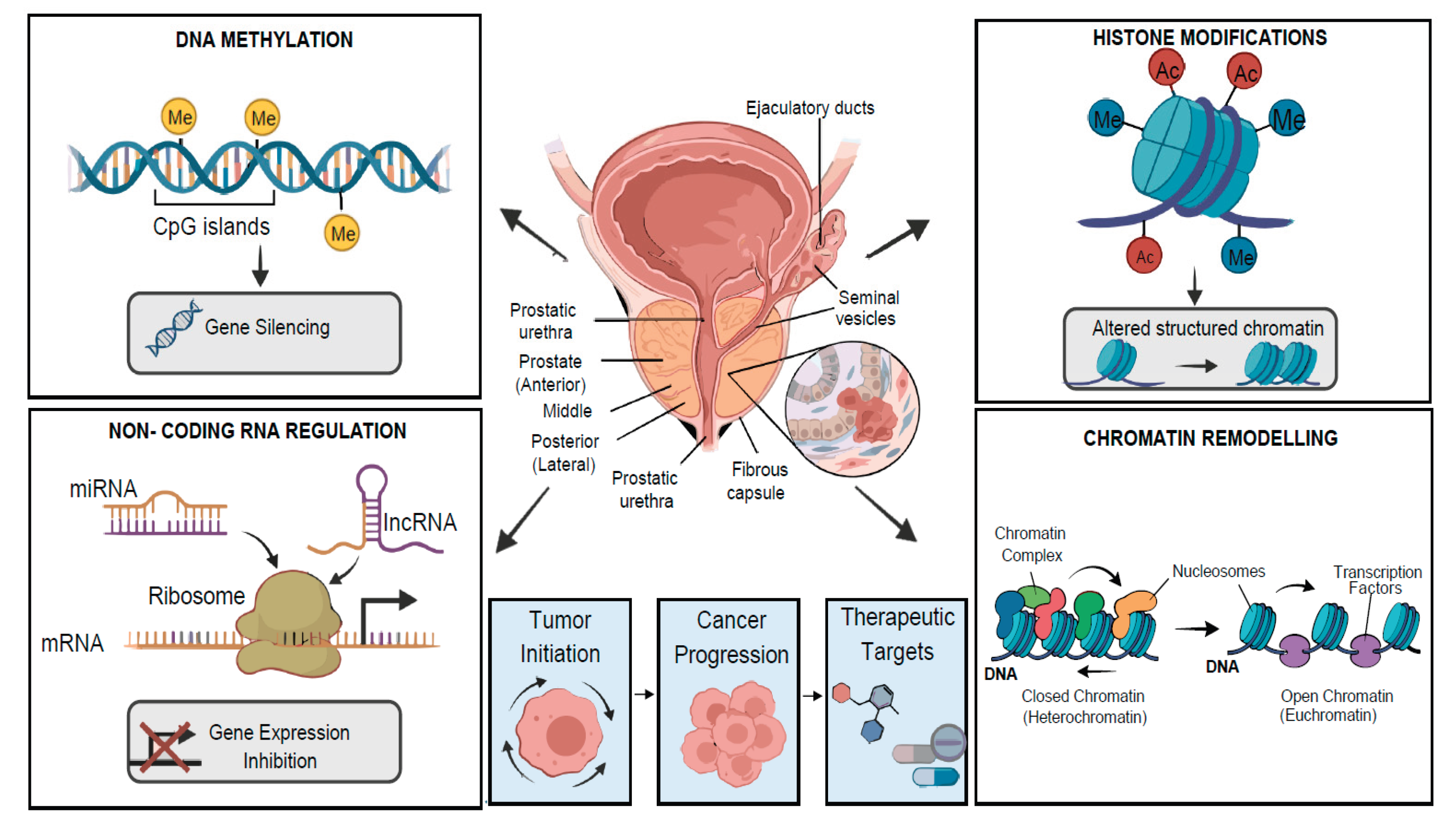

Table 1.
Clinical Trials Evaluating Epigenetic-targeting Agents in Prostate Adenocarcinoma.
| Setting | Trial (NCT) | Phase | Year | Study drug | Target | Combination | Primary endpoint | Status | N | Results |
|---|---|---|---|---|---|---|---|---|---|---|
| Early | NCT04812366 [36] | 2 | 2021 | Tazemetostat | EZH2 inhibitor | Apalutamide, Abiraterone, Prednisone, Docetaxel, Niraparib, Atezolizumab, Capivasertib | pCR, pMRD | Recruiting | 315 | - |
| Early | NCT05567679 [37] | 1 | 2023 | Tazemetostat | EZH2 inhibitor | - | Safety and Proportion of pts able to undergo surgery | Withdrawn (PI voluntarily closed the study) | 0 | - |
| M0 | NCT03572387 [38] |
2 | 1018 | 5-Azacitidine | DNMT inhibitor | All trans retinoic acid (ATRA) | Changes in PSADT, TTNT | Completed | 14 | The combination of AZA and ATRA was feasible and prolonged PSA kinetics in a subset of pts, with a favorable safety profile |
| mHSPC | NCT07028853 [39] | 3 | 2025 | PF-06821497 (Mevrometostat) | EZH2 inhibitor | Enzalutamide | rPFS | Recruiting | 1000 estimated | - |
| mHSPC | NCT07190300 [40] | 1/2 | 2026 | DZR123 (Tulmimetostat) | EZH1 and EZH2 inhibitor | Abiraterone, Enzalutamide | Safety, PSA response rate | Recruiting | 181eestimated | - |
| mCRPC | NCT01075308 [41] | 2 | 2010 | SB939 | HDAC inhibitor | - | PSA response; PFS | Completed | 32 | Not sufficient activity |
| mCRPC | NCT00878436 [43] | 1/2 | 2009 | LBH589 (Panobinostat) | HDAC inhibitor | Bicalutamide | Percentage of pts free of progression and without symptomatic deterioration | Completed | 52 | The proportion of pts that achieved rPFS at was 40% (8/20 pts) at 6 mo (p = 0.006), 25% (5/20 pts) at 9 mo (p = 0.35) |
| mCRPC | NCT04703920 [44] |
1 | 2021 | Belinostat | HDAC inhibitor | Talazoparib | Safety | Completed | 26 | Favourable safety profile. Further studies are warranted to determine the efficacy of this combination. |
| mCRPC | NCT03829930 [63] | 1 | 2019 | Entinostat | HDAC inhibitor | Enzalutamide | Safety | Terminated (Sponsor discontinued the drug) | 6 | Entinostat at the selected dose levels (3 and 5 mg per week), in combination with Enzalutamide showed promising safety profile |
| mCRPC | NCT06145633 [64] | 2 | 2024 | Vorinostat | HDAC inhibitor | Lutetium Lu 177 Vipivotide Tetraxetan | Proportion of patients who convert from PSMA low to PSMA high | Active, recruiting | 15 estimated | - |
| mCRPC | NCT03709550 [45] | 1/2 | 2021 | Decitabine | DNMT inhibitor | Enzalutamide | Safety | Withdrawn (lack of funding) | 0 | - |
| mCRPC | NCT05037500 [46] | 1 | 2022 | Decitabine | DNMT inhibitor | Cedazuridine, Enzalutamide | Safety | Terminated (PI closed the study) | 8 | - |
| mCRPC | NCT04471974 [47] |
2 | 2021 | ZEN-3694 | BET inhibitor | Enzalutamide, Pembrolizumab | Composite Response Rate | Active, not recruiting | 61 | The combination had an acceptable safety profile |
| mCRPC | NCT02711956 [48] |
1/2 | 2016 | ZEN-3694 | BET inhibitor | Enzalutamide | Safety | Completed | 75 | Favourable safety profile |
| mCRPC | NCT06922318 [49] | 2 | 2025 | ZEN-3694 | BET inhibitor | Enzalutamide | Clinical/radiographic PFS with ZEN-3694; PSA-PFS with combo ZEN-3694 and Enzalutamide | Recruiting | 50 estimated |
- |
| mCRPC | NCT04986423 [50] | 2 | 2021 | ZEN-3694 | BET inhibitor | Enzalutamide | rPFS | Recruiting | 200 estimated | - |
| mCRPC | NCT02607228 [51] |
1/2 | 2015 | GS-5829 (Alobresib) | BET inhibitor | - | Safety and non-progression rate at week 24 | Terminated | 31 | GS-5829 was generally tolerated but demonstrated limited efficacy and lack of dose proportional increases in plasma concentrations |
| mCRPC | NCT02431260 [52] | 1/2 | 2015 | INCB054329 | BET inhibitor | - | Safety | Terminated (by the sponsor due to PK variability) | 69 | - |
| mCRPC | NCT02711137 [53] |
1/2 | 2016 | INCB057643 | BET inhibitor | Different drugs | Safety | Teminated (due to safety issues) | 137 | Thrombocytopenia limited the target inhibition that could be safely maintained |
| mCRPC | NCT03150056 [65] | 1 | 2017 | GSK525762 | BET inhibitor | Abiraterone, Prednisone, Enzalutamide | Safety | Terminated (due to meeting protocol defined futility) | 73 | - |
| mCRPC | NCT02705469 [66] | 1 | 2016 | ZEN003694 | BET inhibitor | - | Safety | Completed | 44 | - |
| mCRPC | NCT02698176 [67] | 1 | 2016 | Birabresib | BET inhibitor | - | Safety | Terminated (due to limited efficacy and not due to safety reasons) | 13 | - |
| mCRPC | NCT04145375 [68] | 1/2 | 2019 | ZEN003694 | BET inhibitor | Enzalutamide | Safety | Enrolling by invitation | 40 | - |
| mCRPC | NCT02259114 [69] |
1 | 2017 | OTX015/MK-8628 (Birabresib) | BET inhibitor | - | Safety | Completed | 47 | Birabresib has a favorable safety profile. RP2D 80 mg once daily continuously |
| mCRPC | NCT05252390 [70] | 1 | 2022 | NUV-868-01 | BET inhibitor | Olaparib, Enzalutamide | Safety | Terminated | 82 | - |
| Solid Tumors including CRPC | NCT04686682 [71] | 1/2 | 2021 | JAB-8263 | BET inhibitor | - | Safety | Recruiting | 152 estimated | - |
| mCRPC | NCT06629779 [54] | 3 | 2024 | PF-06821497 (Mevrometostat) | EZH2 inhibitor | Enzalutamide | rPFS | Active, recruiting | 900 | - |
| mCRPC | NCT06551324 [55] | 3 | 2024 | PF-06821497 (Mevrometostat) | EZH2 inhibitor | Enzalutamide, Docetaxel | rPFS | Active, not recruiting | 600 | - |
| mCRPC | NCT07592910 [56] | 2 | 2026 | PF-06821497 (Mevrometostat) | EZH2 inhibitor | Enzalutamide | rPFS | Active, not recruiting | 60 | - |
| mCRPC | NCT04179864 [57] |
1/2 | 2019 | Tazemetostat | EZH2 inhibitor | Enzalutamide, Abiraterone, Prednisone | Safety, rPFS | Terminated (by the Sponsor) | 109 | Combination therapy with TAZ+ENZ extended median rPFS by 2.8 mo, although this was not statistically significant. No significant difference was identified for ORR |
| mCRPC | NCT04846478 [58] |
1 | 2021 | Tazemetostat | EZH2 inhibitor | Talazoparib | Safety | Active, not recruiting | 35 | RP2D of talazoparib 0.75 mg daily and tazemetostat 800 mg twice daily was associated with expected myelosuppression but otherwise acceptable safety profile, with clinical benefit seen in a minority of pts |
| PCa cohort | NCT04104776 [59] |
1/2 | 2019 | DZR123 (Tulmimetostat) | EZH1 and EZH2 inhibitor | Enzalutamide | Safety and PSA response, ORR | Recruiting | 300 estimated |
Safety profile consistent with previous data. Based on ORR the ovarian (M2), endometrial (M3), and mesothelioma (M5) cohorts |
| mCRPC | NCT03480646 [72] |
1/2 | 2017 | CPI-1205 | EZH2 inhibitor | Enzalutamide, Abiraterone, Prednisone | Safety and Efficacy (best ORR Percent by treatment group, percentage of subjects with PSA30, percentage of subjects with PSA50, Composite Response Rate | Completed | 175 | no results posted |
| mCRPC | NCT03741712 [73] | 1/2 | 2019 | SHR2554 | EZH2 inhibitor | SHR3680 | Safety, PSA response rate | Terminated (by the Sponsor) | 9 | - |
| mCRPC | NCT07244341 [74] | 1 | 2025 | DS3201 (Valemetostat) | EZH1 and EZH2 inhibitor | Darolutamide | Safety | Recruiting | 60 estimated | - |
| mCRPC | NCT04388852 [75] | 1 | 2020 | DS3201 (Valemetostat) | EZH1 and EZH2 inhibitor | Ipilimumab | Safety | Active, not recruiting | 65 | - |
| mCRPC | NCT03460977 [76] |
1 | 2018 | PF-06821497 (Mevrometostat) | EZH2 inhibitor | Enzalutamude, Itraconazole | Safety | Recruiting | 453 estimated | PF-06821497 875 mg twice daily and Enzalutamide show promising outcomes and a manageable safety profile. |
| mCRPC | NCT06632977 [77] | 2 | 2025 | DS3201 (Valemetostat) | EZH1 and EZH2 inhibitor | Abiraterone, Prednisone, Enzalutamide, Cabazitaxel, Carboplatin, Lutetium Lu 177 | ORR | Recruiting | 474 estimated | - |
| Prostate cancer (adenocarcinoma) | NCT07230106 [78] | 2 | 2018 | SHR2554 | EZH2 inhibitor | HS-20093, SHR3680, Abiraterone, Enzalutamide, Darotamine | Safety and PSA response rate | Recruiting | 218 estimated | - |
| Prostate cancer (adenocarcinoma) | NCT07407283 [79] | 1/2 | 2026 | Tazemetostat | EZH2 inhibitor | SHR-4394, Rezvilutamide, HRS-5041 | Safety and PSA response rate | Recruiting | 100 estimated |
- |
Abbreviations: ATRA, all trans retinoic acid; AZA, azacitidine; BET, bromodomain and extra-terminal; DNMT, DNA methyltransferase; EZH1, enhancer of zeste homolog 1; EZH2, enhancer of zeste homolog 2; HDAC, histone deacetylase; M0, non-metastatic hormone-sensitive prostate cancer; mCRPC, metastatic castration-resistant prostate cancer; mHSPC, metastatic hormone-sensitive prostate cancer; N, number of patients enrolled/planned; NCT, National Clinical Trial identifier; ORR, objective response rate; PSA, prostate-specific antigen; pCR, Complete Pathologic Response; PFS, progression-free survival; PI, Principal Investigator; pMRD, Pathological Minimal Residual Disease; PSADT, prostate-specific antigen doubling time; PSMA, prostate-specific membrane antigen; pts, patients; RP2D, recommended phase II dose; rPFS, radiographic progression-free survival; TTNT, time to next treatment; '-', not available/not applicable.
Table 2.
Clinical Trials Evaluating Epigenetic-targeting Agents in NEPC.
| Setting | Trial (NCT) | Phase | Year | Study drug | Target | Combination | Primary endpoint | Status | N | Results |
|---|---|---|---|---|---|---|---|---|---|---|
| Solid Tumors (including neuroendocrines cancers) | NCT02875223 [80] |
1 | 2016 | CC-90011 | LSD1 Inhibitor | Rifampicine, Itraconazole | Safety | Terminated (Business objectives have changed) | 75 (7 prostate cancer) | CC-90011 is well tolerated; RP2D established as 60 mg once per week; MTD and NTD were determined to be 80 mg once per week and 120 mg once per week |
| Neuroendocrine carcinomas | NCT05420636 [82] |
2 | 2022 | Iadademstat | LSD1 Inhibitor | Paclitaxel | ORR | Terminated (Closed to accrual due to low probability of successful outcomes) | 20 | Efficacy was insufficient to meet the prespecified threshold |
| Selected solid tumor cohorts, including high grade neuroendocrine; prostate | NCT07517198 [83] | 1 | 2026 | EXS74539 (REC-4539) | LSD1 Inhibitor | - | Safety | Recruiting | 40 estimated | - |
| Metastatic aggressive variant prostate cancers | NCT04388852 [75] |
1 | 2020 | DS3201 (Valemetostat) | EZH1 and EZH2 inhibitor | Ipilimumab | Safety | Active, not recruiting | 65 | DS3201 combined with ipilimumab was well tolerated and showed activity in heavily pretreated patients with refractory genitourinary tumors |
| High grade neuroendocrine neoplasms | NCT06406465 [84] | 2 | 2026 | Belinostat | HDAC inhibitor | Cisplatin, Etoposide | To determine if pharmacogenomic intervention can normalize the area under the curve (AUC) at cycle 6 between UGT1A1*28 and UGT1A1*60 genotypes) of belinostat administered as a continuous 48 h infusion in combination with cisplatin and etoposide | Recruiting | 60 estimated |
- |
Abbreviations: EZH1, enhancer of zeste homolog 1; EZH2, enhancer of zeste homolog 2; HDAC, histone deacetylase; LSD1, lysine-specific demethylase 1; MTD, maximum tolerated dose; N, number of patients enrolled/planned; NCT, National Clinical Trial identifier; NTD, Non Tolerated Dose; ORR, objective response rate; RP2D, recommended phase II dose; '-', not available/not applicable.
Disclaimer/Publisher’s Note: The statements, opinions and data contained in all publications are solely those of the individual author(s) and contributor(s) and not of MDPI and/or the editor(s). MDPI and/or the editor(s) disclaim responsibility for any injury to people or property resulting from any ideas, methods, instructions or products referred to in the content. |
© 2026 by the authors. Licensee MDPI, Basel, Switzerland. This article is an open access article distributed under the terms and conditions of the Creative Commons Attribution (CC BY) license.
Copyright: This open access article is published under a Creative Commons CC BY 4.0 license, which permit the free download, distribution, and reuse, provided that the author and preprint are cited in any reuse.