

Submitted:
04 September 2026
Posted:
07 September 2026
You are already at the latest version
Abstract
The present study investigates the effect of synthetic diamond nanoparticles as functional modifiers of NiCoP coatings, simultaneously addressing their corrosion resistance and bifunctional HER/OER electrocatalytic performance on Fe-steel substrates. A direct comparison between electroless and electrodeposition routes is presented. The corrosion behaviour of the coatings was evaluated ex situ in 1 M and 6 M KOH electrolytes to assess their stability under both operating and accelerated degradation conditions. The as-prepared and alkali-treated coatings were characterized by potentiodynamic polarization measurements, X-ray diffraction (XRD), field-emission scanning electron microscopy coupled with energy-dispersive spectroscopy (FE-SEM/EDS), and X-ray fluorescence (XRF) analysis. In addition, their bifunctional electrocatalytic performance toward the hydrogen evolution reaction (HER) and oxygen evolution reaction (OER) was evaluated. The results demonstrate that synthetic diamond incorporation influences the corrosion behaviour of NiCoP coatings; however, the magnitude and direction of this effect depend strongly on both the deposition route and the electrolyte concentration. Furthermore, co-electrodeposition combined with synthetic diamond nanoparticles emerges as a promising approach for developing PGM-free, diamond-modified NiCoP composite coatings on commercially available Fe-steel substrates, providing an effective balance between coating microstructure, corrosion resistance, and bifunctional electrocatalytic performance.
Keywords:
diamond-NiCoP/Fe-steel
; PGM-free coatings
; corrosion resistance
; electrodeposition
; electroless
; alkaline water splitting
; HER
; OER
1. Introduction
Green hydrogen generating from hydrogen carriers such as ammonia, methanol, and other synthetic fuels represents a new generation of energy carriers. These fuels are among the key trends shaping the development of clean technologies towards 2030. In this framework, the green fuels are pathways reducing carbon emissions and transitioning to a sustainable, low-carbon future, but they still remain a challenge. Achieving carbon neutrality continues to be a critical issue and a key focus for 2030. Current efforts are more and more focused on defining and implementing the long-term vision for climate neutrality by 2050 strategy [1,2,3,4].
Green hydrogen, fully renewable, is today a central feedstock in the energy sector and represents a major opportunity for the decarbonization targets and transition toward sustainability. One requirement income that new electrolyzers needs to be produced hydrogen using additional, renewable electricity, such as solar or wind energy. Got hydrogen is very low associated carbon footprint. Thus, water electrolysis allowing better integration with hydrogen fuel cells (FCs) into of renewable energy production system, supplying efficient and clean electricity to remote and off-grid areas [5,6,7]. The benefits of the green hydrogen as a renewable clean energy source defined this topic of considerable scientific and technological point of view and particularly noteworthy and sets the targets of research and innovation.
Electrocatalytic water splitting is employed in small-scale hydrogen production systems and involves two half-reactions: the anodic oxygen evolution reaction (OER) and the cathodic hydrogen evolution reaction (HER). For large-scale hydrogen production three predominant types electrolyzers are being considered as predominant, alkaline electrolyzers, proton exchange membrane (PEM) and solid oxide electrolyzers [8]. Alkaline water electrolysis cells (AEC) are refer to electrolyzers with the lowest capital costs, ideal for converting electrical energy from renewable sources into green hydrogen with minimal environmental impact. AEC implementation is appropriate for producing hydrogen in large quantities, although it faces challenges such as slow electrochemical kinetics and high electricity consumption [9,10]. The prosses in the alkaline electrolytes system (H2O(l) → H2(g) + ½O2(g)) is constituted by a pair of electrodes immersed in an alkaline solution, usually potassium hydroxide at a concentrations 1-7 M KOH. The scaling of the water splitting prosses still presents a challenge because of requirements for high performance under commercially operating conditions. Achieving commercially viable current densities at low overpotentials is essential, improving the suitability of alkaline electrolyzers for off-grid applications. An additional innovation in alkaline water splitting is the use of bifunctional electrodes, capable of catalyzing both the hydrogen and oxygen evolution reactions [11,12,13].
Development of catalysts is related to the race is on to scale production and scalable method of synthesis, proving durability and reliability. Their performance depends on materials. Main factors are better catalyst activity and durability as well as structure – porosity, surface area control, particle size, electronic properties. The high cost of noble metal catalysts remains a major barrier to their widespread deployment. The lower costs can achieve through better catalyst materials, not only via cheaper metals and substrates. The engineering of multicomponent catalysts is a promoted strategy for in realizing the prospective performance in HER and OER presses. Enhancing overall water-splitting performance remains challenging in the rational design of non-noble-metal catalysts.
Developing efficient non-noble-metal-based electrocatalysts is essential for scalable applications. It is well-known that engineering multicomponent heteroatom doping structure by phosphides is the strategy to modify the electronic structure in realizing the prospective water splitting performance. Nickel-cobalt-phosphorus (NiCoP) composite coatings have emerged as promising materials due to their unique combination of mechanical hardness, thermal and structural stability, and corrosion resistance under harsh conditions of the alkaline electrolyzers [14,15,16]. The latest investigations are focused onto the rational design of the bifunctional composite-structed phosphide-based catalysts for water splitting [12,17,18]. In parallel, noble metal doping (e.g., Ru, Ir) remains a research direction for developing cost-effective bifunctional electrocatalysts for practical large-scale water splitting, offering a high-performance alternative to fully noble-metal-based catalysts such as Pt/C and RuO2 [19,20].
In our recently published study, the bifunctional HER and OER catalytic potential of co-electrodeposited NiCoP composite coatings fabricated on 2D-structured Fe-steel plates (FS) plates as commercially available substrate was explored vs. performance of NiCoP on 3D-structured nickel foam [21]. The creating of non-noble electrine compositions was combined with application of co-electrodeposition as relatively simple synthesis method suitable for practical realization and scalability. The NiCoP/FS configuration, with nominal composition 50wt.% Ni−50wt.% Co−7wt% P, was demonstrated potential for practical application in alkaline electrolysers. The resulting active 3D high-surface-area NiCoP composite coating, composed of individual spherical particles, effectively provides abundant active sites and facilitates reactant transport, thereby improving the overall electrochemical efficiency. Furthermore, phosphorus doping enhanced the electronic structure and charge-transfer properties of the NiCoP coating on 2D Fe-steel compared with 3D nickel foam, making it a suitable electrode for overall water-splitting applications.
From this perspective, assessing the degradation of noble-free NiCoP/Fe-steel coatings caused by electrochemical interaction with the alkaline electrolyte is essential for understanding their long-term stability and for further developing robust and highly efficient bifunctional electrodes for alkaline water electrolysis. The studies reported in the literature have demonstrated that synthetic diamond nanoparticles enhance the corrosion resistance of coatings owing to their chemical inertness and their lack of participation in electrochemical reactions [22,23,24].
Following our previous study on the development of noble-metal-free bifunctional NiCoP/Fe-steel coatings for alkaline electrolysis [21], the present work addresses the next essential step, namely the evaluation of their corrosion stability under alkaline operating conditions. Since electrochemical degradation directly affects the long-term durability of the coatings, understanding the influence of synthetic diamond nanoparticle incorporation on their corrosion behaviour is of particular importance. Therefore, the aim of this work is to elucidate the role of synthetic diamond nanoparticles incorporated into nickel–cobalt–phosphide (NiCoPD) composite coatings in improving corrosion resistance during alkaline water electrolysis. A comparative investigation of the corrosion behaviour of NiCoP and NiCoPD composite coatings in relation to the deposition technique was carried out. Two deposition methods, electrodeposition (ED) and electroless deposition (EL), both widely employed in industrial applications, were investigated. The corrosion behaviour of the coatings was evaluated ex situ in 1M and 6M KOH solutions to assess their stability under both operating and accelerated degradation conditions. The as-prepared and alkali-treated coatings were systematically characterized using potentiodynamic polarization measurements, X-ray diffraction (XRD), field-emission scanning electron microscopy coupled with energy-dispersive spectroscopy (FE-SEM/EDS), and X-ray fluorescence (XRF) analysis. In addition to evaluating corrosion stability, the influence of synthetic diamond nanoparticle incorporation on the bifunctional HER/OER electrocatalytic performance of the electrodeposited and electroless NiCoP/Fe-steel coatings was also assessed by comparing the HER and OER overpotentials in alkaline electrolyte. Although synthetic diamond particles have been widely incorporated into metallic coatings to improve corrosion resistance, their influence on the HER and OER electrocatalytic performance of diamond-NiCoP/Fe-steel coatings remains largely unexplored. The results demonstrate that the deposition method plays a key role in determining the influence of synthetic diamond nanoparticle incorporation on the corrosion stability and bifunctional electrocatalytic performance of NiCoP coatings.
2. Materials and Methods
2.1. Reagents and Materials
Nickel(II) sulfate hexahydrate (NiSO4·6H2O), Nickel(II) Chloride Hexahydrate (NiCl2·6H2O), Cobalt(II) sulfate heptahydrate (СoSO4·7H2O), Cobalt(II) chloride hexahydrate (CoCl2·6H2O), Sodium hypophosphite monohydrate (NaH2PO2·H2O), Trisodium citrate (C6H5O7Na3), Ammonium sulfate ((NH4)2SO4), Aminoacetic acid (C2H5NO2), Hydrochloric (HCl) acid and Potassium hydroxide (KOH) were procured by Sigma-Aldrich (affiliates of Merck KGaA, Darmstadt, Germany). All reagents were of ‘pro analyse’ purity grade and utilized as received without further purification. Freshly prepared deionized (DI) water was used throughout the experiments.
The synthetic diamond nanoparticles (D) with dimensions of 0.05 μm were used. Prior to addition to the solution, all particles were subjected to preliminary treatment in aqueous solution of sodium laurylsulphonate (SLS) with concentrations of 0.01 g l-1 at room temperature.
The Fe-steel plate (FS) (C-0.12, Mn-0.6, P-0.045 and S-0.045 wt. %, Metall-Folien GmbH, Mühlheim am Main, Germany), factory galvanized for corrosion protection, was used as conductive substrate. In the beginning, the surfaces of the Fe-steel substrates (3 cm × 2.5 cm in size) activated by immersion in 3M HCl for 5 minutes to completely dissolve the Zn coating from the surface. After that the FS plates were thoroughly washed with deionized (DI) water.
2.2. Preparation of NiCoP and NiCoPD Composite Coatings
The present study was based on the NiCoP coating deposited by electrodeposition on a 2D Fe-steel substrate with a nominal Ni/Co weight ratio of 50/50. This composition was selected based on its superior bifunctional HER/OER electrocatalytic performance demonstrated in our previous study [21]. Subsequently, NiCoP and diamond-added NiCoPD composite coatings were prepared by both electrodeposition (ED) and electroless deposition (EL) for the comparative corrosion study. The coatings prepared by electroless deposition were designated as NiCoP–EL and NiCoPD–EL, whereas those prepared by electrodeposition were designated as NiCoP–ED and NiCoPD–ED. Two solutions for steel metallization were prepared. Diamond particles were pre-wetted with sodium lauryl sulfate (SLS) to improve their dispersion prior to being added separately to each plating solution. The required amounts of metal salt precursors and complexing agents were dissolved in 1000 mL of deionized (DI) water under vigorous stirring for 30 minutes to obtain a transparent, homogeneous electrolyte solution. The electrolyte compositions are listed in Table S1 and S2.
2.2.1. Co-Electrodeposition of the NiCoP–ED and NiCoPD–ED Composite Coatings Fe-Steel Plates
The co-electrodeposition (ED) of NiCoP coatings was carried out using the procedure for substrate. Typically, 200 mL of the corresponding electrolyte was placed in a 300 mL glass beaker and heated to 50 °C. Once the temperature reached 50 °C, two Ni-electrodes were immersed in the electrolyte. The rectifier was adjusted to the appropriate current density for the deposition process. The freshly activated substrates were then positioned between the Ni-electrodes and fully immersed in the electrolyte under current. After the deposition time had elapsed (Table S1), the as-deposited NiCoP electrode samples were removed, thoroughly washed with DI water, and dried in static air.
2.2.2. Electroless Co-Deposition of the NiCoP–EL and NiCoPD–EL Composite Coatings Fe-Steel Plates
The chemical co-deposition of the coatings (EL) was carried out in a solution containing dispersed particles and a surfactant, heated to the required temperature. The deposition was conducted for 10 min (Table S2), analogous to the electrodeposited coatings. Subsequently, the samples were removed from the solution and rinsed with distilled water.
The near-surface bulk composition of the NiCoP–ED, NiCoPD–ED and NiCoP–EL, NiCoPD–EL composite coatings from FE-EDS analysis at magnification ×100 is provided in the Supplementary Material (Table S3). Initial coating state are hereafter referred to as “as-deposited”.
2.3. Corrosion Measurements in 1M and 6M KOH Solutions
The corrosion behaviour of the electroless and electrodeposited NiCoP and NiCoPD composite coatings was evaluated by potentiodynamic polarization measurements in 1M and 6M KOH solutions. The samples after the corresponding corrosion measurements are hereafter referred to as “post-exposure”.
Potentiodynamic polarization measurements were carried out using a Gamry Interface 1000 potentiostat/galvanostat in a conventional three-electrode electrochemical cell at a scan rate of 1 mV s⁻¹. The potential was scanned from −50 mV relative to the open-circuit potential (EOCP) to +1500 mV vs. the saturated calomel electrode (SCE). A platinized titanium mesh served as the counter electrode, while a saturated calomel electrode (SCE) was used as the reference electrode. The corrosion potential (Ecorr) and corrosion current (Icorr) were determined by Tafel extrapolation of the polarization curves.
2.4. Electrochemical Evaluation for HER and OER of the Electrodeposited and Electroless NiCoP and NiCoPD Coatings
All electrochemical measurements were carried out in a conventional three-electrode cell using a platinum counter electrode and a Hg/HgO reference electrode. The NiCoP- and NiCoPD-coated Fe-steel substrates served as the working electrodes. The measurements were performed in 1 M KOH (pH 14) at room temperature using a potentiostat/galvanostat (Model 263A, EG&G Princeton Applied Research, USA). Prior to each experiment, the working electrode was stabilized at the open-circuit potential (OCP) for 30 min. Linear sweep voltammetry (LSV) measurements were carried out at a scan rate of 25 mV s⁻¹ using an exposed electrode area of 0.2 cm². Depending on the investigated reaction, the potential was scanned from the OCP to a vertex potential of −1.6 V for the hydrogen evolution reaction (HER) and from the OCP to 1.2–1.6 V for the oxygen evolution reaction (OER), after which the scan was reversed to the initial potential. After each measurement, the electrodes were rinsed with deionized water, and all measured potentials were converted to the standard hydrogen electrode (SHE) scale.
The HER and OER overpotentials (ηHER and ηOER) were determined from the LSV curves at a current density of 10 mA cm⁻² according to η=E−Eeq equation, where E is the measured electrode potential and Eeq is the thermodynamic equilibrium potential.
2.5. Physicochemical Characterization
The study began with an analysis of the surface and structure of the fresh (synthesized) coatings on two deposition method, electroless (current-free) and electrochemical co-deposition. After corrosion testing in 1M and 6M KOH solutions, the physicochemical properties of the post-exposure electrodes were characterized using PXRD and FE-SEM-EDS.
2.5.1. Field-Emission Scanning Electron Microscopy-Energy Dispersive Spectroscopy (FE-SEM-EDS)
The morphology and qualitative elemental composition of the as-synthesized electrode samples were investigated using a “JEOL IT800SHL” field-emission scanning electron microscope (FE-SEM) equipped with secondary- and backscattered-electron detectors (SED/VBED). Images were acquired at a landing voltage of 10.0 kV under high-vacuum conditions. Local elemental composition was determined by EDS point analysis. After corrosion testing, the post-exposure coatings were further characterized by FE-SEM together with EDS point analyses and FE-SEM-EDS area scans.
2.5.2. X-Ray Diffraction (XRD)
XRD thin films analysis of the as-synthesized electrode samples was performed by Philips PW 1830 generator equipped with PW 1050 goniometer. Experimental conditions: 2theta Scan Axis, 7o start position and 100.00° 2Theta end position; step size 0.05° 2Theta and scan step time of 3 s. Additional calculations from the obtained diffraction patterns and their phase analysis were performed in the Match! Program [25] using the free crystallographic database COD [26].
2.5.3. X-Ray Fluorescence (XRF)
The coating thickness of the fresh prepared and aged electroless and electrodeposited NiCoP and NiCoPD coatings and were determined by X-ray fluorescence.
3. Results
3.1. Surface Morphology and Structural Characterization of the As-Deposited Coating State of the Electrodeposited and Electroless NiCoP and NiCoPD Coatings
The microstructures of the as-deposited NiCoP–EL, NiCoPD–EL, NiCoP–ED, and NiCoPD–ED coatings are shown in Figure 1. A general inspection of the FE-SEM images reveals definitely different surface morphologies for the diamond-free NiCoP coatings prepared by the electroless and electrodeposition methods. The electroless-deposited NiCoP–EL coating exhibits a relatively smooth and compact surface with a few isolated particles (Figure 1a). In contrast, the electrodeposited NiCoP–ED coating is characterized by a homogeneous distribution of spherical protrusions with diameters of up to 10 μm (Figure 1b). This three-dimensional morphology is consistent with our previous observations for phosphorus-doped NiCo coatings [21]. A similar 3D-network composed of spherical protrusions has also been reported for electrodeposited Co–Ni–P coatings on carbon fiber paper [27].
As shown in Figure 1c, the incorporation of diamond particles into the electroless NiCoPD–EL coating promotes the formation of localized cauliflower-like clusters, which become more evident at higher magnification. At first glance, the overall surface morphology of the electrodeposited NiCoPD–ED coating remains similar to that of the diamond-free NiCoP–ED coating (Figure 1d). However, closer inspection reveals that diamond incorporation modifies the microstructure, resulting in a denser packing of the spherical protrusions and the presence of partially coalesced protrusions with diameters exceeding 10 μm. General, the incorporation of diamond nanoparticles does not alter the characteristic surface features of either the electroless or the electrodeposited NiCoP coatings, but leads to subtle modifications in their surface microstructure.
EDS point analysis was performed on selected surface of the as-deposited NiCoPD–EL and NiCoPD–ED coatings to determine their local elemental composition of the observed microstructural features (Figure 2a,b). The cauliflower-like clusters observed on the NiCoPD–EL coating exhibit compositional heterogeneity (Figure 2a). The red-marked region (Spc_010) is dominated by carbon (86.9 wt.%). It is noteworthy that the composition of the Spc_011 particle contains smaller amounts of Ni, Co, and P. whereas the blue-marked region (Spc_011) contains characteristic composition of the electroless NiCoPD coating.
In contrast, EDS point analysis of the NiCoPD–ED coating (Figure 2b) reveals two characteristic surface features with distinct morphologies but considerably smaller variations in their local elemental composition. Both the spherical protrusion (Spc_008) and the relatively flat surface region (Spc_009) contain the characteristic composition of the electrodeposited NiCoPD coating (Ni, Co, P, C). However, the spherical protrusion exhibits higher carbon and oxygen contents, whereas the flat surface region is relatively enriched in nickel and small difference in phosphorus amount.
The crystalline structure and phases of the as-deposited NiCoP–EL, NiCoPD–EL, NiCoP–ED, and NiCoPD–ED coatings was identified. Figure 3 presents the diffraction patterns of NiCoP deposited by two different methods, along with diamond particles. The two bottom graphs are compared with the signal from a Zero background XRD sample holder recorded under identical conditions, facilitating the easy identification of any amorphous halos in the experimental patterns. In both cases, the NiCoP coatings are amorphous, exhibiting two distinct amorphous halos between 15-35° (2θ) and 35-55° (2θ), corresponding to (b) and (c) diffraction patterns (Figure 3). The peak intensity distribution of co-deposited samples reveals that the electrodeposition method leads to higher inclusion rates of diamond particles. All samples also show the characteristic peak of the Fe-steel type used as substrate (Figure 7c-e), identified with a card reference number ICSD: 98-063-1728.
3.3. Corrosion Performance in 1М and 6М KOH Solutions
The corrosion behavior of the as-deposited electroless and electrochemical co-deposited composite coatings, NiCoP–EL, NiCoPD–EL and NiCoP–ED, NiCoPD–ED were evaluated by potentiodynamic measurements in both 1M and 6M KOH solutions. The 6 M KOH solution was intentionally selected to accelerate corrosion processes under highly alkaline conditions. The elevated hydroxide concentration promotes faster dissolution of the NiCoP and NiCoPD coatings, providing a more stringent evaluation of their chemical stability. This accelerated corrosion approach enables the assessment of the coatings’ resistance to long-term chemical degradation within a shorter experimental period, while allowing the effects of diamond nanoparticle incorporation and the deposition method on corrosion behaviour to be clearly distinguished.
3.2.1. Potentiodynamic Polarization Behavior of the Electrodeposited and Electroless NiCoP and NiCoPD Coatings in 1M KOH
Firstly, the corrosion behavior of the fourth NiCoP–EL, NiCoPD–EL and NiCoP–ED, NiCoPD–ED electrodes was tested in the regular electrolyte employed of 1M KOH solution for alkaline water electrolysis. The corrosion parameters obtained from Tafel extrapolation in 1 M KOH electrolyte are listed in Table 1. All investigated NiCoP and NiCoPD coatings exhibited low corrosion current (Icorr) values, ranging from 6.8 × 10⁻⁸ to 1.4 × 10⁻⁷ A.
Among them, the electroless NiCoP–EL coating displayed the lowest corrosion current (6.8 × 10⁻⁸ A), indicating the highest corrosion resistance among the investigated coatings in 1M KOH. The addition of synthetic diamond particles to the electroless coating slightly increased Icorr to 1.1 × 10⁻⁷ A, which shows slight decrease in corrosion resistance. For the electrodeposited coatings, the incorporation of diamond particles led to a small variation in the corrosion current from 1.4 × 10⁻⁷ A (NiCoP–ED) decreasing to 1.2 × 10⁻⁷ A (NiCoPD–ED), suggesting modest beneficial effect diamond contribution of diamond incorporation to corrosion resistance in 1M KOH electrolyte.
The relatively narrow variation in the Icorr values indicates similar corrosion kinetics among the investigated coatings in 1M KOH. In particular, the NiCoPD coatings deposited by electrodeposition and electroless deposition exhibited nearly identical Icorr values (1.2 × 10⁻⁷ and 1.1 × 10⁻⁷ A, respectively), suggesting that the deposition route has only a limited effect on the corrosion behaviour of the diamond-containing coatings under these conditions. Although both diamond-modified NiCoPD coatings exhibited more negative Ecorr values than their diamond-free counterparts, their Icorr values remained nearly unchanged, indicating that the lower corrosion potentials were not accompanied by accelerated corrosion kinetics under the investigated 1M KOH conditions.
The polarization curves shown in Figure 4 provide additional insight into the anodic behaviour of the diamond-free NiCoP coatings. Both the electroless (Figure 4a) and electrodeposited (Figure 4b) coatings exhibited a distinct anodic peak immediately above the corrosion potential, followed by a decrease in the anodic current and the establishment of a passive region. The initial anodic peak is commonly associated with the surface oxidation of nickel and cobalt and the formation of hydroxide species. During anodic polarization, Ni(OH)₂ may be progressively oxidized to NiOOH, while Co(OH)₂ may undergo an analogous transformation to CoOOH. The formation of such hydroxide/oxyhydroxide surface layers has been widely reported for Ni- and Co-containing materials under alkaline anodic polarization, where they are associated with passive behaviour and may retard further anodic dissolution, thereby contributing to the stabilization of the coating surface under alkaline conditions [28,29,30,31].
For the electroless coatings, the NiCoPD–EL coating maintained relatively low anodic currents over a broad potential range (Figure 4a), indicating that diamond nanoparticle incorporation did not adversely affect the passivation behaviour under 1M KOH conditions. In contrast, the electrodeposited NiCoPD–ED coating exhibited higher anodic dissolution currents than the corresponding NiCoP–ED coating (Figure 4b), suggesting less effective passivation despite diamond nanoparticle incorporation. At higher anodic potentials, all coatings exhibited a sharp increase in current corresponding to the onset of the oxygen evolution reaction.
3.2.2. Corrosion Behavior of Electrodeposited and Electroless NiCoP and NiCoPD Coatings Evaluated by Potentiodynamic Polarization Under Accelerated Conditions in 6M KOH
Potentiodynamic polarization measurements conducted in 6M KOH were designed to provide an accelerated assessment of coating durability under highly alkaline conditions.
Corrosion parameters of the electroless and electrochemical deposited NiCoP and NiCoP–D composite coatings in the highly alkaline 6M KOH solution disclose a different trend compared to 1M KOH test( Table 1). It is observed, that the electroless NiCoP–EL coating exhibited a corrosion current of 1.3 × 10⁻⁶ A, whereas diamond nanoparticle incorporation reduced the corrosion current to 1.6 × 10⁻⁷ A for the NiCoPD–EL coating. This approximately eightfold reduction in Icorr suggests a substantial improvement in corrosion resistance under highly alkaline conditions.
The electrodeposited coatings exhibited a different behaviour. The NiCoP–ED coating showed a corrosion current of 1.7 × 10⁻⁶ A, while the NiCoPD–ED coating exhibited a slightly higher value of 1.9 × 10⁻⁶ A. This observation indicates that diamond nanoparticle incorporation did not provide any measurable improvement in the corrosion resistance of the electrodeposited coating under highly alkaline conditions. Consequently, the beneficial effect of diamond nanoparticles appears to be strongly dependent on the deposition route.
The Ecorr values shifted towards more negative potentials for all coatings, ranging from −0.428 V for NiCoP–EL to −0.604 V for NiCoPD–ED, indicating an increased thermodynamic tendency for electrochemical activity in the highly alkaline electrolyte. However, despite its relatively negative Ecorr (−0.584 V), the NiCoPD–EL coating exhibited the lowest corrosion current in 6M KOH, confirming its superior corrosion resistance under these conditions. These results demonstrate that the thermodynamic tendency for corrosion, reflected by Ecorr, does not necessarily correlate with the corrosion kinetics, as evaluated by Icorr.
Furthermore, the anodic branches of the polarization curves (Figure 5) provide additional insight into the corrosion behaviour of the coatings. The NiCoPD–EL coating exhibited lower anodic dissolution currents than the corresponding NiCoP–EL coating (Figure 5a), suggesting more effective passivation during anodic polarization under 6M KOH conditions. In contrast, both electrodeposited NiCoP–ED and NiCoPD–ED coatings (Figure 5b) displayed similar anodic behaviour, characterized by a distinct anodic peak immediately after Ecorr, followed by a gradual increase in the anodic current with increasing potential. At higher anodic potentials, both coatings exhibited a sharp increase in current corresponding to the onset of the oxygen evolution reaction.
The accelerated corrosion test in 6M KOH revealed that both the deposition route and diamond nanoparticle incorporation significantly influenced the corrosion behaviour of the investigated NiCoP-based composite coatings. To further elucidate the origin of these differences, the post-exposure state of the investigated coatings was analyzed.
3.4 Surface Morphology and Structural Characterization of the Post-Exposure Stateof Electrodeposited and Electroless NiCoP and NiCoPD Composite Coatings After 6M KOH Treatment
The physicochemical characterization focused on the surface morphology and structure of the post-exposure state of electrodeposited and electroless NiCoP and NiCoPD composite coatings after the accelerated alkaline corrosion tests in 6M KOH. The objective of this analysis was to evaluate the morphological evolution of the coatings under highly alkaline conditions and to correlate the observed degradation features with their corrosion behaviour. Figure 6 presents the corrosion-induced changes in the surface morphology of the coatings after exposure to the more aggressive medium.
Compared with the as-deposited state of the electroless coatings (Figure 1a,c), the post-exposure NiCoP–EL coating retains a relatively compact surface with localized corrosion defects (Figure 6a), whereas the NiCoPD–EL coating exhibits a more heterogeneous surface characterized by numerous fine particles and localized degradation features(Figure 6c). Figure 6b,d show that the electrodeposited coatings retain their characteristic morphology, but exhibit distinct surface modifications. The characteristic spherical protrusions NiCoP–ED coating are still recognizable; however, their surfaces become considerably roughened and locally covered by corrosion products, indicating substantial surface degradation (Figure 6b). In contrast, the NiCoPD–ED surface exhibits a more uneven morphology with a higher density of fine particles and shallower grooves (Figure 6d) compared with the as-deposited coating (Figure 1d).
Upon closer inspection, the post-exposure FE-SEM images reveal that both the electroless and electrodeposited coatings largely retain their characteristic initial morphology despite the corrosion-induced surface modifications under accelerated conditions in 6M KOH.
Following, EDS point analysis on selected surface of the post-exposure NiCoPD–EL and NiCoPD–ED demonstrates the local elemental composition of the observed surface microstructures (Figure 7a,b). The area marked in red in the image of the NiCoPD–EL (Spc_002 in Figure 6a) shows a composition dominated by carbon (89.7 wt.%), with smaller amounts of Ni and Co. Furthermore, no phosphorus was detected in this particle after post-exposure in 6M KOH. In contrast, the green-marked area on the surface of the electrodeposited NiCoPD–ED coating (Spc_003 in Figure 6b) contains the characteristic NiCoPD composition. It should be noted that the phosphorus content remains the same as in the state immediately after deposition; there is only 11.4wt.% decrease in Co and 14.86wt.% increase in Ni. Apparently, the observed spherical microstructures are enriched with Ni due to the loss of Co compared to the spherical microstructures on the as-prepared NiCoPD–ED surface (Figure 7b).
Figure 7.
High-magnification FE-SEM images and at point EDS analysis of post-exposure NiCoPD coatings: (a) NiCoPD–ED at magnification ×12,000; (b) NiCoPD–ED at magnification ×23,000.
Figure 7.
High-magnification FE-SEM images and at point EDS analysis of post-exposure NiCoPD coatings: (a) NiCoPD–ED at magnification ×12,000; (b) NiCoPD–ED at magnification ×23,000.
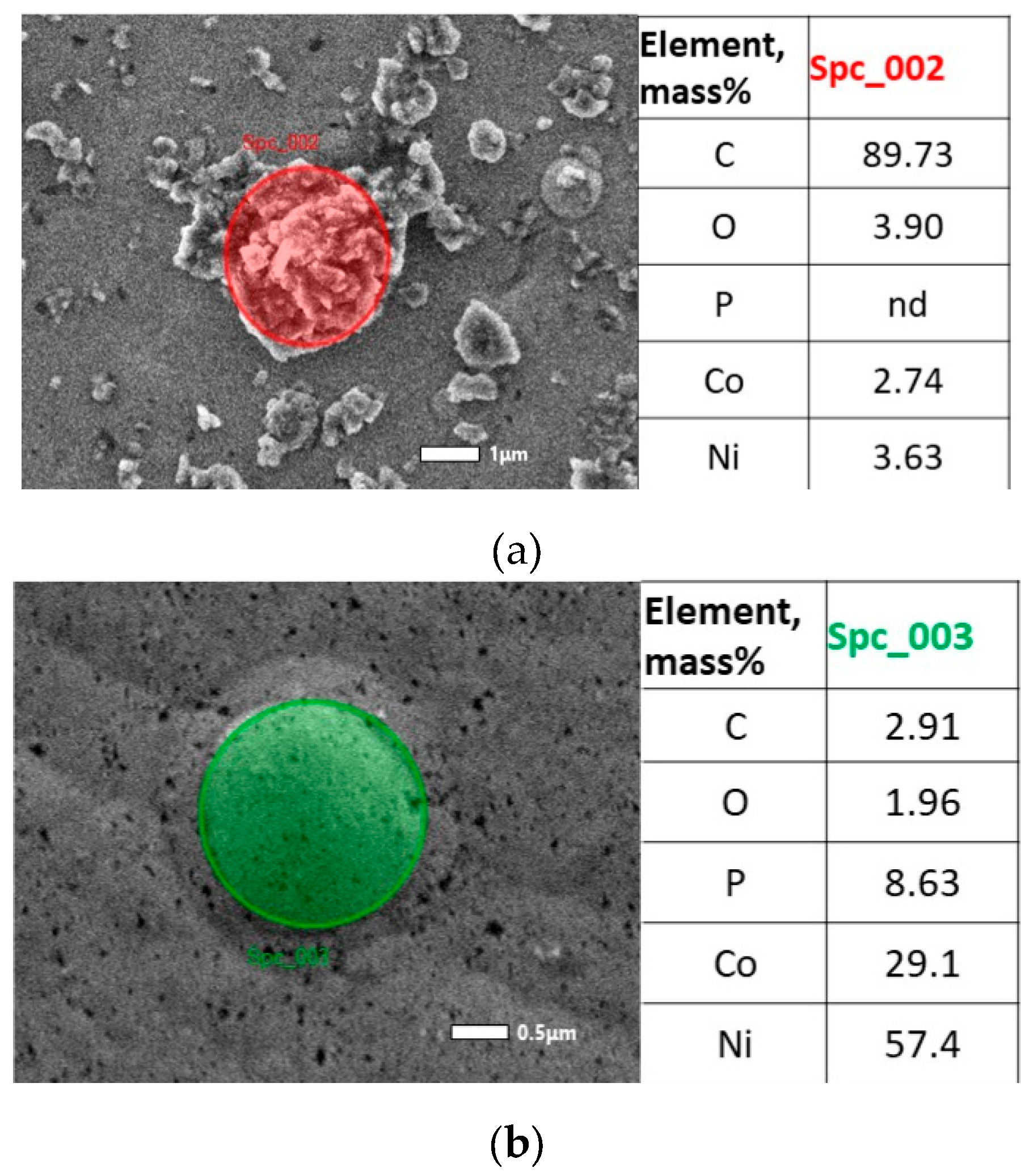
Because the post-exposure coatings exhibited pronounced morphological heterogeneity after accelerated corrosion testing in 6M KOH, additional FE-SEM–EDS area scans were carried out over selected high-magnification surface regions to obtain a more representative elemental composition of the corrosion-modified surface. The elemental compositions obtained from the area scans are summarized in Table 2, while the corresponding scanned regions and EDS spectra are presented in the Supplementary Materials (Figure S1–S4).
The FE-SEM-EDS area scan results obtained for the post-exposure coatings were compared with the elemental composition of the corresponding as-deposited surfaces determined by low-magnification EDS analysis provided in Supplementary (Table S3), as well as with the overall chemical composition of the post-exposure coatings obtained under the same analytical conditions (Table S4). This comparison reveals changes in the relative contents of Ni, Co, and P after accelerated corrosion testing in 6M KOH. The Ni/Co ratios determined from the low-magnification EDS analysis indicate that the overall surface composition was largely preserved after the accelerated corrosion test (Table 2). However, the high-magnification EDS area scans revealed local compositional variations in the NiCoPD–EL and NiCoPD–ED coatings relative to their overall chemical composition. In particular, the electrodeposited NiCoPD–ED coating exhibited local nickel enrichment, which is consistent with preferential cobalt dissolution during corrosion. In contrast, the electroless NiCoPD–EL coating showed localized nickel lessening in the analyzed surface regions. Further analysis of the post-exposure EDS results (Table S4) revealed that the highest O content measured for the NiCoPD–EL coating, suggesting more extensive formation of surface oxide/hydroxide species during the accelerated corrosion test in 6M KOH. A decrease in phosphorus was observed for all coatings after exposure, consistent with its leaching during corrosion, with the more pronounce decrease (3.5 wt.%) recorded for the electroless NiCoPD–EL coating. This phenomenon is also reported for corrosion resistance of commercial electroless Ni–P-based coatings exposed to alkaline (11M KOH) media [32]. The authors stated that corrosion rate depended nonlinearly on the phosphorus content, reaching a maximum at approximately 6–8 wt.% P. Additionally, higher Fe concentrations were found in the electroless coatings than in the corresponding electrodeposited coatings, suggesting localized partial exposure of the Fe-steel substrate due to coating degradation. The FE-SEM and EDS results indicate that exposure to the aggressive 6M KOH electrolyte induced localized morphological and compositional inhomogeneities in the coatings, with the most pronounced changes observed for the electroless NiCoPD–EL coating.
Figure 8 compares the structural characterization of the post-exposure NiCoP–EL, NiCoPD–EL, NiCoP–ED, and NiCoPD–ED electrodes. All XRD patterns exhibit a broad amorphous halo in the same angular region as observed for the as-deposited coatings (Figure 3), indicating that a fraction of the original coating remains preserved despite the aggressive alkaline treatment.
A noticeable difference is observed in the phase composition of the coatings without diamond incorporation, which exhibit a more complex crystalline structure after exposure. In the electroless NiCoP–EL coating, the formation of K₃H₅(P₂O₇)₂ (ICDD card No. 00-025-0638) is detected (Figure 8b). Even more pronounced phase transformations occur in the electrodeposited NiCoP–ED electrode (Figure 8c), where three additional potassium-containing phases are identified as K₀.₃₄Ni(O(OH))(H₂O)₀.₇₃₃ (ICSD card No. 98-016-5713), K₃H₂P₃O₁₀·H₂O (ICSD card No. 98-004-7108), and K₃HP₂O₇(H₂O)₃ (ICSD card No. 98-000-2602). For completeness, Figure S6 showing the detailed phase identification is provided in the Supporting data. In contrast, the diamond-containing coatings (NiCoPD–EL and NiCoP–ED) either suppress the formation of these potassium phosphate phases or reduce their retention on the coating surface (Figure 8d and e). The registration of weak diffraction peak at approximately 19.15° (2θ) observed for the electroless diamond-containing NiCoPD–EL coating can assign to theophrastite, Ni(OH)₂ (ICSD card No. 98-002-8101).
Taken together, the FE-SEM and XRD observations demonstrate that the degradation mechanism strongly depends on both the deposition method and the incorporation of diamond nanoparticles. The distinct post-exposure morphologies are consistent with the differences observed in the electrochemical corrosion behaviour, indicating different levels of structural stability under highly alkaline conditions.
3.5. Coating Thickness Evolution
To quantify the morphological changes observed by FE-SEM and to correlate them with the corrosion behaviour, the coating thickness of the electrodeposited and electroless NiCoP and NiCoPD composite coatings was determined by X-ray fluorescence (XRF) before and after exposure to 1M and 6M KOH. Table 3 represents the obtained results providing a quantitative measure of the coating thickness evolution of NiCoP–EL, NiCoPD–EL, NiCoP–ED, NiCoPD–ED composite deposits during alkaline exposure.
In is observed the nearly identical initial thicknesses of the electroless NiCoP–EL and NiCoPD–EL coatings, measuring 1.7 and 1.8 μm, respectively. These similar values indicate that the incorporation of diamond nanoparticles does not significantly affect the overall coating thickness under the applied electroless deposition conditions. Following exposure to 1M KOH, the NiCoP–EL coating exhibits practically no thick-ness reduction, whereas the NiCoPD–EL coating shows only a slight decrease. However, after exposure to the more aggressive 6M KOH solution, the behaviour of the two electroless coatings differs significantly. While the NiCoP–EL coating retains nearly its initial thickness, the residual thickness of the NiCoPD–EL coating decreases to 0.2 μm, representing the pronounced coating thickness loss during the accelerated corrosion test.
A different thickness evolution is observed for the electrodeposited coatings. The initial thickness of the NiCoP–ED coating (10.4 μm) was considerably greater than that of the composite NiCoPD–ED coating (7.9 μm), which can be attributed to the denser packing of the spherical surface formations observed in Figure 1b,d. The thicknesses of both electrodeposited coatings were substantially higher than those of the corresponding electroless NiCoP–EL and NiCoPD–EL coatings, consistent with the characteristic three-dimensional Co–Ni–P morphology composed of spherical protrusions formed on the two-dimensional Fe-steel substrate (Figure 1). The exposure to low concentrated 1M KOH leads to the substantially larger decrease the NiCoP–ED coating, whereas diamante-incorporated at NiCoPD–ED coating exhibits negligible thickness reduction. This behaviour is consistent with the FE-SEM observations and suggests improved structural stability of the electrodeposited composite coating in the operational alkaline electrolyte. As FE-SEM images discovered (Figure 5b,d), the accelerated corrosion testing in 6M KOH results in significant thickness reduction for both electrodeposited coatings, although the NiCoPD–ED coating retains a greater residual thickness than the NiCoP–ED coating. This finding reflects the improved structural stability of the electrodeposited NiCoPD–ED composite coating attributed to the incorporation of diamond.
Coating thickness evolution gives an additional assessment of the influence of the synthetic diamond nanoparticles on the structural stability of the NiCoPD–EL and NiCoPD–ED coatings, highlighting the effect of the co-deposition mode used for the synthesis.
3.6. HER/OER Electrocatalytic Performance of the Electrodeposited and Electroless NiCoP and NiCoPD Coatings
To assess the influence of synthetic diamond nanoparticle incorporation on the bifunctional HER/OER electrocatalytic performance of as-deposited electroless and electrodeposited NiCoP/Fe-steel and NiCoPD/Fe-steel coatings for alkaline water electrolysis, the HER and OER activities were evaluated under identical experimental conditions, comparing the overpotentials (ηHER and ηOER) at a current density of 10 mA cm⁻², the commonly used benchmark for comparative assessment.
As summarized in the Table 4, electrodeposited NiCoPD–ED exhibited the lowest overpotential of 134 mV, representing a significant improvement compared to the unreinforced NiCoP–ED (182 mV). Conversely, a completely opposite trend was observed for the electroless coatings; the incorporation of diamond particles led to an increase in overpotential from 167 mV (NiCoP–EL) to 197 mV (NiCoPD–EL). The OER overpotentials reveal a trend similar to that observed for HER (Table 4). The electrodeposited NiCoPD–ED coating exhibited the lowest OER overpotential (366 mV), representing an improvement over the unreinforced NiCoP–ED coating (393 mV). The incorporation of synthetic diamond nanoparticles in electroless-deposited NiCoP coating increased the OER overpotential from 563 mV (NiCoP–EL) to 631 mV (NiCoPD–EL), which indicates a slower rate of OER.
These results demonstrate the incorporation of synthetic diamond nanoparticles markedly improves both HER and OER activities in the electrodeposited NiCoPD–ED. This contrasting behavior indicates that the beneficial effect of diamond nanoparticles depends strongly on their incorporation within the NiCoP matrix, reducing the HER overpotential by 48 mV (≈26%) and the OER overpotential by 27 mV (≈7%). In contrast, the incorporation of synthetic diamond nanoparticles into the electroless-deposited coatings had the opposite effect at NiCoPD–EL. This shows that applying the results of the synthesis via current-free deposition leads to improved performance characteristics of the NiCoPD coating. The data also reveal a pronounced influence of the deposition method on the electrocatalytic performance of the both NiCoP and NiCoPD coatings. That is showing the application of electroless deposition synthesis results in positively performance of NiCoPD coating.
Among all the investigated electrodes, the NiCoPD–ED coating exhibited the most promising bifunctional HER/OER electrocatalytic activity. These findings suggest a synergistic effect between synthetic diamond nanoparticle incorporation and the electrodeposition process, resulting in superior catalytic performance toward both the hydrogen and oxygen evolution reactions.
4. Discussion
In the begging of the discussion to elucidate the role of synthetic diamond nanoparticles incorporated into nickel–cobalt–phosphide composite coatings in relation to the co-deposition technique, Figure 9 is presented comparative illustration of the corrosion properties and changes in coating thickness under both moderate 1M and extra aggressive 6M KOH solutions of the electrodeposited and electroless NiCoP and NiCoPD electrodes. The relationships between their stability in accelerated degradation conditions and bifunctional electrocatalytic HER/OER performance.
The combined analysis of these results suggests that the deposition route plays a key role in determining the functional behaviour of the NiCoP-based coatings. Although the incorporation of synthetic diamond nanoparticles influences both corrosion resistance and electrocatalytic activity, its effect is strongly dependent on the deposition route.
Apparently, the deposition route represents the primary factor governing the subsequent performance of the investigated NiCoP/Fe-steel coatings. It is known that the electrodeposition and electroless deposition techniques are fundamentally different growth processes. Electrodeposition proceeds through electrochemical nucleation and growth under an externally applied current, whereas electroless deposition is an autocatalytic process driven by the chemical reduction of metal ions [33,34]. Consequently, the two methods generate coatings with different initial morphologies, thicknesses, and structural homogeneity in produced NiCoP/FS composite coatings.
It was proved that electrodeposition proceeds through electrochemical nucleation and growth under an externally applied current, promoting the formation of three-dimensional Ni-Co-P structures on the 2D-structuted of Fe-steel substrate [21]. Conversely, the autocatalytic nature of electroless deposition produces a more compact Ni–Co–P morphology on the Fe-steel surface, characterized by pronounced compositional heterogeneity and carbon-rich regions within the cauliflower-like clusters. (Figure 2a). A common observation for both deposition methods is that the incorporation of synthetic diamond nanoparticles does not fundamentally alter the characteristic surface morphology of the primary NiCoP coatings’ structure (Figure 1 and Figure 3). Instead, it causes only changes in their surface microstructure, reflected by changes in the size and distribution of the surface features (Figure 2a,b).
The similar initial thicknesses of the electroless NiCoP and NiCoPD coatings indicate that the incorporation of diamond nanoparticles did not significantly affect coating growth under the applied co-deposition conditions. A different behaviour is observed for the electrodeposited coatings. The lower initial thickness of the NiCoPD–ED coating suggests that diamond nanoparticle incorporation decreases the deposition rate during electrodeposition. These initial characteristics provide the basis for the subsequent response of the coatings observed upon alkaline exposure and are reflected in their corrosion behaviour and electrocatalytic performance (Figure 9).
Comparison of the corrosion parameters obtained in 1M and 6M KOH assessments clearly demonstrates the influence of electrolyte concentration on the corrosion behaviour of the investigated coatings. Although the lowest value measured for NiCoP–EL in 1M KOH (6.8 × 10⁻⁸), the difference is relatively small. This relatively narrow range of the corrosion currents of all coatings confirms similar corrosion kinetics for the studied diamond-free NiCoP and NiCoPD coatings. Moreover, the nearly identical Icorr values of both diamante-modified NiCoPD–EL and NiCoPD–ED coatings (1.2 × 10⁻⁷ and 1.1 × 10⁻⁷ A, respectively) suggests that the deposition route has an insignificant impact on the corrosion stability under 1M alkaline conditions.
A substantially different behavior was observed when increasing the KOH concentration to 6M. The changes in Icorr were found to strongly depend on both the coating composition and the deposition route. As expected, the more aggressive 6M KOH electrolyte caused a considerable increase in the corrosion current of the electroless and electrochemical co-deposited NiCoP coatings. The corrosion current in increased to corrosion rates more than one order of magnitude higher (Table 1). This indicates enhanced dissolution kinetics of the Ni–Co–P matrix in concentrated alkaline media, where the elevated hydroxide ion concentration and electrolyte conductivity accelerate the electrochemical reactions in a manner analogous to that found for the Ni–P coating on carbon steel [35]. In contrast, the diamante presence in the electroless NiCoPD–EL composite coating reflects in different response. The slightly increased Icorr value (1.6 × 10⁻⁷ A) is approximately eight times lower than that of the corresponding electroless NiCoP coating in 6M KOH and more than one order of magnitude lower than those measured for the electrodeposited coatings. These results suggest that the incorporation of synthetic diamond nanoparticles substantially improves the corrosion resistance of the electroless NiCoP–EL coating under highly alkaline conditions. The behaviour of the electrodeposited NiCoP-ED and NiCoPD–ED coating differed considerably in 6M KOH. Despite the same nominal composition, the NiCoPD–ED coating exhibited a corrosion current (1.9 × 10⁻⁶ A) slightly higher than that of the corresponding NiCoP–ED coating (1.7 × 10⁻⁶ A).
The corrosion behaviour of studied NiCoP-based coatings in alkaline media is closely associated with the surface electrochemistry of nickel and cobalt phosphides [21,30]. Unlike conventional metallic coatings, the corrosion response of NiCoP is not governed solely by anodic metal dissolution. Instead, the surface undergoes a series of electrochemical transformations involving partial phosphide oxidation and surface reconstruction, leading to the gradual formation of catalytically active Ni(Co)(OH)₂ and Ni(Co)OOH species [30]. The extent of these surface transformations is strongly influenced by the electrolyte alkalinity. In a 6M KOH, the higher OH-concentration and electrolyte conductivity facilitate both surface reconstruction and electrochemical corrosion processes, thereby contributing to the more pronounced degradation of the Ni–Co–P matrix. Accordingly, our results demonstrate that the beneficial effects of synthetic diamond nanoparticle incorporation are governed by the combined influence of the deposition route and electrolyte concentration.
Following the anodic peak observed in the polarization curves recorded in 1M KOH (Figure 4), the both NiCoP coatings entered a passive region characterized by reduced anodic dissolution currents. This behaviour is consistent with the formation of a phosphorus-containing passive surface layer, which is known to enhance the corrosion resistance of Ni-based coatings [31,36]. In addition to modifying the electronic structure of the Ni–Co matrix, phosphorus promotes the formation of stable phosphate- and phosphite-containing surface species that reduce the dissolution rate of the metallic components and contribute to passive film stabilization [21,31]. The passive behaviour observed in the present study is therefore in good agreement with these reported corrosion-protection mechanisms.
The deposition method together with the resulting coating microstructure governs the thickness evolution and degradation behaviour of the NiCoP-based coatings during alkaline exposure. The slight increase in coating thickness (approximately 12%, from 1.7 to 1.9 μm) observed for the electroless NiCoP–EL coating after exposure to 1M KOH (Figure 9) formation of surface nickel and cobalt hydroxide/oxyhydroxide layers during anodic polarization [28,29,30,31]. The nearly unchanged coating thickness (1.8 μm) after exposure to the aggressive 6M KOH solution, together with the low corrosion current (Figure 9), suggests the development of a stable surface layer that limited further uniform material loss under highly alkaline conditions.
Upon exposure to the aggressive 6M KOH solution, the coating thickness remained nearly unchanged (1.8 μm), while the corrosion current also remained relatively low (Figure 9). Taken together, these observations suggest the development of a stable surface layer that limited further uniform material loss under highly alkaline conditions. Compared with the electrodeposited NiCoP–ED coating (initial thickness of 6.0 μm), which retained approximately 58% of its original thickness and exhibited a higher corrosion current in 1M KOH (Figure 9), the electroless NiCoP–EL coating appears to provide better dimensional stability. However, this assessment should also consider the fundamentally different initial morphologies of the two coatings. The electrodeposited NiCoP–ED coating consists of a 3D-structure of spherical entities (Figure 1b and Figure S5), which is characteristically more susceptible to morphological degradation during alkaline exposure than the comparatively compact electroless NiCoP–EL coating (Figure 1a). Nevertheless, the most remarkable observation is that both NiCoP coatings exhibited nearly identical final thicknesses after exposure to the highly aggressive 6M KOH electrolyte, accompanied by very similar corrosion current values. These similarities indicate that both coatings reached a comparable overall corrosion state despite their distinctly different initial thicknesses and surface morphologies. However, FE-SEM and EDS analyses (Figure 6 and Table S4) reveal important differences in the degradation mechanisms. After 6M KOH testing, the electrodeposited NiCoP–ED coating exhibited less localized exposure of the Fe-steel substrate, despite the nearly identical final thicknesses, while maintaining a relatively homogeneous local chemical composition. In addition, the post-exposure electroless NiCoP–EL coating contained localized P-depleted microstructural regions (Figure 7a), although its average elemental composition indicated a relatively higher phosphorus content than the NiCoP–ED (Table S4). This suggests that phosphorus depletion occurred locally rather than uniformly across the coating surface.
These observations suggest that NiCoP coating degradation is strongly influenced by the deposition route. While the electrodeposited NiCoP–ED coating primarily undergoes relatively uniform thickness reduction, the electroless coating tends to preserve its overall thickness, but develops localized compositional and microstructural degradation.
Following diamond incorporation, the pronounced thickness reduction of the electroless NiCoPD–EL coating after exposure to 6M KOH suggests substantial degradation of the original coating (Figure 9). This material loss may be associated with localized dissolution of the electroless NiCoPD matrix accompanied by the detachment of diamond-containing regions. In contrast, the electrodeposited NiCoPD–ED coating exhibited only a minor reduction in coating thickness after exposure to the less aggressive 1M KOH electrolyte (Figure 9), indicating greater structural stability than the corresponding NiCoP–ED coating. The high thickness retention values of 94.4% for NiCoPD–EL and 97.5% for NiCoPD–ED after exposure to 1M KOH clearly demonstrate the beneficial effect of diamond nanoparticle incorporation on coating stability under moderate alkaline conditions. Despite this, after accelerated corrosion testing in 6M KOH, the residual coating thickness differed markedly, with only 0.2 μm remaining for NiCoPD–EL compared with 2.7 μm for NiCoPD–ED (Figure 9 and Table 3). Thus, among all investigated coatings, the electrodeposited NiCoPD–ED coating retained the greatest residual thickness after exposure to the aggressive electrolyte.
An interesting observation is that the electroless diamond-containing NiCoPD–EL coating exhibited the lowest corrosion current and the lowest anodic dissolution currents during polarization (Figure 9). However, the post-exposure FE-SEM and EDS analyses reveal substantial morphological and compositional changes of surface regions depleted of phosphorus, suggesting partial loss of the electroless Ni–Co–P matrix and preferential exposure of diamond-rich domains. Furthermore, the exceptionally low Icorr value may be attributed to the combined contribution of the partially exposed Fe-steel substrate and the formation of passive corrosion products during localized degradation, including nickel hydroxide and cobalt hydroxide/oxyhydroxide species. Supporting evidence is provided by the post-corrosion XRD characterization, which detected the formation of Ni(OH)₂ on the NiCoPD–EL coating after exposure to 6M KOH (Figure 8d). The presence of this hydroxide phase indicates surface passivation and provides a plausible explanation for the superior corrosion resistance of the NiCoPD–EL coating under highly alkaline conditions. Obviously, the electroless deposition process facilitates the formation of a more protective surface layer during polarization. These observations indicate that diamond nanoparticle incorporation primarily influences the passivation behaviour during polarization, rather than preventing localized degradation under the aggressive alkaline conditions of 6M KOH.
The parallel analysis of the coating behaviour in both the moderate 1M KOH and the highly aggressive 6M KOH electrolytes indicates that the stability of NiCoP-based coatings is determined by the cooperative effects of electrolyte severity, deposition method, and diamond nanoparticle incorporation.
The comparative electrocatalytic assessment of the investigated NiCoP–EL, NiCoP–ED, NiCoPD–EL and NiCoPD–ED electrodes at a current density of 10 mA cm⁻2 defined NiCoPD–ED coating as the promising configuration, exhibiting the highest bifunctional HER/OER performance (Figure 9). This superior electrocatalytic activity is attributed to its characteristic three-dimensional morphology, which combines a high density of electrochemically accessible active sites with interconnected inter channels that facilitate reactant transport and the efficient evolution and release of H₂ and O₂ bubbles (Figure 1d and Figure S5). This structure–property relationship is consistent with our previous findings, demonstrating that the simple and scalable co-electrodeposition approach is an effective strategy for producing self-supported three-dimensional NiCoP coatings on Fe-steel substrates [21]. In addition, the post-exposure SEM observations indicate that the NiCoPD–ED coating better preserves its overall coating morphology than the electroless counterpart after exposure to 6M KOH. These findings suggest that the combination of electrodeposition and synthetic diamond nanoparticle incorporation provides a favourable relationship between bifunctional electrocatalytic activity and corrosion resistance. The HER and OER overpotentials of the NiCoPD–ED electrode (134 mV and 366 mV at 10 mA cm⁻², respectively) fall within the performance range reported for recently developed PGM-free electrocatalysts operating in alkaline media, as summarized in the comprehensive review by Jamesh et al. [37]. These catalysts include various transition metal oxides, hydroxides/(oxy)hydroxides, layered double hydroxides, sulfides, selenides, phosphides, nitrides, carbon-based composites, and alloy-based systems. Their superior electrocatalytic performance is generally achieved through various preparation strategies, including nanostructuring, facet engineering, heterostructure preparing, hollow and porous structures formation, heteroatom doping, defect/vacancy engineering, and surface/interface modification. Considering the present NiCoPD–ED coating was fabricated by a simple electrodeposition process directly onto a commercially available Fe-steel substrate, the results reveal that synthetic diamond incorporation represents an effective and scalable strategy for enhancing the bifunctional HER/OER performance of NiCoP-based coatings.
In summary, the present results indicate that synthetic diamond nanoparticles play a role beyond that of an inert reinforcing component. Their incorporation influences the formation and protective characteristics of the passive surface layer, thereby affecting the corrosion behaviour of NiCoP/Fe-steel coatings. However, the effect of diamond incorporation strongly depends on the deposition route. For electroless coatings, diamond nanoparticles primarily promote passivation during polarization, although they do not completely suppress localized degradation under the highly aggressive conditions of 6M KOH. In contrast, electrodeposition combined with synthetic diamond incorporation leads to the highest bifunctional HER/OER activity, highlighting the beneficial effect of this deposition route on the electrocatalytic performance of NiCoP-based coatings.
Despite extensive studies on NiCoP electrocatalysts and diamond-reinforced metallic coatings separately, to the best of our knowledge, the HER and OER catalytic behavior of synthetic diamond-incorporated NiCoP coatings deposited on Fe-steel has not yet been systematically investigated. Furthermore, a direct comparison between electroless and electrodeposition routes for such composite bifunctional electrocatalysts has not been reported. The present results therefore provide an initial proof-of-concept demonstrating that synthetic diamond can serve as a functional modifier of NiCoP coatings for alkaline water electrolysis while simultaneously influencing their corrosion resistance. Importantly, the results also demonstrate that the effect of diamond incorporation strongly depends on the deposition method. In particular, co-electrodeposition offers a promising route for producing diamond-incorporated NiCoP composite coatings with an improved balance between corrosion resistance and bifunctional electrocatalytic performance. These findings warrant further systematic studies to optimize diamond loading, coating microstructure, and deposition conditions for enhanced performance in alkaline water electrolysis.
5. Conclusions
At this stage of our research, aimed at elucidating the influence of synthetic diamond nanoparticles as a doping strategy for modulating the corrosion behaviour of noble-metal-free NiCoP/Fe-steel composite coatings and providing insights into the design of more robust water-splitting electrodes, the following conclusions can be drawn:
- Synthetic diamond nanoparticle incorporation does not influence electroless and electrodeposited NiCoP coatings in the same manner, demonstrating that its effect is strongly dependent on the deposition route.
- The deposition route predetermines the initial coating microstructure and governs its subsequent evolution during alkaline exposure, ultimately controlling the long-term corrosion stability and electrocatalytic performance of the coatings.
- Among the investigated materials, the electrodeposited NiCoPD coating exhibited the most favourable combination of bifunctional HER/OER electrocatalytic activity and structural stability, highlighting the beneficial synergy between electrodeposition and diamond nanoparticle incorporation.
- The combined use of electrochemical, morphological, and compositional characterization demonstrates that coating degradation cannot be adequately assessed by a single technique, emphasizing the complementary nature of electrochemical and post-exposure microstructural analyses.
In general, the present study demonstrates that the deposition route is not merely a processing parameter but a key design factors governing the relationship between coating microstructure, corrosion resistance, and bifunctional electrocatalytic performance. More importantly, it demonstrates that electrically insulating synthetic diamond nanoparticles can act as functional modifiers of NiCoP coatings. These findings open new perspectives for the rational design of durable, noble-metal-free NiCoP/Fe-steel electrocatalysts for alkaline water electrolysis.
Supplementary Materials
The following supporting information can be downloaded at website of this paper posted on Preprints.org, Table S1. The electrolyte solutions composition and synthesis conditions for co-electrodeposited coatings; Table S2. The electrolyte solutions composition and synthesis conditions for electroless co-deposited coatings; Table S3. Chemical composition of as-deposited electroless and electrodeposited NiCoP and NiCoPD coatings determined by low-magnification EDS analysis at magnification ×100; Table S4. Chemical composition after post-exposure in 6M KOH electroless and electrodeposited NiCoP and NiCoPD coatings determined by low-magnification EDS analysis at magnification ×100; Figure S1. FE-SEM-EDS area scan of post-exposure NiCoP–EL in 6M KOH at magnification ×100000: (a) FE-SEM image; (b) EDS spectra; Figure S2. FE-SEM-EDS area scan of post-exposure NiCoPD–EL in 6M KOH at magnification ×100000: (a) FE-SEM image; (b) EDS spectra; Figure S3. FE-SEM-EDS area scan of post-exposure NiCoP–ED in 6M KOH at magnification ×100000: (a) FE-SEM image; (b) EDS spectra; Figure S4. FE-SEM-EDS area scan of post-exposure NiCoPD–ED in 6M KOH at magnification ×100000: (a) FE-SEM image; (b) EDS spectra; Figure S5. Cross-section FE-SEM morphology by electrodeposited route of as-deposited NiCoP(D)/Fe-steel coatings: (a) as-deposited NiCoP–ED; (b) as-deposited NiCoPD–ED; Figure S6. XRD pattern after the post-exposure in 6M KOH of the electrodeposited NiCoP–ED electrode.
Author Contributions
Conceptualization, V.Ch., Ts.P.-M. and M.A.; synthesis, V.Ch.; methodology, D.N.; formal analysis, V.Ch., Ts.P.-M, M.A. and G.Av.; investigation, V.Ch., I.P. M.A., and G.Av.; writing—original draft preparation, D.N. and Ts.P.-M; writing—review and editing, D.N. and Ts.P.-M; visualization, V.Ch., Ts.P.-M, M.A. and G.Av; funding acquisition, D.N. and V.Ch.; supervision, D.N. All authors have read and agreed to the published version of the manuscript.
Funding
The authors kindly acknowledge the financial support of project No BG16RFPR002-1.014-0009 “Development and sustainability of Centre of Competence HITMOBIL” funded by Programme “Research, Innovations and Digitalization for Smart Transformation” 2021-2027, co- funded by the EU from European Regional Development Fund. https://hitmobil.iees.bas.bg/en/aboutUs-102/aboutProject-116 This work was also financially supported by the Bulgarian National Science Fund under Project KP-06-M99/3 (КП-06-М99/3).
Institutional Review Board Statement
Not applicable.
Informed Consent Statement
Not applicable.
Data Availability Statement
Data is contained within the article.
Acknowledgments
The authors gratefully acknowledge of research equipment of the project № BG16RFPR002-1.014-0006 “National Centre of Excellence Mechatronics and Clean Technologies” was used for experimental work financially supported by European Regional Development Fund under “Research Innovation and Digitization for Smart Transformation” program 2021-2027 and the project INFRAMAT (National Roadmap for Research Infrastructure) financed by Bulgarian Ministry of Education and Science was used in this investigation.
Conflicts of Interest
The authors declare no conflict of interest.
References
- Hou, M.Z.; Luo, J.; Huang, L.; Beck, H.P.; Mehmood, F.; Wang, Q.; Wu, X.; Wu, L.; Yue, Y.; Fang, Y.; Chen, Q.; Guo, Y.; Zhang, T.; Mao, J.; Cai, N.; Xiong, Y.; Shi, T.; Zhang, R. Strategies toward carbon neutrality: Comparative analysis of China, USA, and Germany. Carbon Neutr. Syst. 2025, 1, 3. [Google Scholar] [CrossRef]
- Stavrakas, V. Modelling in support of the European energy transition: Pathways towards the 2030 targets and the vision of climate neutrality by 2050: Editorial of the Virtual Special Issue: “H2020 SENTINEL project”. Energy 2025, 327, 136441. [Google Scholar] [CrossRef]
- Mikropoulos, E.; Roelfsema, M.; Chen, H.-H.; Staffell, I.; Oreggioni, G.; Hdidouan, D.; Thellufsen, J.Z.; Chang, M.A.; Fragkos, P.; Giannousakis, A.; Chatterjee, S.; Ürge-Vorsatz, D.; Pfenninger, S.; Pickering, B.; Victoria, M.; Brown, T.; van Vuuren, D.P. Examining pathways for a climate neutral Europe by 2050: A model comparison analysis including integrated assessment models and energy system models. Energy 2025, 319, 134809. [Google Scholar] [CrossRef]
- Huang, J.; Hu, B.; Meng, J.; Meng, T.; Liu, W.; Guan, Y.; Jin, L.; Zhang, X. Highly efficient sustainable strategies toward carbon-neutral energy production. Energy Environ. Sci. 2024, 17, 1007–1045. [Google Scholar] [CrossRef]
- Reza, M.S.; Fattah, I.M.R.; Wang, J.; Hannan, M.A.; Zainal, B.S.; Ong, H.C.; Mahlia, T.M.I. Hydrogen-based hybrid energy system: A review of technologies, optimization approaches, objectives, constraints, applications, and outstanding issues. Renew. Sustain. Energy Rev. 2026, 226, 116192. [Google Scholar] [CrossRef]
- Hou, M.Z.; Wang, Q.; Guo, Y.; Beck, H.P.; Huang, L.; Fang, Y.; Yue, Y. Integrated and sustainable energy systems: Unleashing applicability across sector. In Reference Module in Materials Science and Materials Engineering; Hashmi, S., Ed.; Elsevier: Amsterdam, The Netherlands, 2025. [Google Scholar] [CrossRef]
- Jayasree, S.; Hemamalini, V.; Bansal, S.; Al-Farouni, M.; Chaudhari, R.J.; Landage, M.; Suresh Babu, D. Integrated fuel cell and electrolyzer systems for renewable energy storage and conversion. E3S Web Conf. 2024, 591, 05004. [Google Scholar] [CrossRef]
- Badgett, A.; Ruth, M.; Pivovar, B. Economic considerations for hydrogen production with a focus on polymer electrolyte membrane electrolysis. In Hydrogen Production by Water Electrolysis; Basile, A., Iulianelli, A., Dalena, F., Veziroğlu, T.N., Eds.; Elsevier: Amsterdam, The Netherlands, 2022; pp. 327–364. [Google Scholar] [CrossRef]
- Çankaya, A.; Kılıç, A.E.; Kaplan, Y. Alkaline water electrolysis: A review on technological progress, market dynamics, and environmental implications. Int. J. Energy Horiz. 2025, 1, 39–60. [Google Scholar]
- Xia, Y.; Cheng, H.; He, H.; Wei, W. Efficiency and consistency enhancement for alkaline electrolyzers driven by renewable energy sources. Commun. Eng. 2023, 2, 22. [Google Scholar] [CrossRef]
- Gunasekaran, A.; Arumugam, M.; Mariappan, M.; Anna Benedict, B.; Philip Anthony, S. Enhancing the bifunctional and overall water splitting electrocatalytic activity of copper MOFs by integrating conductive rGO. Dalton Trans. 2026, 55, 5635–5643. [Google Scholar] [CrossRef] [PubMed]
- Li, G.L.; Deng, F.; Ma, T.G.; Shi, Y.H.; Liu, J.; Yan, Y.; Mao, Q.; Bao, J. Integrating Ni₂P crystalline–NiFeBP amorphous heterojunction nanosheets on hierarchical nickel foam for superior overall water splitting. Chem. Eng. J. 2025, 505, 159290. [Google Scholar] [CrossRef]
- Tekalgne, M.A.; Cho, J.H.; Kim, J.; Jang, H.W.; Ahn, S.H.; Kim, S.Y. Augmenting overall water splitting with transition-metal-doped NiCr-LDH as a bifunctional electrocatalyst. Chem. Eng. J. 2025, 514, 163398. [Google Scholar] [CrossRef]
- Sheng, M.; Yang, Y.; Bin, X.; Que, W. One-step electrochemical synthesis and surface reconstruction of NiCoP as an electrocatalyst for bifunctional water splitting. Materials 2023, 16, 1529. [Google Scholar] [CrossRef] [PubMed]
- Do, V.-H.; Lee, J.-M. Surface engineering for stable electrocatalysis. Chem. Soc. Rev. 2024, 53, 2693–2737. [Google Scholar] [CrossRef] [PubMed]
- Sun, L.; Zhao, S.; Gao, S.; Zhu, R.; Tan, Y.; Tang, X.; Yi, H. Recent advances of metal vacancies in energy and environmental catalysis. Green Energy Environ. 2025, 10, 84–108. [Google Scholar] [CrossRef]
- Wang, X.; Cheng, M.; Sun, S.; Dai, J. Overcoming the activity-stability trade-off in NiCoP catalysts at industrial current density via coupled proton-electron transfer mechanism. Mater. Today Chem. 2026, 51, 103351. [Google Scholar] [CrossRef]
- Yang, L.; Zhang, M.; Shi, M.; Yao, Y.; Liu, Y.; Zhou, J.; Cao, Y.; Li, Z.; Liu, M.; Wang, X.; Gan, Z.; Zhang, H.; Chang, S.; Zhou, G.; Yun, S. Hierarchical porous P-doped NiCo alloy with α/ε phase-defect synergy to boost alkaline HER kinetics and bifunctional activity. Nanomaterials 2025, 15, 1562. [Google Scholar] [CrossRef] [PubMed]
- Zhu, L.; Cheng, Y.; Gong, Y. Ultra-low Ir-doped CoNi phosphide self-assembles into an embroidered ball for efficient overall water splitting. Int. J. Hydrogen Energy 2025, 97, 1177–1186. [Google Scholar] [CrossRef]
- Zhou, M.; Jia, W.; Tian, T.; Ye, Y.; Zhou, J.; Tian, J.; Pan, G.; He, B. Electronic structure engineering of NiCoP sites via N, Ru dual doping for bifunctional water electrolysis. Inorg. Chem. 2024, 63, 23296–23303. [Google Scholar] [CrossRef] [PubMed]
- Parvanova-Mancheva, T.; Chakarova, V.; Gabrovska, M.; Atanasova-Vladimirova, S.; Baeva, A.; Andreeva, R.; Hodzhaoglu, F.; Nikolova, D. Evaluating the bifunctional properties towards HER and OER of NiCo electrodeposited coatings: Combined influence of support, Ni/Co ratio, and phosphorus doping. Catal. Today 2025, 460, 115495. [Google Scholar] [CrossRef]
- Dong, T.; Zheng, K.; An, P.; Ma, Y.; Gao, J.; Yu, S. Element-to-phase design of bimodal diamond/NiCrBSi coatings: Thermodynamic and tribological insights. Surf. Coat. Technol. 2026, 526, 133360. [Google Scholar] [CrossRef]
- Mohsen, N.; Mardali, Y.; Hassan, A.-P.; Hassan, P. Effect of diamond nanoparticles on the performance of PEO coatings on zirconium: Microstructural, mechanical, corrosion, and tribological properties. Surf. Coat. Technol. 2025, 507, 132139. [Google Scholar] [CrossRef]
- Saba, F.; Zhang, F.; Liu, S.; Liu, T. Tribological properties, thermal conductivity and corrosion resistance of titanium/nanodiamond nanocomposites. Compos. Commun. 2018, 10, 57–63. [Google Scholar] [CrossRef]
- Impact, Crystal. Match! Phase Analysis Using Powder Diffraction; Crystal Impact GbR: Bonn, Germany; Available online: https://www.crystalimpact.de/match/.
- Gražulis, S.; Chateigner, D.; Downs, R.T.; Yokochi, A.F.T.; Quirós, M.; Lutterotti, L.; Manakova, E.; Butkus, J.; Moeck, P.; Le Bail, A. Crystallography Open Database—An open-access collection of crystal structures. J. Appl. Crystallogr. 2009, 42, 726–729. [Google Scholar] [CrossRef] [PubMed]
- Zhang, A.; Xiao, Y.; Cao, Y.; Fang, H.; Zhang, Y.; Das, P.; Zhang, H. Electrodeposition, formation mechanism, and electrocatalytic performance of Co-Ni-P ternary catalysts coated on carbon fiber paper. J. Solid State Electrochem. 2021, 25, 1503–1512. [Google Scholar] [CrossRef]
- Mellsop, S.R.; Gardiner, A.; Johannessen, B.; Marshall, A.T. Structure and transformation of oxy-hydroxide films on Ni anodes below and above the oxygen evolution potential in alkaline electrolytes. Electrochim. Acta 2015, 168, 356–364. [Google Scholar] [CrossRef]
- Schubert, N.; Schneider, M.; Michaelis, A. The mechanism of anodic dissolution of cobalt in neutral and alkaline electrolyte at high current density. Electrochim. Acta 2013, 113, 748–754. [Google Scholar] [CrossRef]
- Liu, H.; Hu, S.; Long, B.; Dai, H.; Yang, Y.; Yang, M.; Zhang, Q.; Ke, Z.; Li, W.; He, D.; Wang, Z.; Xiao, X. In situ unraveling surface reconstruction of Ni-CoP nanowire for excellent alkaline water electrolysis. Energy Environ. Mater. 2025, 8, e12834. [Google Scholar] [CrossRef]
- Chen, J.; Deng, Y.; Cao, R.; Wang, P.; Mao, Y.; Yi, C.; Zhang, S.; Zhang, T.; Liu, X. Phosphorus-containing nickel-based coatings for enhanced corrosion resistance and mechanical performance: A review. FlatChem 2025, 52, 100887. [Google Scholar] [CrossRef]
- He, A.; Hu, H.; Aasen, D.; Ivey, D.G. The corrosion behavior of electroless Ni–P coatings in concentrated KOH electrolyte. J. Appl. Electrochem. 2024, 54, 2919–2929. [Google Scholar] [CrossRef]
- Sudagar, J.; Lian, J.; Sha, W. Electroless nickel, alloy, composite and nano coatings—A critical review. J. Alloys Compd. 2013, 571, 183–204. [Google Scholar] [CrossRef]
- Lelevic, A.; Walsh, F.C. Electrodeposition of Ni–P alloy coatings: A review. Surf. Coat. Technol. 2019, 369, 198–220. [Google Scholar] [CrossRef]
- Yang, D.; Cao, X.; Lu, Y.; Yao, H.; Lv, H.; Zhang, C. Corrosion behavior of Ni–P plated steel for alkaline electrolyzers under the influence of coupled physicochemical and fluid factors. Electrochim. Acta 2025, 541, 147331. [Google Scholar] [CrossRef]
- Elsener, B.; Crobu, M.; Scorciapino, M.A.; Rossi, A. Electroless deposited Ni–P alloys: Corrosion resistance mechanism. J. Appl. Electrochem. 2008, 38, 1053–1060. [Google Scholar] [CrossRef]
- Jamesh, M.-I.; Hu, D.; Wang, J.; Naz, F.; Feng, J.; Yu, L.; Cai, Z.; Colmenares, J.C.; Lee, D.-J.; Chu, P.K.; Hsu, H.-Y. Recent advances in noble metal-free electrocatalysts to achieve efficient alkaline water splitting. J. Mater. Chem. A 2024, 12, 11771–11820. [Google Scholar] [CrossRef]
Figure 1.
FE-SEM images of as-deposited coatings at magnification ×1,000: (a) NiCoP–EL; (b) NiCoP–ED; (c) NiCoPD–EL; (d) NiCoPD–ED.
Figure 1.
FE-SEM images of as-deposited coatings at magnification ×1,000: (a) NiCoP–EL; (b) NiCoP–ED; (c) NiCoPD–EL; (d) NiCoPD–ED.
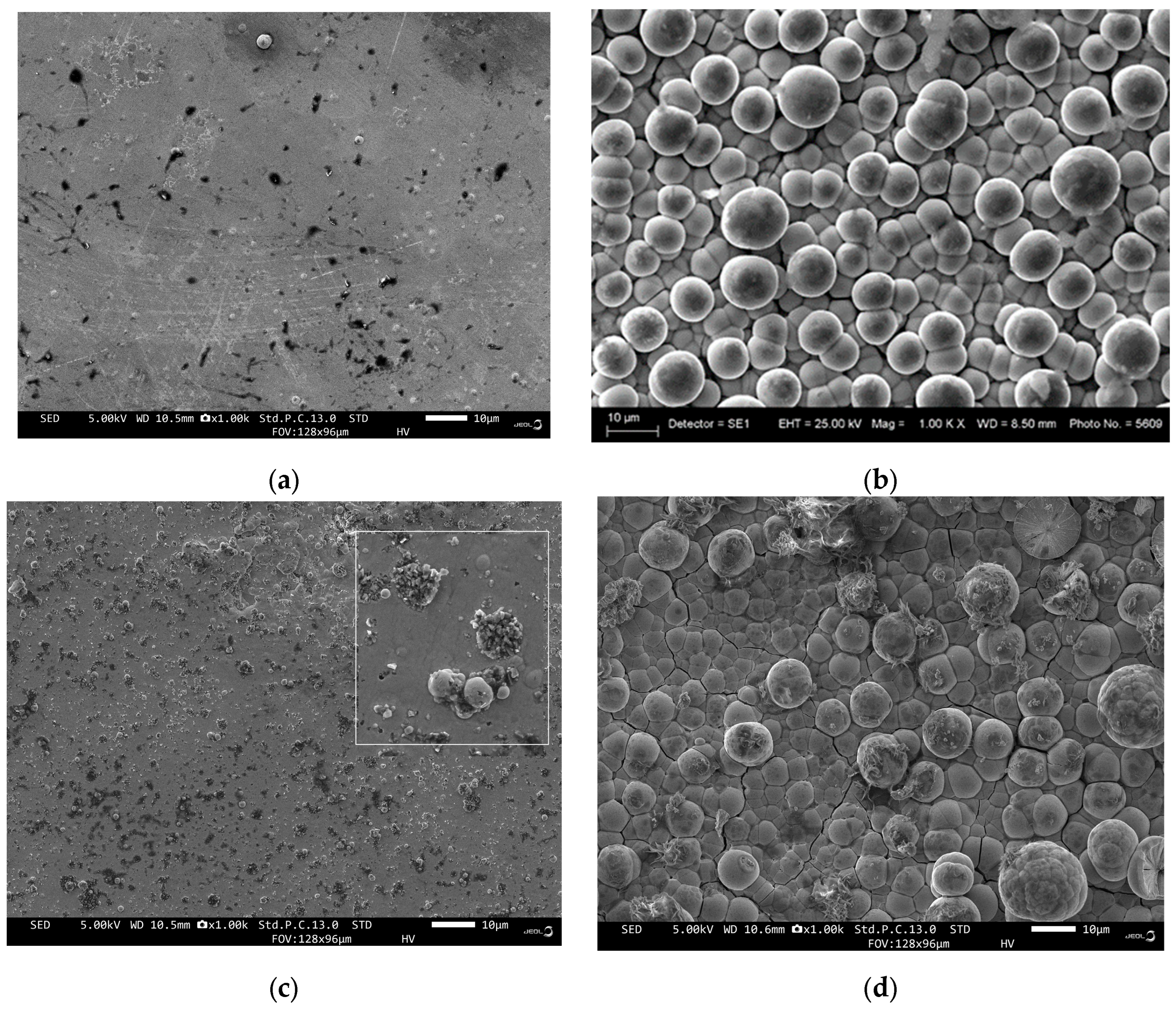
Figure 2.
High-magnification FE-SEM images and at point EDS analysis of as-deposited NiCoPD coatings: (a) NiCoP–ED at magnification ×15,000; (b) NiCoPD–ED at magnification ×3,300.
Figure 2.
High-magnification FE-SEM images and at point EDS analysis of as-deposited NiCoPD coatings: (a) NiCoP–ED at magnification ×15,000; (b) NiCoPD–ED at magnification ×3,300.
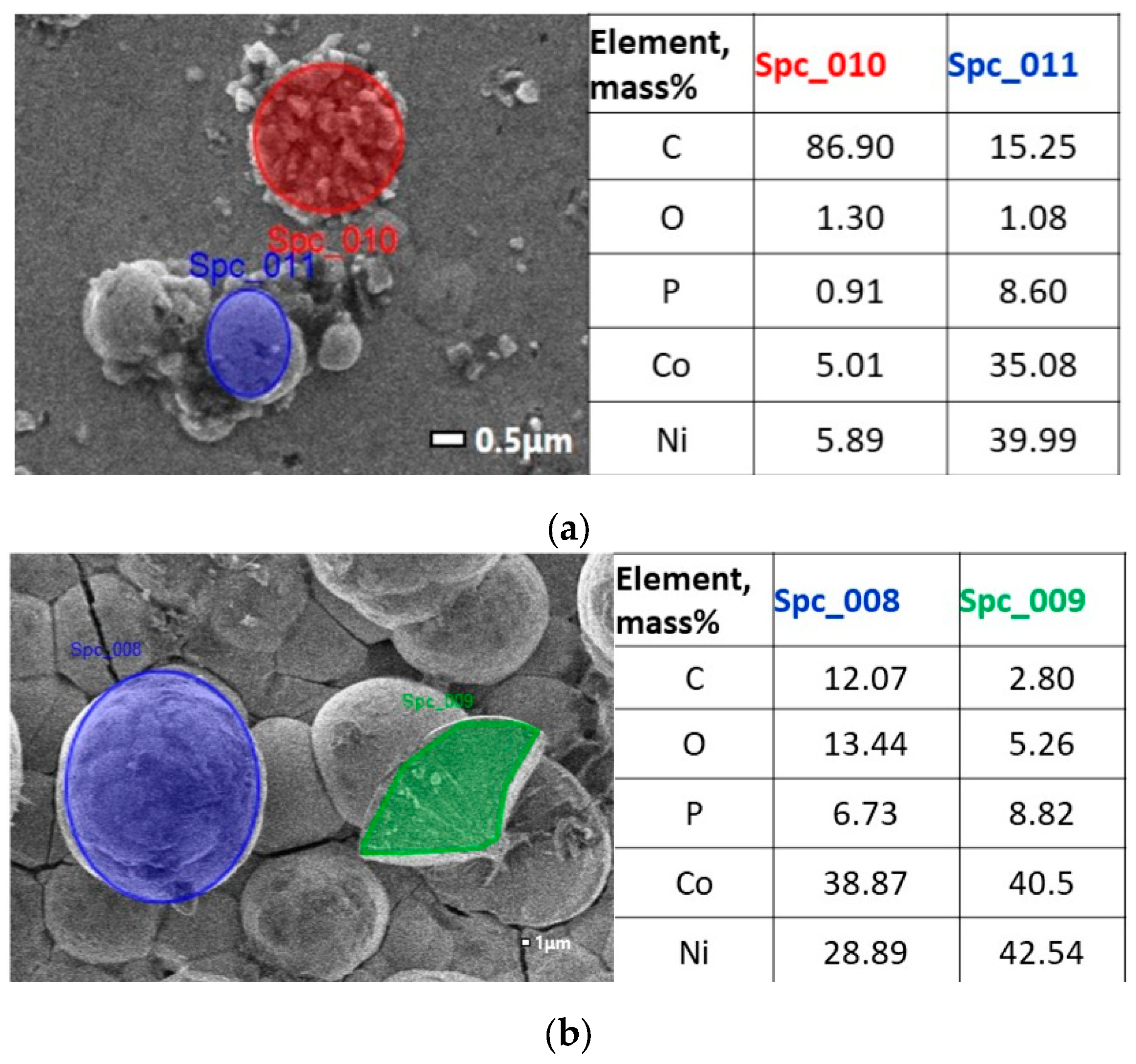
Figure 3.
XRD patterns of as-deposited electrodes: (a) Zero background XRD sample holder, (b) NiCoP–EL; (c) NiCoP–ED, (d) NiCoPD–EL (e) NiCoP–ED coatings.
Figure 3.
XRD patterns of as-deposited electrodes: (a) Zero background XRD sample holder, (b) NiCoP–EL; (c) NiCoP–ED, (d) NiCoPD–EL (e) NiCoP–ED coatings.
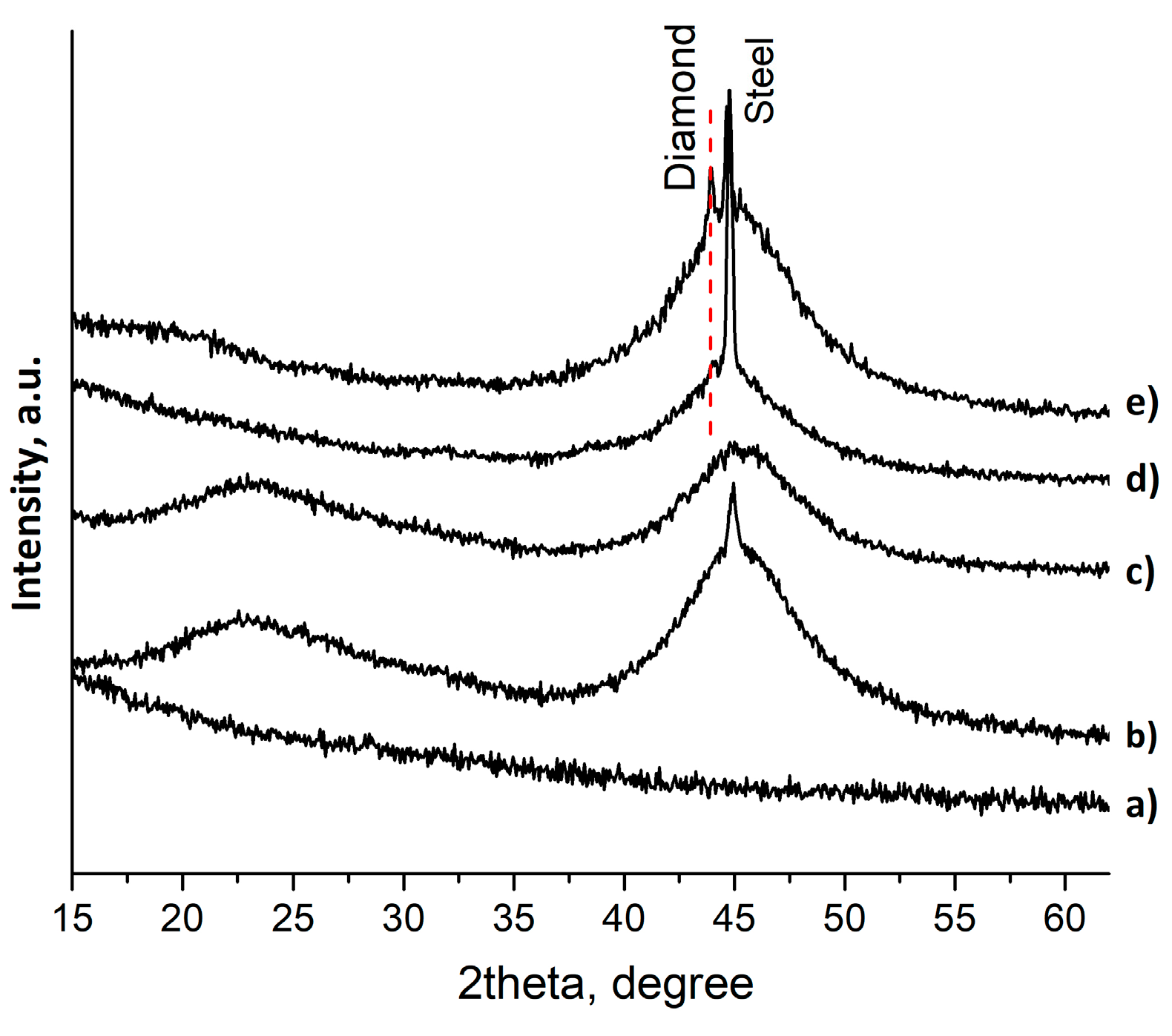
Figure 4.
Potentiodynamic polarization curves of (a) electroless NiCoP−EL and NiCoPD−EL coatings and (b) electrodeposited NiCoP−ED and NiCoPD−ED coatings recorded at potential scan rate of 1 mV s–1 in 1М КОН aqueous solution.
Figure 4.
Potentiodynamic polarization curves of (a) electroless NiCoP−EL and NiCoPD−EL coatings and (b) electrodeposited NiCoP−ED and NiCoPD−ED coatings recorded at potential scan rate of 1 mV s–1 in 1М КОН aqueous solution.
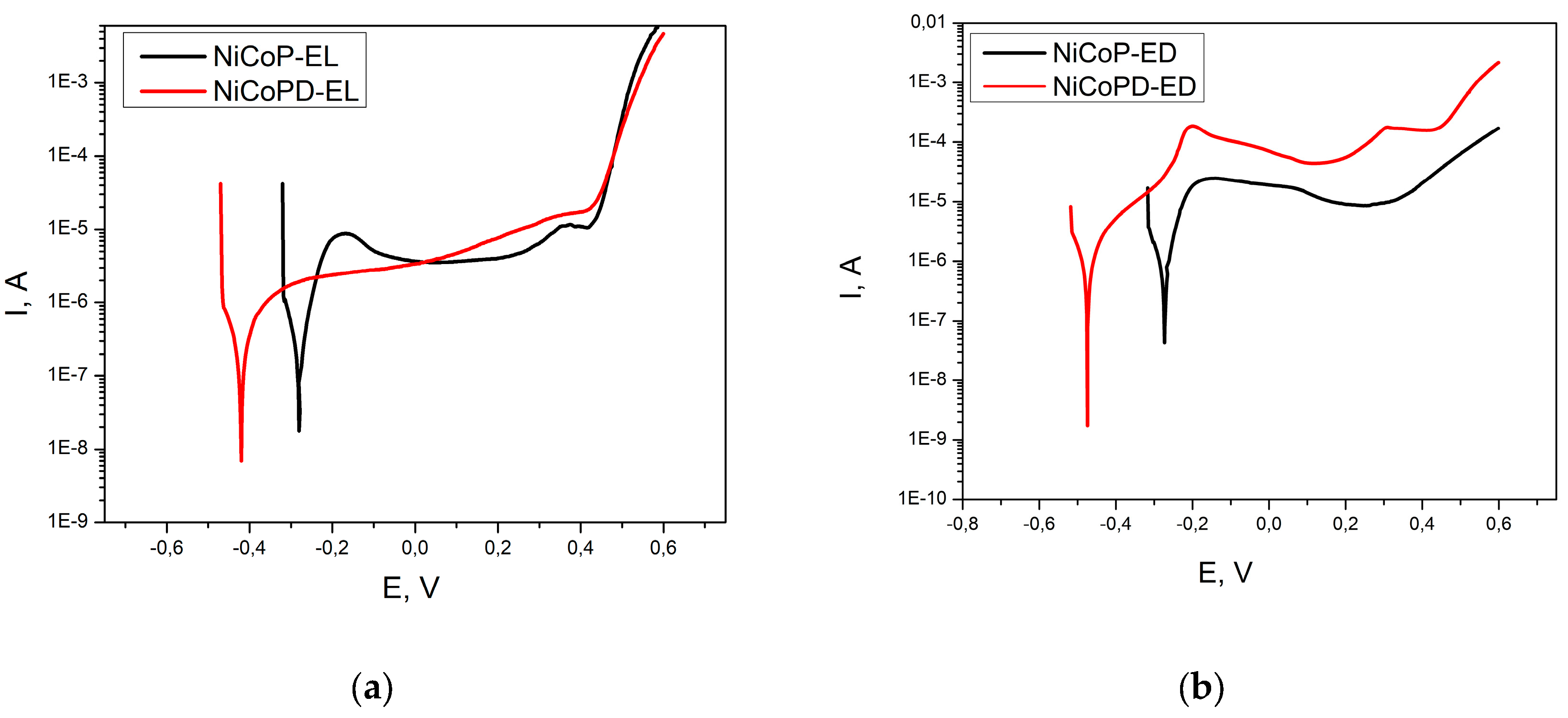
Figure 5.
Potentiodynamic polarization curves of (a) electroless NiCoP−EL and NiCoPD−EL coatings and (b) electrodeposited NiCoP−ED and NiCoPD−ED coatings recorded at potential scan rate of 1 mV s–1 in 6М КОН aqueous solution.
Figure 5.
Potentiodynamic polarization curves of (a) electroless NiCoP−EL and NiCoPD−EL coatings and (b) electrodeposited NiCoP−ED and NiCoPD−ED coatings recorded at potential scan rate of 1 mV s–1 in 6М КОН aqueous solution.
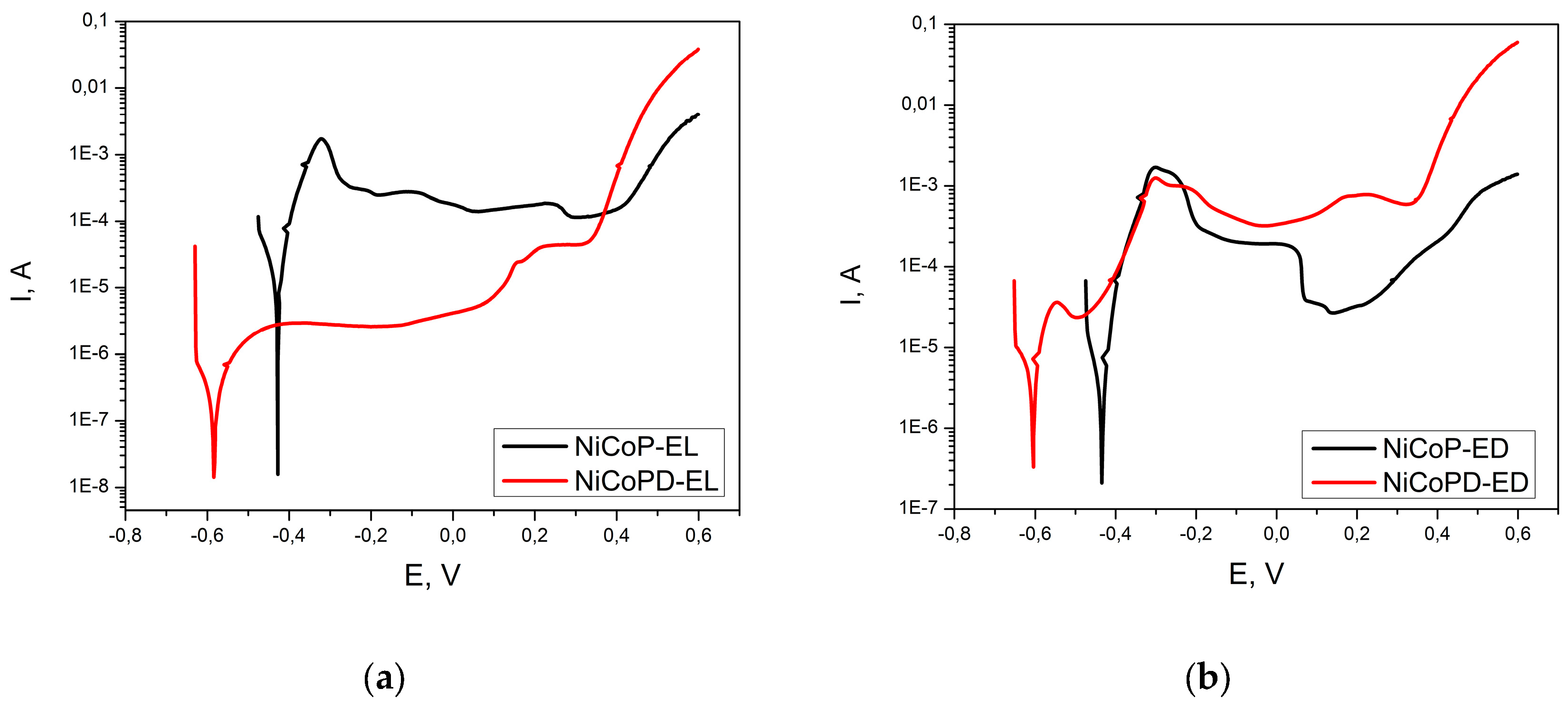
Figure 6.
FE-SEM images of post-exposure state of electrodeposited and electroless NiCoP and NiCoPD composite coatings after 6M KOH treatment at magnification ×1,000: (a) NiCoP–EL; (b) NiCoP–ED; (c) NiCoPD–EL; (d) NiCoPD–ED.
Figure 6.
FE-SEM images of post-exposure state of electrodeposited and electroless NiCoP and NiCoPD composite coatings after 6M KOH treatment at magnification ×1,000: (a) NiCoP–EL; (b) NiCoP–ED; (c) NiCoPD–EL; (d) NiCoPD–ED.
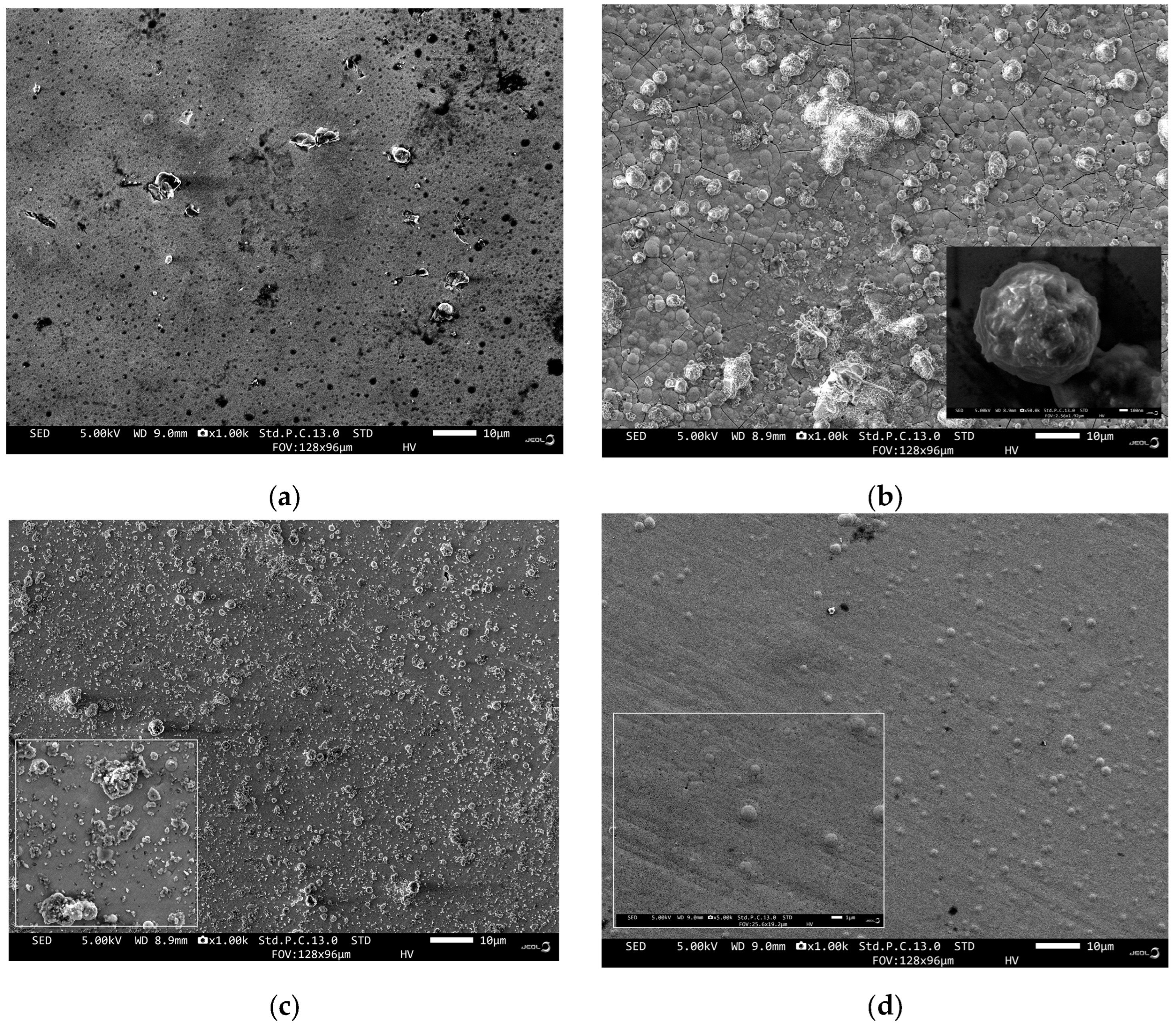
Figure 8.
XRD patterns after the post-exposure in 6M KOH of the electroless and electrodeposited NiCoP and NiCoPD electrodes: (a) Zero background XRD sample holder, (b) NiCoP–EL; (c) NiCoP–ED, (d) NiCoPD–EL (e) NiCoP–ED coatings; Marked peaks: (+) K₃H₅(P₂O₇)₂; (^) K₃HP₂O₇(H₂O)₃ and K₀.₃₄Ni(O(OH))(H₂O)₀.₇₃₃; (*) K₃H₂P₃O₁₀·H₂O.
Figure 8.
XRD patterns after the post-exposure in 6M KOH of the electroless and electrodeposited NiCoP and NiCoPD electrodes: (a) Zero background XRD sample holder, (b) NiCoP–EL; (c) NiCoP–ED, (d) NiCoPD–EL (e) NiCoP–ED coatings; Marked peaks: (+) K₃H₅(P₂O₇)₂; (^) K₃HP₂O₇(H₂O)₃ and K₀.₃₄Ni(O(OH))(H₂O)₀.₇₃₃; (*) K₃H₂P₃O₁₀·H₂O.
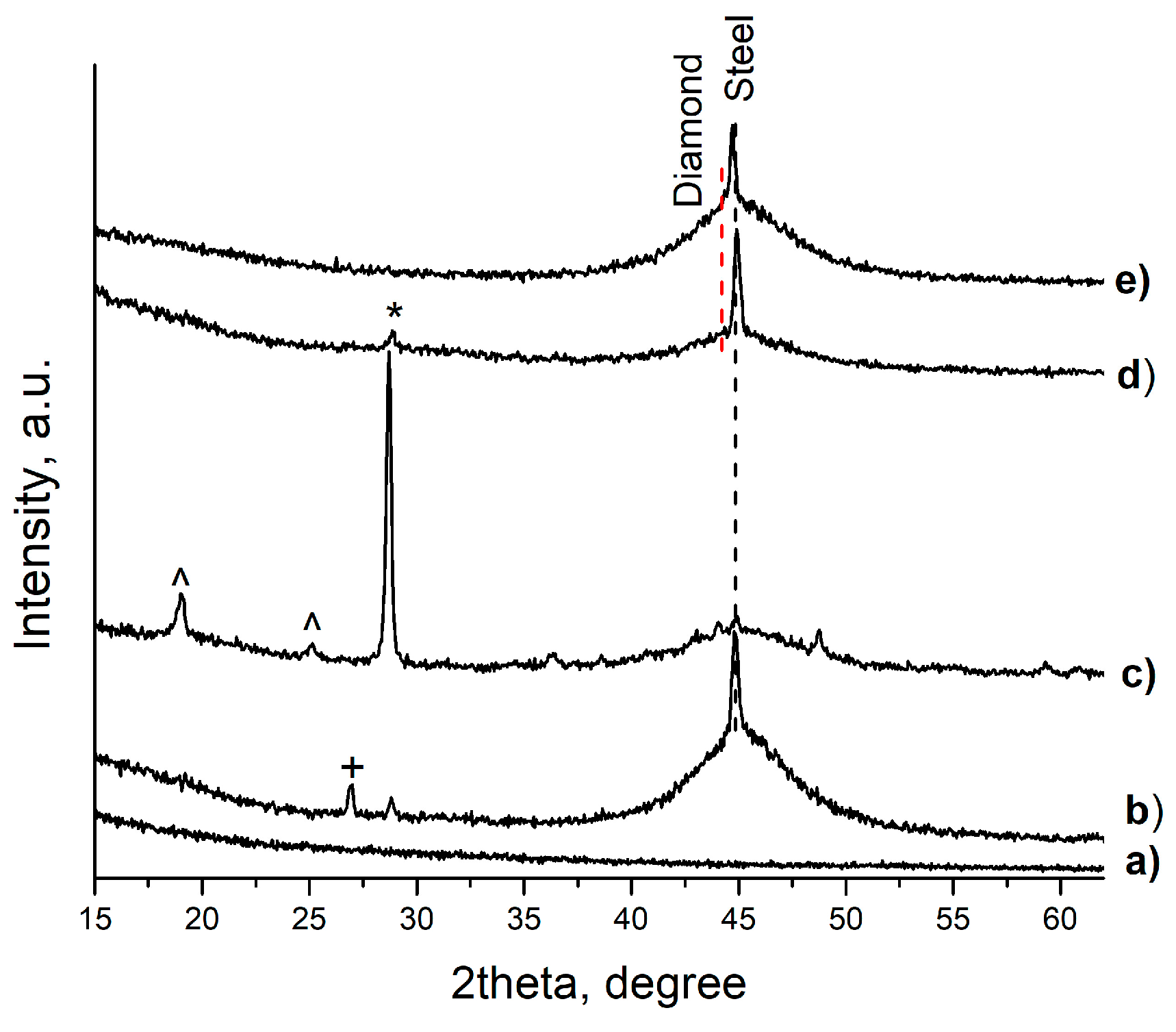
Figure 9.
Summary of selected data on coating thickness, corrosion behaviour, and electrocatalytic performance of the investigated coatings.
Figure 9.
Summary of selected data on coating thickness, corrosion behaviour, and electrocatalytic performance of the investigated coatings.
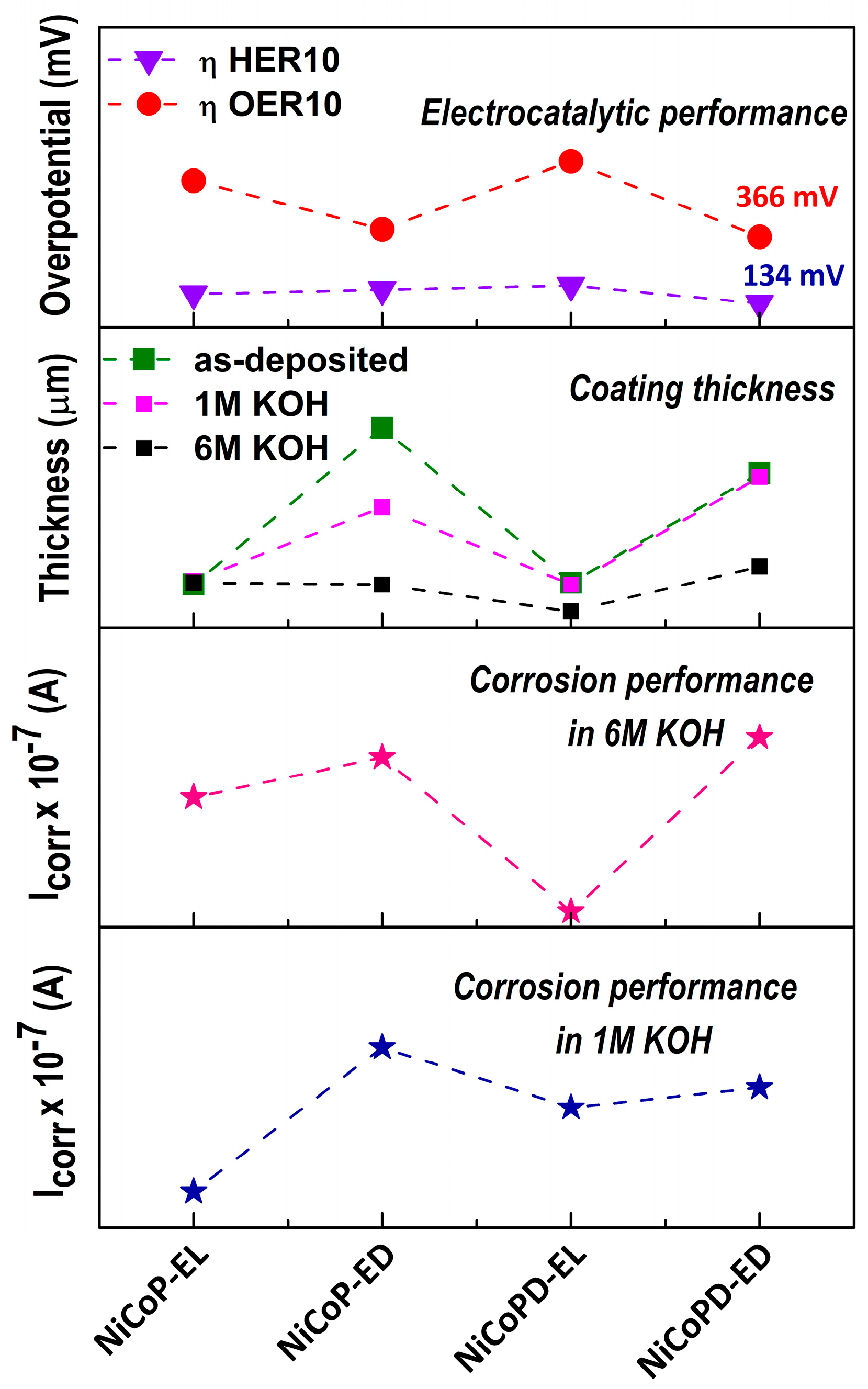

Table 1.
Corrosion parameters of the coatings in 1М and 6M KOH aqueous solution according synthesis deposition method.
Table 1.
Corrosion parameters of the coatings in 1М and 6M KOH aqueous solution according synthesis deposition method.
| Parameters | Coating type | |||
| NiCoP–EL | NiCoPD–EL | NiCoP–ED | NiCoPD–ED | |
| 1М KOH | ||||
| Ecorr, V | -0.290 | -0.420 | -0.280 | -0.480 |
| Icorr, A | 6.8×10⁻8 | 1.1×10⁻7 | 1.4×10⁻7 | 1.2×10⁻7 |
| 6М KOH | ||||
| Ecorr, V | -0.428 | -0.584 | -0.434 | -0.604 |
| Icorr, A | 1.3×10⁻6 | 1.6×10⁻7 | 1.7×10⁻6 | 1.9×10⁻6 |
Table 2.
Chemical composition after the post-exposure in 6M KOH of the electroless and electrodeposited NiCoP and NiCoPD coatings determined by FE-SEM-EDS area scan analysis at ×100,000 magnification.
Table 2.
Chemical composition after the post-exposure in 6M KOH of the electroless and electrodeposited NiCoP and NiCoPD coatings determined by FE-SEM-EDS area scan analysis at ×100,000 magnification.
| Sample | Elements’ concentration (wt. %) |
Ni/Co ratio |
1Ni/Co ratio |
2Ni/Co ratio |
||||
| Ni | Co | P | C | O | ||||
| NiCoP–EL (Spc_007) |
60.5 | 22.1 | 6.87 | − | 3.5 | 2.74 | 2.22 | 2.19 |
| NiCoPD–EL (Spc_003) |
40.1 | 42.1 | 8.01 | 8.2 | 1.7 | 0.95 | 1.79 | 1.89 |
| NiCoP–ED (Spc_004) |
40.3 | 37.0 | 8.94 | − | 5.6 | 1.09 | 1.35 | 1.33 |
| NiCoPD–ED (Spc_001) |
54.8 | 26.8 | 8.34 | 6.3 | 3.8 | 2.05 | 0.73 | 1.20 |
1 Ni/Co ratio of the as-deposited coatings determined by low-magnification EDS analysis.2 Ni/Co ratio of the post-exposure coatings determined by low-magnification EDS analysis after accelerated corrosion testing in 6M KOH.
Table 3.
Coating thickness evolution determined by X-ray fluorescence.
| Electrodes | Coating thickness | |||
|
Initial (µm) |
Post-exposure to 1M KOH (µm) |
Post-exposure to 6M KOH (µm) |
||
| NiCoP–EL | 1.7 | 1.9 | 1.8 | |
| NiCoPD–EL | 1.8 | 1.7 | 0.2 | |
| NiCoP–ED | 10.4 | 6.0 | 1.7 | |
| NiCoPD–ED | 7.9 | 7.7 | 2.7 | |
Table 4.
Overpotentials measured for electrodeposited and electroless deposited NiCoP and NiCoPD coatings during HER and OER.
Table 4.
Overpotentials measured for electrodeposited and electroless deposited NiCoP and NiCoPD coatings during HER and OER.
| Electrode |
ηHER(10mAcm-2), mV |
ηOER(10mAcm-2), mV |
| NiCoP–ED | 182 | 393 |
| NiCoPD–ED | 134 | 366 |
| NiCoP–EL | 167 | 563 |
| NiCoPD–EL | 197 | 631 |
| Fe-steel | 330 | 550 |
Disclaimer/Publisher’s Note: The statements, opinions and data contained in all publications are solely those of the individual author(s) and contributor(s) and not of MDPI and/or the editor(s). MDPI and/or the editor(s) disclaim responsibility for any injury to people or property resulting from any ideas, methods, instructions or products referred to in the content. |
© 2026 by the authors. Licensee MDPI, Basel, Switzerland. This article is an open access article distributed under the terms and conditions of the Creative Commons Attribution (CC BY) license (http://creativecommons.org/licenses/by/4.0/).
Copyright: This open access article is published under a Creative Commons CC BY 4.0 license, which permit the free download, distribution, and reuse, provided that the author and preprint are cited in any reuse.