

Submitted:
05 September 2026
Posted:
07 September 2026
You are already at the latest version
Abstract
Advertising is the principal financial base of commercial media, and its scale, structure, and distribution shape what media institutions can produce. This study analyzes the role of advertising in the Saudi media industry across the 26-year period from 2000 to 2026, a span that opens with the consolidation of a pan-Arab satellite television market financed largely by Saudi capital and closes with a platform-dominated digital advertising economy operating under the Vision 2030 media strategy. Adopting a descriptive–analytical documentary design, the study triangulates industry expenditure estimates (Ipsos, IAB MENA, Statista), connectivity and audience data (DataReportal, the Communications, Space and Technology Commission), regulatory documents, corporate disclosures (MBC Group), and peer-reviewed scholarship to address three questions: how the scale, structure, and measurement of the Saudi advertising market have evolved; which conditions have sustained the advertising base of the media industry across the satellite and platform eras; and to what extent nine anticipated effects of advertising on the Saudi media industry, formulated at the dawn of the satellite era, have materialized. The findings show that Saudi Arabia became the largest national advertising market in the Middle East and North Africa, that digital media rose from under 10% of Gulf advertising expenditure in 2012 to roughly three-quarters of Saudi expenditure by 2023, and that an estimated 70–80% of digital spending flows to global platforms. Seven of the nine anticipated effects are supported or partially supported and two have been transformed: advertiser influence over content now operates through platform algorithms and influencer economies rather than through channel schedules, and advertising’s expected contribution to news credibility has been complicated by platform capture of revenue and by state ownership. The study concludes with recommendations on measurement, regulation, professionalization, and research.
Keywords:
advertising expenditure
; Saudi Arabia
; media economics
; satellite television
; digital platforms
; influencer marketing
; Vision 2030
; media regulation
1. Introduction
The media and communication industry have become, and will foreseeably remain, one of the principal pillars of the global economy, whether measured by the number of enterprises operating within it or by the volume of capital invested. Writing at the turn of the century, Al-Qassas (2000, p. 20) predicted that what had come to be termed the media industry would soon rank among the foremost of industries and among the most generative of employment and wealth. The intervening quarter-century has borne out that assessment. Global advertising expenditure, the revenue stream that sustains most commercial media, is forecast to exceed USD 1 trillion for the first time in 2026, with digital channels accounting for approximately 69% of the total on the narrower definition used by dentsu (2025) and 73% on the broader definition used by WPP Media (2026). WPP Media (2026) further observes that advertising revenue now represents its highest share of global gross domestic product since 1999, surpassing the dot-com peak of 2000, and that the three largest sellers of advertising outside China (Alphabet, Meta, and Amazon) account for 57.6% of the market, with no traditional media owner remaining among the ten largest sellers worldwide.
When the earlier scholarship on which this study builds spoke of the media, it meant the press, radio, and television. Of these, television long remained the most consequential in influence, reach, and audience size; several studies found that its audience exceeded that of all other media combined (Al-Makaty, 1995). Cross-border viewing began in Western Europe and North America in the 1950s (Nasr, 1994, p. 7), and in the Arab world the Arab Satellite Communications Organization (Arabsat) enabled most television services to adopt satellite transmission at the beginning of the 1990s, with Nilesat and Badr subsequently sustaining the growth of the market (Boyd, 1999; Sakr, 2001).
The Saudi private sector mounted the first non-governmental Arab effort to establish commercial satellite channels whose resources derived principally from advertising revenue: the Middle East Broadcasting Center (MBC), the Arab Radio and Television Network (ART), and the Orbit network (Kraidy & Khalil, 2009; Sakr, 2001). Satellite channels then proliferated until their number ran into the hundreds, competing for the Arab viewer with films, serial dramas, music, sports, and news (Nasr, 1994) and with television advertising in particular (Youssef, 1994); among Saudi viewers in the mid-1990s, MBC occupied first place in reported exposure (Bait Al-Mal, 1994). Such networks could not sustain operations without a stable stream of income. Because they relied on advertising as their principal source of revenue and on subscriptions as a secondary one, and because the sale of pan-Arab airtime was intermediated by a small number of Lebanese-led sales houses, most prominently the Choueiri Group (Harb, 2015), the advertising dimension of the media industry acquired considerable significance for researchers, economists, and policymakers alike.
The period examined here, 2000 to 2026, encompasses the maturation and partial displacement of that satellite model. Three developments distinguish between its later years. First, near-universal connectivity, with internet penetration of 99% and social media user identities exceeding the population by late 2025 (Kemp, 2025), transferred the bulk of advertising expenditure from television and print to digital platforms owned outside the region. Second, the launch of Saudi Vision 2030 in 2016 (Council of Economic and Development Affairs, 2016) reframed the media sector as a target of industrial policy, with a strategy to raise its contribution to gross domestic product from SAR 16 billion in 2024 to SAR 47 billion by 2030 (Saudi Gazette, 2025; Saudi Press Agency, 2023). Third, the institutional architecture of the industry changed: cinemas reopened in 2018 after a 35-year absence, MBC Group listed on the Saudi Exchange in January 2024 (The National, 2024), and a succession of Saudi newspapers, culminating in Al-Riyadh in August 2026, abandoned print for digital-only publication (Arab News, 2026). The question posed at the dawn of the satellite era, namely what effects advertising carried on satellite channels would have on the Saudi media industry, therefore requires re-examination in light of a quarter-century of evidence.
This article makes three contributions. It assembles a methodologically annotated record of Saudi and regional advertising expenditure across the period, drawing attention to the incompatibility of rate-card and net measurement conventions that has long confounded comparison. It updates the three enabling conditions and nine anticipated effects originally proposed for the satellite era, evaluating each against verifiable evidence from 2000 to 2026 and against a substantially expanded peer-reviewed literature, including the most recent Saudi studies of influencer marketing. And it draws out the implications for media policy, professional practice, and future research in a media system undergoing deliberate, state-leading transformation.
2. Research Problem, Questions, and Objectives
Advertising ranks among the most important marketing activities of the contemporary economy. It serves the consumer by supplying information about available goods and services and enabling comparison among them, raises rates of sale and production, and stimulates economic activity more broadly. It is likewise the principal source of financing on which media institutions depend, the engine of the media industry in every country of the world, the Arab world included (Shalabiyya, 2000). In the vocabulary of media economics, commercial media operate in a dual product market, selling content to audiences and audiences to advertisers, so that the size and composition of advertising revenue determine both the resources available for content and the incentives governing its production (Napoli, 2003; Picard, 1989).
The regional figures available at the opening of the study period conveyed both the promise and the fragility of this financial base. Advertising expenditure in the Arab Gulf states reached an estimated USD 675 million in 1997 (Al-Jazirah, 1418 AH, p. 28); MBC’s advertising revenue in that year was estimated at USD 50 million and that of the Lebanese satellite channels at USD 57 million (Al-Hayat, 1997, p. 10); and by 2000 total advertising expenditure across the Arab world had reached approximately USD 2.3 billion on the rate-card basis then in universal use (Pan Arab Research Center [PARC], 2000). Media researchers had already observed satellite channels racing to win advertisers and recorded the efforts of some to satisfy them at the expense of their core mission. By the close of the period the numbers had changed by an order of magnitude and the media had changed in kind: digital advertising expenditure in the Middle East and North Africa (MENA) alone reached USD 8.19 billion in 2025, making the region the fastest-growing digital advertising market in the world (IAB MENA, 2026), and Saudi Arabia was consistently identified as the largest national market within it (Ipsos, 2022; Statista, 2025). The same transformation raises questions the satellite-era literature could not anticipate whether advertising revenue still accrues to Saudi media institutions or leaks to global intermediaries; whether the influence advertisers were expected to exert over programming has migrated to platform algorithms and influencer economies; and whether the state’s assumption of a developmental role has altered the balance between commercial and public functions.
Accordingly, the study seeks to answer the following principal question: what are the observed and anticipated effects of advertising on the Saudi media industry across the period 2000 to 2026, and how have these effects been shaped by the transition from pan-Arab satellite television to digital platforms? This question is decomposed into three research questions:
RQ1. How have the scale, structure, and measurement of the Saudi advertising market evolved between 2000 and 2026, and how does the Saudi market compare with the regional and global markets of which it forms a part?
RQ2. Which conditions have sustained the advertising base of the Saudi media industry across the satellite and platform eras, and how have those conditions changed?
RQ3. To what extent have the anticipated effects of advertising on the Saudi media industry, both positive and negative, materialized, and in what ways have they been transformed by digital platforms and by Vision 2030 media policy?
The objectives follow from these questions: to document, with attention to methodological comparability, the growth and changing composition of advertising expenditure in Saudi Arabia and its region; to identify and update the conditions that have made Saudi Arabia a climate conducive to advertising; to evaluate systematically the nine anticipated effects formulated at the outset of the satellite era, classifying each as supported, partially supported, or transformed; and to derive recommendations for policy, practice, and research.
3. Literature Review
Given the abundance of scholarships on advertising, its influence on media content, and its role in the economics of media institutions, this review is organized around seven themes bearing directly on the research questions and closes by identifying the gap the present study addresses.
3.1. The Economics of Advertising-Supported Media
Media economics treats commercial media as operating simultaneously in two markets. Picard (1989) formalized the dual product market, in which a media firm produces content for audiences and sells access to those audiences to advertisers, while Napoli (2003) elaborated the audience marketplace as transactions in predicted, measured, and actual audiences, whose imperfect correspondence generates much of the uncertainty in advertising markets. The theory of two-sided markets supplied a more general framework: Rochet and Tirole (2003) showed that platforms serving two groups of users must set not merely a price level but a price structure across the two sides, and Anderson and Gabszewicz (2006) applied the insight to media, demonstrating that audience aversion to advertising constrains the equilibrium quantity of advertising and that competition among advertising-financed media may reduce rather than increase content diversity. Evans (2009) extended the analysis to online advertising, explaining how algorithmic intermediation and behavioral targeting restructured the value chain, shifting rents from publishers to platforms that own the audience relationship and the data describing it. These frameworks explain why advertising revenue confers both resources and dependence, and why the migration of expenditure to platforms alters the position of national media institutions even when total advertising grows.
3.2. Television Advertising and Its Effects on Audiences
The satellite-era literature established the importance of television as an advertising vehicle on the basis of its combination of sound, image, and motion, and descriptive studies documented its rapid ascent in the Arab world (Kalliny et al., 2008). A field study in Egypt found that advertising ranked first among the factors stimulating demand among children (44%), ahead of friends (32%) and actual need (16%), and that frequency of exposure bore directly on frequency of requests (Abdel Aziz, 1991, pp. 193–221). A study of Saudi television found that 38% of Jeddah residents took television as a principal source of product information and 49.4% increased expenditure on advertised goods after viewing commercials, with the effect intensifying as viewing hours rose (Khanah et al., 1989), and a survey of 400 residents of Greater Cairo found that 93% believed television advertising always or sometimes increases consumption and 48.2% that it raises aspirations (Rida, 1993, pp. 100–106). These findings converge with the international review by Buijzen and Valkenburg (2003), which concluded that exposure to television advertising is reliably associated with materialism, parent–child conflict, and purchase requests among children, and they establish the premise on which the anticipated cultural effects of satellite advertising were built.
3.3. The Pan-Arab Satellite Television Market
A rich scholarship traces the political economy of Arab satellite television. Boyd (1999) provided the standard history of Arab broadcasting up to the satellite era, and Rugh (2004) placed Saudi Arabia within the loyalist category of Arab media systems, in which private ownership coexists with close alignment to state policy. Sakr (2001) showed how Saudi capital came to dominate pan-Arab channels headquartered outside the Kingdom, later examined how Al Jazeera’s non-commercial funding exposed the advertising dependence of its Saudi-financed competitors (Sakr, 2005), and analyzed the intertwining of Gulf subsidy and advertising revenue (Sakr, 2007). Ayish (2002) typologized Arab television into state-controlled, reformist, and liberal-commercial patterns, within which the Saudi-owned commercial channels occupied a distinctive position of commercial form and political caution. Kraidy and Khalil (2009) traced the shift to a pan-Arab commercial satellite industry with Saudi capital as its principal financier and identified Ramadan as the sweeps period in which the year’s advertising expenditure is concentrated, and Kraidy (2010) showed how commercially driven reality formats became sites of contention over religion, gender, and modernity. Harb (2015) supplied the commercial link, a case study of Antoine Choueiri and the near-monopoly his group exercised over pan-Arab advertising sales, which explains why television expenditure originating with Saudi advertisers was habitually booked to a pan-Arab market rather than attributed to Saudi Arabia. Kalliny et al. (2008) offered a benchmark account of Arab television advertising in the mid-2000s, updated by Kalliny (2014) to document the migration of expenditure toward satellite and early digital channels.
3.4. Advertising, Culture, and Religion in Saudi Arabia
The Saudi-specific literature has been concerned above all with the relationship between advertising practice and Islamic and cultural norms. Tuncalp (1990) found among Saudi executives broadly favorable views of advertising’s economic role coupled with criticism of its social and ethical execution, and documented the constraints of the pre-satellite audiovisual environment, including the state broadcasting monopoly and content restrictions (Tuncalp, 1992). Kadasah (1992a) identified the economic and social factors that created a climate conducive to advertising in Saudi society and found that 51% of enterprises operating for fifteen years or more maintained dedicated advertising departments, while a companion study of 250 businesspeople established that they regarded advertising as a necessity and specialized agencies as indispensable (Kadasah, 1992b). Al-Makaty et al. (1996) found that religious conservatism shaped Saudi acceptance of advertising content, particularly the portrayal of women, more strongly than acceptance of advertising as an institution, a distinction that continues to organize the field. Kalliny and Gentry (2007) showed that Arab television advertising emphasizes collectivism, tradition, and religious values where American advertising emphasizes individualism; Abdul Cader (2015) identified the Shari’ah-derived constraints on gender portrayal, deception, and prohibited products that Saudi advertisers must negotiate, arguing that they shape creative strategy rather than merely restricting it; and Benmamoun et al. (2019) demonstrated that culturally adapted digital content significantly improves Arab e-consumer response. Earlier Arabic-language studies of the image of women in television advertising (Al-Omar, 1412 AH, p. 71) and warnings about the dangers of direct broadcasting for Islamic society (Youssef, 1994) supplied the normative concerns the present study revisits.
3.5. Source Credibility, Opinion Leadership, and the Influencer Turn
The proposition that advertising would broaden the pool of opinion leaders cited in persuasive messages rests on two classic lines of research. Hovland and Weiss (1951) demonstrated that identical messages produce greater opinion change when attributed to a high-credibility source, and Katz and Lazarsfeld (1955) formulated the two-step flow model in which media messages reach the public through opinion leaders embedded in interpersonal networks. Ohanian (1990) operationalized source credibility for endorsement research as expertise, trustworthiness, and attractiveness, and Al-Makaty et al. (1994) showed that rural and urban Saudi audiences diverged sharply in the news sources they judged credible during the 1991 Gulf War. The digital era has converted these constructs into the foundations of influencer marketing: Lou and Yuan (2019) established that message value and influencer credibility jointly build follower trust in branded content. In the Gulf, Hurley (2019) showed that female Gulf-Arab influencers construct a fantastical authenticity on Instagram that reconciles conspicuous consumption with local norms of modesty, and Alsalloum and Gainous (2025) analyzed how these women have become a primary advertising channel in a post-reform market.
A cluster of very recent Saudi studies documents the mechanisms involved. Mabkhot et al. (2022) confirmed that influencer trustworthiness and expertise drive purchase intention, with attractiveness a weaker predictor; Saad et al. (2025) found that credibility mediates the path from influencer exposure to purchase intention among university students; Inkesar et al. (2026) established brand trust as the mediating mechanism among Saudi Millennials and Generation Z; and Alamoudi (2026) showed that brand-page value and self-brand connection convert Generation Z engagement into purchase intention. Alqahtani et al. (2026), integrating the theory of planned behavior with the elaboration likelihood model among Saudi users of Instagram, Snapchat, and X, found that advertising content quality was the strongest predictor of purchase intention, followed by influencer credibility, engagement, and exposure. Alharthi et al. (2026) mapped how influencer marketing has become a core e-commerce acquisition channel in a market of near-universal connectivity; Aldakhil and Badran (2026) provided the first peer-reviewed treatment of Ramadan as a digital advertising season, linking social media influence to both conspicuous and conscious purchasing among Saudi women; and Alsaeed (2026) argued that religiosity functions as a credibility signal across both source and message dimensions, such that adherence to Islamic principles, modest self-presentation, and family orientation are prerequisites for trust in Saudi influencer marketing, a finding that connects the newest literature directly to the concerns raised by Al-Makaty et al. (1996) three decades earlier.
3.6. Platforms, Publishers, and Advertiser Influence over Content
The anticipated negative effect of advertiser control over content has a long pedigree. Baker (1994) argued that dependence on advertising creates a structurally corrupting incentive, pushing news media toward bland content that avoids offending advertisers, and Rinallo and Basuroy (2009) showed across 291 firms and 123 publishers in five countries a strong positive effect of advertising expenditure on the editorial coverage advertisers receives. The platform era has altered the mechanism without removing it. Nielsen and Ganter (2018) showed that relations between publishers and digital intermediaries are asymmetric and continually renegotiated, with publishers accepting short-term reach in exchange for long-term dependency; Hardy (2021) mapped how the collapse of display advertising pushed publishers toward native and sponsored content, merging editorial and marketing functions; and Young and Hermida (2024) found that platform payments to publishers accrued mainly to large incumbents, entrenching the imbalance. On the supply of news, the debate over the dominance of Western agencies that preoccupied Arab scholars (Al-Uwaini, 1981; Tash, 1991) and the MacBride Report (International Commission for the Study of Communication Problems, 1980) has been reframed by Boyd-Barrett and Rantanen (1998), who showed how agencies drove both globalization and the construction of national media, and by Straubhaar (1991), whose concept of cultural proximity explains the audience preference for culturally near content that underwrote the commercial success of pan-Arab channels. Varis (1984) quantified the one-way flow of television programming that Arab critics deplored.
3.7. The Saudi Media System Under Vision 2030
The most recent scholarship situates the Saudi media industry within a program of state-led transformation. Kraidy (2021) provided the current system-level account of Saudi media, covering ownership, state–market relations, and the restructuring that followed the launch of Vision 2030. Wheeler (2020) characterized Saudi new media as Janus-faced, simultaneously liberalizing and surveilled, an assessment that frames the regulatory environment in which influencer advertising now operates. Muyidi (2025) traced Saudi media through state broadcasting, satellite, and digital phases, arguing that modernization has been balanced at every stage against the preservation of Islamic cultural identity, and Almohawes (2026) offered corpus evidence that web news discourse about Vision 2030 rose steadily from 2016 and peaked in 2023 and 2024, with entertainment and media reform among its dominant collocates. These works confirm that the industry examined here is no longer the private, offshore, advertising-financed satellite sector of 2000 but a hybrid system in which state capital, regulatory policy, and global platforms interact.
3.8. Research Gap
The literature thus supplies robust theory on advertising-financed media, detailed histories of Arab satellite television, a growing body of Saudi consumer research on influencer credibility, and system-level accounts of Vision 2030 media policy. What it lacks is a longitudinal evaluation connecting these strands: a study that takes the propositions advanced about advertising’s effects on the Saudi media industry at the dawn of the satellite era and tests them against the evidence of the following quarter-century, while attending to the measurement problems that make regional expenditure data so difficult to interpret.
4. Methodology
This section sets out how the study was conducted. It first describes the descriptive–analytical research design and its documentary basis (4.1), then identifies the five categories of source on which the analysis draws and explains why triangulation across them was required given the absence of a consistent series of Saudi advertising expenditure for 2000 to 2026 (4.2). It next presents the three-stage analytical procedure aligned with the research questions, together with the conceptual framework that organizes the assessment of the enabling conditions and anticipated effects (4.3), and closes by stating the limitations of the evidence (4.4).
4.1. Research Design
The study employs the descriptive–analytical method, selected for its close association with research in the social sciences and because it is concerned with prevailing conditions, their characteristics, their interrelations, and the factors bearing on them, and frequently encompasses projections regarding the future of the phenomenon under examination (Alyan & Ghunaym, 2000). The method allows the phenomenon of advertising to be observed and tracked across the period 2000 to 2026 in order to identify its observed and anticipated effects on the Saudi media industry. The design is documentary rather than survey-based: no primary interviews or questionnaires were administered, and all evidence derives from published sources that can be independently verified.
4.2. Data Sources and Triangulation
Five categories of source were assembled: industry expenditure estimates, comprising the Ipsos net-basis series for the MENA region and Saudi Arabia for 2019 to 2021 (Ipsos, 2020, 2022), the IAB MENA sell-side series for regional digital expenditure for 2023 to 2025 (IAB MENA, 2026), Statista Market Insights estimates for Saudi Arabia in 2023 (Statista, 2025), the Markaz estimates of Gulf Cooperation Council (GCC) expenditure for 2012 (Gulf News, 2013), and the historical rate-card figures cited in the satellite-era literature (Al-Hayat, 1997; Al-Jazirah, 1418 AH; PARC, 2000); connectivity and audience data from DataReportal (Kemp, 2025) and the Communications, Space and Technology Commission (CST, 2025); regulatory and policy documents, namely Saudi Vision 2030 (Council of Economic and Development Affairs, 2016), the Audiovisual Media Law (2017), the Mawthooq licensing regime (Clyde & Co, 2022; Saudi Gazette, 2022), and the media sector strategy (Saudi Gazette, 2025; Saudi Press Agency, 2023); corporate disclosures, principally the audited earnings releases of MBC Group (ArabAd, 2026; MBC Group, 2025), reporting on its initial public offering (The National, 2024), Saudi Film Commission box-office statistics (Arab News, 2025), and reporting on the closure of print newspapers (Arab News, 2026; Saudi Gazette, 2019); and the peer-reviewed scholarship reviewed in Section 3, together with the Arabic-language empirical studies that constituted the evidentiary base of the original analysis.
Triangulation was necessary because no single source offers a continuous, methodologically consistent series of Saudi advertising expenditure for 2000 to 2026. Ipsos, which operates the region’s principal advertising monitoring service, has stated that rate-card figures reported for MENA in 2019 totaled roughly USD 22 billion whereas actual expenditure was closer to USD 3.9 billion, and that its 2020 publication was the first to present net estimates by country and medium (Ipsos, 2020); any series that crosses 2019 therefore mixes two incompatible conventions, and Statista, IAB MENA, and rate-card sources each apply further definitions of their own. The study accordingly identifies the basis of every estimate, refrains from splicing series of different construction, and treats the dispersion among sources as a finding in its own right.
4.3. Analytical Framework and Procedure
The analysis proceeds in three stages corresponding to the research questions. For RQ1, expenditure and audience data are tabulated and charted by year, coverage, and measurement basis. For RQ2, the three enabling conditions identified in the satellite-era analysis, namely a market climate conducive to advertising, advertisers’ awareness of the importance of advertising, and competition among media for advertisers, are re-examined against the evidence of the period. For RQ3, each of the nine anticipated effects is restated as a proposition and assessed on a three-level scale: supported, where the evidence confirms the effect substantially as anticipated; partially supported, where it is confirmed in part or with material qualification; and transformed, where it has materialized through mechanisms or in forms the original formulation did not foresee. The conceptual framework organizing this procedure is shown in Figure 1. It positions advertising as the financial base of the Saudi media industry within a two-sided market linking audiences and advertisers, traces the three enabling conditions that feed that base, distinguishes anticipated positive from anticipated negative effects, and adds a category absent from the original formulation: the moderating forces of platform capture, regulation, and state capital that shaped how the effects were realized.
As Figure 1 indicates, the framework does not assume that advertising affects the media industry uniformly: the same revenue stream may strengthen a broadcaster’s news operation while eroding its entertainment schedule, or finance domestic production while transferring the bulk of expenditure to foreign platforms. The moderating forces determine which outcome prevails, and the results for each effect are reported with explicit attention to them.
4.4. Limitations
Three limitations should be stated. First, the absence of a consistent expenditure series means that growth rates across the full period cannot be computed precisely. Second, corporate and regulatory sources are public relations documents as well as records; their figures are used only where corroborated or where they constitute the sole authoritative source, as with audited earnings releases. Third, the Arabic-language empirical studies retained from the original analysis date from the late 1980s and early 1990s and are cited as the historical evidentiary base of the propositions under test, not as evidence about present conditions.
5. Results
This section reports the findings in the order of the three research questions. Section 5.1 addresses RQ1 by assembling the available estimates of advertising expenditure for Saudi Arabia and its region between 1997 and 2025, identifying the coverage and measurement basis of each, and tracing the shift in the distribution of expenditure by medium. Section 5.2 addresses RQ2 by re-examining the three enabling conditions identified in the satellite-era analysis, namely a climate conducive to advertising, advertisers’ awareness of its importance, and competition among media for advertisers, against the evidence of the period. Section 5.3 addresses RQ3 by restating each of the nine anticipated effects as a proposition and assessing it as supported, partially supported, or transformed, with explicit attention to the moderating forces of platform capture, regulation, and state capital set out in Figure 1.
5.1. Scale, Structure, and Measurement of the Saudi Advertising Market (RQ1)
The opening decade of the period is the least well documented. The regional and Gulf totals for 1997 and 2000 reported in Section 2 were compiled on a rate-card basis, and reported growth in the 2000s must be read with that inflation in mind. The first regional estimate whose methodology is documented is the Markaz assessment of GCC advertising revenue for 2012, which placed expenditure at USD 4.8 billion, up 5%, with the United Arab Emirates holding a 33% share, print media 71% of the total, and digital media only 9.4%, or approximately USD 180 million (Gulf News, 2013). Table 1 assembles the principal estimates for Saudi Arabia and its region across the period, identifying the coverage and measurement basis of each.
Two features of Table 1 warrant emphasis. The first is the effect of the 2020 methodological reset. On the net basis introduced by Ipsos, total MENA expenditure in 2019 was USD 3.91 billion, or USD 4.16 billion including an estimated USD 250 million of influencer marketing, and Saudi Arabia, the largest national market, accounted for a little over USD 1 billion exclusive of television expenditure booked to the pan-Arab market (Ipsos, 2020). The pandemic reduced regional expenditure to USD 3.12 billion in 2020 before a recovery of 62% to USD 5.07 billion in 2021, within which Saudi Arabia reached USD 1.52 billion (Ipsos, 2022). The second feature is the dispersion among sources for recent years. Statista Market Insights estimated total Saudi expenditure at approximately USD 2.01 billion in 2023, of which USD 1.56 billion, or 77%, was digital, with search advertising alone worth USD 746 million (Statista, 2025), whereas an industry estimate for 2022 placed Saudi digital expenditure at roughly USD 1.5 billion with 70% to 80% flowing to Google and Meta, an annual outflow of about USD 1 billion from the national economy, and a government share of 20% to 25% of the digital market (Asharq Al-Awsat, 2024). Regional digital expenditure measured on the sell side rose from USD 6.25 billion in 2023 to USD 6.95 billion in 2024 and USD 8.19 billion in 2025, a growth rate of 17.8% in the final year that made MENA the fastest-growing digital advertising region in the world (IAB MENA, 2026). Figure 2 plots these estimates.
The pattern in Figure 2 is one of rapid growth accompanied by irreducible uncertainty about levels. Every series shows regional and Saudi expenditure rising strongly after the pandemic trough, and every recent source identifies Saudi Arabia as the largest market in the region; the level, however, depends on the construction of the estimate, and the gap between a Saudi total of about USD 2 billion (Statista) and Saudi digital expenditure alone of USD 1.5 billion (industry estimate) is consistent only if offline media account for a small residual, which is what the medium-share data indicate. A further implication of the Ipsos convention deserves note. Because the television expenditure of Saudi advertisers has for three decades been sold by pan-Arab sales houses and attributed to a pan-Arab market rather than to Saudi Arabia (Harb, 2015; Ipsos, 2020), a clean national crossover year in which digital overtook television cannot be identified from published statistics. What can be identified is the regional crossover: on the net basis, digital became the largest medium in MENA with the 2019 data year, when it reached USD 1.26 billion against a television total that had fallen from roughly USD 2 billion in earlier years, and 70% to 75% of that digital expenditure went to Facebook and Google (Ipsos, 2020). Figure 3 sets out the distribution of expenditure by medium at four points across the period.
The transformation recorded in Figure 3 is among the most striking in the recent history of any advertising market. In 2012 print commanded 71% of GCC expenditure and digital under 10%; by 2021 online media accounted for 47% of MENA expenditure, television 24.5%, out-of-home 19.5%, newspapers 5.5%, and magazines and cinema 0.5% each (Ipsos, 2022); by 2023 digital media accounted for 77% of Saudi expenditure (Statista, 2025); and the global forecast for 2026 places digital at 68.7% on the dentsu definition, with print declining by 3% and television growing by only 2.4% (dentsu, 2025). The figure should be read as a sequence of snapshots on different bases rather than as a single trend line, but the direction and magnitude of change are robust to the differences in construction. Regional newspaper expenditure fell to USD 303 million in 2019 and recovered only to USD 281 million in 2021, and Ipsos (2020) described newspapers, once dominant especially in the GCC, as the first victim of digital; between roughly 2017 and 2019 Saudi daily television viewing fell from 6 hours 44 minutes to 4 hours 51 minutes, newspaper readership fell from 62.6% to 47.6% while online readership rose from 18.7% to 29.1%, and over-the-top video penetration among Millennials and Generation Z rose from 34% to 45.4% (Ipsos, 2020). Within the digital category, the fastest-growing channels in 2025 were social video (up 23.6%), connected television (up 31%), and retail media (up as much as 40.5%) (IAB MENA, 2026). The consequences for print were institutional as well as financial. Saudi Gazette issued its final print edition in April 2019 on the ground that reader and advertiser behavior had changed (Saudi Gazette, 2019), and in August 2026 Al-Riyadh, the Kingdom’s flagship Arabic daily for more than six decades, ended its print edition together with the magazine Al-Yamamah, a decision attributed to the loss of the dual circulation-and-advertising model and the migration of budgets to platforms offering superior targeting and measurement (Arab News, 2026). The answer to RQ1 is therefore that the Saudi advertising market grew from a rate-card total measured in hundreds of millions of dollars at the opening of the period to a net total of roughly USD 2 billion by 2023, became the largest national market in its region, and shifted from a print-and-television structure to one in which digital media command roughly three-quarters of expenditure, while the statistical apparatus measuring the market remained fragmented and methodologically inconsistent throughout.
5.2. Enabling Conditions for Advertising in Saudi Arabia (RQ2)
5.2.1. A Climate Conducive to the Flourishing of Advertising
The satellite-era analysis identified six economic and social factors that had combined to create a climate conducive to advertising in Saudi society: a free economic system in which the private sector assumed the greater part of production, distribution, and services; the broadening of commercial activity through infrastructure projects, with intensified domestic competition; the encouragement of foreign capital; the increase in circulating liquidity from government and household expenditure, which made the Kingdom one of the largest consumer markets in the region; changing consumption patterns driven by rising incomes, education, urbanization, and contact with the outside world; and the expansion of basic services across most regions (Kadasah, 1992a, pp. 97–99). Each of these factors has intensified across the study period, and two new ones have been added: a deliberate state strategy for the media sector and a digital infrastructure of near-universal reach. Table 2 summarizes the relevant indicators.
The connectivity indicators in Table 2 describe a market in which the reach once attributed to satellite television has been surpassed by digital platforms. By late 2025 Saudi Arabia had 34.4 million internet users, a penetration rate of 99%, and 38.6 million social media user identities, equivalent to 111% of a population of 34.7 million with a median age of 29.6 years (Kemp, 2025); the CST reported mobile access for 99.4% of users and average mobile data consumption three times the global average (CST, 2025). Policy indicators describe a state that has assumed a developmental role. The media sector strategy launched in December 2023 set a target of raising the sector’s contribution to gross domestic product to SAR 47 billion by 2030 (Saudi Press Agency, 2023); by 2024 the contribution stood at SAR 16 billion, or 0.57% of gross domestic product, against a 2030 target of 0.8%, media employment had reached 67,000 with a target of 160,000, and the IGNITE program had committed USD 1.1 billion to content creation and digital infrastructure, including USD 234 million for film financing (Saudi Gazette, 2025). Figure 4 shows the advertising reach of the principal platforms.
Figure 4 shows that YouTube (27.5 million), Snapchat (25.3 million, or 91.8% of the eligible population aged 13 and over), Instagram (18.2 million), and Facebook (17.7 million) each reach a majority or near-majority of the population, that X has declined to 15.0 million after losing 6.8% of its audience in a year, and that the reported reach of TikTok exceeds the adult population (Kemp, 2025). The advertiser’s choice of medium, once framed as a choice between national television and pan-Arab satellite channels, is now a choice among platforms whose audiences are measured, addressable, and, on Snapchat and TikTok, disproportionately young. The first enabling condition therefore holds more strongly than at any earlier point in the period, with the qualification that the climate now favors advertising on platforms owned outside the Kingdom as much as advertising in Saudi media.
5.2.2. Advertisers’ Awareness of the Importance of Advertising
The second enabling condition rested on evidence that Saudi businesspeople had come to recognize the importance of advertising and had become more attentive to establishing dedicated advertising departments. Among 106 enterprises surveyed in Jeddah, 51% of those operating for fifteen years or more maintained such departments, and annual expenditure of SAR 100,000 or more was concentrated among enterprises with more than ten years of experience, which accounted for 59% of the total (Kadasah, 1992a, pp. 104–107); a companion study of 250 businesspeople found them firmly persuaded that advertising had become a necessity and that specialized agencies were indispensable (Kadasah, 1992b, p. 148). The evidence of the study period confirms that this awareness has deepened and diffused. The number of advertisers using MBC Group’s platforms rose 22.7% to 789 in 2024 (MBC Group, 2025), and public-sector advertisers alone accounted for an estimated 20% to 25% of the digital market (Asharq Al-Awsat, 2024). Awareness has also been institutionalized through regulation: since October 2022 any individual earning revenue from advertising on social media has been required to hold a Mawthooq license issued by the media regulator, at a fee of SAR 15,000 for three years, with penalties extending to the companies that contract with unlicensed advertisers (Clyde & Co, 2022; Saudi Gazette, 2022). The licensing regime formalizes a category of advertiser, the individual content creator, that did not exist when the original analysis was written, and the studies reviewed in Section 3.5 document that Saudi consumers respond to those creators’ credibility, content quality, and religiosity in ways advertisers have learned to exploit (Alqahtani et al., 2026; Alsaeed, 2026; Mabkhot et al., 2022).
5.2.3. Competition Among Media for Advertisers
The third enabling condition was competition among Arab satellite channels for advertisers, which the original analysis expected to draw advertisers away from national television, whose share had fallen by 30% in the first half of 1997 as satellite channels offered discounts (Al-Hayat, 1997, p. 10). That expectation was fulfilled in the first decade of the period and then overtaken by a second wave of competition from digital platforms, and by a third in which the surviving satellite broadcasters entered the platform market themselves. Table 3 records the institutional milestones of this sequence.
The trajectory of MBC Group, the largest Saudi-owned broadcaster and the principal case in the original analysis, illustrates the three waves. Having relied on pan-Arab advertising sales through the Choueiri Group throughout the satellite era (Harb, 2015), the group launched the Shahid video-on-demand service and in January 2024 sold a 10% stake on the Saudi Exchange, raising SAR 831 million at an implied valuation of about SAR 8.3 billion in an offering oversubscribed roughly 66 times that rose 30% on its first day of trading (The National, 2024). Its audited results for 2024 reported revenue of SAR 4.20 billion, up 13.1%, and net profit of SAR 426 million; the broadcasting and advertising segment generated SAR 2.42 billion, of which SAR 1.27 billion derived from television, while Shahid generated SAR 1.08 billion, of which SAR 186 million came from advertising-supported video, up 65.4%, from 18.6 million monthly active users and 5.0 million paying subscribers (MBC Group, 2025). In 2025 revenue rose 28.5% to SAR 5.4 billion, Shahid’s advertising revenue rose a further 27.1% to SAR 236 million, and the Public Investment Fund completed a majority shareholding in the company (ArabAd, 2026). Figure 5 presents the revenue composition.
Figure 5 demonstrates that competition for advertisers has not destroyed the satellite-era broadcaster but has forced it to become a multi-platform enterprise in which streaming advertising is the fastest-growing revenue line and in which 86 of the top 100 programs viewed in Saudi Arabia in 2024 were its own titles (MBC Group, 2025). Reported revenue declines at Saudi Research and Media Group in 2024 and 2025, with advertising among the lines named, suggest that the transition has been uneven, although those figures could not be verified against exchange filings for this study and are noted rather than relied upon. The answer to RQ2 is therefore that the three enabling conditions have all been sustained, that the competitive condition has been transformed by two successive waves of platform competition, and that a fourth condition unforeseen in the original analysis, state media policy backed by public capital, now structures the environment in which the other three operate.
5.3. The Anticipated Effects of Advertising on the Saudi Media Industry Re-Examined (RQ3)
The satellite-era analysis advanced nine anticipated effects of advertising on the Saudi media industry and media culture, seven of them positive and two cautionary. Each is restated below as a proposition and assessed against the evidence of the period.
5.3.1. Enhancing the News Credibility of Satellite Channels
The first proposition held that increasing advertising revenue would be reflected positively in the news services of the satellite channels, already evident in their reliance on permanent correspondents across world capitals and would confer on them what researchers term source credibility, of which MBC’s high ranking in viewer exposure was taken as early evidence (Bait Al-Mal, 1994). The proposition is partially supported. Advertising revenue did finance the expansion of Arab satellite news, most visibly in MBC’s launch of the Al Arabiya news channel in 2003 (Kraidy & Khalil, 2009), and the liberal-commercial model that Ayish (2002) identified produced correspondent networks of a scale unknown to state broadcasters. Yet two moderating forces intervened. The first is platform capture: the migration of expenditure to Google and Meta, which absorb 70% to 80% of Saudi digital spending (Asharq Al-Awsat, 2024), removed from broadcasters and publishers the incremental revenue the proposition assumed, and the closure of print titles that had sustained newsrooms for decades (Arab News, 2026) shows that advertising can withdraw credibility-sustaining resources as readily as it supplies them. The second is ownership: the Public Investment Fund’s majority shareholding in MBC Group from 2025 (ArabAd, 2026) replaces the commercial independence on which the source-credibility argument implicitly rested with a hybrid of market finance and state capital, closer to the loyalist than to the liberal-commercial pattern (Kraidy, 2021; Rugh, 2004). Credibility, as Al-Makaty et al. (1994) showed in the Saudi context, is in any case audience-relative rather than a property of revenue.
5.3.2. Mitigating the Adverse Effects of the International News Agencies
The second proposition held that advertising-financed Arab satellite news would reduce dependence on the international agencies that, in the account of the period, supplied more than 80% of the world’s news from London, Paris, New York, and Moscow (Tash, 1991, p. 47) and served the foreign policies of the states that owned them (Al-Uwaini, 1981). The proposition is transformed. In the satellite era it was substantially fulfilled: Al Jazeera, Al Arabiya, and their competitors created Arab-sourced coverage of the Arab world and beyond, and the cultural proximity of that coverage (Straubhaar, 1991) underwrote its commercial success. Over the same period, however, the agency system itself was reshaped by globalization (Boyd-Barrett & Rantanen, 1998), and the locus of dependence shifted from the agencies that supply news to the platforms that distribute it. Nielsen and Ganter (2018) show that publishers accept short-term reach from platforms in exchange for long-term dependency, and Young and Hermida (2024) show that platform payments entrench rather than correct the imbalance. The Arab media system that entered the period dependent on Western agencies for news supply left it dependent on Western platforms for news distribution and advertising revenue, a dependence the original analysis could not have foreseen.
5.3.3. Opening New Fields of Inquiry for Saudi Media Researchers
The third proposition held that rising advertising revenue would open new fields of inquiry for media researchers, enumerating six: the effects of advertising on audiences and on segments such as children, women, and young people; the planning and evaluation of campaigns; the nature of advertising carried and the profile of advertisers; adherence to ethical standards; the employment of children and women in advertisements; and the relationship between the public and the media. The proposition is supported. Every one of these fields is now populated by peer-reviewed Saudi research: audience effects among young people (Alamoudi, 2026; Inkesar et al., 2026; Saad et al., 2025), women (Aldakhil & Badran, 2026; Alsalloum & Gainous, 2025; Hurley, 2019), and consumers generally (Alqahtani et al., 2026; Mabkhot et al., 2022); the nature and industry structure of influencer advertising (Alharthi et al., 2026); the ethical and religious standards governing it (Abdul Cader, 2015; Alsaeed, 2026); and the historical and systemic relationship between the Saudi public and its media (Kraidy, 2021; Muyidi, 2025; Wheeler, 2020). The field has broadened to include corpus analysis of media discourse about Vision 2030 itself (Almohawes, 2026). What remains underdeveloped is peer-reviewed research on the economics and regulation of industry, for which the present study has had to rely on industry and regulatory sources.
5.3.4. The Flourishing of Advertising Agencies and Firms
The fourth proposition held that expansion of satellite channels would revive public relations and advertising agencies through the development of existing agencies and the establishment of new ones, advertisers’ recognition of their need for agencies to conduct research, plan campaigns, select media, and measure results, and intensified competition and professionalization among agencies. The proposition is supported, with a qualification. The Saudi market is now served by a licensed population of advertising offices, marketing offices, and agencies regulated by the General Authority of Media Regulation, and by a licensed population of individual advertisers under the Mawthooq regime (Clyde & Co, 2022; Saudi Gazette, 2022), although no official aggregate count of agencies was available for this study. The functions the proposition assigned to agencies have been reinforced by the measurement and targeting capabilities of digital platforms, which make research, planning, and evaluation continuous rather than episodic (Evans, 2009). The qualification is that a substantial share of the value chain has been captured instead by the platforms themselves, whose self-service tools substitute for agency intermediation among smaller advertisers and whose share of digital expenditure is the source of the economic leakage identified in Section 5.1.
5.3.5. Broadening the Pool of Opinion Leaders Cited in Advertising Messages
The fifth proposition held that, because advertisers seek endorsers who have not previously appeared in comparable advertisements, who suit the product category, and who command popularity and credibility, the growth of satellite advertising would require many more such figures, drive advertisers toward second-rank celebrities, broaden the base of opinion leaders, and give rise to a culture of societal celebrity. The proposition is supported, and in a form that makes it the most prescient of the nine. The premise that audiences buy ideas from those they trust (Hovland & Weiss, 1951) and that mass communication flows through opinion leaders (Katz & Lazarsfeld, 1955) has become the operating logic of an influencer economy whose regional value Ipsos (2020) estimated at USD 250 million in 2019 and which the Saudi state has formalized through licensing. The endorsers are no longer second-rank performers but ordinary users of Snapchat, Instagram, and TikTok whose credibility derives from perceived authenticity (Hurley, 2019), whose trustworthiness and expertise, in the terms of Ohanian (1990), drive purchase intention among Saudi consumers (Mabkhot et al., 2022; Saad et al., 2025), and whose religiosity and modesty function as credibility signals in their own right (Alsaeed, 2026). The culture of societal celebrity the proposition foresaw has materialized, and with it the concern, raised by Alsalloum and Gainous (2025) and Hurley (2019), that the fantastical authenticity of Gulf influencers reconciles conspicuous consumption with local norms in ways that merit critical scrutiny.
5.3.6. The Entry of Saudi Satellite Channels into Media Production
The sixth proposition held that the pressure to fill round-the-clock schedules with programming attractive to advertisers would lead channels toward self-sufficiency in production and away from imported programming, which studies of the period found to constitute as much as 57% of Arab television schedules (Al-Badr, 1991, pp. 116–123; Varis, 1984) in a one-way flow the MacBride Report had condemned (International Commission for the Study of Communication Problems, 1980). The proposition is supported. MBC Group produced 115 new Arabic series in 2024 and held a library exceeding 60,000 hours (MBC Group, 2025), and its media and entertainment segment grew 69.6% in 2025 (ArabAd, 2026). Beyond broadcasting, more than 35 film studios were operational by 2025, NEOM and AlUla had hosted more than 235 productions with cash rebates of up to 40%, and the video sector was projected to reach SAR 15 billion by 2027 (Saudi Gazette, 2025). Cinema, absent for 35 years, generated SAR 845.6 million in box-office revenue from 17.5 million tickets across more than 640 screens in 2024, with eight Saudi films accounting for 19% of revenue by mid-2025 (Arab News, 2025). The mechanism, however, differs from the one anticipated: advertising pressure initiated the turn to domestic production, but state investment through IGNITE and the Cultural Development Fund, together with subscription revenue from Shahid, has sustained it, so that the cultural independence the proposition sought is being pursued through a mixed rather than a purely commercial model.
5.3.7. Creating Employment Opportunities for Graduates of Saudi Media Departments
The seventh proposition held that the satellite channels’ reliance on advertising would create employment for media graduates through the staffing of round-the-clock schedules, the channels’ entry into production, and the revival of agencies. The proposition is supported. Media sector employment reached 67,000 at the end of 2024, an increase of 22% in a single year, against a 2030 target of 160,000, with three national media academies established to supply the labor force (Saudi Gazette, 2025). The composition of that employment has, however, shifted from the broadcast occupations the proposition enumerated toward content creation, streaming, gaming, and film production, and toward the self-employment of licensed influencers, so that media departments face a curriculum challenge as well as an opportunity.
5.3.8. Advertisers’ Control over the Arab Satellite Channels
The eighth proposition, the first of the two cautionary effects, held that advertisers, conscious of the channels’ dependence on their expenditure, would exert control over content on the principle that whoever pays commands, in four forms: the predominance of the advertising function over the news, educational, socializing, entertainment, and cultural functions the media must perform in balance (Ajwa et al., 1989, pp. 332–338), with the risk that channels become a department store through which the viewer wanders; the modest quality of programming, exemplified by the observation of the chairman of Télé Liban that advertisers demand programming in conflict with social values (Okaz, 1418 AH, p. 10); the interruption of serious programming; and breaches of ethical norms, including sexual imagery, the advertising of prohibited products, which accounted for 40% (alcohol) and 30% (tobacco) of the USD 57 million earned by the Lebanese satellite channels in 1997 (Okaz, 1418 AH, p. 10), the selective use of women’s bodies (Al-Omar, 1412 AH, p. 71), and psychological effects on children (Al-Madina Al-Usbu’iyya, 1419 AH, p. 20). The proposition is partially supported. The mechanism is well established (Baker, 1994; Rinallo & Basuroy, 2009). In the satellite era the reality formats that drew the largest budgets became precisely the sites of cultural contention the proposition feared (Kraidy, 2010), and the concentration of expenditure in the Ramadan sweeps (Kraidy & Khalil, 2009) subordinated schedules to the advertising calendar. In the platform era, the control the proposition attributed to advertisers over channel schedules has migrated to algorithms that rank content by engagement and to sponsored-content practices through which editorial and marketing functions have merged (Hardy, 2021); commercial breaks have been replaced by pre-roll video, in-feed promotion, and influencer endorsement whose commercial character consumers may not recognize; and the effects on children that Buijzen and Valkenburg (2003) documented for television have been relocated rather than eliminated. Yet the specific breaches the proposition catalogued have been curtailed in Saudi Arabia by regulation rather than by advertiser restraint: the Audiovisual Media Law (2017) prohibits content contrary to Shari’ah principles, national security, and public morals and bars the promotion of alcohol, drugs, and tobacco, and the Mawthooq regime extends comparable obligations to individual advertisers on social media (Clyde & Co, 2022).
5.3.9. The Possibility of Arriving at an Ethical Charter for Advertising
The ninth proposition held that the transgressions of some satellite channels would lead advertisers, agencies, media, and academics to converge on a common ethical charter purging advertising of deception, confining it to goods and services not contrary to Islamic law, and preserving the integrity and independence of the media. The proposition is transformed. The convergence anticipated has occurred, but through state regulation rather than voluntary self-regulation. The General Commission for Audiovisual Media, established in 2012, became the General Authority of Media Regulation in 2023 with a strategy combining licensing, content standards, and sectoral development (Saudi Press Agency, 2023); the Audiovisual Media Law (2017) codified content prohibitions; and the Mawthooq license of 2022 brought social media advertising within the same regulatory perimeter, with penalties for noncompliance extending to the companies that contract with unlicensed advertisers (Saudi Gazette, 2022). Whether a regulatory perimeter is the functional equivalent of an ethical charter is a question the discussion takes up; what can be recorded here is that the exclusion of prohibited products and the constraint of deception have been secured, while the independence from advertisers the proposition also sought has been pursued through a mechanism that raises independence from the state as a separate question. Table 4 summarizes the assessment of all nine propositions.
Table 4 shows that, of the nine propositions, five are supported, two are partially supported, and two are transformed, and that several of the supported effects also bear elements of transformation in their mechanism. No proposition was disconfirmed outright. The pattern is consistent with the framework in Figure 1: the enabling conditions delivered the revenue growth the original analysis expected, and the effects that depend principally on the volume of revenue (research, agencies, endorsers, production, employment) materialized substantially as anticipated, whereas the effects that depend on who receives the revenue and on what terms (news credibility, dependence, advertiser control, ethical governance) were reshaped by the moderating forces of platform capture, regulation, and state capital.
6. Discussion
The results invite four analytical observations that connect the Saudi case to the broader literature.
The first concerns the relationship between the volume of advertising and the fortunes of media institutions. The satellite-era analysis assumed that growth in advertising expenditure would accrue to the media that carried it. The evidence of 2000 to 2026 shows that the assumption held for the first decade and failed thereafter. Advertising expenditure in Saudi Arabia grew severalfold, but the two-sided market that Anderson and Gabszewicz (2006) described came to be dominated by platforms that own the audience relationship and the data describing it (Evans, 2009), so that Saudi media institutions found themselves competing for a shrinking share of a growing market. The closure of Saudi Gazette and Al-Riyadh as print titles and the survival of MBC Group only through transformation into a streaming enterprise with state backing are faces of the same phenomenon, which WPP Media’s (2026) observation that no traditional media owner remains among the ten largest sellers of advertising worldwide locates within a global pattern. The implication for theory is that the dual product market of Picard (1989) must now be modeled with a third party, the platform, interposed between the medium and both of its markets.
The second concerns the reorientation of advertiser influence. The proposition that whoever pays commands was formulated with channel schedules in mind; the platform era has not abolished advertiser influence but has diffused it. Hardy (2021) shows that sponsored content merges editorial and marketing functions; the Saudi influencer studies reviewed in Section 3.5 show that the persuasive force of advertising now operates through individuals whose credibility rests on authenticity and religiosity (Alsaeed, 2026; Hurley, 2019); and the licensing of those individuals by the state (Clyde & Co, 2022) shows that the regulator has recognized the shift. The concern of the original analysis with the cultural effects of advertising remains valid, but its object has changed: the question is no longer whether a satellite channel will interrupt a serious program with an advertisement for a prohibited product, but whether a young Saudi user can distinguish a friend’s recommendation from a licensed commercial endorsement, and whether ranking algorithms reward the modesty and family orientation that Alsaeed (2026) finds to be prerequisites of trust or the conspicuous consumption that Hurley (2019) finds to be its content.
The third concerns the role of the state. The original analysis conceived the Saudi media industry as a largely private undertaking constrained principally by advertisers and safeguarded by a voluntary charter. The industry of 2026 is a hybrid in which the state is regulator, investor, majority shareholder of the largest broadcaster, and one of the largest advertisers. This configuration resolves some tensions the original analysis identified, notably by excluding prohibited products and constraining deception through law rather than through the goodwill of advertisers, while raising others that the literature on Arab media systems anticipated: Rugh (2004) and Ayish (2002) observed that private ownership in loyalist systems coexists with alignment to state policy, and Wheeler (2020) characterized Saudi new media as simultaneously liberalizing and surveilled. The developmental achievements recorded in Section 5 are real, and Muyidi (2025) is right to see in them a continuation of the balance between modernization and cultural preservation that has characterized Saudi media policy since the founding of state broadcasting. But the news-credibility proposition, which depended on the commercial independence advertising was expected to confer, has been overtaken by a settlement in which independence from advertisers has been purchased at the price of dependence on the state, and the literature offers no assurance that source credibility survives that exchange unchanged (Al-Makaty et al., 1994; Baker, 1994).
The fourth concerns measurement. The most consequential finding of Section 5.1 for future research is that the Saudi advertising market cannot be described by a consistent series across the period: the rate-card convention produced regional totals more than five times actual expenditure (Ipsos, 2020), the pan-Arab booking of Saudi television expenditure obscured the national market (Harb, 2015), and current estimates differ by a factor of two according to the definition employed. Napoli (2003) observed that advertising markets trade in predicted, measured, and actual audiences whose correspondence is always imperfect; the Saudi case shows that the same is true of expenditure itself. A media sector strategy that sets a target of SAR 47 billion for the sector’s contribution to gross domestic product (Saudi Press Agency, 2023) will require, as a condition of its own evaluation, an authoritative national accounting of advertising expenditure by medium and by destination that does not at present exist in the public domain.
The study’s principal theoretical contribution is to demonstrate that the enabling-conditions-and-anticipated-effects framework, formulated for a single medium and a single mechanism, retains its explanatory value when the medium changes provided that a moderating layer is added. The enabling conditions proved durable because they describe the demand side of the advertising market, which has only grown; the anticipated effects proved contingent because they describe the supply side, which has been reorganized. The Saudi case therefore offers a template for the longitudinal evaluation of media-industry propositions in other markets that have passed from broadcast to platform dominance under active state policy, a category that includes much of the Gulf.
7. Recommendations
The findings support the following recommendations, addressed to policymakers and regulators, to media institutions and advertisers, and to researchers.
For policymakers and regulators, the first recommendation is to establish an authoritative, publicly available national account of advertising expenditure in Saudi Arabia, compiled on a net basis and disaggregated by medium, by advertiser category, and by the domestic or foreign domicile of the recipient. The evaluation of the media sector strategy depends on it, and the estimate that USD 1 billion a year leaves the national economy through platform advertising (Asharq Al-Awsat, 2024) cannot be tested, or acted upon, without it. The second is to treat the economic leakage of digital advertising as a matter of industrial policy, through measures that encourage placement of expenditure with licensed domestic media and content creators, build domestic advertising technology and measurement capacity, and negotiate with global platforms on the terms of their access to the Saudi audience, drawing on the platform–publisher arrangements that Young and Hermida (2024) review. The third is to complement the regulatory perimeter of the Audiovisual Media Law and the Mawthooq regime with the voluntary ethical charter the original analysis envisaged, developed jointly by advertisers, agencies, media institutions, licensed content creators, and academics, so that the exclusion of prohibited content is accompanied by professional norms on disclosure of sponsorship, protection of children, and the portrayal of women that regulation alone cannot supply.
For media institutions and advertisers, the fourth recommendation is that Saudi media institutions pursue the multi-platform, multi-revenue model that has sustained MBC Group, combining advertising with subscription and licensing income and investing in the domestic Arabic-language production for which cultural proximity (Straubhaar, 1991) guarantees audience preference, while guarding the editorial independence on which their credibility, and therefore their long-run advertising value, depends. The fifth is that advertisers and agencies adopt the findings of the recent Saudi literature in their creative and media strategies: that content quality outweighs exposure (Alqahtani et al., 2026), that trust mediates the effect of influencers on younger consumers (Inkesar et al., 2026), that religiosity and modesty function as credibility signals (Alsaeed, 2026), and that culturally adapted content outperforms standardized content (Benmamoun et al., 2019). The sixth is that media and communication departments revise their curricula to prepare graduates for content creation, streaming, data-driven media planning, and regulatory compliance, rather than for the broadcast occupations of the satellite era alone.
For researchers, the seventh recommendation is that the peer-reviewed literature on the economics, ownership, and regulation of the Saudi media industry be developed to match the maturity of the consumer-behavior literature. Priorities include econometric estimation of the relationship between advertising revenue and news output in Saudi media; longitudinal content analysis of sponsored and influencer advertising for compliance with disclosure and cultural norms; audience research on Saudi users’ ability to recognize commercial content on social platforms; comparative study of the media sector strategies of the Gulf states; and evaluation of the measurable effects of the Mawthooq regime on the volume, composition, and ethical standard of influencer advertising. The eighth is that the longitudinal, proposition-testing design employed here be replicated at intervals, so that the anticipated effects of the platform era can themselves be evaluated against evidence in due course.
8. Conclusions
This study set out to analyze the role of advertising in the Saudi media industry across the period 2000 to 2026 by revisiting the enabling conditions and anticipated effects formulated at the dawn of the satellite era and testing them against a quarter-century of evidence. It found that Saudi Arabia became the largest national advertising market in its region; that the structure of that market shifted from print and television to digital media commanding roughly three-quarters of expenditure; that the three enabling conditions were sustained and intensified; and that seven of the nine anticipated effects are supported or partially supported, with the effects that depend on the volume of advertising materializing substantially as anticipated and the effects that depend on its distribution and governance transformed by platform capture, state regulation, and public capital. The original analysis described its projections as probabilities grounded in established premises and evidence and hoped that later research would confirm or disconfirm them; this study has found them vindicated in their expectations of growth and instructive in their misapprehensions of mechanism. Advertising remains the engine of the Saudi media industry, but it now drives a vehicle of different construction, on roads that lead as often to the headquarters of global platforms as to Riyadh, and under a traffic code written by the state. The study accordingly closes, as its predecessor did, by opening a door: to research on whether the developmental settlement of the Vision 2030 era can reconcile the commercial vitality that advertising confers with the editorial credibility and cultural integrity that the Saudi public, then as now, expects of its media.
The funding statements
This work was supported and funded by the Deanship of Scientific Research at Imam Mohammad ibn Saud Islamic University (IMSIU) (grant number IMSIU-DDRSP2602).
Consent to Publish declaration
applicable.
Consent to Participate declaration
not applicable.
Ethics declaration
not applicable.
Conflicts of Interest
The authors declare no conflicts of interest.
Transparency
The author confirms that the manuscript is an honest, accurate and transparent account of the study that no vital features of the study have been omitted and that any discrepancies from the study as planned have been explained. This study followed all ethical practices during writing.
Note on Arabic-language sources. Titles of Arabic-language sources are rendered in English translation; the original works are in Arabic and are identified by the bracketed annotation [In Arabic]. Hijri dates are given with their Gregorian equivalents where the source supplied only a Hijri date.
References
- Abdel Aziz, S. The effect of advertising on the purchasing behavior of the child: A field study. J. Commun. Res. In Arabic. 1991, 6, 193–221. [Google Scholar]
- Abdul Cader, A. Islamic challenges to advertising: A Saudi Arabian perspective. J. Islam. Mark. 2015, 6(2), 166–187. [Google Scholar] [CrossRef]
- Ajwa, A.; et al. An introduction to the media, In Arabic, 1st ed.; Misbah Bookshop, 1989. [Google Scholar]
- Al-Badr, H. A. The state of culture among the youth of the Arab Gulf and the role of education and the media in its reconstruction. Risalat Al-Khaleej Al-Arab. In Arabic. 1991, 39, 116–123. [Google Scholar]
- Al-Hayat. [Untitled report on satellite channel advertising rates and revenues]. In Al-Hayat; In Arabic; 20 August 1997; p. 10. [Google Scholar]
- Al-Jazirah. Untitled report on advertising expenditure in the Arab Gulf states. Al-Jazirah In Arabic. No. 9295, 28.
- Al-Usbu’iyya, Al-Madina. Untitled report on the psychological effects of advertising on children. Al-Madina Al-Usbu’iyya In Arabic. No. 12979, 20.
- Al-Makaty, S. S. Direct satellite broadcasting (DBS) in the Arab world: A descriptive study of DBS’s impact in Saudi Arabia. Doctoral dissertation, University of Kentucky, 1995. [Google Scholar]
- Al-Makaty, S. S.; Boyd, D. A.; Van Tubergen, G. N. Source credibility during the Gulf War: A Q-study of rural and urban Saudi Arabian citizens. Journal. Q. 1994, 71(1), 55–63. [Google Scholar] [CrossRef]
- Al-Makaty, S. S.; Van Tubergen, G. N.; Whitlow, S. S.; Boyd, D. A. Attitudes toward advertising in Islam. J. Advert. Res. 1996, 36(3), 16–26. [Google Scholar] [CrossRef]
- Al-Omar, N. S. Direct broadcasting: Facts and figures, In Arabic, 1st ed.; Dar Al-Watan for Publishing, 1992. [Google Scholar]
- Al-Qassas, M. The media industry: The foremost of the twentieth century’s industries. Al-Amwal In Arabic. 2000, 14, 20–22. [Google Scholar]
- Al-Uwaini, M. A. The International Islamic News Agency in the balance, In Arabic, 1st ed.; Dar Alam Al-Kutub, 1981. [Google Scholar]
- Alamoudi, H. From social media engagement to purchase intention: The roles of brand page value, self-brand connection, and viral behavior among Generation Z beauty consumers in Saudi Arabia. Innov. Mark. 2026, 22(3), 129–140. [Google Scholar] [CrossRef]
- Aldakhil, K.; Badran, S. Digital influence and conscious consumerism: How social media shapes Saudi women’s Ramadan purchase behavior. Front. Commun. 2026, 11, 1888672. [Google Scholar] [CrossRef]
- Alharthi, B.; Farsi, M.; Helmy, A. Social media influencer marketing and e-commerce in Saudi Arabia: A social media analysis from consumer and industry perspectives. Front. Commun. 2026, 11, 1723356. [Google Scholar] [CrossRef]
- Almohawes, M. A corpus-based critical discourse analysis of news on the web representing Saudi Vision 2030. Front. Commun. 2026, 11, 1801652. [Google Scholar] [CrossRef]
- Alqahtani, A.; Badran, S.; Alhassan, T. Sponsored advertising on social media and purchase intention: An attitude-mediated TPB–ELM model among Saudi consumers. Front. Commun. 2026, 11, 1876021. [Google Scholar] [CrossRef]
- Alsaeed, G. R. Signalling credibility: Culture, religion, and ethics in Saudi influencer marketing. Res. Glob. 2026, 12, 100362. [Google Scholar] [CrossRef]
- Alsalloum, A. A.; Gainous, J. Female social media influencers in the Arab Gulf: Shaping marketing and advertising on Instagram. Front. Commun. 2025, 10, 1518386. [Google Scholar] [CrossRef]
- Alyan, R.; Ghunaym, O. Approaches and methods of scientific research: Theory and application. In Dar Safa for Publishing and Distribution; In Arabic; 2000. [Google Scholar]
- Anderson, S. P.; Gabszewicz, J. J. The media and advertising: A tale of two-sided markets. In Handbook of the economics of art and culture; Ginsburgh, V. A., Throsby, D., Eds.; Elsevier, 2006; Vol. 1, pp. 567–614. [Google Scholar] [CrossRef]
- Arab News. Kingdom’s film revenue hits $225m, Riyadh takes biggest share. 22 November 2025. Available online: https://www.arabnews.com/business/kingdoms-film-revenue-hits-225m-riyadh-takes-biggest-share-2623596.
- Arab News. Can digital media save newspapers as journalism turns the page on paper? 25 August 2026. Available online: https://www.arabnews.com/media/can-digital-media-save-newspapers-as-journalism-turns-the-page-on-paper-2655832.
- ArabAd. MBC Group reports 29% revenue growth to SAR 5.4 billion in FY 2025. 16 March 2026. Available online: https://www.arabaddigital.com/en/article/6008-mbc-group-reports-29-revenue-growth-to-sar-54-billion-in-fy-2025.
- Al-Awsat, Asharq. Saudi Arabia’s digital advertising boom: Addressing economic leakage, boosting local content. 26 September 2024. Available online: https://english.aawsat.com/business/5064931-saudi-arabias-digital-advertising-boom-addressing-economic-leakage-boosting-local.
- Audiovisual Media Law, Royal Decree No. M/33 (2017) (Saudi Arabia).
- Ayish, M. I. Political communication on Arab world television: Evolving patterns. Political Commun. 2002, 19(2), 137–154. [Google Scholar] [CrossRef]
- Bait Al-Mal, H. The reception of satellite television channels in the Kingdom of Saudi Arabia: A case study of the city of Riyadh. Gulf Telev. Mag. In Arabic. 1994, 22(4). [Google Scholar]
- Baker, C. E. Advertising and a democratic press; Princeton University Press, 1994; ISBN 978-0-691-02116-4. [Google Scholar]
- Benmamoun, M.; Singh, N.; Sobh, R. How advertisers can target Arab e-consumers more effectively. J. Advert. Res. 2019, 59(2), 171–184. [Google Scholar] [CrossRef]
- Boyd, D. A. Broadcasting in the Arab world: A survey of the electronic media in the Middle East, 3rd ed.; Iowa State University Press, 1999; ISBN 978-0-8138-0467-5. [Google Scholar]
- Boyd-Barrett, O.; Rantanen, T. (Eds.) The globalization of news; Sage, 1998; ISBN 978-0-7619-5387-6. [Google Scholar]
- Buijzen, M.; Valkenburg, P. M. The effects of television advertising on materialism, parent–child conflict, and unhappiness: A review of research. J. Appl. Dev. Psychol. 2003, 24(4), 437–456. [Google Scholar] [CrossRef]
- Clyde; Co. New social media requirements for Saudi Arabia. September 2022. Available online: https://www.clydeco.com/en/insights/2022/09/new-social-media-requirements-for-saudi-arabia.
- Communications; Space and Technology Commission. CST issued the Saudi Internet Report 2024. 12 May 2025. Available online: https://www.cst.gov.sa/en/media-center/news/N2025051200.
- Council of Economic and Development Affairs. Saudi Vision 2030. Kingdom of Saudi Arabia. 2016. Available online: https://www.vision2030.gov.sa.
- dentsu. Global ad spends set to surpass $1 trillion for the first time in 2026 as the algorithmic era redefines growth. 3 December 2025. Available online: https://www.dentsu.com/news-releases/global-ad-spend-set-to-surpass-one-trillion-for-the-first-time-in-2026-as-the-algorithmic-era-redefines-growth.
- Evans, D. S. The online advertising industry: Economics, evolution, and privacy. J. Econ. Perspect. 2009, 23(3), 37–60. [Google Scholar] [CrossRef]
- Gulf News. GCC advertising revenues jump to $4.8b in 2012. 9 June 2013. Available online: https://gulfnews.com/technology/media/gcc-advertising-revenues-jump-to-48b-in-2012-1.1194699.
- Harb, Z. Antoine Choueiri: “President” of Arab advertising. In Arab media moguls; Della Ratta, D., Sakr, N., Skovgaard-Petersen, J., Eds.; I.B. Tauris, 2015. [Google Scholar] [CrossRef]
- Hardy, J. Sponsored editorial content in digital journalism: Mapping the merging of media and marketing. Digit. Journal. 2021, 9(7), 865–886. [Google Scholar] [CrossRef]
- Hovland, C. I.; Weiss, W. The influence of source credibility on communication effectiveness. Public Opin. Q. 1951, 15(4), 635–650. [Google Scholar] [CrossRef] [PubMed]
- Hurley, Z. Imagined affordances of Instagram and the fantastical authenticity of female Gulf-Arab social media influencers. Soc. Media Soc. 2019, 5(1). [Google Scholar] [CrossRef]
- IAB MENA. 2025 MENA digital adspend. 8 June 2026. Available online: https://iabmena.com/2026-2025-mena-digital-adspend/.
- Inkesar, A.; Alam, S.; Hasan, A.; Alazzaz, S. A.; Khan, N.; Ahmad, F. R.; Chishty, S. K. Influencer marketing and purchase intention among Millennials and Generation Z in Saudi Arabia: The mediating role of brand trust. Front. Sustain. 2026, 7, 1838170. [Google Scholar] [CrossRef]
- International Commission for the Study of Communication Problems. Many voices, one world: Towards a new, more just and more efficient world information and communication order; UNESCO, 1980; ISBN 978-92-3-101802-2. [Google Scholar]
- Ipsos. MENA advertising expenditure dissected. 12 May 2020. Available online: https://www.ipsos.com/en-ae/mena-advertising-expenditure-dissected.
- Ipsos. MENA 2021 ad spend. 28 June 2022. Available online: https://www.ipsos.com/en-sa/mena-2021-ad-spend.
- Kadasah, M. A. The attitudes of Saudi businessmen toward advertising within their enterprises: An applied study of the city of Jeddah. J. Commun. Res. In Arabic. 1992a, 7, 96–107. [Google Scholar]
- Kadasah, M. A. The psychological attitudes of Saudi businessmen toward advertising: An applied study of the city of Jeddah. J. Commun. Res. In Arabic. 1992b, 8, 148. [Google Scholar]
- Kalliny, M. Advertising trends in the Arab world: A status report. J. Curr. Issues Res. Advert. 2014, 35(1), 86–106. [Google Scholar] [CrossRef]
- Kalliny, M.; Dagher, G.; Minor, M. S.; De Los Santos, G. Television advertising in the Arab world: A status report. J. Advert. Res. 2008, 48(2), 215–223. [Google Scholar] [CrossRef]
- Kalliny, M.; Gentry, L. Cultural values reflected in Arab and American television advertising. J. Curr. Issues Res. Advert. 2007, 29(1), 15–32. [Google Scholar] [CrossRef]
- Katz, E.; Lazarsfeld, P. F. Personal influence: The part played by people in the flow of mass communications; Reissued 2006 by; Free Press; Transaction Publishers, 1955; ISBN 978-1-4128-0507-0. [Google Scholar]
- Kemp, S. Digital 2026: Saudi Arabia; DataReportal, 8 November 2025; Available online: https://datareportal.com/reports/digital-2026-saudi-arabia.
- Khanah, I. K.; et al. Commercial advertising on Saudi television and its effect on the consumption behavior of the residents of Jeddah In Arabic. 1989. [CrossRef] [PubMed]
- Kraidy, M. M. Reality television and Arab politics: Contention in public life; Cambridge University Press, 2010. [Google Scholar] [CrossRef]
- Kraidy, M. M. Saudi Arabia. In Arab media systems; Richter, C., Kozman, C., Eds.; Open Book Publishers, 2021; pp. 91–108. [Google Scholar] [CrossRef]
- Kraidy, M. M.; Khalil, J. F. Arab television industries; British Film Institute/Palgrave Macmillan, 2009. [Google Scholar] [CrossRef]
- Lou, C.; Yuan, S. Influencer marketing: How message value and credibility affect consumer trust of branded content on social media. J. Interact. Advert. 2019, 19(1), 58–73. [Google Scholar] [CrossRef]
- Mabkhot, H.; Isa, N. M.; Mabkhot, A. The influence of the credibility of social media influencers SMIs on the consumers’ purchase intentions: Evidence from Saudi Arabia. Sustainability 2022, 14(19), 12323. [Google Scholar] [CrossRef]
- MBC Group. FY 2024 earnings release. 26 March 2025. Available online: https://ent.news/2025/4/37.pdf.
- Muyidi, A. A historical approach of media development in Saudi Arabia under the cultural and religious influences. Humanit. Soc. Sci. Commun. 2025, 12(1), 1746. [Google Scholar] [CrossRef]
- Napoli, P. M. Audience economics: Media institutions and the audience marketplace; Columbia University Press., 2003; ISBN 978-0-231-12652-6. [Google Scholar]
- Nasr, E. Arab news on the satellite channels: A study of the Egyptian, Kuwaiti, MBC, and Dubai satellite channels. In Journal of Media Research; In Arabic; Al-Azhar University, 1994. [Google Scholar]
- Nielsen, R. K.; Ganter, S. A. Dealing with digital intermediaries: A case study of the relations between publishers and platforms. New Media Soc. 2018, 20(4), 1600–1617. [Google Scholar] [CrossRef]
- Ohanian, R. Construction and validation of a scale to measure celebrity endorsers’ perceived expertise, trustworthiness, and attractiveness. J. Advert. 1990, 19(3), 39–52. [Google Scholar] [CrossRef]
- Okaz. Untitled report on advertising and programming standards on Arab satellite channels. Okaz In Arabic. No. 11300, 10.
- Pan Arab Research Center. Arab world advertising expenditure; PARC, 2000. [Google Scholar]
- Picard, R. G. Media economics: Concepts and issues; Sage, 1989; ISBN 978-0-8039-3502-0. [Google Scholar]
- Rida, A. M. The effect of television advertising on the purchasing behavior of the Egyptian public: A field study of a sample drawn from Greater Cairo. J. Commun. Res. In Arabic. 1993, 9, 100–106. [Google Scholar]
- Rinallo, D.; Basuroy, S. Does advertising spending influence media coverage of the advertiser? J. Mark. 2009, 73(6), 33–46. [Google Scholar] [CrossRef]
- Rochet, J.-C.; Tirole, J. Platform competition in two-sided markets. J. Eur. Econ. Assoc. 2003, 1(4), 990–1029. [Google Scholar] [CrossRef]
- Rugh, W. A. Arab mass media: Newspapers, radio, and television in Arab politics; Praeger, 2004; ISBN 978-0-275-98212-6. [Google Scholar]
- Saad, M.; Awad, A.; Aziz, A. F.; Shma, T. R. Influencer marketing’s impact on credibility and purchase intention: A study on University of Bisha students in Saudi Arabia. Innov. Mark. 2025, 21(1), 326–337. [Google Scholar] [CrossRef]
- Sakr, N. Satellite realms: Transnational television, globalization and the Middle East; I.B. Tauris, 2001. [Google Scholar] [CrossRef]
- Sakr, N. Maverick or model? Al-Jazeera’s impact on Arab satellite television. In Transnational television worldwide: Towards a new media order; Chalaby, J. K., Ed.; I.B. Tauris, 2005. [Google Scholar] [CrossRef]
- Sakr, N. Arab television today; I.B. Tauris, 2007. [Google Scholar] [CrossRef]
- Saudi Gazette. New beginning: Change on the horizon as Saudi Gazette goes totally digital. 30 April 2019. Available online: https://saudigazette.com.sa/article/565280.
- Saudi Gazette. Mawthooq license of advertisers comes into force. 1 October 2022. Available online: https://www.saudigazette.com.sa/article/625590.
- Saudi Gazette. Saudi Arabia’s media industry undergoes transformation, aims for $12 billion GDP contribution. 19 May 2025. Available online: https://saudigazette.com.sa/article/651941.
- Saudi Press Agency. Minister of Media launches new strategy and identity of the General Authority of Media Regulation. 19 December 2023. Available online: https://www.spa.gov.sa/en/N2016298.
- Shalabiyya, M. The image of women in advertising on the Jordanian television screen: An analytical study [Conference paper]. Fifth Conference of the Arab-American Association of Communication Educators, Yarmouk University, In Arabic. Irbid, Jordan, 2000. [Google Scholar]
- Statista. Advertising in Saudi Arabia: Statistics & facts. 17 December 2025. Available online: https://www.statista.com/topics/12177/advertising-in-the-saudi-arabia/.
- Straubhaar, J. D. Beyond media imperialism: Asymmetrical interdependence and cultural proximity. Crit. Stud. Mass Commun. 1991, 8(1), 39–59. [Google Scholar] [CrossRef]
- Tash, A. Q. Illuminations on Islamic media. In Essays on Islamic call and media; In Arabic; (Kitab Al-Ummah series). Sharia Courts and Religious Affairs, Qatar., 1991. [Google Scholar]
- The National. MBC Group IPO: Shares rise 30% in Tadawul trading debut. 8 January 2024. Available online: https://www.thenationalnews.com/business/markets/2024/01/08/mbc-group-ipo-shares-rise-30-in-tadawul-trading-debut/.
- Tuncalp, S. Attitudes towards advertising among executives in Saudi Arabia. Int. J. Advert. 1990, 9(3), 219–231. [Google Scholar] [CrossRef]
- Tuncalp, S. The audio-visual media in Saudi Arabia: Problems and prospects. Int. J. Advert. 1992, 11(2), 119–130. [Google Scholar] [CrossRef]
- Varis, T. The international flow of television programs. J. Commun. 1984, 34(1), 143–152. [Google Scholar] [CrossRef]
- Wheeler, D. L. The Janus-faced new media in Saudi Arabia. In Routledge handbook on Arab media; Miladi, N., Mellor, N., Eds.; Routledge, 2020; pp. 348–360. [Google Scholar] [CrossRef]
- WPP Media. This Year Next Year: 2026 midyear forecast. 16 June 2026. Available online: https://www.wppmedia.com/news/report-this-year-next-year-midyear-2026.
- Youssef, M. Direct broadcasting and its dangers for Islamic society. J. Fac. Educ. Damietta, 21. Mansoura Univ. In Arabic. 1994. [Google Scholar]
-
Author Bio
Dr. Safran Safar Almakaty is a Professor at Imam Mohammad ibn Saud Islamic University (IMSIU) in Riyadh, known for his contributions to communication, media studies, and higher education in Saudi Arabia and the Middle East. He holds a master’s from Michigan State University and a PhD from the University of Kentucky. His research focuses on media evolution, technology, and sociopolitical influences shaping public discourse. Dr. Almakaty consults on communication strategy and policy for government, corporate, and non-profit organizations, with expertise in media literacy and educational reform. He has published extensively, contributed to international forums, and advanced Saudi Arabia’s Vision 2030 through research on hybrid conference formats and strategic events. Committed to mentoring future scholars, Dr. Almakaty encourages academic innovation and excellence across the region.
Figure 1.
Conceptual Framework of Advertising and the Saudi Media Industry, 2000–2026. Note. The three enabling conditions and the nine anticipated effects derive from the author’s satellite-era analysis; the moderating forces were added on the basis of the evidence reviewed in Section 3.6 and Section 3.7. Source: Author’s elaboration, drawing on Anderson and Gabszewicz (2006), Napoli (2003), and Picard (1989).
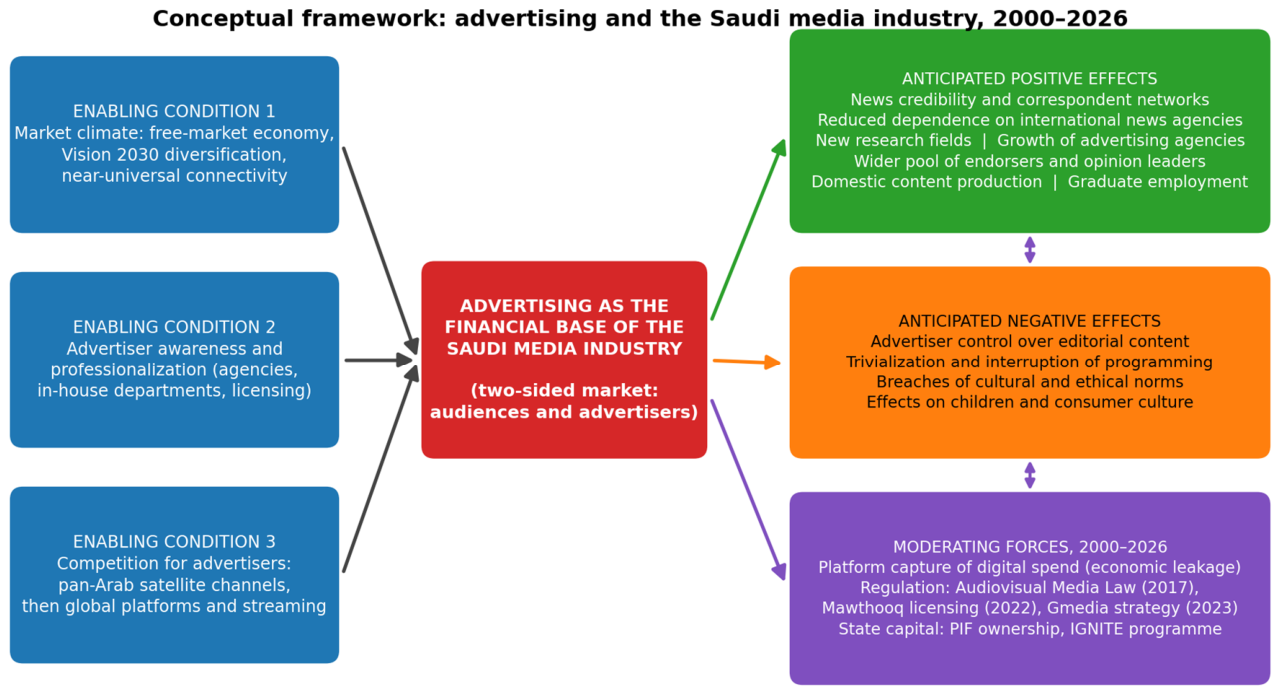
Figure 2.
Advertising Expenditure Estimates for the MENA Region and Saudi Arabia, 2019–2025, by Source and Measurement Basis. Note. Panel A: total regional expenditure, net basis (Ipsos, 2020, 2022), and regional digital expenditure only (IAB MENA, 2026); the series are not additive. Panel B: Saudi estimates from Ipsos (2020, 2022), Asharq Al-Awsat (2024), and Statista (2025); Ipsos figures exclude television booked to the pan-Arab market. Source: Compiled by the author from the sources cited.
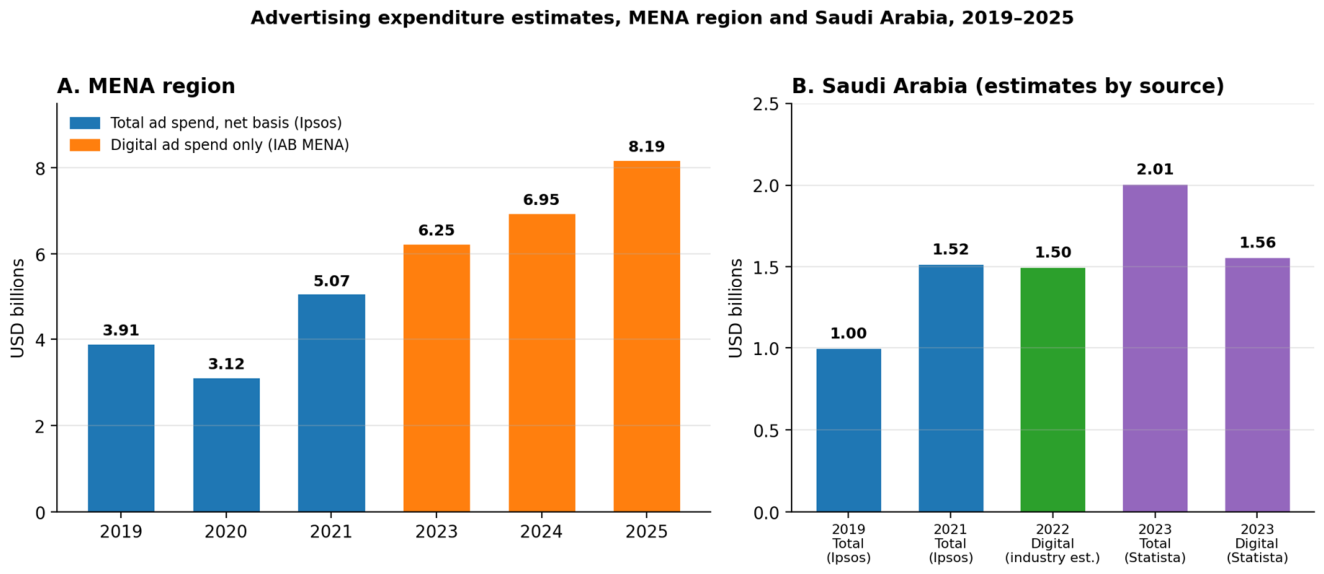
Figure 3.
Distribution of Advertising Expenditure by Medium: GCC 2012, MENA 2021, Saudi Arabia 2023, and Global 2026 Forecast. Note. GCC 2012 (Gulf News, 2013) is on a rate-card basis without disaggregation of non-print offline media; MENA 2021 (Ipsos, 2022) is on a net basis, with a residual of about 3% allocated to radio, cinema, and other; Saudi 2023 (Statista, 2025) reports digital and offline shares only; global 2026 (dentsu, 2025) counts pure-play digital platforms as digital. Source: Compiled by the author from the sources cited.
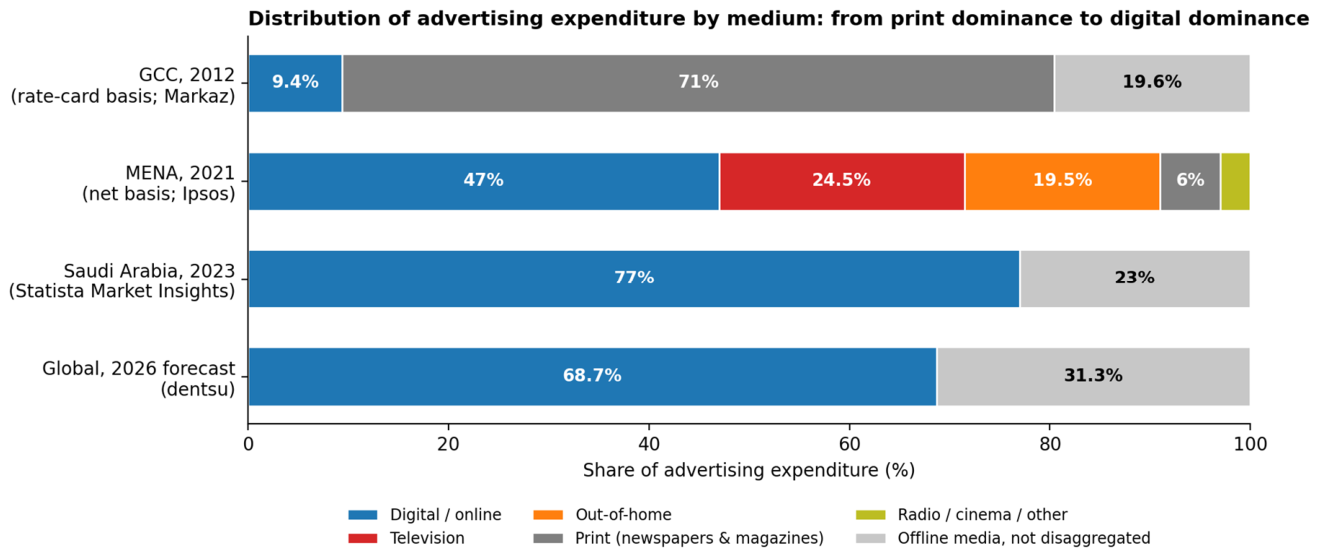
Figure 4.
Advertising Audience Reach of Major Digital Platforms in Saudi Arabia, Late 2025. Note. Platform-reported advertising audience estimates as of October 2025; figures may include duplicate and non-resident accounts, and the TikTok figure (users aged 18 and over) exceeds the adult population as reported. Percentages are of total population (34.7 million). Source: Compiled by the author from Kemp (2025).
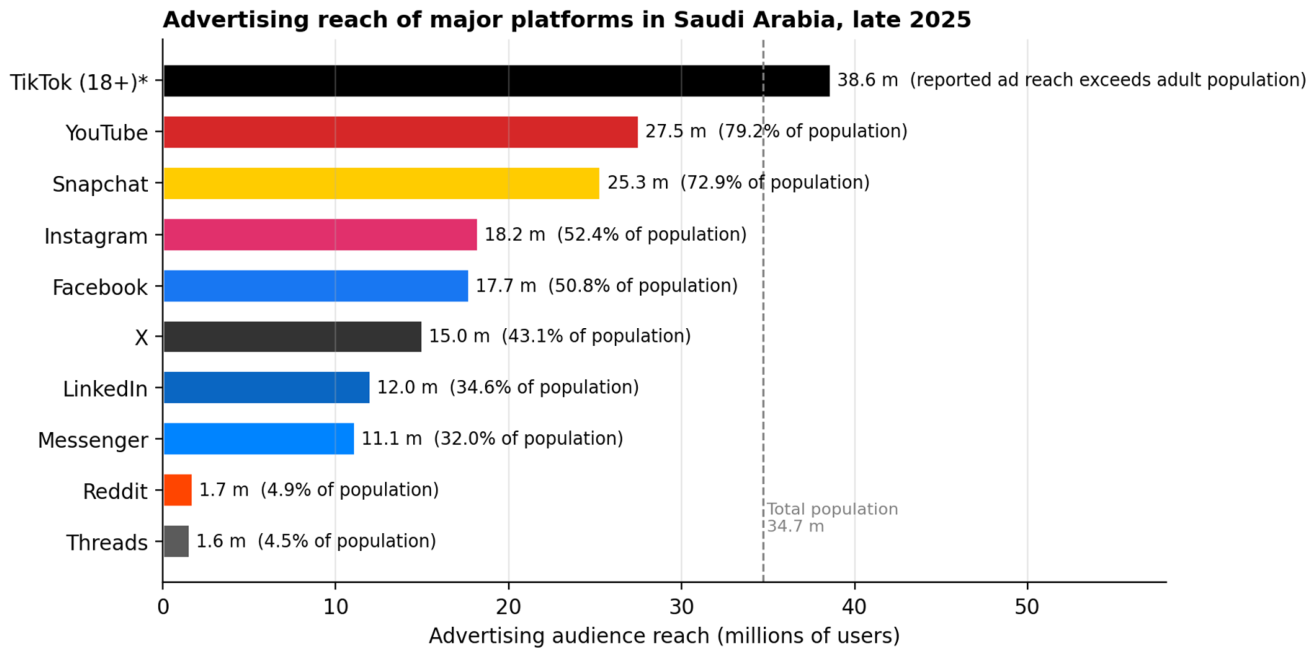
Figure 5.
MBC Group Revenue by Segment and Advertising-Supported Streaming Revenue, Fiscal Years 2023–2025. Note. BOCA = broadcasting and commercial activities; SVOD = subscription video on demand; AVOD = advertising-supported video on demand. Revenue in SAR millions. MBC Group does not disclose a consolidated advertising revenue line; television revenue within BOCA and AVOD revenue within Shahid are the nearest disclosed proxies. Source: Compiled by the author from MBC Group (2025) and ArabAd (2026).
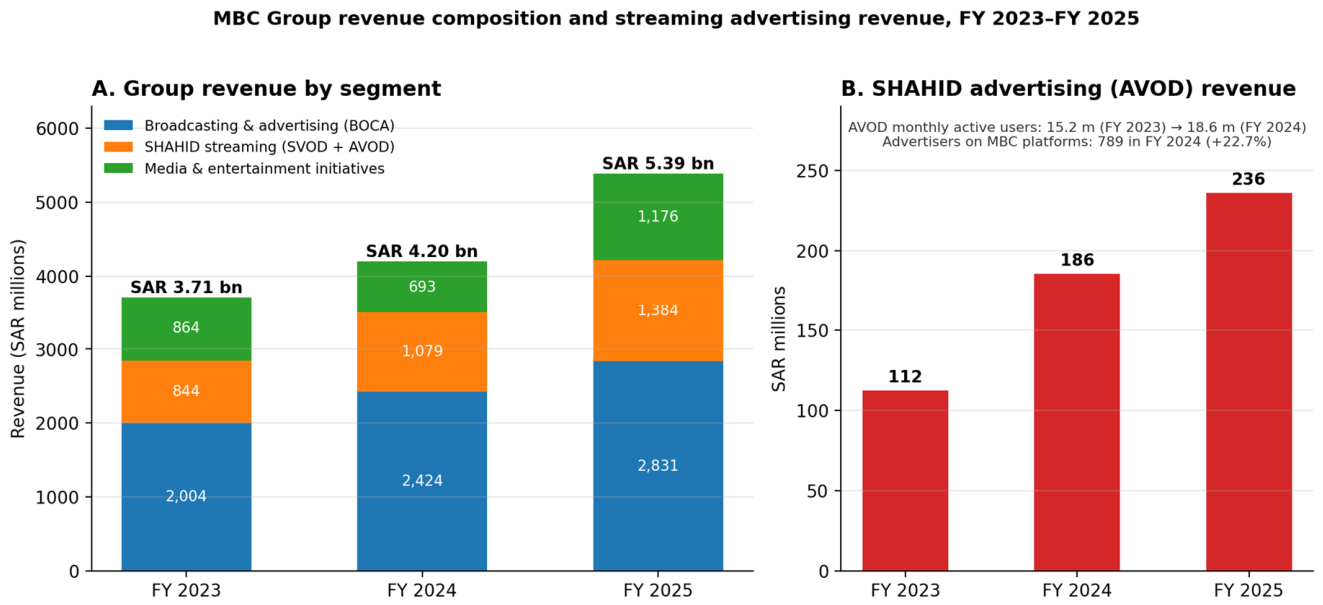

Table 1.
Advertising Expenditure Estimates for Saudi Arabia and Its Region, 1997–2025, by Coverage, Source, and Measurement Basis.
Table 1.
Advertising Expenditure Estimates for Saudi Arabia and Its Region, 1997–2025, by Coverage, Source, and Measurement Basis.
| Year | Coverage | Estimate (USD) | Measurement basis | Source |
| 1997 | Arab Gulf states | 675 million | Rate card | Al-Jazirah (1418 AH) |
| 2000 | Arab world | ≈ 2.3 billion | Rate card | PARC (2000) |
| 2012 | GCC (six states) | 4.8 billion (+5%); print 71%, digital 9.4% | Rate card (Markaz) | Gulf News (2013) |
| 2019 | MENA | 3.91 billion (4.16 billion incl. influencer marketing) | Net (“real”) spend | Ipsos (2020) |
| 2019 | Saudi Arabia | ≈ 1.0 billion, excl. TV booked to pan-Arab market | Net spend | Ipsos (2020) |
| 2020 | MENA | 3.12 billion (pandemic trough) | Net spend | Ipsos (2022) |
| 2021 | MENA | 5.07 billion (+62%) | Net spend | Ipsos (2022) |
| 2021 | Saudi Arabia | 1.52 billion (largest market in MENA) | Net spend | Ipsos (2022) |
| 2022 | Saudi Arabia, digital only | ≈ 1.5 billion; 70–80% to Google and Meta | Industry estimate | Asharq Al-Awsat (2024) |
| 2023 | Saudi Arabia | 2.01 billion total; 1.56 billion digital (77%) | Market Insights (net of commissions, rebates, taxes) | Statista (2025) |
| 2023–2025 | MENA, digital only | 6.25 → 6.95 → 8.19 billion | Sell-side receipts | IAB MENA (2026) |
Note. Estimates compiled on different bases are not comparable and have not been spliced; Ipsos (2020) reported that rate-card totals for MENA in 2019 (≈ USD 22 billion) exceeded actual expenditure (≈ USD 3.9 billion) by more than fivefold. GCC = Gulf Cooperation Council; MENA = Middle East and North Africa; PARC = Pan Arab Research Center. Source: Compiled by the author from the sources cited in the final column.
Table 2.
Digital Connectivity, Audience, and Media-Sector Indicators for Saudi Arabia, 2017–2030.
| Indicator | Value | Reference year | Source |
| Internet users | 34.4 million (99% penetration) | 2025 | Kemp (2025) |
| Social media user identities | 38.6 million (111% of population) | 2025 | Kemp (2025) |
| Population; median age; urban share | 34.7 million; 29.6 years; 85.4% | 2025 | Kemp (2025) |
| Mobile share of access; data use | 99.4%; 48 GB per person per month | 2024 | CST (2025) |
| Daily television viewing | 6 h 44 min → 4 h 51 min | c. 2017 → 2019 | Ipsos (2020) |
| Newspaper readership; online readership | 62.6% → 47.6%; 18.7% → 29.1% | c. 2017 → 2019 | Ipsos (2020) |
| Media sector GDP contribution; target | SAR 16 billion (0.57%); SAR 47 billion (0.8%) | 2024; 2030 | Saudi Press Agency (2023); Saudi Gazette (2025) |
| Media sector employment; target | 67,000 (+22%); 160,000 | 2024; 2030 | Saudi Gazette (2025) |
| IGNITE program commitments | USD 1.1 billion (incl. USD 234 million for film) | 2025 | Saudi Gazette (2025) |
| Cinema box office | SAR 845.6 million; 17.5 million tickets; > 640 screens | 2024 | Arab News (2025) |
Note. CST = Communications, Space and Technology Commission; GDP = gross domestic product. DataReportal figures refer to October 2025 (Digital 2026 report). Source: Compiled by the author from the sources cited in the final column.
Table 3.
Institutional Milestones in the Saudi Media and Advertising Industry, 2000–2026.
| Year | Milestone | Significance for advertising | Source |
| 2000 | Arab-world advertising expenditure ≈ USD 2.3 billion (rate card) | Satellite-era baseline | PARC (2000) |
| 2012 | General Commission for Audiovisual Media established; GCC expenditure USD 4.8 billion, print 71% | Regulatory foundation; peak of print | Saudi Press Agency (2023); Gulf News (2013) |
| 2016 | Saudi Vision 2030 launched | Media sector as industrial policy | Council of Economic and Development Affairs (2016) |
| 2017 | Audiovisual Media Law (Royal Decree No. M/33) | Codified content standards and licensing | Audiovisual Media Law (2017) |
| 2018 | Commercial cinemas reopen after 35 years | New medium and production market | Arab News (2025) |
| 2019 | Saudi Gazette ends print; digital becomes largest medium in MENA (net basis) | Print decline; digital crossover | Saudi Gazette (2019); Ipsos (2020) |
| 2022 | Mawthooq license for social media advertisers in force (1 October) | Influencers regulated as advertisers | Saudi Gazette (2022) |
| 2023 | Regulator renamed General Authority of Media Regulation; SAR 47 billion target for 2030 | State developmental role | Saudi Press Agency (2023) |
| 2024 | MBC Group IPO raises SAR 831 million; media sector SAR 16 billion, 67,000 jobs | Capital market financing of media | The National (2024); Saudi Gazette (2025) |
| 2025 | PIF majority stake in MBC; MBC revenue SAR 5.4 billion; MENA digital expenditure USD 8.19 billion | State capital; platform-scale growth | ArabAd (2026); IAB MENA (2026) |
| 2026 | Al-Riyadh ends print; global expenditure exceeds USD 1 trillion | End of print era; platform dominance | Arab News (2026); dentsu (2025) |
Note. GCC = Gulf Cooperation Council; IPO = initial public offering; MENA = Middle East and North Africa; PIF = Public Investment Fund. Source: Compiled by the author from the sources cited in the final column.
Table 4.
Assessment of the Nine Anticipated Effects of Advertising on the Saudi Media Industry Against the Evidence of 2000–2026.
Table 4.
Assessment of the Nine Anticipated Effects of Advertising on the Saudi Media Industry Against the Evidence of 2000–2026.
| No. | Anticipated effect | Principal evidence, 2000–2026 | Moderating forces | Assessment |
| 1 | Enhanced news credibility of satellite channels | Al Arabiya (2003); correspondent networks; but platform capture and PIF ownership of MBC (2025) | Platform capture; state capital | Partially supported |
| 2 | Reduced dependence on international news agencies | Arab-sourced news achieved; new dependence on platforms for distribution and revenue | Platform capture | Transformed |
| 3 | New fields of inquiry for media researchers | More than a dozen peer-reviewed Saudi studies, 2019–2026, in every field enumerated | — | Supported |
| 4 | Flourishing of advertising agencies | Licensed agencies and advertisers; platforms capture part of the value chain | Platform capture; regulation | Supported (qualified) |
| 5 | Broader pool of opinion leaders in advertising | Influencer economy (USD 250 million, 2019); licensed creators; credibility research | Regulation | Supported |
| 6 | Entry of Saudi channels into media production | 115 new series (2024); 60,000-hour library; 35+ studios; box office SAR 845.6 million | State capital (IGNITE) | Supported |
| 7 | Employment for media graduates | 67,000 media jobs (2024); target 160,000; three academies | State policy | Supported |
| 8 | Advertiser control over content | Ramadan sweeps; reality-format contention; sponsored content and algorithms; prohibitions by law | Regulation; platform algorithms | Partially supported |
| 9 | Ethical charter for advertising | Achieved through law (2017), Mawthooq (2022), and Gmedia strategy (2023), not a voluntary charter | Regulation | Transformed |
Note. Supported = confirmed substantially as anticipated; partially supported = confirmed in part or with material qualification; transformed = materialized through mechanisms not foreseen. Gmedia = General Authority of Media Regulation; PIF = Public Investment Fund. Source: Author’s assessment based on Section 5.1, Section 5.2 and Section 5.3.
Disclaimer/Publisher’s Note: The statements, opinions and data contained in all publications are solely those of the individual author(s) and contributor(s) and not of MDPI and/or the editor(s). MDPI and/or the editor(s) disclaim responsibility for any injury to people or property resulting from any ideas, methods, instructions or products referred to in the content. |
© 2026 by the authors. Licensee MDPI, Basel, Switzerland. This article is an open access article distributed under the terms and conditions of the Creative Commons Attribution (CC BY) license (http://creativecommons.org/licenses/by/4.0/).
Copyright: This open access article is published under a Creative Commons CC BY 4.0 license, which permit the free download, distribution, and reuse, provided that the author and preprint are cited in any reuse.