

Submitted:
05 September 2026
Posted:
07 September 2026
You are already at the latest version
Abstract
Genotype-resolved data on human papillomavirus (HPV) are almost absent for Venezuelan indigenous populations. We conducted a multi-site cross-sectional study of 260 indigenous women from La Guajira (Wayuu, n = 94), Maniapure (Eñepa, n = 141), and Delta Amacuro (Warao, n = 25), Venezuela. All samples were processed under a single protocol, with real-time PCR resolving 21 genotypes individually; conventional cytology was available in 144 women. Overall HPV prevalence was 55.4% (95% CI 49.3–61.3) and high-risk HPV prevalence was 51.2% (95% CI 45.1–57.2); positivity differed across communities (χ² = 13.40, df = 2, p = 0.001), reaching 80.0% in Delta Amacuro versus 59.6% in Maniapure and 42.6% in La Guajira. Nineteen genotypes were detected. HPV-31 was the most frequent overall (15.8%), then HPV-16 (11.5%) and HPV-18 (9.2%). The profiles differed markedly between communities: HPV-68 (48.0%) and HPV-56 (40.0%) in Delta Amacuro, HPV-51 (9.6%) in La Guajira, and HPV-31 (20.6%) in Maniapure. Multiple genotypes were found in 51.4% of infected women. Agreement between cytology and qPCR was negligible (Cohen’s κ = 0.056), with a cytology sensitivity of 25.6%. HPV is highly prevalent in these communities; the circulating genotype spectrum extends well beyond HPV-16/18, and cytology alone is not an adequate screening strategy. In conclusion, the nonavalent vaccine is preferred, as it covers 69.4% of infected women of the indigenous community, compared to 30.6% for the bivalent formulation.
Keywords:
human papillomavirus
; genotyping
; indigenous population
; Venezuela
; Wayuu
; Eñepa
; Warao
; cervical cytology
; HPV vaccine
; health disparities
1. Introduction
Human papillomavirus (HPV) is the most prevalent sexually transmitted infection worldwide; an estimated 75–80% of sexually active individuals will acquire the virus at some point in their lives [1]. Persistent infection with high-risk (oncogenic) genotypes is the necessary cause of cervical cancer and is implicated in a proportion of vulvar, vaginal, anal, and oropharyngeal malignancies [2,3]. Global HPV prevalence among women with normal cytology is estimated at 11.7%, but the burden is markedly higher in Latin America and the Caribbean (16.1%) [4]. Cervical cancer incidence and mortality remain concentrated in low- and middle-income settings, with a clear gradient towards countries of lower human development [5].
In Venezuela, national data on HPV prevalence remain fragmented. However, a substantial body of single-center studies has accumulated over the past two decades [6,7], and country statistics are available from the ICO/IARC HPV Information Center [8]. Reported prevalence varies widely by population screened and diagnostic method: hybrid-capture-based studies in asymptomatic urban women report 12.5–15.6% [9,10], whereas PCR-based studies in women with clinical or cytological suspicion report considerably higher figures, generally between 34% and 91% [11,12,13,14,15,16,17,18,19,20,21,22,23]. Larger series show the same range. A genotyping study of 24,734 women in Carabobo State found PCR positivity of 68.7% [24]. A nationwide series of 329 women with invasive cervical cancer or CIN2/3 found HPV DNA in 92–99% of specimens [25]. In Mérida, a substantial proportion of women with normal cytology carried HPV DNA [26,27]. Statistical estimates situate high-risk HPV positivity at approximately three in ten sexually active Venezuelan women nationally, with cervical cancer remaining the second leading cause of cancer-related death among Venezuelan women [8].
Attention to indigenous communities is not new. In 1990, an early Venezuelan survey using dot-blot hybridization restricted to seven HPV types found no infection among 46 Hüottüja (Piaroa) women of the Orinoco basin, compared with 35% in a group of non-monogamous urban women [28]. That contrast was attributed at the time to sexual behavior, although the narrow probe panel could not detect the types that later work has shown to circulate in these territories. A systematic review of Latin American indigenous populations found that cervical cancer is the leading cancer in both incidence and mortality in this group, is diagnosed at advanced stages, and that some populations show very high-risk HPV prevalence [29,30]. In the Venezuelan Amazon, HPV DNA has been detected by conventional PCR in 35.1% of indigenous women from Amazonas State [31]. In contrast, independent genotyping of Amerindian women from the same state found a disproportionately high burden of infections restricted to oncogenic-only HPV types relative to urban mestizo women [32]. In Bolívar State, HPV was detected in 45.7% of Eñepa indigenous women versus 20.0% of Creole women attending the same outpatient clinic in Maniapure [33]. In Zulia State, cytological alterations were documented in 66.3% of women from the Bari, Yukpa, and Wayuu ethnic groups [34,35], and qualitative work among Wayuu women in La Guajira documents low HPV-specific health literacy and substantial cultural barriers to gynecological screening [36]. Geographic isolation, limited infrastructure, and reduced access to molecular diagnosis converge to delay diagnosis and increase the likelihood that cervical lesions are detected only at advanced stages [29,30,33].
Conventional cytology remains the most widely available screening method in resource-limited settings. Still, its sensitivity for HPV-associated lesions is comparatively low, whereas PCR-based techniques offer higher sensitivity and enable genotype-level characterization [3,38]. Genotype resolution matters here for a practical reason: it decides which vaccine formulation would protect the most women. Most Venezuelan indigenous literature relies on assays that pool oncogenic types into one channel or resolve only HPV-16 and HPV-18. An earlier sub-analysis of the La Guajira and Maniapure samples, conducted within this same research line, applied different molecular platforms at each site, so it could not support a direct comparison of genotypes between communities [38,39]. The contrast with non-indigenous Venezuelan settings is instructive: in La Guaira State, on the central coast, HPV was investigated in relation to cervical lesions in a population with no indigenous component and with routine access to gynecological services [40].
The present study was designed to overcome that limitation. All samples from the three communities were reprocessed under a single unified molecular protocol that resolved 21 HPV genotypes individually, allowing, for the first time in this cohort, a direct comparison of genotype spectra between geographically and ethnically distinct Venezuelan indigenous populations. The objectives were to determine HPV and high-risk HPV prevalence, describe genotype distribution and coinfection patterns by community, evaluate the agreement between conventional cytology and qPCR, and estimate the proportion of circulating infections that current HPV vaccine formulations would target.
2. Materials and Methods
2.1. Study Design and Setting
This was a multi-site, cross-sectional descriptive study conducted in three geographically and culturally distinct indigenous communities of Venezuela: La Guajira (Zulia State, Wayuu population), Maniapure (Bolívar State, Eñepa population) and Delta Amacuro (Delta Amacuro State, Warao population). Field enrolment was carried out in successive campaigns between January 2024 and 2025 to accommodate the logistical constraints of reaching remote riverine, forest and desert communities.
A defining feature of this analysis is that all samples from the three sites were processed under a single, unified molecular protocol. In earlier work in this research line, sites were analyzed with different molecular platforms, which precluded valid between-community genotype comparisons [33,37,38]. Harmonizing the protocol across all three communities makes the genotype-level results reported here directly comparable, and the present dataset supersedes the earlier partial analysis [39].
2.2. Study Population
The investigation was carried out in accordance with the principles established in the Declaration of Helsinki, as revised in 2013. Eligible participants were sexually active women resident in the participating communities, with or without prior clinical or cytological findings suggestive of HPV infection. In accordance with the approved protocol, eligibility was defined by sexual activity rather than by a minimum age, since sexual debut occurs early in several of these communities and restricting recruitment by age would have excluded part of the population at risk. Women were excluded if they presented active menstrual bleeding, a confirmed or suspected pregnancy, any contraindication to cervicovaginal sampling, or if they declined to participate. A total of 260 women were included: 94 from La Guajira, 141 from Maniapure, and 25 from Delta Amacuro.
2.3. Ethical Considerations
The study protocol was reviewed and approved by the Bioethics Commission (Comisión de Bioética) of the Escuela de Medicina “Luis Razetti”, Facultad de Medicina, Universidad Central de Venezuela (protocol CBI-EMLR-58-2024, approved 18 June 2024), in accordance with the Declaration of Helsinki and applicable national regulations governing human-subjects research in Venezuela. Nine participants were under 18 years of age, the youngest being 13; for each, we obtained written consent from a legal guardian using the combined consent–assent form approved by the Ethical Committee. Before enrolment at each site, all participants received a detailed, culturally appropriate explanation of the study’s purpose, procedures, potential risks and benefits, and voluntary nature, delivered in Spanish and, where needed, with community interpreters. Written or witnessed verbal informed consent was obtained before any sample was collected. Confidentiality was maintained through anonymized sample coding and restricted data access, and mechanisms were established to return individual results to participants to support timely clinical referral. The Ethical Committee approved the manuscript submission.
2.4. Sample Collection
Before collection, participants attended a structured educational session on the self-collection technique and confirmed their understanding by verbal acknowledgment. Samples were self-collected using a sterile Dacron swab introduced into the vaginal canal and rotated three to four times to optimize cellular yield. The swab was placed in a pre-labeled 15 mL polypropylene conical tube containing 1 mL of sterile nucleic-acid-stabilizing lysis buffer as a transport medium, transported under refrigeration to the Laboratorio de Investigaciones Básicas y Aplicadas, Escuela de Bioanálisis, Universidad Central de Venezuela, and stored at 8 °C until processing. Lysis-based transport media immediately lyse cells and inactivate nucleases, protecting genomic DNA independently of refrigeration; for validated commercial media of this type, HPV-DNA results show almost perfect agreement (κ = 0.98) between testing within 6 days and after one month of ambient storage [41]. Self-collection has been validated against clinician collection for PCR-based assays, with a pooled relative sensitivity of 0.99 (95% CI 0.97–1.02) for detecting CIN2+ [42]. Where clinically feasible, the attending gynecologist obtained a concurrent conventional cervical cytology sample for morphological evaluation.
2.5. Cytological Evaluation
Cervical cytology was interpreted according to the Bethesda System and coded into two separate variables. The first, a cytological risk scale, classified results as negative for intraepithelial lesion or malignancy (NILM), low-grade squamous intraepithelial lesion (LSIL), or high-grade squamous intraepithelial lesion (HSIL). The second, cervical findings, were classified as negative, lesion (LSIL or HSIL), inflammatory changes, or infectious changes, the last category comprising smears reporting bacterial vaginosis, Candida spp., or Trichomonas spp. No smear reported more than one of these findings, so each was assigned to a single category without ambiguity. The two variables were never entered jointly into the same model to avoid collinearity. Cytology was available in 144 of the 260 participants (55.4%); in the remaining women, a cytological sample could not be obtained or was inadequate for evaluation, reflecting the operational constraints of field campaigns in remote settings. For concordance analyses, cytology was binarised as positive (LSIL + HSIL) or negative (NILM); see supplemental file.
2.6. DNA Extraction and Molecular Detection
Genomic DNA was extracted from cervicovaginal swabs using a modified Bunce precipitation method, and DNA concentration was measured before amplification [43]. HPV detection and genotyping were performed by real-time PCR on a Bio-Rad CFX Opus 96 system, under the same protocol in the three communities. The assay resolves 21 HPV types individually, distributed across seven reaction tubes, each with an internal control. Fourteen of them are the high-risk types used in commercial genotyping assays and in WHO screening guidance: 16, 18, 31, 33, 35, 39, 45, 51, 52, 56, 58, 59, 66 and 68. IARC places twelve of these in group 1 and classifies HPV-68 as probably carcinogenic and HPV-66 as possibly carcinogenic. The remaining seven types are low-risk or possibly carcinogenic: 6, 11, 26, 44, 53, 73 and 82. We classified a sample as HPV-positive when at least one genotype was detected, and as high-risk-positive when at least one of the 14 high-risk types was present.
The assay interrogated HPV-11 and HPV-26, but neither was detected in any sample, so the Results describe 19 genotypes. Since HPV-11 was covered and never found, the vaccine-targeted coverage estimates reported below are complete rather than lower bounds.
2.7. DNA Extraction and Quality Control
DNA was successfully extracted from all 260 samples, and its integrity was verified by electrophoresis on 0.75% agarose gels. All reactions amplified with a valid internal control included in each of the eight tubes of the assay, confirming that the extracted material was adequate for genotyping and free of PCR inhibition [44].
2.8. Statistical Analysis
Continuous variables were summarised as mean ± standard deviation and median with interquartile range. Normality was assessed with the Shapiro–Wilk test and homogeneity of variances with the Levene test; because the normality assumption failed, between-group comparisons of age used the Kruskal–Wallis test with Dunn post-hoc comparisons and Bonferroni correction, and two-group comparisons used the Mann–Whitney U test. Categorical variables were compared using Pearson’s chi-square test or Fisher’s exact test, the latter with a simulated p-value (B = 10,000) when expected cell counts were small. Prevalence estimates are reported with 95% confidence intervals calculated by the Wilson score method, which was preferred over the Wald interval because it performs better with moderate sample sizes and proportions far from 0.5. This consideration matters for Delta Amacuro, where n = 25 and prevalence approaches 80%. Agreement between cytology and qPCR was quantified with Cohen’s κ, interpreted according to Landis and Koch [44], with qPCR as the reference standard. We performed a multiple correspondence analysis (MCA) on the 144 cases with complete data, including origin, age group by quartiles, cervical findings, and HPV status. A two-tailed p-value < 0.05 was considered statistically significant. Analyses were performed in R version 4.5.2 [46], using the packages ggplot2 v4.0.1 for data visualization [47], tableone v0.13.2 for descriptive statistics [48], FactoMineR v2.13 for multiple correspondence analysis [49], and dunn.test v1.3.6 for post-hoc pairwise comparisons [50]. The map shown in Figure 1 was generated in R from administrative boundary data of the GADM database version 4.1 [51], retrieved with the geodata package [52], using ggrepel [53] for label placement and ggspatial [54] for the scale bar and north arrow. All detailed statistical analyses are summarized in the supplemental file.
3. Results
3.1. General Characteristics of the Study Population
A total of 260 indigenous women were analyzed: 141 from Maniapure (54.2%), 94 from La Guajira (36.2%), and 25 from Delta Amacuro (9.6%). Overall mean age was 34.0 ± 12.3 years (median 32, range 13–76). Age differed significantly across communities (Kruskal–Wallis H = 27.44, df = 2, p < 0.001). Post-hoc Dunn comparisons showed that all three communities differed, with the ranking from oldest to youngest being La Guajira (37.7 ± 11.8), Maniapure (33.0 ± 12.4), and Delta Amacuro (25.6 ± 7.3). HPV-positive women were significantly younger than HPV-negative women (31.8 ± 12.5 vs 36.7 ± 11.4 years; Mann–Whitney, p < 0.001; mean difference 4.9 years, 95% CI 1.96–7.82). Age also differed across cervical finding categories (H = 7.74, df = 2, p = 0.021), with women with inflammatory changes younger than those with negative cytology (p = 0.010). Half the cohort had a negative smear (72/144, 50.0%). In Delta Amacuro, only one of the 23 women examined had inflammatory changes, compared with 78.0% in La Guajira. Infectious changes appeared only in Maniapure and Delta Amacuro, reaching 21.7% in the latter. Table 1 presents the general and cytological characteristics of the cohort.
3.2. HPV and High-Risk HPV Prevalence
Overall HPV prevalence by qPCR was 55.4% (95% CI 49.3–61.3), and high-risk HPV prevalence was 51.2% (95% CI 45.1–57.2). Positivity varied significantly across communities (χ² = 13.40, df = 2, p = 0.001), being highest in Delta Amacuro (80.0%), intermediate in Maniapure (59.6%), and lowest in La Guajira (42.6%). The same gradient was observed for high-risk types (χ² = 13.98, df = 2, p < 0.001; Table 2, Figure 2). Of the 144 infected women, 133 (92.4%) carried at least one high-risk genotype, 11 (7.6%) carried exclusively low-risk or possibly carcinogenic types, and 21 (14.6%) carried both categories simultaneously.
3.3. Genotype Distribution
Of the 21 genotypes the assay resolves, 19 were found in at least one participant. The most frequently detected genotype in the cohort as a whole was HPV-31 (41 women, 15.8%), followed by HPV-16 (30, 11.5%), HPV-18 (24, 9.2%), HPV-56 (22, 8.5%) and HPV-39 (21, 8.1%). HPV-33 was detected in a single participant. The genotype spectrum differed substantially between communities (Table 3, Figure 3, Figure 4). In Delta Amacuro the dominant genotypes were HPV-68 (48.0%), HPV-56 (40.0%), HPV-31 (36.0%) and HPV-16 (36.0%); in Maniapure, HPV-31 (20.6%), HPV-16 (12.1%) and HPV-39 (11.3%); and in La Guajira, HPV-51 (9.6%), HPV-18 (8.5%) and HPV-45 (6.4%). HPV-16 did not lead in any of the three communities. In La Guajira, it appeared in only 4.3% of women. The La Guajira profile, dominated by HPV-51 and HPV-18, reproduces the pattern previously described for this community using an independent nested multiplex PCR assay [37].
3.4. Coinfection Patterns
Multiple concurrent genotypes were common: among the 144 HPV-positive women, 74 (51.4%) carried more than one genotype, and 19 (13.2%) carried four or more, with a maximum of seven genotypes in a single sample. Coinfection categories differed significantly across communities (Fisher’s exact test, p = 0.006), and the number of genotypes per infected woman also differed (Kruskal–Wallis H = 13.87, df = 2, p < 0.001). Delta Amacuro showed the most intense coinfection, with a mean of 3.0 genotypes per infected woman and 35.0% of infected women carrying four or more, compared with 1.9 in Maniapure and 1.8 in La Guajira (Figure 5).
3.5. Agreement Between Cytology and qPCR
Cytological and molecular results were both available in 144 women. Taking qPCR as the reference standard, agreement between conventional cytology and molecular detection was negligible overall (Cohen’s κ = 0.056), with a cytology sensitivity of 25.6%, specificity of 80.3%, positive predictive value of 60.6%, and negative predictive value of 47.7%. Agreement remained at or below the slight range in every community, and in Delta Amacuro it fell below chance (κ = −0.219), where only 6 of 19 qPCR-positive women with cytology available had an abnormal smear (Table 4). In practical terms, cytology missed roughly three of every four HPV infections detected by molecular testing.
3.6. Genotypes Targeted by Current Vaccine Formulations
Among the 144 HPV-positive women, the bivalent formulation (HPV-16/18) targeted at least one detected genotype in 44 women (30.6%), the quadrivalent formulation in 53 (36.8%) and the nonavalent formulation in 100 (69.4%). Expressed over the whole cohort, the corresponding figures were 16.9%, 20.4% and 38.5%. The gain from the nonavalent formulation was driven principally by HPV-31, HPV-45, HPV-52 and HPV-58, and was largest in Delta Amacuro, where coverage rose from 50.0% with the bivalent to 90.0% with the nonavalent formulation (Table 5, Figure 6). Even so, 44 of the 144 infected women (30.6%) carried no genotype included in any currently licensed formulation, most often HPV-56, HPV-39, HPV-68, HPV-51, or HPV-59.
3.7. Multiple Correspondence Analysis
A multiple correspondence analysis including origin, age group categorized into quartile-based ranges (≤24, 25–32, 33–41 and >41 years), cervical findings and HPV status was performed on the 144 women with complete data (Figure 7). The first two dimensions accounted for 37.4% of total inertia (22.2% and 15.1%). The first dimension was defined principally by geographic origin, with Delta Amacuro and La Guajira occupying opposite extremes (coordinates 1.497 and −1.115) and Maniapure lying close to the centroid with a contribution of only 0.62%; the oldest age group (>41 years) also loaded heavily on this axis (13.6%) and aligned with the La Guajira profile. The second dimension was dominated by cytological lesions, which contributed 35.8% and had the highest cos² of any category (0.562). HPV status contributed little to either dimension (approximately 5% and 3%), indicating that within this cohort, geographic origin and age structure separate the communities rather than HPV positivity, with cytological findings playing a secondary but visible role.
4. Discussion
To our knowledge, this is the first genotype-resolved comparison of HPV infection across three geographically and ethnically distinct indigenous communities of Venezuela processed under a single molecular protocol. The burden was high, 55.4% for any HPV and 51.2% for high-risk types. HPV-31, not HPV-16, led the circulating spectrum, and the three communities’ profiles differed sharply. Conventional cytology, under field conditions, identified barely a quarter of the infections found by qPCR.
The prevalence observed here substantially exceeds both the global estimate for women with normal cytology (11.7%) and the regional Latin American estimate (16.1%) [4], and also exceeds the national governmental estimate of approximately three in ten sexually active Venezuelan women [8]. It is consistent with the pattern reported for indigenous populations elsewhere in the region, where systematic review evidence identifies populations with very high high-risk HPV prevalence and a burden of cervical cancer that is both higher and diagnosed later than in non-indigenous comparison groups [29,30]. Within Venezuela, every geographically matched comparison available points in the same direction: 45.7% in Eñepa women versus 20.0% in Creole women attending the same clinic in Maniapure [33], an oncogenic-only HPV burden in Amazonian Amerindian women exceeding that of urban mestizas from the same state [31,32], and cytological alteration in two-thirds of women from three Zulia indigenous groups [34,35,36].
The genotype data carry direct implications for vaccine policy. HPV-31 was the most frequent genotype overall and the leading type in Maniapure, while Delta Amacuro was dominated by HPV-68 and HPV-56 and La Guajira by HPV-51 and HPV-18. This departs from the global predominance of HPV-16 and HPV-18 in cervical cancer, and it means that a bivalent program would target a detected genotype in fewer than one in three infected women in this population. The nonavalent formulation more than doubles that figure, to 69.4%, and would be particularly advantageous in Delta Amacuro (90.0%). Even so, close to a third of infected women carried only genotypes absent from every licensed formulation, predominantly HPV-56, HPV-39, HPV-68, HPV-51 and HPV-59. This argues that vaccination, however well chosen, cannot substitute for a functioning screening program in these communities. It also argues that genotype-resolved surveillance should precede, not follow, decisions about which formulation to procure for indigenous territories.
Other Amerindian populations of the region show a similar departure from HPV-16 predominance, although the pattern is far from uniform. Among 280 indigenous women of the Paujil reserve in Guainía, Colombian Amazon, overall prevalence was 31.1%, and HPV-16 remained the most frequent type, followed by HPV-52, -66, -56 and -68, with the nonavalent formulation covering 57.1% of high-risk infections [55]. In two remote communities of northwestern Ecuador, by contrast, HPV-58 was the leading genotype among 291 Afro-Ecuadorian and Chachi women, ahead of HPV-16 and HPV-68, and Chachi (Amerindian) women were significantly more likely to be infected than their Afro-Ecuadorian neighbors [56]. In the Pilagá community of Formosa, northern Argentina, 46.7% of 227 women were positive across 21 genotypes, with HPV-16 clearly leading at 19.4% [57]. Prevalence among Amerindian populations of the region runs from roughly 30% to 80%, and no single genotype leads consistently. Genotype spectra cannot be extrapolated from one indigenous population to another, and procurement decisions for these territories need data generated locally.
The three populations are not interchangeable. They differ in age structure, prevalence, coinfection intensity, and circulating genotypes, and the multiple correspondence analysis places geographic origin as the dominant axis of variation in the dataset. Much of the regional literature is obliged to treat “indigenous women” as a single epidemiological category for want of disaggregated data, and doing so hides the variation on which local program design would depend. Coinfection was most intense in Delta Amacuro, where infected women carried a mean of three concurrent genotypes and 35.0% carried four or more. That pattern fits high transmission in a young population with almost no screening exposure. The sample from that site is small, so the observation is provisional.
Host genetics may also contribute. The HLA repertoire of Venezuelan Amerindian populations is unusually narrow [58,59]. Among the Barí of the Perijá Range, only 22 nine-locus haplotypes segregate in families, described at the time as the most limited polymorphism reported in any human population [58]. Among the neighboring Yucpa, three of seventeen haplotypes account for close to two-thirds of the haplotypic constitution [59]. Within this narrow repertoire, HLA-DRB1*1602 has been reported to reach frequencies close to 40% in both the Barí and the Warao [87]. DRB1*1602 has in turn been positively associated with cervical HPV infection in Andean Bolivian women [60], and it was the Warao of Delta Amacuro who showed the highest prevalence, the most intense coinfection, and the most divergent genotype profile in our own series. HLA class II molecules determine which viral peptides are presented to CD4+ T cells, and their associations with HPV-related disease are frequently type-specific rather than uniform. Among southern Chinese women, DRB1*03 conferred increased risk for HPV-18-associated lesions but not for lesions associated with HPV-16, -52, or -58 [61]. A restricted class II repertoire, unevenly shared between ethnically distinct groups, could influence which genotypes are cleared and which persist, alongside transmission dynamics and access to care. We offer this only as a hypothesis. We did not type HLA in this cohort. The available Venezuelan haplotype data cover the Barí, Yucpa and Warao, so only one of our three communities is directly represented, and there is nothing comparable for the Wayuu or the Eñepa. The evidence linking particular class II alleles to HPV outcomes is also inconsistent between populations. Joint HLA and HPV genotyping in these communities would be a natural second phase of this research line and would allow direct testing.
The concordance data have the most immediate practical consequence. Agreement between cytology and qPCR was negligible overall (κ = 0.056) and fell below chance in Delta Amacuro, with sensitivity between 23.5% and 31.6% across sites. Three of every four molecularly confirmed infections were not identified cytologically. Part of this reflects biology, since most HPV infections are transient and never produce cytological change, so perfect agreement is neither expected nor desirable. Even so, the magnitude of the gap, together with a negative predictive value below 50%, indicates that a negative smear provides very little reassurance in this setting. This is compounded by the operational reality that cytology could be obtained in only 55.4% of participants, and by the well-documented difficulty of sustaining cytological quality control, sampling adequacy, and trained cytopathology personnel in remote territories. These observations align directly with the WHO recommendation of HPV DNA testing as the primary screening modality [62] and support the use of self-collected molecular sampling as the operational backbone of cervical cancer prevention in these communities, with cytology or other triage reserved for women who test positive.
The inverse association between age and HPV positivity, with infected women approximately five years younger on average, is consistent with the well-described pattern of higher prevalence of transient infection in younger women [62]. It should not be read as implying lower risk in older women: the only two high-grade lesions in the series occurred in La Guajira, the oldest of the three communities, and the literature describes a second prevalence peak after the fourth decade in populations with deficient screening [29]. Voluntary participation and non-uniform recruitment across age strata mean that selection bias cannot be excluded as a partial explanation.
Much of the burden documented here likely has structural origins. All three communities are hard to reach. Maniapure is served only by unpaved roads across sparsely populated territory [33]. The Warao communities of the Orinoco Delta are dispersed along river channels and can be reached only by boat; humanitarian teams report journeys of six hours or more by motorboat to deliver basic care [63]. The Wayuu of La Guajira live in an arid binational border region where formal healthcare coverage has always been thin [34]. In this context, opportunistic rather than programmatic screening, early sexual debut and early marriage in some groups, low baseline knowledge of HPV as a sexually transmitted infection [31], and the general destabilization of health services in remote Venezuelan territories [63,64] together represent structural rather than biological drivers. Molecular diagnostics alone will not close this gap; screening logistics adapted to the geography, health education that works in each cultural setting, and sustained vaccination coverage are all required [30,64].
5. Limitations
This study has several limitations. First, the cross-sectional design does not allow assessment of infection persistence, which determines progression to cervical cancer; the high prevalence reported here includes an unknown proportion of transient infections. Second, the Delta Amacuro sample comprises only 25 women, and every estimate for that community, including the 80.0% prevalence and the HPV-68/HPV-56 profile, carries wide confidence intervals and should be regarded as hypothesis-generating rather than definitive. Third, cytology was available in only 144 of 260 participants, and its availability was not uniform across sites. Hence, the concordance estimates apply to the subset in whom both tests could be performed rather than to the full cohort. Fourth, genotype assignment relied on the commercial assay and was not confirmed by sequencing. Fifth, histological confirmation by colposcopy-directed biopsy was not available, so cytological categories could not be validated against a histological reference. Sixth, self-collection, while practical and validated for PCR-based assays [43], may vary in adequacy relative to clinician-collected specimens [65]. Seventh, we did not collect HLA or other host genetic data, so we could not test the hypothesis raised in the Discussion. Eighth, apart from age and community, we recorded no individual covariates: sexual and reproductive history, HPV vaccination status, and HIV serology were unavailable. This precludes any adjusted or multivariable analysis and is a particular constraint in Delta Amacuro, where HIV infection has been documented in Warao communities and could plausibly contribute to the high prevalence and intense coinfection observed there. Finally, participation was voluntary, and recruitment was not uniform across age groups within communities, so selection bias cannot be excluded, and the differences in age structure between sites may leave residual confounding in the between-community comparisons.
6. Conclusions
HPV infection is highly prevalent among indigenous women in these three remote Venezuelan communities, affecting 55.4% overall and 80.0% in Delta Amacuro, and the burden is overwhelmingly attributable to high-risk genotypes. Under a single genotyping protocol, HPV-31 led the circulating spectrum rather than HPV-16, and it differed markedly between the three communities. A bivalent vaccination strategy would reach a detected genotype in fewer than a third of infected women; the nonavalent formulation would reach about seven in ten. Cytology agreed poorly with molecular testing and missed three of every four infections, and should not be relied on as the only screening method in these settings. Molecular testing on self-collected samples is the screening tool these communities need. Vaccine procurement for indigenous territories should wait for genotype-resolved data. And Delta Amacuro, at 80.0%, should come first.
Supplementary Materials
The following supporting information can be downloaded at the website of this paper posted on Preprints.org.
Author Contributions
Conceptualization, M.F.G. and A.H.G.; methodology, M.F.G., J.G. and D.A.; formal analysis, Y.B.S.; investigation, M.F.G., J.G., D.A., M.S.A.M., L.F. and R.B.; resources, M.F.G. and A.H.G.; data curation, Y.B.S. and M.F.G.; writing—original draft preparation, A.H.G.; writing—review and editing, J.B.D.S., Y.B.S. and A.H.G.; visualization, A.H.G. and Y.B.S.; supervision, A.H.G. and J.B.D.S.; project administration, M.F.G. All authors have read and agreed to the published version of the manuscript.
Funding
This research was funded by the National Fund for Science, Technology, and Innovation (FONACIT), an entity attached to the Ministry of Popular Power for Science and Technology of the Bolivarian Republic of Venezuela (MINCYT) under project CDCH-MINCYT 2024PGP197. JBDS was partially financed by the Excelles project ID LX22NPO5103, National Institute of Bacteriology and Virology, Czech Ministry of Education, Youth and Sports Funding.
Institutional Review Board Statement
The study was conducted in accordance with the Declaration of Helsinki and approved by the Bioethics Commission (Comisión de Bioética) of the Escuela de Medicina “Luis Razetti”, Facultad de Medicina, Universidad Central de Venezuela (protocol code CBI-EMLR-58-2024, date of approval 18 June 2024).
Informed Consent Statement
Informed consent was obtained from all participants in the study; for participants under 18 years of age, assent was obtained along with written consent from a legal guardian. The Ethics Committee approved the publication of the study due to language limitations.
Data Availability Statement
The data are not publicly available due to privacy and ethical restrictions protecting the participating indigenous communities. A written request with reasonable justification may be sent to the corresponding author.
Acknowledgments
The authors thank the participating communities of La Guajira, Maniapure, and Delta Amacuro for their trust and collaboration, and the staff of the Laboratorio de Investigaciones Básicas y Aplicadas, Escuela de Bioanálisis, and the university extension program Campamento Universitario Multidisciplinario de Investigación y Servicio (CUMIS), Universidad Central de Venezuela, for their technical and logistical support. During the preparation of this manuscript, the authors used Claude (Anthropic) for language editing and drafting assistance in specific sections of the text. The authors carried out the study design, data collection, laboratory work, statistical analysis, and interpretation of results entirely. The authors reviewed and edited all content produced with this assistance and take full responsibility for the publication’s content.
Conflicts of Interest
The authors declare no conflicts of interest.
Abbreviations
CI: confidence interval; CIN: cervical intraepithelial neoplasia; HPV: human papillomavirus; hrHPV: high-risk human papillomavirus; HSIL: high-grade squamous intraepithelial lesion; IARC: International Agency for Research on Cancer; LSIL: low-grade squamous intraepithelial lesion; MCA: multiple correspondence analysis; NILM: negative for intraepithelial lesion or malignancy; NM-PCR: nested multiplex polymerase chain reaction; NPV: negative predictive value; PCR: polymerase chain reaction; PPV: positive predictive value; qPCR: real-time polymerase chain reaction; WHO: World Health Organization; κ: Cohen’s kappa coefficient.
References
- Chesson, H. W.; Dunne, E.F.; Hariri, S.; Markowitz, L.E. The estimated lifetime probability of acquiring human papillomavirus in the United States. Sex. Transm. Dis. 2014, 41, 660–664. [Google Scholar] [CrossRef] [PubMed]
- De la Fuente-Villarreal, D.; Guzmán-López, S.; Barboza-Quintana, O.; González-Ramírez, R. Biology of the human papillomavirus and its diagnosis. Med. Univ. 2010, 12, 231–238. [Google Scholar]
- de Martel, C.; Georges, D.; Bray, F.; Ferlay, J.; Clifford, G.M. Global burden of cancer attributable to infections in 2018: a worldwide incidence analysis. Lancet Glob. Health 2020, 8, e180–e190. [Google Scholar] [CrossRef] [PubMed]
- Bruni, L.; Diaz, M.; Castellsagué, X.; Ferrer, E.; Bosch, F.X.; de Sanjosé, S. Cervical human papillomavirus prevalence in 5 continents: meta-analysis of 1 million women with normal cytological findings. J. Infect. Dis. 2010, 202, 1789–1799. [Google Scholar] [CrossRef] [PubMed]
- Singh, D.; Vignat, J.; Lorenzoni, V.; Eslahi, M.; Ginsburg, O.; Lauby-Secretan, B.; Arbyn, M.; Basu, P.; Bray, F.; Vaccarella, S. Global estimates of incidence and mortality of cervical cancer in 2020: a baseline analysis of the WHO Global Cervical Cancer Elimination Initiative. Lancet Glob. Health 2023, 11, e197–e206. [Google Scholar] [CrossRef] [PubMed]
- Cavazza, M.E.; Ortiz-Princz, D.; Ávila, M.; Correnti, M. Reseña de las investigaciones sobre la infección por el virus del papiloma humano en el Instituto de Biomedicina “Dr. Jacinto Convit”. Trib. Del Investig. 2020, 22. [Google Scholar]
- WHO/ICO Information Centre on HPV and Cervical Cancer. Human Papillomavirus and Related Cancers in the Americas. Summary Report 2010; WHO/ICO Information Centre on HPV and Cervical Cancer: Barcelona, Spain, 2010; (accessed on 27 August 2026). [Google Scholar]
- ICO/IARC Information Centre on HPV and Cancer. Venezuela: Human Papillomavirus and Related Cancers, Fact Sheet 2023; ICO/IARC Information Centre on HPV and Cancer: Barcelona, Spain, 2023; Available online: https://hpvcentre.net/statistics/reports/VEN_FS.pdf (accessed on 2 September 2026).
- Núñez-Troconis, J.; Delgado, M.; González, J.; Mindiola, R.; Velásquez, J.; Conde, B.; et al. Prevalence and risk factors of human papillomavirus infection in asymptomatic women in a Venezuelan urban area. Invest Clin. 2009, 50, 203–212. [Google Scholar] [PubMed]
- Correnti, M.; Cavazza, M.E.; Herrera, O.; Rodríguez, A. Presence of human papillomavirus infection determined by hybrid capture assay in cervical lesions in a Venezuelan population. Invest Clin. 2010, 51, 27–35. [Google Scholar] [PubMed]
- Reigosa, A.; Álvarez, M.; De Vasconcelo, M.; Cristina, R.; Salas, W.; Rebolledo, V.; Voldman, A. Diagnóstico del virus papiloma humano en cuello uterino de mujeres que acuden a su consulta anual citológica. Salus 2004, 8, 33–42. [Google Scholar]
- Contreras, L.; Correnti, M.; Ávila, M.; Guerrero, A.; León, A. Virus papiloma humano (VPH) en contexto ecológico venezolano (I): diagnóstico citológico y molecular. Salus 2008, 12, 68–77. [Google Scholar]
- Alfonzo, B.; Correnti, M.; Cavazza, M.E.; Michelli, P.; Salma, N. Detección del virus papiloma humano en muestras cervicales de una población de estudiantes de la Universidad Central de Venezuela. Rev. Fac. Med. 2003, 26, 120–126. [Google Scholar]
- De Guglielmo, Z.; Ávila, M.; Veitía, D.; Cavazza, M. Evaluación, mediante RCP, de la infección por el virus de papiloma humano en muestras de pacientes con diagnóstico clínico o citológico. Rev. Obstet. Ginecol. Venez. 2008, 68, 240–247. [Google Scholar]
- Suárez, C.; Mijares, A.; Castillo, L.; Briceño, J. Tipificación del VPH en el cáncer de cuello uterino en la población venezolana. Rev. Venez. Oncol. 2006, 18, 221–225. [Google Scholar]
- Salazar, E. Detección del virus de papiloma humano en pacientes con lesiones intraepiteliales escamosas de cuello uterino. Rev. Obstet. Ginecol. Venez. 2007, 67, 47–54. [Google Scholar]
- Muñoz, M.; Mendoza, J.A.; Téllez, L.; Noguera, M.E.; Moret, O.; López, M.; Toro, M. Detección de VPH-16 y 18 en muestras de cérvix de mujeres que acuden a centros asistenciales de la ciudad de Mérida, Venezuela. Rev. Biomed. 2003, 14, 61–68. [Google Scholar] [CrossRef]
- Quintero, M.; Cruz, J.; Bastidas, M.; Márquez, L.; Puig, J. Detección y tipificación de virus del papiloma humano (VPH) mediante PCR-RFLP. Rev. Obstet. Ginecol. Venez. 2008, 68, 25–31. [Google Scholar]
- Cañarte, J.; Giler, M.; Saavedra, S.; Téllez, L.; Callejas, D. Detección, tipificación y carga viral del virus papiloma humano asociado a lesiones preinvasoras de cérvix. Rev. GICOS. 2021, 6, 46–62. [Google Scholar]
- Oviedo, G.; Arpaia, A.L.; Ratia, E.; Seco, N.; Rodríguez, I.; Ramírez, Z. Factores de riesgo en mujeres con infección del virus papiloma humano. Salus 2004, 8, 15–21. [Google Scholar]
- Somogyi, L.; Malpica, C.; Alvarado, B.; García, M. Virus del papiloma humano (VPH): detección y tipificación en la consulta privada. Rev. Obstet. Ginecol. Venez. 2010, 70, 160–166. [Google Scholar]
- Araujo, E. Infección por virus de papiloma humano en mujeres: hallazgos paraclínicos. Rev. Obstet. Ginecol. Venez. 2010, 70, 82–89. [Google Scholar]
- Michelli, E.; Téllez, L.; Mendoza, J.A.; Jürgensen, C.; Muñoz, M.; Pérez, S.; Mosqueda, N.; Hernández, E.; Noguera, M.E.; Callejas, D.; Correnti, M.; Cavazza, M.E.; Vielma, S. Comparative analysis of three methods for HPV DNA detection in cervical samples. Invest Clin. 2011, 52, 344–57. [Google Scholar] [PubMed]
- Reigosa, A.; Fernández, A.; Hung, C.Y.; Graterol, I.; Fernández, Y.; Espinal, J.D.; et al. Genotipos del virus papiloma humano en el cuello uterino de mujeres de la región central de Venezuela. Rev. Obstet. Ginecol. Venez. 2015, 75, 177–186. [Google Scholar]
- Sánchez-Lander, J.; Cortiñas, P.; Loureiro, C.; Pujol, F.; Medina, F.; Capote-Negrín, L.; et al. Human papillomavirus in invasive cervical cancer and cervical intraepithelial neoplasia 2 and 3 in Venezuela: a cross-sectional study. Cancer Epidemiol. 2012, 36, 284–287. [Google Scholar] [CrossRef] [PubMed]
- Toro de Méndez, M.; López de Sánchez, M. Infección por virus papiloma humano en pacientes con citología de cuello uterino negativa. Rev. Obstet. Ginecol. Venez. 2017, 77, 9–18. [Google Scholar]
- Téllez Gil, L.E.; Michelli Viña, E.M.; Callejas Monsalve, D.E.; Contreras Colmenares, M.; Cavazza Porro, M.E.; Correnti de Plata, M. Presencia de lesiones preinvasoras e invasoras de cérvix, relación con el virus papiloma humano y factores epidemiológicos en Mérida, Venezuela. QhaliKay 2018, 2, 92–105. [Google Scholar] [CrossRef]
- Azocar, J.; Abad, S.M.J.; Acosta, H.; Hernandez, R.; Gallegos, M.; Pifano, E.; Blanch, R.; Kramar, A. Prevalence of cervical dysplasia and HPV infection according to sexual behavior. Int. J. Cancer 1990, 45, 622–625. [Google Scholar] [CrossRef] [PubMed]
- Novais, I.R.; Coelho, C.O.; Carvalho, C.F.; Surita, F.; Vale, D.B. The epidemiology of cervical cancer among indigenous women living in Latin America: a systematic review. Prev. Med. Rep. 2024, 49, 102955. [Google Scholar] [CrossRef] [PubMed]
- Muslin, C. Addressing the burden of cervical cancer for Indigenous women in Latin America and the Caribbean: a call for action. Front Public Health 2024, 12, 1376748. [Google Scholar] [CrossRef] [PubMed]
- Nicita, G.; Reigosa, A.; Torres, J.; Vázquez, C.; Fernández, Y.; Álvarez, M.; Núñez, N.; Magris, M. Infección por virus del papiloma humano (VPH) en una población indígena del Amazonas venezolano. Salus 2010, 14, 51–59. [Google Scholar]
- Vargas-Robles, D.; Magris, M.; Morales, N.; de Koning, M.N.C.; Rodríguez, I.; Nieves, T.; Godoy-Vitorino, F.; Sánchez, G.I.; Alcaraz, L.D.; Forney, L.J.; Pérez, M.E.; García-Briceño, L.; van Doorn, L.J.; Domínguez-Bello, M.G. High rate of infection by only oncogenic human papillomavirus in Amerindians. mSphere 2018, 3, e00176-18. [Google Scholar] [CrossRef] [PubMed]
- Fuenmayor, A.; Fernández, C.; Pérez, V.; Coronado, J.; Ávila, M.; Fernandes, A.; Fuenmayor, J. Detection of precancerous lesions in the cervix and HPV infection in women in the region of Maniapure, Bolivar State. ecancermedicalscience 2018, 12, 884. [Google Scholar] [CrossRef] [PubMed]
- Carrero, Y.; Bracho, A.; García, W.; Argüello, M. J.; Silva, C.; González, M. J.; Marín, D.; Arencio, R. Hallazgos citológicos y factores de riesgo asociados a lesión cervical en mujeres pertenecientes a tres etnias indígenas del Estado Zulia. Kasmera 2018, 46, 159–169. [Google Scholar]
- Contreras Benítez, A. de J.; Urdaneta Machado, J.R.; Baabel Zambrano, N.; Maggiolo, I.B. Genotipificación del virus del papiloma humano en mujeres en edad reproductiva del estado Zulia, Venezuela. ReVitae 2022, (75). [Google Scholar]
- Antúnez, C.; Paz, C.; García, N. Representación del VPH en mujeres Wayuu. Perspect. Rev. Hist. Geogr. Arte Cult. 2020, 8. [Google Scholar]
- Williams, J.; Kostiuk, M.; Biron, V.L. Molecular detection methods in HPV-related cancers. Front Oncol. 2022, 12, 864820. [Google Scholar] [CrossRef] [PubMed]
- Mesa-Arango, J.A.; Tapia-Vela, L.J.; Loaiza-Díaz, N.; Echeverry-Chica, J.; Toro-Montoya, A.I. Detección y genotipificación del virus del papiloma humano de alto riesgo mediante PCR multiplex en tiempo real. Med. Lab. 2021, 25(2) 25(2), 547–550. [Google Scholar] [CrossRef]
- Guzmán Silva, J.A.; Liendo Suárez, S.A. Prevalencia de la infección por el virus del papiloma humano (VPH) en pacientes de comunidades indígenas venezolanas provenientes de La Guajira y Maniapure durante el periodo enero 2024 – agosto 2024 (Prevalence of human papillomavirus infection in patients from Venezuelan indigenous communities of La Guajira and Maniapure, January–August 2024). Undergraduate Thesis, Universidad Central de Venezuela, Caracas, Venezuela, 2025. [Google Scholar]
- Veitía, D.; Correnti, M.; Ávila, M.; Fernandes, A.; Ortiz, D.; Aurrecoechea, M.; Marcano, J.; López, J.; Cavazza Porro, M. Evaluación de la infección por virus del papiloma humano y su asociación con lesiones de cuello uterino en un grupo de mujeres del estado La Guaira, Venezuela. Rev. Soc. Venez. Microbiol. 2025. [Google Scholar] [CrossRef]
- Sechi, I.; Muresu, N.; Puci, M.V.; Saderi, L.; Del Rio, A.; Cossu, A.; Muroni, M.R.; Castriciano, S.; Martinelli, M.; Cocuzza, C.E.; Sotgiu, G.; Piana, A. Preliminary results of feasibility and acceptability of self-collection for cervical screening in Italian women. Pathogens 2023, 12, 1169. [Google Scholar] [CrossRef] [PubMed]
- Arbyn, M.; Smith, S.B.; Temin, S.; Sultana, F.; Castle, P. Collaboration on Self-Sampling and HPV Testing. Detecting cervical precancer and reaching underscreened women by using HPV testing on self samples: updated meta-analyses. BMJ 2018, 363, k4823. [Google Scholar] [CrossRef] [PubMed]
- Gilbert, M.T.P.; Haselkorn, T.; Bunce, M.; Sanchez, J.J.; Lucas, S.B.; Jewell, L.D.; Marck, E.V.; Worobey, M. The isolation of nucleic acids from fixed, paraffin-embedded tissues–which methods are useful when? PLoS ONE 2007, 2, e537. [Google Scholar] [CrossRef] [PubMed]
- Baay, M.F.; Verhoeven, V.; Lambrechts, H.A.; Pattyn, G.G.; Lardon, F.; Van Royen, P.; Vermorken, J.B. Feasibility of collecting self-sampled vaginal swabs by mail: quantity and quality of genomic DNA. Eur. J. Clin. Microbiol. Infect. Dis. 2009, 28, 1285–1289. [Google Scholar] [CrossRef] [PubMed]
- Landis, J.R.; Koch, G.G. The measurement of observer agreement for categorical data. Biometrics 1977, 33, 159–174. [Google Scholar] [CrossRef]
- R Core Team. R: A Language and Environment for Statistical Computing. In Vienna: R Foundation for Statistical Computing; 2025; Available online: https://www.R-project.org/ (accessed on 1-30 August 2026).
- Wickham, H. ggplot2: Elegant Graphics for Data Analysis; Springer-Verlag: New York, 2016; ISBN 978-3-319-24277-4. [Google Scholar]
- Yoshida, K.; Bartel, A. tableone: Create ‘Table 1’ to Describe Baseline Characteristics with or without Propensity Score Weights. R package version 0.13.2. 2022. [CrossRef]
- Lê, S.; Josse, J.; Husson, F. FactoMineR: an R package for multivariate analysis. J. Stat. Softw. 2008, 25, 1–18. [Google Scholar] [CrossRef]
- Dinno, A. dunn. test: Dunn’s Test of Multiple Comparisons Using Rank Sums. R package version 1.3.6. 2024. [CrossRef]
- Global Administrative Areas (GADM). GADM database of Global Administrative Areas, version 4.1. Available online: https://gadm.org (accessed on 1-30 August 2026).
- Hijmans, R. geodata: Access Geographic Data. R package version 0.6-9. 2026. [CrossRef]
- Slowikowski, K. ggrepel: Automatically Position Non-Overlapping Text Labels with ggplot2. R package version 0.9.8. 2026. [CrossRef]
- Dunnington, D. ggspatial: Spatial Data Framework for ggplot2. R package version 1.1.10. 2025. [CrossRef]
- Sarmiento-Medina, M.I.; Puerto de Amaya, M.; Villamizar-Gómez, L.; González-Coba, A.C.; Guzmán-Barajas, L. High-risk HPV prevalence and vaccination coverage among Indigenous women in the Colombian Amazon: implications for cervical cancer prevention. Cross-sectional study. PLoS ONE 2024, 19, e0297579. [Google Scholar] [CrossRef] [PubMed]
- Bayas-Rea, R.A.; Ponce, K.; Guenther, A.; Mosquera, J.D.; Armijos, C.; Mejía, L.; Bustamante, G.; Zapata, S. Prevalence of human papillomavirus genotypes in women of different ethnicity from rural northwestern Ecuador. BMC Glob. Public Health 2024, 2, 46. [Google Scholar] [CrossRef] [PubMed]
- Deluca, G.D.; Basiletti, J.; González, J. V.; Díaz Vásquez, N.; Lucero, R. H.; Picconi, M. A. Human papilloma virus risk factors for infection and genotype distribution in aboriginal women from Northern Argentina. Med. (B Aires) 2012, 72, 461–466. [Google Scholar]
- Layrisse, Z.; Guedez, Y.; Domínguez, E.; Herrera, F.; Soto, M.; Balbas, O.; Matos, M.; Alfonzo, J.C.; Granados, J.; Scorza, J. Extended HLA haplotypes among the Bari Amerindians of the Perija Range. Relationship to other tribes based on four-loci haplotype frequencies. Hum. Immunol. 1995, 44, 228–235. [Google Scholar] [CrossRef] [PubMed]
- Layrisse, Z.; Guedez, Y.; Domínguez, E.; Paz, N.; Montagnani, S.; Matos, M.; Herrera, F.; Ogando, V.; Balbas, O.; Rodríguez-Larralde, A. Extended HLA haplotypes in a Carib Amerindian population: the Yucpa of the Perija Range. Hum. Immunol. 2001, 62, 992–1000. [Google Scholar] [CrossRef] [PubMed]
- Cervantes, J.; Lema, C.; Hurtado, L.V.; Andrade, R.; Hurtado Gomez, L.; Torrico, L.; Zegarra, L.; Quiroga, G.; Asturizaga, D.; Dulon, A.; Prada, R.; Panoso, W.; Yashiki, S.; Fujiyoshi, T.; Sonoda, S. HLA-DRB1*1602 allele is positively associated with HPV cervical infection in Bolivian Andean women. Hum. Immunol. 2003, 64, 890–895. [Google Scholar] [CrossRef] [PubMed]
- Chan, P.K.; Cheung, T.H.; Lin, C.K.; Siu, S.S.; Yim, S.F.; Lo, K.W.; Cheung, J.L.; Tam, A.O.; Tang, J.W. Association between HLA-DRB1 polymorphism, high-risk HPV infection and cervical neoplasia in southern Chinese. J. Med. Virol. 2007, 79, 970–976. [Google Scholar] [CrossRef] [PubMed]
- World Health Organization. WHO guideline for screening and treatment of cervical pre-cancer lesions for cervical cancer prevention, 2nd ed.; World Health Organization: Geneva, 2021; (accessed on 31 August 2026)ISBN 978-92-4-003082-4. [Google Scholar]
- Sans Frontières, Médecins. Bridging the gap in healthcare in Venezuela’s Delta Amacuro state; MSF: Geneva, 22 May 2023; Available online: https://www.msf.org/bridging-gap-healthcare-venezuela’s-delta-amacuro-state. (accessed on 31 August 2026).
- Bruni, L.; Serrano, B.; Roura, E.; Alemany, L.; Cowan, M.; Herrero, R.; Poljak, M.; Murillo, R.; Broutet, N.; Riley, L.M.; de Sanjose, S. Cervical cancer screening programs and age-specific coverage estimates for 202 countries and territories worldwide: a review and synthetic analysis. Lancet Glob. Health Erratum in: Lancet Glob Health. 2023 Jul;11(7):e1011. doi: 10.1016/S2214-109X(23)00240-1. 2022, 10, e1115–e1127. [Google Scholar] [CrossRef] [PubMed]
- Carrillo, C.; López, G.; González, M.; Caraballo, L.; Venegas, C. Detección del virus del papiloma humano: influencia del tipo de muestra y de la severidad de la lesión intraepitelial cervical. Rev. Obstet. Ginecol. Venez. 2010, 70, 240–248. [Google Scholar]
Figure 1.
Geographic location of the three indigenous communities included in this study, relative to Caracas: La Guajira (Zulia State, Wayuu), Maniapure (Bolívar State, Eñepa) and Delta Amacuro (Delta Amacuro State, Warao). Shaded states indicate the sampling regions. Map generated in R; see Section 2.8 for data sources and packages.
Figure 1.
Geographic location of the three indigenous communities included in this study, relative to Caracas: La Guajira (Zulia State, Wayuu), Maniapure (Bolívar State, Eñepa) and Delta Amacuro (Delta Amacuro State, Warao). Shaded states indicate the sampling regions. Map generated in R; see Section 2.8 for data sources and packages.
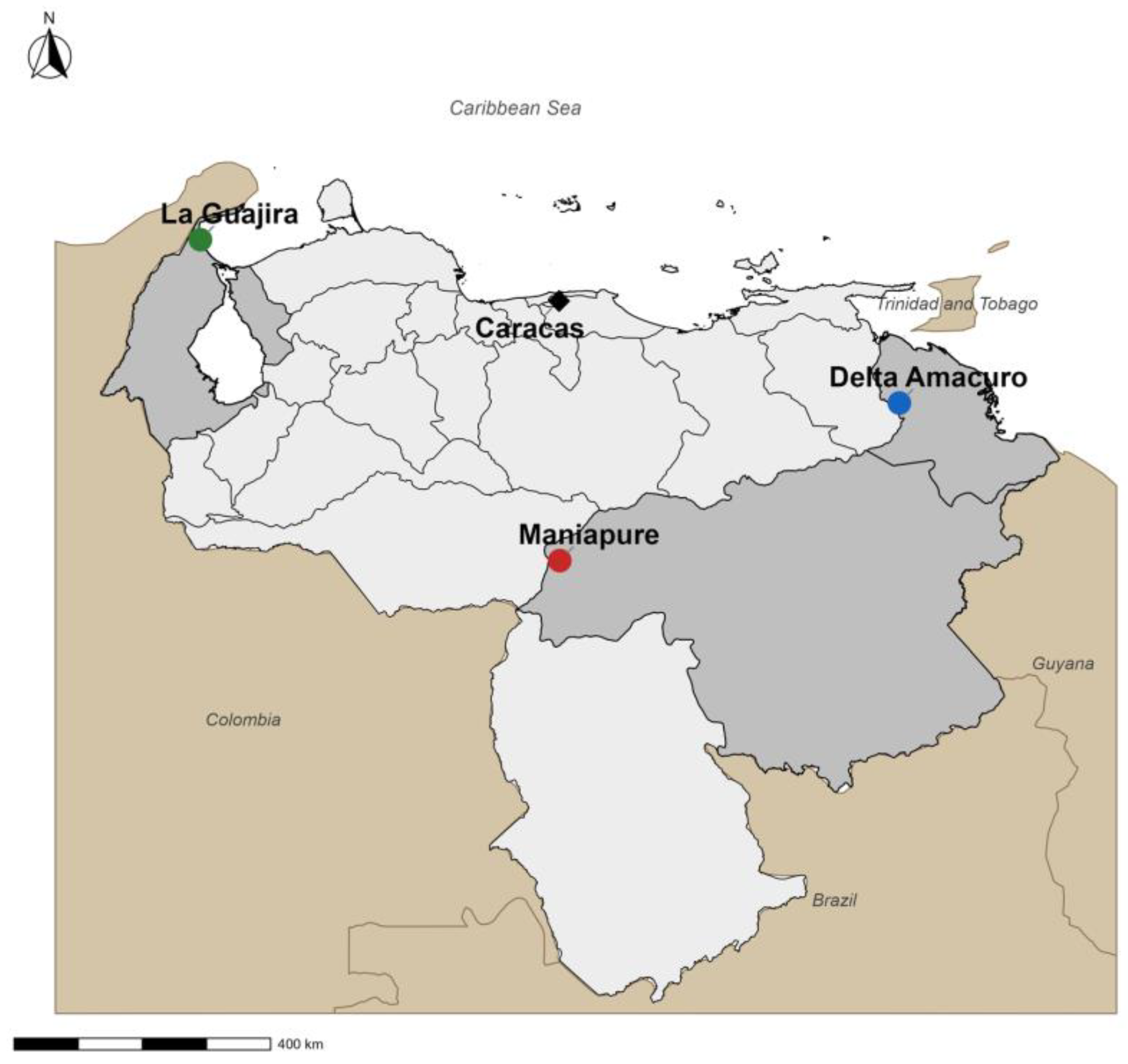
Figure 2.
Prevalence of any HPV and of high-risk HPV, overall and by community, with 95% Wilson confidence intervals. High-risk HPV comprises genotypes 16, 18, 31, 33, 35, 39, 45, 51, 52, 56, 58, 59, 66 and 68. In Delta Amacuro, every HPV-positive woman carried at least one high-risk genotype, so the two estimates coincide.
Figure 2.
Prevalence of any HPV and of high-risk HPV, overall and by community, with 95% Wilson confidence intervals. High-risk HPV comprises genotypes 16, 18, 31, 33, 35, 39, 45, 51, 52, 56, 58, 59, 66 and 68. In Delta Amacuro, every HPV-positive woman carried at least one high-risk genotype, so the two estimates coincide.
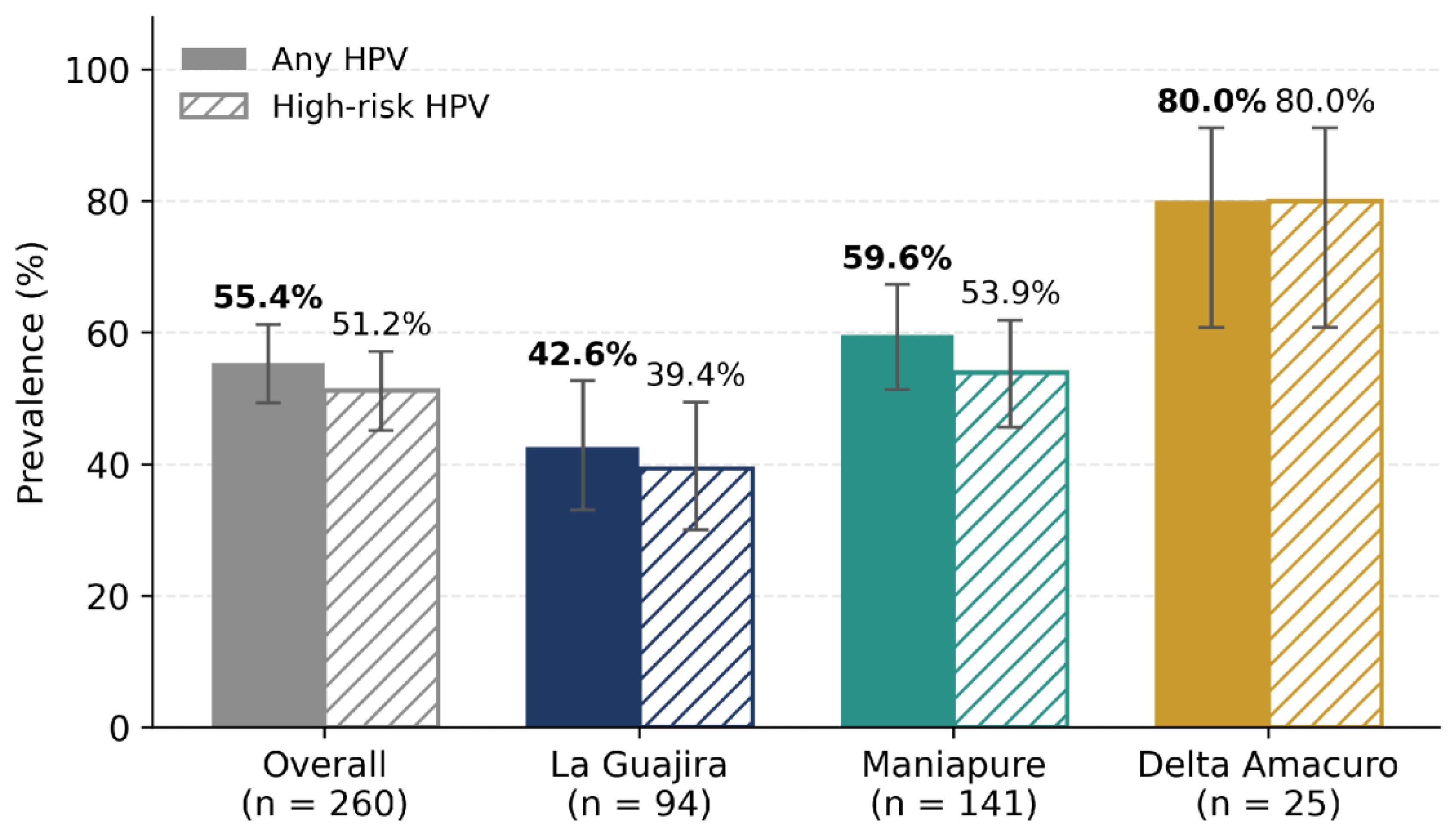
Figure 3.
Frequency of the 19 HPV genotypes detected in the whole cohort (n = 260), expressed as the percentage of women tested in whom each genotype was identified. Bars are coloured by oncogenic risk category.
Figure 3.
Frequency of the 19 HPV genotypes detected in the whole cohort (n = 260), expressed as the percentage of women tested in whom each genotype was identified. Bars are coloured by oncogenic risk category.
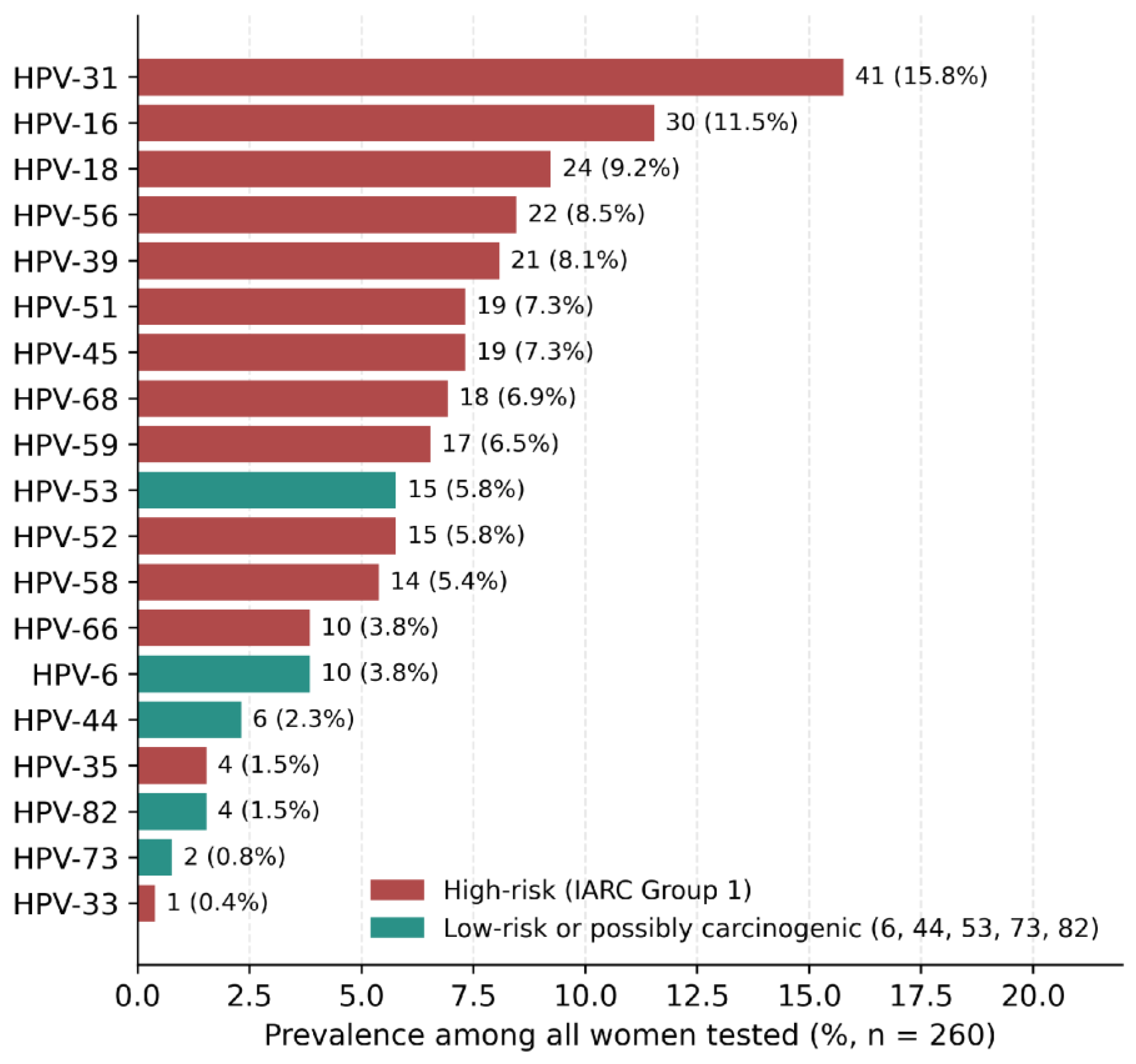
Figure 4.
Heat map of genotype-specific prevalence within each community, with genotypes ordered by overall frequency in the cohort. Cell values are percentages of women tested at each site; a dash indicates that the genotype was not detected in that community.
Figure 4.
Heat map of genotype-specific prevalence within each community, with genotypes ordered by overall frequency in the cohort. Cell values are percentages of women tested at each site; a dash indicates that the genotype was not detected in that community.
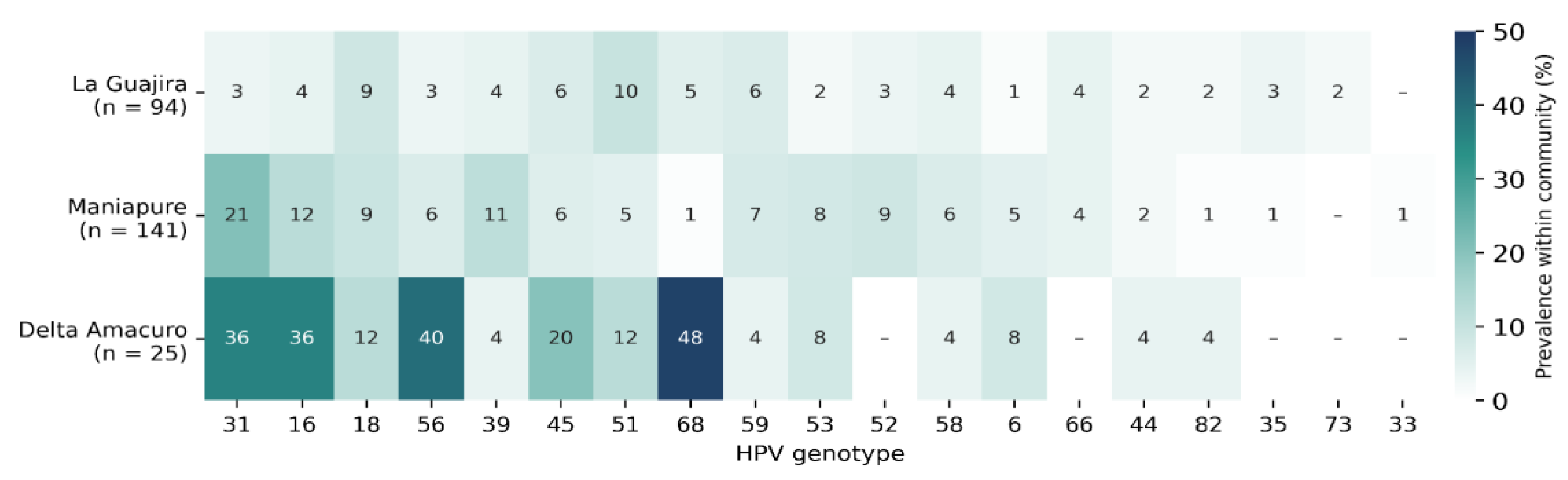
Figure 5.
Distribution of the number of concurrent HPV genotypes among HPV-positive women, overall and by community. Percentages are calculated on HPV-positive women only. Labels are shown for categories representing at least 5% of the corresponding group.
Figure 5.
Distribution of the number of concurrent HPV genotypes among HPV-positive women, overall and by community. Percentages are calculated on HPV-positive women only. Labels are shown for categories representing at least 5% of the corresponding group.
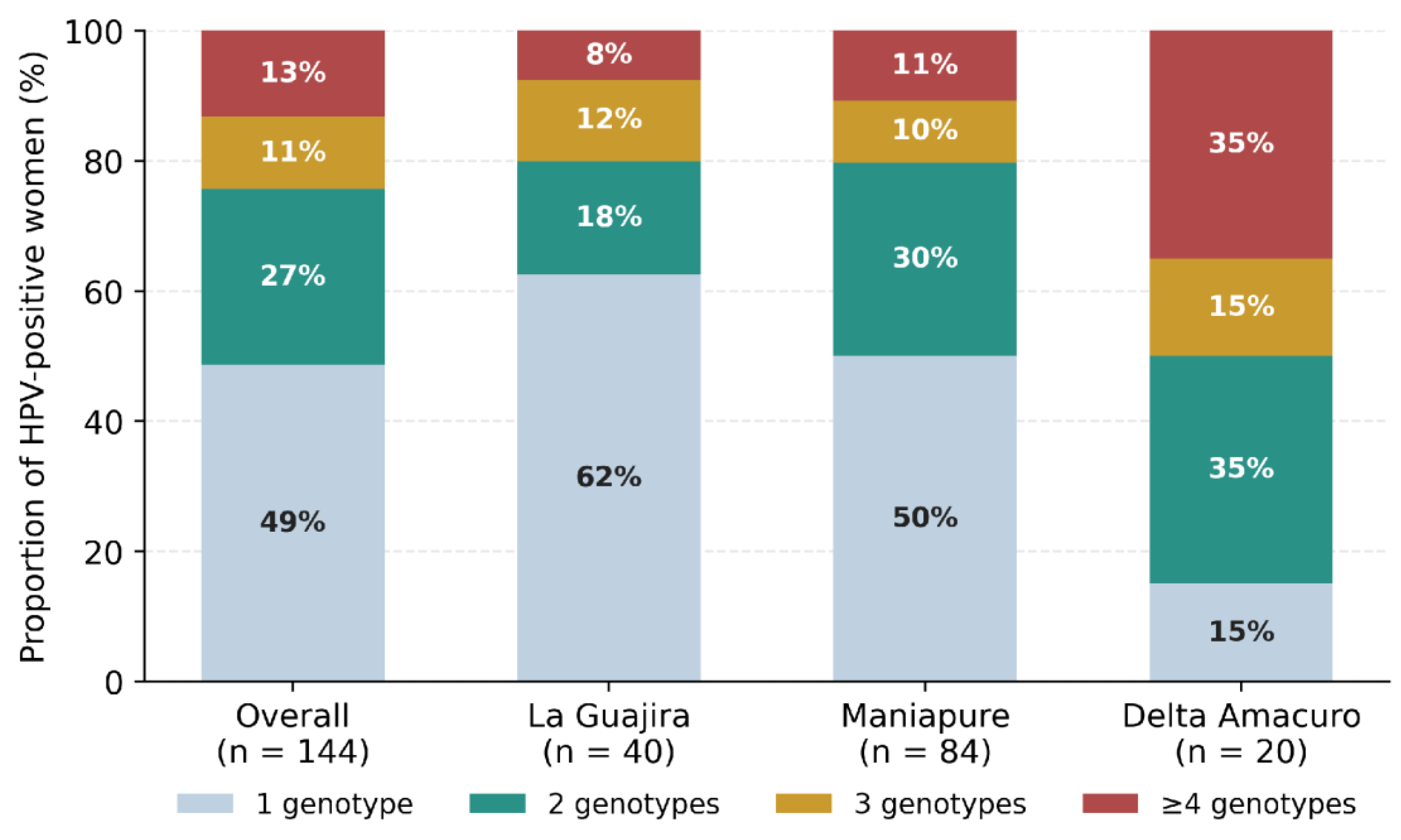
Figure 6.
Proportion of HPV-positive women carrying at least one genotype included in each licensed vaccine formulation, overall and by community.
Figure 6.
Proportion of HPV-positive women carrying at least one genotype included in each licensed vaccine formulation, overall and by community.
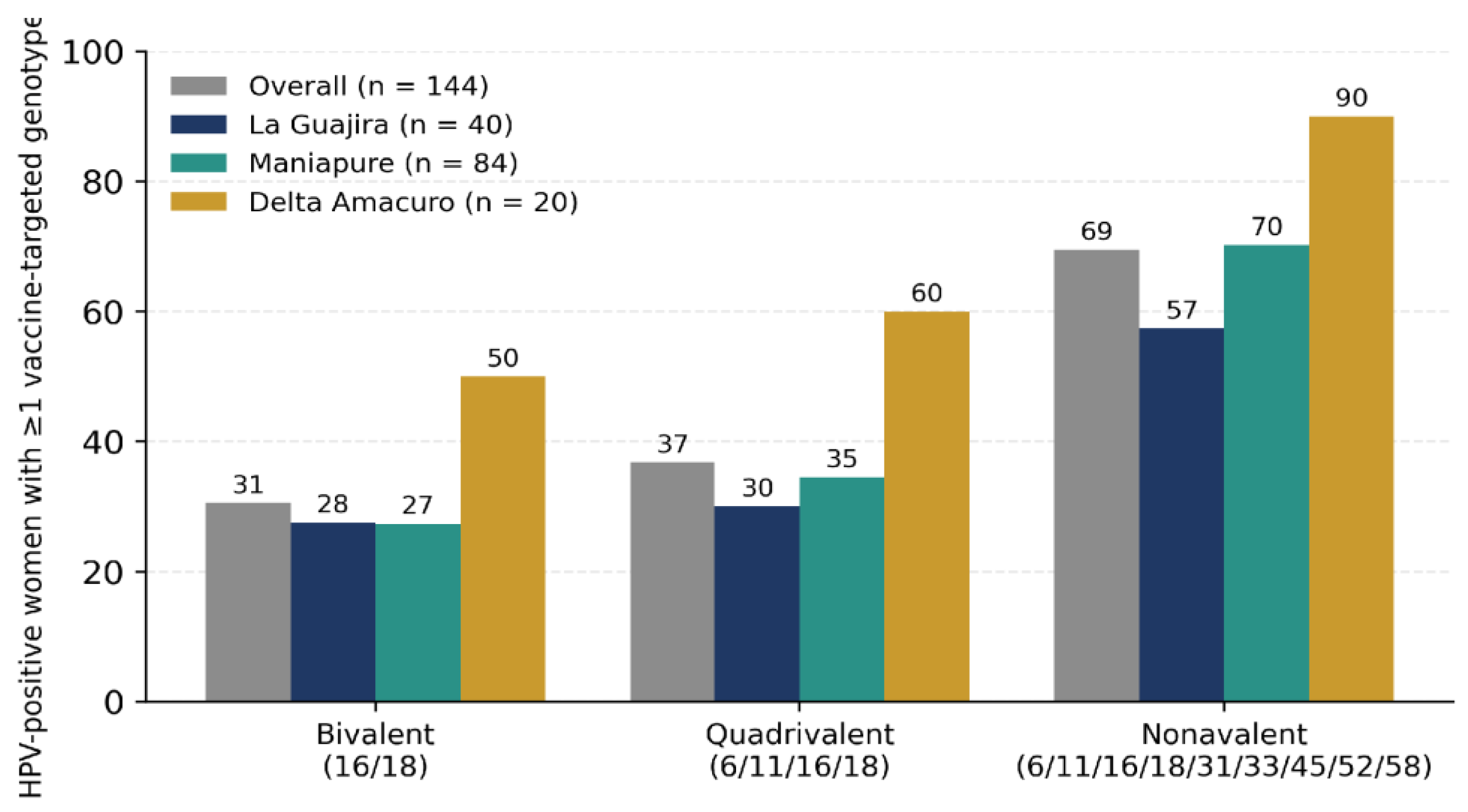
Figure 7.
Multiple correspondence analysis of the 144 women with complete data, showing the first two factorial dimensions with 95% confidence ellipses by community. Category coordinates are plotted as triangles and individual women as points. Delta Amacuro and La Guajira occupy opposite ends of the first dimension, with Maniapure close to the centroid and overlapping both.
Figure 7.
Multiple correspondence analysis of the 144 women with complete data, showing the first two factorial dimensions with 95% confidence ellipses by community. Category coordinates are plotted as triangles and individual women as points. Delta Amacuro and La Guajira occupy opposite ends of the first dimension, with Maniapure close to the centroid and overlapping both.
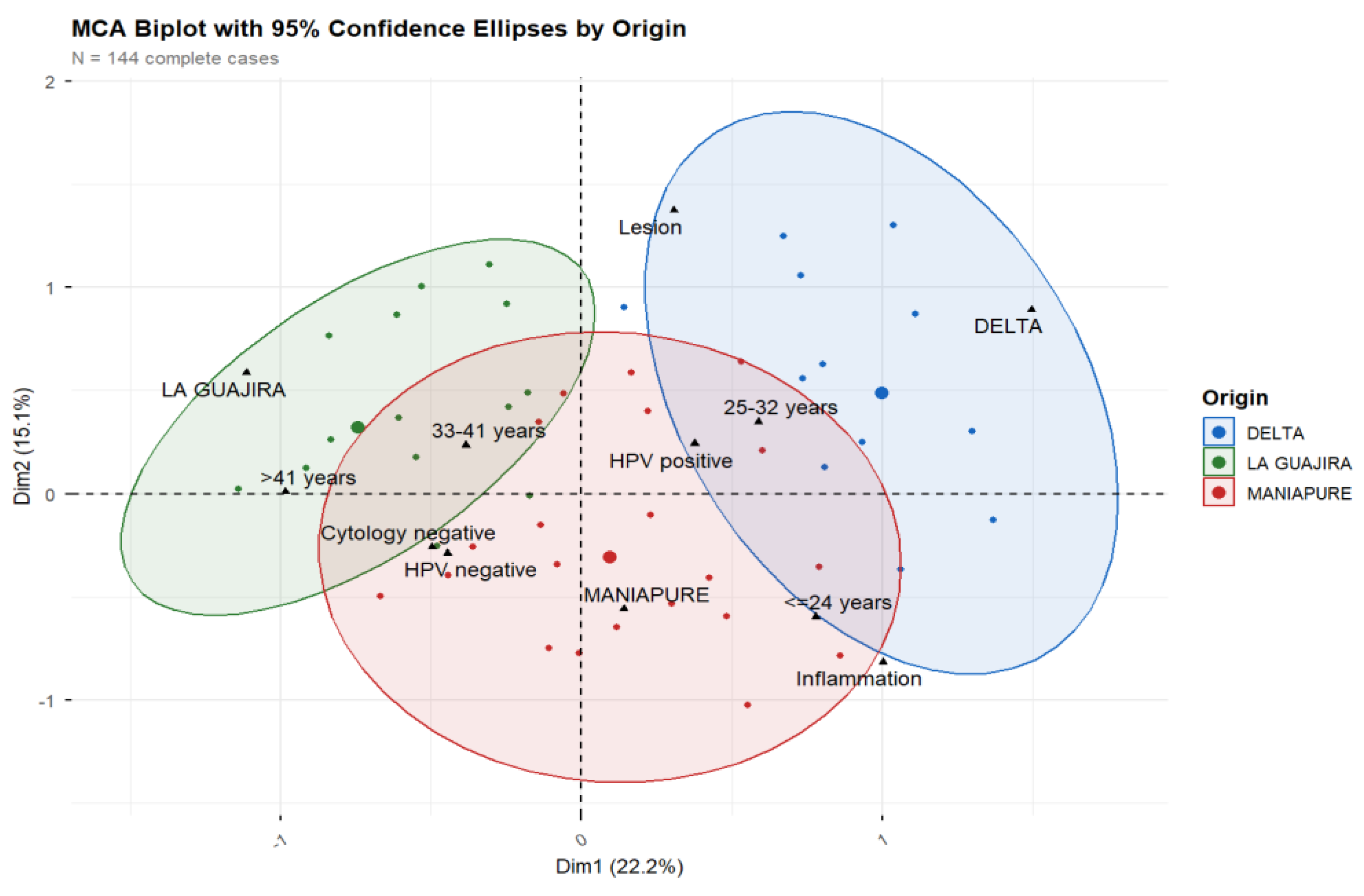

Table 1.
General, cytological and virological characteristics of the study population, stratified by community. Percentages for cytological variables are calculated on the number of women with an available cytological result (overall n = 144; La Guajira n = 41; Maniapure n = 80; Delta Amacuro n = 23); all other percentages are calculated on the full analyzed sample.
Table 1.
General, cytological and virological characteristics of the study population, stratified by community. Percentages for cytological variables are calculated on the number of women with an available cytological result (overall n = 144; La Guajira n = 41; Maniapure n = 80; Delta Amacuro n = 23); all other percentages are calculated on the full analyzed sample.
| Variable | Overall (n = 260) | La Guajira (n = 94) | Maniapure (n = 141) | Delta Amacuro (n = 25) | p-value | Test |
|---|---|---|---|---|---|---|
| Age, years, mean (SD) | 34.0 (12.3) | 37.7 (11.8) | 33.0 (12.4) | 25.6 (7.3) | <0.001 | KW |
| Age, years, median (Q1–Q3) | 32 (24–41) | 38 (30–45) | 31 (23–39) | 25 (19–30) | ||
| Cytology, risk scale, n (%) | 0.047 | Fisher | ||||
| NILM | 111 (77.1) | 32 (78.0) | 65 (81.2) | 14 (60.9) | ||
| LSIL | 31 (21.5) | 7 (17.1) | 15 (18.8) | 9 (39.1) | ||
| HSIL | 2 (1.4) | 2 (4.9) | 0 (0.0) | 0 (0.0) | ||
| Cervical findings, n (%) | <0.001 | Fisher | ||||
| Negative | 72 (50.0) | 32 (78.0) | 39 (48.8) | 1 (4.3) | ||
| Lesion (LSIL/HSIL) | 33 (22.9) | 9 (22.0) | 15 (18.8) | 9 (39.1) | ||
| Inflammatory changes | 29 (20.1) | 0 (0.0) | 21 (26.2) | 8 (34.8) | ||
| Infectious changes | 10 (6.9) | 0 (0.0) | 5 (6.2) | 5 (21.7) | ||
| HPV status by qPCR, n (%) | 0.001 | χ² | ||||
| HPV-positive | 144 (55.4) | 40 (42.6) | 84 (59.6) | 20 (80.0) | ||
| High-risk HPV-positive | 133 (51.2) | 37 (39.4) | 76 (53.9) | 20 (80.0) | <0.001 | χ² |
| Coinfection pattern, n (%) | 0.006 | Fisher | ||||
| No genotype detected | 116 (44.6) | 54 (57.4) | 57 (40.4) | 5 (20.0) | ||
| 1 genotype | 70 (26.9) | 25 (26.6) | 42 (29.8) | 3 (12.0) | ||
| 2 genotypes | 39 (15.0) | 7 (7.4) | 25 (17.7) | 7 (28.0) | ||
| 3 genotypes | 16 (6.2) | 5 (5.3) | 8 (5.7) | 3 (12.0) | ||
| ≥4 genotypes | 19 (7.3) | 3 (3.2) | 9 (6.4) | 7 (28.0) |
Table legends: KW: Kruskal–Wallis test; NILM: negative for intraepithelial lesion or malignancy; LSIL: low-grade squamous intraepithelial lesion; HSIL: high-grade squamous intraepithelial lesion; qPCR: real-time polymerase chain reaction; SD: standard deviation.
Table 2.
HPV and high-risk HPV prevalence, overall and by community. Confidence intervals were calculated using the Wilson score method.
Table 2.
HPV and high-risk HPV prevalence, overall and by community. Confidence intervals were calculated using the Wilson score method.
| Group | n tested | HPV-positive, n | HPV prevalence, % (95% CI) | High-risk HPV-positive, n | High-risk prevalence, % (95% CI) |
|---|---|---|---|---|---|
| Overall | 260 | 144 | 55.4 (49.3–61.3) | 133 | 51.2 (45.1–57.2) |
| La Guajira | 94 | 40 | 42.6 (33.0–52.6) | 37 | 39.4 (30.1–49.5) |
| Maniapure | 141 | 84 | 59.6 (51.3–67.3) | 76 | 53.9 (45.7–61.9) |
| Delta Amacuro | 25 | 20 | 80.0 (60.9–91.1) | 20 | 80.0 (60.9–91.1) |
Table 3.
Distribution of the 19 HPV genotypes detected, overall and by community. Values are the number and percentage of women tested in whom each genotype was detected; because coinfections are frequent, column percentages sum to more than the corresponding HPV prevalence. Risk classification follows the IARC categorization of carcinogenic HPV types.
Table 3.
Distribution of the 19 HPV genotypes detected, overall and by community. Values are the number and percentage of women tested in whom each genotype was detected; because coinfections are frequent, column percentages sum to more than the corresponding HPV prevalence. Risk classification follows the IARC categorization of carcinogenic HPV types.
| Genotype | Risk category | Overall (n = 260) | La Guajira (n = 94) | Maniapure (n = 141) | Delta Amacuro (n = 25) |
|---|---|---|---|---|---|
| HPV-31 | High-risk | 41 (15.8) | 3 (3.2) | 29 (20.6) | 9 (36.0) |
| HPV-16 | High-risk | 30 (11.5) | 4 (4.3) | 17 (12.1) | 9 (36.0) |
| HPV-18 | High-risk | 24 (9.2) | 8 (8.5) | 13 (9.2) | 3 (12.0) |
| HPV-56 | High-risk | 22 (8.5) | 3 (3.2) | 9 (6.4) | 10 (40.0) |
| HPV-39 | High-risk | 21 (8.1) | 4 (4.3) | 16 (11.3) | 1 (4.0) |
| HPV-45 | High-risk | 19 (7.3) | 6 (6.4) | 8 (5.7) | 5 (20.0) |
| HPV-51 | High-risk | 19 (7.3) | 9 (9.6) | 7 (5.0) | 3 (12.0) |
| HPV-68 | High-risk | 18 (6.9) | 5 (5.3) | 1 (0.7) | 12 (48.0) |
| HPV-59 | High-risk | 17 (6.5) | 6 (6.4) | 10 (7.1) | 1 (4.0) |
| HPV-53 | Low-risk / possibly carcinogenic | 15 (5.8) | 2 (2.1) | 11 (7.8) | 2 (8.0) |
| HPV-52 | High-risk | 15 (5.8) | 3 (3.2) | 12 (8.5) | 0 (0.0) |
| HPV-58 | High-risk | 14 (5.4) | 4 (4.3) | 9 (6.4) | 1 (4.0) |
| HPV-6 | Low-risk / possibly carcinogenic | 10 (3.8) | 1 (1.1) | 7 (5.0) | 2 (8.0) |
| HPV-66 | High-risk | 10 (3.8) | 4 (4.3) | 6 (4.3) | 0 (0.0) |
| HPV-44 | Low-risk / possibly carcinogenic | 6 (2.3) | 2 (2.1) | 3 (2.1) | 1 (4.0) |
| HPV-82 | Low-risk / possibly carcinogenic | 4 (1.5) | 2 (2.1) | 1 (0.7) | 1 (4.0) |
| HPV-35 | High-risk | 4 (1.5) | 3 (3.2) | 1 (0.7) | 0 (0.0) |
| HPV-73 | Low-risk / possibly carcinogenic | 2 (0.8) | 2 (2.1) | 0 (0.0) | 0 (0.0) |
| HPV-33 | High-risk | 1 (0.4) | 0 (0.0) | 1 (0.7) | 0 (0.0) |
Table 4.
Agreement between conventional cervical cytology and qPCR, overall and by community, with qPCR as the reference standard. Cytology was binarised as positive (LSIL + HSIL) versus negative (NILM). κ values are interpreted according to Landis and Koch [44].
Table 4.
Agreement between conventional cervical cytology and qPCR, overall and by community, with qPCR as the reference standard. Cytology was binarised as positive (LSIL + HSIL) versus negative (NILM). κ values are interpreted according to Landis and Koch [44].
| Comparison (reference: qPCR) | n | Cohen’s κ | Interpretation | Sensitivity | Specificity | PPV | NPV |
|---|---|---|---|---|---|---|---|
| Cytology vs qPCR — Overall | 144 | 0.056 | Slight | 25.6% | 80.3% | 60.6% | 47.7% |
| Cytology vs qPCR — La Guajira | 41 | 0.029 | Slight | 23.5% | 79.2% | 44.4% | 59.4% |
| Cytology vs qPCR — Maniapure | 80 | 0.103 | Slight | 23.8% | 86.8% | 66.7% | 50.8% |
| Cytology vs qPCR — Delta Amacuro | 23 | -0.219 | Below chance | 31.6% | 25.0% | 66.7% | 7.1% |
Table legend: PPV: positive predictive value; NPV: negative predictive value. The Delta Amacuro estimate is based on 23 women, of whom only 4 were qPCR-negative, and is correspondingly imprecise.
Table 5.
Proportion of HPV-positive women carrying at least one genotype targeted by each licensed HPV vaccine formulation. A woman is counted once per formulation if any detected genotype is included in that formulation; categories are therefore not mutually exclusive.
Table 5.
Proportion of HPV-positive women carrying at least one genotype targeted by each licensed HPV vaccine formulation. A woman is counted once per formulation if any detected genotype is included in that formulation; categories are therefore not mutually exclusive.
| Formulation | Overall (n = 144) | La Guajira (n = 40) | Maniapure (n = 84) | Delta Amacuro (n = 20) |
|---|---|---|---|---|
| Bivalent (HPV-16/18) | 44 (30.6) | 11 (27.5) | 23 (27.4) | 10 (50.0) |
| Quadrivalent (HPV-6/11/16/18) | 53 (36.8) | 12 (30.0) | 29 (34.5) | 12 (60.0) |
| Nonavalent (HPV-6/11/16/18/31/33/45/52/58) | 100 (69.4) | 23 (57.5) | 59 (70.2) | 18 (90.0) |
| No genotype targeted by any formulation | 44 (30.6) | 17 (42.5) | 25 (29.8) | 2 (10.0) |
Disclaimer/Publisher’s Note: The statements, opinions and data contained in all publications are solely those of the individual author(s) and contributor(s) and not of MDPI and/or the editor(s). MDPI and/or the editor(s) disclaim responsibility for any injury to people or property resulting from any ideas, methods, instructions or products referred to in the content. |
© 2026 by the authors. Licensee MDPI, Basel, Switzerland. This article is an open access article distributed under the terms and conditions of the Creative Commons Attribution (CC BY) license (http://creativecommons.org/licenses/by/4.0/).
Copyright: This open access article is published under a Creative Commons CC BY 4.0 license, which permit the free download, distribution, and reuse, provided that the author and preprint are cited in any reuse.