

Submitted:
05 September 2026
Posted:
07 September 2026
You are already at the latest version
Abstract
This work introduces PCREM, a Principal Component Analysis/Artificial Neural Network-guided methodology for identifying candidate reduced ethanol-combustion mechanism topologies from high-fidelity two-dimensional OpenFOAM pool-fire simulations. The high-fidelity database is generated using The San Diego Mechanism, while the reduced-state analysis is organized around the modified Millán-Merino retained-species set containing 17 chemical species, including dynamically retained CH3CHOH. Principal Component Analysis (PCA) is applied to the pool-fire thermochemical state, and the first 10 principal components (PCs) are retained, capturing 99.9390% of the cumulative variance and yielding reconstruction errors of approximately 2% for the selected thermochemical scalars. Artificial neural networks (ANN) are then trained to reconstruct temperature and species mass fractions from the retained principal components, with validation losses of 3.4716e-06 for temperature, 2.0333E-06 for major species (avg of CO2, H2O, C2H5OH), and 2.4943E-6 for selected radicals/intermediates (avg of CH3, CO, H). A PCA-ANN-based sensitivity and species-ranking framework is subsequently developed to quantify the influence of each retained thermochemical scalar on key quantities of interest, including temperature, fuel, O2, CO2, H2O, CO, and principal-component source terms. Using unity-weighted quantities of interest, the cumulative species-importance analysis indicates that the top 13, 15, and 16 species retain approximately 91.91%, 97.83%, and 99.40% of the total importance, respectively. Based on these thresholds, three candidate reduced mechanism topologies are proposed: PCREM-16, a conservative candidate that removes only CH3 CH2O; PCREM-15, an intermediate candidate that removes CH3CH2O and CH3CHOH; and PCREM-13, an aggressive candidate that additionally removes HO2 and C2H2. Reaction-consistency analysis is used to identify which pathways remain directly closed and which require ANN reconstruction, QSS treatment, or future reduced-rate re-derivation.The proposed PCREM framework is not intended as an arbitrary truncation of the Millán-Merino mechanism. Rather, it provides a data-informed, pool-fire-specific, a priori methodology for identifying compact candidate reduced mechanisms suitable for future ANN-closed principal-component transport simulations. The results establish the foundation for subsequent a posteriori OpenFOAM implementation and validation of PCREM-16, PCREM-15, and PCREM-13.
Keywords:
PCREM
; PCA
; LDM
; low-dimensional manifold
; ethanol
; biofuels
; reduced mechanism
1. Introduction
1.1. Motivation: Ethanol Pool Fires and Computational Cost
Pool fires remain among the most important canonical configurations in fire-safety and process-hazard analysis because they combine liquid-fuel evaporation, buoyancy-driven entrainment, turbulent mixing, finite-rate chemistry, radiation, and heat release in a single strongly coupled problem [1,2,3,4]. Accurate numerical prediction of pool-fire behavior is therefore important for estimating flame structure, thermal hazards, storage-tank fire consequences, and mitigation strategies. However, practical deployment of high-fidelity reacting-flow simulations is still limited by the computational cost associated with transporting many thermochemical scalars and evaluating stiff chemical source terms.
Reduced chemical mechanisms provide one route for decreasing this cost, and several ethanol mechanisms have been developed to balance accuracy and efficiency [5,6,7]. In particular, Millán-Merino et al. [5,6] developed skeletal and reduced ethanol mechanisms intended to reproduce ignition, premixed-flame propagation, diffusion-flame structure, and extinction behavior over a range of relevant conditions. Their skeletal mechanism contains 31 species and 66 reactions, while the associated reduced mechanism contains 16 species and 14 overall reactions [5,6]. Such mechanisms provide an important foundation for ethanol combustion modeling. However, conventional mechanism-reduction strategies are usually developed and validated using canonical configurations, such as autoignition, premixed flames, counterflow flames, or droplet combustion. They do not necessarily identify which species are most important within the thermochemical state space sampled by a pool-fire simulation.
More broadly, reduced-chemistry and manifold-based combustion modeling have been pursued through several complementary approaches, including intrinsic low-dimensional manifolds (ILDM) [7,8], in situ adaptive tabulation (ISAT) [9], computational singular perturbation (CSP) [10], and directed-relation-graph/error-propagation-based mechanism reduction methods [11,12]. These methods have significantly advanced the efficient treatment of detailed chemistry in reacting-flow simulations. Nevertheless, their direct application to pool-fire combustion still requires careful consideration because the accessed thermochemical states are shaped by buoyant entrainment, transient mixing, extinction/reignition pockets, and strongly non-premixed flame structure.
A recent extension of DRGEP further illustrates the importance of choosing reduction targets that reflect the dominant physics of the intended application. Bellemans et al. [13] developed P-DRGEP for plasma-assisted combustion by augmenting conventional DRGEP targets with plasma-specific energy-transfer quantities. Their results showed that canonical combustion targets alone were insufficient to preserve the relevant plasma energy-branching pathways, whereas the inclusion of application-specific targets produced smaller skeletal mechanisms with controlled errors in ignition delay, electron energy, energy losses, and flame speed [13]. Although the present study does not address plasma-assisted combustion, the underlying lesson is directly relevant: mechanism reduction should be guided by the quantities of interest that control the target physical configuration. In the present pool-fire context, this motivates the use of PCA-ANN-derived quantities of interest, including thermochemical reconstruction errors, species sensitivities, and PC source-term sensitivities, to identify candidate reduced ethanol mechanisms.
In parallel, low-dimensional manifold approaches based on principal component analysis have been developed to reduce the dimensionality of turbulent reacting-flow simulations. Previous works by Mirgolbabaei demonstrated that principal component analysis (PCA), nonlinear PCA, and kernel PCA can identify compact representations of combustion composition space and reconstruct thermochemical scalars from a reduced set of transported variables [14,15,16,17,18,19,20]. These studies established the feasibility of principal-component transport and thermochemical reconstruction in turbulent combustion. Nevertheless, most of these demonstrations were performed in canonical turbulent-flame configurations rather than practical liquid-fuel fire scenarios.
More recently, Ray and Mirgolbabaei [20] presented preliminary a priori results for low-dimensional biofuel combustion simulation in a simplified flame configuration. That study provided an initial demonstration that PCA-based manifold reduction could be extended toward biofuel combustion. However, it did not yet provide a complete framework for identifying candidate reduced ethanol mechanisms from pool-fire-generated thermochemical data, nor did it address how PCA-ANN sensitivity information could be used to rank retained species and propose reduced mechanism topologies.
More broadly, data-driven surrogate modeling has also been applied to large CFD-derived thermal-fluid datasets, using Gaussian-process, generalized-additive, and ensemble-learning methods to capture nonlinear relationships governing exergy destruction, heat-exchanger effectiveness, and shell-side heat transfer [22,23,24,25]. These studies further demonstrate the utility of machine-learning regression for extracting compact predictive mappings from high-dimensional numerical datasets, providing additional motivation for the ANN-based thermochemical reconstruction adopted here. The broader applicability of data-driven dimensionality-reduction methods has also been demonstrated in the analysis of environmental factors associated with food- and waterborne norovirus outbreaks [26].
This gap motivates the present work. Rather than adopting an existing reduced ethanol mechanism unchanged, the present study uses high-fidelity OpenFOAM pool-fire data to determine which thermochemical scalars are most important for reconstructing the dominant low-dimensional manifold and key combustion quantities of interest. PCA is first applied to the modified Millán-Merino retained-species space, and artificial neural networks are then trained to reconstruct thermochemical scalars from the retained principal components. A PCA-ANN-based sensitivity and ranking framework is subsequently used to identify a hierarchy of candidate reduced mechanisms, denoted PCREM-16, PCREM-15, and PCREM-13.
The proposed PCREM framework is therefore not a direct replacement for classical chemical-kinetic reduction methods. Instead, it provides a data-informed, pool-fire-specific layer of reduction that identifies which species should be retained, reconstructed, or treated with caution in a PCA-ANN manifold simulation. In this sense, the present work provides an a priori foundation for future posteriori OpenFOAM implementation of PC transport, including the corresponding ANN-tabulated source and diffusion terms closures in ethanol pool-fire combustion.
The specific objectives of this work are to: (i) generate a high-fidelity ethanol pool-fire thermochemical database using the detailed San Diego Mechanism chemistry; (ii) construct a reduced thermochemical reference space based on the modified Millán-Merino 17-species retained set; (iii) apply PCA to identify a low-dimensional representation of the pool-fire thermochemical manifold; (iv) train ANN models to reconstruct temperature and species mass fractions from the retained PCs; (v) develop a PCA-ANN-based sensitivity framework for ranking the importance of retained thermochemical scalars; and (vi) propose three candidate reduced mechanism topologies, denoted PCREM-16, PCREM-15, and PCREM-13. These candidates are introduced as a priori, PCA-ANN-guided reduced-state mechanism topologies rather than fully validated standalone kinetic mechanisms.
2. High-Fidelity Dataset and Reference Chemistry
2.1. Parent Ethanol Skeletal Mechanism
The chemistry used for this simulation is from the 2016-12-14 San Diego Mechanism [24]. The chem.inp and thermo.dat chemkin formatted files were used directly in OpenFOAM using the chemkinReader chemistryReader. The transport files from the San Diego Mechanism were not used. Instead the sutherland transport coefficients for gaseous Nitrogen were applied to all species universally. (I should find a source about the main reaction pathways starting from H and radical abstraction to and and intermediates to oxidation into and )
2.3. OpenFOAM Ethanol Pool-Fire Configuration
This study was run in OpenFOAM v2412 using the fireFoam solver. The geometry is based off of the smallFirePool2d tutorial case. The computational domain is a 1x1m square with a 151x151 square grid and a depth of 1 cell. Each cell is also bisected to form triangular volumetric elements. A 10cm inlet is centered on the bottom face of the domain. The pressure is uniform at 1 atm, and 100% gaseous Ethanol is seeded at the inlet. 77% Nitrogen and 23% Oxygen fill the rest of the domain. The velocity at the inlet is set to a constant upward value of 0.05 m/s. The temperature at the inlet is set to 2,000k for the first 0.1s and reduced linearly to 800k at 0.11s. The bottom face has a no-slip condition, and the walls and top outlet are of the type pressure/Inlet/Outlet/Velocity, allowing combustion products to exit the domain.
The partially stirred combustion model was used with laminar chemistry and a value of 1.0. The turbulence model uses a LES single-equation . There are accuracy sacrifices in modeling turbulence this way in 2-D, but they are not significant in this case [need a source for this]. The Sutherland transport coefficients for gaseous Nitrogen ( = 1.67212e-06 and = 170.672) were assigned universally to every species in the mixture [maybe another source about accuracy?]. The chemistry ODE solver using the seulex sub-method was implemented with an absolute tolerance of 1e-12 and a relative tolerance of 0.01. The maximum chemical time step is 1e-6. The maximum Courant number is 0.4.
Data were written every 0.05s for a total of 10s of flame time, or 200 snapshots. The total number of spatiotemporal observations is or 9,120,400. This data captures the ignition, transient, and quasi-steady burning regimes and was used to develop the reduced-order model and train the reconstruction of the high-fidelity flame.
3. PCA-ANN Low-Dimensional Representation
3.1. Data Preprocessing
Prior to PCA, each thermochemical scalar was centered and scaled to the range [-1,1] to prevent large-magnitude variables, such as temperature and major-species mass fractions, from dominating the covariance structure. The same transformation parameters were retained for inverse reconstruction and ANN training.
3.2. Principal Component Analysis
PCA is the orthogonal transformation of the high-dimensional manifold to get uncorrelated variables, called Principal Components (PCs). PCA is applied to transform the set of thermochemical scalars in the state-space composition of reacting flows into orthogonal moments, PCs. First, the covariance matrix is constructed from an matrix of variables, with m representing the number of temporal and spatial realizations:
The data may be based on a canonical problem that reproduces important features in the composition space of the desired problem. Then, the matrix of orthonormal eigenvectors, Q, of the covariance matrix is constructed using singular value decomposition:
where is the diagonal matrix of the eigenvalues in descending order of magnitude. The columns of are the PCs’ loading factors. Then, the PCs, , are calculated as follows:
To get a lower dimensionality of the original manifold, a truncated version of , , will be multiplied by the original manifold to get a reduced manifold spanned by a selected set of PCs, as follows:
Matrix holds the “conversion” from the original thermochemical scalars , scalars’ diffusion term , and source term , to the corresponding PCs, , PCs’ diffusion term , and PCs’ source term , at any given point. ANNs with the inputs of , and as the outputs, will then reconstruct the original manifold which is desired as the eventual output of a CFD solution as the ongoing work in this project [14].
It was decided to retain only the principal components whose cumulative variance accounts for 99.9% of the total variance in the original high-fidelity data. Using this metric, 10 PCs were retained out of the original 18 thermochemical scalars. Validation losses for the models trained on 10 PCs were 3.4716e-06 for temperature, 2.0333E-06 for major species (avg of CO2, H2O, C2H5OH), and 2.4943E-6 for selected radicals/intermediates (avg of CH3, CO, H). The reconstruction percentage error was similarly low with most values around 1%-1.5% and peak percent errors of only 5.0477%.
Construction of PC Transport Terms
A pivotal step is to redefine the governing equations for thermochemical scalars to apply to PCs. This transformation is the foundation for implementing our approach within CFD. We carefully formulate these equations for the PCs in a way that mirrors the characteristics of thermochemical scalars [14], as follows:
Original thermochemical species’ equations (traditional codes):
PCs’ transport equations (our approach):
The detailed description of such a transformation is explained by Mirgolbabaei & Echekki [16]. This means that the equations for PCs will encapsulate the same fundamentals of transport, diffusion, and source terms as those of thermochemical scalars. An integral part of this is the meticulous tabulation of the PCs’ source and diffusion terms as functions of the PCs themselves, which will be implemented through the current objective. We are developing a parallel framework to study and predict PC behavior under various conditions, much like how we study .
The simple linear relation between PCs and the thermo-cehmical vectores enables the derivation of expressions for and , as follows [14]:
for the full PC set, while
for the retained PCs, and
To proceed further in evaluating the transport terms for the PCs, we have adopted a simplified form for the diffusive flux assuming that a set of diffusion coefficients can be constructed for the principal components:
where DΨ is the matrix of diffusion coefficients for the PCs. Based on that form, we have derived an expression for DΨ in terms of the matrix of diffusion coefficients for the thermochemical scalars, Dθ, as follows [14]:
3.3. ANN Reconstruction of Thermochemical Scalars
One network was trained to reconstruct each individual original parameter for a total of 29 different ANNs (17 species, 10 PC source terms, and the diffusion term). Each network shares the same structure. The 10 retained principal components are used in the input layer, then an 18-node hidden layer with the swish activation function and an 18-node layer with the hyperbolic tangent activation function, and a single output node. In each case, a random selection of 50% of the data was used for training, and the rest was used for validation. The ANNs were trained in MATLAB and used the ADAM gradient descent solver with a piecewise learning rate and a drop factor of 0.5 every 10 epochs, with an initial learning rate of . The networks were trained in batches with a batch size of shuffled every epoch. A Huber loss function with delta=0.2 was selected to minimize the dominance of outliers, especially in intermediate species’ mass fractions, which have exceptionally poor skewness and kurtosis. Training was limited to 30 epochs with an early stopping condition if the validation error increases relative to the previous batch 6 times. All of the networks finished in between 10 and 15 epochs due to this condition.
3.4. ANN Reconstruction-Error Metrics
The accuracy of the ANN-based reconstruction was quantified using five complementary error metrics: the root-mean-square error (RMSE), normalized root-mean-square error (NRMSE), mean absolute error (MAE), coefficient of determination (), and maximum absolute error. For a thermochemical scalar , with observations, the reconstruction error was evaluated by comparing the original value with its ANN-reconstructed value .
The RMSE was calculated as:
while the NRMSE was obtained by normalizing the RMSE by the range of the corresponding scalar,
The MAE was defined as:
and the coefficient of determination was calculated according to
where denotes the mean value of the original scalar. Finally, the maximum absolute reconstruction error was evaluated as:
These metrics provide complementary measures of reconstruction performance. RMSE emphasizes larger deviations, MAE characterizes the average absolute discrepancy, NRMSE enables comparison among scalars having different ranges, measures the degree to which the reconstructed field reproduces the variability of the original data, and the maximum absolute error identifies the largest local deviation encountered within the sampled thermochemical state space.
Reconstruction accuracy was evaluated for representative scalars spanning distinct combustion roles, including temperature; the parent fuel C2H5OH; the oxidizer O; the major products CO and HO; the incomplete-combustion product CO; the oxidation radical OH; the radical reservoir HO; and the ethanol-oxidation intermediates CH3CHOH and CH3CHO. The corresponding quantitative reconstruction results are presented and discussed in Section 5.3. This assessment establishes the fidelity of the PCA-ANN manifold reconstruction before the reconstructed thermochemical state is used in the subsequent sensitivity analysis and PCREM species-ranking procedure.
It is noteworthy that the scalar error metrics were evaluated in the -normalized space used for ANN training, whereas the parity plots were generated after inverse transformation to the original thermochemical variables.
4. PCA-ANN-Guided Species Ranking
4.1. Rationale for Ranking Within the Modified Millán-Merino Space
The ranking is performed within the 17-species modified Millán-Merino retained set because this set is already chemically vetted and includes the corrected treatment of CH3CHOH. Therefore, PCREM does not begin directly from the full skeletal 56-species mechanism. Instead, it asks:
Given the modified Millán-Merino retained species, which species are most important for reconstructing the pool-fire thermochemical manifold and key combustion QoIs?
4.2. Quantity-of-Interest Set
The sensitivity analysis was formulated using a quantity-of-interest (QoI) set designed to represent both the thermochemical state of the ethanol pool flame and the closure quantities required for the eventual principal-component transport formulation. The thermochemical QoIs consisted of temperature and the 17 species comprising the modified Millán-Merino reference state: , , , , , , , , , , , , O, , , , and . Collectively, these variables span the parent fuel and oxidizer, major stable combustion products, incomplete-oxidation products, chain-carrying and oxidation radicals, radical reservoirs, and ethanol-specific intermediate pathways represented within the reference mechanism.
In addition to the thermochemical state variables, the source terms of the first 10 retained principal components, –, were included as QoIs. Their inclusion is important because the intended PC-transport formulation requires accurate closure of the transported PC source terms; consequently, a species that appears comparatively unimportant for reconstructing an individual concentration may nevertheless exert a meaningful influence on the evolution of the reduced PC state. The PC diffusion term was likewise included so that the ranking also reflects the influence of the original thermochemical scalars on diffusive transport within the reduced manifold.
All QoIs were assigned equal weighting in the present analysis. This unity-weight formulation avoids imposing an a priori preference for any single species, temperature, or PC transport term and allows the resulting species-importance ranking to reflect their aggregate influence across the complete set of reconstruction and reduced-transport targets. The resulting sensitivity matrix therefore provides the basis for the RSSq aggregation and cumulative species ranking used subsequently to define the PCREM-16, PCREM-15, and PCREM-13 candidate mechanisms.
5. Results and Discussion
5.1. Baseline Pool-Fire Structure
Before examining the low-dimensional representation and ANN reconstruction, the thermochemical structure of the underlying OpenFOAM ethanol pool-fire simulation is first considered. Figure 1, Figure 2, Figure 3, Figure 4 and Figure 5 present an instantaneous realization at s directly from the high-fidelity simulation for ethanol, CO, , , and temperature. These fields are shown solely to characterize the reference flame state sampled by the PCA-ANN framework; no reconstructed quantities are involved at this stage.
The ethanol field (Figure 1) is concentrated near the fuel inlet and rapidly decreases away from the source, whereas the CO field (Figure 2) develops along the reacting region above the inlet. Farther into the flame structure, the field (Figure 3) occupies a broader region associated with the burned-gas plume. The corresponding field (Figure 4) shows substantial depletion within the reacting region relative to the surrounding oxidizer-rich environment. The temperature field (Figure 5) exhibits a similarly organized flame structure, with the elevated-temperature region extending upward from the fuel source and overlapping the primary reaction and product-formation zones.
Taken together, these instantaneous fields demonstrate that the simulation spans strongly varying fuel-rich, oxidizer-rich, reacting, and product-dominated regions within the computational domain. Such coupled spatial variations in temperature and species composition provide the high-dimensional thermochemical state space subsequently subjected to PCA. The following section therefore examines how much of this state-space variability can be represented by a reduced number of principal components.
5.2. PCA Eigenvalue Spectrum and Retained PCs
Most of the variance in the 18 retained parameters can be explained by only a handful of principal components. 95.7961% of the variance is captured by the first 3 PCs while only 6 PCs capture over 99% of the variance. To prioritize accurate reconstruction of all 18 parameters, 10 principal components were retained for this study. This accounts for 99.939% of the variance in the parameters.
5.3. Global ANN Reconstruction Accuracy
The reconstruction accuracy of the PCA-ANN manifold was evaluated for temperature and all 17 species in the modified Millán-Merino thermochemical state. The quantitative error metrics are summarized in Table X, while Figure 6, Figure 7, Figure 8, Figure 9, Figure 10, Figure 11, Figure 12, Figure 13, Figure 14, Figure 15, Figure 16, Figure 17, Figure 18, Figure 19, Figure 20, Figure 21, Figure 22 and Figure 23 provide parity plots comparing the ANN-reconstructed values with the corresponding reference values. The parity plots are presented in the original thermochemical variables, whereas the error metrics reported in Table1 are based on the normalized representation used for ANN training.
Overall, the PCA-ANN reconstruction reproduces the dominant thermochemical state with high accuracy. Temperature, the parent fuel OH, , the major products and , , and the principal radical species H and OH all exhibit coefficients of determination of approximately 0.999 or greater. Their parity distributions remain closely aligned with the ideal relation over nearly the complete range of the corresponding variables. Particularly strong performance is obtained for (), temperature (), (), O (), OH (), and OH (). This agreement indicates that the retained 10-PC representation contains sufficient information to reconstruct the major thermodynamic, fuel, oxidizer, product, and radical features of the sampled pool-fire state space.
Strong reconstruction is also obtained for several intermediate species. , , , O, , and yield values of 0.9992, 0.9993, 0.9927, 0.9878, 0.9857, and 0.9758, respectively. The corresponding parity plots nevertheless reveal a modest tendency toward underprediction at the upper end of the concentration range for some of these intermediates, particularly , , and . Thus, although their global reconstruction remains strong, the largest departures from parity are associated primarily with the comparatively infrequent high-concentration states rather than with the bulk of the sampled observations.
A different behavior is observed for the lower-abundance radical and intermediate species O, , , and , for which decreases to 0.5753, 0.7273, 0.8486, and 0.8816, respectively. Their parity plots show substantially greater dispersion and, most notably, systematic underprediction of the largest reference concentrations. represents the most difficult scalar to reconstruct: most observations remain clustered near very small concentrations, whereas the comparatively rare larger values are not reproduced proportionally by the ANN. Similar, though less pronounced, behavior is observed for , , and .
Importantly, the lower values for these species occur together with comparatively small NRMSE values. This apparent contrast reflects the highly nonuniform distributions of low-concentration radicals and intermediates. Because much of their sampled state space is concentrated near zero, relatively small absolute reconstruction errors can represent a substantial fraction of the variance of these species and therefore produce a noticeable reduction in . The parity plots consequently provide information complementary to the aggregate error measures: the principal reconstruction limitation is not a uniformly poor representation of these scalars, but rather reduced fidelity in the relatively sparse portions of the manifold where their concentrations become largest.
Taken collectively, the global reconstruction statistics demonstrate that the 10-PC PCA-ANN representation accurately recovers the dominant pool-fire thermochemical state while identifying a smaller subset of low-abundance intermediates for which reconstruction is more challenging. This distinction is particularly relevant to the subsequent PCREM analysis because and are among the species considered for ANN-based retrieval in the reduced candidate mechanisms. Global statistical agreement alone, however, does not establish where within the flame these reconstruction errors occur. The instantaneous spatial comparisons presented in Section 5.4 are therefore used to examine the localization of the reconstruction discrepancies within representative fuel, intermediate, product, oxidizer, and temperature fields.

Table 1.
Global ANN reconstruction performance for temperature and the 17 species of the modified Millán-Merino thermochemical state, quantified using RMSE, NRMSE, MAE, coefficient of determination (), and maximum absolute error (Max AE).
Table 1.
Global ANN reconstruction performance for temperature and the 17 species of the modified Millán-Merino thermochemical state, quantified using RMSE, NRMSE, MAE, coefficient of determination (), and maximum absolute error (Max AE).
| Scalars; Concentrations & Temperature | Combustion role | RMSE | NRMSE | MAE | (R^2) | Max AE |
| C2H2 | Acetylene intermediate | 0.0074 | 0.0037 | 0.0014 | 0.9758 | 0.5067 |
| C2H4 | Ethylene intermediate | 0.0059 | 0.0029 | 0.001 | 0.9857 | 0.383 |
| C2H5OH | Parent fuel | 0.0015 | 0.0008 | 0.0005 | 0.9996 | 0.0735 |
| CH2O | Formaldehyde intermediate | 0.0038 | 0.0019 | 0.0009 | 0.9878 | 0.4573 |
| CH3 | Methyl radical | 0.0022 | 0.0011 | 0.0007 | 0.9992 | 0.1262 |
| CH3CH2O | Ethoxy radical | 0.0043 | 0.0021 | 0.0007 | 0.5753 | 1.7959 |
| CH3CHO | Acetaldehyde intermediate | 0.0031 | 0.0015 | 0.0006 | 0.9927 | 0.2374 |
| CH3CHOH | (\alpha)-hydroxyethyl radical | 0.0053 | 0.0027 | 0.0008 | 0.8816 | 1.3386 |
| CO | Incomplete oxidation product | 0.0029 | 0.0014 | 0.0011 | 0.9993 | 0.1498 |
| CO2 | Major carbon oxidation product | 0.0022 | 0.0011 | 0.0007 | 0.9999 | 0.1487 |
| H | Chain-carrying radical | 0.002 | 0.001 | 0.0007 | 0.999 | 0.1048 |
| H2 | Light intermediate / H–O chemistry | 0.0024 | 0.0012 | 0.0006 | 0.9993 | 0.2088 |
| H2O | Major hydrogen oxidation product | 0.0022 | 0.0011 | 0.0005 | 0.9999 | 0.1515 |
| H2O2 | Peroxide intermediate / radical reservoir | 0.0054 | 0.0027 | 0.0012 | 0.7273 | 0.8348 |
| HO2 | Hydroperoxyl radical / radical reservoir | 0.0042 | 0.0021 | 0.0013 | 0.8486 | 0.848 |
| O2 | Oxidizer | 0.0015 | 0.0008 | 0.0008 | 1 | 0.051 |
| OH | Major oxidation radical | 0.0016 | 0.0008 | 0.0004 | 0.9997 | 0.0807 |
| T | Thermodynamic state / heat-release indicator | 0.0022 | 0.0011 | 0.0011 | 0.9999 | 0.0532 |
5.4. Spatial Reconstruction Quality
The global reconstruction statistics and parity plots described in Section 5.3 quantify the overall accuracy of the PCA-ANN representation, but they do not indicate where reconstruction discrepancies occur within the flame. To provide a spatial assessment, Figure 24, Figure 25, Figure 26, Figure 27, Figure 28 and Figure 29 compare representative instantaneous OpenFOAM fields at s with their corresponding PCA-ANN reconstructions and absolute-error distributions. The selected quantities span the parent fuel, an ethanol-specific intermediate, major product and incomplete-oxidation species, oxidizer, and temperature.
For (Figure 24), the reconstructed field preserves the strongly localized fuel distribution near the inlet and reproduces the overall spatial extent of the reference field. The absolute-error contour indicates that the principal discrepancies are confined to the narrow region associated with the evolving fuel-containing plume rather than being distributed throughout the computational domain. This suggests that the ANN captures both the predominantly fuel-free surroundings and the localized fuel structure with good spatial fidelity.
(Figure 25) represents a more demanding reconstruction because its mass fraction is substantially smaller and spatially confined to a comparatively narrow region. Despite this, the reconstructed field retains the principal location and topology of the reference distribution. The absolute-error field remains localized around the region in which is present, consistent with the greater scatter observed for this intermediate in the corresponding parity plot. Thus, the reconstruction error is spatially associated with the chemically active portion of the field rather than with the large regions in which the species concentration is negligible.
The field (Figure 26) provides a particularly clear comparison because the species occupies a broader portion of the reacting plume. The reconstructed contour reproduces the major product-rich structures, including the curved upper portions of the flame and the narrower region extending toward the fuel source. The absolute-error distribution is concentrated primarily along the boundaries and internal gradients of these structures. This behavior indicates that the principal discrepancies occur where the field changes rapidly in space, while the overall location and magnitude distribution of the product field remain well preserved.
A similar trend is observed for (Figure 27). The reconstructed field closely follows the narrow -rich region extending upward from the inlet, while the error contour is localized around the evolving reaction structure. Since is associated with incomplete oxidation and occupies a considerably narrower spatial region than , preservation of this localized structure provides additional evidence that the retained PC state captures spatially distinct combustion features rather than only the dominant major-species fields.
For (Figure 28), the ANN reconstruction reproduces both the oxygen-rich surroundings and the pronounced oxygen-depleted region associated with the flame. The reference and reconstructed contours are visually almost indistinguishable at the scale shown. The remaining absolute error is concentrated around the interface between the oxygen-depleted reacting region and the surrounding oxidizer-rich gas. This is consistent with the very high global reconstruction accuracy reported for in Section 5.3 and indicates that even the relatively sharp spatial variation across the oxidizer-consumption region is retained by the PCA-ANN representation.
The temperature comparison in Figure 29 likewise shows close agreement between the original and reconstructed flame structures. The ANN reproduces the location, shape, and extent of the elevated-temperature region, including the curved upper flame structure and the high-temperature region extending toward the inlet. The absolute-error contour is concentrated mainly around the flame boundaries and internal regions of strong temperature variation. Accordingly, the largest visible temperature discrepancies appear to coincide with regions having comparatively strong spatial thermal gradients rather than being uniformly distributed over the domain.
Taken together, Figure 24, Figure 25, Figure 26, Figure 27, Figure 28 and Figure 29 demonstrate that the PCA-ANN reconstruction preserves the principal spatial organization of the thermochemical state across variables having substantially different magnitudes and combustion roles. The absolute-error fields are generally localized within or around the reacting structures, particularly near regions of pronounced scalar gradients, while the large portions of the domain outside these structures exhibit comparatively small discrepancies. Importantly, each absolute-error panel uses its own numerical scale; therefore, error magnitudes should not be compared directly between species based solely on contour color. A subsequent quantitative analysis of the underlying s data can further determine whether the largest reconstruction errors preferentially occur at high or low scalar concentrations, high or low temperatures, or particular combinations of these thermochemical conditions.
5.5. Sensitivity Matrix
The PCA-ANN sensitivity analysis was used to quantify how perturbations of each original thermochemical scalar influence the selected quantities of interest (QoIs). Let denote the th original thermochemical scalar and the th QoI. The resulting sensitivity matrix, , contains one column for each of the 18 original thermochemical variables and one row for each of the 29 QoIs considered in Section 4.2.
For each sensitivity evaluation, the original scalar was perturbed by relative to its baseline value while the remaining variables were left unchanged. The perturbed thermochemical state was then projected into the retained 10-PC space using the same PCA transformation employed in the reduced-order representation. The corresponding perturbed QoI was evaluated through the trained ANN mapping and compared with the QoI obtained from the unperturbed PC state. The resulting normalized response defines the sensitivity coefficient , representing the influence of thermochemical scalar on quantity of interest .
Accordingly, the sensitivity matrix is written as
where
where the rows correspond to the thermochemical QoIs, PC source terms, and PC diffusion term, and the columns correspond to the original thermochemical scalars. Larger magnitudes of indicate a stronger influence of scalar on QoI , while the sign of , where retained, indicates the direction of the response to the imposed perturbation.
Table 2 presents the resulting sensitivity matrix. The matrix reveals that the influence of individual scalars is distributed across both thermochemical reconstruction targets and PC-transport closure quantities rather than being determined solely by their direct reconstruction. This full sensitivity information is subsequently aggregated using the RSSq procedure described in Section 5.6 to obtain the scalar-importance ranking used to define the PCREM candidate hierarchy.
5.6. RSSq Species Ranking
The species ranking is determined by the row-wise root sum square of the sensitivity matrix which is then normalized by the sum of the species importance values so that the species rankings sum to 1. This takes into consideration negative correlations for Sji and penalizes larger errors. The proposed mechanisms are based off of several cumulative importance targets. The top 13 species account for 88.72% of the cumulative importance, the top 15 species account for 95.05% and the top 16 species account for 97.83%. These thresholds motivated the the proposal of the PCREM-13, PCREM-15, and PCREM-16 mechanisms.
6. PCREM Candidate Mechanism Family
6.1. Definition of PCREM-N
The three reduced mechanisms proposed follow the PCREM-N notation where N is the number of retained chemical species. In each mechanism, temperature remains part of the thermochecmical state reconstruction because of its significance to the reaction rates and transport properties. The PCREM-13, 15, and 16 mechanisms therefore detail reduced mechanisms with 13, 15, and 16 species compared to the original 17 specie mechanism proposed by Millan Merino.
6.2. Candidate Hierarchy
The PCREM candidate family was constructed by progressively removing the lowest-ranked chemical species from the modified Millán-Merino 17-species reference state while retaining temperature as a separate thermochemical variable in all cases. The resulting hierarchy provides three levels of reduction—conservative, intermediate, and aggressive—so that the tradeoff between dimensional reduction and preservation of the ranked thermochemical information can be assessed systematically.
PCREM-16 represents the most conservative candidate. It retains 16 of the 17 chemical species and removes only O, the lowest-ranked species in the RSSq analysis. With temperature retained independently, this candidate preserves approximately 99.4% of the cumulative thermochemical importance represented in the ranking. PCREM-16 therefore provides the closest reduced-state approximation to the modified Millán-Merino reference set and serves as the natural first candidate for subsequent a posteriori assessment.
PCREM-15 provides an intermediate level of reduction by additionally removing CHOH. The retained state therefore contains 15 chemical species and preserves approximately 97.8% of the cumulative importance. This candidate reduces two ethanol-specific radical intermediates while maintaining the higher-ranked major species, products, H/O radical chemistry, and other intermediate pathways. It is consequently intended to explore whether a meaningful additional reduction can be achieved without substantially compromising the information represented by the retained thermochemical state.
PCREM-13 represents the most aggressive candidate considered in the present study. In addition to O and CHOH, and are removed, leaving 13 explicitly retained chemical species. This candidate preserves approximately 92% of the cumulative importance represented in the current RSSq ranking and is intended to probe the lower practical limit of the proposed reduced-state description. Because and participate in chemically distinct radical and rich-flame pathways, PCREM-13 necessarily carries greater closure risk and therefore requires the most careful subsequent validation.
Table 3 summarizes the unity-weight RSSq ranking from which these three candidate levels were defined. The hierarchy is not intended to imply that a particular cumulative-importance threshold guarantees chemical fidelity; rather, it provides a systematic basis for selecting progressively reduced candidate topologies whose relative accuracy and computational benefits can subsequently be evaluated through a posteriori OpenFOAM simulations.
6.3. Retained-Species Table
In this table, “Retained” indicates that the species belongs to the transported or explicitly retained PCREM chemical state, whereas “ANN-retrieved” indicates that the species is removed from the retained mechanism topology but recovered through the PCA-ANN algebraic manifold closure when needed. Temperature is retained as a thermochemical scalar in all cases but is not counted as a chemical species.
Table 4.
Retained and ANN-retrieved species in the modified Millán-Merino 17-species reference set and the proposed PCREM candidates.
Table 4.
Retained and ANN-retrieved species in the modified Millán-Merino 17-species reference set and the proposed PCREM candidates.
| Species | MM-17 | PCREM-16 | PCREM-15 | PCREM-13 | Chemical role |
| C₂H₅OH | Retained | Retained | Retained | Retained | Parent fuel; primary ethanol reactant |
| O₂ | Retained | Retained | Retained | Retained | Oxidizer; participates in fuel oxidation and radical pathways |
| CO₂ | Retained | Retained | Retained | Retained | Major final oxidation product |
| H₂O | Retained | Retained | Retained | Retained | Major final oxidation product; heat-release marker |
| H₂ | Retained | Retained | Retained | Retained | Light intermediate; participates in H/O radical chemistry |
| CO | Retained | Retained | Retained | Retained | Incomplete-combustion product; precursor to CO₂ formation |
| H | Retained | Retained | Retained | Retained | Key chain-carrying radical |
| OH | Retained | Retained | Retained | Retained | Key oxidation radical; drives fuel and CO oxidation |
| HO₂ | Retained | Retained | Retained | ANN-retrieved | Hydroperoxyl radical; important in H/O₂ and HO₂/H₂O₂ pathways |
| H₂O₂ | Retained | Retained | Retained | Retained | Peroxide intermediate; HO₂ reservoir and OH source |
| CH₂O | Retained | Retained | Retained | Retained | Formaldehyde intermediate; C₁ oxidation pathway |
| CH₃CH₂O | Retained | ANN-retrieved | ANN-retrieved | ANN-retrieved | Ethoxy radical; ethanol oxidation intermediate |
| CH₃CHOH | Retained | Retained | ANN-retrieved | ANN-retrieved | Alpha-hydroxyethyl radical; ethanol oxidation intermediate |
| CH₃CHO | Retained | Retained | Retained | Retained | Acetaldehyde intermediate; ethanol oxidation product |
| C₂H₄ | Retained | Retained | Retained | Retained | Ethylene intermediate; ethanol dehydration product |
| C₂H₂ | Retained | Retained | Retained | ANN-retrieved | Acetylene intermediate; rich-flame and high-temperature oxidation pathway |
| CH₃ | Retained | Retained | Retained | Retained | Methyl radical; C₁ radical intermediate |
6.4. Reaction-Consistency Logic
The PCREM candidates are introduced as PCA-ANN-guided reduced-state mechanism topologies. Their purpose is to identify compact retained-species sets capable of supporting accurate manifold reconstruction and future PC-source closure. Therefore, reaction consistency is discussed explicitly, but the present a priori paper does not claim that PCREM-16, PCREM-15, or PCREM-13 are immediately deployable standalone Arrhenius mechanisms without additional closure work.
In the PCREM candidates, “directly closed” indicates that all reactants and products of a reaction belong to the retained species set. “ANN-closed” indicates that one or more participating species have been removed from the retained topology and must be supplied through the PCA-ANN algebraic retrieval closure. Therefore, the PCREM candidates should be interpreted as PCA-ANN-guided reduced-state mechanism topologies rather than standalone Arrhenius mechanisms obtained by direct species deletion.
6.5. PCREM-16 Reaction Topology
PCREM-16 is the conservative candidate in the proposed PCREM hierarchy. It is obtained by removing only one species, CH₃CH₂O, from the modified Millán-Merino 17-species reference set. The retained species are C₂H₅OH, O₂, CO₂, H₂O, H₂, CO, H, OH, HO₂, H₂O₂, CH₂O, CH₃CHOH, CH₃CHO, C₂H₄, C₂H₂, and CH₃. Temperature is retained separately as a thermochemical scalar and is not counted as a chemical species.
Since PCREM-16 removes only CH₃CH₂O, any modified Millán-Merino reduced reaction that does not contain CH₃CH₂O can remain directly closed. A reaction is considered directly closed if all of its reactants and products belong to the retained PCREM-16 species set. Based on this criterion, the directly closed reactions are Reactions I–XI, XIV, and XV.
Therefore, the directly closed reactions include:
and, the following from the modified Millán-Merino mechanism [6]:
which they call Reaction XV [6].
So the only reactions that become not directly closed are the reactions in the modified Millán-Merino mechanism that contain .
The two reactions are:
and
They are not directly closed for two different but related reasons.
The first one,
consumes . Since is not retained in PCREM-16, its concentration is not directly available as a transported/solved species. Therefore, this reaction cannot be evaluated in the usual Arrhenius form unless is supplied by some closure, in your case the PCA-ANN algebraic retrieval.
The second one,
produces . If you keep this reaction in a normal kinetic mechanism while not solving for , then the reaction produces a species that is not part of the retained state vector. That breaks the closed species accounting unless is reconstructed or otherwise closed.
The removal of CH₃CH₂O removes the ethoxy radical from the retained species set. However, its thermochemical role is not simply discarded. Instead, CH₃CH₂O is retrieved through a PCA-ANN-based algebraic reconstruction relation. This means that PCREM-16 removes CH₃CH₂O from the retained mechanism topology, while its concentration can still be recovered from the learned low-dimensional thermochemical manifold.
For the removed species CH₃CH₂O, the ANN-based retrieval closure is written as:
where (\boldsymbol{\psi}) is the retained PC vector, is the input preprocessing or scaling function, is the hidden-layer activation function, is the output-layer transfer function, and is the inverse normalization operator used to recover the physical mass fraction of CH₃CH₂O.
Accordingly, PCREM-16 is best described as a conservative ANN-closed reduced-state mechanism topology. It preserves the full modified Millán-Merino retained chemistry except for the ethoxy radical CH₃CH₂O, whose concentration is retrieved from the PCA-ANN manifold. This makes PCREM-16 the least aggressive candidate in the proposed hierarchy and the most natural starting point for future a posteriori validation.
6.7. PCREM-15 Reaction Topology
For PCREM-15, the retained species are:
The removed species are:
Temperature is retained separately as a thermochemical scalar and is not counted as a chemical species.
A reaction is considered directly closed in PCREM-15 if all of its reactants and products belong to the retained 15-species set. Therefore, we go through the modified MM mechanism in its original reaction order and retain only the reactions whose species all remain inside PCREM-15.
Based on this criterion, the directly closed reactions inherited from the modified Millán-Merino mechanism are Reactions I–XI and XIV:
Which are the following according to Millan-Merino numbering:
Reactions removed are:
Which are the following according to Millan-Merino numbering:
The removal of eliminates the directly represented ethoxy branch associated with Reactions XII and XIII, while the removal of removes the explicitly retained alpha-hydroxyethyl intermediate represented in the modified Millán-Merino mechanism through Reaction XV. Consequently, for PCREM-15, the directly closed reaction subset consists of Reactions I–XI and XIV, while Reactions XII, XIII, and XV are not directly closed because they involve species removed from the retained set.
Therefore, PCREM-15 should not be interpreted as a fully standalone Arrhenius mechanism obtained only by deleting two species while preserving all chemical effects of the modified Millán-Merino mechanism. Rather, within the present PCA-ANN framework, and are removed from the retained species set used to define the reduced mechanism topology, while their thermochemical influence may still be represented through the trained PCA-ANN manifold. To implement PCREM-15 later as a standalone kinetic mechanism, the effects of the removed pathways would require algebraic closure from the ANN-based reconstruction, as follows:
Accordingly, PCREM-15 is best described as an ANN-closed reduced-state mechanism topology. It preserves the main fuel, oxidizer, major-product, CO/CO₂, HO₂/H₂O₂, formaldehyde, acetaldehyde, ethylene, acetylene, methyl, H, and OH chemistry, while removing the two lowest-priority ethanol-specific radical intermediates. This makes PCREM-15 a balanced candidate between the conservative PCREM-16 and the aggressive PCREM-13.
6.8. PCREM-13 reaction Topology
PCREM-13 represents the aggressive candidate in the proposed PCREM hierarchy. It is obtained by removing four lower-ranked species from the modified Millán-Merino 17-species reference set: CH3CH2O, CH3CHOH, HO2, and C2H2. The retained species are C2H5OH, O2, CO2, H2O, H2, CO, H, OH, H2O2, CH2O, CH3CHO, C2H4, and CH3. Temperature is retained separately as a thermochemical scalar and is not counted as a chemical species.
Using the same closure criterion applied to PCREM-16 and PCREM-15, a reaction is considered directly closed if all of its reactants and products belong to the retained PCREM-13 species set. Under this criterion, the directly closed subset consists of Reactions I, II, V, VI, VII, VIII, XI, and XIV. These reactions preserve the main H/O radical chemistry, CO-to-CO2 oxidation pathway, formaldehyde decomposition pathway, methyl oxidation pathway, acetaldehyde decomposition pathway, and ethanol dehydration route.
The reactions that are not directly closed are those involving one or more of the removed species. Therefore, Reactions III, IV, IX, X, XII, XIII, and XV require closure because they involve HO2, C2H2, CH3CH2O, and/or CH3CHOH. In particular, removing HO2 affects the hydroperoxyl radical pathway, removing C2H2 affects the acetylene/rich-flame pathway, removing CH3CH2O affects the ethoxy branch, and removing CH3CHOH affects the alpha-hydroxyethyl pathway represented in the modified Millán-Merino mechanism through Reaction XV.
However, in the present PCREM framework, the removed species are not treated using quasi-steady-state assumptions. Instead, they are retrieved through PCA-ANN-based algebraic reconstruction relations. This is an important distinction: PCREM-13 does not assume that the removed species satisfy local production-consumption balance. Rather, their concentrations are recovered as manifold-constrained functions of the retained principal components.
Accordingly, the removed species are represented through ANN-based algebraic retrieval closures of the following form:
For PCREM-13, this closure is applied to the four removed species:
These expressions define the removed species as deterministic functions of the retained low-dimensional PC state. Therefore, CH3CH2O, CH3CHOH, HO2, and C2H2 are not discarded from the thermochemical description; they are removed from the retained species topology and recovered through the trained PCA-ANN manifold whenever needed for diagnostics, closure assessment, or future chemistry-source reconstruction.
This reconstruction strategy may be interpreted as a manifold-constrained algebraic closure. Unlike QSS closures, which are derived from local reaction-rate balance, the present closure is learned from the pool-fire thermochemical database and therefore reflects the region of composition space actually accessed by the OpenFOAM ethanol pool-fire simulation. This makes PCREM-13 a data-informed reduced-state mechanism topology rather than a purely kinetic truncation.
Accordingly, PCREM-13 represents the lower-limit candidate in the PCREM hierarchy. It preserves the main fuel, oxidizer, major-product, CO/CO2, formaldehyde, acetaldehyde, ethylene, methyl, H, and OH chemistry, while relying on PCA-ANN-based algebraic retrieval for the removed hydroperoxyl, acetylene, ethoxy, and alpha-hydroxyethyl pathways. This makes PCREM-13 attractive for maximum dimensional reduction, but also the candidate requiring the most careful a posteriori validation.
Table 5.
Parent, reference, and PCA-ANN-guided candidate reduced mechanisms considered in this study.
Table 5.
Parent, reference, and PCA-ANN-guided candidate reduced mechanisms considered in this study.
| Mechanism | Type | No. of species | No. of reactions / directly closed reactions | Species treatment | Role in the present study |
| Skeletal ethanol mechanism | Parent detailed-reduced mechanism | 31 | 66 reactions | All 31 skeletal species are explicitly retained | Used to generate the high-fidelity ethanol pool-fire database and serves as the parent chemistry level for the reduced-state analysis |
| Original Millán-Merino reduced mechanism | Literature reduced mechanism | 16 | 14 global reactions | CH₃CHOH is treated as a QSS species in the original formulation; the 16 retained species are solved explicitly | Provides the baseline ethanol reduced-mechanism structure from Millán-Merino et al. |
| Modified Millán-Merino reduced mechanism, MM-17 | Reference reduced mechanism | 17 | 15 global reactions | CH₃CHOH is promoted from QSS to retained species; Reaction XV, CH₃CHOH + O₂ → CH₃CHO + HO₂, is added | Used as the 17-species reference set for the PCA-ANN sensitivity analysis and PCREM construction |
| PCREM-16 | Conservative PCA-ANN-guided candidate | 16 retained + 1 ANN-retrieved | 13 directly closed; 2 ANN-closed | CH₃CH₂O is removed from the retained set and retrieved through the PCA-ANN algebraic manifold closure | Least aggressive PCREM candidate; preserves nearly all MM-17 chemistry while removing only the ethoxy radical |
| PCREM-15 | Intermediate PCA-ANN-guided candidate | 15 retained + 2 ANN-retrieved | 12 directly closed; 3 ANN-closed | CH₃CH₂O and CH₃CHOH are removed from the retained set and retrieved through PCA-ANN algebraic manifold closures | Balanced PCREM candidate; removes the two lowest-ranked ethanol-specific radical intermediates while retaining HO₂ and C₂H₂ |
| PCREM-13 | Aggressive PCA-ANN-guided candidate | 13 retained + 4 ANN-retrieved | 8 directly closed; 7 ANN-closed | CH₃CH₂O, CH₃CHOH, HO₂, and C₂H₂ are removed from the retained set and retrieved through PCA-ANN algebraic manifold closures | Most compact PCREM candidate; provides the lower-limit reduced topology and requires the most careful a posteriori validation |
6.6. Comparison of PCREM Candidates
The three PCREM candidates represent progressively stronger reductions of the modified Millán-Merino 17-species reference state. Their principal differences lie not only in the number of explicitly retained species, but also in the fraction of cumulative thermochemical importance preserved and the extent to which the original reaction topology remains directly closed. Table 6 summarizes these differences and provides the basis for interpreting the candidates as a conservative-to-aggressive hierarchy rather than as three equivalent reduced mechanisms.
PCREM-16 provides the most conservative reduction. By removing only O, it retains approximately 99.4% of the cumulative importance represented by the unity-weight RSSq ranking. Thirteen of the 15 modified Millán-Merino reactions remain directly closed, while the two reactions involving O require ANN-based retrieval of the removed species. PCREM-16 therefore introduces the smallest departure from the reference topology and represents the lowest-risk candidate for initial a posteriori implementation.
PCREM-15 additionally removes CHOH and retains approximately 97.8% of the cumulative ranked importance. Twelve reactions remain directly closed, while three require ANN-based closure. Relative to PCREM-16, this candidate achieves greater dimensional reduction while still retaining the higher-ranked fuel, oxidizer, major products, H/O radical chemistry, / chemistry, and the principal carbon-containing intermediates. PCREM-15 therefore represents the intermediate candidate and is intended to test whether additional reduction can be obtained without a substantial loss of thermochemical fidelity.
PCREM-13 is the most aggressive candidate. In addition to O and CHOH, it removes and , leaving 13 explicitly retained chemical species and preserving approximately 92.0% of the cumulative importance. Only eight of the 15 reactions remain directly closed, while seven involve at least one ANN-retrieved species. Because the additional removals affect the hydroperoxyl and acetylene pathways, PCREM-13 offers the greatest potential dimensional reduction but also introduces the greatest chemical-closure uncertainty.
The hierarchy therefore reflects an explicit tradeoff between state-space reduction and closure complexity. PCREM-16 prioritizes fidelity to the modified Millán-Merino reference state, PCREM-15 provides an intermediate balance between reduction and retained chemical structure, and PCREM-13 probes the lower-limit reduced topology considered in the present study. These classifications are a priori assessments based on the sensitivity ranking and reaction-consistency analysis; definitive conclusions regarding accuracy, robustness, and computational benefit require subsequent a posteriori OpenFOAM validation.
6.8. Computational Implications
The present study establishes an a priori basis for reducing the computational burden associated with ethanol pool-fire chemistry, but no direct speedup is claimed at this stage because the proposed PCREM candidates have not yet been implemented and benchmarked in OpenFOAM. The expected computational benefit arises from reducing the number of explicitly retained chemical species and the associated reaction-closure requirements, together with the eventual replacement of the full thermochemical state by the retained principal-component representation and ANN-based closures.
In a future PC-transport implementation, only the retained PCs would be transported, while thermochemical scalars and the corresponding source and diffusion quantities would be recovered through the trained ANN mappings as required. Such a formulation is expected to reduce scalar-transport, storage, and chemistry-closure costs; however, these savings must be weighed against the additional cost of ANN evaluation. Consequently, the net computational benefit of PCREM-16, PCREM-15, and PCREM-13 will be determined through a posteriori wall-clock comparisons under identical OpenFOAM conditions.
7. Limitations and Future Work
The present study is an a priori development of the PCREM framework and therefore does not establish the a posteriori performance of PCREM-16, PCREM-15, or PCREM-13 in a coupled reacting-flow simulation. The candidate mechanisms are identified from the thermochemical state space sampled by the present two-dimensional ethanol pool-fire configuration, and their rankings should consequently be interpreted as application-specific rather than universally valid ethanol-mechanism reductions. In addition, the unity-weight QoI formulation and the selected perturbation magnitude used in the sensitivity analysis represent methodological choices; alternative QoI weightings or perturbation levels could modify the relative ranking of individual scalars.
A second limitation concerns the ANN retrieval of species removed from the retained PCREM state. Although the dominant thermochemical variables are reconstructed with high fidelity, Section 5.3 shows that some low-abundance intermediates and radicals are more difficult to reconstruct, particularly O, CHOH, and . These species are among those removed in the progressively more aggressive PCREM candidates, making their reconstruction and chemical influence especially important during subsequent validation.
Furthermore, special attention must be paid to reaction closure when removed species participate in retained pathways. Their influence on the production and consumption source terms of the retained species, as well as on the associated heat-release rate, must remain consistently represented through the PCA-ANN closure. Accordingly, the present candidates should be regarded as ANN-closed reduced-state mechanism topologies rather than fully validated standalone kinetic mechanisms.
Future work will therefore proceed through a posteriori OpenFOAM assessment of the PCREM hierarchy, beginning with the conservative PCREM-16 candidate and subsequently examining PCREM-15 and PCREM-13. The comparisons will include flame structure, temperature and species fields, heat-release rate, numerical stability, reconstruction fidelity, and wall-clock computational cost. Additional operating conditions will ultimately be required to assess the robustness and transferability of the framework beyond the thermochemical state space used for its development. The methodology may also be extended to other fuels and combustion configurations once its performance has been established for the present ethanol pool-fire application.
8. Conclusions
A high-fidelity ethanol pool fire dataset was generated using the San Diego ethanol combustion mechanism. From this dataset, the modified Millan Merino 17 species retained set was used as the reference thermochemical space that contained the dominant reaction pathways and radical chemistry. From this reference space, a low dimensional manifold composed of 10 principal components was derived via principal component analysis. ANN reconstruction very accurately recovered the original thermochemical state space from this low dimensional manifold.
Then, by perturbing the original state space, the sensitivity of each original variable on the reduced manifold and the reconstruction was determined. The importance of each variable was calculated as the normalized RSS of the sensitivities of each original variable on the reconstructed thermochemical state vectors.
Three candidate reduced mechanisms are proposed based on this derived importance ranking. PCREM-16 is the most conservative and only removes one species, PCREM-15 is the preferred balanced mechanism, while PCREM-13 is an aggressive reduction of the modified Millan-Merino mechanism. Reaction-consistency analysis shows that the candidates should initially be treated as ANN-closed reduced-state mechanisms rather than immediately deployable standalone Arrhenius mechanisms. The results provide the a priori foundation for future a posteriori OpenFOAM validation.
References
- Casal, J. Evaluation of the effects and consequences of major accidents in industrial plants; Elsevier, 2017. [Google Scholar]
- Leite, R. M.; Centeno, F. R. Effect of tank diameter on thermal behavior of gasoline and diesel storage tanks fires. J. Hazard. Mater. 2018, vol. 342, 544–552. [Google Scholar] [CrossRef] [PubMed]
- Hurley, M. J. SFPE Handbook of Fire Protection Engineering; Springer, 2016. [Google Scholar]
- Rengel, B.; Mata, C.; Pastor, E.; Casal, J.; Planas, E. A priori validation of CFD modelling of hydrocarbon pool fires. J. Loss Prev. Process Ind. 2018, vol. 56, 18–31. [Google Scholar] [CrossRef]
- Millán-Merino; Fernández-Tarrazo, E.; Sánchez-Sanz, M.; Williams, F. A. A multipurpose reduced mechanism for ethanol combustion. Combust. Flame 2018, vol. 193, 112–122. [Google Scholar] [CrossRef]
- Millán-Merino; Fernández-Tarrazo, E.; Sánchez-Sanz, M.; Williams, F. A. Modified multipurpose reduced chemistry for ethanol combustion. Combust. Flame 2020, vol. 215, 221–223. [Google Scholar] [CrossRef]
- Mirgolbabaei, H. The Evolution of Data-Driven Low-Dimensional Manifolds for Combustion: From Canonical Flames to Biofuels 2026, 1–36, Available online: Preprints.org.
- Maas, U.; Pope, S. Simplifying chemical kinetics: Intrinsic low-dimensional manifolds in composition space. Combust. Flame 1992, vol. 88(no. 3-4), 239–264. [Google Scholar] [CrossRef]
- Pope, S. B. Computationally efficient implementation of combustion chemistry using in situ adaptive tabulation. Combust. Theory Model. 1997, vol. 1(no. 1), 41–63. [Google Scholar] [CrossRef]
- Lam, S. H.; Goussis, D. A. The CSP method for simplifying kinetics. Int. J. Chem. Kinet. 1994, vol. 26(no. 4), 461–486. [Google Scholar] [CrossRef]
- Pepiot-Desjardins, P.; Pitsch, H. An efficient error-propagation-based reduction method for large chemical kinetic mechanisms. Combust. Flame 2008, vol. 154(no. 1-2), 67–81. [Google Scholar] [CrossRef]
- Mirgolbabaei, H. Mapping the landscape of reduced kinetic mechanisms for ethanol diffusion flames: a scoping review. Biofuels 2026, vol. 17(no. 8), 1767–1780. [Google Scholar] [CrossRef]
- Bellemans; Kincaid, N.; Deak, N.; Pepiot, P.; Bisetti, F. P-DRGEP: A novel methodology for the reduction of kinetics mechanisms for plasma-assisted combustion applications. Proc. Combust. Inst. 2021, vol. 38(no. 4), 6631–6639. [Google Scholar] [CrossRef]
- Mirgolbabaei, H. Low-dimensional manifold simulation of turbulent reacting flows using linear and nonlinear principal components analysis; North Carolina State University: Raleigh, NC, 2014. [Google Scholar]
- Mirgolbabaei, H.; Ecekki, T. A novel principal component analysis-based acceleration scheme for LES–ODT: An a priori study. Combust. Flame 2013, vol. 160(no. 5), 898–908. [Google Scholar] [CrossRef]
- Echekki, T.; Mirgolbabaei, H. Principal component transport in turbulent combustion: A posteriori analysis. Combust. Flame 2015, vol. 162(no. 5), 1919–1933. [Google Scholar] [CrossRef]
- Mirgolbabaei, H.; Echekki, T. The reconstruction of thermo-chemical scalars in combustion from a reduced set of their principal components. Combust. Flame 2015, vol. 162(no. 5), 1650–1652. [Google Scholar] [CrossRef]
- Mirgolbabaei, H.; Echekki, T.; Smaoui, N. A nonlinear principal component analysis approach for turbulent combustion composition space. Int. J. Hydrogen Energy 2014, vol. 39(no. 9), 4622–4633. [Google Scholar] [CrossRef]
- Mirgolbabaei, H.; Echekki, T. Nonlinear reduction of combustion composition space with kernel principal component analysis. Combust. Flame 2014, vol. 161(no. 1), 118–126. [Google Scholar] [CrossRef]
- Mirgolbabaei, H.; Muller, R.; Honari, H. Reduced large Eddy flame simulation, dimensional surrogate approach. 10th Thermal and Fluids Engineering Conference (TFEC), Washington, DC, 2025. [Google Scholar]
- Ray; Mirgolbabaei, H. Low-Manifold Biofuel Fast Combustion Simulation. ASME Summer Heat Transfer Conference (SHTC2025), Westminster, CO, 2025. [Google Scholar]
- MIrgolbabaei, H.; Gruenes, J.; Walaman-I, I.; Nahid, M. S. H.; Witt, T.; Smith, M.; Swaja, J.; Eischens, R.; Phifer, C.; Cornelisen, D.; Suliin, J. Numerical Exploration of Helically Coiled Tube Heat Exchangers’ Shell-Side Nature Through Morpho-Hydrodynamic Variations & A Global Correlation; Preprints.org, 2025; pp. 1–14. [Google Scholar]
- Mirgolbabaei, H. CFD-derived ε–NTU correlations for a vertical tube-in-annular-shell helically coiled heat exchanger: pitch and capacity-rate effects. Int. J. Numer. Methods Heat Fluid Flow 2026, vol. 36(no. 9), 3507–3533. [Google Scholar] [CrossRef]
- Mirgolbabaei, H. Predictability of exergy destruction in helically coiled tube heat exchangers: global, pitch-specific and hierarchical correlations. Int. J. Numer. Methods Heat Fluid Flow 2026, 1–36. [Google Scholar] [CrossRef]
- Mirgolbabaei, H. Numerical Optimization of Helically Coiled Tube Heat Exchangers Using Artificial Neural Networks: Predicting Optimal Pitch for Enhanced Heat Transfer Efficiency. 10th Thermal and Fluids Engineering Conference (TFEC), Washington, DC, 2025. [Google Scholar]
- Torve, M.; Mirgolbabaei, H. Low-dimensional analysis of environmental factors mediating norovirus outbreaks from food and water. 5th Edition of the World Congress on Infectious Diseases, Boston, MA, 2023. [Google Scholar]
- University of California San Diego; Department of Mechanical and Aerospace Engineering. Chemical-Kinetic Mechanisms for Combustion Applications. 14 December 2016. Available online: http://web.eng.ucsd.edu/mae/groups/combustion/mechanism.html (accessed on 2026).
Figure 1.
Ethanol contour directly from openFOAM for time = 1.8s.
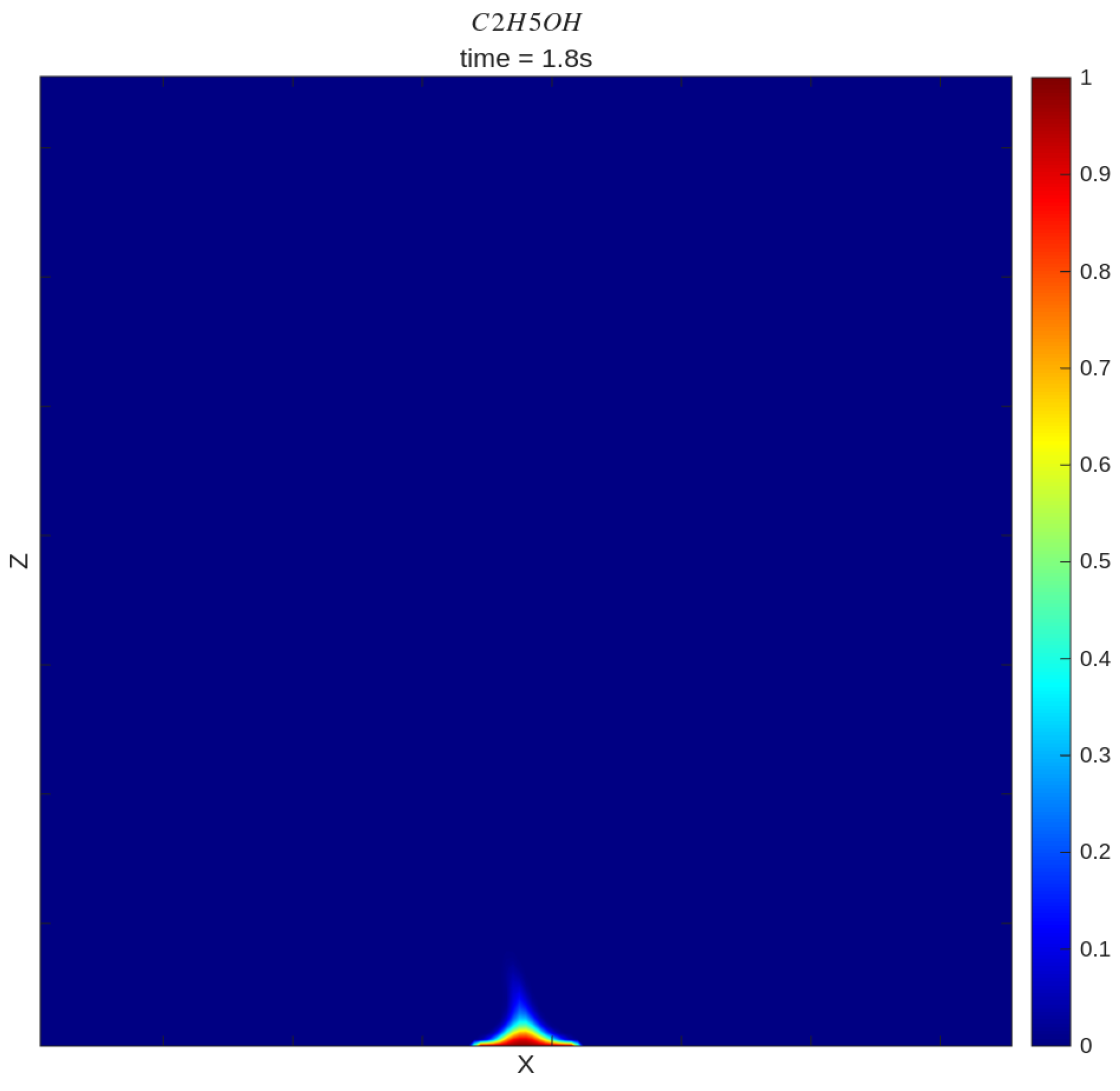
Figure 2.
Carbon monoxide contour directly from openFOAM for time = 1.8s.
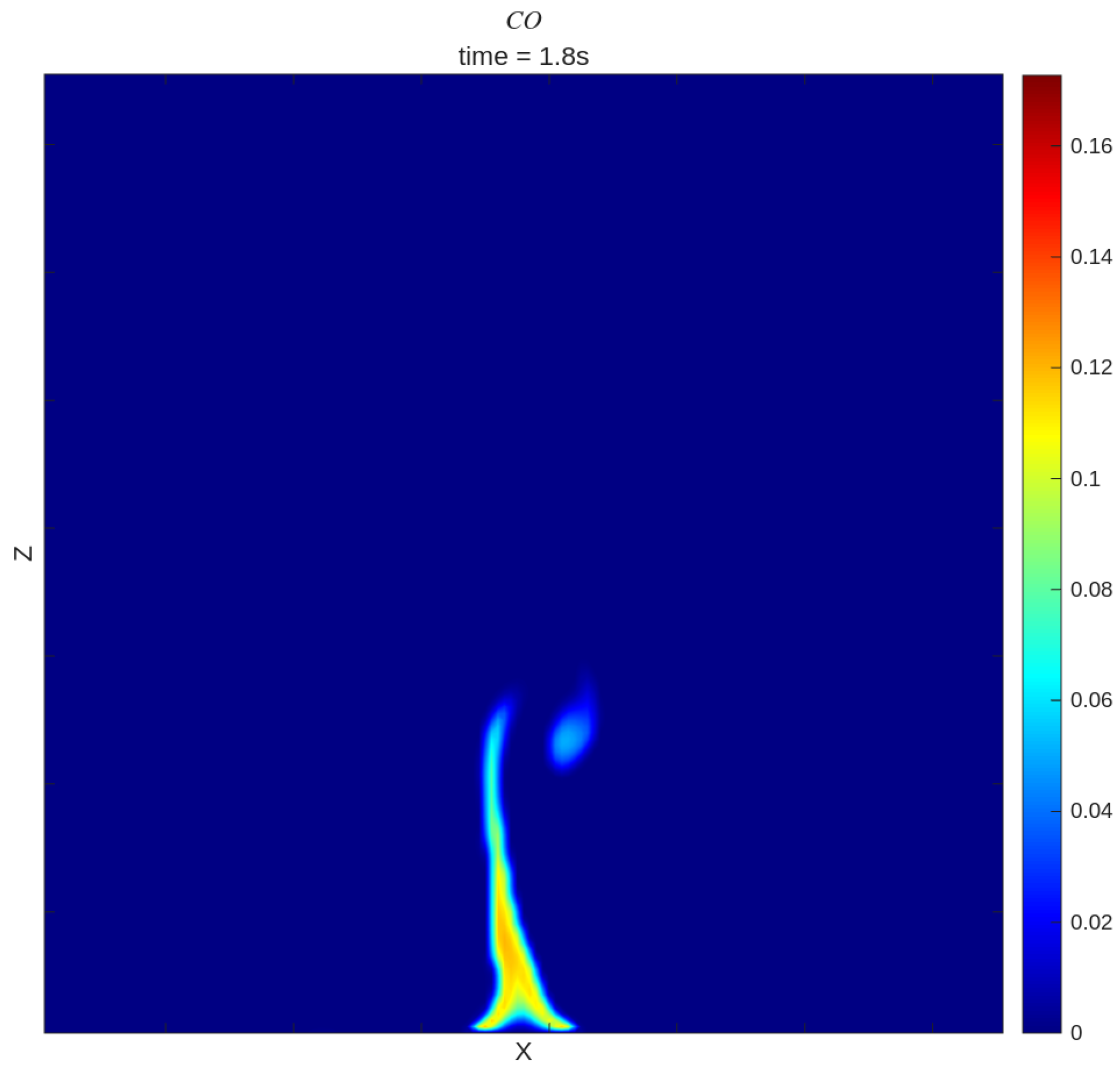
Figure 3.
Carbon dioxide contour directly from openFOAM for time = 1.8s.
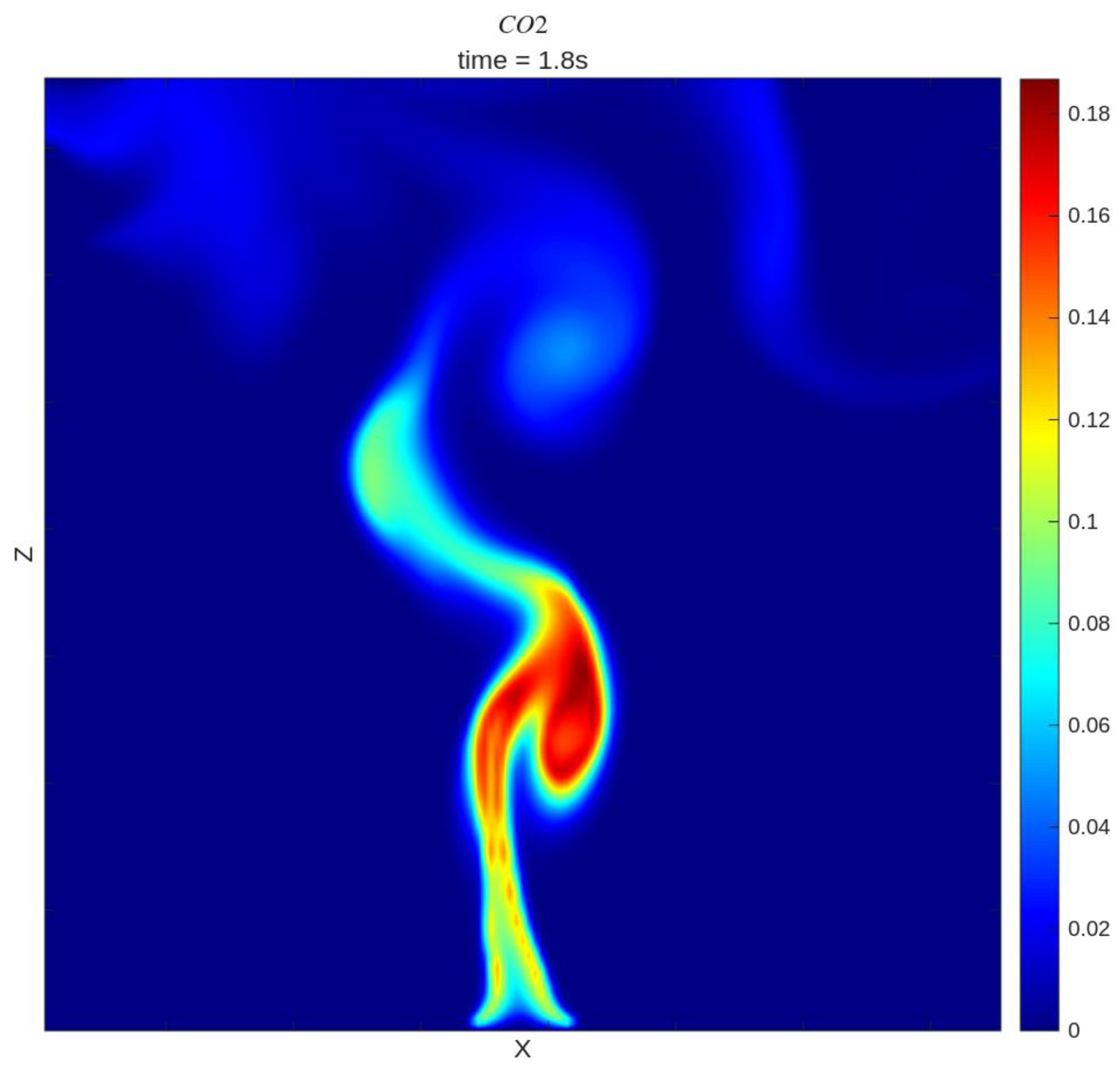
Figure 4.
Oxygen contour directly from openFOAM for time = 1.8s.
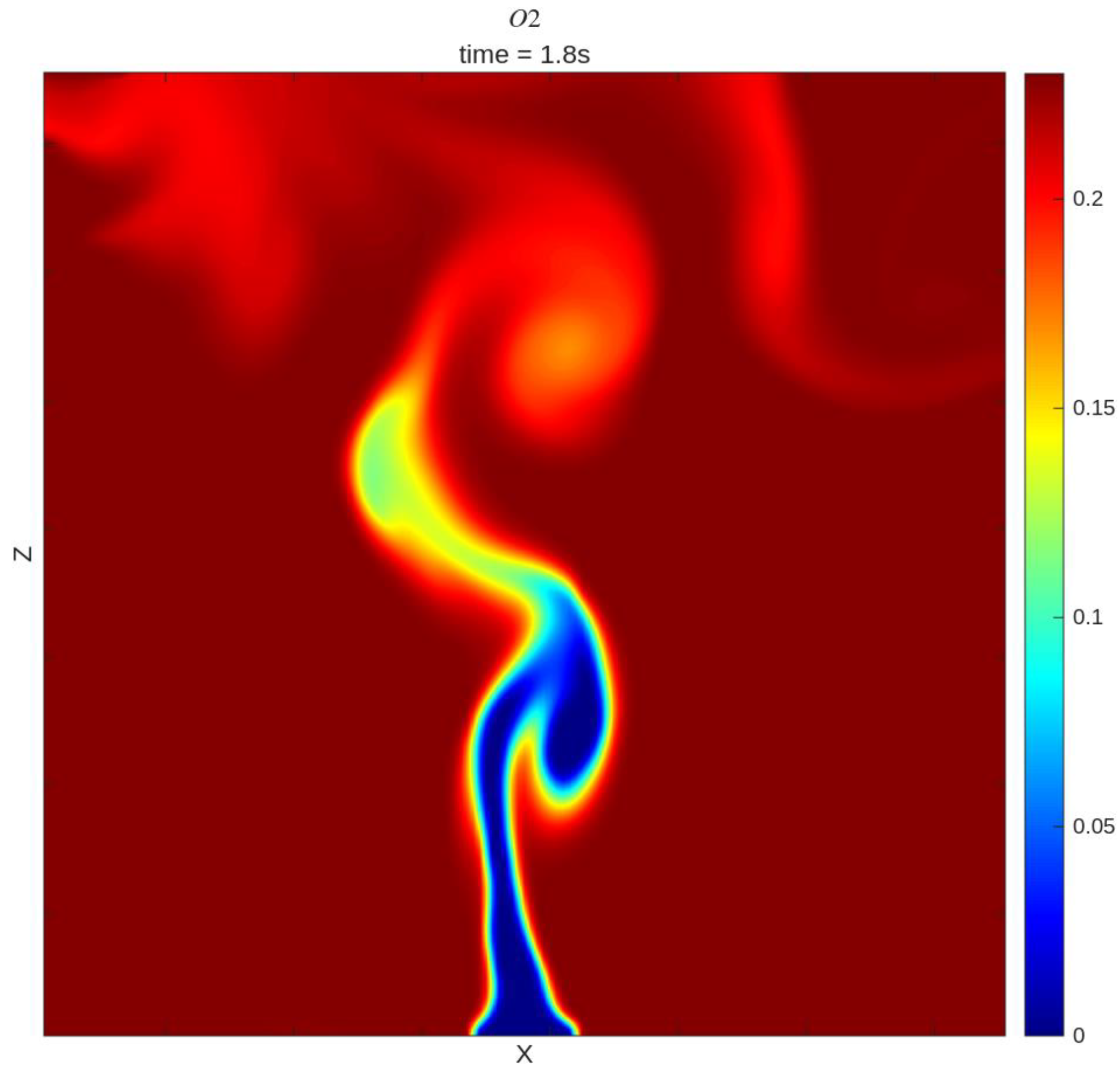
Figure 5.
Temperature contour directly from openFOAM for time = 1.8s.
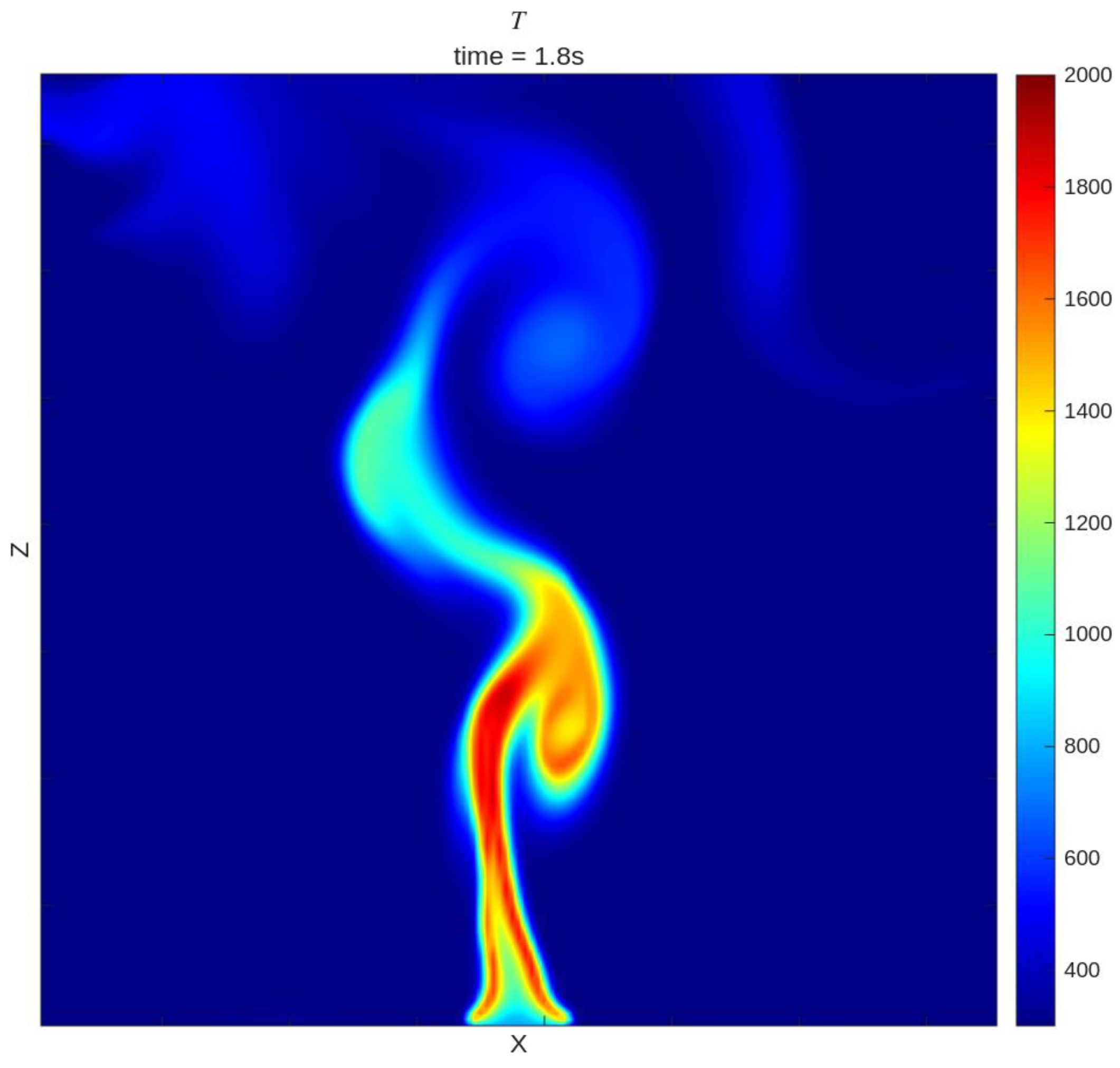
Figure 6.
C2H2 reconstruction vs C2H2 parity plot.
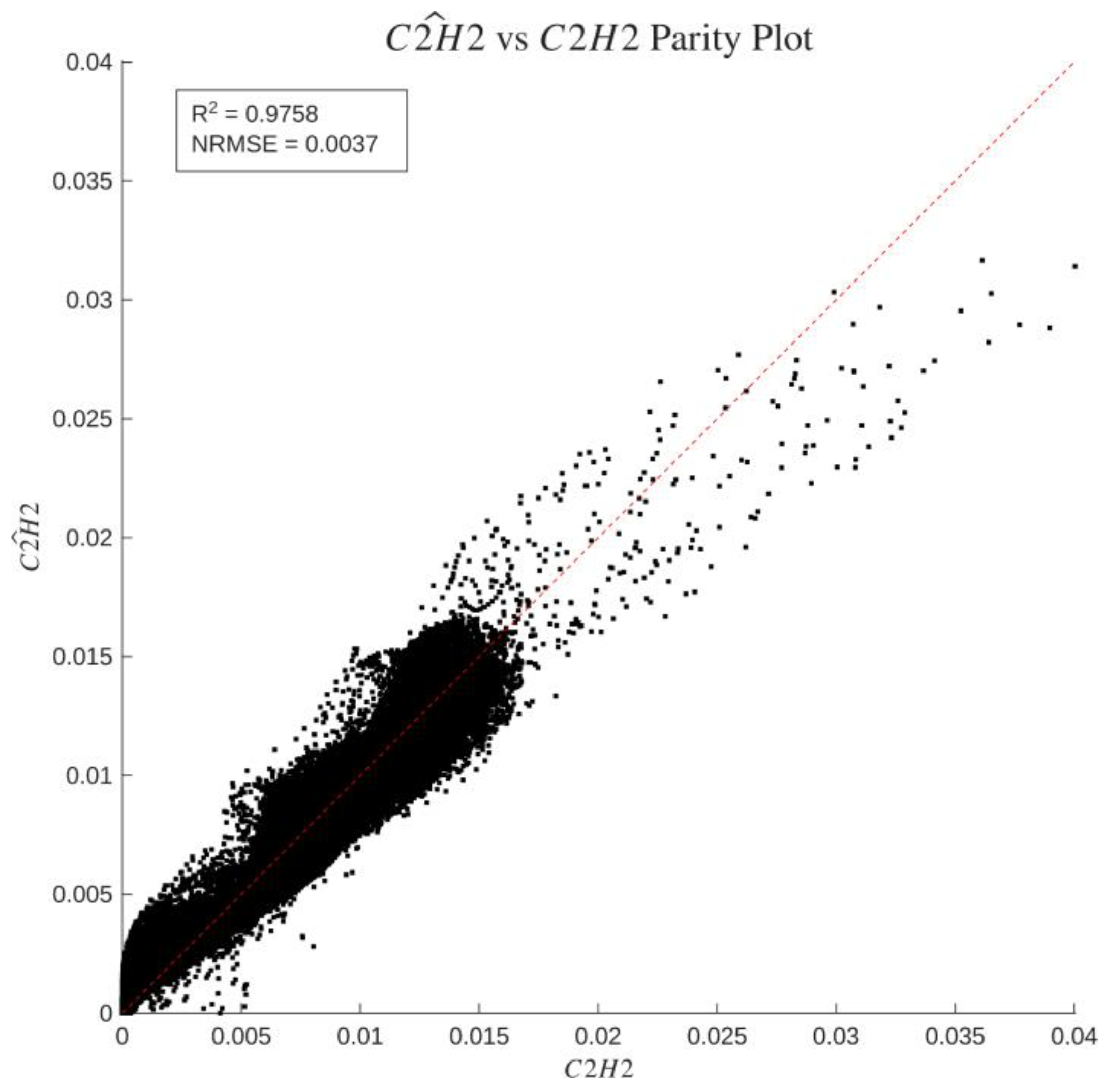
Figure 7.
C2H4 reconstruction vs C2H4 parity plot.
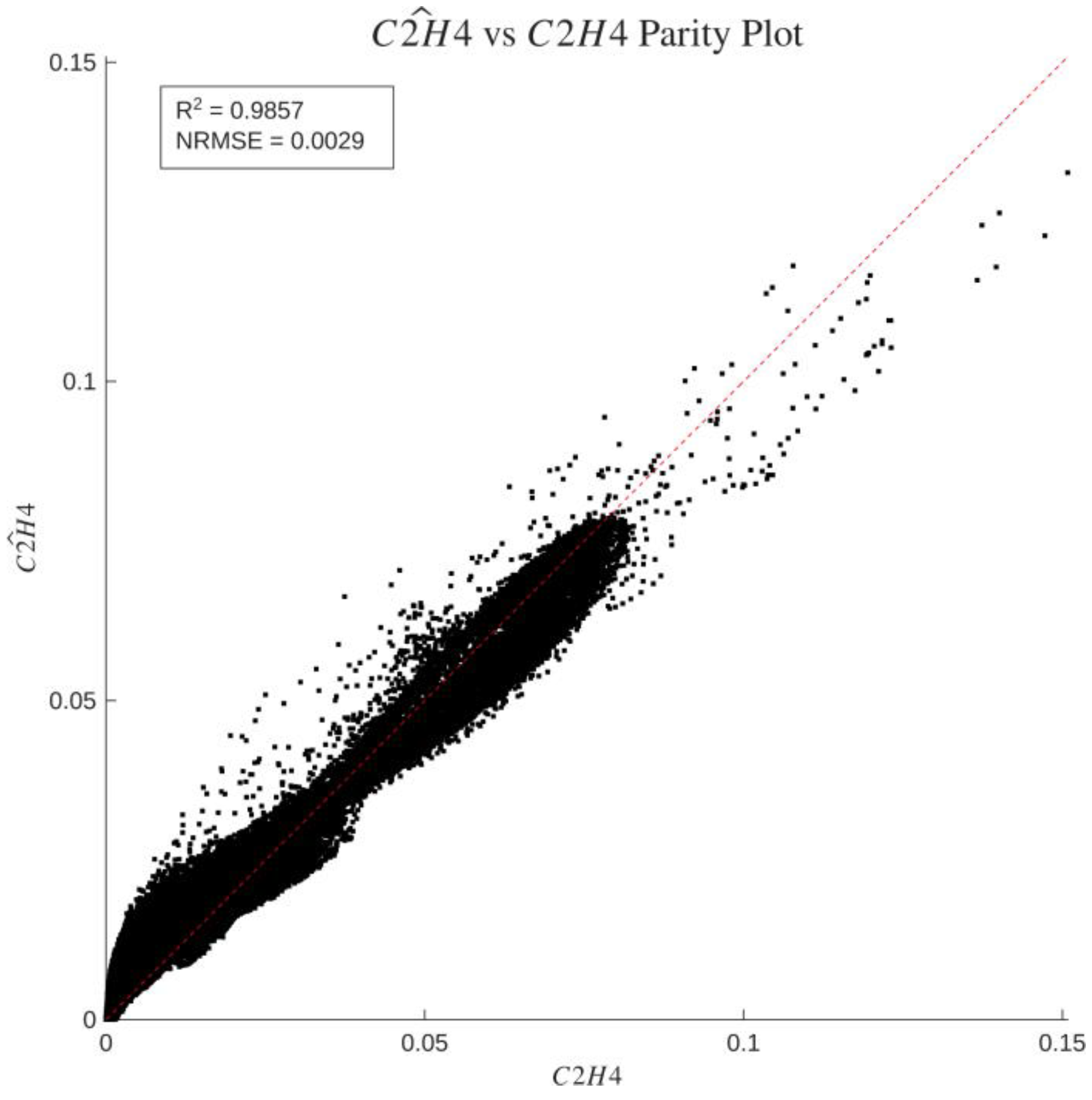
Figure 8.
C2H5OH reconstruction vs C2H5OH parity plot.
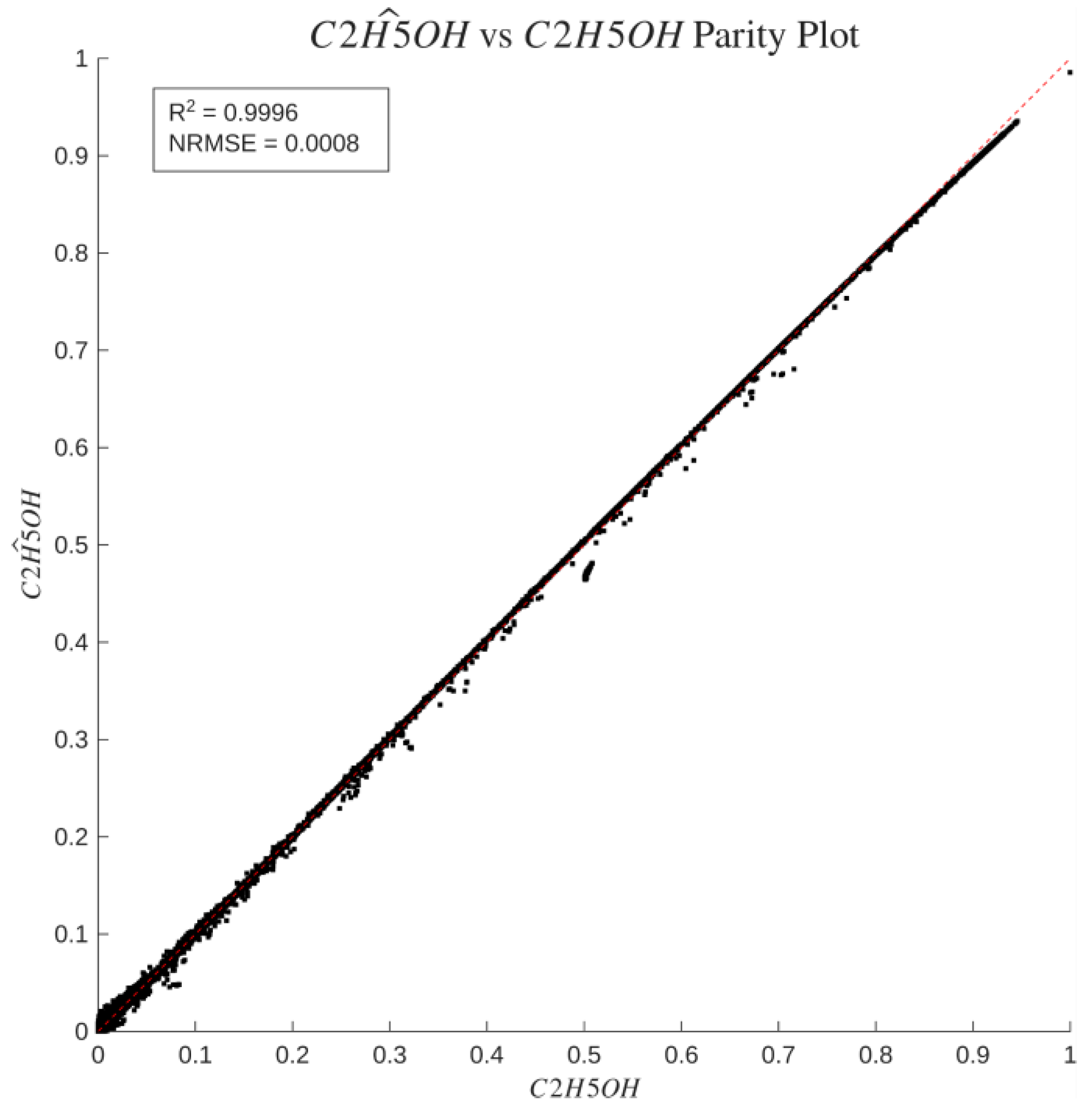
Figure 9.
CH2O reconstruction vs CH2O parity plot.
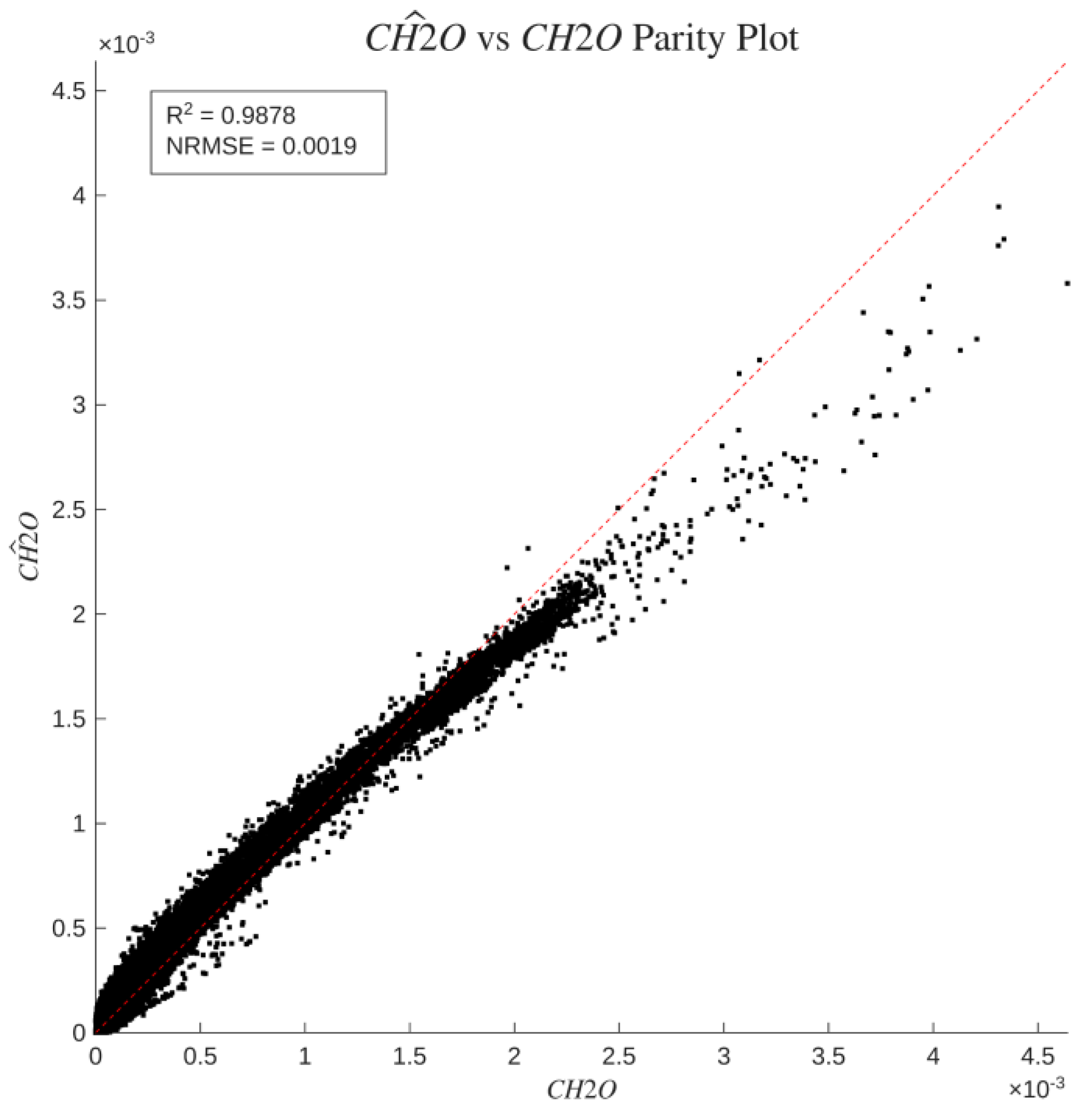
Figure 10.
CH3 reconstruction vs CH3 parity plot.
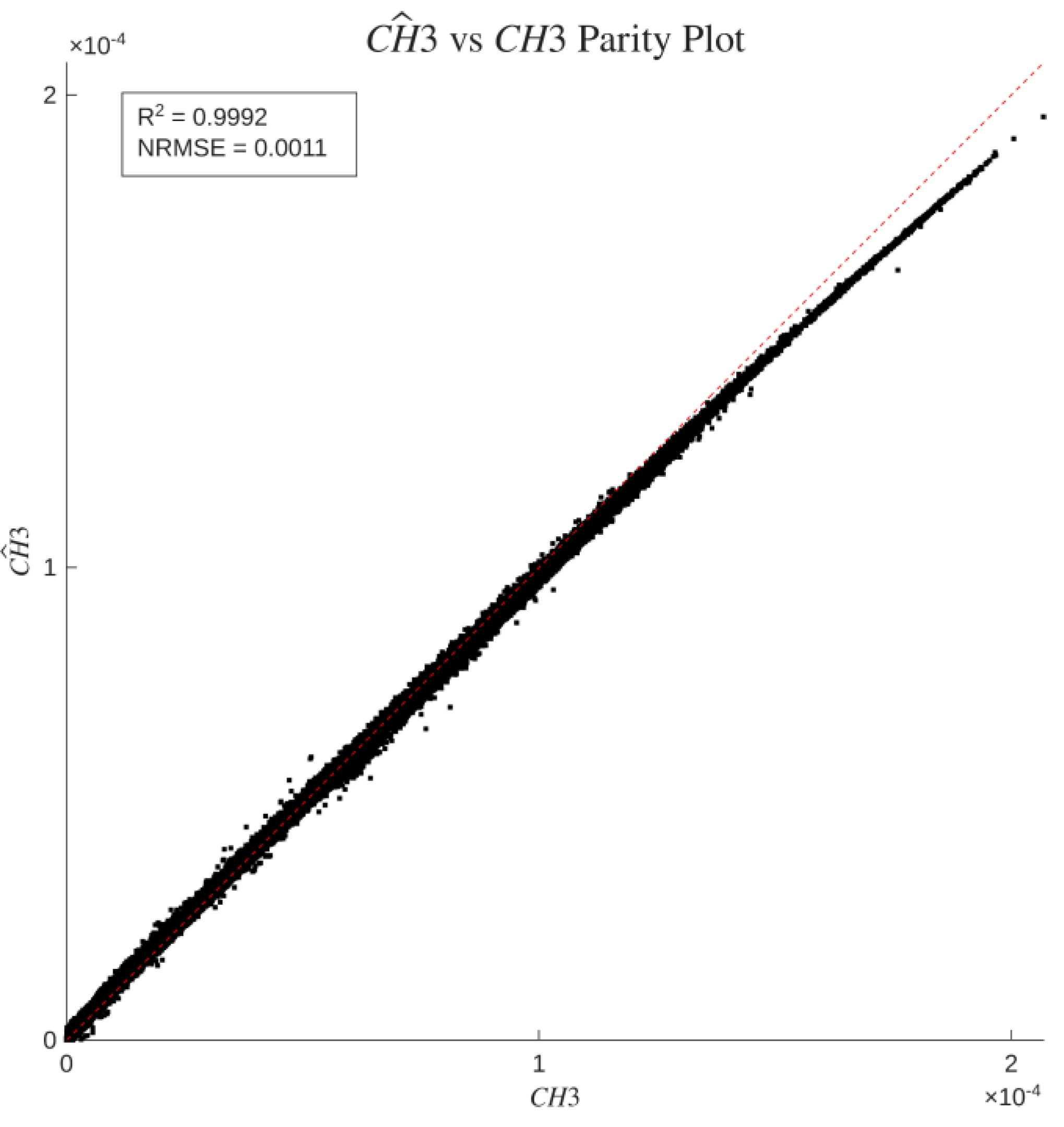
Figure 11.
CH3CH2O reconstruction vs CH3CH2O parity plot.
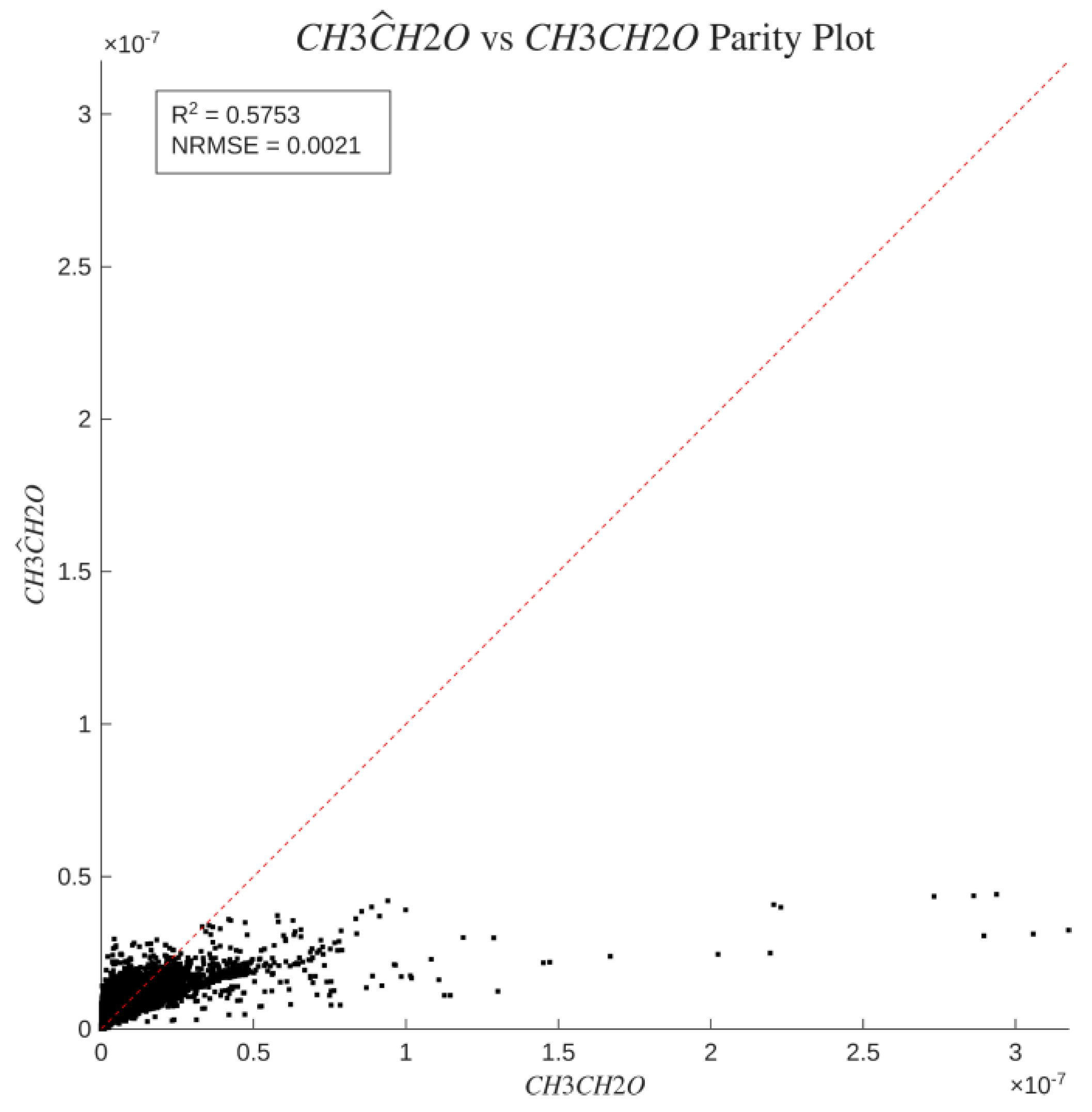
Figure 12.
CH3CHO reconstruction vs CH3CHO parity plot.
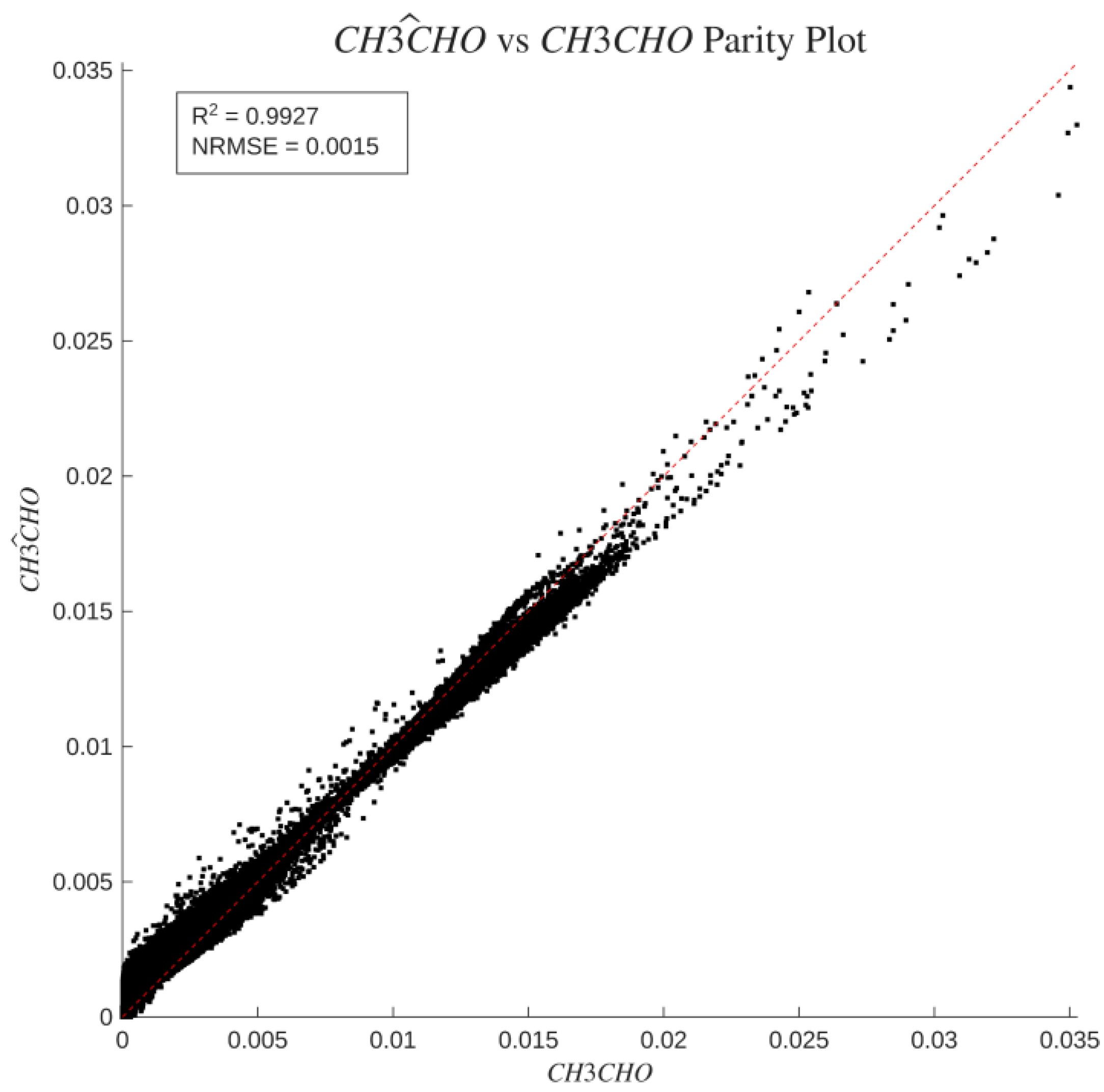
Figure 13.
CH3CHOH reconstruction vs CH3CHOH parity plot.
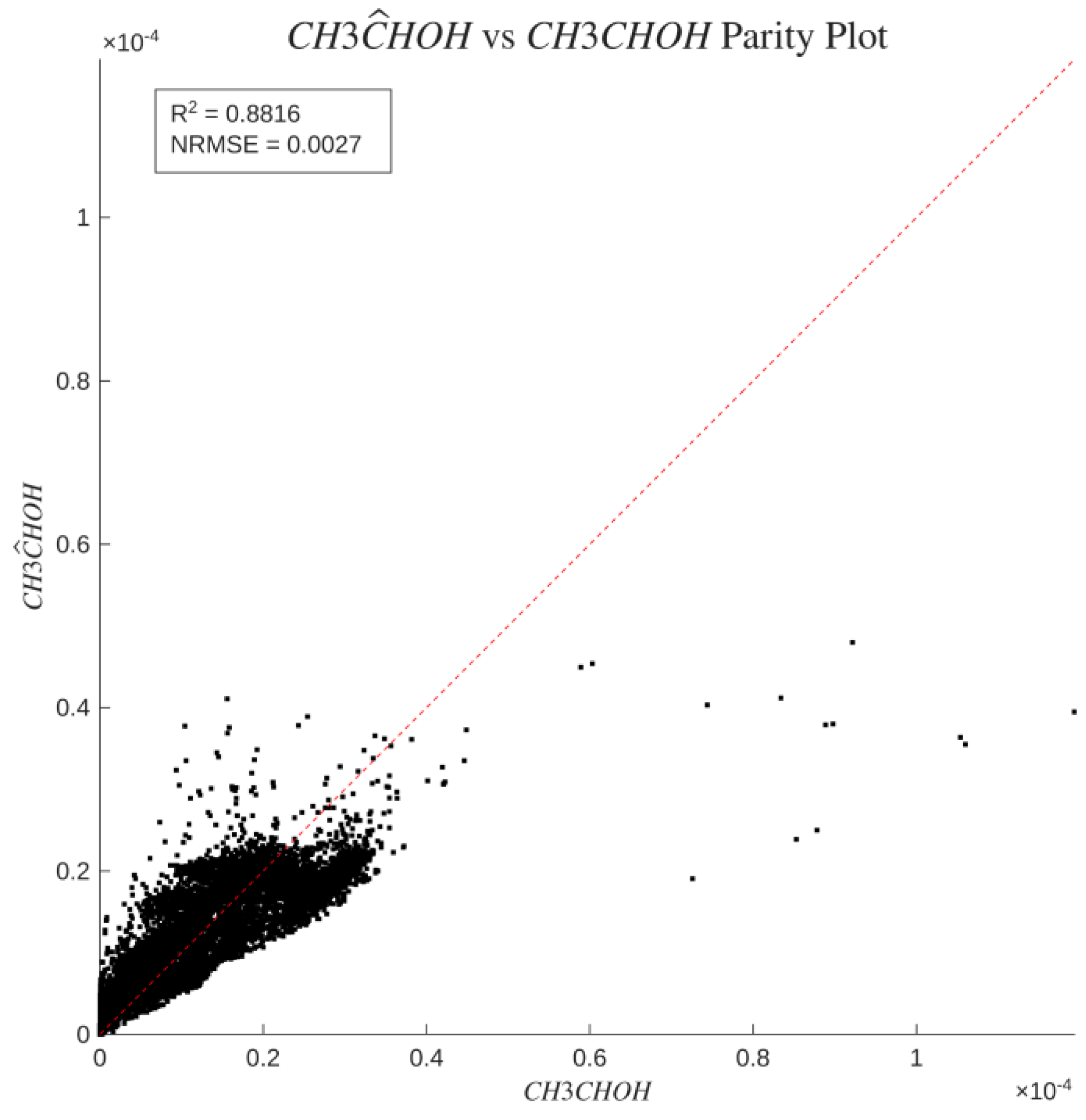
Figure 14.
CO reconstruction vs CO parity plot.
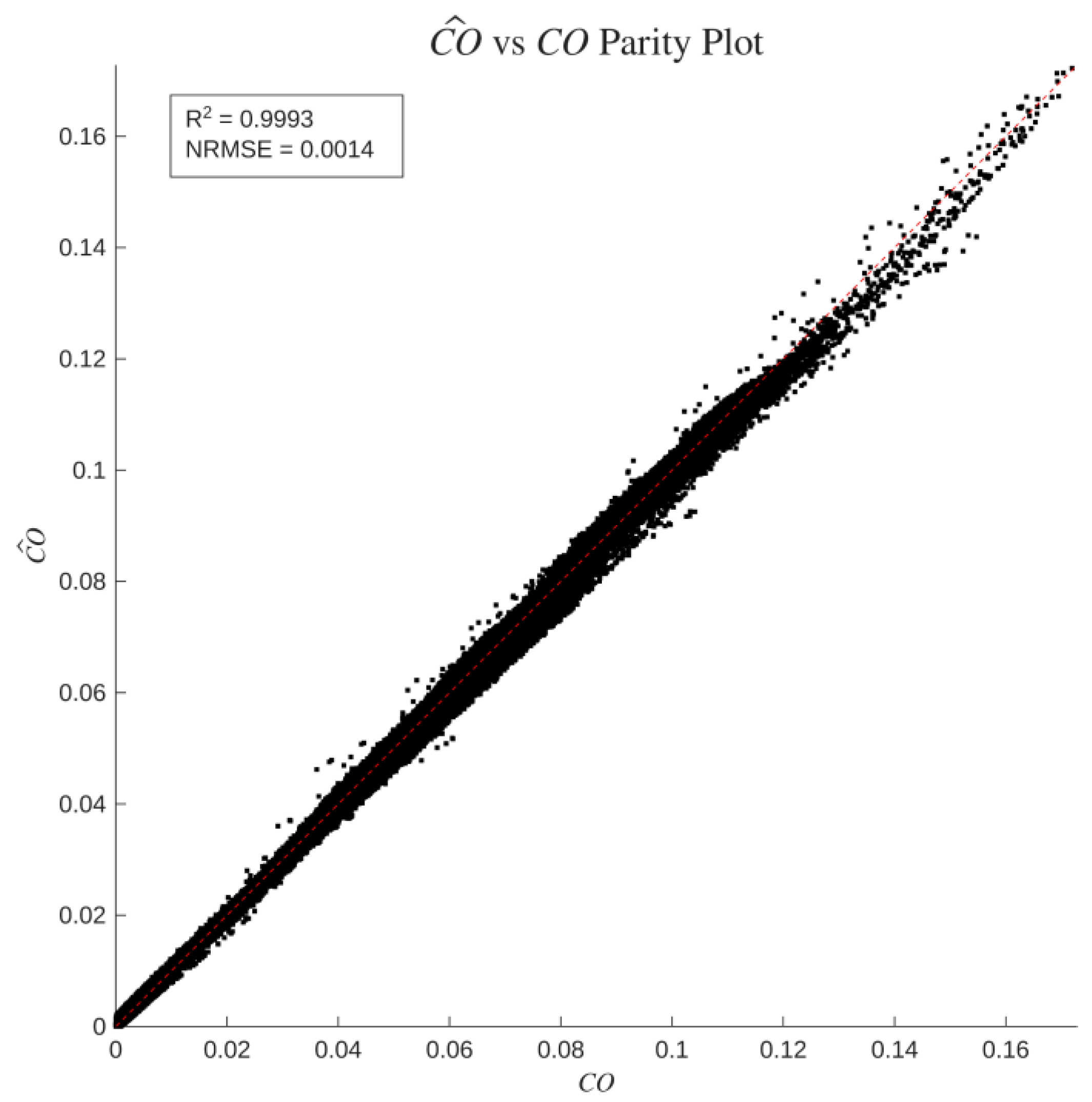
Figure 15.
CO2 reconstruction vs CO2 parity plot.
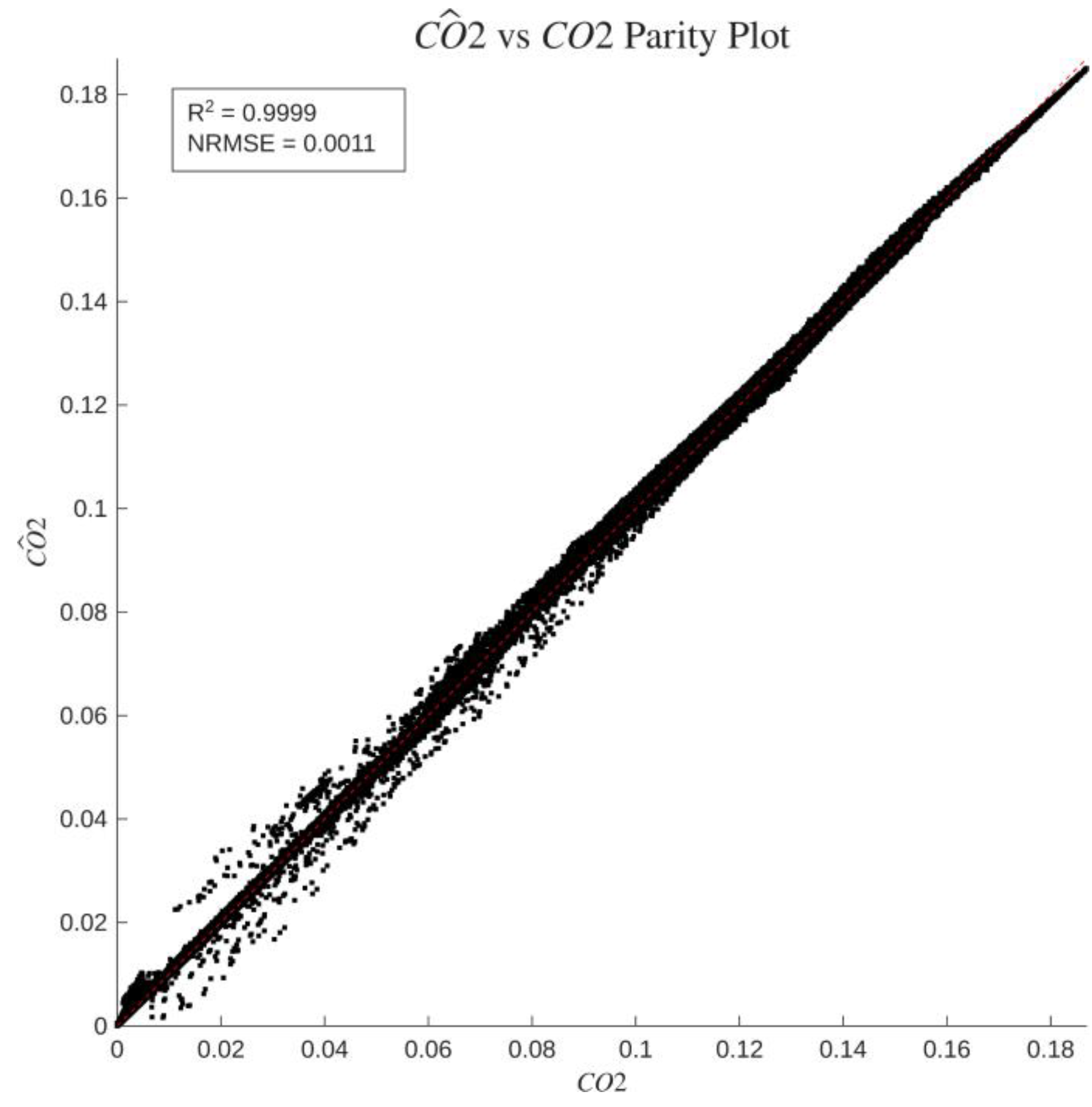
Figure 16.
H reconstruction vs H parity plot.
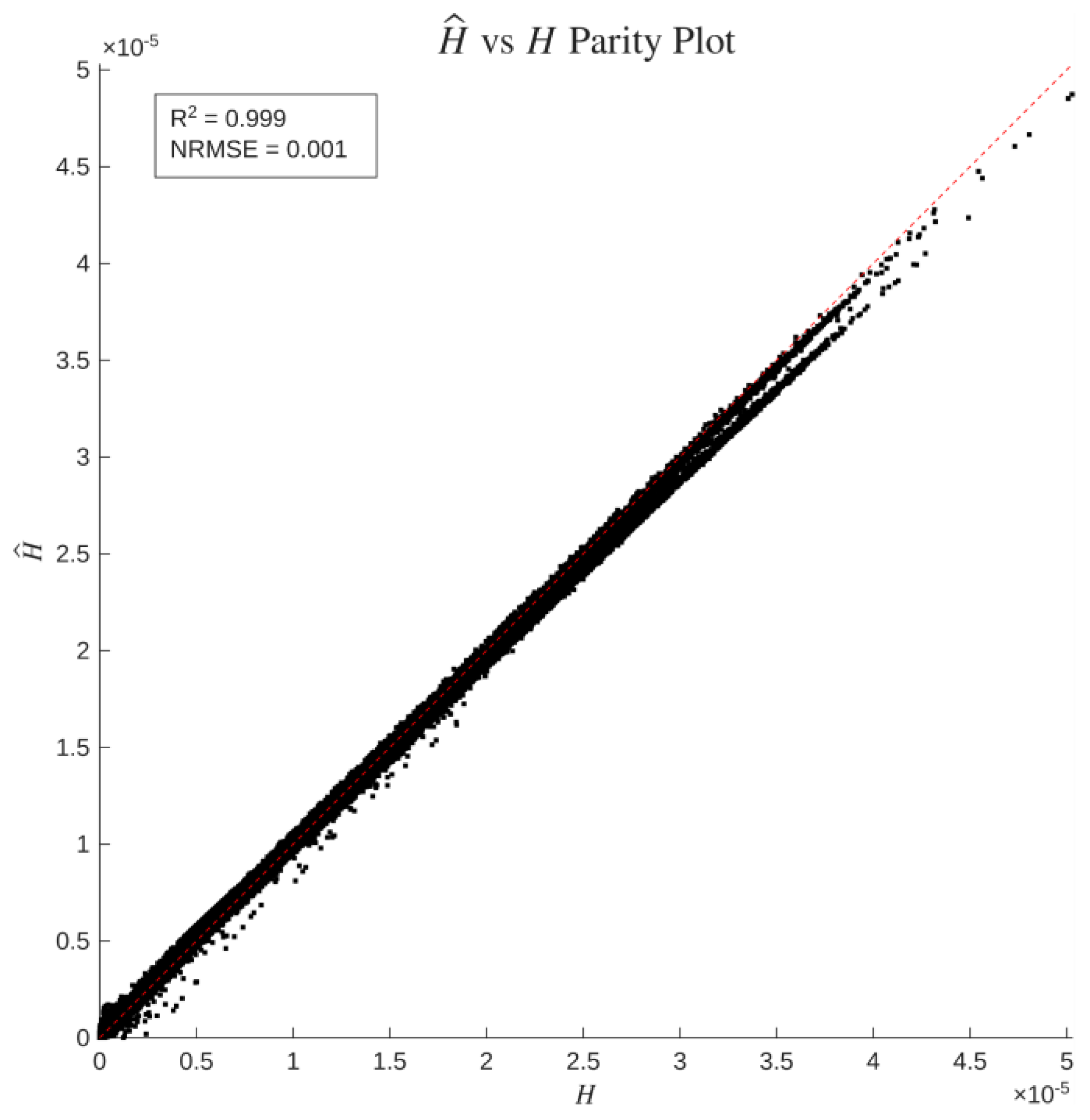
Figure 17.
H2 reconstruction vs H2 parity plot.
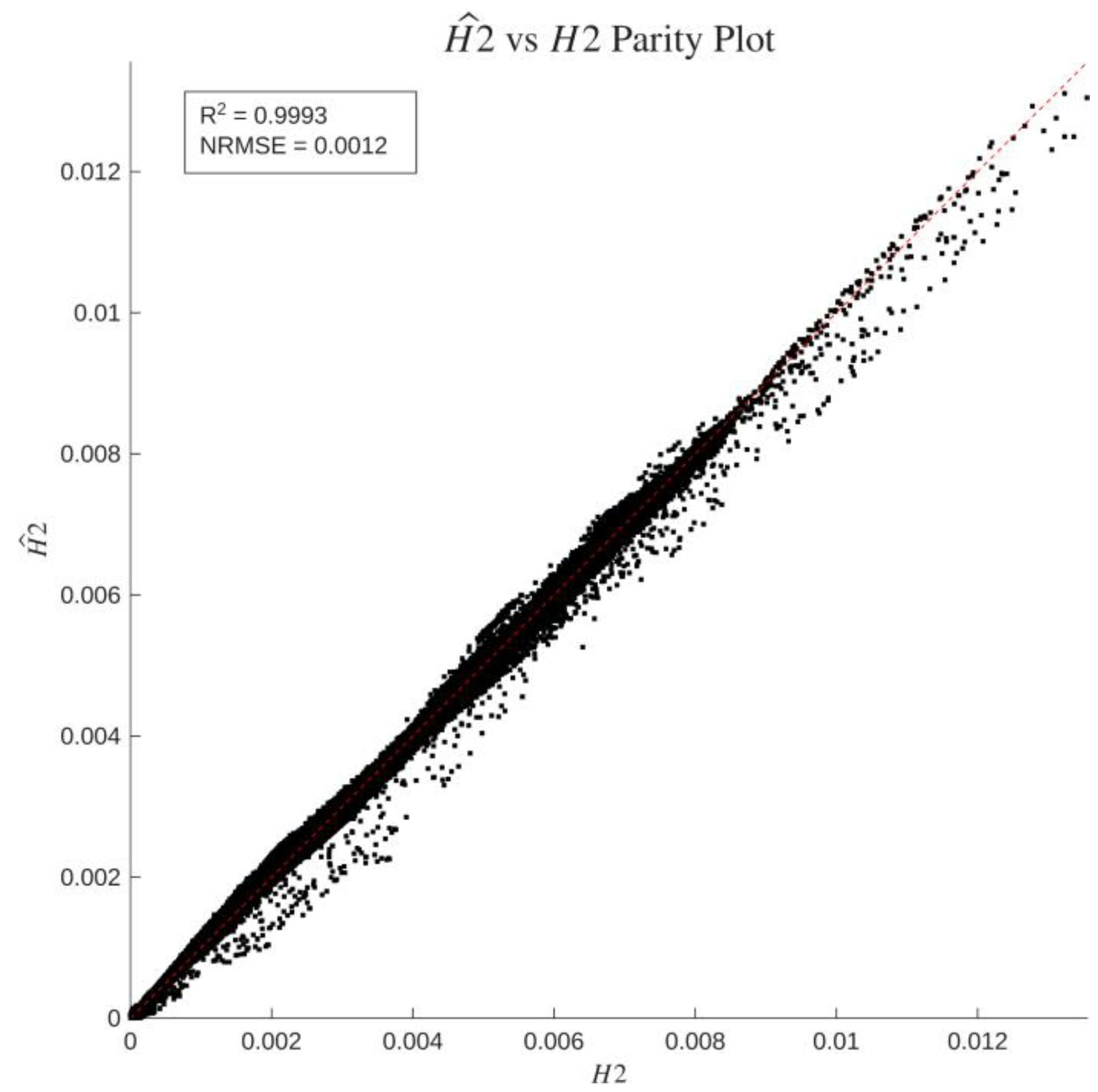
Figure 18.
H2O reconstruction vs H2O parity plot.
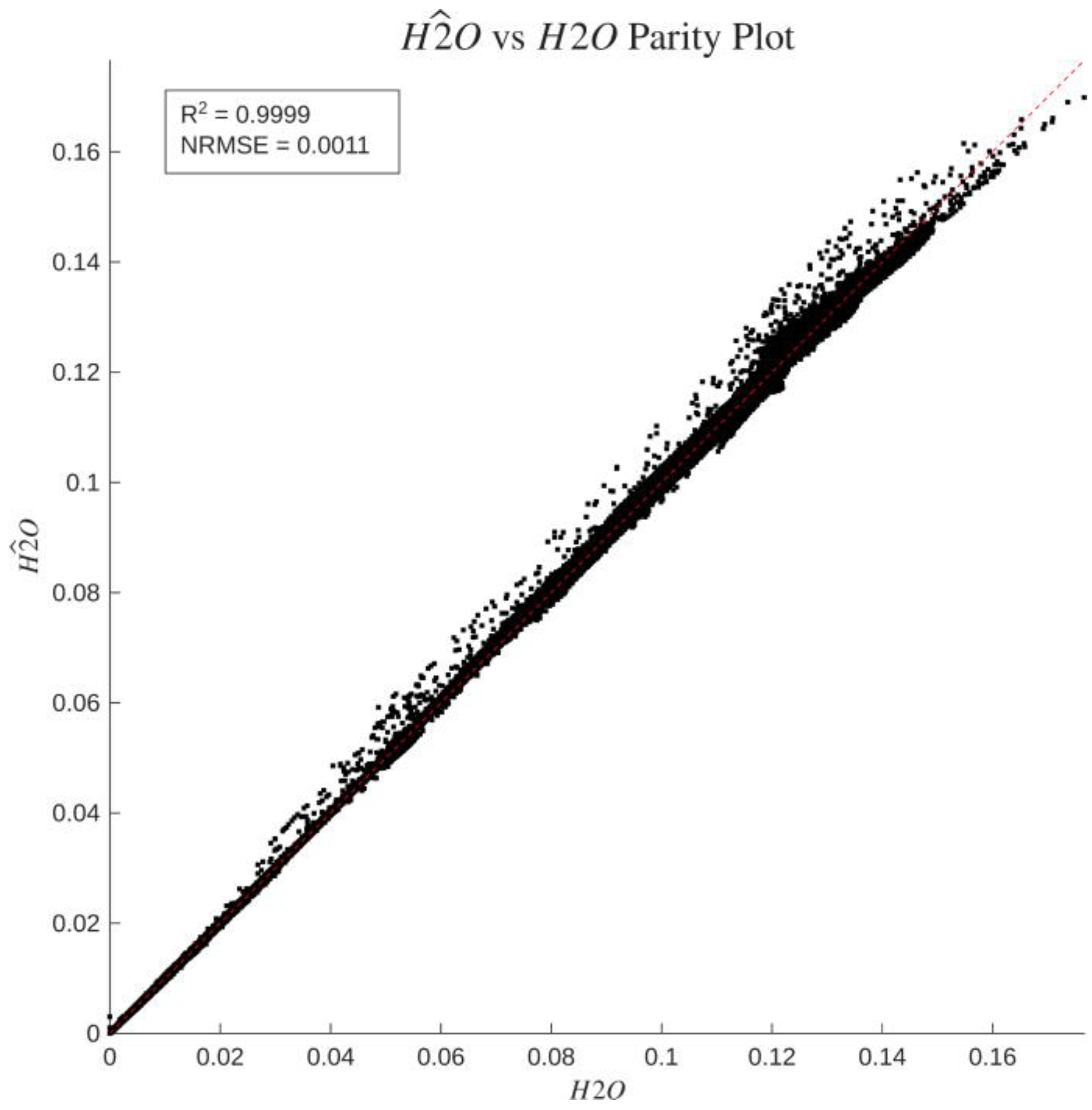
Figure 19.
H2O2 reconstruction vs H2O2 parity plot.
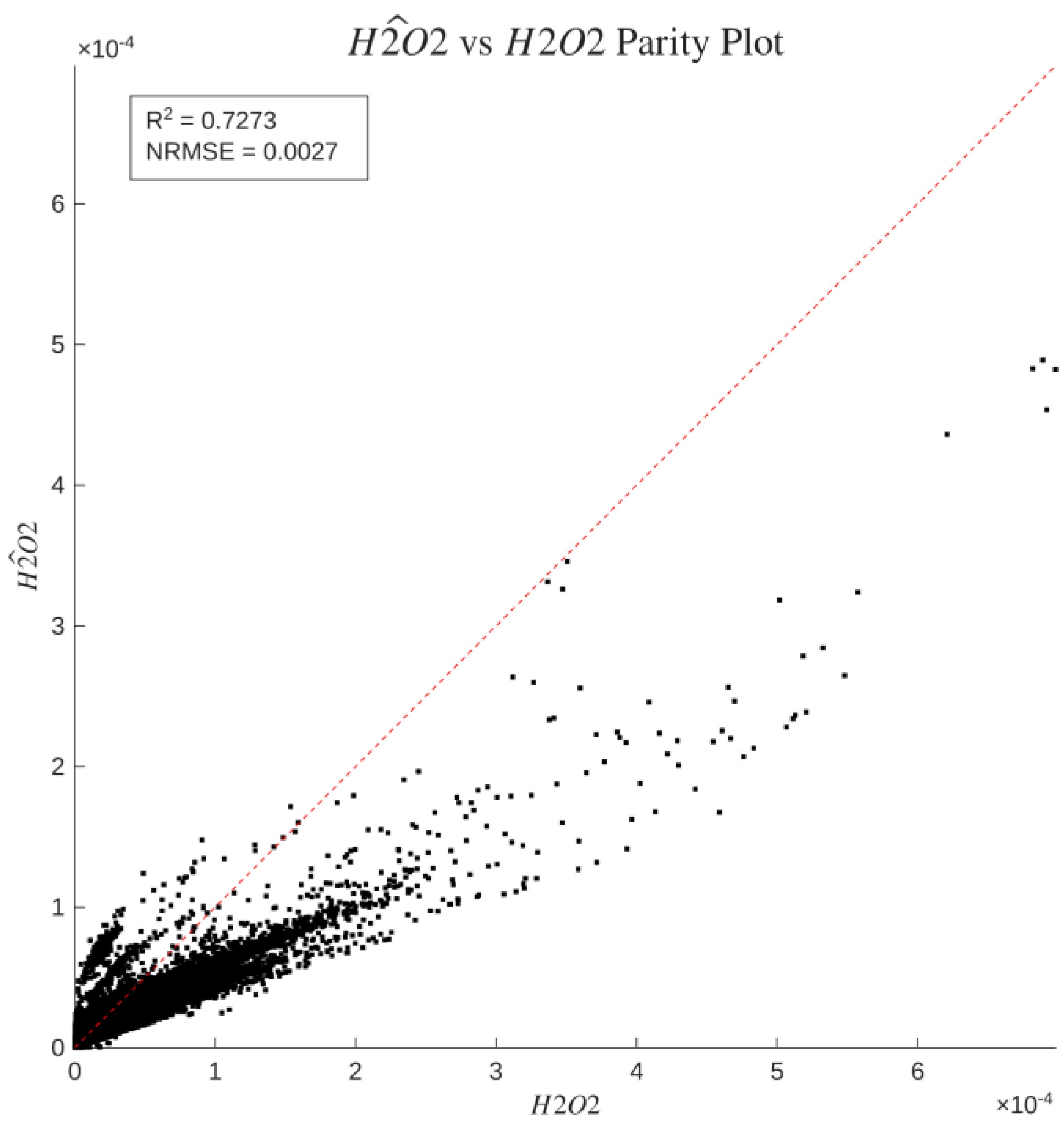
Figure 20.
HO2 reconstruction vs HO2 parity plot.
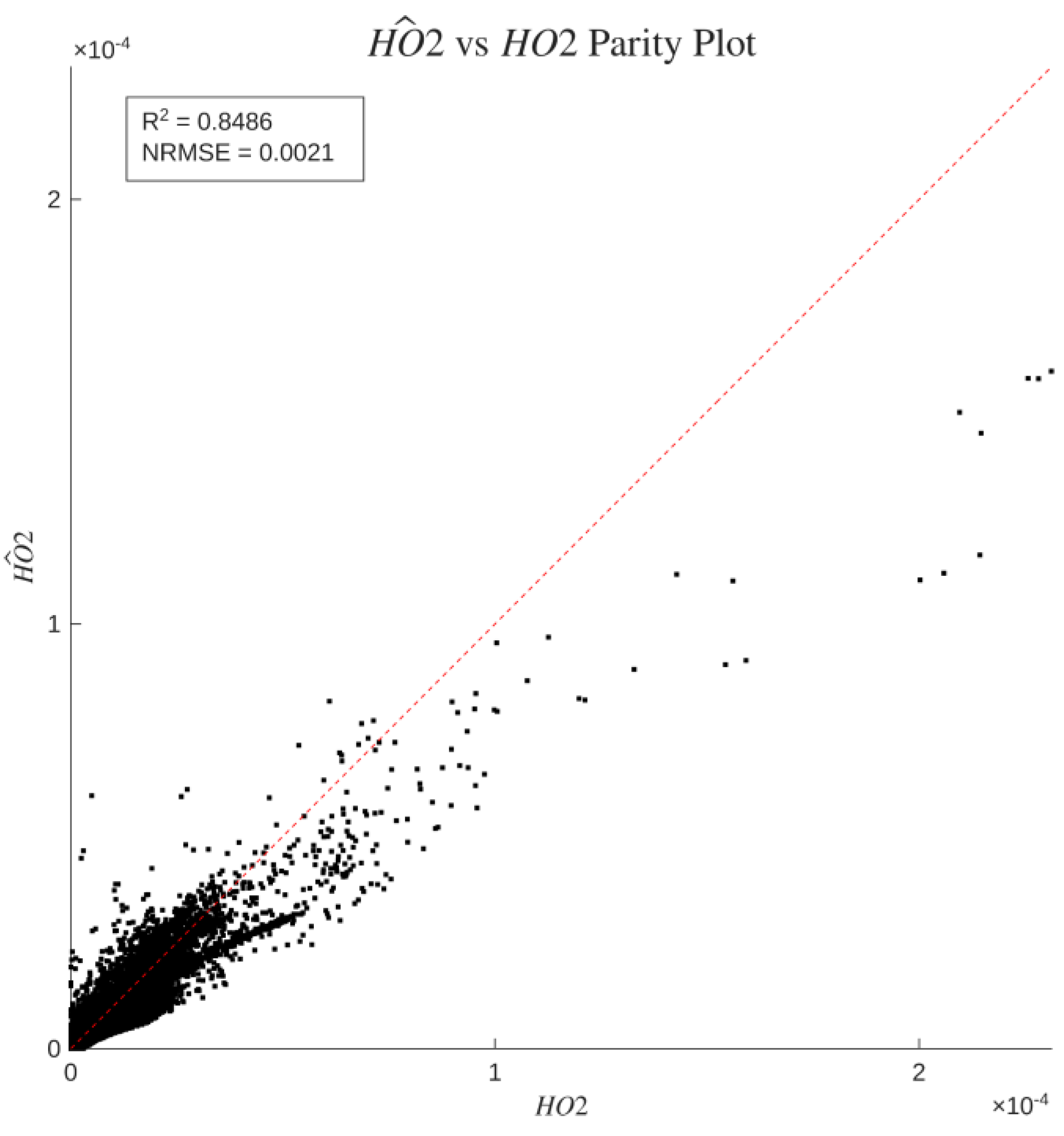
Figure 21.
O2 reconstruction vs O2 parity plot.
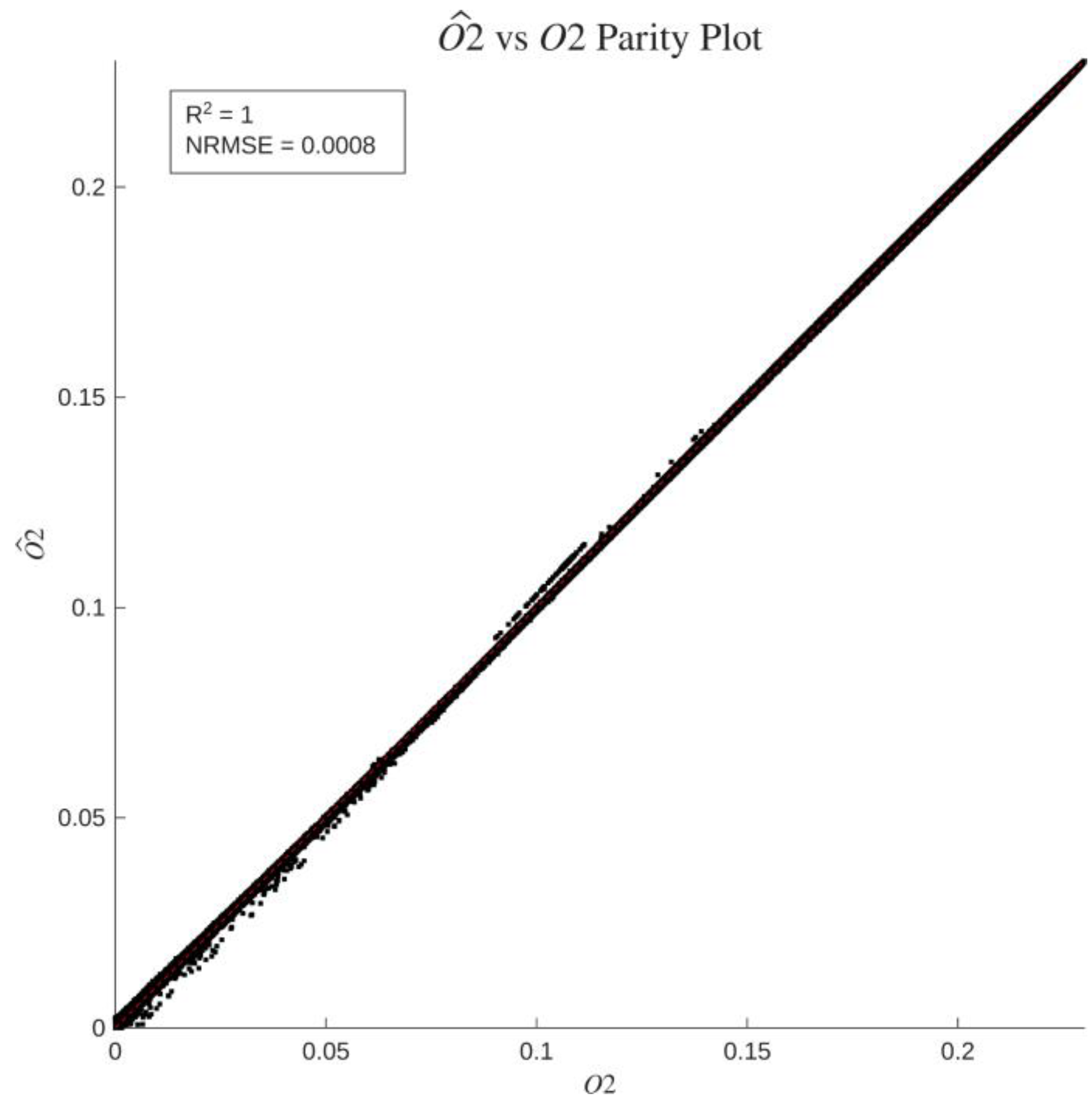
Figure 22.
OH reconstruction vs OH parity plot.
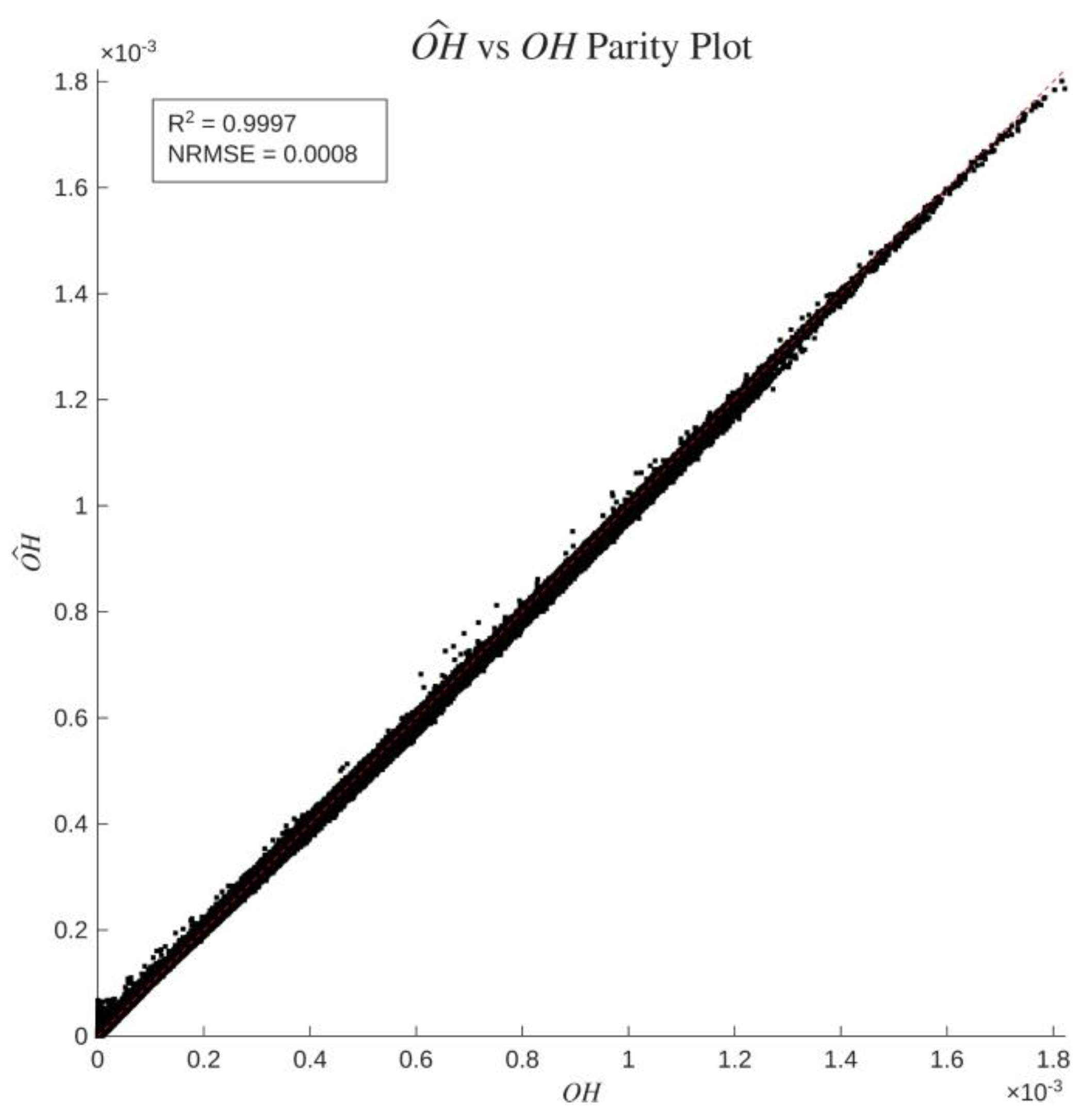
Figure 23.
Temperature reconstruction vs Temperature parity plot.
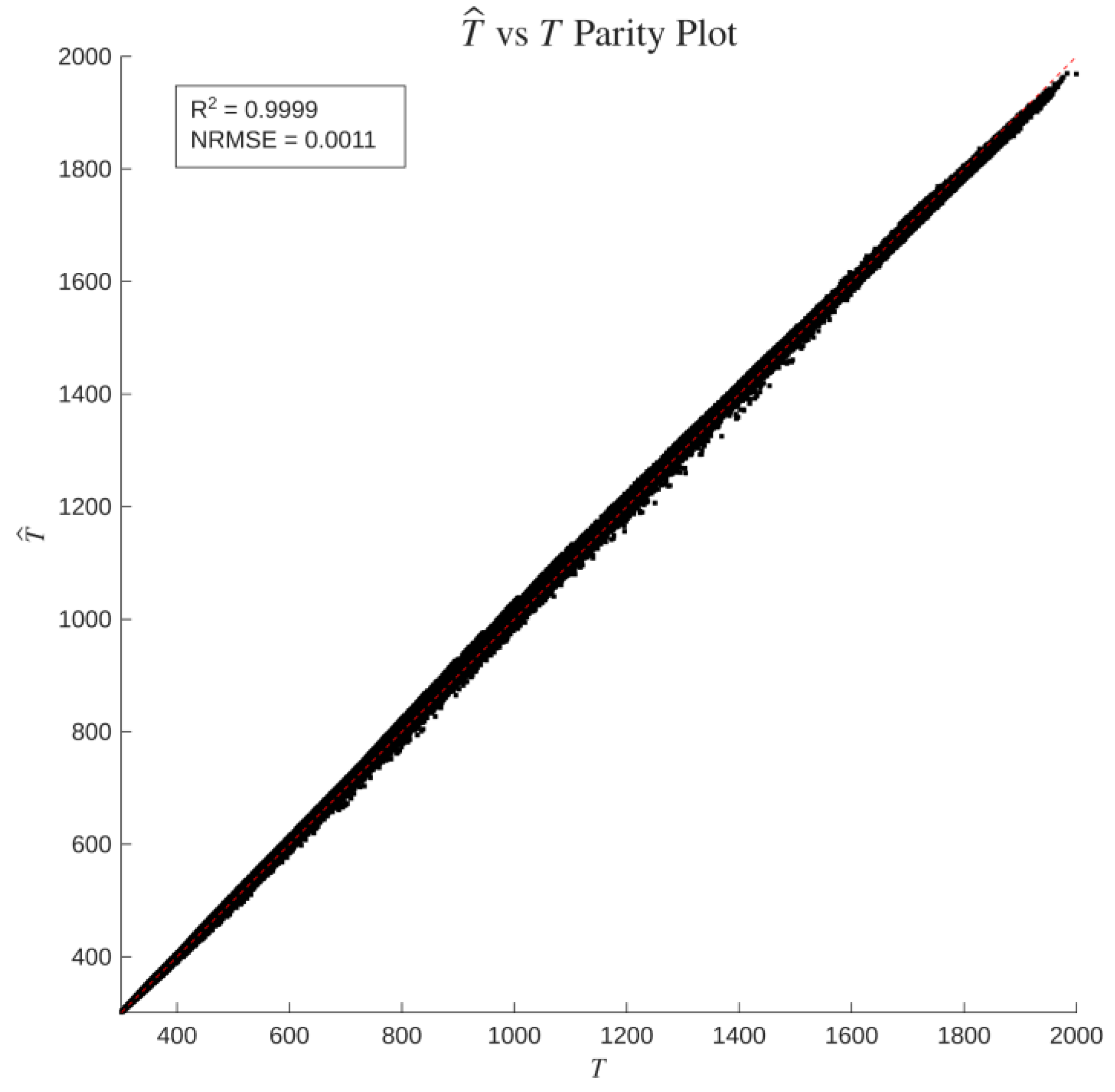
Figure 24.
Ethanol contour directly from openFOAM compared to the PCA-ANN reconstruction and absolute error for time = 0.7s.
Figure 24.
Ethanol contour directly from openFOAM compared to the PCA-ANN reconstruction and absolute error for time = 0.7s.
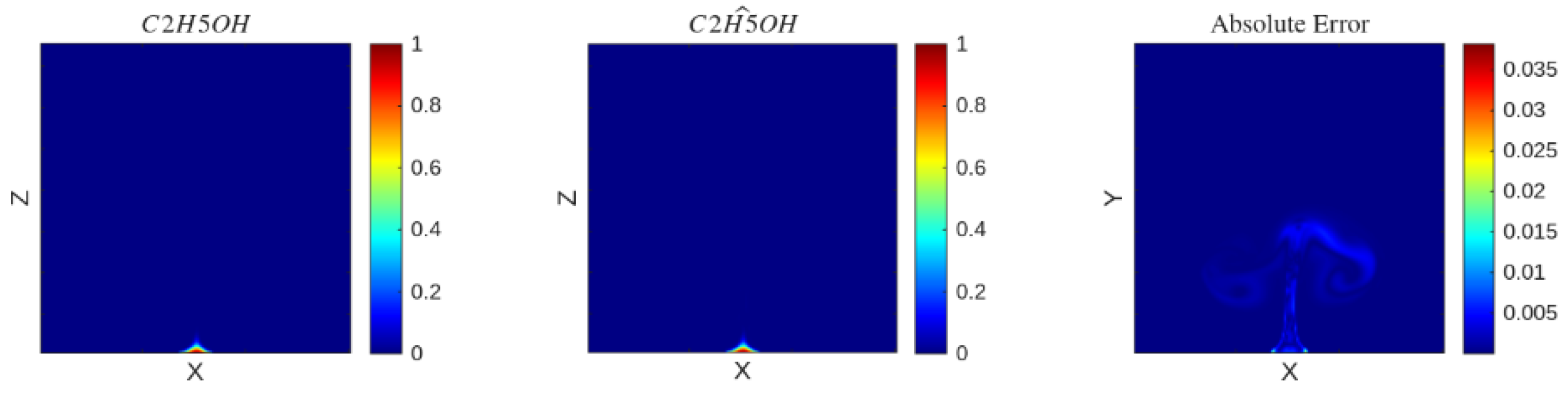
Figure 25.
CH3CHOH contour directly from openFOAM compared to the PCA-ANN reconstruction and absolute error for time = 0.7s.
Figure 25.
CH3CHOH contour directly from openFOAM compared to the PCA-ANN reconstruction and absolute error for time = 0.7s.
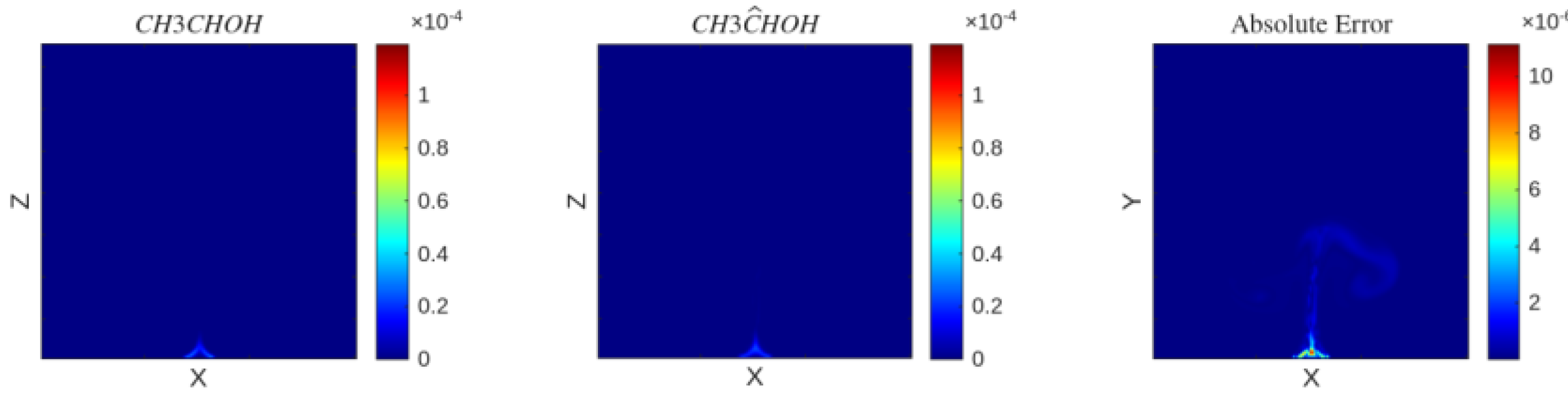
Figure 26.
Carbon dioxide contour directly from openFOAM compared to the PCA-ANN reconstruction and absolute error for time = 0.7s.
Figure 26.
Carbon dioxide contour directly from openFOAM compared to the PCA-ANN reconstruction and absolute error for time = 0.7s.
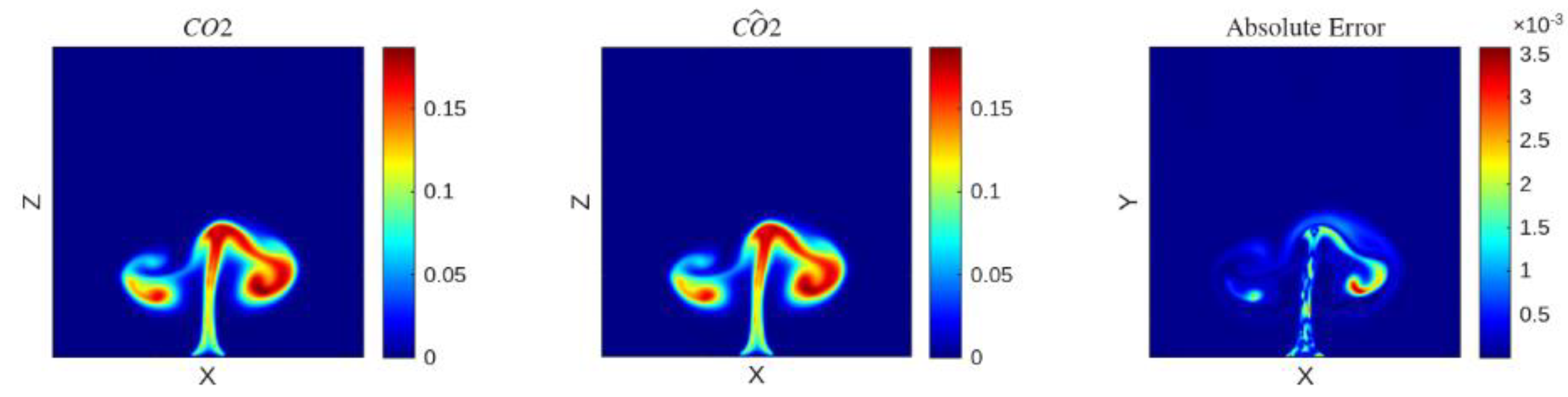
Figure 27.
Carbon monoxide contour directly from openFOAM compared to the PCA-ANN reconstruction and absolute error for time = 0.7s.
Figure 27.
Carbon monoxide contour directly from openFOAM compared to the PCA-ANN reconstruction and absolute error for time = 0.7s.
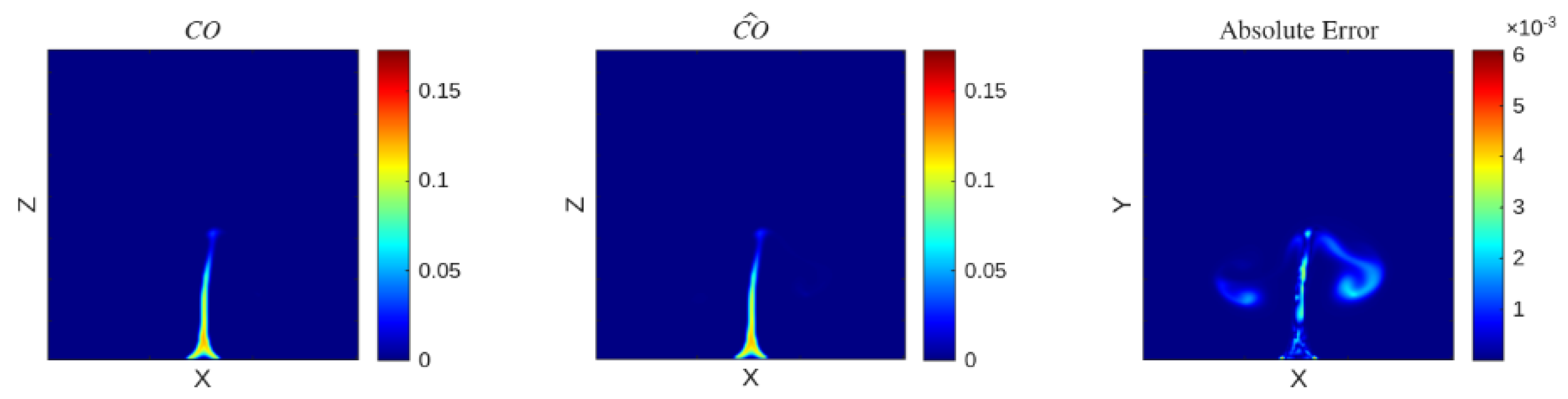
Figure 28.
Oxygen contour directly from openFOAM compared to the PCA-ANN reconstruction and absolute error for time = 0.7s.
Figure 28.
Oxygen contour directly from openFOAM compared to the PCA-ANN reconstruction and absolute error for time = 0.7s.
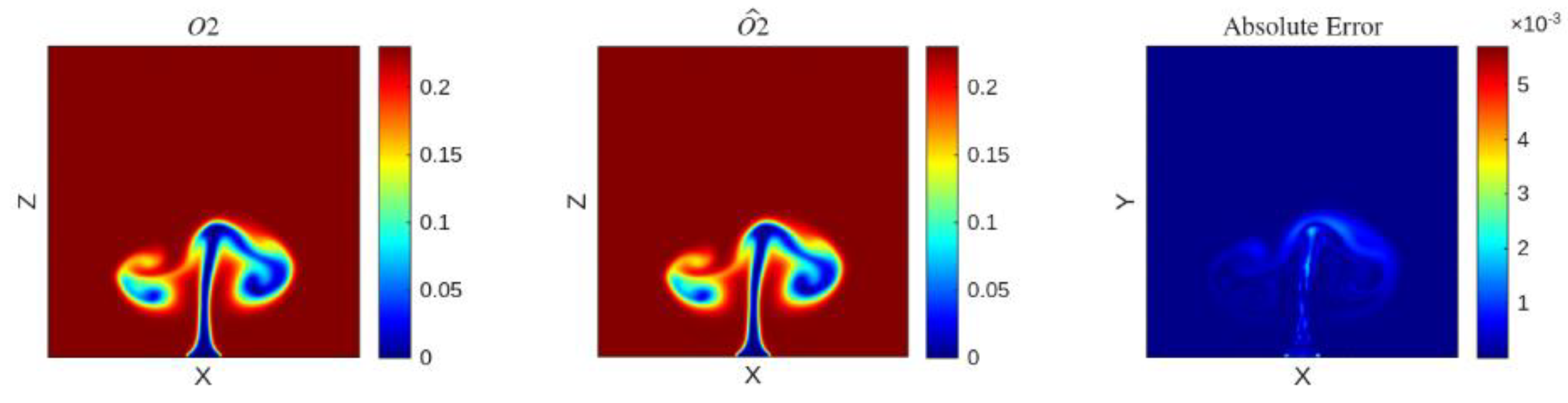
Figure 29.
Temperature contour directly from openFOAM compared to the PCA-ANN reconstruction and absolute error for time = 0.7s.
Figure 29.
Temperature contour directly from openFOAM compared to the PCA-ANN reconstruction and absolute error for time = 0.7s.
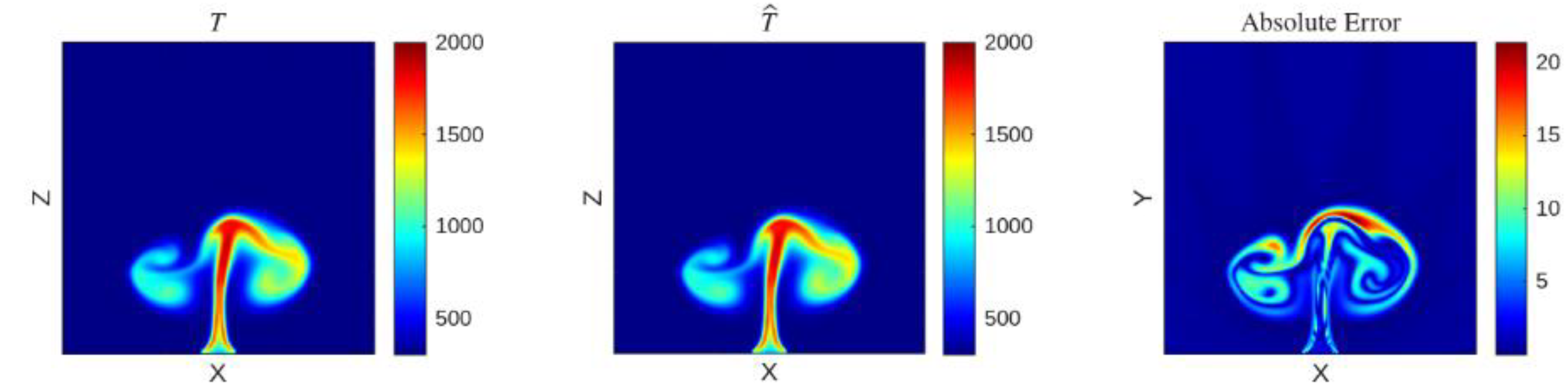
Table 2.
The sensitivity matrix Sji for the selected thermochemical state and PC source and diffusion terms.
Table 2.
The sensitivity matrix Sji for the selected thermochemical state and PC source and diffusion terms.
| Original thermochemical scalar | |||||||||||||||||||
| C2H2' | C2H4' | C2H5OH' | CH2O' | CH3' | CH3CH2O' | CH3CHO' | CH3CHOH' | CO' | CO2' | H' | H2' | H2O' | H2O2' | HO2' | O2' | OH' | T' | ||
| The quantities of interest | 'C2H2' | 0.1522 | 0.0843 | 0.0000 | 0.0358 | 0.0009 | 0.0006 | 0.0311 | 0.0100 | 0.0201 | 0.0041 | 0.0060 | 0.0741 | 0.0189 | 0.0000 | 0.0004 | 0.0012 | 0.0069 | 0.0012 |
| 'C2H4' | 0.1106 | 0.2895 | 0.0027 | 0.0459 | 0.0021 | 0.0001 | 0.0673 | 0.0078 | 0.0115 | 0.0075 | 0.0013 | 0.0377 | 0.0411 | 0.0066 | 0.0002 | 0.0002 | 0.0042 | 0.0006 | |
| 'C2H5OH' | 0.0026 | 0.0015 | 0.5105 | 0.0003 | 0.0001 | 0.0013 | 0.0004 | 0.0023 | 0.0373 | 0.1610 | 0.0002 | 0.0119 | 0.1230 | 0.0027 | 0.0023 | 0.2831 | 0.0063 | 0.0020 | |
| 'CH2O' | 0.0596 | 0.0837 | 0.0070 | 0.2465 | 0.0019 | 0.0109 | 0.2558 | 0.0877 | 0.0521 | 0.0211 | 0.0006 | 0.0190 | 0.0402 | 0.0001 | 0.0006 | 0.0062 | 0.0073 | 0.0025 | |
| 'CH3' | 0.0007 | 0.0032 | 0.0021 | 0.0001 | 0.6753 | 0.0017 | 0.0026 | 0.0006 | 0.0316 | 0.0024 | 0.0003 | 0.0080 | 0.0049 | 0.0003 | 0.0047 | 0.0035 | 0.0099 | 0.0001 | |
| 'CH3CH2O' | 0.0009 | 0.0036 | 0.0001 | 0.0095 | 0.0083 | 0.0017 | 0.0076 | 0.0026 | 0.0236 | 0.0033 | 0.0002 | 0.0123 | 0.0059 | 0.0077 | 0.0065 | 0.0045 | 0.0010 | 0.0009 | |
| 'CH3CHO' | 0.0332 | 0.1568 | 0.0033 | 0.2683 | 0.0085 | 0.0087 | 0.2865 | 0.0975 | 0.0581 | 0.0385 | 0.0098 | 0.0440 | 0.0569 | 0.0051 | 0.0017 | 0.0073 | 0.0050 | 0.0008 | |
| 'CH3CHOH' | 0.0072 | 0.0147 | 0.0005 | 0.0603 | 0.0033 | 0.0019 | 0.0619 | 0.0157 | 0.0150 | 0.0036 | 0.0001 | 0.0055 | 0.0081 | 0.0006 | 0.0008 | 0.0027 | 0.0006 | 0.0007 | |
| 'CO' | 0.0301 | 0.0168 | 0.0243 | 0.0047 | 0.0274 | 0.0002 | 0.0020 | 0.0013 | 0.3958 | 0.0986 | 0.0189 | 0.2357 | 0.0686 | 0.0017 | 0.0001 | 0.0590 | 0.0012 | 0.0002 | |
| 'CO2' | 0.0029 | 0.0041 | 0.1622 | 0.0136 | 0.0009 | 0.0006 | 0.0115 | 0.0022 | 0.0475 | 0.4776 | 0.0083 | 0.0280 | 0.2472 | 0.0044 | 0.0057 | 0.2099 | 0.0003 | 0.0129 | |
| 'H' | 0.0120 | 0.0071 | 0.0028 | 0.0020 | 0.0008 | 0.0000 | 0.0019 | 0.0005 | 0.0290 | 0.0119 | 0.7184 | 0.0022 | 0.0232 | 0.0000 | 0.0002 | 0.0048 | 0.0235 | 0.0003 | |
| 'H2' | 0.1280 | 0.0649 | 0.0163 | 0.0001 | 0.0079 | 0.0005 | 0.0002 | 0.0002 | 0.2691 | 0.0773 | 0.0050 | 0.2248 | 0.0781 | 0.0035 | 0.0035 | 0.0287 | 0.0030 | 0.0009 | |
| 'H2O' | 0.0385 | 0.0617 | 0.1448 | 0.0164 | 0.0066 | 0.0004 | 0.0208 | 0.0044 | 0.1030 | 0.2229 | 0.0124 | 0.0874 | 0.2423 | 0.0005 | 0.0004 | 0.1465 | 0.0003 | 0.0030 | |
| 'H2O2' | 0.0354 | 0.0065 | 0.0023 | 0.0079 | 0.0096 | 0.0353 | 0.0001 | 0.0049 | 0.0743 | 0.0184 | 0.0006 | 0.0439 | 0.0143 | 0.2056 | 0.1766 | 0.0195 | 0.0071 | 0.0008 | |
| 'HO2' | 0.0168 | 0.0080 | 0.0002 | 0.0184 | 0.0318 | 0.0349 | 0.0030 | 0.0086 | 0.0404 | 0.0134 | 0.0178 | 0.0200 | 0.0099 | 0.1807 | 0.1609 | 0.0067 | 0.0737 | 0.0013 | |
| 'O2' | 0.0016 | 0.0049 | 0.2832 | 0.0056 | 0.0027 | 0.0000 | 0.0037 | 0.0002 | 0.0790 | 0.1904 | 0.0022 | 0.0409 | 0.1610 | 0.0000 | 0.0029 | 0.5693 | 0.0008 | 0.0174 | |
| 'OH' | 0.0256 | 0.0002 | 0.0005 | 0.0020 | 0.0041 | 0.0000 | 0.0018 | 0.0001 | 0.0162 | 0.0041 | 0.0089 | 0.0194 | 0.0001 | 0.0023 | 0.0067 | 0.0028 | 0.8456 | 0.0005 | |
| 'T' | 0.0146 | 0.0077 | 0.0010 | 0.0000 | 0.0037 | 0.0007 | 0.0002 | 0.0000 | 0.0099 | 0.0168 | 0.0013 | 0.0111 | 0.0000 | 0.0015 | 0.0016 | 0.0013 | 0.0058 | 0.8943 | |
| Ψ_source1 | 0.0389 | 0.0355 | 0.0038 | 0.0650 | 0.0181 | 0.0013 | 0.0593 | 0.0156 | 0.1851 | 0.0001 | 0.0008 | 0.0401 | 0.0287 | 0.0013 | 0.0006 | 0.0764 | 0.1185 | 0.0531 | |
| Ψ_source2 | 0.0193 | 0.0134 | 0.0097 | 0.0283 | 0.1169 | 0.0013 | 0.0258 | 0.0070 | 0.0253 | 0.0101 | 0.0948 | 0.0029 | 0.0017 | 0.0061 | 0.0022 | 0.0059 | 0.0163 | 0.0051 | |
| Ψ_source3 | 0.0323 | 0.0257 | 0.0016 | 0.0332 | 0.0112 | 0.0007 | 0.0301 | 0.0081 | 0.0482 | 0.0006 | 0.0277 | 0.0043 | 0.0043 | 0.0008 | 0.0004 | 0.0217 | 0.0235 | 0.0251 | |
| Ψ_source4 | 0.0050 | 0.0071 | 0.0014 | 0.0170 | 0.0128 | 0.0018 | 0.0125 | 0.0045 | 0.0812 | 0.0024 | 0.0095 | 0.0199 | 0.0098 | 0.0072 | 0.0043 | 0.0216 | 0.0643 | 0.0081 | |
| Ψ_source5 | 0.0513 | 0.0521 | 0.0156 | 0.0324 | 0.0131 | 0.0023 | 0.0246 | 0.0091 | 0.0564 | 0.0005 | 0.0601 | 0.0020 | 0.0014 | 0.0092 | 0.0025 | 0.0012 | 0.0328 | 0.0275 | |
| Ψ_source6 | 0.0090 | 0.0129 | 0.0016 | 0.0052 | 0.0486 | 0.0002 | 0.0044 | 0.0013 | 0.0133 | 0.0002 | 0.0219 | 0.0009 | 0.0002 | 0.0010 | 0.0002 | 0.0018 | 0.0039 | 0.0054 | |
| Ψ_source7 | 0.0122 | 0.0040 | 0.0042 | 0.0141 | 0.0438 | 0.0001 | 0.0153 | 0.0031 | 0.0107 | 0.0031 | 0.0309 | 0.0010 | 0.0004 | 0.0010 | 0.0021 | 0.0012 | 0.0249 | 0.0015 | |
| Ψ_source8 | 0.0361 | 0.0321 | 0.0093 | 0.0236 | 0.0074 | 0.0014 | 0.0186 | 0.0063 | 0.0308 | 0.0007 | 0.0240 | 0.0003 | 0.0010 | 0.0054 | 0.0017 | 0.0012 | -0.0004 | 0.0040 | |
| Ψ_source9 | 0.0447 | 0.0368 | 0.0109 | 0.0316 | 0.0248 | 0.0016 | 0.0259 | 0.0083 | 0.0371 | 0.0015 | 0.0499 | 0.0005 | 0.0017 | 0.0062 | 0.0016 | 0.0022 | 0.0186 | 0.0149 | |
| Ψ_source10 | 0.0502 | 0.0572 | 0.0216 | 0.0230 | 0.1077 | 0.0010 | 0.0186 | 0.0061 | 0.0380 | 0.0027 | 0.0593 | 0.0009 | 0.0011 | 0.0051 | 0.0011 | 0.0056 | 0.0129 | -0.0007 | |
| D | 0.0014 | 0.0154 | 0.0004 | 0.0015 | 0.0003 | 0.0019 | 0.0002 | 0.0007 | 0.0390 | 0.0112 | 0.0029 | 0.0062 | 0.0006 | 0.0175 | 0.0094 | 0.0016 | 0.0724 | 0.1618 | |
Table 3.
. RSSq thermochemical-scalar/species importance ranking used to motivate the PCREM-16, PCREM-15, and PCREM-13 candidate mechanisms.
Table 3.
. RSSq thermochemical-scalar/species importance ranking used to motivate the PCREM-16, PCREM-15, and PCREM-13 candidate mechanisms.
| Rank | Scalar | Importance score | Cumulative importance (%) | Chemical role | Retained in |
| 1 | T | 0.8948 | 10.6 | Temperature field; dominant thermochemical state variable and heat-release indicator | All PCREM cases; not counted as a chemical species |
| 2 | OH | 0.8494 | 20.7 | Key oxidation radical; controls fuel oxidation and CO-to-CO₂ conversion | PCREM-16, PCREM-15, PCREM-13 |
| 3 | H | 0.7192 | 29.2 | Chain-carrying radical in the H/O radical pool | PCREM-16, PCREM-15, PCREM-13 |
| 4 | O₂ | 0.6890 | 37.4 | Oxidizer; participates in radical branching and fuel oxidation | PCREM-16, PCREM-15, PCREM-13 |
| 5 | CH₃ | 0.6768 | 45.4 | Methyl radical; C₁ radical intermediate | PCREM-16, PCREM-15, PCREM-13 |
| 6 | C₂H₅OH | 0.6237 | 52.8 | Parent ethanol fuel | PCREM-16, PCREM-15, PCREM-13 |
| 7 | CO₂ | 0.5989 | 59.9 | Major final oxidation product | PCREM-16, PCREM-15, PCREM-13 |
| 8 | CO | 0.5161 | 66.0 | Incomplete-combustion product; precursor to CO₂ | PCREM-16, PCREM-15, PCREM-13 |
| 9 | H₂O | 0.4238 | 71.1 | Major final oxidation product; heat-release marker | PCREM-16, PCREM-15, PCREM-13 |
| 10 | CH₃CHO | 0.3969 | 75.8 | Acetaldehyde intermediate; ethanol oxidation product | PCREM-16, PCREM-15, PCREM-13 |
| 11 | CH₂O | 0.3752 | 80.2 | Formaldehyde intermediate; C₁ oxidation pathway | PCREM-16, PCREM-15, PCREM-13 |
| 12 | C₂H₄ | 0.3623 | 84.5 | Ethylene intermediate; ethanol dehydration product | PCREM-16, PCREM-15, PCREM-13 |
| 13 | H₂ | 0.3586 | 88.8 | Light intermediate; participates in H/O chemistry | PCREM-16, PCREM-15, PCREM-13 |
| 14 | H₂O₂ | 0.2741 | 92.0 | Peroxide intermediate; HO₂ reservoir and OH source | PCREM-16, PCREM-15, PCREM-13 |
| 15 | C₂H₂ | 0.2478 | 95.0 | Acetylene intermediate; rich-flame/high-temperature oxidation pathway | PCREM-16, PCREM-15; ANN-retrieved in PCREM-13 |
| 16 | HO₂ | 0.2393 | 97.8 | Hydroperoxyl radical; HO₂/H₂O₂ and low-temperature radical pathway | PCREM-16, PCREM-15; ANN-retrieved in PCREM-13 |
| 17 | CH₃CHOH | 0.1332 | 99.4 | Alpha-hydroxyethyl radical; ethanol oxidation intermediate | PCREM-16; ANN-retrieved in PCREM-15 and PCREM-13 |
| 18 | CH₃CH₂O | 0.0517 | 100.0 | Ethoxy radical; ethanol oxidation intermediate | ANN-retrieved in PCREM-16, PCREM-15, and PCREM-13 |
Table 6.
Comparison of the proposed PCREM candidate mechanisms in terms of retained and ANN-retrieved species, cumulative thermochemical importance, reaction closure, and intended level of reduction*.
Table 6.
Comparison of the proposed PCREM candidate mechanisms in terms of retained and ANN-retrieved species, cumulative thermochemical importance, reaction closure, and intended level of reduction*.
| Candidate | Retained species | ANN-retrieved species | Cumulative importance retained* | Directly closed / ANN-closed reactions | Relative closure risk | Intended role |
| PCREM-16 | 16 | O | 99.4% | 13 / 2 | Lowest | Conservative starting candidate |
| PCREM-15 | 15 | CHOH | 97.8% | 12 / 3 | Intermediate | Balanced reduction candidate |
| PCREM-13 | 13 | 92.0% | 8 / 7 | Highest | Aggressive / lower-limit candidate |
*Cumulative importance includes temperature as a retained thermochemical scalar; temperature is not counted in the reported number of chemical species.
Disclaimer/Publisher’s Note: The statements, opinions and data contained in all publications are solely those of the individual author(s) and contributor(s) and not of MDPI and/or the editor(s). MDPI and/or the editor(s) disclaim responsibility for any injury to people or property resulting from any ideas, methods, instructions or products referred to in the content. |
© 2026 by the authors. Licensee MDPI, Basel, Switzerland. This article is an open access article distributed under the terms and conditions of the Creative Commons Attribution (CC BY) license (http://creativecommons.org/licenses/by/4.0/).
Copyright: This open access article is published under a Creative Commons CC BY 4.0 license, which permit the free download, distribution, and reuse, provided that the author and preprint are cited in any reuse.