

Submitted:
05 September 2026
Posted:
07 September 2026
You are already at the latest version
Abstract
Rapid electric and magnetic energy-release events are commonly treated as separate classes of phenomena, including dielectric breakdown, sparks, arcs, lightning, magnetic restructuring, reconnection, and solar flares. This article develops a unified threshold and regime-selection framework in which these events are interpreted as distinct post-threshold branches of a common sequence involving electromagnetic energy storage, progressive loading, instability, environmental selection, and release. Maxwell’s equations, electromagnetic energy density, conductivity, and Poynting energy flow provide the established macroscopic description, while Photony-based structural concepts provide a complementary interpretation of electric chain and magnetic chain organization, electron-mediated transduction, geometric loading, and loss of structural continuity. An effective loading functional, \( \Theta \), represents the approach to a common instability boundary, while an environmental-selection parameter, \( \Sigma \), represents the conductivity, electron support, confinement, structural density, geometry, and related conditions that favor an electric or magnetic post-threshold regime. Low-conductivity pre-threshold environments favor persistent charge separation and localized electric loading, followed by conducting-path formation, whereas high-conductivity environments support distributed current and extended magnetic organization. Within the magnetic regime, an admissibility condition distinguishes magnetic reassignment, in which continuity can be preserved through reorganization, from magnetic breakdown, in which no admissible continuation remains. The resulting framework preserves the physical differences among electric breakdown, magnetic reassignment, and magnetic breakdown while identifying measurable pre-event quantities as the basis for testing whether post-threshold branch selection can be predicted before rapid energy release occurs.
Keywords:
electric breakdown
; magnetic breakdown
; magnetic reassignment
; threshold instability
; regime selection
; electromagnetic energy release
; conductivity
; Poynting flux
; Maxwell equations
; Photony theory
1. Introduction
Rapid electromagnetic energy-release events occur across a wide range of physical systems, including dielectric materials, electrical equipment, atmospheric discharges, laboratory plasmas, and the solar atmosphere. They are commonly classified according to what becomes observable after rapid release begins: electrostatic discharge, dielectric failure, a spark, an arc, lightning, magnetic restructuring, reconnection, plasma acceleration, heating, radiation, or material damage. These classifications are physically useful, but describe the resulting event more readily than the conditions that determined why that particular form of energy release became accessible.
Classical electromagnetism provides the established quantitative description of these systems. Maxwell’s equations, constitutive relations, electrical conductivity, electromagnetic energy density, current transport, and Poynting energy flow describe the evolution and redistribution of electric and magnetic energy and remain the macroscopic basis for the present analysis Jackson (1999); Griffiths (2017). The purpose of this article is not to replace those descriptions. Instead, it addresses a more specific problem: when an electromagnetic system is progressively loaded toward instability, what determines whether the subsequent energy release occurs through electric breakdown, magnetic reorganization, or loss of magnetic structural continuity?
The distinction begins with the physical state that exists before the threshold is crossed. Electric breakdown is associated primarily with conditions under which charge separation and electric-field stress can persist. Such conditions occur in gases, dielectric materials, surface and interface regions, and other insulating, resistive, or incompletely conducting pathways. Before breakdown, the region can support substantial electric-field energy while significant charge transport through the stressed region remains restricted. As local electric loading increases, ionization, streamer development, dielectric failure, surface processes, or other medium-dependent mechanisms can increase conductivity and develop a conducting pathway. Streamer discharges provide an established example of rapidly propagating ionization fronts that can precede sparks and lightning (Nijdam et al., 2020). Electrostatic discharge, dielectric puncture, sparks, arcs, and lightning provide examples of this broad electric-breakdown pathway (Martin, 2026a).
Magnetic energy release begins from a fundamentally different pre-threshold condition. The medium is already sufficiently conductive to support the distributed current and an extended magnetic organization already exists. Energy can accumulate through increasing magnetic-field strength, current density, curvature, shear, twist, compression, confinement, or interaction among neighboring magnetic structures. The central instability is therefore not the creation of an initially absent conducting path. It is the loss of stability of an organization that is already current-supported and magnetically structured Martin (2026b).
This distinction is consistent with the different topologies of conventional electric and magnetic fields. Electric field lines may originate or terminate on charge, whereas magnetic flux satisfies and is represented by continuous closed field structures. Within the Photony interpretation used in this article, this conventional difference is assigned a proposed underlying physical organization. Electric fields are associated primarily with electric chains supported by surface- or interface-electron transduction of predominantly static elemental charge photons, whereas magnetic fields are associated with closed magnetic-chain structures supported through internal electron transduction of dynamic elemental charge photons. These proposed structures differ in topology, electron support, loading geometry, spatial extent, and the manner in which continuity can be preserved or lost Martin (2026c).
The present framework therefore does not treat electric and magnetic energy release as different magnitudes of one generic breakdown process. Their pre-threshold structures and immediate failure mechanisms remain distinct. What is proposed to be common is a higher-level sequence: electromagnetic energy is supplied and stored, structural loading increases, a stability boundary is approached, the existing configuration becomes unstable, environmental conditions select the accessible post-threshold regime, and stored energy is then released or redistributed.
A central feature of this formulation is the separation of instability from regime selection. Crossing an instability threshold does not uniquely determine what happens next. The same general condition of lost stability can occur in systems with substantially different conductivity, electron support, confinement, geometry, chain density, curvature, and available structural continuations. The surrounding environment therefore determines which post-threshold branch can be sustained. This distinction is developed mathematically through an effective loading functional , which represents the approach to the instability boundary, and an environmental-selection parameter , which represents the conditions supporting the evolution of the post-threshold state dominated by electric or magnetic forces Martin (2026c).
Under predominantly low-conductivity pre-threshold conditions, persistent charge separation and limited distributed-current support favor the electric branch. The threshold event is then associated with the localized failure of the existing electric organization and the formation or substantial enlargement of a conducting pathway. Under highly conducting conditions, distributed current and extended magnetic organization can remain supported before instability. Once the magnetic regime is selected, however, a second distinction is required. If an admissible post-threshold configuration remains available, the system can reorganize through magnetic reassignment while preserving structural continuity. If no such continuation remains, the system proceeds toward magnetic breakdown, in which collective magnetic-chain support can no longer be maintained.
The resulting framework therefore contains three principal post-threshold branches: electric breakdown, magnetic reassignment, and magnetic breakdown. These branches are complementary rather than physically identical. Electric breakdown creates or greatly enlarges a conductive pathway through a region that was previously insulating, resistive, or incompletely conducting. Magnetic reassignment occurs within an already conducting and magnetically organized system and permits continuity to be retained through reorganization. Magnetic breakdown represents the contrasting magnetic outcome in which the existing organization cannot be continued through an admissible structural reassignment.
The value of comparing these regimes is not to imply that events such as lightning and solar flares are manifestations of the same local mechanism. They are not. However, the question is whether their very different physical pathways can be placed within a common sequence of energy storage, progressive loading, loss of stability, environmental selection, and rapid energy release. Such a framework is useful only if it provides more than a retrospective classification. Its principal objective must be prediction: measurable pre-event conditions should indicate which post-threshold branch is becoming physically accessible before the rapid release itself occurs.
Accordingly, this article develops the common energetic and structural quantities associated with electric and magnetic loading, distinguishes the instability threshold from subsequent regime selection, formulates the conditions separating electric breakdown, magnetic reassignment, and magnetic breakdown, and relates those conditions to measurable quantities including electric and magnetic field strength, conductivity, current density, electron density, geometry, curvature, stored electromagnetic energy, and Poynting energy flow. Photony-specific structural concepts are introduced only where required to interpret the proposed chain-level organization or branch transition. The resulting formulation is then evaluated in terms of observable precursor signatures and experimental or observational conditions capable of testing whether the proposed post-threshold branches can be distinguished from measurements made before the event.
2. Photony Interpretation of Electric and Magnetic Field Structures
Photony theory is used in this article as a complementary structural interpretation of electric and magnetic field organization. Maxwell’s equations, electromagnetic energy density, Poynting energy flow, dielectric-breakdown theory, magnetohydrodynamics, and plasma diagnostics remain the established macroscopic descriptions of the systems considered here. The Photony framework addresses a different physical level by proposing that the geometrical patterns conventionally represented as electric and magnetic field lines correspond to organized physical chain structures formed from elemental charge photons through electron-mediated transduction ?.
Only the Photony concepts required for the unified threshold and regime-selection framework are introduced here. The underlying treatment of Planck Space, energy filaments, elemental charge-photon construction, electron structure, and discrete physical continuity is developed in the Mathematical Compendium Martin (2026c). For the present analysis, the essential distinction is that electric and magnetic organization arise from related fundamental structures but different electron-supported transduction pathways. Electric chains are associated primarily with surface or interface electrons and predominantly static elemental charge photons, whereas magnetic chains are associated primarily with internal free electrons, current, and dynamic elemental charge photons.
This difference produces distinct topologies and support architectures before either system approaches instability. Electric organization is strongly influenced by charge separation, surfaces, interfaces, and the region between charge-supporting boundaries. Magnetic organization instead forms closed current-supported structures whose continuity is distributed through an extended conducting region. The significance of the Photony interpretation for this article is therefore not simply that electric and magnetic fields are represented by chains, but that the two kinds of chain organization possess different continuity requirements and consequently different loading and failure pathways.
The relationship between conventional field-line representations and the proposed chain interpretation is illustrated in Figure 1. Conventional field lines remain geometrical descriptions of the macroscopic fields. The Photony interpretation proposes an underlying physical chain organization whose form depends on the elemental charge-photon state, electron-transduction pathway, and local support environment.
2.1. Elemental Charge Photons and Classical Photons
Within the Photony framework, an energy filament is the fundamental filamentary carrier of energy from which elemental charge photons and larger photon-chain structures are formed. Its admissible motion and configuration are constrained by the discrete geometry of Planck Space Martin (2026c). The detailed Planck-scale construction is not required for the present threshold analysis. What is required is the distinction between the elemental charge-photon states that participate in electric and magnetic organization.
An elemental charge photon is a closed energy-filament configuration associated with the fundamental structure of charge. Two principal states are relevant here. A static elemental charge photon is a closed ground-state configuration associated primarily with stored charge, electric potential, and electric-chain organization. A dynamic elemental charge photon is a dynamically reconfigured form associated with directed transport, current-related processes, and magnetic-chain organization.
The terms static and dynamic refer to the structural state of the elemental charge photon, not simply to whether a macroscopic electrical source is direct current or alternating current. Static elemental charge photons can accumulate and become organized where charge separation persists, especially at surfaces and interfaces. Dynamic elemental charge photons participate in current-supported processes and can be organized through internal electron transduction into magnetic-chain structures. This difference becomes important because the environment that favors one form of organization need not favor the other.
A classical photon is a propagating chainlet formed from two interlinked elemental charge photons. Unlike a static elemental charge photon, a classical photon cannot remain at rest and constitutes a propagating energy quantum within the Photony framework. The structural hierarchy relevant to the present article may therefore be summarized schematically as
Equation (1) is a structural classification, not a replacement for the conventional photon-energy relation or for the standard quantum description of electromagnetic radiation. Its purpose is to identify the common proposed structural origin of the electric and magnetic chain organizations used later in the threshold model.
The unified framework therefore does not require electric and magnetic breakdown to originate from unrelated fundamental entities. Their difference develops at the level of organization. The elemental charge-photon state, electron-transduction pathway, topology, support architecture, and subsequent loading determine whether an extended electric or magnetic structure is formed and how that structure can later lose stability.
2.2. Electron Transduction and the Separation of Electric and Magnetic Chain Pathways
The first major separation between electric and magnetic organization occurs through electron transduction. In the Photony framework, electrons do not merely respond to a pre-existing field. They also act as transducers that organize available elemental charge photons into extended chain structures. The type of organization that results depends on the electron population, its location, the local environment, and the structural state of the elemental charge photons available for transduction Martin (2026c).
At surfaces and interfaces where charge separation persists, surface-associated electrons transduce predominantly static elemental charge photons into electric chains. The electric pathway can be represented schematically as
where represents the population of participating static elemental charge-photons, represents transduction by surface or interface electrons, and represents the resulting organization of the electric-chain.
Within a conducting material or plasma containing mobile internal electrons and sustained current, dynamic elemental charge photons are instead organized into magnetic chains,
where represents the dynamic elemental charge-photon population participating, represents internal-electron transduction, and represents magnetic-chain organization. Equations (2) and (3) are structural representations rather than conventional constitutive equations.
The spatial distribution of the transducing electron population is important. Electric-chain formation is strongly associated with charge-supporting boundaries and therefore depends on surface charge, interfaces, electrode geometry, separation distance, and the ability of surface-associated electrons to maintain the required chain organization. Magnetic-chain formation occurs throughout a conducting volume that contains distributed mobile electrons. Neighboring magnetic-chain structures can therefore combine and extend longitudinally through the conducting region, producing a larger current-supported magnetic organization.
The Photony framework also distinguishes transduction demand from transduction capacity. The demand for transduction is the requirement placed on the local electron population to create, maintain, convert, or reorganize the chain structures required by the evolving electromagnetic state. The transduction capacity describes the ability of that electron population to satisfy the demand under the prevailing conditions, including the local availability of elemental charge photons. As demand approaches the available transduction capacity, the existing organization becomes increasingly difficult to maintain. This relationship becomes one of the structural contributions to the instability functional developed in Section 3.
An additional distinction is important. An electron that participates in forming a chain through transduction need not be the same electron that later interacts with that chain. Once an electric or magnetic chain has been established, an electron can subsequently become associated with and move along, or "ride," the previously transduced chain structure. The electron is not itself a constituent link of the chain. Transduction establishes or reorganizes the photon-chain pathway, whereas riding describes a subsequent interaction of an electron with an already established chain.
Within the Photony interpretation, this post-transduction behavior can occur for both electric and magnetic chain organizations. For an electric chain, electron motion along an established chain provides the proposed structural interpretation associated with electron transport in the photoelectric effect after sufficient energy has been supplied to free the electron from its bound state. For a magnetic chain, an electron can (likewise) remain associated with a previously transduced closed-chain structure. Within the Photony model of atomic structure, this provides the proposed chain-based mechanism by which an electron can remain associated with and move around a nucleus along an established atomic-shell structure. These interpretations do not replace the established quantitative descriptions of photoemission or atomic energy levels; they specify the proposed underlying Photony transport structure.
The distinction among transduction, chain maintenance, and electron riding is important for the present article because mobile electrons observed during a discharge or within a conducting plasma should not automatically be identified with the chain structures themselves. The chains are photon-chain organizations. Electrons can establish, maintain, reorganize, terminate, or subsequently travel along those structures depending on the local physical state.
The evolution of the electric and magnetic chain populations can be expressed schematically through continuity relations. Let and represent effective local densities of electric and magnetic chains. Their evolution may be written
and
where and are effective transport velocities and and represent net local production or loss associated with transduction, conversion, reassignment or breakdown Martin (2026c).
For the electric population, for example,
with an analogous expression for the magnetic population. A positive source term represents net growth of the organized population, while a negative value represents net reduction, conversion, or removal. These relations provide a structural connection between electron transduction and later threshold behavior without requiring the source terms themselves to be treated as directly measurable macroscopic quantities.
The environmental tendency associated with the two pathways can now be stated qualitatively. In a relatively low-conductivity region, charge separation can persist while distributed mobile-electron support remains limited. Such conditions favor surface-supported electric-chain organization. In a highly conducting region, charge imbalance is redistributed more readily while the mobile internal-electron population can support distributed current and magnetic-chain organization. Conductivity therefore influences which form of organization is most readily sustained, but it does not by itself determine whether instability has occurred.
The pathway separation may be summarized as
The common origin therefore precedes the regime distinction. Electric and magnetic behavior diverge through the form of electron-supported organization that can be maintained by the local physical environment.
2.3. Topology, Support Architecture, and the First Separation of Regimes
Once transduction has established an extended chain structure, the electric and magnetic pathways are no longer topologically equivalent. This difference in topology produces different continuity constraints and is one of the principal physical reasons that the two structures approach instability differently.
The conventional distinction is already expressed by Maxwell’s equations. Electric fields can originate or terminate on electric charge, whereas magnetic flux obeys
Magnetic field lines therefore do not have an isolated beginning or ending associated with magnetic charge Jackson (1999); Griffiths (2017). Within the Photony interpretation, this conventional topological distinction is assigned a proposed chain structure. Electric chains may extend between charge-supporting regions and may terminate on appropriate electron-supported boundary conditions, whereas magnetic chains form closed loops whose continuity must be maintained collectively.
The two support architectures can therefore be summarized schematically as
These expressions are structural classifications rather than new electromagnetic field equations. Their purpose is to identify the different forms of continuity that must be maintained as loading increases.
The Electric-chain organization is particularly sensitive to its boundaries and the region that separates them. Charge accumulation can increase electric-field strength and the concentration of the associated electric-chain organization across an insulating, resistive, or incompletely conducting region. Geometry can further concentrate the local electric stress. The important pre-threshold question is whether the charge-supported organization and the intervening medium can continue to accommodate the imposed electric loading without developing a substantially more conductive path.
A simple capacitor illustrates the conventional energetic part of this process,
Increasing the potential difference can therefore increase the stored electric energy while the dielectric or gaseous separation remains only weakly conducting. Within the Photony interpretation, the same state is associated with increasing charge-supported electric-chain organization. Equation (12) describes the macroscopic stored energy; it does not, by itself, specify the breakdown threshold.
Magnetic loading has a different architecture. Because magnetic chains are closed and distributed through an already conducting system, additional loading can be accommodated through changes in chain density, curvature, twist, compression, confinement, and interaction among neighboring structures. A local disturbance cannot simply be relieved through a free endpoint. The surrounding structure must accommodate the disturbance through an admissible reorganization or lose the collective support required to preserve continuity.
For a simple inductive system, the stored energy is
and the corresponding magnetic-field energy may be expressed as
These conventional relations show how substantial energy can accumulate in a system that remains conducting throughout the loading interval. Within the Photony interpretation, increasing magnetic energy is associated with increasing organization and loading of the current-supported magnetic-chain structure. The latter instability is therefore not primarily a problem of creating conductivity where none previously existed. It is a problem of whether an already conducting magnetic organization can continue to maintain an admissible structure.
This difference also explains why conductivity cannot be treated as the sole regime-selection variable. Low conductivity favors persistent charge separation and therefore favors electric loading, but electric breakdown still depends on field strength, geometry, material response, charge support, and the state of the local electric organization. High conductivity favors distributed current and magnetic organization, but it does not determine by itself whether a loaded magnetic system will undergo reassignment or magnetic breakdown. That distinction depends on the condition of the magnetic structure and whether a physically admissible continuation remains available.
The contrast can therefore be stated compactly. Electric structures are predominantly boundary-supported and endpoint-sensitive; their characteristic breakdown pathway creates or substantially enlarges a conducting route through a previously insulating, resistive, or incompletely conducting region. Magnetic structures are distributed, current-supported, and closed-loop constrained; their characteristic post-threshold pathways involve either reassignment that preserves continuity or magnetic breakdown when that continuity can no longer be maintained.
These structural differences establish the physical basis for the regime-selection framework that follows. They do not yet define the instability threshold itself. Section 3 therefore moves from structural organization to electromagnetic energy storage, energy transport, conductivity, and quantitative loading. That progression allows the electric and magnetic systems to share a common mathematical instability condition without erasing the physical differences in the structures that approach it.
3. Electromagnetic Energy Storage, Transport, and Structural Loading
Section 2 established that electric and magnetic field organization can be distinguished by elemental charge-photon state, electron-transduction pathway, topology, support architecture, and continuity requirements. The next step is to connect those structural differences to the electromagnetic energy stored and transported before instability develops. Electric breakdown, magnetic reassignment, and magnetic breakdown all require an available energy reservoir, but the magnitude of that reservoir alone does not determine which post-threshold regime becomes accessible.
Conventional electromagnetic theory provides the quantitative foundation for this comparison. Electric and magnetic energy densities, Poynting energy flow, current density, conductivity, and local energy conservation describe how electromagnetic energy is stored, transported, and transferred to matter Jackson (1999); Griffiths (2017); Poynting (1884). The Photony interpretation does not replace these relations. It adds a proposed structural description of how the corresponding energy is organized, loaded, and maintained before the system reaches an instability boundary.
An important distinction will be maintained throughout this section. Energy content describes the electromagnetic reservoir available to the system. Structural loading describes how close the organization containing that energy has moved toward a condition at which its existing configuration can no longer remain stable. Two systems may therefore contain comparable electromagnetic energy while occupying very different positions relative to their respective instability thresholds.
3.1. Electric and Magnetic Energy Storage
For a linear isotropic medium, the electric-field energy density is
where is the electric energy per unit volume, is the permittivity of the medium, and E is the magnitude of the electric field. The corresponding magnetic-field energy density is
where is the magnetic energy per unit volume, B is the magnetic flux density, and is the permeability of the medium. These are standard electromagnetic energy relations and provide the principal macroscopic measures of the electric and magnetic energy reservoirs considered in this article Jackson (1999); Griffiths (2017).
When both electric and magnetic fields are present, the total electromagnetic energy density may be written as
The total electromagnetic energy contained within a volume V is therefore
or explicitly,
These relations provide a common energetic basis for comparing electric and magnetic systems, but they do not define the release regime by themselves. A physical system may simultaneously contain both electrical and magnetic energy, and their relative contributions may change continuously during loading and release. The distinction between electric and magnetic energy-release regimes therefore cannot be reduced simply to whether or is numerically larger.
This point is particularly clear for a propagating electromagnetic wave. In free space, the electric and magnetic contributions to the time-averaged energy density are equal. That equality does not imply that electric and magnetic structures in dielectric systems, electrical equipment, conducting materials, or plasmas possess identical support requirements or identical failure mechanisms. The energy density answers the question of how much electromagnetic energy is present locally. Stability additionally depends on how that energy is organized and what physical conditions are required to maintain the organization.
The spatial volume over which the field is organized is equally important. A localized high-field region can possess a large energy density while containing substantially less total energy than a lower-field structure that occupies a much larger volume. This distinction is essential when comparing phenomena with very different characteristic scales. A spark or lightning leader can involve intense localized electric loading, whereas a magnetically organized plasma can store energy throughout a far more extensive current-supported volume.
Within the Photony interpretation, the same macroscopic electromagnetic reservoir is structurally represented through the populations of the electric and magnetic chains introduced in Section 2. Let and denote effective local electric- and magnetic-chain densities, and let and denote corresponding mean energies associated with participating chain segments. The chain-based energy density may then be represented schematically as
Equation (20) does not represent an additional energy reservoir separate from the electromagnetic energy described by Equation (17). It is the proposed Photony representation of the same organized electromagnetic energy at the chain level Martin (2026c). The quantities and should therefore be regarded as structural variables whose quantitative relationship to the measurable field strength must ultimately be determined by calibration.
For an electric system, increasing charge separation can increase E and therefore increase according to Equation (15). Within the Photony interpretation, this macroscopic increase is associated with greater electric-chain organization and increasing demand on the surface or interface electron population that supports that organization. A large value of does not itself constitute a breakdown. The system can remain stable while substantial electric energy is stored, provided the surrounding material, geometry, charge-support conditions, and transduction capacity remain sufficient to maintain the pre-breakdown state.
Magnetic loading follows a different structural path. In a conducting system, an increasing current can increase B and therefore increase . The magnetic organization can change simultaneously through increasing chain density, curvature, twist, compression, confinement, or interaction among neighboring structures. Magnetic loading is therefore not completely characterized by B alone. Two magnetic structures with similar field strength can occupy different stability states if their current distribution, curvature, confinement, structural density, or transduction demand differ substantially.
The common conclusion is that stored electromagnetic energy provides the reservoir from which rapid release or redistribution can occur, but the magnitude of the energy and the proximity to instability are not identical quantities. The latter requires consideration of the loading state of the structure that contains the energy.
3.2. Poynting Energy Flow and Local Energy Conservation
The stored electromagnetic energy can increase, decrease, or be redistributed only through the corresponding energy transport and conversion processes. The conventional quantity describing electromagnetic energy transport is the Poynting vector,
which, for a linear isotropic medium satisfying , becomes
In free space,
The Poynting vector represents electromagnetic energy-flux density. Its magnitude has SI units of , and its direction identifies the local direction of electromagnetic energy transport. The net electromagnetic power crossing a closed or open surface A is obtained from
Energy storage and energy transport must be distinguished. A region may contain a substantial electromagnetic energy reservoir while the instantaneous net energy transport through its boundary is small. Conversely, substantial electromagnetic power may pass through a region without producing a correspondingly large local increase in stored energy.
The local energy-conservation relation is given by Poynting’s theorem,
where represents the local rate per unit volume at which electromagnetic energy is transferred to charged matter Jackson (1999); Griffiths (2017); Poynting (1884). Equation (25) separates three processes relevant to the present framework: change in stored electromagnetic energy, imbalance of electromagnetic energy transport, and transfer of electromagnetic energy to matter.
The condition
does not require . Energy may continue to flow through a region while the incoming and outgoing fluxes balance. By contrast,
indicates a local imbalance of electromagnetic energy transport. According to Equation (25), that imbalance must be associated with a change in stored electromagnetic energy, transfer to charged matter, or both. The resulting energy transfer can appear as heating, ionization, radiation, particle acceleration, mechanical motion, material modification, or electromagnetic reorganization.
For an electric system approaching breakdown, Poynting energy flow can continue supplying energy to a localized stressed region while charge separation and electric-field energy increase. Once a conductive pathway begins to form, the local distribution of , , and changes rapidly. Stored electric energy can then be transferred into conduction, heating, ionization, radiation, mechanical effects, and redistribution of charge Martin (2026a).
A magnetic system can be loaded over a much larger current-supported region. Poynting flux can transport energy into the system while magnetic-field strength, current distribution, curvature, confinement, and interaction among neighboring magnetic structures evolve. When instability occurs, the pattern of electromagnetic energy transport can change as stored magnetic energy is redistributed through reassignment or released through magnetic breakdown Martin (2026b).
Within the Photony framework, the chain populations introduced in Subsection 2.2 provide a proposed structural representation of this energy transport. Using the chain-energy density from Equation (20), a schematic chain-energy balance may be written
with
Here, and represent effective transport velocities of the corresponding chain populations, while and are the net local source and loss terms introduced previously. These relations are structural rather than independent macroscopic conservation laws. Their purpose is to connect changes in the proposed chain populations with the conventional requirement that electromagnetic energy remain conserved Martin (2026c).
The distinction between energy transport and structural change is important. Electromagnetic energy can pass through a region without substantially altering the local organized state. Alternatively, continuing energy input can increase the loading of the existing organization until its ability to accommodate additional structural demand is exhausted. Poynting transport therefore describes how energy reaches and moves through the region, but does not by itself define the instability threshold.
3.3. Conductivity, Current Transport, and Pre-Threshold Organization
Electrical conductivity provides an important macroscopic link between electromagnetic loading and the form of organization that a medium can sustain. For a simple linear conductor, the local current density is related to the electric field through
where is the electrical conductivity. Although this relation is idealized and does not describe every nonlinear discharge or plasma condition, it identifies an important limiting distinction. Low conductivity permits charge separation and electric-field stress to persist without immediately producing a large conduction current, whereas high conductivity permits charge redistribution and sustained current more readily.
For a homogeneous linear medium, the characteristic charge-relaxation time is
When is small, is comparatively long and separated charge can persist. When is large, becomes short and macroscopic charge imbalance is redistributed more rapidly Jackson (1999); Griffiths (2017).
This distinction concerns the pre-threshold support environment. It should not be interpreted as stating that electric breakdown occurs because conductivity is low at the moment after breakdown. Before electric breakdown, an insulating, resistive, gaseous, or incompletely conducting region can sustain substantial electric-field loading while conduction through that region remains limited. During breakdown, ionization, dielectric failure, surface conduction, thermal processes, or other material-dependent mechanisms can cause the local conductivity to increase sharply and produce a substantially more conductive pathway.
The electric sequence is therefore
This ordering is important to the unified framework. Low pre-threshold conductivity favors persistence of the electric loading condition, while the subsequent increase in conductivity is a consequence and enabling feature of the electric-breakdown pathway.
A highly conducting system follows a different pre-threshold evolution. Mobile charge carriers support sustained current, and the resulting current distribution supports an extended magnetic field. Within the Photony interpretation, the same macroscopic condition is associated with internal free-electron transduction of dynamic elemental charge photons into closed magnetic-chain organization. The system can therefore accumulate magnetic energy while remaining conducting throughout the loading interval.
The limiting tendencies may be represented schematically as
and
Equations (33) and (34) are regime tendencies, not breakdown criteria. Conductivity may vary strongly with temperature, ionization, carrier density, pressure, field strength, frequency, material state, and time. No universal value of is therefore expected to separate all electric and magnetic systems.
The distinction is also not absolute. Mixed and transitional states can occur. An electric breakdown event can create a conducting channel through which substantial current subsequently flows, after which magnetic organization can develop around or within the current-carrying structure. The initiating threshold can therefore remain electric even though the post-breakdown system becomes increasingly coupled to magnetic energy transport. Conversely, an already conducting plasma can contain significant electric fields without becoming an electric-breakdown system in the sense used here. Regime identification must therefore be based on the pre-threshold organization and the mechanism by which instability develops.
Within the Photony framework, conductivity is consequently treated primarily as part of the environmental support state. Low conductivity favors the persistence of surface- and interface-supported electric organization. High conductivity favors distributed internal-electron support and magnetic organization. The instability threshold itself must then be determined by the loading of the structure that has actually formed.
3.4. Effective Loading Functional and the Instability Threshold
The preceding subsections established three quantities that must remain conceptually separate. Stored electromagnetic energy identifies the available reservoir. Poynting energy flow describes energy transport into, through, and out of the system. Conductivity and charge relaxation help determine which form of pre-threshold organization can be supported. None of these quantities alone establishes that the existing structure has become unstable.
A separate measure is therefore required to represent proximity to the structural stability boundary. The Mathematical Compendium introduces an effective loading functional,
where denotes spatial position and n represents the discrete evolutionary state of the system Martin (2026c). The quantity is not introduced as a new directly measured physical field. It is an effective normalized measure combining the principal forms of structural loading relevant to the stability of the existing configuration.
The stable regime is represented by
while the critical boundary occurs at
For
the prior configuration can no longer remain stably admissible in its existing form.
The threshold condition can therefore be written compactly as
This condition is common to the electric and magnetic systems considered here, but its physical meaning must be interpreted carefully. It identifies loss of stability of the existing organization. It does not determine which post-threshold branch follows. Electric breakdown, magnetic reassignment, and magnetic breakdown remain distinct possible outcomes that require a separate environmental-selection step.
For the present unified article, is most usefully expressed schematically in terms of normalized structural contributions,
where represents loading associated with chain density, represents curvature-related loading, represents compression or crowding, represents transduction demand relative to available transduction capacity, and represents geometry- and continuity-related loading specific to the existing structure.
Equation (40) is an effective normalized decomposition, not a direct addition of raw dimensional variables. Chain density, curvature, compression, transduction demand, and geometry have different physical dimensions and meanings. Each term represents a normalized contribution to the approach toward instability.
Conductivity is deliberately not introduced here as an independent additive loading term. Its primary role in this unified formulation is to help establish the environmental support state in which electric or magnetic organization develops and, later, to contribute to the post-threshold selection parameter . Conductivity can still affect indirectly by changing current transport, charge redistribution, electron support, transduction demand, or geometry of the loaded structure, but separating these roles avoids treating conductivity simultaneously as both the instability criterion and the regime-selection criterion.
Particular structural contributions can be represented using normalized ratios. For example, a chain-density loading measure may be written as
where is an effective chain-density measure and is the corresponding limiting density. A curvature measure may be represented similarly as
where is the local curvature and is the characteristic curvature associated with the limiting configuration. The transduction demand can likewise be normalized relative to the local elemental charge-photon population available to the transducing electrons.
These ratios describe individual loading mechanisms. The functional represents their combined effect on the stability of the existing organization. The instability boundary may therefore be reached through different trajectories. One system may approach criticality primarily by increasing structural density. Another may remain below its isolated density limit but become unstable through increasing curvature, compression, confinement, unfavorable geometry, or transduction demand. The threshold is therefore better regarded as a boundary in a multidimensional loading space than as a universal limiting value of E, B, J, or .
The final admissible pre-threshold state may be denoted as follows.
with
The critical state is the point at which the existing configuration has reached its stability boundary but the subsequent post-threshold branch has not yet been selected. This distinction separates loading from release.
Stored energy must also remain distinct from . Two systems can possess similar values of while having different values of because their energy is distributed through different geometries, volumes, chain densities, curvatures, transduction demands, or continuity constraints. Conversely, a system can approach its stability boundary without possessing the largest total electromagnetic energy among the systems being compared.
For the electric regime, increasing E and commonly accompany increasing stress across an insulating, resistive, or incompletely conducting region. The approach to instability also depends on local geometry, electric-chain density, surface or interface support, transduction capacity, and the ability of the intervening region to preserve the existing charge-supported organization. Electric breakdown begins only when that pre-threshold state can no longer be maintained and a more conductive pathway becomes accessible.
For the magnetic regime, increasing B and can accompany increasing magnetic loading, but field magnitude alone does not determine the threshold. Current distribution, structural density, curvature, twist, compression, confinement, interaction among neighboring structures, and transduction demand can collectively move an already conducting system toward instability. The common mathematical condition is still Equation (39), even though the structures approaching that condition are physically different.
Conventional plasma theory also provides examples in which an already conducting magnetic structure can remain organized until a separate instability condition is reached. In high-Lundquist-number current sheets, for example, the current sheet can become rapidly unstable to plasmoid formation rather than evolving only through slow resistive restructuring (Loureiro et al., 2007). This established result does not imply the Photony threshold mechanism proposed here, but it supports the broader distinction between the existence of a conducting magnetic structure and the onset of a separate instability within that structure.
The unified sequence developed in this section can therefore be summarized as
Threshold crossing establishes that the prior configuration has become unstable. It deliberately leaves the post-threshold outcome unspecified. The next question is whether the surrounding environment supports an electric-dominated or magnetic-dominated continuation and, if the magnetic regime is selected, whether structural continuity can be preserved through reassignment. Section 4 therefore introduces the environmental-selection parameter and develops the branch logic separating electric breakdown, magnetic reassignment, and magnetic breakdown.
4. Conductivity, Environmental Support, and Regime Selection
Section 3 established the distinction between electromagnetic energy storage, structural loading, and instability. The effective threshold condition
identifies that the existing configuration has reached or exceeded its admissible stability limit. This condition is common to the electric and magnetic systems considered here, but it deliberately does not specify which physical process follows.
That separation is essential. A weakly conducting gas or dielectric can approach instability while sustaining substantial charge separation and localized electric loading. A highly conducting plasma can approach instability while already containing distributed current and an extended magnetic structure. In both cases the existing configuration can become unstable, but the physical environments in which the instability occurs are very different.
The post-threshold problem must therefore be treated separately from the instability problem. The loading functional answers whether the existing organization can remain stable. Once that condition has been evaluated, the surrounding support environment determines which form of post-threshold evolution is physically accessible.
Conductivity is central to this second question because it influences both the persistence of separated charge and the ability of a medium to support distributed current. As shown in Subsection 3.3, low pre-threshold conductivity favors persistent electric loading, whereas high conductivity favors current-supported magnetic organization. Conductivity alone, however, is not sufficient to determine the regime. Mobile-electron availability, current distribution, confinement, structural geometry, transduction capacity, and the organization already present when instability develops must also be considered.
The regime-selection problem is, therefore, treated hierarchically. The first stage determines whether the unstable state remains predominantly associated with a localized electric organization or with an extended magnetic organization. If the magnetic regime is selected, a second question then determines whether the existing magnetic structure can preserve continuity through an admissible reassignment or whether collective magnetic support is lost.
The three stages of the unified framework are therefore
The effective environmental-selection parameter is introduced to represent the second stage.
4.1. The Environmental-Selection Parameter
Once
has established that the existing configuration is unstable, an additional quantity is required to characterize the physical environment in which the post-threshold evolution occurs. The Mathematical Compendium introduces this effective environmental-selection parameter as
The parameter is not proposed as a new fundamental field comparable to , , conductivity, or electron density. Nor is it presently a calibrated constitutive variable. It is an effective regime-selection quantity that represents the combined environmental support for electric- or magnetic-dominated post-threshold evolution Martin (2026c).
In general schematic form,
where is electrical conductivity, represents the available mobile-electron population, represents distributed current support, C represents confinement, G represents the relevant structural geometry, and represents effective transduction capacity. The ellipsis indicates that additional material- or plasma-specific variables may be required for particular systems.
Equation (50) is intentionally schematic. It does not imply that the listed quantities contribute linearly, independently, or with equal weight. Its purpose is to define the categories of measurable and structural conditions that determine which post-threshold organization can be supported. A calibrated form of must ultimately be developed for particular materials, plasmas, geometries, and scales.
Conductivity provides the most direct macroscopic contribution to this environmental distinction. When is comparatively low, separated charge can persist, distributed current support remains limited, and electric-field loading can remain concentrated across a gap, dielectric, surface, or interface. When instability develops under those conditions, the resulting transition is naturally associated with the electric-breakdown pathway.
As increases, charge imbalance is redistributed more rapidly and larger distributed currents can be sustained. The corresponding organization can therefore become increasingly magnetic, with electromagnetic energy supported through a current and magnetic structure throughout an extended conducting volume. Within the Photony interpretation, this corresponds to distributed internal-electron transduction and magnetic-chain organization Martin (2026c).
The mobile-electron population is related to conductivity, but is not identical to it. Conductivity is a macroscopic transport property, whereas describes part of the microscopic carrier population available for current transport and electron-mediated transduction. Two systems can possess similar conductivity while differing in carrier density, carrier mobility, temperature, collision rate, ionization state, or other microscopic conditions. The inclusion of both and therefore distinguishes macroscopic transport from the underlying electron support.
Distributed current is similarly important in the magnetic regime. A high conductivity does not by itself establish an extended magnetic organization. Current must actually be present and distributed through the region in a form capable of supporting the magnetic structure. The quantity is therefore explicitly included among the macroscopic conditions that contribute to the environmental state.
Confinement and geometry further modify the accessible post-threshold behavior. Confinement can allow substantial energy and magnetic organization to accumulate before instability, but it can also restrict the configurations available after the existing state becomes unstable. Geometry determines whether the loading is concentrated locally in an electric separation or distributed throughout an extended current-supported structure.
The transduction capacity contributes at the structural level. Within the Photony interpretation, formation, maintenance, and reorganization of electric and magnetic chains require the appropriate electron population and a sufficient local supply of elemental charge photons. Environmental conditions that reduce the ability of the local electron population to maintain or reorganize the required structure can therefore restrict the set of physically accessible post-threshold states.
The distinction between and is consequently fundamental:
The same physical quantity can influence both stages indirectly without being assigned the same mathematical role. Conductivity, for example, can alter current transport, electron support, and loading history before instability. However, in the present formulation it is not an independent additive term in . Its explicit role in the branch structure is represented primarily through .
This separation prevents conductivity from becoming a surrogate instability criterion. A highly conducting plasma is not necessarily unstable, and a weakly conducting dielectric is not necessarily close to breakdown. The system must first satisfy the loading condition . Only then does the environmental support represented by determine which principal post-threshold regime is accessible.
4.2. Physical Separation of Electric and Magnetic Post-Threshold Regimes
Once instability has been established, the first regime-selection question is whether the system is supported predominantly as a localized electric-breakdown environment or as an extended magnetic environment. This distinction depends on the organization present when the threshold is crossed, not simply on the fields observed afterwards.
The electric branch begins from a pre-threshold state in which charge separation remains important and direct conduction through the stressed region is restricted. Such conditions occur in gasses, dielectric materials, interfaces, surface regions, and incompletely conducting pathways. Electric energy can accumulate across the affected region until the existing configuration can no longer be maintained.
The characteristic electric post-threshold transition then is the formation or substantial enlargement of a conducting pathway. Local conductivity increases rapidly through material- and medium-dependent processes, such as ionization, dielectric failure, surface conduction, thermal modification, or channel formation. Electrostatic discharge, dielectric puncture, sparks, arcs, and lightning belong to this general electric-breakdown class Martin (2026a).
Within the Photony interpretation, the pre-threshold electric field is associated primarily with surface- or interface-supported electric-chain organization. Breakdown occurs when the local material response produces an electrical environment in which the previous charge-supported chain organization cannot remain continuous in its existing form. The resulting conducting pathway and its mobile carriers are distinct from the pre-existing electric chains themselves.
The magnetic branch begins from a fundamentally different state. The medium is already sufficiently conducting, the current is already present, and the extended magnetic organization has already been established. Instability therefore does not require the initial creation of conductivity through a previously insulating region. Instead, the already conducting magnetic structure cannot remain stable in its existing configuration.
Within the Photony interpretation, this condition corresponds to a distributed closed magnetic-chain organization supported by internal electron transduction. Increasing chain density, curvature, twist, compression, confinement, interaction with neighboring structures, or transduction demand can drive the magnetic organization toward the common threshold while the medium remains strongly conducting Martin (2026b,2).
The primary physical distinction can therefore be summarized as
To formalize this first branch decision, let represent the effective boundary separating conditions that predominantly support the electric regime from those that support the magnetic regime.
For an already unstable state,
By contrast,
These relations are effective branch-selection criteria, not universal constitutive laws. In particular, should not be interpreted as a single numerical conductivity boundary applicable to every material or plasma. It represents a combined environmental boundary at which distributed current and magnetic support become sufficiently dominant that the magnetic post-threshold pathway is selected.
The transition need not be discontinuous in a physical system. Conditions near can contain both electric and magnetic characteristics. This is particularly important after an electric breakdown has created a conducting channel. An initially electric event can subsequently carry substantial current and develop magnetic organization. The initiating branch is still classified by the pre-threshold state and the mechanism by which the instability first produced rapid energy release.
Accordingly, the framework distinguishes regime initiation from later electromagnetic coupling. A source-fed arc, for example, can originate through electric breakdown and then evolve into a strongly coupled electric-magnetic state as sustained current develops. Such evolution does not require the original threshold event to be reclassified as magnetic breakdown.
The logical sequence is therefore
The magnetic branch remains incomplete at this stage because a magnetically supported unstable structure can have more than one post-threshold continuation.
4.3. Magnetic Reassignment Versus Magnetic Breakdown
Once
Having selected the magnetic regime, the final post-threshold outcome is still not uniquely determined. An unstable current-supported magnetic structure may be capable of reorganizing while preserving an admissible continuation, or it may reach a condition in which no such continuation remains.
The first possibility is termed magnetic reassignment. In this branch, the previous magnetic configuration is no longer stable, but the system retains sufficient electron support, transduction capacity, geometric freedom, and structural continuity to establish a new magnetic organization. Connectivity can change while an organized magnetic state remains physically supportable. In conventional plasma physics, magnetic reconnection provides an established mechanism by which magnetic topology changes while magnetic energy is converted and redistributed within an already conducting plasma (Priest and Forbes, 2000). Reconnection-like behavior is therefore treated within the present framework as one possible manifestation of magnetic reassignment (Martin, 2026b,2).
The econd possibility is magnetic breakdown. Here, instability has already been established and the magnetic environment has already been selected, but the existing system possesses no accessible reorganization capable of preserving the required collective continuity. The magnetic structure consequently loses the support necessary to remain coherently organized, and stored magnetic energy is rapidly released or redistributed.
To represent this distinction, define the effective admissibility indicator
where
indicates that at least one physically admissible magnetic continuation remains available, while
indicates that no such continuation is available.
The quantity is not a new instability threshold and is not proposed as a fundamental binary property of matter. It is an effective branch indicator that summarizes whether the already unstable magnetic system retains an accessible configuration capable of preserving magnetic continuity.
The physical basis of admissibility may be represented schematically as
where G represents geometry, C represents confinement, represents effective chain density, represents curvature, represents available mobile-electron support, and represents the transduction capacity required for magnetic reorganization. As in , this expression is schematic and requires a system-specific calibration.
The magnetic reassignment branch is therefore
whereas
The two magnetic outcomes therefore do not represent separate instability thresholds. Both begin after the same loading boundary has been crossed and after the magnetic support environment has been selected. Their difference is whether continuity can still be preserved through reorganization.
This gives the three variables of the unified framework distinct roles:
The sequence is intentionally hierarchical. is not used to determine whether an instability has occurred, and is not evaluated to distinguish an electric event from a magnetic one. The loading threshold is first evaluated, environmental selection follows, and admissibility is required only within the magnetic branch.
The resulting logic provides the basis for combining electric breakdown, magnetic reassignment, and magnetic breakdown into a single post-threshold branch structure. The following section develops that unified representation and relates the selected branch to the electromagnetic energy released or redistributed after threshold crossing.
5. Unified Post-Threshold Branch Structure and Energy Release
The preceding sections separate the evolution of an electromagnetic system into three logically distinct stages. Section 3 established the loading and instability condition represented by . Section 4 then introduced the environmental-selection parameter and, within the magnetic regime, the admissibility indicator . These quantities can now be combined into a unified post-threshold branch structure.
The purpose of the unified representation is not to imply that electric breakdown, magnetic reassignment, and magnetic breakdown are different magnitudes of the same physical event. Their pre-threshold structures, support mechanisms, spatial organizations, and post-threshold developments remain distinct. What they share is a common logical sequence in which a loaded electromagnetic configuration first becomes unstable and only then evolves through the branch permitted by the surrounding physical environment.
Figure 2 emphasizes that the three post-threshold branches share the common instability condition but differ in the physical organization present before threshold crossing and in the continuation available afterward. The electric branch is associated with and the development of a conducting path, whereas the magnetic branches require . Within the magnetic regime, identifies an admissible reorganization and therefore magnetic reassignment, while identifies the absence of an admissible continuation and the magnetic-breakdown branch. The figure therefore provides a physical comparison of the three regimes rather than merely repeating the mathematical branch sequence.
5.1. Unified Branch Logic
The first requirement for all three branches is
which establishes that the prior configuration can no longer remain stably admissible in its existing form. The threshold crossing alone does not specify the subsequent event.
The complete branch structure is
Equation (65) is the central branch relation of the unified framework. The three quantities have different functions. The loading functional determines whether the existing organization is unstable. The environmental parameter determines whether the unstable state is supported predominantly as an electric or magnetic regime. The admissibility indicator is evaluated only after the magnetic regime has been selected and determines whether magnetic continuity can be preserved by reorganization.
The hierarchy can therefore be stated as
This ordering prevents the branch variables from being interpreted as interchangeable thresholds. In particular, does not determine whether the system is unstable, and does not determine whether the original event is electric or magnetic.
5.2. Electric-Breakdown Branch
The electric branch is selected when the instability threshold has been crossed while the pre-threshold environment remains dominated by localized charge-supported electric organization,
The characteristic post-threshold development is the formation or substantial enlargement of a conducting pathway through a region that was previously insulating, resistive, gaseous, or incompletely conducting. The increase in conductivity is therefore primarily a post-threshold development, even though the low-conductivity pre-threshold environment helped permit the electric loading to persist.
The resulting current redistributes charge and changes the electric-field configuration. Stored electric energy may be converted into conduction, heating, ionization, radiation, mechanical motion, material modification, or other forms of energy transfer. Depending on the available energy reservoir and the external circuit, the discharge may end after the stored charge has been redistributed or continue as a sustained source-fed arc Martin (2026a).
Within the Photony interpretation, the pre-threshold electric-chain organization undergoes rapid reorganization when the surrounding region becomes substantially more conductive. The mobile electrons and ions in the new conducting channel are not themselves the electric chains. Rather, the changed conductivity and charge distribution alter the conditions under which the previously transduced electric-chain organization can be maintained.
This distinction is important because the electric branch is classified by the mechanism that initiates the rapid transition. A spark or lightning channel may subsequently carry substantial current and develop strong magnetic organization, but the initiating event remains electric breakdown if the pre-threshold state was a charge-supported electric configuration that failed through conducting-path formation.
5.3. Magnetic-Reassignment Branch
The magnetic reassignment branch is selected when
In this regime, the prior magnetic configuration is unstable, but the system retains at least one physically admissible continuation. The magnetic organization can therefore change connectivity, redistribute current, and establish a new configuration while preserving an organized magnetic state.
The energy released during reassignment need not represent destruction of the entire magnetic organization. A portion of the pre-event magnetic-energy reservoir can be converted into heating, radiation, plasma acceleration, particle acceleration, mechanical motion, or other forms, while another portion remains stored in the newly organized post-threshold magnetic configuration.
Within the Photony interpretation, reassignment requires sufficient electron support, geometric freedom, transduction capacity, and local elemental charge-photon availability to establish the new chain organization. The defining feature is therefore not simply a change in topology. It is a change in connectivity that preserves an admissible continuation of the magnetic structure.
Reconnection-like behavior is treated in this framework as one possible form of magnetic reassignment. The conventional description of changes in magnetic connectivity and associated energy conversion remains applicable at the macroscopic level, while the Photony interpretation proposes a chain-level mechanism through which the organized structure is reassigned (Martin 2026b; 2026c).
5.4. Magnetic-Breakdown Branch
Magnetic breakdown represents the contrasting magnetic outcome,
Here, the instability threshold has been crossed within an already conducting and magnetically organized environment, but no admissible reorganization remains capable of preserving the required structural continuity. The system therefore cannot proceed merely by changing connectivity while maintaining an organized magnetic state.
Within the Photony interpretation, magnetic breakdown corresponds to loss of collective magnetic-chain support. Excessive density, curvature, compression, confinement, interaction with neighboring structures, insufficient transduction capacity, or some combination of these effects has driven the system beyond the range in which continuity can be maintained through reassignment.
The resulting energy release can extend over a substantially larger volume than a localized electric discharge because the pre-threshold magnetic organization itself is distributed through an extended current-supported region. The magnitude and spatial extent of the release nevertheless depend on the actual stored magnetic-energy reservoir and the portion of that reservoir involved in the unstable structure. Magnetic breakdown should therefore not be interpreted as requiring complete disappearance of all magnetic field from the surrounding system.
The distinguishing feature is the loss of support for the unstable organized structure, not the elimination of magnetism generally. Nearby magnetic structures can remain intact, and a new post-event magnetic configuration can subsequently develop as energy and current are redistributed.
5.5. Common Electromagnetic Energy Accounting
Although the three branches differ physically, each is constrained by electromagnetic energy conservation. Let denote the electromagnetic energy associated with the relevant organized region immediately before the rapid post-threshold transition, and let denote the electromagnetic energy remaining in that region or its reorganized continuation afterward.
The net decrease in stored electromagnetic energy is
This notation is used instead of to avoid confusing total energy with the electric-field magnitude E.
Equation (70) does not imply that all appear in an observable form. The energy may be partitioned among several channels,
where the terms represent, respectively, energy transferred into heating, radiation, particle energization, mechanical motion, ionization, and other available channels. The relative partition depends on the physical system and the selected branch.
In magnetic reassignment, an important portion of the electromagnetic energy can remain in the newly organized magnetic state. Thus, need not be small. Magnetic breakdown can produce a larger reduction in the energy associated with the unstable structure, but even that branch does not require the entire surrounding electromagnetic energy reservoir to be released.
Similarly, electric breakdown can be strongly limited by the available stored charge. An isolated electrostatic system may discharge rapidly and terminate, whereas a source-fed system can continue receiving electromagnetic energy after the initial threshold event. The energy released after breakdown can therefore exceed the energy stored locally immediately before threshold crossing if an external source continues to supply power.
For a source-fed system, the complete energy accounting over an interval to must therefore include continued electromagnetic energy input,
where is the net electromagnetic power supplied to the region after the onset of the transition. This distinction is especially important for sustained arcs and for magnetically active systems that continue to receive Poynting energy during reorganization.
5.6. Poynting Flow During Post-Threshold Evolution
Poynting energy flow provides the conventional macroscopic connection between the pre-threshold reservoir and the subsequent release. Before instability, can transport energy into the loaded region. During the post-threshold transition, both the direction and magnitude of the Poynting flux can change as electromagnetic energy is redistributed or transferred to matter.
The local relation remains
The branch framework therefore does not introduce a separate energy law. Rather, it specifies the structural conditions under which the conventional energy-conservation relation is expressed through different post-threshold geometries and mechanisms.
For electric breakdown, can increase sharply within the newly conducting path as electromagnetic energy is transferred to charged matter. For magnetic reassignment, changes in and accompany redistribution of energy and current through the reorganizing magnetic structure. For magnetic breakdown, the energy-flow pattern can change over a larger region as collective magnetic support is lost. These differences provide a direct connection between the proposed branch structure and measurable quantities. They also emphasize that energy release should be evaluated dynamically rather than inferred only from the final post-event configuration.
5.7. Spatial Scale, Duration, and Post-Threshold Coupling
The branch structure also predicts differences in characteristic spatial organization. Electric breakdown is generally initiated within a localized region in which electric loading has been concentrated across a gap, interface, surface, or weakly conducting path. The resulting channel may subsequently propagate or enlarge, as occurs in streamer, leader, spark, arc, and lightning development.
Magnetic reassignment occurs within an already extended current-supported structure and can therefore redistribute electromagnetic energy over a larger connected region. Magnetic breakdown can involve an even more extensive loss of coherence if the supporting magnetic structure can no longer maintain collective continuity.
Spatial scale alone, however, is not a regime criterion. A large lightning channel remains an electric-breakdown structure if its initiation occurred through localized electric loading and conducting-path formation. Similarly, a small laboratory plasma can exhibit magnetic behavior if it begins from an already conducting, current-supported magnetic organization.
The same caution applies to duration. The threshold crossing may be rapid, while the subsequent energy-release phase continues for a much longer interval. The framework therefore distinguishes the initiating branch from the later evolution of the system.
This distinction is especially important for coupled electric and magnetic states. An electric breakdown can create a conductive channel that subsequently supports substantial current. Once that current exists, internal electron transduction can support magnetic-chain organization, and the later discharge can contain both electric and magnetic energy-transfer processes. The event has evolved into a coupled electromagnetic state without changing the physical mechanism that selected its initiating branch. Similarly, magnetic reassignment or magnetic breakdown can generate localized electric fields, particle acceleration, radiation, and subsequent current systems. The appearance of electric effects during a magnetic event does not by itself convert the initiating magnetic instability into electric breakdown. Regime classification should therefore be based primarily on the pre-threshold support state and initiating instability mechanism, while the later evolution should be allowed to contain coupled electric and magnetic processes.
5.8. Compact Unified Sequence
The entire framework can now be summarized as a sequence of distinct physical questions:
The usefulness of this formulation lies in the separation of quantities that are often inferred only after an event has occurred. Stored electromagnetic energy identifies the available reservoir. identifies the loss of stability. characterizes the environmental support that selects the electric or magnetic regime. distinguishes magnetic continuity through reassignment from magnetic failure. The selected branch then determines the principal geometry and mechanism through which electromagnetic energy is redistributed or converted.
The framework therefore leads to a stronger requirement than post-event classification. If the branch structure has predictive value, measurable pre-event quantities should provide evidence of the approaching loading state, the environmental support regime, and, for magnetic events, the availability of an admissible continuation before the rapid release is complete.
Section 6 develops this requirement by identifying observable signatures and falsifiable distinctions associated with electric breakdown, magnetic reassignment, and magnetic breakdown.
6. Observable Signatures and Testability
The unified framework is useful only if the quantities associated with loading, threshold approach, and regime selection can be connected to measurable physical observables. The Photony variables introduced in the preceding sections are not all directly observable in chain-level form. However, their proposed effects can be compared with conventional measurements of electric and magnetic field strength, current density, conductivity, electron density, plasma temperature, geometry, radiation, and energy-release timing. The Mathematical Compendium identifies this mapping between structural variables and measurable proxies as the principal route by which the threshold framework can be tested (Martin, 2026c).
The electric regime provides the most direct laboratory test. Before electric breakdown, measurable quantities include electric-field strength, applied voltage, gap spacing, conductivity, current, surface or space-charge behavior, and the time dependence of the approach to discharge. In atmospheric lightning, established observations likewise show progressive electrical development through streamer- and leader-related processes before the formation of a highly conducting discharge channel (Dwyer and Uman, 2014). The framework predicts that electric events should remain strongly associated with localized geometry and the development of a conductive pathway. Observable onset should therefore be accompanied by rapid local changes in field strength, current, ionization, heating, optical or other radiative emission, and channel development (Martin, 2026a).
A useful electric test is not merely whether a spark or arc occurs but whether the measured pre-event state is consistent with an electric-dominated support environment. Increasing electric stress should occur while distributed current support remains limited, followed by a rapid transition toward increased local conductivity once the threshold is crossed. Variation of gap spacing, permittivity, conductivity, electrode geometry, and applied field provides a controlled means of determining whether the observed onset follows the predicted localized electric branch rather than a distributed magnetic one.
The magnetic regime requires a different set of observables. Relevant pre-event measurements include magnetic-field strength, current density, electron or plasma density, magnetic shear, loop or flux-tube geometry, curvature, twist, confinement, and the rate of electromagnetic energy input. Within the proposed framework, increasing magnetic loading should be reflected not only by increasing stored magnetic energy, but also by changes in the geometry and support of the current-carrying structure (Martin 2026b; 2026c).
The distinction between magnetic reassignment and magnetic breakdown provides an additional test. If an unstable magnetic configuration can reorganize while preserving an admissible continuation, the resulting event should exhibit changes in connectivity and redistribution of energy without requiring a complete loss of organized magnetic support. If no admissible continuation remains, the breakdown branch predicts a more extensive loss of magnetic coherence and a correspondingly stronger conversion or redistribution of the stored magnetic-energy reservoir. The important observational question is therefore not simply whether magnetic topology changes, but whether detectable signatures of instability precede the subsequent reassignment or failure.
This temporal ordering is particularly important. The framework predicts the general sequence
A strong test therefore requires time-resolved measurements capable of separating the pre-threshold loading interval from the impulsive release itself. For electric breakdown, this means resolving the evolution of field, current, ionization, and channel formation. For magnetic events, it means resolving changes in magnetic geometry, current, plasma properties, radiation, and energy flow before and during rapid reorganization.
Poynting flux provides a common measurable bridge between the two regimes. Measurements or reconstructions of , , and the associated energy flow can be used to determine whether electromagnetic energy is entering, leaving, or being redistributed within the region approaching instability. Comparison of the temporal evolution of Poynting flux with stored field energy and the onset of rapid conversion provides a direct way to test the proposed sequence of energy input, loading, threshold crossing, and release (Jackson, 1999; Griffiths, 2017; Poynting, 1884).
The strongest validation would come from determining whether pre-event measurements consistently separate into the branch structure proposed in Equation 65. Electric breakdown should be associated predominantly with localized, charge-separation-supported loading and conductive-path formation. Magnetic events should arise in high-conductivity, current-supported structures and should further separate according to whether an admissible reorganization remains available. If these pre-event distinctions cannot be observed, or if events repeatedly follow branches inconsistent with the measured support conditions, the proposed selection framework would require revision.
The framework is therefore falsifiable in a practical sense. It predicts different precursor conditions, spatial organization, and release pathways for electric breakdown, magnetic reassignment, and magnetic breakdown. Quantitative calibration of , , and the admissibility condition remains necessary, but the physical distinctions they represent can already be compared with laboratory and astrophysical data. The objective of future testing should be to determine whether those distinctions improve prediction of the post-threshold branch before the event, rather than merely providing a classification afterward (Martin, 2026c).
7. Limitations and Discussion
The present framework is intended as a structural synthesis rather than a completed constitutive theory. Maxwell’s equations, conventional electromagnetic energy relations, conductivity, plasma physics, and Poynting energy flow remain the established macroscopic descriptions. The Photony contribution is the proposed interpretation of electric and magnetic organization in terms of chains, transduction, structural loading, threshold crossing, and post-threshold branch selection.
The principal mathematical limitation is that neither nor has yet been reduced to a unique experimentally calibrated functional form. The loading functional combines normalized contributions associated with structural density, curvature, compression, transduction demand, geometry, and continuity. The environmental parameter summarizes the support conditions that favor predominantly electric or magnetic post-threshold behavior. Their present forms establish the logical structure of the model but do not yet provide universal numerical thresholds applicable across different materials, plasmas, geometries, and spatial scales Martin (2026c).
The same qualification applies to the admissibility indicator . Its purpose is to distinguish magnetic reassignment from magnetic breakdown after the magnetic regime has already been selected. The notation
represents the availability of at least one admissible magnetic continuation, whereas
represents the absence of such a continuation. This binary notation should be understood as branch logic rather than as a directly measurable two-state physical variable.
A quantitative criterion for must ultimately be related to measurable properties such as magnetic geometry, current density, curvature, confinement, electron support, and the ability of the system to reorganize while preserving magnetic continuity. The central observational question is whether these quantities can distinguish an unstable magnetic configuration that can still reorganize from one that proceeds toward magnetic breakdown.
The proposed Photony chain-level quantities also remain indirectly observable. Electric- and magnetic-chain densities, transduction demand, transduction capacity, and structural admissibility must presently be inferred through conventional measurements such as electric- and magnetic-field strength, current density, conductivity, electron density, geometry, temperature, radiation, and Poynting energy flow. This limitation is important because the framework must not become purely retrospective. The values or proxies associated with , , and should be determined from the pre-event state rather than assigned after the final outcome is already known. A useful predictive model should indicate which branch is becoming accessible before rapid energy release occurs.
The distinction between electric and magnetic regimes should also be understood as a dominant-regime classification rather than an absolute separation. Electric breakdown can create a highly conducting current channel that later develops substantial magnetic organization. Likewise, magnetic events can contain strong localized electric fields and particle acceleration. The initiating regime is therefore identified primarily by the pre-threshold support state and the mechanism by which instability first develops. The parameter should similarly not be interpreted as a universal conductivity cutoff. Conductivity is an important part of the environmental support state, but the electric-to-magnetic transition also depends on electron availability, distributed current, geometry, confinement, and transduction capacity. Mixed electric and magnetic behavior may occur near the effective regime boundary.
The framework remains complementary to established electromagnetic and plasma descriptions. Conventional dielectric-breakdown theory describes ionization, material failure, streamer and leader development, and conducting-channel formation. Magnetohydrodynamic and plasma models describe magnetic topology, current evolution, reconnection, heating, particle acceleration, and plasma motion. The present framework asks whether these different phenomena can additionally be organized through a common sequence of loading, instability, environmental selection, and post-threshold evolution.
The immediate theoretical task is therefore to calibrate the threshold and selection quantities for specific physical systems. The experimental and observational task is to obtain sufficiently time-resolved pre-event measurements to determine whether electric breakdown, magnetic reassignment, and magnetic breakdown occupy distinguishable regions of the proposed loading and support space.
Agreement between predicted and observed branch selection would support further development of the framework. If measured pre-event conditions repeatedly fail to distinguish the proposed branches, or if events systematically follow outcomes inconsistent with the predicted support conditions, the corresponding assumptions would require modification or rejection. The central limitation is therefore also the central test of the theory: the framework must ultimately demonstrate that measurable pre-event conditions can predict the accessible post-threshold branch more successfully than classification based only on the event observed afterward.
8. Conclusions
This article develops a unified threshold framework for comparing electric and magnetic energy-release regimes while preserving their physical differences. Both begin with electromagnetic energy storage and progressive structural loading, but the organization carrying that loading differs. Electric breakdown develops from a pre-threshold state in which charge separation (produced primarily by redistribution of free or mobile electrons) and localized electric loading can persist, whereas magnetic energy release develops within an already conducting, current-supported magnetic structure.
The framework separates three questions that are often combined after an event has already occurred. The effective loading functional represents the approach to instability and identifies when the existing configuration can no longer remain stable. The environmental-selection parameter represents the support conditions that favor predominantly electric or magnetic post-threshold evolution. Within the magnetic regime, the admissibility indicator distinguishes magnetic reassignment, in which an organized continuation remains available, from magnetic breakdown, in which such continuity can no longer be maintained.
The resulting branch structure, summarized in Equation 65, separates the post-threshold evolution into electric breakdown, magnetic reassignment, and magnetic breakdown according to the sequential roles of , , and . The common feature of the three branches is therefore not a common local failure mechanism, but a common sequence of energy storage, loading, instability, environmental selection, and energy redistribution. Electric breakdown is characterized by the formation or substantial enlargement of a conducting pathway through a previously insulating, resistive, or incompletely conducting region. Magnetic reassignment and magnetic breakdown instead occur within systems that are already conducting and already support extended magnetic organization. This distinction also clarifies the role of conductivity. Low conductivity refers primarily to the pre-threshold condition that permits charge separation and electric loading to persist. Electric breakdown itself can produce a rapid increase in local conductivity. High conductivity favors distributed current and magnetic organization, but does not by itself establish instability or determine whether the magnetic outcome will be reassignment or breakdown.
All branches remain constrained by conventional electromagnetic energy conservation. The net reduction in stored electromagnetic energy may be written as follows.
with the released or redistributed energy appearing through heating, radiation, ionization, particle acceleration, mechanical motion, current redistribution, or a newly organized electromagnetic state. Poynting energy flow provides the macroscopic connection between the pre-threshold reservoir and these post-threshold processes.
The framework also allows later electric and magnetic processes to become coupled without changing the identity of the initiating branch. An electric breakdown can create a conducting channel that subsequently supports strong current and magnetic organization, while a magnetic event can produce localized electric fields and particle acceleration, thus regime classification should be based primarily on the pre-threshold support state and the mechanism by which instability first develops.
The principal prediction of the framework is that the accessible post-threshold branch should be identifiable from measurable pre-event conditions rather than only from the event observed afterward. Electric breakdown should be preceded by localized charge-supported loading and limited distributed conduction. Magnetic events should arise from already conducting, current-supported structures and should separate further according to whether an admissible magnetic continuation remains available.
Quantitative calibration of , , and remains necessary. Their value will ultimately depend on whether conventional measurements of electric and magnetic fields, current density, conductivity, electron density, geometry, curvature, confinement, Poynting energy flow, and related precursor quantities can be mapped consistently onto the proposed branch structure. If such measurements distinguish the three regimes before rapid release occurs, the framework would provide a predictive basis for comparing electric breakdown, magnetic reassignment, and magnetic breakdown. If not, the corresponding assumptions must be revised.
References
- Jackson, J.D. Classical Electrodynamics, 3 ed.; John Wiley & Sons: New York, NY, 1999. [Google Scholar]
- Griffiths, D.J. Introduction to Electrodynamics, 4 ed.; Cambridge University Press: Cambridge, UK, 2017. [Google Scholar]
- Nijdam, S.; Teunissen, J.; Ebert, U. The Physics of Streamer Discharge Phenomena. Plasma Sources Sci. Technol. 2020, 29, 103001. [Google Scholar] [CrossRef]
- Martin, F.L. Beyond Field-Line Descriptions: Electric Energy-Release Regimes. Manuscript submitted for publication.
- Martin, F.L. Beyond Field-Line Descriptions: Magnetic Energy-Release Regimes. Manuscript submitted for publication.
- Martin, F.L. The Photony Mathematical Compendium: Volume VI: A Structural Mathematics of Planck Space, Photon Chains, and Physical Continuity, 1 ed.; PC Consulting: Knoxville, Tennessee, 2026. [Google Scholar]
- Poynting, J.H. On the Transfer of Energy in the Electromagnetic Field. Philos. Trans. R. Soc. Lond. 1884, 175, 343–361. [Google Scholar] [CrossRef]
- Loureiro, N.F.; Schekochihin, A.A.; Cowley, S.C. Instability of Current Sheets and Formation of Plasmoid Chains. Phys. Plasmas 2007, 14, 100703. [Google Scholar] [CrossRef]
- Priest, E.R.; Forbes, T.G. Magnetic Reconnection: MHD Theory and Applications; Cambridge University Press: Cambridge, UK, 2000. [Google Scholar]
- Dwyer, J.R.; Uman, M.A. The Physics of Lightning. Phys. Rep. 2014, 534, 147–241. [Google Scholar] [CrossRef]
Figure 1.
Comparison between conventional electric and magnetic field-line representations and the proposed Photony chain-based interpretations. Electric chains are associated primarily with surface or interface electron transduction and predominantly static elemental charge-photon organization. Magnetic chains are represented as closed-loop structures associated with distributed internal electron transduction and dynamic elemental charge-photon organization. Conventional field lines remain geometrical representations of the corresponding macroscopic fields, while the Photony framework proposes a physical chain structure underlying those representations.
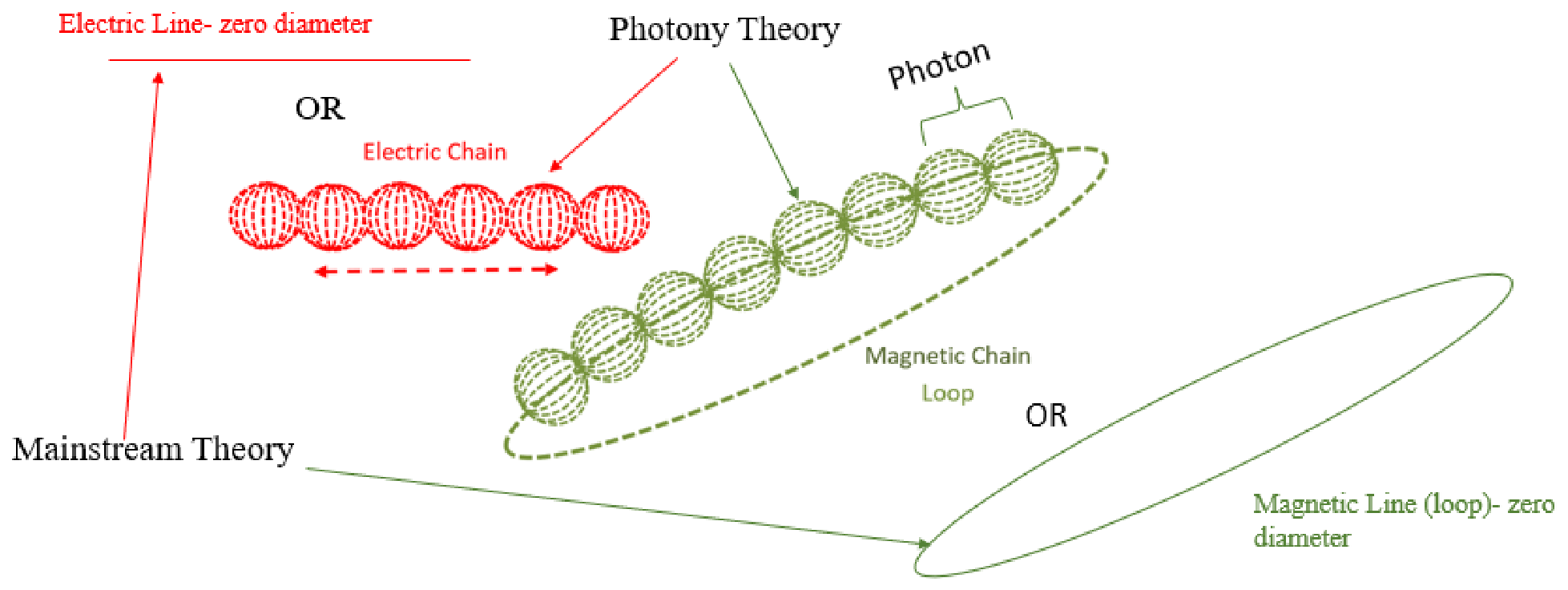
Figure 2.
Comparison of electric breakdown, magnetic reassignment, and magnetic breakdown. The upper panels illustrate idealized pre-threshold and post-threshold configurations for the three regimes. Electric breakdown begins from localized charge-supported electric loading and proceeds through formation or substantial enlargement of a conducting pathway. Magnetic reassignment begins within an already conducting, current-supported magnetic structure and preserves continuity through reorganization. Magnetic breakdown represents the contrasting magnetic branch in which no admissible continuation remains and collective magnetic support is lost. The lower panel summarizes the corresponding differences in pre-threshold conductivity, energy storage, structural organization, threshold condition, environmental selection, admissibility, and post-threshold outcome.
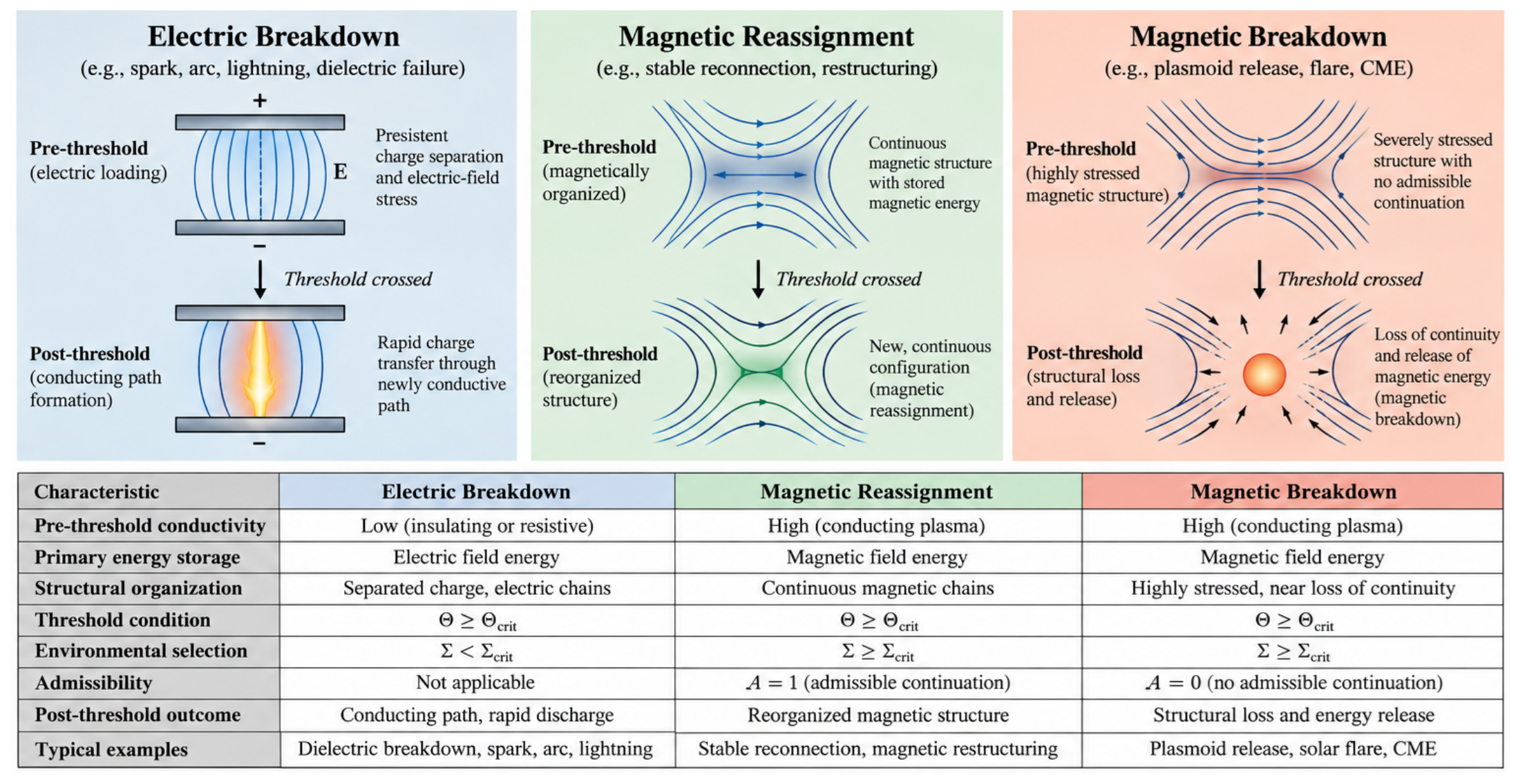
Disclaimer/Publisher’s Note: The statements, opinions and data contained in all publications are solely those of the individual author(s) and contributor(s) and not of MDPI and/or the editor(s). MDPI and/or the editor(s) disclaim responsibility for any injury to people or property resulting from any ideas, methods, instructions or products referred to in the content. |
© 2026 by the authors. Licensee MDPI, Basel, Switzerland. This article is an open access article distributed under the terms and conditions of the Creative Commons Attribution (CC BY) license (http://creativecommons.org/licenses/by/4.0/).
Copyright: This open access article is published under a Creative Commons CC BY 4.0 license, which permit the free download, distribution, and reuse, provided that the author and preprint are cited in any reuse.