
Submitted:
05 September 2026
Posted:
07 September 2026
You are already at the latest version
Abstract
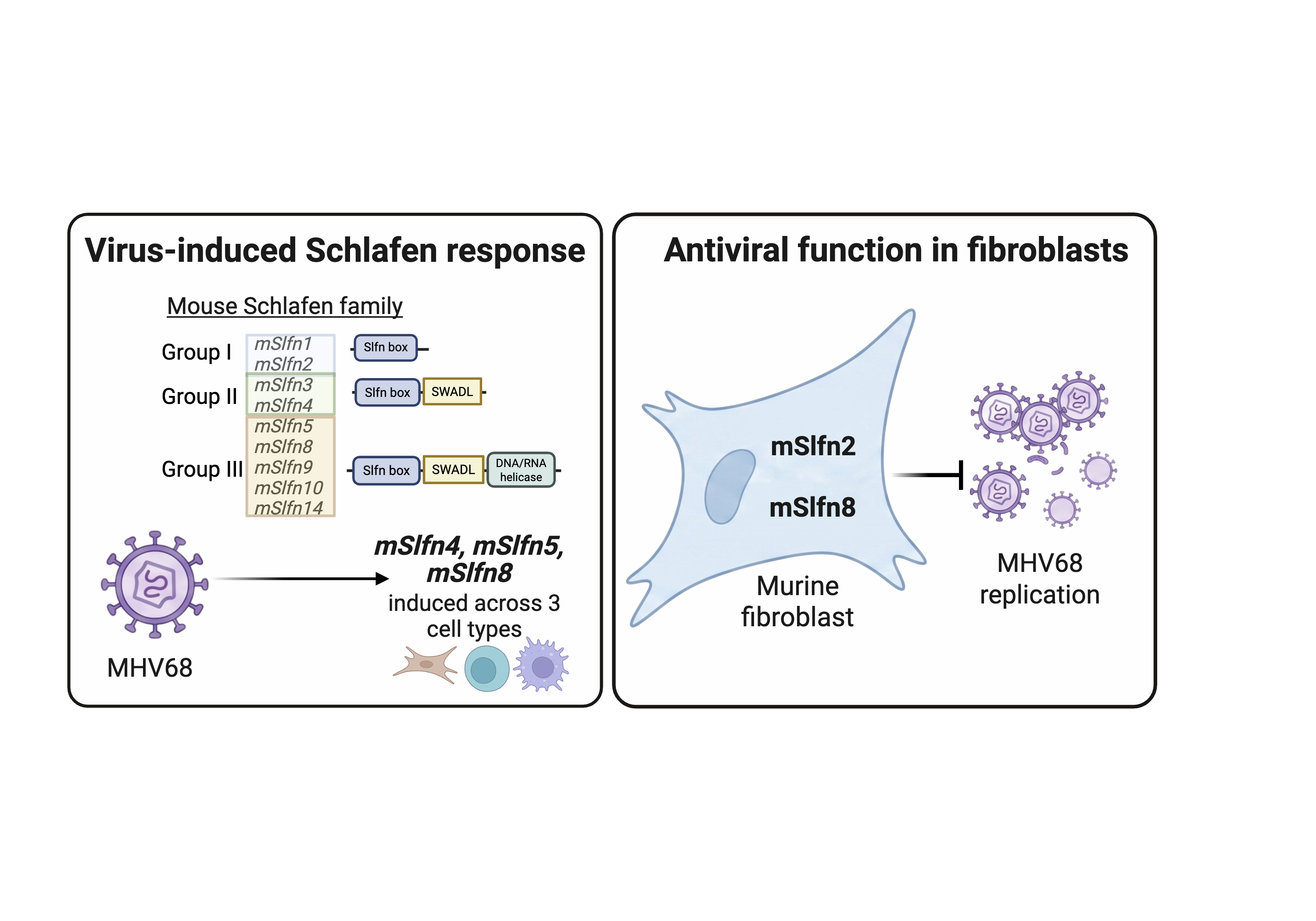
Schlafen proteins are interferon-responsive regulators of cellular and antiviral pathways that can profoundly influence viral replication and host defense. Diverse viral infections are known to induce expression of Schlafen (SLFN) family members in human cells, while infection studies in mice have been primarily limited to mSlfn2, a group I SLFN protein without a clear ortholog in humans. RNA-seq analysis of three distinct infection models reveals that mouse Slfns are induced in response to murine gammaherpesvirus 68 (MHV68) in fibroblasts, B cells, and primary peritoneal macrophages. Further, mSlfn8 is induced during MHV68 infection only under conditions with robust interferon signaling, suggesting that its expression is limited by viral interferon antagonism. To assess whether mSlfn8 or related Slfns impact MHV68 replication, we performed siRNA-mediated knockdown and CRISPR/Cas9 knockout of mSlfn2, mSlfn8, and mSlfn9 in NIH 3T3 cells. Two independent clonal mSlfn2 and mSlfn8 cell lines supported higher viral titer, indicating that these mSlfns are restriction factors for MHV68 replication in murine fibroblasts. Collectively, these results demonstrate that mSlfn2 and mSlfn8 function as antiviral effectors during MHV68 infection and support a model in which MHV68 counteracts interferon-induced mSlfn expression to promote efficient replication.
Keywords:
herpesvirus
; Schlafen
; MHV68
; interferon-stimulated genes
Copyright: This open access article is published under a Creative Commons CC BY 4.0 license, which permit the free download, distribution, and reuse, provided that the author and preprint are cited in any reuse.