

Submitted:
04 September 2026
Posted:
04 September 2026
You are already at the latest version
Abstract
Background/Objectives: Structured exercise may modulate the myostatin–follistatin (MSTN–FST) axis, but evidence across exercise modalities and doses remains uncertain. Methods: We systematically searched seven bibliographic databases for controlled exercise interventions lasting at least four weeks in adults (PROSPERO CRD420261492548). Multilevel random-effects models with study-clustered CR2 correction accounted for dependent effect sizes; sensitivity, exercise-modality subgroup, and linear duration analyses were exploratory. Results: Thirty-seven independent studies were included. Structured exercise was associated with lower circulating MSTN (16 effects from 10 studies; Hedges’ g = 1.79, 95% confidence interval [CI] 0.62–2.96) and higher circulating FST (12 effects from 7 studies; g = 1.62, 95% CI 0.18–3.06). Heterogeneity was high and both prediction intervals crossed the null. Effect directions generally persisted across assumed within-study correlations and after excluding HIFT/CrossFit-type interventions, although excluding extreme effects attenuated the estimates. Exploratory analyses showed no clear difference between resistance-based and non-resistance-based exercise, and program duration was not linearly associated with either outcome. GRADE certainty was moderate for both outcomes. Conclusions: Structured exercise may favorably alter circulating MSTN and FST, but sparse modality- and dose-specific evidence precludes identifying a superior modality, optimal dose, confirmed intracellular mechanism, or validated clinical surrogate endpoint.
Keywords:
myostatin
; follistatin
; structured exercise
; skeletal muscle
; exerkines
; multilevel meta-analysis
1. Introduction
The maintenance of skeletal muscle mass and function depends on a continuously regulated balance among mechanical loading, energy metabolism, and growth-factor signaling. Myostatin (MSTN; also known as growth differentiation factor 8), a member of the transforming growth factor-β superfamily, is a major negative regulator of skeletal muscle growth; genetic deletion of MSTN causes marked myofiber hyperplasia and hypertrophy [1]. After binding to ActRIIB, mature MSTN promotes the assembly of a heteromeric receptor complex in which the type II receptor recruits and activates ALK4/5. Activated ALK4/5 receptors phosphorylate SMAD2/3, which associates with the common-mediator SMAD4 and translocates to the nucleus to regulate transcription, thereby constraining myogenesis and anabolic processes [2,3,4]. Follistatin (FST) binds MSTN and activin-like ligands in the extracellular space, reducing their availability for receptor binding and acting as a key antagonist of this inhibitory axis [2]. Circulating FST, however, does not simply reflect local release from skeletal muscle. Human studies indicate that the liver is a major source of circulating FST during exercise and that its secretion is regulated partly by the glucagon-to-insulin ratio [5]. Thus, circulating MSTN and FST may inform the study of exercise-related molecular adaptation, but both are influenced by multiple tissue sources and the systemic metabolic milieu.
Structured exercise provides a biologically plausible, nonpharmacological stimulus for modulating the MSTN–FST axis. Human studies and reviews suggest that endurance and resistance training may alter MSTN expression or circulating concentrations, potentially contributing to muscular and metabolic adaptation [6]. Acute experiments further indicate that different exercise modalities can produce transient changes in circulating FST and related activin ligands, while baseline concentrations vary with age, adiposity, and metabolic status [7]. Circulating FST responses are also shaped by hepatic endocrine signaling [5]. A recent review of exercise intensity and circulating exerkines found inconsistent MSTN and FST responses across acute and longitudinal studies, with evidence on dose and intensity remaining largely descriptive and hypothesis-generating [8]. Collectively, these findings suggest that observed changes in MSTN or FST may depend on exercise modality, training dose, program duration, participant metabolic status, the interval between the final exercise session and sampling, and the assay platform. No single training modality or biomarker is therefore likely to capture the full long-term adaptation of this molecular axis.
Existing evidence has not addressed these issues simultaneously. A 2023 systematic review and meta-analysis reported that resistance training was associated with lower circulating MSTN and higher FST in adults, but its scope was restricted to resistance training [9]. A meta-analysis of exerkines in people with type 2 diabetes included diverse exercise protocols and molecular markers, yet focused on the broader exerkine profile and metabolic control rather than an evidence framework centered on the MSTN–FST axis [10]. A 2026 multilevel meta-analysis explicitly addressed within-study effect-size dependence but examined only resistance training and serum MSTN in frail or sarcopenic older adults [11]. Another meta-analysis, focused primarily on circulating irisin in adults with overweight or obesity, included MSTN and FST only as secondary outcomes and did not conduct an independent systematic search for these markers [12]. Although these studies advanced specific aspects of the field, an integrated evaluation covering healthy and clinically at-risk adults, multiple long-term structured exercise modalities, correlated within-study effects, and training-dose information remains lacking. Multiple intervention arms, shared controls, and multiple eligible comparisons can generate dependent effect sizes; ignoring this structure may underestimate uncertainty. Whether exercise modality and training dose modify the molecular response also remains unresolved.
To address these gaps, we conducted a systematic review, multilevel meta-analysis, and exploratory dose–response analysis of structured exercise programs lasting at least 4 weeks in adults. Circulating MSTN and FST were the primary quantitative outcomes; skeletal muscle protein and mRNA expression were analyzed separately by measurement level. Multilevel random-effects models with study-clustered robust correction were used to account for correlated effects within studies. Where permitted by the evidence, we explored resistance training, aerobic or concurrent training, and high-intensity functional training, together with program duration and other extractable dose characteristics. These analyses were intended to identify potential effect modifiers and evidence gaps, not to rank exercise modalities or define an unvalidated optimal prescription.
2. Materials and Methods
2.1. Study Design and Reporting Standards
This systematic review, multilevel meta-analysis, and exploratory dose–response analysis evaluated the effects of structured exercise on the MSTN–FST axis in adults. Reporting followed PRISMA 2020, and the search process was reported in accordance with PRISMA-S [13,14]. The review was registered in PROSPERO (CRD420261492548). Only aggregate data from publicly available studies were used; additional ethical approval and informed consent were therefore not required.
2.2. Eligibility Criteria and Exclusion Criteria
Eligibility criteria were defined using the PICOS framework. Population: adults aged ≥18 years, irrespective of sex or health status. Mixed-age samples were eligible only when adult data could be extracted separately or the sample was explicitly composed entirely of adults. Intervention: active, structured exercise lasting at least 4 weeks, with a repeatable and clearly defined protocol. Eligible modalities included resistance, aerobic or endurance, interval, concurrent, circuit, high-intensity functional, and other active training programs with quantifiable dose characteristics. Combined interventions were eligible only when the effect of exercise could be isolated or all groups received the same nonexercise co-intervention (Supplementary File S1).
Comparator: nonexercise, usual-lifestyle, usual-care, or wait-list controls, as well as direct comparisons of exercise modalities, sequences, intensities, or doses. Outcomes: the primary outcomes were circulating MSTN and FST, with serum and plasma recorded separately. Secondary measures included skeletal muscle MSTN/FST protein or mRNA expression and reliably calculated FST/MSTN ratios. Circulating concentrations, tissue protein, and mRNA outcomes were not pooled together.
Study design: eligible reports were original randomized controlled trials or nonrandomized longitudinal intervention studies with a contemporaneous control group that met the PICOS criteria and were available in full text. Preprints were flagged separately and evaluated against the same data-adequacy criteria as journal articles before quantitative synthesis. We excluded animal, cellular, and in vitro studies; mixed-age studies without separable adult data; single-session acute exercise studies and interventions lasting <4 weeks; observational physical-activity studies; multicomponent rehabilitation studies in which the exercise effect could not be isolated; and reviews, meta-analyses, editorials, protocols, cross-sectional studies, case reports, and conference abstracts with insufficient information.
2.3. Information Sources and Search Strategies
We searched PubMed, MEDLINE Ultimate (EBSCOhost), Embase (Embase.com), Web of Science Core Collection, Scopus, SPORTDiscus with Full Text (EBSCOhost), and Cochrane CENTRAL. ClinicalTrials.gov was searched to identify registered trials. Searches were completed on 22–23 August 2026, with no restrictions on publication year or language. Except for the exclusion of animal-only studies in Embase, no age or study-design filters were applied (Supplementary File S1).
Search strategies combined two concept blocks, MSTN/FST and structured exercise, and were adapted to the controlled vocabulary, field tags, and syntax of each platform. Dose terms were not required because frequency, intensity, volume, and program duration are generally reported only in full texts. Strategies were peer-reviewed against PRESS principles [15]; complete platform-specific strategies are provided in Supplementary File S1.
The seven bibliographic databases yielded 3,325 records, and ClinicalTrials.gov yielded 103 trial registrations. Records were exported in RIS or PubMed/NBIB format and merged. Duplicates were removed sequentially using normalized DOIs, PMIDs, and titles with publication years; fuzzy title matching was used only to support manual review. Of 3,428 imported records, 1,808 duplicates were removed, leaving 1,620 unique records for screening. Original export files, batch details, record counts, and search audit logs were retained.
2.4. Literature Screening
CQ and CY independently assessed titles, abstracts, and full texts for eligibility. Title and abstract screening prioritized sensitivity: records were retained for full-text review whenever the available information was insufficient to confirm an adult population, a structured exercise intervention lasting at least 4 weeks, a longitudinal intervention design, or an MSTN/FST outcome. Each reviewer’s original decision, date, exclusion reason, and any screening conflict were retained. Disagreements were resolved by discussion, with YW adjudicating when required.
Full-text retrieval was sought for 220 reports, in the following order: open-access sources, PubMed/PMC, publisher platforms, and institutionally subscribed databases. Full texts were obtained for 82 reports and assessed for eligibility. The remaining 138 reports were classified as “Reports not retrieved” under prespecified rules and did not enter full-text eligibility assessment. One primary reason was recorded for each report excluded after full-text review (Supplementary Table S1).
2.5. Data Extraction and Outcome Definitions
Multiple reports and potentially overlapping samples were linked using authorship, location, participant characteristics, recruitment period, intervention structure, registration number, and outcome time points. The 37 included reports represented 37 independent studies. Extracted study characteristics included design, sample size, age, sex, health status, exercise modality, frequency, program duration, session duration, intensity, progression, total sessions, and co-interventions (Supplementary Tables S2, S3A and S3B).
Outcome fields included specimen matrix, measurement level and assay, sampling time point, unit, group sample size, mean, standard deviation (SD), standard error (SE), change score, and 95% confidence interval (CI), together with the source location and extraction method. SEs were converted using SD = SE × √n; where necessary, SEs were reconstructed from 95% CIs. Graphical values were obtained using a prespecified digitization procedure. Circulating proteins, muscle proteins, and muscle mRNA were coded separately. Follistatin-related protein 3 was not included in the canonical FST outcome. Artificial intelligence was used only to assist record location and preliminary extraction; CQ verified every field, and CY independently reviewed the extracted data.
2.6. Risk of Bias and Certainty of Evidence
Randomized trials were assessed with Cochrane RoB 2 [16], and nonrandomized intervention studies with ROBINS-I [17]. Selection of the appropriate tool and domain-level judgments followed the actual allocation process and methods reported in each full text. CQ and CY independently reviewed all domain-level and overall judgments for the 37 studies; disagreements were documented and resolved by consensus or adjudication. Studies are labeled by first author and year in the risk-of-bias figures. Certainty of evidence was assessed separately for circulating MSTN and circulating FST using GRADE [18], considering risk of bias, inconsistency, indirectness, imprecision, and other relevant factors (Supplementary Table S7; Supplementary Tables S8A and S8B; Supplementary Figure S1 and Figure S2).
2.7. Effect Sizes and Data Conversion
Because specimen matrices, assay platforms, and measurement units differed across studies, the primary effect measure was Hedges’ g, the small-sample-corrected standardized mean difference. The primary analyses comprised 27 postintervention between-group comparisons and one between-group change-score comparison. For postintervention data, Cohen’s d was calculated as the between-group mean difference divided by the pooled within-group SD and multiplied by the small-sample correction factor J to obtain Hedges’ g. Change scores were standardized using the same principles. Effect direction was coded so that positive values consistently favored exercise, representing lower MSTN or higher FST. Sampling variances, SEs, and 95% CIs were derived from the corresponding sample sizes and Hedges’ g. Dependencies arising from shared controls, multiple intervention arms, and multiple eligible comparisons were modeled within studies rather than treating repeated use of a shared control as independent information. All eligible primary-outcome effects were retained to limit selective inclusion among multiple available effects [19].
2.8. Data Synthesis and Statistical Analysis
Meta-analyses were conducted separately for MSTN and FST. The primary model was a multilevel random-effects model estimated by restricted maximum likelihood, with effect sizes nested within studies and the study as the clustering unit. SEs, 95% CIs, and p values were obtained using CR2 robust covariance correction and Satterthwaite small-sample degrees-of-freedom approximation [20,21,22]. A conventional independent-effects random-effects model was fitted as a reference to report the Q statistic, I², and 95% prediction interval. Prediction intervals described the range of plausible true effects in a new study setting and the practical implications of between-study heterogeneity [22]. This reference model did not replace the primary model accounting for effect dependence.
Sensitivity to assumed within-study correlations was examined at ρ = 0, 0.5, and 0.8. Effect sizes were aggregated within studies under a compound-symmetry correlation structure, and restricted maximum likelihood random-effects models were refitted with the Knapp–Hartung correction. We also excluded effect sizes with |Hedges’ g| > 3 to assess the influence of a small number of extreme effects and conducted leave-one-study-out analyses.
Exercise modalities were grouped according to the observed evidence structure as resistance training, aerobic or concurrent training, and high-intensity functional training (HIFT)/CrossFit-type training. Subgroup effects were estimated only when a category contained at least two independent studies. We also fitted an exploratory three-category multilevel meta-regression with resistance training as the reference, using CR2 robust covariance and Satterthwaite degrees of freedom. An HTZ Wald test with small-sample correction was used for the omnibus comparison. Because sparse categories produced extremely low effective degrees of freedom, this test was treated as diagnostic rather than confirmatory. Modalities were additionally collapsed into resistance-based and non-resistance-based categories for a binary exploratory meta-regression. Moderator pseudo-R² was calculated from the change in between-study variance; negative values were retained computationally and interpreted as 0%. Residual heterogeneity was reported. All modality analyses were prespecified as exploratory because the small number of studies precluded reliable ranking. Robustness was further assessed by retaining only resistance training, excluding HIFT/CrossFit, and sequentially excluding each modality. For these analyses, effects were first aggregated at the study level under compound symmetry with ρ = 0.5, followed by a REML random-effects model with Knapp–Hartung correction.
Candidate dose variables were training frequency, program duration, session duration, total sessions, and total exercise time. Before modeling, we examined study coverage, number of distinct values, range, and collinearity. Because all analyzable studies prescribed three sessions per week, a frequency–response association could not be estimated. Program duration had the greatest coverage and was examined in an exploratory linear multilevel meta-regression per 4-week increment, with CR2 correction. Total sessions were fully collinear with program duration and were not interpreted independently. The number of independent studies, dose variation, and effective degrees of freedom were insufficient for restricted cubic splines or other nonlinear dose–response models. Tests were two-sided with p < 0.05, but interpretation prioritized effect sizes, 95% CIs, prediction intervals, and sensitivity analyses rather than p values alone (Supplementary Table S6A and S6B).
The feasibility of formal funnel-plot asymmetry tests was assessed a priori from the number of independent studies and the dependent effect structure. Only 10 independent studies contributed circulating MSTN data and 7 contributed circulating FST data, with several studies providing multiple eligible effects. Egger regression, rank-correlation tests, and visual inferences from funnel-plot asymmetry were therefore not performed. The absence of these tests was not interpreted as evidence that publication bias was absent.
Analyses were conducted in R version 4.6.1, primarily with metafor 5.0-1 [23] and clubSandwich 0.7.0. Data import and graphics also used readxl 1.5.0, ggplot2 4.0.3, patchwork 1.3.2, svglite 2.2.2, and ragg 1.5.2. Scripts for the primary meta-analysis, sensitivity analyses, leave-one-study-out diagnostics, subgroup analyses, dose meta-regression, and figures were retained with R session information, model objects, analysis inputs, and plot-ready data to support reproducibility.
3. Results
3.1. Literature Search and Screening
After cross-source deduplication of records from bibliographic databases and the trial registry, 1,620 unique records entered screening. Of these, 1,229 were excluded by title and abstract, and 171 registry records were retained separately for linkage with published reports. Retrieval was sought for 220 reports; 82 full texts were obtained and assessed for eligibility, whereas 138 reports could not be retrieved. Full-text assessment excluded 45 reports, leaving 37 included reports. Linkage checks found no multiple included reports from the same study; the 37 reports therefore represented 37 independent studies (Figure 1).
3.2. Characteristics of Included Studies
Included studies were published from 2010 to 2026 and encompassed traditional, periodized, and functional resistance training; blood-flow restriction training; suspension training; whole-body vibration combined with electromyostimulation; aerobic or endurance training; Nordic walking; concurrent and multicomponent training; interval training; high-intensity functional training; and other targeted exercise programs. Participants included healthy adults, older adults, people with or at risk of sarcopenia, and clinical populations with obesity or metabolic disorders, cancer, chronic kidney disease, heart failure, HIV infection, or polycystic ovary syndrome. Twenty-six studies provided structured quantitative data for at least one MSTN- or FST-related outcome. The primary quantitative synthesis was restricted to valid between-group comparisons of circulating MSTN or FST. RoB 2 was applied to 27 studies and ROBINS-I to 10 studies (Table 1 and Supplementary Table S2).
3.3. Main Results
3.3.1. Circulating Myostatin
The primary MSTN analysis included 16 effect sizes from 10 independent studies. In the multilevel random-effects model estimated by restricted maximum likelihood with study-clustered CR2 small-sample correction, structured exercise was associated with lower circulating MSTN (Hedges’ g = 1.79, 95% CI 0.62–2.96, p = 0.007; Figure 2A and Table 2). Positive values indicate lower MSTN in the exercise group. The conventional random-effects reference model showed high heterogeneity (I² = 91.98%), and the 95% prediction interval crossed the null (−1.38 to 5.72), indicating that effects may vary substantially across study settings.
3.3.2. Circulating Follistatin
The primary FST analysis included 12 effect sizes from 7 independent studies. In the multilevel random-effects model with CR2 correction, structured exercise was associated with higher circulating FST (Hedges’ g = 1.62, 95% CI 0.18–3.06, p = 0.033; Figure 2B and Table 2). The conventional random-effects reference model showed high heterogeneity (I² = 92.29%), and the 95% prediction interval crossed the null (−1.64 to 5.56), indicating substantial between-study variation and uncertainty about the effect expected in a new setting.
3.3.3. Risk of Bias, Certainty of Evidence, and Reporting Bias
All 27 studies assessed with RoB 2 were rated overall as having some concerns. The most frequent issues related to deviations from intended interventions, selective reporting, and incomplete reporting of randomization; all were rated at low risk in the outcome-measurement domain. All 10 nonrandomized studies assessed with ROBINS-I were rated overall as having a serious risk of bias, driven primarily by confounding. Domain-level and overall judgments are presented in Supplementary Figure S1 and Figure S2. Certainty of evidence was rated as moderate for both circulating MSTN and circulating FST.
Circulating MSTN and FST analyses included 10 and 7 independent studies, respectively. Because tests for funnel-plot asymmetry have limited utility with few studies and because several studies contributed multiple dependent effect sizes, formal small-study-effect and funnel-plot asymmetry tests were not performed. This decision does not establish the absence of publication bias. Its possible influence was considered cautiously within GRADE alongside evidence availability, selective-reporting risk, and result robustness.
3.3.4. Sensitivity and Influence Analyses
After within-study aggregation under assumed correlations of ρ = 0, 0.5, and 0.8, the pooled MSTN effect remained positive, with Hedges’ g ranging from 1.64 to 1.78; none of the 95% CIs crossed the null. For FST, the pooled effect remained positive at ρ = 0 (g = 1.54, 95% CI 0.14–2.94) and ρ = 0.5 (g = 1.38, 95% CI 0.10–2.67). At ρ = 0.8, the 95% CI crossed the null (g = 1.13, 95% CI −0.02 to 2.27, p = 0.052).
Excluding effect sizes with |Hedges’ g| > 3 attenuated both pooled effects. The pooled estimate was 0.85 for MSTN (95% CI 0.26–1.43, p = 0.010; 9 effect sizes) and 0.89 for FST (95% CI 0.47–1.32, p = 0.002; 8 effect sizes). Thus, the favorable direction persisted, although a small number of large effects influenced the magnitude of the primary estimates. Modality-restricted analyses provided similar robustness information. When only resistance-training studies were retained, the pooled effect was 1.26 for MSTN (95% CI −0.21 to 2.73; 6 studies; I² = 90.37%) and 1.03 for FST (95% CI 0.12–1.93; 5 studies; I² = 64.71%). After excluding HIFT/CrossFit-type training, favorable effects persisted for MSTN (g = 1.15, 95% CI 0.16–2.13; 8 studies; I² = 87.82%) and FST (g = 0.92, 95% CI 0.23–1.61; 6 studies; I² = 61.81%). Other modality-exclusion analyses were directionally consistent, but CIs widened markedly when few studies remained and were interpreted only as robustness checks (Supplementary Table S4).
3.3.5. Exploratory Subgroup and Dose–Response Analyses
Because some categories contained few independent studies, modality and population subgroup analyses were exploratory. For MSTN, the pooled effect was 0.87 for aerobic or concurrent training (95% CI −0.93 to 2.66; 2 studies), 1.26 for resistance training (95% CI −0.21 to 2.73; 6 studies), and 4.09 for HIFT/CrossFit-type training (95% CI 3.78–4.40; 2 studies). For FST, only resistance training included at least two independent studies (g = 1.03, 95% CI 0.12–1.93; 5 studies); the aerobic or concurrent and HIFT categories each contained one study and were not pooled. The three-category models descriptively reduced between-study variance, with pseudo-R² values of 44.96% for MSTN and 49.39% for FST. However, denominator degrees of freedom for the omnibus tests were only 1.28 and 1.40, respectively, so nominal tests were not considered reliable evidence of subgroup differences. In the binary comparison of resistance-based versus non-resistance-based training, the meta-regression coefficient was 1.10 for MSTN (95% CI −1.57 to 3.76, p = 0.358; effective df = 6.55) and 1.19 for FST (95% CI −8.22 to 10.60, p = 0.620; effective df = 1.85). Neither indicated a clear difference. The binary models explained only 0.34% and 0% of between-study variance, respectively, and residual heterogeneity remained significant. Exercise modality may contribute to heterogeneity, but current evidence does not support robust between-modality comparisons or ranking (Supplementary Table S5A–S5C).
Training frequency could not be analyzed as a dose variable because every study with analyzable data prescribed three sessions per week. Program duration was therefore used as the primary exploratory dose measure. Per 4-week increase in program duration, the estimated change in Hedges’ g was −0.03 for MSTN (95% CI −0.65 to 0.59, p = 0.830; 10 studies) and 1.26 for FST (95% CI −1.14 to 3.67, p = 0.201; 7 studies; Figure 3). Total sessions were collinear with program duration and were not analyzed independently. The number of studies, dose variation, and effective degrees of freedom were insufficient to fit a nonlinear dose–response model.
4. Discussion
4.1. Key Findings and Comparison with Previous Evidence
This systematic review and multilevel meta-analysis indicates that structured exercise is associated with favorable changes in the circulating MSTN–FST axis in adults, specifically lower MSTN and higher FST. Certainty of evidence was moderate for both primary outcomes. The direction of the MSTN effect was stable across assumed within-study correlations and after exclusion of extreme effects. The FST effect was also generally consistent, although its CI crossed the null under the highest correlation assumption. Biologically, exercise may influence two extracellular modulators with opposing roles in activin-receptor signaling. Nevertheless, high heterogeneity, prediction intervals crossing the null, and attenuation after exclusion of extreme effects preclude interpreting the pooled standardized estimates as fixed effects applicable to all populations and training contexts. They also do not demonstrate activation of a specific intracellular pathway.
These findings extend the scope and methods of the 2023 meta-analysis by Khalafi et al., which reported lower circulating MSTN and higher FST after resistance training [9]. The present study differs in three main respects. First, it encompasses multiple structured exercise modalities, including aerobic, concurrent, and high-intensity functional training in addition to resistance training. Second, multiple eligible effects from the same study were retained and their dependence addressed using multilevel models with study-clustered CR2 small-sample correction, rather than treating correlated comparisons as independent. Third, the evidence on program duration, frequency, and other dose characteristics was systematically organized and explored quantitatively where possible. The consistent effect directions across reviews provide mutually supportive evidence that exercise may modulate the MSTN–FST axis. However, differences in evidence scope and statistical methods mean that standardized estimates should not be compared directly.
4.2. Exercise Modality and Training Dose
The modality analyses revealed a pattern warranting further investigation: the MSTN–FST axis may respond to more than one form of structured exercise, but current evidence cannot determine their relative effects. Resistance training contributed most of the quantitative evidence and was the only modality with enough independent studies for a pooled FST estimate. HIFT/CrossFit-type interventions showed larger MSTN effects, but this finding was based on only two studies; aerobic or concurrent training was similarly sparse. The three-category model yielded a high descriptive pseudo-R², but the omnibus test had fewer than 1.5 denominator degrees of freedom. This combination is more consistent with sparse categories and influential effects than with a confirmed moderator. The more stable binary meta-regression comparing resistance-based with non-resistance-based training found no clear difference and explained almost none of the between-study variance. Favorable MSTN and FST effects persisted after exclusion of HIFT/CrossFit studies, with lower heterogeneity for both outcomes, indicating that the overall direction was not wholly driven by this small, high-effect subgroup. Residual MSTN heterogeneity nevertheless remained high. Restriction to resistance training also preserved favorable point estimates, but the MSTN CI crossed the null, reflecting the substantial loss of information. Exercise modality should therefore be regarded as a potential, unconfirmed effect modifier. Broader exerkine research likewise suggests that aerobic and resistance exercise can alter circulating factors, with magnitude and time course depending on the molecule and sampling schedule [61]. Adequately powered, assay-standardized, head-to-head trials are needed to determine whether modality truly modifies the response.
No clear linear association was observed between program duration and either primary outcome, but this does not imply that exercise dose is biologically irrelevant. Every study with analyzable frequency data prescribed three sessions per week, leaving no between-study variation for estimating frequency effects. Total sessions were completely collinear with program duration, and the number of independent studies and dose levels was insufficient for reliable nonlinear modeling. Moreover, frequency and duration capture only part of exercise dose and do not reflect intensity, session volume, work-to-rest structure, progressive overload, adherence, or energy expenditure. Future studies should report these dimensions consistently and systematically vary at least one while holding others relatively constant. Such designs are needed to construct biologically meaningful dose–response curves rather than relying on ecological associations across heterogeneous protocols.
4.3. Molecular Interpretation and Assay Context
The observed effect directions are compatible with established regulation of skeletal muscle growth, but this meta-analysis does not show that the pathway mediates exercise adaptation. MSTN is a negative regulator of skeletal muscle mass [1]. After binding to ActRIIB, receptor-available MSTN promotes recruitment and activation of ALK4/5, followed by phosphorylation of SMAD2/3. Phosphorylated SMAD2/3 associates with SMAD4, and the resulting complex translocates to the nucleus to regulate transcriptional responses that suppress myogenesis and anabolic signaling [2,3,4,62]. FST binds and neutralizes MSTN and activin, reducing ligand availability for activin-receptor binding [2,7]. Lower circulating MSTN together with higher FST after exercise is therefore compatible with reduced availability of inhibitory ligands, and the opposing directions may be more informative than either marker alone. Circulating concentration, however, is not equivalent to ligand bioactivity, receptor occupancy, ALK4/5 activation, SMAD2/3 phosphorylation, p-SMAD2/3–SMAD4 complex formation, nuclear translocation, transcriptional regulation, muscle protein synthesis, or tissue-specific signaling flux. Future studies should pair blood with muscle sampling, distinguish active, latent, and protein-bound ligand forms, and concurrently measure ActRIIB/ALK4/5–SMAD2/3–SMAD4 signaling, myogenic targets, and functional adaptation (Figure 4).
Between-study differences may reflect both biological and methodological variation. Participants ranged from healthy adults and older adults to people with sarcopenia, obesity, metabolic disease, cancer, chronic kidney disease, heart failure, HIV infection, or polycystic ovary syndrome. Age, sex, adiposity, metabolic status, disease severity, and medication exposure may affect baseline concentrations; circulating activin and FST are themselves associated with metabolic and anthropometric characteristics [7]. Exercise protocols also varied in modality, intensity, duration, co-interventions, and the interval between the final session and sampling. Circulating MSTN measurement is particularly challenging because MSTN forms complexes with binding proteins, occurs in active and latent forms, and shares high homology with related ligands. Antibody cross-reactivity, sample pretreatment, and variation among commercial assays can yield substantially different concentrations [63,64,65]. These factors also explain why circulating protein, muscle protein, and muscle mRNA measurements are not interchangeable [6].
4.4. Research and Clinical Implications
Circulating MSTN and FST are better regarded at present as candidate biomarkers of molecular adaptation to exercise than as independent therapeutic targets or validated clinical surrogate endpoints. Expert consensus recognizes the potential value of the MSTN–FST system in studies of musculoskeletal aging while emphasizing the need for improved assays and validation against clinically relevant outcomes [66]. This distinction matters because pharmacological inhibition of MSTN signaling often increases muscle mass without consistently improving strength or physical function [3,67]. Future exercise studies should integrate molecular signaling with phenotypic outcomes in a coherent evidence chain. Priorities include validated assays that distinguish relevant ligand forms, standardized fasting and postexercise sampling intervals, muscle measures of receptor and SMAD signaling, and prespecified outcomes for muscle mass, strength, and physical function. Multiarm trials directly comparing modalities or doses, as well as adequately powered individual-participant-data or aggregate-data meta-analyses, are more likely to determine whether modality, dose, and host phenotype modify the molecular response.
5. Strengths and Limitations
This study has several strengths in evidence coverage, process control, and statistical analysis. Searches encompassed multiple databases and a trial registry, and search, screening, and full-text retrieval records were retained in accordance with PRISMA 2020 and PRISMA-S. Eligibility, data extraction, and risk-of-bias assessments were independently reviewed. Circulating MSTN and FST were synthesized separately, and multilevel models treated studies as independent clusters while examining sensitivity to assumed within-study correlations and extreme effects. Estimable and nonestimable dose dimensions were explicitly distinguished. By situating multiple structured exercise modalities within one evidence framework, this review provides a broader view of long-term exercise effects on the molecular axis than earlier resistance-training reviews.
Several limitations should be considered. The primary MSTN and FST analyses included only 10 and 7 independent studies, respectively, limiting modality subgroups, category-exclusion analyses, meta-regression, and nonlinear dose–response modeling. Denominator degrees of freedom for the three-category omnibus tests were <1.5, and each non-resistance FST category was represented by only one study; pseudo-R² values and category coefficients may therefore be highly unstable. Exercise modalities were not randomly distributed across populations, health conditions, doses, or assay platforms, so apparent subgroup differences may reflect study-level confounding and cannot support modality ranking. Heterogeneity was high and both prediction intervals crossed the null. Although favorable directions persisted and heterogeneity declined after excluding HIFT/CrossFit studies, residual MSTN heterogeneity remained high. Excluding extreme effects substantially attenuated the pooled estimates, and the FST result was sensitive to the highest assumed within-study correlation. Randomized studies had some concerns about bias, while all nonrandomized studies had a serious risk of bias, mainly from confounding. Variation in populations, exercise prescriptions, co-interventions, specimens, assays, and sampling schedules further limited biological comparability. Finally, 138 reports could not be retrieved and therefore did not undergo eligibility assessment, creating a risk of full-text availability bias. These reports appear as “Reports not retrieved” in the PRISMA flow diagram rather than as full-text exclusions.
6. Conclusions
Structured exercise is associated with lower circulating MSTN and higher FST in adults, with moderate-certainty evidence for both primary outcomes. Sensitivity analyses generally supported these effect directions; however, high heterogeneity, prediction intervals crossing the null, sparse modality-specific evidence, and limited dose variation constrain estimates of magnitude, between-modality differences, and optimal prescription. The findings support continued investigation of the MSTN–FST axis as a candidate molecular pathway of exercise adaptation, but they do not identify a superior exercise modality, optimal dose, specific intracellular mechanism, or clinical surrogate endpoint.
Supplementary Materials
The following supporting information can be downloaded at the website of this paper posted on Preprints.org, Figure S1: Risk-of-bias traffic-light plots for the 37 included studies; Figure S2: Summary distributions of risk-of-bias judgements; Table S1: Reports excluded after full-text assessment and the single primary reason for exclusion; Table S2: Study-level methodological classification and quantitative contribution; Table S3A: Effect-size inputs entering the outcome-specific quantitative syntheses; Table S3B: Dose fields linked to each quantitative comparison; Table S4: Sensitivity and leave-one-study-out analyses; Table S5A: Exploratory exercise-modality subgroup estimates; Table S5B: Meta-regression and heterogeneity diagnostics for exercise modality; Table S5C: Exercise-modality restriction and leave-class-out sensitivity analyses; Table S6A: Coverage and feasibility of prespecified training-dose variables; Table S6B: Exploratory dose meta-regression models; Table S7: GRADE evidence profile for the two primary outcomes; Table S8A: RoB 2 domain-level and overall judgements; Table S8B: ROBINS-I domain-level and overall judgements; Supplementary File S1: Full electronic search strategies.
Author Contributions
Conceptualization, C.Q., C.Y., and S.G.; methodology, C.Q. and C.Y.; software, C.Q., C.Y., and S.G.; validation, C.Q., C.Y., S.G., and Y.W.; formal analysis, C.Q. and C.Y.; investigation, C.Q. and C.Y.; resources, C.Q. and C.Y.; data curation, C.Q. and C.Y.; writing—original draft preparation, C.Q. and C.Y.; writing—review and editing, C.Q., C.Y., S.G., S.Y., and Y.W.; visualization, C.Q. and C.Y.; supervision, C.Q., C.Y., S.G., S.Y., and Y.W.; project administration, C.Q., C.Q. and C.Y. contributed equally to this work and share first authorship. All authors have read and agreed to the published version of the manuscript.
Funding
This study received no external funding.
Institutional Review Board Statement
Not applicable. This study used only aggregate data from published studies and did not involve new research with human participants or animals.
Informed Consent Statement
Not applicable.
Data Availability Statement
The original contributions presented in this study are included in the article and Supplementary Materials. Further inquiries can be directed to the corresponding author.
Acknowledgments
We sincerely thank our supervisors, colleagues, and all experts who provided guidance and constructive suggestions during the conception, analysis, and writing of this manuscript. We also express our respect and gratitude to all investigators whose studies were included in this review and meta-analysis.
Conflicts of Interest
The authors declare no conflicts of interest.
Abbreviations
The following abbreviations are used in this manuscript:
| ActRIIB | Activin receptor type IIB |
| ADT | Androgen-deprivation therapy |
| AET | Aerobic exercise training |
| ALK4/5 | Activin receptor-like kinases 4 and 5 |
| AST | Astaxanthin |
| BFR | Blood-flow restriction |
| CI | Confidence interval |
| CKD | Chronic kidney disease |
| CR2 | Bias-reduced cluster-robust variance correction |
| EAA | Essential amino acids |
| ELISA | Enzyme-linked immunosorbent assay |
| EMS | Electromyostimulation |
| FST | Follistatin |
| GDF-8 | Growth differentiation factor 8 |
| GRADE | Grading of Recommendations Assessment, Development and Evaluation |
| HIFT | High-intensity functional training |
| HIIT | High-intensity interval training |
| HTZ | Approximate Hotelling’s T² test with Zhang correction |
| IMT | Inspiratory muscle training |
| MSTN | Myostatin |
| NR | Not reported |
| NW | Nordic walking |
| PCOS | Polycystic ovary syndrome |
| PICOS | Population, Intervention, Comparator, Outcomes, and Study design |
| PRESS | Peer Review of Electronic Search Strategies |
| PRISMA | Preferred Reporting Items for Systematic Reviews and Meta-Analyses |
| PRISMA-S | PRISMA extension for reporting literature searches in systematic reviews |
| PROSPERO | International Prospective Register of Systematic Reviews |
| p-SMAD2/3 | Phosphorylated SMAD family members 2 and 3 |
| qPCR | Quantitative polymerase chain reaction |
| RCT | Randomized controlled trial |
| REML | Restricted maximum likelihood |
| RoB 2 | Cochrane Risk of Bias 2 tool |
| ROBINS-I | Risk Of Bias In Non-randomized Studies of Interventions |
| RT | Resistance training |
| SD | Standard deviation |
| SE | Standard error |
| SMAD2/3 | SMAD family members 2 and 3 |
| SMAD4 | SMAD family member 4 |
| WB-EMS | Whole-body electromyostimulation |
References
- McPherron, A.C.; Lawler, A.M.; Lee, S.J. Regulation of Skeletal Muscle Mass in Mice by a New TGF-Beta Superfamily Member. Nature 1997, 387, 83–90. [Google Scholar] [CrossRef] [PubMed]
- Lee, S.J.; McPherron, A.C. Regulation of Myostatin Activity and Muscle Growth. Proc. Natl. Acad. Sci. U S A 2001, 98, 9306–9311. [Google Scholar] [CrossRef] [PubMed]
- Lee, S.-J. Targeting the Myostatin Signaling Pathway to Treat Muscle Loss and Metabolic Dysfunction. J. Clin. Invest 2021, 131(e148372), 148372. [Google Scholar] [CrossRef] [PubMed]
- Zhu, X.; Topouzis, S.; Liang, L.-F.; Stotish, R.L. Myostatin Signaling through Smad2, Smad3 and Smad4 Is Regulated by the Inhibitory Smad7 by a Negative Feedback Mechanism. Cytokine 2004, 26, 262–272. [Google Scholar] [CrossRef] [PubMed]
- Hansen, J.S.; Rutti, S.; Arous, C.; Clemmesen, J.O.; Secher, N.H.; Drescher, A.; Gonelle-Gispert, C.; Halban, P.A.; Pedersen, B.K.; Weigert, C.; et al. Circulating Follistatin Is Liver-Derived and Regulated by the Glucagon-to-Insulin Ratio. J. Clin. Endocrinol. Metab. 2016, 101, 550–560. [Google Scholar] [CrossRef] [PubMed]
- Allen, D.L.; Hittel, D.S.; McPherron, A.C. Expression and Function of Myostatin in Obesity, Diabetes, and Exercise Adaptation. Med. Sci. Sports Exerc 2011, 43, 1828–1835. [Google Scholar] [CrossRef] [PubMed]
- Perakakis, N.; Mougios, V.; Fatouros, I.; Siopi, A.; Draganidis, D.; Peradze, N.; Ghaly, W.; Mantzoros, C.S. Physiology of Activins/Follistatins: Associations With Metabolic and Anthropometric Variables and Response to Exercise. J. Clin. Endocrinol. Metab. 2018, 103, 3890–3899. [Google Scholar] [CrossRef] [PubMed]
- Zhao, Y.; Wang, T.; Zhang, X.; Wang, W.; Fu, Y.; Laher, I.; Li, S. Exercise Intensity and Circulating Exerkine Responses: A Narrative Review of Selected Molecules. Biomolecules 2026, 16, 852. [Google Scholar] [CrossRef] [PubMed]
- Khalafi, M.; Aria, B.; Symonds, M.E.; Rosenkranz, S.K. The Effects of Resistance Training on Myostatin and Follistatin in Adults: A Systematic Review and Meta-Analysis. Physiol. Behav. 2023, 269, 114272. [Google Scholar] [CrossRef] [PubMed]
- García-Hermoso, A.; Ramírez-Vélez, R.; Díez, J.; González, A.; Izquierdo, M. Exercise Training-Induced Changes in Exerkine Concentrations May Be Relevant to the Metabolic Control of Type 2 Diabetes Mellitus Patients: A Systematic Review and Meta-Analysis of Randomized Controlled Trials. J. Sport Health Sci. 2023, 12, 147–157. [Google Scholar] [CrossRef] [PubMed]
- Chu, R.; Li, M.; Zhu, C.; Du, Y.; Xie, Y.; Ni, T.; Wu, S. The Effects of Resistance Training on Myostatin in Older Adults with Frailty and/or Sarcopenia: A Systematic Review and Meta Analysis. BMC Sports Sci. Med. Rehabil. 2026, 18, 222. [Google Scholar] [CrossRef] [PubMed]
- Hejazi, K.; Mohammad Rahimi, G.R.; Saeidi, A.; Ayed, K.; Laher, I.; Del Coso, J.; Hackney, A.C.; Granacher, U.; Zouhal, H. Effects of Different Training Modalities on Circulating Irisin Levels in Overweight and Obesity Adults: A Systematic Review and Meta-Analysis of Randomized Controlled Trials. Sports Med. 2026, 56, 2231–2265. [Google Scholar] [CrossRef] [PubMed]
- Page, M.J.; McKenzie, J.E.; Bossuyt, P.M.; Boutron, I.; Hoffmann, T.C.; Mulrow, C.D.; Shamseer, L.; Tetzlaff, J.M.; Akl, E.A.; Brennan, S.E.; et al. The PRISMA 2020 Statement: An Updated Guideline for Reporting Systematic Reviews. BMJ 2021, 372, n71. [Google Scholar] [CrossRef] [PubMed]
- Rethlefsen, M.L.; Kirtley, S.; Waffenschmidt, S.; Ayala, A.P.; Moher, D.; Page, M.J.; Koffel, J.B. PRISMA-S Group PRISMA-S: An Extension to the PRISMA Statement for Reporting Literature Searches in Systematic Reviews. Syst. Rev. 2021, 10, 39. [Google Scholar] [CrossRef] [PubMed]
- McGowan, J.; Sampson, M.; Salzwedel, D.M.; Cogo, E.; Foerster, V.; Lefebvre, C. PRESS Peer Review of Electronic Search Strategies: 2015 Guideline Statement. J. Clin. Epidemiol. 2016, 75, 40–46. [Google Scholar] [CrossRef] [PubMed]
- Sterne, J.A.C.; Savović, J.; Page, M.J.; Elbers, R.G.; Blencowe, N.S.; Boutron, I.; Cates, C.J.; Cheng, H.-Y.; Corbett, M.S.; Eldridge, S.M.; et al. RoB 2: A Revised Tool for Assessing Risk of Bias in Randomised Trials. BMJ 2019, 366, l4898. [Google Scholar] [CrossRef] [PubMed]
- Sterne, J.A.; Hernán, M.A.; Reeves, B.C.; Savović, J.; Berkman, N.D.; Viswanathan, M.; Henry, D.; Altman, D.G.; Ansari, M.T.; Boutron, I.; et al. ROBINS-I: A Tool for Assessing Risk of Bias in Non-Randomised Studies of Interventions. BMJ 2016, 355, i4919. [Google Scholar] [CrossRef] [PubMed]
- Guyatt, G.H.; Oxman, A.D.; Vist, G.E.; Kunz, R.; Falck-Ytter, Y.; Alonso-Coello, P.; Schünemann, H.J. GRADE Working Group GRADE: An Emerging Consensus on Rating Quality of Evidence and Strength of Recommendations. BMJ 2008, 336, 924–926. [Google Scholar] [CrossRef] [PubMed]
- Page, M.J.; Forbes, A.; Chau, M.; Green, S.E.; McKenzie, J.E. Investigation of Bias in Meta-Analyses Due to Selective Inclusion of Trial Effect Estimates: Empirical Study. BMJ Open 2016, 6, e011863. [Google Scholar] [CrossRef] [PubMed]
- Pustejovsky, J.E.; Tipton, E. Meta-Analysis with Robust Variance Estimation: Expanding the Range of Working Models. Prev. Sci. 2022, 23, 425–438. [Google Scholar] [CrossRef] [PubMed]
- Tipton, E.; Pustejovsky, J.E. Small-Sample Adjustments for Tests of Moderators and Model Fit Using Robust Variance Estimation in Meta-Regression. J. Educ. Behav. Stat. 2015, 40, 604–634. [Google Scholar] [CrossRef]
- IntHout, J.; Ioannidis, J.P.A.; Rovers, M.M.; Goeman, J.J. Plea for Routinely Presenting Prediction Intervals in Meta-Analysis. BMJ Open 2016, 6, e010247. [Google Scholar] [CrossRef] [PubMed]
- Viechtbauer, W. Conducting Meta-Analyses in R with the Metafor Package. J. Stat. Softw. 2010, 36, 1–48. [Google Scholar] [CrossRef]
- Ayaz, E.Y.; Dincer, B.; Cinbaz, G.; Karacan, E.; Benli, R.K.; Mete, E.; Bilgiç, H.; Mesci, B. The Effect of Exercise on Spexin and Follistatin in Elderly Individuals. J. Cachexia Sarcopenia Muscle 2025, 16, e13692. [Google Scholar] [CrossRef] [PubMed]
- Zhuang, M.; Gu, Y.; Wang, Z.; He, X.; Chen, N. Effects of 12-Week Whole-Body Vibration Training versus Resistance Training in Older People with Sarcopenia. Sci. Rep. 2025, 15, 6981. [Google Scholar] [CrossRef] [PubMed]
- Jeong, D.; Valentine, R.J.; Jeong, H.; Sung, J.-Y.; Lim, H.; Kang, S. Combined Resistance Exercise and Essential Amino Acid Intake Enhance Follistatin/Myostatin Ratio and Muscle Fitness in Older Women: A Randomized Controlled Trial. J. Int. Soc. Sports Nutr. 2026, 23, 2646626. [Google Scholar] [CrossRef] [PubMed]
- Zhang, M.; Song, Y.; Zhu, J.; Ding, P.; Chen, N. Effectiveness of Low-Load Resistance Training with Blood Flow Restriction vs. Conventional High-Intensity Resistance Training in Older People Diagnosed with Sarcopenia: A Randomized Controlled Trial. Sci. Rep. 2024, 14, 28427. [Google Scholar] [CrossRef] [PubMed]
- Ataeinosrat, A.; Saeidi, A.; Abednatanzi, H.; Rahmani, H.; Daloii, A.A.; Pashaei, Z.; Hojati, V.; Basati, G.; Mossayebi, A.; Laher, I.; et al. Intensity Dependent Effects of Interval Resistance Training on Myokines and Cardiovascular Risk Factors in Males With Obesity. Front Endocrinol. 2022, 13, 895512. [Google Scholar] [CrossRef] [PubMed]
- Moqaddam, M.A.; Nemati, M.; Dara, M.M.; Hoteit, M.; Sadek, Z.; Ramezani, A.; Rand, M.K.; Abbassi-Daloii, A.; Pashaei, Z.; Almaqhawi, A.; et al. Exploring the Impact of Astaxanthin Supplementation in Conjunction with a 12-Week CrossFit Training Regimen on Selected Adipo-Myokines Levels in Obese Males. Nutrients 2024, 16, 2857. [Google Scholar] [CrossRef] [PubMed]
- Hofmann, M.; Schober-Halper, B.; Oesen, S.; Franzke, B.; Tschan, H.; Bachl, N.; Strasser, E.-M.; Quittan, M.; Wagner, K.-H.; Wessner, B. Effects of Elastic Band Resistance Training and Nutritional Supplementation on Muscle Quality and Circulating Muscle Growth and Degradation Factors of Institutionalized Elderly Women: The Vienna Active Ageing Study (VAAS). Eur. J. Appl. Physiol. 2016, 116, 885–897. [Google Scholar] [CrossRef] [PubMed]
- Seo, M.-W.; Jung, S.-W.; Kim, S.-W.; Lee, J.-M.; Jung, H.C.; Song, J.-K. Effects of 16 Weeks of Resistance Training on Muscle Quality and Muscle Growth Factors in Older Adult Women with Sarcopenia: A Randomized Controlled Trial. Int. J. Environ. Res. Public Health 2021, 18, 6762. [Google Scholar] [CrossRef] [PubMed]
- Saeidi, A.; Nouri-Habashi, A.; Razi, O.; Ataeinosrat, A.; Rahmani, H.; Mollabashi, S.S.; Bagherzadeh-Rahmani, B.; Aghdam, S.M.; Khalajzadeh, L.; Al Kiyumi, M.H.; et al. Astaxanthin Supplemented with High-Intensity Functional Training Decreases Adipokines Levels and Cardiovascular Risk Factors in Men with Obesity. Nutrients 2023, 15, 286. [Google Scholar] [CrossRef] [PubMed]
- Arazi, H.; Salek, L.; Nikfal, E.; Izadi, M.; Tufano, J.J.; Elliott, B.T.; Brughelli, M. Comparable Endocrine and Neuromuscular Adaptations to Variable vs. Constant Gravity-Dependent Resistance Training among Young Women. J. Transl. Med. 2020, 18, 239. [Google Scholar] [CrossRef] [PubMed]
- Mahboobi Semnan, F.; Bolbol Anbaran, M.; Bayati, M.; Amani-Shalamzari, S.; Carneiro, L. Effects of Whole-Body Electromyostimulation as a Time-Efficient Intervention on Myokine Profile and Muscular Performance in Overweight Adults: A Randomized Controlled Study. Front Sports Act. Living 2026, 8, 1761170. [Google Scholar] [CrossRef] [PubMed]
- Rezaei, S.; Eslami, R.; Tartibian, B. The Effects of TRX Suspension Training on Sarcopenic Biomarkers and Functional Abilities in Elderlies with Sarcopenia: A Controlled Clinical Trial. BMC Sports Sci. Med. Rehabil. 2024, 16, 58. [Google Scholar] [CrossRef] [PubMed]
- Antunes-Correa, L.M.; Trevizan, P.F.; Bacurau, A.V.N.; Ferreira-Santos, L.; Gomes, J.L.P.; Urias, U.; Oliveira, P.A.; Alves, M.J.N.N.; de Almeida, D.R.; Brum, P.C.; et al. Effects of Aerobic and Inspiratory Training on Skeletal Muscle microRNA-1 and Downstream-Associated Pathways in Patients with Heart Failure. J. Cachexia Sarcopenia Muscle 2020, 11, 89–102. [Google Scholar] [CrossRef] [PubMed]
- Dantas, W.S.; Roschel, H.; Murai, I.H.; Gil, S.; Davuluri, G.; Axelrod, C.L.; Ghosh, S.; Newman, S.S.; Zhang, H.; Shinjo, S.K.; et al. Exercise-Induced Increases in Insulin Sensitivity After Bariatric Surgery Are Mediated By Muscle Extracellular Matrix Remodeling. Diabetes 2020, 69, 1675–1691. [Google Scholar] [CrossRef] [PubMed]
- Shahrokhian, S.; Habibi, A.H.; Shakerian, S. The Effect of Nonlinear Resistance Training on Serum Myostatin and Insulin Resistance in Women with Breast Cancer. AJDM 2022, 30. [Google Scholar] [CrossRef]
- Binns, A.; Gray, M.; Henson, A.C.; Fort, I.L. Changes in Lean Mass and Serum Myostatin with Habitual Protein Intake and High-Velocity Resistance Training. J. Nutr. Health Aging 2017, 21, 1111–1117. [Google Scholar] [CrossRef] [PubMed]
- Planella-Farrugia, C.; Comas, F.; Sabater-Masdeu, M.; Moreno, M.; Moreno-Navarrete, J.M.; Rovira, O.; Ricart, W.; Fernández-Real, J.M. Circulating Irisin and Myostatin as Markers of Muscle Strength and Physical Condition in Elderly Subjects. Front Physiol. 2019, 10, 871. [Google Scholar] [CrossRef] [PubMed]
- Kortas, J.; Ziemann, E.; Juszczak, D.; Micielska, K.; Kozłowska, M.; Prusik, K.; Prusik, K.; Antosiewicz, J. Iron Status in Elderly Women Impacts Myostatin, Adiponectin and Osteocalcin Levels Induced by Nordic Walking Training. Nutrients 2020, 12, 1129. [Google Scholar] [CrossRef] [PubMed]
- Ryan, A.S.; Li, G.; Blumenthal, J.B.; Ortmeyer, H.K. Aerobic Exercise + Weight Loss Decreases Skeletal Muscle Myostatin Expression and Improves Insulin Sensitivity in Older Adults. Obesity 2013, 21, 1350–1356. [Google Scholar] [CrossRef] [PubMed]
- Zhou, Y.; Hellberg, M.; Hellmark, T.; Höglund, P.; Clyne, N. Muscle Mass and Plasma Myostatin after Exercise Training: A Substudy of Renal Exercise (RENEXC)-a Randomized Controlled Trial. Nephrol. Dial. Transpl. 2021, 36, 95–103. [Google Scholar] [CrossRef] [PubMed]
- Guo, X.; Cao, G.; Tang, Y.; Liu, X.; Zhou, Y.; Chen, M. 36-Week Personalized Resistance Training Improves Muscle Function and Circulating Myokines in Older Women with Possible Sarcopenic Obesity: A Randomized Clinical Trial. BMC Geriatr. 2025, 25, 702. [Google Scholar] [CrossRef] [PubMed]
- Brooks, N.E.; Cadena, S.M.; Vannier, E.; Cloutier, G.; Carambula, S.; Myburgh, K.H.; Roubenoff, R.; Castaneda-Sceppa, C. Effects of Resistance Exercise Combined with Essential Amino Acid Supplementation and Energy Deficit on Markers of Skeletal Muscle Atrophy and Regeneration during Bed Rest and Active Recovery. Muscle Nerve 2010, 42, 927–935. [Google Scholar] [CrossRef] [PubMed]
- Dawson, J.K.; Dorff, T.B.; Tuzon, C.; Rice, J.C.; Schroeder, E.T.; Lane, C.J.; Gross, M.E.; Dieli-Conwright, C.M. Effect of Periodized Resistance Training on Skeletal Muscle During Androgen Deprivation Therapy for Prostate Cancer: A Pilot Randomized Trial. Integr. Cancer Ther. 2021, 20, 15347354211035442. [Google Scholar] [CrossRef] [PubMed]
- Ghayomzadeh, M.; Hackett, D.; SeyedAlinaghi, S.; Gholami, M.; Hosseini Rouzbahani, N.; Azevedo Voltarelli, F. Combined Training Improves the Diagnostic Measures of Sarcopenia and Decreases the Inflammation in HIV-Infected Individuals. J. Cachexia Sarcopenia Muscle 2022, 13, 1024–1035. [Google Scholar] [CrossRef] [PubMed]
- Gould, D.W.; Baker, L.A.; Wilkinson, T.J.; Eastley, N.; Ashford, R.U.; Denniff, M.; Graham-Brown, M.; Viana, J.L.; Philp, A.; Watson, E.L. Anabolic and Catabolic Responses to Different Modes of Exercise in Patients with Chronic Kidney Disease. BMC Nephrol. 2026, 27, 252. [Google Scholar] [CrossRef] [PubMed]
- Zuo, C.; Ma, X.; Ye, C.; Zheng, Z.; Bo, S. Acute and Chronic Functional and Traditional Resistance Training Improve Muscular Fitness in Young Males via the AMPK/PGC-1α/Irisin Signaling Pathway. Environ. Health Prev. Med. 2023, 28, 69. [Google Scholar] [CrossRef] [PubMed]
- Watson, E.L.; Viana, J.L.; Wimbury, D.; Martin, N.; Greening, N.J.; Barratt, J.; Smith, A.C. The Effect of Resistance Exercise on Inflammatory and Myogenic Markers in Patients with Chronic Kidney Disease. Front Physiol. 2017, 8, 541. [Google Scholar] [CrossRef] [PubMed]
- Radzimińska, A.; Weber-Rajek, M.; Strączyńska, A.; Podhorecka, M.; Kozakiewicz, M.; Kędziora-Kornatowska, K.; Goch, A. The Impact of Pelvic Floor Muscle Training on the Myostatin Concentration and Severity of Urinary Incontinence in Elderly Women with Stress Urinary Incontinence - a Pilot Study. Clin. Interv. Aging 2018, 13, 1893–1898. [Google Scholar] [CrossRef] [PubMed]
- Jerobin, J.; Ramanjaneya, M.; Bettahi, I.; Parammal, R.; Siveen, K.S.; Alkasem, M.; Aye, M.; Sathyapalan, T.; Skarulis, M.; Atkin, S.L.; et al. Regulation of Circulating CTRP-2/CTRP-9 and GDF-8/GDF-15 by Intralipids and Insulin in Healthy Control and Polycystic Ovary Syndrome Women Following Chronic Exercise Training. Lipids Health Dis. 2021, 20, 34. [Google Scholar] [CrossRef] [PubMed]
- Micielska, K.; Flis, M.; Kortas, J.A.; Rodziewicz-Flis, E.; Antosiewicz, J.; Wochna, K.; Lombardi, G.; Ziemann, E. Nordic Walking Rather Than High Intensity Interval Training Reduced Myostatin Concentration More Effectively in Elderly Subjects and the Range of This Drop Was Modified by Metabolites of Vitamin D. Nutrients 2021, 13, 4393. [Google Scholar] [CrossRef] [PubMed]
- Razi, O.; Shafei, A.; Abdi, M.; Saeidi, B.; Farzanegi, P.; Zamani, N.; ALNasser, M.N.; Hejazi, K.; Almaqhawi, A.; Saeidi, A.; et al. Adipo-Myokine Modulation in Obesity: Integrative Effects of Spinach Thylakoids and Functional Training in Men with Obesity: A Randomized Controlled Clinical Trial. Nutrients 2026, 18, 509. [Google Scholar] [CrossRef] [PubMed]
- Turoń-Skrzypińska, A.; Mińko, A.; Rył, A.; Mańkowska, K.; Cymbaluk-Płoska, A.; Ciechanowski, K.; Rotter, I. The Effect of Regular Physical Activity during Hemodialysis on Levels of FOXO Proteins and Myostatin Concentration. Arch. Med. Sci. 2026, 22, 1653–1662. [Google Scholar] [CrossRef] [PubMed]
- Brown, J.C.; Spielmann, G.; Yang, S.; Compton, S.L.E.; Jones, L.W.; Irwin, M.L.; Ligibel, J.A.; Meyerhardt, J.A. Effects of Exercise or Metformin on Myokine Concentrations in Patients with Breast and Colorectal Cancer: A Phase II Multi-Centre Factorial Randomized Trial. J. Cachexia Sarcopenia Muscle 2024, 15, 1520–1527. [Google Scholar] [CrossRef] [PubMed]
- Benavente, C.; Padial, P.; Scott, B.R.; Almeida, F.; Olcina, G.; Pérez-Regalado, S.; Feriche, B. Strength and Muscle Mass Development after a Resistance-Training Period at Terrestrial and Normobaric Intermittent Hypoxia. Pflug. Arch. 2024, 476, 1221–1233. [Google Scholar] [CrossRef] [PubMed]
- Pazokian, F.; Amani-Shalamzari, S.; Rajabi, H. Effects of Functional Training with Blood Occlusion on the Irisin, Follistatin, and Myostatin Myokines in Elderly Men. Eur. Rev. Aging Phys. Act. 2022, 19, 22. [Google Scholar] [CrossRef] [PubMed]
- Park, J.; Bae, J.; Lee, J. Complex Exercise Improves Anti-Inflammatory and Anabolic Effects in Osteoarthritis-Induced Sarcopenia in Elderly Women. Healthcare 2021, 9, 711. [Google Scholar] [CrossRef] [PubMed]
- Jang, K.S.; Kang, S.; Woo, S.H.; Bae, J.Y.; Shin, K.O. Effects of Combined Open Kinetic Chain and Closed Kinetic Chain Training Using Pulley Exercise Machines on Muscle Strength and Angiogenesis Factors. J. Phys. Ther. Sci. 2016, 28, 960–966. [Google Scholar] [CrossRef] [PubMed]
- Bettariga, F.; Taaffe, D.R.; Galvão, D.A.; Lopez, P.; Bishop, C.; Markarian, A.M.; Natalucci, V.; Kim, J.-S.; Newton, R.U. Exercise Training Mode Effects on Myokine Expression in Healthy Adults: A Systematic Review with Meta-Analysis. J. Sport Health Sci. 2024, 13, 764–779. [Google Scholar] [CrossRef] [PubMed]
- Trendelenburg, A.U.; Meyer, A.; Rohner, D.; Boyle, J.; Hatakeyama, S.; Glass, D.J. Myostatin Reduces Akt/TORC1/p70S6K Signaling, Inhibiting Myoblast Differentiation and Myotube Size. Am. J. Physiol. Cell Physiol. 2009, 296, C1258–1270. [Google Scholar] [CrossRef] [PubMed]
- Lakshman, K.M.; Bhasin, S.; Corcoran, C.; Collins-Racie, L.A.; Tchistiakova, L.; Forlow, S.B.; St Ledger, K.; Burczynski, M.E.; Dorner, A.J.; Lavallie, E.R. Measurement of Myostatin Concentrations in Human Serum: Circulating Concentrations in Young and Older Men and Effects of Testosterone Administration. Mol. Cell Endocrinol. 2009, 302, 26–32. [Google Scholar] [CrossRef] [PubMed]
- Bergen, H.R.; Farr, J.N.; Vanderboom, P.M.; Atkinson, E.J.; White, T.A.; Singh, R.J.; Khosla, S.; LeBrasseur, N.K. Myostatin as a Mediator of Sarcopenia versus Homeostatic Regulator of Muscle Mass: Insights Using a New Mass Spectrometry-Based Assay. Skelet. Muscle 2015, 5, 21. [Google Scholar] [CrossRef] [PubMed]
- Baczek, J.; Silkiewicz, M.; Wojszel, Z.B. Myostatin as a Biomarker of Muscle Wasting and Other Pathologies-State of the Art and Knowledge Gaps. Nutrients 2020, 12, 2401. [Google Scholar] [CrossRef] [PubMed]
- Ladang, A.; Beaudart, C.; Reginster, J.-Y.; Al-Daghri, N.; Bruyère, O.; Burlet, N.; Cesari, M.; Cherubini, A.; da Silva, M.C.; Cooper, C.; et al. Biochemical Markers of Musculoskeletal Health and Aging to Be Assessed in Clinical Trials of Drugs Aiming at the Treatment of Sarcopenia: Consensus Paper from an Expert Group Meeting Organized by the European Society for Clinical and Economic Aspects of Osteoporosis, Osteoarthritis and Musculoskeletal Diseases (ESCEO) and the Centre Académique de Recherche et d’Expérimentation En Santé (CARES SPRL), Under the Auspices of the World Health Organization Collaborating Center for the Epidemiology of Musculoskeletal Conditions and Aging. Calcif. Tissue Int. 2023, 112, 197–217. [Google Scholar] [CrossRef] [PubMed]
- Wetzlich, B.; Nyakundi, B.B.; Yang, J. Therapeutic Applications and Challenges in Myostatin Inhibition for Enhanced Skeletal Muscle Mass and Functions. Mol. Cell Biochem 2025, 480, 1535–1553. [Google Scholar] [CrossRef] [PubMed]
Figure 1.
PRISMA 2020 flow diagram of study identification, screening, retrieval, eligibility assessment, and inclusion. Database searches and ClinicalTrials.gov yielded 3,428 records. After removing 1,808 duplicates, 1,620 unique records underwent title and abstract screening. Of these, 1,229 records were excluded, 171 registry records were retained separately for study linkage, and 220 reports were sought for retrieval. Full texts could not be obtained for 138 reports; 82 reports were assessed for eligibility, 45 were excluded for one primary reason, and 37 reports representing 37 independent studies were included.
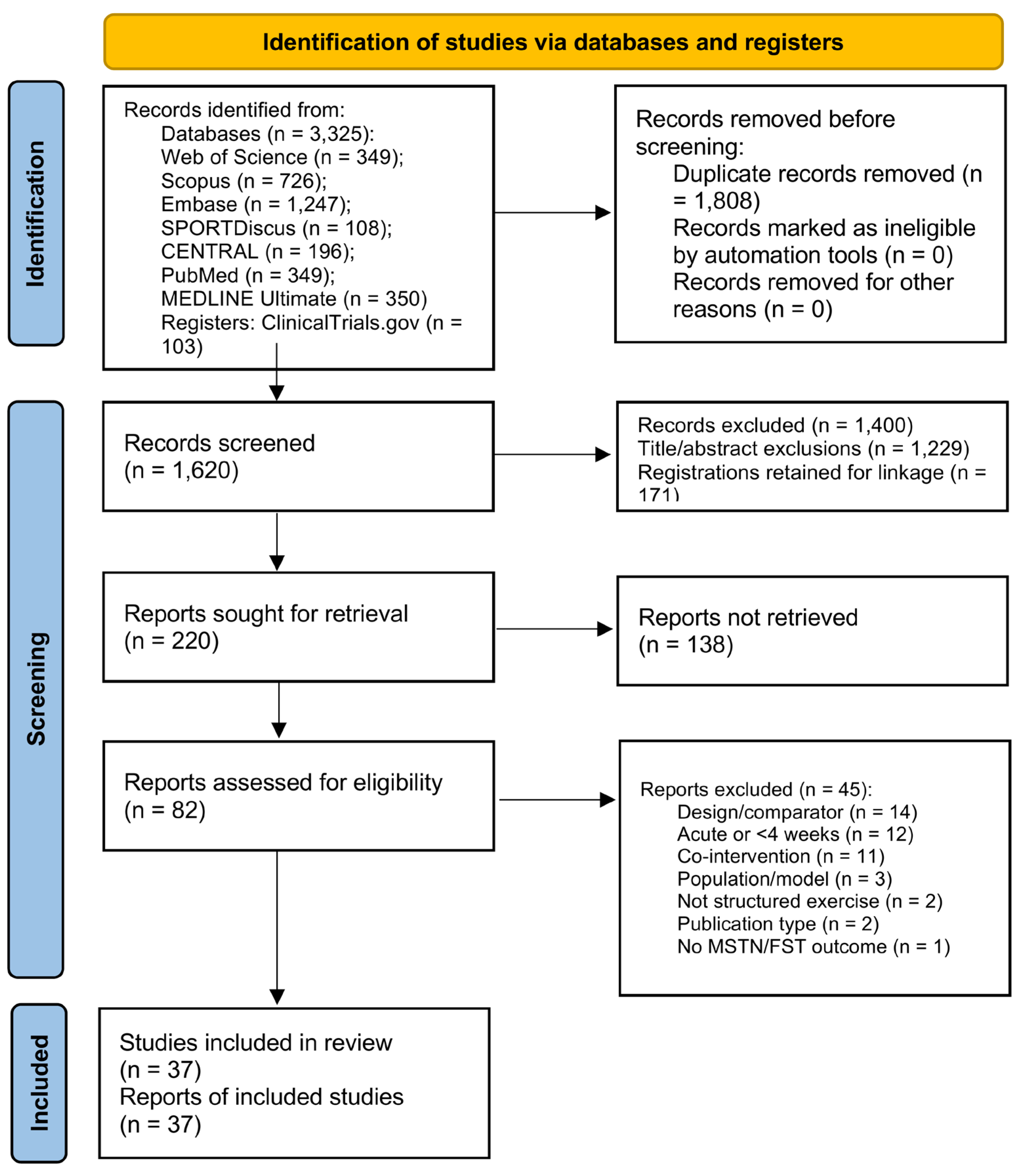
Figure 2.
Effects of structured exercise training on circulating myostatin and follistatin. (A) Myostatin (MSTN). (B) Follistatin (FST). Squares represent Hedges’ g for individual eligible comparisons, with horizontal lines denoting 95% confidence intervals and square sizes scaled by inverse-variance weights under the working-independence random-effects model. Diamonds show pooled effects and 95% confidence intervals from multilevel random-effects models with study-clustered CR2 small-sample correction. Positive values consistently indicate a direction favorable to exercise training, corresponding to lower MSTN or higher FST. Multiple comparisons from the same study were treated as correlated effects, and their dependence was modeled. Abbreviations: CR2, cluster-robust small-sample variance correction; FST, follistatin; MSTN, myostatin; REML, restricted maximum likelihood.
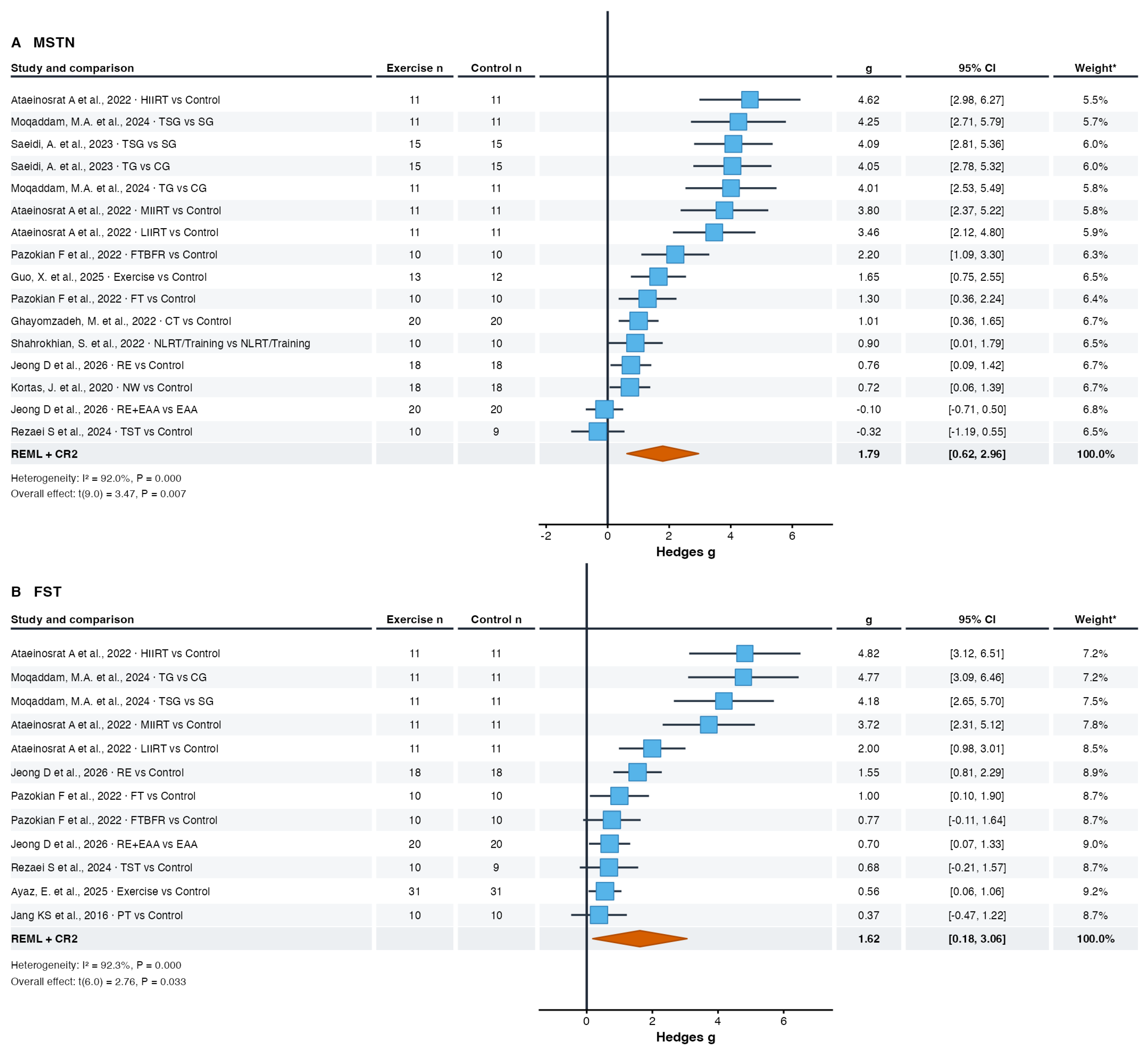
Figure 3.
Exploratory linear dose–response associations between program duration and effect sizes for circulating myostatin and follistatin. (A) Myostatin (MSTN). (B) Follistatin (FST). Solid lines show multilevel meta-regression predictions, shaded bands show 95% confidence intervals, and circles represent eligible comparisons scaled by effect-size precision. Horizontal dashed lines mark the null. Neither linear slope was statistically significant. Given the limited number of studies, effective degrees of freedom, and dose variation, these analyses are exploratory and do not identify an optimal program duration or nonlinear dose threshold.
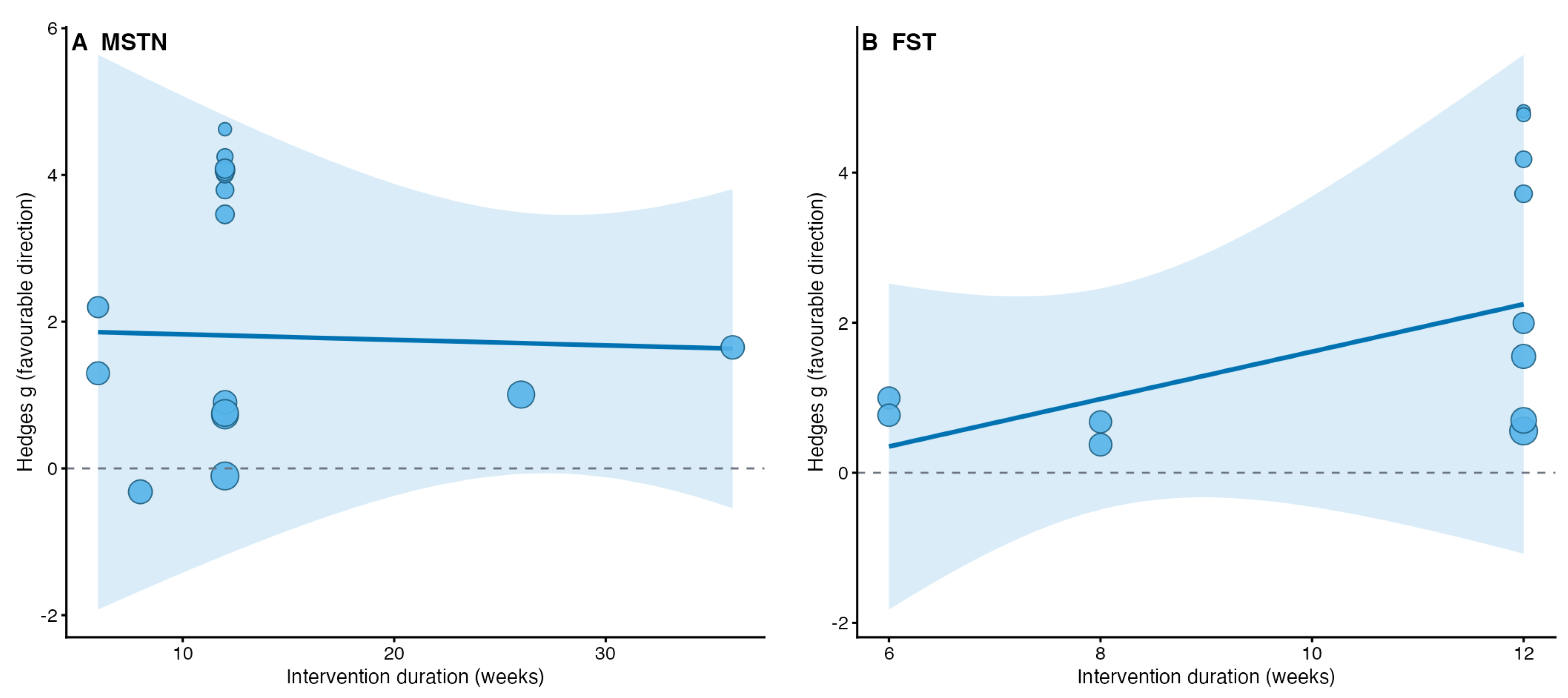
Figure 4.
Evidence-informed model of exercise-associated modulation of the myostatin–follistatin axis. Across the included structured-exercise interventions, the pooled evidence indicated lower circulating myostatin (MSTN) and higher circulating follistatin (FST). Thick navy arrows denote associations directly synthesized in this meta-analysis. Thin black arrows show established pathway biology that was not directly tested in the included studies. FST sequesters MSTN and reduces its availability for receptor binding [2]. Receptor-available MSTN binds ActRIIB, promotes ALK4/5 activation and SMAD2/3 phosphorylation, and facilitates formation of the p-SMAD2/3–SMAD4 complex involved in transcriptional regulation of myogenesis and anabolic processes [2,3,4,62]. Purple dashed elements indicate a proposed interpretation in which an exercise-associated increase in the glucagon-to-insulin ratio may promote hepatic FST secretion and attenuate downstream MSTN signaling [5]. Circulating concentrations do not establish ligand bioactivity, receptor occupancy, intracellular signaling, or muscle adaptation. Given the high heterogeneity and prediction intervals crossing the null, the model does not imply a superior exercise modality, an optimal dose, a confirmed mechanism, or a validated clinical surrogate endpoint. Abbreviations: ActRIIB, activin receptor type IIB; ALK4/5, activin receptor-like kinases 4 and 5; FST, follistatin; HIFT, high-intensity functional training; MSTN, myostatin; p-SMAD2/3, phosphorylated SMAD2/3; SMAD4, SMAD family member 4.
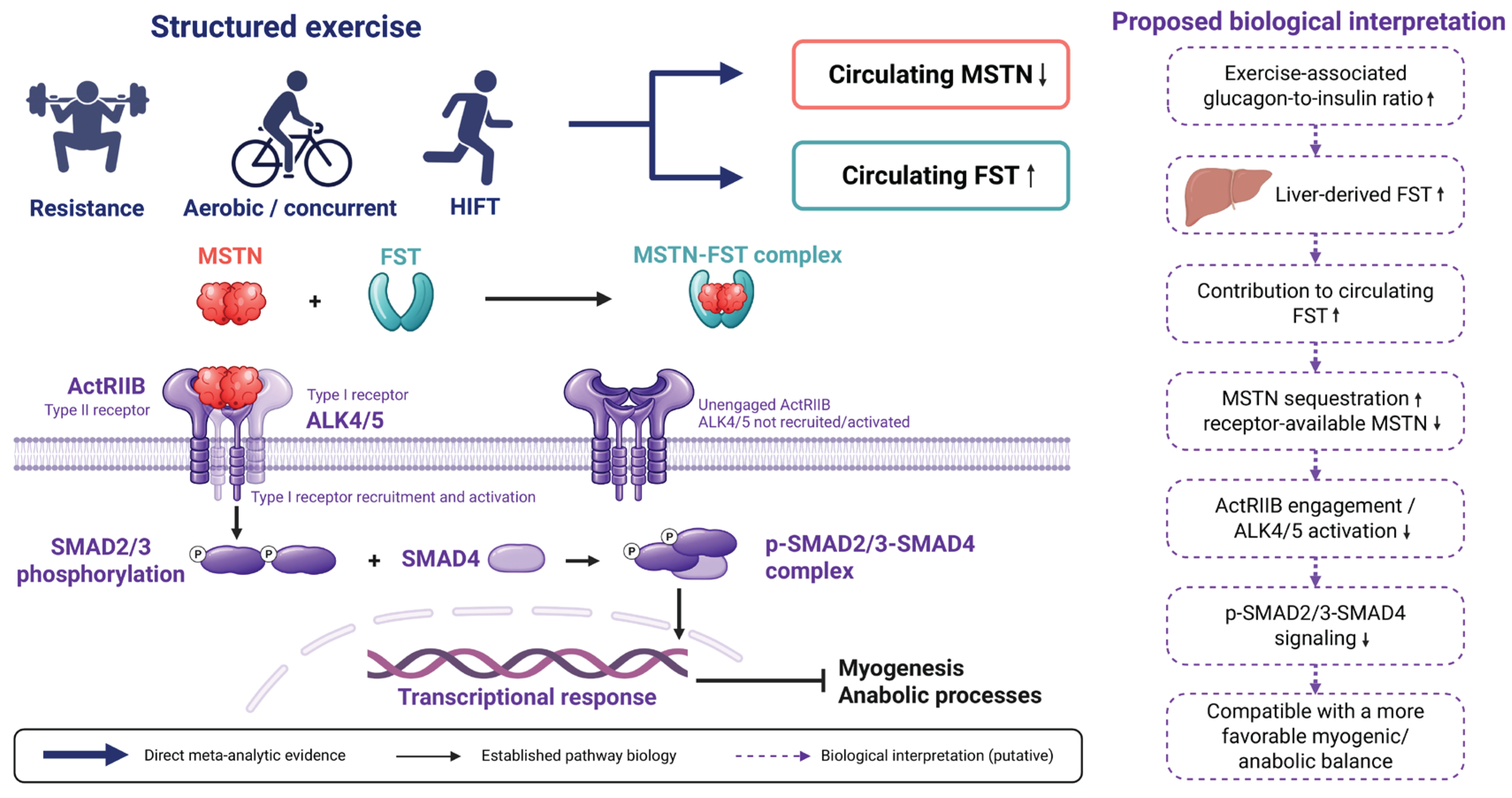

Table 1.
Characteristics of the included studies.
| Study | Country | Design and population | Baseline/analyzed n | Duration | Exercise intervention | Comparator | Outcome, specimen, and assay |
| Ayaz, E. (2025) [24] | Turkey | Multicenter RCT; institutionalized adults aged ≥65 years | 66/62 | 12 weeks | Combined aerobic and resistance training | Exercise vs. non-exercise control | FST; serum; immunoassay |
| Zhuang, M. (2025) [25] | China | Assessor-blinded RCT; adults aged ≥65 years with sarcopenia | 27/27 | 12 weeks | Whole-body vibration or resistance training | Direct comparison of two training modalities | MSTN and FST; blood/serum; ELISA |
| Jeong D (2026) [26] | Republic of Korea | Four-arm RCT; healthy women aged ≥65 years without insulin resistance | 96/NR | 12 weeks | Circuit resistance training | Control/RE/EAA/RE+EAA | MSTN and FST; serum; immunoassay |
| Zhang, M. (2024) [27] | China | Single-blind RCT; adults aged ≥65 years with sarcopenia | 21/21 | 12 weeks | Low-load BFR resistance training or conventional high-intensity resistance training | Direct comparison of training doses/modes | MSTN and FST; serum; ELISA |
| Ataeinosrat A (2022) [28] | Iran | Four-arm RCT; adult men with obesity | 44/44 | 12 weeks | Low-, moderate-, or high-intensity interval resistance training | Three intensities vs. non-exercise control | MSTN and FST; plasma; ELISA |
| Moqaddam, M.A. (2024) [29] | Iran | Four-arm RCT; adult men with obesity | Inconsistent/44 | 12 weeks | CrossFit/high-intensity functional training | Control/AST/training/training+AST | MSTN and FST; plasma; ELISA |
| Hofmann, M. (2016) [30] | Austria | Three-arm RCT (VAAS); institutionalized older women | 91/70 | 26 weeks | Elastic-band resistance training | RT/RT+nutrition/cognitive training control | MSTN and FST; serum; immunoassay |
| Seo, M.-W. (2021) [31] | Republic of Korea | RCT; women aged ≥65 years with sarcopenia | 22/22 | 16 weeks | Bodyweight plus elastic-band resistance training | RT vs. non-exercise control | MSTN and FST; plasma; ELISA |
| Saeidi, A. (2023) [32] | Iran | Four-arm RCT; adult men with obesity | 68/60 | 12 weeks | HIFT/CrossFit | Control/AST/training/training+AST | MSTN; plasma; ELISA |
| Arazi, H. (2020) [33] | Iran | Three-arm RCT; untrained young women | 36/36 | 8 weeks | Variable- or constant-resistance training | VRT/CRT/non-training control | MSTN and FST; serum; immunoassay |
| Mahboobi Semnan F (2026) [34] | Iran | Three-arm, single-blind RCT; adults who are overweight | 40/35 | 8 weeks | Whole-body EMS or resistance training | WB-EMS/RT/non-training control | MSTN and FST; serum; ELISA |
| Rezaei S (2024) [35] | Iran | Two-arm RCT; older men with sarcopenia | 19/19 | 8 weeks | TRX suspension training | TST vs. non-training control | MSTN and FST; serum; ELISA |
| Antunes-Correa, L.M. (2020) [36] | Brazil | Three-arm RCT; patients with NYHA Class II–III heart failure | 44/33 | NR | Aerobic or inspiratory muscle training | AET/IMT/control | FST; vastus lateralis; qPCR and Western blot |
| Dantas, W.S. (2020) [37] | Brazil/USA | RCT in post-bariatric surgery patients; women who underwent Roux-en-Y gastric bypass | NR/NR | 24 weeks | Combined aerobic and resistance training | RYGB + exercise / RYGB / lean reference | MSTN and FST; vastus lateralis; transcriptomics/qPCR/protein |
| Shahrokhian, S. (2022) [38] | Iran | Three-arm quasi-experimental study with stated random allocation; women with breast cancer | 20/NR | 12 weeks | Nonlinear or linear resistance training | NLRT/LRT/control | MSTN; serum; ELISA |
| Binns, A (2017) [39] | USA | Two-arm randomized longitudinal study; community-dwelling older adults | 33/NR | 20 weeks | High-velocity resistance training | HVRT/control | MSTN; serum; ELISA |
| Planella-Farrugia, C. (2019) [40] | Spain | Three-arm prospective RCT; adults aged 60–75 years | Inconsistent/NR | 16 weeks | Low-intensity resistance exercise | Control/RE/RE+nutrition | MSTN; serum; ELISA |
| Kortas, J. (2020) [41] | Poland | Two-arm RCT; postmenopausal older women | 42/36 | 12 weeks | Nordic walking | Nordic walking/non-training control | MSTN; serum; ELISA |
| Ryan, AS (2013) [42] | USA | Single-group longitudinal intervention; sedentary older adults with obesity | 33/33 | 26 weeks | Aerobic exercise combined with weight loss | Within-participant pre–post comparison | MSTN; serum and vastus lateralis; ELISA/qPCR/Western blot |
| Zhou, Y (2021) [43] | Sweden | Parallel-group RCT; patients with non-dialysis CKD | 151/NR | 52 weeks | Strength or balance training | Strength/balance training | MSTN; plasma; ELISA |
| Guo, X. (2025) [44] | China | Two-arm randomized clinical trial; older women with sarcopenic obesity | 25/25 | 36 weeks | Individualized resistance training | Training vs. lifestyle control | MSTN; serum; ELISA |
| Brooks, N.E. (2010) [45] | USA | Three-arm randomized controlled trial; healthy men on bed rest with an energy deficit | 31/31 | 4 weeks | Resistance exercise during bed rest | EAA/delayed RT + EAA/pre-exercise RT + EAA | MSTN; vastus lateralis; qPCR |
| Dawson, J.K. (2021) [46] | USA | Randomized trial substudy; prostate cancer survivors receiving ADT | 17/17 | 12 weeks | Periodized resistance training | RT/home-stretching control | MSTN; skeletal muscle biopsy; qPCR |
| Ghayomzadeh, M. (2022) [47] | Iran/Australia | Assessor-blinded RCT; adults living with HIV | 40/37 | 26 weeks | Concurrent training | Concurrent training/lifestyle control | MSTN; serum; ELISA |
| Gould, D.W. (2025) [48] | UK | Randomized trial muscle biopsy substudy; patients with CKD | 19/19 | 12 weeks | Aerobic or concurrent training | Aerobic/concurrent exercise | MSTN; vastus lateralis; qPCR/Western blot |
| Zuo, C. (2023) [49] | China | Two-arm RCT; young men | 20/18 | 6 weeks | Functional or traditional resistance training | FRT/TRT | MSTN; serum; ELISA |
| Watson EL (2017) [50] | UK | Randomized trial biopsy substudy; patients with CKD stages 3b–4 | 17/17 | 8 weeks | Progressive resistance training | RT/non-training control | MSTN; vastus lateralis; qPCR/Western blot |
| Radzimińska, A. (2018) [51] | Poland | Randomized double-blind controlled trial; adult women with urinary incontinence | 84/74 | 4 weeks | Pelvic-floor muscle training | PFMT/no-treatment control | MSTN; EDTA plasma; ELISA |
| Jerobin, J. (2021) [52] | Qatar/UK | Two-cohort pre–post training study; women with PCOS and matched healthy women | 19/19 | 8 weeks | Moderate-intensity aerobic training | Pre–post comparison in both cohorts | MSTN; plasma; ELISA |
| Micielska K (2021) [53] | Poland | Two independent training cohorts; older adults | 38/NR | 12 weeks of Nordic walking / 2 weeks of HIIT | Nordic walking or HIIT | Comparison of NW and HIIT of unequal duration | MSTN; serum; ELISA |
| Razi, O. (2026) [54] | Iran | 2×2 factorial RCT; adult men with obesity | 60/44 | 12 weeks | HIFT/CrossFit | Placebo/supplement/HIFT/HIFT+supplement | MSTN and FST; plasma; ELISA |
| Turoń-Skrzypińska, A. (2026) [55] | Poland | Two-arm RCT; patients undergoing hemodialysis | NR/NR | 13 weeks | Intradialytic virtual-reality exercise | NefroVR/usual dialysis | MSTN; plasma; ELISA |
| Brown, J.C. (2024) [56] | USA | 2×2 factorial multicenter RCT; stage I–III breast or colorectal cancer | 116/116 | 12 weeks | Aerobic exercise | Exercise/metformin/combined/control | MSTN and FST; EDTA plasma; multiplex immunoassay |
| Benavente, C. (2024) [57] | Spain | Three-group parallel training study; resistance-trained men | 33/NR | 8 weeks | Whole-body resistance training | Normoxia/terrestrial altitude/normobaric hypoxia | MSTN; serum; ELISA |
| Pazokian F (2022) [58] | Iran | Three-arm RCT; older men | 30/30 | 6 weeks | Functional training with or without BFR | FT/FT-BFR/control | MSTN and FST; serum; ELISA |
| Park J (2021) [59] | Republic of Korea | Two clinical pre–post cohorts; older women with sarcopenia with or without osteoarthritis | 19/19 | 15 weeks | Multicomponent exercise | Training in the SEG and OSEG cohorts | MSTN; serum; ELISA |
| Jang KS (2016) [60] | Republic of Korea | Two-arm RCT; male college students | 20/20 | 8 weeks | Open- and closed-chain pulley exercises | Pulley training/non-training control | FST; serum; ELISA |
Abbreviations: ADT, androgen-deprivation therapy; AET, aerobic exercise training; AST, astaxanthin; BFR, blood-flow restriction; CKD, chronic kidney disease; EAA, essential amino acids; ELISA, enzyme-linked immunosorbent assay; EMS, electromyostimulation; FST, follistatin; HIFT, high-intensity functional training; HIIT, high-intensity interval training; IMT, inspiratory muscle training; MSTN, myostatin; NR, not reported; NW, Nordic walking; PCOS, polycystic ovary syndrome; qPCR, quantitative polymerase chain reaction; RCT, randomized controlled trial; RT, resistance training; WB-EMS, whole-body electromyostimulation.
Table 2.
Primary meta-analytic estimates and heterogeneity statistics for circulating myostatin and follistatin.
Table 2.
Primary meta-analytic estimates and heterogeneity statistics for circulating myostatin and follistatin.
| Outcome | Model | Effects | Studies | Hedges’ g | 95% CI | p | I2(%) | 95% prediction interval |
| MSTN | Multilevel REML + CR2 | 16 | 10 | 1.79 | 0.62 to 2.96 | 0.007 | — | — |
| MSTN | Conventional REML | 16 | 10 | 2.17 | 1.26 to 3.09 | <0.001 | 91.98 | −1.38 to 5.72 |
| FST | Multilevel REML + CR2 | 12 | 7 | 1.62 | 0.18 to 3.06 | 0.033 | — | — |
| FST | Conventional REML | 12 | 7 | 1.96 | 0.88 to 3.05 | 0.002 | 92.29 | −1.64 to 5.56 |
Note: The multilevel REML model with study-clustered CR2 small-sample correction was the primary analysis. Conventional REML estimates assumed working independence and were used as reference models for I2 and prediction intervals. Dashes indicate statistics not estimated for the corresponding model. CI, confidence interval; CR2, cluster-robust small-sample variance correction; FST, follistatin; MSTN, myostatin; REML, restricted maximum likelihood.
Disclaimer/Publisher’s Note: The statements, opinions and data contained in all publications are solely those of the individual author(s) and contributor(s) and not of MDPI and/or the editor(s). MDPI and/or the editor(s) disclaim responsibility for any injury to people or property resulting from any ideas, methods, instructions or products referred to in the content. |
© 2026 by the authors. Licensee MDPI, Basel, Switzerland. This article is an open access article distributed under the terms and conditions of the Creative Commons Attribution (CC BY) license (http://creativecommons.org/licenses/by/4.0/).
Copyright: This open access article is published under a Creative Commons CC BY 4.0 license, which permit the free download, distribution, and reuse, provided that the author and preprint are cited in any reuse.