

Submitted:
03 September 2026
Posted:
04 September 2026
You are already at the latest version
Abstract
Tuberculosis (TB) remains a leading global infectious cause of death. While host lipidomics offers a promising frontier for biomarker discovery, the evidence base remains fragmented across heterogeneous study models, biological matrices, and analytical platforms. This scoping review systematically maps the landscape of TB host lipidomics to identify methodological trends, established knowledge clusters, and translational bottlenecks. Guided by the PRISMA-ScR and the PCC JBI (Joanna Briggs Institute) frameworks, a structured search was conducted across PubMed, Europe PMC, OpenAlex, and Google Scholar. The review protocol was prospectively registered on the Open Science Framework (OSF Protocol: 10.17605/OSF.IO/5EGMR). Forty-eight primary empirical studies published between 2014 and 2026 were selected for descriptive numerical analysis and thematic synthesis. Research is highly centralized in low- and middle-income countries (85.4%), with China, India, and South Africa acting as primary hubs. Methodological analysis revealed a heavy reliance on blood-based matrices (64.6% plasma/serum), with truly non-invasive matrices, urine and exhaled breath, accounting for only 14.6% of studies with liquid chromatography-mass spectrometry accounting for (77.1% LC-MS/MS). Glycerophospholipids (66.7%) and sphingolipids (43.8%) emerged as the most consistent systemic metabolic signatures of active disease. However, a severe longitudinal data deficit exists: 64.6% of studies are restricted to cross-sectional diagnostic discovery, while only 12.5% address treatment monitoring or prognosis. Critically, 70.8% of the evidence base lacked independent cohort validation, and no studies correlated host lipid profiles with direct measures of TB infectiousness. TB lipidomics has achieved technical maturity in initial diagnostic discovery but remains poorly optimized for longitudinal patient management and transmission control. A critical knowledge gap is the total absence of data linking host lipid signatures to aerobiologic measures of transmission potential, such as Cough Aerosol Culture (CAC) positivity. As primary disease burden hubs and research volume, LMICs are uniquely positioned to lead this next translational phase of prospective longitudinal validation. Advancing the field requires a deliberate reorientation toward specimen types and study designs capable of capturing the biology of the lung-airway interface, the anatomical origin of infectious aerosols. Prospective studies correlating systemic and localized lipid signatures with CAC-defined infectiousness in transmission cohorts represent an essential and entirely unexplored frontier for host-directed TB biomarker science.
Keywords:
biomarker
; lipidomics
; metabolomics
; Mycobacterium tuberculosis
; scoping review
; tuberculois
Introduction
Tuberculosis (TB) remains among the world’s deadliest infectious diseases. An estimated 10.7 million people fell ill with TB and 1.23 million died from the disease in 2024, corresponding to a global incidence rate of 131 per 100,000 population (WHO, 2025). The net reduction in TB incidence between 2015 and 2024 was only 12%, far short of the 50% milestone of the End TB Strategy. Diagnostic gaps remain central to this shortfall: approximately 2.4 million people who developed TB in 2024 were not diagnosed or reported, and a WHO-recommended rapid molecular test was used as the initial diagnostic test for only 54% of those newly diagnosed (WHO, 2025). These burdens fall disproportionately on children, people living with HIV, and communities in resource-limited settings, where sputum-dependent diagnostic pathways perform least well (Ong’ang’o et al., 2025a).
Recent TB research increasingly applies large-scale biological profiling methods ("omics") to generate new insights into disease processes and candidate biomarkers. Within this family of approaches, lipidomics, the comprehensive study of lipids and their metabolic pathways, has gained significant traction. Lipids are not peripheral molecules in TB biology but are central actors in both Mycobacterium tuberculosis (Mtb) pathobiology and host immune defense (Cambier et al., 2014; Russell et al., 2019). Mtb's lipid-rich cell envelope facilitates immune evasion, while host macrophage lipid metabolism is fundamentally remodeled upon infection to create the foamy macrophage phenotype central to granuloma formation (Cambier et al., 2014).
Lipidomics has been applied across a spectrum of contexts in TB research: from mechanistic characterization of the bacterial cell envelope and granuloma biology in experimental models, to profiling circulating lipids in human biofluids such as plasma, serum, urine, sputum, and exhaled breath (Shivakoti et al., 2022; Lyu et al., 2024). Despite this growing body of work, the evidence base is highly heterogeneous. Some studies pursue diagnostic discovery through case-control designs, others focus on pathogenesis mechanisms, and a smaller subset investigates prognostic or monitoring applications. This heterogeneity has led to fragmentation, creating persistent uncertainty about which lipid classes, specimen types, and analytical platforms are most analytically robust and clinically actionable.
Several ongoing debates further justify a comprehensive evidence mapping exercise. First, while multiple studies report strong diagnostic performance for lipid-based biomarkers (Shivakoti et al., 2022; Lyu et al., 2024), others highlight limited reproducibility across populations and study designs (Zhang et al., 2025). Second, there is a fundamental question of biological specificity: do observed lipid alterations primarily reflect host immune-metabolic responses to infection, or are they driven by pathogen-derived molecules (Cambier et al., 2014; Russell et al., 2019)? Third, uncertainty persists regarding whether high-resolution platforms, particularly LC-MS/MS and Nuclear Magnetic Resonance (NMR), can be implemented sustainably in the low-resource, high-burden settings where TB is most prevalent, given recurring infrastructure constraints (Bell et al., 2018; Lee et al., 2021).
This scoping review was designed to address these uncertainties systematically. A scoping design was selected in preference to a conventional systematic review because the objective was to map the breadth, characteristics, and methodological trends across a large and heterogeneous body of literature, rather than to answer a narrowly defined question of biomarker efficacy (Arksey and O’Malley, 2005; Peters et al., 2020). The review is further motivated by the pressing public health context of Kenya and comparable high-burden LMIC settings, which simultaneously face a severe triple burden of high TB incidence, a TB/HIV co-infection rate of approximately 25%, and rising drug-resistant TB, against a backdrop of constrained laboratory infrastructure (Ong’ang’o et al., 2025b).
The specific review question was: How has lipidomics been applied in tuberculosis biomarker discovery across human, animal, ex vivo, and in vitro studies, and what specimen types, analytical platforms, lipid classes, and research applications have been reported to date? Four operational objectives guided the analysis: (1) characterize the range of specimen types and analytical platforms employed; (2) summarize the lipid classes and pathways reported as significant; (3) map the distribution of studies across diagnostic, pathogenesis, monitoring, and prognostic applications; and (4) identify research gaps that should inform future host-directed biomarker discovery efforts. This review encompasses the full clinical spectrum of tuberculosis, including both pulmonary and extrapulmonary disease, together with animal and in vitro or ex vivo models of Mtb infection. No restriction was placed on anatomical site of disease, consistent with the registered protocol (OSF: 10.17605/OSF.IO/5EGMR).
Materials and Methods
Study Design and Registration
This study was designed as a scoping review conducted between December 2025 and May 2026. Methodology followed the five-stage framework of Arksey and O'Malley (2005), as refined by Peters et al. (2020), and the Population-Concept-Context (PCC) eligibility framework recommended by the Joanna Briggs Institute (JBI). Reporting adheres to the PRISMA Extension for Scoping Reviews (PRISMA-ScR) checklist (Tricco et al., 2018). The protocol was prospectively registered and archived on the Open Science Framework (OSF; DOI: 10.17605/OSF.IO/5EGMR) prior to data extraction, ensuring methodological transparency and reproducibility. Ethical approval was not required, as the review is based exclusively on published, publicly accessible primary literature and did not involve direct contact with human participants or collection of biological samples.
Information Sources and Search Strategy
A structured search strategy was developed to balance sensitivity and specificity, with PubMed/MEDLINE as the primary development platform due to its support for controlled vocabulary and iterative refinement. The final search strategy was organized around two core concept blocks: (1) the tuberculosis block, incorporating the MeSH term "Tuberculosis" alongside free-text terms including "Mycobacterium tuberculosis" and "tuberculous"; and (2) the lipidomics block, incorporating the MeSH term "Lipidomics" and free-text terms including "lipidomic*", "lipid profiling", "targeted lipidomics", "untargeted lipidomics", and "shotgun lipidomics". To maximize retrieval of mixed metabolomics studies with substantive lipid components, a supplementary lipid-metabolomics block was appended using "metabolom*" combined with lipid-class-specific terms including "phospholipid*", "sphingolipid*", "ceramide*", "triglycerid*", and "oxylipin*". Searches were also conducted in Europe PMC, OpenAlex, and Google Scholar (simplified phrase-based searches), with supplementary citation tracking performed on sentinel records. Full search strings and database logs are provided in the supplementary materials.
Eligibility Criteria
Eligibility was determined using the PCC framework. Eligible Population comprised the full clinical spectrum of tuberculosis, including both pulmonary and extrapulmonary disease, tuberculosis-relevant human cohorts, animal models of TB infection, or in vitro/ex vivo experimental systems relevant to TB biology. The Concept of interest was lipidomics or a substantive lipid-focused analytical component applied to TB biomarker discovery or related translational applications, including diagnostic, prognostic, treatment-monitoring, and mechanistic investigations. Context was unrestricted by geographic setting or temporal range.
Included study types were peer-reviewed primary empirical publications in English, across observational, interventional, and experimental designs, utilizing LC-MS, GC-MS, NMR, MALDI, or equivalent platforms. Exclusion criteria were: non-TB studies; studies lacking a substantive lipidomics component; reviews, systematic reviews, editorials, conference abstracts, theses, and grey literature; mixed metabolomics studies unless lipid findings were separately reported and substantively interpreted; and pathogen-only lipid studies without host biomarker or host-pathogen translational relevance.
Study Selection and Data Charting
Records were deduplicated using the Rayyan tool. Two independent reviewers screened titles and abstracts, advancing records to full-text review if directly eligible or borderline uncertain. Discrepancies were resolved by consensus. Full-text exclusions were categorized by predefined exclusion reason. Data were extracted using a standardized charting form capturing: bibliographic information, geographic origin, study design, population characteristics, specimen type, analytical platform, lipid classes and candidate biomarkers identified, primary research application, and identified research gaps. Extraction was piloted on a subset of included studies by two reviewers prior to full extraction, with discrepancies resolved by consensus. Descriptive numerical analysis and data visualization were performed in R (version 4.4.0). The charting form was refined during peer review to record site of disease, which was extracted retrospectively from the full texts of all included studies.
Synthesis Approach
Synthesis was descriptive and non-statistical, consistent with scoping review methodology. Findings were organized thematically across four dimensions: geographic distribution of research, specimen type distribution, analytical platform distribution, and primary research application. Cross-tabulation of lipid classes against research applications, and of analytical platforms against geographic setting, was employed to identify patterns and gaps within the evidence base. Percentages are rounded to one decimal place and may not sum to exactly 100.0% owing to rounding.
Results
Study Selection
The search identified 1,200 records across all databases. Following preliminary relevance sorting (n = 1,064 excluded), 136 records were exported for formal deduplication. Removal of 44 duplicate records yielded 92 unique records for title and abstract screening; 19 were excluded at this stage, advancing 73 records to full-text assessment. A further 25 records were excluded at full-text review: 12 for insufficient lipid-specific data, 8 for lack of translational focus, and 5 as pathogen-only lipid studies. Forty-eight unique studies met all inclusion criteria and were included in the evidence base (Figure S1 - PRISMA-ScR Flow Diagram).
Summary of Main Study Characteristics
Table 1 provides the categorical overview of the 48 included studies across three key variables: specimen type, analytical platform, and primary research application.
The evidence base is recent, spanning 2014 to 2026, with 58.3% (n = 28) of studies published from 2022 onwards It is also narrow in whom it studies: 87.5% (n = 42) of studies enrolled adults and only two (4.2%) addressed paediatric populations under 15 years, despite children accounting for a substantial share of undiagnosed tuberculosis. The remaining four studies comprise two mixed-age clinical cohorts enrolling both adults and children (4.2%), one experimental animal model (2.1%), and one study of laboratory pathogen isolates (2.1%), the latter two having no applicable human age category. Comorbidity reporting was sparse, with 34 studies (70.8%) reporting neither diabetes metrics nor HIV co-infection status, limiting the interpretability of lipid signatures in the populations where TB burden is highest. Case-control frameworks predominated (47.9%, n = 23) over cohort or longitudinal designs (29.2%, n = 14), a distribution examined further in Section 4.1. The included human evidence addresses predominantly pulmonary tuberculosis, with seven studies (14.6%) explicitly addressing extrapulmonary presentations: pleural tuberculosis (n = 3), tuberculous meningitis (n = 2), osteoarticular tuberculosis (n = 1), and one cohort comparing pulmonary and extrapulmonary disease within the same treatment-response framework. Notably, extrapulmonary phenotypes were not confined to site-specific matrices; osteoarticular tuberculosis was investigated using plasma, indicating that systemic lipid profiling has been applied beyond pulmonary disease. Full characteristics of the included studies, including the publication period distribution, site of disease, and the complete design breakdown, are presented in Table S3.
Geographic Distribution of Research
Geographically, 85.4% (n = 41) of studies originated from LMICs, with China (n = 25), South Africa (n ≈ 9), and India (n ≈ 7) collectively accounting for the overwhelming majority of the evidence base. Only five studies (10.4%) originated from High-Income Countries (HICs), and two (4.2%) employed mixed global cohorts. Table 2 presents the research focus and primary molecular outputs stratified by geographic hub.
China's research landscape is characterized by a high degree of thematic alignment, with 92% of its studies focused on diagnosis and pathogenesis through primary analysis of Glycerophospholipids and neutral lipids. High-income countries, despite contributing a smaller volume of research, demonstrate a distinct specialization in monitoring and safety applications, with 57% of molecular outputs centered on niche markers such as acyl-carnitines and oxysterols. India and South Africa show the most diversified research portfolio, with a notable extension into TB-diabetes comorbidity pathogenesis.
Distribution of Research Focus
As shown in Table 3, diagnosis represents the dominant research focus, accounting for 64.6% (n = 31) of the included studies. Pathogenesis constitutes the second largest category at 22.9% (n = 11). Longitudinal applications (Treatment and Monitoring, and Prognosis) each account for only 6.2% (n = 3), collectively representing approximately 12.5% of the total evidence base.
Distribution of Biological Sample Matrices
Plasma and serum represent the primary biological matrix, employed in 64.6% (n = 31) of included studies (Table 4). The remaining 35.4% (n = 17) span a heterogeneous set of alternative matrices. Localised compartment sampling accounts for the largest of these groups (12.5%, n = 6), comprising pleural fluid and pleural effusion extracellular vesicles, cerebrospinal fluid, and tissue. Truly non-invasive matrices remain scarce: urine and urinary extracellular vesicles were used in four studies (8.3%) and exhaled breath fractions in three (6.3%), together accounting for only 14.6% (n = 7) of the evidence base. Cell lysates or sputum were used in three studies (6.3%), and one study (2.1%) analysed supernatants from a stimulated whole-blood assay.
Distribution of Analytical Platforms
The distribution of analytical platforms across the 48 included studies is summarised in Table 1. Liquid Chromatography-Mass Spectrometry (LC-MS/LC-MS/MS) was the dominant analytical methodology, employed in 77.1% (n = 37) of studies. Alternative platforms were considerably less represented: GC-MS (8.3%, n = 4), NMR and other mass spectrometry variants (8.3%, n = 4), and targeted immunoassays (6.3%, n = 3).
Thematic Frequency of Identified Lipid Classes
Table 5 presents the frequency of major lipid classes identified as significant markers across the included evidence base. Glycerophospholipids(PC/PE) were the most frequently identified class, appearing in 66.7% (n = 32) of studies. Sphingolipids were identified in 43.8% (n = 21) of studies. Neutral Storage Lipids (TAG/DAG/MAG) and Cholesterol and Sterols appeared in 31.3% (n = 15) and 22.9% (n = 11) of studies, respectively.
Note that total counts exceed N = 48 as individual studies frequently identified significant markers across multiple lipid classes.
Cross-Tabulation: Lipid Classes by Research Focus
Table 6 presents the distribution of major lipid classes stratified by research focus. The diagnostic pillar concentrates the majority of biomarker reporting, particularly for Glycerophospholipids(n = 19) and Sphingolipids (n = 10). Studies focusing on prognosis and treatment monitoring report the fewest lipid markers across all categories; Neutral Storage Lipids and Cholesterol and Sterols show zero representation within prognostic research.
Geographic Stratification of Analytical Platforms
Table 7 presents the proportional distribution of analytical platforms by geographic setting. LC-MS/MS predominated in both contexts, accounting for 80.0% (n = 4) of HIC studies and 75.6% (n = 31) of LMIC studies, whereas all identified applications of GC-MS (n = 4) and immunoassay (n = 3) occurred exclusively within LMIC settings.
Study Design Distribution
Table 8 presents the distribution of broad study design categories. Case-control frameworks represent the predominant study architecture (47.9%, n = 23), followed by cohort/longitudinal designs (29.2%, n = 14). Collectively, non-longitudinal designs, case-control, other observational, experimental, and cross-sectional, comprise 70.8% (n = 34) of the evidence base, highlighting a systemic scarcity of prospective validation frameworks.
Biological Origin of Reported Lipid Findings
The biological origin of reported lipid species is summarised in Table 9. Host-derived signatures dominate the evidence base: 42 studies (87.5%) reported exclusively mammalian lipid species, spanning glycerophospholipids, sphingolipids, neutral storage lipids, sterols, and eicosanoid or specialised pro-resolving mediator classes. Three studies (6.3%) reported exclusively mycobacterial species, lipoarabinomannan, phosphatidylinositol mannosides, sulfoglycolipids, phthiocerol dimycocerosates and mycolic acids in exhaled breath condensate; tuberculostearic acid in cerebrospinal fluid; and mycolic acids with phosphatidylinositol mannosides in cultured isolates. A further three studies (6.3%) reported species of both origins, combining host phospholipid or eicosanoid profiling with detection of mycobacterial markers such as tuberculostearic acid, acylphosphatidylinositol mannosides, and trehalose-6-mycolate.
Origin was associated with specimen matrix. Of the 31 blood-based studies, two (6.5%) reported any pathogen-derived species, compared with four of the 17 studies using alternative matrices (23.5%). Pathogen-derived detection was thus concentrated in matrices sampled at or near the site of disease, exhaled breath, cerebrospinal fluid, sputum, lung tissue, and cultured isolates, while systemic profiling almost exclusively captured host metabolic response.
Discussion
Overview of the Selection Process
The reduction from 1,200 identified records to 48 included studies is itself an informative finding (Figure 1). It reflects a persistent gap between how often lipidomics appears as a keyword in TB literature and how often it is deployed rigorously as a primary tool for host biomarker discovery. The two largest categories of full-text exclusion are analytically revealing. Studies excluded for insufficient lipid-specific data (n = 12) mostly reported lipid fractions as secondary outputs within broader metabolomics pipelines, without the species-level resolution or class annotation that translational biomarker interpretation requires (Liebisch et al., 2013). Studies excluded for lack of translational focus (n = 8) represent mechanistic in vitro work that stops short of connecting observed lipid alterations to host pathophysiological states or clinically defined phenotypes. These two categories account for 80% of full-text rejections, and together they define the field's principal methodological frontier, which is the move from broad metabolic observation toward molecularly resolved, clinically anchored lipidomic profiling. The exclusion of five pathogen-only lipid studies reflects a related reorientation, in which the translational centre of gravity has shifted from structural characterisation of the Mycobacterium tuberculosis cell envelope toward profiling of the host immune-metabolic response (Cambier et al., 2014).
Geographic Distribution and Centralization Bias
The finding that 85.4% of the evidence originates from LMICs aligns the research geography with the global disease burden, a form of ecological validity that is commendable (Table 2). However, the further concentration of this LMIC evidence within just three nations (China, India, South Africa) represents a significant centralization bias. Regions that bear a substantial fraction of the global TB burden, including Eastern Europe, Francophone Africa, Southeast Asia, and Latin America, are critically underrepresented. This geographic imbalance is consequential because regional variations in host genetics, nutritional status, TB strain lineages, and co-morbidity patterns (particularly TB-HIV and TB-Diabetes) are known to influence the host lipidome (Yang et al., 2024). Lipid biomarkers identified and validated exclusively in Chinese or South African cohorts may not be generalizable across the full spectrum of global TB burden (Woods et al., 2023). The Kenyan context is itself an instructive exemplar of this under-representation: a high-burden setting with documented TB/HIV co-infection rates of approximately 25% (KSDCC, 2025), a persistent rise in DR-TB(CHS, 2023) and a near univeral delay in TB diagnosis (Ng’ang’a et al., 2025), yet absent from the current lipidomics evidence base as a study origin, a gap this review is positioned to help address.
The Dominant Diagnostic Paradigm and the Longitudinal Data Deficit
The concentration of 64.6% of studies on initial diagnostic discovery, compared to only 12.5% addressing monitoring and prognosis, reveals a critical structural imbalance in the field's ambitions (Table 3). This finding should be interpreted in light of the global TB treatment architecture: all TB patients who are diagnosed undergo a six-month treatment regimen, yet there are currently no validated lipid-based tools to objectively track treatment response, identify early treatment failure, or predict post-treatment relapse. The absence of such tools has real clinical consequences, as current monitoring relies heavily on sputum smear microscopy and culture, methods with known limitations in sensitivity, speed, and applicability to paucibacillary or pediatric TB(Basu and Chakraborty, 2025; WHO, 2025).
The predominance of case-control designs (47.9%; Table 8) compounds this limitation. Case-control studies measure lipid profiles at a single time point and cannot show how signatures evolve across infection, treatment, or recovery. Only 29.2% of studies employed cohort or longitudinal designs, which constrains translational progress directly. Serial lipidome profiling, from pre-treatment baseline through the full six-month course of therapy and beyond, is the necessary next step, and it is the standard approach by which candidate biomarkers of treatment response have been established in other infectious diseases (Weiner et al., 2018).
Specimen Matrix Bias and the Point-of-Care Imperative
Plasma and serum account for 64.6% of studies (Table 4), which reflects a pragmatic research choice, since blood is accessible, volumes are manageable, and pre-analytical handling protocols are well established (Liebisch et al., 2013). This systemic bias carries a translational cost. TB is primarily a pulmonary disease, and the metabolic events that matter most, including granuloma formation, macrophage lipid remodelling, and aerosol generation, occur at the lung-airway interface rather than in circulation (Russell et al., 2019). Blood provides a distal view of that process. Only three studies used sputum or cell lysates (6.3%) and three used exhaled breath (6.3%), so the localised metabolic environment relevant to transmission remains poorly characterised.
From a public health perspective, non-invasive and localised specimen types are essential for point-of-care deployment in high-burden LMIC settings. Exhaled breath aerosols and urine are particularly promising, since they require no phlebotomy and are applicable in community health worker settings (WHO, 2025). Three breath studies and four urine studies constitute the early evidence for this transition, and substantial methodological development remains. The three breath studies establish proof of concept for non-invasive matrix feasibility, but they are not yet analytically comparable. Chen et al. (2020) and Chen et al. (2022) both originated from the same Cape Town group and used aerosol particle capture with Orbitrap-based LC-MS/MS, identifying phosphatidylcholines and phosphatidylinositols as candidate markers, which provides internal replication within a single methodological tradition. Mosquera-Restrepo et al. (2022) used exhaled breath condensate rather than aerosol particles and applied a hybrid NMR and SFC-HRMS platform to identify mycobacterial lipids including lipoarabinomannan and phenolic glycolipids, which are structurally distinct from the host phospholipids reported in the Cape Town studies.
These divergences, between aerosol capture and condensate collection and between host-lipidome and pathogen-lipid targeting, mean the three studies measure different biological signals from the same anatomical compartment. Breath-based lipidomics cannot progress beyond isolated proof of concept toward a reproducible diagnostic pipeline until collection methods and analytical targets are standardised (McDonald et al., 2022).
Analytical Platform Landscape and Technology-Resource Alignment
The technological consensus around LC-MS/MS (77.1%) represents both a strength and a constraint (Table 1). Its dominance confirms that the field has achieved a sophisticated standard for primary discovery, LC-MS/MS provides the sensitivity, specificity, and breadth of lipid coverage needed to identify novel biomarkers. The notable finding that this platform is similarly prevalent across both HIC and LMIC settings (80.0% vs. 75.6%) (Table 7), suggests a successful alignment of LMIC research capacity with international discovery standards, even amid documented infrastructure challenges (Bell et al., 2018; Lee et al., 2021).
However, the exclusive presence of immunoassay and GC-MS platforms in LMIC settings signals an important secondary layer of the translational pipeline: the translation of complex omic findings into simpler, more deployable formats. GC-MS and targeted immunoassays require less specialized maintenance and may be more resilient to the supply chain and power stability challenges that frequently affect high-resolution instrumentation in resource-limited settings (Lee et al., 2021). The emergence of these platforms in LMIC contexts represents a practical pathway for converting laboratory-discovered lipid markers into accessible diagnostic tools closer to the point of care.
Dominant Lipid Classes: A Metabolic Signature of Membrane Remodeling
The consistent emergence of Glycerophospholipids (PC/PE; 66.7% of studies) and Sphingolipids (43.8%) as the most frequently reported significant markers across the evidence base establishes these two classes as a provisional metabolic signature of active TB (Table 5). This pattern is biologically coherent. Glycerophospholipids are major structural components of cell membranes and key precursors to lipid-signaling mediators; their perturbation in TB likely reflects the extensive macrophage membrane remodeling, lipid droplet biogenesis, and phospholipase activity that characterizes infected cells (Cambier et al., 2014; Russell et al., 2019). Sphingolipids, particularly ceramides and sphingomyelins, are critical regulators of apoptosis, autophagy, and inflammatory signaling, processes actively manipulated by Mtb to ensure intracellular survival (Russell et al., 2019).
These dominant classes are, without exception, host-derived. Coding the evidence base by biological origin (Table 9) shows that 87.5% of studies characterised mammalian lipid species only, with just six studies reporting mycobacterial species such as lipoarabinomannan, mycolic acids, phosphatidylinositol mannosides, or tuberculostearic acid. The field has therefore mapped the host metabolic response to infection in considerable detail while leaving the pathogen's own molecular signature comparatively uncharacterised. This asymmetry carries a diagnostic cost as mycobacterial lipids have no mammalian counterpart, so their detection is specific to infection in a way that perturbations in ubiquitous host phospholipids can never be. The provisional signature identified above is thus a signature of the host response to TB rather than of Mtb itself, a distinction that constrains how far these markers can discriminate TB from other conditions producing similar inflammatory remodelling.
The lower representation of Neutral Storage Lipids and Cholesterol/Sterols in prognostic and treatment-monitoring research (Table 6) defines a critical and mechanistically underexplored frontier. Cholesterol accumulation within foamy macrophages is a direct metabolic substrate for Mtb persistence; bacterial exploitation of host-derived cholesterol sustains intracellular survival and contributes to granuloma chronicity (Russell et al., 2019). It follows that remodeling or depletion of the systemic cholesterol pool during effective anti-TB therapy would be mechanistically expected to track bacterial clearance, positioning these classes as biologically plausible treatment-response markers whose translational potential remains entirely uncharacterized by the current evidence base.
Key Research Gaps
The analysis of the 48 included studies identifies four primary research gaps, ordered here by their strategic significance for advancing the field toward clinical utility.
First, longitudinal evidence is scarce. Without data tracking how lipid profiles change during and after anti-TB therapy, candidate markers cannot be validated for predicting treatment failure or relapse. This gap follows structurally from the dominance of case-control designs (47.9%; Table 8), which generate measurements at a single diagnostic time point and cannot establish whether a lipid signature tracks disease resolution or post-treatment outcome. All diagnosed TB patients undergo a standardised six-month regimen for which no validated lipid-based monitoring tool exists (WHO, 2025), so the clinical consequences of this gap are immediate.
Second, no study in this evidence base linked host lipid profiles, systemic or localised, to direct aerobiologic measures of infectiousness such as cough aerosol culture positivity. Cough aerosol culture quantifies viable Mtb in patient-generated respiratory aerosols and provides the most direct phenotypic measure of transmission potential currently available (Fennelly et al., 2012). CAC-positive patients transmit disproportionately, which makes their identification a priority for transmission interruption (Jones-López et al., 2013). The method requires specialised containment and sampling equipment, however, and it is not scalable for routine programmatic use. Whether plasma or airway lipid signatures correlate with CAC positivity is unknown, because no study has tested it. A signature that did correlate would offer a culture-independent proxy for identifying the most infectious index cases. This is the most consequential unexplored question identified by this review.
Third, the bias toward blood-based specimens (64.6%; Table 4) leaves the localised metabolic environment of the lung-airway interface, which is the anatomical origin of infectious aerosols, poorly characterised. This bias is a particular barrier to point-of-care tool development in LMIC settings, where non-invasive matrices such as urine and exhaled breath offer deployment advantages that blood-based assays cannot match (WHO, 2025). The three exhaled breath studies demonstrate feasibility, but methodological heterogeneity across collection approaches and analytical platforms prevents meaningful cross-study synthesis. This bias also shapes what can be detected. Pathogen-derived lipid species were reported in only two of the 31 blood-based studies, compared with four of the 17 studies using alternative matrices (Table 9), so proximity to the site of disease appears to govern access to the most diagnostically specific markers available.
Fourth, paediatric lipidomic research is nearly absent (n = 2; Table S3), and control for key confounders is limited, with HIV status reported in 8.3% of studies, diabetes metrics in 20.8%, and nutritional status or BMI rarely at all. These are analytically distinct problems. The paediatric gap reflects the different presentation and paucibacillary nature of childhood TB, which makes adult-derived signatures unlikely to transfer directly (Marais et al., 2004). The comorbidity gap reflects inadequate control for metabolic confounders known to remodel the host lipidome independently, particularly in the TB-HIV and TB-diabetes phenotypes most prevalent in high-burden settings (Restrepo, 2016).
Implications for Low- and Middle-Income Countries
The findings carry specific and actionable implications for LMICs, particularly for institutions such as the Kenya Medical Research Institute (KEMRI) that operate at the intersection of high-burden clinical environments and research infrastructure constraints. The finding that the majority of the evidence is already situated in LMICs represents a strategic opportunity whereby these countries are uniquely positioned to lead the longitudinal validation phase, ensuring that future lipid-based monitoring tools are optimised for the specific TB strain lineages, nutritional profiles, and co-infection patterns of their own populations. The documented use of immunoassays and GC-MS exclusively within LMIC settings suggests that the infrastructure for deploying targeted, simplified lipid assays is already present, a practical translational pathway that aligns directly with WHO's stated priority for near-point-of-care diagnostic tools in high-burden settings, where the operational constraints of high-resolution LC-MS/MS platforms present recurring barriers to sustainable deployment (Bell et al., 2018; Lee et al., 2021).
Limitations
Several limitations should inform interpretation of these findings. The review was restricted to English-language publications, which may have excluded relevant research from Francophone Africa, Latin America, and parts of Asia, and language restriction is a recognised source of bias in evidence synthesis that can distort the apparent geographic distribution of a literature (Neimann Rasmussen and Montgomery, 2018). Literature retrieval was conducted over a condensed period in May 2026, so studies published immediately before or during that window may be underrepresented in the thematic synthesis. The prospectively archived protocol (OSF DOI: 10.17605/OSF.IO/5EGMR) provides a timestamped record of the search dates.
The evidence base itself carries publication bias toward studies reporting statistically significant findings, and null results are therefore likely underrepresented (Dickersin, 1990; Song et al., 2010). Grey literature, theses, and organisational reports were excluded. That decision maintained a consistent standard of peer review across included sources, though it narrows the coverage of the evidence map, particularly for work conducted in settings where findings are more often reported outside indexed journals (Paez, 2017). As a scoping review, this study did not appraise the methodological quality of individual studies, assess the statistical robustness of reported biomarkers, or generate pooled performance estimates; such tasks require a targeted systematic review with meta-analysis (Munn et al., 2018).
A further limitation lies in the heterogeneity of the evidence base, which operates at four levels. Biologically, findings from in vitro macrophage systems, animal models, and human cohorts describe different degrees of physiological complexity, and they are not interchangeable as sources of candidate biomarkers. Analytically, untargeted discovery profiling and targeted quantitative assays coexist across the included studies, so reported species differ both in the confidence of their identification and in whether absolute concentrations are recoverable. Pre-analytically, variation in matrix collection, storage, extraction protocol, and internal standard use introduces systematic differences that are rarely reported in enough detail to permit correction (Liebisch et al., 2013). Biomarker definition is inconsistent as well: significant species are variously determined by fold change, by univariate testing with or without correction for multiple comparisons, or by contribution to multivariate models, which makes reported discriminatory performance difficult to compare across studies. Together these differences constrain cross-study synthesis and help explain why few candidate markers have been independently replicated. Harmonised reporting standards for lipidomic studies in tuberculosis are a precondition for clinical translation.
Conclusions
This scoping review asked how lipidomics has been applied in tuberculosis research and what the resulting evidence base can support. Forty-eight studies were mapped across human, animal, ex vivo, and in vitro models. The field has reached technical maturity in diagnostic discovery. A methodological consensus has formed around LC-MS/MS platforms, and glycerophospholipids and sphingolipids emerge consistently as markers of active disease. The evidence base does not yet support clinical management over time. Case-control designs predominate, and these produce molecular measurements at a single diagnostic time point rather than across the course of treatment.
Coding every study by the biological origin of the reported lipid species shows that 87.5% characterised host-derived species only. The field has described the host response to infection in considerable detail. The molecular signature of the pathogen itself remains largely uncharacterised, despite the diagnostic specificity that mycobacterial lipids offer.
Three changes would move the field toward clinical utility. The first is a shift from case-control diagnostic designs toward prospective cohorts with serial lipidome profiling, which would allow lipid signatures to be tested against treatment response. The second is engagement with the biology of infectiousness. No study in this evidence base linked host lipid profiles to direct aerobiologic measures of transmission potential. Whether a lipid signature of cough aerosol culture positivity exists remains unknown, because the studies that would test it have not been conducted. This is the most consequential gap identified in this review. The third is adoption of standardised reporting for lipid species identification, extraction workflows, and cohort characteristics, which would make cross-study synthesis possible.
TB lipidomics has established a substantial body of work in diagnostic discovery. Extending that work to treatment trajectories and transmission biology will determine whether lipid biomarkers become clinically useful, particularly in the high-burden settings where non-sputum diagnostics are most needed.
Supplementary Materials
The following supporting information can be downloaded at the website of this paper posted on Preprints.org. Table S1: Full list of included studies (n = 48); Table S2: Complete database search log; Table S3: Characteristics of the 48 included studies; Figure S1: PRISMA-ScR flow diagram; Appendix S1: Data extraction form; Appendix S2: OSF-registered protocol.
Author Contributions
JOG: Writing - original draft, Writing - review & editing, Conceptualization, Data curation, Formal analysis, Investigation, Methodology, Project administration, Software, Validation, Visualization. NO: Conceptualization, Methodology, Investigation, Supervision, Writing - review & editing. GOD: Conceptualization, Methodology, Investigation, Supervision, Writing - review & editing. All authors contributed to the article and approved the submitted version.
Funding
This research received no external funding.
Artificial Intelligence Statement
To improve text clarity, formatting, and grammatical accuracy during manuscript preparation. Following this automated refinement process, the authors meticulously reviewed, cross-referenced, and edited the text to guarantee factual correctness, and we maintain complete accountability for the final integrity of the submitted work.
Informed Consent Statement
Not applicable.
Data Availability Statement
The datasets analyzed for this review study can be found in the Open Science Framework.
Acknowledgments
The authors express their gratitude to Prof. Videlis Nduba, PhD, and colleagues at the Kenya Medical Research Institute, Centre for Respiratory Diseases Research (KEMRI/CRDR), for their professional support. We also sincerely thank the faculty members and students at Liverpool John Moores University (LJMU), as well as UNICAF, for their valuable academic institutional framework and support throughout this study.
Conflicts of Interest
The authors declare no conflicts of interest.
Ethical Statement: Ethical review and approval were not required for this study as it is a scoping review based exclusively on previously published, publicly accessible literature. The research did not involve human participants, animal subjects, primary collection of biological samples, or access to identifiable personal data.
References
- Arksey, H.; O’Malley, L. Scoping studies: towards a methodological framework. International Journal of Social Research Methodology 2005, 8, 19–32. [Google Scholar] [CrossRef]
- Basu, S.; Chakraborty, S. A Comprehensive Review of the Diagnostics for Pediatric Tuberculosis Based on Assay Time, Ease of Operation, and Performance. Microorganisms 2025, 13, 178. [Google Scholar] [CrossRef] [PubMed]
- Bell, L.; Calder, B.; Hiller, R.; Klein, A.; Soares, N. C.; Stoychev, S. H.; et al. Challenges and Opportunities for Biological Mass Spectrometry Core Facilities in the Developing World. Journal of Biomolecular Techniques : JBT 29 2018, 4–15. [Google Scholar] [CrossRef] [PubMed]
- Cambier, C. J.; Takaki, K. K.; Larson, R. P.; Hernandez, R. E.; Tobin, D. M.; Urdahl, K. B.; et al. Mycobacteria manipulate macrophage recruitment through coordinated use of membrane lipids. Nature 2014, 505, 218–222. [Google Scholar] [CrossRef] [PubMed]
- Chen, D.; Bryden, N. A.; Bryden, W. A.; McLoughlin, M.; Smith, D.; Devin, A. P.; et al. Non-volatile organic compounds in exhaled breath particles correspond to active tuberculosis. Sci Rep 2022, 12, 7919. [Google Scholar] [CrossRef] [PubMed]
- Chen, D.; Bryden, W. A.; Wood, R. Detection of Tuberculosis by The Analysis of Exhaled Breath Particles with High-resolution Mass Spectrometry. Sci Rep 2020, 10, 7647. [Google Scholar] [CrossRef] [PubMed]
- CHS. Tuberculosis in Kenya. CHS: Centre for Health Solutions - Kenya. 2023. Available online: https://chskenya.org/tuberculosis-in-kenya/ (accessed on 24 June 2026).
- KSDCC. Kenya AIDS Response Progress Report 2025; Kenya Syndemic Diseases Control Council: Nairobi, 2025; Available online: http://chrome-extension://efaidnbmnnnibpcajpcglclefindmkaj/https://nsdcc.go.ke/wp-content/uploads/2025/11/Kenya-AIDS-Progress-Report-2025.pdf (accessed on 24 June 2026).
- Lee, S.; Chintalapudi, K.; Badu-Tawiah, A. K. Clinical Chemistry for Developing Countries: Mass Spectrometry. Annual Review of Analytical Chemistry 2021, 14, 437–465. [Google Scholar] [CrossRef] [PubMed]
- Lyu, L.; Jia, H.; Liu, Q.; Ma, W.; Li, Z.; Pan, L.; et al. Individualized lipid profile in urine-derived extracellular vesicles from clinical patients with Mycobacterium tuberculosis infections. Frontiers in Microbiology 2024, 15. [Google Scholar] [CrossRef] [PubMed]
- Mosquera-Restrepo, S. F.; Zuberogoïtia, S.; Gouxette, L.; Layre, E.; Gilleron, M.; Stella, A.; et al. A Mycobacterium tuberculosis fingerprint in human breath allows tuberculosis detection. Nature communications 2022, 13, 7751–7751. [Google Scholar] [CrossRef] [PubMed]
- Ng’ang’a, J. M.; Karanja, S.; Ong’ang’o, J. R. Factors Associated with Delay in Diagnosis of Tuberculosis among Newly Diagnosed Patients in Meru County. East African Journal of Health and Science 2025, 8, 495–508. [Google Scholar] [CrossRef]
- Ong’ang’o, J. R.; Ross, J.; Kiplimo, R.; Kerama, C.; Tram, K. H.; Zifodya, J. S.; et al. Persistently high TB prevalence in Nairobi County neighbourhoods, 2015-2022. PLOS Glob Public Health 2025a, 5, e0003849. [Google Scholar] [CrossRef] [PubMed]
- Ong’ang’o, J. R.; Ross, J.; Kiplimo, R.; Kerama, C.; Tram, K. H.; Zifodya, J. S.; et al. Persistently high TB prevalence in Nairobi County neighbourhoods, 2015–2022. PLOS Global Public Health 2025b, 5, e0003849. [Google Scholar] [CrossRef] [PubMed]
- Peters, M. D.; Marnie, C.; Tricco, A. C.; Pollock, D.; Munn, Z.; Alexander, L.; et al. Updated methodological guidance for the conduct of scoping reviews. JBI evidence synthesis 2020, 18, 2119–2126. [Google Scholar] [CrossRef] [PubMed]
- Russell, D. G.; Huang, L.; VanderVen, B. C. Immunometabolism at the interface between macrophages and pathogens. Nature Reviews Immunology 2019, 19, 291–304. [Google Scholar] [CrossRef] [PubMed]
- Shivakoti, R.; Newman, J. W.; Hanna, L. E.; Queiroz, A. T. L.; Borkowski, K.; Gupte, A. N.; et al. Host lipidome and tuberculosis treatment failure. European Respiratory Journal 2022, 59. [Google Scholar] [CrossRef] [PubMed]
- Tricco, A. C.; Lillie, E.; Zarin, W.; O’Brien, K. K.; Colquhoun, H.; Levac, D.; et al. PRISMA Extension for Scoping Reviews (PRISMA-ScR): Checklist and Explanation. Annals of Internal Medicine 2018, 169, 467–473. [Google Scholar] [CrossRef] [PubMed]
- WHO. Global tuberculosis report 2025; World Health Organization: Geneva, 2025; Available online: https://www.who.int/publications/i/item/9789240116924 (accessed on 18 August 2026).
- Woods, W. A.; Watson, M.; Ranaweera, S.; Tajuria, G.; Sumathipala, A. Under-representation of low and middle income countries (LMIC) in the research literature: Ethical issues arising from a survey of five leading medical journals: have the trends changed? Global Public Health 2023, 18, 2229890. [Google Scholar] [CrossRef] [PubMed]
- Yang, H.; Ruan, X.; Li, W.; Xiong, J.; Zheng, Y. Global, regional, and national burden of tuberculosis and attributable risk factors for 204 countries and territories, 1990–2021: a systematic analysis for the Global Burden of Diseases 2021 study. BMC Public Health 2024, 24, 3111. [Google Scholar] [CrossRef] [PubMed]
- Zhang, C.; Cai, M.; Cai, H.; Chen, X. Plasma lipidomic analysis reveals distinct lipid alterations in patients with pulmonary tuberculosis. European Journal of Medical Research 2025, 30, 566. [Google Scholar] [CrossRef] [PubMed]
Figure 1.
The PRISMA-SCR flow diagram of the study selection process. The diagram illustrates the systemic flow of records from initial identification (n=1,200) to the final inclusion of 48 studies. Preliminary relevance sorting and duplicate resolution were performed to refine the search results prior to formal title/abstract and full text screening based on pre-defined eligibility criteria.
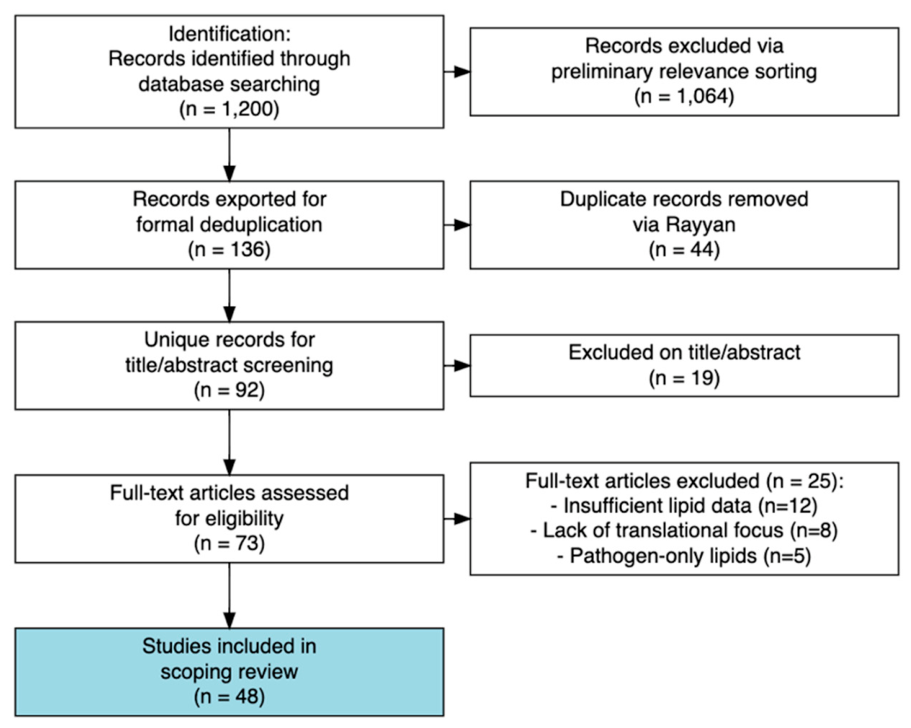

Table 1.
Summary of main study characteristics across the 48 included studies.
| Variable | Category | Count (n) | Percentage (%) |
|---|---|---|---|
| Specimen Type | Blood-based (Plasma/Serum) | 35 | 72.9% |
| Other (Non-Invasive / Localized) | 13 | 27.1% | |
| Analytical Platform | LC-MS / LC-MS/MS | 37 | 77.1% |
| GC-MS / GC×GC | 4 | 8.3% | |
| Other (NMR / MS Variants) | 4 | 8.3% | |
| Immunoassay | 3 | 6.3% | |
| Research Application | Diagnosis | 31 | 64.6% |
| Pathogenesis | 11 | 22.9% | |
| Prognosis / Other | 3 | 6.3% | |
| Treatment / Monitoring | 3 | 6.3% |
Percentages are rounded to one decimal place and may not sum to exactly 100.0% owing to rounding.
Table 2.
Distribution of research focus and molecular findings by geographic region.
| Research Hub | Research Focus (n, %) | Primary Molecular Output (n, %) |
|---|---|---|
| China (n=25) | Diagnosis/Pathogenesis: 23 (92.0%); Safety: 2 (8.0%) | Glycerophospholipids: 18 (72.0%); Neutral Lipids/PCs: 7 (28.0%) |
| India/South Africa (n=16) | Diagnosis/Pathogenesis: 13 (81.3%); Monitoring/Response: 3 (18.7%) | Glycerophospholipids: 12 (75.0%); Other Lipids: 4 (25.0%) |
| HIC/Mixed (n=7) | Monitoring/Safety: 4 (57.1%); Diagnosis: 3 (42.9%) | Acyl-carnitines/Oxysterols: 4 (57.1%); Other Lipids: 3 (42.9%) |
| Total | 48 (100%) | 48 (100%) |
Table 3.
Distribution of included studies by primary research focus (n = 48).
| Research Focus | Description | Count (n) | Percentage (%) |
|---|---|---|---|
| Diagnosis | Identification of active TB vs. controls, LTBI, or other respiratory diseases | 31 | 64.6% |
| Pathogenesis | Basic science, host-pathogen interactions, and mechanistic biological studies | 11 | 22.9% |
| Treatment & Monitoring | Longitudinal tracking of therapeutic efficacy and drug-induced injury monitoring | 3 | 6.2% |
| Prognosis / Other | Predictive modeling of disease progression, relapse risk, and specialized phenotyping | 3 | 6.2% |
| Total | 48 | 100% |
Table 4.
Distribution of biological sample matrices utilized in included studies (n = 48).
| Sample Matrix | Description | Count (n) | Percentage (%) |
|---|---|---|---|
| Plasma / serum | Standard blood-derived matrices for systemic profiling | 31 | 64.6 |
| Localised compartment fluids and tissue | Pleural fluid and pleural effusion extracellular vesicles, cerebrospinal fluid, and tissue | 6 | 12.5 |
| Urine | Whole urine and urinary extracellular vesicles | 4 | 8.3 |
| Cell lysates / sputum | Direct measurements from infected cells or respiratory secretions | 3 | 6.3 |
| Exhaled breath | Exhaled breath condensate and aerosol particles | 3 | 6.3 |
| Stimulated whole-blood supernatant | QuantiFERON assay supernatant | 1 | 2.1 |
| Total | 48 | 100.0 |
Percentages are rounded to one decimal place and may not sum to exactly 100.0% owing to rounding.
Table 5.
Frequency of major lipid classes identified as significant markers (n = 48).
| Lipid Class | Description/ Biological interpretation | Count (n) | Percentage (%) |
|---|---|---|---|
| Glycerophospholipids(PC/PE) | Major cell membrane components and signaling precursors | 32 | 66.7% |
| Sphingolipids | Lipids involved in cell signaling and host-pathogen interactions (e.g., SM, Cer) | 21 | 43.8% |
| Neutral Storage Lipids | Triacylglycerols, diacylglycerols, and monoacylglycerols (TAG/DAG/MAG) | 15 | 31.3% |
| Cholesterol & Sterols | Free cholesterol, cholesteryl esters, and oxysterols | 11 | 22.9% |
Percentages are rounded to one decimal place and may not sum to exactly 100.0% owing to rounding.
Table 6.
Distribution of major lipid classes across TB research focus.
| Lipid Class | Diagnosis | Pathogenesis | Treatment/Monitoring | Prognosis |
|---|---|---|---|---|
| Glycerophospholipids(PC/PE) | 19 | 6 | 2 | 1 |
| Sphingolipids | 10 | 5 | 1 | 1 |
| Neutral Storage Lipids | 7 | 3 | 2 | 0 |
| Cholesterol & Sterols | 8 | 1 | 1 | 0 |
Table 7.
Proportional distribution of analytical platforms by geographic setting.
| Analytical Platform | HIC (n=5) | LMIC (n=41) | Mixed (n=2) | Total (N=48) |
|---|---|---|---|---|
| LC-MS / LC-MS/MS | 80.0% (4) | 75.6% (31) | 100.0% (2) | 77.1% (37) |
| GC-MS | 0.0% (0) | 9.8% (4) | 0.0% (0) | 8.3% (4) |
| Other (NMR/MS Variants) | 20.0% (1) | 7.3% (3) | 0.0% (0) | 8.3% (4) |
| Immunoassay | 0.0% (0) | 7.3% (3) | 0.0% (0) | 6.3% (3) |
Percentages are rounded to one decimal place and may not sum to exactly 100.0% owing to rounding.
Table 8.
Study Design breakdown of included lipidomics studies (n = 48).
| Broad Study Design Category | Count (n) | Proportion (%) |
|---|---|---|
| Case-Control | 23 | 47.9% |
| Cohort / Longitudinal | 14 | 29.2% |
| Other Observational | 7 | 14.6% |
| Experimental / Laboratory | 2 | 4.2% |
| Cross-Sectional | 2 | 4.2% |
| Total | 48 | 100% |
Percentages are rounded to one decimal place and may not sum to exactly 100.0% owing to rounding.
Table 9.
Biological origin of reported lipid findings across the 48 included studies.
| Biological Origin | Description | Count (n) | Percentage (%) |
|---|---|---|---|
| Host-derived | Reported species of mammalian origin only | 42 | 87.5% |
| Pathogen-derived | Reported species of mycobacterial origin only | 3 | 6.3% |
| Both | Species of each origin reported and interpreted | 3 | 6.3% |
| Total | 48 | 100.0% |
Percentages are rounded to one decimal place and may not sum to exactly 100.0% owing to rounding. Origin was coded from the lipid classes and candidate biomarkers charted for each study; study-level classifications are given in Table S1.
Disclaimer/Publisher’s Note: The statements, opinions and data contained in all publications are solely those of the individual author(s) and contributor(s) and not of MDPI and/or the editor(s). MDPI and/or the editor(s) disclaim responsibility for any injury to people or property resulting from any ideas, methods, instructions or products referred to in the content. |
© 2026 by the authors. Licensee MDPI, Basel, Switzerland. This article is an open access article distributed under the terms and conditions of the Creative Commons Attribution (CC BY) license (http://creativecommons.org/licenses/by/4.0/).
Copyright: This open access article is published under a Creative Commons CC BY 4.0 license, which permit the free download, distribution, and reuse, provided that the author and preprint are cited in any reuse.