

Submitted:
03 September 2026
Posted:
04 September 2026
You are already at the latest version
Abstract
Hexavalent chromium (Cr⁶⁺) pollution critically threatens ecological and human health, driving demand for efficient fluorescent sensors. This work fabricated a chiral multilayer three-dimensional aggregation-induced emission (AIE) conjugated polymer via palladium-catalyzed asymmetric Suzuki-Miyaura cross-coupling, using thiophene diboronic ester, 1,8-dibromonaphthalene, and dibromodibenzofuran as aromatic monomers with chiral Pd[S-BINAP]Cl₂ as the catalyst. The stereoregular layered network was confirmed by ¹H NMR and GPC. Photophysical tests revealed excitation-wavelength-tunable luminescence, typical AIE effects, and solvatochromic behavior in THF/water, THF/simulated body fluid, and THF/simulated urine systems. Ion sensing experiments showed the polymer exhibits excellent selective recognition for Cr⁶⁺, with fluorescence intensity linearly correlated to Cr⁶⁺ concentration and a detection limit of 316.5 μM. Mechanistic studies via dynamic light scattering and electrochemistry indicated that sensing proceeds through coordination-induced aggregate enlargement and intermolecular charge transfer. This work offers a reliable platform for Cr⁶⁺ detection in complex aqueous and biomimetic environments, significantly expanding the application of ternary monomer-assembled chiral AIE polymers in environmental and biological sensing.
Keywords:
chiral multilayer 3D polymer
; aggregation-induced emission
; fluorescent chemosensor
; ion recognition
1. Introduction
The growing problem of heavy metal contamination in industrial wastewater, surface water and biological fluids has created an urgent demand for high-performance fluorescent sensing materials, which has in turn stimulated extensive research into topological conjugated macromolecules with tailored photophysical and molecular recognition properties [1,2,3,4]. Among emerging functional polymer architectures, chiral multilayer three-dimensional (3D) macromolecules constructed from multi-aromatic building blocks have attracted wide attention by integrating intrinsic chiral skeletons, hierarchical layered stacking and extended π-conjugated networks assembled via ternary aromatic units [5,6,7,8,9]. Such unique ternary-combined topological structures endow materials with distinctive excitation-dependent luminescence, aggregation-responsive optical behavior and stereoselective molecular recognition capacity [10,11,12]. As an important photophysical property embedded in this three-component chiral 3D framework, aggregation-induced emission (AIE) shows great application prospects for trace hazardous ion identification in complicated multi-component aqueous and biological systems [13].
Essentially different from conventional aggregation-caused quenching (ACQ) fluorophores, AIE luminogens emit intense fluorescence upon molecular aggregation because non-radiative intramolecular rotational and vibrational relaxation pathways are effectively suppressed, making them superior signal reporters for sensing in high-polarity aqueous media [14,15].The chiral multilayer spatial stacking structure co-assembled by thiophene, 1,8-dibromonaphthalene and dibenzofuran aromatic units enables precise modulation of intramolecular rotation freedom and intermolecular π–π stacking intensity, which is critical for amplifying AIE efficiency and tuning solvatochromic luminescence color [16]. Meanwhile, abundant electron-rich heteroatom sites distributed across the three-component layered skeleton (sulfur atoms on thiophene units and oxygen atoms on dibenzofuran rings) provide sufficient coordination binding sites for high-valent metal analytes, enabling selective ion capture and efficient signal transduction [17]. In the present work, a chiral multilayer 3D conjugated polymer with ordered layered topology was synthesized via palladium-catalyzed asymmetric Suzuki polymerization, using three matched aromatic building blocks: 2,5-bis(4,4,5,5-tetramethyl-1,3,2-dioxaborolan-2-yl)thiophene, 1,8-dibromonaphthalene and 4,6-dibromodibenzo[b,d]furan as comonomers [18]. The chiral S-BINAP ligand was introduced to drive asymmetric cross-coupling and construct stereoregular layered conjugated chains from the three aromatic monomers, and the successful synthesis as well as molecular weight distribution of the ternary-composed chiral polymer was fully validated by ¹H NMR spectroscopy and gel permeation chromatography (GPC) [19].
Hexavalent chromium (Cr⁶⁺) is a highly toxic and carcinogenic heavy metal ion widely discharged from industrial electroplating, tanning and mineral processing effluents, which causes severe damage to aquatic ecosystems and human health even at trace concentrations [20]. Traditional instrumental detection techniques for Cr⁶⁺ generally suffer from expensive equipment, complicated sample pretreatment and inability for on-site rapid screening, highlighting the necessity for facile and sensitive fluorescent chemosensors [21]. Although various single or binary monomer-based achiral multilayer 3D AIE polymer probes have been developed for metal ion detection, most of these materials lack stereoselective recognition capability and cannot maintain stable sensing signals in complex biomimetic fluid matrices such as simulated body fluid and simulated urine.
Distinct from previously reported achiral single/thiophene binary 3D polymer sensors, the ternary aromatic monomer-combined chiral layered architecture designed in this work achieves an exclusive fluorescence enhancement response toward Cr⁶⁺ among a wide range of interfering metal cations, accompanied by an observable solvatochromic color shift and a quantifiable linear correlation between fluorescence intensity and Cr⁶⁺ concentration. Comprehensive characterizations including steady-state photoluminescence, UV–vis absorption, dynamic light scattering (DLS) and cyclic voltammetry (CV) were performed to elucidate the ion-sensing mechanism: Cr⁶⁺ acts as an electron-deficient bridging center to cross-link the three-unit assembled polymer chains, enlarging hydrodynamic aggregate sizes and triggering intermolecular charge transfer, which jointly amplify radiative emission via the core AIE restriction of intramolecular motion (RIM) mechanism [24,25]. Anti-interference experiments further confirm the stable sensing performance under multi-cation coexistence conditions [22,23]. This research deepens the understanding of ternary aromatic monomer-assembled chiral multilayer 3D polymer design, AIE photophysical regulation and selective coordination interactions with heavy metal ions, and provides theoretical guidance for the development of next-generation chiral topological polymer sensors.
2. Materials and Methods
2.1. Materials and Instruments
All synthetic manipulations were implemented within anhydrous, deoxygenated nitrogen environments to avoid side reactions triggered by moisture and atmospheric oxygen. Prior to use, all organic solvents underwent rigorous dehydration treatment, while all glass reactors were thermally dried under vacuum to eliminate adsorbed water impurities. Upon the completion of each polymerization and small-molecule synthetic procedure, volatile solvents were stripped from crude mixtures by vacuum rotary evaporation, and subsequent silica column chromatography was utilized for purification. Eluent systems were carefully selected to isolate target polymers from unreacted monomers, catalyst impurities and low-molecular byproducts.
A series of standard characterization tools were utilized to comprehensively analyze the chemical architecture, molecular weight distribution, optical performance, electrochemical features and aggregate behavior of the chiral layered AIE polymer. Proton nuclear magnetic resonance (¹H NMR) spectroscopy was adopted to validate the accurate molecular framework and monomer copolymerization ratio of the product. Gel permeation chromatography (GPC) was performed to acquire vital macromolecular indices such as number-average molecular mass, weight-average molecular mass and polydispersity index. Steady-state ultraviolet–visible absorption and photoluminescence (PL) measurements were conducted to characterize the inherent optical traits and AIE-associated photophysical responses of the polymer in organic–water blended solutions with varied compositions. Cyclic voltammetry (CV) measurements were carried out to explore the energy level structure and redox behaviors of the conjugated backbone. Dynamic light scattering (DLS) was adopted to quantify the hydrodynamic sizes of polymer aggregates in aqueous–organic mixtures, offering direct experimental evidence for the AIE working mechanism.
2.2. Synthetic Procedure of Chiral Multilayer 3D Polymer
2,5-bis(4,4,5,5-tetramethyl-1,3,2-dioxaborolan-2-yl)thiophene 1 (336 mg, 1 mmol, 1 equiv), 1,8-dibromonaphthalene 2 (286 mg, 1 mmol, 1.0 equiv), 4,6-dibromodibenzo[b,d]furan 3 (326 mg, 1 mmol, 1.0 equiv), K₂CO₃ (553 mg, 4 mmol, 8 equiv) and Pd[S-BINAP]Cl₂ (40 mg, 0.05 mmol, 5 mol%) were charged into a 100 mL oven-dried round-bottom flask, followed by addition of 20 mL of THF and 4 mL of deionized water (THF:H₂O = 5:1, v/v). The flask was subjected to three freeze-pump-thaw cycles to remove dissolved oxygen, then backfilled with nitrogen. The mixture was heated to 85 °C and stirred for over 96 h.
After cooling to room temperature, the reaction mixture was poured into vigorously stirred methanol acidified with a small amount of hydrochloric acid. The precipitated solid was collected by filtration through a Buchner funnel, washed repeatedly with methanol and deionized water, and dried under vacuum to afford the target chiral multilayer 3D polymer co-assembled by three aromatic monomers as a pale yellow solid. The complete asymmetric cross-coupling synthetic route of the three matching aromatic monomers (thiophene diboronate, 1,8-dibromonaphthalene, dibenzofuran dibromide) to construct stereoregular chiral layered conjugated network is intuitively illustrated in Figure 1.
¹H NMR spectroscopy was adopted to verify the chemical structure of the target ternary-composed polymer; the NMR spectrum is presented in Figure S1 of Supporting Information. GPC characterization was conducted to measure the molecular weight and distribution of the chiral three-dimensional polymer, and the GPC elution curve together with molecular weight data are displayed in Figure S2 of Supporting Information.
3. Results
3.1. Excitation-Wavelength-Dependent Photoluminescence Performance
Systematic photoluminescence (PL) characterizations of the as-prepared chiral multilayer 3D conjugated polymer were performed at a concentration of 0.05 mg/mL in pure tetrahydrofuran (THF), and the results are summarized in Figure 2.
Figure 2a displays serial PL spectra collected under excitation wavelengths ranging from 280 nm to 410 nm. In THF good solvent, polymer chains are fully stretched without severe steric constraints, and unrestricted intramolecular rotations and vibrations of thiophene, fused aromatic and dibenzofuran units aggravate non-radiative energy dissipation, resulting in moderate intrinsic fluorescence intensity. With variation of excitation wavelength, the emission maximum, fluorescence intensity and full width at half maximum change regularly: the PL intensity first increases, reaches its peak under approximately 370 nm excitation, and then gradually decreases with further red-shift of excitation wavelength. Meanwhile, long-wavelength excitation activates low-energy electron transition channels within the extended conjugated domains, accompanied by continuously red-shifted emission peaks and slight alteration of peak width.
The corresponding CIE 1931 chromaticity coordinates and color variation trajectory are presented in Figure 2b. The chromaticity points shift regularly along a continuous gradient path with increasing excitation wavelength, visually demonstrating the luminescence color evolution of the polymer system.
To eliminate intensity interference and verify the intrinsic bathochromic shift behavior, all PL spectra were normalized to their respective maximum intensity and plotted in Figure 2c. The normalized curves clearly show a monotonous red-shift of the emission maximum with stepwise increase of excitation wavelength, while the overall spectral profile and peak shape remain well preserved, confirming that the emission red-shift is an inherent photophysical feature of the polymer system.
3.2. AIE and Solvatochromic Behavior in Aqueous Biomimetic Media
The AIE performance and solvatochromic properties of the chiral multilayer 3D conjugated polymer were investigated in three organic-aqueous mixed solvent systems, with the volume fraction of aqueous poor solvent adjusted from 0% to 90%. The three systems are THF/deionized water, THF/simulated body fluid (SBF) and THF/simulated urine (SU), and the results are shown in Figure 3.
Figure 3a–c display the steady-state PL spectra of the polymer in the three mixed systems, all measured at a fixed excitation wavelength of 280 nm. At 0% aqueous fraction (pure THF), the polymer exhibits very weak intrinsic fluorescence emission. With stepwise increase of aqueous fraction, the PL intensity increases progressively and reaches the maximum at 90% aqueous fraction, directly demonstrating the typical AIE characteristic of the polymer. Meanwhile, the maximum emission wavelength shows an obvious red-shift with increasing water fraction, and the luminescence color gradually shifts from the blue-violet region to the green region, revealing a distinct solvatochromic effect. Notably, the polymer maintains highly consistent AIE and solvatochromic responses in both SBF and SU biomimetic matrices.
Figure 3d–f record the corresponding UV–vis absorption spectra. In pure THF solution, the polymer presents a sharp characteristic absorption band ascribed to the π-π* transition of the conjugated backbone. With increasing aqueous fraction, the absorption spectra gradually broaden, and an evident absorption tail emerges in the long-wavelength range, accompanied by a slight red-shift of the maximum absorption wavelength. The highly consistent spectral variation tendency among the three solvent systems proves that the polymer can form stable and ordered aggregates in diverse aqueous matrices.The AIE data after normalization processing and their chromaticity changes are shown in Figure S3.
3.3. Ion Recognition Selectivity and Quantitative Sensing Toward Cr⁶⁺
The fluorescence and UV–vis absorption responses of the chiral multilayer 3D AIE polymer toward a series of common metal cations were systematically investigated under fixed excitation conditions.
Figure 4a presents the steady-state PL spectra of the polymer incubated with various metal ions at an excitation wavelength of 280 nm. Only the Cr⁶⁺ system gives rise to a remarkable enhancement in fluorescence intensity, while the PL profiles of other metal ions (Au³⁺, Al³⁺, Ba²⁺, Ca²⁺, Cu²⁺, Hg²⁺, Mg²⁺, Mn²⁺, Na⁺, Ni²⁺, Pb²⁺, Pd²⁺, Zn²⁺, Fe³⁺, K⁺) nearly overlap with that of the blank sample.
The corresponding UV–vis absorption spectra are displayed in Figure 4b. All ion-added systems show negligible changes in overall absorption profile, peak wavelength and absorbance, indicating that the fluorescence enhancement triggered by Cr⁶⁺ mainly originates from modulation of excited-state energy dissipation pathways rather than ground-state electronic structure variation.
Normalized PL spectra are shown in Figure 4c, which more intuitively verify that only Cr⁶⁺ induces a significant elevation of normalized emission intensity at the characteristic peak.
Figure 4d quantitatively compares the fluorescence response via histogram statistics. The fluorescence intensity of systems containing both Cr⁶⁺ and each competing ion remains at a high level comparable to the single Cr⁶⁺ system without obvious attenuation, confirming excellent anti-interference capability.
Gradient concentration fluorescence titration experiments were carried out to characterize detection sensitivity, and the evolution of PL spectra with increasing Cr⁶⁺ dosage is shown in Figure 4e. Fluorescence intensity increases steadily and monotonically with rising Cr⁶⁺ concentration, accompanied by a slight red-shift of the emission peak.
Based on the titration data, the linear fitting curve between maximum fluorescence intensity and Cr⁶⁺ concentration was established (Figure 4f). The linear fitting equation is Y = 66.61 + 0.461X with a correlation coefficient R² = 0.77453. According to the standard 3σ/slope method, the limit of detection (LOD) was calculated to be 316.5 μM.The fluorescence intensity of the polymer under different pH conditions is shown in Figure S4; the polymer remains relatively stable across these conditions.
3.4. Aggregation Behavior Characterization by Dynamic Light Scattering
Dynamic light scattering (DLS) measurements were performed to track the variation of hydrodynamic diameters of polymer aggregates under gradient Cr⁶⁺ concentrations, and the corresponding particle size distribution profiles are displayed in Figure 5.
Figure 5a stands for the blank polymer solution without Cr⁶⁺ (0 μM), showing a narrow monomodal distribution with an average hydrodynamic particle size of roughly 400 nm. After introducing Cr⁶⁺ at 85 μM (Figure 5b), the average aggregate diameter slightly rises to around 600 nm. As Cr⁶⁺ concentration is further raised to 170 μM (Figure 5c) and 255 μM (Figure 5d), the mean hydrodynamic size sequentially increases to nearly 1500 nm and 2500 nm, accompanied by gradual broadening of the particle size distribution width. When the Cr⁶⁺ concentration reaches the maximum tested value of 340 μM (Figure 5e), the average aggregate diameter sharply grows up to approximately 8000 nm, which clearly reveals the concentration-dependent aggregation growth trend of the chiral polymer.
3.5. Electrochemical Properties and Ion Binding Analysis
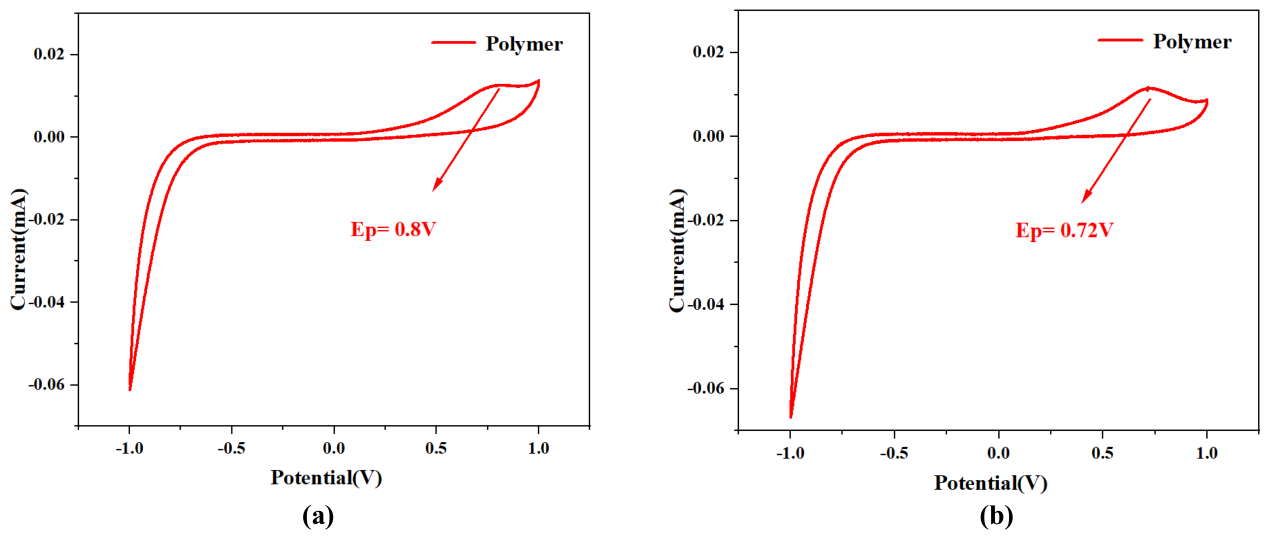
Cyclic voltammetry (CV) curves of the chiral multilayer 3D AIE polymer before and after Cr⁶⁺ incubation were measured with Ag/AgCl as the reference electrode in a potential scanning range from −1.0 V to 1.0 V, and the results are presented in Figure 6.
Figure 6a shows the CV curve of the pristine polymer sample. The polymer exhibits a well-defined anodic oxidation peak at Ep = 0.8 V during positive scanning, while no distinct corresponding reduction peak appears in reverse negative scanning, indicating that the electrochemical oxidation of the 3D conjugated polymer is an irreversible process under the test conditions.
After incubation with Cr⁶⁺, the CV curve is shown in Figure 6b. Compared with the pristine polymer, the anodic oxidation peak shifts negatively to Ep = 0.72 V, and the peak shape remains well-resolved without significant attenuation of peak current.
4. Discussion
The above experimental results collectively demonstrate that the as-synthesized chiral multilayer 3D conjugated polymer possesses excellent AIE activity and specific Cr⁶⁺ recognition performance. From the perspective of structure–property relationship, the introduction of chiral S-BINAP catalyst constructs a stereoregular layered topological skeleton, which not only endows the polymer with excitation-wavelength-tunable luminescence property, but also provides a stereoselective microenvironment for ion binding. Compared with achiral multilayer 3D polymer sensors reported in previous work , the chiral material in this work maintains stable AIE and sensing responses in SBF and SU biomimetic matrices with complex components, showing broader application scenarios.
The sensing mechanism can be elucidated from two aspects: aggregation behavior and electronic interaction. DLS results confirm that Cr⁶⁺ ions serve as intermolecular bridging centers to cross-link adjacent polymer chains through coordination with electron-rich heteroatom sites (thiophene sulfur and dibenzofuran oxygen), leading to continuous enlargement of aggregate sizes. Larger aggregated structures impose stronger steric restriction on intramolecular motions of conjugated chromophores, thus suppressing non-radiative energy dissipation and enhancing fluorescence via the RIM mechanism. In addition, CV analysis provides direct evidence for charge transfer interaction: as an electron-deficient high-valent metal species, Cr⁶⁺ acts as an electron acceptor after binding to the polymer skeleton, reducing the electron cloud density of the conjugated backbone and causing a negative shift of oxidation potential. The synergistic effect of aggregation enhancement and charge transfer jointly contributes to the specific fluorescence enhancement response toward Cr⁶⁺.
It should be noted that the current detection limit of 316.5 μM meets the basic requirements for routine screening of Cr⁶⁺ in industrial wastewater, but there is still room for improvement in sensitivity for trace detection in drinking water and biological fluids. Follow-up work can further optimize the monomer structure and binding site density to improve detection sensitivity, and explore the application of the material in photoelectric dual-mode sensing systems.
5. Conclusions
In summary, a chiral multilayer 3D conjugated polymer with AIE activity was successfully synthesized via asymmetric Suzuki polymerization. The polymer exhibits excitation-wavelength-tunable luminescence property and typical AIE effect accompanied by solvatochromic behavior in deionized water, simulated body fluid and simulated urine media. The polymer shows excellent selective recognition ability and anti-interference performance toward Cr⁶⁺, with a linear fluorescence response in the micromolar concentration range. DLS and electrochemical characterizations confirm that the sensing mechanism is based on coordination-induced aggregate enlargement and intermolecular charge transfer. This work provides a new strategy for the design of chiral AIE polymer sensors, and demonstrates the application potential of such materials in environmental water monitoring and biological fluid detection.
Funding
Starting Funding of Changzhou University (ZMF25020019).
Conflicts of Interest
The authors declare no conflict of interest.
References
- Montreemuk, J.; Rongsayamanont, W.; Ussawarujikulchai, A.; Pansak, W.; Prapagdee, B. 2025 Evaluation of heavy metal contamination in landfills and role of multi-heavy metal-resistant rhizobacteria in heavy metal mobilization. Int. J. Environ. Sci. Technol. 22, 15893–908. [CrossRef]
- Liu, Y.; Zu, B.; Dou, X. Cellulose-based fluorescent materials for chemical sensing applications. Coord. Chem. Rev. 2025, 532 216505. [Google Scholar] [CrossRef]
- Deree, Y.; Bogoslavsky, B.; Schapiro, I. Gidron O 2024 The photochemistry and photophysics of benzoyl-carbazole. Phys. Chem. Chem. Phys. 26, 18048–53. [PubMed]
- Kusano, S.; Konishi, S.; Ishikawa, R.; Sato, N.; Kawata, S.; Nagatsugi, F.; Hayashida, O. Synthesis of water-soluble triazinophanes and evaluation of their molecular recognition properties: Synthesis of water-soluble triazinophanes and evaluation of their molecular recognition properties. Eur. J. Org. Chem. 2017, 1618–23. [Google Scholar] [CrossRef]
- Tsakanika, M.; Stergiou, A.; Pantazidis, C.; Sakellariou, G. 2026 Single-ion solid polymer electrolytes by design: chemistries, architectures and functional trade-offs. J. Mater. Chem. A Mater. Energy Sustain. 14, 25150–77. [CrossRef]
- Wu, G.; Liu, Y.; Rouh, H.; Ma, L.; Tang, Y.; Zhang, S.; Zhou, P.; Wang, J.-Y.; Jin, S.; Unruh, D.; Surowiec, K.; Ma, Y.; Li, G. Asymmetric catalytic approach to multilayer 3D chirality Chem. Eur. J. 2021, 27, 8013–20. [Google Scholar] [CrossRef] [PubMed]
- Li, X.; Dong, S.; Fan, T.; Wang, Q.; Shi, T. Role of chiral skeleton in chiral phosphoric acids catalyzed asymmetric transfer hydrogenation: A DFT study. Catalysts 2023. [Google Scholar] [CrossRef]
- Chen, H.; Suo, X.; Yang, Z.; Dai, S. 2022 Graphitic Aza-fused π-conjugated networks: Construction, engineering, and task-specific applications. Adv. Mater. 34, e2107947. [CrossRef] [PubMed]
- Pan, Z.; Gao, S.; Zhao, Y.; Liao, B.; Cui, Y.; Guo, J.; Pang, H. Processability-enhanced aromatic thermotropic liquid crystalline copolyesters via the introduction of the unsymmetrical units. J. Appl. Polym. Sci. 2023, 140. [Google Scholar] [CrossRef]
- Zhou, B.; Yan, D. Excitation-dependent organic persistent luminescence. Sci. China Chem. 2020, 63, 423–5. [Google Scholar] [CrossRef]
- Hamada, H.; Tsuji, H.; Nakamura, E. Aggregation-responsive ON–OFF–ON fluorescence-switching behaviour of twisted tetrakis(benzo[ b ]furyl)ethene made by hafnium-mediated McMurry coupling Mater. Chem. Front. 2018, 2, 296–9. [Google Scholar]
- Testa, A.; Lucas, X.; Castro, G. V.; Chan, K.-H.; Wright, J. E.; Runcie, A. C.; Gadd, M. S.; Harrison, W. T. A.; Ko, E.-J.; Fletcher, D.; Ciulli, A. 2018. 3-fluoro-4-hydroxyprolines: Synthesis, conformational analysis, and stereoselective recognition by the VHL E3 ubiquitin ligase for targeted protein degradation. J. Am. Chem. Soc. 140, 9299–313. [CrossRef] [PubMed]
- Wu, W.; Li, Z. Nanoprobes with aggregation-induced emission for theranostics. Mater. Chem. Front. 2021, 5, 603–26. [Google Scholar] [CrossRef]
- Jia, Y.-Y.; Yin, J.-C.; Li, N.; Zhang, Y.-H.; Feng, R.; Yao, Z.-Q.; Bu, X.-H. 2022 Crystalline-state solvent: Metal-organic frameworks as a platform for intercepting aggregation-caused quenching Chin. J. Chem. 40, 589–96. [CrossRef]
- Gabr, M. T.; Pigge, F. C. 2021 AIE luminogens as versatile bioprobes. Curr. Anal. Chem. 17, 302–16. [CrossRef]
- Khatua, S.; Kashyap, N.; Sen, B.; Baruah, K.; Rabha, M.; Kalita, D. J 2026 A solvatochromic luminescence color switchable iridium( iii ) complex of a click-generated ligand for nitroaromatic explosive detection. CrystEngComm 28, 2403–14. [CrossRef]
- Li, Q.; Guo, W.; Wang, Z.; Tan, L.-L.; Shang, L. Tailoring electron-rich fluorescent supramolecular organic frameworks for efficient capture and visual monitoring of iodine. Adv. Funct. Mater. 35. [CrossRef]
- Ahluwalia, G.; Subbiah, J.; Mitchell, V. D.; Saker Neto, N.; Jones, D. J. One-pot synthesis of fully conjugated amphiphilic block copolymers using asymmetrically functionalized push–pull monomers. Macromolecules 2022, 55, 2872–81. [Google Scholar] [CrossRef]
- Anisimov, A. A.; Drozdov, F. V.; Vysochinskaya, Y. S.; Minyaylo, E. O.; Peregudov, A. S.; Dolgushin, F. M.; Shchegolikhina, O. I.; Muzafarov, A. M. Organoboron derivatives of stereoregular phenylcyclosilsesquioxanes Chem. Eur. J. 2020, 26, 11404–7. [Google Scholar] [CrossRef] [PubMed]
- Ponraj, S. B.; Zhou, R.; Wang, P.; Zhang, T.; Alam, D.; Soltani, B.; Ostrikov, K (ken); Zhou, R.; Cullen, P. J 2023 Hexavalent chromium reduction by atmospheric plasma bubbles. J. Environ. Chem. Eng. 11, 111018. [CrossRef]
- Roy, P. Fluorescent chemosensors based on 4-methyl-2,6-diformylphenol. Coord. Chem. Rev. 2021, 427, 213562. [Google Scholar] [CrossRef]
- Zhu, X.; Wang, Y.; Nadinov, I.; Thomas, S.; Gutiérrez-Arzaluz, L.; He, T.; Wang, J.-X.; Alkhazragi, O.; Ng, T. K.; Bakr, O. M.; Alshareef, H. N.; Ooi, B. S.; Mohammed, O. F 2024 Leveraging intermolecular charge transfer for high-speed optical wireless communication. J. Phys. Chem. Lett. 15, 2988–94. [CrossRef] [PubMed]
- Li, Y.; Aquino, A. J. A.; Siddique, F.; Niehaus, T. A.; Lischka, H.; Nachtigallová, D. Pathways to fluorescence via restriction of intramolecular motion in substituted tetraphenylethylenes. Phys. Chem. Chem. Phys. 2022, 24, 1722–35. [Google Scholar] [CrossRef] [PubMed]
- Ramirez, L. M. F.; Rihouey, C.; Chaubet, F.; Le Cerf, D.; Picton, L. Characterization of dextran particle size: How frit-inlet asymmetrical flow field-flow fractionation (FI-AF4) coupled online with dynamic light scattering (DLS) leads to enhanced size distribution. J. Chromatogr. A 2021, 1653 462404. [Google Scholar] [CrossRef] [PubMed]
- Kamatham, N.; Ibraikulov, O. A.; Durand, P.; Wang, J.; Boyron, O.; Heinrich, B.; Heiser, T.; Lévêque, P.; Leclerc, N.; Méry, S. On the impact of linear siloxanated side chains on the molecular self-assembling and charge transport properties of conjugated polymers. Adv. Funct. Mater. 2021, 31, 2007734. [Google Scholar] [CrossRef]
Figure 1.
Synthetic route of the chiral multilayer 3D polymer.
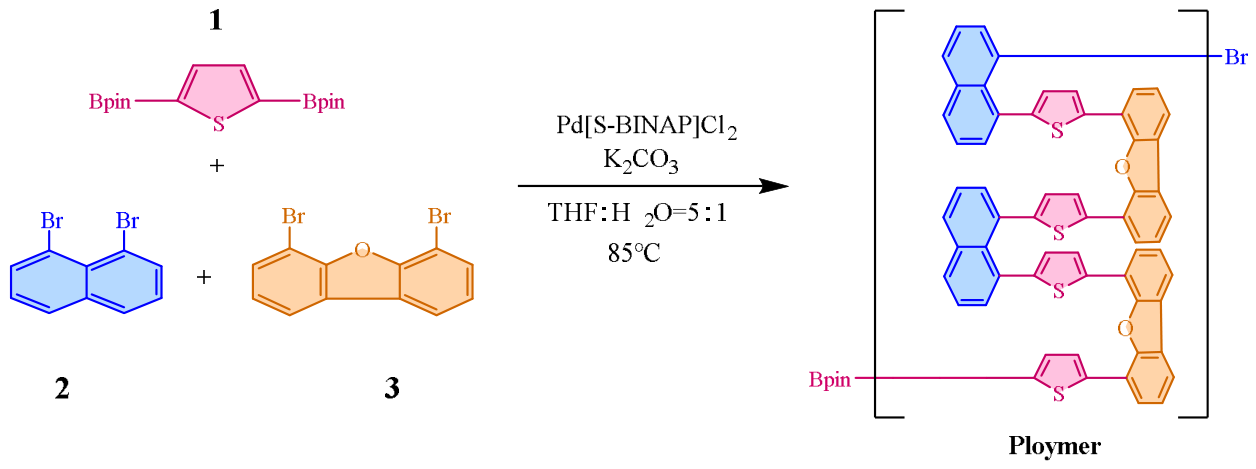
Figure 2.
Photoluminescence properties of the chiral multilayer 3D polymer in pure THF (0.05 mg/mL). (a) PL spectra under different excitation wavelengths; (b) CIE 1931 chromaticity coordinates; (c) normalized PL spectra.
Figure 2.
Photoluminescence properties of the chiral multilayer 3D polymer in pure THF (0.05 mg/mL). (a) PL spectra under different excitation wavelengths; (b) CIE 1931 chromaticity coordinates; (c) normalized PL spectra.
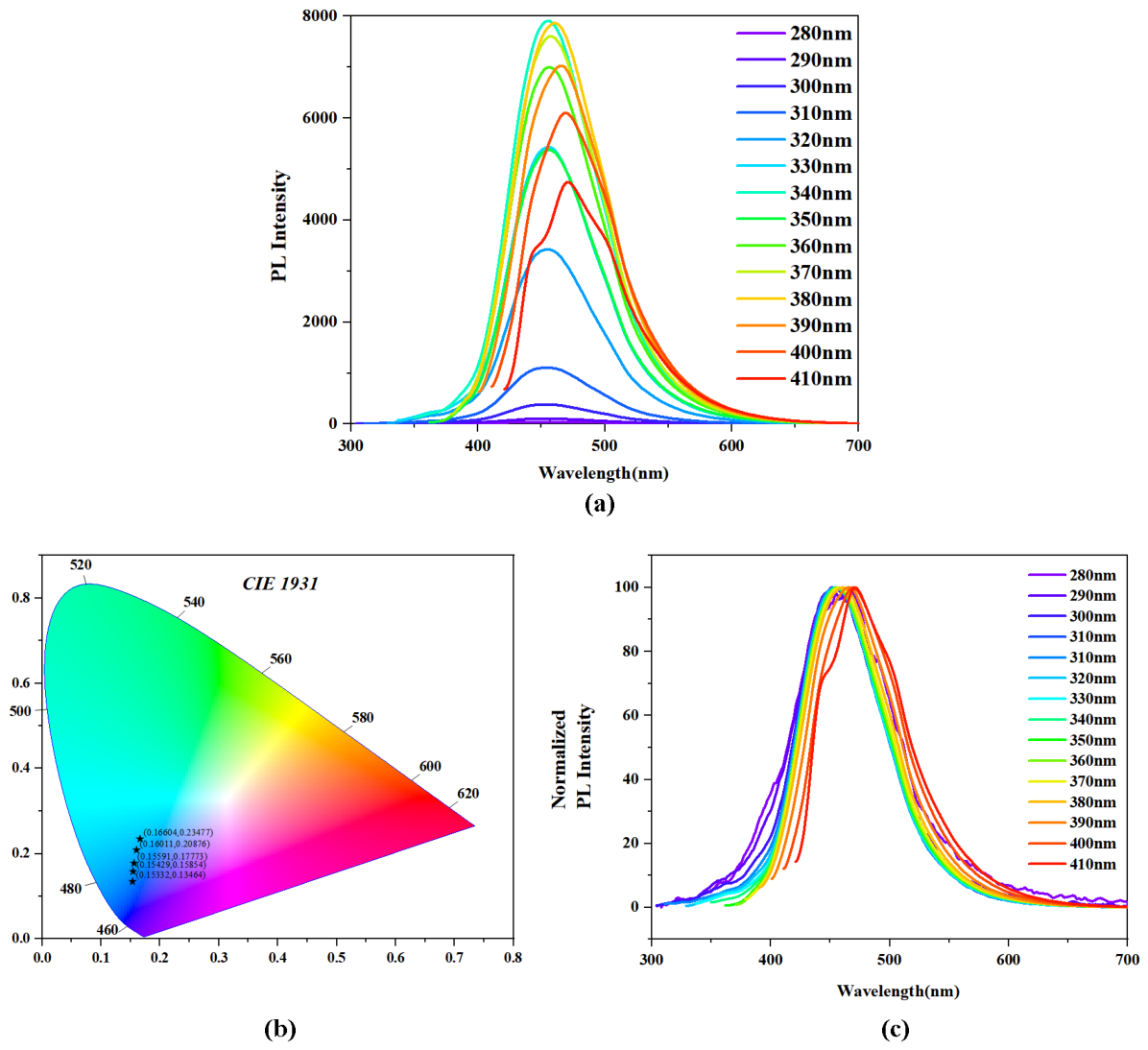
Figure 3.
AIE and solvatochromic properties of the chiral multilayer 3D polymer in different mixed solvent systems. PL spectra in (a) THF/deionized water, (b) THF/SBF and (c) THF/SU; UV–vis absorption spectra in (d) THF/deionized water, (e) THF/SBF and (f) THF/SU.
Figure 3.
AIE and solvatochromic properties of the chiral multilayer 3D polymer in different mixed solvent systems. PL spectra in (a) THF/deionized water, (b) THF/SBF and (c) THF/SU; UV–vis absorption spectra in (d) THF/deionized water, (e) THF/SBF and (f) THF/SU.
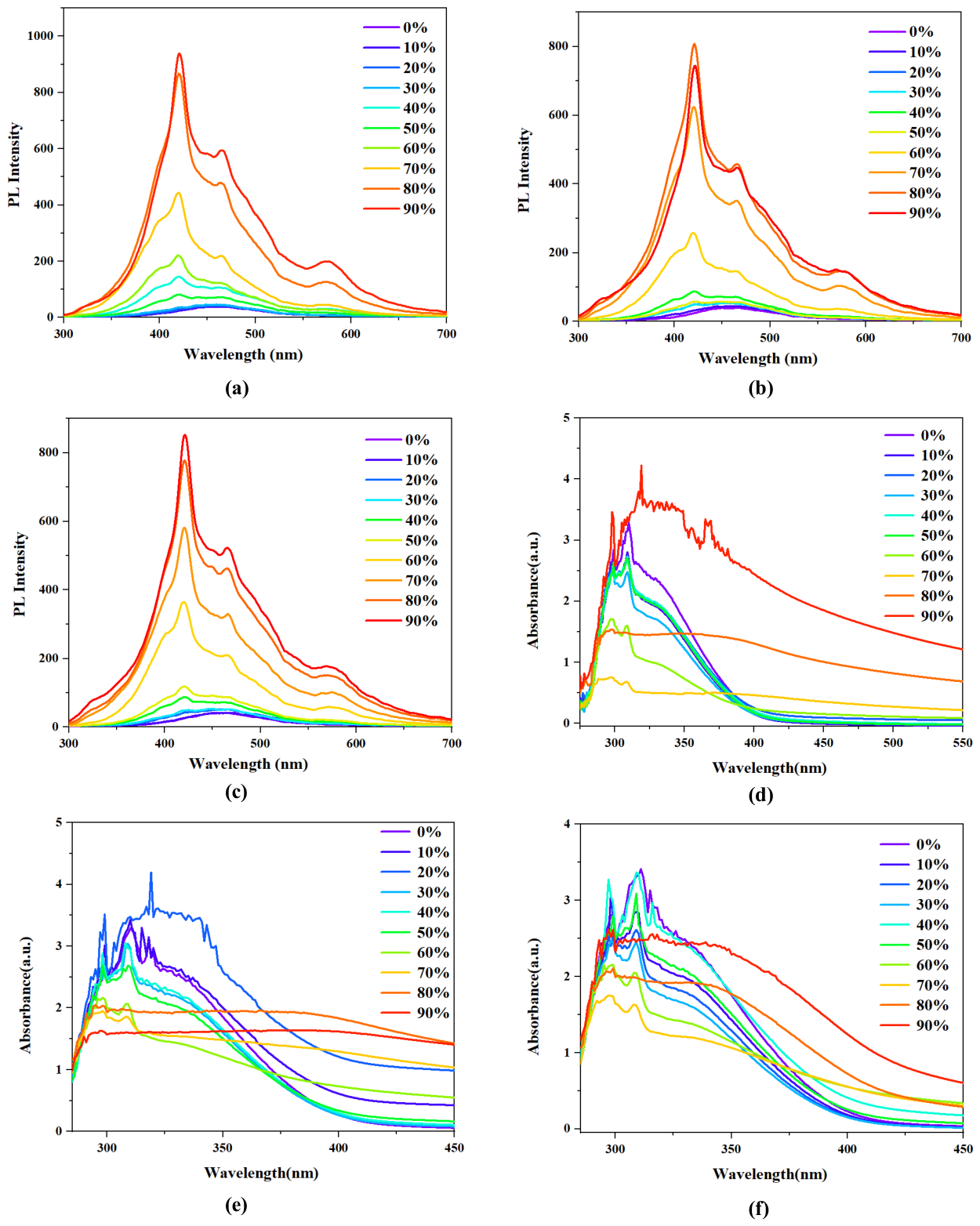
Figure 4.
Ion recognition and quantitative sensing performance of the chiral multilayer 3D polymer toward Cr⁶⁺. (a) PL spectra with various metal ions; (b) UV–vis absorption spectra with various metal ions; (c) normalized PL spectra; (d) anti-interference histogram; (e) PL titration spectra with gradient Cr⁶⁺ concentrations; (f) linear fitting curve of fluorescence intensity vs. Cr⁶⁺ concentration.
Figure 4.
Ion recognition and quantitative sensing performance of the chiral multilayer 3D polymer toward Cr⁶⁺. (a) PL spectra with various metal ions; (b) UV–vis absorption spectra with various metal ions; (c) normalized PL spectra; (d) anti-interference histogram; (e) PL titration spectra with gradient Cr⁶⁺ concentrations; (f) linear fitting curve of fluorescence intensity vs. Cr⁶⁺ concentration.
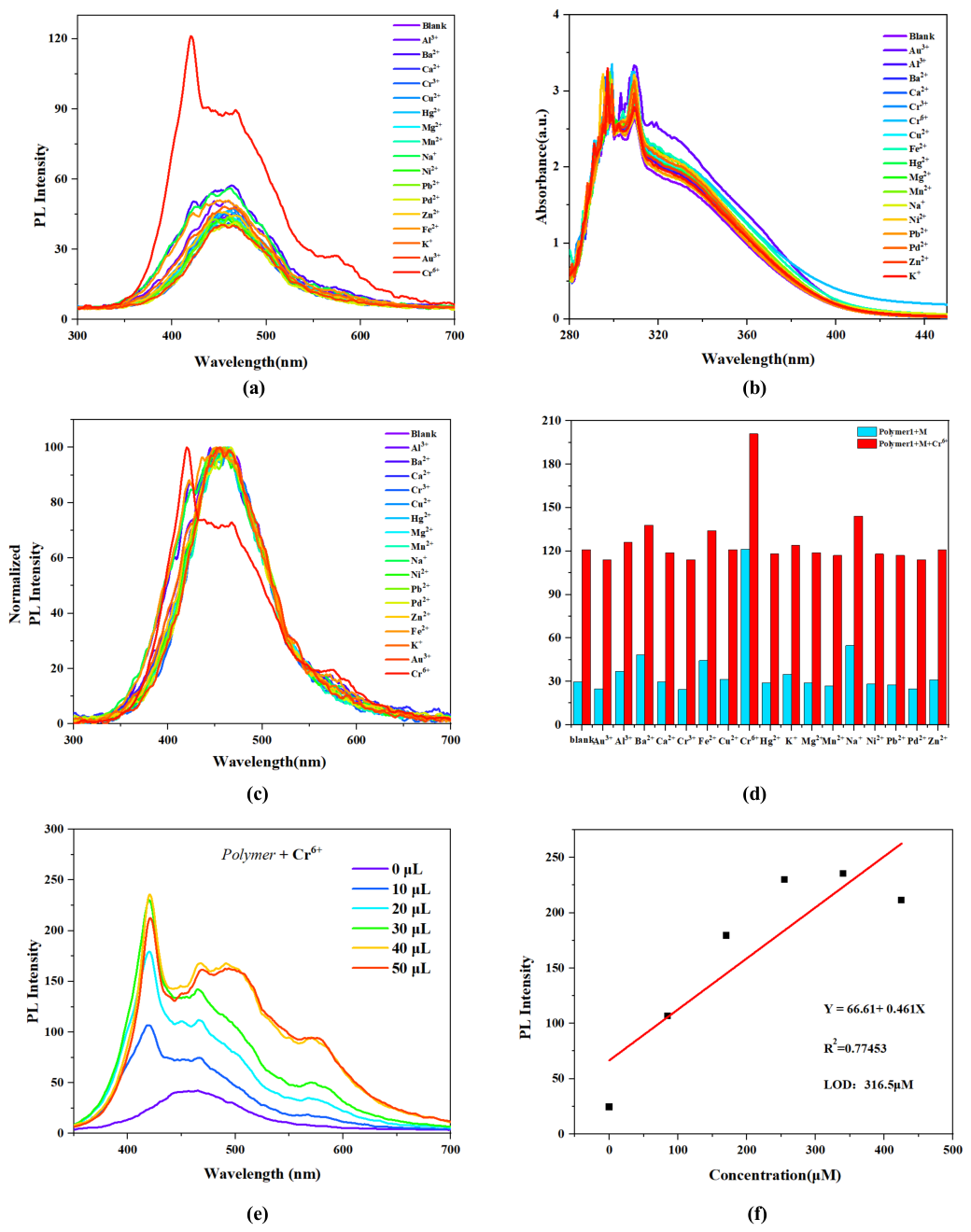
Figure 5.
DLS particle size distribution curves of the chiral multilayer 3D polymer with gradient Cr⁶⁺ concentrations. (a) blank sample; (b–d) medium–high Cr⁶⁺ concentrations(85-255uM); (e) Highest Cr⁶⁺ concentration(340uM).
Figure 5.
DLS particle size distribution curves of the chiral multilayer 3D polymer with gradient Cr⁶⁺ concentrations. (a) blank sample; (b–d) medium–high Cr⁶⁺ concentrations(85-255uM); (e) Highest Cr⁶⁺ concentration(340uM).
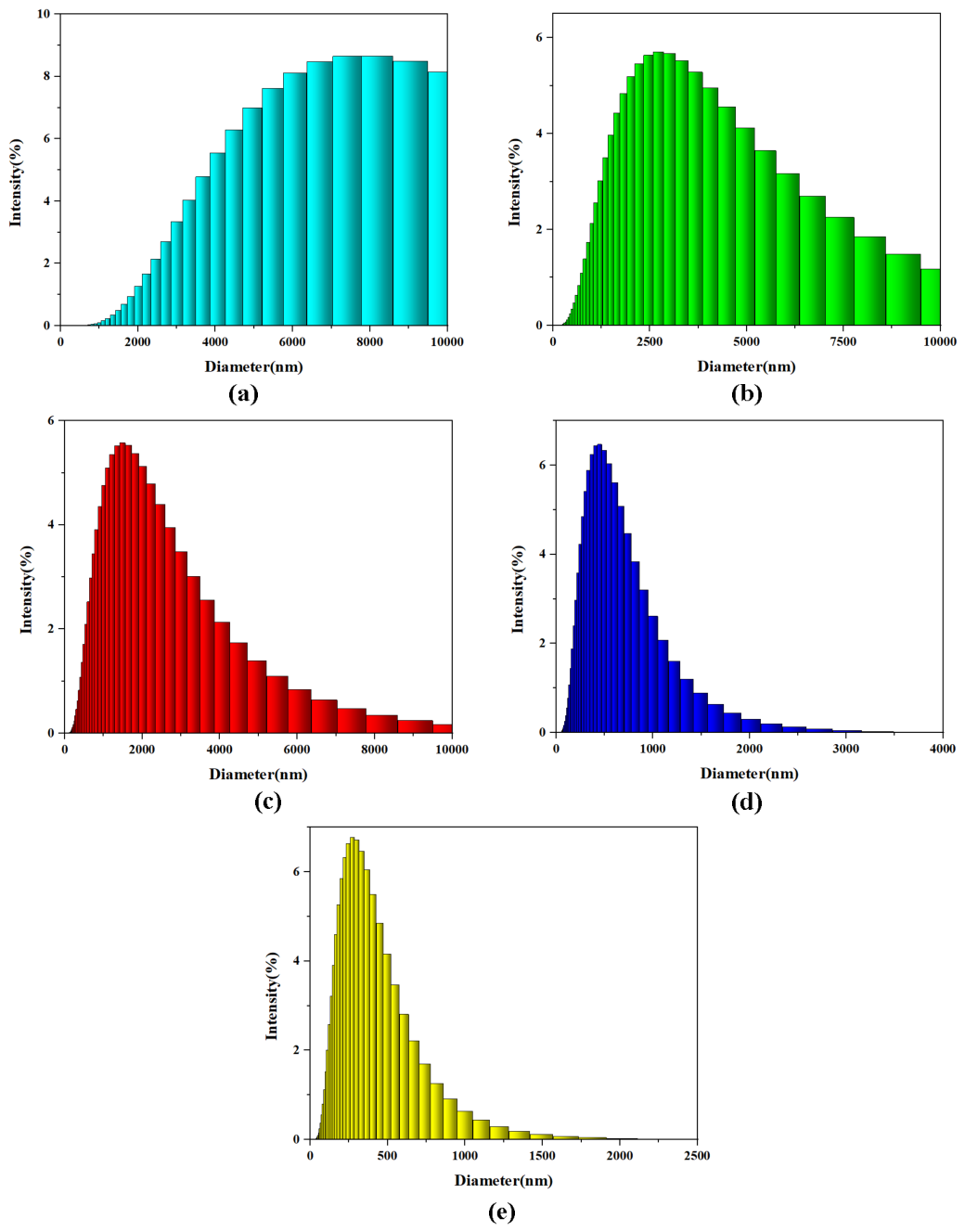
Figure 6.
Cyclic voltammetry curves. (a) Pristine chiral multilayer 3D polymer; (b) polymer-Cr⁶⁺ complex system.
Figure 6.
Cyclic voltammetry curves. (a) Pristine chiral multilayer 3D polymer; (b) polymer-Cr⁶⁺ complex system.
Disclaimer/Publisher’s Note: The statements, opinions and data contained in all publications are solely those of the individual author(s) and contributor(s) and not of MDPI and/or the editor(s). MDPI and/or the editor(s) disclaim responsibility for any injury to people or property resulting from any ideas, methods, instructions or products referred to in the content. |
© 2026 by the authors. Licensee MDPI, Basel, Switzerland. This article is an open access article distributed under the terms and conditions of the Creative Commons Attribution (CC BY) license (http://creativecommons.org/licenses/by/4.0/).
Copyright: This open access article is published under a Creative Commons CC BY 4.0 license, which permit the free download, distribution, and reuse, provided that the author and preprint are cited in any reuse.