

Submitted:
03 September 2026
Posted:
04 September 2026
You are already at the latest version
Abstract
Organic contaminants such as dyes, phenols, pesticides, antibiotics, pharmaceuticals and personal care products (PPCPs), and endocrine-disrupting chemicals (EDCs) are widespread in water and wastewater, and are highly harmful to human health and the environment. Biochar, a solid carbon material derived from waste biomass under limited oxygen conditions, is a promising low-cost sustainable adsorbent for their removal. This review critically integrates recent advances in biochar preparation—feedstock selection, thermochemical conversion routes, activation, and modification—with the physicochemical properties that govern performance. Removal mechanisms are systematically analyzed, spanning adsorption (pore filling, hydrophobic partitioning, π–π electron donor–acceptor interactions, hydrogen bonding, electrostatic attraction, cation bridging) and catalytic degradation mediated by persistent free radicals, persulfate/peroxymonosulfate activation, and photocatalysis. Key influencing factors (solution pH, temperature, coexisting ions, natural organic matter, dosage, particle size), regeneration, and engineering application are evaluated. Current challenges—heterogeneity and standardization, safety of biochar-borne hazardous constituents, performance in real matrices, and spent material management—and future directions, including machine-learning-assisted design and integrated treatment trains, are identified. This review aims to guide the rational design of biochar-based materials toward practical water and wastewater treatment.
Keywords:
biochar
; organic pollutants
; adsorption
; catalytic degradation
; removal mechanisms
; wastewater treatment
; preparation and modification
1. Introduction
The massive discharge of organic contaminants into water bodies is a consequence of rapid industrialization, urbanization and intensive agriculture [1]. Textile, chemical, pharmaceutical, and agricultural industries release synthetic dyes, phenolic compounds, pesticides, antibiotics, and pharmaceuticals and personal care products (PPCPs); many of these substances are persistent, bioaccumulative and toxic at low concentrations [1]. The traditional wastewater treatment plants are typically designed to remove bulk organic matter and tend to perform poorly on refractory micropollutants removal, while the advanced technologies like membrane filtration and advanced oxidation processes are limited by high cost, energy demand or the generation of toxic transformation byproducts [1,2]. Adsorption has been considered as one of the most viable methods for the removal of organic pollutants from water and wastewater; however, the high price of commercial activated carbon has triggered an active search for cheap alternatives [2].
Biochar is a porous solid, rich in carbon that is obtained by thermochemical conversion of waste biomass (agricultural wastes, forestry wastes, sewage sludge, manure and municipal organic wastes) under oxygen-limiting conditions at temperatures between 300 and 700 o C [3]. Since the feedstock used is waste biomass, the production of biochar is directly connected with the valorization of waste, carbon sequestration, and the circular economy. Biochar can be manufactured at a much lower cost and energy footprint than activated carbon, and its high surface functional groups, tunable porosity, and mineral constituents offer flexible active sites to bind pollutants [2,3].
Early reviews of the use of biochar as an adsorbent for contaminant remediation in soil and water were conducted by Ahmad et al. [3] and Mohan et al. [2]. While many studies have been published on heavy-metal removal, increasing awareness of antibiotics, PPCPs and other emerging organic contaminants has led to a rapid advancement in the use of biochar for the removal of organic contaminants, including the design of modified and engineered biochars with improved performance and selectivity [4,5,6]. Recent reviews have focused on the use of biochar in wastewater treatment [7], regeneration and engineering [8], machine-learning-driven design [9], and - most recently - emerging contaminants, such as per- and polyfluoroalkyl substances (PFAS) [10,11,12]. However, the area is rapidly growing and a comprehensive integration of preparation methods, material characteristics and removal mechanisms (both adsorption and catalytic degradation) is still lacking.
This review aims to critically and update on biochar in the removal of organic pollutants in water and wastewater. In particular, we (i) overview the preparation and modification strategies and their impact on biochar properties (Section 2); (ii) describe the physicochemical properties that determine pollutant removal (Section 3); (iii) critically discuss the mechanisms of removal, including adsorption and catalytic degradation pathways (Section 4); (iv) evaluate the factors that influence the performance ofThe aim of this review is to inform the rational design of biochar-based materials and to outline the knowledge gaps that are currently limiting the use of these materials at a large scale.
2. Preparation of Biochar
2.1. Feedstock Selection
The feedstock composition has a strong influence on the properties of biochar, and the variability of biochars produced by different feedstocks has been reported in comparative studies [13]. The most widely used feedstock is lignocellulosic biomass such as agricultural waste (rice husk, rice straw, wheat straw, corn stalk, sugarcane bagasse), woody biomass (pine, bamboo, poplar) and fruit peels, although sewage sludge, animal manure, food waste and algae are increasingly used to dispose of waste and produce materials simultaneously [13,14]. The relative proportions of cellulose, hemicellulose, and lignin define the carbon skeleton and the formation of porosity and functional groups during pyrolysis: feedstocks with high lignin content tend to give rise to more aromatic, higher-carbon biochars, whereas feedstocks with high mineral and ash contents tend to give rise to biochars with high inorganic content, high pH, and cation exchange capacity [13,15]. Choosing an appropriate feedstock thus involves trade-offs between the characteristics of the target pollutant, local availability of biomass, and the end-use application, as both feedstock and pyrolysis conditions determine the physicochemical characteristics of the resulting biochar [13].
2.2. Thermochemical Conversion Technologies
The most common approach to the production of biochar is slow pyrolysis (Figure 1). It is performed at 300-700 C at heating rates of 1-20 C/min and residence times of minutes to hours, maximizing the solid yield (usually 25-35%) [16]. Fast pyrolysis uses fast heating (up to ~1000 o C/s) and short vapor residence times (<2 s) at 400550 o C to prefer bio-oil production, which gives only 1020% char, but gasification uses even higher temperatures (>700 o C) under partial oxidation and produces chars with low yield but very developed microporosity [16]. The most important parameter that determines the extent of carbonization is the pyrolysis temperature: the higher the temperature, the more amorphous aliphatic structures are transformed into condensed aromatic rings, and oxygen- and hydrogen-containing functional groups are lost due to dehydration and decarboxylation [15]. This change is indicated by lower H/C and O/C ratios and a change in sorption behavior to adsorption-dominated rather than partitioning-dominated as has been shown in pine-needle biochars produced at 100700 o C [17].
Hydrothermal carbonization (HTC) is a process that transforms wet biomass in subcritical water (180-250 C, autogenous pressure) into a solid material called hydrochar. In contrast to pyrolytic biochar, hydrochar has a relatively aliphatic structure and retains many oxygen-containing functional groups, which promote ion exchange, complexation and hydrogen bonding but the porosity of hydrochar is typically underdeveloped [14]. The route of conversion itself is therefore a design variable. Microwave pyrolysis, volumetrically heating biomass and rapidly, has become an increasingly popular technique due to its ability to reduce processing time, and can generate porous carbons with high specific surface area in one step when combined with chemical activation [18]..
2.3. Activation
Pristine biochar often possesses a limited specific surface area (SSA) because pores are blocked by tars and residual amorphous carbon. Activation removes these deposits and creates new pores, substantially enhancing SSA and adsorption capacity [3,19]. Physical activation uses steam or CO2 at high temperatures (typically 800–900 °C) to gasify carbon, preferentially developing micropores; for example, steam-activated bamboo biochar exhibited strong synergistic removal of tetracycline and copper [20]. Chemical activation impregnates the feedstock or char with reagents such as KOH, NaOH, ZnCl2, H3PO4, or K2CO3 before pyrolysis; KOH activation, in particular, can generate SSA values exceeding 1000–2000 m2/g through intercalation and gasification reactions [19]. For instance, KOH activation increased the SSA of peanut-shell biochar from 12 to 641 m2/g and its methylene blue capacity to 208 mg/g [19]. It should be noted that activation adds reagent costs and post-treatment steps, so the trade-off between performance and production cost must be considered for practical deployment [16].
2.4. Modification Strategies
Since pristine biochar can be poorly reactive toward anionic, hydrophilic or low-molecular-weight organic pollutants, many modification approaches have been explored to alter its surface chemistry, porosity and magnetism (see elsewhere for a comprehensive review [4,5]). Acid, alkali, and oxidant treatments (HNO3, H2O2, KMnO4) enhance the density of oxygen-containing functional groups and eliminate mineral impurities, which boosts hydrogen bonding and electrostatic interactions [4]. Magnetization - usually achieved by co-precipitating Fe3O4 particles onto the biochar surface or pyrolyzing Fe-loaded biomass - enables easy solid-liquid separation and allows simultaneous removal of organic contaminants and phosphate or heavy metals [21]. Immobilizing metal oxides or nanoparticles (MgO, ZnO, MnO2, nano zero-valent iron) provides extra sites for complexation, precipitation and catalytic degradation [5]. Ball milling not only increases the surface area and creates new surfaces, but also introduces oxygen functional groups and defects, significantly enhancing the sorption and catalytic activity of biochar without using chemicals [22]. Nitrogen doping introduces N atoms into the carbon matrix to generate graphitic-N, pyridinic-N, and pyrrolic-N species that not only tune the surface charge but also introduce catalytic activity of biochar for persulfate-based oxidation [23]. In general, these approaches support the notion of engineered/designer biochar, where the material is designed for target pollutants [5].
3. Physicochemical Properties of Biochar Relevant to Organic Pollutant Removal
The efficiency of biochar removal is determined by a chain of interdependent physicochemical properties that differ with feedstock, pyrolysis temperature and post-treatment [13,24]. The number of adsorption sites depends on surface area and pore structure: natural biochars typically have specific surface areas (SSAs) less than 500 m2/g whereas activated or chemically treated biochars can have SSAs greater than 1000 m2/g [3,19]. Pore size distribution defines accessibility - micropores (<2 nm) provide high adsorption capacity and molecular sieving, mesopores (2-50 nm) provide intraparticle diffusion and macropores (>50 nm) provide transport pores. Nguyen et al. provided strong evidence of pore filling by demonstrating that the sorption of aromatic hydrocarbons was correlated with the pore volume distribution of a wood char [25].
Surface chemistry is also given importance. The high oxygen content of low-temperature biochars and hydrochars (-OH, -COOH, C=O, lactone) can act as hydrogen-bonding sites and deprotonate at higher pH to create negatively charged surfaces that attract cationic species [3,26]. Low H/C and O/C ratios are used to define the electron-richness of the carbon matrix and its pi-electron systems and determine the extent of aromatic condensation [15,26]. Biochar also contains inorganic constituents (ash, carbonates, phosphates and mineral oxides) which raise the solution pH and provide cation-bridging and complexation sites [13]. Another distinctive feature of biochar is environmentally persistent free radicals (PFRs): they persist days to months and give biochar redox activity both in terms of pollutant degradation and potential toxicity: they are produced during pyrolysis by thermal cleavage of biomass components and stabilized on condensed aromatic rings [27]. Finally, graphitic-like domains of high-temperature biochars are π-electron donors or acceptors, an important aspect of the π -pi interactions below [28].
4. Removal Mechanisms
The biochar-mediated removal of organic pollutants is a multifaceted process that can involve several, often concurrent mechanisms whose importance varies with the properties of the biochar and chemistry of the pollutant [3,26]. These processes can be classified into adsorption, catalytic degradation and microbially mediated degradation (Figure 2).
4.1. Adsorption Mechanisms
4.1.1. Pore Filling
In high temperature biochars that have formed micropores, pore filling is usually predominant. The adsorption potential of micropores is very efficient due to overlapping van der Waals fields and molecules of suitable size can be retained virtually irreversibly; there are good correlations between sorption capacity and micropore volume which support this mechanism [25]. Pore filling also prefers small planar molecules to bulky ones, making it favorable to size-selective removal. [24].
4.1.2. Hydrophobic Partitioning
Low-temperature biochars retain a partially amorphous, aliphatic phase into which hydrophobic compounds partition, analogous to natural organic matter; this produces near-linear isotherms and is important for nonpolar and weakly polar pollutants [17]. Partitioning contributions generally diminish as pyrolysis temperature increases and the carbon matrix condenses [17,24].
4.1.3. π–π Electron Donor–Acceptor (EDA) Interactions
Aromatic/graphitic domains of biochar are condensed and interact with aromatic pollutants via π–π stacking; the strength is dependent on the electron donor/acceptor nature of both species [28]. Electron-withdrawing groups (–NO2, –Cl, –SO2–) on the pollutant enhance π–π EDA interactions with the electron-rich surface of biochar, but O- and N-containing groups on modified biochars can switch to π-donor. These interactions account for the pH dependence of sorption of ionizable aromatics like sulfamethazine on biochar [29]. Cationic species also have cation–π interactions between protonated amino groups and aromatic rings[28,29].
4.1.4. Hydrogen Bonding
The presence of oxygen-containing groups on biochar allows the formation of hydrogen bonds with polar moieties (-OH, -NH2, -COOH) of pollutants, which is a significant process in the adsorption of phenols, antibiotics, and PPCPs by low-temperature biochars and hydrochars. In ionizable solutes, negative charge-assisted hydrogen bonding ((−)CAHB) may be especially intense: herb-residue biochar prepared at 250 °C sorbed sulfamethoxazole 27 times stronger than higher-temperature biochars, which was explained by (-)CAHB between surface oxyl groups and the sulfonamide. [30].
4.1.5. Electrostatic Interactions
Electrostatic attraction can be dominant when the pH of solution and point of zero charge (PZC) of biochar give opposite charges. At circumneutral pH, biochar surfaces are negatively charged, which promotes the uptake of cationic dyes and protonated bases; very large capacities of crystal violet on Korean-cabbage-waste biochar (1304 mg/g) were explained by electrostatic attraction in addition to π -pi stacking [31]. On the other hand, at high pH, anionic species (ionized antibiotics, anionic dyes, 2,4-D) undergo electrostatic repulsion that tends to decrease uptake [29,32].
4.1.6. Cation Bridging and Complexation
Multivalent cations (Ca2+, Mg2+) and mineral/metal-oxide components of biochar can bridge anionic or zwitterionic pollutants to the negatively charged carbon surface, a mechanism frequently invoked for tetracycline-type antibiotics [6]. In the steam-activated bamboo biochar system, coexisting Cu2+ markedly enhanced tetracycline uptake through bridge enhancement, which was identified as a key mechanism of the synergistic removal [20]. Metal-oxide-loaded biochars likewise remove pollutants through surface complexation in addition to adsorption [5].
4.1.7. Relative Contributions
The main mechanism varies with the pyrolysis temperature, feedstock and structure of pollutant. Systematic studies using temperature-series chars revealed a shift in partitioning in low-temperature chars to surface adsorption (pore filling and pi -pi interactions) in high-temperature chars [17,24], and adsorption of 2,4-D, simazine and structurally diverse aromatics were dependent on preparation conditions and molecular properties [32,33]. These changes need to be understood to align biochar type with pollutant class.
4.2. Catalytic Degradation
In addition to adsorption, biochar can also directly or indirectly catalyze the degradation of organic contaminants via radical reactions. Stable free radicals in biochar can activate H2O2 to produce hydroxyl radicals, allowing 2-chlorobiphenyl degradation without catalysts [34], and can trigger p-nitrophenol degradation even in the absence of oxidants [35]. PFRs also activate persulfate (PS) and peroxymonosulfate (PMS) to generate sulfate radicals (SO4•−) and hydroxyl radicals (•OH); the type and concentration of PFRs can be tuned by pyrolysis conditions and transition-metal doping [27,36]. Defect structures (edge sites, vacancies) and oxygen-containing groups (particularly C=O) have been found as additional catalytic sites: Ouyang et al. demonstrated that biochar defects were crucial for PMS activation in 1,4-dioxane degradation [37]. Nitrogen-doped biochars mainly activate PMS via nonradical mechanisms such as singlet oxygen (1O2) production and electron transfer on the biochar surface, which are less affected by background water components and thus suitable for practical water treatment [23]. Recent reviews of metal-loaded biochar/persulfate systems also emphasize the role of both radical (SO4•−, •OH, O2•−) and nonradical (1O2, direct electron transfer) pathways for degrading emerging contaminants [38]. Biochar can also be used as a support and electron shuttle for semiconductors (TiO2, ZnO, ZnFe2O4), suppressing electron-hole recombination and improving photocatalytic activity [39]. However, the use of oxidants and the reactivity of PFRs also calls into question the consumption of oxidants, formation of transformation products and the environmental impact of biochar itself [27].
4.3. Biofilm Support and Synergistic Biodegradation
Biochar serves as a carrier in biological treatment systems: the porous nature and surface groups of biochar offer habitat and nutrient retention, which facilitate the formation of biofilms and enzymatic activity. Adsorption preconcentration followed by biodegradation is an effective way to regenerate adsorption sites and prolong the service life of biochar; this synergy was shown when removing naphthenic acid with biochar-attached biofilms [40]. Granular biochar has been effectively applied as a biofilter material in wastewater treatment and as an electrode material in microbial fuel cells and bioelectrochemical systems where energy or resource recovery is coupled with pollutant removal [41].
5. Factors Affecting Removal Performance
Solution pH. pH regulates both the surface charge of biochar and the speciation of pollutants (Figure 3a). Adsorption of ionizable pollutants like sulfamethoxazole and sulfamethazine tends to decrease when the surface and the pollutant are negatively charged, and increases at pH values close to the pKa where neutral or cationic species predominate [29,30]. The removal of cationic dyes is more efficient in alkaline pH whereas anionic dyes and weak acids (e. g., 2,4-D) prefer acidic pH [32,42].
Temperature. Adsorption on biochar is typically exothermic, with capacity decreasing at higher temperature, but endothermic adsorption has also been observed for some pollutant-biochar combinations (e.g., tetracycline on magnetic porous carbon) [43]; thermodynamic parameters obtained from temperature-dependent isotherms are thus system-dependent (Figure 3b) [8].
Coexisting ions and natural organic matter (NOM). Inorganic cations can compete for electrostatic and cation-exchange sites or, conversely, enhance uptake through cation bridging; anions may compete with anionic pollutants (Figure 3c) [8,30]. NOM and dissolved organic matter in real water and wastewater compete for adsorption sites and can block micropores, and their presence typically reduces biochar capacity relative to ultrapure-water experiments (Figure 3d)—an important consideration when extrapolating laboratory data to real matrices [7].
Biochar dosage, particle size, and contact time. Larger doses enhance removal efficiency, but reduce the mass-normalized capacity (Figure 3e); smaller particles offer shorter intraparticle diffusion distances and greater external surface area, enhancing uptake (Figure 3f) [3]. Kinetic data indicate that the uptake of organic pollutants by biochar is typically fast at first and slows towards equilibrium, with pseudo-second-order and intraparticle diffusion models often providing good fits to the data; isotherms are often well described by Langmuin and Freundlich models, with Freundlich generally giving better fits to heterogeneous biochar surfaces [44].
6. Performance for Representative Organic Pollutants
Biochar has been used to treat all types of organic water pollutants. Table 1 provides an overview of representative studies and the major mechanisms, while Table 2 compares biochar with commercial activated carbon.
Dyes. Biochar has a high affinity to cationic dyes by electrostatic attraction and pi-pi stacking: Korean-cabbage-waste biochar had a Langmuir capacity of 1304 mg/g to crystal violet [31], peanut-shell biochar activated by KOH had a higher capacity of 208 mg/g to methylene blue [19], and a straw-based biochar with a surface area of 1057 m2/g was also effective in removing Congo red (82.6%), similar to activated carbon (85.4%) [45].
Pesticides. Triazine herbicides (atrazine, simazine) and 2,4-D are primarily adsorbed by partitioning and surface adsorption, with capacity highly dependent on pyrolysis temperature and biochar polarity [32,33]. In the case of simazine, sorption to corn-straw biochars was positively correlated with aromatic carbon content (π–π charge-transfer interactions) and surface area (pore filling) [33]. Notably, the uptake of biochars produced at 700 °C was similar to that of commercial activated carbons, suggesting that sufficiently carbonized biochars can be economical alternatives [32].
Antibiotics. The most studied pollutants include tetracyclines, sulfonamides and fluoroquinolones due to the prevalence of antibiotic resistance; adsorption mechanisms include π -pi EDA, hydrogen bonding, electrostatic interactions and cation bridging [6]. Significant ones are Fe/Zn-modified sawdust biochar to remove both tetracycline and Cu(II) simultaneously [46], magnetic porous carbon prepared using waste hydrochar (349 m2/g) with endothermic, spontaneous uptake of tetracycline [43], steam-activated bamboo biochar that removed sulfamethoxazole much more strongly than high-temperature chars did through (−)CAHB [30]. The adsorption of sulfamethoxazole on bamboo and sugarcane-bagasse biochars (Kd = 2104 L/kg) significantly decreased the mobility of antibiotics in reclaimed-water irrigation columns [47].
EDCs and PPCPs. The removal of bisphenol A is mainly through π -pi and hydrogen-bonding interactions on pristine biochars [48], and β-cyclodextrin-modified biochar, which combines host-guest inclusion with adsorption, has a BPA capacity of 209.2 mg/g with simultaneous Pb(II) removal [49]. Aging of biochar (exposure to ozone or nitrate) had only a minor effect on the uptake of BPA, suggesting that it performs well in the long term [48]. The biochar produced by activating municipal solid waste with KOH removed up to 99.9% of methylene blue and 63.7% of acetaminophen, and the adsorption was controlled by oxygenated surface functional groups [44].
Phenolic compounds. Pore filling and π -pi interactions remove phenol and substituted phenols. Biochars obtained through poplar, such as pyrolysis wastewater containing high organic load (TOC), were found to be effective in treating the wastewater, with NaOH-activated biochar having 2.5 times the sorption capacity of commercial activated carbon [50].
7. Regeneration, Reusability, and Practical Application
Regeneration is essential for the economics and lifetime of biochar. Thermal regeneration (300-500 °C) can recover most of the adsorption capacity by volatilizing or pyrolyzing the sorbed organics but uses energy and causes gradual destruction of porosity; chemical regeneration (acids, alkalis, organic solvents) and microwave-assisted desorption are less severe but produce concentrated eluents that need to be treated [8]. In general, biochars retain most of their capacity after three to five adsorption-regeneration cycles, with a steady decline due to irreversible pore clogging and surface degradation [8].
On the engineering scale, powdered biochar is not feasible due to separation and pressure-drop problems; granulation, pelletization or magnetization are thus necessary to operate columns [21,41]. Biofilters based on granular biochar have been used in wastewater polishing and resource recovery [41], and magnetic separation has been shown to be an effective recovery route [21]. Life-cycle and cost analyses have shown that the production costs of biochar (0.05-0.4 USD/kg, depending on scale and technology) are significantly lower than those of commercial activated carbon, but environmental comparisons of tertiary wastewater treatment have revealed that the benefits vary with assumptions about feedstock, activation, and regeneration [16,51]. Biochar-based systems were suggested as low-cost, decentralized water-treatment systems in low-income areas where both feedstock and end-product can be sourced locally [2]. However, the majority of existing demonstrations are still at laboratory or pilot scale, and systematic studies in real water and wastewater matrices, such as the impact of NOM, phosphate, and hardness ions, are relatively limited. [7].
8. Challenges and Future Perspectives
Despite encouraging progress, several obstacles limit the practical application of biochar for organic pollutant removal.
Heterogeneity and standardization. The properties of biochar significantly differ between feedstocks and production conditions, which is a barrier to reproducibility and makes standardization, quality control, and regulatory acceptance difficult [13]. Recent reviews demand common reporting standards, including pyrolysis conditions, elemental composition, SSA, pore distribution, surface functionality, and PFR content, in order to make the results obtained in various laboratories comparable and use them in machine-learning databases[9,10,11].
Safety and risk assessment.Biochar can emit dangerous components, such as PAHs, dioxins, heavy metals of contaminated feedstocks, and reactive PFRs, which must be systematically evaluated in terms of safety prior to large-scale use, especially in potable and reuse purposes [27,52]. The increasing focus on catalytic degradation brings up the additional question of transformation byproduct toxicity, as incomplete mineralization can lead to the formation of intermediates that are more toxic than their parent compounds [38].
Performance in real matrices and scale-up. The majority of research is done in idealized batch systems with single contaminants; the interactions of biochar in complex mixtures, competitive effects of other contaminants and long-term field performance are not well understood [7]. New types of pollutants present further challenges: for example, the adsorption of PFAS (especially short-chain and ultrashort-chain congeners) by pristine biochars is often poor, and strategies to modify these stubborn pollutants are a rapidly emerging area [12].
Spent biochar management. Valorization, regeneration eluates or disposal of spent biochar has been given very little attention compared to adsorption performance [8]. Combining exhausted biochar with further treatment (e. g., incineration, pyrolysis recycling) or using it as a soil amendment where retained nutrients and carbon can be valuable is worth systematic research, as is the management of PFAS-laden sorbents, which currently lacks mature destruction technologies [12].
Future studies should therefore aim to: (i) develop standardized procedures and certification criteria for biochar production and property reporting, in line with existing biochar standards and life-cycle assessment frameworks [10,16]; (ii) conduct systematic toxicity and risk assessment of pristine and engineered biochars, including transformation products during catalytic degradation [27,38]; (iii) use machine learning for biochar screening and inverse design, which has already demonstrated success in predicting sorption performance and synthesis conditions and could speed up material development [9,53]; (iv) investigate hybrid treatmentA transition from empirical screening to mechanistic, data-driven and practical design is clearly in progress [9,10].
9. Conclusions
Biochar is a versatile, inexpensive and renewable material to remove organic contaminants in water and wastewater. It is characterized by an interdependent set of preparation parameters (feedstock, thermochemical route, activation, chemical modification) that govern surface area, porosity, surface functional groups, and the density of persistent free radicals. Removal is carried out by several concurrent processes: pore filling, hydrophobic partitioning, 0 -0 EDA interactions, hydrogen bonding, electrostatic attraction and cation bridging to adsorb, with PFR-mediated and persulfate/peroxymonosulfate-activated catalytic degradation and, in biological systems, biofilm-mediated biodegradation. The most important thing in rational material design is matching biochar properties to chemistry of pollutants (hydrophobicity, ionizability, molecular size). Other issues, such as heterogeneity and standardization, safety of biochar-borne hazardous constituents, behavior in real matrices, regeneration, and scale-up, should be resolved with standardized production, strict risk assessment, machine-learning-assisted design, and integrated treatment trains. With these developments, it can be anticipated that biochar-based technologies will shift out of laboratory demonstrations into practical, sustainable water and wastewater treatment.
Author Contributions
Conceptualization, Y.G., W.J., and X.Z.; methodology, Y.G., M.C., L.W., X.L., and Y.Z.; investigation, Y.G., M.C., L.W., X.L., and Y.Z.; resources, W.J. and X.Z.; data curation, Y.G., M.C., L.W., X.L., and Y.Z.; writing—original draft preparation, Y.G.; writing—review and editing, Y.G., W.J., and X.Z.; visualization, Y.G.; supervision, W.J. and X.Z.; project administration, W.J. and X.Z.; funding acquisition, W.J. and X.Z. All authors have read and agreed to the published version of the manuscript.
Funding
This research was funded by Research and Integrated Demonstration on Synergistic Disposal and Resource Utilization Technologies for Municipal Sludge and Urban Organic Solid Waste(2025JH2/102800030).
Data Availability Statement
No new data were created or analyzed in this study. Data sharing is not applicable to this article.
Conflicts of Interest
The authors declare no conflicts of interest.
References
- Schwarzenbach, R.P.; Escher, B.I.; Fenner, K.; Hofstetter, T.B.; Johnson, C.A.; von Gunten, U.; Wehrli, B. The challenge of micropollutants in aquatic systems. Science 2006, 313, 1072–1077. [Google Scholar] [CrossRef]
- Mohan, D.; Sarswat, A.; Ok, Y.S.; Pittman, C.U., Jr. Organic and inorganic contaminants removal from water with biochar, a renewable, low cost and sustainable adsorbent—A critical review. Bioresour. Technol. 2014, 160, 191–202. [Google Scholar] [CrossRef]
- Ahmad, M.; Rajapaksha, A.U.; Lim, J.E.; Zhang, M.; Bolan, N.; Mohan, D.; Vithanage, M.; Lee, S.S.; Ok, Y.S. Biochar as a sorbent for contaminant management in soil and water: A review. Chemosphere 2014, 99, 19–33. [Google Scholar] [CrossRef]
- Ahmed, M.B.; Zhou, J.L.; Ngo, H.H.; Guo, W.; Chen, M. Progress in the preparation and application of modified biochar for improved contaminant removal from water and wastewater. Bioresour. Technol. 2016, 214, 836–851. [Google Scholar] [CrossRef]
- Rajapaksha, A.U.; Chen, S.S.; Tsang, D.C.W.; Zhang, M.; Vithanage, M.; Mandal, S.; Gao, B.; Bolan, N.S.; Ok, Y.S. Engineered/designer biochar for contaminant removal/immobilization from soil and water: Potential and implication of biochar modification. Chemosphere 2016, 148, 276–291. [Google Scholar] [CrossRef]
- Peiris, C.; Gunatilake, S.R.; Mlsna, T.E.; Mohan, D.; Vithanage, M. Biochar based removal of antibiotic sulfonamides and tetracyclines in aquatic environments: A critical review. Bioresour. Technol. 2017, 246, 150–159. [Google Scholar] [CrossRef]
- Xiang, W.; Zhang, X.; Chen, J.; Zou, W.; He, F.; Hu, X.; Tsang, D.C.W.; Ok, Y.S.; Gao, B. Biochar technology in wastewater treatment: A critical review. Chemosphere 2020, 252, 126539. [Google Scholar] [CrossRef]
- Dai, Y.; Zhang, N.; Xing, C.; Cui, Q.; Sun, Q. The adsorption, regeneration and engineering applications of biochar for removal organic pollutants: A review. Chemosphere 2019, 223, 12–27. [Google Scholar] [CrossRef]
- Zhang, W.; Chen, R.; Li, J.; Huang, T.; Wu, B.; Ma, J.; Wen, Q.; Tan, J.; Huang, W. Synthesis optimization and adsorption modeling of biochar for pollutant removal via machine learning. Biochar 2023, 5, 25. [Google Scholar] [CrossRef]
- Laishram, D.; Kim, S.; Lee, S.; Park, S. Advancements in biochar as a sustainable adsorbent for water pollution mitigation. Adv. Sci. 2025, 12, 2410383. [Google Scholar] [CrossRef]
- Ullah, Z.; Joseph, C.G.; Tian, Z.; Yasin, M.; Khan, M.N.; Ali, S.; Khan, A.; Suazo-Hernández, J.; Poblete-Grant, P.; Nabeel, M.I. The production of biochar and its impact on the removal of various emerging pollutants from wastewater: A review. Toxics 2025, 13, 1079. [Google Scholar] [CrossRef]
- Wang, H.; Zhang, H.; He, L.; Wang, J.; Wang, S.; Shi, X.; Zhang, X.; Wang, H.; He, F. Environmental behavior of per- and polyfluoroalkyl substances (PFASs) and the potential role of biochar for its remediation: A review. Biochar 2025, 7, 14. [Google Scholar] [CrossRef]
- Zhao, L.; Cao, X.; Mašek, O.; Zimmerman, A. Heterogeneity of biochar properties as a function of feedstock sources and production temperatures. J. Hazard. Mater. 2013, 256–257, 1–9. [Google Scholar] [CrossRef]
- Kambo, H.S.; Dutta, A. A comparative review of biochar and hydrochar in terms of production, physico-chemical properties and applications. Renew. Sustain. Energy Rev. 2015, 45, 359–378. [Google Scholar] [CrossRef]
- Keiluweit, M.; Nico, P.S.; Johnson, M.G.; Kleber, M. Dynamic molecular structure of plant biomass-derived black carbon (biochar). Environ. Sci. Technol. 2010, 44, 1247–1253. [Google Scholar] [CrossRef]
- Meyer, S.; Glaser, B.; Quicker, P. Technical, economical, and climate-related aspects of biochar production technologies: A literature review. Environ. Sci. Technol. 2011, 45, 9473–9483. [Google Scholar] [CrossRef]
- Chen, B.; Zhou, D.; Zhu, L. Transitional adsorption and partition of nonpolar and polar aromatic contaminants by biochars of pine needles with different pyrolytic temperatures. Environ. Sci. Technol. 2008, 42, 5137–5143. [Google Scholar] [CrossRef]
- Lam, S.S.; Liew, R.K.; Wong, Y.M.; Yek, P.N.Y.; Ma, N.L.; Lee, C.L.; Chase, H.A. Microwave-assisted pyrolysis with chemical activation, an innovative method to convert orange peel into activated carbon with improved properties as dye adsorbent. J. Clean. Prod. 2017, 162, 1376–1387. [Google Scholar] [CrossRef]
- Han, X.; Chu, L.; Liu, S.; Chen, T.; Ding, C.; Yan, J.; Cui, L.; Quan, G. Removal of methylene blue from aqueous solution using porous biochar obtained by KOH activation of peanut shell biochar. BioResources 2015, 10, 2836–2849. [Google Scholar] [CrossRef]
- Wang, R.Z.; Huang, D.L.; Liu, Y.G.; Zhang, C.; Lai, C.; Wang, X.; Zeng, G.M.; Zhang, Q.; Gong, X.M.; Xu, P. Synergistic removal of copper and tetracycline from aqueous solution by steam-activated bamboo-derived biochar. J. Hazard. Mater. 2020, 384, 121470. [Google Scholar] [CrossRef]
- Chen, B.; Chen, Z.; Lv, S. A novel magnetic biochar efficiently sorbs organic pollutants and phosphate. Bioresour. Technol. 2011, 102, 716–723. [Google Scholar] [CrossRef]
- Lyu, H.; Gao, B.; He, F.; Zimmerman, A.R.; Ding, C.; Huang, H.; Tang, J. Effects of ball milling on the physicochemical and sorptive properties of biochar: Experimental observations and governing mechanisms. Environ. Pollut. 2018, 233, 54–63. [Google Scholar] [CrossRef]
- Zhu, S.; Huang, X.; Ma, F.; Wang, L.; Duan, X.; Wang, S. Catalytic removal of aqueous contaminants on N-doped graphitic biochars: Inherent roles of adsorption and nonradical mechanisms. Environ. Sci. Technol. 2018, 52, 8649–8658. [Google Scholar] [CrossRef]
- Lattao, C.; Cao, X.; Mao, J.; Schmidt-Rohr, K.; Pignatello, J.J. Influence of molecular structure and adsorbent properties on sorption of organic compounds to a temperature series of wood chars. Environ. Sci. Technol. 2014, 48, 4790–4798. [Google Scholar] [CrossRef]
- Nguyen, T.H.; Cho, H.-H.; Poster, D.L.; Ball, W.P. Evidence for a pore-filling mechanism in the adsorption of aromatic hydrocarbons to a natural wood char. Environ. Sci. Technol. 2007, 41, 1212–1217. [Google Scholar] [CrossRef]
- Pignatello, J.J.; Mitch, W.A.; Xu, W. Activity and reactivity of pyrogenic carbonaceous matter toward organic compounds. Environ. Sci. Technol. 2017, 51, 8893–8908. [Google Scholar] [CrossRef]
- Ruan, X.; Sun, Y.; Du, W.; Tang, Y.; Liu, Q.; Zhang, Z.; Doherty, W.; Frost, R.L.; Qian, G.; Tsang, D.C.W. Formation, characteristics, and applications of environmentally persistent free radicals in biochars: A review. Bioresour. Technol. 2019, 281, 457–468. [Google Scholar] [CrossRef]
- Zhu, D.; Pignatello, J.J. Characterization of aromatic compound sorptive interactions with black carbon (charcoal) assisted by graphite as a model. Environ. Sci. Technol. 2005, 39, 2033–2041. [Google Scholar] [CrossRef]
- Teixidó, M.; Pignatello, J.J.; Beltrán, J.L.; Granados, M.; Peccia, J. Speciation of the ionizable antibiotic sulfamethazine on black carbon (biochar). Environ. Sci. Technol. 2011, 45, 10020–10027. [Google Scholar] [CrossRef]
- Lian, F.; Sun, B.; Song, Z.; Zhu, L.; Qi, X.; Xing, B. Physicochemical properties of herb-residue biochar and its sorption to ionizable antibiotic sulfamethoxazole. Chem. Eng. J. 2014, 248, 128–134. [Google Scholar] [CrossRef]
- Sewu, D.D.; Boakye, P.; Woo, S.H. Highly efficient adsorption of cationic dye by biochar produced with Korean cabbage waste. Bioresour. Technol. 2017, 224, 206–213. [Google Scholar] [CrossRef]
- Kearns, J.P.; Wellborn, L.S.; Summers, R.S.; Knappe, D.R. U. 2,4-D adsorption to biochars: Effect of preparation conditions on equilibrium adsorption capacity and comparison with commercial activated carbon literature data. Water Res. 2014, 62, 20–28. [Google Scholar] [CrossRef]
- Zhang, G.; Zhang, Q.; Sun, K.; Liu, X.; Zheng, W.; Zhao, Y. Sorption of simazine to corn straw biochars prepared at different pyrolytic temperatures. Environ. Pollut. 2011, 159, 2594–2601. [Google Scholar] [CrossRef]
- Fang, G.; Gao, J.; Liu, C.; Dionysiou, D.D.; Wang, Y.; Zhou, D. Key role of persistent free radicals in hydrogen peroxide activation by biochar: Implications to organic contaminant degradation. Environ. Sci. Technol. 2014, 48, 1902–1910. [Google Scholar] [CrossRef]
- Yang, J.; Pan, B.; Li, H.; Liao, S.; Zhang, D.; Wu, M.; Xing, B. Degradation of p-nitrophenol on biochars: Role of persistent free radicals. Environ. Sci. Technol. 2016, 50, 694–700. [Google Scholar] [CrossRef]
- Fang, G.; Liu, C.; Gao, J.; Dionysiou, D.D.; Zhou, D. Manipulation of persistent free radicals in biochar to activate persulfate for contaminant degradation. Environ. Sci. Technol. 2015, 49, 5645–5653. [Google Scholar] [CrossRef]
- Ouyang, D.; Chen, Y.; Yan, J.; Qian, L.; Han, L.; Chen, M. Activation mechanism of peroxymonosulfate by biochar for catalytic degradation of 1,4-dioxane: Important role of biochar defect structures. Chem. Eng. J. 2019, 370, 614–624. [Google Scholar] [CrossRef]
- Lu, J.; Lu, Q.; Di, L.; Zhou, Y.; Zhou, Y. Iron-based biochar as efficient persulfate activation catalyst for emerging pollutants removal: A review. Chin. Chem. Lett. 2023, 34, 108357. [Google Scholar] [CrossRef]
- Mian, M.M.; Liu, G. Recent progress in biochar-supported photocatalysts: Synthesis, role of biochar, and applications. RSC Adv. 2018, 8, 14237–14248. [Google Scholar] [CrossRef]
- Frankel, M.L.; Bhuiyan, T.I.; Veksha, A.; Demeter, M.A.; Layzell, D.L.; Helleur, R.J.; Hill, J.M.; Turner, R.J. Removal and biodegradation of naphthenic acids by biochar and attached environmental biofilms in the presence of co-contaminating metals. Bioresour. Technol. 2016, 216, 352–361. [Google Scholar] [CrossRef]
- Huggins, T.M.; Haeger, A.; Biffinger, J.C.; Ren, Z.J. Granular biochar compared with activated carbon for wastewater treatment and resource recovery. Water Res. 2016, 94, 225–232. [Google Scholar] [CrossRef]
- Qiu, Y.; Zheng, Z.; Zhou, Z.; Sheng, G.D. Effectiveness and mechanisms of dye adsorption on a straw-based biochar. Bioresour. Technol. 2009, 100, 5348–5351. [Google Scholar] [CrossRef]
- Zhu, X.; Liu, Y.; Qian, F.; Zhou, C.; Zhang, S.; Chen, J. Preparation of magnetic porous carbon from waste hydrochar by simultaneous activation and magnetization for tetracycline removal. Bioresour. Technol. 2014, 154, 209–214. [Google Scholar] [CrossRef]
- Sumalinog, D.A.G.; Capareda, S.C.; de Luna, M.D.G. Evaluation of the effectiveness and mechanisms of acetaminophen and methylene blue dye adsorption on activated biochar derived from municipal solid wastes. J. Environ. Manag. 2018, 210, 255–262. [Google Scholar] [CrossRef]
- Nautiyal, P.; Subramanian, K.A.; Dastidar, M.G. Adsorptive removal of dye using biochar derived from residual algae after in-situ transesterification: Alternate use of waste of biodiesel industry. J. Environ. Manag. 2016, 182, 187–197. [Google Scholar] [CrossRef]
- Zhou, Y.; Liu, X.; Xiang, Y.; Wang, P.; Zhang, J.; Zhang, F.; Wei, J.; Luo, L.; Lei, M.; Tang, L. Modification of biochar derived from sawdust and its application in removal of tetracycline and copper from aqueous solution: Adsorption mechanism and modelling. Bioresour. Technol. 2017, 245, 266–273. [Google Scholar] [CrossRef]
- Yao, Y.; Gao, B.; Chen, H.; Jiang, L.; Inyang, M.; Zimmerman, A.R.; Cao, X.; Yang, L.; Xue, Y.; Li, H. Adsorption of sulfamethoxazole on biochar and its impact on reclaimed water irrigation. J. Hazard. Mater. 2012, 209–210, 408–413. [Google Scholar] [CrossRef]
- Zhou, L.; Richard, C.; Ferronato, C.; Chovelon, J.-M.; Sleiman, M. Investigating the performance of biomass-derived biochars for the removal of gaseous ozone, adsorbed nitrate and aqueous bisphenol A. Chem. Eng. J. 2018, 334, 2098–2104. [Google Scholar] [CrossRef]
- Qu, J.; Dong, M.; Wei, S.; Meng, Q.; Hu, L.; Hu, Q.; Wang, L.; Han, W.; Zhang, Y. Microwave-assisted one pot synthesis of β-cyclodextrin modified biochar for concurrent removal of Pb(II) and bisphenol A in water. Carbohydr. Polym. 2020, 250, 117003. [Google Scholar] [CrossRef]
- de Caprariis, B.; De Filippis, P.; Hernandez, A.D.; Petrucci, E.; Petrullo, A.; Scarsella, M.; Turchi, M. Pyrolysis wastewater treatment by adsorption on biochars produced by poplar biomass. J. Environ. Manag. 2017, 197, 231–238. [Google Scholar] [CrossRef]
- Thompson, K.A.; Shimabuku, K.K.; Kearns, J.P.; Knappe, D.R.U.; Summers, R.S.; Cook, S.M. Environmental comparison of biochar and activated carbon for tertiary wastewater treatment. Environ. Sci. Technol. 2016, 50, 11253–11262. [Google Scholar] [CrossRef]
- Hale, S.E.; Lehmann, J.; Rutherford, D.; Zimmerman, A.R.; Bachmann, R.T.; Shitumbanuma, V.; O’Toole, A.; Sundqvist, K.L.; Arp, H.P.H.; Cornelissen, G. Quantifying the total and bioavailable polycyclic aromatic hydrocarbons and dioxins in biochars. Environ. Sci. Technol. 2012, 46, 2830–2838. [Google Scholar] [CrossRef]
- Zhu, X.; Wang, X.; Ok, Y.S. The application of machine learning methods for prediction of metal sorption onto biochars. J. Hazard. Mater. 2019, 378, 120727. [Google Scholar] [CrossRef]
Figure 1.
Preparation routes of biochar: from waste biomass feedstocks through thermochemical conversion (slow pyrolysis, fast pyrolysis, gasification, hydrothermal carbonization, microwave pyrolysis) to activation and modification strategies, yielding engineered biochars tailored for organic pollutant removal.
Figure 1.
Preparation routes of biochar: from waste biomass feedstocks through thermochemical conversion (slow pyrolysis, fast pyrolysis, gasification, hydrothermal carbonization, microwave pyrolysis) to activation and modification strategies, yielding engineered biochars tailored for organic pollutant removal.
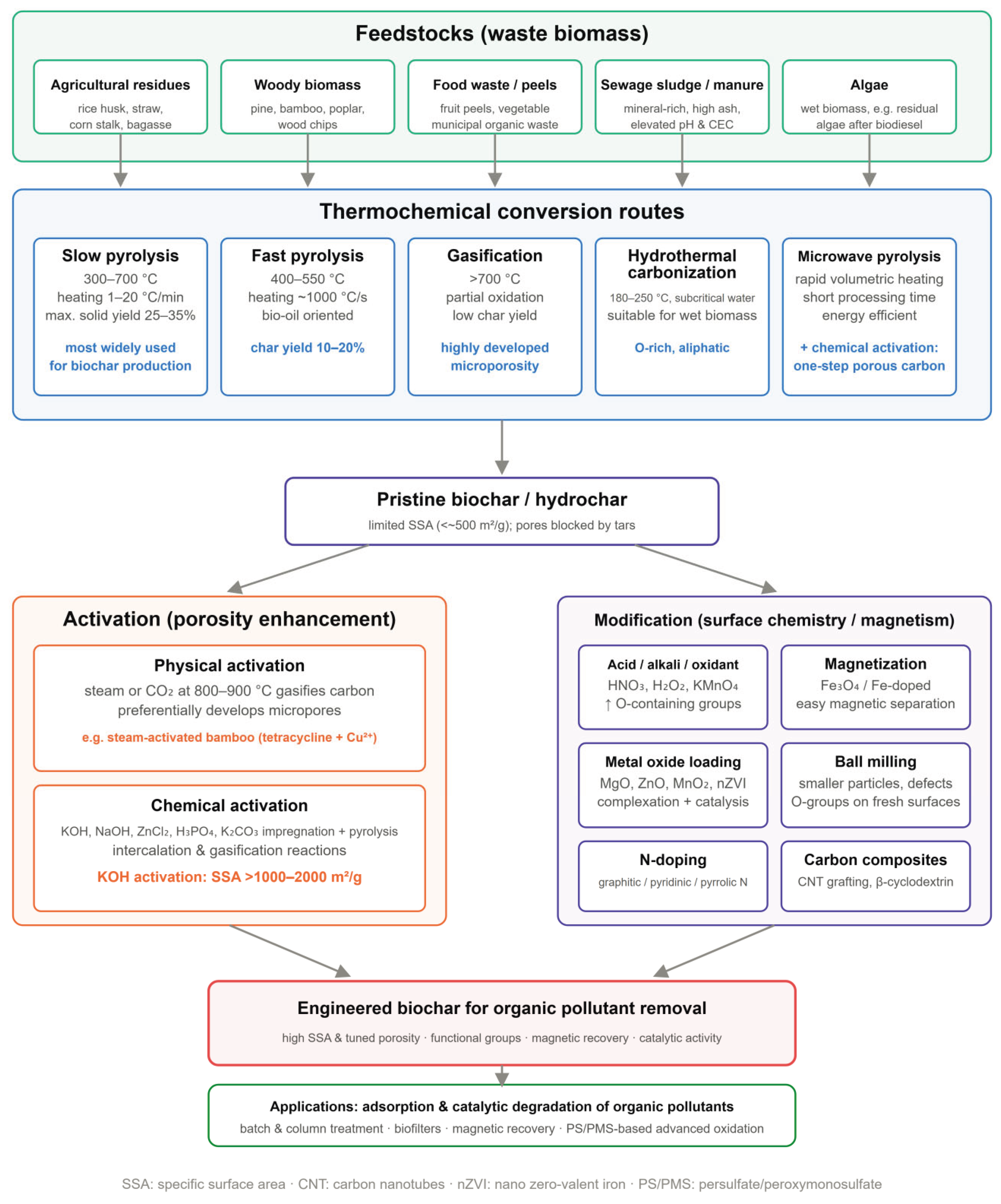
Figure 2.
Mechanisms of organic pollutant removal by biochar: adsorption (pore filling, hydrophobic partitioning, π–π EDA interactions, hydrogen bonding, electrostatic attraction, cation bridging), catalytic degradation (PFR-mediated oxidation, persulfate/peroxymonosulfate activation, photocatalysis), and biofilm-mediated biodegradation.
Figure 2.
Mechanisms of organic pollutant removal by biochar: adsorption (pore filling, hydrophobic partitioning, π–π EDA interactions, hydrogen bonding, electrostatic attraction, cation bridging), catalytic degradation (PFR-mediated oxidation, persulfate/peroxymonosulfate activation, photocatalysis), and biofilm-mediated biodegradation.
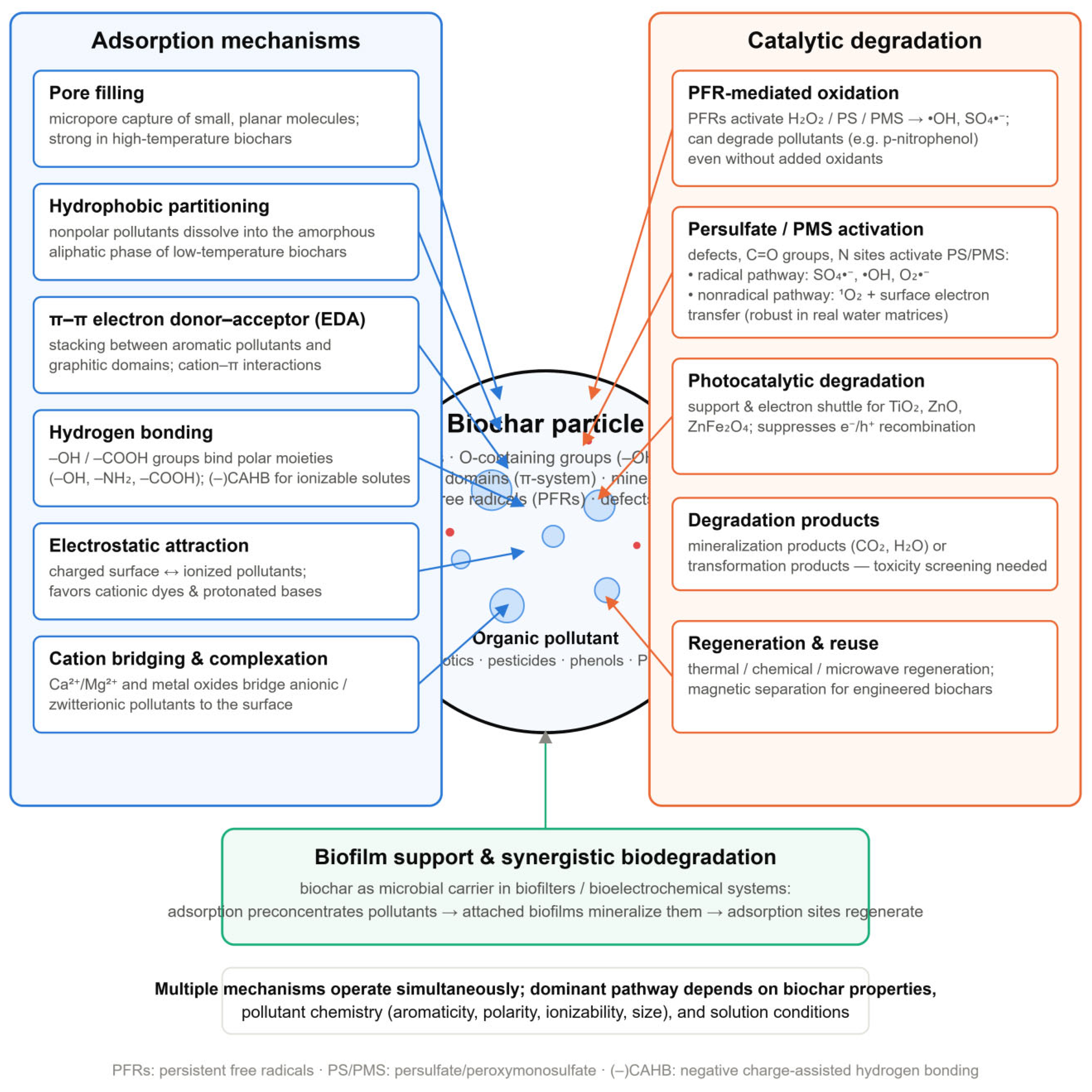
Figure 3.
Key factors governing biochar performance: (a) solution pH, (b) temperature, (c) coexisting ions, (d) natural organic matter (NOM), (e) biochar dosage, and (f) particle size and contact time. Curves are schematic qualitative trends synthesized from the cited literature.
Figure 3.
Key factors governing biochar performance: (a) solution pH, (b) temperature, (c) coexisting ions, (d) natural organic matter (NOM), (e) biochar dosage, and (f) particle size and contact time. Curves are schematic qualitative trends synthesized from the cited literature.
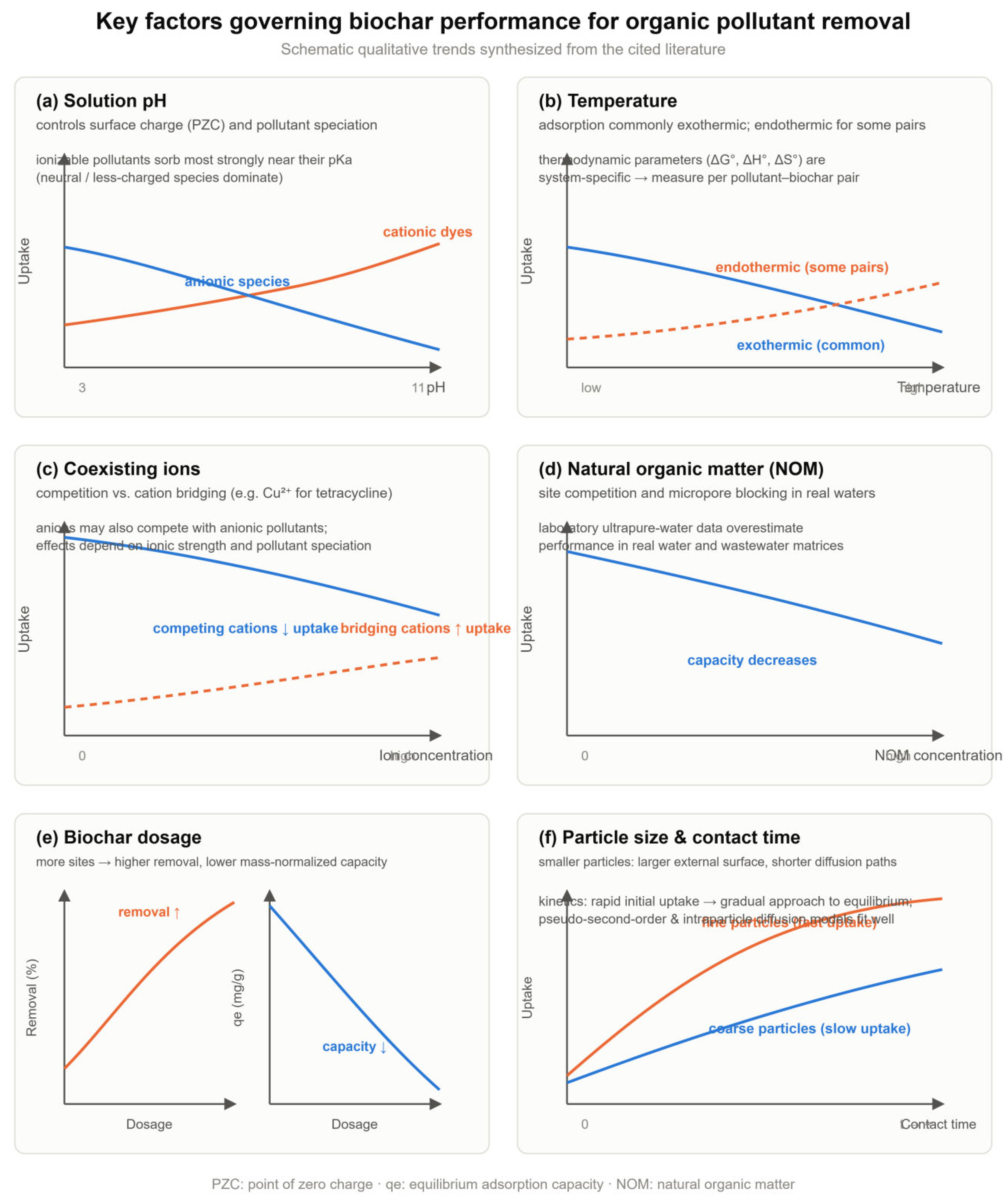

Table 1.
Representative studies on organic pollutant removal from aqueous solution by pristine and engineered biochars.
Table 1.
Representative studies on organic pollutant removal from aqueous solution by pristine and engineered biochars.
| Pollutant | Biochar (feedstock/modification) | Reported capacity or key result | Dominant mechanism(s) | Ref. |
|---|---|---|---|---|
| Crystal violet (cationic dye) | Korean cabbage waste, slow pyrolysis | qmax = 1304 mg/g | Electrostatic, π–π stacking | [31] |
| Methylene blue | KOH-activated peanut shell (SSA 641 m2/g) | qmax = 208 mg/g | Pore filling, electrostatic | [19] |
| Rhodamine B / reactive brilliant blue | Rice straw biochar (SSA 1057 m2/g) | More effective than AC for cationic dye | π–π, electrostatic, H-bonding | [42] |
| Congo red | Residual algae biochar | 82.6% removal (AC: 85.4%) | π–π, electrostatic (Freundlich fit) | [45] |
| Tetracycline | Steam-activated bamboo biochar | 95.75% removal at 0.15 mmol/L TC | π–π EDA, H-bonding, pore filling; Cu2+ bridge enhancement | [20] |
| Tetracycline | Fe/Zn-modified sawdust biochar | Simultaneous TC + Cu(II) removal | Complexation, π–π, cation bridging | [46] |
| Tetracycline | Magnetic porous carbon from hydrochar (γ-Fe2O3, 349 m2/g) | Endothermic, spontaneous uptake; magnetic recovery | π–π, electrostatic | [43] |
| Sulfamethoxazole | Herb-residue biochar (250 °C) | B250 sorbed 2–7× more than high-T chars | (−)CAHB, π–π EDA | [30] |
| Sulfamethoxazole | Bamboo / sugarcane-bagasse biochars | Kd = 2–104 L/kg; 2–14% leaching in columns (vs. 60% unamended) | Electrostatic (pH-dependent), π–π | [47] |
| Simazine | Corn straw biochars (100–600 °C) | Uptake ↑ with aromatic C and SSA | Partitioning + π–π + pore filling | [33] |
| 2,4-D | Wood-derived biochars (400–700 °C) | 700 °C chars comparable to commercial ACs | Surface adsorption; repulsion at high pH | [32] |
| Bisphenol A | Biomass-derived biochars (550 °C) | Capacity stable after O3/nitrate aging | π–π, H-bonding | [48] |
| Bisphenol A | β-cyclodextrin-modified rice-husk biochar | 209.2 mg/g; concurrent Pb(II) 240.1 mg/g | Host–guest inclusion + π–π | [49] |
| Acetaminophen / methylene blue | KOH-activated MSW-derived biochar | MB 99.9% removal; APAP 63.7% (pH-sensitive) | H-bonding, pore filling, electrostatic | [44] |
| Pyrolysis wastewater (TOC) | Poplar biochar; NaOH-activated | NaOH-activated biochar: 2.5× AC capacity | Pore filling, π–π | [50] |
AC: activated carbon; APAP: acetaminophen; Kd: solid–water distribution coefficient; MB: methylene blue; MSW: municipal solid waste; SSA: specific surface area; TOC: total organic carbon; (−)CAHB: negative charge-assisted hydrogen bonding. All values are compiled from the cited original studies.
Table 2.
Comparison of biochar and commercial activated carbon as adsorbents for water treatment.
| Attribute | Biochar | Activated carbon |
|---|---|---|
| Feedstock | Waste biomass (agricultural/forestry residues, sludge, manure) | Coal, coconut shell, peat/wood (often non-renewable) |
| Production | One-step pyrolysis (300–700 °C); activation/modification optional | Two-step carbonization + high-temperature activation (800–1000 °C) |
| Typical SSA (m2/g) | <500 pristine; >1000–2000 after activation | 500–1500 (typical commercial grades) |
| Surface chemistry | Abundant O-groups, minerals/ash, PFRs, N/defect sites | Fewer O-groups; chemistry determined by activation and washing |
| Production cost | ≈0.05–0.4 USD/kg (scale- and technology-dependent) | Typically ~1–4 USD/kg for commercial GAC/PAC |
| Regeneration | Thermal (300–500 °C), chemical, or magnetic separation; capacity mostly retained over 3–5 cycles | Well-established thermal regeneration (600–900 °C) |
| Co-benefits | Waste valorization, carbon sequestration, circular economy | Mature supply chain, consistent quality |
| Maturity | Emerging; mostly laboratory/pilot scale | Established; full-scale standard in drinking and wastewater treatment |
Disclaimer/Publisher’s Note: The statements, opinions and data contained in all publications are solely those of the individual author(s) and contributor(s) and not of MDPI and/or the editor(s). MDPI and/or the editor(s) disclaim responsibility for any injury to people or property resulting from any ideas, methods, instructions or products referred to in the content. |
© 2026 by the authors. Licensee MDPI, Basel, Switzerland. This article is an open access article distributed under the terms and conditions of the Creative Commons Attribution (CC BY) license (http://creativecommons.org/licenses/by/4.0/).
Copyright: This open access article is published under a Creative Commons CC BY 4.0 license, which permit the free download, distribution, and reuse, provided that the author and preprint are cited in any reuse.