
Submitted:
02 September 2026
Posted:
03 September 2026
You are already at the latest version
Abstract
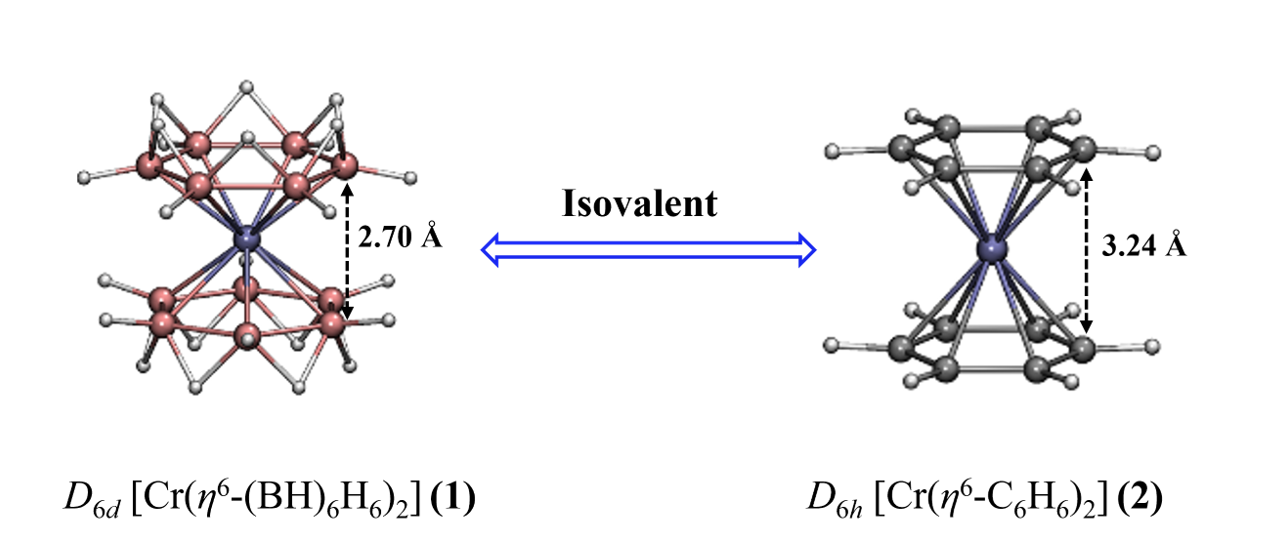
Inspired by the newly discovered sandwich D5d [Os(η5-B5H10)2] as a carbon-free analog of ferrocene [Fe(η5-C5H5)2] (Science 392, (2026): 411) and based on extensive global searches and first-principles theory calculations, we present herein the viable possibility of a staggered sandwich bis(η6-cycloborane)chromium D6d [Cr(η6-(BH)6H6)2] (1) with two equivalent η6- (BH)6H6 ligands isovalent with benzene as the boron analog of the eclipsed bis(η6-benzene)chromium D6h [Cr(η6-C6H6)2] (2). Detailed coordination bonding pattern, energy decomposition, and magnetically induced ring current analyses indicate that D6d 1 matches the 18-electron rule (1S21P61D10) and exhibits similar aromaticity with D6h 2, rendering high stability to the system. The metal-ring coordination bonding in D6d 1 is dominated by effective Cr → (η6-(BH)6H6)2 δ-back-donations which appear to be significantly stronger than the corresponding Cr → (η6-C6H6)2 δ-back-donations in D6h 2, leading to an unusually short ring-ring distance of 2.70 Å and large HOMO-LUMO gap of 7.06 eV in 1. D6d 1 and D6h 2 can also be used as building blocks to form their sandwich tetramers D2h [Cr4(BH)48H28] (3) and D2h [Cr4C48H28] (4) and sandwich two-dimensional nanosheets [Cr(η6-(BH)6)2] (5) and [Cr(η6-C6)2] (6) via partial or complete dehydrogenations, respectively.
Keywords:
cycloboranes
; bis(η6-cycloborane)chromium
; 18-electron rule
; aromaticity
; coordination bonding pattern
1. Introduction
Transition metal sandwich complexes have long been considered as the cornerstone in organometallic chemistry [1,2]. Ferrocene [Fe(η5-C5H5)2], the first transition metal sandwich complex, was successfully synthesized in 1951 and later expanded widely into catalysis, biomedicine, and materials science [3,4,5]. Fischer and co-workers achieved the synthesis of bis(η6-benzene)chromium [Cr(η6-C6H6)2] in 1955, adding another prototypical member to the sandwich family and further refining its structural models and bonding theories [6,7]. Subsequent investigations extended this field into the actinide elements. Streitwieser’s research group successfully synthesized bis(cyclooctatetraenyl)uranium (Uranocene) in 1968, establishing the theoretical and experimental foundations for the development of f-block organometallic chemistry [8]. The first carbon-free inorganic sandwich dianion, [Ti(η5-P5)2]2−, was successfully synthesized in 2001 by Schleyer’s group [9]. Since then, related research has progressed steadily: in 2022, Sun’s group reported [(η4-P4)2Fe]2− [10]; in 2026, the Wolf team further synthesized the cobalt-based sandwich anion [(η5-P5)Co(η3-P3)]−, which contains two inequivalent phosphorus ring fragments — η5-P5 and η3-P3 [11]. Carbon-free sandwich compounds based on arsenic and antimony frameworks have also been successively achieved [12].
As the light neighbor of carbon in the periodic table, boron exhibits obvious similarity with carbon in both structures and bonding. Designing possible synthetic routes to achieve carbon-free, all-boron ligated analogs of ferrocene has been a long-standing goal in organometallic chemistry over the past several decades. As early as 1977, Grimes and his co-workers achieved the synthesis and characterization of the mixed-sandwich complex CpFe(B5H10) (Cp = η5-C5H5) [13]. Since then, various boron-based mixed-sandwich complexes have been successively designed and synthesized [14,15,16], including [Cp*Os(B5H10)] (Cp* = η5-C5Me5) and [Cp*Os(η6-B6H11)] and triple-decker sandwich species [(Cp*Ti)2(μ-η6:η6-B6H6)(μ-H)6] containing a near-planar B6H6 ring [17,18,19]. In 2010, Gribanova et al. theoretically proposed a series of sandwich complexes formed by transition metals (M = Ni, Fe, Cr) coordinated to two equivalent cycloborane ligands, including the inorganic all-boron complexes [Ni(η4-B4H8)2], [Fe(η5-B5H10)2], and [Cr(η6-B6H12)2] [20]. However, this study did not perform global searches and provided no detailed coordination bonding analyses on the concerned sandwich species. Inspiringly, in 2026, Ghosh and coworkers successfully synthesized and characterized the first carbon-free all-boron analog of ferrocene D5d [Os(η5-B5H10)2] with two equivalent η5-(B5H10) ligands isovalent with Cp in experiments, along with its competing isomer [Os(η5-B5H10)(η3-B5H10)], making a milestone in the area [21]. Although D5d [Os(η5-B5H10)2] was found to be air- and moisture-sensitive, it remained reasonably stable in solution under inert conditions, with gradual decomposition over times. Detailed orbital interaction diagram and nucleus-independent chemical shift (NICS) analyses show that [Os(η5-B5H10)2] matches the 18-electron rule and exhibits similar aromaticity with ferrocene. Meantime, Tiznado and co-workers performed an extensive global search on [Fe(η5-B5H10)2] and showed that staggered D5d [Fe(η5-B5H10)2] was the global minimum of the system [22]. The theoretical prediction is expected to be confirmed in future experiments. To carry on this path, we present in this work a detailed theoretical investigation on staggered bis(η6-cycloborane)chromium D6d [Cr(η6-(BH)6H6)2] (1) which is the boron analog of bis(η6-benzene)chromium D6h [Cr(η6-C6H6)2] (2), by performing extensive global searches on its potential energy surface (PES), analyzing its electronic and coordination bonding patterns, simulating its NMR and IR spectra, and expanding it to its sandwich tetramer [Cr4(BH)48H28] (3) and two-dimensional (2D) semiconducting nanosheet [Cr(η6-(BH)6)2] (5) through partial dehydrogenations, aiming to facilitate its future characterization in experiments and application in nanomaterials.
2. Theoretical Methods
To determine the global minimum (GM) structure of CrB12H24, extensive searches were performed on both its singlet and triplet PESs using the TGMin2 [23,24] and CALYSO [25] programs, in conjunction with manual structural constructions guided by chemical intuitions. The initially screened low-lying isomers were fully optimized using the B2PLYP-D3BJ/def2-TZVP method [26,27,28] which has been confirmed to be reliable in the newly discovered D5d [Os(η5-B5H10)2] [21] using the Gaussian16 program [29]. Frequency checks were performed to make sure that all the reported structures are true minima on the PESs. Single-point calculations for the 12 lowest-lying isomers were conducted at the more accurate CCSD(T)/def2-TZVP level [30,31] at the B2PLYP-D3BJ geometries using the ORCA program [32,33]. The energy barrier at the transition state D6h [Cr(η6-(BH)6H6)2] (TS1) was calculated via single-point CCSD(T) calculations. Extensive Born–Oppenheimer molecular dynamics (BOMD) simulations were performed using the CP2K package to evaluate the kinetic stability of the concerned systems [34,35].
To comprehend the structures and stability of the concerned sandwich complexes, detailed adaptive natural density partitioning (AdNDP) bonding analyses were performed using the Multiwfn program [36,37,38], with the results visualized via VMD software [39]. Energy decomposition analysis combined with natural orbitals for chemical valence (EDA-NOCV) [40,41,42] was undertaken using the ADF program [43] at B2PLYP-D3BJ/TZ2P level to compare the ligand–metal orbital interactions in D6d [Cr(η6-(BH)6H6)2] (1) and D6h [Cr(η6-C6H6)2] (2). The aromaticity of both D6d 1 and D6h 2 was comparatively evaluated by anisotropic current-induced density (ACID) [44,45] and gauge-including magnetically induced current (GIMIC) [46,47] analyses, with the ACID plots and GIMIC data visualized using POV-Ray and ParaView programs [48,49], respectively. The 11B and 1H NMR spectra of 1 were simulated at the PBE0/def2-TZVP level using the solvation model based on density (SMD), with chloroform as the solvent [50] and tetramethylsilane (TMS) and BF3·Et2O as the references for 1H and 11B chemical shifts, respectively.
The sandwich tetramers [Cr4(BH)48H28] (3) and [Cr4C48H28] (4) were optimized at B2PLYP-D3BJ/def2-SVP level, while the corresponding 2D nanosheets [Cr(η6-(BH)6)2] (5) and [Cr(η6-C6)2] (6) were fully optimized using the Vienna ab initio simulation package (VASP) [51,52] at PBE [53], with their bonding patterns analyzed using the solid-state adaptive natural density partitioning (SSAdNDP) [54] approach and visualized with the VESTA program [55].
3. Results and Discussion
3.1. Structures and Stabilities
Based on extensive GM searches with over 7000 local stationary points explored, the optimized structures of the twelve lowest-lying isomers of CrB12H24 are collectively depicted in Figure S1. At the most accurate CCSD(T)/def2-TZVP//B2PLYP-D3BJ/def2-TZVP level performed in this work, the staggered sandwich complex D6d [Cr(η6-(BH)6H6)2] (1, 1A1g) lies only 0.04 eV above the GM 1B which contains a CrB12H18 unit with three H2 molecules released, while all the other low-lying isomers appear to be systematically less stable than 1. D6d 1 may thus potentially coexist with other low-lying isomers and be isolated and characterized in experiments, though it may decompose gradually over times, similar to the situation in the experimentally synthesized D5d [Os(η5-B5H10)2] [21]. It is noticed that 1I ([Cr(η2-B6H12)(η4-B6H12)]) contains a η2/η4-mixed coordination motif, while 1K ([Cr(η2-B6H12)(η6-B6H12)]) possesses a η2/η6-mixed coordination pattern, similar to the situation in the experimentally observed [Os(η5-B5H10)(η3-B5H10)] [21] which possesses a η3/η5-mixed coordination configuration.
Figure 1 details the optimized structural parameters of D6d [Cr(η6-(BH)6H6)2] (1, 1A1g) which contains two equivalent η6-cycloborane (BH)6H6 ligands in a staggered configuration, compared with that of the bis(η6-benzene)chromium D6h [Cr(η6-C6H6)2] (2, 1A1g) which possesses two equivalent benzene C6H6 ligands in an eclipsed motif at B2PLYP-D3BJ/def2-TZVP. Frequency analyses indicate that D6d 1 is a true minimum on its PES, with the lowest vibrational frequency of 107.33 cm–1. The η6-cycloborane (BH)6H6 ligand isovalent with benzene C6H6 features a perfect planar B6 ring bridged together by six equivalent B-H-B three-center bridge bonds on one side, with the six terminal B–H bonds around bending toward the metal with a bending angle of 13.17° which appears to be even obviously bigger than bending angle of 5.8° observed in D5d [Os(η5-B5H10)2] [21]. The staggered configuration helps reduce the electrostatic repulsion between the two η6-(BH)6H6 ligands in D6d 1. It is worth noticing that a bare planar (BH)6H6 corresponds to a second-order saddle point on its PES. Coordination to a Cr atom on one side effectively helps to stabilize the η6-(BH)6H6 planar geometry with the B–B bond length of 1.75 Å and Cr-B coordination bond length of 2.20 Å. More importantly, the large B6 ring size and effective Cr-B6 orbital interaction lead to the unusually short ring-ring distance of 2.70 Å in 1 which appears to be much shorter than the corresponding ring-ring distance of 3.24 Å in 2 and obviously shorter than the observed ring-ring separation of 3.071 Å in D5d [Os(η5-B5H10)2] [21]. The calculated large HOMO–LUMO gap of ∆EH-L = 7.06 eV in 1 turns out to be even slightly larger than the corresponding value of ∆EH-L = 6.72 eV in 2, strongly supporting the high chemical stability of D6d 1 mainly concerned in this work.
As indicated in Figure 1, sandwich D6d 1 and D6h 2 can be used as building blocks to form their sandwich tetramers D2h [Cr4(BH)48H28] (3) and D2h [Cr4C48H28] (4) via partial removal of their terminal hydrogens, with the top and bottom ligands adopting eclipsed conformations. Frequency analyses confirm that both 3 and 4 are genuine minima on their PESs. The adjacent η6-(BH)6 and η6-C6 ligands are interconnected via B–B and C–C covalent bonds, respectively. The B–B and Cr–B and C-C and Cr–C bond lengths and centroid-to-centroid distances in 3 and 4 are highly consistent with that of their monomers 1 and 2, respectively. The calculated large HOMO-LUMO gaps of ∆EH-L =5.99 eV in 3 and ∆EH-L = 4.58 eV in 4 well support the high chemical stability of the two sandwich tetramers.
To evaluate the dynamic stability of 1, we performed extensive BOMD simulations on it at 500 K for 100 ps, as shown in Figure S2. With the small calculated average root-mean-square deviation of RMSD = 0.08 Å and maximum bond-length deviation of MAXD = 0.25 Å, sandwich 1 appears to be dynamically stable at high-temperatures. Although the calculated RMSD and MAXD values exhibit certain fluctuations during the simulations, they return to the baselines quickly and the overall sandwich molecular framework remains well preserved throughout the simulation processes.
We compare the fluxional behaviors of 1 and 2 in details in Figure S3. [Cr(η6-(BH)6H6)2] (1) possesses an eclipsed transition state of D6h [Cr(η6-(BH)6H6)2] (TS1) with an imaginary frequency of νmin = –94.85 cm–1 at B2PLYP-D3BJ, an energy barrier of 8.53 kcal·mol–1 at CCSD(T), and a calculated fluxional rate constant of k1 = 7.73 × 10⁸ s–1 in transition state theory. In comparison, [Cr(η6-C6H6)2] (2) has a staggered transition state of D6d [Cr(η6-C6H6)2] (TS2) with an imaginary frequency of νmin = –43.01 cm–1, an energy barrier of 0.92 kcal·mol–1, and fluxional rate constant of k2 = 4.48 × 10¹¹ s–1. D6d 1 thus exhibits a fluxional rate constant about 1000 times smaller than that of D6h 2 due to the strong Cr → (η6-(BH)6H6)2 δ-back donation interaction in it as detailed below.
3.2. Bonding Pattern and Aromaticity Analyses
The AdNDP bonding patterns of D6d [Cr(η6-(BH)6H6)2] (1) are presented in Figure 2a, compared with that of D6h [Cr(η6-C6H6)2] (2) in Figure 2b. The staggered D6d 1 possesses 12 2c–2e B–H terminal σ-bonds with the occupation numbers ON = 1.98 |e|, 12 3c–2e B–H–B bridge σ-bonds with ON = 1.98 |e|, and 9 13c–2e Cr-(B6)2 coordination bonds with ON = 1.93–1.99. The Cr coordination center in D6d 1 thus follows the 18-electron rule in the valence electron configuration of 1S21P61D10. Such a bonding pattern has a one-to-one correspondence with that of eclipsed D6h 2 in Figure 2b which has 12 2c–2e C–H terminal σ-bonds, 12 2c–2e C–C σ-bonds, and 9 13c–2e Cr-(C6)2 coordination bonds matching the 18-electron rule. As shown in Figure S4, the two slightly less stable transition states D6h [Cr(η6-(BH)6H6)2] (TS1) and D6d[Cr(η6-C6H6)2] (TS2) possess similar bonding patterns with 1 and 2 in which one ligand is rotated by 30° relative to the other one, with the Cr center remained to follow the 18-electron rule.
To gain deeper insight into the nature of the Cr–ligand interactions, we carried out detailed EDA-NOCV analyses on 1 and 2 in Figure 3. Following the Cr – (ƞ6-C6H6)2 ligand bonding scheme previously proposed by Frenking and co-workers [56], we chose neutral singlet fragment pairs Cr and (L)2 (L = (BH)6H6 or C6H6) to describe their bonding characteristics, enabling a systematic comparison between the two compounds. Figure 3 clearly illustrates the orbital interactions between Cr and (L)2. In 1, the occupied Cr and empty Cr 4s orbitals interact with the occupied 4a1 orbital of ((BH)6H6)2 ligand to generate the 8a1 σ-donation bond (), the occupied Cr and 3dxy orbitals interact with the empty 4e2 orbitals of ((BH)6H6)2 to form the two 4e2 δ-back-donation bonds (1/1Dxy), while the two 4e5 π-donation bonds (1Dxz/1Dyz), two 6e1 π-donation bonds (1Px/1Py), one 6b2 σ-donation bond (1Pz), and one 7a1 σ-donation bond (1S) all mainly originate from interactions between the occupied orbitals of ((BH)6H6)2 and the corresponding empty orbitals of the Cr atom. The orbital interaction diagram of 2 is similar to that of 1, but the overall interaction energy of ΔEint = –465.93 kcal/mol and orbital interaction energy of ΔEorb = -646.81 kcal/mol in 1 appear to be significantly bigger than the corresponding values of ΔEint = -247.61 kcal/mol and ΔEorb = -567.37 kcal/mol in 2, as detailed in Table 1.
The EDA–NOCV deformation density plots of 1 and 2 are comparatively depicted in Figure S5, with the color code clearly indicating the directions of charge flows from the red regions to blue ones. In 1, the largest orbital contribution arises from the two 4e2 δ-back donation interactions, with ΔEorb(1) = –227.24 kcal/mol (35.13%) and ΔEorb(2) = –227.12 kcal/mol (35.13%), respectively. The second largest contribution comes from the 8a1 σ-donation bond, with ΔEorb(3) = –141.43 kcal/mol (21.87%). The two degenerate 4e5 π-donation interactions make minor contributions to the overall ΔEorb, with ΔEorb(4) = ΔEorb(5) = –22.27 kcal/mol (3.44%). Similarly, in 2, the major contribution originates from the two 4e2g δ-back-donation bonds, with ΔEorb(1) = –150.22 kcal/mol (26.48%) and ΔEorb(2) = –149.80 kcal/mol (26.40%), respectively. The 8a1g σ-donation in 2 makes a significantly bigger contribution to the overall ΔEorb, with ΔEorb(3) = –208.88 kcal/mol (36.82%), while the two degenerate 4e1g π-donations contribute much less, with ΔEorb(4) = ΔEorb(5) = –22.51 kcal/mol (3.97%). Overall, the quantitative data in Table 1 unveil the fact that the Cr → (L)2 δ-back donation plays a dominant role in both 1 and 2. However, the total contribution of the δ-back-donations in 1 (70.26%) appears to be significantly higher than that of the corresponding δ-back-donations (52.88%) in 2, in agreement with the fact that the centroid-to-centroid distance of 2.70 Å in 1 is much smaller than the corresponding distance of 3.24 Å in 2.
The aromaticity of D6d [Cr(η6-(BH)6H6)2] (1) and D6h [Cr(η6-C6H6)2] (2) was comparatively analyzed using both the ACID and GIMIC methods, as shown in Figure 4a and Figure 4b, respectively. The red arrows in both Figure 4a and Figure 4b clearly indicate the clockwise directions of the induced ring currents in D6d [Cr(η6-(BH)6H6)2] (1) which appear to be very similar to that of D6h [Cr(η6-C6H6)2] (2), a well-known aromatic sandwich complex. These results strongly suggest that [Cr(η6-(BH)6H6)2] (1) possesses similar aromaticity with [Cr(η6-C6H6)2] (2). Substitution of two η6-C6H6 lingands in 2 with two isovalent planar η6-(BH)6H6 units in 1 well maintains the profound aromatic character of the sandwich system.
3.3. NMR Spectral Simulations
The simulated 11B and 1H NMR spectra of D6d [Cr(η6-(BH)6H6)2] (1) are depictd in Figure 5 to facilitate its future spectroscopic characterization. As anticipated, the simulated 11B NMR spectrum exhibits only one characteristic chemical shift at δ = 13.87 ppm because all the twelve B atoms in 1 are chemically equivalent. Its 1H NMR spectrum in Figure 5b displays two characteristic peaks at δ = –3.30 and 2.92 ppm which originate from the twelve equivalent B–H–B bridge hodrogens and twelve equivalent terminal hydrogens, respectively. The simulated IR spectrum of 1 is also provided in Figure S6 to facilitate future IR measurements.
3.3. Two-Dimentional Sandwich Nanosheets of [Cr(η6-(BH)6H6)2] (1) and [Cr(η6-C6H6)2] (2)
As shown in Figure 6, 2D sandwich nanosheets [Cr(η6-(BH)6)2] (5) and [Cr(η6-C6)2] (6) can be formed using 1 and 2 as building blocks via complete removal of the terminal hydrogen atoms. Each unit cell in 5 contains one Cr atom, twelve B atoms, and twelve bridging hydrogen atoms, with the optimized lattice parameters of a = b = 5.26 Å, α = β = 90°, and γ = 60°. Similarly, each unit cell in 6 consists of one Cr atom and twelve C atoms, with the optimized lattice parameters of a = b = 4.33 Å, α = β = 90° and γ = 60°. The C–C, B–B, Cr–C, and Cr–B bond lengths and intralayer distances in 2D 5 and 6 in Figure 6 are all well consistent with their monomers 1 and 2 in Figure 1, indicating that the local coordination environment of the Cr centers is well retained during the stepwise expansion from monomers to their infinite 2D nanosheets.
Figure 7 shows that no imaginary frequencies exist in the calculated phonon dispersion curves of 2D 5 and 6, indicating that both of them are dynamically stable. The 2D 5 exhibits a small indirect band gap of Egap = 0.34 eV, suggesting that it is a semiconductor, while 2D 6 appears to be metallic in nature with no band gaps observed. To elucidate the orbital interactions between Cr and B in these sandwich 2D nanomaterials, we calculated their densities of states (DOS) at the right side of Figure 7. DOS analyses clearly reveal that, in the valence band regions, the Cr 3d -- B 2p orbital overlap in 5 is considerably stronger than the Cr 3d -- C 2p orbital overlap in 6, indicating that stronger δ-back donation interactions exist between Cr and B in 5 than that between Cr and C in 6, in agreement with the situation in their monomers 1 and 2 demonstrated in Figure 3 and Table 1.
SSAdNDP bonding pattern analyses are also comparatively performed on 2D 5 and 2D 6 in Figure S7. Interestingly, as shown in Figure S7a, a unit cell in 2D 5 possesses 6 2c–2e B–B σ-bonds between adjacent rings, 12 3c–2e B–H–B bridge σ-bonds on the top and bottom, and 9 13c–2e delocalized bonds between the Cr center and its two η6-(B6)2 ligands on the top and bottom following the 18-electron rule. The bonding pattern of 2D 5 is thus well consistent with that of monomer complex 1. Similar situation exists in 2D 6, as shown in Figure S7b.
4. Conclusions
In summary, we have presented herein a comprehensive first-principles theory investigation on D6d [Cr(η6-(BH)6H6)2] (1) and its tetramer [Cr4(BH)48H28] (3) and 2D nanosheet [Cr(η6-(BH)6)2] (5). Detailed AdNDP, EDA-NOCV, ACID, and GIMIC analyses indicate that [Cr(η6-(BH)6H6)2] (1) possesses similar aromaticity with [Cr(η6-C6H6)2] (2), each Cr center in 1, 3, and 5 matches the 18-electron rule, and Cr → ((BH)6H6)2 δ-back-donation dominates the coordination orbital interactions in these sandwich species. An isovalent ligand-substitution (η6-(BH)6H6 → η6-C6H6) in [Cr(η6-C6H6)2] (2) well retains the sandwich geometry and bonding pattern of the system in [Cr(η6-(BH)6H6)2] (1). With the right precursors under suitable conditions, it is viably possible to synthesize and characterize 1 and its derivatives 3 and 5 in experiments to effectively enrich the chemistry of cycloborane-based transition metal sandwich complexes.
Supplementary Materials
The following supporting information can be downloaded at the website of this paper posted on Preprints.org: Figure S1, the twelve lowest-lying isomers of CrB12H24; Figure S2, BOMD simulations of D6d [Cr(η6 -(BH)6H6)2] (1) at 500K for 100 ps; Figure S3, optimized fluxional mechanisms of D6d [Cr(η6-(BH)6H6)2] (1) and D6h [Cr(η6-C6H6)2] (2) with the transition states TS1 and TS2 indicated; Figure S4, AdNDP bonding patterns of transition states TS1 and TS2; Figure S5, deformation density (Δρ) plots from EDA-NOCV analyses for [Cr(η6-(BH)6H6)2] (1) and [Cr(η6-C6H6)2] (2); Figure S6, simulated infrared (IR) spectrum of D6d [Cr(ƞ6-(BH)6H6)2] (1); Figure S7, SSAdNDP bonding patterns of 2D nanosheets [Cr(η6-(BH)6)2] (5) and [Cr(η6-C6)2] (6).
Author Contributions
Conceptualization, S.-D. L.; methodology, S.-D. L. and Q.-W.Z.; investigation, Q.-W.Z., R.W., and H.-X. P.; resources, S.-D.L.; data calculation, Q.-W.Z. and R.W.; writing—original draft preparation, Q.-W.Z.; writing—review and editing, S.-D.L.; funding acquisition, S.-D.L. All authors have read and agreed to the published version of the manuscript.
Funding
This research was funded by “the National Natural Science Foundation of China, grant number 22373061 and 92461303 to S. D. L”.
Data Availability Statement
Data are contained with in the article and Supplementary Materials.
Conflicts of Interest
The authors declare no conflicts of interest.
Abbreviations
The following abbreviations are used in this manuscript:
| Cp | C5H5 |
| Cp* | η5-C5Me5 |
| GM | Global minimum |
| PES | Potential energy surface |
| BOMD | Born-Oppenheimer molecular dynamics |
| RMSD | Root-mean-square deviation |
| MAXD | Maximum bond-length deviation |
| AdNDP | Adaptive natural density partitioning |
| ACID | Anisotropic current-induced density |
| GIMIC | Gauge-including magnetically induced current |
| EDA-NOCV | Energy decomposition analysis combined with natural orbitals for chemical valence |
| VASP | Vienna ab initio simulation package |
| SSAdNDP | Solid-state adaptive natural density partitioning |
| 2D | Two-dimensional |
| DOS | Density of states |
References
- Abel, E.W.; Stone, F.G.A.; Wilkinson, G., Eds. Comprehensive Organometallic Chemistry II, Vol. 1–14, Elsevier, Oxford, 1995.
- Elschenbroich, Ch.; Salzer, A. Organometallics, 2nd ed., VCH, Weinheim, 1992, p. 309.
- Kealy, T.J.; Pauson, P.L. A New Type of Organo-Iron Compound. Nature 1951, 168, 1039–1040. [CrossRef]
- Astruc, D. The Numerous Paths of Ferrocene. Nat. Chem. 2023, 15, 1650. [CrossRef]
- Štěpnička, P. Forever Young: The First Seventy Years of Ferrocene. Dalton Trans. 2022, 51, 8085–8102.
- Pampaloni, G. Aromatic Hydrocarbons as Ligands. Recent Advances in the Synthesis, the Reactivity and the Applications of Bis(η6-arene) Complexes. Coord. Chem. Rev. 2010, 254, 402–419. [CrossRef]
- Seyferth, D. Bis(benzene)chromium. 2. Its Discovery by E. O. Fischer and W. Hafner and Subsequent Work by the Research Groups of E. O. Fischer, H. H. Zeiss, F. Hein, C. Elschenbroich, and Others. Organometallics 2002, 21, 2800–2820.
- Streitwieser, A., Jr.; U. Mueller-Westerhoff Bis(cyclooctatetraenyl)uranium (Uranocene). A New Class of Sandwich Complexes That Utilize Atomic f Orbitals. J. Am. Chem. Soc. 1968, 90, 7364. [CrossRef]
- Urne˙žius, E.; Brennessel, W.W.; Cramer, C.J.; Ellis, J.E.; Schleyer, P.v.R. A Carbon-Free Sandwich Complex [(P5)2Ti]2−. Science 2002, 295, 832–834.
- Wang, Z.-C.; Qiao, L.; Sun, Z.-M.; Scheer, M. Inorganic Ferrocene Analogue [Fe(P4)2]2–. J. Am. Chem. Soc. 2022, 144, 6698–6702.
- Trabitsch, K.; Ziegler, C.G.P.; Prock, L.; Balázs, G.; Schwedtmann, K.; García-Padilla, E.; Meurer, F.; Snabilié, D.D.; de Bruin, B.; Weigand, J.J.; Wolf, R. Inorganic Cobalt Sandwich Complex [(η5-P5)Co(η3-P3)]−. J. Am. Chem. Soc. 2026, 148, 11467–11472.
- Yue, X.-H.; Chen, W.-X.; Yang, T.; Muñoz-Castro, A.; Frenking, G.; Sun, Z.-M. Carbon-Free Sandwich Compounds Based on Arsenic and Antimony with Icosahedral Metal Cores. Nat. Synth. 2023, 2, 423–429. [CrossRef]
- Weiss, R.; Grimes, R.N. New Ferraboranes. Structural Analogs of Hexaborane(10) and Ferrocene. A Complex of Cyclic B5H10–, a Counterpart of C5H5–. J. Am. Chem. Soc. 1977, 99, 8087–8088. [CrossRef]
- King, R.B. Cyclopentadienyl Ruthenium, Rhodium, and Iridium Vertices in Metallaboranes: Geometry and Chemical Bonding. Inorg. Chem. 2004, 43, 4241–4247.
- Li, L.; Xu, C.; Jin, B.; Cheng, L. Ferrocene Analogues of Sandwich M(CrB6H6)2: A Theoretical Investigation. Dalton Trans. 2014, 43, 11739–11744.
- Grimes, R.N. Synthesis and Serendipity in Boron Chemistry: A 50 Year Perspective. J. Organomet. Chem. 2013, 747, 4–15. [CrossRef]
- Kar, K.; Joshi, G.; Jemmis, E.D.; Ghosh, S. All-Boron Analogue of Planar Benzene on an Osmium Template. Chem. Sci. 2026, 17, 196–204.
- Shyamal, S.; Chatterjee, D.; Kar, K.; Ghosh, S. Osmaborane Clusters with B4 and B5 Rings Stabilized in the Coordination Sphere of {OsLn} (Ln = η5-C5Me5 or H2(PPh3)2). Inorg. Chem. 2024, 63, 21838–21848.
- Kar, S.; Bairagi, S.; Haridas, A.; Joshi, G.; Jemmis, E.D.; Ghosh, S. Hexagonal Planar [B6H6] within a [B6H12] Borate Complex: Structure and Bonding of [(Cp*Ti)2(μ-η6 : η6-B6H6)(μ-H)6]. Angew. Chem. Int. Ed. 2022, 61, e202208293. [CrossRef]
- Gribanova, T.N.; Starikov, A.G.; Minyaev, R.M.; Minkin, V.I.; Siebert, M.R.; Tantillo, D.J. Sandwich Compounds of Transition Metals with Cyclopolyenes and Isolobal Boron Analogues. Chem. Eur. J. 2010, 16, 2272–2281. [CrossRef]
- Mohapatra, S.; Saha, S.; Joshi, G.; Gupta, U.; Patel, D.K.; Jemmis, E.D.; Ghosh, S. [Os(η5-B5H10)2]: A Carbon-Free Analog of Ferrocene. Science 2026, 392, 411–414.
- Roman-Ventura, V.; Quispe-Corimayhua, L.; Sacanamboy, D.S.; Inostroza, D.; Leyva-Parra, L.; Páez, D.; Donald, K.J.; Merino, G.; Tiznado, W. A Borane Sandwich Analogue of Ferrocene. Angew. Chem. Int. Ed. 2026, 65, e3470057.
- Zhao, Y.F.; Chen, X.; Li, J. TGMin: A Global-Minimum Structure Search Program Based on a Constrained Basin-Hopping Algorithm. Nano Res. 2017, 10, 3407–3420. [CrossRef]
- Chen, X.; Zhao, Y.-F.; Wang, L.-S.; Li, J. Recent Progresses of Global Minimum Searches of Nanoclusters with a Constrained Basin-Hopping Algorithm in the TGMin Program. Comput. Theo. Chem. 2017, 1107, 57–65. [CrossRef]
- Wang, Y.; Lv, J.; Zhu, L.; Ma, Y. CALYPSO: A Method for Crystal Structure Prediction. Comput. Phys. Commun. 2012, 183, 2063–2070.
- Grimme, S.; Semiempirical Hybrid Density Functional with Perturbative Second-Order Correlation. J. Chem. Phys. 2006, 124, 034108. [CrossRef]
- Grimme, S.; Ehrlich, S.; Goerigk, L. Effect of the Damping Function in Dispersion Corrected Density Functional Theory. J. Comput. Chem. 2011, 32, 1456–1465.
- Weigend, F.; Ahlrichs, R. Balanced Basis Sets of Split Valence, Triple Zeta Valence and Quadruple Zeta Valence Quality for H to Rn: Design and Assessment of Accuracy. Phys. Chem. Chem. Phys. 2005, 7, 3297–3305. [CrossRef]
- Frisch, M.J.; Trucks, G.W.; Schlegel, H.B.; Scuseria, G.E.; Robb, M.A.; Cheeseman, J.R.; Scalmani, G.; Barone, V.; Petersson, G.A.; et al. Gaussian 16, Revision C.01, Gaussian, Inc., Wallingford, CT, 2016.
- Purvis, G.D., III; Bartlett, R.J. A Full Coupled-Cluster Singles and Doubles Model: The Inclusion of Disconnected Triples. J. Chem. Phys. 1982, 76, 1910–1918.
- Lee, T.J.; Taylor, P.R. A Diagnostic for Determining the Quality of Single-Reference Electron Correlation Methods. Int. J. Quantum Chem. 1989, 36, 199–207. [CrossRef]
- Neese, F. The ORCA Program System. WIREs Comput. Mol. Sci. 2012, 2, 73–78.
- Neese, F.; Wennmohs, F.; Becker, U.; Riplinger, C. The ORCA Quantum Chemistry Program Package. J. Chem. Phys. 2020, 152, 224108.
- Millam, J.M.; Bakken, V.r.; Chen, W.; Hase, W.L.; Schlegel, H.B. Ab Initio Classical Trajectories on the Born-Oppenheimer Surface: Hessian-Based Integrators Using Fifth-order Polynomial and Rational Function Fits. J. Chem. Phys. 1999, 111, 3800–3805. [CrossRef]
- VandeVondele, J.; Krack, M.; Mohamed, F.; Parrinello, M.; Chassaing, T.; Hutter, J. Quickstep: Fast and Accurate Density Functional Calculations Using a Mixed Gaussian and Plane Waves Approach. Comput. Phys. Commun. 2005, 167, 103–128.
- Zubarev, D.Y.; Boldyrev, A.I. Developing Paradigms of Chemical Bonding: Adaptive Natural Density Partitioning. Phys. Chem. Chem. Phys. 2008, 10, 5207–5217.
- Lu, T.; Chen, F.W. Multiwfn: A Multifunctional Wavefunction Analyzer. J. Comput. Chem. 2012, 33, 580–592.
- Lu, T. A Comprehensive Electron Wavefunction Analysis Toolbox for Chemists, Multiwfn. J. Chem. Phys. 2024, 161, 082503. [CrossRef]
- Humphrey, W.; Dalke, A.; Schulten, K. VMD: Visual Molecular Dynamics. J. Mol. Graph. 1996, 14, (1996): 33–38.
- Mitoraj, M.P.; Michalak, A.; Ziegler, T. A Combined Charge and Energy Decomposition Scheme for Bond Analysis” J. Chem. Theory Comput. 2009, 5, 962–975.
- Mitoraj, M.; Michalak, A. Donor–Acceptor Properties of Ligands from the Natural Orbitals for Chemical Valence. Organometallics 2007, 26, 6576–6580. [CrossRef]
- Mitoraj, M.; Michalak, A. Natural Orbitals for Chemical Valence as Descriptors of Chemical Bonding in Transition Metal Complexes. J. Mol. Model. 2007, 13, 347–355.
- te Velde, G.; Bickelhaupt, F. M.; Baerends, E. J.; Fonseca Guerra, C.; van Gisbergen, S. J. A.; Snijders, J. G.; Ziegler, T. Chemistry with ADF. J. Comput. Chem. 2001, 22, 931–967.
- Geuenich, D.; Hess, K.; Köhler, F.; Herges, R. Anisotropy of the Induced Current Density (ACID), A General Method To Quantify and Visualize Electronic Delocalization. Chem. Rev. 2005, 105, 3758–3772. [CrossRef]
- Herges, R.; Geuenich, D. Delocalization of Electrons in Molecules. J. Phys. Chem. A 2001, 105, 3214–3220.
- Fliegl, H.; Taubert, S.; Lehtonen, O.; Sundholm, D. The Gauge Including Magnetically Induced Current Method. Phys. Chem. Chem. Phys. 2011, 13 20500–20518.
- Sundholm, D.; Fliegl, H.; Berger, R.J.F. Calculations of Magnetically Induced Current Densities: Theory and Applications. WIREs Comput. Mol. Sci. 2016, 6, 639–678. [CrossRef]
- L. Persistence of Vision Raytracer Pty, POV-Ray 3.7, http://www.povray.org (accessed on Nov 20, 2019).
- Squillacote, A.H.; Ahrens, J.; Law, C.; Geveci, B.; Moreland, K.; King, B. The Paraview Guide. Kitware Clifton Park, NY: 2007.
- Marenich, A.V.; Cramer, C.J.; Truhlar, D.G. Universal Solvation Model Based on Solute Electron Density and on a Continuum Model of the Solvent Defined by the Bulk Dielectric Constant and Atomic Surface Tensions. J. Phys. Chem. B 2009, 113, 6378–6396.
- Kresse, G.; Furthmüller, J. Efficient Iterative Schemes for Ab Initio Total-Energy Calculations Using A Plane-Wave Basis Set. J. Phys. Rev. B 1996, 54, 11169–11186. [CrossRef]
- Kresse, G.; Furthmüller, J. Efficiency of Ab-Initio Total Energy Calculations for Metals and Semiconductors Using A Plane-Wave Basis Set. Comput. Mater. Sci. 1996, 6, 15–50.
- Perdew, J.P.; Burke, K.; Ernzerhof, M. Generalized Gradient Approximation Made Simple. Phys. Rev. Lett. 1996, 77, 3865–3868.
- Galeev, T.R.; Dunnington, B.D.; Schmidt, J.R.; Boldyrev, A.I. Solid State Adaptive Natural Density Partitioning: A Tool for Deciphering Multi-Center Bonding in Periodic Systems. Phys. Chem. Chem. Phys. 2013, 15, 5022–5029.
- Momma, K.; Izumi, F. VESTA: A Three-Dimensional Visualization System for Electronic and Structural Analysis. J. Appl. Crystallogr. 2008, 41, 653–658.
- Rayón, V.M.; Frenking, G. Bis(benzene)chromium Is a δ-Bonded Molecule and Ferrocene Is a π-Bonded Molecule. Organometallics 2003, 22, 3304–3308.
Figure 1.
Optimized structures of the transition-metal sandwich complexes bis(η6-cycloborane)chromium D6d [Cr(η6-(BH)6H6)2] (1) and bis(η6-benzene)chromium D6h [Cr(η6-C6H6)2] (2) and their corresponding tetramers D2h [Cr4(BH)48H28] (3) and D2h [Cr4C48H28] (4) at B2PLYP-D3BJ level, with the necessary C-C, B-B, Cr-C, and Cr-B bond lengths and centroid-to-centroid distances indicated in Å.
Figure 1.
Optimized structures of the transition-metal sandwich complexes bis(η6-cycloborane)chromium D6d [Cr(η6-(BH)6H6)2] (1) and bis(η6-benzene)chromium D6h [Cr(η6-C6H6)2] (2) and their corresponding tetramers D2h [Cr4(BH)48H28] (3) and D2h [Cr4C48H28] (4) at B2PLYP-D3BJ level, with the necessary C-C, B-B, Cr-C, and Cr-B bond lengths and centroid-to-centroid distances indicated in Å.
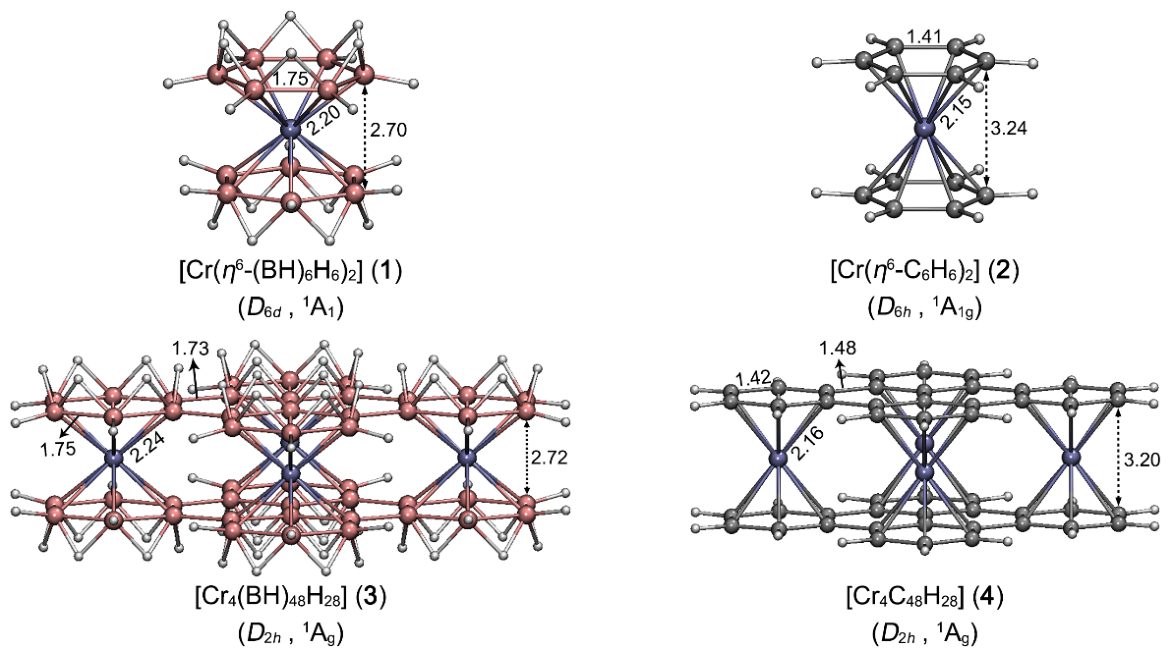
Figure 2.
AdNDP bonding patterns of (a) D6d [Cr(η6-(BH)6H6)2] (1) and (b) D6h [Cr(η6-C6H6)2] (2), with the occupation numbers (ON) indicated.
Figure 2.
AdNDP bonding patterns of (a) D6d [Cr(η6-(BH)6H6)2] (1) and (b) D6h [Cr(η6-C6H6)2] (2), with the occupation numbers (ON) indicated.
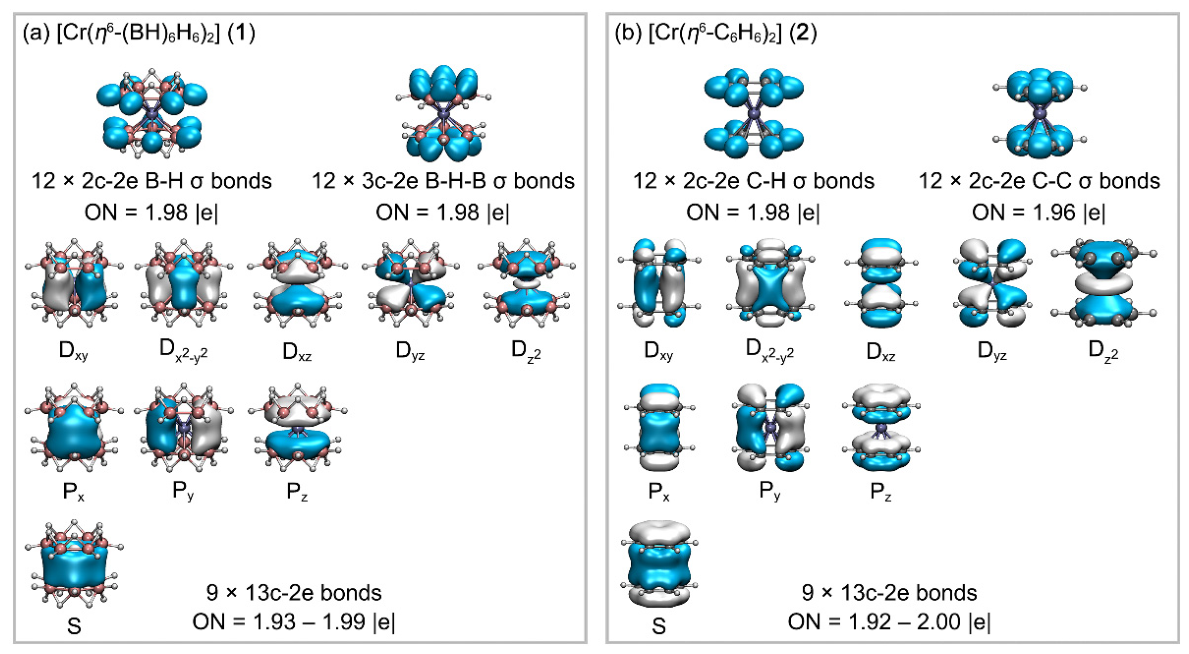
Figure 3.
Orbital interaction diagrams of D6d [Cr(η6-(BH)6H6)2] (1) and D6h [Cr(η6-C6H6)2] (2) at B2PLYP-D3BJ/TZ2P level.
Figure 3.
Orbital interaction diagrams of D6d [Cr(η6-(BH)6H6)2] (1) and D6h [Cr(η6-C6H6)2] (2) at B2PLYP-D3BJ/TZ2P level.
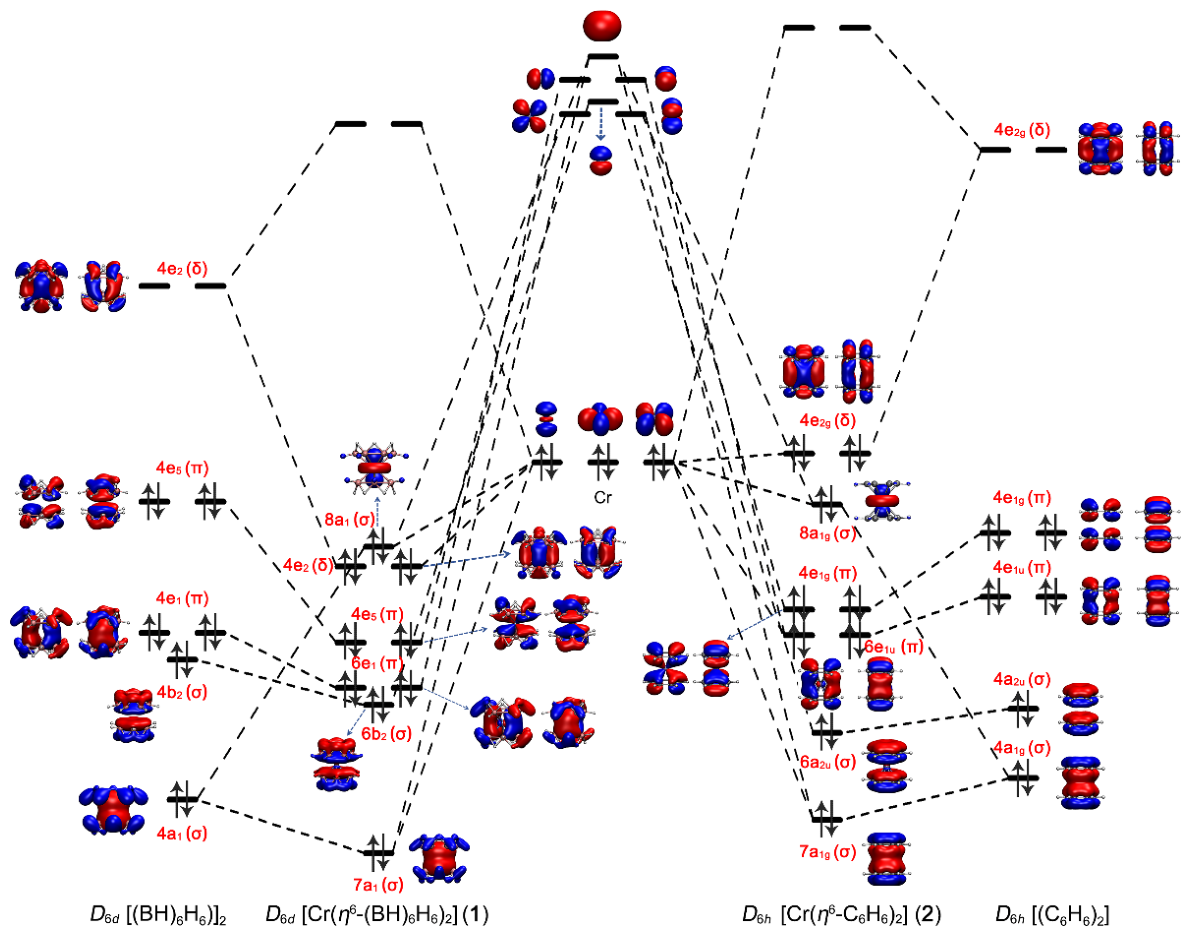
Figure 4.
(a) ACID and (b) GIMIC analyses of D6d [Cr(η6-(BH)6H6)2] (1) on the left and D6h [Cr(η6-C6H6)2] (2) on the right. The external magnetic field along the six-fold C6 molecular axis is perpendicular to the paper plane. The red arrows represent directions of the ring currents at various positions on the ACID and GIMIC iso-surfaces.
Figure 4.
(a) ACID and (b) GIMIC analyses of D6d [Cr(η6-(BH)6H6)2] (1) on the left and D6h [Cr(η6-C6H6)2] (2) on the right. The external magnetic field along the six-fold C6 molecular axis is perpendicular to the paper plane. The red arrows represent directions of the ring currents at various positions on the ACID and GIMIC iso-surfaces.
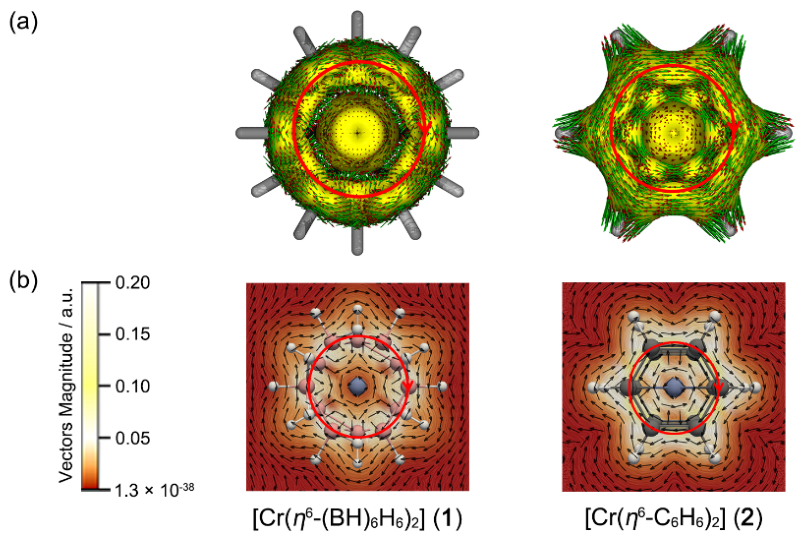
Figure 5.
Simulated (a) 11B and (b) 1H NMR spectra of D6d [Cr(η6-(BH)6H6)2] (1) at PBE0/def2-TZVP.
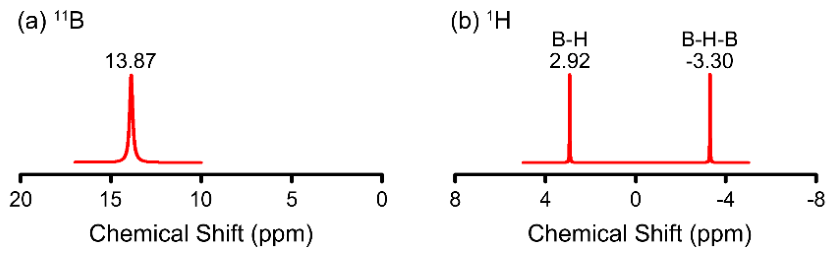
Figure 6.
Top and side views of the optimized geometric structures for the 2D sandwich nanosheets [Cr(η6-(BH)6)2] (5) and [Cr(η6-C6)2] (6) at PBE level, with C-C, B-B, Cr-C, and Cr-B bond lengths and centroid-to-centroid distances indicated in Å. The red dashed lines denote a unit cell.
Figure 6.
Top and side views of the optimized geometric structures for the 2D sandwich nanosheets [Cr(η6-(BH)6)2] (5) and [Cr(η6-C6)2] (6) at PBE level, with C-C, B-B, Cr-C, and Cr-B bond lengths and centroid-to-centroid distances indicated in Å. The red dashed lines denote a unit cell.
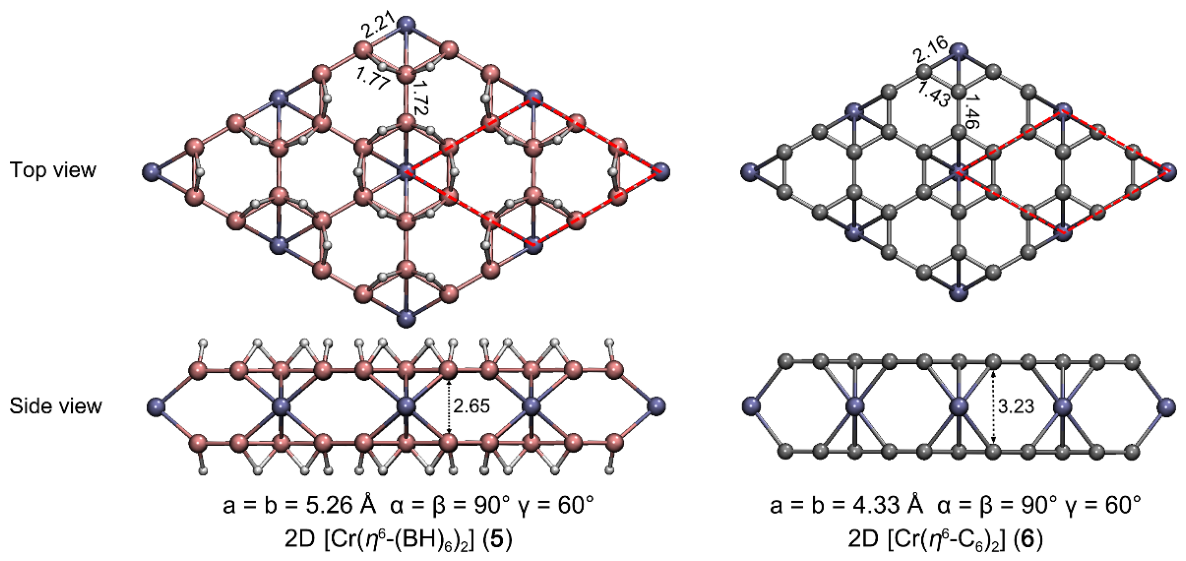
Figure 7.
Calculated phonon spectra and electronic band structures and densities of states (DOS) in (a) 2D [Cr(η6-(BH)6)2] (5) which has an indirect band gap of 0.34 eV and (b) 2D [Cr(η6-C6)2] (6) with no band gaps. The blue dashed line denotes the position of Fermi level.
Figure 7.
Calculated phonon spectra and electronic band structures and densities of states (DOS) in (a) 2D [Cr(η6-(BH)6)2] (5) which has an indirect band gap of 0.34 eV and (b) 2D [Cr(η6-C6)2] (6) with no band gaps. The blue dashed line denotes the position of Fermi level.
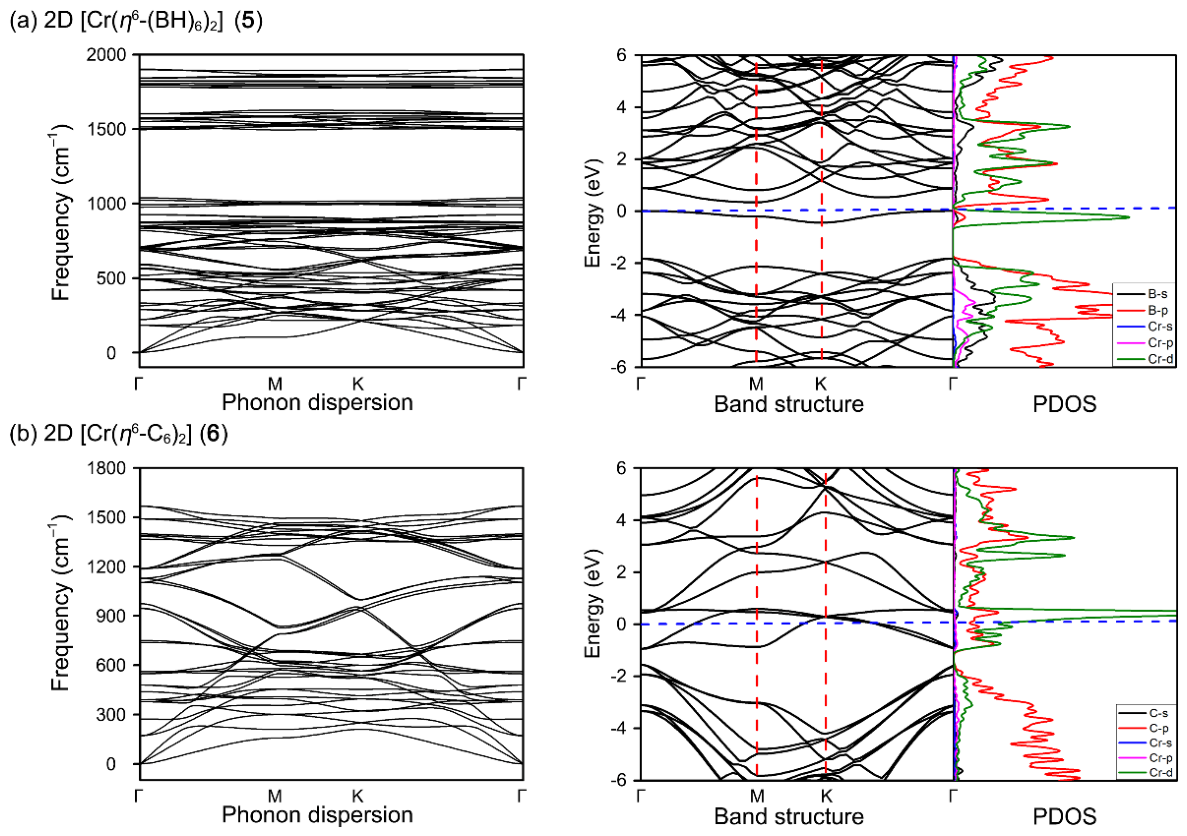

Table 1.
EDA-NOCV results of D6d [Cr(η6-(BH)6H6)2] (1) and D6h [Cr(η6-C6H6)2] (2) at B2PLYP-D3BJ/TZ2P, with all the interaction energies in kcal/mol and indicated corresponding percentage contributions indicated.
Table 1.
EDA-NOCV results of D6d [Cr(η6-(BH)6H6)2] (1) and D6h [Cr(η6-C6H6)2] (2) at B2PLYP-D3BJ/TZ2P, with all the interaction energies in kcal/mol and indicated corresponding percentage contributions indicated.
| Energy Terms | Intreraction | Cr(η6-(BH)6H6)2 | Cr(η6-C6H6)2 |
| Eint | -465.93 | -247.61 | |
| ΔEpauli | 804.99 | 919.46 | |
| ΔEelstat | -539.05 (45.46%) | -524.60 (48.04%) | |
| ΔEorb | -646.81 (54.54%) | -567.37 (51.96%) | |
| ΔEorb(1) (δ) | Cr(dxy) → (L)2 δ-back donation | -227.24 (35.13%) | -150.22 (26.48%) |
| ΔEorb(2) (δ) | Cr() → (L)2 δ-back donation | -227.12 (35.13%) | -149.80 (26.40%) |
| ΔEorb(3) (σ) | Cr() ← (L)2 σ-donation | -141.43 (21.87%) | -208.88 (36.82%) |
| ΔEorb(4) (π) | Cr(dxz) ← (L)2 π-donation | -22.27 (3.44%) | -22.51 (3.97%) |
| ΔEorb(5) (π) | Cr(dyz) ← (L)2 π-donation | -22.27 (3.44%) | -22.51 (3.97%) |
| ΔEorb(rest) | -6.48 (1.00%) | -13.45 (2.36%) |
Disclaimer/Publisher’s Note: The statements, opinions and data contained in all publications are solely those of the individual author(s) and contributor(s) and not of MDPI and/or the editor(s). MDPI and/or the editor(s) disclaim responsibility for any injury to people or property resulting from any ideas, methods, instructions or products referred to in the content. |
© 2026 by the authors. Licensee MDPI, Basel, Switzerland. This article is an open access article distributed under the terms and conditions of the Creative Commons Attribution (CC BY) license (http://creativecommons.org/licenses/by/4.0/).
Copyright: This open access article is published under a Creative Commons CC BY 4.0 license, which permit the free download, distribution, and reuse, provided that the author and preprint are cited in any reuse.