

Submitted:
02 September 2026
Posted:
03 September 2026
You are already at the latest version
Abstract
Background: Candida parapsilosis is an opportunistic yeast of increasing clinical importance, with fluconazole resistance rates rising globally and reaching concerning levels in clinical settings across several countries, including Colombia. However, the occurrence of antifungal-resistant Candida species in domestic water systems in the country remains largely unexplored. Methods: This cross-sectional study assessed the occurrence and antifungal susceptibility of Candida spp. in intradomiciliary water from 104 households in Villavicencio, Colombia, during two monitoring periods. Water samples were filtered, and yeast-like colonies were identified using MALDI-TOF mass spectrometry. Susceptibility to fluconazole, amphotericin B, and anidulafungin was determined using the CLSI broth microdilution method. The ERG11 gene was sequenced in the fluconazole-resistant isolate. Results: C. parapsilosis was recovered from 16 of 104 households (15.4%), yielding 22 isolates distributed across six communes. Most isolates (72.7%) were obtained from household water-storage tanks. One isolate was resistant to fluconazole (MIC = 8 µg/mL) and harbored a nonsynonymous R398I substitution in ERG11. Conclusions: To our knowledge, this is the first report of C. parapsilosis, including a fluconazole-resistant isolate carrying an ERG11 substitution, recovered from domestic water in Colombia. These findings suggest that household water-storage tanks may serve as environmental reservoirs for this opportunistic yeast. The implications for human exposure remain to be determined and highlight the need for integrated One Health surveillance.
Keywords:
Candida parapsilosis
; domestic water
; fluconazole resistance
; ERG11
; One Health
1. Introduction
Yeasts constitute an important component of the microbial community in aquatic environments [1]. Several pathogenic or opportunistic yeasts have been isolated from diverse aquatic matrices, including lakes [2] , rivers [3,4], drinking water [5,6], and wastewater [7,8,9]. Importantly, these environmental yeasts are susceptible to developing resistance to antifungal agents, including fluconazole, which remains a first-line therapeutic agent in many low- and middle-income countries where access to echinocandins is limited[10,11].
In recent years, reports of antifungal-resistant yeast strains commonly found in aquatic environments have become increasingly frequent. For instance, Medeiros et al. [12] isolated Candida spp. resistant to itraconazole and fluconazole from lakes and rivers in southeastern Brazil. Similarly, Milanezi et al. [8] conducted a study in Rio Grande do Sul, Brazil, and reported a high prevalence of Candida spp. and Debaryomyces spp. resistant to azole antifungals and amphotericin B. Across South America, studies have documented antifungal-resistant isolates of pathogenic yeasts from lakes, lagoons, rivers, and wastewater treatment plants[1].
Among the species within the genus Candida spp., C. parapsilosis, alongside the emerging multidrug-resistant pathogen C. auris, has garnered particular concern owing to its capacity to colonize aquatic environments and its well-documented role in healthcare-associated infections [13]. C. parapsilosis is responsible for invasive infections predominantly in immunocompromised patients [14] and, of particular concern, fluconazole resistance is escalating globally. In Colombia, recent post-pandemic data have reported resistance rates as high as 28.6% among clinical isolates [15]. Although its clinical prevalence has been widely documented, a significant knowledge gap persists regarding its distribution in aquatic environmental matrices in Latin America [16]. Globally, the presence of C. parapsilosis in water is frequently reported [17], where it acts as a colonizer of household surfaces composed of plastic, rubber, and silicone matrices. This environmental persistence establishes a potential reservoir for onward transmission to vulnerable populations.
In Colombia, routine microbiological surveillance for Candida spp. in intradomiciliary water remains limited. Although some studies have documented yeast diversity in aquatic matrices [18,19], no previous study has specifically reported the presence of C. parapsilosis in water intended for domestic use in Colombian cities. The quality of drinking water and its association with microbiological contamination represent an important public health concern [20].
This local knowledge gap mirrors a broader regional pattern: socio-environmental pressures including substandard housing quality and inequitable access to safe water have been proposed as drivers of Candida spp. transmission outside hospital settings across Latin America [16]. Conversely, in other regions, C. parapsilosis ranks among the yeasts most frequently recovered from groundwater intended for human consumption [21].
Therefore, the present study aimed to describe the occurrence of Candida spp. in intradomiciliary water samples collected from households across Villavicencio, an urban area of approximately 600,000 inhabitants located in central-eastern Colombia.
2. Materials and Methods
This study was conducted within the framework of a macro-project, which sought to identify pathogenic microorganisms of public health interest in intradomiciliary water across the city of Villavicencio.
2.1. Study Population, Design, Sample Size Calculation, and Eligibility Criteria
A cross-sectional study was conducted in the city of Villavicencio, Department of Meta, Colombia. Two monitoring campaigns were carried out, corresponding to distinct climatic periods: the transition period, and the ascending rainfall period. The study population comprised urban households with access to an intradomiciliary water distribution system across the eight communes of the city.
For household selection, the community was invited to participate through digital recruitment campaigns. From the registered households, a stratified sampling approach was employed, selecting 13 households from each commune. This yielded a final sample size of 104 households.
Households were included if they possessed an active intradomiciliary water supply system and were located within any of the eight communes of Villavicencio. Institutional facilities, including hospitals, clinical laboratories, schools, universities, and day-care centers were excluded from the study.
2.2. Sample Collection
For each household visited, water samples were collected: one from a faucet supplied directly by a public or community water supply system and the other from a faucet connected to a water storage tank. Before sample collection, the external surface of the faucet was disinfected with alcohol. When feasible, the inner surface was also cleaned using a swab to facilitate access. The faucet was then allowed to run for approximately 45 seconds to flush stagnant water from the plumbing and ensure that the sample was representative of the corresponding water source. After flushing, the pH was measured on site using a pH indicator strip before the sample was collected. During sample collection, a flame was maintained near the faucet during collection to minimize airborne contamination.
Approximately 200–300 mL of water was collected in Nasco sampling bags containing sodium thiosulfate tablets, which were used to neutralize residual chlorine and prevent interference with bacterial recovery. At least one inch of headspace was left between the water surface and the bag closure to maintain aeration and allow adequate mixing of the sample. The samples were subsequently refrigerated at 2–8°C and transported in expanded polystyrene coolers with ice packs to protect them from spills, physical damage, light exposure, and heat. Each sample was labeled in the white write-on area of the Nasco bag, indicating the district, sampling number, collection point, and sample source. Samples were processed within approximately 18 h of collection.
2.3. Sample Processing: Membrane Filtration
It should be noted that this investigation was nested within a broader water quality monitoring program primarily designed for the recovery of bacterial pathogens (findings to be reported separately). Consequently, the filtration and culture protocol was standardized for the detection of enteric bacteria. Briefly, a volume of 200 mL of water was filtered under vacuum through a cellulose nitrate membrane with a pore size of 0.45 µm (Millipore®, Burlington, MA, USA). The membrane was then transferred aseptically to a Petri dish containing MacConkey agar or nutrient agar. Both media were incubated at 37°C for 24–48 hours. Yeast-like colonies were recovered as incidental isolates (nutrient agar) and subsequently preserved in skim milk at −20°C for downstream identification by Matrix-Assisted Laser Desorption/Ionization Time-Of-Flight Mass Spectrometry (MALDI-TOF MS MALDI Biotyper, Bruker Daltonics, Bremen, Germany).
2.4. Matrix-Assisted Laser Desorption/Ionization Time-Of-Flight Mass Spectrometry (MALDI-TOF MS)
Preserved isolates were streaked from glycerol stocks onto Sabouraud Dextrose Agar (SDA) and grown for 24–36 hours at 35°C. Protein extraction was performed using the formic acid/ethanol method, according to the Bruker Daltonics’ protocol. Mass spectra were acquired and analyzed using the Flex Control software and the MALDI Biotyper version 3.1 (Bruker Daltonics, Bremen, Germany). Identification scores were interpreted according to the manufacturer's specifications: correct genus and species identification (score ≥2.0), reliable genus identification (score 1.7–2.0), and no reliable identification (score <1.7). All isolates processed in this study yielded scores above 2.0 [22].
2.5. Antifungal Susceptibility Testing
Susceptibility to amphotericin B (AMB), fluconazole (FLC), and anidulafungin (AND) (Sigma-Aldrich, St. Louis, MO, USA) was determined using the Clinical and Laboratory Standards Institute broth microdilution (CLSI-BMD) method, following the M27-A4 document[23]. Quality control was ensured by testing the CLSI-recommended reference strains C. parapsilosis ATCC 22019 and C. krusei ATCC 6258.
Interpretive criteria were applied according to CLSI guidelines[23]. Resistance to fluconazole and anidulafungin was defined as a Minimum Inhibitory Concentration (MIC) ≥8 µg/mL. For amphotericin B, the Epidemiological Cutoff Value (ECV) of 1 µg/mL was applied. MIC endpoints for fluconazole and anidulafungin were defined as the lowest drug concentration that produced a prominent reduction in visual growth (approximately 50% inhibition) relative to the drug-free growth control. For amphotericin B, the MIC was defined as the lowest concentration that resulted in complete inhibition of visual growth (100% inhibition).
2.6. Sequencing Analysis of ERG11
The fluconazole-resistant isolate was further characterized by amplification and bidirectional sequencing of the entire ERG11 gene coding region. PCR was performed using a single-tube protocol described previously [24]. Amplicons were purified and sequenced on a SeqStudio genetic analyzer (Applied Biosystems, Foster City, CA, USA). The resulting sequences were analyzed using BLAST and aligned against the C. parapsilosis reference sequence for ERG11 available in GenBank (accession no. GQ302972) to identify known resistance-associated amino acid substitutions.
2.7. Statistical Analysis
A descriptive analysis of the data was performed using Stata version 19 (StataCorp LLC, College Station, TX, USA). Fisher’s exact test was used to compare the frequency of C. parapsilosis isolation between the two monitoring periods. Statistical significance was defined as a two-sided p-value < 0.05.
2.8. Ethical and Legal Considerations
The study was approved by the Institutional Research Ethics Committee of Universidad de los Llanos (Minutes No. 04, dated April 5, 2024). Written informed consent was obtained from the heads of all participating households before sample collection. Participant confidentiality was ensured by assigning a unique numerical identification code to each household. Geographic location, water source type, and basic household demographic data were recorded using a standardized form and subsequently anonymized.
3. Results
3.1. Recovery and Distribution of Candida Parapsilosis
A total of 349 water samples collected from participating households during the two follow-up campaigns were analyzed: 209 were collected during the transitional rainfall period and 140 during the period of increasing rainfall. Two water samples were collected from each household visited. According to the water supply source, 95 samples were collected from faucets directly connected to public or community water supply systems (n=52 during the transitional period and n= 43 during the period of increasing rainfall). The remaining 254 samples were collected from faucets connected to water storage tanks (n=157 during the transitional period and n=97 during the period of increasing rainfall). Water availability from public or community supply systems varied among participating households, limiting the collection of samples directly from the distribution network. Consequently, most samples were obtained from household storage systems, which typically consisted of an underground reservoir from which water was pumped to an elevated tank and subsequently distributed throughout the household by gravity.
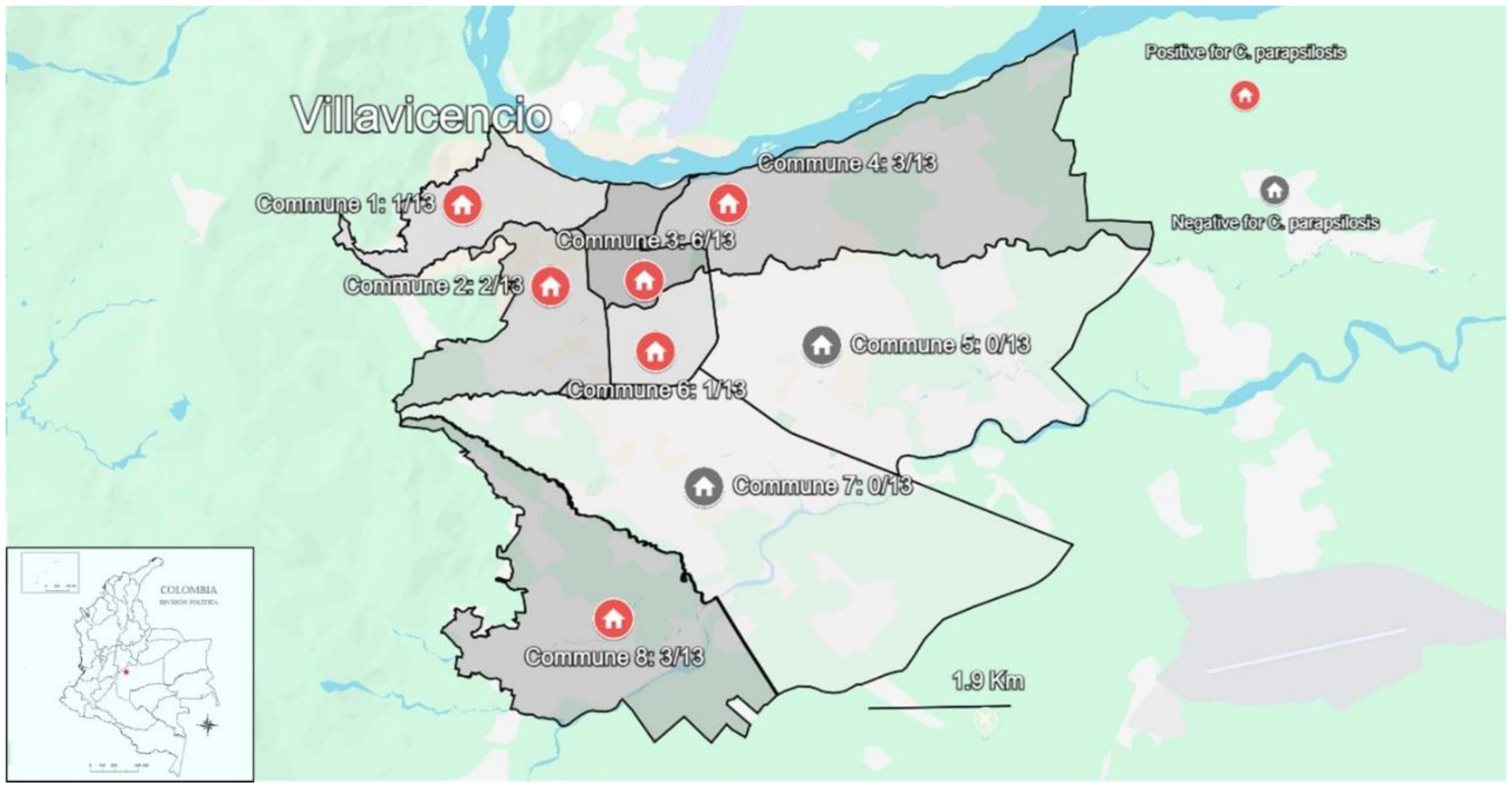
Among the species of the genus Candida spp., only C. parapsilosis (n=22) was recovered, identified in 16 out of the 104 (15.4%) participating households. The 22 isolates were recovered across both monitoring periods, with 11 isolates obtained in each period. Isolates were obtained from six of the eight communes of Villavicencio (C1, C2, C3, C4, C6, and C8). No statistically significant differences were observed in isolation frequency between the two periods (Fisher's exact test, p = 0.372).
Commune 3 accounted for the largest proportion of positive samples (31.8%; n=7), followed by commune 4 (18.2%; n=4). Communes 1, 2, and 8 each yielded three positive samples (13.6%, each), whereas commune 6 yielded two positive samples (9.1%). Notably, C. parapsilosis was recovered from the same two households during both monitoring periods. No isolates were recovered from communes 5 and 7. The overall positivity rate was 15.4% at the household level (16/104) and 6.3% at the sample level (22/349).
Figure 1.
Geographic distribution of Candida parapsilosis positive households across the eight communes of Villavicencio, Colombia. Red house icons indicate communes in which at least one C. parapsilosis isolate was recovered from intradomiciliary water (Communes 1, 2, 3, 4, 6, and 8); grey house icons indicate communes with no isolates recovered (Communes 5 and 7). Numbers within each commune represent the proportion of positive households. Scale bar = 1.9 km.
Figure 1.
Geographic distribution of Candida parapsilosis positive households across the eight communes of Villavicencio, Colombia. Red house icons indicate communes in which at least one C. parapsilosis isolate was recovered from intradomiciliary water (Communes 1, 2, 3, 4, 6, and 8); grey house icons indicate communes with no isolates recovered (Communes 5 and 7). Numbers within each commune represent the proportion of positive households. Scale bar = 1.9 km.
3.2. Household Water Characteristics and Storage practices
The majority of C. parapsilosis isolates (72.7%; n=16) were recovered from household water-storage tanks, with the remaining 27.3% (n=6) originating from direct connections to the public water-supply system. The pH of the positive water samples ranged from 4.0 to 7.0, with a mean of 5.4. Most positive samples had a pH between 5.0 and 6.0 (81.8%, n=18). Overall, 90.5% of participating households had access to the public water-supply system, and 81% stored water at home. Furthermore, 14 out of 21 households (66.7%) reported treating water before use, mainly by boiling or using commercial filtration systems.
3.3. Antifungal Susceptibility
The distribution of MIC values for amphotericin B, fluconazole, and anidulafungin against the 22 isolates of C. parapsilosis is presented in Table 1. Amphotericin B MIC values spanned four dilutions (0.03 µg/mL to 0.25 µg/mL), with MIC₅₀ and MIC₉₀ of 0.06 µg/mL and 0.12 µg/mL, respectively. The modal MIC was 0.06 µg/mL (n=11). All isolates were inhibited at concentrations below the established CLSI ECV of 1 µg/mL.
Anidulafungin MIC values spanned five dilutions (0.015 µg/mL to 0.25 µg/mL), with MIC₅₀ and MIC₉₀ of 0.06 µg/mL and 0.25 µg/mL, respectively. The modal MIC was 0.015 µg/mL (n=8), followed by 0.06 µg/mL (n=6). All isolates were susceptible according to the CLSI clinical breakpoint of ≤2 µg/mL.
Fluconazole exhibited the widest MIC range among the three agents, spanning eight dilutions (0.06 µg/mL to 8 µg/mL), with MIC₅₀ and MIC₉₀ of 2 µg/mL and 4 µg/mL, respectively. The modal MIC was 4 µg/mL (n=10). Notably, one isolate had an MIC of ≥8 µg/mL, which categorized it as resistant according to the CLSI clinical breakpoint. This resistant isolate was recovered from a household in Commune 3, originating from a water-storage tank during the ascending rainfall period.
3.2. Detection of Mutations in ERG11
Among the 22 C. parapsilosis isolates recovered, one exhibited resistance to fluconazole. BLAST analysis of the ERG11 coding sequence from this isolate, aligned against the reference sequence (GenBank accession no. GQ302972), revealed a single non-synonymous substitution: an arginine-to-isoleucine change at codon 398 (R398I). No additional amino acid substitutions were detected in the ERG11 gene of this isolate.
4. Discussion
To the best of our knowledge, this is the first report describing the recovery of C. parapsilosis from intradomiciliary water in Colombia, and one of the few such reports for Latin America. The species was identified in 16 of 104 participating households (15.4%), with isolates recovered across both monitoring periods in equal numbers (11 isolates each) and no statistically significant difference between periods. This finding reinforces the notion that domestic water systems, rather than only clinical or hospital environments, may serve as reservoirs for this opportunistic pathogen [25].
The severe water-supply disruptions experienced in Villavicencio during 2025 limited the availability of water directly from the distribution network and increased household reliance on water-storage systems. Accordingly, the greater number of positive samples from storage tanks may partly reflect the larger number of samples collected from this source rather than a higher source-specific probability of contamination.
Nevertheless, household storage systems may provide conditions conducive to the persistence of C. parapsilosis, given the recognized ability of this species to adhere to and colonize plastic, rubber, and silicone surfaces, materials commonly found in household storage tanks and plumbing components [26,27,28]. Infrequently cleaned storage tanks may therefore constitute a persistent environmental niche that favors biofilm formation and prolonged survival of this yeast [29]. Indeed, C. parapsilosis has been described as a dominant contaminant of household appliances, and it is transferred via water to dishwashers, washing machines, and storage systems, where it subsequently proliferates [25].
The recovery of C. parapsilosis from domestic water in Colombia aligns with a growing body of evidence documenting the presence of this species in aquatic environments across the region. In Brazil, studies have reported C. parapsilosis from multiple water matrices: it was the predominant yeast species (68.5%) recovered from a haemodialysis unit water distribution system, and it was the most frequent species (43%) isolated from lagoon systems in Rio de Janeiro, being the only species recovered from all sampling points. Similarly, C. parapsilosis has been isolated from coastal waters in southern Brazil and from tropical freshwater environments in the southeastern region [30].
Perhaps the most clinically relevant finding of this study is the identification of a fluconazole-resistant C. parapsilosis isolate recovered from intradomiciliary water that carries a nonsynonymous R398I substitution in ERG11. Notably, this substitution has previously been reported in clinical C. parapsilosis isolates in combination with other mutations, such as Y132F and K143R, but has not been shown to independently confer azole resistance [31]. Therefore, the resistance phenotype observed in our environmental isolate may involve additional or alternative mechanisms, such as ERG11 overexpression, efflux pump-mediated resistance, or lipid-related adaptations, none of which were evaluated in the present study [32,33]. To our knowledge, this is the first report of azole-resistant C. parapsilosis recovered from a non-clinical domestic water source in Colombia.
This finding gains particular significance when contextualized with recent clinical data from Colombia. In a post-pandemic cohort study conducted at a high-complexity teaching hospital in Cali, 28.6% of C. parapsilosis bloodstream isolates were resistant to fluconazole [15]. Furthermore, a four-year surveillance study at a quaternary care hospital reported that 25% of C. parapsilosis clinical isolates displayed fluconazole resistance, with Erg11 amino acid substitutions (Y132F or K143R) identified in resistant strains [24]. The national laboratory-based surveillance led by the National Institute of Health in Colombia reveals up to 39% of fluconazole resistant C. parapsilosis isolates [34].
Globally, fluconazole resistance in environmental C. parapsilosis has been documented with increasing frequency [14,35]. A recent study on potable water as a source of resistant strains reported that 5.8% of Candida spp. isolates were borderline resistant to fluconazole, and C. parapsilosis from water samples had statistically higher MICs for anidulafungin than clinical strains[18]. Furthermore, environmental strains of C. parapsilosis have been found to harbor the same Erg11-Y132F amino acid substitution as clinical resistant isolates [31]. The presence of azole resistance in environmental isolates has been attributed to the widespread use of fluconazole in clinical settings and agriculture, as well as the discharge of antifungal residues into wastewater, which may exert selective pressure on aquatic yeast populations [36].
Our detection of a fluconazole-resistant C. parapsilosis isolate from a household water-storage tank, combined with the high resistance rates reported in Colombian hospitals, raises concerns about the potential for environmental strains to serve as a reservoir for resistance or to directly contribute to human exposure through domestic water consumption.
Several limitations should be considered when interpreting these results. First, this investigation was nested within a broader water quality monitoring program primarily designed for bacterial pathogen detection; consequently, the culture media used (MacConkey agar and nutrient agar) were not optimized for fungal recovery, which may have underestimated the true prevalence and diversity of Candida species in the samples. Second, the study was limited to two monitoring periods (transition and ascending rainfall), which may not fully capture seasonal variations in yeast occurrence. Third, the sample size, while adequate for a descriptive cross-sectional study, was limited to 104 households in a single city, and the use of digital recruitment campaigns may have introduced selection bias. Finally, the absence of whole-genome sequencing or multilocus sequence typing prevents a definitive assessment of the genetic relatedness between environmental isolates and clinical strains circulating in Colombian hospitals.
Despite these limitations, this study provides the first evidence of C. parapsilosis in domestic water in Colombia and documents the presence of a fluconazole-resistant environmental isolate, highlighting an under-recognized public health concern that warrants further investigation.
5. Conclusions
This study provides the first evidence of C. parapsilosis in domestic water in Colombia and, more critically, documents the presence of a fluconazole-resistant environmental isolate from a non-clinical setting. This finding is of significant public health concern, as it demonstrates that azole-resistant C. parapsilosis is not confined to hospital environments but is already circulating in household water systems environments where vulnerable populations, including children, the elderly, and immunocompromised individuals, are directly exposed. These results highlight an urgent need for routine microbiological surveillance of domestic water supplies and for public health interventions aimed at improving water storage practices. Further molecular studies are essential to determine whether environmental and clinical strains are genetically linked and to elucidate the transmission dynamics of this emerging pathogen in the community.
Author Contributions
Conceptualization, N.V. A.C.G and Y.V; methodology, V.V., M.J., P.C., A.C.G., N.V. and Y.V; software, M.J., A.C.G. and N.V; validation, P.C., A.C.G. and N.V.; formal analysis, V.V., M.J., A.C.G. and N.V.; investigation, V.V., M.J., A.C.G., N.V. and Y.V;.; resources, P.C., A.C.G. and N.V. and Y.V.; data curation, M.J., A.C.G. and N.V.; writing—original draft preparation, M.J., A.C.G., and N.V.; writing—review and editing, P.C., A.C.G., N.V. and Y.V; visualization, M.J., A.C.G., and N.V; supervision, P.C., A.C.G., N.V. and Y.V; project administration, V.V., N.V. and Y.V.; funding acquisition, N.V. and Y.V. All authors have read and agreed to the published version of the manuscript.
Funding
This research was funded by the Ministry of Science, Technology and Innovation of Colombia for the funding provided through Call No. 948 of 2024, under the Orquídeas: Women in Science Program, Grant Agreement No. 112721-148-2024.
Institutional Review Board Statement
The study was conducted in accordance with the Declaration of Helsinki and approved by the Bioethics Committee of the Universidad de los Llanos (Minutes No. 04, 5 April 2024).
Informed Consent Statement
Written informed consent was obtained from all participants before their enrollment in the study. The consent covered household entry, water sample collection, and the collection of sociodemographic information.
Data Availability Statement
The data supporting the findings of this study are available from the corresponding author upon reasonable request. The data are not publicly available because they contain sociodemographic and household-level information that could compromise participant privacy.
Acknowledgments
The authors thank the participating households for granting access to their homes and for their cooperation during water sample collection and the administration of the sociodemographic questionnaire. The authors also acknowledge the technical and administrative staff who supported the fieldwork, sample transportation, and laboratory procedures.
Conflicts of Interest
The authors declare no conflicts of interest.
References
- Caicedo-Bejarano, L.D.; Osorio-Vanegas, L.S.; Ramírez-Castrillón, M.; Castillo, J.E.; Martínez-Garay, C.A.; Chávez-Vivas, M. Water Quality, Heavy Metals, and Antifungal Susceptibility to Fluconazole of Yeasts from Water Systems. Int. J. Environ. Res. Public Health 2023, 20. [Google Scholar] [CrossRef] [PubMed]
- Pagani, D.M.; Heidrich, D.; Tormente, F.; Milani, G.; Jank, L.; They, N.H.; Valente, P.; Scroferneker, M.L. High MICs for Antifungal Agents in Yeasts from an Anthropized Lagoon in South America. Microbiol. Res. 2022, 262. [Google Scholar] [CrossRef] [PubMed]
- Brandão, L.R.; Medeiros, A.O.; Duarte, M.C.; Barbosa, A.C.; Rosa, C.A. Diversity and Antifungal Susceptibility of Yeasts Isolated by Multiple-Tube Fermentation from Three Freshwater Lakes in Brazil. J. Water Health 2010, 8, 279–289. [Google Scholar] [CrossRef] [PubMed]
- Monapathi, M.E.; Bezuidenhout, C.C.; Rhode, O.H.J. Water Quality and Antifungal Susceptibility of Opportunistic Yeast Pathogens from Rivers. Water Sci. Technol. 2017, 75, 1319–1331. [Google Scholar] [CrossRef] [PubMed]
- Monapathi, M.; Horn, S.; Vogt, T.; van Wyk, D.; Mienie, C.; Ezeokoli, O.T.; Coertze, R.; Rhode, O.; Bezuidenhout, C.C. Antifungal Agents, Yeast Abundance and Diversity in Surface Water: Potential Risks to Water Users. Chemosphere 2021, 274. [Google Scholar] [CrossRef] [PubMed]
- Van Wyk, D.A.B.; Bezuidenhout, C.C.; Rhode, O.H.J. Diversity and Characteristics of Yeasts from Water Sources in the North West Province, South Africa. Water Sci. Technol. Water Supply 2012, 12, 422–430. [Google Scholar] [CrossRef]
- Monapathi, M.; Bezuidenhout, C.; Rhode, O. Physico-Chemical Parameters and Culturable Yeast Diversity in Surface Water: A Consequence of Pollution. Water SA 2020, 46, 593–601. [Google Scholar] [CrossRef]
- Milanezi, A.C.M.; Witusk, J.P.D.; van der Sand, S.T. Antifungal Susceptibility of Yeasts Isolated from Anthropogenic Watershed. An. Acad. Bras. Cienc. 2019, 91. [Google Scholar] [CrossRef] [PubMed]
- Assress, H.A.; Selvarajan, R.; Nyoni, H.; Ntushelo, K.; Mamba, B.B.; Msagati, T.A.M. Diversity, Co-Occurrence and Implications of Fungal Communities in Wastewater Treatment Plants. Sci. Rep. 2019, 9. [Google Scholar] [CrossRef] [PubMed]
- Nucci, M.; Queiroz-Telles, F.; Alvarado-Matute, T.; Tiraboschi, I.N.; Cortes, J.; Zurita, J.; Guzman-Blanco, M.; Santolaya, M.E.; Thompson, L.; Sifuentes-Osornio, J.; et al. Epidemiology of Candidemia in Latin America: A Laboratory-Based Survey. PLoS ONE 2013, 8. [Google Scholar] [CrossRef] [PubMed]
- Roohi, B.; Tyndall, J.D.A.; Svoboda, T.; de Hoog, S.; Crous, P.W.; Monk, B.C.; Strobl, B.; Weissenbacher, A.; Strauss, J.; Verweij, P.E.; et al. The Dual Role of Azoles: Lifesaving Antifungals and Drivers of Resistance – a One Health Perspective. Nat. Commun. 2026, 17. [Google Scholar] [CrossRef] [PubMed]
- Medeiros, A.O.; Missagia, B.S.; Brandão, L.R.; Callisto, M.; Barbosa, F.A.R.; Rosa, C.A. water quality and diversity of yeasts from tropical lakes and rivers from the rio doce basin in southeastern Brazil. Braz. J. Microbiol. 2012, 1582–1594. [Google Scholar] [CrossRef]
- Choi; Heitman; Won, E.J. Emerging Fungal Threats from the Environment—a Lesson from Candida auris and a Warning about a Second Candidate, Rhodosporidiobolus Fluvialis. PLoS Pathog. 2026, 22. [Google Scholar] [CrossRef] [PubMed]
- Guinea, J.; Escribano, P.; Cadeau, M.; Lombardi, L.; Morio, F. Emerging Antifungal Resistance in Candida parapsilosis: The End of the Innocence. npj Antimicrob. Resist. 2025, 3. [Google Scholar] [CrossRef] [PubMed]
- Muñoz-Lombo, J.P.; Cardales-Arizal, W.D.; Vallejo-Serna, R.A.; Berrio, I. Shift in Candidemia Epidemiology and Emerging Fluconazole Resistance in Candida parapsilosis: A Post-Pandemic Cohort Study in a Colombian High-Complexity Teaching Hospital. J. Fungi 2026, 12, 457. [Google Scholar] [CrossRef] [PubMed]
- Motta, J.C.; Rivas-Pinedo, P.; Onate, J.M. Changing Climate, Changing Candida: Environmental and Social Pressures on Invasive Candidiasis and Antifungal Resistance in Latin America. J. Fungi 2025, 11(9), 609. [Google Scholar] [CrossRef] [PubMed]
- Novak Babič, M.; Gunde-Cimerman, N. Design of species-specific primers for rapid detection and identification of Candida parapsilosis sensu stricto. Acta Biol. Slov. 2020, 63(1), 63–77. [Google Scholar] [CrossRef]
- Babič, M.N.; Gunde-Cimerman, N. Potable Water as a Source of Intermediate and Borderline-Resistant Aspergillus and Candida Strains. J. Water Health 2025, 23, 225–237. [Google Scholar] [CrossRef] [PubMed]
- Silva-Bedoya, L.M.; Ramírez-Castrillón, M.; Osorio-Cadavid, E. Yeast Diversity Associated to Sediments and Water from Two Colombian Artificial Lakes. Braz. J. Microbiol. 2014, 45(1). [Google Scholar] [CrossRef] [PubMed]
- Ashbolt, N.J. Microbial contamination of drinking water and disease outcomes in developing regions. Toxicology 2004, 20;198(1-3), 229–38. [Google Scholar] [CrossRef] [PubMed]
- Cupozak-Pinheiro, W.J.; Araújo de Almeida-Apolonio, A.; Sasaki, M.H.; Maran, N.H.; Pires de Araújo, R.; Beraldo dos Santos Silva, D.; et al. Candida Species Contamination in Drinking Groundwater from Residence Wells in Three Municipalities of Midwestern Brazil and the Potential Human Health Risks. Microb. Pathog. 2022, 169. [Google Scholar] [CrossRef] [PubMed]
- Ceballos-Garzon, A.; Amado, D.; Vélez, N.; Jiménez-A, M.J.; Rodríguez, C.; Parra-Giraldo, C.M. Development and Validation of an In-House Library of Colombian Candida auris Strains with Maldi-TOF MS to Improve Yeast Identification. J. Fungi 2020, 6. [Google Scholar] [CrossRef] [PubMed]
- CLSI Supplement M27M44S Performance Standards for Antifungal Susceptibility Testing of Yeast. <bold>2022</bold>.
- Ceballos-Garzon, A.; Peñuela, A.; Valderrama-Beltrán, S.; Vargas-Casanova, Y.; Ariza, B.; Parra-Giraldo, C.M. Emergence and Circulation of Azole-Resistant C. albicans, C. auris and C. parapsilosis Bloodstream Isolates Carrying Y132F, K143R or T220L Erg11p Substitutions in Colombia. Front. Cell. Infect. Microbiol. 2023, 13. [Google Scholar] [CrossRef] [PubMed]
- Montanari, L.B.; Sartori, F.G.; Ribeiro, D.B.M.; Leandro, L.F.; Pires, R.H.; Melhem, M. de S.C.; de Mello, C.A.; Martins, C.H.G. Yeast Isolation and Identification in Water Used in a Brazilian Hemodialysis Unit by Classic Microbiological Techniques and Raman Spectroscopy. J. Water Health 2018, 16, 311–320. [Google Scholar] [CrossRef] [PubMed]
- Zupančič, J.; Novak Babič, M.; Gunde-Cimerman, N. High Incidence of an Emerging Opportunistic Pathogen Candida Parapsilosis in Water-Related Domestic Environments. In Fungal Infection; IntechOpen, 2019. [Google Scholar]
- Babič, M.N.; Gunde-Cimerman, N. Water-Transmitted Fungi Are Involved in Degradation of Concrete Drinking Water Storage Tanks. Microorganisms 2021, 9, 1–18. [Google Scholar] [CrossRef] [PubMed]
- Evison, L.; Sunna, N. Microbial Regrowth in Household Water Storage Tanks. J. Am. Water Work. Assoc. 2001, 93, 85–94. [Google Scholar] [CrossRef]
- da Silveira, L.C.; Charone, S.; Maia, L.C.; Soares, R.M.; Portela, M.B. Biofilm formation by Candida species on silicone surfaces and latex pacifier nipples: an in vitro study. J. Clin. Pediatr. Dent. 2009, 33(3), 235–40. [Google Scholar] [CrossRef] [PubMed]
- Ramos, L.S.; Fernandes, M.F.; Santos, H.L.C.; Picão, R.C.; Branquinha, M.H.; Santos, A.L.S. Antifungal-Resistant Yeasts Detected in Recreational Coastal Waters of Rio de Janeiro, Brazil. Rev. Iberoam. Micol. 2026. [Google Scholar] [CrossRef] [PubMed]
- Thomaz, D.Y.; de Almeida, J.N.; Sejas, O.N.E.; Del Negro, G.M.B.; Carvalho, G.O.M.H.; Gimenes, V.M.F.; de Souza, M.E.B.; Arastehfar, A.; Camargo, C.H.; Motta, A.L.; et al. Environmental Clonal Spread of Azole-Resistant Candida parapsilosis with Erg11-Y132f Mutation Causing a Large Candidemia Outbreak in a Brazilian Cancer Referral Center. J. Fungi 2021, 7. [Google Scholar] [CrossRef] [PubMed]
- Štefánek, M.; Garaiová, M.; Valček, A.; Jordao, L.; Bujdáková, H. Comparative Analysis of Two Candida parapsilosis Isolates Originating from the Same Patient Harbouring the Y132F and R398I Mutations in the ERG11 Gene. Cells 2023, 12. [Google Scholar] [CrossRef] [PubMed]
- Morio, F.; Pagniez, F.; Besse, M.; Gay-Andrieu, F.; Miegeville, M.; Le Pape, P. Deciphering Azole Resistance Mechanisms with a Focus on Transcription Factor-Encoding Genes TAC1, MRR1 and UPC2 in a Set of Fluconazole-Resistant Clinical Isolates of Candida albicans. Int. J. Antimicrob. Agents 2013, 42, 410–415. [Google Scholar] [CrossRef] [PubMed]
- Instituto Nacional de Salud (INS). Vigilancia Por Laboratorio de Otras Levaduras de Origen Colombiano [Interactive Power BI Dashboard]. Bogotá, Colombia. Available online: Https://App.Powerbi.Com/View?R=eyJrIjoiNzZmOGM1YzUtZDI2ZC00Yzk2LWJiZjUtNTBiYWVkMmRjNDNlIiwidCI6ImE2MmQ2YzdiLTlmNTktNDQ2OS05MzU5LTM1MzcxNDc1OTRiYiIsImMiOjR9&pageName=ReportSectiondfdeab867861490510a9.
- Yamin, D.; Akanmu, M.H.; Al Mutair, A.; Alhumaid, S.; Rabaan, A.A.; Hajissa, K. Global Prevalence of Antifungal-Resistant Candida parapsilosis: A Systematic Review and Meta-Analysis. Trop. Med. Infect. Dis. 2022, 7(8), 188. [Google Scholar] [CrossRef] [PubMed]
- Indrajith, M.D.A.; Brandão, J. Wastewater in Asia as an Evolutionary Reactor: Linking Environmental Azoles to the Emergence of Clinical Resistance. Water Res. 2027, 308, 126668. [Google Scholar] [CrossRef] [PubMed]

Table 1.
Minimum inhibitory concentration (MIC) distributions and summary statistics for 22 environmental Candida parapsilosis isolates against three antifungal agents.
Table 1.
Minimum inhibitory concentration (MIC) distributions and summary statistics for 22 environmental Candida parapsilosis isolates against three antifungal agents.
| Specie (n) | Antifungal | 0.015 | 0.03 | 0.06 | 0.12 | 0.25 | 0.5 | 1 | 2 | 4 | 8 | GM | MIC₅₀ | MIC₉₀ |
|---|---|---|---|---|---|---|---|---|---|---|---|---|---|---|
| C. parapsilosis (22) | amphotericin B | - | 1 | 11 | 9 | 1 | - | - | - | - | - | 0.06 | 0.06 | 0.12 |
| anidulafungin | 8 | - | 6 | 4 | 4 | - | - | - | - | - | 0.06 | 0.06 | 0.25 | |
| fluconazole | - | - | 4 | 1 | - | - | 1 | 5 | 10 | 1* | 1 | 2 | 4 |
* resistant isolate.
Disclaimer/Publisher’s Note: The statements, opinions and data contained in all publications are solely those of the individual author(s) and contributor(s) and not of MDPI and/or the editor(s). MDPI and/or the editor(s) disclaim responsibility for any injury to people or property resulting from any ideas, methods, instructions or products referred to in the content. |
© 2026 by the authors. Licensee MDPI, Basel, Switzerland. This article is an open access article distributed under the terms and conditions of the Creative Commons Attribution (CC BY) license (http://creativecommons.org/licenses/by/4.0/).
Copyright: This open access article is published under a Creative Commons CC BY 4.0 license, which permit the free download, distribution, and reuse, provided that the author and preprint are cited in any reuse.