

Submitted:
02 September 2026
Posted:
02 September 2026
You are already at the latest version
Abstract
Biomolecular condensates assemble through multivalent, low-affinity interactions among proteins and nucleic acids, and cells tune this assembly with the same enzymatic toolkit that governs every other layer of proteome regulation. This mini review discusses how phosphorylation, ubiquitination, SUMOylation, acetylation, methylation, glycosylation and ADP-ribosylation set the valency, charge, and material state of condensates, how chaperones read these marks to police condensate quality, and how the same circuitry is repurposed in plant immunity, human disease and drug discovery.
Keywords:
biomolecular condensates
; post-translational modifications
; phosphorylation
; ubiquitination
; SUMOylation
; acetylation
; methylation
; glycosylation
; ADP-ribosylation
; immune signaling condensates
; stress granules
Introduction
Cells organize biochemistry in space without necessarily using membranes. Ribonucleoprotein granules, the nucleolus, transcriptional hubs, autophagosome-adjacent bodies and dozens of other membraneless compartments assemble through multivalent, often weak interactions among modular proteins and nucleic acids, a process broadly described as biomolecular condensation or liquid-liquid phase separation [1,2]. A comprehensive guide to these membraneless organelles now catalogues dozens of distinct condensate types and their roles in gene regulation [3], and phase separation is understood to organize biochemistry not only in the cytoplasm and nucleus but also at and across cellular membranes [4]. The composition of any given condensate is dynamic and heterogeneous rather than fixed, changing with cell state and with the modification status of its components [5], and viruses have converged on the same organizing principle, assembling dedicated biomolecular condensates to coordinate progeny particle assembly during infection [6]. Because condensate assembly depends on the number and strength of the interactions a molecule can make, rather than on a single high-affinity binding event, condensates are exquisitely sensitive to any modification that changes valency, charge patterning, or the conformational ensemble of an intrinsically disordered region (IDR) [7,8,9]. Post-translational modifications (PTMs) are the most versatile way for a cell to make such changes: they are fast, reversible, combinatorial, and can be targeted to individual residues within a disordered region by dedicated writer, eraser, and reader enzymes (Box 1).
This mini review examines the growing evidence that PTMs constitute a general regulatory grammar for biomolecular condensates, in the same way that PTMs govern signal transduction, chromatin state, and protein degradation. We first summarize the biophysical principles by which PTMs alter condensate behavior, then survey the major PTM classes and the mechanisms by which each tunes condensate assembly, composition, and material state (Figure 1). We then examine how this regulatory logic operates within specific condensate types, with particular attention to plant nuclear immune condensates and to condensates that intersect with autophagy and chaperone-mediated proteostasis. We close with the consequences of PTM-condensate dysregulation for human disease and the opportunities this circuitry presents for therapeutic intervention.
Phosphorylation: The Fastest Condensate Switch
Phosphorylation is the most thoroughly documented PTM regulator of condensates, consistent with its established role as the fastest reversible switch in cell signaling. In early embryonic cell cycles, cyclin-dependent kinases install multisite phosphorylation on highly disordered, condensate-resident proteins, and this multisite phosphorylation switches homotypic interactions between modes that favor or disfavor condensation, providing a mechanistic link between the CDK oscillator and the ordered reorganization of membraneless compartments during mitotic entry and exit [10] (Table 1).
Molecular simulations of enzymatic phosphorylation acting directly on disordered proteins show that the kinetics and site pattern of phosphorylation, not just the final charge state, shape the resulting condensate material properties [11]. Consistent with a broad regulatory role, systematic proteomic screens have identified phosphorylation events that are selectively enriched on condensate-resident proteins relative to their diffuse counterparts, defining a condensate-specific phosphoproteome that includes numerous scaffold and client proteins [12]. Mechanistic studies of the chaperone HSP70 show that mechanosensing triggers HSP70 phosphorylation, which reshapes the phosphorylation landscape of its client condensates and couples mechanical cues to proteostatic decisions [13].
Phosphorylation also gates chromatin-associated condensates: phosphorylated HDAC6 drives aberrant chromatin architecture through condensation-dependent mechanisms with implications for transcriptional dysregulation [14]. At the organelle scale, phosphorylation of the chloroplast kinase KEY1 controls the size of the pyrenoid, an algal biomolecular condensate that concentrates the carbon-fixing enzyme Rubisco, throughout the cell cycle, illustrating that phosphorylation-condensate coupling extends to carbon-fixation machinery in photosynthetic organisms [15]. In neurons, phosphorylation-sensitive interactions of the synaptotagmin-1 juxtamembrane linker regulate calcium-dependent condensate behavior at synaptic vesicles [16], while the kinase eEF2K controls ribosome availability in a manner that intersects translational condensates [17].
Collectively, these studies establish phosphorylation as a near-universal dial for condensate nucleation, growth, and dissolution, acting on timescales compatible with acute cell-biological decisions.
Ubiquitination and SUMOylation: Bidirectional Gatekeepers
Unlike phosphorylation, ubiquitin and the small ubiquitin-like modifier (SUMO) add bulky, folded protein moieties to lysine residues, and their conjugation can either be a cause or a consequence of condensation. Phase separation of the histone-modifying machinery directs ubiquitination specifically to gene-body nucleosomes, showing that condensation can spatially restrict and amplify an otherwise diffuse enzymatic activity [18]. The heterochromatin regulator Clr4SUV39H1 is itself controlled by ubiquitination together with non-coding RNA to mediate transcriptional silencing, linking the ubiquitin system to condensate-based heterochromatin formation [19].
SUMOylation operates with comparable versatility: a broad signaling review of SUMO conjugation catalogues its roles in nuclear body formation, DNA damage responses, and transcription, establishing the conceptual framework for SUMO as a condensate regulator [20]. The SUMO protease SENP6 controls the localization and nuclear condensation of DNA-damage-response factors, demonstrating that de-SUMOylation, not just conjugation, is required to properly partition proteins into or out of nuclear condensates [21].
In a directly relevant example from plant immunity, the SUMO E3 ligase SIZ1 promotes nuclear condensate-mediated immune activation in Arabidopsis: SIZ1 overaccumulation drives immune responses and cell death through SUMOylation and stabilization of components of the MOS4-associated complex (MAC), reinforcing formation of MAC-dependent nuclear condensates (MDNCs) that recruit the immune receptor SNC1 upon pathogen challenge, and this pro-condensation SUMO pathway is counterbalanced by karyopherin-mediated condensate disassembly to prevent autoimmunity [22]. Viral proteins exploit the same modification: TRIM28-mediated SUMOylation of the SARS-CoV-2 nucleocapsid protein enhances viral condensate formation and, ultimately, virulence [23].
Ubiquitin conjugation also functions downstream of condensation, as a degradation signal. Polyubiquitin chains induce phase separation of the autophagy receptor p62/SQSTM1, driving formation of autophagic cargo condensates that are subsequently engulfed by autophagosomes [24], and the cryo-electron microscopy structure of p62 filaments reveals how pH, LC3 binding, and poly-ubiquitin binding rearrange the filament scaffold that enwraps calcium-rich lipid droplet cargo [25].
Proximity-labelling proteomics of stress granules during their disassembly phase has identified HECT-family ubiquitin ligases (ITCH, NEDD4L) and the ubiquitin receptor TOLLIP as central mediators of granule clearance, alongside an autophagy-linked disassembly pathway [26]. Not all degradative condensates require ubiquitin, however: the chaperone client BAG2 nucleates a distinct, ubiquitin-independent phase-separated organelle that routes stressed clients to the 20S proteasome under hyperosmotic stress [27], and endocytic adaptor Epsin1 enforces a condensation-dependent checkpoint specifically for ubiquitylated cargo during endocytosis [28].
In Drosophila, the ubiquitin ligase Hecw promotes the liquid state of ribonucleoprotein particles required for oogenesis and neuronal homeostasis; loss of Hecw activity causes RNP granules to transition from liquid to a more solid, gel-like state, with attendant defects in fertility and neuronal survival [29].
Ubiquitin ligases with more specialized roles, such as the cardioprotective E3 ligase MARCH2, further illustrate how ubiquitin conjugation intersects condensate-adjacent stress pathways in specific tissues [30]. Selective autophagy more broadly relies on ubiquitin- and condensate-based cargo selection mechanisms that converge with the p62 biology described above [31].
Acetylation, Methylation and Glycosylation: Charge and Hydrogen-Bonding Control
Because many condensate-driving IDRs are enriched in lysine, arginine, serine and threonine, modifications that mask charge or add bulky sugar groups to these residues have an outsized effect on condensation. Lysine is itself an important, and underappreciated, positive determinant of condensation: lysine-rich polypeptides form dynamic coacervates with RNA that are chemically and materially distinct from arginine/RNA coacervates, and lysine-rich variants of the Alzheimer’s-disease-linked protein tau undergo RNA-driven coacervation and partition into stress granules — a behavior that is reversed by acetylation of the same lysine residues, directly demonstrating that acetylation functions as an off-switch for lysine-driven condensation [32]. In plants, a histone acetyltransferase regulates aspects of shoot architecture, indicating that acetylation-based condensate control extends into developmental patterning pathways [33].
O-linked N-acetylglucosamine (O-GlcNAc) modification, installed on serine and threonine residues, provides another charge- and sterics-based lever. O-GlcNAcylation of the postsynaptic scaffold SynGAP and its partner PSD-95 modulates the liquid-liquid phase separation that organizes postsynaptic density condensates [34], while O-GlcNAcylation elsewhere determines both the translational regulation and the phase-separation behavior of its substrates, linking glycosylation directly to condensate-based control of protein synthesis [35].
Methylation contributes at the level of chromatin and RNA: CK2 kinase signaling to the Polycomb Repressive Complex 2 (PRC2) drives genome-wide histone H3 lysine-27 trimethylation in plants and transduces prolonged cold exposure into a lasting epigenetic cold memory, a PTM relay in which a kinase output (CK2 activity) is translated into a methylation mark with condensate-relevant chromatin consequences [36]. RNA itself can be methylated in ways that intersect condensate biology: Mycobacterium tuberculosis inhibits host METTL14-mediated m6A methylation of RNA as part of its infection strategy, illustrating that pathogens target the methylation machinery that shapes RNA-protein condensates [37].
At the level of chromatin organization more broadly, the diversity of histone post-translational modifications, both classical (acetylation, methylation) and their combinatorial “code,” is a long-established determinant of genome function that increasingly intersects with condensate-based models of transcriptional control [38], and histone variants add a further layer of chromatin fine-tuning relevant to condensate-competent chromatin states [39].
ADP-Ribosylation and Other Modifications in Genome-Maintenance Condensates
Poly(ADP-ribosyl)ation (PARylation), catalyzed by PARP enzymes and removed by PARG, is a well-established driver of DNA-damage-response condensate assembly. Structural work shows that PARP1 binding to nucleosomes involves an allosteric mechanism coupled to nucleosome unwrapping that governs PARP1 affinity for chromatin and for DNA breaks, a step upstream of PARylation-driven condensate nucleation at damage sites [40]. Downstream, the glycohydrolase PARG is essential for Polymerase theta-mediated DNA end-joining because it removes repressive poly-ADP-ribose marks, revealing that PAR removal, not only PAR addition, is required to license a specific genome-maintenance condensate and repair pathway [41].
More broadly, replication stress responses are decoded through a combinatorial vocabulary of post-translational modifications that extends beyond PARylation to phosphorylation and ubiquitination on shared substrates [42], and co-transcriptional gene regulation in both eukaryotes and prokaryotes depends on comparable PTM-coupled condensate and complex assembly logic [43]. The intrinsically disordered transactivation domain of the tumor suppressor p53 is itself a direct target of the transcription factor FOXO4 and of the senolytic compound FOXO4-DRI, connecting disordered-domain pharmacology to PTM-relevant condensate biology at a genome-maintenance hub [44].
PTM Control of Stress Granules and Other RNP Condensates
Cytoplasmic ribonucleoprotein (RNP) granules, including stress granules, are the best-studied condensates from the standpoint of PTM regulation, in part because their rapid, stress-triggered assembly and disassembly make PTM kinetics experimentally tractable. Tau, a microtubule-associated protein whose phase behavior is altered by multiple PTMs, forms synaptic nano-biomolecular condensates that control the dynamics of the pre- and postsynaptic proteome [45], and multivalent interactions between tau and the scaffold protein PSD-95 arrest condensates in a manner relevant to synaptic and neurodegenerative biology [46].
Homotransfer Förster resonance energy transfer (homoFRET) imaging captures how intermolecular energy migration reports on the conformational and modification-dependent state of condensate-forming proteins in cells [47]. The Cajal-body protein coilin uses its N-terminus to mediate multivalent interactions that nucleate coilin-based nuclear condensates [48], while the splicing factor TFIP11 has DHX15-independent roles in U6 snRNA modification and in U4/U6.U5 tri-snRNP biogenesis that intersect nuclear RNP granule assembly [49].
Beyond individual granule components, cells maintain collective homeostasis of condensation-prone proteins at the level of their encoding mRNAs, revealing a feedback loop between condensate protein supply and condensate-forming propensity [50], and multi-step nucleation kinetics govern how prion-like domains assemble into condensates and, ultimately, amyloid [51]. Modular RNA interactions and metamorphic conformational states of prion-like domains, such as that of TDP-43, further determine which chaperones recognize a given condensate-resident conformer, linking sequence, structure, RNA content and chaperone surveillance in a single regulatory unit [52] (Figure 2).
Nucleolar, Chromatin and Transcriptional Condensates
The nucleolus is the prototypical multiphase liquid condensate, organizing ribosome biogenesis through nested immiscible layers [53], and nuclear compartmentalization more broadly provides a mechanism for quantitative control of gene expression by locally concentrating transcriptional machinery [54]. Transcription itself is increasingly understood as a condensate-organized process: nucleated transcriptional condensates amplify gene expression output beyond what diffusion-limited biochemistry would predict [55], and a broader review of transcriptional condensates catalogues how PTMs on RNA polymerase II, coactivators and transcription factors set condensate composition and lifetime [56].
The transcriptional coactivator TAZ compartmentalizes its own transcriptional machinery through phase separation, illustrating how mechanotransduction and phase separation converge on a single transcriptional condensate [57]. During mitosis, a chromatin-wide phase transition prevents perforation of condensed chromosomes by microtubules, coupling PTM-driven chromatin condensation to genome segregation fidelity [58].
Nuclear body assembly is itself PTM-regulated at the level of protein complexes: the SP110-SP100 axis is a critical regulator of promyelocytic leukaemia (PML) nuclear bodies, condensates whose assembly and antiviral function depend heavily on SUMOylation [59].
Splicing is coupled to condensate biology as well, with membraneless organelles increasingly recognized as sites of splicing regulation [60], and inner-centromere condensates scaffolded by the chromosomal passenger complex illustrate that even mitotic surveillance machinery is condensate-based and subject to the same PTM-sensitive assembly rules [61].
Immune Signaling Condensates: Lessons from Plant Nuclear Immunity
Innate immune signaling relies extensively on condensate formation to achieve rapid, switch-like activation, a principle established across both animal and plant systems [62,63]. In mammalian innate immunity, signal-induced phase separation of the inflammasome sensor NLRP3 initiates inflammasome activation, showing that a single phase-separation event can convert a diffuse sensor into a supramolecular activation platform [64]. Plant nuclear immunity provides one of the clearest examples of PTM-gated condensate assembly integrating pathogen perception with transcriptional output.
As detailed above, the SUMO E3 ligase SIZ1 SUMOylates and stabilizes components of the MOS4-associated complex, reinforcing formation of MAC-dependent nuclear condensates (MDNCs) that recruit the intracellular immune receptor SNC1 following pathogen challenge and synergistically potentiate immune responses and programmed cell death; this pro-assembly SUMO circuit is opposed by karyopherin KA120-mediated condensate disassembly, and the balance between the two prevents autoimmunity while preserving rapid defense capacity [22]. This SUMO-condensate axis exemplifies a broader theme in which a single PTM-writing enzyme simultaneously stabilizes its condensate-resident substrates and reinforces the condensate itself, creating a positive feedback loop that can be tuned by opposing erasers and transport factors. The same logic, in principle, positions PTM-condensate circuits as an attractive framework for interpreting other plant immune receptor systems, including nucleotide-binding leucine-rich repeat receptors that assemble into higher-order signaling platforms upon pathogen perception.
Plant Developmental and Environmental-Stress Condensates
Beyond immunity, plants use PTM-gated condensation to integrate environmental cues into developmental and metabolic decisions. The transcriptional regulator SEUSS condenses to promote tolerance of hyperosmotic stress in Arabidopsis, coupling osmotic sensing to a phase-separation-based transcriptional switch [65]. Cold stress triggers CBF-mediated protein condensation that regulates alternative splicing, linking a well-characterized cold-response transcription factor family to condensate-based post-transcriptional control [66], and consistent with the CK2-PRC2 methylation relay described above, this cold-responsive circuitry culminates in durable, chromatin-encoded cold memory [36].
Temperature sensing in the other direction — heat — is coordinated by oligomerization-competent PIF4, which drives thermomorphogenesis through functional redundancy in transactivation and DNA binding, a condensation-relevant mechanism for translating ambient temperature into shoot growth responses [67], within the broader framework of plant heat-acclimation biology [68].
Small RNA biogenesis is likewise condensate-dependent: phase separation of the RNA-binding protein SERRATE drives assembly of dicing bodies and promotes microRNA processing in Arabidopsis [69]. In the chloroplast, phosphorylation of the kinase KEY1 controls the size of the pyrenoid condensate that concentrates Rubisco throughout the cell cycle, directly linking a PTM-sensitive condensate to carbon-fixation efficiency in photosynthetic eukaryotes [15]. Together, these examples show that the PTM-condensate regulatory grammar identified in animal systems operates with equal sophistication in plants, where it couples abiotic and biotic stress perception, developmental timing, and metabolism to transcriptional and post-transcriptional output.
Chaperones as PTM-State Readers in Condensate Quality Control
Because aberrant or excessive condensation can nucleate irreversible aggregates, cells deploy molecular chaperones to read the PTM and conformational state of condensate clients and to intervene before a liquid condensate hardens into a solid. The HSP70 chaperone network has broad, PTM-integrated roles in regulating condensate maturation and disassembly, and mechanistic studies show that HSP70 phosphorylation itself, triggered by mechanical cues, reshapes the phosphorylation landscape of client condensates, positioning HSP70 as both a PTM reader and, through its own phosphorylation, a PTM-modified regulator [13,70].
Small heat-shock protein HSPB1 regulates the cytoplasmic phase separation of TDP-43, a stress-granule and disease-relevant RNA-binding protein, illustrating client-specific chaperone control of condensate material state [71], and the metamorphic prion-like domain of TDP-43 determines which chaperone machinery recognizes it in a given conformational and PTM state [52].
The stress-granule protein FUS exhibits chaperone-like activity that ensures the proper dynamics of TAZ condensates, indicating that condensate components can themselves double as PTM- and conformation-sensitive chaperones for other condensates [72]. Protein thermal sensing more broadly regulates physiological amyloid formation, providing a temperature-linked layer of surveillance that intersects the PTM-chaperone-condensate network [73].
Finally, macromolecular condensation itself buffers intracellular water potential, suggesting that condensate quality control also has an osmotic and biophysical dimension that chaperones and PTMs jointly regulate [74]; condensates that sustain internal pH gradients at equilibrium through charge neutralization add a related, chemically distinct axis of PTM-tunable biophysical control [75].
PTM-Condensate Dysregulation in Disease
Because condensation is so tightly coupled to PTM state, disease-associated mutations and altered PTM signaling frequently converge on aberrant condensate behavior. Liquid-liquid phase separation drives both physiological cellular function and pathological dysfunction in cancer, spanning oncogenic transcription factor condensates, mislocalized tumor suppressors, and altered signaling hubs [76].
Reactive oxygen species (ROS) signaling, itself capable of oxidatively modifying condensate-resident cysteines, is an actionable rationale for cancer therapy [77], and phase separation of the lipid peroxidase regulator FSP1 promotes ferroptosis, a regulated cell-death pathway with growing relevance to cancer and neurodegeneration [78].
In the endoplasmic reticulum, calcium-driven biomolecular condensation of the oxidoreductase PDIA6 ensures proper proinsulin folding, and dysregulation of this condensate has direct implications for insulin secretion and metabolic disease [79].
Engineered nanomaterials can also trigger pathological condensation: polystyrene nanoparticles trigger aberrant condensation of TDP-43 and produce amyotrophic-lateral-sclerosis-like symptoms in model systems, directly linking an environmental exposure to a PTM- and condensate-relevant neurodegenerative mechanism [80].
Extracellularly, the lectin galectin-3 uses liquid-liquid phase separation and multivalent carbohydrate interactions to agglutinate glycosylated ligands, a condensate-based mechanism operating outside the traditional intracellular context [81].
Viruses exploit the same regulatory logic as host cells: TRIM28-mediated SUMOylation of the SARS-CoV-2 nucleocapsid protein enhances the condensate-forming, and ultimately virulence-promoting, properties of the viral protein [23]. More broadly, biomolecular condensates sit at the nexus of cellular stress, protein aggregation disease, and organismal ageing, a framework that unifies the disease-relevant mechanisms described throughout this Review [82].
Therapeutic Targeting of PTM-Condensate Circuits
The recognition that PTMs set condensate saturation concentrations and material states has opened a new axis for drug discovery: rather than targeting a folded active site, therapeutics can modulate the writer, eraser, or reader enzymes that control a disease-relevant condensate, or the condensate’s biophysical properties directly.
Reviews of this emerging field describe strategies for modulating biomolecular condensates as a drug-discovery approach in its own right [83] and for targeting intrinsically disordered protein regions, long considered “undruggable,” as the next frontier in pharmacology [84].
Small molecules can be designed to bind RNA-binding proteins directly and shift their condensation behavior, a strategy now being explored across the RNP granule disease spectrum [85]. Beyond small molecules, the same design principles that describe natural condensates are being adapted to build engineered, synthetic biomolecular condensates for biotechnological and therapeutic applications [86], including fluid protein condensates designed for bio-inspired materials and delivery applications [87].
As the enzymology of individual PTM-condensate axes (SUMO ligases, HECT E3 ligases, O-GlcNAc transferase, PARG, CDKs) becomes better resolved, each represents a candidate node for selective pharmacological intervention in the diseases described above.
Outlook
Because subcellular localization is itself a major driver of protein function, and multilocalizing “moonlighting” proteins often depend on PTM state to select among compartments [88], the PTM-condensate axis described here is best understood as one instance of a general principle linking modification state to where, not just whether, a protein acts.
A decade of work has established that PTMs are not incidental decorations on condensate-forming proteins but a primary regulatory layer, on par with sequence-encoded valency and RNA content, that determines when and where a condensate forms, how long it persists, and whether it dissolves harmlessly or matures into a pathological aggregate. The next phase of the field will need to move from cataloguing individual PTM-condensate pairs toward a predictive, combinatorial understanding of how multiple simultaneous modifications on a single scaffold integrate to specify condensate identity — a challenge analogous to, and likely as rich as, the histone code.
Emerging quantitative and machine-learning approaches to predict condensate phase behavior from sequence and modification state [9] offer one path forward, as do condensate-resolved proteomic and phosphoproteomic methods that can map PTM state directly within a phase-separated compartment [12,89].
In plants, where PTM-condensate circuits couple immune, developmental and environmental signaling to transcriptional output through defined nodes such as the SIZ1-MAC-SNC1 immune axis, these approaches are particularly well positioned to reveal design principles that generalize across kingdoms and inform both crop resilience and human therapeutic strategy.
Key points
|
Box 1. Biophysical principles of condensate assembly and how PTMs intersect them.
| Condensate-forming proteins typically combine folded domains with intrinsically disordered regions (IDRs) that carry “stickers” — short motifs or single residues capable of transient intermolecular contacts — spaced along “spacers” that modulate chain flexibility and solvent interaction [8,90]. The valency (number of stickers), the strength of each sticker-sticker interaction, and the overall concentration of a scaffold jointly set the boundary, or saturation concentration, above which a remixed, condensate-rich phase forms [2,91]. Sequence-encoded chemical patterning — the spacing of charged, aromatic, or polar residues — further tunes miscibility between different condensate components, and can even generate multiphase, immiscible sub-compartments within a single organelle [92,93]. RNA and other polyanions add an additional dimension of control, acting as both scaffold and modulator of protein-rich condensates [32,94], and the RNA-binding proteins that couple to this control layer have distinct functional and structural roles that are themselves subject to phase-separation-relevant regulation [95]. Because PTMs act directly on the side chains that form stickers — phosphorylation and acetylation change local charge, methylation changes hydrogen-bonding and cation–π capacity, ubiquitination and SUMOylation add large, folded moieties that alter both valency and steric bulk — a single enzymatic event can shift a protein from below to above its saturation concentration or convert a liquid condensate into a gel or solid aggregate, within seconds. Condensates in turn feed back on the modifying machinery: several kinases, ubiquitin ligases and their substrates are themselves concentrated by phase separation, creating self-reinforcing or self-limiting circuits [12,74,89]. |
Author Contributions
The authors contributed equally to all aspects of the article.
Acknowledgments
We acknowledge Huang Lab members for the fruitful discussion on this topic. Due to space limitations, we apologize to authors whose works were not cited. During the preparation of this work, the authors used Google Gemini to improve language and readability of figures. After using this tool, the authors reviewed and edited the content as needed and took full responsibility for the content of the publication. This research received no external funding.
Conflicts of Interest
The authors declare no conflict of interest.
References
- Lyon, A. S.; Peeples, W. B.; Rosen, M. K. A framework for understanding the functions of biomolecular condensates across scales. Nat. Rev. Mol. Cell Biol. 2021, 22, 215–235. [Google Scholar] [CrossRef] [PubMed]
- Banani, S. F.; Lee, H. O.; Hyman, A. A.; Rosen, M. K. Biomolecular condensates: organizers of cellular biochemistry. Nat. Rev. Mol. Cell Biol. 2017, 18, 285–298. [Google Scholar] [CrossRef] [PubMed]
- Hirose, T.; Ninomiya, K.; Nakagawa, S.; Yamazaki, T. A guide to membraneless organelles and their various roles in gene regulation. Nat. Rev. Mol. Cell Biol. 2023, 24, 288–304. [Google Scholar] [CrossRef] [PubMed]
- Mangiarotti, A.; Dimova, R. Phase separation across membranes and condensates in cell organization and function. Nat. Rev. Mol. Cell Biol. 2026, 27, 1–17. [Google Scholar] [CrossRef] [PubMed]
- Sang, C. Chin; Upadhyay, S.; Nosella, M. L.; Forman-Kay, J. D.; Lee, H. O. The dynamic and heterogeneous composition of biomolecular condensates and its functional relevance. Nat. Rev. Mol. Cell Biol. 2026, 27, 278–296. [Google Scholar] [CrossRef] [PubMed]
- Charman, M.; Grams, N.; Kumar, N.; Halko, E.; Dybas, J. M.; Abbott, A.; Lum, K. K.; Blumenthal, D.; Tsopurashvili, E.; Weitzman, M. D. A viral biomolecular condensate coordinates assembly of progeny particles. Nature 2023, 616, 332–338. [Google Scholar] [CrossRef] [PubMed]
- Tesei, G.; Trolle, A. I.; Jonsson, N.; Betz, J.; Knudsen, F. E.; Pesce, F.; Johansson, K. E.; Lindorff-Larsen, K. Conformational ensembles of the human intrinsically disordered proteome. Nature 2024, 626, 897–904. [Google Scholar] [CrossRef] [PubMed]
- Holehouse, A. S.; Kragelund, B. B. The molecular basis for cellular function of intrinsically disordered protein regions. Nat. Rev. Mol. Cell Biol. 2024, 25, 187–211. [Google Scholar] [CrossRef] [PubMed]
- Langstein-Skora, I.; Schmid, A.; Huth, F.; Shabani, D.; Spechtenhauser, L.; Likhodeeva, M.; Kunert, F.; Metzner, F. J.; Emenecker, R. J.; Richardson, M. O.; Aftab, W.; Götz, M. J.; Payer, S. K.; Pietrantoni, N.; Valka, V.; Ravichandran, S. K.; Bartke, T.; Hopfner, K.-P.; Gerland, U.; P. Korber, A. S. Holehouse, Sequence and chemical specificity define the functional landscape of intrinsically disordered regions. Nat. Cell Biol. 2026, 28, 323–337. [Google Scholar] [CrossRef] [PubMed]
- Valverde, J. M.; Dubra, G.; Phillips, M.; Haider, A.; Elena-Real, C.; Fournet, A.; Alghoul, E.; Chahar, D.; Andrés-Sanchez, N.; Paloni, M.; Bernadó, P.; van Mierlo, G.; Vermeulen, M.; van den Toorn, H.; Heck, A. J. R.; Constantinou, A.; Barducci, A.; Ghosh, K.; Sibille, N.; Knipscheer, P.; Krasinska, L.; Fisher, D.; Altelaar, M. A cyclin-dependent kinase-mediated phosphorylation switch of disordered protein condensation. Nat. Commun. 2023, 14, 6316. [Google Scholar] [CrossRef] [PubMed]
- Zippo, E.; Dormann, D.; Speck, T.; Stelzl, L. S. Molecular simulations of enzymatic phosphorylation of disordered proteins and their condensates. Nat. Commun. 2025, 16, 4649. [Google Scholar] [CrossRef] [PubMed]
- Sridharan, S.; Hernandez-Armendariz, A.; Kurzawa, N.; Potel, C. M.; Memon, D.; Beltrao, P.; Bantscheff, M.; Huber, W.; Cuylen-Haering, S.; Savitski, M. M. Systematic discovery of biomolecular condensate-specific protein phosphorylation. Nat. Chem. Biol. 2022, 18, 1104–1114. [Google Scholar] [CrossRef] [PubMed]
- Omkar, S.; Kline, J. T.; Grissom, J. H.; Sun, D.; Chi, R. J.; Bard, J. A. M.; Fornelli, L.; Truman, A. W. Mechanosensor-mediated Hsp70 phosphorylation orchestrates the landscape of the heat shock response. Nat. Commun. 2025, 17, 507. [Google Scholar] [CrossRef] [PubMed]
- Lu, B.; Qiu, R.; Wei, J.; Wang, L.; Zhang, Q.; Li, M.; Zhan, X.; Chen, J.; Hsieh, I.-Y.; Yang, C.; Zhang, J.; Sun, Z.; Zhu, Y.; Jiang, T.; Zhu, H.; Li, J.; Zhao, W. Phase separation of phospho-HDAC6 drives aberrant chromatin architecture in triple-negative breast cancer. Nat. Cancer 2024, 5, 1622–1640. [Google Scholar] [CrossRef] [PubMed]
- He, S.; Lemma, L. M.; Martinez-Calvo, A.; He, G.; Hennacy, J. H.; Wang, L.; Ergun, S. L.; Rai, A. K.; Wang, C.; Bunday, L.; Kayser-Browne, A.; Wang, Q.; Brangwynne, C. P.; Wingreen, N. S.; Jonikas, M. C. Kinase KEY1 controls pyrenoid condensate size throughout the cell cycle by disrupting phase separation interactions. Nat. Cell Biol. 2026, 28, 725–738. [Google Scholar] [CrossRef] [PubMed]
- Mehta, N.; Mondal, S.; Watson, E. T.; Cui, Q.; Chapman, E. R. The juxtamembrane linker of synaptotagmin 1 regulates Ca2+ binding via liquid-liquid phase separation. Nat. Commun. 2024, 15, 262. [Google Scholar] [CrossRef] [PubMed]
- Smith, P. R.; Loerch, S.; Kunder, N.; Stanowick, A. D.; Lou, T.-F.; Campbell, Z. T. Functionally distinct roles for eEF2K in the control of ribosome availability and p-body abundance. Nat. Commun. 2021, 12, 6789. [Google Scholar] [CrossRef] [PubMed]
- Gallego, L. D.; Schneider, M.; Mittal, C.; Romanauska, A.; Gudino Carrillo, R. M.; Schubert, T.; Pugh, B. F.; Köhler, A. Phase separation directs ubiquitination of gene-body nucleosomes. Nature 2020, 579, 592–597. [Google Scholar] [CrossRef] [PubMed]
- Kim, H.-S.; Roche, B.; Bhattacharjee, S.; Todeschini, L.; Chang, A.-Y.; Hammell, C.; Verdel, A.; Martienssen, R. A. Clr4SUV39H1 ubiquitination and non-coding RNA mediate transcriptional silencing of heterochromatin via Swi6 phase separation. Nat. Commun. 2024, 15, 9384. [Google Scholar] [CrossRef] [PubMed]
- A. C. O. Vertegaal, Signalling mechanisms and cellular functions of SUMO. Nat. Rev. Mol. Cell Biol. 2022, 23, 715–731. [Google Scholar] [CrossRef] [PubMed]
- Claessens, L. A.; Verlaan-de Vries, M.; de Graaf, I. J.; Vertegaal, A. C. O. SENP6 regulates localization and nuclear condensation of DNA damage response proteins by group deSUMOylation. Nat. Commun. 2023, 14, 5893. [Google Scholar] [CrossRef] [PubMed]
- Jia, M.; Calvanese, E.; Bai, R.; Fang, Y.; Gu, Y. SUMO E3 ligase SIZ1 promotes nuclear condensate-mediated immune activation in arabidopsis. Nat. Commun. 2026, 17, 5248. [Google Scholar] [CrossRef] [PubMed]
- Ren, J.; Wang, S.; Zong, Z.; Pan, T.; Liu, S.; Mao, W.; Huang, H.; Yan, X.; Yang, B.; He, X.; Zhou, F.; Zhang, L. TRIM28-mediated nucleocapsid protein SUMOylation enhances SARS-CoV-2 virulence. Nat. Commun. 2024, 15, 244. [Google Scholar] [CrossRef] [PubMed]
- Sun, D.; Wu, R.; Zheng, J.; Li, P.; Yu, L. Polyubiquitin chain-induced p62 phase separation drives autophagic cargo segregation. Cell Res. 2018, 28, 405–415. [Google Scholar] [CrossRef] [PubMed]
- Berkamp, S.; Jungbluth, L.; Katranidis, A.; Mostafavi, S.; Korculanin, O.; Lu, P.-H.; Ickert, L.; Dierig, M. M.; Sharma, L.; Thukral, L.; Huesgen, P. F.; Kononenko, N. L.; Fitter, J.; Dunin-Borkowski, R. E.; Sachse, C. Structural organization of p62 filaments and the cellular ultrastructure of calcium-rich p62-enwrapped lipid droplet cargo. Nat. Commun. 2025, 16, 10810. [Google Scholar] [CrossRef] [PubMed]
- Pan, C. (Roderick); Knutson, S. D.; Huth, S. W.; MacMillan, D. W. C. µMap proximity labeling in living cells reveals stress granule disassembly mechanisms. Nat. Chem. Biol. 2025, 21, 490–500. [Google Scholar] [CrossRef] [PubMed]
- Carrettiero, D. C.; Almeida, M. C.; Longhini, A. P.; Rauch, J. N.; Han, D.; Zhang, X.; Najafi, S.; Gestwicki, J. E.; Kosik, K. S. Stress routes clients to the proteasome via a BAG2 ubiquitin-independent degradation condensate. Nat. Commun. 2022, 13, 3074. [Google Scholar] [CrossRef] [PubMed]
- Sarkar, S.; Liu, H.-Y.; Yuan, F.; Malady, B. T.; Wang, L.; Lafer, E. M.; Perez, J.; Huibregtse, J. M.; Stachowiak, J. C. Epsin1 enforces a condensation-dependent checkpoint for ubiquitylated cargo during clathrin-mediated endocytosis. Nat. Commun. 2025, 16, 7929. [Google Scholar] [CrossRef] [PubMed]
- Fajner, V.; Giavazzi, F.; Sala, S.; Oldani, A.; Martini, E.; Napoletano, F.; Parazzoli, D.; Cesare, G.; Cerbino, R.; Maspero, E.; Vaccari, T.; Polo, S. Hecw controls oogenesis and neuronal homeostasis by promoting the liquid state of ribonucleoprotein particles. Nat. Commun. 2021, 12, 5488. [Google Scholar] [CrossRef] [PubMed]
- Liu, S.; Bi, Y.; Han, T.; Li, Y. E.; Wang, Q.; Wu, N. N.; Xu, C.; Ge, J.; Hu, R.; Zhang, Y. The E3 ubiquitin ligase MARCH2 protects against myocardial ischemia-reperfusion injury through inhibiting pyroptosis via negative regulation of PGAM5/MAVS/NLRP3 axis. Cell Discov. 2024, 10, 24. [Google Scholar] [CrossRef] [PubMed]
- Vargas, J. N. S.; Hamasaki, M.; Kawabata, T.; Youle, R. J.; Yoshimori, T. The mechanisms and roles of selective autophagy in mammals. Nat. Rev. Mol. Cell Biol. 2023, 24, 167–185. [Google Scholar] [CrossRef] [PubMed]
- Ukmar-Godec, T.; Hutten, S.; Grieshop, M. P.; Rezaei-Ghaleh, N.; Cima-Omori, M.-S.; Biernat, J.; Mandelkow, E.; Söding, J.; Dormann, D.; Zweckstetter, M. Lysine/RNA-interactions drive and regulate biomolecular condensation. Nat. Commun. 2019, 10, 2909. [Google Scholar] [CrossRef] [PubMed]
- Yang, X.; Yan, J.; Zhang, Z.; Lin, T.; Xin, T.; Wang, B.; Wang, S.; Zhao, J.; Zhang, Z.; Lucas, W. J.; Li, G.; Huang, S. Regulation of plant architecture by a new histone acetyltransferase targeting gene bodies. Nat. Plants 2020, 6, 809–822. [Google Scholar] [CrossRef] [PubMed]
- Lv, P.; Du, Y.; He, C.; Peng, L.; Zhou, X.; Wan, Y.; Zeng, M.; Zhou, W.; Zou, P.; Li, C.; Zhang, M.; Dong, S.; Chen, X. O-GlcNAcylation modulates liquid–liquid phase separation of SynGAP/PSD-95. Nat. Chem. 2022, 14, 831–840. [Google Scholar] [CrossRef] [PubMed]
- Chen, Y.; Wan, R.; Zou, Z.; Lao, L.; Shao, G.; Zheng, Y.; Tang, L.; Yuan, Y.; Ge, Y.; He, C.; Lin, S. O-GlcNAcylation determines the translational regulation and phase separation of YTHDF proteins. Nat. Cell Biol. 2023, 25, 1676–1690. [Google Scholar] [CrossRef] [PubMed]
- Zeng, X.; Gao, Z.; Gu, J.; Qin, G.; Ou, Y.; Gao, Z.; Wang, P.; He, Y. CK2 kinase–PRC2 signalling regulates genome-wide H3K27 trimethylation and transduces prolonged cold exposure into epigenetic cold memory in plants. Nat. Plants 2025, 11, 1572–1590. [Google Scholar] [CrossRef] [PubMed]
- Ma, M.; Duan, Y.; Peng, C.; Wu, Y.; Zhang, X.; Chang, B.; Wang, F.; Yang, H.; Zheng, R.; Cheng, H.; Cheng, Y.; He, Y.; Huang, J.; Lei, J.; Ma, H.; Li, L.; Wang, J.; Huang, X.; Tang, F.; Liu, J.; Li, J.; Ying, R.; Wang, P.; Sha, W.; Gao, Y.; Wang, L.; Ge, B. Mycobacterium tuberculosis inhibits METTL14-mediated m6A methylation of Nox2 mRNA and suppresses anti-TB immunity. Cell Discov. 2024, 10, 36. [Google Scholar] [CrossRef] [PubMed]
- Millán-Zambrano, G.; Burton, A.; Bannister, A. J.; Schneider, R. Histone post-translational modifications — cause and consequence of genome function. Nat. Rev. Genet. 2022, 23, 563–580. [Google Scholar] [CrossRef] [PubMed]
- Martire, S.; Banaszynski, L. A. The roles of histone variants in fine-tuning chromatin organization and function. Nat. Rev. Mol. Cell Biol. 2020, 21, 522–541. [Google Scholar] [CrossRef] [PubMed]
- Schaich, M. A.; Weaver, T. M.; Rakowski, J. A.; Roginskaya, V.; Leary, L. P.; Van den Berg, A. A.; Iwasa, J. H.; Freudenthal, B. D.; Van Houten, B. Nucleosome unwrapping and PARP1 allostery drive affinities for chromatin and DNA breaks. Nat. Commun. 2025, 17, 384. [Google Scholar] [CrossRef] [PubMed]
- Vekariya, U.; Minakhin, L.; Chandramouly, G.; Tyagi, M.; Kent, T.; Sullivan-Reed, K.; Atkins, J.; Ralph, D.; Nieborowska-Skorska, M.; Kukuyan, A.-M.; Tang, H.-Y.; Pomerantz, R. T.; Skorski, T. PARG is essential for polθ-mediated DNA end-joining by removing repressive poly-ADP-ribose marks. Nat. Commun. 2024, 15, 5822. [Google Scholar] [CrossRef] [PubMed]
- Han, J.; Wu, M.; Liu, T.; Huang, J. Decoding replication stress responses through post-translational modifications. Nat. Chem. Biol. 2025, 21, 1859–1872. [Google Scholar] [CrossRef] [PubMed]
- Shine, M.; Gordon, J.; Schärfen, L.; Zigackova, D.; Herzel, L.; Neugebauer, K. M. Co-transcriptional gene regulation in eukaryotes and prokaryotes. Nat. Rev. Mol. Cell Biol. 2024, 25, 534–554. [Google Scholar] [CrossRef] [PubMed]
- Bourgeois, B.; Spreitzer, E.; Platero-Rochart, D.; Paar, M.; Zhou, Q.; Usluer, S.; de Keizer, P. L. J.; Burgering, B. M. T.; Sánchez-Murcia, P. A.; Madl, T. The disordered p53 transactivation domain is the target of FOXO4 and the senolytic compound FOXO4-DRI. Nat. Commun. 2025, 16, 5672. [Google Scholar] [CrossRef] [PubMed]
- Longfield, S. F.; Mollazade, M.; Wallis, T. P.; Gormal, R. S.; Joensuu, M.; Wark, J. R.; van Waardenberg, A. J.; Small, C.; Graham, M. E.; Meunier, F. A.; Martínez-Mármol, R. Tau forms synaptic nano-biomolecular condensates controlling the dynamic clustering of recycling synaptic vesicles. Nat. Commun. 2023, 14, 7277. [Google Scholar] [CrossRef] [PubMed]
- Shen, Z.; Sun, D.; Savastano, A.; Varga, S. J.; Cima-Omori, M.-S.; Becker, S.; Honigmann, A.; Zweckstetter, M. Multivalent tau/PSD-95 interactions arrest in vitro condensates and clusters mimicking the postsynaptic density. Nat. Commun. 2023, 14, 6839. [Google Scholar] [CrossRef] [PubMed]
- Joshi, A.; Walimbe, A.; Sarkar, S.; Arora, L.; Kaur, G.; Jhandai, P.; Chatterjee, D.; Banerjee, I.; Mukhopadhyay, S. Intermolecular energy migration via homoFRET captures the modulation in the material property of phase-separated biomolecular condensates. Nat. Commun. 2024, 15, 9215. [Google Scholar] [CrossRef] [PubMed]
- Courchaine, E.; Gelles-Watnick, S.; Machyna, M.; Straube, K.; Sauyet, S.; Enright, J.; Neugebauer, K. M. The coilin N-terminus mediates multivalent interactions between coilin and Nopp140 to form and maintain cajal bodies. Nat. Commun. 2022, 13, 6005. [Google Scholar] [CrossRef] [PubMed]
- Duchemin, A.; O’Grady, T.; Hanache, S.; Mereau, A.; Thiry, M.; Wacheul, L.; Michaux, C.; Perpète, E.; Hervouet, E.; Peixoto, P.; Ernst, F. G. M.; Audic, Y.; Dequiedt, F.; Lafontaine, D. L. J.; Mottet, D. DHX15-independent roles for TFIP11 in U6 snRNA modification, U4/U6.U5 tri-snRNP assembly and pre-mRNA splicing fidelity. Nat. Commun. 2021, 12, 6648. [Google Scholar] [CrossRef] [PubMed]
- Faraway, R.; Costello Heaven, N.; Digby, H.; Kuret Hodnik, K.; Rebselj, J.; Wilkins, O. G.; Chakrabarti, A. M.; Iosub, I. A.; Vadnjal, N.; Dore, R.; Knez, L.; Ameres, S. L.; Plaschka, C.; Ule, J. Collective homeostasis of condensation-prone proteins via their mRNAs. Nature 2025, 647, 798–808. [Google Scholar] [CrossRef] [PubMed]
- Martin, E. W.; Harmon, T. S.; Hopkins, J. B.; Chakravarthy, S.; Incicco, J. J.; Schuck, P.; Soranno, A.; Mittag, T. A multi-step nucleation process determines the kinetics of prion-like domain phase separation. Nat. Commun. 2021, 12, 4513. [Google Scholar] [CrossRef] [PubMed]
- Carrasco, J.; Antón, R.; Valbuena, A.; Pantoja-Uceda, D.; Mukhi, M.; Hervás, R.; Laurents, D. V.; Gasset, M.; Oroz, J. Metamorphism in TDP-43 prion-like domain determines chaperone recognition. Nat. Commun. 2023, 14, 466. [Google Scholar] [CrossRef] [PubMed]
- Lafontaine, D. L. J.; Riback, J. A.; Bascetin, R.; Brangwynne, C. P. The nucleolus as a multiphase liquid condensate. Nat. Rev. Mol. Cell Biol. 2021, 22, 165–182. [Google Scholar] [CrossRef] [PubMed]
- Bhat, P.; Honson, D.; Guttman, M. Nuclear compartmentalization as a mechanism of quantitative control of gene expression. Nat. Rev. Mol. Cell Biol. 2021, 22, 653–670. [Google Scholar] [CrossRef] [PubMed]
- Wei, M.-T.; Chang, Y.-C.; Shimobayashi, S. F.; Shin, Y.; Strom, A. R.; Brangwynne, C. P. Nucleated transcriptional condensates amplify gene expression. Nat. Cell Biol. 2020, 22, 1187–1196. [Google Scholar] [CrossRef] [PubMed]
- Pei, G.; Lyons, H.; Li, P.; Sabari, B. R. Transcription regulation by biomolecular condensates. Nat. Rev. Mol. Cell Biol. 2025, 26, 213–236. [Google Scholar] [CrossRef] [PubMed]
- Lu, Y.; Wu, T.; Gutman, O.; Lu, H.; Zhou, Q.; Henis, Y. I.; Luo, K. Phase separation of TAZ compartmentalizes the transcription machinery to promote gene expression. Nat. Cell Biol. 2020, 22, 453–464. [Google Scholar] [CrossRef] [PubMed]
- Schneider, M. W. G.; Gibson, B. A.; Otsuka, S.; Spicer, M. F. D.; Petrovic, M.; Blaukopf, C.; Langer, C. C. H.; Batty, P.; Nagaraju, T.; Doolittle, L. K.; Rosen, M. K.; Gerlich, D. W. A mitotic chromatin phase transition prevents perforation by microtubules. Nature 2022, 609, 183–190. [Google Scholar] [CrossRef] [PubMed]
- Aird, E. J.; Rabl, J.; Knuesel, T.; Groen, K.; Awwad, S. W.; Korablev, B.; Scherpe, L.; Al-Herz, W.; Hupfer, R.; Recher, M.; Jackson, S. P.; Hale, B. G.; Corn, J. E. An SP110–SP100 axis is a critical regulator of promyelocytic leukaemia body dynamics and mitotic fidelity. Nat. Cell Biol. 2026, 28, 684–695. [Google Scholar] [CrossRef] [PubMed]
- Giudice, J.; Jiang, H. Splicing regulation through biomolecular condensates and membraneless organelles. Nat. Rev. Mol. Cell Biol. 2024, 25, 683–700. [Google Scholar] [CrossRef] [PubMed]
- Trivedi, P.; Palomba, F.; Niedzialkowska, E.; Digman, M. A.; Gratton, E.; Stukenberg, P. T. The inner centromere is a biomolecular condensate scaffolded by the chromosomal passenger complex. Nat. Cell Biol. 2019, 21, 1127–1137. [Google Scholar] [CrossRef] [PubMed]
- Kodali, S.; Sands, C. M.; Guo, L.; Huang, Y.; Di Stefano, B. Biomolecular condensates in immune cell fate. Nat. Rev. Immunol. 2025, 25, 1–15. [Google Scholar] [CrossRef] [PubMed]
- Xiao, Q.; McAtee, C. K.; Su, X. Phase separation in immune signalling. Nat. Rev. Immunol. 2022, 22, 188–199. [Google Scholar] [CrossRef] [PubMed]
- Zou, G.; Tang, Y.; Yang, J.; Fu, S.; Li, Y.; Ren, X.; Zhou, N.; Zhao, W.; Gao, J.; Ruan, Z.; Jiang, Z. Signal-induced NLRP3 phase separation initiates inflammasome activation. Cell Res. 2025, 35, 437–452. [Google Scholar] [CrossRef] [PubMed]
- Wang, B.; Zhang, H.; Huai, J.; Peng, F.; Wu, J.; Lin, R.; Fang, X. Condensation of SEUSS promotes hyperosmotic stress tolerance in arabidopsis. Nat. Chem. Biol. 2022, 18, 1–9. [Google Scholar] [CrossRef] [PubMed]
- Fu, D.; Song, Y.; Wu, S.; Peng, Y.; Ming, Y.; Li, Z.; Zhang, X.; Song, W.; Su, Z.; Gong, Z.; Yang, S.; Shi, Y. Regulation of alternative splicing by CBF-mediated protein condensation in plant response to cold stress. Nat. Plants 2025, 11, 505–517. [Google Scholar] [CrossRef] [PubMed]
- Xiong, H.; Bajracharya, A.; Odari, R.; Bayer, E. E.; Stoner, A.; Wasti, A.; Xi, J.; Baerson, S. R.; Chen, M.; Qiu, Y. Oligomerization-competent PIF4 drives thermomorphogenesis through functional redundancy in transactivation and DNA binding. Nat. Commun. 2026, 17, 4044. [Google Scholar] [CrossRef] [PubMed]
- Crawford, T.; Pratx, L.; Bäurle, I. Principles and mechanisms of plant acclimation to heat stress. Nat. Rev. Mol. Cell Biol. 2026, 1–16. [Google Scholar] [CrossRef] [PubMed]
- Xie, D.; Chen, M.; Niu, J.; Wang, L.; Li, Y.; Fang, X.; Li, P.; Qi, Y. Phase separation of SERRATE drives dicing body assembly and promotes miRNA processing in arabidopsis. Nat. Cell Biol. 2021, 23, 32–39. [Google Scholar] [CrossRef] [PubMed]
- Wentink, A.; Rosenzweig, R.; Kampinga, H.; Bukau, B. Mechanisms and regulation of the Hsp70 chaperone network. Nat. Rev. Mol. Cell Biol. 2026, 27, 110–128. [Google Scholar] [CrossRef] [PubMed]
- Lu, S.; Hu, J.; Arogundade, O. A.; Goginashvili, A.; Vazquez-Sanchez, S.; Diedrich, J. K.; Gu, J.; Blum, J.; Oung, S.; Ye, Q.; Yu, H.; Ravits, J.; Liu, C.; Yates, J. R.; Cleveland, D. W. Heat-shock chaperone HSPB1 regulates cytoplasmic TDP-43 phase separation and liquid-to-gel transition. Nat. Cell Biol. 2022, 24, 1378–1393. [Google Scholar] [CrossRef] [PubMed]
- Shao, Y.; Shu, X.; Lu, Y.; Zhu, W.; Li, R.; Fu, H.; Li, C.; Sun, W.; Li, Z.; Zhang, Y.; Cao, X.; Ye, X.; Ajiboye, E.; Zhao, B.; Zhang, L.; Wu, H.; Feng, X.-H.; Yang, B.; Lu, H. A chaperone-like function of FUS ensures TAZ condensate dynamics and transcriptional activation. Nat. Cell Biol. 2024, 26, 86–99. [Google Scholar] [CrossRef] [PubMed]
- Marijan, D.; Momchilova, E. A.; Burns, D.; Chandhok, S.; Zapf, R.; Wille, H.; Potoyan, D. A.; Audas, T. E. Protein thermal sensing regulates physiological amyloid aggregation. Nat. Commun. 2024, 15, 1222. [Google Scholar] [CrossRef] [PubMed]
- Watson, J. L.; Seinkmane, E.; Styles, C. T.; Mihut, A.; Krüger, L. K.; McNally, K. E.; Planelles-Herrero, V. J.; Dudek, M.; McCall, P. M.; Barbiero, S.; Vanden Oever, M.; Peak-Chew, S. Y.; Porebski, B. T.; Zeng, A.; Rzechorzek, N. M.; Wong, D. C. S.; Beale, A. D.; Stangherlin, A.; Riggi, M.; Iwasa, J.; Morf, J.; Miliotis, C.; Guna, A.; Inglis, A. J.; Brugués, J.; Voorhees, R. M.; Chambers, J. E.; Meng, Q.-J.; O’Neill, J. S.; Edgar, R. S.; Derivery, E. Macromolecular condensation buffers intracellular water potential. Nature 2023, 623, 842–852. [Google Scholar] [CrossRef] [PubMed]
- Ausserwöger, H.; Scrutton, R.; Fischer, C. M.; Sneideris, T.; Qian, D.; de Csilléry, E.; Baronaite, I.; Saar, K. L.; Białek, A. Z.; Oeller, M.; Krainer, G.; Franzmann, T. M.; Wittmann, S.; Iglesias-Artola, J. M.; Invernizzi, G.; Hyman, A. A.; Alberti, S.; Lorenzen, N.; Knowles, T. P. J. Biomolecular condensates sustain pH gradients at equilibrium through charge neutralization. Nat. Chem. 2026, 18, 246–257. [Google Scholar] [CrossRef] [PubMed]
- Mehta, S.; Zhang, J. Liquid–liquid phase separation drives cellular function and dysfunction in cancer. Nat. Rev. Cancer 2022, 22, 239–252. [Google Scholar] [CrossRef] [PubMed]
- Glorieux, C.; Liu, S.; Trachootham, D.; Huang, P. Targeting ROS in cancer: rationale and strategies. Nat. Rev. Drug Discov. 2024, 23, 583–606. [Google Scholar] [CrossRef] [PubMed]
- Nakamura, T.; Hipp, C.; Santos Dias Mourão, A.; Borggräfe, J.; Aldrovandi, M.; Henkelmann, B.; Wanninger, J.; Mishima, E.; Lytton, E.; Emler, D.; Proneth, B.; Sattler, M.; Conrad, M. Phase separation of FSP1 promotes ferroptosis. Nature 2023, 619, 371–377. [Google Scholar] [CrossRef] [PubMed]
- Lee, Y.-H.; Saio, T.; Watabe, M.; Matsusaki, M.; Kanemura, S.; Lin, Y.; Mannen, T.; Kuramochi, T.; Kamada, Y.; Iuchi, K.; Tajiri, M.; Suzuki, K.; Li, Y.; Heo, Y.; Ishii, K.; Arai, K.; Ban, K.; Hashimoto, M.; Oshita, S.; Ninagawa, S.; Hattori, Y.; Kumeta, H.; Takeuchi, A.; Kajimoto, S.; Abe, H.; Mori, E.; Muraoka, T.; Nakabayashi, T.; Akashi, S.; Okiyoneda, T.; Vendruscolo, M.; Inaba, K.; Okumura, M. Ca2+-driven PDIA6 biomolecular condensation ensures proinsulin folding. Nat. Cell Biol. 2025, 27, 1952–1964. [Google Scholar] [CrossRef] [PubMed]
- Sun, H.; Yang, B.; Li, Q.; Zhu, X.; Song, E.; Liu, C.; Song, Y.; Jiang, G. Polystyrene nanoparticles trigger aberrant condensation of TDP-43 and amyotrophic lateral sclerosis-like symptoms. Nat. Nanotechnol. 2024, 19, 1354–1365. [Google Scholar] [CrossRef] [PubMed]
- Chiu, Y.-P.; Sun, Y.-C.; Qiu, D.-C.; Lin, Y.-H.; Chen, Y.-Q.; Kuo, J.-C.; Huang, J. Liquid-liquid phase separation and extracellular multivalent interactions in the tale of galectin-3. Nat. Commun. 2020, 11, 1229. [Google Scholar] [CrossRef] [PubMed]
- Alberti, S.; Hyman, A. A. Biomolecular condensates at the nexus of cellular stress, protein aggregation disease and ageing. Nat. Rev. Mol. Cell Biol. 2021, 22, 196–213. [Google Scholar] [CrossRef] [PubMed]
- Mitrea, D. M.; Mittasch, M.; Gomes, B. F.; Klein, I. A.; Murcko, M. A. Modulating biomolecular condensates: a novel approach to drug discovery. Nat. Rev. Drug Discov. 2022, 21, 841–862. [Google Scholar] [CrossRef] [PubMed]
- Lazar, T.; Connor, A.; DeLisle, C. F.; Burger, V.; Tompa, P. Targeting protein disorder: the next hurdle in drug discovery. Nat. Rev. Drug Discov. 2025, 24, 743–763. [Google Scholar] [CrossRef] [PubMed]
- Miao, W.; Porter, D. F.; Lopez-Pajares, V.; Khavari, P. A. Regulation of RNA-binding proteins by small biomolecules. Nat. Rev. Mol. Cell Biol. 2026, 27, 213–233. [Google Scholar] [CrossRef] [PubMed]
- Dai, Y.; You, L.; Chilkoti, A. Engineering synthetic biomolecular condensates. Nat. Rev. Bioeng. 2023, 1, 466–480. [Google Scholar] [CrossRef] [PubMed]
- Harrington, M. J.; Mezzenga, R.; Miserez, A. Fluid protein condensates for bio-inspired applications. Nat. Rev. Bioeng. 2024, 2, 260–278. [Google Scholar] [CrossRef]
- Sigaeva, A.; Hutchings, C.; Cesnik, A.; Lilley, K. S.; Lundberg, E. Subcellular localization as a driver of protein function. Nat. Rev. Mol. Cell Biol. 2026, 27, 493–510. [Google Scholar] [CrossRef] [PubMed]
- Li, K.; Xie, X.; Gao, R.; Chen, Z.; Yang, M.; Wen, Z.; Weng, Y.; Fan, X.; Zhang, G.; Liu, L.; Zeng, X.; Han, Y.; Cao, M.; Wang, X.; Li, J.; Yang, Z.; Li, T.; Chen, P. R. Spatiotemporal protein interactome profiling through condensation-enhanced photocrosslinking. Nat. Chem. 2025, 17, 111–123. [Google Scholar] [CrossRef] [PubMed]
- Villegas, J. A.; Heidenreich, M.; Levy, E. D. Molecular and environmental determinants of biomolecular condensate formation. Nat. Chem. Biol. 2022, 18, 1319–1329. [Google Scholar] [CrossRef] [PubMed]
- Kilgore, H. R.; Young, R. A. Learning the chemical grammar of biomolecular condensates. Nat. Chem. Biol. 2022, 18, 1298–1306. [Google Scholar] [CrossRef] [PubMed]
- Zhou, L.; Zhu, L.; Wang, C.; Xu, T.; Wang, J.; Zhang, B.; Zhang, X.; Wang, H. Multiphasic condensates formed with mono-component of tetrapeptides via phase separation. Nat. Commun. 2025, 16, 2706. [Google Scholar] [CrossRef] [PubMed]
- Pei, G.; Wang, X.; Quan, X.; Geng, D.; Chen, Z.; Xu, W.; Huang, K.; Li, T.; Li, P. Opposing roles of serine and charge in IDR condensate miscibility. Nat. Chem. Biol. 2026, 22, 1–12. [Google Scholar] [CrossRef] [PubMed]
- Roden, C.; Gladfelter, A. S. RNA contributions to the form and function of biomolecular condensates. Nat. Rev. Mol. Cell Biol. 2021, 22, 183–195. [Google Scholar] [CrossRef] [PubMed]
- Wiedner, H. J.; Giudice, J. It’s not just a phase: Function and characteristics of RNA-binding proteins in phase separation. Nat. Struct. Mol. Biol. 2021, 28, 465–473. [Google Scholar] [CrossRef] [PubMed]
Figure 1.
PTMs tune the sticker-spacer grammar of condensate assembly. Writer enzymes add stickers or charge patches to intrinsically disordered regions (IDRs), raising effective valency and driving a protein above its saturation concentration into a condensed, liquid-like phase (a-c). The competing activities of eraser enzymes (phosphatases, deacetylases, SUMO/ubiquitin proteases, PARG) and molecular chaperones reset the material-state balance toward the liquid state and away from gel- or solid-like aggregates (d).
Figure 1.
PTMs tune the sticker-spacer grammar of condensate assembly. Writer enzymes add stickers or charge patches to intrinsically disordered regions (IDRs), raising effective valency and driving a protein above its saturation concentration into a condensed, liquid-like phase (a-c). The competing activities of eraser enzymes (phosphatases, deacetylases, SUMO/ubiquitin proteases, PARG) and molecular chaperones reset the material-state balance toward the liquid state and away from gel- or solid-like aggregates (d).
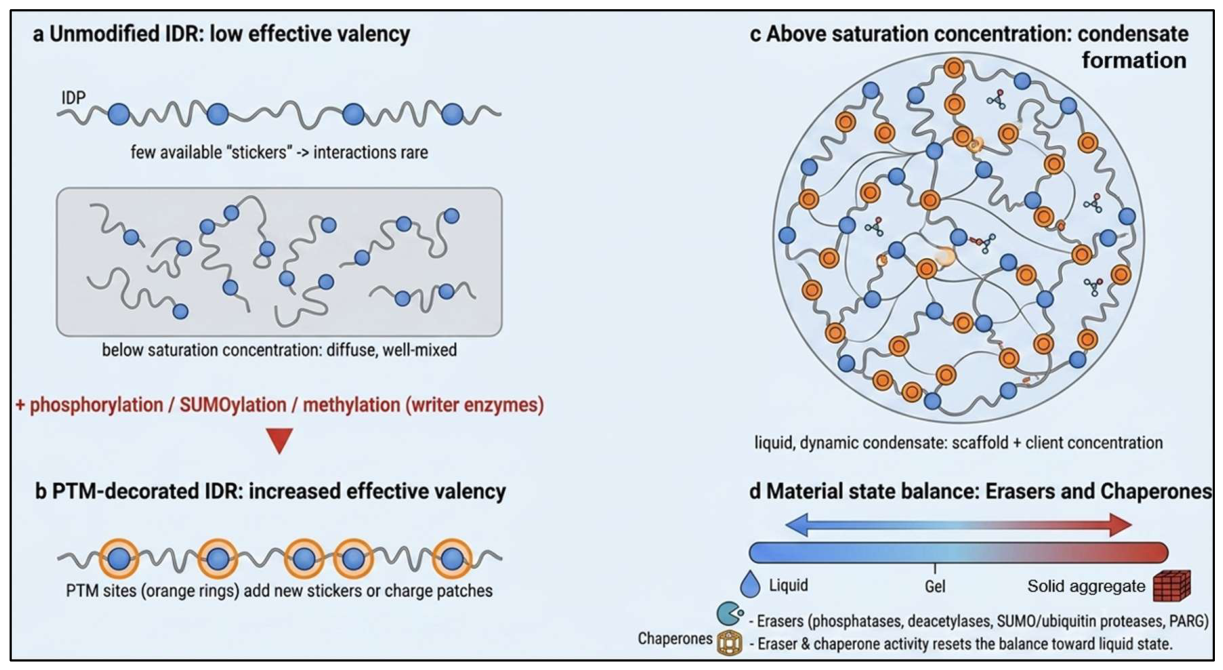
Figure 2.
The post-translational modification toolkit for condensate control. Six major PTM classes act on distinct residues, are installed and removed by dedicated writer/eraser enzymes, and each imparts a distinct biophysical effect on condensate assembly, composition, or clearance. The lower panel summarizes the SUMOylation-driven plant nuclear immune condensate circuit built around the SIZ1-MAC-SNC1 axis, in which a single SUMO ligase both stabilizes and reinforces assembly of its own condensate substrate, counterbalanced by karyopherin-mediated disassembly.
Figure 2.
The post-translational modification toolkit for condensate control. Six major PTM classes act on distinct residues, are installed and removed by dedicated writer/eraser enzymes, and each imparts a distinct biophysical effect on condensate assembly, composition, or clearance. The lower panel summarizes the SUMOylation-driven plant nuclear immune condensate circuit built around the SIZ1-MAC-SNC1 axis, in which a single SUMO ligase both stabilizes and reinforces assembly of its own condensate substrate, counterbalanced by karyopherin-mediated disassembly.
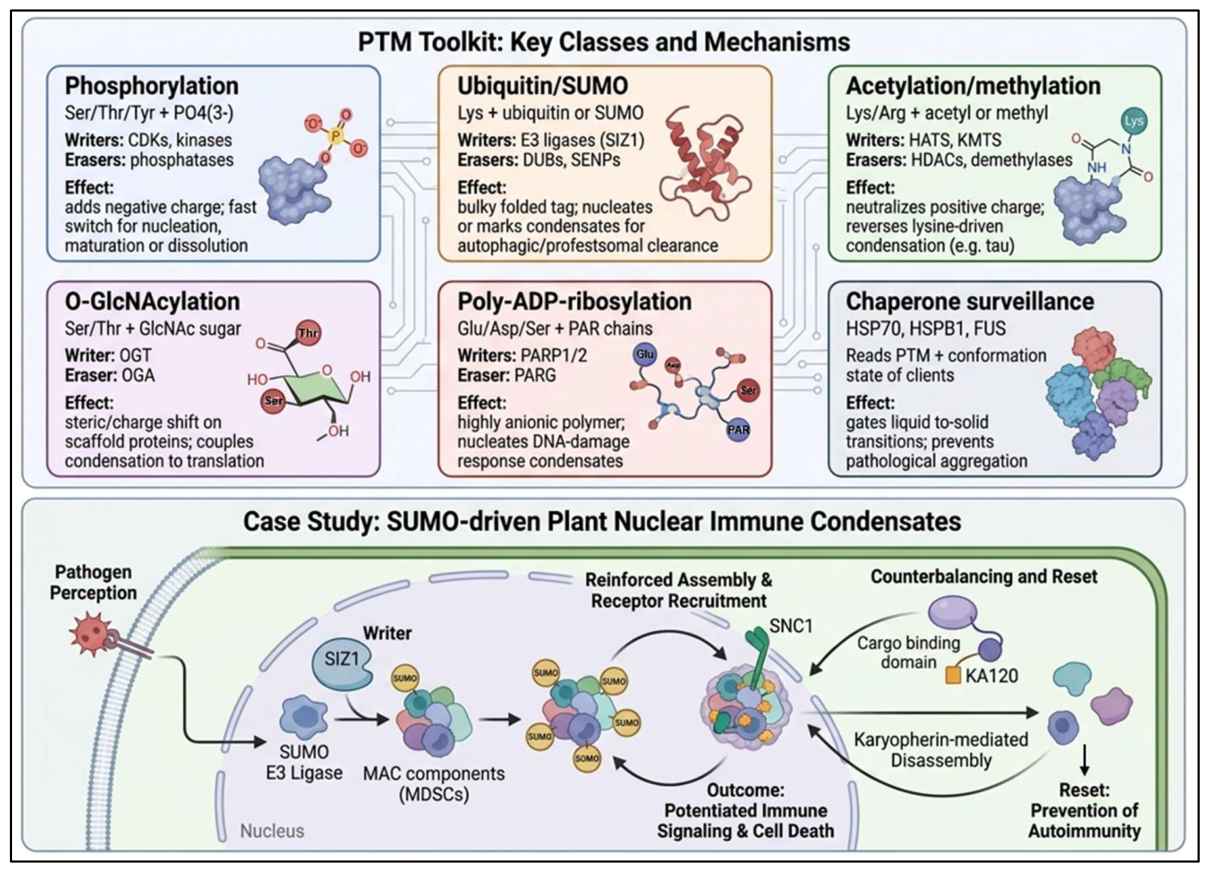

Table 1.
The post-translational modification toolkit that regulates biomolecular condensates.
| PTM class | Target residue | Key enzymes | Effect on condensates | Example |
|---|---|---|---|---|
| Phosphorylation | Ser/Thr/Tyr | CDKs / phosphatases | Adds negative charge; fast nucleation or dissolution switch | CDK-driven mitotic condensate reorganization [10] |
| Ubiquitination | Lys | E3 ligases / DUBs | Bulky tag; nucleates condensates or marks for clearance | Polyubiquitin-driven p62 phase separation [24] |
| SUMOylation | Lys | SUMO E3 ligases (SIZ1) / SENPs | Stabilizes and reinforces condensate scaffolds | SIZ1-driven plant immune nuclear condensates [22] |
| Acetylation | Lys | HATs / HDACs | Neutralizes positive charge; reverses lysine-driven condensation | Acetylation reverses tau/RNA coacervation [32] |
| Methylation | Lys/Arg | KMTs/PRMTs / demethylases | Alters hydrogen bonding and cation-pi capacity | CK2-PRC2 H3K27me3 cold memory [36] |
| O-GlcNAcylation | Ser/Thr | OGT / OGA | Steric and charge shift; couples condensation to translation | SynGAP/PSD-95 postsynaptic condensates [34] |
| Poly-ADP-ribosylation | Glu/Asp/Ser | PARP1/2 / PARG | Highly anionic polymer; nucleates DNA-damage condensates | PARG licenses Pol-theta end-joining condensates [41] |
Disclaimer/Publisher’s Note: The statements, opinions and data contained in all publications are solely those of the individual author(s) and contributor(s) and not of MDPI and/or the editor(s). MDPI and/or the editor(s) disclaim responsibility for any injury to people or property resulting from any ideas, methods, instructions or products referred to in the content. |
© 2026 by the authors. Licensee MDPI, Basel, Switzerland. This article is an open access article distributed under the terms and conditions of the Creative Commons Attribution (CC BY) license (http://creativecommons.org/licenses/by/4.0/).
Copyright: This open access article is published under a Creative Commons CC BY 4.0 license, which permit the free download, distribution, and reuse, provided that the author and preprint are cited in any reuse.