

Submitted:
01 September 2026
Posted:
02 September 2026
You are already at the latest version
Abstract
Leguminous crops contribute approximately 40–60 million tonnes of biologically fixed nitrogen annually to agricultural soils through symbiotic associations with rhizobia, underpinning the sustainability of diverse cropping systems. However, rising herbicide use, driven by the adoption of herbicide-tolerant crops and intensifying weed resistance, poses significant threats to the integrity of the legume-rhizobium symbiosis. This review synthesises current mechanistic and agronomic evidence on herbicide-induced disruption of symbiotic nitrogen fixation. We discuss evidence from studies demonstrating that herbicides impair symbiosis through multiple interconnected pathways, such as cytotoxicity to rhizobia and soil microbial communities, inhibition of flavonoid biosynthesis and Nod factor signalling, disruption of cytoskeletal dynamics that enhance the progression of thread infection, oxidative stress induction, alterations of auxin-cytokinin homeostasis, and modification of soil physicochemical parameters to the detriment of rhizobia spp. Furthermore, we synthesise recent advances from field and greenhouse studies demonstrating that symbiotic impairment is dose- and time-dependent, species-specific, and strongly influenced by rhizobial strain genotype. Additionally, we discuss mitigation strategies, such as herbicide-tolerant rhizobial strains, organic soil amendments, optimised herbicide application, and integrated weed management frameworks, which have shown considerable promise. Nevertheless, research gaps regarding tropical legume systems and long-term evolutionary consequences of herbicides on legume-rhizobia compatibility are highlighted.
Keywords:
biological nitrogen fixation
; nodulation
; rhizobia
; herbicide stress
; nod factor signalling
; nitrogenase
1. Introduction
Leguminous crops occupy a pivotal position in sustainable agricultural systems owing to their unique capacity to establish symbiotic associations with nitrogen-fixing rhizobia, thereby converting atmospheric dinitrogen into plant-available ammonium [1,2]. Globally, legumes contribute approximately 40–60 million tonnes of biologically fixed nitrogen annually to agricultural soils, substantially reducing dependence on synthetic nitrogen fertilizers and their associated environmental externalities, including greenhouse gas emissions and groundwater contamination [3,4]. Beyond nitrogen inputs, legumes enhance cropping system sustainability by improving soil organic matter content, mobilizing phosphorus, and disrupting pest and disease cycles when integrated into cereal-based rotations [5,6,7]. The ecological and economic significance of legumes is therefore inextricably linked to the efficiency of their symbiotic nitrogen fixation machinery.
The establishment of functional root nodules; the specialized organs housing differentiated bacteroids capable of nitrogenase-mediated nitrogen reduction, represents a highly coordinated molecular dialogue between the host legume and its compatible rhizobial partner [8,9]. This process initiates with the plant’s exudation of flavonoid signal molecules into the rhizosphere, which activate rhizobial nodulation (nod) genes responsible for synthesizing lipochitooligosaccharide Nod factors [10,11]. Subsequent signalling cascades govern root hair deformation, infection thread formation, cortical cell division, and ultimately the differentiation of a functional nodule capable of sustained nitrogen fixation [12,13]. The integrity of nodulation is fundamental to maintaining soil fertility, as biologically fixed nitrogen contributes to both immediate crop nutrition and long-term nitrogen cycling within agroecosystems, thereby supporting the productivity of subsequent non-leguminous crops in rotation [14,15].
Despite the recognised importance of legume-rhizobium symbiosis, modern agricultural intensification has introduced numerous chemical stressors that threaten its functionality. Herbicides, the most widely used category of pesticides worldwide, have experienced a dramatic increase in use over recent decades, driven by the proliferation of herbicide-tolerant crop cultivars and the need to manage increasingly resistant weed populations [16]. While herbicides are designed to target specific metabolic pathways in weeds, mounting evidence indicates that many active ingredients exert non-target effects on beneficial soil microorganisms, including symbiotic rhizobia [17,18,19]. Glyphosate, sulfonylureas, and dinitroaniline herbicides have been shown to impair rhizobial viability, alter rhizosphere community composition, and inhibit critical stages of the nodulation process [20,21]. Such disruptions compromise nitrogenase activity, reduce nodule biomass, and ultimately diminish the proportion of plant nitrogen derived from biological fixation, with cascading consequences for soil health and agricultural sustainability [22,23] (Figure 1A).
Given the concurrent global imperatives to intensify food production while minimizing environmental degradation, understanding the mechanistic basis of herbicide-induced symbiotic dysfunction is of considerable scientific and practical importance. This review provides a comprehensive synthesis of current knowledge regarding the impacts of herbicide stress on legume-rhizobium symbiosis, examining disruptions from molecular signalling through to whole-plant and field-level outcomes. It further evaluates emerging mitigation strategies and identifies critical knowledge gaps that must be addressed to reconcile effective weed management with the preservation of symbiotic nitrogen fixation in legume-based production systems.
2. Herbicide Classes and Their Soil Residual Effects
2.1. Overview of Commonly used Herbicides in Legume Production Systems
The global herbicide market encompasses a diverse array of chemical classes, each characterized by distinct modes of action, physicochemical properties, and environmental behaviours that collectively determine their potential to interact with soil biological processes. Understanding the classification, target pathways, and soil dynamics of these compounds is essential to evaluating their impacts on legume-rhizobium symbiosis.
Glyphosate [N-(phosphonomethyl)glycine] is the most widely applied herbicide globally, functioning as a non-selective, post-emergent inhibitor of 5-enolpyruvylshikimate-3-phosphate synthase (EPSPS) within the shikimate pathway, thereby disrupting the biosynthesis of aromatic amino acids in susceptible plants and microorganisms [24]. Its use has expanded dramatically following the commercial introduction of glyphosate-resistant crop varieties, including soybean, with annual global application exceeding 800,000 tonnes of active ingredient [16]. Critically, the shikimate pathway is present in many soil bacteria, including rhizobia, raising concerns regarding direct toxicity to symbiotic partners [25,26].
Atrazine (2-chloro-4-ethylamino-6-isopropylamino-1,3,5-triazine) belongs to the triazine class and inhibits photosystem II by binding to the D1 protein of the thylakoid membrane, blocking electron transport in photosynthesis [27,28]. Although primarily employed in maize-based systems, atrazine residues frequently persist in soils where legumes are subsequently cultivated in rotation, thereby exposing rhizobial populations and emerging nodulation processes to residual concentrations [29,30]. Its moderate to high persistence in soil, combined with leaching potential and misapplication in developing countries due to lack of education, has raised considerable moderate to high persistence in soil, combined with leaching potential and misapplication environmental concern about groundwater contamination and non-target microbial effects [31,32].
Paraquat (1,1′-dimethyl-4,4′-bipyridinium dichloride) is a non-selective contact herbicide belonging to the bipyridylium class that reactive oxygen species through the diversion of electrons from photosystem generates I, causing rapid membrane lipid peroxidation and cellular desiccation [33]. Despite its acute phytotoxicity, paraquat undergoes rapid and virtually irreversible adsorption to soil clay minerals upon contact with soil, rendering it biologically unavailable under most conditions [34]. Nevertheless, questions remain about its effects on surface-dwelling microbial communities and rhizobia during the immediate post-application period before complete adsorption.
Pendimethalin [N-(1-ethylpropyl)-3,4-dimethyl-2,6-dinitrobenzenamine] is a dinitroaniline herbicide widely employed as a pre-emergent treatment for annual grass and broadleaf weed control in various legume crops. Its mode of action involves binding to tubulin proteins, thereby inhibiting microtubule assembly and disrupting mitotic cell division in susceptible meristematic tissues [35]. Given its application at or before crop emergence, pendimethalin is present in the soil at precisely the time when rhizobial colonization and early infection events are initiated, creating a temporal overlap of particular concern for symbiotic establishment [36,37].
Nicosulfuron [2-(4,6-dimethoxypyrimidin-2-ylcarbamoylsulfamoyl)-N,N-dimethylnicotinamide] is a sulfonylurea herbicide that inhibits acetolactate synthase (ALS), the first enzyme in the branched-chain amino acid biosynthetic pathway [38]. Applied predominantly in maize, nicosulfuron residues in soil may adversely affect subsequently planted legumes and their associated rhizobia, as the ALS pathway is conserved across many bacterial taxa, including nitrogen-fixing symbionts [39,40]. The extreme potency of sulfonylurea herbicides; active at gram-per-hectare application rates, means that even trace residues may exert biological effects on sensitive microorganisms.
The synthetic auxin herbicide 2,4-dichlorophenoxyacetic acid (2,4-D amine) mimics the natural phytohormone indole-3-acetic acid at supraoptimal concentrations, inducing uncontrolled and disorganized growth in susceptible dicotyledonous plants, ultimately leading to vascular disruption and plant death [41,42]. As a selective broadleaf herbicide, 2,4-D is particularly relevant to legume systems because leguminous crops are dicotyledonous and thus potentially susceptible to drift or residual activity. Moreover, auxin signalling plays an integral role in nodule organogenesis, suggesting that exogenous auxin-mimicking compounds may disturb symbiotic development even at sub-lethal concentrations [43,44].
Propanil (3′,4′-dichloropropionanilide) is an acetanilide herbicide primarily utilized in rice production systems that inhibits photosynthesis at photosystem II through a mechanism analogous to that of triazines, though with distinct binding characteristics [45]. In tropical and subtropical regions where rice-legume rotational systems are prevalent, propanil residues and their metabolites; principally 3,4-dichloroaniline, may persist in soil and interact with rhizobial populations during subsequent legume cultivation [46]. The metabolite 3,4-dichloroaniline is of particular ecotoxicological concern due to its greater persistence and antimicrobial activity compared to the parent compound.
Propaquizafop [2-isopropylideneamino-oxyethyl(R)-2-[4-(6-chloroquinoxalin-2-yloxy)phenoxy]propanoate] is an aryloxyphenoxypropionate (FOP) herbicide that inhibits acetyl-CoA carboxylase (ACCase), a key enzyme in fatty acid biosynthesis, and is employed selectively for post-emergent grass weed control in broadleaf crops including various grain legumes [47,48]. As ACCase-inhibiting herbicides target a plastidic enzyme form absent in dicotyledonous crops, they are generally considered safe for legume cultivation; however, their effects on soil microbial communities and rhizobial metabolism have received comparatively limited research attention [49,50].
Imazethapyr [5-ethyl-2-(4-isopropyl-4-methyl-5-oxo-4,5-dihydro-1H-imidazol-2-yl)nicotinic acid] is an imidazolinone herbicide that, like sulfonylureas, inhibits the ALS enzyme but possesses broader soil residual activity and is extensively used for selective weed control in soybean, groundnut, and other grain legumes [51,52]. Its direct application within legume crops ensures intimate contact with rhizobial populations in the rhizosphere, and numerous studies have documented inhibitory effects on nodulation parameters and nitrogenase activity at field-relevant concentrations [36,37,53].
2.2. Persistence, Degradation Pathways, and Soil Residual Dynamics
The persistence of herbicides in soil is governed by complex interactions among the physicochemical properties of the active ingredient, soil characteristics, climatic conditions, and the activity of degrading microbial communities [54,55]. Soil half-life (DT50); the time required for 50% dissipation of the applied compound, varies enormously across herbicide classes, ranging from days for rapidly degraded compounds to months or years for highly persistent molecules (Table 1). This persistence determines the duration and intensity of exposure experienced by non-target soil microorganisms, including free-living and symbiotic rhizobia.
Glyphosate degradation in soil proceeds primarily through microbial metabolism, yielding aminomethylphosphonic acid (AMPA) as the principal metabolite, with reported half-lives ranging from 2 to 215 days depending on soil type, organic matter content, and microbial activity [56,57]. Although historically considered rapidly degraded, evidence indicates that glyphosate can form stable complexes with soil mineral surfaces, particularly in phosphorus-deficient soils with high iron and aluminium oxide content, potentially extending its bioavailability and the duration of microbial exposure [58]. The metabolite AMPA exhibits persistence comparable to or exceeding that of the parent compound and may itself exert biological effects on soil microorganisms [17,59].
Atrazine persistence is notably variable, with field half-lives reported between 13 and 261 days, influenced predominantly by soil pH, organic carbon content, and prior exposure history that determines the presence of adapted microbial degraders [32]. In soils without prior atrazine exposure, degradation proceeds slowly via chemical hydrolysis and limited microbial co-metabolism, whereas in adapted soils, specific bacterial consortia can rapidly mineralize atrazine via the atzABCDEF degradation pathway [31]. Bound residues of atrazine and its chlorinated metabolites may persist for years in subsoil horizons, representing a long-term source of low-level exposure for deep-rooting legumes and their rhizobial partners.
Paraquat exhibits exceptional persistence in soil owing to its extremely strong adsorption to clay mineral interlayer spaces, with estimated half-lives exceeding 10–20 years in some soil types [34]. However, this adsorption simultaneously renders paraquat biologically unavailable, creating a paradox in which extreme chemical persistence coexists with minimal biological activity. The practical significance of this bound residue pool for soil microbiology remains debated. However, desorption under specific conditions, such as soil erosion that exposes subsurface clays, may release biologically active concentrations [60,61].
Pendimethalin demonstrates moderate persistence with typical field half-lives of 40–120 days, degrading primarily through microbial oxidation and photolysis at the soil surface [35].. Its high hydrophobicity (log Kow = 5.2) promotes strong adsorption to soil organic matter, limiting leaching but potentially concentrating residues in the organic-rich surface horizon where rhizobial populations are most abundant and where initial root infection events occur [36,37]. Under anaerobic conditions or in cold climates, pendimethalin persistence may extend considerably beyond typical half-life estimates.
Nicosulfuron persistence in soil is relatively short under optimal degradation conditions, with reported half-lives of 10–45 days; however, degradation is highly pH-dependent, proceeding most rapidly under acidic conditions through chemical hydrolysis and more slowly in neutral to alkaline soils where microbial degradation predominates [38]. The extreme biological potency of sulfonylurea herbicides means that even low residual concentrations well below analytical detection limits may exert phytotoxic and microbiological effects, making half-life values potentially misleading indicators of ecological risk [39,62].
The degradation of 2,4-D amine in soil is generally rapid under aerobic conditions, with typical half-lives of 7–30 days, proceeding through microbial catabolism via the tfdA gene-encoded dioxygenase pathway [63,64]. Nevertheless, persistence increases substantially under anaerobic, cold, or low-organic-matter conditions, and repeated applications may temporarily suppress the abundance and diversity of sensitive microbial populations before degrader communities expand [41,42]. The relatively rapid dissipation of 2,4-D suggests that its primary risks to rhizobia are concentrated in the immediate post-application period rather than through long-term residual exposure.
Propanil undergoes rapid hydrolysis in soil with half-lives typically below 7 days; however, its metabolite 3,4-dichloroaniline (3,4-DCA) is substantially more persistent and may undergo polymerization reactions with soil humic substances, creating bound residues with half-lives exceeding 100 days [46].This metabolite-driven persistence is ecologically significant because 3,4-DCA possesses documented antimicrobial properties and may affect rhizobial survival during the intercropping period between rice harvest and legume establishment in rotational systems.
Propaquizafop persistence data remain relatively limited compared to older herbicide classes, though available studies suggest moderate soil half-lives of 15–40 days with degradation proceeding primarily through ester hydrolysis followed by microbial metabolism of the released acid moiety [49]. Its moderate lipophilicity promotes retention in the soil surface horizon, where degradation is facilitated by higher microbial biomass and enzymatic activity.
Imazethapyr exhibits moderate to high persistence with field half-lives of 60–180 days, and its degradation is strongly influenced by soil pH, proceeding most rapidly under acidic conditions [51,52]. The imidazolinone ring structure confers considerable resistance to microbial degradation in some soils, and carryover injury to subsequent rotational crops has been documented at intervals exceeding 12 months after application [53,65]. In legume systems where imazethapyr is applied directly, this persistence ensures prolonged exposure of rhizobial populations throughout the nodulation and nitrogen fixation period.
2.3. Impacts on Soil Microbial Communities and Rhizobia
The effects of herbicide residues on soil microbial communities represent a growing area of research concern, driven by recognition that soil biological health underpins numerous ecosystem services including nutrient cycling, organic matter decomposition, and biological nitrogen fixation [66]. Herbicide impacts on soil microorganisms range from stimulatory; where compounds serve as carbon or nutrient sources for degrader populations, to severely inhibitory, depending on the herbicide class, concentration, exposure duration, and community composition [67].
Glyphosate effects on soil microbial communities have been extensively studied, yielding somewhat contradictory results that likely reflect variation in experimental conditions and soil types. Several investigations have documented shifts in bacterial community structure, including reductions in the relative abundance of rhizobial populations, following glyphosate application at field rates [20,68]. Mechanistically, glyphosate may directly inhibit the shikimate pathway in sensitive rhizobial strains lacking resistant EPSPS isoforms, or indirectly alter rhizobial competitiveness by modifying root exudation patterns in the host plant [25]. Studies on Bradyrhizobium japonicum have demonstrated strain-dependent sensitivity to glyphosate, with some strains exhibiting growth inhibition at concentrations below those encountered in the rhizosphere of treated plants [69].
Atrazine has been shown to reduce soil microbial biomass carbon and nitrogen, suppress dehydrogenase and phosphatase enzyme activities, and alter bacterial community composition at field-relevant concentrations [29]. Specific effects on rhizobia include inhibition of Rhizobium leguminosarum growth at concentrations exceeding 10 µg mL−1 and reduced nodulation in clover and pea when atrazine residues persist from prior maize cultivation [70]. The photosystem II inhibition mechanism is not directly relevant to heterotrophic bacteria; however, atrazine may interfere with other cellular processes in rhizobia or indirectly affect symbiosis by impairing host plant physiology.
Pendimethalin has demonstrated inhibitory effects on rhizobial growth, nodule initiation, and nitrogenase activity in several legume species. Research by [36,37] documented significant reductions in nodule number, nodule dry weight, and acetylene reduction activity in chickpea and lentil following pendimethalin application at recommended field rates. The microtubule-disrupting mechanism of dinitroaniline herbicides may interfere with the cytoskeletal rearrangements required for infection thread growth and nodule primordia establishment in host root cortical cells [35].
The ALS-inhibiting herbicides nicosulfuron and imazethapyr share a common mode of action targeting branched-chain amino acid biosynthesis, a pathway present in rhizobial bacteria. Zabaloy et al. [53] reported that imazethapyr application to soybean significantly altered rhizosphere bacterial community structure and reduced the metabolic versatility of soil microbial communities as assessed by community-level physiological profiling. The sensitivity of individual rhizobial strains to ALS-inhibiting herbicides varies considerably, suggesting that herbicide exposure may exert selective pressure favouring resistant strains that are potentially less symbiotically effective [39,40].
Research on 2,4-D effects on rhizobia has revealed dose-dependent toxicity, with concentrations exceeding field application rates inhibiting growth of multiple Rhizobium and Bradyrhizobium species in pure culture, while field-rate concentrations produced transient effects on soil microbial biomass and activity [63]. The auxin-mimicking properties of 2,4-D are of particular concern for nodulation because auxin transport and local accumulation regulate nodule positioning and meristem establishment; exogenous disruption of auxin gradients may therefore interfere with nodule organogenesis independently of direct rhizobial toxicity [43,44].
Propaquizafop and propanil have received comparatively less research attention regarding their effects on rhizobial populations, though limited evidence suggests that both compounds may transiently suppress nitrogen-fixing bacteria at field application rates [46,49]. The metabolite 3,4-DCA from propanil degradation is of greater concern than the parent compound, as it possesses demonstrated bacteriostatic activity and greater environmental persistence.
The cumulative evidence presented in Table 1 demonstrates that herbicide effects on rhizobia and the nodulation process are highly variable across chemical classes, influenced by mode of action, soil behaviour, and exposure dynamics. Herbicides sharing modes of action targeting conserved metabolic pathways present in both plants and bacteria; particularly the shikimate and branched-chain amino acid biosynthesis pathways, pose the most direct risk to rhizobial viability and symbiotic function [70,86]. Conversely, herbicides with highly specific plant targets or those rapidly inactivated in soil may present lower risk, though indirect effects mediated through host plant physiological disruption, altered root exudation, or shifts in rhizosphere competitive dynamics cannot be discounted [17,59]. The following sections examine the specific molecular mechanisms by which these herbicide classes disrupt symbiotic signalling, nodule development, and nitrogen fixation.
3. Impact of Herbicides on Legume-Rhizobia Symbiosis
3.1. Direct Toxicity to Rhizobia in Free-Living and Symbiotic States
The rhizosphere and soil microbiome plays essential role in shapping plants inteactions and resource acquisition [87,88]. However, herbicides can exert direct cytotoxic and cytostatic effects on these microbial populations, including rhizobial species both in their free-living saprophytic state within the soil matrix and during their differentiated bacteroid phase within root nodules. The sensitivity of rhizobia to herbicide exposure varies considerably depending on the herbicide class, concentration, and the specific rhizobial species or strain involved [70] Figure 1. Glyphosate, an inhibitor of 5-enolpyruvylshikimate-3-phosphate synthase (EPSPS) in the shikimate pathway, has been demonstrated to suppress the growth of multiple Bradyrhizobium japonicum strains at field-relevant concentrations, reducing colony-forming units and impairing their capacity to colonize soybean rhizospheres effectively [25]. Similarly, Santos et al. [69] reported that imazethapyr, a member of the imidazolinone herbicide family targeting acetolactate synthase (ALS), significantly inhibited the in vitro growth of Rhizobium leguminosarum bv. viciae at concentrations approximating those encountered in field soils following standard application rates.
The vulnerability of rhizobia to herbicide toxicity is amplified during critical transitional stages, particularly during the shift from free-living to symbiotic existence. During infection thread progression and bacteroid differentiation, rhizobia undergo substantial physiological and morphological restructuring that renders them susceptible to metabolic perturbation [89]. Sulfonylurea herbicides such as chlorimuron-ethyl have been shown to inhibit branched-chain amino acid biosynthesis in rhizobial cells, leading to impaired protein synthesis, reduced exopolysaccharide production, and compromised cell surface integrity, all of which are essential for successful host infection [90]. Importantly, herbicide-induced rhizobial mortality in soil reduces the density of compatible inoculant populations below the threshold necessary for competitive nodule occupancy, thereby diminishing the proportion of effective nitrogen-fixing nodules formed [91].
Within established nodules, herbicide translocation from shoot tissues to the root system via phloem transport exposes differentiated bacteroids to sublethal or lethal concentrations of the active ingredients. Zobiole et al. [20] demonstrated that glyphosate application to glyphosate-resistant soybean cultivars resulted in significant accumulation of the herbicide within nodule tissues, subsequently reducing nitrogenase activity by 22–25% and leghemoglobin content by up to 30%. This intra-nodular toxicity is particularly insidious because it compromises nitrogen fixation efficiency without necessarily causing visible phytotoxicity to the host plant, leading to concealed nitrogen deficits that may only manifest as yield reductions at harvest [68]. Metribuzin, a photosystem II-inhibiting triazinone herbicide commonly applied in soybean production, has also been shown to reduce bacteroid respiration rates and accelerate nodule senescence when translocated to root tissues at concentrations below those that cause foliar injury [92]. The differential sensitivity of rhizobial strains to specific herbicides has prompted researchers to propose strain screening protocols that prioritize herbicide tolerance as a selection criterion for commercial inoculant development, although such approaches remain insufficiently validated under field conditions [93].
3.2. Disruption of Root Hair Formation and Molecular Signalling Pathways
The initiation of legume-rhizobium symbiosis is contingent upon a precisely orchestrated molecular dialogue between symbiotic partners, beginning with the host plant’s secretion of flavonoid compounds into the rhizosphere that serve as chemoattractants and transcriptional activators of rhizobial nodulation genes [8]. Herbicides that interfere with plant phenylpropanoid metabolism directly compromise flavonoid biosynthesis, thereby disrupting the earliest stages of symbiotic signalling. Glyphosate inhibits EPSPS in the shikimate pathway, which serves as the precursor route for aromatic amino acid and flavonoid production; consequently, glyphosate-treated legumes exhibit significantly reduced root exudation of key Nod gene-inducing flavonoids such as genistein, daidzein, and luteolin [94,95]. This disruption weakens rhizobial nod gene expression and diminishes Nod factor production, effectively severing the initial chemical communication that triggers the symbiotic cascade.
Beyond flavonoid-Nod factor signalling, herbicides interfere with downstream signal transduction events essential for infection establishment. Nod factor perception by host LysM receptor kinases initiates a signalling cascade involving calcium spiking in root hair nuclei, activation of calcium-calmodulin-dependent kinase (CCaMK), and transcriptional reprogramming mediated by NODULE INCEPTION (NIN) and other symbiosis-specific transcription factors [11]. Dinitroaniline herbicides such as pendimethalin and trifluralin, which disrupt microtubule polymerization by binding to plant tubulin, severely impair root hair deformation, the morphological response to Nod factor perception that facilitates bacterial entrapment and infection thread initiation [96]. Treated root hairs fail to exhibit the characteristic curling response necessary to enclose rhizobial microcolonies, and cytoskeletal disruption further prevents the polarized growth of infection threads through cortical cell layers [97].
Pre-emergent herbicides applied at or near the time of legume sowing are particularly detrimental to early symbiotic establishment because they coincide with the critical window of root hair development and initial rhizobial colonization. Trifluralin incorporation into soil has been documented to reduce nodule numbers in pea (Pisum sativum) and lentil (Lens culinaris) by 30–60%, attributable to combined effects on root hair morphogenesis and rhizobial viability in the spermosphere [98]. Furthermore, auxin-mimicking herbicides such as 2,4-dichlorophenoxyacetic acid (2,4-D) disrupt the phytohormone balance governing nodule organogenesis. Auxin-cytokinin ratios precisely regulate cortical cell dedifferentiation and nodule primordium formation, and perturbation of these ratios by synthetic auxin herbicides can either stimulate the formation of ineffective pseudonodules or entirely suppress nodule organogenesis [99]. Recent transcriptomic analyses have revealed that herbicide exposure triggers broad-spectrum downregulation of symbiosis-related genes, including those encoding flotillins, symbiotic remorin proteins, and ENOD (early nodulin) genes, collectively undermining the host’s capacity to accommodate its microbial partner [100].
3.3. Herbicide-Induced Alterations in Soil Physicochemical Conditions Affecting Nodulation
Beyond direct biochemical interactions with rhizobia and host plant signalling, herbicides modify the soil’s physicochemical environment, thereby indirectly compromising nodulation efficiency. Soil pH represents a critical determinant of both rhizobial survival and nodulation competence, with most Rhizobium and Bradyrhizobium species exhibiting optimal growth and Nod factor production within a narrow pH range of 6.0–7.5 [14]. Certain herbicide formulations, particularly those containing acidic active ingredients or acidifying adjuvants, can transiently reduce rhizosphere pH upon application, creating microenvironmental conditions unfavorable for rhizobial proliferation and attachment to root surfaces [101,102]. Conversely, repeated applications of atrazine and its degradation products have been associated with shifts in soil cation exchange dynamics and buffering capacity, with downstream consequences for calcium availability, an element essential for Nod factor signal transduction and nodule structural integrity [23,103].
Soil organic matter and microbial biomass carbon serve as indicators of overall soil biological health and influence the competitive saprophytic competence of rhizobial inoculants. Persistent herbicide use has been consistently associated with reductions in microbial biomass carbon and shifts in microbial community composition that disadvantage symbiotic bacteria relative to more herbicide-tolerant saprophytic competitors [17,59]. Glyphosate application, in particular has been shown to stimulate populations of Fusarium and other root-associated fungi at the expense of beneficial rhizobacteria, altering rhizosphere competitive dynamics to the detriment of rhizobial nodule occupancy [68]. Modifications to soil microbial community structure induced by herbicide regimes may also disrupt synergistic interactions between rhizobia and other plant growth-promoting rhizobacteria, such as phosphate-solubilizing bacteria and mycorrhizal fungi, that facilitate nutrient acquisition necessary for energetically demanding nitrogen fixation processes [104,105].
Herbicide persistence and degradation kinetics further determine the duration and severity of soil physicochemical perturbations. Herbicides with extended soil half-lives, including certain triazines, sulfonamides, and phenylureas, maintain inhibitory concentrations in the nodulation zone for periods spanning multiple weeks to months, coinciding with critical early stages of legume establishment [106]. Adsorption-desorption dynamics governed by soil texture, organic carbon content, and moisture status modulate the bioavailability of herbicide residues to both free-living rhizobia and developing root systems [107]. In sandy soils with low organic matter content, herbicide bioavailability is elevated, exacerbating rhizobial toxicity and extending the period during which nodulation is suppressed. Furthermore, herbicide degradation intermediates may possess distinct toxicity profiles from their parent compounds; for instance, aminomethylphosphonic acid (AMPA), the primary degradation product of glyphosate, has been shown to inhibit root elongation and alter rhizosphere exudation patterns, thereby indirectly impairing symbiotic establishment [95].
Soil moisture dynamics also interact with herbicide impacts on symbiosis. Herbicide-induced reductions in soil microbial activity decrease aggregate stability through diminished production of extracellular polysaccharides and glomalin-related soil proteins, potentially increasing susceptibility to waterlogging or drought stress in the nodulation zone [108]. Since nitrogenase activity is exquisitely sensitive to oxygen concentration, alterations in soil porosity and aeration status resulting from degraded aggregate structure can shift the oxygen diffusion barrier within nodules, further compromising nitrogen fixation efficiency [109]. The convergence of direct herbicide toxicity with these indirect physicochemical modifications creates a multifactorial stress environment that challenges the resilience of legume-rhizobium symbioses under modern agricultural management. Figure 1 above lustrates the multiple pathways through which herbicide application disrupts legume-rhizobium symbiosis, encompassing direct microbial toxicity, interference with molecular signalling, and modification of the soil environment.
4. Evidence from Field and Greenhouse Studies
4.1. Key Experimental Findings on Herbicide Impacts on Nodulation and Nitrogen Fixation
A substantial body of experimental evidence, derived from both controlled greenhouse bioassays and multi-season field trials, demonstrates that herbicides commonly applied in legume cropping systems can significantly impair the Rhizobium-legume symbiosis. The perturbation of this mutualistic association manifests primarily as reductions in nodule number, nodule biomass, leghemoglobin content, and nitrogenase activity, all of which collectively compromise biological nitrogen fixation (BNF). Fox et al. [70] provided seminal evidence that agrochemicals, including widely used herbicides, reduced symbiotic efficiency in multiple legume species by disrupting molecular signalling between host roots and rhizobial microsymbionts. Their findings, published in the Proceedings of the National Academy of Sciences, underscored that even sub-lethal herbicide concentrations could decrease Nod factor perception and flavonoid exudation, thereby impairing the initiation of nodule organogenesis.
Glyphosate, the most extensively studied herbicide in this context, has received particular attention following the widespread adoption of glyphosate-resistant (GR) soybean cultivars. Zablotowicz and Reddy [25] demonstrated in field trials conducted in Mississippi that glyphosate applications to GR soybean reduced nodule biomass by 28% and nitrogenase activity (assessed by acetylene reduction assay) by up to 35% compared with untreated controls at certain growth stages. These findings were consistent with earlier work by King et al. (2001), who reported significant suppression of nitrogenase activity in GR soybean at the V4–V5 growth stages following post-emergence glyphosate application, though partial recovery was observed later in the season (Figure 1A). Reddy and Zablotowicz [110] further documented that glyphosate accumulated in soybean nodules and inhibited the shikimate pathway in resident Bradyrhizobium japonicum, providing a physiological basis for the observed symbiotic impairment. More recently, Bärwald Bohm et al. [111] confirmed these patterns in Brazilian field conditions, reporting that sequential glyphosate applications reduced both nodule occupancy and grain nitrogen content in GR soybean, with cumulative effects apparent over consecutive growing seasons. Furthermore, in systems using multiple residuals and post-emergence herbicides (e.g., PPO inhibitors, chloroacetamides, and dicamba or 2,4-D in traited cultivars), visible soybean injury frequently coincides with growth reduction and lower biomass accumulation [112]. Because nodulation and N2 fixation are tightly coupled to host carbon availability, these growth reductions are often accompanied by fewer and smaller nodules and lower acetylene reduction or ureide levels, even when nodulation is not directly targeted by the herbicide. Similarly, in cowpea, preharvest desiccation with various herbicides has been shown to alter antioxidant enzyme activity and protein and amino acid contents in seeds, indicating physiological stress [113]. Although these studies focus mainly on seed quality, they implicate herbicide-induced oxidative stress as a mechanism that could modulate subsequent rhizobial colonization and early nodule formation.
In addition to direct plant effects, rhizobial responses to herbicides can be critical. Rhizobia exposed to abiotic stresses in the rhizosphere; including salinity, acidity, osmotic stress, and oxidative stress, activate stress-tolerance regulons that are increasingly recognized as integral to symbiotic signaling [114,115]. Herbicides, especially those that perturb redox and membrane integrity, can potentially co-opt or disrupt these stress-response pathways. Recent mesocosm work with legume–rhizobium systems under herbicide exposure suggests that rhizobial genetic variation largely determines how mutualistic outcomes change in the presence of herbicides: different rhizobial strains produce markedly different effects on plant performance when exposed to herbicides, even on the same host genotype [116]. This highlights that nodulation and N2 fixation under herbicide regimes are emergent properties of both plant and bacterial responses.
Pre-emergence herbicides have similarly been implicated in disrupting early nodulation events. Khan et al. (117) conducted greenhouse experiments demonstrating that metribuzin and glyphosate applied at recommended field rates significantly reduced nodulation parameters in chickpea (Cicer arietinum), including 40–60% reductions in nodule number and 25–50% decreases in nitrogenase activity. Pendimethalin, a dinitroaniline herbicide widely used in groundnut and soybean production systems, was shown by Ahemad & Saghir Khan [118] and Tsyganova et al. [119] to suppress root hair deformation and curling, thereby interfering with the earliest stages of rhizobial infection thread formation. In a comprehensive field study, Hungria et al. [120] evaluated the long-term impacts of glyphosate on BNF in Brazilian soybean systems over four consecutive seasons and concluded that while single applications induced transient reductions in symbiotic performance, repeated applications led to progressive declines in nodule function and soil rhizobial populations.
The competitive context also matters. In field inoculation trials, high-performing elite rhizobial strains often fail to occupy nodules when competing with native rhizobial populations of lower N2-fixing capacity [121]. Herbicide programs can alter this competitive balance by differentially affecting the survival and stress physiology of inoculant versus native rhizobia, potentially reducing the realized benefits of inoculation. If herbicide residues in soil or on seed surfaces reduce inoculant viability or impede early root colonization, native rhizobia; possibly more herbicide-tolerant but less efficient at N2 fixation, may dominate nodule occupancy, lowering system-level N input despite the presence of inoculants.
4.2. Species-Specific Sensitivity
Field and greenhouse evidence consistently indicates that sensitivity to herbicide-induced stress varies among legume species and among cultivars within a species. Soybean (Glycine max)–Bradyrhizobium japonicum associations have been the most extensively characterized, largely because of the global economic importance of soybean and the dominance of glyphosate-based weed management in GR cultivars. However, tropical and subtropical grain legumes, including cowpea (Vigna unguiculata), groundnut (Arachis hypogaea), and common bean (Phaseolus vulgaris), have emerged as particularly sensitive systems in comparative studies.
In glyphosate-resistant soybean, the introduced EPSPS enzyme allows aromatic amino acid synthesis to continue under glyphosate exposure [122,123]. This trait largely prevents gross phytotoxicity, but sub-lethal effects such as transient growth suppression, altered carbon partitioning, and shifts in rhizosphere microbial communities have been reported in some studies, and these can indirectly influence nodulation. Enlist and Xtend soybean systems, which enable in-crop use of 2,4-D or dicamba plus glyphosate and/or glufosinate, are effective for managing herbicide-resistant weeds [124]. Yet extension and experimental data emphasize that these programs often produce some degree of soybean injury, especially when dicamba or PPO-inhibitor herbicides are mixed with residuals like metribuzin or chloroacetamides [112]. In soybeans grown on high pH or iron-deficient soils, injury is worsened, and these stress conditions are known from classical work to impair nodulation and N2 fixation even in the absence of herbicides.
Ahemad and Khan [125] reported that the cowpea-Bradyrhizobium symbiosis exhibited greater sensitivity to quizalafop-p-ethyl than did the pea-Rhizobium association under identical greenhouse conditions, attributing this differential to the lower intrinsic tolerance of cowpea-nodulating bradyrhizobia to aryloxyphenoxypropionate herbicides. In a parallel investigation, Ahemad and Khan [91] demonstrated that greengram (Vigna radiata) symbiosis with Bradyrhizobium sp. strain MRM6 was severely compromised by herbicide applications at recommended rates, with reductions in nodule number exceeding 50%. Conversely, soybean cultivars, particularly modern GR varieties, appeared to maintain relatively more robust symbiotic function under moderate glyphosate stress, potentially due to co-selection for herbicide-tolerant rhizobial strains in long-term GR cropping systems [120,126].
Cowpea and groundnut (peanut) show distinct patterns. Cowpea, often cultivated in low-input systems, is frequently exposed to preharvest desiccation with herbicides as a management tool to standardize harvest. Greenhouse and field studies have shown that desiccant choice and timing can significantly affect antioxidant enzyme activities (e.g., CAT, superoxide dismutase) and seed biochemical quality [113]. These biochemical perturbations may influence the vigor of seedlings and their subsequent nodulation capacity, although direct quantification of nodulation following seed exposure to desiccant residues remains limited. In groundnut, which is relatively sensitive to certain herbicides, field trials have shown that imidazolinones, triazines, and PPO inhibitors can reduce early vigor and root growth; since groundnut forms nodules primarily on the taproot and lateral roots, any reduction in root system development can have disproportional effects on total nodulation and N2 fixation.
Furthermore, Groundnut has been identified as especially vulnerable to pre-emergence herbicide injury to nodulation. Dzomeku [127] reported from field trials in Ghana that pendimethalin applied at standard agronomic rates reduced groundnut yield by 36% in 2011 and 76% in 2012, while other studies reported reductions in nodulation by 45% and pod nitrogen content by 22% relative to hand-weeded controls. Comparatively, soybean subjected to equivalent pendimethalin rates in the same study exhibited only 18% nodule reduction, suggesting that the Arachis-Bradyrhizobium symbiosis is less inherently resilient to dinitroaniline interference. The underlying mechanisms for this differential sensitivity likely involve species-specific differences in root exudate composition, the kinetics of Nod factor signaling, and the capacity of associated rhizobial strains to metabolize or exclude herbicide molecules [128].
Species-specific rhizobial partners also differ in their inherent stress tolerance. Rhizobium tropici and some Bradyrhizobium species that nodulate tropical legumes, including cowpea, show strong tolerance to acidity, salinity, and oxidative stress, and they use stress-response regulators (e.g., NodD2, ExoR–ExoS–ChvI-like systems) that are tightly integrated with nodulation signalling and exopolysaccharide production [115]. This intrinsic stress tolerance may buffer cowpea and some groundnut–rhizobium partnerships against herbicide-induced stress more effectively than certain soybean–Bradyrhizobium systems that evolved under different soil conditions. Conversely, the heavy reliance on commercial inoculants for soybean, often with relatively narrow strain diversity, may make some soybean systems more vulnerable if the inoculant strain is particularly herbicide-sensitive, whereas native rhizobial populations associated with cowpea or groundnut may harbour greater functional redundancy.
Finally, emerging evidence suggests that rhizobial genetic variation exerts a stronger influence than plant genetic variation on mutualism outcomes under herbicide exposure [116]. This suggests that, while crop species and cultivar choice are important, selecting or breeding rhizobial strains with enhanced tolerance to herbicides and oxidative stress may be an especially powerful lever for maintaining nodulation and N2 fixation in herbicide-intensive systems.
4.3. Dose- and Time-Dependent Effects
The relationship between herbicide dose and symbiotic impairment is consistently nonlinear across studies, with threshold effects frequently observed. Khan et al. [117] demonstrated in chickpea that metribuzin at half the recommended rate produced only marginal (8–12%) reductions in nodule dry weight, whereas applications at the full recommended rate and twice the recommended rate resulted in 38% and 62% reductions, respectively. This dose-response pattern is consistent with the concept of a functional buffering capacity within the symbiosis, below which compensatory mechanisms; including enhanced rhizobial exopolysaccharide production and upregulation of host antioxidant defenses, can partially offset herbicide toxicity [129].
Across field and greenhouse research, herbicide effects on legume-rhizobium symbiosis are consistently dose- and time-dependent. At low doses, several herbicides may have minimal or even undetectable impacts on nodulation and N2 fixation, especially when applied at growth stages less critical for rhizobial colonization. However, as dose increases, through off-label application, adjuvant interactions, or accumulation of residues, symbiotic processes become more vulnerable.
Pre-emergence (PRE) versus post-emergence (POST) timing is particularly important. PRE applications of residual herbicides can affect rhizobia and roots in the rhizosphere before or during inoculation, potentially reducing rhizobial survival, motility, or chemotaxis toward root exudates. When herbicides are applied just before or soon after planting, they may interfere with the formation of initial infection threads and nodule development, analogous to how osmotic or water stress reduces infection threads and nodulation during early growth stages [14]. Herbicide-induced soil stress has also been shown to interact with environmental stress; for example, when herbicides are applied under drought conditions, their efficacy can decrease, and plant injury can increase [130], which indirectly increases the risk of nodulation and N2 fixation impairment.
Temporal dynamics are equally critical in determining symbiotic outcomes. Pre-emergence herbicide applications, while potentially toxic to free-living rhizobia in the soil prior to root colonization, may have diminished effects on established nodules that possess physical barriers to herbicide penetration [70]. Conversely, post-emergence applications, particularly of systemic herbicides such as glyphosate and imazethapyr, directly access developing nodules via phloem translocation. Zablotowicz and Reddy [25] showed that glyphosate applied at the V3 stage (early nodulation) produced significantly greater symbiotic disruption than applications at R1 (flowering), when nodules were fully mature and possessed more developed peribacteroid membranes that could limit intracellular herbicide accumulation.
Furthermore, the timing of herbicide exposure relative to rhizobial infection has been shown to modulate outcomes. Eberbach, [131] demonstrated in greenhouse studies with common bean that imazethapyr applied within 7 days of inoculation reduced successful infection events by 70%, whereas the same herbicide applied 21 days post-inoculation; when nodules were structurally mature, caused only 20% reduction in nitrogenase activity. These findings underscore that the pre-infection and early infection stages represent critical vulnerability windows during which herbicide exposure can irreversibly compromise nodule establishment, with significant implications for the scheduling of herbicide applications in inoculant-dependent legume systems.
Dose–response relationships also extend to rhizobial communities. Sub-lethal herbicide concentrations can act as selective filters, favoring rhizobial genotypes with greater intrinsic stress tolerance or specific detoxification pathways, while higher doses may drastically reduce overall rhizobial abundance and diversity. Experimental exposure of legume–rhizobium systems to realistic herbicide scenarios has revealed that rhizobial variation in herbicide tolerance strongly shapes plant performance under herbicide stress [116]. Thus, the effective “dose” from the symbiosis perspective is not just the concentration in plant tissues but also the concentration experienced by rhizobia in the rhizosphere and within nodules, modulated by soil type, organic matter, and microbial degradation.
Collectively, the experimental evidence from field and greenhouse investigations establishes that herbicide-induced disruption of the legume-rhizobium symbiosis is a multifactorial phenomenon governed by herbicide chemistry, application rate and timing, legume species identity, and rhizobial strain characteristics. The agronomic consequences include reduced biological N2 fixation, greater reliance on synthetic N fertilizers, and potential long-term shifts in rhizobial community composition toward less beneficial strains. These findings highlight the necessity for integrated weed management strategies that reconcile effective weed control with the preservation of symbiotic nitrogen fixation capacity.
5. Mechanisms of Disruption
The disruption of legume-rhizobium symbiosis by herbicides operates through multiple interconnected molecular, biochemical, and physiological pathways that collectively compromise the establishment and function of nitrogen-fixing nodules. Understanding these mechanisms is essential for developing mitigation strategies that preserve biological nitrogen fixation (BNF) in herbicide-dependent cropping systems.
5.1. Molecular and Biochemical Pathway Interference
The initiation of legume-rhizobium symbiosis depends on a precisely orchestrated molecular dialogue involving plant-derived flavonoids, rhizobial Nod factors, and downstream signal transduction cascades within root cortical cells. Herbicides targeting the shikimate pathway, most notably glyphosate, directly impair this signalling axis by inhibiting 5-enolpyruvylshikimate-3-phosphate synthase (EPSPS) in both plant roots and rhizobial cells, thereby depleting aromatic amino acid precursors essential for flavonoid biosynthesis [24]. Reduced flavonoid exudation from host roots diminishes transcriptional activation of rhizobial nod genes, reducing Nod factor production and consequently impairing root hair curling and infection thread formation [70,132] (Figure 1C). Reddy and Zablotowicz [110] demonstrated that glyphosate accumulated within soybean nodules at concentrations sufficient to inhibit EPSPS in resident Bradyrhizobium japonicum, effectively suppressing aromatic amino acid synthesis within the bacteroid and compromising nitrogenase metalloprotein assembly, which requires molybdenum-iron cofactor coordination dependent on intact metabolic pools.
Acetolactate synthase (ALS)-inhibiting herbicides, including imazethapyr and other imidazolinones widely used in legume production, disrupt branched-chain amino acid biosynthesis (valine, leucine, isoleucine) in both the host plant and rhizobial symbionts. Burul et al. [46] demonstrated that ALS inhibition in Rhizobium leguminosarum reduced bacteroid differentiation efficiency and impaired peribacteroid membrane integrity, thereby compromising the metabolic exchange of dicarboxylic acids and ammonium, which are essential for functional symbiosis. Furthermore, protoporphyrinogen oxidase (PPO)-inhibiting herbicides such as sulfentrazone have been shown to disrupt heme biosynthesis, thereby limiting leghemoglobin production within nodules, a critical oxygen-buffering molecule that maintains the microaerobic environment required for nitrogenase function [128].
5.2. Oxidative Stress and Antioxidant Defense Disruption
Herbicide exposure induces pronounced oxidative stress in both the host root system and nodular tissues, generating reactive oxygen species (ROS), including superoxide anion, hydrogen peroxide, and hydroxyl radicals, that damage cellular macromolecules and impair symbiotic function (Figure 1D). Paraquat and other photosystem I electron diverters directly catalyze ROS production, but even herbicides with ostensibly unrelated primary targets; including glyphosate and metribuzin, have been shown to elicit secondary oxidative bursts in legume roots [133,134]. Romdhane et al. [135] reported that herbicide-induced ROS accumulation in the nodule cortex compromised the structural integrity of the oxygen diffusion barrier, exposing nitrogenase to inhibitory oxygen concentrations and irreversibly inactivating the enzyme complex. The antioxidant defense system within functional nodules; comprising superoxide dismutase, ascorbate peroxidase, catalase, and glutathione reductase, is overwhelmed under herbicide stress, leading to lipid peroxidation of peribacteroid membranes and premature nodule senescence [118]. Acar et al. [136] demonstrated that pendimethalin-treated cowpea nodules exhibited 3.5-fold increases in malondialdehyde content alongside significant depletion of reduced glutathione, indicating severe oxidative membrane damage concurrent with 60% reductions in acetylene reduction activity.
5.3. Hormonal Imbalance and Root Exudate Modification
Phytohormones are essential molecules that regulate plants growth and interactions. Phytohormone homeostasis, particularly the auxin-cytokinin balance governing nodule organogenesis, is profoundly altered by herbicide exposure. Synthetic auxin herbicides (2,4-D, dicamba) directly disrupt auxin transport polarity in root cortical cells, abolishing the localized auxin accumulation gradients necessary for nodule primordium initiation [43,44,137,138] (Figure 1E). Even non-auxinic herbicides indirectly perturb hormonal signaling; glyphosate has been shown to reduce endogenous indole-3-acetic acid (IAA) concentrations in soybean roots by depleting tryptophan, the primary IAA precursor synthesized via the shikimate pathway [24]. Additionally, herbicide-stressed legume roots exhibit altered exudate profiles, characterized by reduced isoflavonoid secretion and elevated phenolic acid concentrations, which can inhibit rhizobial chemotaxis and attachment to root hair surfaces [70,86]. Ribeiro et al. [139] recently showed that metolachlor exposure modified the composition of root border cell mucilage in common bean, reducing the chemoattractant capacity of root exudates for Rhizobium tropici by 45% while simultaneously increasing exudation of allelopathic compounds that suppressed rhizobial proliferation in the rhizosphere. These convergent hormonal and exudate perturbations collectively undermine the spatiotemporal coordination required for successful symbiotic establishment.
6. Mitigation and Management Strategies
The deleterious effects of herbicides on legume-rhizobium symbiosis necessitate the development of integrated mitigation strategies that preserve biological nitrogen fixation (BNF) while maintaining effective weed control (Figure 2A). Three principal approaches have emerged in the literature: the deployment of herbicide-tolerant microbial and plant germplasm, the use of soil amendments to attenuate herbicide bioavailability, and the optimization of herbicide application timing relative to critical symbiotic stages.
The selection and inoculation of herbicide-tolerant rhizobial strains represents one of the most promising avenues for sustaining BNF under chemical weed management (Figure 2B). Several studies have demonstrated that rhizobial populations exhibit considerable intraspecific variability in their capacity to tolerate herbicide exposure, and that strains isolated from herbicide-treated soils often possess enhanced enzymatic detoxification pathways or modified membrane permeability that limits intracellular herbicide accumulation [70,140]. For instance, Drouin et al. [89] reported that certain Bradyrhizobium japonicum strains maintained near-normal nitrogenase activity under glyphosate concentrations that severely impaired sensitive counterparts, attributing this tolerance to overexpression of aroA gene variants encoding insensitive 5-enolpyruvylshikimate-3-phosphate synthase. Complementing microbial tolerance, the breeding and deployment of herbicide-tolerant legume cultivars, including transgenic lines expressing modified acetolactate synthase or glyphosate-resistant EPSPS, can protect the host plant component of the symbiosis, thereby ensuring adequate photosynthate supply to bacteroids and sustained nodule function [141,142]. Santos et al. [128] emphasized that combining tolerant inoculants with tolerant cultivars yields synergistic protection, as both symbiotic partners maintain metabolic competence under herbicide pressure.
Soil amendments, particularly organic matter additions, have been shown to mitigate herbicide toxicity to rhizobia through adsorption-mediated reduction of herbicide bioavailability in the rhizosphere (Figure 2). The incorporation of compost, biochar, or farmyard manure increases the soil organic carbon content and cation exchange capacity, thereby enhancing herbicide sorption and reducing the concentration of free herbicide molecules in soil solution accessible to rhizobial cells and root infection zones [143,144]. Kapoor and Hasanuzzaman [145] demonstrated that biochar application at 10 t ha−1 reduced pendimethalin-induced inhibition of Rhizobium leguminosarum nodulation in lentil by approximately 40%, attributing the protective effect to the high surface area and microporosity of biochar particles. Additionally, organic amendments stimulate general soil microbial activity, potentially accelerating herbicide degradation through co-metabolic processes and shortening the duration of symbiont exposure [146,147,148].
The strategic timing of herbicide application relative to critical windows of nodule initiation and development constitutes a readily implementable management practice (Figure 2C). Pre-emergence applications or early post-emergence treatments administered prior to the onset of root hair curling and infection thread formation generally impose less damage on symbiotic establishment than applications coinciding with active nodulation [25,149]. Bikrol et al. [150] showed that delaying imazethapyr application in soybean until the V3 stage, after nodules had matured and attained functional leghemoglobin expression, resulted in significantly less BNF impairment compared to applications at the V1 stage. Furthermore, integrating herbicide application into diversified crop rotations allows temporal separation of chemical inputs from the legume phase, reducing cumulative herbicide residue loads in soil during periods of active symbiotic nitrogen fixation [151,152]. Collectively, these strategies underscore that safeguarding legume-rhizobium symbiosis under herbicide stress demands an integrated approach combining biological, chemical, and agronomic interventions tailored to specific cropping systems and edaphic conditions.
7. Research Gaps and Future Directions
Despite significant advances in understanding the physiological and molecular impacts of herbicides on legume-rhizobium symbiosis, critical knowledge gaps persist that constrain the translation of laboratory findings into sustainable agronomic practices. Addressing these deficiencies will require broadening the geographic and ecological scope of research, elevating experimental complexity to reflect real-world conditions, and exploring alternative weed management paradigms that inherently minimize symbiotic disruption.
A conspicuous limitation in the existing literature is the pronounced geographical bias toward temperate cropping systems, with the majority of studies conducted on soybean, clover, and pea in North American, European, and Australian contexts [153]. Tropical and subtropical agricultural systems, which support the cultivation of globally important grain legumes such as cowpea (Vigna unguiculata), groundnut (Arachis hypogaea), pigeonpea (Cajanus cajan), and common bean (Phaseolus vulgaris), remain vastly underrepresented in the herbicide-symbiosis literature. This is particularly concerning given that tropical soils exhibit distinct physicochemical characteristics, including higher microbial turnover rates, elevated temperatures accelerating herbicide degradation and transformation, lower organic matter content in many savanna systems, and acidic pH regimes, that fundamentally alter herbicide fate, bioavailability, and toxicological thresholds for both rhizobia and host plants [154,155]. Furthermore, smallholder farming systems in sub-Saharan Africa and South Asia are experiencing rapid herbicide adoption as labour costs rise and conservation agriculture expands, yet the implications for indigenous rhizobial communities adapted to these edaphic environments remain almost entirely uncharacterized [156,157]. Future research must prioritize multi-site field trials across diverse tropical agroecologies, employing locally relevant herbicide formulations and indigenous rhizobial inoculants to generate region-specific management recommendations.
A second major gap concerns the predominance of simplified experimental designs; typically involving single herbicide active ingredients applied to axenically grown rhizobia or pot-cultured legumes under controlled environments, which fail to capture the complexity of herbicide–microbe–plant interactions under authentic field conditions [25]. In agricultural soils, rhizobia exist within intricate microbial consortia where competitive interactions, co-metabolic herbicide degradation by non-target organisms, and synergistic or antagonistic relationships with mycorrhizal fungi, plant growth-promoting rhizobacteria, and soil fauna collectively modulate symbiotic outcomes [158,159]. Moreover, field conditions introduce variables such as herbicide tank mixtures, sequential applications of multiple active ingredients across growing seasons, variable soil moisture regimes affecting herbicide mobility, and UV-mediated photodegradation, none of which are adequately replicated in vitro [146]. Multi-omics approaches, integrating metagenomics, metatranscriptomics, and metabolomics, applied to rhizosphere samples from herbicide-treated field plots offer considerable promise for elucidating community-level responses and identifying molecular biomarkers predictive of symbiotic impairment [116]. Long-term field experiments tracking rhizobial population dynamics, nodulation efficiency, and BNF contributions across multiple cropping cycles under realistic herbicide regimes are urgently needed.
Finally, the potential of bioherbicides and integrated weed management (IWM) frameworks to reconcile effective weed suppression with symbiotic preservation remains largely unexplored. Bioherbicides derived from fungal pathogens (e.g., Phoma macrostoma, Colletotrichum spp.) or allelopathic plant metabolites offer, in theory, higher target specificity and reduced non-target toxicity to soil mutualists compared to synthetic herbicides [161,162]. However, empirical evidence regarding their effects on rhizobial viability, chemotaxis, and nod-factor signaling is exceedingly scarce. Similarly, IWM strategies combining reduced-rate herbicide applications with mechanical cultivation, cover cropping, and competitive crop genotypes could maintain weed control efficacy while lowering the chemical burden on symbiotic processes [163]. Investigating threshold herbicide concentrations below which symbiotic function remains uncompromised, and designing IWM systems that operate within these thresholds, represents a fertile area for interdisciplinary research linking weed science, soil microbiology, and legume agronomy [164]. The integration of precision agriculture technologies, including site-specific herbicide application guided by weed mapping, could further minimize unnecessary symbiont exposure and warrants rigorous evaluation in legume-based cropping systems.
8. Conclusion
body of evidence synthesized in this review underscores that herbicides, while indispensable for weed management in modern legume production systems, exert multifaceted and often underappreciated impacts on the legume-rhizobium symbiosis. These effects span the entire continuum of symbiotic establishment and function, from the inhibition of rhizobial growth, chemotaxis, and nod-factor biosynthesis, through the disruption of infection thread development and nodule organogenesis, to the impairment of nitrogenase activity and leghemoglobin-mediated oxygen regulation within mature nodules. The magnitude of symbiotic disruption is contingent upon herbicide chemistry, application rate and timing, soil edaphic properties, and the inherent tolerance of both symbiotic partners, highlighting the context-dependent nature of these interactions. Critically, even sub-lethal herbicide concentrations that do not produce visible phytotoxicity in the host legume may nonetheless compromise BNF efficiency, representing a hidden yield penalty and a diminished contribution of biologically fixed nitrogen to agroecosystem nutrient budgets. Moving forward, the imperative for agricultural science and practice is to reconcile the legitimate need for effective weed suppression with the preservation of soil microbiome functions that underpin long-term soil fertility and sustainable crop production. This balance demands a paradigm shift from viewing herbicide application as an isolated crop protection decision toward recognizing it as an intervention with cascading consequences for belowground mutualistic networks. Achieving this balance will require the convergence of multiple strategies: deploying herbicide-tolerant rhizobial inoculants and legume cultivars, incorporating organic amendments that buffer microbial communities from chemical stress, optimizing application timing to avoid critical symbiotic windows, and embracing integrated weed management frameworks that reduce overall herbicide dependence. Ultimately, sustaining the legume-rhizobium symbiosis is not merely a microbiological concern but an agronomic necessity, one that directly influences global food security, agricultural economic viability, and the environmental sustainability of nitrogen management in cropping systems worldwide.
Author Contributions
AKN Kpemuonye: Conceptualization and writing of original draft. TY Ngmenzuma. Provided guidance, proof reading and supervision. V. Ninkuu; Editing and development of figures. FD Dakora: Resources, Supervision, writing – review and editing as well as proof reading.
Funding
This work was supported by the Hainan Province international Research Cooperation R&D project (GHYF26008) awarded to FDD.
Conflicts of Interest
There is no conflict of interest to the best of any of the authors. The authors therefore declare that the research was conducted in the absence of any commercial or financial relationships that could be construed as a potential conflict of interest.
Abbreviations
The following abbreviations are used in this manuscript:
| PPO | protoporphyrinogen oxidase |
| ROS | reactive oxygen species |
| ENOD | Early Nodulin |
| NIN | Nodule Inception |
References
- Herridge, D. F.; Peoples, M. B.; Boddey, R. M. Global inputs of biological nitrogen fixation in agricultural systems. Plant Soil 2008, 311(1), 1–18. [Google Scholar] [CrossRef]
- Soumare, A.; Diedhiou, A. G.; Thuita, M.; Hafidi, M.; Ouhdouch, Y.; Gopalakrishnan, S.; Kouisni, L. Exploiting biological nitrogen fixation: a route towards a sustainable agriculture. Plants 2020, 9(8), 1011. [Google Scholar] [CrossRef] [PubMed]
- Peoples, M. B.; Herridge, D. F.; Ladha, J. K. Biological nitrogen fixation: an efficient source of nitrogen for sustainable agricultural production? Plant Soil 1995, 174(1), 3–28. [Google Scholar] [CrossRef]
- Jensen, E. S.; Peoples, M. B.; Boddey, R. M.; Gresshoff, P. M.; Hauggaard-Nielsen, H.; JR Alves, B.; Morrison, M. J. Legumes for mitigation of climate change and the provision of feedstock for biofuels and biorefineries. A review. Agron. Sustain. Dev. 2012, 32(2), 329–364. [Google Scholar] [CrossRef]
- Stagnari, F.; Maggio, A.; Galieni, A.; Pisante, M. Multiple benefits of legumes for agriculture sustainability: an overview. Chem. Biol. Technol. Agric. 2017, 4(1), 2. [Google Scholar] [CrossRef]
- Jena, J.; Maitra, S.; Hossain, A.; Pramanick, B.; Gitari, H. I.; Praharaj, S.; ...; Jatav, H. S. Role of legumes in cropping system for soil ecosystem improvement. In Ecosystem services: types, management and benefits; Nova Science Publishers, Inc, 2022; Volume 415, pp. 1–21. [Google Scholar]
- Molla, A.; Bebie, M.; Solomou, A. D.; Skoufogianni, E. Enhancing Plant Biodiversity, Soil Health and Agroecosystem Resilience: The Role of Cereal-Legume Crop Rotations. Sustainability 2026, 18(13), 6586. [Google Scholar] [CrossRef]
- Oldroyd, G. E. Speak, friend, and enter: signalling systems that promote beneficial symbiotic associations in plants. Nat. Rev. Microbiol. 2013, 11(4), 252–263. [Google Scholar] [CrossRef] [PubMed]
- Clúa, J.; Roda, C.; Zanetti, M. E.; Blanco, F. A. Compatibility between legumes and rhizobia for the establishment of a successful nitrogen-fixing symbiosis. Genes 2018, 9(3), 125. [Google Scholar] [CrossRef] [PubMed]
- Kidaj, D.; Wielbo, J.; Skorupska, A. Nod factors stimulate seed germination and promote growth and nodulation of pea and vetch under competitive conditions. Microbiol. Res. 2012, 167(3), 144–150. [Google Scholar] [CrossRef] [PubMed]
- Roy, S.; Liu, W.; Nandety, R. S.; Crook, A.; Mysore, K. S.; Pislariu, C. I.; ...; Udvardi, M. K. Celebrating 20 years of genetic discoveries in legume nodulation and symbiotic nitrogen fixation. Plant Cell 2020, 32(1), 15–41. [Google Scholar] [CrossRef] [PubMed]
- Udvardi, M.; Poole, P. S. Transport and metabolism in legume-rhizobia symbioses. Annu. Rev. Plant Biol. 2013, 64, 781–805. [Google Scholar] [CrossRef] [PubMed]
- Nuc, K.; Olejnik, P. Molecular mechanisms underlying root nodule formation and activity. Agronomy 2025, 15(7), 1552. [Google Scholar] [CrossRef]
- Zahran, H. H. Rhizobium-legume symbiosis and nitrogen fixation under severe conditions and in an arid climate. Microbiol. Mol. Biol. Rev. 1999, 63(4), 968–989. [Google Scholar] [CrossRef] [PubMed]
- Ma, C.; Zhang, X.; Bao, X.; Zhu, X. In the symbiosome: Cross-kingdom dating under the moonlight. New Crops 2024, 1, 100015. [Google Scholar] [CrossRef]
- Benbrook, C. M. Trends in glyphosate herbicide use in the United States and globally. Environ. Sci. Eur. 2016, 28(1), 3. [Google Scholar] [CrossRef] [PubMed]
- Van Bruggen, A. H.; He, M. M.; Shin, K.; Mai, V.; Jeong, K. C.; Finckh, M. R.; Morris, J. G., Jr. Environmental and health effects of the herbicide glyphosate. Sci. Total Environ. 2018, 616, 255–268. [Google Scholar] [CrossRef] [PubMed]
- Ruuskanen, S.; Fuchs, B.; Nissinen, R.; Puigbò, P.; Rainio, M.; Saikkonen, K.; Helander, M. Ecosystem consequences of herbicides: the role of microbiome. Trends Ecol. Evol. 2023, 38(1), 35–43. [Google Scholar] [CrossRef] [PubMed]
- Bamal, D.; Duhan, A.; Pal, A.; Beniwal, R. K.; Kumawat, P.; Dhanda, S.; ...; Yadav, R. Herbicide risks to non-target species and the environment: A review. Environ. Chem. Lett. 2024, 22(6), 2977–3032. [Google Scholar] [CrossRef]
- Zobiole, L. H. S.; Kremer, R. J.; Oliveira, R. S., Jr.; Constantin, J. Glyphosate affects micro-organisms in rhizospheres of glyphosate-resistant soybeans. J. Appl. Microbiol. 2011, 110(1), 118–127. [Google Scholar] [CrossRef] [PubMed]
- Ahmad, Z.; Tariq, R. M. S.; Ramzan, M.; Bukhari, M. A.; Raza, A.; Iqbal, M. A.; ...; Sabagh, A. E. Biological nitrogen fixation: An analysis of intoxicating tribulations from pesticides for sustainable legume production. In Managing plant production under changing environment; Springer Nature Singapore: Singapore, 2022; pp. 351–374. [Google Scholar]
- Brochado, M. G. D. S.; Silva, L. B. X. D.; Lima, A. D. C.; Guidi, Y. M.; Mendes, K. F. Herbicides versus nitrogen cycle: assessing the trade-offs for soil integrity and crop yield—an in-depth systematic review. Nitrogen 2023, 4(3), 296–310. [Google Scholar] [CrossRef]
- Yasir, M.; Hossain, A.; Pratap-Singh, A. Pesticide degradation: Impacts on soil fertility and nutrient cycling. Environments 2025, 12(8), 272. [Google Scholar] [CrossRef]
- Duke, S. O.; Powles, S. B. Glyphosate: a once-in-a-century herbicide. Pest Manag. Sci. Former. Pestic. Sci. 2008, 64(4), 319–325. [Google Scholar] [CrossRef] [PubMed]
- Zablotowicz, R. M.; Reddy, K. N. Nitrogenase activity, nitrogen content, and yield responses to glyphosate in glyphosate-resistant soybean. Crop Prot. 2007, 26(3), 370–376. [Google Scholar] [CrossRef]
- Asrat, A.; Sitotaw, B.; Dawoud, T. M.; Nafidi, H. A.; Bourhia, M.; Mekuriaw, A.; Wondmie, G. F. Effect of glyphosate on the growth and survival of rhizobia isolated from root nodules of grass pea (Lathyrus sativus L.). Sci. Rep. 2023, 13(1), 21535. [Google Scholar] [CrossRef] [PubMed]
- Jablonowski, N. D.; Schäffer, A.; Burauel, P. Still present after all these years: persistence plus potential toxicity raise questions about the use of atrazine. Environ. Sci. Pollut. Res. 2011, 18(2), 328–331. [Google Scholar] [CrossRef] [PubMed]
- Battaglino, B.; Grinzato, A.; Pagliano, C. Binding properties of photosynthetic herbicides with the QB site of the D1 protein in plant photosystem II: a combined functional and molecular docking study. Plants 2021, 10(8), 1501. [Google Scholar] [CrossRef] [PubMed]
- Mahía, J.; González-Prieto, S. J.; Martín, A.; Bååth, E.; Díaz-Raviña, M. Biochemical properties and microbial community structure of five different soils after atrazine addition. Biol. Fertil. Soils 2011, 47(5), 577–589. [Google Scholar] [CrossRef]
- Maphalala, N.; Richardson, A.; Sastre, S. Q.; Correa, A. R.; Souza, F. R. D.; Tseng, T. M. Rhizobium inoculants mitigate corn herbicide residual effects on soybean germination. Seeds 2025, 4(1), 6. [Google Scholar] [CrossRef]
- Mudhoo, A.; Garg, V. K. Sorption, transport and transformation of atrazine in soils, minerals and composts: a review. Pedosphere 2011, 21(1), 11–25. [Google Scholar] [CrossRef]
- Elgaber, A. K. A.; Yasin, E. H.; Czimber, K.; Osman, A. G.; Elsheikh, E. A. Concentration-dependent effects of atrazine on culturable soil microbial groups and biodegradation in Gerif soil, Sudan. Front. Soil Sci. 2026, 6, 1894161. [Google Scholar] [CrossRef]
- Alizadeh, S.; Anani-Sarab, G.; Amiri, H.; Hashemi, M. Paraquat induced oxidative stress, DNA damage, and cytotoxicity in lymphocytes. Heliyon 2022, 8(7). [Google Scholar] [CrossRef] [PubMed]
- Roberts, T. R.; Dyson, J. S.; Lane, M. C. Deactivation of the biological activity of paraquat in the soil environment: a review of long-term environmental fate. J. Agric. Food Chem. 2002, 50(13), 3623–3631. [Google Scholar] [CrossRef] [PubMed]
- Kočárek, M.; Artikov, H.; Voříšek, K.; Borůvka, L. Pendimethalin degradation in soil and its interaction with soil microorganisms. Soil Water Res. 2016, 11(4). [Google Scholar] [CrossRef]
- Singh, R.; Singh, G. Effect of pendimethalin and imazethapyr on the development of microorganisms in vitro and at field conditions. Toxicol. Environ. Chem. 2020, 102(9), 439–454. [Google Scholar] [CrossRef]
- Paniagua-López, Mario; Jiménez-Pelayo, César; Gómez-Fernández, Germán Orlando; Herrera-Cervera, José Antonio; López-Gómez, Miguel. Reduction in the use of some herbicides favors nitrogen fixation efficiency in Phaseolus vulgaris and Medicago sativa. Plants 2023, 12(no. 8), 1608. [Google Scholar] [CrossRef] [PubMed]
- Zhou, Q.; Liu, W.; Zhang, Y.; Liu, K. K. Action mechanisms of acetolactate synthase-inhibiting herbicides. Pestic. Biochem. Physiol. 2007, 89(2), 89–96. [Google Scholar] [CrossRef]
- Yates, R. J.; Steel, E. J.; Edwards, T. J.; Harrison, R. J.; Hackney, B. F.; Howieson, J. G. Adverse consequences of herbicide residues on legumes in dryland agriculture. Field Crops Res. 2024, 308, 109271. [Google Scholar] [CrossRef]
- Lalević, B.; Stojanova, M.; Haseljić, S.; Hamidović, N.; Bezdrob, M.; Mutapčić, A.; Hamidović, S. Effects of different herbicides on the growth of Rhizobium sp. strains isolated from rhizosphere of legumes. Glas. Zaštite Bilja 2025, 48(6.), 84–90. [Google Scholar] [CrossRef]
- Song, Y.; Li, L.; Ou, Y.; Gao, Z.; Li, E.; Li, X.; ...; Zhan, Q. Identification of genomic alterations in oesophageal squamous cell cancer. Nature 2014, 509(7498), 91–95. [Google Scholar] [CrossRef] [PubMed]
- Garcia, N. S.; Dayan, F. E.; Camargo, E. R.; Ceolin, B. C.; Deuner, S.; de Avila, L. A. Auxin-mimic herbicides dilema: Their benefits and limitations. Pest Manag. Sci. 2025, 81(9), 4973–4992. [Google Scholar] [CrossRef] [PubMed]
- Mathesius, U. Goldacre paper: Auxin: at the root of nodule development? Funct. Plant Biol. 2008, 35(8), 651–668. [Google Scholar] [CrossRef] [PubMed]
- Moreno-Serrano, D.; Gaines, T. A.; Dayan, F. E. Current status of auxin-mimic herbicides. Outlooks Pest Manag. 2024, 35(3), 105–112. [Google Scholar] [CrossRef]
- Tomlin, C. D. The pesticide manual: a world compendium, No. Ed. ed; 2009; Volume 15, pp. xxii+–1457. [Google Scholar]
- Burul, F.; Barić, K.; Lakić, J.; Milanović-Litre, A. Herbicides effects on symbiotic nitrogen-fixing bacteria. J. Cent. Eur. Agric. 2022, 23(1), 89–102. [Google Scholar]
- Délye, C.; Zhang, X. Q.; Michel, S.; Matéjicek, A.; Powles, S. B. Molecular bases for sensitivity to acetyl-coenzyme A carboxylase inhibitors in black-grass. Plant Physiol. 2005, 137(3), 794–806. [Google Scholar] [CrossRef] [PubMed]
- Lee, S.; Payne, C.; Rees, S.; Ahrens, H.; Arve, L.; Asmus, E.; ...; Barber, D. M. Investigation of acetyl-CoA carboxylase-inhibiting herbicides that exhibit soybean crop selectivity. Pest Manag. Sci. 2025, 81(5), 2511–2521. [Google Scholar] [CrossRef] [PubMed]
- Latha, P. C.; Gopal, H. Effect of herbicides on soil microorganisms. Indian J. Weed Sci. 2010, 42(3&4), 217–222. [Google Scholar]
- Takano, H. K.; Ovejero, R. F. L.; Belchior, G. G.; Maymone, G. P. L.; Dayan, F. E. ACCase-inhibiting herbicides: mechanism of action, resistance evolution and stewardship. Sci. Agric. 2020, 78(1), e20190102. [Google Scholar] [CrossRef]
- Cantwell, J. R.; Liebl, R. A.; Slife, F. W. Biodegradation characteristics of imazaquin and imazethapyr. Weed Sci. 1989, 37(6), 815–819. [Google Scholar] [CrossRef]
- Xu, Z.; Li, B.; Jia, Y.; Guo, X.; Lv, F. Biodegradation of Imazethapyr by Bacterial Strain IM9601 Isolated from Agricultural Soil: Z. Xu. Curr. Microbiol. 2024, 81(1), 33. [Google Scholar] [CrossRef] [PubMed]
- Zabaloy, M. C.; Gómez, E.; Garland, J. L.; Gómez, M. A. Assessment of microbial community function and structure in soil microcosms exposed to glyphosate. Appl. Soil Ecol. 2012, 61, 333–339. [Google Scholar] [CrossRef]
- Arias-Estévez, M.; López-Periago, E.; Martínez-Carballo, E.; Simal-Gándara, J.; Mejuto, J. C.; García-Río, L. The mobility and degradation of pesticides in soils and the pollution of groundwater resources. Agric. Ecosyst. Environ. 2008, 123(4), 247–260. [Google Scholar] [CrossRef]
- Guijarro, K. H.; Aparicio, V.; De Gerónimo, E.; Castellote, M.; Figuerola, E. L.; Costa, J. L.; Erijman, L. Soil microbial communities and glyphosate decay in soils with different herbicide application history. Sci. Total Environ. 2018, 634, 974–982. [Google Scholar] [CrossRef] [PubMed]
- Samson-Brais, É.; Lucotte, M.; Moingt, M.; Tremblay, G.; Paquet, S. Glyphosate and aminomethylphosphonic acid contents in field crops soils under various weed management practices. Agrosystems Geosci. Environ. 2022, 5(3), e20273. [Google Scholar] [CrossRef]
- Bemowska-Kałabun, O.; Zawadzka, A.; Wierzbicka, M. Long-term effects of glyphosate on substrates with varying organic matter content: an ecotoxicological assessment under laboratory conditions. Environ. Sci. Pollut. Res. 2026, 1–31. [Google Scholar] [CrossRef] [PubMed]
- Vereecken, H. Mobility and leaching of glyphosate: a review. Pest Manag. Sci. Former. Pestic. Sci. 2005, 61(12), 1139–1151. [Google Scholar] [CrossRef] [PubMed]
- Michael, I.; Abamba, E. E.; Chikukula, A. A.; Dugeri, D. R.; Ibeneme, U. J.; Olukayode, O. J.; ...; Akpome, A. Herbicides effects on soil functions: a review. Asian Soil Res. J. 2024, 8(4), 34–41. [Google Scholar] [CrossRef]
- Bromilow, R. H. Paraquat and sustainable agriculture. Pest Manag. Sci. Former. Pestic. Sci. 2004, 60(4), 340–349. [Google Scholar] [CrossRef] [PubMed]
- Sartori, F.; Vidrio, E. Environmental fate and ecotoxicology of paraquat: a California perspective. Toxicol. Environ. Chem. 2018, 100(5-7), 479–517. [Google Scholar] [CrossRef]
- Borozan, A. B.; Bordean, D. M.; Boldura, O. M.; Popescu, S.; Caraba, M. N.; Moldovan, C. Risk assessment of sulfonylurea herbicides based on a complex bioindicator. Agriculture 2023, 13(5), 924. [Google Scholar] [CrossRef]
- Chinalia, F. A.; Killham, K. S. 2, 4-Dichlorophenoxyacetic acid (2, 4-D) biodegradation in river sediments of Northeast-Scotland and its effect on the microbial communities (PLFA and DGGE). Chemosphere 2006, 64(10), 1675–1683. [Google Scholar] [PubMed]
- Chen, S. F.; Chen, W. J.; Song, H.; Liu, M.; Mishra, S.; Ghorab, M. A.; ...; Chang, C. Microorganism-driven 2, 4-D biodegradation: Current status and emerging opportunities. Molecules 2024, 29(16), 3869. [Google Scholar] [CrossRef] [PubMed]
- Junkes, G. V.; Avila, L. A.; Kemmerich, M.; Gehrke, V. R.; Fipke, M. V.; Camargo, E. R. Imidazolinone herbicide dissipation in rice fields as affected by intermittent and continuous irrigation. Adv. Weed Sci. 2022, 40, e020220094. [Google Scholar] [CrossRef]
- Jacobsen, C. S.; Hjelmsø, M. H. Agricultural soils, pesticides and microbial diversity. Curr. Opin. Biotechnol. 2014, 27, 15–20. [Google Scholar] [CrossRef] [PubMed]
- Lo, C. C. Effect of pesticides on soil microbial community. J. Environ. Sci. Health Part B 2010, 45(5), 348–359. [Google Scholar] [CrossRef]
- Kremer, R. J.; Means, N. E. Glyphosate and glyphosate-resistant crop interactions with rhizosphere microorganisms. Eur. J. Agron. 2009, 31(3), 153–161. [Google Scholar] [CrossRef]
- Santos, J. B.; Jakelaitis, A.; Silva, A. A.; Costa, M. D.; Manabe, A.; Silva, M. C. S. Action of two herbicides on the microbial activity of soil cultivated with common bean (Phaseolus vulgaris) in conventional-till and no-till systems. Weed Res. 2006, 46(4), 284–289. [Google Scholar] [CrossRef]
- Fox, J. E.; Gulledge, J.; Engelhaupt, E.; Burow, M. E.; McLachlan, J. A. Pesticides reduce symbiotic efficiency of nitrogen-fixing rhizobia and host plants. Proc. Natl. Acad. Sci. 2007, 104(24), 10282–10287. [Google Scholar] [CrossRef] [PubMed]
- Zablotowicz, R. M.; Reddy, K. N. Impact of glyphosate on the Bradyrhizobium japonicum symbiosis with glyphosate-resistant transgenic soybean: a minireview. J. Environ. Qual. 2004, 33(3), 825–831. [Google Scholar] [CrossRef] [PubMed]
- Corral, R. A.; Giaccioa, G.; Yanniccari, M. Effects of glyphosate on nodulation and nitrogen fixation of transgenic glyphosate-tolerant soybean. Adv. Weed Sci. 2022, 40, e020220059. [Google Scholar] [CrossRef]
- Eberbach, P. L.; Douglas, L. A. Herbicide effects on the growth and nodulation potential of Rhizobium trifolii with Trifolium subterraneum L. Plant Soil 1989, 119(1), 15–23. [Google Scholar] [CrossRef]
- Hu, Y.; Jiang, Z.; Hou, A.; Wang, X.; Zhou, Z.; Qin, B.; ...; Zhang, Y. Impact of atrazine on soil microbial properties: A meta-analysis. Environ. Pollut. 2023, 323, 121337. [Google Scholar] [CrossRef] [PubMed]
- Salvestrini, S.; Grilli, E.; Coppola, E. Investigating the sorption/desorption of the cationic herbicide paraquat in clay minerals using batch and electro–ultrafiltration techniques. Environments 2024, 11(3), 53. [Google Scholar] [CrossRef]
- Maldani, M.; Messaoud, B. B.; Nassiri, L.; Ibijbijen, J. Influence of paraquat on four rhizobacteria strains: Pantoea agglomerans, Rhizobium nepotum, Rhizobium radiobacter and Rhizobium tibeticum. Open Environ. Sci. 2018, 10(1), 48–55. [Google Scholar] [CrossRef]
- Zaidi, A.; Khan, M. S.; Rizvi, P. Q. Effect of herbicides on growth, nodulation and nitrogen content of greengram. Agron. Sustain. Dev. 2005, 25(4), 497–504. [Google Scholar] [CrossRef]
- Mohamad, R.; Al-naser, Z. Effect of pesticides and essential oils in the growth of rhizobial isolated from nodules of some leguminous plants in vitro. Arab J. Arid Environ. 2018, 1, 111–117. [Google Scholar]
- Arias, R. N.; de Peretti, A. F. Effects of 2, 4-dichlorophenoxyacetic acid on Rhizobium sp. growth and characterization of its transport. Toxicol. Lett. 1993, 68(3), 267–273. [Google Scholar] [CrossRef] [PubMed]
- Pazmiño, D. M.; Romero-Puertas, M. C.; Sandalio, L. M. Insights into the toxicity mechanism of and cell response to the herbicide 2, 4-D in plants. Plant Signal. Behav. 2012, 7(3), 425–427. [Google Scholar] [CrossRef] [PubMed]
- Carvalho, G.; Marques, R.; Lopes, A. R.; Faria, C.; Noronha, J. P.; Oehmen, A.; ...; Reis, M. A. M. Biological treatment of propanil and 3, 4-dichloroaniline: kinetic and microbiological characterisation. Water Res. 2010, 44(17), 4980–4991. [Google Scholar] [CrossRef] [PubMed]
- Cheng, Z.; Hou, Z.; Han, H.; Yu, X.; Li, J.; Zhao, Q.; ...; Lu, Z. Adsorption, mobility, and degradation of the pesticide propaquizafop in five agricultural soils in China. Sci. Rep. 2023, 13(1), 5814. [Google Scholar] [CrossRef] [PubMed]
- Singh, M. K.; Singh, N. K.; Singh, S. P. Impact of herbicide use on soil microorganisms. In Plant responses to soil pollution; Springer Singapore: Singapore, 2020; pp. 179–194. [Google Scholar]
- Pertile, M.; Rocha, S. M. B.; Silva, I. S. D. C.; Antunes, J. E. L.; Alcântara, F. D.; Araújo, A. S. F. D. Flumioxazin, imazethapyr and their mixture in the rhizosphere of soybean: effect on early nodulation and biological N fixation. Rev. Ceres 2022, 69(5), 571–577. [Google Scholar] [CrossRef]
- Wang, Z.; Wang, X.; Wang, T. Effects of imazethapyr on soybean root growth and soil microbial communities in sloped fields. Sustainability 2022, 14(6), 3518. [Google Scholar] [CrossRef]
- Paruvaiah, Y.; Raju, N. S.; Vadiraj, K. T. Glyphosate and Its Dual Impact: Enzyme Inhibition, Herbicide Resistanceand Environmental Challenges in Agricultural Contamination. Curr. World Environ. 2026, 21(1), 64. [Google Scholar] [CrossRef]
- Kabir, A. H.; Baki, M. Z. I.; Ahmed, B.; Mostofa, M. G. Current, faltering, and future strategies for advancing microbiome-assisted sustainable agriculture and environmental resilience. New Crops 2024, 1, 100013. [Google Scholar] [CrossRef]
- Lu, J.; Yu, Q.; Marhavý, P.; Ding, Z. Lessons from endodermal barrier-mediated glutamine leakage in shaping the root microbiome. New Crops 2026, 3, 100104. [Google Scholar] [CrossRef]
- Drouin, P.; Sellami, M.; Prevost, D.; Fortin, J.; Antoun, H. Tolerance to agricultural pesticides of strains belonging to four genera of Rhizobiaceae. J. Environ. Sci. Health Part B 2010, 45(8), 757–765. [Google Scholar] [CrossRef] [PubMed]
- Anderson, A.; Baldock, J. A.; Rogers, S. L.; Bellotti, W.; Gill, G. Influence of chlorsulfuron on rhizobial growth, nodule formation, and nitrogen fixation with chickpea. Aust. J. Agric. Res. 2004, 55(10), 1059–1070. [Google Scholar] [CrossRef]
- Ahemad, M.; Khan, M. S. Effects of pesticides on plant growth promoting traits of Mesorhizobium strain MRC4. J. Saudi Soc. Agric. Sci. 2012, 11(1), 63–71. [Google Scholar] [CrossRef]
- Singh, G.; Wright, D. In vitro studies on the effects of herbicides on the growth of rhizobia. Lett. Appl. Microbiol. 2002, 35(1), 12–16. [Google Scholar] [CrossRef] [PubMed]
- Shahid, M.; Khan, M. S. Pesticide-induced alteration in proteins of characterized soil microbiota revealed by sodium dodecyl sulphate–polyacrylamide gel electrophoresis (SDS-PAGE). J. Proteins Proteom. 2020, 11(1), 1–9. [Google Scholar] [CrossRef]
- Hernandez, A.; Garcia-Plazaola, J. I.; Becerril, J. M. Glyphosate effects on phenolic metabolism of nodulated soybean (Glycine max L. Merr.). J. Agric. Food Chem. 1999, 47(7), 2920–2925. [Google Scholar] [CrossRef] [PubMed]
- Zobiole, L. H. S.; Oliveira, R. S., Jr.; Kremer, R. J.; Constantin, J.; Yamada, T.; Castro, C.; ...; Oliveira, A., Jr. Effect of glyphosate on symbiotic N2 fixation and nickel concentration in glyphosate-resistant soybeans. Appl. Soil Ecol. 2010, 44(2), 176–180. [Google Scholar] [CrossRef]
- Eberbach, P. L.; Douglas, L. A. Effect of herbicide residues in a sandy loam on the growth, nodulation and nitrogenase activity (C2H2/C2H4) of Trifolium subterraneum. Plant Soil 1991, 131(1), 67–76. [Google Scholar] [CrossRef]
- Lhuissier, F. G. P.; De Ruijter, N. C. A.; Sieberer, B. J.; Esseling, J. J.; Emons, A. M. C. Time course of cell biological events evoked in legume root hairs by Rhizobium Nod factors: state of the art. Ann. Bot. 2001, 87(3), 289–302. [Google Scholar] [CrossRef]
- Aamil, M.; Zaidi, A.; Saghir Khan, M. Fungicidal impact on chickpea–Mesorhizobium symbiosis. J. Environ. Sci. Health Part B 2004, 39(5-6), 779–790. [Google Scholar] [CrossRef]
- Zuanazzi, J. A. S.; Clergeot, P. H.; Quirion, J. C.; Husson, H. P.; Kondorosi, A.; Ratet, P. Production of Sinorhizobium meliloti nod gene activator and repressor flavonoids from Medicago sativa roots. Mol. Plant-Microbe Interact. 1998, 11(8), 784–794. [Google Scholar] [CrossRef]
- Liu, H.; Carvalhais, L. C.; Crawford, M.; Singh, E.; Dennis, P. G.; Pieterse, C. M.; Schenk, P. M. Inner plant values: diversity, colonization and benefits from endophytic bacteria. Front. Microbiol. 2017, 8, 2552. [Google Scholar] [CrossRef] [PubMed]
- Nowak, J.; Kaklewski, K.; Klódka, D. Influence of various concentrations of selenic acid (IV) on the activity of soil enzymes. Sci. Total Environ. 2002, 291(1-3), 105–110. [Google Scholar] [CrossRef] [PubMed]
- Basu, Sayantani; Rao, Y. Vasudeva. Environmental effects and management strategies of the herbicides. Int. J. Bio-Resour. Stress Manag. 2020, 11(no. 6), 518–535. [Google Scholar] [CrossRef]
- Khan, M. F. Microbial remediation of agrochemical-contaminated soils: enzymatic mechanisms, quorum sensing, and emerging opportunities. Integr. Environ. Assess. Manag. 2025, vjaf167. [Google Scholar] [CrossRef] [PubMed]
- Gaur, R.; Shani, N.; Kawaljeet; Johri, B. N.; Rossi, P.; Aragno, M. Diacetylphloroglucinol-producing pseudomonads do not influence AM fungi in wheat rhizosphere. Curr. Sci. 2004, 86(3), 453–457. [Google Scholar]
- Yang, Y.; Meng, W.; Li, Y.; Wang, W.; Wang, J.; Ghafoor, A.; ...; Ahmed, W. The rhizosphere nexus: Mechanistic foundations and engineering of plant-soil-microbe interactions for agricultural sustainability. Ind. Crops Prod. 2026, 251, 124090. [Google Scholar] [CrossRef]
- Schimel, J. P.; Schaeffer, S. M. Microbial control over carbon cycling in soil. Front. Microbiol. 2012, 3, 348. [Google Scholar] [CrossRef] [PubMed]
- Laitinen, P.; Rämö, S.; Nikunen, U.; Jauhiainen, L.; Siimes, K.; Turtola, E. Glyphosate and phosphorus leaching and residues in boreal sandy soil. Plant Soil 2009, 323(1), 267–283. [Google Scholar] [CrossRef]
- Jansa, J.; Wiemken, A.; Frossard, E. The effects of agricultural practices on arbuscular mycorrhizal fungi; Geological Society; Special Publications: London, 2006; Volume 266, 1, pp. 89–115. [Google Scholar]
- Serraj, R.; Sinclair, T. R.; Purcell, L. C. Symbiotic N2 fixation response to drought. J. Exp. Bot. 1999, 50(331), 143–155. [Google Scholar] [CrossRef]
- Reddy, K. N.; Zablotowicz, R. M. Glyphosate-resistant soybean response to various salts of glyphosate and glyphosate accumulation in soybean nodules. Weed 2003. [Google Scholar] [CrossRef]
- Bärwald Bohm, G. M.; Rombaldi, C. V.; Genovese, M. I.; Castilhos, D.; Rodrigues Alves, B. J.; Rumjanek, N. G. Glyphosate effects on yield, nitrogen fixation, and seed quality in glyphosate-resistant soybean. Crop Sci. 2014, 54(4), 1737–1743. [Google Scholar] [CrossRef]
- Peters, T. J.; Lystad, A. L. Herbicide tolerance trait in soybean: flexibility or complexity. Sugarbeet Res. Ext. Rep. 2020, 26. [Google Scholar]
- Coelho, E. D. S.; Everthon da Silva Ribeiro, J.; Oliveira, P. H. D. A.; Lopes, W. D. A. R.; Oliveira, A. K. S. D.; Souza, M. D. F.; ...; Valadão Silva, D. Chemical desiccation in the preharvest of cowpea: A study of how the time of application interferes in the enzymatic and physiological aspects of seedlings from desiccated plants. ACS Omega 2024, 9(32), 34893–34904. [Google Scholar] [CrossRef] [PubMed]
- Geddes, B. A.; Oresnik, I. J. The mechanism of symbiotic nitrogen fixation The mechanistic benefits of microbial symbionts; 2016; pp. 69–97. [Google Scholar]
- Hawkins, J. P.; Oresnik, I. J. The rhizobium-legume symbiosis: co-opting successful stress management. Front. Plant Sci. 2022, 12, 796045. [Google Scholar] [CrossRef] [PubMed]
- Iriart, V.; Rarick, E. M.; Ashman, T. L. Rhizobial variation, more than plant variation, mediates plant symbiotic and fitness responses to herbicide stress. Ecology 2024, 105(12), e4426. [Google Scholar] [CrossRef] [PubMed]
- Khan, M. S.; Zaidi, A.; Rizvi, P. Q. Biotoxic effects of herbicides on growth, nodulation, nitrogenase activity, and seed production in chickpeas. Commun. Soil Sci. Plant Anal. 2006, 37(11-12), 1783–1793. [Google Scholar] [CrossRef]
- Ahemad, M.; Saghir Khan, M. Toxicological effects of selective herbicides on plant growth promoting activities of phosphate solubilizing Klebsiella sp. strain PS19. Curr. Microbiol. 2011, 62(2), 532–538. [Google Scholar] [CrossRef] [PubMed]
- Tsyganova, A. V.; Brewin, N. J.; Tsyganov, V. E. Structure and development of the legume-rhizobial symbiotic interface in infection threads. Cells 2021, 10(5), 1050. [Google Scholar] [CrossRef] [PubMed]
- Hungria, M.; Mendes, I. C.; Nakatani, A. S.; dos Reis-Junior, F. B.; Morais, J. Z.; de Oliveira, M. C. N.; Fernandes, M. F. Effects of the glyphosate-resistance gene and herbicides on soybean: Field trials monitoring biological nitrogen fixation and yield. Field Crops Res. 158 2014, 43–54. [Google Scholar] [CrossRef]
- Mendoza-Suárez, M.; Andersen, S. U.; Poole, P. S.; Sánchez-Cañizares, C. Competition, nodule occupancy, and persistence of inoculant strains: key factors in the rhizobium-legume symbioses. Front. Plant Sci. 2021, 12, 690567. [Google Scholar] [CrossRef] [PubMed]
- Delannay, X.; Bauman, T. T.; Beighley, D. H.; Buettner, M. J.; Coble, H. D.; DeFelice, M. S.; ...; Padgette, S. R. Yield evaluation of a glyphosate-tolerant soybean line after treatment with glyphosate. Crop Sci. 1995, 35(5), 1461–1467. [Google Scholar] [CrossRef]
- Padgette, S. R.; Kolacz, K. H.; Delannay, X.; Re, D. B.; LaVallee, B. J.; Tinius, C. N.; ...; Kishore, G. M. Development, identification, and characterization of a glyphosate-tolerant soybean line. Crop Sci. 1995, 35(5), 1451–1461. [Google Scholar] [CrossRef]
- Bland, C. R.; Meyers, S. L.; Bernards, M. L.; Johnson, W. G. Herbicide programs for control of a five-way herbicide resistant waterhemp population in Xtendflex or Enlist E3 soybean. Crop Forage Turfgrass Manag. 2025, 11(2), e70063. [Google Scholar] [CrossRef]
- Ahemad, M.; Khan, M. S. Toxicity assessment of herbicides quizalafop-p-ethyl and clodinafop towards Rhizobium pea symbiosis. Bull. Environ. Contam. Toxicol. 2009, 82(6), 761–766. [Google Scholar] [CrossRef] [PubMed]
- Allemann, A. The effect of herbicide formulations and soybean genotype on the relationship between beneficial organisms and root pathogens. Doctoral dissertation, University of the Free State, 2019. [Google Scholar]
- Dzomeku, I. K. Evaluation of herbicides for weed control efficacy in groundnuts (Arachis hypogaea L.) in the Guinea savannah zone of Ghana. UDS Int. J. Dev. 2017, 3(2), 1–15. [Google Scholar]
- Santos, M. S.; Nogueira, M. A.; Hungria, M. Outstanding impact of Azospirillum brasilense strains Ab-V5 and Ab-V6 on the Brazilian agriculture: Lessons that farmers are receptive to adopt new microbial inoculants. Rev. Bras. De Ciência Do Solo 2021, 45, e0200128. [Google Scholar] [CrossRef]
- Skorupska, A.; Janczarek, M.; Marczak, M.; Mazur, A.; Król, J. Rhizobial exopolysaccharides: genetic control and symbiotic functions. Microb. Cell Fact. 2006, 5(1), 7. [Google Scholar] [CrossRef] [PubMed]
- Radchenko, M. P.; Ponomareva, I. G.; Pozynych, I. S.; Morderer, Y. Y. Stress and use of herbicides in field crops. Agric. Sci. Pract. 2021, (3), 50–70. [Google Scholar] [CrossRef]
- Eberbach, P. L. The effect of herbicides and fungicides on Legume-Rhizobium symbiosis. In Pesticide interactions in crop production; CRC Press, 2018; pp. 183–212. [Google Scholar]
- Yu, X.; Zhu, H. Enacting partner specificity in legume–rhizobia symbioses. Abiotech 2025, 6(2), 311–327. [Google Scholar] [CrossRef] [PubMed]
- Sergiev, I. G.; Alexieva, V. S.; Ivanov, S. V.; Moskova, I. I.; Karanov, E. N. The phenylurea cytokinin 4PU-30 protects maize plants against glyphosate action. Pestic. Biochem. Physiol. 2006, 85(3), 139–146. [Google Scholar] [CrossRef]
- Zhang, F.; Zeng, Y.; Guo, X.; Wang, J.; Zhou, Y.; Shang, B.; Zhang, X. The GhNAC091-GhZAT12 module regulates cotton acclimation to excess light via ROS scavenging. New Crops 3 2026, 100085. [Google Scholar] [CrossRef]
- Romdhane, S.; Devers-Lamrani, M.; Martin-Laurent, F.; Calvayrac, C.; Rocaboy-Faquet, E.; Riboul, D.; ...; Barthelmebs, L. Isolation and characterization of Bradyrhizobium sp. SR1 degrading two β-triketone herbicides. Environ. Sci. Pollut. Res. 2016, 23(5), 4138–4148. [Google Scholar] [CrossRef] [PubMed]
- Acar, A.; Singh, D.; Srivastava, A. K. Assessment of the ameliorative effect of curcumin on pendimethalin-induced genetic and biochemical toxicity. Sci. Rep. 2022, 12(1), 2195. [Google Scholar] [CrossRef] [PubMed]
- Liu, Y.; Chen, S.; Pal, S.; Yu, J.; Zhou, Y.; Tran, L.-S. P.; Xia, X. The hormonal, metabolic, and environmental regulation of plant shoot branching. New Crops 2024, 1, 100028. [Google Scholar] [CrossRef]
- Zhang, Y.; Duan, X.; Xie, Y.; Xuan, W. Uncovering the function of peptides: Bridging hormone signaling, microbial interactions, and root development in plants. New Crops 1 2024, 100011. [Google Scholar] [CrossRef]
- Ribeiro, B. B.; Teixeira, I. R.; Silva, G. C.; Bravo, T. E. P.; Cunha, N. M. B.; Benício Neto, M. R.; ...; Reis, E. F. Reinoculation in topdressing of Rhizobium tropici, Azospirillum brasilense, and the micronutrients Mo/Co in common bean. Agronomy 2024, 14(7), 1368. [Google Scholar] [CrossRef]
- Ahemad, M.; Khan, M. S. Pesticides as antagonists of rhizobia and the legume-Rhizobium symbiosis: a paradigmatic and mechanistic outlook. Biochem Mol. Biol. 2013, 1(63), 10–12966. [Google Scholar] [CrossRef]
- Pollegioni, L.; Schonbrunn, E.; Siehl, D. Molecular basis of glyphosate resistance–different approaches through protein engineering. FEBS J. 2011, 278(16), 2753–2766. [Google Scholar] [CrossRef] [PubMed]
- Achary, V. M. M.; Sheri, V.; Manna, M.; Panditi, V.; Borphukan, B.; Ram, B.; ...; Reddy, M. K. Overexpression of improved EPSPS gene results in field level glyphosate tolerance and higher grain yield in rice. Plant Biotechnol. J. 2020, 18(12), 2504–2519. [Google Scholar] [CrossRef] [PubMed]
- Meng, L.; Sun, T.; Li, M.; Saleem, M.; Zhang, Q.; Wang, C. Soil-applied biochar increases microbial diversity and wheat plant performance under herbicide fomesafen stress. Ecotoxicol. Environ. Saf. 2019, 171, 75–83. [Google Scholar] [CrossRef] [PubMed]
- Oyebiyi, O. O.; Laezza, A.; Hoque, M. M.; Thammavongsa, S.; Li, M.; Tsipas, S.; ...; Drosos, M. Organic Amendments for Sustainable Agriculture: Effects on Soil Function, Crop Productivity and Carbon Sequestration Under Variable Contexts. C 2026, 12(1), 7. [Google Scholar] [CrossRef]
- Kapoor, R. T.; Hasanuzzaman, M. Integration of Biochar into Soil Unravels Protective Mechanisms Against Plastic-Induced Stress in Lens culinaris by Modulating Physiological Traits, Antioxidant Defense, and Methylglyoxal Detoxification Systems. Plants 2026, 15(3), 470. [Google Scholar] [CrossRef] [PubMed]
- Rose, M. T.; Cavagnaro, T. R.; Scanlan, C. A.; Rose, T. J.; Vancov, T.; Kimber, S.; ...; Van Zwieten, L. Impact of herbicides on soil biology and function. Adv. Agron. 2016, 136, 133–220. [Google Scholar] [CrossRef]
- Omokaro, G. O.; Osarhiemen, I. O.; Idama, V.; Airueghian, E. O.; West, S. T.; Igbigbi, F. E.; ...; Omoshie, V. O. The role of organic amendments and their impact on soil restoration: A review. Asian J. Environ. Ecol. 2024, 23(11), 41–52. [Google Scholar] [CrossRef]
- Xu, J.; Li, Y.; Li, L. A comprehensive review of the effects of organic amendments on soil health and fertility: Mechanisms, greenhouse gas emissions, and implications for sustainable agriculture. Agronomy 2025, 15(12), 2705. [Google Scholar] [CrossRef]
- Lu, W.; Wang, X.; Jia, W. Characterization of root hair curling and nodule development in soybean–rhizobia symbiosis. Sensors 2024, 24(17), 5726. [Google Scholar] [CrossRef] [PubMed]
- Bikrol, A.; Saxena, N.; Singh, K. Response of Glycine max in relation to nitrogen fixation as influenced by fungicide seed treatment. Afr. J. Biotechnol. 2005, 4(7), 667–671. [Google Scholar] [CrossRef]
- Sessitsch, A.; Howieson, J. G.; Perret, X.; Antoun, H.; Martínez-Romero, E. Advances in Rhizobium research. Crit. Rev. Plant Sci. 2002, 21(4), 323–378. [Google Scholar] [CrossRef]
- Al-Musawi, Z. K.; Vona, V.; Kulmány, I. M. Utilizing different crop rotation systems for agricultural and environmental sustainability: A review. Agronomy 2025, 15(8), 1966. [Google Scholar] [CrossRef]
- Hungria, M.; Mendes, I. C. Nitrogen fixation with soybean: the perfect symbiosis? Biol. Nitrogen Fixat. 2015, 1009–1024. [Google Scholar] [CrossRef]
- Chianu, J. N.; Nkonya, E. M.; Mairura, F. S.; Chianu, J. N.; Akinnifesi, F. K. Biological nitrogen fixation and socioeconomic factors for legume production in sub-Saharan Africa: a review. Agron. Sustain. Dev. 2011, 31(1), 139–154. [Google Scholar] [CrossRef]
- Kawaka, F.; Dida, M. M.; Opala, P. A.; Ombori, O.; Maingi, J.; Osoro, N.; ...; Muoma, J. Symbiotic efficiency of native rhizobia nodulating common bean (Phaseolus vulgaris L.) in soils of Western Kenya. Int. Sch. Res. Not. 2014, 2014(1), 258497. [Google Scholar] [CrossRef] [PubMed]
- Oerke, E. C. Crop losses to pests. J. Agric. Sci. 2006, 144(1), 31–43. [Google Scholar] [CrossRef]
- Rodenburg, J.; Johnson, D. E. Weed management in rice-based cropping systems in Africa. Adv. Agron. 2009, 103, 149–218. [Google Scholar] [CrossRef]
- Gupta, A.; Rico-Medina, A.; Caño-Delgado, A. I. The physiology of plant responses to drought. Science 2020, 368(6488), 266–269. [Google Scholar] [CrossRef] [PubMed]
- Santos, M. S.; Nogueira, M. A.; Hungria, M. Microbial inoculants: reviewing the past, discussing the present and previewing an outstanding future for the use of beneficial bacteria in agriculture. Amb. Express 2019, 9(1), 205. [Google Scholar] [CrossRef] [PubMed]
- Aguiar-Pulido, V.; Huang, W.; Suarez-Ulloa, V.; Cickovski, T.; Mathee, K.; Narasimhan, G. Metagenomics, metatranscriptomics, and metabolomics approaches for microbiome analysis: supplementary issue: bioinformatics methods and applications for big metagenomics data. Evol. Bioinform. 2016, 12, EBO-S36436. [Google Scholar]
- Cordeau, S.; Triolet, M.; Wayman, S.; Steinberg, C.; Guillemin, J. P. Bioherbicides: Dead in the water? A review of the existing products for integrated weed management. Crop Prot. 2016, 87, 44–49. [Google Scholar] [CrossRef]
- Triolet, M.; Guillemin, J. P.; Andre, O.; Steinberg, C. Fungal-based bioherbicides for weed control: a myth or a reality? Weed Res. 2020, 60(1), 60–77. [Google Scholar] [CrossRef]
- Ekanayake, U. The effect of integrated crop management (ICM) on crop-weed competition, weed phenology and weed seed dormancy. 2026. [Google Scholar] [PubMed]
- Beckie, H. J.; Harker, K. N. Our top 10 herbicide-resistant weed management practices. Pest Manag. Sci. 2017, 73(6), 1045–1052. [Google Scholar] [CrossRef] [PubMed]
Figure 1.
Impact of Herbicides on Legume-Rhizobia Symbiosis (A) Overview of herbicide application in legume field (B) Impact of herbicides on nodulation and nitrogen fixation parameters (C) Molecular and biochemical pathways interference (D) Oxidative stress and antioxidant defense disruption (E) Hormonal imbalance and altered rood exudates.
Figure 1.
Impact of Herbicides on Legume-Rhizobia Symbiosis (A) Overview of herbicide application in legume field (B) Impact of herbicides on nodulation and nitrogen fixation parameters (C) Molecular and biochemical pathways interference (D) Oxidative stress and antioxidant defense disruption (E) Hormonal imbalance and altered rood exudates.
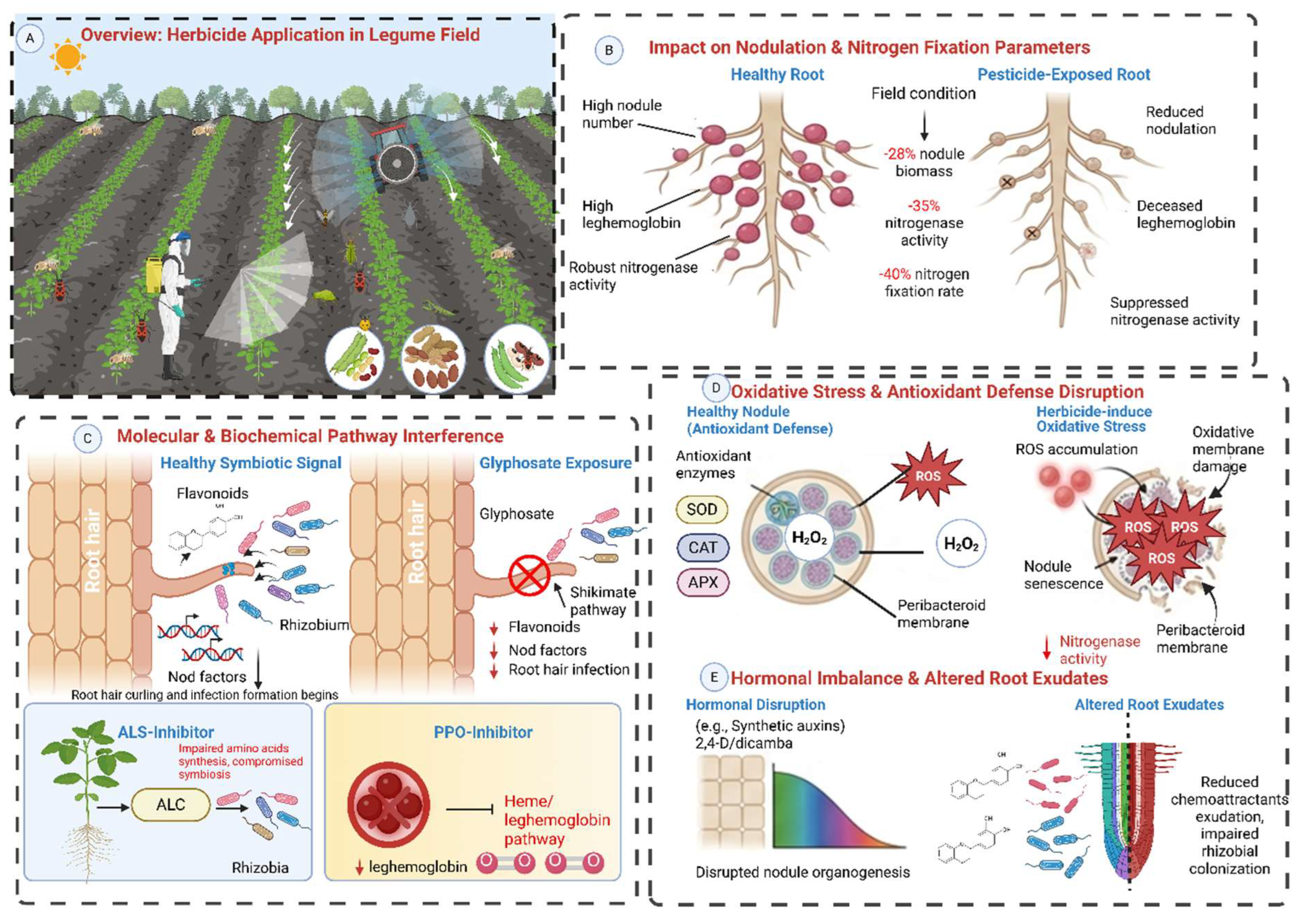
Figure 2.
Integrated mitigation strategies for preserving bnf in legume-rhizobium symbiosis under herbicide stress: (A) Herbicide-tolerant germplasm, (B) Soil amendments (C) Application timing and crop rotation.
Figure 2.
Integrated mitigation strategies for preserving bnf in legume-rhizobium symbiosis under herbicide stress: (A) Herbicide-tolerant germplasm, (B) Soil amendments (C) Application timing and crop rotation.
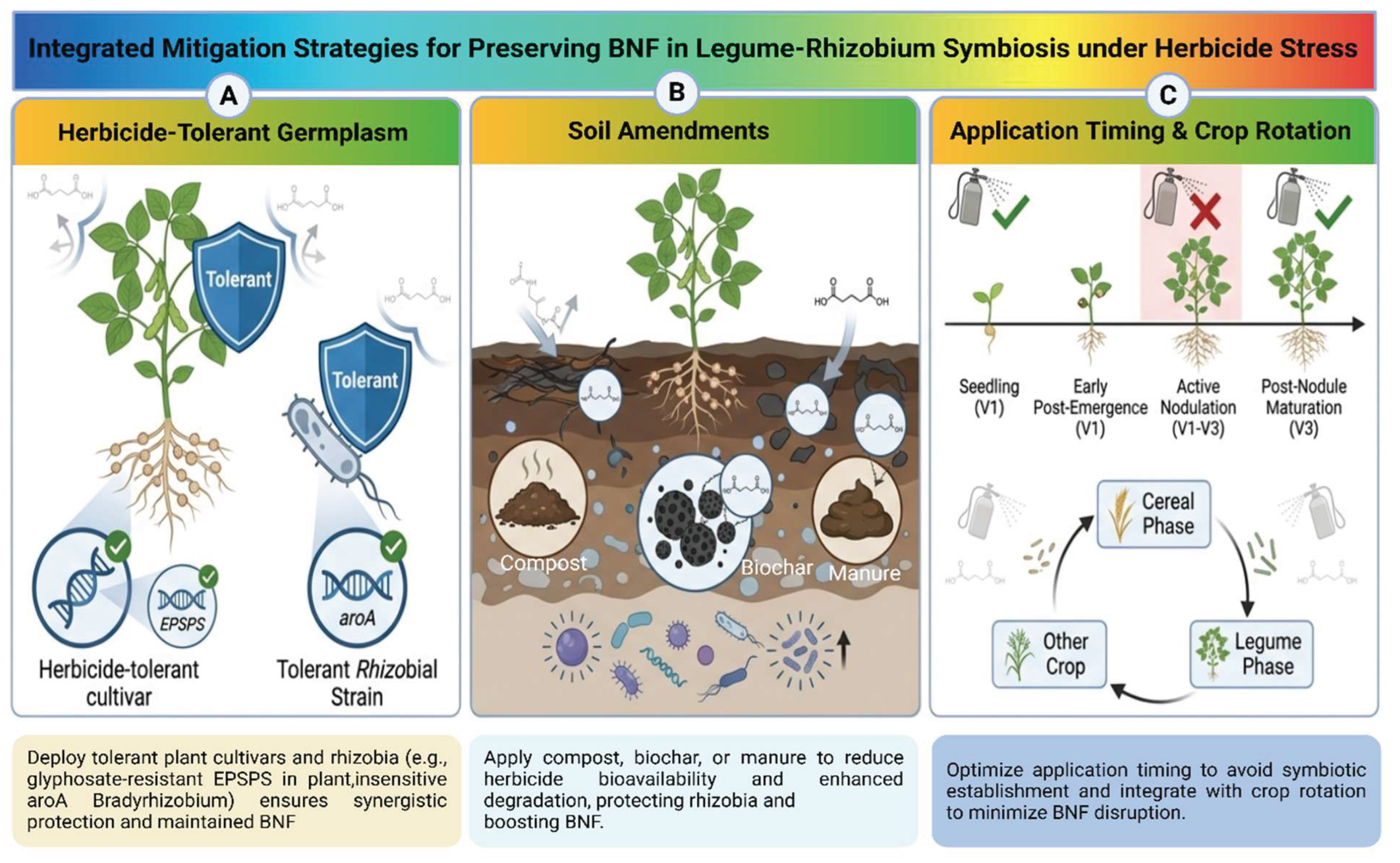

Table 1.
Summary of herbicide classes, modes of action, soil persistence, and reported effects on rhizobia and nodulation. DT50 = dissipation time for 50% of applied compound; Koc = organic carbon-normalized adsorption coefficient; ALS = acetolactate synthase; AHAS = acetohydroxyacid synthase; EPSPS = 5-enolpyruvylshikimate-3-phosphate synthase; ACCase = acetyl-CoA carboxylase.
Table 1.
Summary of herbicide classes, modes of action, soil persistence, and reported effects on rhizobia and nodulation. DT50 = dissipation time for 50% of applied compound; Koc = organic carbon-normalized adsorption coefficient; ALS = acetolactate synthase; AHAS = acetohydroxyacid synthase; EPSPS = 5-enolpyruvylshikimate-3-phosphate synthase; ACCase = acetyl-CoA carboxylase.
| Herbicide | Chemical Class | Mode of Action | Typical Soil DT50 (days) | Soil Adsorption (Koc) | Reported Effects on Rhizobia/Nodulation | References |
| Glyphosate | Phosphonoglycine | EPSPS inhibition (shikimate pathway) | 2–215 | 884–60,000 | Strain-dependent growth inhibition; reduced nodule occupancy; decreased nitrogenase activity | [71,72] |
| Atrazine | Triazine | Photosystem II inhibition | 13–261 | 100–512 | Reduced rhizobial growth; decreased nodulation in clover and pea; suppressed microbial biomass | [73,74] |
| Paraquat | Bipyridylium | Photosystem I electron diversion | >3650 (bound) | 15,473–100,000 | Limited bioavailability due to strong adsorption; transient effects pre-adsorption | [75,76] |
| Pendimethalin | Dinitroaniline | Microtubule assembly inhibition | 40–120 | 5,000–17,200 | Reduced nodule number and weight; inhibited infection thread development; decreased nitrogenase activity | [37,77] |
| Nicosulfuron | Sulfonylurea | ALS/AHAS inhibition | 10–45 | 30–100 | Inhibition of rhizobial growth at low concentrations; potential carryover effects on subsequent legumes | [40,78] |
| 2,4-D Amine | Phenoxyacetic acid | Synthetic auxin mimic | 7–30 | 20–136 | Dose-dependent rhizobial toxicity; disruption of nodule organogenesis via auxin signalling interference | [79,80] |
| Propanil | Anilide | Photosystem II inhibition | 1–7 (parent); >100 (3,4-DCA metabolite) | 149–399 | Parent compound low concern; metabolite 3,4-DCA exhibits antimicrobial activity | [81] |
| Propaquizafop | Aryloxyphenoxypropionate | ACCase inhibition | 15–40 | 500–1,500 | Limited data; possible transient suppression of N-fixing bacteria | [82,83] |
| Imazethapyr | Imidazolinone | ALS/AHAS inhibition | 60–180 | 52–137 | Altered rhizosphere community structure; reduced nodulation and N2 fixation in soybean and groundnut | [84,85] |
Disclaimer/Publisher’s Note: The statements, opinions and data contained in all publications are solely those of the individual author(s) and contributor(s) and not of MDPI and/or the editor(s). MDPI and/or the editor(s) disclaim responsibility for any injury to people or property resulting from any ideas, methods, instructions or products referred to in the content. |
© 2026 by the authors. Licensee MDPI, Basel, Switzerland. This article is an open access article distributed under the terms and conditions of the Creative Commons Attribution (CC BY) license (http://creativecommons.org/licenses/by/4.0/).
Copyright: This open access article is published under a Creative Commons CC BY 4.0 license, which permit the free download, distribution, and reuse, provided that the author and preprint are cited in any reuse.