

Submitted:
01 September 2026
Posted:
02 September 2026
You are already at the latest version
Abstract
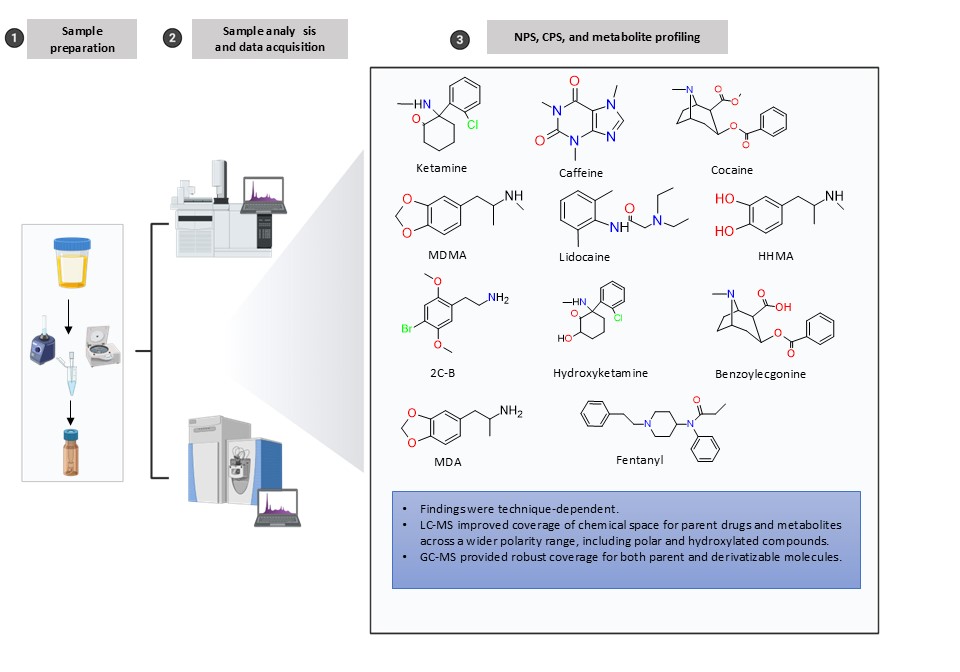
The use of new psychoactive substances (NPS), whether pure or in mixtures, has grown steadily, increasing the need for accurate confirmatory analysis in biological matrices given their chemical diversity, structural variability, and potential postmortem redistribution and degradation. Forensic interventions require comprehensive, broad-coverage screening strategies. Two complementary platforms, ultra-high-performance liquid chromatography-high-resolution mass spectrometry (UHPLC-ESI(+/-)-Orbitrap-HRMS) and gas chromatography-mass spectrometry (GC-MS), were used to screen classical psychoactive substances (CPS), NPS, and their metabolites in 25 postmortem urine samples with suspected consumption of NPS, using Platform-specific sample preparation and identification workflows. Forty-four drugs/metabolites were identified. Ketamine was the most prevalent drug (92% LC-MS, 84% GC-MS), along with its phase I metabolites norketamine, hydroxyketamine, and hydroxynorketamine. Cocaine (68% LC-MS, 12% GC-MS) and its main metabolite, benzoylecgonine (88% LC-MS, 52% GC-MS), were also frequent on both platforms, while amphetamine-type drugs, benzodiazepines, and opioids showed marked technique-dependent detection (e.g., 3,4-methylenedioxyamphetamine: 32% LC-MS, 4% GC-MS). UHPLC-ESI-Orbitrap-HRMS provided broader polarity coverage of parent drugs and metabolites; GC-MS reliably detected parent drugs and derivatizable xenobiotics. Combined use of both platforms provided complementary, high-confidence coverage for forensic toxicology urine screening; quantitative validation and larger cohorts are needed for diagnostic, impairment, and epidemiological extrapolation.
Keywords:
new psychoactive substances
; mass spectrometry
; urine screening
; forensic drug screening
; UHPLC-Orbitrap-HRMS
; GC/MS
; forensic toxicology
1. Introduction
The increase in the abuse of classical psychoactive substances (CPS) and novel psychoactive substances (NPS), especially anesthetics and synthetic opioids, has created a public health crisis. In several countries, the rates of deaths and intoxications related to this kind of drug use have risen, as well as phenomena related to criminality, adverse events, and mental health problems, which are remarkably present in school-age teenagers and young adults [1,2,3].
Despite the opioid crisis in North America, it is essential to consider that there is not a unique NPS consumption global trend, and that these phenomena could shift according to social determinants, the type of drug, consumer, region, supply, and demand. There are distinct effects for different substances, each associated with specific compounds that trigger imbalances and dysregulation in pathways across several systems (e.g., dopaminergic, serotonergic, GABAergic). Each altered pathway could produce a distinctive pharmacological profile, which is why there is an imperative need for the forensic toxicology system to determine the best methodologies for the reliable identification of any kind of drugs and their metabolites [4,5,6,7], for contributing to elucidate the mechanism of drug-impairment, intoxication, or death in the forensic toxicology system, and the generation of adverse event treatment at the clinical toxicology and emergency medicine practice [8,9,10,11,12,13].
Several methods for extracting NPS and their metabolites have been reported in the literature, including solid-phase extraction (SPE) using various sorbents. The traditional liquid extraction (LLE), miniaturized and eco-friendly techniques such as hollow fiber solvent bar microextraction, liquid-liquid microextraction, membrane-protected molecularly imprinted polymers, and QuEChERS or dispersive extraction [14,15,16,17,18,19]. Urine is the preferred matrix for forensic and clinical analysis due to its easy, non-invasive collection, a broader diagnostic window (compared to blood), relatively high concentrations of drugs and metabolites, and ease of extraction, often requiring hydrolysis and chemical derivatization before chromatographic analysis [20,21,22]. Regarding instrumental analysis, publications report the use of universal detectors for targeted screening, low mass-resolution GC and LC in single quadrupole in full-scan mode, as well as triple quadrupole systems (QqQ-MS) for targeted analysis and quantification, and high-resolution LC-MS/MS for both targeted and non-targeted analysis, focusing on the simultaneous confirmation and quantification of compounds using data-dependent and independent acquisition modes [23,24,25,26]. The selection of the system to use must account for the physicochemical differences between the lipophilicity of Phase I metabolites and the hydrophilicity of Phase II metabolites; steps or modifications should be applied to increase extraction efficiency. Recently, several approaches have aimed to elucidate drug-drug interactions and potential metabolites using in silico ADMETox and quantitative structure-activity relationship models, as well as in vitro analyses using cell and animal models [27,28,29].
This study aimed to determine a selection of NPS, CPS, and their metabolites in urine using GC/MS and UHPLC-ESI (+/-)-Orbitrap-HRMS as analytical methods for the screening in samples provided by the Forensic Toxicology Laboratory at the National Institute of Legal Medicine and Forensic Sciences, with suspected consumption of tusibi, a cocktail of drugs with high use growth and popularity mainly in Latin America, Caribbean and Spain. No detailed report on this subject has been previously published. While GC/MS helped identify parent compounds, LC/MS provided a more comprehensive profile of urinary excretion for both parent drugs and metabolites. The complementarity of the two techniques for rapid and reliable screening of CPS and NPS in urine was demonstrated. This qualitative approach helps expand the forensic metabolic chemical space and links forensic analytics with clinical and epidemiological practice by describing toxicological findings in relation to the recorded manner of death. These findings may inform future studies on drug-drug interaction-related impairment and support harm-reduction strategies.
2. Results
Analysis of Forensic Samples by GC/MS and UHPLC-ESI (+/-)-Orbitrap-HRMS
A simple, sensitive, and selective screening method was successfully applied to screen CPS, NPS, and metabolites in forensic urine. Compound identification was assigned two confidence levels: level 1 (confirmed structure), where the proposed identification was confirmed by comparison with reference standards and spectral libraries. Level 2 corresponds to a probable or tentative structure proposed using evidence from repositories and spectral libraries. [34] Selectivity assessment showed the absence of coeluting interferents from endogenous or exogenous compounds at the retention time and with the same mass spectra of drugs of interest. Carryover was negligible, as solvent and sample blanks and negative controls showed no signals for CPS, NPS, or metabolites. Limits of detection ranged from 21 to 438 ng/mL and 8.7 to 30.8 ng/mL for GC/MS and LC/MS, respectively (see Table 1). Samples underwent comprehensive preparation for GC and LC analysis. Although the total analysis time was not short (chromatographic runs were 38 and 20 min for GC/MS and LC/MS, respectively), using two complementary instruments enabled high-confidence identification.
Table 2 details the xenobiotics of forensic interest identified in 25 screened samples and relates the findings to the cause of death. Identification data were anonymized to meet ethical research requirements.
Dissociative anesthetic ketamine (bay food, bump, cat killer, k, Special k…), known on the streets of Colombia as “tusi”, was found in 92% and 84% of the samples by LC/MS and GC/MS, respectively. Norketamine, the main active metabolite, was detected in 80% and 28% of the samples by LC/MS and GC/MS, respectively. This compound is the product of N-dealkylation catalyzed by Cytochrome P450 in the liver, acts as a non-competitive NMDA receptor antagonist, and is 5 times less potent than the parent drug. The hydroxylated forms, hydroxynorketamine and hydroxyketamine, were confirmed only by LC/MS in 64% and 56% of samples, respectively. Both are products of the hydroxylation of the cyclohexanone ring of ketamine and norketamine, respectively. This analysis found no conjugation to glucuronic acid (phase II metabolism) for ketamine (Figure S1) [35]. Cocaine, one of the most widely abused substances, a CNS stimulant and a CPS that can exert multisystemic cytotoxicity, was identified in 88% and 12% of the samples for LC/MS and GC/MS, respectively. It is extensively biotransformed via both enzymatic and non-enzymatic pathways to the pharmacologically inactive benzoylecgonine (BE), detected in 88% and 52% of the samples by LC/MS and GC/MS, respectively, a product of cocaine hydrolysis catalyzed by carboxylesterases. Ecgonine methyl ester (EME), an inactive metabolite formed by enzymatic hydrolysis of cocaine, was detected in 64% and 36% of the samples by LC/MS and GC/MS, respectively. Ecgonine, also an inactive metabolite produced by hydrolysis of BE and EME, was present in 64% of the samples analyzed by LC/MS. When cocaine and alcohol are used together, some cocaine undergoes transesterification, forming in the body at least two new substances. Cocaethylene (present in 32% of the samples for LC/MS) is pharmacologically similar to cocaine, with a slight difference in terms of longer elimination half-life, slower renal clearance, and larger volume of distribution. Ecgonine ethyl ester (EEE), an inactive metabolite formed during the hydrolysis of cocaethylene, which is catalyzed by carboxylesterase, was detected in 24% of the samples analyzed by LC/MS (see Figure S2) [36,37,38,39,40].
The hallucinogen Δ9-tetrahydrocannabinol, the main active constituent of Cannabis sativa, undergoes various phase I transformations until the formation of the main urinary inactive metabolite 11-nor-9-carboxy-Δ9-tetrahydrocannabinol (THC-COOH), along with its phase II metabolite 11-nor-9-carboxy-Δ9-tetrahydrocannabinol-glucuronide, which were detected only by LC/MS in 60% and 8% of the samples, respectively [41,42].
Central nervous system stimulants, entactogens, and hallucinogens, 3,4-methylenedioxymethamphetamine (MDMA) or ecstasy, were present in 12% of the samples, both in GC/MS and LC/MS. 3,4-methylenedioxyamphetamine (MDA) was found in 32% and 4% of the samples for LC/MS and GC/MS analysis. Both NPS were also confirmed indirectly through their hydroxylated forms, HHMA (32%), HHA (16%), HMA (12%), and HMMA (8%). Methamphetamine (MA) was confirmed in 32% of the LC/MS samples, and its main hepatic metabolites, 4-HA and 4-HMA, were confirmed in 8% of the samples analyzed by LC/MS. Figure S3 and Figure S4 show the putative urinary metabolic products of amphetamine-type drugs. Amphetamine was found in 12% of the samples by LC/MS [43,44].
Central nervous system depressants consisted mainly of the benzodiazepine oxazepam, an active metabolite of diazepam, nordazepam, and temazepam, which was present in 52% of the samples; midazolam, and its metabolite α-hydroxymidazolam, found in 12% and 4% of the samples for LC/MS and GC/MS, respectively. The synthetic opioid fentanyl and analog norfentanyl were present in 24% and 4% of the samples for LC/MS and GC/MS, respectively; the metabolites hydroxyfentanyl and hydroxynorfentanyl were found in one sample analyzed by LC/MS. Morphine-3-glucuronide, a phase II metabolite of morphine, was detected in 1 sample. [45,46,47,48,49].
Two active substances known as adulterants, or cuttings, were found. First, the local anesthetic lidocaine was detected in 64% and 8% of the samples by LC/MS and GC/MS, respectively. Its main metabolite, hydroxylidocaine, was detected in 28% of the samples analyzed by LC/MS. Caffeine, a mild stimulant, and its metabolites were present in 84% and 76% of the samples by LC/MS and GC/MS, respectively; theobromine and 1,3,7-trimethyluric acid were confirmed in the LC/MS analysis for 96% and 56% of the samples. Further discussion is needed on caffeine’s role in drug-drug interactions and its origin, since forensic laboratories report its use as an adulterant; however, its origin could also be linked to the widespread practice of coffee consumption in the Colombian population [50].
The implemented GC/MS setup, using deconvolution software with an in-house AMDIS library and commercial NIST 2023 library, proved useful for identifying parent compounds and some phase I metabolites. LC/MS analysis exhibited a more complete urinary excretion profile of parent drugs and metabolites. No hydroxylated or dehydrated adducts, conjugated to sulfate, or glucuronic metabolites were found by GC/MS analysis. In this methodology, cleaning steps are preceded by cleavage of conjugate ester glucuronides of carboxy derivatives by acid, alkaline, or the preferred (time-consuming, yet analyte-gentle) enzymatic hydrolysis. Derivatization is necessary for polar metabolites containing amino, hydroxy, and carboxylic groups. Common procedures include acylation, trifluoroacetylation, pentafluoropropionylation, heptafluorobutyration, trimethylsilylation, and alkylation. Each methodology has its own pros and cons. In the present work, enzymatic hydrolysis and trimethylsilylation were selected as a compromise between simplicity, sensitivity, chemical coverage, reaction time, experimental conditions, low sample degradation, chromatographic properties, and high library coverage for TMS adducts [51].
NPS, on average, have a half-life of approximately 2 h; the bioavailable dose is excreted in urine as the unchanged parent compound or as a metabolite. Differences in the time between ingestion and sampling, as well as in ADME profiles, could affect detection capability [52,53,54,55].
Both methodologies, used complementarily, were suitable for determining several CPS, NPS, and their metabolites. GC/MS showed limitations in the analysis of some phase I and II oxidized, hydroxylated, and conjugated forms, despite the positive impact on sensitivity associated with TMS-derivatization and glucuronide-conjugated cleavage during enzymatic hydrolysis. Sample preparation for LC/MS was more straightforward and faster. Data analysis in both methodologies requires a certain level of expertise, given the possibility of coelutions, mass spectra with several endogenous matrix compounds, derivatization, or ESI adducts. Identification confidence levels in both methodologies relied on confirmation with a reference standard, retention time, and identity match. For LC/MS runs, identification confidence was higher than for GC/MS due to mass accuracy and error, as recommended in the literature [56]. It is worth noting that the AIF (all-ion-fragmentation) spectra did not suit the MS/MS tree spectra structure for the library, usually calling for a specific isolation width for filtering candidates and better matching (mzCloud); however, they exhibited fragments used for identification that were in good agreement with the low error calculated against the mass lists used and compared with the in silico libraries integrated search. The identification phase was easier with GC/MS due to the high coverage of commercial, in-house, and free-downloadable low-resolution GC spectral libraries containing EI and silylated compounds. The combination of bioinformatic tools and commercial and homemade libraries provided us with a faster way to analyze the spectral data [57].
Phase II metabolites, 11-Hydroxy-Δ9-THC-glucuronide, nordazepam-glucuronide, and morphine-3-glucuronide, were detected in the LC/MS analysis associated with the respective parent drugs. No phase II metabolites (e.g., glucuronidation conjugates) were detected for any CPS, NPS, or metabolite by GC/MS. Conjugate metabolites often contain polar functional groups, such as -OH and -COOH, as part of sugars and amino acids; they form strong intermolecular interactions that could affect chromatography and ionize poorly under standard ESI conditions, resulting in weak or missing signals. Glucuronic conjugates were detected in GC/MS as the parent drug after enzymatic hydrolysis, extraction, and derivatization. This allowed the proposal of phase I and phase II biotransformation mechanisms for the xenobiotics under study, in good agreement with studies reporting increased molecular polarity following sequential oxidation and hydroxylation reactions [58,59]. Forensic laboratories must keep pace with the ever-changing dynamics of consumption and update their analytical methodologies to meet these requirements. Once the substance, or group of substances, has been identified, quantification must be carried out to establish levels of impairment and toxic or lethal doses, requiring the acquisition of certified reference materials of parent compounds and metabolites, and the extensive validation of a quantitative method in forensic and clinical interest matrices [60,61].
3. Discussion
The implemented GC/MS setup, using deconvolution software with an in-house AMDIS library and commercial NIST 2023 library, proved useful for identifying parent compounds and some phase I metabolites. LC/MS analysis exhibited a more complete urinary excretion profile of parent drugs and metabolites. No hydroxylated or dehydrated adducts, conjugated to sulfate, or glucuronic metabolites were found by GC/MS analysis. In this methodology, cleaning steps are preceded by cleavage of conjugate ester glucuronides of carboxy derivatives by acid, alkaline, or the preferred (time-consuming, yet analyte-gentle) enzymatic hydrolysis. Derivatization is necessary for polar metabolites containing amino, hydroxy, and carboxylic groups. In the present work, enzymatic hydrolysis and trimethylsilylation were selected as a compromise between simplicity, sensitivity, chemical coverage, reaction time, experimental conditions, low sample degradation, chromatographic properties, and high library coverage for TMS adducts [51].
NPS, on average, have a half-life of approximately 2 h; the bioavailable dose is excreted in urine as the unchanged parent compound or as a metabolite. Differences in the time between ingestion and sampling, as well as in ADME profiles, could affect detection capability [52,53,54,55].
Both methodologies, used complementarily, were suitable for determining several CPS, NPS, and their metabolites. GC/MS showed limitations in the analysis of some phase I and II oxidized, hydroxylated, and conjugated forms, despite the positive impact on sensitivity associated with TMS-derivatization and glucuronide-conjugated cleavage during enzymatic hydrolysis. Sample preparation for LC/MS was more straightforward and faster. Data analysis in both methodologies requires a certain level of expertise, given the possibility of coelutions, mass spectra with several endogenous matrix compounds, derivatization, or ESI adducts. Identification confidence levels in both methodologies relied on confirmation with a reference standard, retention time, and identity match. For LC/MS runs, identification confidence was higher than for GC/MS due to mass accuracy and error, as recommended in the literature [56]. It is worth noting that the AIF (all-ion-fragmentation) spectra did not suit the MS/MS tree spectra structure for the library, usually calling for a specific isolation width for filtering candidates and better matching (mzCloud); however, they exhibited fragments used for identification that were in good agreement with the low error calculated against the mass lists used and compared with the in silico libraries integrated search. Generally speaking, the identification phase was easier with GC/MS due to the high coverage of commercial, in-house, and free-downloadable low-resolution GC spectral libraries containing EI and silylated compounds. The combination of bioinformatic tools and commercial and homemade libraries provided us with a faster way to analyze the spectral data [57].
Phase II metabolites, 11-Hydroxy-delta-9-THC-glucuronide, nordazepam-glucuronide, and morphine-3-glucuronide, were detected in the LC/MS analysis associated with the respective parent drugs. No phase II metabolites (e.g., glucuronidation conjugates) were detected for any CPS, NPS, or metabolite by GC/MS. Conjugate metabolites often contain polar functional groups, such as -OH and -COOH, as part of sugars and amino acids; they form strong intermolecular interactions that could affect chromatography, and ionize poorly under standard ESI conditions, resulting in weak or missing signals. Glucuronic conjugates in GC/MS were detected as the parent drug analysis after enzymatic hydrolysis, extraction, and derivatization. It was possible to propose phase I and phase II biotransformation mechanisms for the xenobiotics under study, in good agreement with studies reporting increased molecular polarity following sequential oxidation and hydroxylation reactions [58,59]. Forensic laboratories must keep pace with the ever-changing dynamics of consumption and update their analytical methodologies to meet these requirements. Once the substance, or group of substances, has been identified, quantification must be carried out to establish levels of impairment and toxic or lethal doses, requiring the acquisition of certified reference materials of parent compounds and metabolites, and the extensive validation of a quantitative method in forensic and clinical interest matrices [60,61].
Further research should address the need for quantitative analysis, using a larger sample size for prevalence and causality interpretation, and include a broad panel of biological matrices (blood, bile, vitreous humor) to assess matrix effects in recoveries.
4. Materials and Methods
Reagents and Chemicals
Acetonitrile, methanol, and ethanol of analytical grade were purchased from Mallinckrodt (Dublin, Ireland); dichloromethane was purchased from Merck (Darmstadt, Germany), and ultrapure helium 99.995% (Messer—Bucaramanga, Colombia) was used as the mobile phase in chromatographic analysis.
All standard solutions for quality control were prepared at a concentration of 10 mg mL-1 (stock solution) and then diluted to a working solution of 1 mg mL-1. Table S1 lists potential target drugs or metabolites to monitor during analysis, including their molecular formula, retention time (tR), and experimental exact and average masses.
Sample Preparation by GC/MS and UHPLC-ESI (+/-)-Orbitrap-HRMS
Figure 1 reports the workflow for urine analysis in both methodologies. The urine samples of forensic origin were provided by the National Institute of Legal Medicine and Forensic Sciences. Each sample was previously analyzed by immunoassay using EMIT®, looking for drugs of abuse and their metabolites (cocaine, opioids, cannabinoids, benzodiazepines, amphetamines, methadone, ketamine, and barbiturates). A total of 25 urine samples tested positive for ketamine or amphetamine-type drugs. Aliquots of 6 mL were taken and stored at -20 °C until analysis. Two extraction methodologies were applied. Extraction methods were based on the forensic laboratory’s protocols, slightly modified to enable the identification of new molecules and their metabolites [30,31,32]. For confirmatory GC/MS analysis, 100 μL of flurazepam (ISTD) was added to 2 mL of the forensic sample, followed by 300 μL of sodium acetate buffer pH 4.5, then 50 μL of β-glucuronidase (Helix pomatia), and incubation at 56 °C for 2 h. The pH was adjusted to 10 by adding 500 μL of sodium tetraborate buffer, followed by 6 mL of dichloromethane. The mixture was vortexed for 1 min, then centrifuged at 2490 g for 10 min. The organic phase was dried under a gentle nitrogen flow, and 100 μL of BSTFA+TMCS mixture (99:1) and ethyl acetate were added to the dry extract, followed by incubation at 80 °C for 20 min. 1 μL was injected into the GC/MS in full scan mode. For UHPLC-ESI (+/-)-Orbitrap-HRMS analysis, 20 μL of oxazepam-d5 (ISTD) was added to 200 μL of urine, followed by 600 μL of ice-cold acetonitrile (ACN), vortex agitation for 1 min, and centrifugation for 10 min at 2490 g. The supernatant was dried under a gentle stream of nitrogen, then reconstituted with mobile phase, and 2 μL was injected into the liquid chromatograph.
To check the reliability of the two methodologies, sample runs included: solvent blank, used between sample injection to clean the system and avoid carryover; matrix blank, to determine the presence of endogenous compounds that may co-elute with the analytes of interest, and isobars that could produce false positive; negative control in a real matrix, to discard solvent, reactants and system contamination, assess drifts in retention time (due to internal standard), and a positive control in both aqueous and real matrix samples enriched with reference materials at final concentrations of 100 ng/mL for LC/MS and 1000 ng/mL for GC/MS, to estimate shifts in retention times, the efficiency of the extraction, the detection capacity of the libraries and establish a contrast medium. Pooled Quality Control Samples (Pool QCs) were prepared by mixing 20 µL aliquots of each sample to assess the repeatability of retention times and analytical response. Controls were treated as samples and analyzed within the same analytical sequence as the study samples, using univariate statistics.
Gas Chromatography–Mass Spectrometry Analysis
GC/MS analysis was conducted on a gas chromatograph (GC 7890A System Plus, Agilent Technologies, Palo Alto, CA, USA) coupled with a selective mass detector (Agilent Technologies, MSD 5975C) using electron ionization at 70 eV. NPS and their metabolites were separated on a capillary column with 5%-phenyl-95% poly (dimethylsiloxane) (DB-5MS 30 m × 250 μm I.D., 0.25 μm film thickness, J&W Scientific, Folsom, CA, USA). The ionization source and interface temperatures were 230 °C and 300 °C, respectively. Injection was performed via pulsed splitless mode at 270 °C in the injection port. Full-scan data was acquired over a mass range of 40–450 m/z at a rate of 3.58 scans per second. The oven was initially set to 80 °C for 1 min, then heated at 15 °C min-1 to 200 °C for 5.3 min, followed by heating at 10 °C min-1 to 300 °C for 12 min. The total run time was 38.3 min. Standard solutions of the analytes were prepared in an authentic matrix at 0.5 μg/mL. Data analysis involved an automated workflow using Agilent MSD ChemStation Software (Ver. F.01.03.2357, Agilent Technologies, Santa Clara, CA, USA) for mass spectral deconvolution, peak detection, base peak integration, and compound identification via comparison with NIST 2023 library and an in-house library containing tR and m/z of confirmed reference standards.
Ultra-High-Performance Liquid Chromatography-High-Resolution Mass Spectrometry Analysis
The urine extracts were analyzed in a VanquishTM ultra-high-performance liquid chromatograph (UHPLC, Thermo Scientific, Waltham, MA, USA), equipped with a degassing unit, a gradient binary pump, and an autosampler maintained at 10 °C. A Zorbax Eclipse XDB C18 chromatographic column (Sigma Aldrich, St. Louis, MO, USA) of 50 mm length × 2.1 mm I.D. and 1.8 μm particle diameter was used. The flow rate of the mobile phases containing Type I water (A) and methanol (B), both containing ammonium formate (5 mM) and formic acid (0.1%), was 300 μL min-1. The elution gradient program was as follows: 100% A for 8 min, then 100% B for 5 min, followed by 100% A for 7 min. The total run was 20 min, and the injection volume was 2 μL. The UHPLC was connected to a Q-Exactive Plus Orbitrap mass spectrometer (Thermo Scientific, Bremen, Germany) with a heated electrospray ionization source (HESI-II) and polarity switching for periods < 500 ms, with HCD fragmentation. The capillary voltage was 3.5 kV. The nebulizer and capillary temperatures were 350 °C and 320 °C, respectively. The mass resolution was set to 70,000 (full width at half maximum, FWHM) at m/z 200, with an automatic gain control target of 3 × 10⁶, a maximum C-trap injection time of 200 ms, and a mass range of m/z 80–1000. The ions injected into the HCD via C-trap were fragmented with normalized collision energies from 10 eV to 40 eV. Mass spectra were collected in all-ion fragmentation mode for each collision energy, employing a mass resolution of 35,000. The instrument was fully calibrated using the Pierce LTQ Velos ESI positive ion calibration solution and the Pierce ESI negative ion calibration solution (Thermo Scientific, Rockford, IL, USA). Data were analyzed using Thermo Xcalibur 3.1 software (Ver. 4.6.67.17 Thermo Scientific, San Jose, CA, USA) and Compound Discoverer (Ver. 3.4 Thermo Scientific). The compounds were identified by comparing the tR and accurate mass (Δ ppm < 1) with standard substances prepared in an authentic matrix at 0.1 μg mL-1, analyzed in the same batch as the samples, and those reported in the local PCDL and NIST 2020 library. Additional putative metabolite identifications were performed by comparing the observed exact masses of each molecule with those reported in NIST 2023 and in silico platforms, including mzCloud, CFM-ID, ChemSpider, DrugBank, and MassBank of North America [30,31,32].
Analytical Performance
Method performance for both methodologies was evaluated according to ANSI/ASB 036-2019 Standard Practices for Method Validation in Forensic Toxicology. Carryover was addressed continuously as part of the run’s quality assurance. Solvent blanks were injected after every sample, especially positive controls. Selectivity was assessed against solvent, matrix blanks, and negative controls; retention time and mass-accuracy drift were monitored via positive controls in authentic matrix and pooled QC samples across the analytical sequence (acceptance criterion: for GC/MS, tR drift ± 0.1 min, base peak ion present; for LC/MS, tR drift ± 0.1 min, and Δppm < 1). Linearity and limits of detection were estimated using a linear calibration model based on the standard deviation of the intercept and the slope. Table 2 shows the analytical performance results for all the CPS, NPS, and metabolites. Quality assurance for the analytical run assessed repeatability in retention times and base-peak areas after response normalization (Figure S5 and Figure S6).
5. Conclusions
This study presents a comprehensive ultra-high-performance liquid chromatography-high-resolution mass spectrometry (UHPLC-ESI(+/-)-Orbitrap-HRMS) and gas chromatography-mass spectrometry (GC/MS) screening method for the analysis of CPS, NPS, and metabolites. The methods were successfully applied to 25 authentic postmortem urine samples, revealing that they could be used alone or in combination for the screening of such substances in postmortem and ante-mortem urine samples in drug-related chronic or acute intoxications, sexual assaults, and fatalities, in emergency medicine departments, and clinical and forensic toxicology services.
Urinary drug profiles reveal a distribution of CPS, NPS, and metabolites in a wide lipophilic distribution range, and indicate concurrent psychoactive drug use, which could explain drug-drug interactions associated with impairment (and the registered cause of death), alteration of enzymatic activity responsible for absorption and metabolism, sympathetic system activation, or depression, cardiac and vascular effects.
In summary, this study not only establishes a reliable screening method but also elucidates the metabolic characteristics of CPS and NPS that could impact several fields related to forensic work.
Supplementary Materials
The following supporting information can be downloaded at the website of this paper posted on Preprints.org, Table S1. List of potential drugs or metabolites to monitor. Retention times (tR) and monitored ions (m/z) used for the screening gas chromatography-mass spectrometry (GC/MS) and ultra-high-performance liquid chromatography-high-resolution mass spectrometry analysis of forensic samples; Figure S1. Putative ketamine phase I metabolic products; Figure S2. Putative Cocaine metabolic products; Figure S3. Putative MDMA and MDA metabolic products; Figure S4. Putative Methamphetamine metabolic products; Figure S5. Boxplot of the normalized area of ketamine obtained by LC/MS analysis; Figure S6. Boxplot of the normalized area of ketamine obtained by GC/MS analysis.
Author Contributions
Conceptualization, Eleazar Vargas-Mena, Milton Rosero-Moreano, Gonzalo Taborda-Ocampo and Elena E. Stashenko; methodology, Eleazar Vargas-Mena, Milton Rosero-Moreano, Gonzalo Taborda-Ocampo and Elena E. Stashenko; validation, Eleazar Vargas-Mena; software, Eleazar Vargas-Mena, Julio César España-Amortegui, and Andrés F. González Suárez; formal analysis, Eleazar Vargas-Mena, Julio César España-Amortegui, and Andrés F. González Suárez; data curation, Eleazar Vargas-Mena, and Julio César España-Amortegui; writing—original draft preparation, Eleazar Vargas-Mena, and Julio César España-Amortegui; writing—review and editing, Eleazar Vargas-Mena, Milton Rosero-Moreano, Gonzalo Taborda-Ocampo, Julio César España-Amortegui, Andrés F. González Suárez and Elena E. Stashenko. All authors have read and agreed to the published version of the manuscript.
Funding
This research was funded by the Instituto Nacional de Medicina Legal y Ciencias Forenses in Pereira, Colombia, and the Ministry of Science and Technology through the project “formación del capital humano de alto nivel corte 2”. Universidad de Caldas, code BPIN 2021000100028.
Institutional Review Board Statement
This investigation was approved by the Institutional Scientific Investigation Research Department of the Colombian National Institute of Legal Medicine and Forensic Sciences (INMLCF). Bioethical approval was granted by the Comité de Ética en Investigación Científica de la Universidad Industrial de Santander (CEINCIUIS), with approval code 4110 of 4 July 2021. This Ethics Committee operates within the framework of cooperative inter-institutional agreements with the INMLCF. The biological samples derived from the study were identified and collected by professionals from the INMLCF in their routine work as Forensic pathologists and were sent to the Forensic Toxicology Laboratory for analysis. The collection of the samples was carried out in strict compliance with Colombian national laws, particularly governed by the provisions of Resolution 008430 of 1993 of the Colombian Ministry of Health, “which establishes the scientific, technical, and administrative standards for health research”, and Resolution 382 of 2015 of the INMLCF Directorate, “which regulates the registration of entities for the obtaining of cadavers, anatomical components and tissues for transplant, teaching and research purposes and dictates other provisions”.
Informed Consent Statement
Patient consent was waived due to the provisions established in Resolution 382 of 2015 of the INMLCF Directorate, “which regulates the registration of entities for the obtaining of cadavers, anatomical components and tissues for transplant, teaching and research purposes and dictates other provisions”. The identification of the human bodies remained confidential, even to the Authors, throughout the study. The information available about these individuals was limited to the cause of death.
Data Availability Statement
All data will be made available on request.
Acknowledgments
In this section, you can acknowledge any support given which is not covered by the author contribution or funding sections. This may include administrative and technical support, or donations in kind (e.g., materials used for experiments). Where GenAI has been used for purposes such as generating text, data, or graphics, or for study design, data collection, analysis, or interpretation of data, please add “During the preparation of this manuscript/study, the author(s) used [tool name, version information] for the purposes of [description of use]. The authors have reviewed and edited the output and take full responsibility for the content of this publication.”.
Conflicts of Interest
The authors declare no conflict of interest.
Abbreviations
The following abbreviations are used in this manuscript:
2C-B: 4-Bromo-2,5-dimethoxyphenetylamine
4-HA: 4-Hydroxyamphetamine
4-HMA: 4-Hydroxymethamphetamine
BSTFA: N,O-Bis(trimethylsilyl)trifluoroacetamide
ESI: Electrospray ionization
eV—electron volt
GC/MS: Gas chromatography coupled to mass spectrometry
GC-MS/MS: Gas chromatography coupled to tandem mass spectrometry
HHA: 3,4-Dihydroxiamphetamine
HHMA: 3,4-Dihydroximethamphetamine
HMA: 4-Hydroxy-3-methoxyamphetamine
HMMA: 4-Hydroxy-3-methoxymethamphetamine
HNK: Hydroxynorketamine
HK: Hydroxyketamine
HRMS: High-resolution mass spectrometry
ISTD: internal standard
LC-MS/MS: Liquid chromatography coupled to tandem mass spectrometry
MDA: 3,4-Methylenedioxyamphetamine
MDMA: 3,4-Methylenedioxymethamphetamine
NK: Norketamine
ppm: parts per million
QqQ: Triple quadrupole mass spectrometry
SNC: Central nervous system
THC-COOH: 11-nor-9-carboxy-Δ9-tetrahydrocannabinol
TMCS: Trimethylchlorosilane
TOF: Time-of-flight
UHPLC- ESI(+/-)-Orbitrap-HRMS, abbreviated as LC-MS, stands for:
UHPLC: Ultra-high performance liquid chromatography
References
- J. J. Palamar, A. Le, C. M. Cleland, and K. M. Keyes, “Trends in drug use among nightclub and festival attendees in New York City, 2017-2022,” Int. J. Drug Policy, vol. 115, no. 104001, p. 104001, 2023. [CrossRef]
- M. K. Laing et al., “An outbreak of novel psychoactive substance benzodiazepines in the unregulated drug supply: Preliminary results from a community drug checking program using point-of-care and confirmatory methods,” Int. J. Drug Policy, vol. 93, no. March 2020, p. 103169, 2021. [CrossRef]
- K. R. Gonçalves de Araújo, A. L. Fabris, L. F. N. Junior, A. L. Soares, J. L. Costa, and M. Yonamine, “Synthetic illicit opioids in Brazil: Nitazenes arrival,” Forensic Sci. Int. Reports, vol. 10, no. March, p. 100375, 2024. [CrossRef]
- P. J. Heinsvig, C. Noble, P. W. Dalsgaard, and M. Mardal, “Forensic drug screening by liquid chromatography hyphenated with high-resolution mass spectrometry (LC-HRMS),” TrAC—Trends Anal. Chem., vol. 162, p. 117023, 2023. [CrossRef]
- V. Luiz Caleffo Piva Bigão, B. Ruiz Brandão da Costa, J. Joaquim Mangabeira da Silva, B. Spinosa De Martinis, and D. R. Tapia-Blácido, “Use of statistical design of experiments (DoE) in Forensic Analysis: A tailored review,” Forensic Chem., vol. 37, no. April 2023, 2024. [CrossRef]
- Taoussi et al., “Human metabolism of four synthetic benzimidazole opioids: isotonitazene, metonitazene, etodesnitazene, and metodesnitazene,” Arch. Toxicol., vol. 98, no. 7, pp. 2101–2116, 2024. [CrossRef]
- J. Becam, A. L. Pelissier-Alicot, N. Doudka, M. Richez, C. Solas, and N. Fabresse, “Validation of a non-targeted method devoted to identification and quantitation of toxicologically relevant compounds in plasma with HRMS,” J. Chromatogr. B Anal. Technol. Biomed. Life Sci., vol. 1224, no. February, p. 123739, 2023. [CrossRef]
- G. Los and A. Malczewski, “Synthetic opioids in Poland—A cause for concern or a media distraction?,” Int. J. Drug Policy, vol. 133, no. September, p. 104595, 2024. [CrossRef]
- S. Rojek, M. Maciów-Głąb, A. Romańczuk, K. Kula, K. Synowiec, and M. Kłys, “New psychoactive substances—96 cases of deaths related to their use based on the material originating from forensic toxicological practice,” Forensic Sci. Int., vol. 364, no. August, 2024. [CrossRef]
- R. A. Mastrovito, D. M. Papsun, and B. K. Logan, “The development and validation of a novel designer benzodiazepines panel by LC-MS-MS,” J. Anal. Toxicol., vol. 45, no. 5, pp. 423–428, 2021. [CrossRef]
- L. Banaszkiewicz et al., “Rapid and simple multi-analyte LC–MS/MS method for the determination of benzodiazepines and Z-hypnotic drugs in blood samples: Development, validation and application based on three years of toxicological analyses,” J. Pharm. Biomed. Anal., vol. 191, 2020. [CrossRef]
- Meister et al., “High-Precision Automated Workflow for Urinary Untargeted Metabolomic Epidemiology,” Anal. Chem., vol. 93, no. 12, pp. 5248–5258, 2021. [CrossRef]
- V. Morales-Sánchez, W. Largo-Taborda, E. Vargas-Mena, C. Moreno, and M. Rosero-Moreano, “Analysis of Benzodiazepines in Urine Samples by Solvent Bar Microextraction using HPLC-UV,” Brazilian J. Anal. Chem., no. December, pp. 1–15, 2025. [CrossRef]
- M. Maghsoudi, S. Nojavan, and E. Hatami, “Development of electrically assisted solvent bar microextraction followed by high performance liquid chromatography for the extraction and quantification of basic drugs in biological samples,” J. Chromatogr. A, vol. 1654, p. 462447, 2021. [CrossRef]
- S. Armenta, F. A. Esteve-Turrillas, S. Garrigues, and M. de la Guardia, “Smart materials for sample preparation in bioanalysis: A green overview,” Sustain. Chem. Pharm., vol. 21, no. March, p. 100411, 2021. [CrossRef]
- S. Sevgen, G. Kara, A. S. Kir, A. Şahin, and E. Boyaci, “A critical review of bioanalytical and clinical applications of solid phase microextraction,” J. Pharm. Biomed. Anal., vol. 252, no. August 2024, 2025. [CrossRef]
- M. Kusano et al., “Development of ‘Quick-DB forensic’: A total workflow from QuEChERS-dSPE method to GC–MS/MS quantification of forensically relevant drugs and pesticides in whole blood,” Forensic Sci. Int., vol. 300, no. July, pp. 125–135, 2019. [CrossRef]
- B. Jain et al., “Comparison of various sample preparation methods for benzodiazepines in terms of the principles of white analytical chemistry,” TrAC—Trends Anal. Chem., vol. 171, no. November 2023, 2024. [CrossRef]
- L. Fabris et al., “Solvent-free parallel artificial liquid membrane extraction for drugs of abuse in plasma samples using LC-MS/MS,” Anal. Chim. Acta, vol. 1301, no. December 2023, 2024. [CrossRef]
- P. K. Rao, A. Dey, P. Pratik, A. Singh, and J. Kubavat, “Current research trends in green analytical tools for the detection of selected illicit drugs in different matrices,” Green Anal. Chem., vol. 9, no. December 2023, p. 100109, 2024. [CrossRef]
- Wachełko, P. Szpot, K. Tusiewicz, K. Nowak, A. Chłopaś-Konowałek, and M. Zawadzki, “An ultra-sensitive UHPLC-QqQ-MS/MS method for determination of 54 benzodiazepines (pharmaceutical drugs, NPS and metabolites) and z-drugs in biological samples,” Talanta, vol. 251, no. August 2022, 2022. [CrossRef]
- E. Vargas Mena, E. R. Herrera Giraldo, and J. A. Gómez Castaño, “Insights into the Silylation of Benzodiazepines Using N,O-Bis(trimethylsilyl)trifluoroacetamide (BSTFA): In Search of Optimal Conditions for Forensic Analysis by GC-MS,” Molecules, vol. 29, no. 24, 2024. [CrossRef]
- G. Di Francesco et al., “Tackling new psychoactive substances through metabolomics: UHPLC-HRMS study on natural and synthetic opioids in male and female murine models,” Sci. Rep., vol. 14, no. 1, pp. 1–15, 2024. [CrossRef]
- Wachełko, P. Szpot, K. Tusiewicz, K. Nowak, A. Chłopaś-Konowałek, and M. Zawadzki, “An ultra-sensitive UHPLC-QqQ-MS/MS method for determination of 54 benzodiazepines (pharmaceutical drugs, NPS and metabolites) and z-drugs in biological samples,” Talanta, vol. 251, no. August 2022, 2022. [CrossRef]
- Z. Li et al., “Separation and identification of the synthetic cathinone isomers dipentylone and N-ethylpentylone using chromatographic and mass spectral characteristics,” Forensic Chem., vol. 37, no. September 2023, p. 100551, 2024. [CrossRef]
- G. Drevin et al., “Synthetic cathinones in drug-facilitated sexual assault: A case report involving the novel generation substituted cathinone N-ethylpentedrone and a review of the literature,” Forensic Sci. Int., vol. 359, no. February, 2024. [CrossRef]
- J. Gao, B. Xu, R. Yang, and H. Zhang, “Screening strategy for ketamine-based new psychoactive substances using fragmentation characteristics from high resolution mass spectrometry,” Forensic Sci. Int., vol. 347, p. 111677, 2023. [CrossRef]
- Siddig, K. Chen, X. Wu, M. Ismail, M. Song, and T. jun Hang, “Pharmacovigilance of drug-drug interactions: A pharmacokinetic study on the combined oral administration of lurasidone and clozapine in rats by using LC-MS/MS,” J. Pharm. Biomed. Anal., vol. 252, no. June 2024, p. 116473, 2025. [CrossRef]
- T. Correa, J. S. Barbosa, T. V. B. da Silva, T. S. J. da S. Parente, D. de P. Magalhães, and W. P. H. Júnior, “A QSAR-based application for the prediction of lethal blood concentration of new psychoactive substances,” Emerg. Trends Drugs, Addict. Heal., vol. 4, no. June, 2024. [CrossRef]
- D. A. Lukovikov et al., “A novel open-access artificial-intelligence-driven platform for CNS drug discovery utilizing adult zebrafish,” J. Neurosci. Methods, vol. 411, no. June, p. 110256, 2024. [CrossRef]
- Z. Hu, Y. Zou, Z. Ma, W. Liu, X. Jin, and J. Yang, “Rapid screening and identification of targeted and non-targeted illegal added drugs in functional foods by MRSIT-HRMS based on NIST screening database,” Food Chem., vol. 446, no. December 2023, p. 138913, 2024. [CrossRef]
- S. Neumann et al., “MassBank : an open and FAIR mass spectral data resource,” Nucleic Acids Res., no. October 2025, pp. 1–6, 2025. [CrossRef]
- Gil et al., “Journal of Pharmaceutical and Biomedical Analysis Knowledge-based metabolite annotation tool : CEU Mass Mediator,” J. Pharm. Biomed. Anal., vol. 154, pp. 138–149, 2018. [CrossRef]
- E. L. Schymanski et al., “Identifying small molecules via high resolution mass spectrometry: Communicating confidence,” Environ. Sci. Technol., vol. 48, no. 4, pp. 2097–2098, 2014. [CrossRef]
- M. Langmia, K. S. Just, S. Yamoune, J. P. Müller, and J. C. Stingl, “Pharmacogenetic and drug interaction aspects on ketamine safety in its use as antidepressant—implications for precision dosing in a global perspective,” Br. J. Clin. Pharmacol., vol. 88, no. 12, pp. 5149–5165, 2022. [CrossRef]
- P. R. Figueiredo, R. D. González, and A. T. P. Carvalho, “Human Carboxylesterase 2 in Cocaine Metabolism,” Mol. Catal., vol. 515, no. September, 2021. [CrossRef]
- Steinmetz et al., “The landscape of cocaine cytotoxicity and the role of sigma-1 receptor modulation and adulterant synergism,” Arch. Toxicol., vol. may 2026, 2026. [CrossRef]
- L. Shang, X. Zheng, T. Zhang, J. Deng, C. G. Zhan, and F. Zheng, “Effects of alcohol on metabolism and toxicity of cocaine in rats,” Toxicol. Reports, vol. 9, no. August, pp. 1586–1594, 2022. [CrossRef]
- D. McCartney, C. Irwin, J. C. Arnold, R. Gordon, A. J. McLachlan, and I. S. McGregor, “Urinary Δ9-tetrahydrocannabinol and metabolite concentrations following cannabis use: A systematic review,” Pharmacol. Res., vol. 225, no. February, p. 108142, 2026. [CrossRef]
- F. Madrid-Gambin et al., “Metabolomic profiling of cannabis use and cannabis intoxication in humans,” Neuropsychopharmacology, vol. 50, no. 6, pp. 920–927, 2025. [CrossRef]
- J. M. Matey, F. Zapata, L. M. Menéndez-Quintanal, G. Montalvo, and C. García-Ruiz, “Identification of new psychoactive substances and their metabolites using non-target detection with high-resolution mass spectrometry through diagnosing fragment ions/neutral loss analysis,” Talanta, vol. 265, no. April, p. 124816, 2023. [CrossRef]
- J. M. Matey, L. M. Menéndez-Quintanal, F. Zapata, G. Montalvo, and C. García-Ruiz, “Non-targeted detection of cathinones by high-resolution mass spectrometry based on their fragmentation pattern prediction. Application to pyrrolidine analogues in a hair case of PV8,” Forensic Chem., vol. 42, no. September 2024, 2025. [CrossRef]
- R. L. Hartman et al., “3,4-Methylenedioxymethamphetamine (MDMA) and metabolites disposition in blood and plasma following controlled oral administration,” Anal. Bioanal. Chem., vol. 406, no. 2, pp. 587–599, 2014. [CrossRef]
- M. Goulart dos Santos, V. Vescovi, and R. Jéssica Alves do Nascimento, “Analytical detection of New Psychoactive Substances in biological samples: a Systematic Review,” Rev. Bras. Crim., vol. 14, no. 2, pp. 109–133, 2025. [CrossRef]
- F. Vincenti et al., “Simultaneous quantification of 25 fentanyl derivatives and metabolites in oral fluid by means of microextraction on packed sorbent and lc–hrms/ms analysis,” Molecules, vol. 26, no. 19, 2021. [CrossRef]
- P. Liu et al., “Simultaneous quantification of 106 drugs or their metabolites in nail samples by UPLC-MS/MS with high-throughput sample preparation: Application to 294 real cases,” Anal. Chim. Acta, vol. 1226, no. May, p. 340170, 2022. [CrossRef]
- M. Murari, S. Pesavento, F. Greco, A. Vettori, F. Tagliaro, and R. Gottardo, “Study of metabolism and potential toxicity of nine synthetic opioid analogs using the zebrafish larvae model,” Drug Test. Anal., vol. 16, no. 6, pp. 629–637, 2024. [CrossRef]
- J. Y. Chen, G. Y. Chen, S. Y. Wang, C. C. Fang, L. Y. Chen, and T. I. Weng, “Development of an analytical method to detect simultaneously 219 new psychoactive substances and 65 other substances in urine specimens using LC-QqQ MS/MS with CriticalPairFinder and TransitionFinder,” Talanta, vol. 238, no. P1, p. 122979, 2022. [CrossRef]
- V. S. Reddy, S. Shiva, S. Manikantan, and S. Ramakrishna, “Pharmacology of caffeine and its effects on the human body,” Eur. J. Med. Chem. Reports, vol. 10, no. February, p. 100138, 2024. [CrossRef]
- F. Wang et al., “Advances in online derivatization for liquid chromatography-mass spectrometry: Automation and performance enhancement,” TrAC—Trends Anal. Chem., vol. 191, no. December 2024, p. 118300, 2025. [CrossRef]
- K. Jurowski, D. Kobylarz, and M. Noga, “IN SILICO ADME profile of phencyclidine ( PCP ) analogues : emerging dissociative hallucinogens 3-MeO-PCP ( CAS : 72242-03-6 ) and 4-MeO-PCP ( CAS : 2201-35-6 )— a multi-in silico approach for comprehensive prediction of absorption , distribution , metabo,” Arch. Toxicol., vol. 100, pp. 1527–1549, 2026.
- Ł. Niżnik, O. Fijałkowska, V. Ahuja, G. A. Perdur, and K. Jurowski, “First ADME profile of fentanyl (437-38-7)—synthetic opioid driving overdose epidemics: Comprehensive in silico studies for clinical and forensic applications,” Chem. Biol. Interact., vol. 432, no. March, 2026. [CrossRef]
- K. E. Grafinger et al., “Machine learning in forensic toxicology: Concepts, applications and challenges in bioanalysis, ADME, and toxicodynamics,” Forensic Sci. Int., vol. 383, no. February, 2026. [CrossRef]
- Ł. Niżnik, O. Fijałkowska, and K. Jurowski, “Toxicity of fentanyl (CAS: 437-38-7) and valerylfentanyl (CAS: 122882-90-0): the first integrative in silico toxicology study with clinical and forensic implications,” Arch. Toxicol., vol. 100, no. 2, pp. 619–634, 2025. [CrossRef]
- S. Alseekh et al., “Mass spectrometry-based metabolomics: a guide for annotation, quantification and best reporting practices,” Nat. Methods, vol. 18, no. July, pp. 747–756, 2021.
- D. Krakko, R. Tautenhahn, and W. L. Stutts, “Implementing Annotation Confidence Scoring in Untargeted Mass Spectrometry Workflows for Small Molecule Analysis,” Anal. Chem., vol. 98, no. 14, pp. 10352–10359, 2026. [CrossRef]
- G. Theodoridis et al., “What’s in a name? Metabolite identification: challenges and pitfalls in untargeted metabolomics,” Metabolomics, vol. 22, no. 2, pp. 1–8, 2026. [CrossRef]
- C. Bardy, L. M. Menéndez-Quintanal, G. Montalvo, C. García-Ruiz, B. B. Serrano, and J. M. Matey, “Prediction and Validation of Phase II Glucuronide Conjugates in Urine Using Combined Non-Targeted and Targeted LC–HRMS/MS Workflows and Their Validation for over 200 Drugs,” Analytica, vol. 7, no. 1, 2026. [CrossRef]
- L. Yuan, X. Sophia Xu, and Q. C. Ji, “Challenges and recommendations in developing LC-MS/MS bioanalytical assays of labile glucuronides and parent compounds in the presence of glucuronide metabolites,” Bioanalysis, vol. 12, no. 9, pp. 615–624, 2020. [CrossRef]
- E. F. Júnior, V. S. Bitencourt, Á. B. M. de Souza, and E. D. Caldas, “Target analysis of psychoactive drugs in oral fluid by QuEChERS extraction and LC-MS/MS,” J. Pharm. Biomed. Anal., vol. 244, no. April, p. 116139, 2024. [CrossRef]
- B. Feigel, P. Adamowicz, and S. Wybraniec, “Recent advances in analysis of new psychoactive substances by means of liquid chromatography coupled with low-resolution tandem mass spectrometry,” Anal. Bioanal. Chem., vol. 416, no. 1, pp. 107–124, 2024. [CrossRef]
Figure 1.
Workflow for urine screening analysis. Oxazepam-d5 was used as an internal standard for LC/MS, and flurazepam for GC/MS.
Figure 1.
Workflow for urine screening analysis. Oxazepam-d5 was used as an internal standard for LC/MS, and flurazepam for GC/MS.
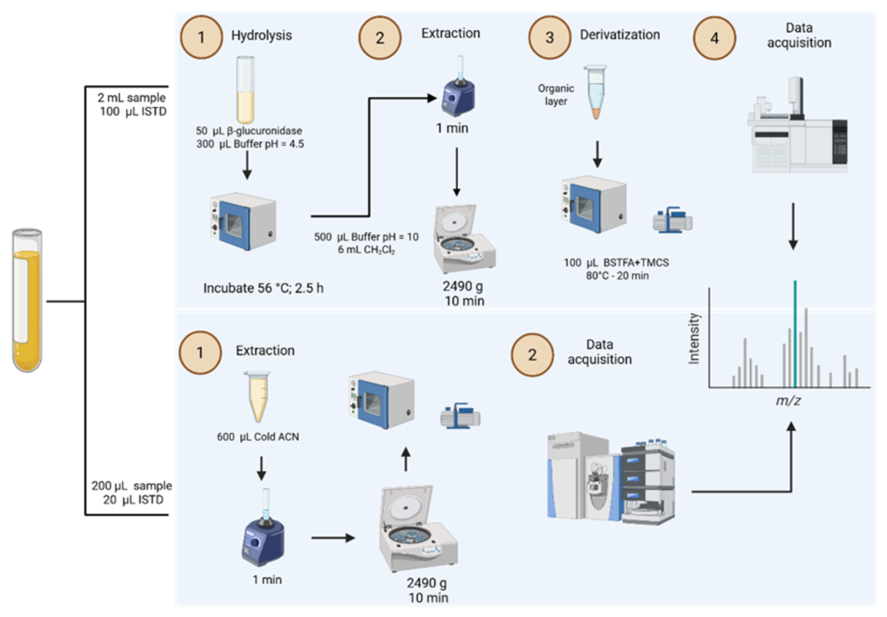

Table 1.
Analytical performance results for CPS, NPS, and metabolites.
| Compound | GC/MS | UHPLC-ESI (+/-)-Orbitrap-HRMS | ||
| R2 | LOD ng/mL | R2 | LOD ng/mL | |
| MDA | 0.839 | 183.74 | 0.985 | 28.8 |
| MDMA | 0.732 | 253.72 | 0.983 | 30.81 |
| 6-Monoacetylmorphine | 0.954 | 114.47 | 0.991 | 16 |
| 7-aminoclonazepam | 0.931 | 143.06 | 0.985 | 31.5 |
| 7-aminoflunitrazepam | 0.961 | 105.42 | 0.991 | 17.5 |
| Alprazolam | 0.921 | 153.98 | 0.986 | 29.6 |
| Amitriptyline | 0.985 | 62.83 | 0.987 | 27.8 |
| Amphetamine | 0.962 | 83.43 | 0.986 | 30.8 |
| Benzocaine | 0.953 | 116.48 | 0.987 | 29.7 |
| Benzoylecgonine | 0.963 | 103.78 | 0.992 | 0.72 |
| Bromazepam | 0.908 | 166.48 | 0.989 | 35.7 |
| Caffeine | 0.841 | 227.91 | 0.908 | 41.3 |
| Carbamazepine | 0.914 | 160.82 | 0.987 | 19.1 |
| Chlorpromazine | 0.949 | 121.15 | 0.991 | 25.2 |
| Clonazepam | 0.794 | 266.94 | 0.968 | 35.3 |
| Clozapine | 0.947 | 123.61 | 0.991 | 24.6 |
| Cocaethylene | 0.931 | 143.58 | 0.981 | 18.1 |
| Cocaine | 0.988 | 46.26 | 0.990 | 10.2 |
| Codeine | 0.996 | 25.72 | 0.992 | 22.6 |
| Diazepam | 0.9830 | 68.939 | 0.982 | 26.7 |
| Diltiazem | 0.972 | 89.90 | 0.992 | 13.3 |
| Dimethyltryptamine | 0.918 | 156.65 | 0.997 | 18.1 |
| Ecgonine | 0.824 | 242.07 | 0.941 | 35.9 |
| Ecgonine methyl ester | 0.925 | 148.51 | 0.985 | 17.7 |
| Ethylmorphine | 0.997 | 21.14 | 0.991 | 15.7 |
| Fentanyl | 0.986 | 48.53 | 0.991 | 23.7 |
| Flurazepam | 0.991 | 50.752 | 0.993 | 12.3 |
| Hydrocodone | 0.974 | 67.93 | 0.993 | 12.1 |
| Hydromorphone | 0.955 | 90.84 | 0.991 | 24.1 |
| Imipramine | 0.930 | 143.17 | 0.952 | 23.2 |
| Ketamine | 0.977 | 78.99 | 0.987 | 10.2 |
| Levomepromazine | 0.987 | 59.97 | 0.995 | 20.2 |
| Lidocaine | 0.983 | 69.02 | 0.994 | 8.7 |
| Lorazepam | 0.947 | 123.46 | 0.981 | 27.3 |
| Meperidine | 0.996 | 24.44 | 0.991 | 11.9 |
| Methadone | 0.990 | 41.51 | 0.991 | 25.3 |
| Methamphetamine | 0.478 | 438.31 | 0.986 | 28.7 |
| Midazolam | 0.946 | 124.50 | 0.991 | 17.2 |
| Morphine | 0.994 | 32.32 | 0.991 | 14.8 |
| Nitrazepam | 0.662 | 373.97 | 0.975 | 38.7 |
| Nordazepam | 0.930 | 143.49 | 0.967 | 24.4 |
| Norketamine | 0.967 | 96.52 | 0.991 | 17.5 |
| Oxazepam | 0.939 | 132.85 | 0.984 | 17.9 |
| Oxycodone | 0.968 | 76.27 | 0.991 | 13.8 |
| Papaverine | 0.963 | 81.54 | 0.987 | 13.8 |
| Phencyclidine | 0.983 | 67.94 | 0.996 | 19.1 |
| Temazepam | 0.974 | 85.80 | 0.987 | 14.6 |
| Thioridazine | 0.792 | 269.26 | 0.987 | 16.2 |
| Tramadol | 0.981 | 59.00 | 0.997 | 10.8 |
| Triazolam | 0.923 | 151.62 | 0.985 | 17.7 |
| Zolpidem | 0.896 | 178.95 | 0.993 | 13.2 |
Table 2.
Detailed GC/MS and UHPLC-ESI (+/-)-Orbitrap-HRMS urine screening findings.
| Code | Cause of death | GC/MS a | LC/MS |
| 04SUP23 | Suicide | BE-2TMS, caffeine, cocaine, EME-TMS | 4-HA c, caffeine b, HNK c, HK c, ketamine b, NK b, theobromine c |
| 665PEI23 | Homicide | caffeine, ketamine, NK | 1,3,7-trimethyluric acid c, BE b, caffeine b, cocaine b, EME b, HNK c, HK c, HMA c, HMMA c, ketamine b, MDMA b, NK b, oxazepam b, theobromine c, THC-COOH b |
| 03PEI23 | Homicide | caffeine, BE-2TMS, cocaethylene, EME-TMS, ketamine, MDA, NK | 4-HA c, 4-HMA c, BE b, caffeine b, cocaine b, HNK c, HK c, ketamine b, lidocaine b, MA b, NK b, oxazepam b, theobromine c, THC-COOH b |
| 187MZ23 | Suicide | BE-2TMS, caffeine, cocaine, EME-TMS, ketamine, MDMA | 1,3,7-trimethyluric acid c, amphetamine b, BE b, caffeine b, cocaethylene b, ecgonine b, EEE b, EME b, HMA c, HMMA c, HHMA c, MDA, theobromine c |
| 265AR23 | Homicide | ketamine | BE b, cocaethylene b, ketamine b, NK b |
| 142MZ23 | Suicide | caffeine, ketamine | 1,3,7-trimethyluric acid c, BE b, caffeine, cocaine b, HK c, ketamine b, NK b, oxazepam b, theobromine c |
| 705PEI22 | Traffic accident | α-hydroxymidazolam, caffeine, EME-TMS, fentanyl, ketamine, lidocaine, midazolam | α-hydroxymidazolam b, BE b, caffeine b, cocaine b, cocaethylene b, ecgonine b, EME b, fentanyl b, HNK c, HK c, hydroxyfentanyl c, hydroxynorfentanyl c, hydroxylidocaine c, ketamine b, lidocaine b, midazolam b, nordiazepam-glucuronide c, NK b, norfentanyl b, oxazepam b, theobromine c, THC-COOH b |
| 04PEI23 | Suicide | BE-2TMS, caffeine, EME-TMS, ketamine, lidocaine, NK | 1,3,7-trimethyluric acid c, α-hydroxymidazolam b, BE b, caffeine b, cocaine b, cocaethylene b, ecgonine b, EEE b, EME b, HNK c, HK c, hydroxylidocaine c, ketamine b, lidocaine b, midazolam b, nordiazepam-glucuronide c, NK b, norfentanyl b, oxazepam b, theobromine c, THC-COOH b |
| 757PEI22 | Homicide | BE-2TMS, caffeine, ketamine, lidocaine | 1,3,7-trimethyluric acid c, BE b, caffeine b, HNK c, HK c, ketamine b, MDA b, NK b, oxazepam b, theobromine c, THC-COOH b, THC-glu c |
| 244PEI23 | Homicide | caffeine, ketamine | BE b, cocaine b, caffeine b, HK c, HNK c, ketamine b, nordiazepam-glucuronide c, NK c, oxazepam b, theobromine c |
| 129ARM23 | Homicide | caffeine, ketamine | 1,3,7-trimethyluric acid c, BE b, caffeine b, ecgonine b, hydroxylidocaine c, ketamine b, lidocaine b, NK b, oxazepam b, theobromine c, THC-COOH b |
| 020SUP23 | Homicide | BE-2TMS, caffeine, cocaine, cocaethylene, EME-TMS, ketamine, MDMA | BE b, caffeine b, cocaethylene b, cocaine b, ecgonine b, EEE b, EME b, HNK c, HK c, HHMA c, hydroxylidocaine c, ketamine b, lidocaine b, MA b, MDA b, NK b, oxazepam b, theobromine c, THC-COOH b |
| 697PEI23 | Homicide | BE-2TMS, caffeine | 1,3,7-trimethyluric acid c, BE b, caffeine b, cocaethylene b, cocaine b, EEE b, EME b, HHMA c, theobromine c, THC-COOH b |
| 045SUP22 | Traffic accident | caffeine, ketamine | 1,3,7-trimethyluric acid c, caffeine b, BE b, cocaine b, hydroxylidocaine c, HHMA c, lidocaine b, oxazepam b, theobromine c, THC-COOH b |
| 185PEI22 | Undefined | BE-2TMS, caffeine, cocaine, EME-TMS, hydromorphone, ketamine, methaqualone, morphine-2TMS | 1,3,7-trimethyluric acid c, 4-HA c, BE, caffeine b, cocaine b, codeine b, HHMA c, HNK c, HK c, hydromorphone c, ketamine b, methaqualone c, morphine b, morphine-3-glucuronide c, NK b, norhydromorphone c, oxazepam b, theobromine c |
| 709PEI23 | Traffic accident | caffeine, ketamine, lidocaine, NK | 1,3,7-trimethyluric acid c, caffeine, cocaine b, fentanyl b, HHMA c, HK c, HNK c, hydroxylidocaine c, ketamine b, NK b, lidocaine b, MDA b, nordiazepam-glucuronide c, norfentanyl b, oxazepam b, theobromine c, THC-COOH b |
| 370PEI23 | Homicide | BE-2TMS, caffeine, EME-TMS, ketamine, lidocaine | 1,3,7-trimethyluric acid c, BE b, caffeine b, cocaine b, fentanyl b, HNK c, HK c, HMA c, ketamine b, levetiracetam c, lidocaine b, MDA b, MDMA b, NK b, norfentanyl b, theobromine c, THC-COOH b |
| 03CTG23 | Homicide | BE-2TMS, caffeine | 1,3,7-trimethyluric acid c, BE b, caffeine b, cocaine b, cocaethylene b, ecgonine b, EEE b, EME b, HHMA c, HNK c, HK c, hydroxylidocaine c, hydroxynorfentanyl c, ketamine b, lidocaine b, MDA b, NK b, norfentanyl b, oxazepam b, theobromine c, THC-COOH b |
| 666PEI23 | Traffic accident | caffeine | BE b, caffeine b, cocaine b, hydroxylidocaine c, HHA c, ketamine b, lidocaine b, nordiazepam-glucuronide c, norfentanyl b, oxazepam b, theobromine c, THC-COOH b |
| 153PEI23 | Homicide | caffeine, codeine-TMS, ketamine, MDA, MDMA, NK |
1,3,7-trimethyluric acid c, amphetamine b, BE b, cocaine b, cocaethylene b, EME b, HK b, HNK c, ketamine b, lidocaine b, MDA b, MDMA b, NK b, theobromine c, THC-COOH b |
| 275PEI23 | Suicide | ketamine | BE b, caffeine b, cocaine b, ketamine b, lidocaine b, MDA b, MDMA b, midazolam b, oxymorphone c, theobromine c |
| 014PEI24 | Homicide | BE-2TMS, caffeine, ketamine | 4-HA c, HHA c, BE b, caffeine b, ecgonine b, EEE b, EME b, ketamine b, lidocaine b, MDA b, NK b, oxymorphone c, theobromine c |
| 379ARM23 | Undefined | Ketamine | 4-HA c, amphetamine b, BE b, caffeine b, ecgonine b, EEE b, ketamine b, lidocaine b, MDA b, MDMA b, midazolam b, oxymorphone c, theobromine c |
| 102DOR23 | Homicide | BE-2TMS, ketamine | BE b, caffeine b, cocaine b, ecgonine b, EEE b, HHA c, HHMA c, HK c, HNK c, ketamine b, lidocaine b, MDA b, MDMA b, NK b, oxycodone c, oxymorphone c, theobromine c |
| 396ARM23 | Homicide | BE-2TMS, ketamine | BE b, caffeine b, HHA c, HK c, HNK c, ketamine b, lidocaine b, midazolam b, MDA b, MDMA b, NK b, theobromine c |
a All GC/MS identifications correspond to level 1. b Confirmatory identification (level 1). c Tentative identification (level 2). 11-nor-9-carboxy-Δ9-tetrahydrocannabinol THC-COOH, 11-Hydroxy-Δ9-THC-glucuronide THC-glu, 4-hydroxyamphetamine 4-HA, 4-hydroxymethamphetamine 4-HMA, 3,4-dihydroxyamphetamine HHA, 3,4-methylenedioxymethamphetamine MDMA, 3,4-methylenedioxyamphetamine MDA, 4-hydroxy-3-methoxyamphetamine HMA, 4-hydroxy-3-methoxymethamphetamine HMMA, 3,4-dihydroximethamphetamine HHMA, benzoylecgonine BE, ecgonine ethyl ester EEE, ecgonine methyl ester EME, Hydroxyketamine HK, hydroxynorketamine HNK, Norketamine NK, methamphetamine MA, trimethylsilyl adduct -TMS.
Disclaimer/Publisher’s Note: The statements, opinions and data contained in all publications are solely those of the individual author(s) and contributor(s) and not of MDPI and/or the editor(s). MDPI and/or the editor(s) disclaim responsibility for any injury to people or property resulting from any ideas, methods, instructions or products referred to in the content. |
© 2026 by the authors. Licensee MDPI, Basel, Switzerland. This article is an open access article distributed under the terms and conditions of the Creative Commons Attribution (CC BY) license (http://creativecommons.org/licenses/by/4.0/).
Copyright: This open access article is published under a Creative Commons CC BY 4.0 license, which permit the free download, distribution, and reuse, provided that the author and preprint are cited in any reuse.