
Submitted:
31 August 2026
Posted:
02 September 2026
You are already at the latest version
Abstract
The Marshall complex—defined here as the integrated structure comprising the vein of Marshall (VOM), the vestigial fold, and their associated myocardial bundles and autonomic innervation—has re-emerged as a clinically relevant substrate for atrial fibrillation (AF). Historically described as a fibrous remnant, accumulating anatomical and electrophysiological evidence indicates that the neuromuscular elements invested around the VOM can act as triggers, modulators and, in susceptible atria, contributors to re-entrant activity. This article addresses an anatomical paradox: why can regression of the embryonic left-sided cardinal venous system leave behind an arrhythmogenic remnant, whereas persistence as a left-sided caval channel, as in persistent left superior vena cava, does not consistently translate into a dominant population-level AF signal? We propose that the Marshall complex may exemplify a time-limited evolutionary optimum, a pattern we term “shrewd degeneration.” Integrating contemporary embryological descriptions of venous remodelling with life-history theory, we hypothesize that left-sided venous regression can be viewed as a developmentally programmed simplification compatible with efficient early-life venous architecture. Its consequence is a small, phenotypically variable neuromuscular remnant that is usually clinically silent but may become arrhythmogenic after a “second hit” of atrial remodelling in the setting of ageing and modern cardiovascular exposures, including hypertension, obesity and metabolic dysfunction. Within this framework, Marshall-targeted strategies in AF can be interpreted not only as lesion delivery but also as targeted local modification of a latent anatomical vulnerability that becomes clinically relevant later in life. Importantly, this evolutionary interpretation is hypothesis-generating rather than evidence of the selective history of the Marshall complex itself. It yields testable translational predictions, including whether variation in “Marshall load,” assessed by mapping or imaging signatures, is associated with AF burden or differential response to Marshall-targeted therapy, and whether autonomic remodelling after Marshall modification contributes to rhythm outcomes. The Marshall complex may therefore provide a tractable model for testing how developmental anatomy, life-history constraints and contemporary intervention intersect in cardiovascular disease.
Keywords:
Marshall complex
; atrial fibrillation
; vein of Marshall ethanol infusion
; evolutionary medicine
; shrewd degeneration
I. Introduction
The ligament of Marshall (LOM) occupies a curious position in contemporary cardiology. For much of the twentieth century it was described, almost in passing, as a fibrous vestige on the posterior aspect of the left atrium, the inconsequential remnant of an embryonic venous channel. 1 Over the past two decades, this quiet annotation has been replaced by a vigorous scientific narrative: the Marshall complex, comprising the vestigial fold, the vein of Marshall and associated myocardial and autonomic elements, contains complex connections to the left atrium and coronary sinus.1-5 Its myocardial components can trigger atrial ectopy, participate in re-entrant circuits and interact with local autonomic innervation to modulate atrial electrophysiology.2,4,5 Targeted ethanol infusion into the vein of Marshall, or focused ablation of Marshall-related myocardial connections, has been shown to improve outcomes in selected patients undergoing catheter ablation for persistent atrial fibrillation (AF).6-8 What was once regarded as a leftover has become a therapeutic target.
This clinical and mechanistic re-evaluation exposes a deeper conceptual puzzle. The Marshall complex arises within the developmental remodelling of the left-sided cardinal venous system. 1,9 By contrast, in individuals in whom a substantial left-sided venous channel persists as a persistent left superior vena cava (PLSVC), there is no compelling evidence that AF risk is dramatically and consistently increased at the population level. 10,11 A large embryonic venous channel that persists can certainly be arrhythmogenic in selected individuals, yet persistence does not appear to confer a uniformly dominant AF phenotype. Meanwhile, the much smaller neuromuscular remnant present in typical anatomy can, under appropriate conditions, participate in the initiation or maintenance of AF. 1-3,10,11 This contrast challenges the intuitive assumption that developmental regression necessarily produces a simpler and electrically less consequential adult configuration.
The broader evolutionary question is not whether natural selection produces perfect anatomy. Evolutionary theory predicts the opposite: selection acts through effects on fitness and does not optimise organisms uniformly across all ages or environments.12-18 The direct force of selection generally declines for effects expressed increasingly late in life, allowing biological configurations that function adequately during fitness-relevant periods to carry liabilities that become apparent only later. 14-19 Modern longevity and cardiovascular risk exposures can therefore reveal vulnerabilities that had relatively little influence on reproductive fitness under past conditions.20-23
We propose that the Marshall complex may represent a particularly tractable anatomical example of this principle. The transition from a more extensive embryonic left-sided venous architecture to the usual right-dominant caval system involves substantial developmental regression and remodelling.1,9,24 The resulting Marshall complex is small and usually clinically silent, yet it retains variable myocardial and autonomic elements that can become electrophysiologically important in a remodelled atrium. We hypothesize that this pattern can be understood as a time-limited structural optimum: a developmentally simplified configuration that is compatible with early-life function while carrying a latent liability whose clinical importance increases with ageing, atrial remodelling and contemporary cardiovascular exposures.
We term the more specific pruning-remnant pattern “shrewd degeneration.” The term does not imply foresight, intention or evolutionary perfection. Rather, it describes a developmental configuration in which reduction of a more extensive precursor structure leaves a small residual element that is compatible with fitness over much of the life course but can become a disproportionate locus of dysfunction under later-life or mismatched conditions. The concept is intended to extend established life-history and evolutionary-mismatch reasoning to selected features of anatomical design, not to replace those frameworks.
Other human anatomical trade-offs provide broader context. The S-shaped spine enables efficient bipedal locomotion but is associated with late-life mechanical vulnerability, whereas features of the human upper airway that facilitate complex speech also contribute to susceptibility to obstructive sleep apnoea.25-30 These examples are not themselves necessarily instances of shrewd degeneration as defined here; rather, they illustrate the broader class of time-limited anatomical trade-offs within which the Marshall hypothesis is situated.
The Marshall complex is particularly useful as a model because the chain from developmental anatomy to microstructure, electrophysiology and intervention can be examined unusually directly. 1-8,31 The same region that emerges from embryonic venous remodelling contains a modifiable arrhythmogenic substrate, and its contribution can be interrogated using electrophysiological mapping, imaging and targeted intervention. This combination makes it possible to move beyond evolutionary analogy toward specific, testable predictions.
In this article, we use the Marshall complex to develop three related arguments. First, we define shrewd degeneration and place it within the broader concept of time-limited evolutionary optima. Second, we examine whether the developmental and electrophysiological features of the Marshall complex are consistent with this framework while distinguishing established evidence from evolutionary inference. Third, we derive testable predictions concerning inter-individual variation in the Marshall complex, response to Marshall-targeted therapy and comparative anatomy. More broadly, we consider whether evolution-informed reasoning can help identify anatomical vulnerabilities that become clinically important when human biology operates under lifespans and environments substantially different from those in which many of its features evolved.
II. The Marshall Complex: From Embryonic Remnant to Arrhythmogenic Substrate
Developmental Remodelling of the Left-Sided Venous System
The venous pole of the embryonic heart undergoes extensive remodelling during early development. As detailed in recent anatomical accounts,24 it initially receives blood through the hepatocardiac channels, with the common cardinal veins appearing subsequently as tributaries to the sinus venosus. The anterior and posterior cardinal veins drain the cranial and caudal parts of the embryo, respectively.
During subsequent remodelling, much of the left-sided cardinal venous system regresses. The proximal portion of the left anterior cardinal vein typically involutes, while its distal remnant is generally considered to contribute to the left superior intercostal vein.32 The left common cardinal vein and the left horn of the sinus venosus contribute to structures that persist in the adult, including the Marshall region and the coronary sinus. 1,9,24 In the usual adult anatomy, systemic venous return is therefore dominated by the right superior vena cava (SVC), while only much smaller components of the left-sided embryonic venous system remain (Figure 1A, B). Persistent left superior vena cava (PLSVC) represents an important developmental variant in which a substantial left-sided venous channel remains (Figure 1C).9
The Marshall region is not simply a fibrous residue of this remodelling. The vestigial fold and vein of Marshall (VOM) are associated with myocardial bundles, autonomic nerve fibres and ganglia, together forming the anatomical basis for the electrophysiological activity of this region (Figure 1D).1,3,33-35
The developmental process clearly reduces a relatively extensive embryonic venous arrangement to a predominantly right-sided caval system with small left-sided remnants. Whether this configuration was favoured because it reduced developmental complexity, tissue requirements or haemodynamic constraints cannot be established from embryological anatomy alone. These possibilities are relevant to the evolutionary hypothesis developed later in this article, but they should be distinguished from the observed developmental sequence itself.
In all panels, the cardiac silhouette is shown in frontal view as a positional reference only; venous structures are drawn in front of the heart contour for clarity and are not intended to represent true transparency.
Within the adult heart, the vestigial fold commonly referred to as the LOM lies along the ridge between the left atrial appendage and the left pulmonary veins and contains or is closely associated with the VOM and surrounding neuromuscular elements.1 It is therefore better regarded as part of a residual developmental complex than as an isolated fibrous scar.
Microstructure: A Neuromuscular Complex Rather than Inert Fibrous Tissue
Histological and anatomical studies have substantially changed the understanding of this region. Terminology is important. In strict anatomical usage, the ligament of Marshall refers primarily to the fibrous vestigial fold, whereas the arrhythmogenic substrate extends beyond the ligament itself. Following recent anatomical descriptions,33 we use the term Marshall complex for the VOM, the vestigial fold, associated myocardial bundles and autonomic neural elements. 5,33-35 It is this broader structure, rather than the fibrous ligament alone, that can contribute to atrial arrhythmogenesis.
Human anatomical studies have shown sympathetic and parasympathetic nerve fibres and ganglia, small vessels, adipose tissue and myocardial tracts within the Marshall region.3,5,35 The myocardial extensions can conduct electrical impulses and may show automatic activity or participate in re-entry.2-4 Autonomic innervation can also influence local refractoriness and conduction.5 Experimental and clinical mapping studies have implicated Marshall-related myocardial tissue in atrial ectopy, AF and macro-re-entrant circuits, including circuits involving the mitral isthmus. 2-4
The amount and distribution of these myocardial and neural components vary between individuals.3,33,35 In most people, the Marshall complex does not appear to have an important clinical effect in the absence of an arrhythmogenic atrial substrate. With atrial dilatation, fibrosis and other forms of remodelling, however, the same region may contribute to AF initiation or maintenance. This interaction between a developmental remnant and later acquired atrial disease is important to the hypothesis discussed in Section III.
From Anatomical Observation to Therapeutic Target
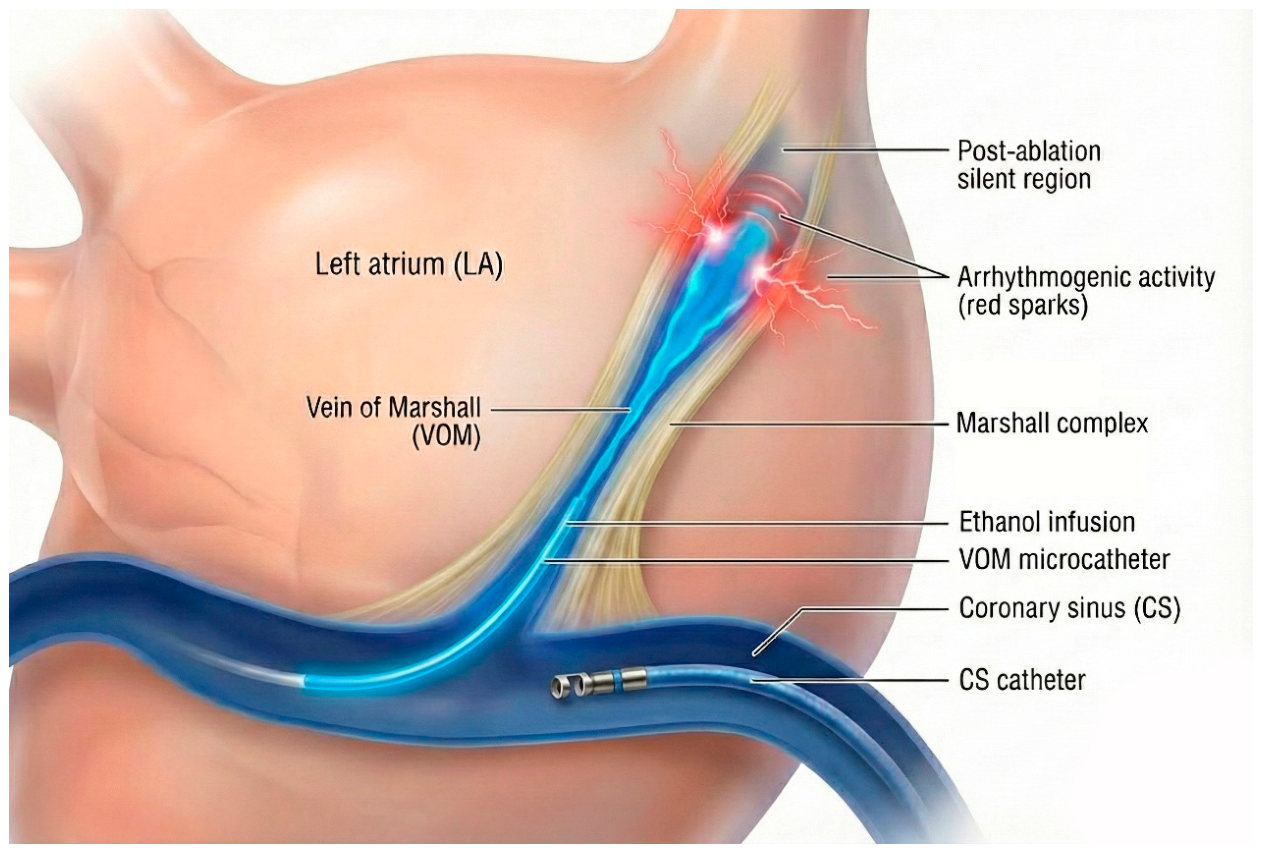
Recognition of the myocardial and autonomic components of the Marshall region has had direct clinical consequences. The VOM can be approached retrogradely through the coronary sinus and selectively cannulated for ethanol infusion, producing ablation of Marshall-related tissue and adjacent left atrial myocardium.7 Radiofrequency ablation can also be directed at Marshall-related connections, particularly when treating mitral isthmus-dependent circuits.2,7
Randomised trials and observational studies have evaluated VOM ethanol infusion as an adjunct to catheter ablation in persistent AF.6,8,36 In the VENUS trial, addition of VOM ethanol infusion to catheter ablation improved freedom from recurrent atrial tachyarrhythmia compared with catheter ablation alone.8 The more recent Marshall-Plan randomised trial also reported better rhythm outcomes with a strategy incorporating Marshall bundle elimination, VOM ethanol infusion and additional lesion sets than with pulmonary vein isolation alone.36 Meta-analyses have generally supported a reduction in recurrent atrial tachyarrhythmia when VOM ethanol infusion is added to ablation.37,38
These findings do not mean that Marshall-targeted treatment is required in all patients with AF. Pulmonary vein isolation remains the central component of catheter ablation, and additional substrate modification is individualized.39,40 VOM ethanol infusion also requires specific expertise in venous cannulation and ethanol delivery. Available evidence therefore supports its use as an adjunctive strategy in selected patients rather than as a universal component of AF ablation. 6-8,36-39,41
The clinical importance of these observations for the present article is relatively simple. A structure arising from embryonic venous remodelling can retain myocardial and neural elements that contribute to arrhythmia, and these elements can be targeted therapeutically. This link between developmental anatomy, electrophysiology and intervention provides the biological basis for asking why such a potentially arrhythmogenic remnant persists in typical human anatomy.
Persistent Left Superior Vena Cava: a Developmental Contrast
PLSVC provides a useful developmental comparison because a substantial part of the left-sided venous pathway remains rather than undergoing the usual degree of regression. It generally descends along the left mediastinum and drains into the coronary sinus, although other drainage patterns occur.9,10 The prevalence is approximately 0.2–3%, with higher rates in patients with congenital heart disease.10
PLSVC is not necessarily electrophysiologically silent. Myocardial connections can be present, and PLSVC-related ectopy and atrial arrhythmias have been documented and treated by catheter ablation.10,11 It may also complicate device implantation and electrophysiological procedures.10
What is less clear is whether PLSVC confers a large increase in AF risk across all affected individuals. Available reports show arrhythmogenicity in selected patients, but population-level evidence is limited and many individuals with PLSVC remain asymptomatic.10,11 PLSVC therefore should not be interpreted as a benign alternative to the usual regressed anatomy.
For the present hypothesis, its value is more limited and more specific. PLSVC shows that persistence of a relatively large left-sided embryonic venous channel is compatible with adult survival and does not invariably produce clinically important arrhythmia, whereas the much smaller Marshall complex in usual anatomy can become arrhythmogenic in susceptible atria. This contrast raises an evolutionary question, but it does not answer it. In particular, the available PLSVC evidence cannot establish that regression of the left-sided venous system was selectively advantageous or that the regressed state is less or more arrhythmogenic at the population level. PLSVC is therefore used here as a developmental comparison that helps motivate the hypothesis, not as evidence for the hypothesis itself.
III. Shrewd Degeneration: Time-Limited Evolutionary Optima in an Extended Lifespan
Life-History Theory and the Declining Force of Selection with Age
Classical evolutionary theories of ageing are based in part on the age-dependent force of natural selection. The effect of selection on traits expressed later in life generally declines as survival to those ages becomes less common and remaining reproductive contribution decreases.14,16 This creates what is often described as a selection shadow, in which deleterious effects expressed mainly at older ages may be subject to weaker selection than effects expressed earlier in life.
Medawar’s mutation-accumulation theory and Williams’ antagonistic pleiotropy hypothesis provide two related explanations for the evolution of senescence.16,19 Late-acting deleterious variants may persist because selection against them is weak, while traits that improve fitness earlier in life may be retained even when they have adverse effects later. Evidence from natural populations supports the existence of trade-offs between early and later life-history traits, although their form and magnitude vary among species and environments.15
Life-history theory extends this reasoning to the allocation of limited resources among growth, reproduction and somatic maintenance.17,18 Natural selection does not require biological systems to remain equally robust at all ages. A configuration that performs adequately during periods when its effects on fitness are greater may persist even if it becomes less reliable later in life.
This decline in selection with age should not be treated as a fixed boundary. There is no single age at which natural selection ceases to operate, and later-life survival and reproduction have varied substantially among human populations. The relevant point for the present argument is narrower: biological effects that arise mainly at older ages can have weaker consequences for fitness than effects expressed earlier.14-19 Modern increases in survival may therefore expose liabilities that had less influence on the evolutionary history of a trait.20,23
From Life-History Traits to Anatomical Structure
Mutation accumulation and antagonistic pleiotropy were developed mainly in genetic and life-history terms. 16,19 The same age-dependent reasoning can also be considered at the level of anatomy, provided that the evolutionary interpretation is kept separate from the developmental observations themselves.
Some anatomical configurations provide clear functional advantages while also carrying costs that become more evident with age or under different environmental conditions. Human spinal morphology associated with bipedalism and features of the upper airway associated with speech are examples discussed in the next section. 25-30 Their later clinical consequences do not imply that these structures were poorly formed. They illustrate the more general point that an anatomical arrangement can have different consequences at different stages of life and in different environments.
We use time-limited evolutionary optimum in this restricted sense. The term does not imply that a structure was globally optimal or that its evolutionary history can be reconstructed from its present form alone. It refers to a configuration whose fitness consequences may have been favourable or sufficiently neutral during periods of stronger selection, while liabilities expressed mainly later in life exerted less selective pressure. Environmental change may further alter this balance, producing evolutionary mismatch.23
The Marshall complex raises the possibility that developmental regression can produce a more specific version of this pattern.
Defining Shrewd Degeneration
We use the term shrewd degeneration for a proposed form of time-limited anatomical trade-off in which:
- a more extensive developmental precursor undergoes regulated reduction or remodelling;
- the resulting configuration is compatible with normal function during earlier life and may carry developmental, structural or functional advantages;
- a small residual structure remains and has properties that are largely inconsequential under usual conditions; and
- with ageing, acquired remodelling or environmental change, that residual structure can become a disproportionate site of dysfunction or disease.
The term shrewd is descriptive rather than teleological. It does not imply foresight or intention. Nor does degeneration refer to pathological degeneration in the usual clinical sense. Here it refers to developmental reduction of a precursor structure that leaves a residual element.
This concept draws on established ideas in evolutionary ageing and mismatch rather than proposing an alternative to them.14,16,19,23 Its more specific claim is that, in some anatomical systems, age-dependent evolutionary trade-offs may be concentrated in remnants produced by developmental reduction. Whether such a pattern applies to a particular structure requires evidence beyond the fact that developmental regression occurred.
For this reason, three levels of evidence should be distinguished. The developmental origin of a structure can often be established directly. Its contribution to later disease may also be tested anatomically, physiologically or clinically. The evolutionary explanation for why the developmental arrangement persisted is harder to establish and remains a hypothesis unless supported by comparative, genetic or fitness-related evidence.
The Marshall Complex as a Candidate Example
The Marshall complex has several features expected under this hypothesis. Developmentally, much of the left-sided cardinal venous system regresses while a smaller set of structures remains.1,9,24 Anatomically, the Marshall region contains variable amounts of myocardial tissue and autonomic innervation rather than being an inert fibrous remnant.3,5,33-35 These components are usually clinically silent but can contribute to atrial ectopy, re-entry and AF in susceptible atria.2-5 Acquired atrial dilatation, fibrosis and cardiovascular risk factors may provide the conditions in which this latent substrate becomes important.
What remains uncertain is why this developmental arrangement evolved and persisted. The usual right-dominant caval anatomy may have advantages related to developmental organisation, spatial economy or haemodynamics, but direct evidence that these features produced a selective advantage is lacking. The Marshall complex should therefore be regarded as a candidate example of shrewd degeneration, rather than proof of the concept.
The hypothesis makes a more limited claim. If the usual pattern of venous regression had little adverse effect on fitness during periods of stronger selection, then a later tendency of the residual Marshall region to contribute to AF would have provided relatively weak pressure against that developmental arrangement. This possibility is consistent with the strong age dependence of AF and with the frequent requirement for acquired atrial remodelling before Marshall-related tissue becomes clinically important. It does not establish the evolutionary cause of venous regression.
Extended Lifespan and Later Expression of Latent Vulnerabilities
Longer survival has increased the number of people who reach ages at which chronic cardiovascular disease, atrial remodelling and accumulated risk-factor exposure are common.20,21 Biological structures are therefore operating for longer periods and under conditions that may differ substantially from those encountered during much of human evolutionary history.23
For the Marshall complex, this matters because arrhythmogenicity is not an inevitable consequence of its presence. The structure is common, whereas clinically important Marshall-related AF occurs only in a subset of individuals. Ageing, hypertension, obesity, atrial enlargement, fibrosis and other acquired factors may change the electrophysiological setting in which its myocardial and autonomic components operate. The clinical problem may therefore arise from an interaction between a developmental remnant and later acquired atrial disease rather than from either factor alone.
This interpretation also defines the limits of the hypothesis. Shrewd degeneration would be weakened if Marshall-related anatomy showed no meaningful variation in arrhythmogenicity, if its contribution to AF were unrelated to ageing or atrial remodelling, or if comparative and developmental studies provided no evidence that the residual structure reflects a broader pattern of regulated reduction with later functional consequences. These questions are considered further in Section VI.
IV. Related Time-Limited Anatomical Trade-Offs
The Bipedal Spine
Human bipedalism required a spinal configuration that supports upright posture and efficient gait. The S-shaped spine helps balance the trunk over the pelvis, reduces the energetic cost of stance and walking, and frees the upper limbs for manipulation and tool use.25,27 Comparative and fossil evidence links this configuration to the evolution of habitual bipedalism in hominins.25,42,43
The same configuration also concentrates load on the lumbar spine and intervertebral discs. Epidemiological and biomechanical studies associate lumbar curvature and vertebral form with disc degeneration, herniation and chronic low back pain, particularly later in life.25,27,28 These clinical effects do not imply poor design. Rather, they show that a structure well suited to one set of functional demands can carry costs that become more apparent with ageing and with changes in activity pattern, body composition and survival.
The Descended Larynx and the Human Upper Airway
A related pattern is seen in the human upper airway. Humans have a descended larynx and a reconfigured supralaryngeal vocal tract that support articulated speech.26 At the same time, these features create a long and relatively unsupported pharyngeal airway that is prone to collapse during sleep.29,30 Modern risk factors, especially obesity, further increase this tendency. 29,30
Again, the point is not that the upper airway is maladaptive in general. The point is that a structure associated with a clear functional advantage can also carry a later clinical liability under present-day conditions. Obstructive sleep apnoea can therefore be viewed as one example of how a beneficial anatomical arrangement may have unfavourable consequences when lifespan and environment change.
Placing the Marshall Complex in This Broader Context
The Marshall complex belongs within this broader group of age- and environment-dependent anatomical trade-offs, but it may represent a more specific pattern. In the spine and the upper airway, the main issue is a trade-off between functional benefit and later liability. In the Marshall complex, the proposed mechanism involves developmental reduction of a more extensive precursor structure, leaving a small residual region that is usually silent but may become clinically important later. It is this more restricted pattern for which we use the term shrewd degeneration.
The Marshall complex is particularly useful because the chain from development to disease can be examined more directly than in many other examples. Its developmental origin has been described anatomically. 1,9,24 Its microstructure and electrophysiological properties have been characterized in human studies. 2-5,33-35 Its role in atrial fibrillation can be investigated by mapping and by targeted intervention.6-8,31,36-38 This degree of anatomical and clinical tractability is one reason why the Marshall complex is a useful candidate example for the present hypothesis.
Figure 2 and Table 1 summarize these related examples. The spine and the upper airway are included as contextual examples of broader time-limited anatomical trade-offs. The Marshall complex is the candidate example used here to illustrate the more specific pruning-remnant pattern proposed as shrewd degeneration.
This table compares three examples of time-limited anatomical trade-offs: the bipedal spine, the descended larynx and the Marshall complex. For each system, we summarise the main functional or developmental driver, the earlier-life or fitness-relevant benefit, the associated anatomical trade-off or residual feature, and the later clinical consequences. Factors that may increase the expression of these liabilities and representative clinical strategies used to modify or treat them are also shown. The spine and upper airway are included as broader examples of anatomical trade-offs, whereas the Marshall complex is the candidate example used here to illustrate the more specific pruning-remnant pattern termed shrewd degeneration. CPAP continuous positive airway pressure; OSA, obstructive sleep apnoea; VOM, vein of Marshall.
V. Clinical Implications of Time-Limited Evolutionary Optima
Longer Survival and Later-Life Disease
Human life expectancy has increased markedly over the past century, largely because of reductions in early-life mortality and advances in the prevention and treatment of infectious and chronic diseases. Global average life expectancy increased from approximately 31–32 years around 1900 to more than 70 years by 2021, with substantially higher values in many high-income countries.22 These changes have greatly increased the number of people surviving to ages at which chronic cardiovascular disease is common.
Atrial fibrillation is a relevant example. Its prevalence rises strongly with age, and the global burden of AF and atrial flutter has increased substantially over recent decades.21,44 Hypertension, obesity, heart failure and other conditions associated with atrial remodelling also become more common with ageing. The clinical expression of a latent arrhythmogenic substrate such as the Marshall complex therefore occurs within a setting that is increasingly dominated by long-term structural and metabolic change.
From an evolutionary perspective, longer survival increases exposure to biological effects that are expressed later in life, when their influence on fitness may historically have been weaker. 14-20 This does not mean that older age lies outside evolution or that human anatomy was designed for a specific lifespan. It means that liabilities expressed mainly at older ages may have been subject to weaker selection than traits affecting survival and reproduction earlier in life. The Marshall hypothesis developed here should be understood in this more limited sense.
Evolutionary Explanation and Clinical Mechanism
Evolutionary medicine distinguishes between proximate explanations of disease, which address mechanisms, and evolutionary explanations, which ask why biological systems remain susceptible to those mechanisms.12,13 In AF, proximate mechanisms include atrial dilatation, fibrosis, electrical remodelling and autonomic changes.45-47 Electrophysiological treatment is based on equally proximate observations, including ectopic triggers, conduction pathways and re-entrant circuits.
The Marshall complex adds a different question. Developmental remodelling leaves myocardial and autonomic tissue in a region that can later participate in AF.1-5 The immediate electrophysiological mechanisms can be studied directly, but they do not explain why this developmental arrangement is present in typical anatomy.
Shrewd degeneration provides one possible evolutionary explanation. If the usual pattern of left-sided venous regression had little adverse effect during periods in which selection was stronger, later arrhythmogenic consequences of the residual Marshall region might have exerted relatively little selective pressure. Acquired atrial remodelling could then expose a liability that was previously of limited consequence. This interpretation complements rather than replaces mechanistic explanations of AF.
Its clinical significance should also be kept in proportion. An evolutionary interpretation does not establish an indication for treatment. Decisions about Marshall-targeted therapy must continue to depend on electrophysiological and clinical evidence, including patient selection, procedural benefit and risk.
Marshall-Targeted Intervention as Local Modification
The VOM provides direct access to tissue within and around the Marshall complex. Ethanol infusion can produce injury to Marshall-related myocardial tissue and adjacent left atrial myocardium, while catheter ablation can target associated myocardial connections.2,7 These procedures provide an unusual example in which a developmental remnant that contributes to later disease can be modified locally.
Randomised trials have shown that strategies incorporating VOM ethanol infusion can improve rhythm outcomes in selected patients with persistent AF.8,36 Observational studies and meta-analyses provide additional support, although the procedure remains an adjunct rather than a universal component of AF ablation.6,37,38,41 Current ESC and ACC/AHA/ACCP/HRS guidelines continue to place pulmonary vein isolation at the centre of AF ablation and do not establish VOM ethanol infusion as a routine lesion set for all patients.39,40
Within the hypothesis proposed here, Marshall-targeted treatment can be viewed as local modification of a later-life vulnerability. This is different from claiming that the procedure corrects an evolutionary error. The developmental configuration may have been neutral or advantageous under other conditions, and its evolutionary history remains uncertain. The intervention addresses its present clinical effect rather than reconstructing an assumed ancestral optimum.
This distinction is important. Evolutionary reasoning may help explain why a potentially troublesome structure persists, but the justification for modifying that structure comes from clinical evidence. In this sense, evolutionary and mechanistic explanations operate at different levels while referring to the same anatomical substrate.
Figure 3.
Local modification of the Marshall complex by vein of Marshall ethanol infusion. Oblique view of the left atrial (LA) lateral wall showing the coronary sinus (CS), a CS catheter and a microcatheter advanced into the vein of Marshall (VOM). Ethanol infusion into the VOM produces injury within the Marshall complex and adjacent LA myocardium, reducing electrical activity arising from Marshall-related tissue. Within the hypothesis proposed here, the procedure illustrates how a developmental remnant that becomes clinically important later in life can be modified locally. This interpretation does not imply that the Marshall complex is an evolutionary error or that its selective history has been established. CS, coronary sinus; LA, left atrium; VOM, vein of Marshall.
Figure 3.
Local modification of the Marshall complex by vein of Marshall ethanol infusion. Oblique view of the left atrial (LA) lateral wall showing the coronary sinus (CS), a CS catheter and a microcatheter advanced into the vein of Marshall (VOM). Ethanol infusion into the VOM produces injury within the Marshall complex and adjacent LA myocardium, reducing electrical activity arising from Marshall-related tissue. Within the hypothesis proposed here, the procedure illustrates how a developmental remnant that becomes clinically important later in life can be modified locally. This interpretation does not imply that the Marshall complex is an evolutionary error or that its selective history has been established. CS, coronary sinus; LA, left atrium; VOM, vein of Marshall.
The Marshall Complex as a Model for Evolution-Informed Intervention
The Marshall complex may also be useful as a model for studying similar questions elsewhere in cardiovascular medicine. Candidate structures would need to meet more than one criterion. Their developmental origin should be reasonably well defined; a residual or remodelled anatomical feature should be identifiable; and its contribution to later disease should be measurable rather than inferred from analogy alone.
Developmental anatomy, histology, imaging and physiological studies could then be used to examine whether such structures show substantial inter-individual variation and whether this variation is associated with later clinical consequences. Comparative studies would be needed before adaptive explanations could be distinguished from developmental constraint, neutral persistence or other evolutionary mechanisms.
The Marshall complex is unusually suitable for this type of work because several links in the chain can already be studied directly: developmental anatomy,1,9,24 neuromuscular structure,3,5,33-35 electrophysiological activity,2-4 and response to targeted intervention.6-8,36-38 What remains uncertain is the evolutionary explanation connecting these observations.
An evolution-informed approach may therefore be most useful when it generates questions that can be tested using conventional anatomical, physiological and clinical methods. For the Marshall complex, these questions include whether variation in residual myocardial and autonomic tissue predicts AF, whether this variation affects response to targeted treatment, and whether comparable developmental remnants differ systematically across species. These predictions are considered in the next section.
VI. Testable Predictions and a Research Agenda
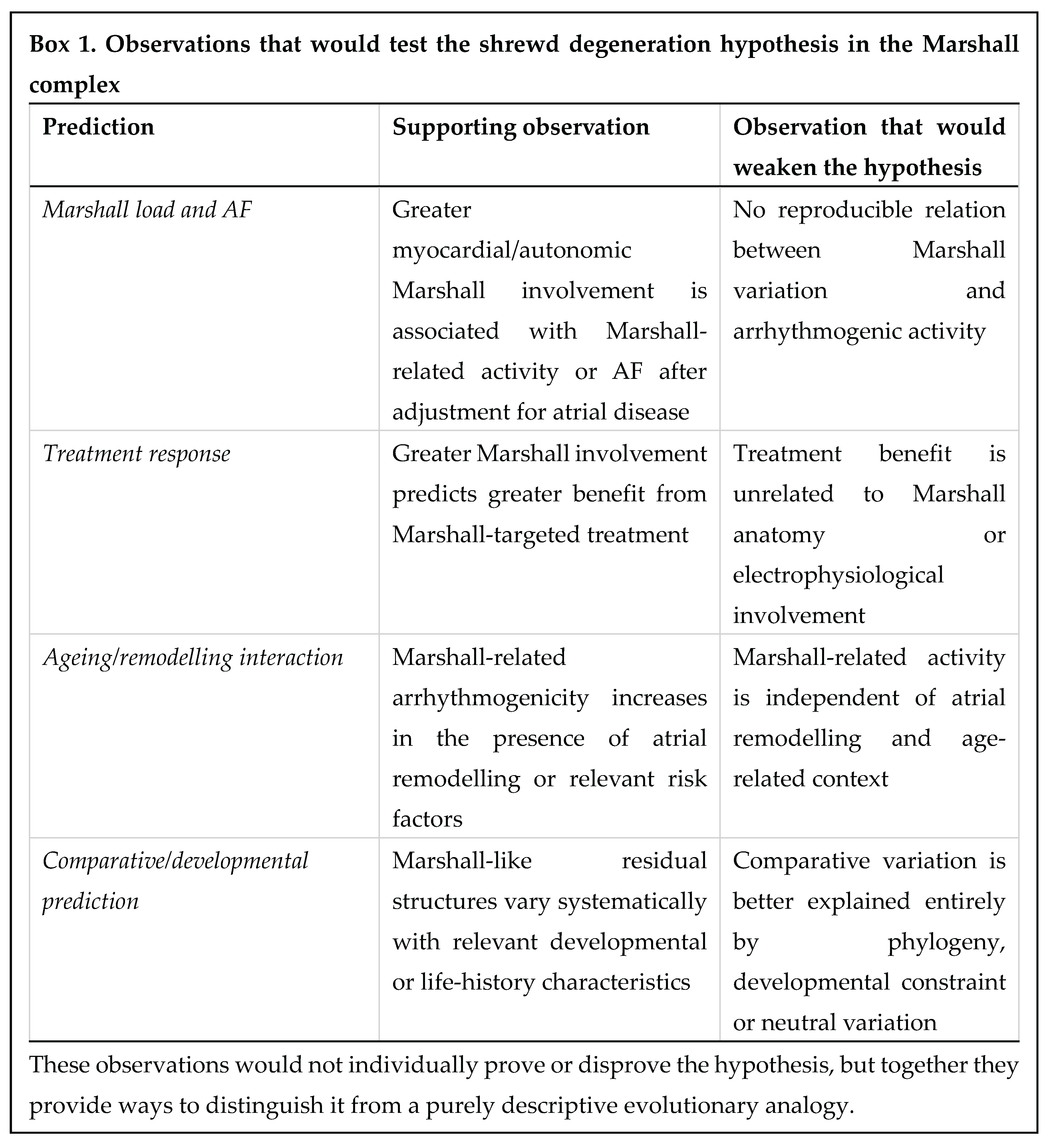
The usefulness of shrewd degeneration depends on whether it generates observations that can support, refine or weaken the hypothesis. The Marshall complex is suitable for this purpose because its anatomy varies between individuals, its electrophysiological activity can be mapped, and its contribution to AF can in some cases be modified directly. The following questions focus first on the Marshall complex itself and then on the broader implications of the hypothesis. Key predictions and observations that could support or weaken the hypothesis are summarized in Box 1.
1. Variation in the Marshall Complex and Clinical Expression
Human anatomical studies show considerable variation in the myocardial and autonomic components of the Marshall region.3,33,35 Some individuals have prominent myocardial extensions and dense neural tissue, whereas in others these components are less developed. Electrophysiological mapping can also identify substantial variation in Marshall-related conduction and activity.4,31
We propose the term Marshall load for the amount and functional prominence of myocardial and autonomic tissue within the Marshall complex. It could be assessed using a combination of anatomical, imaging and electrophysiological measures rather than as a single fixed variable.
A first prediction is that greater Marshall load is associated with a higher probability of Marshall-related triggers or drivers and with greater AF burden after accounting for established clinical and atrial risk factors. This could be tested by combining imaging, electroanatomic mapping and, where available, histological data with measures such as AF burden, inducible Marshall activity and recurrent atrial tachyarrhythmia.
A second prediction is that Marshall load modifies the response to targeted treatment. VOM ethanol infusion improves rhythm outcomes in selected patients with persistent AF, but the magnitude of benefit is unlikely to be identical in all patients.6,8,36 Patients with a more prominent Marshall-related substrate may derive greater benefit than those in whom Marshall involvement is limited. Future studies could therefore prospectively define anatomical or mapping measures of Marshall involvement and test their relation to treatment effect.
A third question concerns autonomic effects. The Marshall complex contains sympathetic and parasympathetic neural elements, and modification of this region may alter local or broader autonomic activity.5 Prospective studies could measure heart-rate variability or other autonomic markers before and after VOM ethanol infusion or Marshall-related ablation and examine whether these changes are associated with AF recurrence. Such findings would not establish that autonomic modification is the principal therapeutic mechanism, but they could clarify one component of treatment response.
Together, these studies would test a central prediction of the hypothesis: that variation in the residual Marshall structure has measurable consequences only in particular anatomical and physiological settings.
2. Comparative and Developmental Tests
The evolutionary part of the hypothesis requires evidence that cannot be obtained from human electrophysiology alone. Comparative and developmental studies are therefore important.
One question is whether structures homologous or analogous to the human Marshall region differ among mammals with different patterns of venous development, lifespan and cardiovascular physiology. Comparative anatomical studies could examine the extent of left-sided venous regression, residual myocardial sleeves, autonomic innervation and atrial connections across species. Any association with life-history characteristics would need to be interpreted cautiously because lifespan, body size, heart rate and phylogeny are strongly correlated.
The direction of such differences should not be assumed in advance. The current hypothesis does not require long-lived species to have more complete regression or greater fibrotic isolation of Marshall-like tissue. Rather, it predicts that if late-life arrhythmogenic costs have influenced the evolution of these structures, comparative variation should show some relation to relevant life-history or cardiovascular characteristics after phylogenetic and physiological differences are taken into account. Absence of such a relation would weaken this part of the hypothesis.
Developmental variation within humans provides another route for testing the idea. The usual pattern of left-sided venous remodelling is well described, but the amount of residual myocardial and neural tissue varies substantially.3,24,33,35 Studies of human fetal hearts and appropriate model organisms could examine when this variation arises and whether it is associated with differences in venous remodelling or signalling pathways involved in cardiac development.
These studies would also help distinguish several explanations that cannot be separated from adult anatomy alone. The Marshall complex could reflect an adaptive developmental arrangement, a neutral consequence of venous remodelling, developmental constraint, or some combination of these processes. Evidence favouring the latter explanations would require the evolutionary interpretation proposed here to be revised.
3. Marshall-Related Anatomy Within the Broader Mechanisms of AF
The Marshall hypothesis may also help define which patients are most likely to have clinically important involvement of developmental remnants. Current approaches to AF already distinguish between paroxysmal and persistent disease and recognise the importance of triggers, atrial remodelling and atrial cardiomyopathy.45-47 Marshall-related activity is unlikely to represent a separate category of AF; it is more plausibly one component whose importance varies between patients.
A useful research question is therefore whether AF can be characterised according to the relative contribution of identifiable anatomical structures and acquired atrial disease. In some patients, myocardial sleeves and junctional regions such as the Marshall complex, coronary sinus or superior vena cava may make a substantial contribution.4,48,49 In others, diffuse fibrosis, inflammation or metabolic disease may dominate.46,47
Environmental and clinical exposures may modify these relationships. Obesity, sleep apnoea, hypertension and other risk factors promote atrial remodelling and are associated with AF.39,50-52 A prominent Marshall substrate might therefore remain clinically silent until the surrounding atrium becomes sufficiently altered. Studies that combine detailed mapping of Marshall-related activity with measures of atrial structure and major risk factors could test this interaction.
The practical question is not whether a patient has an evolution-related form of AF. It is whether measurable involvement of the Marshall complex adds useful information to existing clinical and electrophysiological assessment and predicts benefit from Marshall-targeted treatment.
4. Testing the Concept Beyond the Marshall Complex
Shrewd degeneration should not be extended to other cardiovascular structures simply because they are embryological remnants or become diseased with age. A candidate structure would need to show the more specific sequence proposed here: regulated developmental reduction of a more extensive precursor, persistence of a residual structure, little or limited adverse effect under usual earlier-life conditions, and a later contribution to disease under particular physiological or environmental conditions.
Other cardiovascular developmental remnants and junctional regions may be worth examining with these criteria, but at present there is insufficient evidence to classify them as examples of shrewd degeneration. Developmental anatomy, comparative biology and clinical studies would first need to establish whether the proposed sequence is present.
This distinction is important because the concept would have little value if almost any age-related anatomical problem could be placed within it. Its usefulness depends on maintaining a narrow definition and on identifying observations that distinguish it from developmental constraint, neutral persistence and conventional age-related degeneration.
The Marshall complex therefore remains a candidate model rather than evidence that shrewd degeneration is widespread. Establishing whether similar patterns occur elsewhere is an empirical question.
VII. Conclusion
The Marshall complex illustrates an unusual link between developmental anatomy, electrophysiology and clinical intervention. Once regarded largely as a fibrous vestige, it is now understood as a variable neuromuscular structure whose myocardial and autonomic components can contribute to atrial arrhythmogenesis. In selected patients with AF, this region can also be targeted by VOM ethanol infusion or related ablation strategies.
We propose that the Marshall complex may also provide a useful model for considering how developmental remnants acquire clinical importance later in life. The concept of shrewd degeneration describes a more specific form of time-limited anatomical trade-off in which regulated reduction of a more extensive developmental precursor leaves a residual structure that is usually of little clinical consequence but may become important with ageing, acquired remodelling or environmental change. The term is intended as a testable evolutionary hypothesis rather than a claim that the selective history of the Marshall complex has already been established.
The available evidence supports the developmental origin, neuromuscular composition and arrhythmogenic potential of the Marshall complex, but it does not establish why the usual pattern of left-sided venous regression evolved or persisted. Possible explanations include adaptive developmental simplification, neutral persistence and developmental constraint. Distinguishing among these possibilities will require comparative and developmental evidence in addition to human electrophysiological studies.
The value of the hypothesis therefore lies in the questions it generates. Variation in Marshall load, its interaction with atrial remodelling, its relation to response to targeted treatment, and comparative variation in Marshall-like structures provide ways to test the proposed model. Failure of these predictions would require the concept to be revised or restricted. If supported, however, the Marshall complex could offer a useful example of how evolutionary reasoning can be linked to measurable anatomy and clinical disease without replacing conventional mechanistic explanation.
Author Contributions
Z.Z. conceived this article, designed the conceptual framework, and drafted the manuscript. J.W. contributed to the literature search and critically revised the manuscript. All authors read and approved the final manuscript.
Data availability
Data sharing is not applicable to this article as no datasets were generated or analysed during the current study.
Acknowledgments
The authors acknowledge the use of Large Language Models (including ChatGPT and Google Gemini) strictly for the purpose of language editing, grammatical polishing, and refining the flow of the manuscript. No AI tools were used for the conceptualization, scientific content generation, data interpretation, or the creation of the intellectual framework of this article. The authors have reviewed and edited the text and take full responsibility for the content of the publication.
Competing interests
The authors declare no competing interests.
Abbreviations Table
| Abbreviation | Definition |
| AF | Atrial fibrillation |
| CS | Coronary sinus |
| LOM | Ligament of Marshall |
| OSA | Obstructive sleep apnoea |
| PVI | Pulmonary vein isolation |
| PLSVC | Persistent left superior vena cava |
| SVC | Superior vena cava |
| VOM | Vein of Marshall |
References
- de Oliveira, I. M., Scanavacca, M. I., Correia, A. T., Sosa, E. A. & Aiello, V. D. Anatomic relations of the Marshall vein: importance for catheterization of the coronary sinus in ablation procedures. Europace 9, 915-919 (2007). [CrossRef]
- Hwang, C. & Chen, P. S. Ligament of Marshall: why it is important for atrial fibrillation ablation. Heart Rhythm 6, S35-40 (2009). [CrossRef]
- Kim, D. T. et al. The ligament of Marshall: a structural analysis in human hearts with implications for atrial arrhythmias. J Am Coll Cardiol 36, 1324-1327 (2000). [CrossRef]
- Han, S. et al. Electrophysiological characteristics of the Marshall bundle in humans. Heart Rhythm 7, 786-793 (2010). [CrossRef]
- Ulphani, J. S. et al. The ligament of Marshall as a parasympathetic conduit. Am J Physiol Heart Circ Physiol 293, H1629-1635 (2007). [CrossRef]
- Al-Sadawi, M. et al. Vein of Marshall ethanol infusion improves ablation outcomes in patients with persistent atrial fibrillation. Heart Rhythm O2 6, 598-605 (2025). [CrossRef]
- Rodriguez-Manero, M., Schurmann, P. & Valderrabano, M. Ligament and vein of Marshall: A therapeutic opportunity in atrial fibrillation. Heart Rhythm 13, 593-601 (2016). [CrossRef]
- Valderrabano, M. et al. Effect of Catheter Ablation With Vein of Marshall Ethanol Infusion vs Catheter Ablation Alone on Persistent Atrial Fibrillation: The VENUS Randomized Clinical Trial. JAMA 324, 1620-1628 (2020). [CrossRef]
- Sondermeijer, B. M., Macgillavry, M. R. & Tan, H. L. Left superior vena cava, a remnant of embryological development. Neth Heart J 16, 173-174 (2008). [CrossRef]
- Azizova, A., Onder, O., Arslan, S., Ardali, S. & Hazirolan, T. Persistent left superior vena cava: clinical importance and differential diagnoses. Insights Imaging 11, 110 (2020). [CrossRef]
- Turagam, M. K. et al. Persistent left superior vena cava as an arrhythmogenic source in atrial fibrillation: results from a multicenter experience. J Interv Card Electrophysiol 54, 93-100 (2019). [CrossRef]
- Nesse, R. M. & Stearns, S. C. The great opportunity: Evolutionary applications to medicine and public health. Evol Appl 1, 28-48 (2008). [CrossRef]
- Nesse, R. M. & Williams, G. C. Why We Get Sick: The New Science of Darwinian Medicine. (Times Books, 1994).
- Hamilton, W. D. The moulding of senescence by natural selection. J Theor Biol 12, 12-45 (1966). [CrossRef]
- Lemaitre, J. F. et al. Early-late life trade-offs and the evolution of ageing in the wild. Proc Biol Sci 282, 20150209 (2015). [CrossRef]
- Medawar, P. B. An Unsolved Problem of Biology: An Inaugural Lecture Delivered at University College, London, 6 December, 1951. (H.K. Lewis and Company, 1952).
- Stearns, S. C. Life-history tactics: a review of the ideas. Q Rev Biol 51, 3-47 (1976). [CrossRef]
- Stearns, S. C. The Evolution Of Life Histories. (Oxford University Press, 1998).
- Williams, G. C. Pleiotropy, Natural Selection, and the Evolution of Senescence. Evolution 11, 398–411 (1957). [CrossRef]
- Aronoff, J. E. & Trumble, B. C. An evolutionary medicine and life history perspective on aging and disease: Trade-offs, hyperfunction, and mismatch. Evol Med Public Health 13, 111-124 (2025). [CrossRef]
- Cheng, S. et al. Global burden of atrial fibrillation/atrial flutter and its attributable risk factors from 1990 to 2021. Europace 26, euae195 (2024). [CrossRef]
- Dattani, S. R. G., Lucas; Ritchie, Hannah; Ortiz-Ospina, Esteban; Roser, Max. Life Expectancy, (2023).
- Lea, A. J. et al. Applying an evolutionary mismatch framework to understand disease susceptibility. PLoS Biol 21, e3002311 (2023). [CrossRef]
- Hikspoors, J. et al. A pictorial account of the human embryonic heart between 3.5 and 8 weeks of development. Commun Biol 5, 226 (2022). [CrossRef]
- Collard, M. et al. Acquired Spinal Conditions in Evolutionary Perspective: Updating a Classic Hypothesis. Biological Theory 17, 186-197 (2022). [CrossRef]
- Davidson, T. M. The Great Leap Forward: the anatomic basis for the acquisition of speech and obstructive sleep apnea. Sleep Med 4, 185-194 (2003). [CrossRef]
- Plomp, K. A., Been, E. & Collard, M. in Palaeopathology and Evolutionary Medicine Ch. Chapter 3, 42-61 (2022).
- Plomp, K. A., Vietharsdottir, U. S., Weston, D. A., Dobney, K. & Collard, M. The ancestral shape hypothesis: an evolutionary explanation for the occurrence of intervertebral disc herniation in humans. BMC Evol Biol 15, 68 (2015). [CrossRef]
- Torre, C., Ramos, A., Dib, S., Abreu, A. & Chediak, A. Anatomy of Obstructive Sleep Apnea: An Evolutionary and Developmental Perspective. International Journal of Head and Neck Surgery 10, 98-101 (2014). [CrossRef]
- Yamashiro, Y. & Kryger, M. Is laryngeal descent associated with increased risk for obstructive sleep apnea? Chest 141, 1407-1413 (2012). [CrossRef]
- Langmuur, S. J. J., Taverne, Y., van Schie, M. S., Bogers, A. & de Groot, N. M. S. Optimization of intra-operative electrophysiological localization of the ligament of Marshall. Front Cardiovasc Med 9, 1030064 (2022). [CrossRef]
- Sonavane, S. K. et al. Comprehensive Imaging Review of the Superior Vena Cava. Radiographics 35, 1873-1892 (2015). [CrossRef]
- Dutka, W. B., Bochenek, A., Lepich, T., Malinowski, M. & Bajor, G. The Marshall Complex in the Human Heart: Embryology, Microanatomy, Autonomic Features and Clinical Implications for Atrial Fibrillation-A State-of-the-Art Narrative Review. J Clin Med 14, 8422 (2025). [CrossRef]
- He, B. et al. The ligament of Marshall and arrhythmias: A review. Pacing Clin Electrophysiol 44, 792-799 (2021). [CrossRef]
- Makino, M. et al. Diverse myocardial extension and autonomic innervation on ligament of Marshall in humans. J Cardiovasc Electrophysiol 17, 594-599 (2006). [CrossRef]
- Derval, N. et al. Marshall-Plan Ablation Strategy Versus Pulmonary Vein Isolation in Persistent AF: A Randomized Controlled Trial. Circ Arrhythm Electrophysiol 18, e013427 (2025). [CrossRef]
- Bola, H. et al. Ethanol infusion of the vein of marshall-based strategies for persistent atrial fibrillation: a systematic review and meta-analysis of randomized trials. Europace 28 (2026). [CrossRef]
- Pranata, R., Kamarullah, W., Karwiky, G., Achmad, C. & Iqbal, M. Ethanol infusion into the vein of Marshall reduced atrial tachyarrhythmia recurrence during catheter ablation: A systematic review and meta-analysis. Heart Rhythm O2 5, 728-738 (2024). [CrossRef]
- Van Gelder, I. C. et al. 2024 ESC Guidelines for the management of atrial fibrillation developed in collaboration with the European Association for Cardio-Thoracic Surgery (EACTS). Eur Heart J 45, 3314-3414 (2024). [CrossRef]
- Joglar, J. A. et al. 2023 ACC/AHA/ACCP/HRS Guideline for the Diagnosis and Management of Atrial Fibrillation: A Report of the American College of Cardiology/American Heart Association Joint Committee on Clinical Practice Guidelines. Circulation 149, e1-e156 (2024). [CrossRef]
- Pambrun, T. et al. Vein of Marshall Ethanol Infusion in Atrial Fibrillation. JACC Clin Electrophysiol 12, 1173-1186 (2026). [CrossRef]
- Weber, J. & Pusch, C. M. The lumbar spine in Neanderthals shows natural kyphosis. Eur Spine J 17 Suppl 2, S327-330 (2008). [CrossRef]
- Williams, S. A. et al. Inferring lumbar lordosis in Neandertals and other hominins. PNAS Nexus 1, pgab005 (2022). [CrossRef]
- Dong, X. J. et al. Global burden of atrial fibrillation/atrial flutter and its attributable risk factors from 1990 to 2019. Europace 25, 793-803 (2023). [CrossRef]
- Staerk, L., Sherer, J. A., Ko, D., Benjamin, E. J. & Helm, R. H. Atrial Fibrillation: Epidemiology, Pathophysiology, and Clinical Outcomes. Circ Res 120, 1501-1517 (2017). [CrossRef]
- Goette, A. et al. EHRA/HRS/APHRS/SOLAECE expert consensus on atrial cardiomyopathies: definition, characterization, and clinical implication. Europace 18, 1455-1490 (2016). [CrossRef]
- Goette, A. et al. Atrial cardiomyopathy revisited-evolution of a concept: a clinical consensus statement of the European Heart Rhythm Association (EHRA) of the ESC, the Heart Rhythm Society (HRS), the Asian Pacific Heart Rhythm Society (APHRS), and the Latin American Heart Rhythm Society (LAHRS). Europace 26, euae204 (2024). [CrossRef]
- Goyal, R., Gracia, E. & Fan, R. The Role of Superior Vena Cava Isolation in the Management of Atrial Fibrillation. J Innov Card Rhythm Manag 8, 2674-2680 (2017). [CrossRef]
- Vrachatis, D. A. et al. Efficacy, Safety and Feasibility of Superior Vena Cava Isolation in Patients Undergoing Atrial Fibrillation Catheter Ablation: An Up-to-Date Review. Biomedicines 11 (2023). [CrossRef]
- Gami, A. S. et al. Obstructive sleep apnea, obesity, and the risk of incident atrial fibrillation. J Am Coll Cardiol 49, 565-571 (2007). [CrossRef]
- Linz, D. et al. Associations of Obstructive Sleep Apnea With Atrial Fibrillation and Continuous Positive Airway Pressure Treatment: A Review. JAMA Cardiol 3, 532-540 (2018). [CrossRef]
- Chen, L., Sun, X., He, Y., Lu, Y. & Zheng, L. Obstructive sleep apnea and atrial fibrillation: insights from a bidirectional Mendelian randomization study. BMC Med Genomics 15, 28 (2022). [CrossRef]
Figure 1.
Development and anatomical variations of the systemic venous system and the Marshall Complex. (A) Early embryonic systemic venous architecture. The bilateral anterior (cranial), common, and posterior (caudal) cardinal veins drain symmetrically into the sinus venosus. The cardiac silhouette is illustrated as a simplified posterior contour purely to provide spatial orientation; embryonic venous structures are intentionally placed in the foreground to avoid anatomical obscuration. (B) Remodeling and right-sided dominance of the venous inflow. With progression of embryonic development, the left common cardinal venous system regresses while the right-sided anterior and common cardinal veins enlarge to form the superior vena cava (SVC). The coronary sinus (CS) is derived from the left horn of the sinus venosus. Remodelling of the left-sided venous system contributes to the structures that form the adult Marshall region. (C) Persistent left superior vena cava (PLSVC). Failure of regression of the left anterior cardinal system results in a persistent left SVC, which drains into a dilated coronary sinus. The right SVC may coexist or be absent depending on the variant. Note the dilated coronary sinus compared to the normal anatomy in Panel B. (D) The Marshall Complex (longitudinal section). Schematic depiction of the Marshall Complex showing its composite nature: the vein of Marshall (VOM) and the vestigial fibrous fold are invested by myocardial tracts (Marshall bundles) and a rich network of autonomic nerve fibers and ganglia. These elements are embedded within fibro-fatty tissue between the left atrial wall and the epicardial surface, forming the neuromuscular substrate for arrhythmias.
Figure 1.
Development and anatomical variations of the systemic venous system and the Marshall Complex. (A) Early embryonic systemic venous architecture. The bilateral anterior (cranial), common, and posterior (caudal) cardinal veins drain symmetrically into the sinus venosus. The cardiac silhouette is illustrated as a simplified posterior contour purely to provide spatial orientation; embryonic venous structures are intentionally placed in the foreground to avoid anatomical obscuration. (B) Remodeling and right-sided dominance of the venous inflow. With progression of embryonic development, the left common cardinal venous system regresses while the right-sided anterior and common cardinal veins enlarge to form the superior vena cava (SVC). The coronary sinus (CS) is derived from the left horn of the sinus venosus. Remodelling of the left-sided venous system contributes to the structures that form the adult Marshall region. (C) Persistent left superior vena cava (PLSVC). Failure of regression of the left anterior cardinal system results in a persistent left SVC, which drains into a dilated coronary sinus. The right SVC may coexist or be absent depending on the variant. Note the dilated coronary sinus compared to the normal anatomy in Panel B. (D) The Marshall Complex (longitudinal section). Schematic depiction of the Marshall Complex showing its composite nature: the vein of Marshall (VOM) and the vestigial fibrous fold are invested by myocardial tracts (Marshall bundles) and a rich network of autonomic nerve fibers and ganglia. These elements are embedded within fibro-fatty tissue between the left atrial wall and the epicardial surface, forming the neuromuscular substrate for arrhythmias.
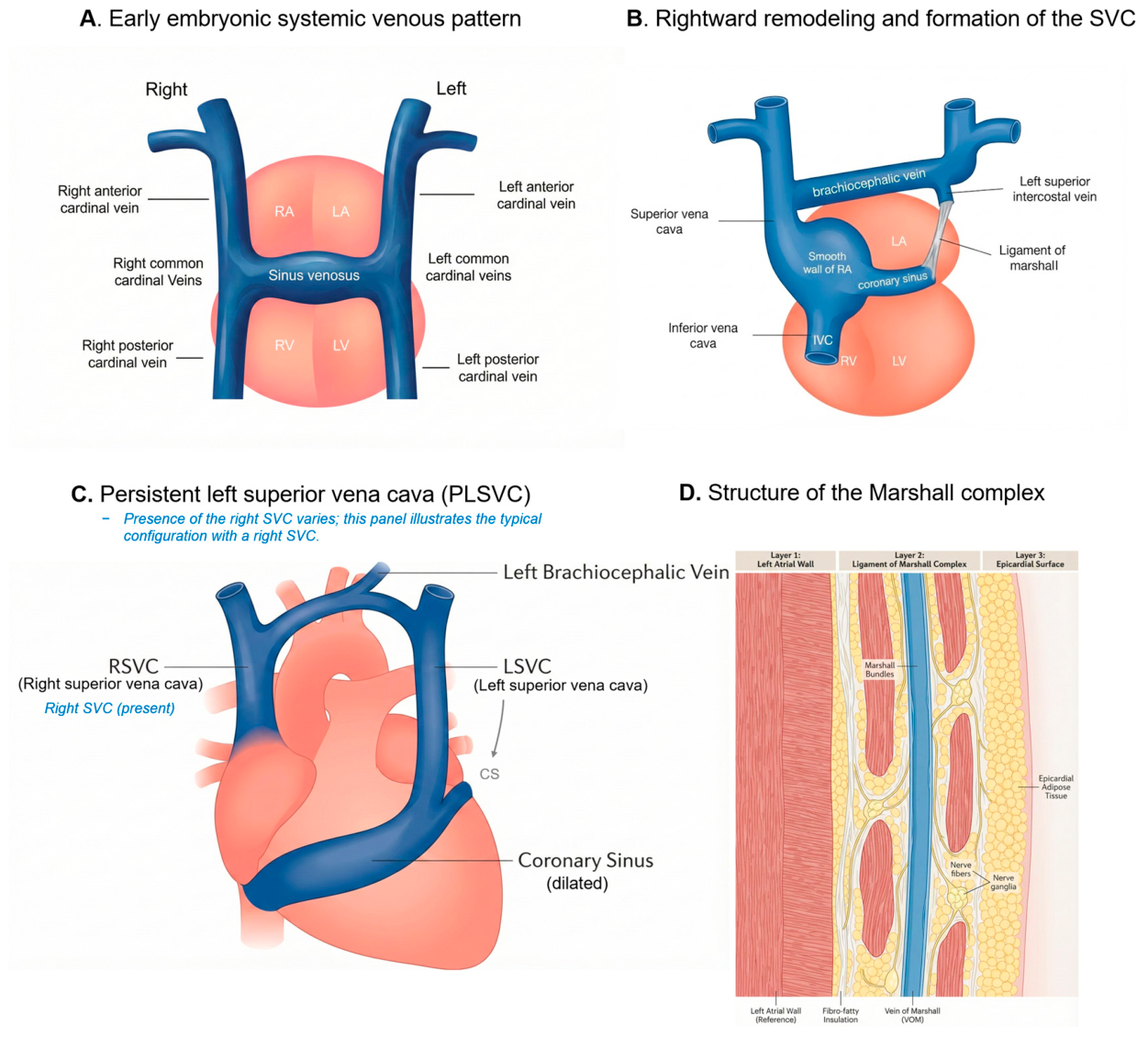
Figure 2.
Age-dependent selection and related anatomical trade-offs. (A) Schematic relation between age and the relative direct force of natural selection in humans. No specific age threshold is implied. Selection is generally stronger earlier in life and weaker later in life. With modern survival, more individuals reach ages at which later clinical liabilities become apparent. (B) Selected examples of time-limited anatomical trade-offs. The bipedal spine supports upright locomotion but later predisposes to disc disease; the human upper airway supports speech but later predisposes to obstructive sleep apnoea; the Marshall complex arises from remodelling of the left-sided venous system and may later contribute to atrial fibrillation in susceptible atria. The spine and upper airway are shown as contextual examples of a broader class of trade-offs. The Marshall complex is the candidate example used in this article for the more specific pruning-remnant pattern termed shrewd degeneration.
Figure 2.
Age-dependent selection and related anatomical trade-offs. (A) Schematic relation between age and the relative direct force of natural selection in humans. No specific age threshold is implied. Selection is generally stronger earlier in life and weaker later in life. With modern survival, more individuals reach ages at which later clinical liabilities become apparent. (B) Selected examples of time-limited anatomical trade-offs. The bipedal spine supports upright locomotion but later predisposes to disc disease; the human upper airway supports speech but later predisposes to obstructive sleep apnoea; the Marshall complex arises from remodelling of the left-sided venous system and may later contribute to atrial fibrillation in susceptible atria. The spine and upper airway are shown as contextual examples of a broader class of trade-offs. The Marshall complex is the candidate example used in this article for the more specific pruning-remnant pattern termed shrewd degeneration.
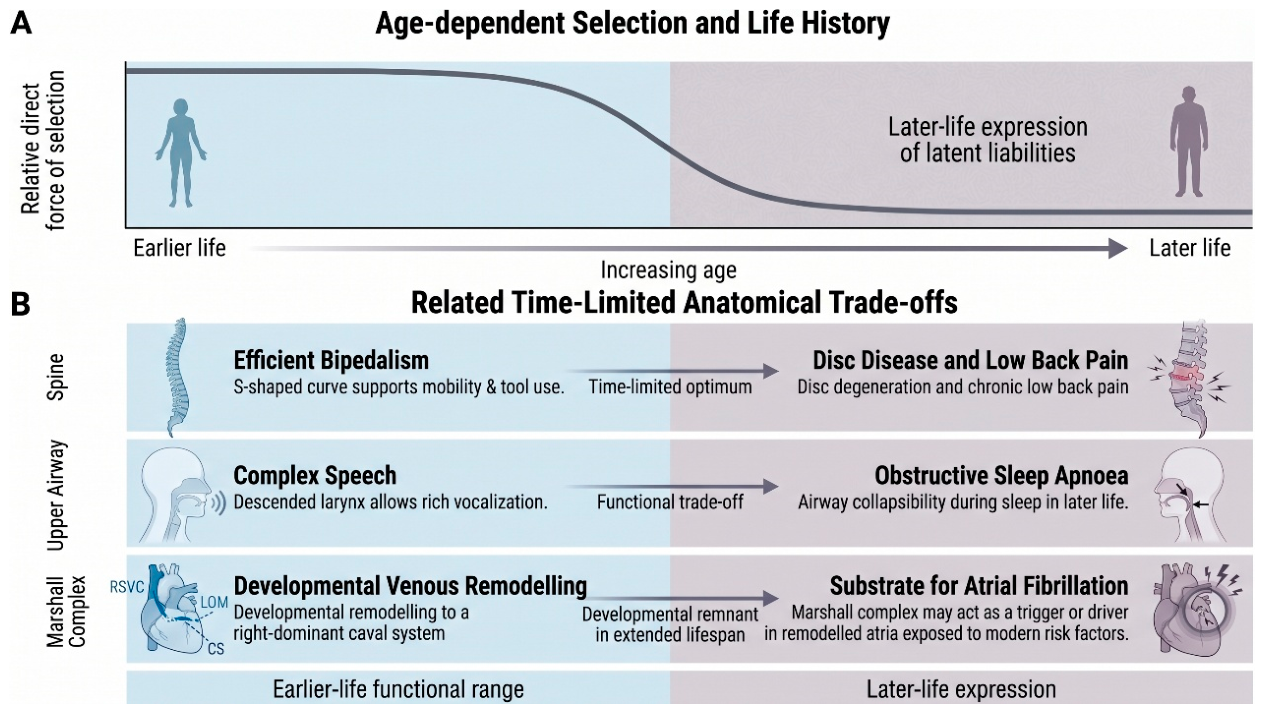

Table 1.
Related time-limited anatomical trade-offs and later-life clinical consequences.
| Feature | Bipedal spine | Descended larynx / upper airway | Marshall complex |
| Main functional or developmental driver | Efficient upright posture and locomotion | Articulated speech and vocal tract configuration | Developmental remodelling of the left-sided venous system |
| Earlier-life / fitness-relevant benefit | Energy-efficient walking; mobile trunk | Rich vocal communication | Usual right-dominant venous anatomy; no clear early-life electrophysiological disadvantage recognized |
| Anatomical trade-off or residual feature | S-shaped spine with concentrated lumbar loading | Long, relatively unsupported pharyngeal airway | Small residual region containing myocardial and autonomic elements |
| Later clinical consequences | Disc degeneration; disc herniation; chronic low back pain | Obstructive sleep apnoea | Atrial fibrillation in susceptible atria |
| Factors that increase expression | Sedentary lifestyle; obesity; age-related degeneration | Obesity; reduced muscle tone during sleep | Atrial dilatation; fibrosis; hypertension; obesity |
| Potential clinical modification | Spinal surgery; disc replacement; rehabilitation | CPAP; hypoglossal nerve stimulation; airway surgery | Vein of Marshall ethanol infusion; targeted ablation |
Disclaimer/Publisher’s Note: The statements, opinions and data contained in all publications are solely those of the individual author(s) and contributor(s) and not of MDPI and/or the editor(s). MDPI and/or the editor(s) disclaim responsibility for any injury to people or property resulting from any ideas, methods, instructions or products referred to in the content. |
© 2026 by the authors. Licensee MDPI, Basel, Switzerland. This article is an open access article distributed under the terms and conditions of the Creative Commons Attribution (CC BY) license (http://creativecommons.org/licenses/by/4.0/).
Copyright: This open access article is published under a Creative Commons CC BY 4.0 license, which permit the free download, distribution, and reuse, provided that the author and preprint are cited in any reuse.