

Submitted:
01 September 2026
Posted:
02 September 2026
You are already at the latest version
Abstract
This study investigates the role of artificial intelligence (AI) in consumers’ food-related decision-making and its relationship with established social-media-mediated practices in e-commerce. A cross-sectional survey was conducted in Algeria in 2025 and generated 223 valid responses. 39.5% of respondents reported using AI, with ChatGPT making up 87.5% of applications reported by AI users. AI users experienced greater satisfaction with AI-related food experiences than non-users (Mann–Whitney U = 7,840.00, p < .001). However, AI use was not significantly associated with food purchasing after social-media exposure (p = .987). Social-media-mediated food discovery and purchasing practices remained prevalent, with no evidence of displacement by AI in the present sample. The findings conceptualize AI-assisted food choice as an additional layer of digital mediation in an established multi-source consumption environment and contribute evidence on AI-augmented consumer behavior to the under-researched Algerian context.
Keywords:
generative AI
; consumer behaviour
; e-commerce
; food consumption
; social media
Introduction
Generative artificial intelligence (GenAI) is transforming digital commerce through the introduction of ever more interactive forms of consumer-technology interaction. Past AI applications in marketing and e-commerce were mostly predictive, applying consumer data to classify, recommend, personalize or predict behavior. GenAI enables consumers to formulate requests and receive dynamically generated information, recommendations, explanations and decision support (Hermann & Puntoni, 2024; Mogaji & Jain, 2024). Therefore, AI is becoming more visible in the consumer journey, allowing consumers to search, evaluate, compare and refine information through conversational interaction. Emerging evidence shows that new developments can change how people decide online. Chang and Park (2024) found that ChatGPT recommendations shift what consumers consider. Kim and Priluck (2025) proved that generative-AI chatbots and ordinary search engines elicit reactions when people evaluate products. Recent studies add that GenAI shopping assistants influence consumer motivation how expectations are met, satisfaction and actions (Xie, 2026).
These results suggest that AI is not only giving suggestions but also shaping the information environment that people use to form choices. This shift happens inside ecosystems that already contain social media, influencers, brands, recommender systems and e-commerce sites. Therefore, the key question is not simply whether people use GenAI. How AI-helped decision support blends into journeys that are already guided by digital media. This matter is especially important for food. Consumers meet food items, recipes, tips, reviews and habits on platforms more and more. A systematic review by Rini et al. (2024) Shows that social media affects aspects of food behavior such as how people learn, what they like, what they pick and what they buy. Food influencers are a part of this landscape. Sokolova et al. (2024) Found that watching food influencers can make people copy food actions and Verma et al. (2024) Showed that when a follower feels a match with an influencer it ties to food choices and brand support with trust playing a role. GenAI offers a kind of digital mediation. Of mainly showing content made or chosen by platforms, brands, influencers or other users conversational AI lets consumers ask for information and suggestions actively. In food contexts people might use AI to search for recipes find meal ideas, compare options or get help with food decisions. Social media and GenAI can overlap in functions like discovery, information, recommendation and inspiration though they use ways of interacting. GenAI is likely to complement of replace established digital sources. Although research on AI recommendations ChatGPT product reviews and AI-driven consumer behavior is growing we still know little, about how AI-assisted food decisions fit with existing habits.
This gap matters a lot because consumers will probably mix GenAI into their multi-platform trips instead of meeting it alone. Also systematic research shows that studies of AI and consumer behaviour mostly happen in markets so we really need evidence from places that are less represented like the Global South (Riandhi et al. 2025). Algeria is a place to look at this because consumers there are meeting both social-media food posts and new AI tools while a big digital change touches food habits and buying (Chikhi, 2026). With that in mind this study thinks of AI-assisted food choice as a layer of digital help inside consumers’ food decision paths. Of saying GenAI will replace social media the study looks at how AI-assisted food actions fit with the known ways social-media helps people discover be influenced and buy food. The study uses survey data taken in Algeria in 2025 from 223 people and looks at social-media food discovery buying food after seeing social-media, influencer effects AI use in food choices and purchases and the experiences people report when food is guided by social-media and AI. Importantly the study looks at AI use, in data and does not assume every tool mentioned by respondents is GenAI.
Four research questions guide the study:
RQ1. How do social media food discovery and influencer influence relate to food purchasing behaviour?
RQ2. To what extent do consumers use AI-based applications in food-related choices and purchases?
RQ3. How is AI use associated with consumers’ reported satisfaction with AI-mediated food shopping and consumption experiences?
RQ4. How are social media and AI related in consumers’ food decision-making?
The study makes three contributions. First, it contributes to emerging research on AI-augmented consumer behaviour by positioning AI-assisted food choice within a multi-layered digital consumer journey, rather than examining AI adoption independently from other digital practices. Second, it extends empirical research on AI and e-commerce consumer behaviour to the Algerian context, providing evidence from an underrepresented North African market. Third, by examining social-media- and AI-mediated food behaviours within the same empirical setting, the study provides an initial basis for understanding whether emerging AI applications operate alongside or independently of established forms of digital food consumption.
Literature Review and Theoretical Background
Generative AI, Consumer Decision-Making and AI-Mediated Recommendations
Generative artificial intelligence (GenAI) is changing how artificial intelligence works with consumer decision-making. Earlier AI tools in marketing mostly used prediction, classification, personalization and recommendation. GenAI lets consumers talk directly to systems that can create answers. Thus AI becomes a visible part of consumers’ search for information and their decision steps (Hermann & Puntoni 2024; Kalpakoglou et al., 2025). In the food-retailing context recent research has also examined how AI-enabled retail formats can reshape distribution processes and consumer experiences (Chikhi & Sahraoui 2026). This difference matters a lot in shopping. Traditional recommendation systems usually rank existing options using consumer data. Generative systems however can mix information. Give conversational recommendations that fit each individual question. GenAI brings an interactive kind of help. Consumers can sharpen their requests. Get information that fits the context (Mogaji & Jain 2024). More generally, research on artificially intelligent technologies highlights the growing importance of AI in shaping consumer engagement and interaction in digital environments (Hollebeek et al., 2024). New studies show that AI-generated recommendations can sway what consumers choose (Starke et al., 2025; Wang et al., 2025).). Chang and Park (2024) tested 443 people. Found that ChatGPT recommendations can shape the purchase journey. Products suggested by ChatGPT were also more likely to be bought. Research in the food domain also shows that consumers’ food choices can be influenced by chatbot personas through AI-powered nudges (Guo & Wan, 2025). Their results also show a trust-transfer effect, for consumers who know fewer brands. This suggests GenAI can change behavior by deciding which options appear in a consumer’s mind. However, the effectiveness of AI-mediated recommendations depends on the nature of the interaction. Ma et al. (2026) Found that whether AI word-of-mouth is one-way or matters and the effect changes with product type. Functional trust and human-like trust play parts. Han and Ko (2025) ran two experiments with 708 people and showed that when consumers feel they have choice, trust, satisfaction and engagement grow. Likewise, Hassan et al. (2025) find that personalized AI-driven recommendations influence the trust-satisfaction-loyalty relationship in e-commerce. These results mean that AI-assisted decision-making is more, than using new tech. The way people interact the trust built, the choice they feel and their agency all matter a lot (Ma et al., 2026).
Consumer responses may also differ from those observed with search. Kim and Priluck (2025) found that consumers preferred search engines to generative-AI chatbots during product evaluation and that consumers were more willing to disclose personal information to familiar search engines even though AI-generated results were perceived as less biased. Thus familiarity, perceived neutrality, trust, usefulness and behavioural preference should be considered dimensions of AI-mediated consumer response. Recent e-commerce research further supports this perspective. Xie (2026) shows that GenAI shopping assistants can influence expectation confirmation and satisfaction with user experience contributing to behavioural outcomes. Collectively these studies indicate that GenAI is evolving from an automated recommendation technology into a decision-support mechanism whose effects depend on consumer characteristics, interaction format, trust, autonomy, familiarity and decision context. This provides the basis, for examining how AI-assisted decision-making becomes embedded in consumption environments, particularly food.
Digital Food Consumption: From Social Media Influence to AI-Assisted Choice
AI-assisted food choice appears in a food-consumption environment that has already experienced a digital transformation. Social media has become a source of food information, inspiration, recipes, product discovery and social influence (Aydın, 2019). A systematic review of 377 studies by Rini et al. (2024) Confirms the strong relationship between media and food consumer behaviour showing social media as a tool, a factor and a source of food-related information and influence. Food influencers represent a mechanism in this digital environment. Verma et al. (2024) Studying 383 social-media users found that when influencer and follower agree, food choices and brand advocacy improve and perceived trust plays a role. Similarly, Sokolova et al. (2024) found that food influencers can encourage home-cooking practices with entertainment value and self-efficacy helping people imitate. Media-mediated food consumption is therefore marked by discovery, social influence, imitation and recommendation. GenAI introduces a form of mediation into this established ecosystem. Social media is mainly exposure-oriented: consumers see content created by influencers, brands, communities and other users. Conversational AI can be more query-oriented letting consumers make requests and get personalized answers. In practice, these mechanisms can intersect. A consumer may find a recipe, via media and then use AI to adapt it to available ingredients or personal preferences. GenAI may therefore act as a decision-support layer instead of replacing the existing digital food channels.
Research specifically addressing AI and food consumption reinforces the distinctiveness of this context. Xia et al. (2024) Examined consumers’ willingness to purchase food associated with AI-generated recipes. They found that food-quality orientation, subjective norms, perceived trust, and affective trust affected purchase intentions, while perceived risk negatively affected affective trust. Motoki et al. (2025) similarly identified AI-generated food images and recipes as emerging applications of GenAI in consumer science while highlighting concerns related to bias, privacy, transparency, oversimplification and misperception. These findings suggest that food provides a relevant context for examining AI-mediated consumption because food decisions involve not only functional evaluation but also taste expectations, recipes, social norms, cultural practices and personal preferences. The literature consequently supports a view of AI-assisted food choice as a layer of digital mediation operating alongside established social-media mechanisms of food discovery and influence. This perspective is particularly relevant, to the study because the questionnaire captures both social-media-mediated food behaviour and AI-related food use.
Trust, Consumer Experience and AI-Mediated Food Decisions
The consequences of AI-mediated consumer behaviour cannot be understood by looking at adoption. Trust and consumer experience are ways that shape how people respond to AI-generated information. In e-commerce, trust matters a lot because shoppers must decide when they are not sure; GenAI adds another kind of uncertainty about whether the information it creates or mixess reliable. Recent research shows that trust has parts. Ma et al. (2026) separate functional trust from human- trust in AI-generated word-of-mouth and Xia et al. (2024) separate cognitive trust from affective trust in AI-related food consumption. The authors also show that cognitive confidence can help build trust, while perceived risk harms affective trust (Yu et al., 2025). Han and Ko (2025) add that perceived autonomy and shared responsibility can boost trust and satisfaction showing that shoppers may feel better when AI helps them of taking over their choices. Consumer experience is another angle. Xie (2026) shows that GenAI shopping assistants can shape expectation confirmation, satisfaction, and stresses how crucial user experience is, for behaviour.
Importantly AI use and AI evaluation should not be conflated. Consumers may use AI because of convenience or curiosity. Consumers may not develop strong trust when using AI. Satisfaction reflects an evaluation of the resulting experience. The present study therefore treats AI use and AI evaluation as analytically distinct dimensions. A further gap concerns the relationship between AI and media. Existing research largely examines these environments separately: social-media studies focus on influencers, exposure, social influence and food content whereas GenAI research emphasizes recommendation, trust, autonomy and AI-mediated experience. The present study brings these streams together by examining whether AI-assisted food use is situated within established social-media-mediated food practices. Conceptually these food practices are two paths that can intersect in consumers’ food journeys. Social media can help in food discovery and inspiration which can subsequently affect evaluation and purchase while AI interaction can assist in recipe exploration and food-related decision making thereby shaping consumers’ experiences, with AI-mediated support. These pathways are not necessarily mutually exclusive. May exist and interact in a progressively multi-source digital food consumption environment.
The present cross-sectional design does not establish the direction of these pathways. However, this design allows examination of whether behaviours and experiences linked to these forms of mediation are empirically connected. Overall existing literature shows that (1) GenAI can influence consumer decision-making and the formation of consideration sets (Chang & Park 2024); (2) AI-mediated interaction can affect trust, autonomy, satisfaction and engagement (Han & Ko 2025; Xie, 2026); (3) social media shapes food-related attitudes and behaviours (Rini et al., 2024); (4) food influencers can shape food choices and practices (Sokolova et al., 2024; Verma et al., 2024);. 5) AI-related food consumption brings unique concerns about trust, perceived risk and acceptance (Xia et al. 2024; Motoki et al., 2025). What remains insufficiently examined is how AI-assisted food choice is positioned within a digitally mediated food-consumption environment. Against this background, this study examines the link between emerging AI-assisted food use, established social-media-mediated food practices and consumers’ reported experiences, in the context.
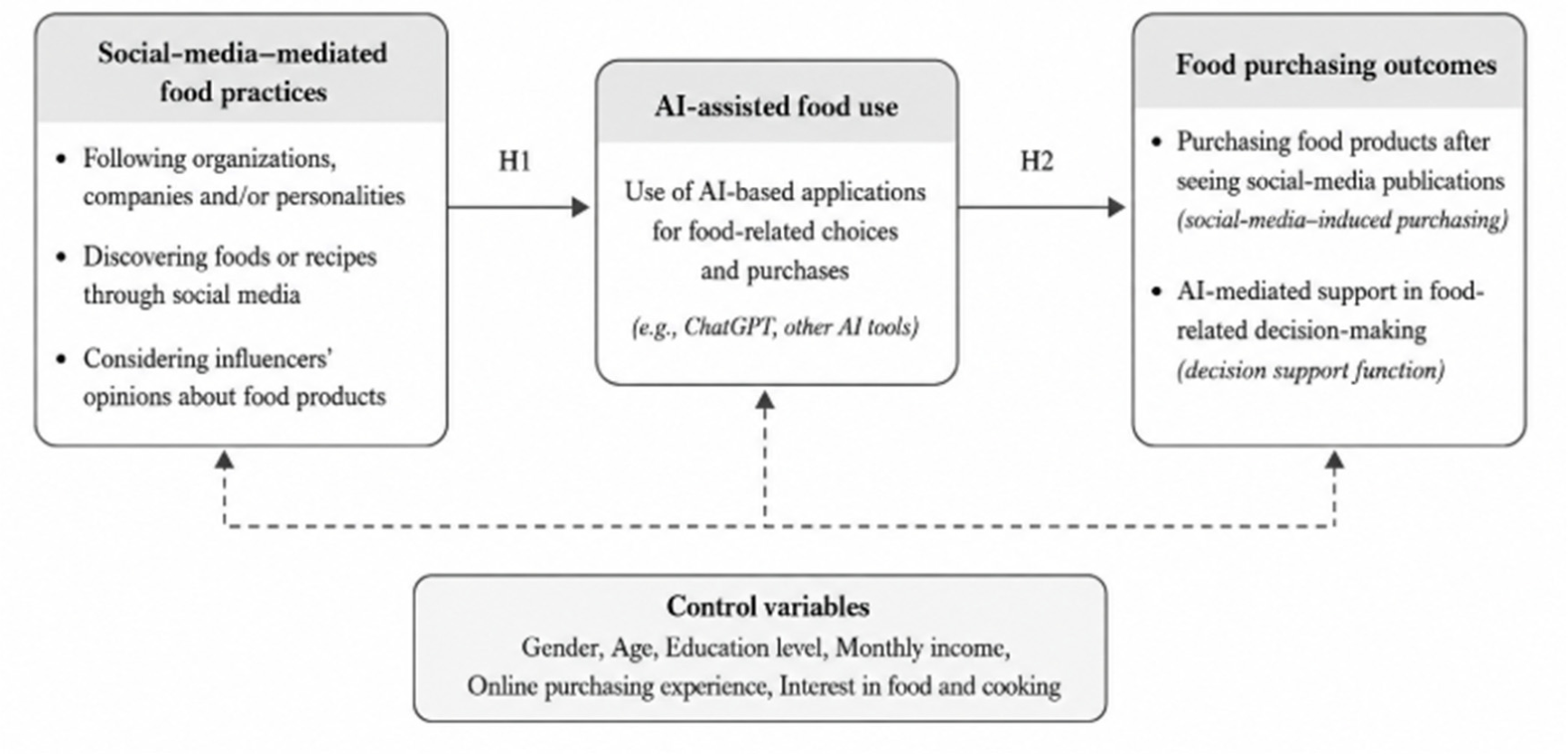
Figure 1.
Conceptual model of the study. Note: The model presents the hypothesized relationships examined in this study. H1: Social-media-mediated food practices are positively associated with AI-assisted food use. H2: AI-assisted food use is positively associated with food purchasing following social-media exposure.
Figure 1.
Conceptual model of the study. Note: The model presents the hypothesized relationships examined in this study. H1: Social-media-mediated food practices are positively associated with AI-assisted food use. H2: AI-assisted food use is positively associated with food purchasing following social-media exposure.
Methodology
Research Design and Data Collection
This study uses a cross-sectional design to look at how AI-assisted food decision-making shows up in people’s overall digital food-consumption habits. The study follows rules for reporting surveys with a full description of the design sample how measurements were taken and the plans for analysis (Stefkovics et al., 2024). We collected data in Algeria in 2025 with an online questionnaire. The questionnaire asked about people’s habits how they find and buy food through social media how they follow influencers for food how they use AI in food buying and choosing and how they feel about food experiences that come from social media and AI tools. We kept 223 answers for analysis. Because the survey was online we checked that the data were complete and that answers were consistent following the advice for consumer research (Jaeger et al., 2024). Participation was voluntary. We let respondents know why we were doing the study before they filled out the survey. We also told them that their participation was voluntary that we would keep their answers private and that we would use the data for research. No personal details were needed for the analysis. Because the study is cross-sectional and observational, we looked for patterns and statistical links instead of proving cause and effect. The analysis focused on the parts of the questionnaire that mattered most to the research questions. In particular we examined: (1) following organizations, companies and/or personalities on media; (2) buying food after seeing social-media posts; (3) finding new foods or recipe ideas through social media; (4) taking influencers’ opinions into account when buying food; (5) using AI for food buying and choosing; and (6) how satisfied people were, with food experiences that came from social media and AI applications.
Measures and Data Preparation
The questionnaire mainly used ordinal measures. Binary behavioural variables were coded according to their original response categories (Yes/No) while AI use status was coded as a variable yielding 88 AI users (39.5%) and 135 non-users (60.5%). Satisfaction was measured using a five-point rating scale ranging from 1 (very dissatisfied) to 5 (very satisfied) with higher scores indicating greater satisfaction. The satisfaction item was treated as ordinal because its response categories represent ordered levels of satisfaction without implying equal intervals between categories (Sönning, 2024). The analysis did not involve the construction of latent variables or composite psychometric scales as the questionnaire items were single-item evaluative measures rather than validated multi-item constructs. Accordingly, internal-consistency reliability statistics such, as Cronbach’s alpha were not calculated because they are not applicable to single-item measures. Before analysis, the dataset was screened for completeness, response consistency and valid category values. Frequencies and percentages were calculated for variables while satisfaction was summarized using the mean standard deviation, median and observed distribution. Given the nature of the satisfaction measure non-parametric procedures were used for group comparisons where appropriate.
Statistical Analysis
The statistical analysis was carried out systematically. First descriptive statistics were applied to determine how common AI use was and to describe respondents’ food practices that happen through media. Frequencies and percentages were computed for variables. Satisfaction scores were summarized with measures of tendency and dispersion. Second Pearson square tests of independence were used to look at relationships between binary categorical variables. Two main analyses were performed. The first looked at the connection between AI-use status. Established social-media food practices, such as following digital actors buying food after seeing social media finding foods or recipes on social media and taking influencer opinions into account. The second examined the link, between social-media practices. Buying food after social media exposure. Because most comparisons were 2 × 2 tables, the continuity-corrected Pearson chi-square statistic also called Yates correction was kept to give an assessment of statistical significance. For significant chi-square associations, phi (φ) was calculated as an effect-size indicator for the 2 × 2 tables. This provides information about the magnitude of the association beyond statistical significance, which is particularly important given the sample size of 223. Third, because satisfaction was measured using a five-point ordinal rating item the response variable was treated as ordinal. The Mann–Whitney U test was used to compare satisfaction distributions between AI users and non-users. This test was chosen because it does not assume intervals between adjacent response categories (Sönning, 2024; Landaluce-Calvo, 2024). For the paired comparison of satisfaction ratings between media- and AI-mediated experiences among AI users the Wilcoxon signed-rank test was used. This test was appropriate because the two ratings came from the respondents and the outcome was ordinal. In addition to the U statistic and the p value, the rank-biserial correlation was calculated as an effect-size measure. Finally, among respondents who reported AI use a Wilcoxon signed-rank test was used to compare their paired satisfaction ratings for food experiences encountered through media and AI applications. This analysis was exploratory. It was interpreted as a within-respondent comparison than as evidence of causal superiority of one digital channel over another. Statistical significance was assessed using a two-tailed α =.05 threshold. Results are reported with the test statistic, degrees of freedom where applicable, exact p values and effect-size estimates. This reporting strategy follows recommendations for quantitative reporting, in behavioural and social science research. It avoids relying on statistical significance.
Analytical Logic and Interpretation
The analysis was explicitly aligned with the four research questions. RQ1 was examined through square tests assessing whether social-media-mediated discovery following digital actors and influencer influence were associated with food purchasing. RQ2 was addressed descriptively through the prevalence of AI use and the applications reported by users. RQ3 was examined through the comparison of AI-related satisfaction between AI users and non-users using the Mann–Whitney U test. RQ4 was approached through the analysis of AI-mediated and social-media-mediated experiences, including the within-user Wilcoxon comparison. The analytical framework was deliberately associational than causal. H2 was assessed by examining the association between AI-use status and reported food purchasing following exposure, to social-media publications.
Consequently, significant relationships are taken as signs of association rather than proof that AI use, social-media exposure or influencer influence directly causes food-purchasing behavior. This distinction is especially important in consumer research. It also matches the literature on AI-mediated consumer behavior, where survey-based studies separate observed relationships from causal mechanisms (Kamoonpuri & Sengar 2025; Xie, 2026). All statistical calculations reported in the analysis were reproduced independently from the original 223-response dataset. The reproduction used Python 3.13.5 together with the pandas and SciPy statistical libraries. For reproducibility the analytical procedures included frequency tabulations, contingency-table analysis, continuity-corrected Pearson chi-square tests Mann-Whitney U tests, Wilcoxon signed-rank tests and the corresponding effect-size calculations. The raw questionnaire dataset was kept exactly as it was with no imputation of missing values, for the variables.
Results
Descriptive Characteristics of Digital Food Consumption
As shown in Table 1 the sample (N = 223) was mainly female (77.6%) and almost half of the respondents were aged between 18 and 25 years (47.1%). The education level was high with 93.3% of respondents reporting respondents had completed university studies. The majority of respondents were single (61.9%). Students (40.4%) and employed individuals (33.6%) were the two main socio-professional groups.
The results show a level of integration of social media into respondents’ food-related information and consumption practices. Overall, 183 respondents (82.1%) reported following organizations, companies and/or personalities, on media. Furthermore, 176 respondents (78.9%) reported having purchased a food product after seeing it in a social-media publication while 211 respondents (94.6%) reported discovering foods or recipe ideas through social media. In addition, 84 respondents (37.7%) stated that they considered influencers’ opinions when making food purchases. Taken together these findings indicate that social media constitutes an established component of respondents’ digital food environment as a source of food discovery and inspiration.

Table 2.
Digital food practices in the sample (N = 223).
| Digital food practice | Yes | No | ||
| n | (%) | n | (%) | |
| Follow organizations, companies and/or personalities on social media | 183 | (82.1%) | 40 | (17.9%) |
| Purchased a food product after seeing it in a social-media publication | 176 | (78.9%) | 47 | (21.1%) |
| Discovered new foods or recipe ideas through social media | 211 | (94.6%) | 12 | (5.4%) |
| Take influencers’ opinions into account in food purchases | 84 | (37.7%) | 139 | (62.3%) |
AI Adoption in Food-Related Decision-Making
The results show that AI has already entered a part of people’s food decisions. Among 223 people, 88 (39.5%) said they use AI for buying food or deciding what to eat. The remaining 135 (60.5%) said they do not use AI. Even though most people said they do not use AI, about two, out of five people use some form of AI for food.
Table 3.
AI applications reported for food-related choices among AI users (n = 88).
| AI application | n | % of AI users |
| ChatGPT | 77 | 87.5% |
| Nutri AI | 12 | 13.6% |
| NutriChef | 5 | 5.7% |
| WiseBite | 5 | 5.7% |
| Chef Bot | 4 | 4.5% |
| Gemini | 3 | 3.4% |
| DeepSeek | 2 | 2.3% |
Note : Multiple responses were possible so the percentages add up to than 100% when combined. Out of 88 AI users, ChatGPT was the often-mentioned application, reported by 77 people (87.5%). Less common were food-related apps: Nutri AI was named by 12 users (13.6%) NutriChef and WiseBite each by 5 (5.7%) Chef Bot by 4 (4.5%) Gemini by 3 (3.4%) and DeepSeek, by 2 (2.3%). Since participants could pick than one app the categories overlap and the total percentage does not reach 100%.
Reported Satisfaction with AI-Related Food Experiences
The questionnaire measured respondents’ reported satisfaction with the experience of purchasing or consuming food after encountering it through AI applications. The item was answered by all 223 respondents and used a five-point ordinal rating scale ranging from 1 (very dissatisfied) to 5 (very satisfied). Across the full sample, the mean satisfaction score was 2.84 (SD = 1.22). When examined by reported AI-use status, respondents classified as AI users reported a higher mean satisfaction score (M = 3.27, SD = 1.03; median = 3) than those classified as non-users (M = 2.56, SD = 1.25; median = 3). This difference was statistically significant according to a two-tailed Mann–Whitney U test (U = 7,840.00, p < .001). The comparison should still be interpreted with caution because AI-use status and AI-related experience were measured with questionnaire items. In particular, respondents who are labelled as non-users may have at times experienced AI, in food situations. They do not see themselves as users of AI for food purchasing or decision-making.
The finding shows a link between reported AI-use status and satisfaction scores, not an effect of AI use on satisfaction. Among the 88 AI users the responses fell mostly in the upper-middle categories: 4 respondents (4.5%) gave a score of 1, 14 (15.9%) gave 2, 35 (39.8%) gave 3, 24 (27.3%) gave 4 and 11 (12.5%) gave 5. In total 79.5% of AI users gave a satisfaction score of least 3 showing that most AI users evaluated the experience as neutral, to positive.
Table 4.
Distribution and descriptive statistics of satisfaction with AI-related food experiences among AI users (n = 88).
Table 4.
Distribution and descriptive statistics of satisfaction with AI-related food experiences among AI users (n = 88).
| Satisfaction score | Very dissatisfied | Dissatisfied | Neutral | Satisfied | Very satisfied | Total | M | SD | Median |
| Score | 1 | 2 | 3 | 4 | 5 | — | — | — | — |
| n | 4 | 14 | 35 | 24 | 11 | 88 | 3.27 | 1.03 | 3 |
| % | 4.5 | 15.9 | 39.8 | 27.3 | 12.5 | 100.0 | — | — | — |
Note: Satisfaction was measured using a five-point ordinal rating scale ranging from 1 (very dissatisfied) to 5 (very satisfied). Percentages are based on the 88 respondents who reported using AI for food-related purchases or decision-making.
An additional descriptive comparison was conducted for the same 88 respondents, examining their satisfaction with food-related experiences encountered through social media and through AI applications. For the social-media-mediated experience, the mean satisfaction score was 3.27 (SD = 1.03; median = 3), while the corresponding mean for the AI-mediated experience was also 3.27 (SD = 1.03; median = 3). A paired Wilcoxon signed-rank test found no statistically significant difference between the two ratings (p = .806). This result shows that among people who use AI the level of satisfaction they reported was not different between the two places. This comparison should still be seen as a description because the survey was not made to do an experiment that compares similar shopping experiences on social media and, through AI.
Relationship Between AI Use and Digital Food Practices
To assess whether AI-assisted food use was associated with food purchasing following social-media exposure (H2), Pearson’s chi-square test was used to compare purchasing rates between AI users and non-users. No significant association was observed, χ²(1) = 0.000, p = .987. Food purchasing following social-media exposure was reported by 79.5% of AI users and 78.5% of non-users. Thus, H2 was not supported in the present sample.
Similarly, no statistically significant association was observed between AI use and discovering new foods or recipe ideas through social media, χ²(1) = 0.563, p = .453. Food and recipe discovery through social media was extremely widespread in both groups: 96.6% of AI users and 93.3% of non-users reported this behaviour. The association between AI use and taking influencers’ opinions into account in food purchases was also not statistically significant at the conventional 5% level, although it approached significance, χ²(1) = 3.226, p = .072. Influencer opinions were considered by 45.5% of AI users compared with 32.6% of non-users. Finally, the association between AI use and following organizations, companies and/or personalities on social media also approached but did not reach conventional statistical significance, χ²(1) = 3.562, p = .059. The corresponding proportions were 88.6% among AI users and 77.8% among non-users.
The lack of links between AI use and these well-known social-media food habits should not be read as proof that they are the same or that there is no cause. Instead, the results show that AI-use status did not have a link, with these habits in this sample.
Table 5.
Associations between AI use and social-media-mediated food practices.
| Digital food behaviour | AI users (n = 88) |
Non-users (n = 135) | χ²(1) | p |
| Follow organizations, companies and/or personalities | 88.6% | 77.8% | 3.562 | .059 |
| Purchased food after social-media exposure | 79.5% | 78.5% | 0.000 | .987 |
| Discovered food/recipe ideas through social media | 96.6% | 93.3% | 0.563 | .453 |
| Consider influencer opinions in food purchases | 45.5% | 32.6% | 3.226 | .072 |
Note: N = 223 (AI users = 88; non-users = 135). Pearson’s chi-square tests with Yates’ continuity correction. p values are two-tailed. φ represents the effect size for the 2 × 2 association.
Taken together these results do not offer significant support for H1 in the current sample. The findings give no evidence that AI use is linked to the displacement of established media-mediated food practices, in the current sample. Instead, these results align with the coexistence of AI-assisted decision support. Established digital food practices.
Social-Media Antecedents of Food Purchasing
To further address the first research question, additional chi-square analyses examined whether established social-media practices were associated with food purchases following social-media exposure. A significant association was observed between following organizations, companies and/or personalities on social media and purchasing a food product after seeing it in a social-media publication, χ²(1) = 15.065, p < .001. Among respondents who followed such digital actors, 154 out of 183 (84.2%) reported purchasing a food product after social-media exposure, compared with 22 out of 40 (55.0%) among those who did not follow them. A significant association was also observed between discovering new foods or recipe ideas through social media and purchasing food products after social-media exposure, χ²(1) = 18.876, p < .001. Among respondents who reported discovering foods or recipes through social media, 173 of 211 (82.0%) had also purchased a food product following social-media exposure, compared with only 3 of 12 (25.0%) among those who had not reported such discovery. Finally, taking influencers’ opinions into account was significantly associated with purchasing food products after exposure to social-media publications, χ²(1) = 7.728, p = .005. Food purchases following social-media exposure were reported by 75 of the 84 respondents (89.3%) who considered influencer opinions, compared with 101 of the 139 respondents (72.7%) who did not.
Table 6.
Associations between social-media practices and food purchasing.
| Social-media practice | Purchase: Yes, % | Purchase: No, % | χ²(1) | p | φ |
| Follow organizations/companies/persons | 84.2 | 55.0 | 15.065 | < .001 | .260 |
| Discover foods/recipes through social media | 82.0 | 25.0 | 18.876 | < .001 | .291 |
| Consider influencer opinions | 89.3 | 72.7 | 7.728 | .005 | .186 |
Note: N = 223. Pearson’s chi-square tests with Yates’ continuity correction. p values are two-tailed. φ represents the effect size for the 2 × 2 association.
These findings give evidence, for how social media helps people discover and influence their food buying. They also give a baseline for understanding AI adoption. People who use AI are already working inside an advanced digital food world not starting from a non-digital buying process.
Table 7.
Reported satisfaction with AI-related food experiences by AI-use status.
| AI-use status | n | Mean | SD | Median | IQR | Mann–Whitney U | p | Rank-biserial r |
| AI users | 88 | 3.27 | 1.03 | 3 | 3–4 | 7,840.00 | < .001 | .320 |
| Non-users | 135 | 2.56 | 1.25 | 3 | 1–3 | — | — | — |
Note: Satisfaction was measured using a five-point ordinal rating scale ranging from 1 (very dissatisfied) to 5 (very satisfied). Scores were compared according to respondents’ reported AI-use status: AI users (n = 88) and non-users (n = 135). The Mann–Whitney U test was two-tailed. AI-use status and satisfaction were measured with questionnaire items. Therefore, the comparison shows an association, between reported AI-use status and satisfaction scores.
The analysis revealed a statistically significant difference in reported satisfaction with AI-related food experiences between respondents classified as AI users and non-users. AI users reported higher satisfaction scores (M = 3.27, SD = 1.03) than non-users (M = 2.56, SD = 1.25), U = 7,840.00, p < .001. The rank-biserial correlation indicated a moderate association between AI-use status and reported satisfaction. However, this result should be looked at carefully because the question about satisfaction was given to everyone, in the study including people who said they did not use AI. The measure therefore shows how people felt about an AI-related food experience, not necessarily, if every person actually had an AI-supported purchase.
Table 8.
Within-user comparison of reported satisfaction with social-media- and AI-mediated food experiences.
Table 8.
Within-user comparison of reported satisfaction with social-media- and AI-mediated food experiences.
| Measure | n | Mean | SD | Median | Wilcoxon W | p |
| Social-media-mediated experience | 88 | 3.27 | 1.03 | 3 | 221.50 | .806 |
| AI-mediated experience | 88 | 3.27 | 1.03 | 3 | — | — |
Note: Wilcoxon signed-rank test for paired observations; two-tailed p value.
Summary of Findings
Taken together, four main empirical findings emerge. First, AI adoption is substantial but not dominant, with 39.5% of respondents reporting AI use in relation to food-related purchasing and services. Second, AI use is overwhelmingly concentrated around ChatGPT, which was reported by 87.5% of AI users. Third, AI users report a moderate-to-positive AI-mediated food experience, with a mean satisfaction score of 3.27 among the 88 users. Fourth, AI use was not significantly associated with food purchasing following social-media exposure. AI users and non-users reported almost identical purchasing rates (79.5% versus 78.5%; χ²(1) = 0.000, p = .987), and H2 was therefore not supported. In contrast, the broader social-media environment is strongly linked to food purchasing. Following food actors discovering foods and recipes and taking influencer opinions into account all have a big impact, on buying decisions after seeing food content on social-media. The results show that AI-assisted tools are not meant to replace the social-media-mediated food habits. Instead, AI-assisted tools add another layer to a consumer journey that is already guided by media.
Discussion
These findings provide evidence of emerging AI-assisted food decision-making while remaining embedded within an already highly digital consumption environment. Almost two-fifths of respondents (39.5%) reported using AI for food-related purchasing or decision-making, and ChatGPT accounted for 87.5% of the applications reported by AI users. Regarding H2, AI use was not significantly associated with food purchasing following social-media exposure (χ²(1) = 0.000, p = .987). The nearly identical purchasing rates among AI users and non-users (79.5% versus 78.5%) therefore provide no empirical support for a positive association between AI-assisted food use and this form of social-media-related purchasing in the present sample. This predominance of a general-purpose conversational system suggests that consumers may increasingly use accessible GenAI tools for information search, recipe exploration, product evaluation and decision support rather than relying exclusively on specialized food applications. This finding is consistent with recent research showing that generative AI shopping assistants can reshape consumer motivation and behaviour through interactive and personalized decision support (Xie, 2026). It also complements evidence that GenAI-enabled retail chatbots can enhance perceived usefulness, familiarity and human-like interaction, although issues related to privacy and trust remain important (Arce-Urriza et al., 2025). At the same time, the findings provide no evidence that AI use is associated with the displacement of established social-media-mediated food practices in the present sample. AI users and non-users reported almost identical levels of purchasing food products following exposure to social-media publications (79.5% versus 78.5%, p = .987), while food and recipe discovery through social media remained extremely widespread in both groups (96.6% versus 93.3%, p = .453). The results show that AI-assisted decision support and established digital food practices can coexist. Social media may still serve as a source, for discovery, inspiration and social influence. Conversational AI can give interactive, personalized or contextualized information. This view fits with the literature that stresses how digital consumer journeys are increasingly connected and how many sources of information and influence can coexist. The results concerning social-media practices further reinforce this interpretation. Following organizations, companies and/or personalities, discovering foods or recipes through social media, and considering influencers’ opinions were all significantly associated with purchasing food after social-media exposure (p < .001, p < .001, and p = .005, respectively). These findings confirm the continuing relevance of social influence and digitally mediated discovery in food purchasing. They also provide an important context for understanding GenAI adoption: consumers are not moving from a non-digital environment toward AI-mediated consumption; rather, they are incorporating AI-assisted tools into an already established ecosystem of platforms, social networks, influencers and digital content. In this respect, the findings are compatible with research emphasizing the role of digital and social mechanisms in shaping food choices and brand-related behaviour, including the importance of perceived trust in influencer–follower relationships (Verma et al., 2024). The reported experience of AI users provides an additional insight. Among the 88 respondents who used AI, satisfaction with the AI-mediated food experience was moderate to relatively positive (M = 3.27, SD = 1.03). This finding should be interpreted descriptively than causally because of the cross-sectional design and the structure of the survey. The result is still in line with experimental evidence that shows consumers can find real value in AI-generated product advice. Meng and Xiao (2026) show that perceived consumption values are linked to satisfaction with product recommendations with trust acting as a key mediator. Their results matter for the study because they reveal that consumer satisfaction with GenAI-generated advice may rely not only on the presence of AI but also on how much value consumers feel in the interaction and how much they trust the recommendations. Likewise research on agents indicates that the success of AI-mediated interactions can hinge on the characteristics of the interaction the product context and the fit, between the communication style and consumer needs (Schindler et al. 2024).
Taken together these findings suggest that generative AI should be viewed as a mediating layer within a broader digital food-consumption journey rather than as a technological replacement for social media or other established digital channels. The contribution of the study therefore lies not in showing that consumers are abandoning digital sources in favour of generative AI but in demonstrating their coexistence within an increasingly multi-source decision environment. It also extends the emerging literature, on AI-mediated consumption by bringing evidence from the food domain and an under-researched market context. From a perspective, the findings suggest that future research should move beyond binary models of AI adoption and examine how different digital information sources interact across the consumer journey. The relevant question is increasingly not whether consumers use AI, social media or influencers but how they combine these sources when discovering, evaluating and purchasing food products. Such an approach could integrate social and behavioural perspectives to better capture the emerging dynamics of AI-augmented consumer decision-making.
Conclusions
Consumers are increasingly incorporating generative artificial intelligence into their digital decision-making, including for food-related consumption. The study uses survey data from 223 respondents, mostly young, female and digitally active users in Algeria, and explores the rise of AI-assisted food decision-making and its connections with the established social-media-mediated consumption practices. The results show that AI-assisted tools are already relevant for a large share of consumers: 39.5% of respondents reported using AI for food-related purchases or decisions, with ChatGPT making up the majority of reported applications. These results suggest that these conversational and AI-assisted tools could be another layer in the broader rise of generative AI in e-commerce. At the same time, social media remains deeply embedded in food discovery and purchasing, with particularly high levels of food and recipe discovery and significant associations between social-media practices, influencer influence and food purchasing. The findings suggest that GenAI should therefore not be interpreted simply as replacing existing digital channels. Rather, it appears to constitute an additional layer within an increasingly multi-source digital food-consumption journey. Social media continues to provide discovery, inspiration and social influence, while generative AI may provide consumers with more interactive, personalized and contextualized forms of information and decision support. This interpretation extends emerging research on AI-mediated consumer behaviour by shifting attention from simple technology adoption towards the interaction between AI and the broader digital ecosystem in which consumer decisions are made.
The study also gives an idea of a positive experience when people use AI. Out of 88 people who said, they use AI their satisfaction was 3.27 on a scale of five. This matches studies that show people’s feelings about value how helpful they think it is and how much they trust it can affect how they respond to AI suggestions (Meng & Xiao 2026; Xie, 2026).. The results here should not be seen as proof that AI causes happiness. Instead, they show that people who already use AI for food topics usually have a good experience. From a theory point of view, the study adds to the growing research on AI. How people behave by showing the need to look at AI helping instead of replacing the way people shop. The results suggest that future ideas, about AI helping people should consider how chatbots, social media, people who influence others and other online sources all work together. Such an approach may offer a realistic view of how people shop online today. Consumers often switch between platforms and information sources before deciding what to buy. These results matter for food retailers, digital platforms and marketers. Companies should not think that generative AI means they can stop using social media strategies. Instead AI tools can work alongside media to help customers check products consider other options get personalized content and choose better.. When building these tools companies must pay attention to transparency, trust, privacy and keeping control in the hands of the consumer. This is important because AI recommendations can shape what people buy even when they don’t know how the suggestions are made. The mix of influence and AI advice shows how important it is to design smooth customer experiences across digital platforms. It’s not enough to treat each platform. Each one should be part of a journey.
Still there are some limits to this study. First, the sample included 223 people, which means the results may not apply to everyone and does not allow strong conclusions about cause and effect. Second, the data came from self-reports, not shopping or online activity. Third, the survey did not use proven scales to measure things like perceived usefulness, trust, perceived risk, and personalization or consumer autonomy. Finally, the study focused on Algeria. While this gives, data from a market that has not been studied much the findings need to be tested in other places. These limits point to next steps. Future studies could follow people over time. Use experiments to see how regular use of generative AI affects trust, satisfaction, buying intentions and real purchases. Researchers could also look at the order in which people discover products on media see influencers use AI to evaluate and finally buy. This would be better, than comparing people who use AI to those who don’t. Cross-cultural studies would also help find out whether this model of digital food buying changes depending on technology, cultural habits and market conditions.
Overall, the study shows that the arrival of AI-assisted decision-support tools does not automatically mean that current digital consumption practices will disappear. Rather it suggests an intricate type of AI-augmented consumer behaviour. In this type conversational AI is becoming a part of the usual social and digital ways people find, check and buy things. When we look at food e-commerce seeing how GenAI mixes with the digital habits is a key area for research, in the future.
AI Usage Statement
During the preparation of this manuscript, the authors used OpenAI’s ChatGPT to assist with language refinement, editorial structuring, and checking the clarity and consistency of the manuscript. The tool was not used to generate or fabricate research data, determine statistical results or replace the authors’ responsibility for research design, analysis, interpretation or scholarly judgment. The authors have reviewed and corrected the entire content. The authors are solely responsible for the originality, accuracy, integrity and final content of the manuscript including references.
Acknowledgments
The author would like to thank all respondents who participated in the survey and contributed to this study.
Disclosure statement
No potential conflicts of interest was reported by the author(s).
References
- Arce-Urriza, M., Chocarro, R., Cortiñas, M., and Marcos-Matás, G. 2025. From familiarity to acceptance: The impact of Generative Artificial Intelligence on consumer adoption of retail chatbots. Journal of Retailing and Consumer Services 84: 104234. [CrossRef]
- Aydın, G. 2019. Do Personality Traits and Shopping Motivations Affect Social Commerce Adoption Intentions? Evidence from an Emerging Market, Journal of Internet Commerce 18(4): 428-467. [CrossRef]
- Chang, W., and Park, J. 2024. A comparative study on the effect of ChatGPT recommendation and AI recommender systems on the formation of a consideration set. Journal of Retailing and Consumer Services 78: 103743. [CrossRef]
- Chikhi, K. 2026. Digitalization and food practices: Socio-technical transformations of food systems in Algeria. Future of Food: Journal on Food, Agriculture and Society 14(2): 15–25. [CrossRef]
- Chikhi, K., and Sahraoui, B. 2026. La distribution commerciale à domination alimentaire à l’ère de l’intelligence artificielle : L’expérience de “Amazon Go” [Food-dominated retail distribution in the age of artificial intelligence: The “Amazon Go” experience]. Revue de l’innovation et marketing 13(1): 140–160. https://asjp.cerist.dz/en/article/286864.
- Guo, X., and Wan, X. 2025. AI-driven nudges: Influence of chatbot personas on consumer food choices. Appetite 214: 108218. [CrossRef]
- Han, J., and Ko, D. 2025. Consumer autonomy in generative AI services: The role of task difficulty and AI design elements in enhancing trust, satisfaction, and usage intention. Behavioral Sciences 15(4): 534. [CrossRef]
- Hassan, N., Abdelraouf, M., and El-Shihy, D. 2025. The moderating role of personalized recommendations in the trust–satisfaction–loyalty relationship: An empirical study of AI-driven e-commerce. Future Business Journal 11: 66. [CrossRef]
- Hermann, E., and Puntoni, S. 2024. Artificial intelligence and consumer behavior: From predictive to generative AI. Journal of Business Research 180: 114720. [CrossRef]
- Hollebeek, L. D., Menidjel, C., Sarstedt, M., Jansson, J., and Urbonavicius, S. 2024. Engaging consumers through artificially intelligent technologies: Systematic review, conceptual model, and further research. Psychology & Marketing 41(4): 880–898. [CrossRef]
- Jaeger, S. R., Rasmussen, M. A., and Cardello, A. V. 2024. Factors affecting data quality of online questionnaires with consumers in sensory and consumer research: Metrics from the literature and empirical insights. Science Talks 9: 100307. [CrossRef]
- Kalpakoglou, K., Calderón-Pérez, L., Boqué, N., Guldas, M., Erdoğan Demir, Ç., Gymnopoulos, L. P., and Dimitropoulos, K. 2025. An AI-based nutrition recommendation system: Technical validation with insights from Mediterranean cuisine. Frontiers in Nutrition 12: 1546107. [CrossRef]
- Kamoonpuri, S. Z., and Sengar, A. 2025. Predicting consumer intentions for shopping using generative AI chatbots. Journal of Decision Systems 34(1). [CrossRef]
- Kim, S., and Priluck, R. 2025. Consumer responses to generative AI chatbots versus search engines for product evaluation. Journal of Theoretical and Applied Electronic Commerce Research 20(2): 93. [CrossRef]
- Landaluce-Calvo, M. I. 2024. Online relationships versus face-to-face relationships: Proposal of a methodology for the holistic analysis of Likert-type scales. Quality & Quantity 58: 3863–3885. [CrossRef]
- Ma, J., Zhang, D., Chen, C., and Du, H. S. 2026. Matching generative AI word-of-mouth with product type: Impact on consumer adoption and trust. Journal of Retailing and Consumer Services 89(Part B): 104615. [CrossRef]
- Meng, K., and Xiao, J. J. 2026. Can ChatGPT relate to you? Exploring consumer satisfaction with AI-generated product advice through the lens of consumption values. Journal of Retailing and Consumer Services 88: 104496. [CrossRef]
- Mogaji, E., and Jain, V. 2024. How generative AI is (will) change consumer behaviour: Postulating the potential impact and implications for research, practice, and policy. Journal of Consumer Behaviour 23(5): 2379–2389. [CrossRef]
- Motoki, K., Low, J., and Velasco, C. 2025. Generative AI framework for sensory and consumer research. Food Quality and Preference 133: 105600. [CrossRef]
- Rini, L., Schouteten, J. J., Faber, I., Frøst, M. B., Perez-Cueto, F. J. A., and De Steur, H. 2024. Social media and food consumer behavior: A systematic review. Trends in Food Science & Technology 143: 104290. [CrossRef]
- Sokolova, K., Vessal, S. R., and Perez, C. 2024. Home cooking in the digital age: When observing food influencers on social media triggers the imitation of their practices. Psychology & Marketing 41(5): 1152–1171. [CrossRef]
- Riandhi, A. N., Arviansyah, M. R., and Sondari, M. C. 2025. AI and consumer behavior: Trends, technologies, and future directions from a scopus-based systematic review. Cogent Business & Management 12(1). [CrossRef]
- Sönning, L. 2024. Ordinal response scales: Psychometric grounding for design and analysis. Research Methods in Applied Linguistics 3(3): 100156. [CrossRef]
- Starke, A. D., Dierkes, J., Arslan Lied, G., Kasangu, G. A. B., and Trattner, C. 2025. Supporting healthier food choices through AI-tailored advice: A research agenda. PEC Innovation 6: 100372. [CrossRef]
- Stefkovics, Á., Eichhorst, A., Skinnion, D., and Harrison, C. H. 2024. Are we becoming more transparent? Survey reporting trends in top journals of social sciences. International Journal of Public Opinion Research 36(2): edae013. [CrossRef]
- Verma, S., Kapoor, D., and Gupta, R. 2024. Role of influencer–follower congruence in influencing followers’ food choices and brand advocacy: Mediating role of perceived trust. British Food Journal 126(12): 4055–4071. [CrossRef]
- Wang, W., Chen, Z., and Kuang, J. 2025. Artificial intelligence-driven recommendations and functional food purchases: Understanding consumer decision-making. Foods 14(6): 976. [CrossRef]
- Yu, T., Pan, Y., and Jang, W. 2025. Modeling consumer reactions to AI-generated content on e-commerce platforms: A trust–risk dual pathway framework with ethical and platform responsibility moderators. Journal of Theoretical and Applied Electronic Commerce Research 20(4): 257. [CrossRef]
- Xia, T., Shen, X., and Li, L. 2024. Is AI food a gimmick or the future direction of food production?—Predicting consumers’ willingness to buy AI food based on cognitive trust and affective trust. Foods 13(18): 2983. [CrossRef]
- Xie, G. 2026. The impact of generative AI shopping assistants on E-commerce consumer motivation and behavior: Consumer-AI interaction design. International Journal of Information Management 86: 102983. [CrossRef]
Table 1.
Sociodemographic profile of respondents (N = 223).
| Variable | Category | n | % |
| Gender | Female | 173 | 77,6 |
| Male | 50 | 22,4 | |
| Age | 18–25 years old | 105 | 47,1 |
| 26–35 years old | 54 | 24,2 | |
| 36–45 years old | 42 | 18,8 | |
| 45–60 years old | 19 | 8,5 | |
| >60 years old | 3 | 1,3 | |
| Education level | University | 208 | 93,3 |
| Secondary | 13 | 5,8 | |
| Middle School | 2 | 0,9 | |
| Marital status | Single | 138 | 61,9 |
| Married | 78 | 35 | |
| Divorced | 6 | 2,7 | |
| Widowed | 1 | 0,4 | |
| Professional status | Student | 90 | 40,4 |
| Employee | 75 | 33,6 | |
| Unemployed | 19 | 8,5 | |
| Self-employed | 10 | 4,5 | |
| Business owner | 8 | 3,6 | |
| Freelance professional | 8 | 3,6 | |
| Executive/Manager | 6 | 2,7 | |
| Other | 7 | 3,1 |
Disclaimer/Publisher’s Note: The statements, opinions and data contained in all publications are solely those of the individual author(s) and contributor(s) and not of MDPI and/or the editor(s). MDPI and/or the editor(s) disclaim responsibility for any injury to people or property resulting from any ideas, methods, instructions or products referred to in the content. |
© 2026 by the authors. Licensee MDPI, Basel, Switzerland. This article is an open access article distributed under the terms and conditions of the Creative Commons Attribution (CC BY) license (http://creativecommons.org/licenses/by/4.0/).
Copyright: This open access article is published under a Creative Commons CC BY 4.0 license, which permit the free download, distribution, and reuse, provided that the author and preprint are cited in any reuse.