
Submitted:
31 August 2026
Posted:
01 September 2026
You are already at the latest version
Abstract
Ceratonia siliqua is a promising species for the restoration of degraded ecosystems in Mediterranean and North African arid regions, but its seeds exhibit low and irregular germination, limiting natural regeneration and large-scale restoration efforts. This study evaluated the effects of exogenous glutathione (GSH; 0, 25, 50, 100, and 200 μM) on carob seed germination under different water and salt stress levels (0, −0.5, −1.0, and −1.6 MPa). Germination performance was assessed using final germination percentage, mean germination time, germination index, vigour index, and GR₅₀, while hydrotime analysis was used to characterize germination responses to water and salt stress. Moderate GSH concentrations (25–50 μM) significantly improved germination performance, with the fastest germination recorded at 25 and 50 μM (GR₅₀ = 2.62 and 2.65, respectively). Under non-stress conditions, 50 μM GSH produced the highest germination percentage, whereas 25 μM was most effective under stress conditions. Hydrotime analysis further supported the beneficial effect of 25 μM GSH, which was associated with lower Ψb(50) and θH values. Low GSH concentrations also increased germination and vigour indices and reduced mean germination time, whereas higher concentrations (100–200 μM) had limited or inhibitory effects. Overall, moderate GSH application, particularly 25 μM under stress, improved carob seed germination under water and salt stress.
Keywords:
Ceratonia siliqua L.
; exogenous glutathione
; hydrotime model
; seed germination
; salt stress
; water stress
1. Introduction
One of the most significant problems of North Africa is climate change, driven by human activity and endangering both human well-being and agricultural productivity [1]. The Intergovernmental Panel on Climate Change (IPCC) forecasted a decline in yearly precipitation and a sustained rise in average global surface temperatures in its most recent assessment report [2]. It is widely expected that global warming will negatively impact plant growth and productivity, due to the deleterious consequences of rising temperatures on their development [3,4,5]. Under heat stress, plants undergo physical changes to their environment and a decrease in the efficiency of plant cell functions, including enzymatic activity, membrane fluidity, protein complex formation, chlorophyll synthesis, photosynthesis, respiration, and redox status [6].
In arid and semi-arid regions, water is a critical factor limiting ecosystems production. One of the major abiotic factors affecting plant growth and productivity is drought [7,8]. This occurs when water loss by the plant exceeds the roots' capacity to absorb water from the soil for a period long enough to cause irreversible damage [9]. Plants undergo osmotic stress due to drought conditions, which eventually leads to desiccation and an inability to absorb water [10,11]. Drought resistance is a complex characteristic influenced by multiple genes and conditioned by various morphological, physiological and biochemical responses [12]. These responses can interact and vary depending on the type, intensity, and duration of water shortages [13,14].The external application of growth regulators is a method for increasing yields, improving crop quality, and managing the uptake and accumulation of mineral nutrients in plants [15].
Another significant threat to crop productivity is salt stress [16,17,18]. Exposure to high salinity causes ionic and osmotic imbalances, leading to the overproduction of reactive oxygen species (ROS). In this context, abiotic stresses are estimated to reduce average crop yields by 50%[19]. Abiotic stresses lead to increased production of reactive oxygen species (ROS), such as superoxide (O2-), singlet oxygen (1O2), hydroxyl radical (OH), and hydrogen peroxide (H2O2) [19]. According to [20], these ROS cause oxidative damage, leading not only to lipid peroxidation and protein oxidation but also to enzyme inhibition and DNA/RNA damage. However, the negative effects of environmental stress can be mitigated by exogenous treatments with small biomolecules. Hydration treatments, such as priming, improve plant physiological properties and seed viability. They also promote increased germination rates and emergence and stimulate strong root growth [21,22]. Therefore, it is essential to regulate ROS to enhance the ability of plants to resist stress, and this is achieved through an antioxidant defence mechanism formed by various antioxidant enzymes and non-enzymatic antioxidants [23].
Glutathione (GSH; γ-glutamyl-cysteinyl-glycine) is one of the major non-enzymatic antioxidants. It is a water-soluble, low-molecular-weight thiol compound that is widely distributed in most plant tissues[23]. This Chemical treatment has several important advantages over transgenic and seeds technology, since it is safe for plants, people, and animals [24]. It is generally more affordable for farmers and considered acceptable from an environmental point of view [25].
GSH is a beneficial metabolite and a crucial component, frequently found in its reduced form, where it acts as a scavenger of reactive oxygen species (ROS), helping reduce abiotic stress [26,27].
GSH plays a role in primary metabolism, promotes chlorophyll conservation, and enhances the synthesis of photosynthetic pigments [28,29]. According to [30], GSH is associated with several plant growth and development processes, including the regulation of cellular redox homeostasis and gene expression, as well as the plant response to biotic and abiotic stressors. Application of GSH greatly reduced oxidative damage caused by drought stress in mung bean seedlings by enhancing the efficiency of glyoxalase and antioxidant systems [31]. In addition, GSH boosted resistance to salt stress during the sowing and reproductive phases in soya [32]. They reported that the use of exogenous GSH promoted seed germination and enhanced plant height., number of branches per plant, number of pods per plant, seeds per pod, and 100-seed weight, leading to a progressive increase in plant productivity [33,34]. Thus, the use of external antioxidants, such as GSH, could be an essential strategy for significantly enhancing seed vigour [29,35]
The major problem facing pastoral ecosystems in the arid zones of North Africa is their low species richness, particularly the absence of the tree and shrub strata. Species belonging to the Fabaceae family were the first group to undergo irreversible phytogenetic erosion. This decline affects the state of these ecosystems across several vital attributes, including the loss of forage quantity in rangelands, decreased soil fertility due to the absence of atmospheric nitrogen fixation, soil erosion, and the depletion of soil water reserves [36].
Faced with these ecological problems, the idea of restoring species richness in degraded ecosystems has become increasingly recurrent among scientists and development practitioners [37]. In this regard, the focus has largely been placed on leguminous species capable of fixing atmospheric nitrogen and thereby improving soil fertility. Furthermore, tree species of this family, once established, are thought to play a key role in further improving microclimatic conditions at the soil level [38].
For a long time, allochthonous leguminous tree species—particularly those of Australian origin, such as Acacia saligna and Acacia salicina, and of South American origin, such as Prosopis chilensis—were used in reforestation programs [39,40]. Unfortunately, these species have not produced satisfactory results, owing to their poor adaptation to aridity and to the edaphic and climatic conditions of North African environments. Moreover, given the limited number of native tree legume species, Ceratonia siliqua has now been adopted in reforestation programs and in the restoration of degraded ecosystems. However, its establishment is hindered by specific germination problems related to seed-coat (tegumentary) dormancy [41,42].
The carob tree (Ceratonia siliqua L.), a dioecious plant, belongs to the Fabaceae family. It is native to the Mediterranean region, which is important both ethnobotanically and nutritionally. Its pods and seeds are essential for human and animal nutrition and are used in the modern food and pharmaceutical industries [43]. In Tunisia, the carob tree has spread widely in the wild [44]. According to [45], it is drought-tolerant, which explains its distribution in the semi-arid and arid regions of the Mediterranean. Consequently, this species has been widely incorporated into ecological restoration programs because of its ability to combat soil erosion, stabilize degraded soils, and improve environmental conditions, thereby facilitating vegetation establishment and ecosystem recovery [42]. To enhance the success of reforestation efforts involving this species while minimizing associated costs, it is essential to understand its seed germination potential and identify the optimal conditions for seed germination and seedling establishment.
In fact, given the tegument's hardness, which characterizes the state of dormancy, carob seeds exhibit a rare and irregular pattern of germination [46]. To overcome seed coat-imposed dormancy and facilitate the germination of carob seeds, the treatment implemented must effectively improve water uptake and gas exchange through the seed coat while preventing damage to the embryo and endosperm. [47].
Although several past studies have demonstrated that GSH can stimulate seed germination, the influence of Glutathione on carob germination has not yet been studied.
The main objective of this study was to evaluate the potential promotive effects of glutathione (GSH) on the germination of carob (Ceratonia siliqua L.) seeds, a tree species recognized as a promising candidate for the ecological restoration of degraded ecosystems. During our field surveys conducted throughout Tunisia, we observed very limited natural seed germination and an almost complete absence of young seedlings. These observations suggest that natural regeneration of this species is severely constrained and constituted the main motivation for this study. Therefore, we investigated seed priming with GSH as a strategy to determine its potential to overcome germination constraints and improve seed germination and seedling establishment.
GSH applied at concentrations of 0, 25, 50, 100, and 200 μM, was investigated as an efficient approach to promote germination performance. Thus, determining the optimal GSH concentration that stimulates germination and improves early seedling establishment in carob trees.
2. Results
2.1. Effect of Priming on Seed Germination of Ceratonia siliqua
The results of the germination kinetics of C. siliqua treated with exogenous glutathione at different concentrations (0, 25, 50, 100, and 200 μM/L) under different salt and water stress concentrations (0, -0.5, -1 and -1.6 MPa) are illustrated as germination curves, showing the evolution of the germinated seed rate over time (Figure 1). Germination of C. siliqua seeds was significantly (P<0.05) affected by exogenous GSH on the one hand and by water and salt stress on the other. At an optimum germination temperature (25°C), seeds germinated up to 100% in the different glutathione treatments. Moreover, the fastest germination was observed between 25 and 50 μM/L, with GR50 of 2.62 and 2.65, respectively.
Under salt stress, the control seeds (0 μM GSH) exhibited the highest germination rates (100% and 77% at –0.5 and –1 MPa, respectively), followed by seeds treated with 25 μM GSH, which showed germination rates of 95% and 44.48% under the same conditions. In contrast, the lowest germination rates (71.48% and 0.56%) were recorded at 200 μM GSH. However, at –1.6 MPa, the maximum germination rate was observed in seeds treated with 25 μM GSH.
Under water stress conditions, the highest germination rates were recorded in seeds treated with 25 μM GSH, reaching 39% and 3% at –0.5 and –1 MPa, respectively. In contrast, the lowest germination rates were observed in seeds treated with 200 μM GSH, with 5% and 0% germination at –0.5 and –1 MPa, respectively. At –1.6 MPa, no germination (0%) was observed in seeds treated with 200 μM GSH. Figure 2 shows the maximum germination index and the MGT as a function of different GSH concentrations. Under salt stress, we observe that IGmax increases progressively from 33.33 to 44.66 between 0 and 50 μM/L. In parallel, the MGT decreases gradually and reaches its minimum value (3.56) at a moderate GSH concentration of 50 μM/L. It indicates that the germination of Ceratonia siliqua is faster at 50 μM/L of GSH. With increasing GSH concentration, IGmax decreased progressively to 27.85 at 200 μM/L. At the same time, MTG increased (almost 5 days). Overall, GSH showed a concentration-dependent biphasic effect under both salt and water stress: moderate concentrations (25–50 μM/L), particularly 50 μM/L, enhanced and accelerated germination, whereas higher concentrations (100–200 μM/L) reduced germination and delayed its onset.
2.2. GSH Effects on Germination Under Abiotic Stress and Correlation Matrix of Seed Germination Parameters
In treated C. siliqua seeds, all environmental factors examined (temperature, osmotic stress, and salinity) significantly affected germination (p ≤ 0.05; Table 1). Treatment with GSH, NaCl, and PEG6000 and their interaction significantly affected the FGP of carob seeds (p < 0.001). At low concentrations, GSH increased the final germination percentage when seeds were subjected to higher salt and osmotic stresses (-1 and -1.6 MPa; Figure 3). However, this effect tended to diminish at higher GSH concentrations (100-200 µmol/L; Figure 3), suggesting that low doses of GSH (25-50 µmol/L) are more effective in improving seed germination yield under two types of stress.
Under salt stress, the initial germination percentage increases progressively with increasing GSH from 0 to 50 μM/L, reaching a maximum of 20-67%, and decreases
progressively when the GSH concentration exceeds 50 μM/L, reaching 28% at 200 μM/L. On the other hand, under water stress, the initial germination percentage increases from 20% to 72% at 0-50 μM/L, then decreases to 28% at 200 μM/L (Table 2). Under the effect of moderate concentration of GSH (between 25 and 50 μM/L), more rapid germination processes were observed. In addition, an inhibition of seed germination was recorded at higher GSH concentrations (>50 μM/L). With increasing salt stress from 0 to -1.6 MPa, the initial germination percentage decreased from 20% in control seeds to 4% and from 63% in 25 μM/L-treated seeds to 4.5%. Similarly, for salt stress, IGP decreased from 20 to 0 for control seeds and from 60.57 to 0 for seeds treated (25 μM/L), respectively, from 0 to -1.6 MPa. The final germination percentage and IGmax tend to decrease as the levels of two types of stress increase. The highest value is observed at control (0 MPa) in seeds treated with 50 μmol. It decreases until it reaches 0% at -1.6 MPa. To determine the ability of these seeds to germinate quickly and efficiently, the VG was calculated. The values obtained range from 0 to 2.13. This index increases from 1.59 in untreated seeds to 2.13 in seeds treated with 50 μM/L in both types of stress. This suggests that at moderate GSH concentrations (up to 50 μM/L), germination speed and seed vigor, thereby promoting germination in Ceratonia siliqua seeds. As GSH concentration and stress increase, this index decreases to 0% at -1.6 MPa, indicating that salt and water stress delay germination by preventing radicle emergence (Table 2).
To determine the number of days required for 50% of the seeds to germinate, GR50 was measured. The lowest value of GR50 was observed in seeds treated with 25 μM/L GSH (2.63 days) followed by a value of 2.66 for seeds treated with 50 μM/L GSH. The highest value was observed in seeds treated with 200 μM/L GSH. It can be seen that this value increases with increasing salt stress from 2.63 to 7.25, respectively, from 0 to -0.5 MPa at 25 μM/L GSH, and from 2.66 to 5.83 and 2.83 to 8.13 from 0 to -0.5 MPa, respectively, at 50 and 100 μM/L GSH. This shows that the GR50 increases with increasing stress.
Under water stress, the GR50 is 2.62 for seeds treated with 25 μM/L, while the highest value is recorded for seeds treated with 200 μM/L (4.87). The GR50 values at higher NaCl concentrations (-1 and -1.6 MPa) are not determined because the germination percentage does not reach 50%. Therefore, water stress affects the time required for seed germination and the speed and vigour of Ceratonia siliqua seeds. The use of GSH led to a significant decrease in the GR₅₀ value, indicating faster germination. This indicates a beneficial impact of GSH on seed viability at a moderate dose (25-50 µmol/L), likely associated with its antioxidant function, which protects embryonic cells against oxidative stress.
These responses were further supported by the analysis of final germination percentage (FGP), which revealed significant effects of GSH and osmotic potential on seed germination. As shown in Table 3, GSH treatments, osmotic potential, and their interaction significantly affected FGP under both salt and water stress (p < 0.0001). Osmotic potential had the strongest effect on FGP, particularly under PEG 6000 stress (F = 4702.00), compared with NaCl stress (F = 1836.10).
Figure 4 shows various correlations between the germination parameters of C. siliqua at 25 °C. A positive correlation (r = 0.9) was observed between treatment and the maximum germination days, when the majority of seeds germinate. Another negative correlation between IGmax and the day of maximum germination (r = -0.9), which means that the faster the carob seeds germinate, the earlier the date of maximum germination. A negative correlation was observed between PGF and GSH, meaning that GSH has an inhibitory effect at high doses. On the other hand, a strong positive correlation between PGF and IGmax (r = 0.88) indicates that seeds that germinate better also germinate faster, suggesting that they have germination vigour in this context. A strong correlation was observed between IGmax and VG (r = 0.99) and between IGP and IGmax (r = 0.9), indicating rapid and early germination at moderate GSH concentrations, which translates into improved germination vigour of the treated seeds.
2.3. Hydrotime Model and Osmotic Adjustment
According to the results in Table 1, the hydrotime model accurately describes (R² > 0.07) the relationship between germination of Ceratonia siliqua seeds and water and salt stress for each GSH treatment. Under salt stress and at an optimal germination temperature (25°C), the base water potential (Ψb) was lower at 25 µmol/L (-0.45 MPa). Under water stress, the estimated Ψb values were much lower. They ranged from -0.9 to -1.1 MPa for seeds treated with 25 µmol/L and for untreated seeds, respectively. The lowest value (-0.6) was observed in seeds treated with the highest GSH dose (200 µmol/L).
Secondly, we measured θH (a constant hydrotime expressed in MPa-days), which quantifies the potential water required for seed germination. Under salt stress, the lowest value of θH was observed in seeds treated with 25 µmol/L, and the highest value was observed in control seeds, at 2.61 MPa-days. Under water stress, the highest value was observed in the control (6.33 MPa -days) while the lowest value (2.77 MPa -days) was observed in seeds treated with a moderate dose of GSH (25 µmol/L).
Ceratonia siliqua exhibits high germination capacity under moderate salt stress rather than water stress, as germination occurs more rapidly (lower θH). However, its tolerance of drought (more negative Ψb) is superior, indicating that some seeds can still germinate even under severe drought conditions. The values of σθH for both types of stress vary slightly with GSH concentration (Table 1), indicating stability in the physiological response of the seeds to the treatment. GSH, therefore, acts similarly on all the seeds. Under water stress, the lowest value is recorded in seeds treated with 50 µmol/L. Under water stress, σθH decreases from 0 to 50 µmol/L, from 0.4 to 0.1, indicating that GSH not only improves stress tolerance but also makes seed yield responses more homogeneous.
3. Discussion
3.1. Effect of Priming on Seed Germination of Ceratonia siliqua
Germination is recognized as one of the most sensitive stages to environmental stresses and is critical for species establishment [54]. These environmental stresses, including water, salt, and extreme temperatures, significantly affect the germination of Ceratonia siliqua seeds [16]. In addition, these seeds are dormant due to the impermeability of the seed coat [55]. To break this dormancy and improve germination, whatever the environmental stress, pre-treatments such as soaking in sulphuric acid and GSH are essential. Antioxidants are essential components that protect plant cells against oxidative damage caused by abiotic stresses [56]. The results of this study revealed that nonenzymatic antioxidant GSH had a significant effect (p<0.05) on seed germination under different concentrations of water and salt stress (Figure 1). Germination was faster at 50 µmol/L than in the control. With increasing salt and water stress, the highest germination rate was observed in seeds treated with 25 µmol/L GSH. A moderate dose of GSH (25- 50µmol/L), therefore, proved to be the most effective in improving germination performance of Ceratonia siliqua seeds subjected to both types of stress, water and salt. According to [57], priming Brassica oleracea L. seeds treated with 50 µM L-1 improved germination compared with untreated control seedlings. In addition, exogenous glutathione (GSH) helps to improve the resistance of young Solanum lycopersicum L. plants to salt stress by restoring the ionic balance, reducing the accumulation of sodium (Na⁺) and chloride (Cl-) in tissues, promoting the transport of potassium (K⁺) and calcium (Ca²⁺) to aerial parts, and regulating the metabolism of polyamines. Thus, it enhances plant resistance and salt tolerance by affecting both ionic balance and cellular function [58].
3.2. Hydrotime Modeling of GSH-Primed Seed Germination Under Combined Abiotic Stress
Given the decrease in the final germination percentage of Ceratonia siliqua seeds under NaCl induced salt stress and PEG6000-induced water stress [16], GSH can play a protective role by enhancing seed germination under stress. In this context, various abiotic stresses, including drought, high temperatures, salinity [59,60], and even heavy metal toxicity [61,62] can be mitigated by exogenous GSH.
In the control and at different GSH concentrations, FGP reaches 100% germination, but the fastest germination is observed at 50 μM/L (Figure 1), followed by the highest IGmax (44.66). This means that carob seed germination is more vigorous, rapid, and uniform, with a germination percentage that is too high in too short a time. The results also show a higher VG value (2.13) at this dose (Table 2, Figure 4), which means that the seeds can germinate more quickly. A low GR50 value is also observed, indicating that the time to achieve 50% germination is reduced. These findings are consistent with previous reports showing that exogenous reduced glutathione (GSH) enhances seed vigour, increases germination percentage and germination index, and shortens mean germination time in aged seeds [63].
Under salt stress and with increasing NaCl concentration, the highest germination rate was observed in seeds treated with 25 μM/L GSH (Figure 3), indicating that a moderate dose of GSH improved the germination capacity of Ceratonia siliqua seeds under severe salt stress conditions. According to [58], the use of exogenous GSH improves salt tolerance in tomatoes by strengthening the antioxidant defence mechanism, while regulating GSH production and function. This helps maintain low levels of ROS and ensure internal balance in the leaves of young tomato plants exposed to salt stress [60,64]. [65], demonstrated that exogenous GSH amplifies net photosynthesis rates in young tomato plants exposed to salt stress by adjusting the redox state at the tissue level to increase PSII photochemical efficiency and Rubisco activity. In addition, GSH application to Capsicum annum seeds has been reported to alleviate stress effects [66]. According to [58], exogenous GSH reduced the concentrations of Na+ and Cl- in the roots and leaves of plants exposed to salt stress. These observations indicate that exogenous GSH application to salt-stressed tomato plants confers salinity resistance in young plants by regulating ion absorption. In Addition, Many researchers have reported that exogenous GSH can significantly delay chlorophyll reduction in leaves of contaminated plants and enhance their resistance to toxic elements [67,68,69].
According to the study by [61], GSH can alleviate Cd toxicity and mitigate Cd-induced damage to the ultrastructure of leaf and root cells. Furthermore, exogenous GSH mitigates oxidative stress and enhances antioxidant protection in young wheat plants exposed to lead-related stress [70]. In addition, exposure to exogenous GSH greatly facilitated resistance to mercury (Hg) during seed germination and seedling development in Arabidopsis thaliana, tobacco, and pepper [71].
Under water stress, across low to high concentrations of PEG, we observe that the most effective dose for mitigating the harmful effects of stress is 25 μM/L of GSH, and that a high dose can slow or even delay seed germination (Figure 3). Therefore, according to [31], in plants exposed to water stress, the external application of GSH increased relative water content, membrane stability, and PSII photosynthetic efficiency in Phaseolus vulgaris. Exogenous GSH application promoted the growth of young mung bean plants and their physiological performance under water stress. GSH ensured osmotic balance by controlling proline levels, which optimised the water status of plant tissues [72].
At comparable osmotic potentials, germination of C. siliqua is more affected by osmotic stress induced by PEG than by that induced by salt, as the species germinated at −1.6 MPa under saline conditions (Table 1). This is consistent with our previous findings for this species [16,42], as well as for other species such as Cichorium intybus [73]. According to [74], at high salt concentrations, germination is impeded because water absorption during imbibition is reduced, presumably due to toxicity induced by the accumulation of Na+ and Cl- ions. Thus, both NaCl and PEG-induced osmotic stress negatively affected seed germination and early seedling growth in Ceratonia siliqua [16,75].
Applications of hydrotime analysis to the germination of C. siliqua seeds at different GSH concentrations revealed distinct behaviours under salt and osmotic stress at the optimal germination temperature tested. Under saline stress conditions, the Ψb value was much lower (-0.45 MPa) than under water stress (-0.90 MPa) at a moderate concentration of 25 μmol of GSH (Table 1). Thus, the application of a moderate GSH concentration resulted in a significant reduction in Ψb, indicating an improvement in the osmotic resistance of Ceratonia siliqua seeds. Under normal and abiotic stress conditions, GSH stimulates growth, development, gene expression, and protein activation thanks to its various properties [76].
For salt stress, the θH value decreased from 2.614 MPa days °C to 0.300 MPa days, and from 6.33 MPa days to 2.777 MPa days for osmotic stress. In fact, according to [77], the θH value is an estimate of seed germination rate and varies with the physiological state of the seeds. In principle, C. siliqua germinates more quickly at a moderate GSH concentration of 25 µmol L−1. Therefore, focusing on Ceratonia siliqua seeds can promote crop development even under severe water and salt stress conditions [74]. With increased water and salt stress and a higher GSH concentration, the value of θH increases (2.181 MPa days °C under salt stress and 4.615 MPa days °C under water stress), indicating a slowdown in germination. The value of Ψb becomes low under salt stress (-0.301 MPa) and lower under water stress (-0.615 MPa) (Table 2), indicating a decrease in the germination capacity of seeds under stress conditions. These results suggest that an excess of GSH may have an inhibitory effect, probably due to metabolic imbalance or redox overload. This confirms the presence of an optimal threshold beyond which GSH no longer stimulates germination and may even inhibit it. According to [57], treating seeds with 50 µmol L–1 GSH reduces lead-induced stress and alters the redox balance, and broccoli germination decreases significantly as GSH concentration increases to 75 µmol L–1. The application of GSH to seeds promoted their viability and precipitated the premature emergence of seedlings
A strong negative correlation was observed between treatment and FGP (Figure 5), indicating that carob germination capacity decreases as stress intensity increases [16,42]. Indeed, as water potential becomes more negative or salinity levels increase, the ability of seeds to take up water and trigger the metabolic processes essential for germination is significantly reduced. FGP and stress are negatively related, meaning that abiotic factors inhibit both seed vigour and germination viability [74]. It is noted that FGP and GSH concentrations are weakly correlated, indicating that when GSH exceeds a threshold, FGP gradually decreases, suggesting an inhibitory effect at high doses [57]. Therefore, although exogenous GSH application can accelerate germination and improve stress tolerance at low doses, it can be inhibitory at high doses. This inhibition may be due to an imbalance in cellular redox status or a disruption of the metabolic processes necessary for germination.
4. Materials and Methods
4.1. Seed Harvesting
A total of seven thousand six hundred (7600) seeds of C. siliqua L. were collected from a natural population located in central Tunisia (10°98′77′′E, 35°18′04′′N). According to [48]’s Mediterranean bioclimatic classification, the collection site experiences a lower semi-arid climate, with an average annual rainfall of 300 mm.
The seeds were collected from many carob individuals growing in sandy-loam soil, an edaphic factor that could affect their physiology. Morphologically, the seeds have an average length of 0.6±0.01 cm. The weight of one hundred seeds, a characteristic generally related to vigor and energy reserves, was 19.202±0.03 g. This represents an estimate of 5.201±0.01 seeds per gram.
4.2. Reagents
Glutathione (GSH; γ-glutamyl-cysteinyl-glycine) is a low-molecular-weight, water-soluble thiol compound and one of the major non-enzymatic antioxidants involved in maintaining cellular redox homeostasis in plants. It plays a crucial role in protecting plant cells against oxidative stress by regulating reactive oxygen species (ROS) accumulation and participating in antioxidant defense mechanisms. In seeds, GSH contributes to the regulation of redox status during imbibition and germination, processes that are closely associated with metabolic activation, enzyme regulation, and embryo development. Moreover, GSH serves as a precursor of phytochelatins and is involved in various physiological processes, including cell division, growth regulation, and stress tolerance. Therefore, due to its potential role in enhancing seed physiological performance and promoting germination, GSH was selected as a seed-priming agent in this study. All chemicals used in the experiments were of analytical grade.
4.3. Experiment Setup and Seed Priming
Carob seeds were surface sterilized for five minutes using sodium hypochlorite (0.5%). To overcome seed dormancy, all C. siliqua seeds were immersed in 98% concentrated H2SO4 for 20 min at 24°C, then washed thoroughly with running water and dried on paper towels, as described by [49]. Two days later, 307.3 mg of GSH was dissolved in 1000 mL of distilled water to obtain a 1 mM GSH stock. Four concentrations of GSH were then prepared using this stock solution. The solutions were 25, 50, 100, and 200 µmol L-1. C. siliqua seeds were primed for 12 h in the dark at 25°C and then washed thoroughly with autoclaved distilled water and dried on paper towels. All seeds were tested in 8 replicates (each containing 25 seeds, due to the relatively large size of the seeds). They were placed in 9 cm diameter Petri dishes containing two layers of blotting paper moistened with 10 mL of distilled water and incubated for 21 days at the optimal germination temperature of 25°C, as previously reported for carob seeds [16]. The dishes were sealed with greaseproof paper to prevent evapotranspiration. Incubation was carried out in a dark incubator (LMS refrigerated incubator, LMS Ltd, Kent, UK). A seed is considered to have germinated when the radical is approximately 2 mm long [50].
4.4. Effect of Temperature and Osmotic Potential on Seed Germination
To study the effects of water and salt stress on the germination behavior of the three accessions, five treatments were tested. germinative behavior of Ceratonia siliqua seeds treated with different formulations of GSH, and to determine the most effective concentration for seed germination under these different osmotic stress conditions, four osmotic potential osmotic potentials in NaCl or PEG were studied (0, -0.5, -1 and -1.6 MPa) for each glutathione concentration, The PEG solutions were prepared according to the formula of Michel and Kaufmann (1973). Osmotic potential the osmotic potential induced by PEG6000 or NaCl was then checked using a VAPRO 5520 pressure osmometer (Wescor Co) to measure the molality (MPa). to measure the molality (MPa). For solutions prepared according to the osmotic pressure formula, the water potentials were measured with an osmometer. Under dark conditions, seeds were subjected to water and salt stress induced by PEG 6000 and NaCl solutions, respectively, with 10 mL of each solution applied to moisten the blotting paper, under the same incubation conditions described above. Germination was assessed daily for 21 days. The mean time germination (MTG) and germination rates (GR) were measured.
4.5. Methods of Germination Expression
During the seed incubation, the following germination variables were calculated: The number of days to first germination (DGI), mean germination time (MTG), final germination percentage (FGP), maximum germination index (IG max). Germination speed and seed quality were assessed using the germination value (VG). The day of maximum germination or (PGD) is the day that simply corresponds to the most significant number of seeds germinated in your experiment. The MTG was determined using the following formula (1):
where n is the seed number germinated at day i, N is the total number of germinated seeds and d is the incubation period.
Using regressions based on hydrotime models, we study the relationship between temperature and water stress and salt stress. Germination data were analyzed using the thermal time model[51].
In the formula (2) and (3) below:
where: θT is the thermal time (°C days), T is the actual temperature of the germination test (°C), Tb is the minimum constant base temperature in the sub-optimal temperature range (°C), tg is the time of germination at the g% fraction, with an intercept on the T axis of Tb and a slope of 1/tg, GRg is a linear function of T above Tb
The hydrotime model was applied to determine germination time under water and salt stress conditions and at different GSH concentrations (0, 25, 50, 100 and 200 µmol/l). According to Bradford (2002), hydrological time (MPa-day) is used to indicate the response of germination to reduced water potential.
The Hydrotime constant, θH, is calculated as follows (4):
where θH is the hydrotime constant (MPa-day), Ψ is the actual water potential of the germination medium. tg is the corresponding fraction g's germination time (day), Ψb(g) is the basic water potential that will prevent the g fraction from germinating.
4.6. Statistical Analysis
A two-way analysis of variance was performed to assess the effects of the main factors (NaCl, PEG6000 and temperature) and their interaction with the final germination percentage and seed viability. The Differences between GSH treatments were determined by a Tukey post hoc test at p<0.05. The Methods for analysing the hydrotime models used in this study have been detailed in [52] and [53]. Statistical analyses were performed using IBM SPSS Statistics version 30.0 (IBM Corp., Armonk, NY, USA) and Excel software. The correlation matrix showed the relationships among seed germination parameters under water and salt stress using the pheatmap package in R [17]. The Figures were drawn using Origin Pro 8.5 software.
5. Conclusions
This study demonstrates the positive effects of glutathione on the germination of Ceratonia siliqua seeds. Low concentrations of glutathione (25 to 50 μM) positively affected carob seed germination compared with high concentrations (100 to 200 μM), with 25 μM as the optimal concentration, as confirmed by the hydrotime model. This concentration also resulted in the highest germination rates. Furthermore, at low concentrations, glutathione can stimulate seed germination even in the presence of NaCl and PEG6000. Indeed, treatment with 25 μM glutathione has been shown to ensure optimal germination while significantly boosting seed vigour, thereby reducing the average germination time and promoting faster germination.
Beyond its physiological significance, this ability of low-dose glutathione priming to sustain germination under both saline and osmotic (drought-simulating) constraints is of direct practical relevance for the restoration of degraded ecosystems in North Africa and the wider Mediterranean basin, where soil salinization and increasingly erratic rainfall are among the main constraints limiting the natural regeneration of native woody species. As a drought- and salinity-tolerant Fabaceae already well adapted to arid and semi-arid Mediterranean bioclimates, Ceratonia siliqua is a strong candidate species for afforestation and reforestation programmes on marginal, saline-prone, or water-limited soils. Improving the germination performance and seedling vigour of carob through simple, low-cost, and environmentally benign seed priming treatments such as glutathione could therefore enhance nursery production and field establishment success, ultimately supporting large-scale ecological restoration and land rehabilitation strategies in degraded North African and Mediterranean landscapes.
Supplementary Materials
None.
Author Contributions
All authors contributed to the study design and development. K.Z. and K.K. performed the experiments and analyzed the data. K.Z. drafted the manuscript. L.M.F., H.F., and M.C. supervised the work and critically reviewed earlier versions of the manuscript. All authors read and approved the final manuscript.
Funding
This research was supported by the Tunisian Ministry of Higher Education and Scientific Research.
Institutional Review Board Statement
Not applicable.
Informed Consent Statement
Not applicable.
Data Availability Statement
The data presented in this study are available from the corresponding author upon reasonable request.
Acknowledgments
The authors would thank the Tunisian Ministry of Higher Education and Scientific Research for its financial support.
Conflicts of Interest
The authors declare no conflicts of interest. The funders had no role in the design of the study; in the collection, analyses, or interpretation of data; in the writing of the manuscript; or in the decision to publish the results.
Abbreviations
The following abbreviations are used in this manuscript:
| GSH | Glutathione |
| IGmax | Maximum germination index |
| PEG | Polyethylene Glycol |
| MGT | Mean Germination Time |
| NaCl | Sodium chloride |
| FGP | Final Germination Percentage |
| IGP | Initial Germination Percentage |
| VG | Germination Value |
| GR50 | The median germination rate |
| Ψb | The base water potential |
| θH | The hydrotime constant |
| σθH | Standard deviation of θh among seeds |
| DGI | Days to Germination Initiation |
| GR | Germination rate |
References
- Bantis, F.; Koukounaras, A. Ascophyllum Nodosum and Silicon-Based Biostimulants Differentially Affect the Physiology and Growth of Watermelon Transplants under Abiotic Stress Factors: The Case of Drought. Horticulturae 2022, 8, 1177. [Google Scholar] [CrossRef]
- Calvin, K.; Dasgupta, D.; Krinner, G.; Mukherji, A.; Thorne, P.W.; Trisos, C.; Romero, J.; Aldunce, P.; Barrett, K.; Blanco, G.; et al. IPCC, 2023: Climate Change 2023: Synthesis Report. Contribution of Working Groups I, II and III to the Sixth Assessment Report of the Intergovernmental Panel on Climate Change [Core Writing Team, H. Lee and J. Romero (Eds.); Arias, P., Bustamante, M., Elgizouli, I., Flato, G., Howden, M., Méndez-Vallejo, C., Pereira, J.J., Pichs-Madruga, R., Rose, S.K., Saheb, Y., et al., Eds.; First.; IPCC: Geneva, Switzerland.; Intergovernmental Panel on Climate Change (IPCC), 2023. [Google Scholar]
- Allakhverdiev, S.I.; Kreslavski, V.D.; Klimov, V.V.; Los, D.A.; Carpentier, R.; Mohanty, P. Heat Stress: An Overview of Molecular Responses in Photosynthesis. Photosynth Res. 2008, 98, 541–550. [Google Scholar] [CrossRef] [PubMed]
- Bita, C.; Gerats, T. Plant Tolerance to High Temperature in a Changing Environment: Scientific Fundamentals and Production of Heat Stress-Tolerant Crops. Front. Plant Sci. 2013, 4. [Google Scholar] [CrossRef] [PubMed]
- Chaudhary, K.B.; Trivedi, A.; Macwan, S.; Barvaliya, P. Effect of Temperature Rise on Crop Growth and Productivity. Int. J. Environ. Clim. Change 2025, 15, 167–177. [Google Scholar] [CrossRef]
- Chen, B.; Wang, Y.; Zhu, Y.; Li, J.; Wan, L.; Zhu, C.; Huang, Q.; Elhamid, M.A.A.; Soaud, S.A.; Yan, K.; et al. Membrane Stability under Heat Stress: Molecular Signaling, Lipid Remodeling, and Defense Mechanisms in Plants. Plant Cell Rep. 2026, 45, 32. [Google Scholar] [CrossRef] [PubMed]
- Seleiman, M.F.; Al-Suhaibani, N.; Ali, N.; Akmal, M.; Alotaibi, M.; Refay, Y.; Dindaroglu, T.; Abdul-Wajid, H.H.; Battaglia, M.L. Drought Stress Impacts on Plants and Different Approaches to Alleviate Its Adverse Effects. Plants 2021, 10, 259. [Google Scholar] [CrossRef] [PubMed]
- Hamidi, Y.; Abbad, M.; Baazize, N.; Saladin, G.; Snoussi, S.-A. Effect of Exogenous Plant Hormones on Germination and Resistance of Durum Wheat (Triticum Durum Desf. Var. Vitron) to Drought Stress. 2023. [Google Scholar] [PubMed]
- Song, F.; Yang, Q.; Huang, J.; Guo, Z.; Li, Y.; Deng, W. Plant Drought Stress: Physiological, Biochemical and Molecular Mechanisms. Plant Stress 2026, 19, 101153. [Google Scholar] [CrossRef]
- Vishwakarma, K.; Upadhyay, N.; Kumar, N.; Yadav, G.; Singh, J.; Mishra, R.K.; Kumar, V.; Verma, R.; Upadhyay, R.G.; Pandey, M.; et al. Abscisic Acid Signaling and Abiotic Stress Tolerance in Plants: A Review on Current Knowledge and Future Prospects. Front. Plant Sci. 2017, 8. [Google Scholar] [CrossRef] [PubMed]
- Sigit Tri Pamungkas, S.; Suwarto; Suprayogi; Farid, N. Drought Stress: Responses and Mechanism in Plants. RAS 2022, 10, 168–185. [Google Scholar] [CrossRef] [PubMed]
- Bakala, H.S.; Devi, J.; Singh, G.; Singh, I. Drought and Heat Stress: Insights into Tolerance Mechanisms and Breeding Strategies for Pigeonpea Improvement. Planta 2024, 259, 123. [Google Scholar] [CrossRef] [PubMed]
- Hellal, F.A.; El-Shabrawi, H.M.; Abd El-Hady, M.; Khatab, I.A.; El-Sayed, S.A.A.; Abdelly, C. Influence of PEG Induced Drought Stress on Molecular and Biochemical Constituents and Seedling Growth of Egyptian Barley Cultivars. J. Genet. Eng. Biotechnol. 2018, 16, 203–212. [Google Scholar] [CrossRef] [PubMed]
- Bandurska, H. Drought Stress Responses: Coping Strategy and Resistance. Plants 2022, 11, 922. [Google Scholar] [CrossRef] [PubMed]
- Ullah, A.; Shahzad, B.; Tanveer, M.; Nadeem, F.; Sharma, A.; Lee, D.J.; Rehman, A. Abiotic Stress Tolerance in Plants Through Pre-Sowing Seed Treatments with Mineral Elements and Growth Regulators. In Priming and Pretreatment of Seeds and Seedlings: Implication in Plant Stress Tolerance and Enhancing Productivity in Crop Plants; Hasanuzzaman, M., Fotopoulos, V., Eds.; Springer: Singapore, 2019; pp. 427–445. ISBN 978-981-13-8625-1. [Google Scholar]
- Zagoub, K.; Krichen, K.; Chaieb, M.; Fakhfakh, L.M. Hydrothermal Time Analysis of Ceratonia Siliqua L. Germination Requirements under Different Abiotic Constraints. Plant Biosyst.-An. Int. J. Deal. With All. Asp. Plant Biol. 2022, 156, 1201–1212. [Google Scholar] [CrossRef]
- Farhat, H.; Krichen, K.; Zagoub, K.; Chaieb, M. Seed Germination Response of the Invasive Haloxylon Persicum in Tunisia. J. Arid Land 2024, 16, 1744–1759. [Google Scholar] [CrossRef]
- Demo, A.H.; Gemeda, M.K.; Abdo, D.R.; Guluma, T.N.; Adugna, D.B. Impact of Soil Salinity, Sodicity, and Irrigation Water Salinity on Crop Production and Coping Mechanism in Areas of Dryland Farming. Agrosystems Geosci. Environ. 2025, 8, e70072. [Google Scholar] [CrossRef]
- Sachdev, S.; Ansari, S.A.; Ansari, M.I.; Fujita, M.; Hasanuzzaman, M. Abiotic Stress and Reactive Oxygen Species: Generation, Signaling, and Defense Mechanisms. Antioxidants 2021, 10, 277. [Google Scholar] [CrossRef] [PubMed]
- Zhang, X.; Chen, J.; Ma, X.; Tang, X.; Tan, B.; Liao, P.; Yao, K.; Jiang, Q. Mycotoxins in Feed: Hazards, Toxicology, and Plant Extract-Based Remedies. Metabolites 2025, 15, 219. [Google Scholar] [CrossRef] [PubMed]
- Afzal, I.; Basra, S.M.A.; Cheema, M.A.; Farooq, M.; Jafar, Z.; Shahid, M.; Yasmeen, A. Seed Priming: A Shotgun Approach for Alleviation of Salt Stress in Wheat. Int. J. Agric. Biol. 2013, 15. [Google Scholar]
- Singh, R.B.; Taranath, A.; Priyadarshini, V.; Maharana, T.; Bharath, M.; Ramachandra, R. Seed Priming for Drought Tolerance: Mechanisms, Innovations, and Implications for Sustainable Agriculture. J. Crop Health 2025, 78, 9. [Google Scholar] [CrossRef]
- Rajput, V.D.; Harish; Singh, R.K.; Verma, K.K.; Sharma, L.; Quiroz-Figueroa, F.R.; Meena, M.; Gour, V.S.; Minkina, T.; Sushkova, S.; et al. Recent Developments in Enzymatic Antioxidant Defence Mechanism in Plants with Special Reference to Abiotic Stress. Biology 2021, 10, 267. [Google Scholar] [CrossRef] [PubMed]
- Nianiou-Obeidat, I.; Madesis, P.; Kissoudis, C.; Voulgari, G.; Chronopoulou, E.; Tsaftaris, A.; Labrou, N.E. Plant Glutathione Transferase-Mediated Stress Tolerance: Functions and Biotechnological Applications. Plant Cell Rep. 2017, 36, 791–805. [Google Scholar] [CrossRef] [PubMed]
- Khalid, M.; Rehman, H.M.; Ahmed, N.; Nawaz, S.; Saleem, F.; Ahmad, S.; Uzair, M.; Rana, I.A.; Atif, R.M.; Zaman, Q.U.; et al. Using Exogenous Melatonin, Glutathione, Proline, and Glycine Betaine Treatments to Combat Abiotic Stresses in Crops. Int. J. Mol. Sci. 2022, 23, 12913. [Google Scholar] [CrossRef] [PubMed]
- Hameed, A.; Sharma, I.; Kumar, A.; Azooz, M.; Ahmad Lone, H.; Ahmad, P. Chapter 6 - Glutathione Metabolism in Plants under Environmental Stress. In Oxidative Damage to Plants; Ahmad, P., Ed.; Academic Press: San Diego, 2014; pp. 183–200. ISBN 978-0-12-799963-0. [Google Scholar]
- Rai, G.K.; Kumar, P.; Choudhary, S.M.; Singh, H.; Adab, K.; Kosser, R.; Magotra, I.; Kumar, R.R.; Singh, M.; Sharma, R.; et al. Antioxidant Potential of Glutathione and Crosstalk with Phytohormones in Enhancing Abiotic Stress Tolerance in Crop Plants. Plants 2023, 12, 1133. [Google Scholar] [CrossRef] [PubMed]
- Khattab, H. Role of Glutathione and Polyadenylic Acid on the Oxidative Defense Systems of Two Different Cultivars of Canola Seedlings Grown under Saline Conditions. Aust. J. Basic Appl. Sci. 2007, 1, 323–334. [Google Scholar]
- Saeed, F.; Kausar, A.; Ali, Q.; Mahmood, A.; Javed, T.; Shabbir, R.; Ali, M.F. Glutathione and Zinc Application Upregulate the Antioxidant System Increasing Photosynthetic Pigments and Growth under Water Stress in Maize (Zea Mays L.). Braz. J. Bot. 2024, 47, 795–808. [Google Scholar] [CrossRef]
- Asgher, M.; Per, T.S.; Anjum, S.; Khan, M.I.R.; Masood, A.; Verma, S.; Khan, N.A. Contribution of Glutathione in Heavy Metal Stress Tolerance in Plants. In Reactive Oxygen Species and Antioxidant Systems in Plants: Role and Regulation under Abiotic Stress; Khan, M.I.R., Khan, N.A., Eds.; Springer: Singapore, 2017; pp. 297–313. ISBN 978-981-10-5254-5. [Google Scholar]
- Mageed, T.A.A.E.; Semida, W.; Hemida, K.A.; Gyushi, M.A.H.; Rady, M.M.; Abdelkhalik, A.; Merah, O.; Brestic, M.; Mohamed, H.I.; Sabagh, A.E.; et al. Glutathione-Mediated Changes in Productivity, Photosynthetic Efficiency, Osmolytes, and Antioxidant Capacity of Common Beans (Phaseolus Vulgaris) Grown under Water Deficit. PeerJ 2023, 11, e15343. [Google Scholar] [CrossRef] [PubMed]
- Akram, S.; Siddiqui, Md.N.; Hussain, B.M.N.; Al Bari, Md.A.; Mostofa, M.G.; Hossain, M.A.; Tran, L.-S.P. Exogenous Glutathione Modulates Salinity Tolerance of Soybean [Glycine Max (L.) Merrill] at Reproductive Stage. J. Plant Growth Regul. 2017, 36, 877–888. [Google Scholar] [CrossRef]
- Rajjou, L.; Gallardo, K.; Debeaujon, I.; Vandekerckhove, J.; Job, C.; Job, D. The Effect of α-Amanitin on the Arabidopsis Seed Proteome Highlights the Distinct Roles of Stored and Neosynthesized mRNAs during Germination. Plant Physiol. 2004, 134, 1598–1613. [Google Scholar] [CrossRef] [PubMed]
- Malviya, R.; Gayen, D. Seed Deterioration: Unraveling the Role of Phytohormones on Seed Germination Under Aging Condition. J. Plant Growth Regul. 2025, 44, 1886–1902. [Google Scholar] [CrossRef]
- Hauvermale, A.L.; Tuttle, K.M.; Takebayashi, Y.; Seo, M.; Steber, C.M. Loss of Arabidopsis Thaliana Seed Dormancy Is Associated with Increased Accumulation of the GID1 GA Hormone Receptors. Plant Cell Physiol. 2015, 56, 1773–1785. [Google Scholar] [CrossRef] [PubMed]
- Gintzburger, G.; Saïdi, S. The Rangelands of Libya; CABI: GB, 2025; ISBN 978-1-80062-713-0. [Google Scholar]
- Allison, S.K. Ecological Restoration and Environmental Change: Renewing Damaged Ecosystems, 2nd ed.; Routledge: London, 2023; ISBN 978-1-003-02738-6. [Google Scholar]
- Rajput, A.; Panhwar, Q.A.; Babar, H. Role of Leguminous Crops by Enhancing Soil Fertility and Plant. Legume Crops Food Secur.-Cultiv. Benefits Cultiv. Benefits 2025, 211. [Google Scholar]
- Eshetu, A.A. A Valuable or a Curse Resource? A Systematic Review on Expansion, Perception of Local Community, Benefits and Side Effects of Prosopis Juliflora. Front. Conserv. Sci. 2024, 5. [Google Scholar] [CrossRef]
- Rejili, M.; Bouznif, B.; Benabderrahim, M.A.; Mars, M. Multilocus Sequencing Analysis of the Rhizobial Symbionts Isolated from Acacia Salicina (Lindl.) Grown in Different Regions in Tunisia Reveals Putative Novel Bradyrhizobium Species. World J. Microbiol. Biotechnol. 2024, 41, 22. [Google Scholar] [CrossRef] [PubMed]
- Thomas, P.A.; Garcia-Martí, X.; Mukassabi, T.A.; Tous, J. International Biological Flora: Ceratonia Siliqua. J. Ecol. 2024, 112, 1885–1922. [Google Scholar] [CrossRef]
- Dadach, M.; Bhatt, A.; Gairola, S.; Elnaggar, A.; El-Keblawy, A. Germination Responses of Carob ( Ceratonia Siliqua L.) Seeds to Salinity and Water Stresses: Implications for the Restoration of Mediterranean Marginal Lands. Botany 2025, 103, 1–13. [Google Scholar] [CrossRef]
- Bolarić, S.; Dragojević Müller, I.; Vokurka, A.; Vitali Čepo, D.; Ruščić, M.; Srečec, S.; Kremer, D. Morphological and Molecular Characterization of Croatian Carob Tree (Ceratonia Siliqua L.) Germplasm. Turk. J. Agric. 2021, 45, 807–818. [Google Scholar] [CrossRef]
- Mahdad, Y.M.; Gaouar, S.B.S. Origin, Distribution and Domestication of the Carob Tree (Ceratonia Siliqua L.). Turk. J. Bot. 2023, 47, 89–96. [Google Scholar] [CrossRef]
- Gharnit, N.; El Mtili, N.; Ennabili, A.; Sayah, F. Importance socio-économique du caroubier (Ceratonia siliqua L.) dans la Province de Chefchaouen (nord-ouest du Maroc). 2006. [Google Scholar] [CrossRef]
- Cavallaro, V.; Maucieri, C.; Patanè, C.; Fascella, G.; Pellegrino, A.; Barbera, A.C. Polyphenols Leaching and Seed Dormancy in Carob (Ceratonia Siliqua L.) in Relation to Hot Water Treatment. Acta Physiol. Plant 2021, 43, 141. [Google Scholar] [CrossRef]
- Zagoub, K.; Krichen, K.; Chaieb, M.; Mnif, L.F. Morphological and Physiological Responses to Drought Stress of Carob Trees in Mediterranean Ecosystems. J. Arid Land 2023, 15, 562–577. [Google Scholar] [CrossRef]
- Emberger, L. Une Classification Biogéographique Des Climats. In Recueil, Travaux de Laboratoire Géolo-Zoologique, Faculté Des Sciences. Service Botanique. Montpellier; - References - Scientific Research Publishing, 1955; Volume 7, pp. 3–43. Available online: https://www.scirp.org/reference/referencespapers?referenceid=1486635 (accessed on 24 August 2026).
- Gunes, E.; Gubbuk, H.; Ayala-Silva, T.; Gozlekci, S.; Ercisli, S. Effects of various treatments on seed germination and growth of carob. Ceratonia Siliqua L. [CrossRef]
- Zhu, J.; Jiang, L.; Zhu, D.-H.; Xing, C.; Jin, M.-R.; Liu, J.-F.; He, Z.-S. Forest Gaps Regulate Seed Germination Rate and Radicle Growth of an Endangered Plant Species in a Subtropical Natural Forest. Plant Divers. 2022, 44, 445–454. [Google Scholar] [CrossRef] [PubMed]
- Dahal, P.; Bradford, K.J. Hydrothermal Time Analysis of Tomato Seed Germination at Suboptimal Temperature and Reduced Water Potential. Seed Sci. Res. 1994, 4, 71–80. [Google Scholar] [CrossRef]
- Bradford, K.J. A Water Relations Analysis of Seed Germination Rates. Plant Physiol. 1990, 94, 840–849. [Google Scholar] [CrossRef] [PubMed]
- Rowse, H.; Finch-Savage, W. Hydrothermal Threshold Models Can Describe the Germination Response of Carrot (Daucus Carota) and Onion (Allium Cepa) Seed Populations across Both Sub- and Supra-Optimal Temperatures. New Phytol. 2003, 158, 101–108. [Google Scholar] [CrossRef]
- Bhattacharya, A. Effect of Soil Water Deficits on Plant–Water Relationship: A Review. In Soil Water Deficit and Physiological Issues in Plants; Bhattacharya, A., Ed.; Springer: Singapore, 2021; pp. 1–98. ISBN 978-981-336-276-5. [Google Scholar]
- Zemouri, Z.; Djabeur, A.; Frimehdi, N.; Khelil, O.; Kaid-Harche, M. The Seed Diversity of Carob (Ceratonia Siliqua L.) and the Relationship between Seeds Color and Coat Dormancy. Sci. Hortic. 2020, 274, 109679. [Google Scholar] [CrossRef]
- Mishra, N.; Jiang, C.; Chen, L.; Paul, A.; Chatterjee, A.; Shen, G. Achieving Abiotic Stress Tolerance in Plants through Antioxidative Defense Mechanisms. Front. Plant Sci. 2023, 14. [Google Scholar] [CrossRef] [PubMed]
- Ahmad, M.; Ahmed, S.; Yasin, N.A.; Wahid, A.; Sardar, R. Exogenous Application of Glutathione Enhanced Growth, Nutritional Orchestration and Physiochemical Characteristics of Brassica Oleracea L. under Lead Stress. Physiol. Mol. Biol. Plants 2023, 29, 1103–1116. [Google Scholar] [CrossRef] [PubMed]
- Zhou, Y.; Diao, M.; Chen, X.; Cui, J.; Pang, S.; Li, Y.; Hou, C.; Liu, H. Application of Exogenous Glutathione Confers Salinity Stress Tolerance in Tomato Seedlings by Modulating Ions Homeostasis and Polyamine Metabolism. Sci. Hortic. 2019, 250, 45–58. [Google Scholar] [CrossRef]
- Nahar, K.; Hasanuzzaman, M.; Alam, Md.M.; Fujita, M. Glutathione-Induced Drought Stress Tolerance in Mung Bean: Coordinated Roles of the Antioxidant Defence and Methylglyoxal Detoxification Systems. AoB Plants 2015, 7, plv069. [Google Scholar] [CrossRef] [PubMed]
- Zhou, Y.; Zheng, J.; Li, Y.; Xu, D.-P.; Li, S.; Chen, Y.-M.; Li, H.-B. Natural Polyphenols for Prevention and Treatment of Cancer. Nutrients 2016, 8, 515. [Google Scholar] [CrossRef] [PubMed]
- Cai, Y.; Cao, F.; Wei, K.; Zhang, G.; Wu, F. Genotypic Dependent Effect of Exogenous Glutathione on Cd-Induced Changes in Proteins, Ultrastructure and Antioxidant Defense Enzymes in Rice Seedlings. J. Hazard. Mater. 2011, 192, 1056–1066. [Google Scholar] [CrossRef] [PubMed]
- Estrella-Gómez, N.E.; Sauri-Duch, E.; Zapata-Pérez, O.; Santamaría, J.M. Glutathione Plays a Role in Protecting Leaves of Salvinia Minima from Pb2+ Damage Associated with Changes in the Expression of SmGS Genes and Increased Activity of GS. Environ. Exp. Bot. 2012, 75, 188–194. [Google Scholar] [CrossRef]
- Mi, C.; Hong, L.; Sun, S.; Zhao, S.; Dou, L.; Mao, P. Ascorbic Acid Priming Restores the Seed Vigor by Enhancing the Mitochondrial AsA-GSH Cycle and Related Gene Expression in the Aged Oat Seeds. Physiol. Plant. 2025, 177, e70190. [Google Scholar] [CrossRef] [PubMed]
- Zhou, Y.; Wen, Z.; Zhang, J.; Chen, X.; Cui, J.; Xu, W.; Liu, H. Exogenous Glutathione Alleviates Salt-Induced Oxidative Stress in Tomato Seedlings by Regulating Glutathione Metabolism, Redox Status, and the Antioxidant System. Sci. Hortic. 2017, 220, 90–101. [Google Scholar] [CrossRef]
- Liu, J.; Gao, H.; Wang, X.; Zheng, Q.; Wang, C.; Wang, X.; Wang, Q. Effects of 24-Epibrassinolide on Plant Growth, Osmotic Regulation and Ion Homeostasis of Salt-Stressed Canola. Plant Biol. 2014, 16, 440–450. [Google Scholar] [CrossRef] [PubMed]
- Ramzan, M.; Aslam, M.N.; Akram, S.; Shah, A.A.; Danish, S.; Islam, W.; Mustafa, A.E.-Z.M.A.; Al-Ghamdi, A.A.; Alajmi, A.H. Exogenous Glutathione Revealed Protection to Bacterial Spot Disease: Modulation of Photosystem II and H2O2 Scavenging Antioxidant Enzyme System in Capsicum Annum L. J. King Saud Univ.-Sci. 2021, 33, 101223. [Google Scholar] [CrossRef]
- Yuan, H.; Guo, Z.; Liu, Q.; Gu, C.; Yang, Y.; Zhang, Y.; Dhankher, O.P.; Huang, S. Exogenous Glutathione Increased Lead Uptake and Accumulation in Iris Lactea Var. Chinensis Exposed to Excess Lead. Int. J. Phytoremediation 2018, 20, 1136–1143. [Google Scholar] [CrossRef] [PubMed]
- Nakamura, S.; Suzui, N.; Yin, Y.-G.; Ishii, S.; Fujimaki, S.; Kawachi, N.; Rai, H.; Matsumoto, T.; Sato-Izawa, K.; Ohkama-Ohtsu, N. Effects of Enhancing Endogenous and Exogenous Glutathione in Roots on Cadmium Movement in Arabidopsis Thaliana. Plant Sci. 2020, 290, 110304. [Google Scholar] [CrossRef] [PubMed]
- Koh, Y.S.; Wong, S.K.; Ismail, N.H.; Zengin, G.; Duangjai, A.; Saokaew, S.; Phisalprapa, P.; Tan, K.W.; Goh, B.H.; Tang, S.Y. Mitigation of Environmental Stress-Impacts in Plants: Role of Sole and Combinatory Exogenous Application of Glutathione. Front Plant Sci. 2021, 12, 791205. [Google Scholar] [CrossRef] [PubMed]
- Hasanuzzaman, M.; Nahar, K.; Rahman, A.; Mahmud, J.A.; Alharby, H.F.; Fujita, M. Exogenous Glutathione Attenuates Lead-Induced Oxidative Stress in Wheat by Improving Antioxidant Defense and Physiological Mechanisms. J. Plant Interact. 2018, 13, 203–212. [Google Scholar] [CrossRef]
- Kim, Y.-O.; Bae, H.-J.; Cho, E.; Kang, H. Exogenous Glutathione Enhances Mercury Tolerance by Inhibiting Mercury Entry into Plant Cells. Front. Plant Sci. 2017, 8. [Google Scholar] [CrossRef] [PubMed]
- Nahar, K.; Hasanuzzaman, M.; Alam, Md.M.; Fujita, M. Glutathione-Induced Drought Stress Tolerance in Mung Bean: Coordinated Roles of the Antioxidant Defence and Methylglyoxal Detoxification Systems. AoB Plants 2015, 7, plv069. [Google Scholar] [CrossRef] [PubMed]
- Bakhshandeh, E.; Bradford, K.J.; Pirdashti, H.; Vahabinia, F.; Abdellaoui, R. A New Halothermal Time Model Describes Seed Germination Responses to Salinity across Both Sub- and Supra-Optimal Temperatures. Acta Physiol. Plant 2020, 42, 137. [Google Scholar] [CrossRef]
- Cavallaro, V.; Barbera, A.C.; Maucieri, C.; Gimma, G.; Scalisi, C.; Patanè, C. Evaluation of Variability to Drought and Saline Stress through the Germination of Different Ecotypes of Carob (Ceratonia Siliqua L.) Using a Hydrotime Model. Ecol. Eng. 2016, 95, 557–566. [Google Scholar] [CrossRef]
- Yatim, M.; Kahkahi, R.E.; Sbata, I.E.-; Askri, T.E.-; ElOirdi, S.; Lakhlifi, T.; Belhaj, A.; Hafidi, M.; Zouhair, R. Effects of Pre-Sowing Treatments and Abiotic Stress on the Germination of Ceratonia Siliqua Seeds of Four Moroccan Biomes | Annual Research & Review in Biology. 2020. [Google Scholar] [PubMed]
- Hasanuzzaman, M.; Nahar, K.; Anee, T.I.; Fujita, M. Glutathione in Plants: Biosynthesis and Physiological Role in Environmental Stress Tolerance. Physiol. Mol. Biol. Plants 2017, 23, 249–268. [Google Scholar] [CrossRef] [PubMed]
- Bradford, K.J. Applications of Hydrothermal Time to Quantifying and Modeling Seed Germination and Dormancy. Weed Sci. 2002, 50, 248–260. [Google Scholar] [CrossRef]
- Ahmad, M.; Ahmed, S.; Yasin, N.A.; Wahid, A.; Sardar, R. Exogenous Application of Glutathione Enhanced Growth, Nutritional Orchestration and Physiochemical Characteristics of Brassica Oleracea L. under Lead Stress. Physiol. Mol. Biol. Plants 2023, 29, 1103–1116. [Google Scholar] [CrossRef] [PubMed]
- Molnár, Á.; Papp, M.; Zoltán Kovács, D.; Bélteky, P.; Oláh, D.; Feigl, G.; Szőllősi, R.; Rázga, Z.; Ördög, A.; Erdei, L.; et al. Nitro-Oxidative Signalling Induced by Chemically Synthetized Zinc Oxide Nanoparticles (ZnO NPs) in Brassica Species. Chemosphere 2020, 251, 126419. [Google Scholar] [CrossRef] [PubMed]
Figure 1.
Final germination percentage (%) of Ceratonia siliqua at different concentrations of exogenous GSH under water and salt stress Each point represents the mean of 25-seed replicates. Bars represent standard deviations.
Figure 1.
Final germination percentage (%) of Ceratonia siliqua at different concentrations of exogenous GSH under water and salt stress Each point represents the mean of 25-seed replicates. Bars represent standard deviations.
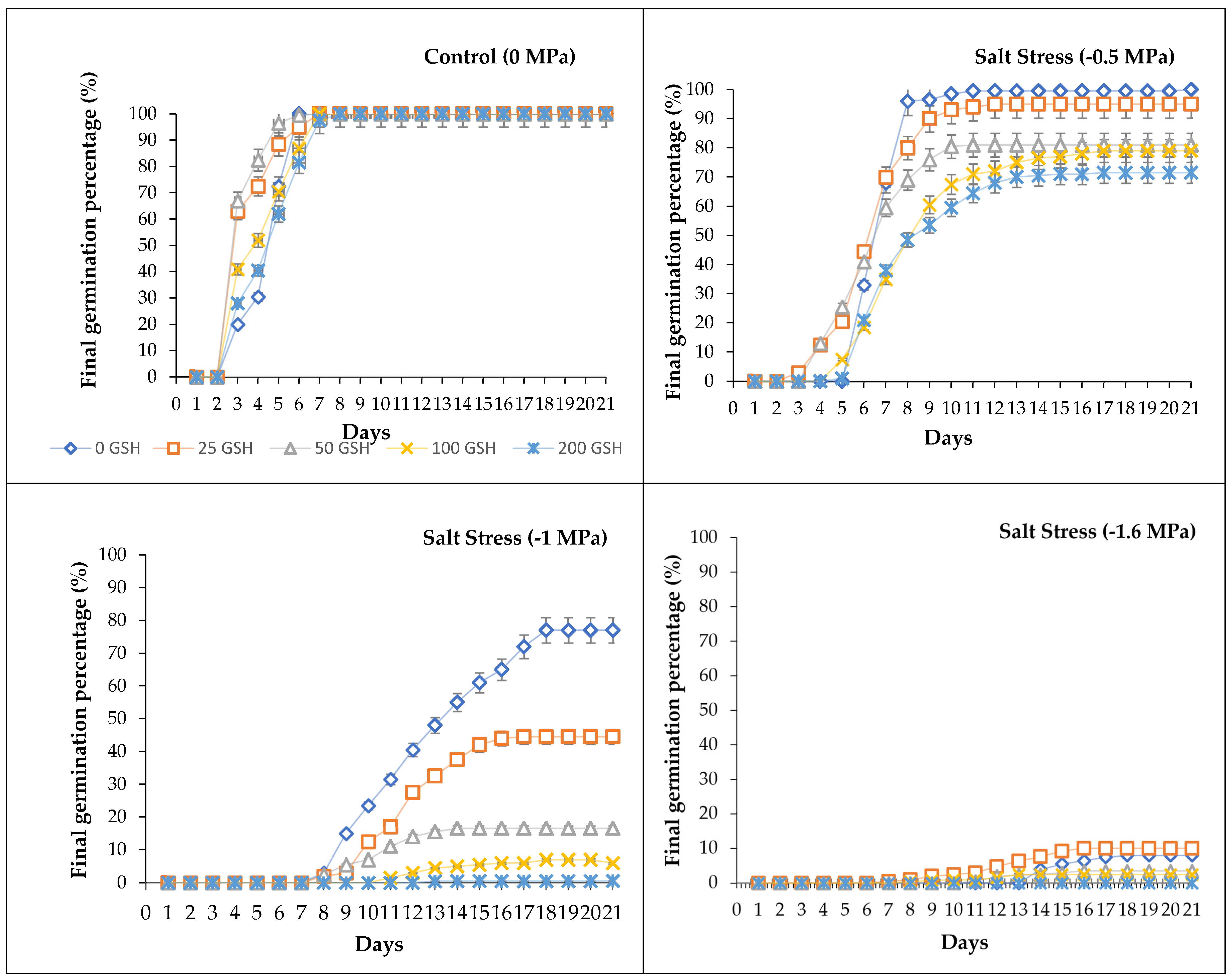
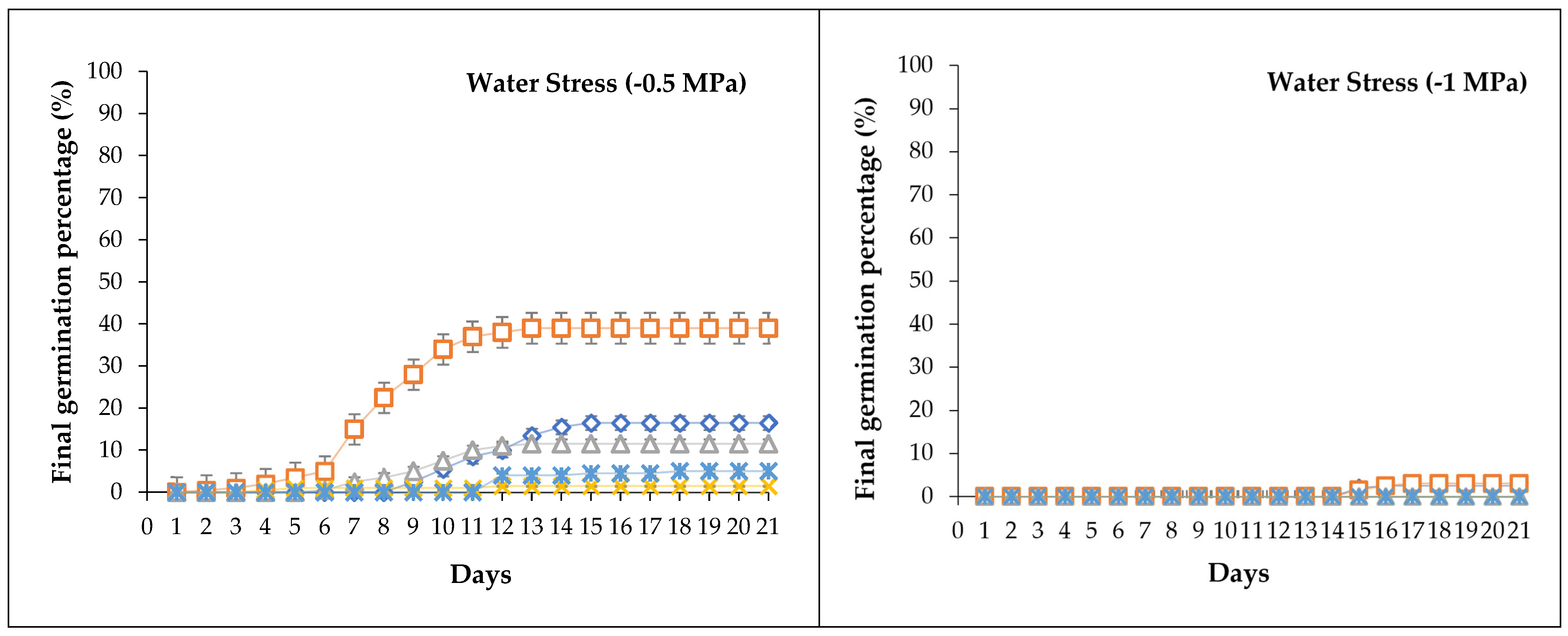
Figure 2.
Variations of maximum germination index (IGmax) and mean time to germination (MTG) of Ceratonia siliqua seeds at various concentrations of glutathione 0. 20. 50. 100 and 200 μM under salt (a) and water stress (b).
Figure 2.
Variations of maximum germination index (IGmax) and mean time to germination (MTG) of Ceratonia siliqua seeds at various concentrations of glutathione 0. 20. 50. 100 and 200 μM under salt (a) and water stress (b).
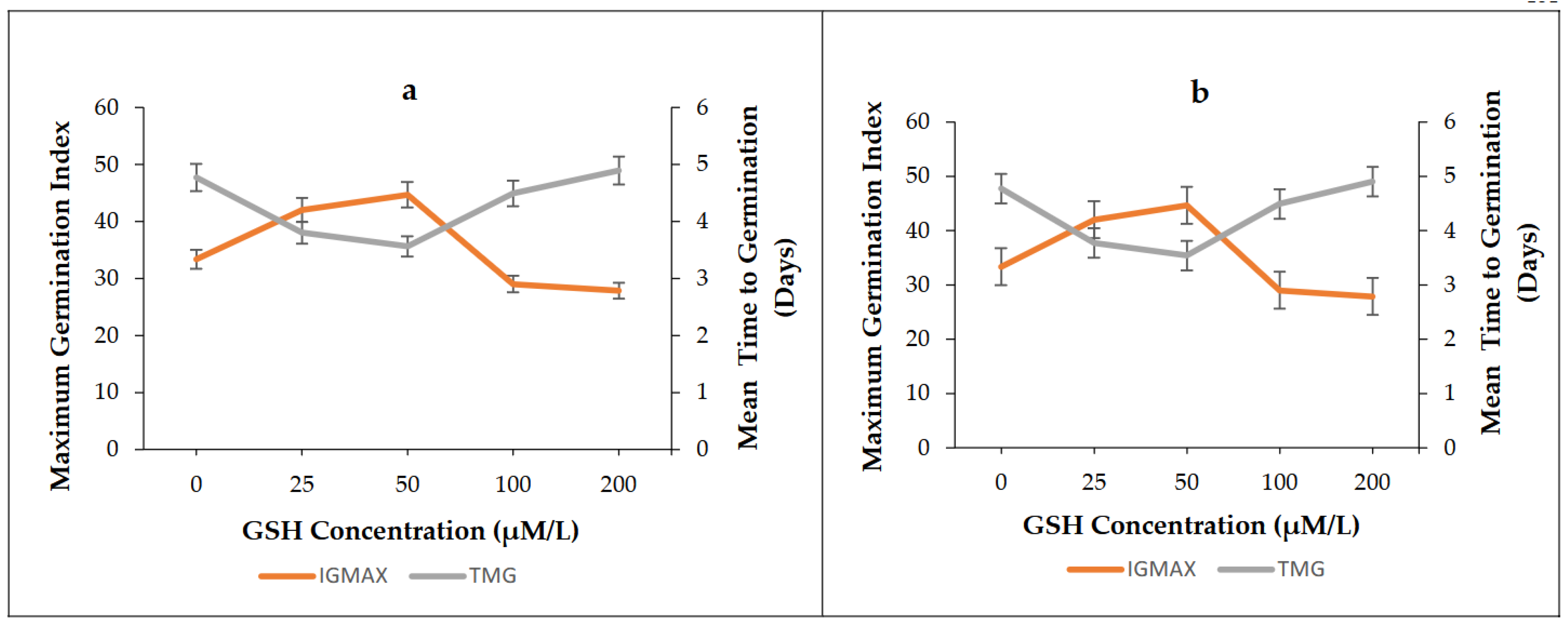
Figure 3.
Final germination percentages of C. siliqua seeds in relation with the different osmotic potentials induced by NaCl (a) and PEG 6000 (b) at different concentrations of glutathione.
Figure 3.
Final germination percentages of C. siliqua seeds in relation with the different osmotic potentials induced by NaCl (a) and PEG 6000 (b) at different concentrations of glutathione.
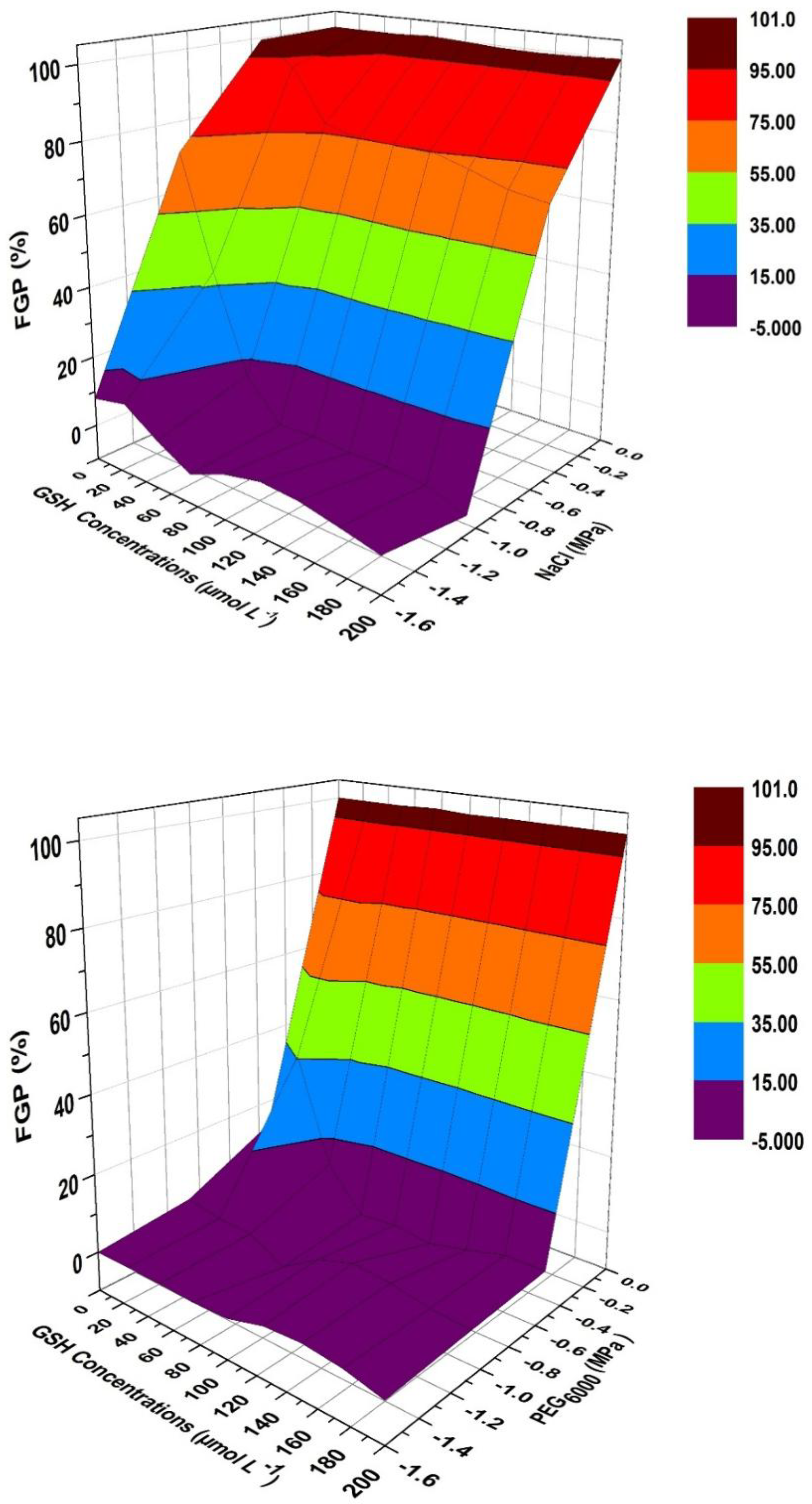
Figure 4.
Heat map correlation between seed germination parameters of C. siliqua under water and salt stress at 25.0°C.
Figure 4.
Heat map correlation between seed germination parameters of C. siliqua under water and salt stress at 25.0°C.
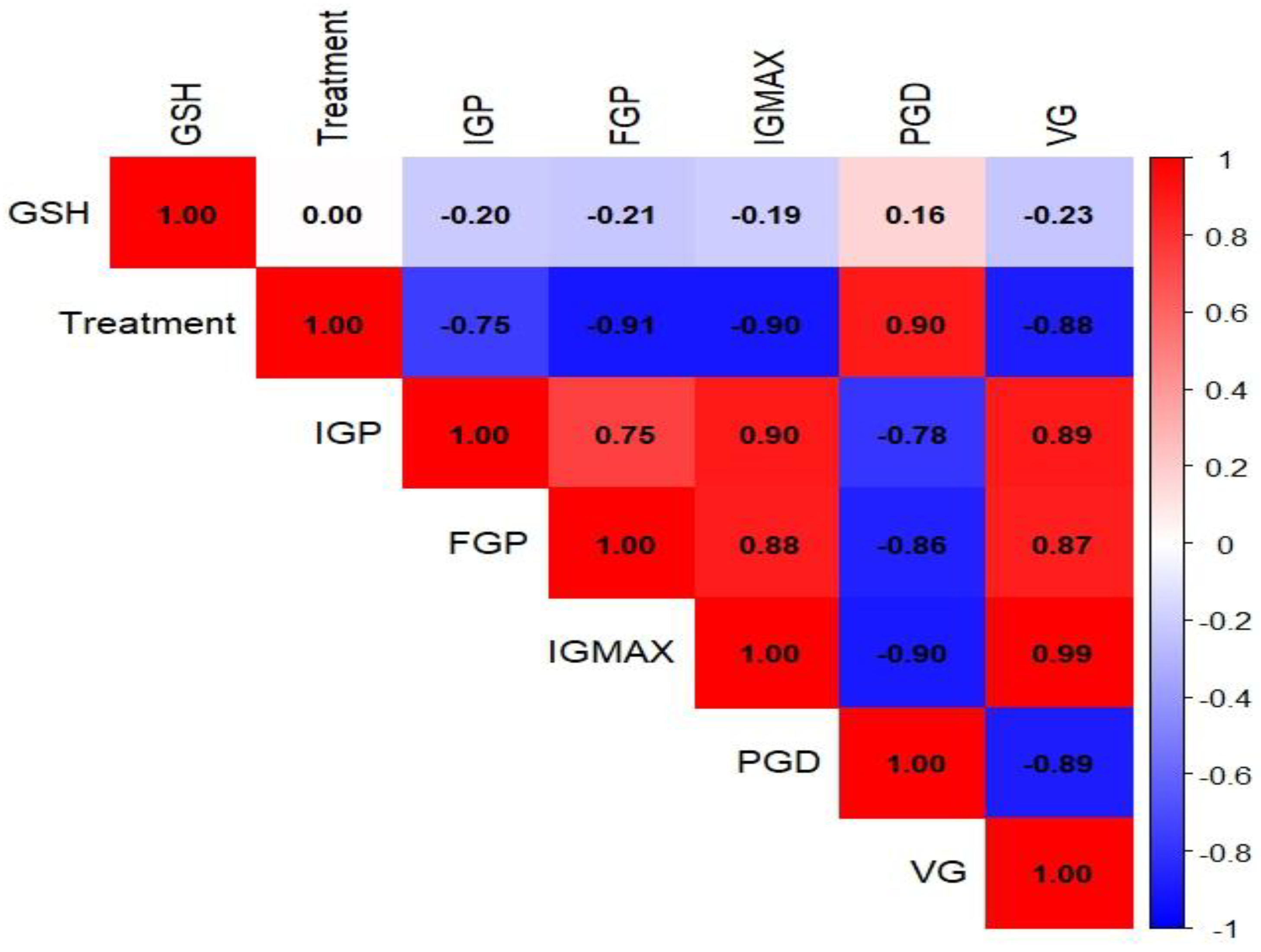

Table 1.
Estimated hydrotime model parameters to describe C. siliqua seeds germination. under various concentrations of glutathione. and in different osmotic and salt stress potentials.
Table 1.
Estimated hydrotime model parameters to describe C. siliqua seeds germination. under various concentrations of glutathione. and in different osmotic and salt stress potentials.
| Salt Stress | Water Stress | |||||||||
| GSH | θH | Ψb(50) | σθH | R2 | p_value | θH | Ψb(50) | σθH | R2 | p_value |
| 0 | 36.334 | -2.012 | 10.489 | 0.818 | p < 0.001 | 36.278 | -1.289 | 10.473 | 0.7 | p < 0.001 |
| 25 | 34.626 | -1.803 | 9.996 | 0.934 | p < 0.001 | 33.761 | -1.346 | 9.746 | 0.839 | p < 0.001 |
| 50 | 30.922 | -1.534 | 9.158 | 0.914 | p < 0.05 | 36.643 | -1.261 | 10.578 | 0.658 | p < 0.05 |
| 100 | 31.723 | -1.469 | 8.926 | 0.876 | p < 0.001 | 37.937 | -1.233 | 10.951 | 0.581 | p < 0.001 |
| 200 | 67.502 | -1.390 | 19.486 | 0.877 | p < 0.001 | 37.474 | -1.243 | 10.818 | 0.608 | p < 0.001 |
θh is the constant hydrotime (MPa days). Ψb (50) is the base water potential for 50% of seeds (MPa). σθH standard deviation of θh among seeds. R2 is the coefficient of determination.
Table 2.
The different germination parameters of Ceratonia siliqua seeds treated with exogenous GSH under different concentrations of NaCl and PEG 6000.
Table 2.
The different germination parameters of Ceratonia siliqua seeds treated with exogenous GSH under different concentrations of NaCl and PEG 6000.
|
Water Stress |
Salt Stress |
|||||||||||||
| IGP | FGP | IGMAX | PGD | VG | GR50 | IGP | FGP | IGMAX | PGD | VG | GR50 | |||
| 0 GSH | 0 | 20±8.12 | 100±0 | 33.33±8.5 | 6 | 1.59 | 4.77 | 20±8.12 | 100±0 | 33.33±8.5 | 6 | 1.59 | 4.77 | |
| -0.5 | 5.5±2.65 | 16.5±10.1 | 2.21±0.13 | 14 | 0.11 | NF | 48±9.34 | 100±0 | 24±7.5 | 8 | 1.14 | 6.95 | ||
| -1 | 2±0.6 | 2.5±1.1 | 0.31±0.13 | 16 | 0.01 | NF | 15±8.42 | 77±12.65 | 8.55±3.63 | 15 | 0.41 | 10.63 | ||
| -1.6 | 0±0 | 0±0 | 0±0 | NF | 0.00 | NF | 4±1.12 | 8±2.65 | 0.88±0.39 | 17 | 0.41 | NF | ||
| 25 GSH | 0 | 60.57±12.82 | 100±0 | 42±11.35 | 3 | 2.00 | 2.62 | 63±7.67 | 100±0 | 42±9.34 | 3 | 2.00 | 2.63 | |
| -0.5 | 10±2.34 | 39±12.04 | 6.7±1.28 | 10 | 0.32 | 11.4 | 9.5±2.63 | 95±9.25 | 20±4.12 | 7 | 0.95 | 7.25 | ||
| -1 | 1.5±0.23 | 3±1.02 | 0.35±0.14 | 17 | 0.02 | NF | 11.5±3.12 | 44.5±7.87 | 5.6±1.37 | 15 | 0.27 | NF | ||
| -1.6 | 0±0 | 0±0 | 0±0 | NF | 0.00 | NF | 4.5±1.41 | 10±2.76 | 1.25±0.47 | 16 | 0.06 | NF | ||
| 50 GSH | 0 | 72±6.32 | 100±0 | 44.66±10.93 | 3 | 2.13 | 2.65 | 67±5.9 | 100±0 | 44.66±9.39 | 3 | 2.13 | 2.66 | |
| -0.5 | 3.5±1.34 | 11.5±4.41 | 1.83±0.67 | 11 | 0.09 | NF | 13±4.78 | 81±8.1 | 17.25±5.32 | 8 | 0.82 | 5.83 | ||
| -1 | 0±0 | 0±0 | 0±0 | NF | 0.00 | NF | 7±3.31 | 16.5±5.2 | 2.3±0.96 | 12 | 0.11 | NF | ||
| -1.6 | 0±0 | 0±0 | 0±0 | NF | 0.00 | NF | 3.5±1.12 | 3.5±1.42 | 0.43±0.19 | 12 | 0.02 | NF | ||
| 100 GSH | 0 | 40±12.04 | 100±0 | 29±5.73 | 6 | 1.38 | 2.83 | 41±7.12 | 100±0 | 29±4.72 | 6 | 1.38 | 2.83 | |
| -0.5 | 1±0.34 | 1.5±0.4 | 0.4±0.1 | 5 | 0.02 | NF | 12.5±5.07 | 79±4.53 | 13.5±4.05 | 10 | 0.64 | 8.13 | ||
| -1 | 0±0 | 0±0 | 0±0 | NF | 0.00 | NF | 3.5±1.05 | 6±2.34 | 0.77±0.34 | 18 | 0.04 | NF | ||
| -1.6 | 0±0 | 0±0 | 0±0 | NF | 0.00 | NF | 2.5±1.4 | 2.5±1.2 | 0.38±0.13 | 18 | 0.02 | NF | ||
| 200 GSH | 0 | 28±11.85 | 100±0 | 27.85±7.43 | 6 | 1.33 | 4.87 | 28±7.0 | 100±0 | 27.85±7.11 | 7 | 1.33 | 4.88 | |
| -0.5 | 4.5±1.04 | 5±2.1 | 0.66±0.23 | 12 | 0.03 | NF | 20±6.76 | 71.5±12.86 | 12.12±4.27 | 8 | 0.58 | 8.2 | ||
| -1 | 0±0 | 0±0 | 0±0 | NF | 0.00 | NF | 0.5±0.1 | 0.5±0.1 | 0.07±0.03 | 14 | 0.00 | NF | ||
| -1.6 | 0±0 | 0±0 | 0±0 | NF | 0.00 | NF | 0±0 | 0±0 | 0±0 | 21 | 0.00 | NF | ||
Table 3.
Analysis of variance (mean squares) of osmotic potential (Nacl and PEG 6000) and their interaction on final germination percentage (FGP).
Table 3.
Analysis of variance (mean squares) of osmotic potential (Nacl and PEG 6000) and their interaction on final germination percentage (FGP).
| Final Germination Percentage (FGP) | ||||
| DDL | F | Pr > F | ||
| Salt Stress | ||||
| Treatments GSH | 4 | 42.55 | <0.0001 | *** |
| NaCl (MPa) | 3 | 1836.10 | <0.0001 | *** |
| Treatments GSH*Salt Stress | 12 | 12.26 | <0.0001 | *** |
| Water Stress | ||||
| Treatments GSH | 4.000 | 20.24 | <0.0001 | *** |
| PFG 6000 (MPa) | 3.000 | 4702.00 | <0.0001 | *** |
| Treatments GSH*Water Stress | 12.000 | 13.16 | <0.0001 | *** |
Disclaimer/Publisher’s Note: The statements, opinions and data contained in all publications are solely those of the individual author(s) and contributor(s) and not of MDPI and/or the editor(s). MDPI and/or the editor(s) disclaim responsibility for any injury to people or property resulting from any ideas, methods, instructions or products referred to in the content. |
© 2026 by the authors. Licensee MDPI, Basel, Switzerland. This article is an open access article distributed under the terms and conditions of the Creative Commons Attribution (CC BY) license (http://creativecommons.org/licenses/by/4.0/).
Copyright: This open access article is published under a Creative Commons CC BY 4.0 license, which permit the free download, distribution, and reuse, provided that the author and preprint are cited in any reuse.