

Submitted:
31 August 2026
Posted:
31 August 2026
You are already at the latest version
Abstract
Edible packaging is commonly evaluated as a material that protects food, reduces conventional packaging, and may deliver active compounds. Its intended ingestion, however, changes the hygienic endpoint: an external surface exposed during manufacture, distribution, retail, and handling can become a direct route of consumer exposure. This critical narrative review introduces Edible Packaging Hygiene (EPH), a lifecycle framework for evaluating microbiological, chemical, allergenic, and physical hazards from raw-material selection to consumption. Low water activity may prevent growth without eliminating pathogens, antimicrobial performance against food-associated targets does not establish the hygienic safety of the packaging surface, and ingestion requires assessment of both migration and the residual material itself. The framework therefore emphasizes process stabilization, prevention of post-process contamination, moisture control, distribution and retail protection, consumer handling, and verification immediately before expected consumption. A secondary-packaging paradox arises when hygienic protection requires an additional non-edible layer, potentially reducing environmental benefits; this trade-off should be assessed at whole-system level rather than inferred from material mass. Research priorities include finished-surface challenge tests, transfer studies, dynamic humidity protocols, realistic retail and consumer simulations, and integrated safety-life-cycle assessment. EPH reframes edible packaging safety around hygienic integrity at the point of consumption.
Keywords:
edible packaging
; food hygiene
; food safety
; lifecycle
; microbial contamination
; direct ingestion
; secondary packaging
; risk assessment
1. Introduction
Conventional food packaging is designed to contain and protect food while remaining outside the diet. Edible films, coatings, pouches, wraps, capsules, and formed containers deliberately weaken that boundary because all or part of the packaging is intended to be consumed. They are produced from polysaccharides, proteins, lipids, or composite systems and may incorporate plasticizers, emulsifiers, antioxidants, antimicrobials, flavours, colours, or nutritionally active ingredients [1,2,3,4,5,6]. The field has expanded in response to interest in food-waste reduction, renewable feedstocks, circular use of by-products, and alternatives to persistent single-use packaging [2,3,4,5,6,7]. Yet technological edibility is not equivalent to hygienic suitability at the moment of ingestion.
Most edible-packaging research asks whether a material forms a continuous film, provides acceptable mechanical and barrier properties, preserves the underlying food, or inhibits selected microorganisms [1,2,3,4,5,6,8]. These are necessary questions, but they treat the edible material mainly as a packaging technology. Intended consumption adds another exposure pathway. Environmental contamination can be transferred through the packaging to food, as with conventional food-contact materials, but contamination or chemical constituents can also be ingested with the packaging itself. Therefore, an edible surface can simultaneously be a barrier, a food-contact material, an ingredient, and a directly consumed environmental interface.
This distinction is especially important after the final manufacturing step that meaningfully reduces microbial contamination. Drying or heating may yield a product with low initial counts, but downstream cutting, printing, filling, transport, display, opening, touching, and domestic storage can recontaminate the surface. Low water activity commonly restricts proliferation, yet foodborne pathogens may remain viable for long periods in low-moisture foods and environments [9,10,11]. Likewise, an antimicrobial film that delays spoilage of a packaged food cannot automatically be considered hygienically safe to eat, because efficacy is organism-, matrix-, dose-, and condition-specific [12,13,14].
Chemical assessment also changes when the material is eaten. Migration testing estimates transfer from a contact material to food, whereas edible packaging may expose the consumer to the migrating fraction and to the residual packaging mass. Proteins may introduce regulated allergens; botanical extracts and essential oils may create dose, purity, interaction, and sensory concerns; agricultural or marine by-products may carry contaminants; and nanoscale structures require case-specific characterization [15,16,17,18,19]. Physical hazards, misidentification of edible and non-edible components, and damaged protective layers add practical risks.
This review proposes Edible Packaging Hygiene (EPH) as the conditions, controls, and evidence required to maintain the microbiological, chemical, allergenic, and physical safety of intentionally consumed packaging throughout its lifecycle. Existing reviews and safety discussions address material composition, migration, antimicrobial systems, allergenicity, regulation, and consumer protection [1,2,3,4,5,6]. The narrower contribution of EPH is to integrate these domains around the lifecycle hygiene of the intentionally consumed external surface, including post-process contamination, handling, and its condition at ingestion. Accordingly, the novelty claimed here is not the first general safety framework for edible packaging, but a distinct point-of-consumption hygiene endpoint. Accordingly, the aim of this review is to critically evaluate the hygiene-specific hazards arising from the intentional consumption of edible food packaging and to examine how microbiological, chemical, allergenic, and physical risks may emerge and change throughout the packaging lifecycle, from raw-material selection and processing to distribution, retail handling, consumer use, and ingestion. On this basis, the review aims to propose EPH as an integrative lifecycle framework centred on hygienic integrity at the point of consumption, and to identify key evidence gaps and priorities for experimental validation, risk assessment, and regulatory development.
1.1. Review Approach
This article was designed as a critical narrative review to support conceptual integration rather than to estimate a pooled effect or claim systematic-review completeness. Literature was identified through iterative searches of Scopus, Web of Science, PubMed, Google Scholar, Crossref, and official European Union and EFSA sources. Searches combined terms relating to edible packaging, edible films, edible coatings, food hygiene, microbial contamination, pathogen survival, water activity, relative humidity, cross-contamination, hand transfer, migration, allergens, nanomaterials, consumer acceptance, secondary packaging, regulation, and life-cycle assessment. The principal search horizon was 2000-August 2026, with a final targeted update on 27 August 2026; earlier seminal studies were retained when they provided direct experimental evidence not replaced by newer work.
Sources were selected purposively according to relevance to the lifecycle hygiene question. Priority was given to primary experimental studies that evaluated edible-film microbiology, survival in low-moisture matrices, external contamination, microbial transfer, humidity-dependent material behaviour, consumer use, or environmental performance. High-quality reviews were used for definitions and synthesis, and current EU legislation and EFSA guidance were used for regulatory and nano-specific statements. Articles focused only on mechanical optimization or food-preservation performance were included only when their findings informed the hygiene of the packaging itself. Because selection was iterative and concept-driven, formal PRISMA screening counts and a quantitative risk-of-bias score were not generated; this limits reproducibility and is acknowledged as a feature of the narrative design.
The evidence was mapped to four hazard classes and six lifecycle control domains. Full texts were used to verify substantive claims whenever accessible; titles, abstracts, and indexed metadata were used for initial relevance screening and bibliographic verification rather than as the sole basis for complex claims. DOI metadata were verified through Crossref, and legal acts were checked against official EU texts. Because the literature is heterogeneous and lacks standardized EPH outcomes, no quantitative synthesis was attempted. The resulting framework should therefore be interpreted as a structured critical synthesis and research agenda, not as a formal systematic-review estimate of risk.
For interpretation, evidence was classified as direct when generated on a finished edible film, coating, container, or consumed surface; indirect when extrapolated from low-moisture foods, hands, conventional food-contact materials, or processing environments; regulatory when derived from binding legislation or authoritative guidance; and proposed when it represented an EPH recommendation formulated by the authors. This hierarchy is used to prevent analogue evidence and conceptual recommendations from being presented as product-specific validation.
2. Edible Packaging as a Distinct Hygienic Category
Edible packaging spans systems with different exposure profiles. A coating formed directly on food may have limited external handling and may be perceived as part of the product. A freestanding film, sachet, straw, cup, or wrapper may be manufactured separately, handled as an object, exposed to retail environments, and intentionally placed in the mouth. The hygienic category should therefore be defined by intended use and actual exposure rather than by material chemistry alone [1,2,3,4].
Three features distinguish the category. First, the packaging surface can become food without a final washing or cooking step. Second, the user may not know which layers, labels, inks, closures, or supports are edible. Third, deterioration that would be merely cosmetic for conventional packaging may alter the safety or acceptability of an edible material. Moisture uptake, cracking, abrasion, delamination, or loss of antimicrobial activity can modify both barrier performance and the fate of contaminants. [1,2,3,4,20,21,22,23]
EPH is complementary to food hygiene and good manufacturing practice. It does not imply that edible packages are intrinsically more hazardous than foods. Rather, it prevents a category error: evidence that a polymer is food grade, that ingredients are permitted, or that a film protects food does not by itself demonstrate safety of the finished package through consumption [24]. The relevant unit of assessment is the complete food-packaging system, including the surface history and the consumer's behaviour.
A risk-based classification could distinguish coatings consumed inseparably with food; primary edible packages protected until opening; exposed edible service items; and composite systems containing edible and non-edible components. Exposure duration, likelihood of touching, expected storage, target population, packaging mass per serving, and presence of a terminal kill step should determine the verification burden. Products for infants, older people, pregnant individuals, or immunocompromised consumers warrant particularly conservative assumptions. [15,18,25,26,27]
3. Microbiological Hazards and Hygienic Stability
Microorganisms may enter edible packaging through biological raw materials, water, processing equipment, air, personnel, rework, or post-process contact [1,2,3,4,5,6,9,10,11,24]. Plant powders, starches, gums, proteins, seaweeds, gelatin, and upcycled side streams can differ in background microbiota and may contain spores, yeasts, moulds, or enteric contamination if sourcing and stabilization are inadequate [5,6,24]. Processing can reduce contamination but may not create commercial sterility; solvent casting commonly combines heating, pH change, mixing, and drying, extrusion applies heat and shear, and coatings may be deposited directly on foods [1,2,3,4,5,6]. Within the proposed EPH approach, validation should identify the last meaningful microbial reduction step and map opportunities for recontamination thereafter, while supplier criteria, hygienic zoning, air control, equipment design, sanitation, personnel practices, and protected transfer should be selected for the intended use [27].
Water activity (aw) is a central but easily misinterpreted property. Many dry films have aw values below those supporting bacterial growth, and moisture-barrier performance varies strongly with relative humidity [20,21,22]. Hydrophilic matrices can absorb water, plasticize, swell, and change surface properties [20,21,22]. More importantly, growth inhibition is not inactivation: Salmonella and other pathogens may persist in low-moisture foods and environments [9,10,11]. This persistence evidence is indirect for edible packaging and should not be converted into product-specific survival estimates without finished-surface testing. Direct studies show that edible films themselves can be microbiologically tested and that counts may persist during storage even when selected target organisms are not detected [24,28].
Transfer efficiency is another missing link. Studies on hands, foods, stainless steel, and conventional food-contact materials show that microbial transfer depends on organism, moisture, contact pressure, time, surface topography, applied weight, and direction of transfer [29,30,31,32]. This is analogue evidence: the reported coefficients cannot be imported directly into an edible-film risk assessment. Biopolymer surfaces may be rough, porous, hygroscopic, oily, charged, tacky, or capable of releasing antimicrobial compounds [1,2,3,4,5,6,19,28]. Product-specific hand-to-edible-surface and surface-to-mouth models are therefore required under realistic contact conditions.
Antimicrobial ingredients can contribute to control, but they should be treated as hurdles whose performance requires validation. Edible films containing organic acids, bacteriocins, plant phenolics, essential oils, or sorbates often inhibit selected organisms on agar or food surfaces [12,13,14,33]. One study directly showed that potassium sorbate released from a tapioca-starch film could help prevent external Zygosaccharomyces bailii contamination, while efficacy depended on pH and release conditions [12]. Such evidence supports feasibility but not universal protection. Activity may decrease because the compound binds to the matrix, partitions into food, volatilizes, degrades, or is diluted by absorbed moisture. A film active against Listeria may be ineffective against Gram-negative pathogens or spores. Testing only inhibition zones or the microbiota of packaged food can therefore overstate hygienic protection of the consumed surface.
Finished-product specifications should include appropriate indicator counts and, where justified, absence or limits for pathogens, yeasts, and moulds. Direct testing of edible biopolymer films intended to be consumed with food supplements has included total counts, coliforms, Enterococcus, Enterobacteriaceae, Escherichia coli, Staphylococcus aureus, Listeria monocytogenes, yeasts, and moulds [24]. A separate study of green-banana-flour films assessed water activity, total aerobic counts, Enterobacteria, and Staphylococcus aureus over storage [28]. These studies demonstrate feasibility of qualifying the material itself, but release testing samples only one point in the lifecycle. Within EPH, shelf-life validation should combine initial quality, environmental monitoring, package-integrity testing, humidity exposure, and challenge studies that inoculate the external finished surface after processing.
Mould control deserves separate attention because some edible matrices contain carbohydrates, proteins, and plant nutrients that become supportive after moisture uptake. Visible growth may lead to rejection, but toxins or allergens can be relevant before extensive spoilage is evident. Conversely, absence of visible mould is not evidence of safety. Specifications for humidity barriers, desiccant use where appropriate, maximum open time, and disposal after damage should be linked to validated product behaviour. [9,10,11,20,21,22,24]
A practical microbiological validation plan should begin with the intended-use profile and a reasoned selection of test organisms. Vegetative bacterial pathogens, spore-formers, yeasts, moulds, and hygienic indicators may have different relevance for a dry wrap, a moist coating, or a formed cup. Challenge organisms and surrogates should reflect raw materials, processing environment, food association, and likely post-process exposure. Recovery methods also require validation because strong adhesion, hydrophobic domains, antimicrobials, or low numbers can reduce analytical recovery and create false reassurance. Neutralizers should be used when residual active compounds could continue killing organisms during sampling. [9,10,11,12,13,14,24,33]
Sampling design should account for heterogeneous contamination. Edges, seams, printed zones, folds, porous regions, and surfaces exposed during opening may differ from flat laboratory coupons. Composite samples can hide local hot spots, whereas very small analytical units may miss them. Validation should therefore include spatially targeted samples and sufficient replicate lots. Where quantitative risk assessment is feasible, uncertainty and variability should be reported separately, and detection limits should be evaluated against the dose-response and population served. [29,30,31,32]
Biofilm terminology should be used carefully. Attachment and persistence on an edible surface do not necessarily demonstrate mature biofilm formation, but production equipment, drains, cutters, rollers, and reusable holders can support persistent microbial niches. Environmental monitoring should connect positive findings to corrective actions, root-cause analysis, intensified cleaning, product disposition, and verification of effectiveness. The goal is not a sterile factory; it is controlled prevention of contamination after the last meaningful reduction step. [27]
4. Chemical, Allergenic and Physical Hazards
Edible-packaging chemistry includes the base biopolymer and every intentional or incidental component. Plasticizers, cross-linkers, surfactants, release agents, processing aids, colours, flavours, antimicrobials, printing substances, adhesives, impurities, reaction products, and other non-intentionally added substances require assessment according to identity, purity, permitted use, and exposure [1,2,3,4,5,6,19,26,34,35,36,37]. Constituents acceptable in a food-contact material at low migration may not be acceptable at the dose resulting from ingestion of the whole article. A practical EPH exposure model is: total dietary exposure = migration into food + ingested residual-package mass multiplied by constituent concentration + relevant background dietary exposure. Average and high-consumer scenarios should be calculated separately, with body-weight-adjusted estimates for children and other vulnerable groups [15,18,25,26,38].
Biological feedstocks require attention to pesticides, veterinary-drug residues, heavy metals, mycotoxins, marine biotoxins, pathogens, and process-derived contaminants. Upcycling fruit pomace, cereal fractions, dairy proteins, or seafood-derived polymers can improve resource efficiency, but circularity does not erase the contaminant history of the raw material [5,6,7,38]. Batch variability and concentration during extraction may be important. Specifications, traceability, validated cleaning, and risk-based analytical plans should be established before claims of sustainability are used as a proxy for safety.
Active and intelligent functions increase complexity. Essential oils and plant extracts may provide antioxidant or antimicrobial effects while also producing irritation, pharmacological activity, interactions, or unacceptable flavour at effective doses. Their composition can vary with cultivar, geography, extraction, and storage. For nanomaterials, particle size distribution, dissolution, agglomeration, surface chemistry, gastrointestinal transformation, and conventional toxicology all matter. EFSA guidance emphasizes physicochemical characterization and nano-specific considerations for food-chain applications [18,19]. An edible nanocomposite requires evidence appropriate to ingestion, not only conventional migration data.
Allergenicity is a direct design constraint. Milk, wheat, soy, egg, fish, crustacean-derived materials, and other proteins may retain allergenic epitopes in films and coatings. The fact that a layer is thin or transparent does not make exposure negligible for sensitized consumers. Allergenic ingredients must enter hazard analysis, cross-contact control, supplier verification, cleaning validation, and labelling under applicable food-information rules [25]. Composite products also need clear communication when only some components are edible.
Physical hazards include fragments from brittle films, hard particles from poorly refined feedstocks, damaged closures, foreign matter, and non-edible labels or supports mistakenly consumed. Mechanical integrity should be assessed after realistic humidity, abrasion, transport, and opening. Design controls should make edible and non-edible parts visually and tactilely distinct, while instructions should remain legible throughout shelf life. A package that is technically edible but predictably confusing is not adequately controlled. [1,2,3,4,25]
Chemical, allergenic, and physical assessments should converge at the finished product. Ingredient compliance is necessary, but interactions, degradation, printing, adhesives, storage, and the quantity actually consumed can change exposure. The most defensible approach is a bill of materials linked to intended use, analytical verification for relevant contaminants, total dietary exposure estimates, and post-market complaint and incident monitoring. [15,18,19,25,26,27,34,35,36,37,38]
Exposure assessment should consider average and high-consumer scenarios. A small wrapper eaten occasionally may contribute little, whereas multiple sachets, straws, cups, or coatings consumed daily can create a different exposure profile. Children may consume more packaging per kilogram of body weight and may be more likely to chew components not intended as food. Scenario analysis should include complete consumption, partial consumption, repeated use, and reasonably foreseeable misuse. When data gaps are material, uncertainty factors and conservative assumptions should be transparent rather than hidden behind the term food grade. [15,18,25,26]
Stability studies should follow chemical change as well as microbial quality. Oxidation of lipids, hydrolysis, loss of volatile actives, polymer cross-linking, colour change, and interactions with light or oxygen can alter exposure and sensory acceptability. Printing systems deserve special scrutiny because consumers may eat the printed surface directly. Food-compatible inks, low-migration concepts, and set-off controls developed for conventional packaging may still be relevant, but intentional ingestion requires confirmation that every component and its likely degradation products are suitable for the anticipated dose. [13,14,19,34,35]
Allergen management must also cover unintentional cross-contact. Shared casting tanks, dryers, cutters, and packing lines may transfer protein between formulations even when the final ingredient list does not contain the allergen. Risk controls should combine scheduling, validated cleaning, segregation, changeover inspection, and verification testing where useful. Precautionary allergen statements should not replace feasible controls, and the decision to use them should follow documented risk assessment. [25,27]
5. Hygiene along the Edible Packaging Lifecycle
EPH begins with product definition. Developers should state which components are intended to be eaten, the expected portion, whether consumption is optional, the target population, storage conditions, and the route by which the consumer accesses the edible surface. Ambiguity at this stage propagates into inappropriate specifications and testing. A hazard analysis should then follow the material from source to ingestion rather than ending at factory release. [26,27]
Raw-material controls include approved suppliers, traceability, microbiological and chemical specifications, allergen status, authenticity, storage, and water quality. For agricultural and upcycled inputs, seasonality and batch variation may require intensified verification. Formulation should select hurdles that remain effective under expected pH, aw, and temperature while staying within acceptable sensory and dietary exposure. [9,10,11,25,27,38]
Manufacturing controls should identify validated time-temperature, drying, irradiation, fermentation, or other stabilization steps. The post-lethality area deserves special protection because cutting, shaping, printing, filling, and packing can expose a large surface area. Environmental monitoring should target relevant niches and indicators; sanitation methods must be compatible with edible materials and should not introduce residues. Rework policies must prevent uncontrolled accumulation of microorganisms, allergens, or active compounds. [1,2,3,4,5,6,27,35]
Storage and distribution can alter both material functionality and microbial fate. Barrier properties, seal integrity, water activity, texture, and active-agent concentration should be monitored across realistic temperature and humidity profiles. Transport abrasion or puncture can expose edible surfaces even when the food remains physically contained. Shelf-life claims should incorporate worst reasonably foreseeable conditions and should define actions after damaged or opened secondary protection. [9,10,11,20,21,22,27,39]
Retail is a distinctive stage for exposed products. Open display, shared dispensers, self-service handling, dust, droplets, utensils, and repeated temperature changes can convert an attractive sustainability concept into an uncontrolled surface-exposure experiment. Formats intended for open retail should be supported by direct contamination and handling evidence. Otherwise, individually protected presentation or controlled dispensing may be necessary. [23,27,29,30,31,32]
Consumer behaviour is the final variable. Consumers may touch the package, place it on tables, share it, store it after opening, separate layers incorrectly, or decide not to eat it. Studies of acceptance show that use context and perceived hygiene affect willingness to consume edible packaging [23,40]. Instructions should explain edibility, storage after opening, damaged-package decisions, allergens, and any non-edible components. Communication should be tested for comprehension and behaviour, not merely noticed in a questionnaire.
Within the proposed EPH framework, verification at the point of consumption should integrate evidence generated across the lifecycle. No single test establishes EPH. A defensible dossier links formulation safety, process validation, environmental control, packaging protection, distribution simulation, challenge testing, consumer-use assumptions, and traceability. Deviations should be evaluated against the final endpoint rather than only against mechanical appearance.
Corrective-action logic should be defined before commercialization. A seal failure, humidity excursion, environmental positive, labelling error, or supplier deviation can affect edible packaging differently from conventional packaging because disposal of an outer layer is not an available consumer control. Decision trees should specify when product can be released, reworked, relabelled, downgraded to a non-edible use, or destroyed. Traceability should link packaging lots to ingredient lots and the packaged food so that withdrawal and recall can be proportionate. [26,27]
Food-service and refill applications need additional controls. Reusable dispensers or holders may reduce material consumption but introduce cleaning, drying, and cross-contamination requirements. Operators should be able to load products without touching consumed surfaces, protect them between service periods, and discard units exposed beyond validated limits. Training should distinguish edible packages from garnishes or conventional service ware and should address allergen communication at the point of sale. [25,27,29,30,31,32]
The lifecycle approach also supports verification of claims. Terms such as edible, compostable, biodegradable, natural, antimicrobial, and plastic-free communicate different properties and should not be treated as interchangeable. A material can be edible without being nutritionally desirable, hygienically robust, home-compostable, or environmentally preferable. Claims should be specific to tested conditions and should not encourage consumption when the protective barrier has been compromised. [3,7,23,39,40]
6. The Secondary-Packaging Paradox: Balancing Hygiene and Sustainability
Edible packaging is frequently presented as a route to less packaging waste, but a consumed surface may itself require protection from humidity, mechanical damage, and contamination. Reviews have long noted that edible primary packaging can be used with non-edible secondary packaging for additional protection [1,2]. Consumer research likewise reports concern that edible films may have been touched by others and a preference for external hygienic protection [23]. This creates the secondary-packaging paradox: eliminating one layer may expose the edible surface, while adding a protective layer may reduce the apparent environmental advantage.
The paradox should not be resolved by assuming that all secondary packaging is wasteful or that edibility is automatically sustainable. Protection can prevent food loss, product rejection, and health risk, whereas an edible article may require resource-intensive ingredients or processing and may not be consumed [7]. The available comparative evidence is still narrow. One life-cycle assessment of edible coffee cups found strong dependence on formulation and use scenario, particularly on whether consumption displaced another snack [39]. This result should not be generalized to other edible-packaging formats; within EPH, the secondary-packaging paradox is therefore presented as a testable design hypothesis requiring product-specific whole-system assessment.
The design objective is therefore the minimum protective system that maintains validated hygienic integrity while minimizing total environmental burden. Options include peelable barriers, hygienic dispensers, grouped rather than individual secondary packs, reusable protective holders, controlled retail presentation, or edible surfaces created only at the point of service. Comparative assessment should include microbial risk, chemical exposure, food waste, consumer behaviour, energy, water, transport, and end-of-life outcomes. Safety and sustainability are joint optimization variables, not sequential marketing claims. [23,29,30,31,32,39]
7. Regulatory Considerations
In the European Union, edible packaging can engage food law, hygiene, food-contact-material, active and intelligent material, additive, flavouring, novel-food, food-information, and packaging-waste regimes. Regulation (EC) No 178/2002 establishes general food-law principles, traceability, and the prohibition on placing unsafe food on the market [26], while Regulation (EC) No 852/2004 establishes hygiene obligations and HACCP-based procedures for food businesses [27]. No single classification applies to every edible-packaging design. Legal characterization should be made case by case according to composition, function, whether the component is integral to the food, how it is presented and marketed, and whether edible and non-edible parts coexist.
Regulation (EC) No 1935/2004 requires food-contact materials not to transfer constituents in quantities that could endanger health or unacceptably change food [34], and Regulation (EC) No 2023/2006 addresses good manufacturing practice [35]. Plastic layers may fall under Regulation (EU) No 10/2011 [36]. Active and intelligent materials are additionally addressed by Regulation (EC) No 450/2009, including requirements relevant to released substances, documentation, and clear identification of non-edible parts [41]. Regulation (EU) 2024/3190 establishes updated restrictions for BPA and other hazardous bisphenols in specified food-contact materials and articles [42]. These instruments remain relevant, but migration alone is not a complete exposure model when the article itself is eaten.
Food information must identify allergens and avoid misleading presentation under Regulation (EU) No 1169/2011 [25]. Depending on composition and history of use, Regulation (EU) 2015/2283 on novel foods may apply [37]. Additives and flavourings require assessment under Regulations (EC) No 1333/2008 and No 1334/2008, respectively [43,44], while active substances and nanoforms require assessment under their applicable frameworks [15,18,41]. Classification should be resolved early with competent authorities because one system may contain a food component, a food-contact layer, an active component, and a non-edible support.
Regulation (EU) 2025/40 on packaging and packaging waste applies from 12 August 2026 and introduces a function-based definition of packaging that can encompass items intended to be used, consumed, or disposed of together with a product, provided they are not integral parts of that product [45]. Commission guidance issued in 2026 confirms that classification depends on function, intended use, and whether the item is integral to the product [46]. Consequently, an edible coating integral to food, a freestanding wrapper, and an edible service cup may not have identical status. Current legislation provides strong general obligations but no dedicated validation standard for lifecycle hygiene of a consumed external surface; EPH is proposed to structure evidence within, rather than replace, the applicable legal regimes [26,27,28,34,35,36,37,41,42,43,44,45,46].
Regulatory submissions and technical files should define intended and foreseeable use, all edible and non-edible components, composition and suppliers, process controls, hazard analysis, exposure calculations, allergen controls, microbiological validation, packaging protection, stability, traceability, recall arrangements, and substantiation of environmental claims. Post-market surveillance should capture hygiene complaints, misuse, allergic reactions, foreign-body events, and non-consumption, because real use can invalidate assumptions made during development. [25,26,27,34,35,36,37]
Responsibility within the supply chain must be explicit. A film manufacturer may validate composition and production, while a food packer changes the moisture environment, a retailer changes surface exposure, and a food-service operator changes handling. Safety information should therefore travel with the product through specifications and instructions, and change-control procedures should trigger reassessment when food composition, pack geometry, printing, distribution, display, or intended use changes. Contractual allocation of tasks does not remove the legal responsibility of each operator for activities under its control. [26,27,34,35]
International commercialization may require different classifications and evidence packages. Definitions of food, food-contact material, additive, processing aid, and novel ingredient are not fully harmonized. A product accepted as a food component in one jurisdiction may require a premarket authorization or a different label elsewhere. Early regulatory mapping can prevent late reformulation and helps determine whether compositional testing, migration testing, toxicology, allergen declaration, nutritional information, or hygiene registration is required. [25,26,27,34,35,36,37]
Within the proposed EPH framework, a future guidance document should avoid prescribing one technology. Instead, it should define performance-based evidence for the point-of-consumption endpoint and provide product categories with escalating validation. Harmonized terminology and reporting would allow regulators, researchers, and businesses to compare results, identify data gaps, and avoid claims based on incomparable laboratory tests.
8. The Edible Packaging Hygiene Framework
The proposed EPH framework organizes control around six connected domains: raw-material safety; process stabilization; post-process exposure control; storage and distribution stability; retail and consumer-stage hygiene; and final hygienic protection. It extends conventional assessment to the condition of the material when it is expected to be eaten. Figure 1 provides the conceptual logic and Table 1 translates it into proposed control questions and evidence requirements. The framework distinguishes direct product evidence, indirect analogue evidence, regulatory requirements, and author-proposed controls; only direct, product-relevant validation can establish performance at the point of consumption.
The proposed EPH framework is deliberately outcome-oriented. Different products may use different barriers, processes, or instructions, but each must support the same endpoint. Evidence should be proportional to exposure and vulnerability. A coating applied immediately before consumption may need a different dossier from a freestanding cup displayed for weeks, yet neither should rely on edibility of ingredients as a substitute for lifecycle validation.
The framework also separates intrinsic stability from external hygiene. Low aw, low pH, or an antimicrobial can reduce risk, but they do not prevent deposition of toxins, allergens, foreign matter, or resistant microorganisms. Likewise, secondary protection is a control measure, not proof of safety; its integrity and removal must be validated. The framework is therefore compatible with HACCP but adds an explicit direct-ingestion endpoint and post-process surface history. [9,10,11,12,13,14,20,21,22,27]
EPH is not proposed as a pass-fail regulatory standard. For operational use, developers should define measurable endpoints before testing: target organisms and recovery limits; survival, growth, or inactivation over the claimed shelf life; aw and relative-humidity profiles; package-integrity criteria; total dietary exposure; allergen and contaminant limits; and instructions for damaged or opened protection. A coating applied shortly before consumption may rely on validated formulation and process control, a protected wrapper additionally requires barrier-integrity and opening simulations, and an exposed service cup requires direct handling, transfer, and retail-display evidence. Acceptance criteria should be justified for the intended population and use rather than transferred between product categories.
9. Research Gaps and Future Priorities
Within the proposed EPH research agenda, the highest-priority gap is finished-surface challenge testing. Existing direct studies demonstrate that finished edible films can be microbiologically characterized [24,28], whereas much of the survival rationale remains extrapolated from low-moisture foods [9,10,11]. Representative pathogens, spoilage organisms, and validated surrogates should therefore be deposited on the external surface after the last reduction step, and survival or inactivation should be measured through realistic storage and use. Reports should separate inability to grow from loss of viability and describe recovery efficiency, neutralization, detection limits, and uncertainty.
A second proposed priority is that transfer studies should simulate hands, gloves, utensils, counters, retail dispensers, food, and mouth contact. Surface roughness, hydrophilicity, pressure, duration, moisture, and direction of transfer should be measured. Data should support quantitative microbial risk assessment rather than qualitative statements that a surface is hygienic. Retail simulation should include repeated touching, damaged barriers, dust, aerosols, and time outside protection. [23,29,30,31,32,40]
Within this proposed research agenda, dynamic moisture protocols should combine humidity and temperature cycling, moisture exchange with food, condensation, opening, and domestic storage with microbiological challenge [9,10,11,20,21,22]. Chemical studies should estimate total dietary exposure from migration, residual-package ingestion, and background sources and should characterize degradation products, non-intentionally added substances, botanical variability, contaminants, allergens, and nanoforms [15,16,17,18,19,28,34,35,36,37,38,41,42,43,44]. Physical studies should test fragmentation, abrasion, and consumer differentiation of edible from non-edible parts under foreseeable use.
The proposed EPH agenda also recommends that consumer research should move beyond purchase intention to observed handling, sharing, storage, consumption, and disposal. Perceived hygiene and measured risk should be analysed separately. Instructions and design cues should be tested experimentally for comprehension and behavioural effect. Special populations and culturally different expectations about eating packaging require inclusion. [23,40]
Finally, the proposed EPH agenda recommends that safety and sustainability should be integrated. Comparative designs should couple life-cycle assessment with microbial risk assessment and chemical exposure where relevant. Standardized minimum reporting would include product definition, composition, packaging mass consumed, initial microbiology, aw and moisture behaviour, terminal process, post-process exposure map, protection system, realistic shelf-life conditions, handling simulation, and measurements immediately before expected consumption. [7,39]

Table 2.
Proposed EPH research agenda and primary outcomes.
| Research area | Proposed approach | Primary outcome |
|---|---|---|
| External-surface contamination | Post-process inoculation of finished products | Survival, growth or inactivation kinetics |
| Human handling | Hand/glove/utensil-to-film transfer experiments | Product-specific transfer coefficients |
| Dynamic moisture | RH/temperature cycling plus challenge testing | aw dynamics and microbial response |
| Retail and distribution | Transport, damage, display and repeated handling simulation | Hygienic integrity after realistic exposure |
| Consumer behaviour | Observation and instruction interventions | Actual handling, consumption and disposal |
| Chemical/allergen exposure | Migration plus residual-package ingestion | Total dietary exposure and risk characterization |
| Secondary protection | Comparative barrier and dispenser configurations | Minimum hygienic protection required |
| Safety-sustainability | LCA plus microbial and chemical risk assessment | Integrated decision criterion |
10. Conclusions
Edible packaging is more than a technological alternative to conventional food-contact materials. Once a packaging component is intended for consumption, its external surface and constituents become potential direct routes of consumer exposure. Safety assessment should therefore extend beyond the ability of the package to protect food and determine whether the edible material remains hygienically suitable throughout its lifecycle.
This review proposes EPH as an integrative approach encompassing raw-material safety, process stabilization, prevention of post-process contamination, storage and distribution stability, retail and consumer-stage hygiene, and final protection. Microbiological stability against growth should not be conflated with elimination of contaminants, and antimicrobial performance against a selected food-associated target should not be conflated with safety of the consumed surface. Chemical assessment should combine migration with ingestion of residual material.
Future validation should prioritize finished-surface challenge testing, realistic humidity and handling conditions, post-process recontamination, consumer behaviour, and total dietary exposure. Hygienic protection must also be reconciled with sustainability through whole-system assessment. EPH reframes the decisive question: not only whether edible packaging can safely protect food, but whether it remains safe to eat after performing that function.
Author Contributions
Conceptualization, W.K., and J.T.; methodology, W.K., and J.T.; software, W.K., and J.T.; writing—original draft preparation, X.X.; writing—review and editing, X.X.; visualization, X.X.; supervision, W.K., and J.T. All authors have read and agreed to the published version of the manuscript.
Funding
This research received no external funding.
Institutional Review Board Statement
Not applicable.
Informed Consent Statement
Not applicable.
Data Availability Statement
No new data were created or analyzed in this study. Data sharing is not applicable to this article.
Conflicts of Interest
The authors declare no conflicts of interest.
Abbreviations
The following abbreviations are used in this manuscript:
| aw | Water activity |
| EPH | Edible Packaging Hygiene |
| EFSA | European Food Safety Authority |
| GMP | Good Manufacturing Practice |
| HACCP | Hazard Analysis and Critical Control Points |
| LCA | life-cycle assessment |
| MRA | microbial risk assessment |
| RH | relative humidity |
References
- Janjarasskul, T.; Krochta, J.M. Edible Packaging Materials. Annu. Rev. Food Sci. Technol. 2010, 1, 415–448. [Google Scholar] [CrossRef] [PubMed]
- Falguera, V.; Quintero, J.P.; Jimenez, A.; Munoz, J.A.; Ibarz, A. Edible films and coatings: Structures, active functions and trends in their use. Trends Food Sci. Technol. 2011, 22, 292–303. [Google Scholar] [CrossRef]
- Trajkovska Petkoska, A.; Daniloski, D.; D'Cunha, N.M.; Naumovski, N.; Broach, A.T. Edible packaging: Sustainable solutions and novel trends in food packaging. Food Res. Int. 2021, 140, 109981. [Google Scholar] [CrossRef] [PubMed]
- Hassan, B.; Chatha, S.A.S.; Hussain, A.I.; Zia, K.M.; Akhtar, N. Recent advances on polysaccharides, lipids and protein based edible films and coatings: A review. Int. J. Biol. Macromol. 2018, 109, 1095–1107. [Google Scholar] [CrossRef] [PubMed]
- Galus, S.; Kadzinska, J. Food applications of emulsion-based edible films and coatings. Trends Food Sci. Technol. 2015, 45, 273–283. [Google Scholar] [CrossRef]
- Suhag, R.; Kumar, N.; Petkoska, A.T.; Upadhyay, A. Film formation and deposition methods of edible coating on food products: A review. Food Res. Int. 2020, 136, 109582. [Google Scholar] [CrossRef] [PubMed]
- Dilkes-Hoffman, L.S.; Lane, J.L.; Grant, T.; Pratt, S.; Lant, P.A.; Laycock, B. Environmental impact of biodegradable food packaging when considering food waste. J. Clean. Prod. 2018, 180, 325–334. [Google Scholar] [CrossRef]
- Karnwal, A.; Kumar, G.; Singh, R.; Selvaraj, M.; Malik, T.; Al Tawaha, A.R.M. Natural biopolymers in edible coatings: Applications in food preservation. Food Chem. X 2025, 25, 102171. [Google Scholar] [CrossRef] [PubMed]
- Podolak, R.; Enache, E.; Stone, W.; Black, D.G.; Elliott, P.H. Sources and risk factors for contamination, survival, persistence, and heat resistance of Salmonella in low-moisture foods. J. Food Prot. 2010, 73, 1919–1936. [Google Scholar] [CrossRef] [PubMed]
- Beuchat, L.R.; Komitopoulou, E.; Beckers, H.; Betts, R.P.; Bourdichon, F.; Fanning, S.; Joosten, H.M.; Ter Kuile, B.H. Low-water activity foods: Increased concern as vehicles of foodborne pathogens. J. Food Prot. 2013, 76, 150–172. [Google Scholar] [CrossRef] [PubMed]
- Finn, S.; Condell, O.; McClure, P.; Amezquita, A.; Fanning, S. Mechanisms of survival, responses and sources of Salmonella in low-moisture environments. Front. Microbiol. 2013, 4, 331. [Google Scholar] [CrossRef] [PubMed]
- Flores, S.; Haedo, A.S.; Campos, C.; Gerschenson, L. Antimicrobial performance of potassium sorbate supported in tapioca starch edible films. Eur. Food Res. Technol. 2007, 225, 375–384. [Google Scholar] [CrossRef]
- Rojas-Grau, M.A.; Avena-Bustillos, R.J.; Friedman, M.; Henika, P.R.; Martin-Belloso, O.; McHugh, T.H. Mechanical, barrier, and antimicrobial properties of apple puree edible films containing plant essential oils. J. Agric. Food Chem. 2006, 54, 9262–9267. [Google Scholar] [CrossRef] [PubMed]
- Seydim, A.C.; Sarikus, G. Antimicrobial activity of whey protein based edible films incorporated with oregano, rosemary and garlic essential oils. Food Res. Int. 2006, 39, 639–644. [Google Scholar] [CrossRef]
- European Food Safety Authority Scientific Committee. Guidance on risk assessment of nanomaterials to be applied in the food and feed chain: Human and animal health. EFSA J. 2021, 19, 6768. [Google Scholar] [CrossRef] [PubMed]
- Rhim, J.W.; Park, H.M.; Ha, C.S. Bio-nanocomposites for food packaging applications. Prog. Polym. Sci. 2013, 38, 1629–1652. [Google Scholar] [CrossRef]
- Dehghani, S.; Hosseini, S.V.; Regenstein, J.M. Edible films and coatings in seafood preservation: A review. Food Chem. 2018, 240, 505–513. [Google Scholar] [CrossRef] [PubMed]
- European Food Safety Authority Scientific Committee. Guidance on technical requirements for regulated food and feed product applications to establish the presence of small particles including nanoparticles. EFSA J. 2021, 19, 6769. [Google Scholar] [CrossRef] [PubMed]
- Mellinas, C.; Valdes, A.; Ramos, M.; Burgos, N.; Garrigos, M.C.; Jimenez, A. Active edible films: Current state and future trends. J. Appl. Polym. Sci. 2016, 133, 42631. [Google Scholar] [CrossRef]
- Gontard, N.; Guilbert, S.; Cuq, J.L. Water and glycerol as plasticizers affect mechanical and water vapor barrier properties of an edible wheat gluten film. J. Food Sci. 1993, 58, 206–211. [Google Scholar] [CrossRef]
- Debeaufort, F.; Quezada-Gallo, J.A.; Voilley, A. Edible films and coatings: Tomorrow's packagings: A review. Crit. Rev. Food Sci. Nutr. 1998, 38, 299–313. [Google Scholar] [CrossRef] [PubMed]
- McHugh, T.H.; Avena-Bustillos, R.; Krochta, J.M. Hydrophilic edible films: Modified procedure for water vapor permeability and explanation of thickness effects. J. Food Sci. 1993, 58, 899–903. [Google Scholar] [CrossRef]
- Koukoumaki, D.I.; Gkatzionis, K.; Panagiotou, M.; Sarris, D. Consumer perception of novel edible films produced by single cell protein derived from cheese whey bio-valorization. J. Sens. Stud. 2024, 39, e70004. [Google Scholar] [CrossRef]
- Gheorghita Puscaselu, R.; Besliu, I.; Gutt, G. Edible biopolymers-based materials for food applications-the eco alternative to conventional synthetic packaging. Polymers 2021, 13, 3779. [Google Scholar] [CrossRef] [PubMed]
- European Parliament and Council. Regulation (EU) No 1169/2011 on the provision of food information to consumers. Off. J. Eur. Union 2011, L304, 18–63. [Google Scholar]
- European Parliament and Council. Regulation (EC) No 178/2002 laying down the general principles and requirements of food law. Off. J. Eur. Communities 2002, L31, 1–24. [Google Scholar]
- European Parliament and Council. Regulation (EC) No 852/2004 on the hygiene of foodstuffs. Off. J. Eur. Union 2004, L139, 1–54. [Google Scholar]
- Salazar, D.; Arancibia, M.; Casado, S.; Viteri, A.; Lopez-Caballero, M.E.; Montero, M.P. Green banana (Musa acuminata AAA) wastes to develop an edible film for food applications. Polymers 2021, 13, 3183. [Google Scholar] [CrossRef] [PubMed]
- Chen, Y.; Jackson, K.M.; Chea, F.P.; Schaffner, D.W. Quantification and variability analysis of bacterial cross-contamination rates in common food service tasks. J. Food Prot. 2001, 64, 72–80. [Google Scholar] [CrossRef] [PubMed]
- Kusumaningrum, H.D.; Riboldi, G.; Hazeleger, W.C.; Beumer, R.R. Survival of foodborne pathogens on stainless steel surfaces and cross-contamination to foods. Int. J. Food Microbiol. 2003, 85, 227–236. [Google Scholar] [CrossRef] [PubMed]
- Perez-Rodriguez, F.; Valero, A.; Carrasco, E.; Garcia, R.M.; Zurera, G. Understanding and modelling bacterial transfer to foods: A review. Trends Food Sci. Technol. 2008, 19, 131–144. [Google Scholar] [CrossRef]
- Maitz, S.; Schmid, P.J.; Kittinger, C. Modelling and determination of parameters influencing the transfer of microorganisms from food contact materials. Int. J. Environ. Res. Public Health 2022, 19, 2996. [Google Scholar] [CrossRef] [PubMed]
- Campos, C.A.; Gerschenson, L.N.; Flores, S.K. Development of edible films and coatings with antimicrobial activity. Food Bioprocess Technol. 2011, 4, 849–875. [Google Scholar] [CrossRef]
- European Parliament and Council. Regulation (EC) No 1935/2004 on materials and articles intended to come into contact with food. Off. J. Eur. Union 2004, L338, 4–17. [Google Scholar]
- European Commission. Commission Regulation (EC) No 2023/2006 on good manufacturing practice for materials and articles intended to come into contact with food. Off. J. Eur. Union 2006, L384, 75–78. [Google Scholar]
- European Commission. Commission Regulation (EU) No 10/2011 on plastic materials and articles intended to come into contact with food. Off. J. Eur. Union 2011, L12, 1–89. [Google Scholar]
- European Parliament and Council. Regulation (EU) 2015/2283 on novel foods. Off. J. Eur. Union 2015, L327, 1–22. [Google Scholar]
- European Commission. Commission Regulation (EU) 2023/915 on maximum levels for certain contaminants in food. Off. J. Eur. Union 2023, L119, 103–157. [Google Scholar]
- Anand, K.; Martinez Arce, A.; Bishop, G.; Styles, D.; Fitzpatrick, C. A tasty solution to packaging waste? Life cycle assessment of edible coffee cups. Resour. Conserv. Recycl. 2024, 201, 107320. [Google Scholar] [CrossRef]
- Taylor, S.; Colonna, A.; Jung, J.; Gutierrez, J.; Zhao, Y. Consumer perception and acceptance of edible packaging for various food products. J. Food Sci. 2024, 89, 2423–2437. [Google Scholar] [CrossRef] [PubMed]
- European Commission. Commission Regulation (EC) No 450/2009 on active and intelligent materials and articles intended to come into contact with food. Off. J. Eur. Union 2009, L135, 3–11. [Google Scholar]
- European Commission. Commission Regulation (EU) 2024/3190 on the use of bisphenol A and other bisphenols and bisphenol derivatives in certain food-contact materials and articles. Off. J. Eur. Union 2024, L, 2024/3190. [Google Scholar]
- European Parliament and Council. Regulation (EC) No 1333/2008 on food additives. Off. J. Eur. Union 2008, L354, 16–33. [Google Scholar]
- European Parliament and Council. Regulation (EC) No 1334/2008 on flavourings and certain food ingredients with flavouring properties. Off. J. Eur. Union 2008, L354, 34–50. [Google Scholar]
- European Parliament and Council. Regulation (EU) 2025/40 on packaging and packaging waste. Off. J. Eur. Union 2025, L, 2025/40. [Google Scholar]
- European Commission. Commission Notice: Guidance document for Regulation (EU) 2025/40 on packaging and packaging waste. Off. J. Eur. Union 2026, C, C/2026/3084. [Google Scholar]
Figure 1.
Conceptual logic of Edible Packaging Hygiene. The framework connects the need created by intended ingestion and surface exposure with lifecycle control stages and the final endpoint of hygienic integrity at the point of consumption.
Figure 1.
Conceptual logic of Edible Packaging Hygiene. The framework connects the need created by intended ingestion and surface exposure with lifecycle control stages and the final endpoint of hygienic integrity at the point of consumption.
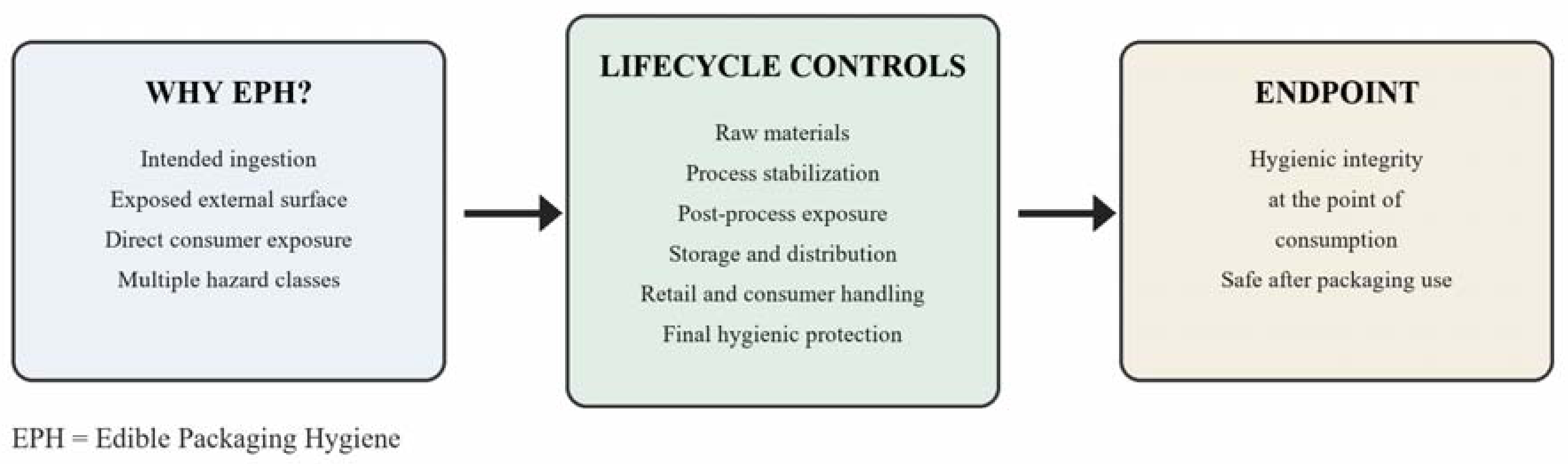
Table 1.
Proposed EPH lifecycle framework: control domains, questions and evidence requirements.
| Control domain | Core question | Proposed evidence requirements |
|---|---|---|
| Raw-material safety | Hazards and variability of ingredients, water and upcycled feedstocks | Supplier approval; specifications; traceability; microbiological and chemical testing |
| Process stabilization | What step achieves meaningful reduction and what survives? | Validated time-temperature/drying process; lethality evidence; deviation limits |
| Post-process exposure | Where can the edible surface be recontaminated? | Hygienic zoning; sanitation; environmental monitoring; protected transfer |
| Storage and distribution | Can humidity, time or damage change risk? | aw/RH studies; seal and barrier integrity; distribution simulation; shelf-life validation |
| Retail and consumer hygiene | How is the surface displayed, touched, opened and stored? | Handling/transfer studies; controlled display; comprehensible instructions |
| Final hygienic protection | Is the article suitable to eat at the expected endpoint? | Finished-surface challenge tests; total exposure; verification at consumption |
Disclaimer/Publisher’s Note: The statements, opinions and data contained in all publications are solely those of the individual author(s) and contributor(s) and not of MDPI and/or the editor(s). MDPI and/or the editor(s) disclaim responsibility for any injury to people or property resulting from any ideas, methods, instructions or products referred to in the content. |
© 2026 by the authors. Licensee MDPI, Basel, Switzerland. This article is an open access article distributed under the terms and conditions of the Creative Commons Attribution (CC BY) license (http://creativecommons.org/licenses/by/4.0/).
Copyright: This open access article is published under a Creative Commons CC BY 4.0 license, which permit the free download, distribution, and reuse, provided that the author and preprint are cited in any reuse.