
Submitted:
31 August 2026
Posted:
31 August 2026
You are already at the latest version
Abstract
The artificial intelligence integrated aerodynamic flow control mechanisms is an important direction for improving the performance of Vertical Axis Wind Turbines (VAWTs). Despite their advantage as urban energy systems, VAWTs have the disadvantage of comparatively lower efficiency to Horizontal Axis Wind Turbines (HAWTs). The reasons are dynamic stalls, flow separation, and negative torque generation on returning blades. This review systematically examines the current state of research across three interconnected domains: VAWT performance challenges, deflector-based aerodynamic enhancement, and artificial intelligence applications in wind energy systems. The analysis reveals that while deflector-assisted designs can improve power coefficients by 15% to 60% depending on configuration, most existing solutions employ fixed-angle deflectors that cannot adapt to fluctuating wind conditions. Simultaneously, AI techniques, particularly reinforcement learning, have demonstrated strong potential for real-time optimization but remain largely confined to HAWT applications or offline design optimization. A critical research gap exists at the intersection of these domains, with limited studies combining AI-driven adaptive control with deflector mechanisms for VAWTs. This article reviewed recent research works with preferred reporting items for systematic reviews and meta-analyses (PRISMA), identified the research gap of adaptive deflector control, and proposed a framework of creating smart, self-improving vertical axis wind turbine (S-VAWT) systems.
Keywords:
Vertical Axis Wind Turbine
; deflector
; reinforcement learning
; adaptive control
; power coefficient
; urban wind energy
; dynamic stall
1. Introduction
The development of Vertical Axis Wind Turbines (VAWTs) is used as an important energy system due to its suitability as an urban energy system. Unlike the horizontal axis counterparts, VAWTs offer advantages in many areas such as turbulent, multi directional, and low speed wind conditions, these are the conditions found in cities and rooftops. Their omni directional capability eliminates the need for complex yaw mechanisms, and their lower noise emissions, reduced visual footprint, and easier maintenance due to ground level component placement make them particularly appealing for distributed energy generation [1].
Despite these operational benefits, the VAWTs have technical limitations of lower aerodynamic efficiency, relative to Horizontal Axis Wind Turbines (HAWTs) [2]. This efficiency gap becomes particularly significant when considering the global wind energy landscape. According to the Global Wind Energy Council, total installed wind power capacity exceeded 1500 GW by the end of 2025, yet VAWTs account for less than 2% of this market, and within small scale and niche applications. The estimates from urban wind potential studies indicate that rooftops and built environments in major cities could collectively generate between 50 to 200 TWh annually if properly harvested. The difference between technical potential and actual deployment underscores the urgent need for performance enhancement and innovations to make the VAWTs competitive for energy generation. The main efficiency gap, such as reduced power coefficients and less effective self-starting characteristics, has driven research into aerodynamic enhancements and intelligent control strategies. Among the proposed solutions, flow deflection structures such as guide vans, diffusers, or deflector plates have shown potential in improving overall performance [3,4,5].
Yet, static deflector systems are limited by their inability to adapt to fluctuating wind conditions, and variable turbine rotational speeds. This limitation has motivated the integration of artificial intelligence-based control systems, which can regulate deflector orientation in real time. By leveraging machine learning algorithms, predictive models, frameworks, an AI controlled deflector system can optimize the VAWT rotor, potentially increasing the energy yield, reducing structural fatigue, and improving self starting behaviour under low wind speeds [6,7].
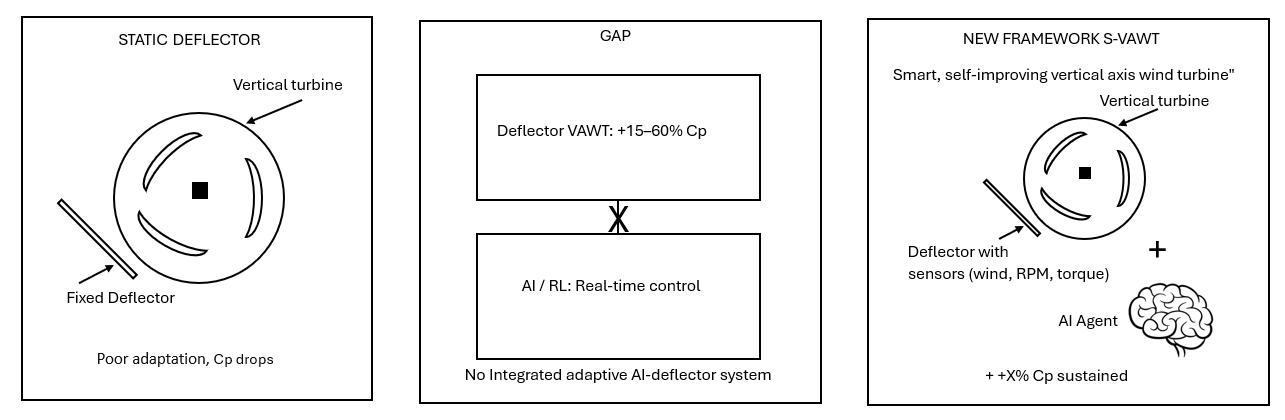
Previous reviews focused solely on VAWT aerodynamics [8] or standalone AI control, this work specifically addresses the intersection of adaptive deflector mechanisms and intelligent control algorithms. Consequently, the investigation of AI based deflector controlled VAWTs represents a novel interdisciplinary frontier, combining computational intelligence, fluid dynamics, and renewable energy engineering. This review aims to systematically examine the existing literature across these domains, identify research gaps, and propose a framework for future investigations. Figure 1 shows schematic representation of VAWT configurations.
2. Materials and Methods
This review was conducted using the Preferred Reporting Items for Systematic Reviews and Meta-Analyses (PRISMA) framework to ensure a transparent and reproducible literature selection process. The objective was to identify and synthesize studies related to Vertical Axis Wind Turbine (VAWT) aerodynamic challenges, deflector-based performance enhancement, and Artificial Intelligence techniques for adaptive control.
A comprehensive search was conducted in the databases Scopus, Web of Science, ScienceDirect, and Google Scholar. Publications from 2008 to 2026 were considered, with emphasis on studies published between 2020 and 2026. The search employed combinations of keywords including: “vertical axis wind turbine” OR “VAWT”; “deflector” OR “guide vane” OR “flow augmentation”; “artificial intelligence” OR “machine learning” OR “reinforcement learning”; “adaptive control” OR “real-time optimization”.
3. VAWT Performance Challenges
The performance of vertical axis wind turbines is having several aerodynamic challenges that have been documented in the literature. These challenges significantly affect energy conversion efficiency, structural reliability, and operational stability. Understanding these limitations is essential for developing effective enhancement strategies and justifies the need for advanced control and design approaches [9]. Key parameters such as the power coefficient, tip speed ratio, and torque coefficient are widely used. The power coefficient represents the efficiency of energy extraction from the wind and is defined as:
(1)
where is the turbine power output, is air density, is the swept area, and is the free-stream wind velocity.
The operational state of the turbine is typically characterized by the tip speed ratio (TSR):
(2)
where is the angular velocity of the rotor and is the turbine radius. The TSR strongly influences blade aerodynamics, including angle of attack and dynamic stall behaviour.
3.1. Negative Torque on Returning Blades
A fundamental limitation in VAWTs is the occurrence of negative torque during the returning phase of blade rotation. As the blade moves against the incoming wind, it experiences drag forces that oppose rotation. The net torque generated by the rotor can be expressed as:
T net = T advancing + T returning
where the returning blade contribution becomes negative over part of the rotation cycle. For normalized analysis, the torque coefficient is defined as:
(3)
Negative values of , during the return phase reduce the overall energy conversion efficiency and directly impact the power coefficient , since:
P=T⋅ω (4)
Thus, reductions in net torque translate directly into reduced power output. In addition to efficiency losses, the periodic variation between positive and negative torque introduces cyclic loading on the turbine structure. These fluctuations can lead to fatigue damage in blades, shafts, and support structures, thereby reducing the operational lifespan of the turbine.
3.2. Flow Separation and Dynamic Stall
Air separation from the blade surface is called boundary layer detachment. When this happens, lift is lost. Drag increases quickly. In VAWTs, this effect is stronger. This is because the blade angle keeps changing. This causes dynamic stall. The airflow becomes unsteady and complex. It is hard to predict and control. In a Darrieus VAWT, the blade angle can go above 30°. This is higher than the normal stall angle. Because of this, fast control methods are needed [10].They must react within one blade rotation. Sun et al. [11] showed the limits of passive control. Passive systems cannot react quickly to wind changes. Le Fouest and Mulleners [12] studied this problem. They called it the dynamic stall issue. It is still a major challenge. It reduces the efficiency of VAWTs. The lift and drag forces acting on a blade are typically expressed as:
and (5)
where is the relative velocity experienced by the blade, is the chord length, and , are the lift and drag coefficients, respectively.
In VAWTs, the relative velocity and angle of attack vary continuously with the azimuthal position of the blade. The instantaneous angle of attack, can be approximated as:
(6)
where is the azimuthal angle. At low TSR values, this angle can become very large, often exceeding the static stall angle, which leads to dynamic stall.
3.3. Performance Dependence on Wind Conditions
The performance of VAWTs is highly sensitive to variations in wind conditions, including wind speed, direction, and turbulence intensity. Variations in wind speed, direction, and turbulence intensity directly affect the relative velocity and angle of attack experienced by the blades. Since the power output is proportional to the cube of wind speed: P∝V3, even small fluctuations in wind velocity can result in significant changes in power generation. Due to their omnidirectional design, VAWTs operate under continuously changing relative wind angles, which directly influence the aerodynamic forces acting on the blades. Zhang and Hu [13] studied this in a wind tunnel. They showed that performance changes with wind conditions. This strong dependence on external wind conditions limits the effectiveness of static optimization approaches. Because of this, fixed design methods are not suitable for actual applications. Consequently, there is a growing need for adaptive systems.
3.4. Comparative Analysis of VAWT Types
VAWTs can be broadly classified into lift-based and drag-based configurations, each exhibiting distinct aerodynamic characteristics. Darrieus-type turbines, which operate primarily on lift forces, typically achieve higher power coefficients but suffer from poor self-starting capability. In contrast, Savonius-type turbines rely on drag forces, resulting in lower efficiency but improved starting performance. Table 1 shows the comparative Performance Characteristics of wind turbines.
Hybrid configurations that combine Darrieus and Savonius features have been proposed to balance these characteristics. While such designs can offer moderate improvements in both efficiency and self-starting behavior, they still face limitations associated with unsteady aerodynamics and sensitivity to wind conditions. The relationship between power coefficient and TSR is commonly used to evaluate turbine performance:
Cp=f(λ) (7)
Each turbine design has an optimal TSR at which is maximized. However, due to fluctuating wind conditions, maintaining operation at this optimal point is challenging for VAWTs. This further emphasizes the importance of adaptive control mechanisms to sustain high efficiency across a range of operating conditions.
4. Deflector Based Aerodynamic Enhancement
Given the performance limitations inherent to VAWTs, researchers have explored various aerodynamic enhancement techniques. Among these, flow deflectors have emerged as one of the most promising and cost-effective approaches.
4.1. Working Principles of Deflectors
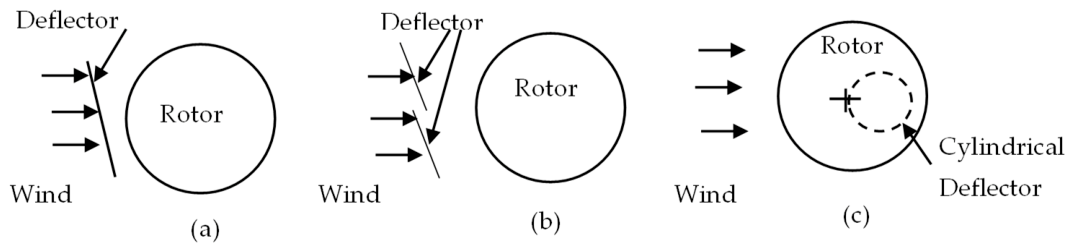
Deflectors are designed to modify the flow field around a VAWT to improve its aerodynamic performance. Their primary functions include redirecting incoming airflow toward the advancing blade to increase positive torque, shielding the returning blade to reduce drag and negative torque, and concentrating flow energy into the rotor swept area to increase effective wind speed at the blades. Chen et al. [4] demonstrated through numerical simulation that a double deflector configuration significantly improves aerodynamic efficiency by optimizing flow interaction with turbine blades. Their work showed that carefully positioned deflectors can create a favourable pressure distribution around the rotor, enhancing the net torque generation.
4.2. Reported Performance Improvements
Studies show that deflectors can improve VAWT performance. Al-Khawlani et al. [5] did a numerical study with an inner cylindrical deflector. They found about 15% increase in power. Ghafoorian et al. [3] added extra blades and deflectors. This helps the turbine start more easily and reported performance improvements. Saham et al. [14] confirmed these results by both experiments and computational analysis. They found clear aerodynamic improvements. Table 2 summarizes Cp improvements.
4.3. Limitations of Static Deflector Designs
Despite the benefits, most deflector-based approaches rely on fixed geometries and predefined configurations. Such designs are unable to maintain optimal performance in real-world environments characteristics such as fluctuating wind speed and direction.
Wang and Ferng [15] investigated VAWT performance with deflectors for noise reduction, demonstrating that deflectors can reduce aerodynamic noise and maintain performance, but sensitive to operating conditions. This sensitivity creates a limitation for static deflector systems. As noted by Didane et al. [16] in their comprehensive review, the lack of adaptability in current deflector designs limits their applicability for real-world wind environments.
5. Artificial Intelligence in Wind Energy Systems
Recent developments in aerodynamic, artificial intelligence techniques have been increasingly applied to wind energy systems, mainly for prediction, optimization, and controls.

Table 3.
Comparison of AI Techniques Applicable to VAWT Deflector Control Systems.
| AI Technique | Category | VAWT Application | Maturity Level | Key Advantage | Key Limitation |
| Artificial Neural Network (ANN) | Supervised Learning | Performance prediction; surrogate modelling | High (HAWT) Medium (VAWT) | Fast inference; generalizable | Requires large, labelled dataset |
| Support Vector Machine (SVM) | Supervised Learning | Wind speed classification; fault detection | High | Effective for high-dimensional feature spaces | Limited for real-time control |
| Kriging (Gaussian Process) | Surrogate Optimization | Offline deflector position optimization | Medium (VAWT) | Handles sparse data; uncertainty quantification | Offline only; not adaptive |
| Deep Q-Network (DQN) | Reinforcement Learning | Discrete deflector angle control | Low (VAWT) – Emerging | Model-free; learns from interaction | Sample inefficient; requires simulation |
| Proximal Policy Optimization (PPO) | Reinforcement Learning | Continuous deflector angle control | Low (VAWT) – Emerging | Stable training; handles continuous actions | Complex reward shaping needed |
| Grey Wolf Optimizer (GWO) | Metaheuristic | Offline geometric optimization | Medium | Fast convergence; no gradient needed | Not suitable for real-time control |
| Long Short-Term Memory (LSTM) | Deep Learning (RNN) | Wind speed/direction prediction | High (general) Medium (VAWT) | Captures temporal wind patterns | High training data requirement |
5.1. AI for VAWT Optimization
While AI applications for HAWTs are relatively mature, the use of AI for VAWTs is an emerging area. Singh et al. [18] demonstrated an AI-based optimization approach using Kriging combined with Grey Wolf Optimization for deflector positioning, achieving approximately a 34% improvement in power coefficient. However, this optimization was performed offline, resulting in a fixed optimal design rather than an adaptive system. Work published on machine learning-optimized VAWT designs represents progress toward AI-enhanced VAWT design but again focuses on offline optimization rather than real-time adaptive control. This is a crucial distinction: offline optimization produces a better static design, while online adaptive control dynamically maintains optimality under changing conditions.
5.2. Limitations of Current AI Applications
Several important limitations characterize the current state of AI in wind energy systems. First, existing applications are largely focused on HAWTs or on high level operational control rather than direct aerodynamic manipulation. Second, most AI implementations for VAWTs remain in the offline optimization domain, producing static designs rather than adaptive control systems. Third, the integration of AI with physical flow modifying components such as deflectors remains largely unexplored.
A fourth critical challenge is the sim to real gap. AI agents, particularly reinforcement learning models, are typically trained in simulation due to the high cost and risk of real world training. However, policies that perform well in simulation often underperform significantly when deployed on physical hardware due to unmodeled physics such as turbulent flow structures, sensor noise, actuator delays, and wear on moving components. For the proposed AI controlled deflector framework, this gap poses a substantial practical risk. Mitigation strategies should include domain randomization, where simulation parameters are varied randomly during training to encourage policy robustness, and transfer learning, where a simulation trained policy is fine tuned using a small amount of real world data. These approaches, while established in robotics, have not yet been applied to AI controlled VAWT systems and represent an important direction for future work.
6. Active Flow Control and Hybrid Systems
Beyond passive deflectors and conventional AI applications, researchers have explored more advanced active flow control strategies that offer potential for integration with intelligent control systems.
6.1. Plasma Actuators and Active Flow Control
Abbasi et al. [19] demonstrated that plasma actuators can significantly improve aerodynamic performance by reducing flow separation and enhancing lift characteristics, with reported improvements of up to approximately 43% in power coefficient. Another study says that hybrid deflector and actuator systems for enhanced aerodynamic control, showing that combined approaches can achieve better results than either technique alone [20]. Shamsoddin and Porté-Agel [21] used large eddy simulation (LES) to demonstrate that controlled flow manipulation reduces vortex losses and increases torque in VAWTs. Their work provides high-fidelity computational evidence that active control can address some of the fundamental aerodynamic limitations of VAWTs.
6.2. Practical Limitations of Active Control
Despite their demonstrated potential, active flow control techniques such as plasma actuators involve significant practical challenges. These approaches often entail high complexity, increased cost, and additional energy consumption, making them less suitable for small scale or decentralized applications. The energy required to operate active control systems must be offset by performance gains to achieve a net benefit, and this balance is not always favorable. Abbasi et. al [19] concluded that while these techniques are promising for large scale applications, more cost-effective solutions are needed for the distributed, small-scale applications where VAWTs have their greatest competitive advantage.
For a small scale VAWT producing 50 to 500 watts, the parasitic load of plasma or blowing systems can consume 5% to 40% of gross output, often eliminating net benefits. In contrast, the proposed AI actuated deflector draws power only during movement, offering a more practical pathway for decentralized applications where VAWTs have their greatest advantage.
Table 4.
Comparison of active flow control technologies for VAWT applications.
| Technology | Power Consumption | Relative Cost | TRL | Suitability for Small Scale VAWT |
| Plasma Actuators | 10 - 50 W | High | 4 - 5 | Low |
| Synthetic Jets | 5 - 20 W | Medium High | 5 - 6 | Low Medium |
| Continuous Blowing | 50 - 200 W | High | 6 - 7 | Very Low |
| Co Flow Jet | 30 - 100 W | High | 3 - 4 | Very Low |
| Passive Deflector (baseline) | 0 W | Low | 8 - 9 | High |
| AI Actuated Deflector (proposed) | 2 – 10 W (intermittent) |
Medium | 3 - 4 | Medium High |
7. Research Gap Analysis
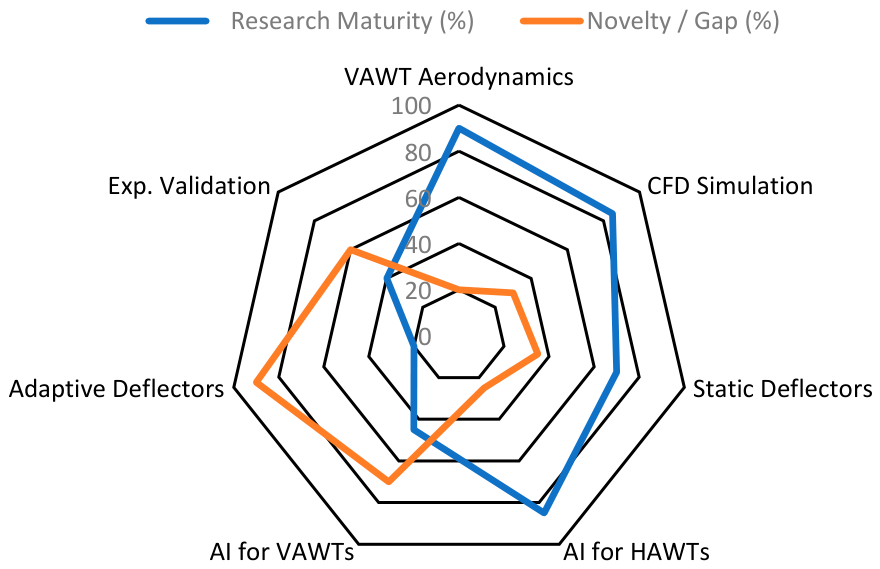
Synthesis of the reviewed literature reveals several critical research gaps that form the motivation for this investigation. The following analysis presents these gaps both qualitatively and through a structured visual assessment.
Figure 3.
Radar chart illustrates research maturity vs. novelty/gap score across key domains.
7.1. Fragmentation Between Aerodynamic and AI Research
Although significant progress has been made in improving VAWT performance, existing research remains largely fragmented between aerodynamic enhancements and computational optimization. Studies on deflector assisted VAWTs consistently report notable gains in power coefficient and torque through improved flow redirection and reduction of negative drag [3,4,5,14,17]. However, these designs are predominantly static and optimized for fixed or idealized wind conditions.
In parallel, AI techniques have been applied to wind energy systems for performance prediction and offline design optimization, yet their role in real time control of physical flow modifying components remains limited [6,7]. This separation creates a significant gap, as VAWTs typically operate in highly unsteady and turbulent wind environments where fixed configurations cannot sustain optimal performance.
7.2. Lack of Adaptive Deflector Control
The literature contains very few studies combining AI driven adaptive control with deflector mechanisms. Most deflector research focuses on finding optimal fixed configurations, while most AI research for VAWTs focuses on prediction or offline optimization rather than real time adaptive control. The combination where an AI system continuously adjusts deflector positioning in response to changing wind conditions remains largely unexplored. Singh et al. [18] represent a partial exception, using AI for deflector optimization, but their approach was offline rather than real time. No studies were identified that implement real time, adaptive AI control of deflector systems for VAWTs. This is the primary research gap that motivates the proposed framework.
7.3. Limited Experimental Validation
A notable gap is the limited experimental validation of integrated systems. While computational studies are abundant [4,5], relatively few studies have validated deflector assisted VAWT performance through wind tunnel or field testing [3,14]. Even fewer have experimentally validated AI controlled systems. This gap is significant because real world wind conditions introduce complexities that are difficult to fully capture in simulations, including turbulence spectra, wind direction variability, and unsteady interactions between the deflector wake and the rotor.
7.4. Absence of Long Term Reliability and Durability Studies
Most studies consider aerodynamic performance alone without assessing the fatigue life of moving components under cyclic wind loading. Actuated deflector systems, by their nature, involve continuous mechanical motion in response to fluctuating wind conditions. This repeated actuation introduces wear and tear on bearings, linkages, servo motors, and control electronics. Long term reliability studies examining mean time between failures, maintenance intervals, and performance degradation over time are entirely absent from the literature. This gap is critical for commercial viability, as any energy gains from adaptive control must outweigh the costs and reliability penalties associated with active components.
7.5. Lack of Standardized Benchmarking Methodology
A further gap exists in the absence of consistent test conditions, turbine geometries, and reporting conventions across studies. Different researchers use different rotor sizes, deflector shapes, wind speeds, and performance metrics, making direct comparison of reported power coefficient improvements unreliable. Some studies report peak Cp under optimal conditions, while others report average Cp over a test period. Without standardized protocols for VAWT deflector testing, it remains difficult to objectively assess the relative merit of different AI control approaches or deflector designs.
Table 5.
Summary of Research Gaps.
| Gap | Description | Priority |
| Fragmentation | Aerodynamic and AI research conducted separately | High |
| Lack of adaptive control | No real time AI controlled deflector systems | Highest |
| Limited experimental validation | Few wind tunnel or field tests of integrated systems | High |
| No reliability studies | Unknown durability of actuated deflectors | Medium |
| No standardized benchmarking | Inconsistent reporting prevents fair comparison | Medium |
8. Proposed Contribution and Research Framework
Based on the identified research gaps, this section outlines the proposed contribution of this investigation and presents a structured framework for developing and validating an AI-based deflector-controlled VAWT system.
8.1. Proposed Contribution
This research aims to achieve three primary contributions to the field: (1) the combination of aerodynamic enhancement through an actuated deflector with AI-based closed-loop control; (2) the development of a smart VAWT system integrating sensors, actuators, embedded processing, and an AI model; and (3) experimental validation of performance improvement under controlled conditions.
8.2. Proposed Framework: Adaptive AI-Driven Deflector Control for VAWT
To systematically achieve these contributions, a five-layer framework is proposed in Figure 4.
9. Key Insights from Literature
The synthesis of reviewed literature provides several key insights that inform the proposed research direction and justify the integration of AI with adaptive deflector control for VAWTs.
Table 6.
Key Literature Insights and their Implications for the proposed AI-Deflector VAWT research framework.
Table 6.
Key Literature Insights and their Implications for the proposed AI-Deflector VAWT research framework.
| Insight Domain | Key Finding | Implication for Proposed Research | Supporting References |
| Deflector Effectiveness | 15%–60% Cp improvement depending on configuration, turbine type, and wind conditions | Adaptive control could sustain peak improvement across variable wind, not just at design point | [3,4,5,14,17] |
| AI Capabilities | RL enables model-free adaptive optimization; strong results for HAWT blade pitch control | RL framework transferable to VAWT deflector control with appropriate state-action-reward formulation | [6,7] |
| Active Flow Control | Plasma actuators give ~43% Cp improvement but involve high energy cost and complexity | Deflector-based approach offers better cost-benefit ratio for small-scale/urban applications | [19,20] |
| Research Gap | No studies implement real-time AI control of deflectors for VAWTs | Clear novelty opportunity: proposed framework directly addresses this gap | This review |
| Dynamic Stall | Dynamic stall is a fundamental VAWT challenge complicating first-principles modelling | Justifies model-free RL approach that does not require an explicit aerodynamic model | [12] |
10. Conclusion
This systematic review has studied research in three interconnected domains relevant to AI-based deflector-controlled VAWTs on performance challenges, deflector-based aerodynamic enhancement, and artificial intelligence applications in wind energy systems. The analysis reveals that a critical gap exists at their junction. Deflector-assisted designs can substantially improve VAWT performance [3,4,5,14,17], but existing solutions are for static and optimized conditions. AI techniques, particularly reinforcement learning, have demonstrated strong potential for real-time adaptive control [6,7], but confined to HAWT applications or offline optimization. Very few studies have attempted to combine these approaches to create an adaptive, self-optimizing VAWT system. This review has proposed a structured five-layer framework for addressing this gap, from mechanical design through experimental validation. The framework emphasizes real-time, closed-loop control where an AI agent continuously adjusts deflector positioning in response to measured wind conditions and turbine performance.
10.1. Future Work
Based on this review, several research directions are recommended. First, a CFD based parametric study of deflector geometry, including chord length, curvature, angle, and gap distance, to establish an aerodynamic database. Second, a validated reinforcement learning training environment should be developed using reduced order models derived from the CFD study to enable safe and efficient policy training under diverse wind conditions. Third, prototype fabrication and wind tunnel testing must compare fixed deflector, and AI controlled adaptive configurations. Fourth, hybrid Savonius Darrieus rotors should be investigated as the preferred turbine type for urban deployment. Fifth, long term reliability assessment of actuated deflector mechanisms is essential to determine whether energy gains outweigh losses and maintenance costs. Cities want to reach net-zero goals. This AI-controlled deflector VAWTs can help society to achieve this. These turbines can be used on buildings. They produce clean energy near where it is used. This reduces energy loss during transmission. It also reduces pressure on the power grid. Energy supply is becoming more secure. This technology supports small local power systems. These systems are smart and flexible. They are low in carbon emissions. They are easier for people to access.
Ethics statements
There are no ethical considerations to declare.
Author Contributions
Palanisamy Chockalingam: Conceptualization, Methodology, Validation, Writing – Original Draft Preparation; Review & Editing.
Funding
There are no funding agencies supporting this work.
Acknowledgments
Author acknowledges the Research Management, Multimedia University and MMU Press for their contribution.
Conflicts of Interest
The authors declare that the research was conducted in the absence of any commercial or financial relationships that could be construed as a potential conflict of interest.
References
- Alizadeh; Roudgar-Amoli, M.; Shariatinia, Z.; Abedini, E.; Asghar, S.; Imani, S. Recent developments of perovskites oxides and spinel materials as platinum-free counter electrodes for dye-sensitized solar cells: A comprehensive review. Renew. Sustain. Energy Rev. 2023, vol. 187, 113770. [Google Scholar] [CrossRef]
- Shen, Z.; Gong, S.; Zuo, Z.; Chen, Y.; Guo, W. Darrieus vertical-axis wind turbine performance enhancement approach and optimized design: A review. Ocean Eng. 2024, vol. 311, 118965. [Google Scholar] [CrossRef]
- Ghafoorian, F.; Enayati, E.; Mirmotahari, S.R.; Wan, H. Self-Starting Improvement and Performance Enhancement in Darrieus VAWTs Using Auxiliary Blades and Deflectors. Machines 2024, vol. 12(no. 11), 806. [Google Scholar] [CrossRef]
- Chen, W.; Lam, T.T.; Chang, M.; Jin, L.; Chueh, C.; Augusto, G.L. Optimizing H-Darrieus Wind Turbine Performance with Double-Deflector Design. Energies 2024, vol. 17(no. 2), 503. [Google Scholar] [CrossRef]
- Al-Khawlani, N.; Fazlizan, A.; Abdalkarem, A.; Ibrahim, A.; Harun, Z. Numerical Study of a Vertical Axis Wind Turbine with an Inner Cylindrical Deflector. Revista Internacional de Métodos Numéricos para Cálculo y Diseño en Ingeniería 2025, vol. 41(no. 2). [Google Scholar] [CrossRef]
- Aghaei, V.T.; Ağababaoğlu, A.; Bawo, B.; Naseradinmousavi, P.; Yıldırım, S.; Yeşilyurt, S.; Onat, A. Energy optimization of wind turbines via a neural control policy based on reinforcement learning Markov chain Monte Carlo algorithm. Appl. Energy 2023, vol. 341, 121108. [Google Scholar] [CrossRef]
- Serale, G.; Fiorentini, M.; Capozzoli, A.; Bernardini, D.; Bemporad, A. Model Predictive Control (MPC) for Enhancing Building and HVAC System Energy Efficiency: Problem Formulation, Applications and Opportunities. Energies 2018, vol. 11(no. 3), 631. [Google Scholar] [CrossRef]
- ISLAM, M.; TING, D.; FARTAJ, A. Aerodynamic models for Darrieus-type straight-bladed vertical axis wind turbines. Renew. Sustain. Energy Rev. 2008, vol. 12(no. 4), 1087–1109. [Google Scholar] [CrossRef]
- Tjiu, W.; Marnoto, T.; Mat, S.; Ruslan, M.H.; Sopian, K. Darrieus vertical axis wind turbine for power generation I: Assessment of Darrieus VAWT configurations. Renew. Energy 2015, vol. 75, 50–67. [Google Scholar] [CrossRef]
- Ferreira, C.S.; Kuik, G.v.; Bussel, G.v.; Scarano, F. Visualization by PIV of dynamic stall on a vertical axis wind turbine. Exp. Fluids 2009, vol. 46(no. 1), 97–108. [Google Scholar] [CrossRef]
- Sun, X.; Hao, T.; Zhang, J.; Dong, L.; Zhu, J. The performance increase of the wind-induced rotation VAWT by application of the passive variable pitching blade. Int. J. Low.-Carbon Technol. 2022, vol. 17, 1420–1434. [Google Scholar] [CrossRef]
- Fouest, S.L.; Mulleners, K. The dynamic stall dilemma for vertical-axis wind turbines. Renew. Energy 2022, vol. 198, 505–520. [Google Scholar] [CrossRef]
- Zhang, H.; Hu, Y. Wind tunnel experimental study on static aerodynamic performance of SB-VAWT without intermediate support axes. Front. Energy Res. 2023, vol. 11. [Google Scholar] [CrossRef]
- Saham, S.; Rezaey, S. Aerodynamic efficiency assessment of a cross-axis wind turbine integrated with an offshore deflector. Heliyon 2024, vol. 10(no. 17), e36412. [Google Scholar] [CrossRef] [PubMed]
- Wang, W.; Ferng, Y. Numerical model for noise reduction of small vertical-axis wind turbines. Wind Energy Sci. 2024, vol. 9(no. 3), 651–664. [Google Scholar] [CrossRef]
- Didane, D.H.; Behery, M.R.; Al-Ghriybah, M.; Manshoor, B. Recent Progress in Design and Performance Analysis of Vertical-Axis Wind Turbines—A Comprehensive Review. Processes 2024, vol. 12(no. 6), 1094. [Google Scholar] [CrossRef]
- Ghafoorian, F.; Mirmotahari, S.R.; Farajyar, S.; Mehrpooya, M.; Shafiee, M. Performance Optimization of Savonius VAWTs Using Wind Accelerator and Guiding Rotor House for Enhanced Rooftop Urban Energy Harvesting. Machines vol. 13(no. 9), 838, 2025. [CrossRef]
- Singh, P.; Jaiswal, V.; Roy, S.; Singh, R.K. Maximizing Savonius Turbine Performance Using Kriging Surrogate Model and Grey Wolf-Driven Cylindrical Deflector Optimization. In Lecture Notes in Mechanical Engineering; 2025; pp. 217–231. [Google Scholar] [CrossRef]
- Abbasi, S.; Daraee, M.A. Ameliorating a vertical axis wind turbine performance utilizing a time-varying force plasma actuator. Sci. Rep. 2024, vol. 14(no. 1). [Google Scholar] [CrossRef] [PubMed]
- Zhou, D.; Zhou, D.; Xu, Y.; Sun, X. Performance enhancement of straight-bladed vertical axis wind turbines via active flow control strategies: a review. Meccanica 2022, vol. 57(no. 1), 255–282. [Google Scholar] [CrossRef]
- Shamsoddin, S.; Porté-Agel, F. Large Eddy Simulation of Vertical Axis Wind Turbine Wakes. Energies 2014, vol. 7(no. 2), 890–912. [Google Scholar] [CrossRef]
Figure 4.
Proposed 5-Layer AI-Deflector VAWT Control Framework.
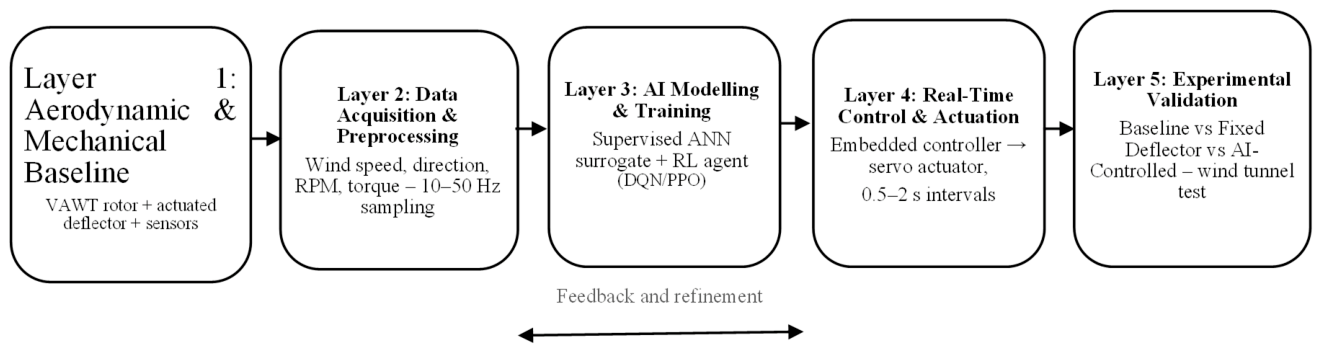
Table 1.
Comparative Performance Characteristics of VAWT Types vs. HAWT Reference based on data from [1,2,9].
| Parameter |
Darrieus (H-Rotor) |
Savonius | Hybrid Darrieus-Savonius | HAWT (Reference) |
| Operating Principle | Lift-based | Drag-based | Lift + Drag | Lift-based |
| Peak Cp (typical) | 0.30–0.45 | 0.15–0.25 | 0.25–0.38 | 0.35–0.50 |
| Self-Starting | Poor | Good | Moderate | Good (with pitch) |
| Optimal TSR Range | 2.5–4.5 | 0.5–1.5 | 1.5–3.5 | 6–9 |
| Wind Directionality | Omni-directional | Omni-directional | Omni-directional | Requires yaw control |
| Noise Level | Moderate | Low | Low–Moderate | High |
| Suitability for Urban Use | High | Very High | High | Low |
Table 2.
Summary of Reported Cp Improvements from Deflector-Assisted VAWT Studies.
| Reference | Deflector Type | Turbine Type | Method | Cp Improvement | Key Finding |
| Al-Khawlani et al. [5] | Inner cylindrical deflector | Darrieus VAWT | CFD (Numerical) | +15% | Pressure distribution improved around rotor |
| Ghafoorian et al. [3] | Aux. blades + deflector | Darrieus VAWT | Exp. + CFD | +~40%* | Best at low TSR; improved self-starting |
| Chen et al. [4] | Double deflector | H-Darrieus VAWT | CFD (Numerical) | +~55%* | Flow optimization at both blade sides |
| Ghafoorian et al. [17] | Wind deflector plate | Savonius VAWT | CFD + Exp. | +~30%* | Optimal placement depends on geometry |
| Saham et al. [14] | Flow deflector | Cross-axis VAWT | Exp. + CFD | Significant* | Validated aerodynamic gains experimentally |
| Singh et al. [18] | AI-optimized position | Darrieus VAWT | AI offline opt. | +34% | Kriging + Grey Wolf Optimizer; offline only |
Disclaimer/Publisher’s Note: The statements, opinions and data contained in all publications are solely those of the individual author(s) and contributor(s) and not of MDPI and/or the editor(s). MDPI and/or the editor(s) disclaim responsibility for any injury to people or property resulting from any ideas, methods, instructions or products referred to in the content. |
© 2026 by the authors. Licensee MDPI, Basel, Switzerland. This article is an open access article distributed under the terms and conditions of the Creative Commons Attribution (CC BY) license (http://creativecommons.org/licenses/by/4.0/).
Copyright: This open access article is published under a Creative Commons CC BY 4.0 license, which permit the free download, distribution, and reuse, provided that the author and preprint are cited in any reuse.