

Submitted:
30 August 2026
Posted:
31 August 2026
You are already at the latest version
Abstract
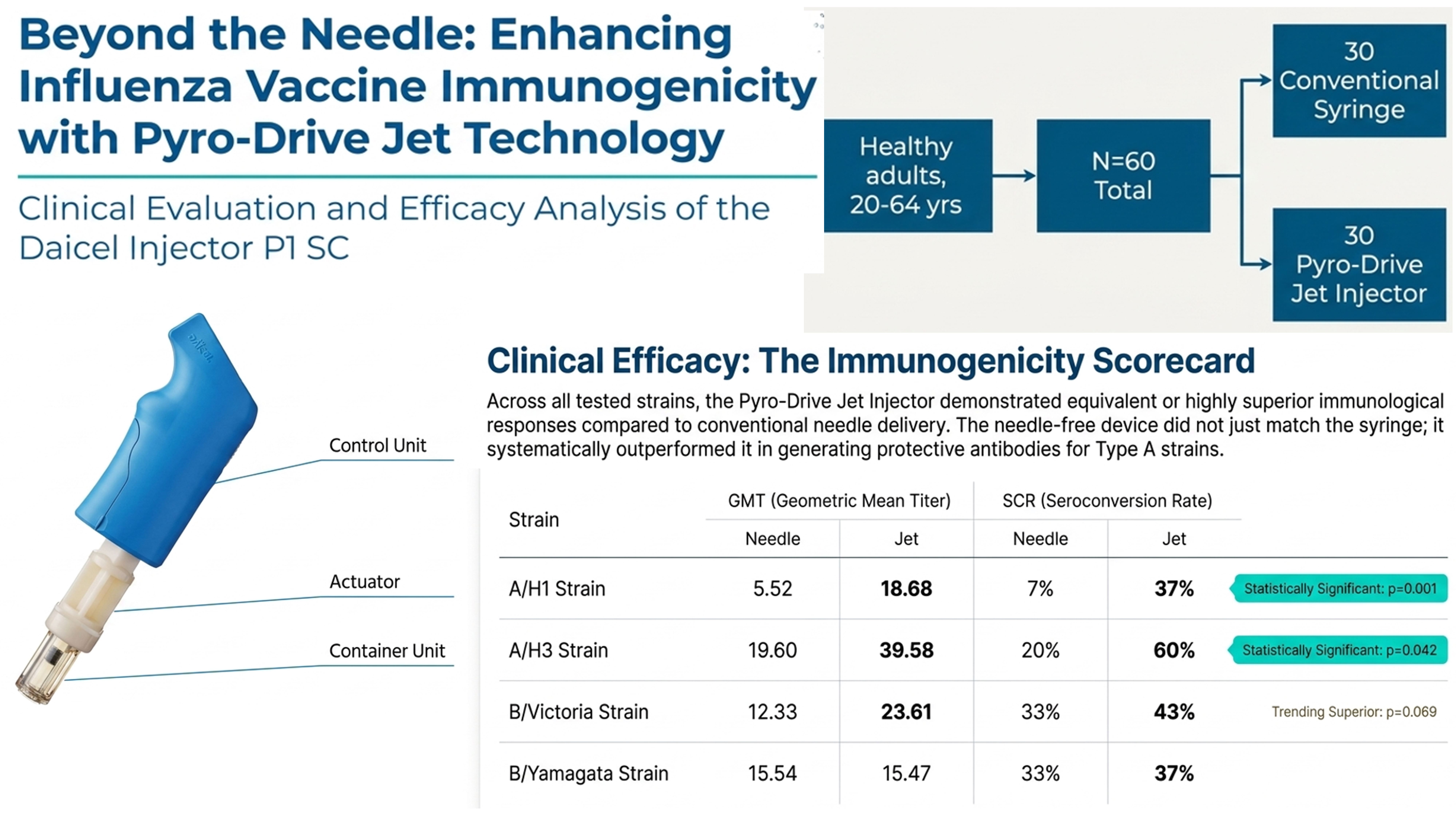
Background/Objectives: The pyro-drive jet injector (Daicel Injector P1 SC) is a needle-free injection device which propels the medication in a fine jet at high pressure, penetrating the skin to deliver the medication subcutaneously. In this study, we evaluated the safety and efficacy of this jet injector for the administration of seasonal influenza vaccine. Methods: As an open-label and observational case-control study, we compared 30 participants who received the seasonal influenza vaccine (2025-2026) via conventional needle injection with 30 participants who received it via the jet injector to evaluate the immune responses and local and systemic adverse reactions. In 2025-2026 season, a trivalent influenza vaccine covering the A strains (H1N1 and H3N2), as well as the B/Victoria strain was administered. Antibody titers were assessed using hemagglutination inhibition (HI) assays 4 to 12 weeks after vaccination, and seroconversion rate (antibody titer ≥40-fold) was calculated. Results: Regarding the immune response, the seroconversion rates were high for the pyro-drive jet injector group (A/H1N1; 7% vs.37%, P=0.005; A/H3N2; 43% vs. 60%, P=0.196; B; 33% vs. 43%, P=0.426). Similarly, the mean geometric mean titer (GMT) was high with the pyro-drive jet injector (A/H1N1; 5.71 vs.18.68, P=0.001; A/H3N1 19.9 vs.40.63, P=0.042; B 12.42 vs.24.08, P=0.069). Regarding safety, there was no difference in the incidence of local reactions between the two groups with no serious adverse events. Conclusions: The pyro-drive jet injector could offer tolerability comparable to that of a conventional needle and have the potential to enhance immune response for the influenza vaccine.
Keywords:
jet injector
; influenza vaccine
1. Introduction
Influenza poses a significant global disease burden for higher risk people of severe symptoms [1]. Among older adults, 70–85% of seasonal influenza-related deaths and 50–70% of influenza-related hospitalizations have been recently reported [2]. Annual influenza vaccination is the most effective way to reduce severe influenza-related disease [2,3,4,5]. However, as well as increasing the risks associated with influenza, immune senescence also diminishes the response to influenza vaccination in older adults by impairing antibody and cell-mediated responses [6]. The need to improve vaccine effectiveness led to the development of influenza vaccines formulation with either a higher antigen or an adjuvant or device to strengthen immune responses.
A needle-free jet injector is a medical device that delivers drugs or vaccines into the body by propelling a high-pressure liquid jet into the skin without using a needle. A comparative study using a spring-loaded needle-free injector, Stratis/PharmaJet, for intramuscular administration of the influenza vaccine reported that the immune response was non-inferior [6]. As a next-generation needle-free jet injectors, pyro-drive needle-free injector (Daicel Injector P1 SC), which recently received regulatory approval in Japan, is a device that administers pharmaceuticals subcutaneously without using a needle. Daicel Injector P1 SC is designed to deliver the vaccine precisely into the subcutaneous layer and features a two-stage delivery mechanism that allows the vaccine solution to spread over a wide area after penetrating the skin [7,8,9,10]. Consequently, the use of this device is expected to ensure that the influenza vaccine reaches a wide area of the subcutaneous tissue, thereby increasing antigen uptake and enhancing the immune response. It is also expected to contribute to improved adherence among patients with a fear of injections, and to enhanced medical safety through the reduction of needle stick injuries. In this study, we compared antibody titers and seroconversion rates between 30 participants who received the influenza vaccine via the jet injector and 30 participants who received it via a conventional needle.
2. Materials and Methods
2.1. Study Design
This study was conducted as an open-label and observational case-control study following approval by the Ethics Review Committee of Osaka University Hospital (25409-2). Informed consent was obtained from all participants involved in the study to publish this paper. This study includes healthy adults who received an influenza vaccine until March 2026. The inclusion criteria are participants aged 20 years or older but under 65 years, and received an influenza vaccination within 4 to 12 weeks prior to obtaining consent.
2.2. Vaccine and Medical Device
The influenza vaccines administered in Japan during the 2025–2026 season contained three types of antigens (15 μg for each antigen): two types of influenza A (H1N1; A/Victoria/4897/2022, IVR-238 and H3N2; A/Perth/722/2024, IVR-262) and one type of influenza B (Victoria lineage; B/Austria/1359417/2021, BVR-26). Ahead of the 2024–25 season, B/Given that the Yamagata lineage has not been detected globally, the WHO has indicated a preference for a trivalent vaccine over a quadrivalent one, and trivalent vaccines will be used starting with the 2025–26 season in Japan. These vaccines were administered subcutaneously using either a standard needle or a pyro-drive jet injector for intra subcutaneous injection [7,8,9,10].
2.3. Endpoints
Primary endpoint was antibody titers which were assessed using hemagglutination inhibition (HI) assays and measured for the three strains mentioned above. In addition, although not included in the vaccine, antibody titer against influenza B (Yamagata lineage) were also measured simultaneously for reference purposes. Antibody titers were expressed as the geometric mean titer (GMT) and the seroconversion rate (40-fold or higher) were also calculated. When calculating the GMT, antibody titers below 10 were treated as 1 for the calculation. Secondary endpoint is the safety which was assessed based on the results of a survey. Self-reported symptoms from the questionnaire include the injection site reactions (pain, swelling, induration at the injection site) and systemic events (fever, fatigue/malaise, headache, chills, nausea, diarrhea, muscle pain, joint pain).
2.4. Statistical Analysis
The chi-square test for the seroconversion rate and the t-test for HI antibody titers were performed to determine significant differences between two groups. All statistical analyses were performed using the statistical software, EZR (Easy R) 12).
3. Results
3.1. Baseline Characteristics
A total of 60 participants, including 30 participants who received the vaccine via a standard needle and 30 participants who received it using a jet injector, took part in this observational case-control study during the 2025-2026 winter season (Table 1).
The participants include 39 male (65%), and 23 of them were in the jet injector group which is a significantly higher number. There was a gender imbalance between groups.
The overall average age was 46.9 years, with no disparity between the two groups. The time from vaccination to blood collection was 10.1 weeks on average for the entire group and 9.7 weeks for the jet injector group. There was a significant difference observed between the two groups.
3.2. Immune Responses
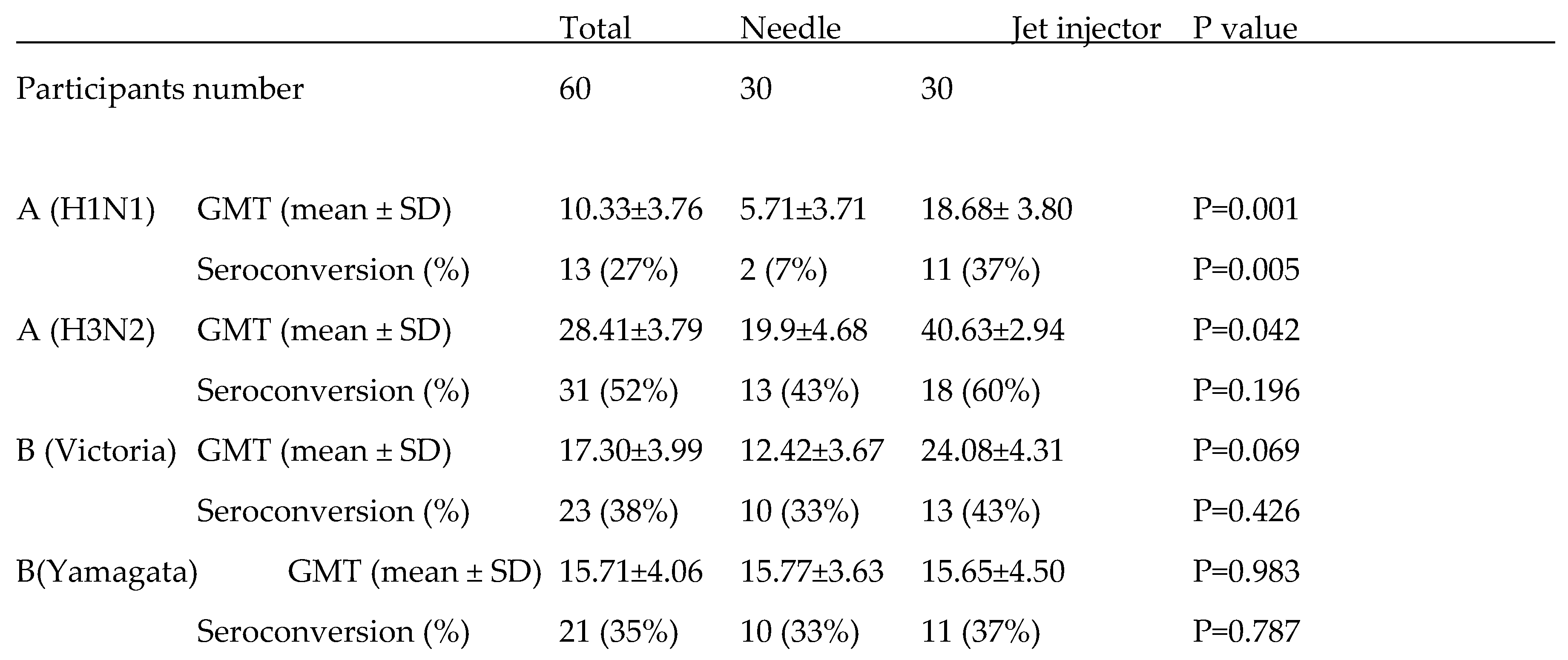
As shown in Table 2, GMT of antibodies against H1N1 was 5.71 in the needle administration group, whereas it was 18.68 in the jet injector group, representing a statistically significant increase. Similarly, the seroconversion rate was 7% in the needle administration group, compared to 37% in the jet injector group, representing a statistically significant increase. Looking at the distribution of GMT antibody titers, while the maximum titer in the needle group was 40-fold, the jet injector group showed several subjects with titers of 40-fold, 80-fold, and 160-fold, respectively (Figure 1A). GMT of antibodies against H3N2 was 19.9 in the needle administration group and 40.63 in the jet injector group, showing a significant increase. Although there was no statistically significant difference in the seroconversion rate, a trend toward an increase was observed in the jet injector group (60%) compared to the needle administration group (20%). In the distribution of GMT antibody titers, while the needle administration group showed a higher frequency of 10-fold and 20-fold titers, the jet injector group tended to have a higher frequency of 80-fold and 160-fold titers (Figure 1B). Although there was no statistically significant difference in the GMT antibody titer against B;Victoria strain an upward trend was observed in the jet injector group (24.08) compared to the needle administration group (12.42); a similar upward trend was also observed in the seroconversion rate (33% vs. 43%). Regarding the distribution of antibody titers, while the difference was not as clear as for Type A, several individuals in the jet injector group were found to have titers of 80-fold and 320-fold, respectively (Figure 1C). Antibodies against B;Yamagata strain, which was previously included in the vaccine, were also measured for reference. The results showed similar values in both groups, GMT antibody titers of 15.77 vs. 15.65 (P=0.787) and seroconversion rates of 33% vs. 37% (P=0.983), suggesting that there is no significant difference in baseline immunity between both groups.
3.3. Safety and Tolerability
As shown in Table 3, in the evaluation of adverse reactions based on the questionnaire survey, 43% of respondents reported localized pain, with the numbers exactly the same in both groups. Localized swelling was reported by 45% of respondents, with the numbers being nearly the same in both groups. Localized induration was reported by 21% of respondents, with the numbers being nearly the same in both groups. No other systemic symptoms, such as fever, fatigue, headache, chills, nausea or vomiting, muscle pain, or joint pain, were observed. Overall, the results showed no difference in adverse reactions between administration via the jet injector and needle administration.
4. Discussion
In this study, for the immune response, the seroconversion rate and GMT were high for the pyro-drive jet injector group. Historically, the need for needle-free jet injectors arose primarily in the United States from the 1950s through the 1970s, as devices for large-scale vaccination campaigns. Globally, they were also utilized in large-scale vaccination programs [12,13]. However, conventional jet injectors designed for mass vaccination were structured such that a single nozzle was used consecutively on multiple recipients, raising concerns about the potential transmission of pathogens to subsequent recipients [14]. Meanwhile, a new generation of jet injectors incorporating disposable nozzles and cartridges has emerged, and development is progressing on devices capable of precisely controlling injection pressure and depth to deliver medications according to specific purposes. Regarding inactivated influenza vaccines, clinical trials using jet injectors have reported safety and immunogenicity profiles generally comparable to those achieved with conventional needles and syringes [15,16,17,18]. Daicel Injector P1 SC is a novel needle-free jet injector that applies technology from Daicel’s automotive airbag inflators to apply a constant pressure to the liquid [7,8,9,10]. In clinical practice, the results in this study showed a high immunoreaction with the Daicel Injector P1 SC. It is hypothesized that the mechanism by which jet injectors enhance the immune response lies in their ability to deliver the drug solution to a wider area beneath the skin. It is presumed that this enhances immune activation by increasing the chances of the drug being taken up by antigen-presenting cells. To understand the immune response in humans, the additional evidence has been required from both basic research findings and clinical research, and therefore, no definitive conclusions can be drawn at this time. In the safety evaluation, in this study, no serious adverse events were observed in any group. Regarding safety evaluation, no serious adverse events were observed in either group, and there was no difference in the incidence of local reactions between the two groups. While previous reports have occasionally mentioned increased local pain and swelling associated with jet injectors [15,16,17,18], this pyro-drive jet injector could offer a level of safety equivalent to that of needle administration.
As a study limitation, since this case-control study was conducted as an observational study rather than a prospective randomized trial, it is susceptible to the effects of confounding factors and bias; indeed, in this study, differences were observed between the two groups in terms of the male-to-female ratio and the time interval between vaccination and blood sampling. Given that this study involved only 30 participants in each group, the data are insufficient to demonstrate the superiority of the jet injector. In the next season, we plan to conduct a randomized, parallel-group trial to verify the reproducibility of these results, and we expect to reach definitive conclusions from that study.
Since the immune response is weaker in older adults, a vaccine with four times the antigen dose (60 μg of hemagglutinin per strain) has been approved in recent years. According to the results of a meta-analysis [16], the high-dose vaccine was associated with reduced hospitalizations for influenza (RR 0.61 [95% CI 0.50–0.74]), hospitalizations for laboratory-confirmed influenza (RR 0.68 [0.58–0.80]), hospitalization for cardiorespiratory disease (RR 0.92 [0.86–0.98]), and all-cause hospitalization (RR 0.97 [0.95–0.99]). The incidence of SAEs (RR 0.97 [0.93–1.01]) was comparable. However, the evidence for high-dose vaccines still does not fully support routine preferential use across all older adults. We believe that utilizing devices is one possible approach for high-risk populations, such as the elderly. Therefore, we are preparing to conduct a specific clinical study targeting the elderly or children during the 2026–2027 season, with the aim of validating the results of this exploratory study.
5. Conclusions
Although this study was an exploratory observational study, it suggested that the use of a jet injector may enhance the immune response to the influenza vaccine. Further verification is anticipated.
Author Contributions
For research articles with several authors, a short paragraph specifying their individual contributions must be provided. The following statements should be used “Conceptualization, H.N and Y.Y.; methodology, H.N and Y.Y.; validation, Y.Y.; formal analysis, Y.Y.; data curation, Y.Y.; writing—original draft preparation, H.N.; writing—review and editing, H.N., H.H., D.F., R.O., and Y.Y.; visualization, H.N., H.H., supervision, Y.Y. All authors have read and agreed to the published version of the manuscript.
Institutional Review Board Statement
The study was conducted in accordance with the Declaration of Helsinki, and approved by the Ethics Review Committee of Osaka University Hospital (protocol code 25409-2 and date of approval Jan 21, 2026).
Informed Consent Statement
Informed consent was obtained from all participants involved in the study to publish this paper.
Data Availability Statement
We encourage all authors of articles published in MDPI journals to share their research data. In this section, please provide details regarding where data supporting reported results can be found, including links to publicly archived datasets analyzed or generated during the study. Where no new data were created, or where data is unavailable due to privacy or ethical restrictions, a statement is still required. Suggested Data Availability Statements are available in section “MDPI Research Data Policies” at https://www.mdpi.com/ethics.
Acknowledgments
We thank all the members of Department of Health Development and Medicine, Osaka University Graduate School of Medicine, for supporting this project.
Conflicts of Interest
The Department of Health Development and Medicine is an endowed department supported by Anges, Daicel, and FunPep. There is a collaboration agreement between Health Developmental Medicine and Daicel.
Abbreviations
The following abbreviations are used in this manuscript:
GMT: geometric mean titer, HI: hemagglutination inhibition
References
- Zhang, Y.; Wang, X.; Li, Y.; et al. Spatiotemporal analysis of influenza in China, 2005–2018. Sci. Rep. 2019, 9, 19650. [Google Scholar] [CrossRef] [PubMed]
- World Health Organization. Evaluation of influenza vaccine effectiveness: a guide to the design and interpretation of observational studies; WHO: Geneva, 2017. [Google Scholar]
- Murray, C.J. Findings from the global burden of disease study 2021. Lancet 2024, 403, 2259–2262. [Google Scholar] [CrossRef] [PubMed]
- Osterholm, M.T.; Kelley, N.S.; Sommer, A.; Pshenichnaya, N. Efficacy and effectiveness of influenza vaccines: a systematic review and meta-analysis. Lancet Infect. Dis. 2012, 12, 36–44. [Google Scholar] [CrossRef] [PubMed]
- Larson, H.J.; Jarrett, C.; Eckersberger, E.; Smith, D.M.; Paterson, P. Understanding vaccine hesitancy around vaccines and vaccination from a global perspective: a systematic review of published literature, 2007–2012. Vaccine 2014, 32, 2150–2159. [Google Scholar] [CrossRef] [PubMed]
- McAllister, L.; Anderson, J.; Werth, K.; Cho, I.; Copeland, K.; Le Cam Bouveret, N.; Plant, D.; Mendelman, P.M.; Cobb, D.K. Needle-free jet injection for administration of influenza vaccine: a randomised non-inferiority trial. Lancet 2014, 84, 674–81. [Google Scholar] [CrossRef] [PubMed]
- Miyazaki, H.; Atobe, S.; Suzuki, T.; Iga, H.; Terai, K. Development of Pyro-Drive Jet Injector With Controllable Jet Pressure. J. Pharm. Sci. 2019, 108, 2415–2420. [Google Scholar] [CrossRef] [PubMed]
- Chang, C.; Sun, J.; Hayashi, H.; Suzuki, A.; Sakaguchi, Y.; Miyazaki, H.; Nishikawa, T.; Nakagami, H.; Yamashita, K.; Kaneda, Y. Stable Immune Response Induced by Intradermal DNA Vaccination by a Novel Needleless Pyro-Drive Jet Injector. AAPS PharmSciTech 2019, 21, 19. [Google Scholar] [CrossRef]
- Tai, J.A.; Nishikawa, T.; Hayashi, H.; Kuan, Y.D.; Yamashita, K.; Nakagami, H. Immunogenic Comparison of Nucleic Acid-Based Vaccines Administered by Pyro-Drive Jet Injector. Vaccines 2024, 12, 757. [Google Scholar] [CrossRef] [PubMed]
- Nakagami, H.; Hayashi, H.; Sun, J.; Yanagida, Y.; Otera, T.; Nakagami, F.; Hamaguchi, S.; Yoshida, H.; Okuno, H.; Yoshida, S.; et al. Phase I Study to Assess the Safety and Immunogenicity of an Intradermal COVID-19 DNA Vaccine Administered Using a Pyro-Drive Jet Injector in Healthy Adults. Vaccines 2022, 10, 1427. [Google Scholar] [CrossRef] [PubMed]
- Kanda, Y. Investigation of the freely available easy-to-use software 'EZR' for medical statistics. Bone Marrow Transpl. 2013, 48, 452–458. [Google Scholar] [CrossRef] [PubMed]
- ten Dam, H.G.; Fillastre, C.; Conge, G.; Orssaud, E.; Gateff, C.; Tanaka, A.; Ramirez, O.O.; Wright, J.; Collas, R.; Chambon, L. The use of jet-injectors in BCG vaccination. J.Bull World Health Organ. 1970, 43, 707–720. [Google Scholar]
- Barolet, D.; Benohanian, A. Current trends in needle-free jet injection: an update. A.Clin Cosmet. Investig. Dermatol. 2018, 11, 231–238. [Google Scholar] [CrossRef] [PubMed]
- Canter, J.; Mackey, K.; Good, L.S.; Roberto, R.R.; Chin, J.; Bond, W.W.; Alter, M.J.; Horan, J. M An outbreak of hepatitis B associated with jet injections in a weight reduction clinic. Arch. Intern Med. 1990, 150, 1923–1927. [Google Scholar] [CrossRef]
- Jackson, L.A.; Austin, G.; Chen, R.T.; Stout, R.; DeStefano, F.; Gorse, G.J.; Newman, F.K.; Yu, O.; Weniger, B.G. Vaccine Safety Datalink Study Group. Safety and immunogenicity of varying dosages of trivalent inactivated influenza vaccine administered by needle-free jet injectors. Vaccine 2001, 19, 4703–4709. [Google Scholar] [CrossRef] [PubMed]
- Mitragotri, S. Current status and future prospects of needle-free liquid jet injectors. Nat. Rev. Drug Discov. 2006, 5, 543–548. [Google Scholar] [CrossRef] [PubMed]
- Shapiro, J.R.; Hodgins, B.; Hendin, H.E.; Patel, A.; Menassa, K.; Menassa, C.; Menassa, M.; Pereira, J.A.; Ward, B.J. Needle-free delivery of influenza vaccine using the Med-Jet® H4 is efficient and elicits the same humoral and cellular responses as standard IM injection: A randomized trial. Vaccine 2019, 37, 1332–1339. [Google Scholar] [CrossRef] [PubMed]
- Simon, J.K.; Carter, M.; Pasetti, M.F.; Sztein, M.B.; Kotloff, K.L.; Weniger, B.G.; Campbell, J.D.; Levine, M.M. Safety, tolerability, and immunogenicity of inactivated trivalent seasonal influenza vaccine administered with a needle-free disposable-syringe jet injector. Vaccine 2011, 29(51), 9544–50. [Google Scholar] [CrossRef] [PubMed]
- Zhao, W.; Lian, R.; Zhao, Y.; Li, Z.; Liu, M.; Yang, F.; Zhang, J.; Tian, J.; Xue, F.; Gao, Y. Effect of high-dose versus standard-dose influenza vaccines on hospitalisation outcomes and mortality in older adults: a systematic review and meta-analysis. Lancet Healthy Longev. 2026, 7(6), 100870. [Google Scholar] [CrossRef] [PubMed]
Figure 1.
The distribution of GMT antibody titers for A (H1N1 and H3N2) and B (Victoria). Needle indicates the needle administration group (dark blue), and jet Injector indicates the pyro-drive jet injector administration group (light blue).
Figure 1.
The distribution of GMT antibody titers for A (H1N1 and H3N2) and B (Victoria). Needle indicates the needle administration group (dark blue), and jet Injector indicates the pyro-drive jet injector administration group (light blue).
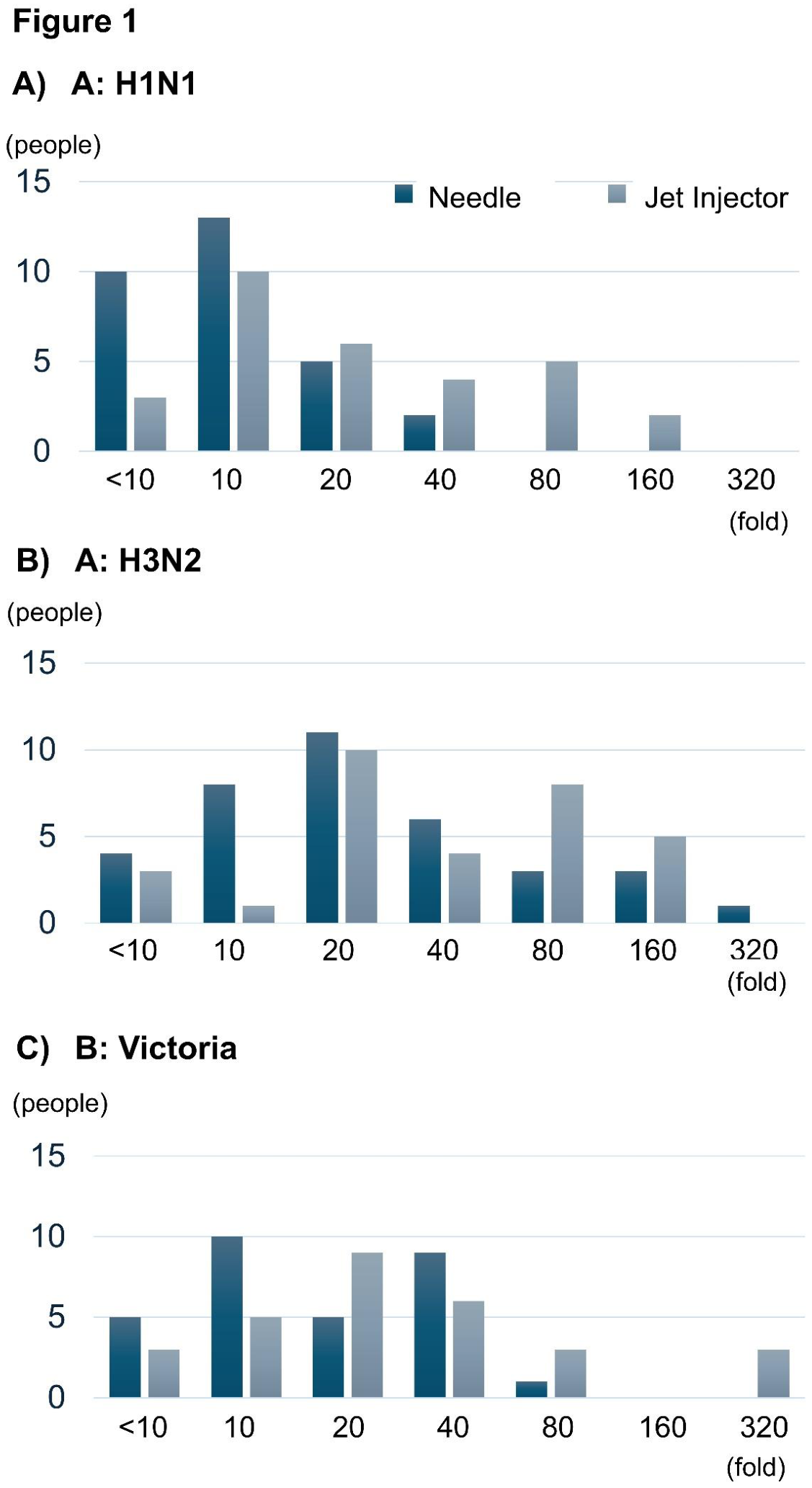

Table 1.
Baseline characteristics of both groups.
| Total | Needle | Jet injector | P value | |
| Participants number | 60 | 30 | 30 | |
| Male (%) | 39 (65%) | 16 (53%) | 23 (77%) | P=0.003 |
| Age (mean ± SD) | 46.9 ± 9.6 | 45.6 ± 10.1 | 48.1 ± 9.8 | P=0.337 |
| Time between vaccination and test (weeks) | 10.1 ± 1.6 | 10.5 ± 1.5 | 9.7 ± 1.5 | P=0.038 |
Table 2.
Immunogenic reaction.
 |
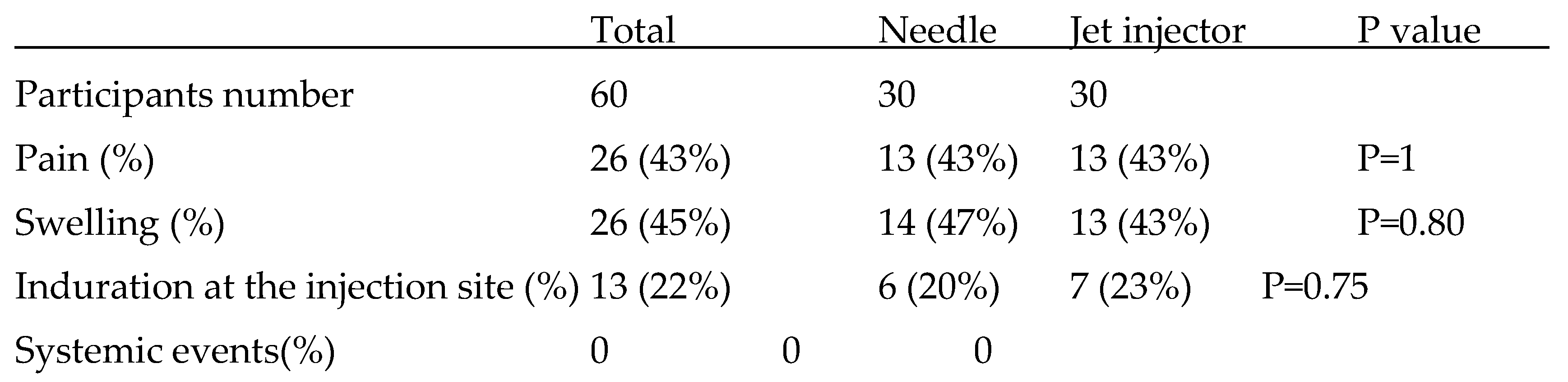 |
Systemic symptoms include fever, fatigue, headache, chills, nausea, diarrhea, muscle pain, and joint pain. A fever is defined as a temperature of 37.5℃ or higher.
Disclaimer/Publisher’s Note: The statements, opinions and data contained in all publications are solely those of the individual author(s) and contributor(s) and not of MDPI and/or the editor(s). MDPI and/or the editor(s) disclaim responsibility for any injury to people or property resulting from any ideas, methods, instructions or products referred to in the content. |
© 2026 by the authors. Licensee MDPI, Basel, Switzerland. This article is an open access article distributed under the terms and conditions of the Creative Commons Attribution (CC BY) license (http://creativecommons.org/licenses/by/4.0/).
Copyright: This open access article is published under a Creative Commons CC BY 4.0 license, which permit the free download, distribution, and reuse, provided that the author and preprint are cited in any reuse.