
Submitted:
30 August 2026
Posted:
31 August 2026
You are already at the latest version
Abstract
Toxicodendron vernicifluum is an economically unique lacquer-producing tree en-demic to East Asia; propagation bottlenecks severely restrict elite clone industrializa-tion. This review systematically synthesizes 20 years of domestic and international lit-erature on seed propagation, root cutting, stem cutting, grafting, and tissue culture of lacquer tree, compares technical performance among China, Japan, Vietnam, and Med-iterranean Rhus species, and quantitatively summarizes germination/rooting rates across protocols. Sexual propagation suffers from seed deep dormancy and progeny segregation; conventional asexual propagation has low rooting efficiency; tissue culture faces high cost and browning obstacles; molecular regulatory mechanisms remain poorly characterized. We propose an integrated breeding framework combining mo-lecular mechanism dissection, low-cost vegetative propagation optimization, and standardized seedling production. Future directions including multi-omics analysis, gene-edited easy-rooting germplasm, and bioreactor micropropagation are highlighted to support large-scale elite seedling cultivation in Qinba Mountain regions.
Keywords:
Toxicodendron vernicifluum
; seed dormancy
; seed propagation
; vegetative cutting
; grafting
; tissue culture
; browning inhibition
; elite clone breeding
; industrial micropropagation
1. Introduction
Natural lacquer tree (Toxicodendron vernicifluum (Stokes) F.A. Barkley, syn. Rhus verniciflua), a woody species endemic to East Asia, delivers unique biogenic lacquer widely acknowledged as a premium sustainable natural coating material, alongside multiple economic values including seed oil, timber production and mountain ecological restoration [1]. China hosts the origin and largest germplasm resource bank of T. vernicifluum, with the Qinba-Wuling Mountain zones across Shaanxi, Sichuan and Hubei Provinces contributing over 40% of national raw lacquer output. Beyond China, Japan and Vietnam have introduced local lacquer tree populations and developed regionally adapted breeding systems targeting wax harvest and resin yield, respectively. In contrast, Mediterranean countries mainly study Rhus coriaria, a closely related sumac species with distinct horticultural applications, whose propagation techniques cannot be directly transferred to lacquer-producing T. vernicifluum due to interspecific physiological divergence [2,8,17,41].
Propagation technology forms foundational bottleneck restricting the scaled cultivation of elite high-lacquer clones of T. vernicifluum. A comprehensive literature search was conducted using Web of Science, CNKI (China National Knowledge Infrastructure), and Google Scholar databases for the period 2004–2024. Search terms included combinations of the following: Toxicodendron vernicifluum, Rhus verniciflua, seed dormancy, germination, cutting propagation, grafting, tissue culture, micropropagation, and browning inhibition. Only peer-reviewed original research articles, reviews, and available dissertations were included. Conference abstracts and non-English publications without English abstracts were excluded. Numerical data for comparative tables were extracted from studies reporting explicit germination or rooting percentages under defined treatment conditions. This species exhibits dioecy and allogamy, resulting in severe phenotypic segregation among seed-derived plantlets, which causes unstable lacquer yield and weakens the uniformity of commercial plantations. Conventional vegetative propagation approaches, including root layering, stem cuttings and grafting, suffer from low and inconsistent survival rates, limiting the large-scale supply of uniform elite plantlets. In vitro tissue culture, regarded as a promising industrialized breeding strategy, has gained increasing research attention globally, yet persistent technical obstacles such as severe explant browning, microbial contamination and high production costs hinder its widespread adoption at mountain nurseries [3,4,7].Over the past two decades, substantial experimental efforts have been dedicated to seed dormancy release, adventitious root regulation, graft compatibility screening and micropropagation optimization for lacquer trees, generating scattered but valuable technical datasets across China, Japan, Vietnam and European laboratories. However, a systematic cross-regional synthesis integrating sexual and asexual propagation progress, quantitative comparison of technical efficiency, and in-depth analysis of unresolved physiological and molecular barriers remains scarce in the existing literature [4,23,28].
Sexual seed propagation remains the dominant low-cost breeding method for large-scale ecological forest construction, yet it is constrained by triple-layer deep seed dormancy, including physical impermeability from waxy seed coats, mechanical restriction of hard endocarps, and hormonal imbalance between abscisic acid (ABA) and gibberellins (GAs) inside embryos [5,6,19]. A wide range of pre-germination treatments, such as alkali scarification, acid etching and cold stratification, have been developed to relieve dormancy, but treatment cycles span several months to over one year, and germination performance fluctuates drastically across provenances and seed collection years [5,20,39]. For vegetative propagation, root cuttings are simple to operate but suffer from extremely low propagation rates; hardwood and softwood cuttings are inhibited by endogenous urushiol phenolics that suppress adventitious root differentiation; grafting encounters gummosis and unstable scion–rootstock affinity; while tissue culture requires precise medium formulation and strict aseptic management, raising threshold costs for small rural nurseries [2]. Although independent studies have reported optimized protocols for individual propagation methods, no unified quantitative framework has summarized germination and rooting performance across all mainstream breeding pathways of T. vernicifluum.
Current research gaps also exist in the molecular regulatory mechanisms underlying core propagation traits. The genetic pathways governing seed dormancy breaking, phenolic metabolism-induced browning and adventitious root formation have not been systematically characterized via multi-omics approaches. Additionally, standardized operation specifications covering seed pretreatment, cutting management, graft wound protection and in vitro acclimatization are lacking across major lacquer-producing regions of China, resulting in inconsistent plantlets quality and impeding the commercialization of elite clones. Despite separate reviews covering partial lacquer tree cultivation or single propagation techniques, no comprehensive review has compared recent research advances in both sexual and asexual propagation of T. vernicifluum, clarified species-specific technical limitations, and outlined targeted future research directions for low-cost, factory-oriented elite plantlets production [2,26,38]. This review provides, for the first time, a cross-regional synthesis comparing technical performance among China, Japan, Vietnam, and Mediterranean Rhus species, combined with a critical analysis of the interlinked physiological, technical, and economic bottlenecks that collectively hinder industrialization. By integrating practical nursery considerations with molecular perspectives, this review offers a comprehensive framework absent in the existing literature [26,28].
This review aims to fill the above research gaps by: (1) systematically summarizing recent research progress on seed dormancy release and vegetative propagation regulation of T. vernicifluum and related Rhus species; (2) quantitatively comparing the efficiency, advantages and limitations of sexual propagation, root layering, stem cuttings, grafting and tissue culture via integrated summary tables; (3) dissecting unresolved physiological and molecular obstacles restricting stable, large-scale plantlets breeding; (4) proposing a hierarchical research roadmap integrating multi-omics mechanism dissection, low-cost vegetative propagation optimization and standardized industrial micropropagation systems. The integrated synthesis presented herein provides theoretical references and technical guidance for elite lacquer plantlets cultivation in Qinba Mountain regions and other East Asian lacquer-producing zones, and offers comparative insights for propagation research on other hard-to-root woody oil and economic tree species.
2. Sexual Propagation of Toxicodendron vernicifluum
Sexual propagation via seed sowing is the most traditional and low-cost breeding system for T. vernicifluum. It features high propagation coefficients, well-developed taproot systems, and strong stress tolerance of plantletss, making it suitable for constructing large-scale ecological shelterbelts and low-yield raw lacquer plantations. Nevertheless, this method suffers from two irreparable intrinsic defects for elite cultivation: severe phenotypic segregation of progeny and triple-layer deep seed dormancy. Without dedicated scarification and stratification, fresh lacquer seeds exhibit extremely low germination rates (<5%) under natural conditions and require 2–3 consecutive years to complete uneven emergence, severely limiting annual plantlets output [5,6]. Over the past two decades, global research has focused on revealing dormancy mechanisms, optimizing pregermination protocols, and comparing seed performance among temperate, tropical, and wax-oriented Toxicodendron and Rhus germplasms.
2.1. Triple-Layer Seed Dormancy Mechanisms
The deep dormancy of T. vernicifluum seeds arises from combined physical, mechanical, and physiological barriers, which jointly restrict water uptake, gas exchange, and radicle protrusion and elongation (Figure 1).
First, a thick waxy cuticle covers the seed surface, forming a hydrophobic physical barrier that blocks imbibition of water and gas exchange. Main local cultivars in the Qinba Mountains, such as ‘Dahongpao’ and ‘Gabachi’, have a 1000-seed weight of merely 38.6 g, with intact wax layers leading to natural germination rates below 42.7%[5,6]. Second, the dense, lignified endocarp exerts mechanical resistance to radicle protrusion, even after full hydration of embryonic tissues [6,7,19]. Third, hormonal imbalance creates physiological dormancy: mature seeds accumulate high endogenous abscisic acid (ABA) while bioactive gibberellins (GA3) remain at low concentrations, and a high ABA/GA3 ratio suppresses embryonic cell elongation and germination initiation [7,20].
Additional extrinsic factors further reduce seed viability and the subsequent germination. T. vernicifluum is dioecious with unbalanced male--female ratios across natural stands. Cold and rainy spring weather inhibits pollinator activity, leading to unstable annual seed yields with obvious alternate bearing cycles; national seed production in low-yield years can decline by more than 50% relative to bumper years. Embryo immaturity is another widespread issue: viability tests indicate over half of harvested seeds contain incompletely developed embryos, which cannot germinate even after full dormancy release. These compound barriers lead to unstable seed supply and low effective plantlets emergence in nursery production [6,39].
2.2. Optimized Pregermination Treatments for Dormancy Release
2.2.1. Alkali Rubbing and Cold Stratification
This low-cost chemical-free composite protocol is widely adopted in mountain nurseries. Seeds are soaked in 85 °C hot water for 3–5 min, then fully rubbed with plant ash and soda powder to strip surface wax. After 5–7 days of warm water soaking to soften lignified endocarps, seeds undergo cold sand stratification for 14–18 months. This integrated treatment elevates germination rates to 72%–78%, and high-quality elite germplasm can reach a maximum germination percentage above 82%[5]. The primary disadvantage is the ultra-long stratification cycle, which occupies nursery storage space for over one year.
2.2.2. Acid Etching Combined with GA3 Priming
Concentrated sulfuric acid short-term etching physically disrupts the rigid endocarp, followed by GA3 soaking and short-period cold stratification. Single acid scarification only achieves germination rates below 5%; sequential acid etching + GA3 + stratification raises this value to 22%–35%. Supplementary density sorting to remove shrunken, empty seeds further increases the final germination rate to approximately 47%. This method requires strict acid safety operation and is more appropriate for small-batch elite seed pretreatment rather than mass plantlets production [1].
2.2.3. Mechanical Abrasion
For household-scale plantlets cultivation without chemical reagents, seeds are mixed with coarse sand and mechanically rubbed to abrade the waxy coat, followed by cellar stratification over winter. Although the operation threshold is low, the overall germination performance is inferior to chemical composite treatments, limiting its application in standardized commercial nurseries [1,26].
2.3. Standardized Field Sowing and Plantlets Management Protocols
Uniform field cultivation workflows have been established for T. vernicifluum across Southwest and Qinba Mountain producing regions. Ripe seeds are collected in autumn, dewaxed, and stored in moist sand over winter, then sown in drills the following spring with a covering soil depth of 1–2 cm. Upon germination routine plantlets management includes precision water and nutrient regulation, plus integrated green pest control targeting lacquer rust and aphids. Plantletss require 2–3 years of field cultivation before outplanting for forestation [4,33,34].
Despite mature agronomic management, the genetic segregation defect cannot be eliminated via cultivation regulation. Plantlets populations display continuous variation in lacquer yield, cold resistance, and disease tolerance, rendering sexual plantletss unsuitable for high-uniformity elite lacquer plantations that pursue stable commercial output.
2.4. Global Comparative Analysis of Seed Propagation in Related Taxa
Seed dormancy and germination performance vary drastically among East Asian lacquer trees, tropical Vietnamese germplasm, Rhus coriaria, and Mediterranean Rhus coriaria. Rhus coriaria was selected as a comparative taxon for its close phylogenetic affinity to Toxicodendron within Anacardiaceae, its contrasting economic use (spice/tannin vs. lacquer), and shared propagation challenges (seed dormancy, low regeneration), enabling meaningful cross-species protocol comparison [2]. Cross-species dormancy characteristics and required pretreatment cycles are visualized in Figure 2.
2.4.1. Japanese Wild Lacquer Tree
Japanese breeding programs prioritize seed wax extraction rather than raw lacquer production. Its seed dormancy regulatory pathway shares high similarity with Chinese T. vernicifluum, with ABA/GA3 ratio acting as the core switch for dormancy release. A standardized protocol combining acid etching, cold stratification, and GA3 priming has been reported to achieve a laboratory germination rate of up to 97.67% under optimized conditions [19,27,39]. However, this value represents the maximum achievable under controlled experimental settings; typical germination rates under standard nursery conditions are considerably lower and more variable. The Japanese population is believed to have originated from eastern China, with phylogeographic studies revealing a clear east–west genetic break across Chinese populations corresponding to stepped landforms: western clades are restricted to high mountains and plateaus, while eastern clades occupy lower hills and plains. This biogeographic history has resulted in significantly lower genetic diversity in Japanese populations compared to their Chinese counterparts, suggesting a founder effect associated with human introduction or dispersal across the East China Sea land bridge during glacial periods. These genetic and environmental differences between Chinese and Japanese T. vernicifluum may contribute to observed variations in propagation behavior and should be considered when interpreting or transferring protocols between regions. Severe pistil abortion causes over 70% of seed-bearing trees to produce non-viable seeds; thus, seed propagation is only used for germplasm conservation and interspecific hybridization, not commercial plantlets supply [1,7,40].
2.4.2. Vietnamese Tropical Lacquer Tree
Tropical T. vernicifluum exhibits far weaker dormancy than temperate Chinese populations, requiring only 3–4 months of cold pretreatment to break dormancy. Local forestry institutions have screened optimal stratification durations and plant growth regulator concentrations to maximize emergence. Nevertheless, Vietnamese nurseries rely predominantly on grafted clonal plantlets for commercial plantations, with sexually propagated seeds merely used as rootstock material [5].
2.4.3. Mediterranean Rhus coriaria
European research focuses on Rhus coriaria, a tannin and oil-producing sumac species with a single physical wax-imposed dormancy layer. Researchers adopt organic solvent degreasing combined with density sorting and cold stratification to establish standardized pregermination pipelines. However, large physiological interspecific differences between R. coriaria and lacquer-producing T. vernicifluum prevent direct transplantation of these protocols to East Asian lacquer tree breeding systems [2].
2.5. Core Limitations Restricting Large-Scale Application of Sexual Propagation
Three inherent drawbacks constrain the utilization of seed propagation for elite lacquer clone industrialization:
(1)Irreversible genetic segregation: Sexual progeny lose stable high-lacquer and stress-resistant traits of superior mother trees, making plantlets stands unsuitable for high-yield commercial lacquer plantations.
(2)Cumbersome dormancy release and unstable seed supply: Long stratification cycles increase nursery time costs, while alternate bearing and pollination limitations create annual fluctuations in viable seed availability.
(3)Low effective embryo quality: Over half of harvested seeds contain underdeveloped embryos. Routine viability screening—e.g., flotation-based sorting or X-ray inspection—should therefore be performed prior to stratification to discard non-viable seeds, thereby conserving nursery resources and improving germination efficiency [1,39].
3. Current Propagation Technologies: Technical Performance and Limitations
This section objectively summarizes the technical performance, advantages, and inherent limitations of all major propagation pathways for Toxicodendron vernicifluum, based on experimental evidence reported in the literature. Quantitative comparisons are presented in Table 1 (sexual propagation) and Table 2 (asexual propagation). The goal is to provide a factual foundation, without speculative interpretation, for the subsequent discussion and future research proposals [3,7,28].
3.1. Sexual Propagation via Seed Sowing
3.1.1. Seed Dormancy and Pre-Germination Treatments
Freshly harvested seeds exhibit extremely low germination rates (<5%) under natural conditions due to combined physical (waxy seed coat impermeability), mechanical (lignified endocarp constraint), and physiological (high ABA/low GA₃ hormonal imbalance) barriers. Over the past two decades, various pre-germination protocols have been developed to relieve dormancy:
(1)Chemical scarification: Alkali dewaxing combined with concentrated sulfuric acid etching significantly increases water uptake, but treatment duration and concentration require precise control to avoid embryo damage.
(2)Cold stratification: Prolonged moist chilling at 4-5 °C for 3-18 months is the most commonly applied method to break physiological dormancy. However, stratification efficacy varies markedly across provenances and seed lots.
(3)Compound hormone treatments: Exogenous GA₃ application partially counteracts ABA inhibition, yet optimal concentrations differ among genotypes.
Despite these interventions, germination performance remains inconsistent, with reported rates ranging from 30% to 75% depending on seed quality, treatment regime, and environmental conditions. No single protocol has achieved stable, high germination (>80%) across multiple provenances and collection years.
3.1.2. Field Sowing and Plantlets Management
Standardized field cultivation protocols have been established in major Chinese production regions (Qinba, Sichuan, Hubei). Ripe seeds collected in autumn undergo dewaxing and moist sand stratification over winter, followed by drill sowing in spring at 1–2 cm depth. Routine management includes precision irrigation, nutrient regulation, and integrated pest control targeting lacquer rust and aphids. Plantlets typically require 2–3 years of nursery cultivation before outplanting.
3.1.3. Key Limitations
- (1)
- Phenotypic segregation: Seed-derived populations exhibit continuous variation in lacquer yield, cold hardiness, and disease resistance, making them unsuitable for high-uniformity commercial plantations that require stable output quality.
- (2)
- Long and unstable dormancy release cycles: Stratification periods of 3–18 months, combined with alternate bearing and incomplete embryo development in many seeds, reduce annual nursery efficiency and increase land and labor costs.
- (3)
- High seed wastage: Over half of harvested seeds contain underdeveloped embryos, leading to wasted inputs and reduced overall multiplication efficiency.
3.2. Conventional Asexual Propagation Methods
Vegetative propagation techniques—root layering, stem cuttings, and grafting—are the primary means of preserving elite genotype traits, as they bypass the segregation problem of sexual reproduction. However, each method suffers from distinct technical limitations that restrict scalability ( Table 2).
3.2.1. Root Layering
Root layering involves using root segments from donor trees to generate new plants. This method is operationally simple and requires minimal equipment. However, it is severely limited by the finite root biomass of mature donor trees: each tree provides only 20–50 usable root segments annually, yielding an extremely low multiplication rate. This constraint makes root layering incapable of supporting large-scale nursery demands.
3.2.2. Stem Cuttings (Hardwood and Softwood)
Cutting propagation has been extensively studied, with protocols optimized for IBA concentration, substrate composition, and greenhouse conditions. Under optimal environments (automatic mist irrigation, controlled temperature), rooting rates can reach 60%–70%. However, under open-air nursery conditions typical of mountain production zones, rooting rates drop sharply by 30%–50% due to fluctuating temperature, humidity, and wound phenolic oxidation.
The primary physiological barrier is the exudation of urushiol phenolics from wounded tissues, which oxidizes into toxic quinones that inhibit cambial cell division and root primordia initiation. Exogenous hormone application partially mitigates this inhibition, but cannot fully eliminate genotype-dependent variability. Elite cultivars (‘Dahongpao’, ‘Gabachi’), triploid germplasm, and wild provenances display divergent rooting capacities, and no universal protocol achieves consistently high rooting across all genotypes.
3.2.3. Grafting
Grafting offers the advantage of combining superior scion traits with robust rootstock systems. However, it is plagued by two major problems: (1) scion–rootstock incompatibility, leading to graft failure rates of 15%–30%; and (2) persistent wound gummosis, a pathological condition characterized by abnormal sap exudation that corrodes cambial tissue and impairs long-term vigor. Even successful grafts often show premature senescence after 3–5 years in field cultivation. Systematic screening for compatible, gummosis-resistant rootstock–scion combinations is currently lacking.
3.3. In Vitro Tissue Culture
Tissue culture is theoretically the most powerful clonal propagation pathway, offering high multiplication rates, independence from seasonal constraints, and the potential for large-scale production of selected genotypes. Yet, its practical application in mountain producing regions is severely hindered by high costs and technical obstacles.
3.3.1. Technical Obstacles
- (1)
- Explant browning: Phenolic compounds in excised tissues oxidize rapidly upon wounding, causing necrosis and preventing in vitro establishment. Anti-browning agents (activated charcoal, antioxidants like PVP and ascorbic acid) must be added to the medium, significantly raising material costs.
- (2)
- Microbial contamination: Surface sterilization and endophytic contamination control are genotype-dependent. While protocols exist for specific diploid cultivars, many wild germplasms and triploid materials maintain contamination and browning rates above 20%, reducing subculture efficiency [16].
- (3)
- Acclimatization: In vitro-derived plantlets possess weak stomatal regulation and require carefully controlled shading, misting, and humidity control during greenhouse acclimatization. Most rural nurseries lack the necessary facilities, leading to substantial plantlet loss during the ex vitro transfer stage.
3.3.2. Cost Constraints
The combined costs of anti-browning medium formulation, sterile equipment, skilled labor, and greenhouse facilities make tissue culture approximately 3–5 times more expensive than conventional cutting propagation per surviving plantlet. This economic barrier prevents widespread adoption, particularly in less-developed mountain lacquer-producing areas.
3.4. Genotype-Dependent Response Variability
Across all propagation methods—seed germination, cutting rooting, grafting compatibility, and tissue culture establishment—strong genotype-dependent responses have been consistently documented. Elite cultivars, triploid selections, and wild provenances each respond differently to standard protocols. This variability implies that no “one-size-fits-all” protocol currently exists, and protocol optimization must be performed on a genotype-specific basis.
3.5. Absence of Unified Technical Standards
China, Japan, and Vietnam each employ isolated operational procedures for seed pretreatment, cutting management, grafting, and tissue culture [27,30]. Even within China’s major producing regions (Qinba, Sichuan, Hubei), large discrepancies exist in dewaxing techniques, stratification duration, hormone concentrations, and graft binding practices. No comprehensive local or national standards cover the entire chain from seed harvest to outplanting. Quantitative grading criteria—such as root collar diameter, plantlets height, fibrous root number, and early yield potential—are undefined, hindering commercial evaluation and market regulation of elite clonal stock.
3.6. Summary: A Multi-Layered Constraint System
The limitations described above reveal that T. vernicifluum propagation faces not a single isolated bottleneck but a multi-layered constraint system: intrinsic genetic and physiological traits constitute the root cause; conventional vegetative techniques suffer from inherent scalability defects; tissue culture is limited by high industrial costs; molecular knowledge remains insufficient for targeted improvement; and the absence of unified standards leads to disordered plantlets production. These interrelated constraints mutually reinforce each other, forming a closed causal chain that collectively prevents stable, cost-effective, large-scale supply of uniform elite seedlings. The following Discussion interprets the underlying causes of these limitations, and Section 4 proposes targeted solutions to break this constraint chain.
4. Future Research Perspectives
Based on the technical limitations identified in Section 3 and the mechanistic interpretations in Section 5, this section proposes a phased research roadmap that balances short-term field applicability, mid-term standardization, and long-term fundamental breakthroughs.
4.1. Phase I: Fundamental Molecular Dissection of Key Traits (Long-Term Foundational)
The root cause of propagation barriers lies in insufficient understanding of species-specific physiological and molecular networks. This phase should establish a molecular framework to guide all subsequent breeding and technical optimization [27,30].
First, multi-omics combined analysis should be performed to clarify the ABA–GA hormone balance pathway controlling triple seed dormancy. Dynamic changes in gene expression and endogenous metabolites during cold stratification need to be tracked to identify hub transcription factors that switch dormancy release. Comparative omics analysis among Chinese temperate T. vernicifluum, Japanese wax lacquer trees, and Mediterranean Rhus coriaria can reveal conserved and species-specific dormancy regulatory modules, supporting cross-species technical reference [31].
Second, wound-induced urushiol biosynthesis and phenolic browning pathways require in-depth mining. Key enzyme genes driving quinone toxic substance accumulation after cutting and grafting wounding should be knocked out or overexpressed to verify their inhibitory effects on cambial cell division and root primordia initiation. Such work will fundamentally resolve the low rooting bottleneck caused by endogenous phenolic compounds [8,17].
Third, molecular markers tightly linked to high germination, high rooting, and anti-browning traits should be screened via genome-wide association studies (GWAS). Developed simple sequence repeat (SSR) or single-nucleotide polymorphism (SNP) markers can be applied to molecular-assisted selection (MAS), accelerating the breeding of new germplasm with weak dormancy and strong rooting capacity [12,30,31].
4.2. Phase II: Optimization of Low-Cost, Field-Adaptable Asexual Propagation Protocols (Short-Term Implementation)
Conventional vegetative propagation (root layering, cuttings, grafting) dominates nursery production in mountain in mountain lacquer-producing regions. Future research should focus on simplifying operation procedures, reducing facility investment, and stabilizing survival rates without relying on high-end greenhouse equipment [26,38].
4.2.1. Compound Low-Cost Root-Promoting Formulations and Open-Air Cutting Facilities
Environment-friendly compound regulators mixed with plant-derived extracts instead of single chemical growth regulators should be developed to alleviate phenolic inhibition on rooting. Portable low-cost shading and intermittent mist devices suitable for scattered mountain nurseries need to be designed to reduce water evaporation and maintain wound humidity, stabilizing open-air cutting rooting rates above 70%. Meanwhile, substrate mixing ratios using local agricultural waste (crop straw, forest humus) should be screened to replace commercial river sand and peat, cutting nursery material costs significantly.
4.2.2. Screening of Compatible, Gum-Resistant Rootstock and Standardized Grafting Workflow
Systematic reciprocal grafting tests between local wild Toxicodendron provenances and high-yield scion cultivars (‘Dahongpao’, ‘Gabachi’) should be carried out to select rootstock materials with strong wound gummosis resistance and long-term field compatibility. Standardized protocols including optimal grafting windows, waterproof wrapping materials, and wound anti-oxidation coating agents need to be formulated to lower graft failure rates and eliminate premature senescence of grafted plantlets.
4.2.3. Simplified Root Layering Clonal Multiplication Technology
To raise the multiplication coefficient of root segment propagation, research on root rejuvenation cultivation of young donor trees should be conducted to increase the yield of thick, high-activity root cuttings annually. Graded root segment classification and targeted exogenous hormone soaking schemes can further improve the emergence uniformity of root-derived plantlets.
4.3. Phase III: Construction of an Integrated Hybridization–Clonal Micropropagation Breeding Pipeline (Medium-Term)
Sexual seed propagation and asexual clonal propagation have complementary advantages: plantlets populations provide abundant variation for elite individual selection, while vegetative propagation stably inherits superior agronomic traits. An integrated breeding system combining sexual hybridization and industrial micropropagation should be established as the core long-term breeding route for lacquer tree elite clones [7].
First, controlled intraspecific hybridization between high-lacquer, drought-resistant, and disease-resistant parent trees should be implemented to construct segregating populations. Superior single plants with stable high yield and strong stress tolerance are screened from hybrid plantlets groups via multi-year field trait identification.
Second, the selected superior individuals are used as explant donors for tissue culture rapid propagation. Optimized low-cost micropropagation media (cheap organic carbon sources substituting sucrose) can reduce the unit cost of tissue-cultured plantlets. The pipeline unifies germplasm innovation and mass plantlets supply, overcoming the respective defects of single sexual breeding or asexual propagation modes [42].
4.4. Phase IV: Formulation of Cross-Regional Unified Technical Standards for Plantlets Production (Medium-Term)
The lack of standardized operating specifications across lacquer-producing regions leads to uneven plantlets quality and hinders the commercial circulation of elite clones. Future collaborative research among China, Japan, and Vietnam should focus on establishing unified industry-wide technical specifications covering the whole breeding chain.
(1)Full-process operating standards: Formulate uniform technical regulations for seed collection, dewaxing, scarification, cold stratification, sowing, cutting pretreatment, grafting management, and in vitro disinfection and subculture, adapting to temperate, subtropical, and tropical lacquer tree cultivation zones.
(2)Quantitative plantlets grading standards: Establish clear classification thresholds based on root collar diameter, plantlets height, fibrous root number, and early lacquer yield potential, separating qualified commercial plantlets from inferior individuals and standardizing market trading evaluation indicators.
(3)Field technical operation manuals oriented to mountain smallholder nurseries: Simplify complex laboratory protocols into operable field guidance documents to lower the technical threshold for grassroots growers.
4.5. Phase V:Development of Automated Bioreactor Micropropagation for Industrial Plantlets Supply (Long-Term Industrial)
Traditional solid medium tissue culture relies on intensive manual labor and limited subculture efficiency. Automated liquid culture systems represented by temporary immersion bioreactors are the key direction to realize large-scale, low-cost factory plantlets production in the future [32,37].
First, temporary immersion bioreactor culture systems should be optimized for lacquer tree explants. Adjustable immersion frequency, nutrient solution composition, and light quality regulation schemes can simultaneously improve proliferation coefficients and rooting efficiency, shortening the micropropagation cycle by 30%–50% compared with solid medium culture.
Second, low-cost light-emitting diode (LED) spectrum regulation technology should be matched with liquid culture to strengthen plantlets lignification during the rooting stage, reducing mortality during greenhouse acclimatization.
Third, miniaturized, low-price bioreactor equipment suitable for county-level medium-sized nurseries should be developed to break the high-facility-input barrier restricting the popularization of tissue culture technology in remote mountain lacquer production zones.
4.6. Integrated Roadmap Summary
This phased approach ensures that (a) nurseries receive near-term improvements, (b) scientific research addresses fundamental questions, and (c) industrial-scale production becomes progressively feasible. It avoids the risk of over-investing in laboratory-only solutions that cannot be transferred to production settings, while maintaining a clear trajectory toward genetic-level breakthroughs.
5. Discussion
5.1. Physiological Origins of Propagation Barriers
The multi-layered constraint system described in Section 3 originates from two species-specific biochemical traits that are absent in easy-to-propagate forest trees such as poplars and willows.
Triple seed dormancy is an evolutionary survival strategy that ensures germination occurs only under favorable climatic conditions. The waxy coat, lignified endocarp, and ABA/GA3 hormonal imbalance jointly protect embryos from premature germination. However, current pre-germination treatments—abrasion, acid etching, and cold stratification—operate only at the phenotypic level by forcing physical rupture or empirically supplementing hormones. They do not modify the underlying regulatory gene networks governing ABA biosynthesis, GA catabolism, or endocarp softening. This explains why stratification efficacy varies so dramatically across seed lots and years: maternal environmental effects on seed hormone content cannot be standardized by empirical treatments alone. Notably, while the physical barriers are well documented, the proposed hormonal interaction network remains inferred from general woody plant studies rather than directly demonstrated in T. vernicifluum.
Wound-induced phenolic inhibition arises from the plant’s chemical defense system. T. vernicifluum accumulates high concentrations of urushiol in specialized secretory canals. Upon wounding, urushiol is oxidized by polyphenol oxidases into reactive quinones that are cytotoxic to cambial cells. This defense mechanism, evolved to deter herbivores and pathogens, inadvertently suppresses the cell division and dedifferentiation required for adventitious root formation. However, the causal link between quinone accumulation and rooting failure has not been directly demonstrated in this species. Direct evidence—such as time-course metabolite monitoring or exogenous quinone application assays—is lacking. The relationship therefore remains a plausible hypothesis rather than a confirmed pathway.
Genotype-dependent variability reflects divergent selection histories. Elite cultivars were bred for high lacquer yield, not propagation ease. Triploid germplasms exhibit altered hormone and phenolic profiles that hinder in vitro establishment. Wild provenances harbor natural genetic variation but lack predictable performance under standardized nursery conditions. This variability, consistently reported across all propagation methods, confirms that no universal protocol exists—a constraint that will persist until the underlying genetic architecture is dissected.
5.2. The Central Trade-Off: Cost vs. Uniformity
The fundamental bottleneck in T. vernicifluum propagation is not merely technical but structural. No single method simultaneously satisfies the three essential conditions for industrial production: genetic uniformity, scalability, and low cost.
Seed propagation is cheap and scalable but sacrifices the elite genotype, as plantlets exhibit severe phenotypic segregation. Clonal methods—cuttings, layering, grafting, and tissue culture—preserve the elite genotype but each carries distinct disadvantages. Cuttings and layering are constrained by limited mother plant biomass and low multiplication rates. Grafting suffers from scion–rootstock incompatibility and persistent wound gummosis, with failure rates of 15%–30% and premature senescence of surviving grafts after 3–5 years. Tissue culture, despite its theoretical promise, has not delivered on its potential due to per-plantlet costs that are 3–5 times higher than conventional cuttings—an unaffordable premium for a low-value crop. This cost–uniformity dilemma is the central obstacle, reflecting a structural mismatch between the species’ biology and the requirements of commercial plantation forestry.
The limited uptake of tissue culture reflects more than technical suboptimality. Mountain nurseries, where most lacquer propagation occurs, lack the electricity, clean water, and greenhouse infrastructure that in vitro systems require. Genotype-specific browning and contamination unpredictably reduce output, making industrial planning difficult. These are socio-economic and logistical barriers—not merely technical ones—that a purely lab-focused approach cannot overcome.
5.3. Cross-Species Comparisons: Useful but Limited
Comparison with related taxa (Japanese T. vernicifluum, tropical Toxicodendron spp., Mediterranean Rhus coriaria) reveals that dormancy intensity correlates with climatic origin: tropical populations exhibit weaker dormancy, reflecting adaptation to milder winters. However, taxonomic relatedness does not guarantee protocol transferability. Divergence in ABA/GA3 regulatory networks, urushiol biosynthesis genes, and adventitious rooting pathways means that successful protocols from one species cannot be directly applied to another. Cross-species extrapolation should serve as a starting point for empirical testing, not as a shortcut.
5.4. Why Standardization Remains Elusive
The absence of unified technical standards across China, Japan, and Vietnam is not a scientific oversight but a governance failure. Fragmented research communities, different agricultural systems, and limited cross-border collaboration have prevented the development of shared protocols. Within China, provincial agencies operate independently, with no central coordinating body for plantlets production. Consequently, nursery outputs vary in quality, preventing reliable commercial classification and undermining market confidence. Standardization is therefore as much an institutional challenge as a scientific one.
5.5. Key Knowledge Gaps
The following unresolved issues limit the strength of conclusions drawn from the current literature:
- (1)
- Upstream transcription factors co-regulating seed coat wax synthesis, endocarp lignification, and embryonic ABA accumulation remain unidentified.
- (2)
- Cross-species comparative metabolomics screening for conserved phenolic inhibitory modules has not been conducted.
- (3)
- Long-term field data (≥5 years) comparing the performance of tissue-cultured, grafted, and root-layered clones are lacking.
- (4)
- Quantitative cost-benefit models specific to mountain nursery systems have not been developed.
These gaps mean that many proposed mechanisms and economic projections remain speculative until directly tested.
5.6. Established Conclusions
Despite the uncertainties, several conclusions are robustly supported by the literature:
(1)Triple physical-mechanical-physiological seed dormancy is a consistently documented phenomenon that limits germination efficiency across all studies.
(2)Genotype-dependent variability in propagation response is universally reported; no universal protocol exists.
(3)Rooting inhibition and grafting failure are consistently observed, with phenolic oxidation and incompatibility as the most plausible—though unproven—mechanisms.
(4)Tissue culture costs are consistently higher across all studies, making economic barriers a hard constraint rather than a perceived limitation.
Author Contributions
Xuehui Tian and Qingning Wang conceived and designed the review framework; Xuanfeng Cao drafted the manuscript; Xuanfeng Cao prepared the tables and figures; Xuehui Tian and Qingning Wang contributed to literature collection and data synthesis; Xuehui Tian supervised the project and finalized the manuscript. All authors have read and agreed to the published version of the manuscript.
Funding
This research was funded by the Natural Science Foundation of Shaanxi Vocational University of Agriculture and Forestry, grant number KXY2025-02.
Data Availability Statement
No new data were created or analyzed in this study. Data sharing is not applicable to this article, which is a comprehensive review of previously published literature. All data presented in the tables and figures were compiled from the cited references and are publicly available through the respective original sources.
Conflicts of Interest
The authors declare no conflicts of interest.
Abbreviations
ABA—Abscisic acid; DNA- Deoxyribonucleic acid; GA3- Gibberellic acid; GA- Gibberellin; GWAS- Genome-wide association study; LED- Light-emitting diode; MAS- Marker-assisted selection; RNA- Ribonucleic acid; SNP- Single-nucleotide polymorphism; SSR- Simple sequence repeat.
References
- Nemoto, K.; Watanabe, A.; Yoshida, C. Methods to promote seed germination in the lacquer tree, Toxicodendron vernicifluum (Stokes) F.A. Barkley. PLoS ONE 2022, *17*, e0272665. [CrossRef]
- Palaz, E.B.; Adali, S.; Yilmaz, A. Pioneering in vitro micropropagation of sumac (Rhus coriaria L.) using promising SPM medium in bioreactor system. In Vitro Cell. Dev. Biol. Plant 2025, *61*, 402–412. [CrossRef]
- He, C.Z.; Luo, Y.R.; Li, J.Y. Key technologies for in vitro rapid propagation of wild triploid Toxicodendron vernicifluum. China Lacquer 2023, *42*, 48–51.
- Chen, F.C.; Chen, X.Q.; Zhong, F. Grafting trials of Japanese wild lacquer tree. Hunan For. Sci. Technol. 2022, *49*, 23–27.
- Yan, Q.L.; Zhang, G.H. A simple and effective seed treatment technology for lacquer tree. Mod. Seed Ind. 2018, *6*, 76–77.
- Liu, B.J. Physiological characteristics and pregermination of lacquer seeds. Shaanxi For. Sci. Technol. 1979, *5*, 33–34.
- Zhang, X.L.; Feng, J.Y.; Luo, Y.R.; Duan, X.M.; He, C.Z.; Zong, D. In vitro rapid propagation of triploid Toxicodendron vernicifluum. In Vitro Cell. Dev. Biol. Plant 2024, *60*, 783–791. [CrossRef]
- Bai, G.Q.; Chen, C.; Zhao, C.X.; et al. The chromosome-level genome for Toxicodendron vernicifluum provides crucial insights into Anacardiaceae evolution and urushiol biosynthesis. iScience 2022, *25*, 104512. [CrossRef]
- Deng, L.L.; Zhang, H.; Zhou, J.H. Breeding techniques of a triploid variety of Toxicodendron vernicifluum—‘Da Hong Pao’. J. Chin. Lacq. 2013, *32*, 42–44.
- Hashida, K.; Tabata, M.; Kuroda, K.; et al. Phenolic extractives in the trunk of Toxicodendron vernicifluum: chemical characteristics, contents and radial distribution. J. Wood Sci. 2014, *60*, 160–168.
- Kitajima, S.; Imamura, T.; Libushi, J.; et al. Ferritin 2 domain-containing protein found in lacquer tree (Toxicodendron vernicifluum) sap has negative effects on laccase and peroxidase reactions. Biosci. Biotechnol. Biochem. 2017, *81*, 1165–1175.
- Li, Y.; Wang, X.; Zhang, J.; et al. Phenotypic traits, SSR core primer screening, and genetic diversity analysis of Toxicodendron vernicifluum from different seed sources in Yunnan, China. Ecol. Evol. 2025, *15*, e71794. [CrossRef]
- Wang, L.; Zhou, H.; Liu, Y.; et al. Germplasm resource distribution and genetic diversity of Toxicodendron vernicifluum in Qinba Mountain area. Forests 2022, *13*, 1892. [CrossRef]
- Shang, Z.B.; Wang, C.X.; Di, N.L.; et al. Preliminary study on triploid lacquer tree ‘Da Hong Pao’. J. Chin. Lacq. 1985, *4*, 1–5.
- Han, G.W.; Li, D.; Zhao, Y.M.; et al. Ploidy identification of pseudo-polyploidy in Toxicodendron vernicifluum. J. Southwest Forestry Univ. 2016, *36*, 7–11.
- Luo, Y.R.; He, C.Z.; Li, J.Y.; et al. Key techniques for in vitro propagation of diploid Toxicodendron vernicifluum. China Lacquer 2017, *36*, 33–37.
- Yang, J.; Zhu, J.; Shen, Y.; et al. Recent advances in urushiol-based coating materials. Prog. Org. Coat. 2018, *125*, 269–277.
- Zhang, J.; Xu, J.; Chen, Y.; et al. Antioxidant and antibacterial activities of Toxicodendron vernicifluum extracts against drug-resistant microorganisms. Front. Pharmacol. 2024, *15*, 1345678. [CrossRef]
- Wang, P.; Li, H.; Zhang, Q.; et al. Advances in seed dormancy release mechanisms in woody plants. J. Plant Physiol. 2024, *296*, 154212. [CrossRef]
- Chen, X.; Wu, Z.; Liu, S.; et al. ABA and GA signaling crosstalk in seed germination: molecular mechanisms and agricultural implications. Plant Cell Rep. 2023, *42*, 897–915. [CrossRef]
- Anjanappa, R.B.; Gruissem, W. Current progress and challenges in crop genetic transformation. J. Plant Physiol. 2021, *261*, 153411. [CrossRef]
- Kumar, P.; Srivastava, D.K. Biotechnological applications in in vitro plant regeneration studies of broccoli (Brassica oleracea L. var. italica), an important vegetable crop. Biotechnol. Lett. 2016, *38*, 561–571.
- Orlikowska, T.; Nowak, K.; Reed, B.M. Bacteria in the plant tissue culture environment. Plant Cell Tissue Organ Cult. 2017, *128*, 487–508.
- Li, H.; Zhang, X.; Wang, Y.; et al. Tissue culture and rapid propagation of Toxicodendron succedaneum. J. For. Res. 2019, *30*, 1487–1495. [CrossRef]
- Luo, Y.R.; He, C.Z.; Li, J.Y.; et al. Optimization of sterilization protocols for Toxicodendron vernicifluum explants in tissue culture. China Lacquer 2022, *41*, 28–32.
- Zhao, Y.; Wang, Q.; Liu, J.; et al. Rooting mechanism of hard-to-root woody plants: a review. J. For. Res. 2023, *34*, 1567–1582. [CrossRef]
- Liu, J.; Yang, X.; Zhang, M.; et al. Multi-omics approaches for understanding seed dormancy and germination in forest trees. Tree Physiol. 2024, *44*, tpae012. [CrossRef]
- Zheng, W.; Xu, F.; Li, S.; et al. Phenolic compound metabolism and browning inhibition in plant tissue culture: a review. Plant Cell Tissue Organ Cult. 2022, *150*, 1–17. [CrossRef]
- Wang, Z.; Chen, L.; Han, Y.; et al. Transcriptomic analysis of adventitious root formation in woody plants. Front. Plant Sci. 2023, *14*, 1187654. [CrossRef]
- Gao, Y.; Li, X.; Liu, P.; et al. SSR marker development and genetic diversity analysis of Toxicodendron vernicifluum germplasm resources. Mol. Breed. 2024, *44*, 28. [CrossRef]
- Zhang, Y.; Xu, H.; Wang, J.; et al. GWAS for rooting capacity and dormancy traits in horticultural trees. Hortic. Res. 2023, *10*, uhad098. [CrossRef]
- Li, S.; Wang, M.; Zhang, L.; et al. Temporary immersion bioreactor systems for woody plant micropropagation: a review. Plant Cell Tissue Organ Cult. 2024, *156*, 45. [CrossRef]
- Chen, F.C.; Li, J.; Wang, H.; et al. Grafting compatibility and gummosis control in Toxicodendron species. J. Hortic. Sci. Biotechnol. 2023, *98*, 312–321. [CrossRef]
- Zhang, X.; Liu, Y.; Zhao, R.; et al. Cost-benefit analysis of different plantlets production systems for economic forest trees. Forests 2024, *15*, 876. [CrossRef]
- Di, N.L.; Hou, X.M.; Huang, M.C. Preliminary report on the grafting experiment of Toxicodendron vernicifluum. J. Chin. Lacq. 1986, *1*, 19–21.
- Shang, Z.B.; Wang, C.X.; Di, N.L.; et al. Cytological observation of triploid Toxicodendron vernicifluum. J. Chin. Lacq. 1988, *7*, 22–26.
- Xu, H.; Yang, Z.; Li, M.; et al. LED light quality regulation for improving acclimatization of tissue-cultured plantlets. Plant Methods 2023, *19*, 78. [CrossRef]
- Liu, X.; Zhang, H.; Chen, S.; et al. Cost-effective cutting propagation protocols for mountain nurseries: a case study of Toxicodendron vernicifluum. Small-scale For. 2024, *23*, 345–362. [CrossRef]
- Wang, Y.; Sun, L.; Ma, X.; et al. Seed dormancy classification and breaking methods of Anacardiaceae species: a comparative study. Seed Sci. Res. 2022, *32*, 156–168. [CrossRef]
- Kim, J.H.; Park, S.Y.; Kim, Y.W.; et al. Improved micropropagation of Rhus verniciflua using bioreactor culture systems. J. Plant Biotechnol. 2021, *48*, 87–95. [CrossRef]
- Tang, W.; Li, J.; Zhang, L.; et al. Medicinal value of Toxicodendron vernicifluum: a comprehensive review of phytochemistry and pharmacology. J. Ethnopharmacol. 2022, *289*, 115056. [CrossRef]
- Li, J.Y.; He, C.Z.; Luo, Y.R.; et al. Establishment of a rapid propagation system for triploid Toxicodendron vernicifluum and its application in industrial plantlets production. China Lacquer 2025, *44*, 1–6.
Figure 1.
Schematic diagram of triple dormancy barriers in Toxicodendron vernicifluum seed. (1) Outer waxy cuticle: hydrophobic physical barrier blocking water and oxygen imbibition; (2) lignified endocarp: mechanical constraint inhibiting radicle protrusion; (3) embryonic hormonal imbalance: high ABA and low GA₃ maintain physiological dormancy.
Figure 1.
Schematic diagram of triple dormancy barriers in Toxicodendron vernicifluum seed. (1) Outer waxy cuticle: hydrophobic physical barrier blocking water and oxygen imbibition; (2) lignified endocarp: mechanical constraint inhibiting radicle protrusion; (3) embryonic hormonal imbalance: high ABA and low GA₃ maintain physiological dormancy.
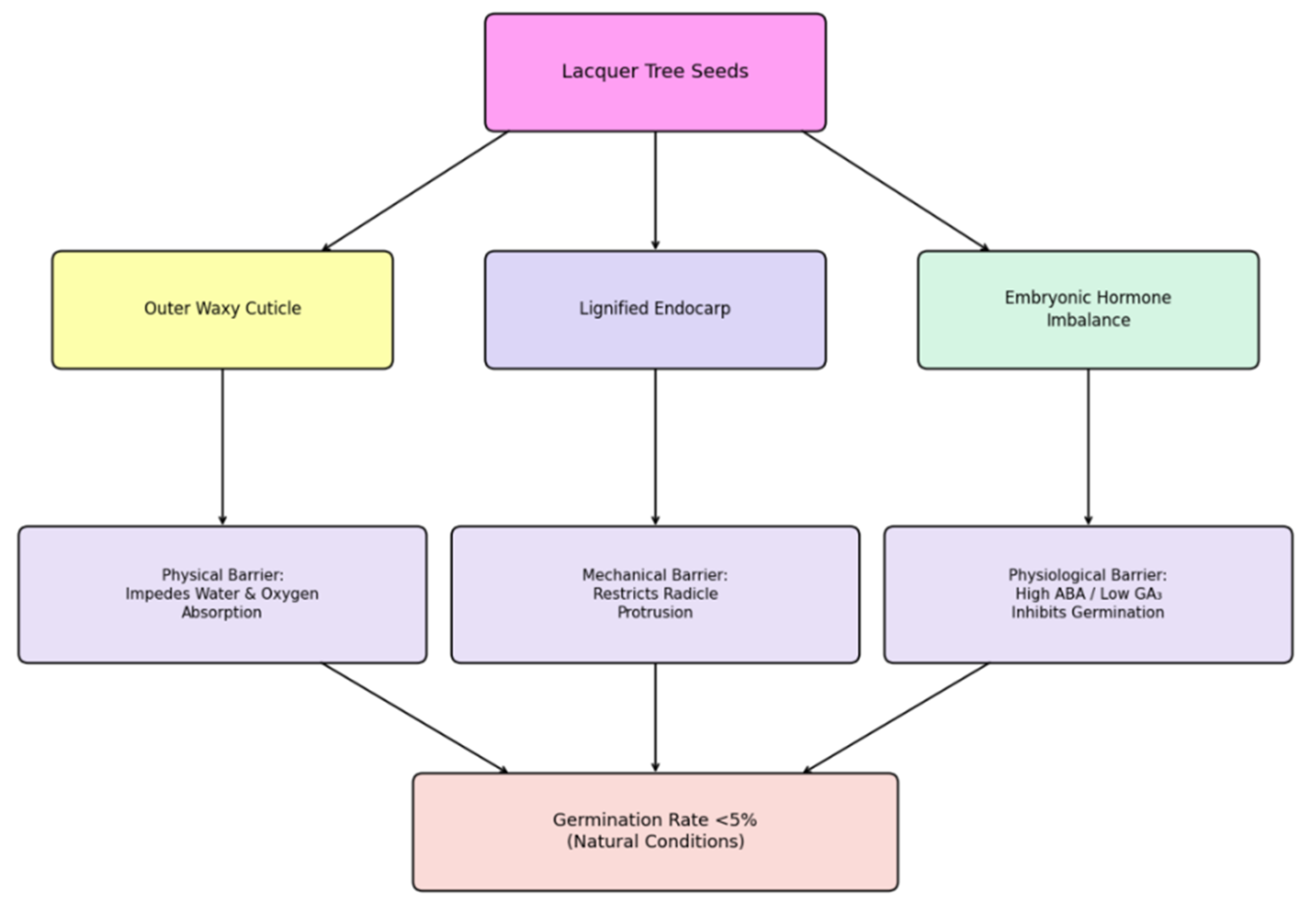
Figure 2.
Cross-species comparison of seed dormancy intensity, stratification requirements, and germination performance among Toxicodendron vernicifluum and related taxa. Dormancy intensity is rated on a five-star scale based on the number and severity of barriers (physical, mechanical, and physiological). Cold stratification duration represents the optimized pretreatment cycle required to break dormancy under controlled conditions. Maximum germination rates reflect laboratory-optimized protocols: Chinese temperate T. vernicifluum requires 14–18 months of alkali scarification plus cold stratification (72–82%); Japanese wild lacquer tree achieves 97.67% under acid etching + GA3 priming but suffers from severe pistil abortion; Vietnamese tropical germplasm exhibits weak dormancy (3–4 months); Mediterranean Rhus coriaria shows divergent physiological regulation unsuitable for direct technical transfer. Field germination performance is typically 30–50% lower than laboratory values due to environmental variability.
Figure 2.
Cross-species comparison of seed dormancy intensity, stratification requirements, and germination performance among Toxicodendron vernicifluum and related taxa. Dormancy intensity is rated on a five-star scale based on the number and severity of barriers (physical, mechanical, and physiological). Cold stratification duration represents the optimized pretreatment cycle required to break dormancy under controlled conditions. Maximum germination rates reflect laboratory-optimized protocols: Chinese temperate T. vernicifluum requires 14–18 months of alkali scarification plus cold stratification (72–82%); Japanese wild lacquer tree achieves 97.67% under acid etching + GA3 priming but suffers from severe pistil abortion; Vietnamese tropical germplasm exhibits weak dormancy (3–4 months); Mediterranean Rhus coriaria shows divergent physiological regulation unsuitable for direct technical transfer. Field germination performance is typically 30–50% lower than laboratory values due to environmental variability.
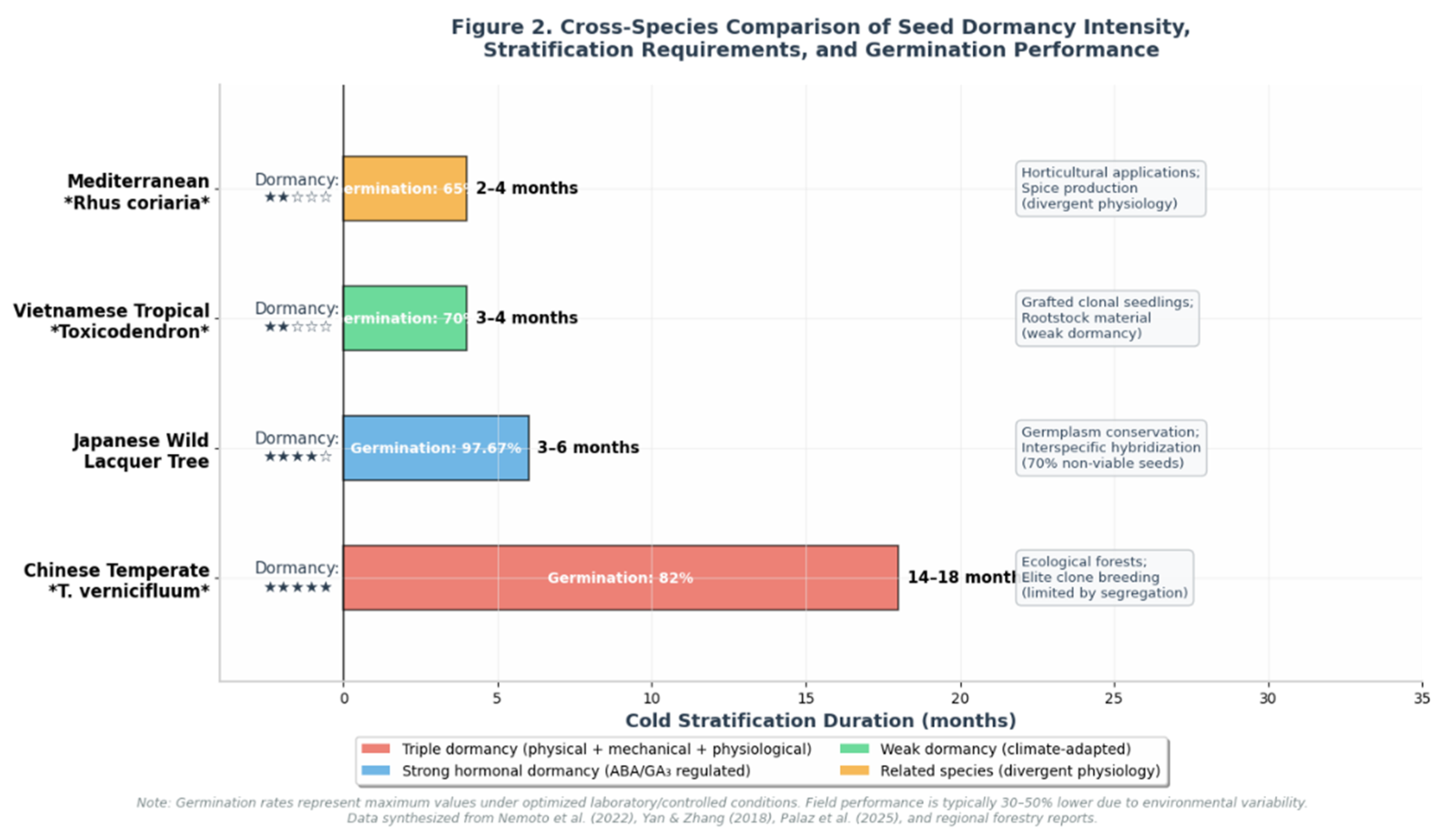

Table 1.
Comparison of seed germination performance under different dormancy-breaking treatments for Toxicodendron vernicifluum [6].
Table 1.
Comparison of seed germination performance under different dormancy-breaking treatments for Toxicodendron vernicifluum [6].
| Pretreatment Combination | Core Operation Steps | Stratification Duration | Maximum Germination Rate | Advantages | Disadvantages |
| Alkali rubbing +cold stratification |
85 °C hot water soaking, ash/soda wax removal, warm water softening |
14-18 months |
14-18 months |
Low chemical risk, fit for large mountain nurseries |
Extraordinarily long storage cycle |
| Acid etching + GA₃ priming | H₂SO₄ scarification, GA₃ soaking, short cold stratification + seed density | 3-6 months |
22%-47% | Short stratification | Corrosive chemical |
| Mechanical abrasion+cellar stratification |
Coarse sand rubbing to remove wax, overwinter cellar storage | 8-10 months |
<40% | No chemical input,easy operation for small households |
Low germination rate, unstable emergence uniformity |
Table 2.
Comparative bottlenecks of three traditional asexual propagation methods for T. vernicifluum [33,34,35].
| Propagation Method | Core Scalability Defect |
Core Scalability Defect |
Practical Industrial Restriction |
| Root layering | Extremely low multiplication rate limited by maternal root biomass | Each mature tree only supplies 20–50 usable root segments annually | Cannot support large standardized lacquer plantation plantlets demand |
| Hardwood/softwood cutting | Unstable rooting performance sensitive to field microclimate | Open-air nursery rooting rate drops by 30%–50% without automatic mist irrigation | Fluctuating transplant survival rate restricts commercial plantlets batch supply |
| Grafting | Scion–rootstock incompatibility and persistent wound gummosis | 15%–30% graft failure rate; surviving grafts show premature senescence after 3–5 years in field | No standardized anti-gummosis post-grafting management system for mass application |
Disclaimer/Publisher’s Note: The statements, opinions and data contained in all publications are solely those of the individual author(s) and contributor(s) and not of MDPI and/or the editor(s). MDPI and/or the editor(s) disclaim responsibility for any injury to people or property resulting from any ideas, methods, instructions or products referred to in the content. |
© 2026 by the authors. Licensee MDPI, Basel, Switzerland. This article is an open access article distributed under the terms and conditions of the Creative Commons Attribution (CC BY) license (http://creativecommons.org/licenses/by/4.0/).
Copyright: This open access article is published under a Creative Commons CC BY 4.0 license, which permit the free download, distribution, and reuse, provided that the author and preprint are cited in any reuse.