

Submitted:
29 August 2026
Posted:
31 August 2026
You are already at the latest version
Abstract
Dengue is a major mosquito-borne viral disease whose rapid progression from self-limiting fever to hemorrhagic or shock syndrome (DHF/DSS) remains difficult to predict using conventional clinical markers. Metabolomics offers a promising avenue for identifying non-invasive biomarkers of infection and severity, but the evidence remains scattered across biofluids and analytical platforms. This systematic review synthesized human metabolomic studies of dengue infection to characterize the biofluids, techniques, and metabolic signatures reported to date. Following PRISMA 2020 guidelines, PubMed, ScienceDirect, and Web of Science were searched for studies applying NMR- or MS-based metabolomics to human dengue samples, screened against PECO criteria requiring a healthy-control or severity comparison group. Of 780 records identified, 17 studies met all eligibility criteria. Most studies (14/17) analyzed blood-derived matrices (serum, plasma, or whole blood), while three analyzed urine; no eligible study examined feces, saliva, tears, sweat, or cerebrospinal fluid. Across studies, three convergent patterns emerged with increasing disease severity: depletion of serotonin and related tryptophan-pathway metabolites, disturbance of glycerophospholipid and lysophospholipid classes, and elevation of markers of hepatic and lipid-metabolic stress (bile acids, VLDL/LDL changes, acylcarnitines). Serotonin combined with IFN-γ achieved the strongest discriminatory performance reported (AUC = 0.92) for progression to DHF, while urinary alkanes and betaine emerged as candidate non-invasive markers linked to infection status and comorbidities such as diabetes. These findings highlight a persistent reliance on blood-based sampling and a near-total absence of studies exploring alternative, more accessible biofluids, representing a clear gap for future non-invasive biomarker research in dengue.
Keywords:
dengue
; metabolomics
; biomarkers
; biofluids
; serum
; urine
; systematic review
; nuclear magnetic resonance (NMR)
; mass spectrometry
; disease severity
Introduction
Dengue fever has emerged as a major public health concern globally, affecting both developed and developing countries in tropical and subtropical regions (Bhatt et al., 2013; Guzman & Harris, 2015). Infection with the dengue virus (DENV) can range from a self-limiting febrile illness (DF) to severe disease characterized by plasma leakage, hemorrhagic manifestations, and shock (DHF/DSS) (World Health Organization, 2009; Soma et al., 2025). The complex array of host physiologic changes and the rapid progression of the disease have hampered a complete understanding of underlying molecular mechanisms of dengue pathogenesis (Cui et al., 2013). Furthermore, the lack of specific therapeutic drugs and appropriate vaccines underscores the importance of exploring distinct clinical diagnostic and prognostic indicators (Guzman & Harris, 2015). Elucidating the mechanisms of dengue development at a molecular level may contribute to identifying potential targeted intervention approaches and clarify the links between host metabolism and viral replication (Melo et al., 2018; Rathnakumar et al., 2023).
Metabolomics, the study of the set of small molecules or metabolites in a biological sample, can improve the understanding of biological responses due to changes at the genetic, epigenetic, or protein level, as well as environmental exposures and host-pathogen interactions (Nicholson et al., 1999). Assessment of the metabolome in dengue research has typically been conducted through two analytical chemistry techniques: nuclear magnetic resonance spectroscopy (NMR) or mass spectrometry (MS) coupled to various chromatographic separations such as liquid or gas chromatography (LC or GC) (Emwas, 2015). Furthermore, analyses may be untargeted to assess a comprehensive range of metabolite classes (Cui et al., 2013; Voge et al., 2016) or targeted to focus on particular molecules, providing gains in precision and quantification (Jusof et al., 2022; Rathnakumar et al., 2023). While the field is evolving, metabolomics may help define molecular phenotypes and better characterize metabolic alterations associated with dengue, such as processes related to lipid remodeling (Khedr et al., 2016; Melo et al., 2018), amino acid perturbation (Shahfiza et al., 2017; El-Bacha et al., 2016), and inflammation (Jusof et al., 2022).
While the literature regarding clinical biochemistry in dengue is relatively mature (Thach et al., 2021; Moallemi et al., 2023), fewer studies have utilized high-throughput metabolomics specifically to identify non-invasive biomarkers in diverse biofluids like urine or fecal matter (Amid et al., 2024; Shahfiza et al., 2015, 2017). Metabolic signatures in dengue may differ based on patient age, gender, or disease phase (febrile, critical, or recovery) (Shahfiza et al., 2015; Rathnakumar et al., 2023; Soma et al., 2025). Furthermore, metabolic alterations early in the infection may affect the propensity for severe outcomes (Voge et al., 2016; Villamor et al., 2018). We therefore conducted a systematic review of the literature related to dengue infection and metabolomics in human populations. This review specifically aimed to identify and synthesize the existing metabolomic evidence in human dengue infection, characterizing the populations studied, the biofluids and analytical platforms used, and the metabolites reported in association with infection status or clinical severity (population: individuals with confirmed or suspected dengue infection; concept: metabolomic/metabonomic profiling; context: any biofluid, compared against healthy controls or across clinical severities).
Methods
This systematic review was accomplished based on the Preferred Reporting Items for Systematic Reviews and Meta-Analyses (PRISMA) statements. This review’s protocol was prospectively registered with PROSPERO (CRD420261490884) on 28 August 2026.
A systematic search of PubMed, ScienceDirect, and Web of Science (WoS) was conducted on 22 July 2026, with no restrictions on publication date, to identify the available evidence on metabolic signatures of dengue infection. Different keywords were combined to retrieve metabolomics papers in the outcomes of interest: (metabolomics OR metabonomics OR metabolites) AND (dengue OR fever dengue OR DENV). The search strategy included free-text terms and Boolean operators.
A screening process was followed to evaluate studies based on the “Participants,” “Exposure,” “Comparator,” and “Outcomes” (PECO) framework. A study was included if it:
- Was conducted in human subjects (P);
- Analyzed the association between metabolomics (including NMR or MS profiling of urine, serum, or plasma) (E) and dengue infection or severity (O);
- Included a control group of healthy individuals or compared different clinical severities of dengue (C).
Additionally, eligibility criteria required that the paper was written in English, peer-reviewed, and described an observational study, excluding letters, editorials, or review articles. Only human studies were included.
During screening, the 380 records excluded at the title/abstract stage were removed because they were not primary research articles (e.g., narrative reviews, editorials), focused solely on animal models, or did not use metabolomics as a primary analytical tool. At the full-text stage, the 73 articles excluded lacked a healthy control group, involved non-human subjects, or presented technical limitations, such as the presence of anticoagulants in plasma samples that interfered significantly with metabolite signal detection in H NMR studies.
Screening of records and full-text articles, as well as data extraction, was performed collaboratively by the co-authors (GMJ, MBD, EBN, HGL, NQE, AHA, and DOY), with the support of an AI assistant (Claude, Anthropic) used to retrieve candidate records, extract structured data from the full text of included studies, and cross-check extracted values against the source documents. All AI-assisted outputs were reviewed and verified by the review team before being incorporated into the review, and any disagreements among reviewers were resolved by discussion with the corresponding author (PLL).
Information was extracted regarding study authors, year, population (region and age), sample type (biofluid), analytical platform, and main findings. The risk of bias of included studies was assessed using a modified framework (such as QUADAS-2) to evaluate the quality of diagnostic accuracy and methodological rigor.
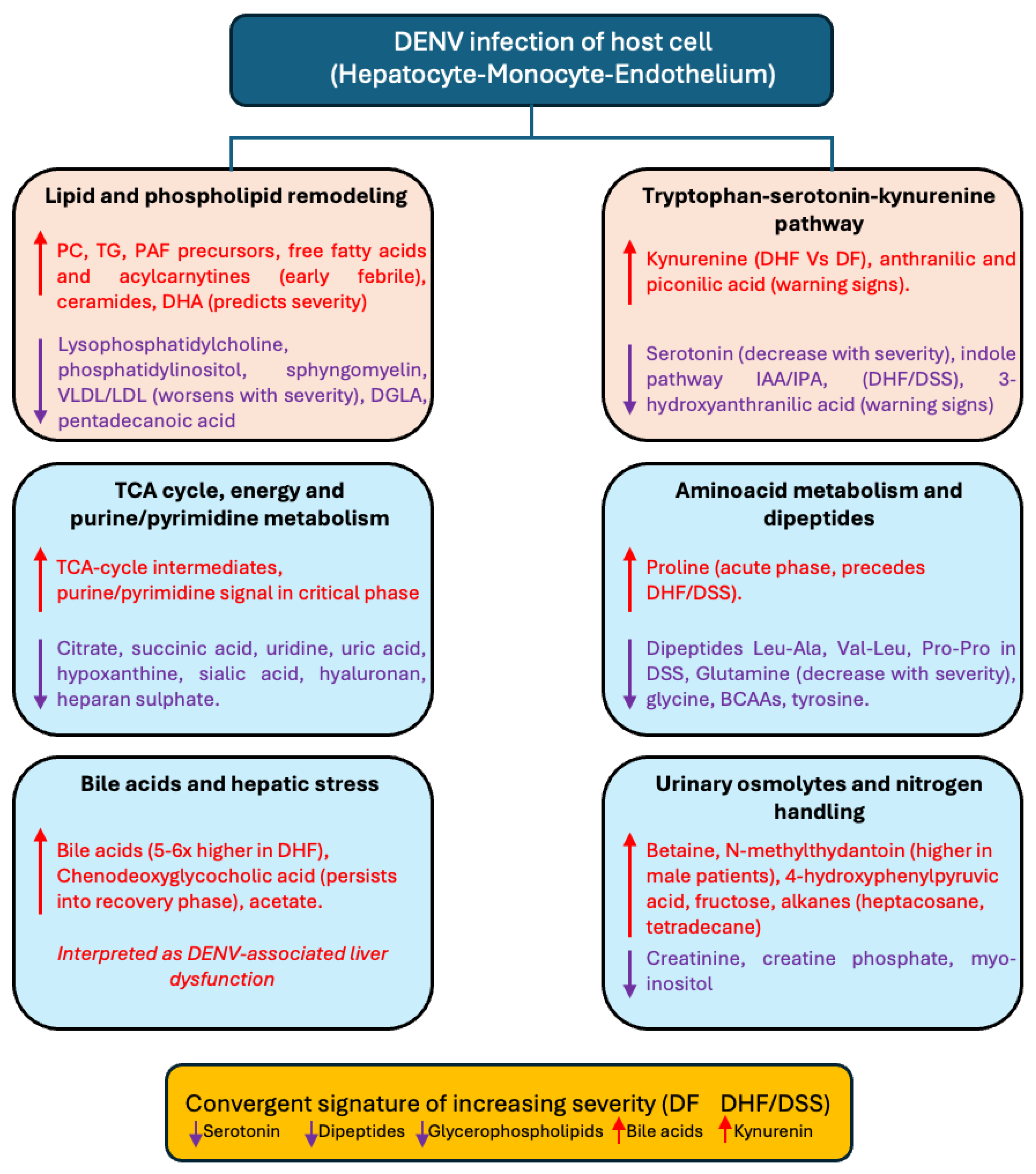
Findings were synthesized narratively, organized by biofluid matrix (blood-derived, urine, fecal) and, within each, by study group or publication date; recurring metabolic pathway alterations across studies were further synthesized into a conceptual model (Figure 2). Given the heterogeneity of analytical platforms and reported outcome metrics across the included studies, no quantitative pooling (meta-analysis) was performed; where individual studies reported a point estimate with a 95% confidence interval, these are compiled for reference in Supplementary Figure S1.
Results
Metabolomic Profiling in Humans with Dengue Infection
In the primary search, 780 records were identified from three databases (PubMed n=226, ScienceDirect n=186, and Web of Science n=368). After removing 310 duplicates, 470 publications were screened for titles and abstracts. Following the exclusion of 380 records during initial screening, 90 articles were assessed for full-text eligibility. Finally, 17 papers met all criteria and were included in the systematic review (Figure 1).
Figure 1.
PRISMA flow diagram.
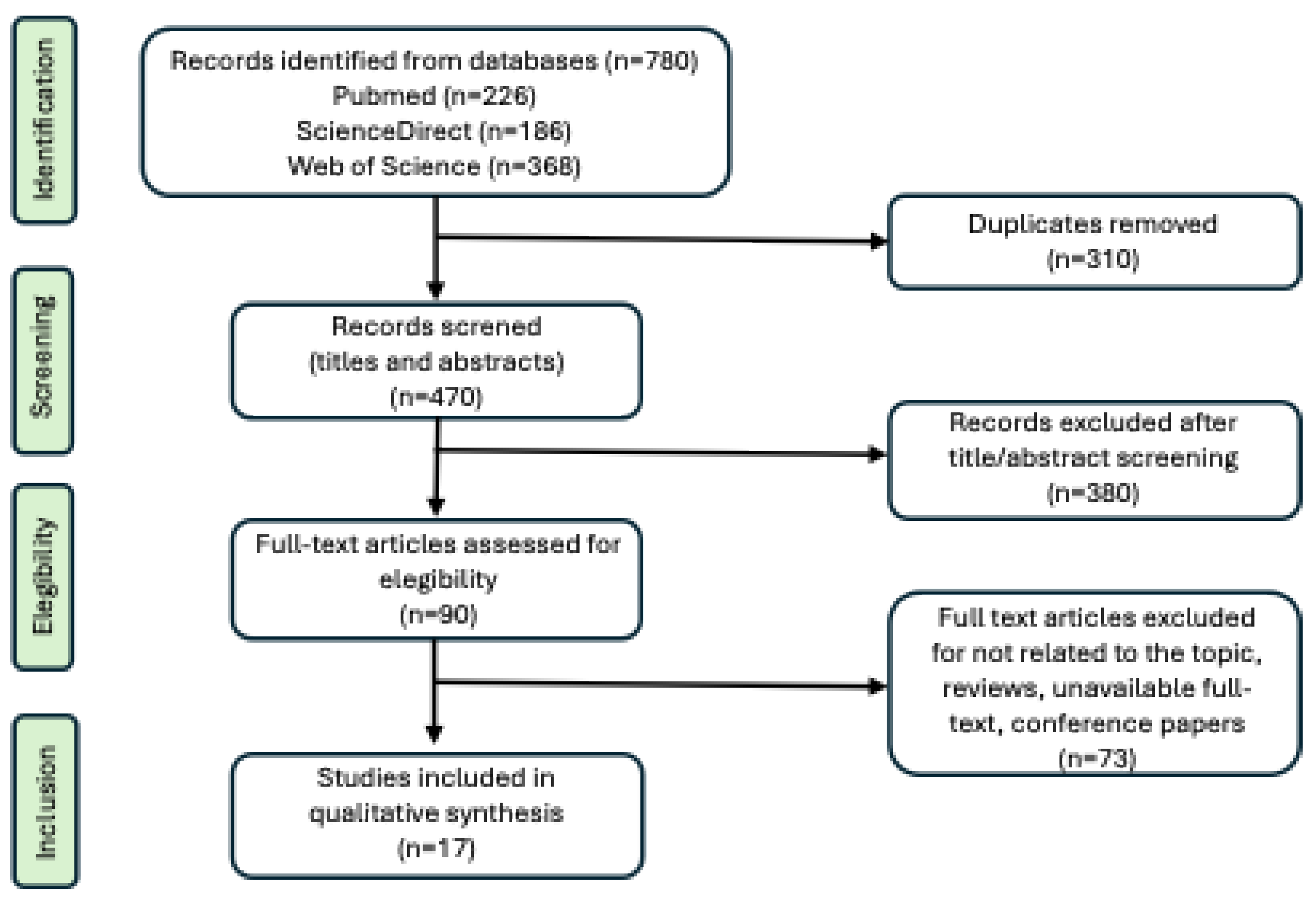
Figure 2.
Proposed model of metabolic pathway alterations in human dengue infection, synthesized from the 17 studies included in this systematic review. Arrows from the central node indicate the six recurrently altered pathway groups identified across studies; up/down arrows within each box indicate metabolites reported as increased or decreased in dengue infection and/or with increasing clinical severity. The bottom panel summarizes the metabolites most consistently associated with progression from dengue fever (DF) to dengue hemorrhagic fever/dengue shock syndrome (DHF/DSS) across independent cohorts (Cui et al., 2016, 2018; Soma et al., 2025).
Figure 2.
Proposed model of metabolic pathway alterations in human dengue infection, synthesized from the 17 studies included in this systematic review. Arrows from the central node indicate the six recurrently altered pathway groups identified across studies; up/down arrows within each box indicate metabolites reported as increased or decreased in dengue infection and/or with increasing clinical severity. The bottom panel summarizes the metabolites most consistently associated with progression from dengue fever (DF) to dengue hemorrhagic fever/dengue shock syndrome (DHF/DSS) across independent cohorts (Cui et al., 2016, 2018; Soma et al., 2025).
The included articles were published between 2013 and 2025. Research was conducted in diverse geographic regions, including Singapore, Malaysia, Nicaragua, Brazil, Colombia, and China. While many studies focused on adult populations, several large-scale studies specifically addressed pediatric cohorts (age ≤ 18 years). Study sizes ranged from small discovery cohorts (n < 20) to large clinical validations including over 500 participants.
Analytical platforms were diverse: four studies utilized ¹H NMR spectroscopy, while the remainder applied LC-MS, GC-MS, HILIC-MS, or direct-infusion high-resolution MS based assays for broader metabolite coverage. Biofluid matrices included serum (11 studies), plasma (3 studies), and urine (3 studies); one study analyzed both serum and plasma from the same patients, and one study analyzed whole blood without serum/plasma separation. No study analyzed feces, saliva, tears, sweat, or cerebrospinal fluid (Table 1).
Metabolomic Analysis on Blood-Derived Samples
Fourteen of the seventeen included studies analyzed blood-derived matrices (serum, plasma, or whole blood), underscoring the field’s continued reliance on venous sampling despite growing interest in non-invasive alternatives.
The most extensively studied cohort came from the Prospective Adult Dengue Study (PADS) in Singapore, described across three companion publications by Cui and colleagues. Cui et al. (2013) followed 44 adult patients with primary dengue fever across three clinical visits and compared them with 50 age-matched healthy controls using LC-MS and GC-MS; seven free fatty acids and ten acylcarnitines were elevated during the early febrile and defervescence phases before normalizing at convalescence, while sphingomyelin SM(d18:1/16:0) fell nearly five-fold between visits 1 and 2, correlating with lymphocyte counts. In a follow-up study restricted to more severe disease, Cui et al. (2016) compared 25 dengue fever (DF) and 27 dengue hemorrhagic fever (DHF) patients in the febrile phase and identified 20 differentially abundant metabolites; kynurenine was increased in DHF while serotonin was decreased (fold change 0.64), and serotonin alone achieved an AUC of 0.80 for predicting progression to DHF, rising to 0.92 when combined with IFN-γ. A third paper from the same group (Cui et al., 2018) extended the comparison into the critical and recovery phases, reporting that bile acids were five- to six-fold higher in DHF and correlated with liver enzymes, while uric acid, hypoxanthine, and several acylcarnitines were decreased; eight metabolites, including chenodeoxyglycocholic acid, remained altered even during recovery, suggesting persistent hepatic and lipid effects of infection.
Similar severity-related signatures emerged from independent cohorts elsewhere. In a two-country study spanning Nicaragua and Mexico, Voge et al. (2016) used untargeted HILIC-MS to profile serum from dengue fever, DHF/DSS, and non-dengue febrile patients; thirteen confidently identified metabolites, including proline, α-linolenic acid, arachidonic acid, docosahexaenoic acid, and two lysophosphatidylcholines, were elevated in the acute phase of patients who would later progress to DHF/DSS compared with those who did not, suggesting early prognostic potential. In Brazil, El-Bacha et al. (2016) applied ¹H NMR spectroscopy to paired plasma samples from 48 DENV-3-infected patients and 17 non-dengue febrile controls, finding that VLDL/LDL and glutamine decreased with disease severity while acetate increased, a pattern the authors interpreted as evidence of dengue-associated liver dysfunction. In Malaysia, Jusof et al. (2022) applied targeted UHPLC and GC-MS quantification of kynurenine-pathway metabolites in plasma from patients stratified by WHO warning-sign criteria; anthranilic acid was the strongest discriminator of patients with warning signs, and together with the chemokines CCL2 and CXCL10 predicted this transition with 97% accuracy.
Lipid and phospholipid remodeling was a recurring theme across several independent groups. Khedr et al. (2016) used targeted LC-ESI-MS/MS to quantify 35 serum phospholipids in Saudi Arabian patients with dengue fever, hepatitis B, or hepatitis C against shared healthy controls; six lysophosphatidylcholines and several phosphatidylinositols were selectively decreased in dengue fever, while two lysophosphatidylinositol species were increased, a pattern the authors attributed to phospholipase-mediated hydrolysis. Using a whole-blood GC-MS panel from a related cohort, Khedr et al. (2015) found that four saturated and eight unsaturated fatty acids were significantly decreased in early febrile-phase dengue fever relative to healthy controls, with the omega-6 fatty acids C18:3n6, C18:2n6, and C20:4n6 falling to roughly half of control levels. In Brazil, Melo et al. (2018) used direct-infusion high-resolution mass spectrometry to profile serum lipids in DENV-4-infected patients, identifying platelet-activating-factor precursors, phosphatidylcholines, and triglycerides that were all elevated relative to healthy controls, consistent with increased membrane synthesis to support viral replication and with the inflammatory and hemorrhagic complications of dengue. Complementing these untargeted lipidomic findings, a nested case-control study from Colombia (Villamor et al., 2018) used targeted gas chromatography to quantify individual serum fatty acids at fever onset in 109 patients who progressed to DHF/DSS and 235 who did not; docosahexaenoic acid (DHA) was positively associated with progression (adjusted OR for the highest versus lowest quintile = 5.34), whereas dihomo-γ-linolenic acid and pentadecanoic acid were inversely associated, indicating that the direction of specific polyunsaturated and odd-chain fatty acid changes at the febrile phase may itself carry prognostic information beyond the overall pattern of lipid remodeling. Because the included studies differ widely in analytical platform and reported outcome metrics, this review followed a narrative rather than a pooled quantitative synthesis. Nonetheless, two of the seventeen included studies reported individual metabolite estimates together with a 95% confidence interval, allowing their effect sizes to be visualized directly rather than only described qualitatively. Villamor et al. (2018) reported adjusted odds ratios comparing the highest and lowest serum quintiles for progression from dengue fever to DHF/DSS (docosahexaenoic acid: AOR = 5.34, 95% CI 2.03–14.1; dihomo-γ-linolenic acid: AOR = 0.30, 95% CI 0.13–0.69), while Cui et al. (2018) reported the discriminatory performance (AUC) of four metabolites between dengue fever and DHF in the critical phase (serotonin: AUC = 0.85, 95% CI 0.75–0.95; uridine: AUC = 0.81, 95% CI 0.68–0.93; glycoursodeoxycholic acid: AUC = 0.77, 95% CI 0.65–0.90; uric acid: AUC = 0.76, 95% CI 0.63–0.89). These single-study estimates are compiled, but not statistically pooled, in Supplementary Figure S1.
Two smaller longitudinal studies added further phase-resolved detail. Rathnakumar et al. (2023) followed 13 adult Indian patients with primary, non-severe dengue across three disease phases using targeted LC-MS/MS, finding fourteen metabolites – spanning amino acid, glycerophospholipid, and purine/pyrimidine pathways – that differed significantly from five matched healthy controls, with the largest number of alterations (52 metabolites, 20 pathways) occurring at the critical phase and a full return to baseline by convalescence. Working with a Colombian cohort, Mena and Wist used ¹H-NMR to compare acute- and recovery-phase serum and plasma from 52 patients, finding that lipid, lactate, and one unidentified signal drove separation between phases, with the largest contributions coming from patients with more severe disease. In a pediatric Nicaraguan cohort, Soma, Perera and colleagues (2025) used untargeted LC-MS/MS to build a 28-metabolite panel that classified dengue fever from DHF/DSS with 96.9% balanced accuracy; dipeptides and serotonin were depleted with increasing severity, while omega-3 and omega-6 fatty acids, eicosanoids, and TCA-cycle intermediates were elevated. An unpublished master’s thesis from Ecuador (Correa Fierro, 2025) reported a complementary pattern in pediatric serum using LC-MS and MALDI-TOF-MS, with sphingolipids and glycerides largely higher in healthy controls than in dengue-positive children, and achieved an AUC of 0.965 for a 15-metabolite panel; because this work has not yet been peer-reviewed, its findings are reported here with that caveat.
Taken together, these blood-based studies converge on three recurring signatures: depletion of serotonin and related tryptophan-pathway metabolites with increasing severity; disturbance of glycerophospholipid and lysophospholipid classes, generally decreased in dengue fever and further altered in more severe disease; and elevation of markers consistent with hepatic and lipid-metabolic stress (bile acids, VLDL/LDL changes, acylcarnitines) that intensify from the febrile through the critical phase.
Metabolomic Analysis on Urine Samples
Three of the seventeen included studies analyzed urine, all using ¹H-NMR or GC-based platforms and all originating from adult cohorts in Malaysia. Amid et al. (2024) compared urine from ten dengue-confirmed adults with three healthy controls using GC-TOF/MS, identifying a panel of alkanes – including heptacosane, hexadecane, tetradecane, and pentadecane – that, combined with 21 discriminating metabolites, achieved complete separation of the two groups in a discriminant analysis model, although the small control group limits the strength of this finding.
Two related studies from the same Malaysian research group used ¹H-NMR to profile urine from larger cohorts. Shahfiza et al. (2017) compared 96 dengue-infected adult men with 50 healthy controls and identified thirteen discriminating metabolites: 4-hydroxyphenylpyruvic acid, fructose, S-sulfocysteine, acetoacetic acid, betaine, and valerylglycine were elevated in dengue, while N-acetylglutamic acid, creatinine, myo-inositol, creatine phosphate, succinic acid, citrate, and 3-hydroxy-3-methylglutarate were decreased, implicating disturbances in amino acid metabolism, the tricarboxylic acid cycle, and fatty acid β-oxidation. In an earlier analysis from the same laboratory, Shahfiza et al. (2015) focused specifically on sex differences within a cohort of 52 dengue patients (39 men, 13 women) and 43 healthy controls, finding that male patients had higher urinary acetaminophen, betaine, and N-methylhydantoin than female patients, alongside lower glycine and 3-hydroxybutyrate; the authors attributed the creatinine- and creatine-phosphate-related differences to greater muscle mass in men and proposed betaine as a candidate sex-specific marker linked to diabetes comorbidity, although they themselves cautioned that the discriminant model for sex separation was statistically weak and likely overfit, and the female subgroup was small (n=13).
Because two of the three urine studies were conducted by the same author group in the same country, some sample overlap between them cannot be ruled out and should be considered when interpreting the combined urinary evidence. Nonetheless, across all three studies, alterations in amino acid metabolism (glycine, betaine), the TCA cycle (citrate, succinic acid), and nitrogen-handling metabolites (creatinine, N-methylhydantoin) emerged as the most consistent urinary signal, broadly paralleling the amino-acid and TCA-cycle disturbances reported in blood-derived samples.
Metabolomic Analysis on Fecal Samples
No study meeting this review’s eligibility criteria analyzed fecal metabolomics in human dengue patients. A structured search of the literature (conducted August 2026) found no published NMR- or MS-based fecal metabolomic profiling study in human dengue infection, despite fecal biomarkers being explored in several other infectious and inflammatory diseases.
The closest available evidence comes from a murine model: an untargeted LC-MS study of BALB/c mice infected with dengue, Japanese encephalitis, or Zika virus identified 225 differentially abundant fecal metabolites following dengue virus infection, with amino acid and lipid metabolism most affected, and proposed sphingosine-1-phosphate as a candidate mediator connecting gut metabolism to viral neuroinvasion via the gut–brain axis. Because this evidence derives from an animal model rather than human subjects, it does not meet this review’s inclusion criteria and is not synthesized further here; it is noted only to indicate that fecal metabolomic profiling of dengue infection is technically feasible and to identify a clear, currently unaddressed gap in the human dengue biomarker literature that future non-invasive biomarker studies could target. No eligible study analyzing saliva, tears, sweat, or cerebrospinal fluid was identified either.
Discussion
The findings of this review can be articulated across three fundamental dimensions of the metabolic response to dengue. First, diagnostic markers were identified that accurately distinguish infected patients from healthy controls. These include molecular signatures detected in non-invasive samples, such as specific alkanes in urine (e.g., heptacosane, tetradecane) and various perturbations in the tricarboxylic acid (TCA) cycle and amino acid metabolism, notably the presence of 4-hydroxyphenylpyruvic acid and fructose in febrile patients.
Second, critical prognostic and severity markers emerged to predict progression toward severe manifestations such as DHF/DSS. A “metabolic collapse” was observed, characterized by a massive reduction in levels of serotonin, tryptophan, and specific dipeptides (such as leucyl-alanine) in patients with critical illness. These changes are complemented by alterations in the lipidome, including decreased phosphatidylcholines and sphingomyelins, reflecting the intense viral demand for host membranes for replication (Figure 2).
Finally, the literature highlights physiological modulators that influence the metabolome architecture during infection. Factors such as patient gender play a determining role, with significant differences observed in the urinary excretion of creatinine, phosphocreatine, and N-methylhydantoin, which are higher in males due to greater muscle mass. Furthermore, age and pre-existing comorbidities like diabetes modulate the metabolic response, where elevated urinary betaine levels may act as an early alarm signal before clinical progression toward severity.
Serotonin (5-HT) plays a fundamental biological role in the context of dengue by acting as a key mediator in platelet function and maintaining vascular integrity. Its relevance has proven to be highly consistent across multiple large-scale cohorts, including both pediatric and adult populations. There is robust evidence, supported by major prospective studies such as that of Soma et al., which analyzed 535 patients, confirming that a massive depletion of serotonin levels constitutes the most reliable metabolic predictor for the transition from dengue fever (DF) to dengue shock syndrome (DSS). Due to this diagnostic strength, serotonin is positioned as a high-confidence prognostic marker for the early triage of patients. Betaine serves a vital biological role as an organic osmolyte and a methyl donor, functions that are essential for maintaining cellular volume and supporting liver health during viral stress. This metabolite has been identified consistently in urine-based studies utilizing diverse analytical platforms, including NMR and GC-MS. The strength of evidence for betaine is considered moderate to high. While the cohort sizes in these investigations are generally smaller than those in serum studies, the repeated identification of betaine in non-invasive urine samples establishes it as a primary candidate for the development of diagnostic kits. Furthermore, its established link to comorbidities such as diabetes adds significant value for patient risk stratification, as diabetic patients often exhibit altered betaine excretion and are at higher risk for severe dengue. Albumin is the primary protein responsible for maintaining oncotic pressure in the blood, and a clinical drop in its levels is a hallmark indicator of plasma leakage. The consistency of this finding is universal across multiple meta-analyses and standard clinical chemistry reports. Consequently, the evidence strength for albumin is strong, serving as a “gold standard” in clinical assessment. Comprehensive meta-analyses involving thousands of patients, such as those conducted by Thach et al. and Moallemi et al., confirm that hypoalbuminemia is a definitive predictor of severe manifestations, including Dengue Hemorrhagic Fever and Dengue Shock Syndrome. Although it is not a “novel” metabolite in the field of omics, its consistent presence validates the metabolic “leakage” signatures identified in contemporary high-throughput studies
Limitations
This review has several limitations. First, given the heterogeneity of analytical platforms, biofluids, and outcome metrics reported across the included studies, findings were synthesized narratively rather than pooled quantitatively; only two of the seventeen included studies reported a point estimate with a 95% confidence interval, precluding a formal meta-analysis (Supplementary Figure S1). Second, the search was restricted to three databases (PubMed, ScienceDirect, and Web of Science) and to English-language, peer-reviewed articles, which may have excluded relevant studies published in other languages, in the gray literature, or indexed elsewhere. Third, sample sizes were generally small, and one included source (Correa Fierro, 2025) is an unpublished thesis that has not yet undergone peer review, which should be weighed when interpreting the strength of the evidence presented. Finally, the near-total reliance of the included literature on blood-derived matrices (14 of 17 studies) limits what can currently be concluded about metabolomic biomarkers in more accessible, non-invasive biofluids.
Conclusions
Human metabolomic studies of dengue infection consistently point to three convergent, severity-associated signatures — depletion of serotonin and tryptophan-pathway metabolites, disturbance of glycerophospholipid classes, and elevation of markers of hepatic and lipid-metabolic stress — but remain overwhelmingly reliant on blood-derived matrices. Non-invasive biofluids such as urine remain underexplored, and feces, saliva, tears, sweat, and cerebrospinal fluid have not been studied at all in this context, representing a clear and actionable gap for future biomarker research aimed at less invasive dengue diagnostics and prognostics.
Supplementary Materials
The following supporting information can be downloaded at the website of this paper posted on Preprints.org.
Funding
This work was supported by the Sistema General de Regalías (SGR) of Colombia under the research project code BPIN: 2024000100078. The funders had no role in study design, data collection and analysis, decision to publish, or preparation of the manuscript. GMJ and EBN are funded by an Ministerio de Ciencia, Tecnología e Innovación-doctoral fellowship.
Contributors
PLL conceptualised the study, developed and refined the search strategy. GMJ, MBD, EBN, HGL, NQE, AHA and DOY screened articles, extracted data and critically appraised the included studies. PLL, GMJ, MBD, EBN, HGL, AHA and DOY wrote the first draft of the manuscript. PLL, GMJ, MBD, EBN, HGL provided critical review of the manuscript. PLL, GMJ, MBD, EBN, HGL and AHA had full access to all the data in the study, and had final responsibility for the decision to submit for publication.
Declaration of interests
We declare no competing interests.
References
- Amid, A.; Abdullah Sani, M. S.; Abdullah, A.; Mohamed Bakrim, N.; et al. Biomarkers identification from urine of dengue patients through GCMS for initial development of non-invasive diagnostic kit. IIUM Eng. J. 2024, 25(2). [Google Scholar] [CrossRef]
- Bhatt, S.; Gething, P. W.; Brady, O. J.; Messina, J. P.; Farlow, A. W.; Moyes, C. L.; et al. The global distribution and burden of dengue. Nature 2013, 496(7446), 504–507. [Google Scholar] [CrossRef] [PubMed]
- Correa Fierro, R. E. Análisis metabolómico del suero de niños infectados por el virus del dengue para la detección de potenciales biomarcadores endógenos. Master’s thesis, unpublished, Escuela Superior Politécnica del Litoral (ESPOL) / Instituto IKIAM, Guayaquil, Ecuador, 2025. [Google Scholar]
- Cui, L.; Lee, Y. H.; Kumar, Y.; Xu, F.; Lu, K.; Ooi, E. E.; Tannenbaum, S. R.; Ong, C. N. Serum metabolome and lipidome changes in adult patients with primary dengue infection. PLoS Neglected Trop. Dis. 2013, 7(8), e2373. [Google Scholar] [CrossRef] [PubMed]
- Cui, L.; Lee, Y. H.; Thein, T. L.; Fang, J.; Pang, J.; Ooi, E. E.; Leo, Y. S.; Ong, C. N.; Tannenbaum, S. R. Serum metabolomics reveals serotonin as a predictor of severe dengue in the early phase of dengue fever. PLoS Neglected Trop. Dis. 2016, 10(4), e0004607. [Google Scholar] [CrossRef] [PubMed]
- Cui, L.; Pang, J.; Lee, Y. H.; Ooi, E. E.; Ong, C. N.; Leo, Y. S.; Tannenbaum, S. R. Serum metabolome changes in adult patients with severe dengue in the critical and recovery phases of dengue infection. PLoS Neglected Trop. Dis. 2018, 12(1), e0006217. [Google Scholar] [CrossRef] [PubMed]
- El-Bacha, T.; Struchiner, C. J.; Cordeiro, M. T.; Almeida, F. C. L.; Marques, E. T., Jr.; Da Poian, A. T. ¹H nuclear magnetic resonance metabolomics of plasma unveils liver dysfunction in dengue patients. J. Virol. 2016, 90(16), 7429–7443. [Google Scholar] [CrossRef] [PubMed]
- Emwas, A. H. The strengths and weaknesses of NMR spectroscopy and mass spectrometry with particular focus on metabolomics research. In Metabonomics: Methods and Protocols, Methods in Molecular Biology; Humana Press, 2015; Vol. 1277, pp. 161–193. [Google Scholar] [CrossRef] [PubMed]
- Guzman, M. G.; Harris, E. Dengue. The Lancet 2015, 385(9966), 453–465. [Google Scholar] [CrossRef] [PubMed]
- Jusof, F. F.; Lim, C. K.; Aziz, F. N.; Soe, H. J.; Samudi Raju, C.; Sekaran, S. D.; Guillemin, G. J. The cytokines CXCL10 and CCL2 and the kynurenine metabolite anthranilic acid accurately predict patients at risk of developing dengue with warning signs. J. Infect. Dis. 2022, 226(11), 1964–1973. [Google Scholar] [CrossRef] [PubMed]
- Khedr, A.; Hegazy, M.; Kamal, A.; Shehata, M. A. Profiling of esterified fatty acids as biomarkers in the blood of dengue fever patients using a microliter-scale extraction followed by gas chromatography and mass spectrometry. In Journal of Separation Science; Advance online publication; 2015. [Google Scholar] [CrossRef] [PubMed]
- Khedr, A.; Hegazy, M. A.; Kammoun, A. K.; Shehata, M. A. Phospholipidomic identification of potential serum biomarkers in dengue fever, hepatitis B and hepatitis C using liquid chromatography-electrospray ionization-tandem mass spectrometry. J. Chromatogr. B 2016, 1009–1010, 44–54. [Google Scholar] [CrossRef] [PubMed]
- Melo, C. F. O. R.; Delafiori, J.; Dabaja, M. Z.; de Oliveira, D. N.; Guerreiro, T. M.; Colombo, T. E.; Nogueira, M. L.; Proença-Modena, J. L.; Catharino, R. R. The role of lipids in the inception, maintenance and complications of dengue virus infection. Sci. Rep. 2018, 8, 11826. [Google Scholar] [CrossRef] [PubMed]
- Mena, L. V.; Wist, J. Análisis de huellas metabólicas en muestras de pacientes enfermos del virus dengue por resonancia magnética nuclear; Departamento de Química, Universidad del Valle: Cali, Colombia, 2016. [Google Scholar]
- Moallemi, S.; Lloyd, A. R.; Rodrigo, C. Early biomarkers for prediction of severe manifestations of dengue fever: A systematic review and a meta-analysis. Sci. Rep. 2023, 13, 17485. [Google Scholar] [CrossRef] [PubMed]
- Nicholson, J. K.; Lindon, J. C.; Holmes, E. ‘Metabonomics’: Understanding the metabolic responses of living systems to pathophysiological stimuli via multivariate statistical analysis of biological NMR spectroscopic data. Xenobiotica 1999, 29(11), 1181–1189. [Google Scholar] [CrossRef] [PubMed]
- Rathnakumar, S.; Kambhampati, N. S. V.; Saiswaroop, R.; Pradhan, S. S.; Ramkumar, G.; Beeraka, N.; Muddu, G. K.; Kumar, S.; Javvaji, S. K.; Parangoankar, A.; Sivaramakrishnan, V.; Ramamurthy, S. S. Integrated clinical and metabolomic analysis of dengue infection shows molecular signatures associated with host-pathogen interaction in different phases of the disease. Metabolomics 2023, 19, 47. [Google Scholar] [CrossRef] [PubMed]
- Shahfiza, N.; Osman, H.; Hock, T. T.; Shaari, K.; Abdel-Hamid, A. Z. Metabolomics for characterization of gender differences in patients infected with dengue virus. Asian Pac. J. Trop. Med. 2015, 8(6), 451–456. [Google Scholar] [CrossRef] [PubMed]
- Shahfiza, N.; Osman, H.; Hock, T. T.; Shaari, K.; Abdel-Hamid, A. Z. Metabolomics approach for multibiomarkers determination to investigate dengue virus infection in human patients. Acta Biochim. Pol. 2017, 64(2), 215–219. [Google Scholar] [CrossRef] [PubMed]
- Soma, P. S.; Gullberg, R. C.; Graham, B.; Islam, M. N.; Kuan, G.; Balmaseda, A.; Blair, C. D.; Beaty, B. J.; Belisle, J. T.; Harris, E.; Perera, R. Perturbed pediatric circulating metabolome in mild and severe dengue disease. J. Virol. Advance online publication. 2025. [Google Scholar] [CrossRef] [PubMed]
- Thach, T. Q.; Eisa, H. G.; Ben Hmeda, A.; Faraj, H.; Thuan, T. M.; Abdelrahman, M. M.; et al. Predictive markers for the early prognosis of dengue severity: A systematic review and meta-analysis. PLoS Neglected Trop. Dis. 2021, 15(10), e0009808. [Google Scholar] [CrossRef] [PubMed]
- Villamor, E.; Villar, L. A.; Lozano-Parra, A.; Herrera, V. M.; Herrán, O. F. Serum fatty acids and progression from dengue fever to dengue haemorrhagic fever/dengue shock syndrome. Br. J. Nutr. 2018, 120(7), 787–796. [Google Scholar] [CrossRef] [PubMed]
- Voge, N. V.; Perera, R.; Mahapatra, S.; Gresh, L.; Balmaseda, A.; Loroño-Pino, M. A.; Hopf-Jannasch, A. S.; Belisle, J. T.; Harris, E.; Blair, C. D.; Beaty, B. J. Metabolomics-based discovery of small molecule biomarkers in serum associated with dengue virus infections and disease outcomes. PLoS Neglected Trop. Dis. 2016, 10(2), e0004449. [Google Scholar] [CrossRef] [PubMed]
- World Health Organization. Dengue: Guidelines for diagnosis, treatment, prevention and control, New ed.; WHO/TDR, 2009; Available online: https://iris.who.int/handle/10665/44188.

Table 1.
Characteristics and key findings of the 17 included studies.
| Study | Country/Region | Design | Sample size | Biofluid | Analytical platform |
| Amid et al. (2024) | Malaysia | Case-control | 10 dengue vs 3 healthy controls (adults) | Urine | GC-TOF/MS |
| Correa Fierro (2025)* | Ecuador | Case-control | 25 dengue vs 15 controls (pediatric) | Serum | LC-MS (UPLC-QTOF) + MALDI-TOF-MS |
| Cui et al. (2013) | Singapore | Prospective cohort | 44 DF patients vs 50 healthy controls | Serum | LC-MS + GC-MS |
| Cui et al. (2016) | Singapore | Prospective cohort, case-control | DF n=25 vs DHF n=27 (febrile phase) | Serum | Untargeted + targeted LC-MS/MS |
| Cui et al. (2018) | Singapore | Prospective cohort, case-control | DF n=25 vs DHF n=27 (critical/recovery phases) | Serum | Untargeted LC-MS |
| El-Bacha et al. (2016) | Brazil | Prospective cohort, case-control | 48 DENV-3+ patients vs 17 non-dengue febrile controls | Plasma | ¹H NMR |
| Jusof et al. (2022) | Malaysia | Cross-sectional, severity-stratified | ~104–116 samples (DWS−, DWS+, SD groups) | Plasma | Targeted UHPLC + GC-MS |
| Khedr et al. (2015) | Saudi Arabia | Case-control | 24 DF patients vs 24 healthy controls | Whole blood | GC-MS (FAME, targeted) |
| Khedr et al. (2016) | Saudi Arabia | Case-control (multi-disease) | 14 DF vs 14 healthy controls (subset) | Serum | LC-ESI-MS/MS (targeted) |
| Melo et al. (2018) | Brazil | Case-control | 20 DENV-4 patients vs 10 healthy controls | Serum | Direct-infusion HRMS |
| Mena & Wist (unpublished) | Colombia | Observational, acute vs recovery | 52 patients, 92 paired spectra | Serum and plasma | ¹H-NMR |
| Rathnakumar et al. (2023) | India | Prospective cohort, longitudinal | 13 dengue patients vs 5 healthy controls | Serum | Targeted LC-MS/MS |
| Shahfiza et al. (2015) | Malaysia | Case-control | 52 dengue patients vs 43 healthy controls | Urine | ¹H-NMR |
| Shahfiza et al. (2017) | Malaysia | Case-control | 96 dengue patients vs 50 healthy controls | Urine | ¹H-NMR |
| Soma et al. (2025) | Nicaragua | Retrospective cohort/case-control | 251 dengue vs 284 non-dengue febrile patients | Serum | Untargeted LC-MS/MS |
| Villamor et al. (2018) | Colombia | Nested case-control | 109 DHF/DSS cases vs 235 DF controls | Serum | Targeted GC (GC-FID) |
| Voge et al. (2016) | Nicaragua & Mexico | Retrospective cross-sectional | Two cohorts; DF, DHF/DSS, and non-dengue febrile groups | Serum | Untargeted HILIC-MS + targeted LC-MS/MS |
DF, dengue fever; DHF, dengue hemorrhagic fever; DSS, dengue shock syndrome; DWS, dengue with warning signs; SD, severe dengue. *Unpublished master’s thesis, not yet peer-reviewed.
Disclaimer/Publisher’s Note: The statements, opinions and data contained in all publications are solely those of the individual author(s) and contributor(s) and not of MDPI and/or the editor(s). MDPI and/or the editor(s) disclaim responsibility for any injury to people or property resulting from any ideas, methods, instructions or products referred to in the content. |
© 2026 by the authors. Licensee MDPI, Basel, Switzerland. This article is an open access article distributed under the terms and conditions of the Creative Commons Attribution (CC BY) license (http://creativecommons.org/licenses/by/4.0/).
Copyright: This open access article is published under a Creative Commons CC BY 4.0 license, which permit the free download, distribution, and reuse, provided that the author and preprint are cited in any reuse.