
Submitted:
29 August 2026
Posted:
31 August 2026
You are already at the latest version
Abstract
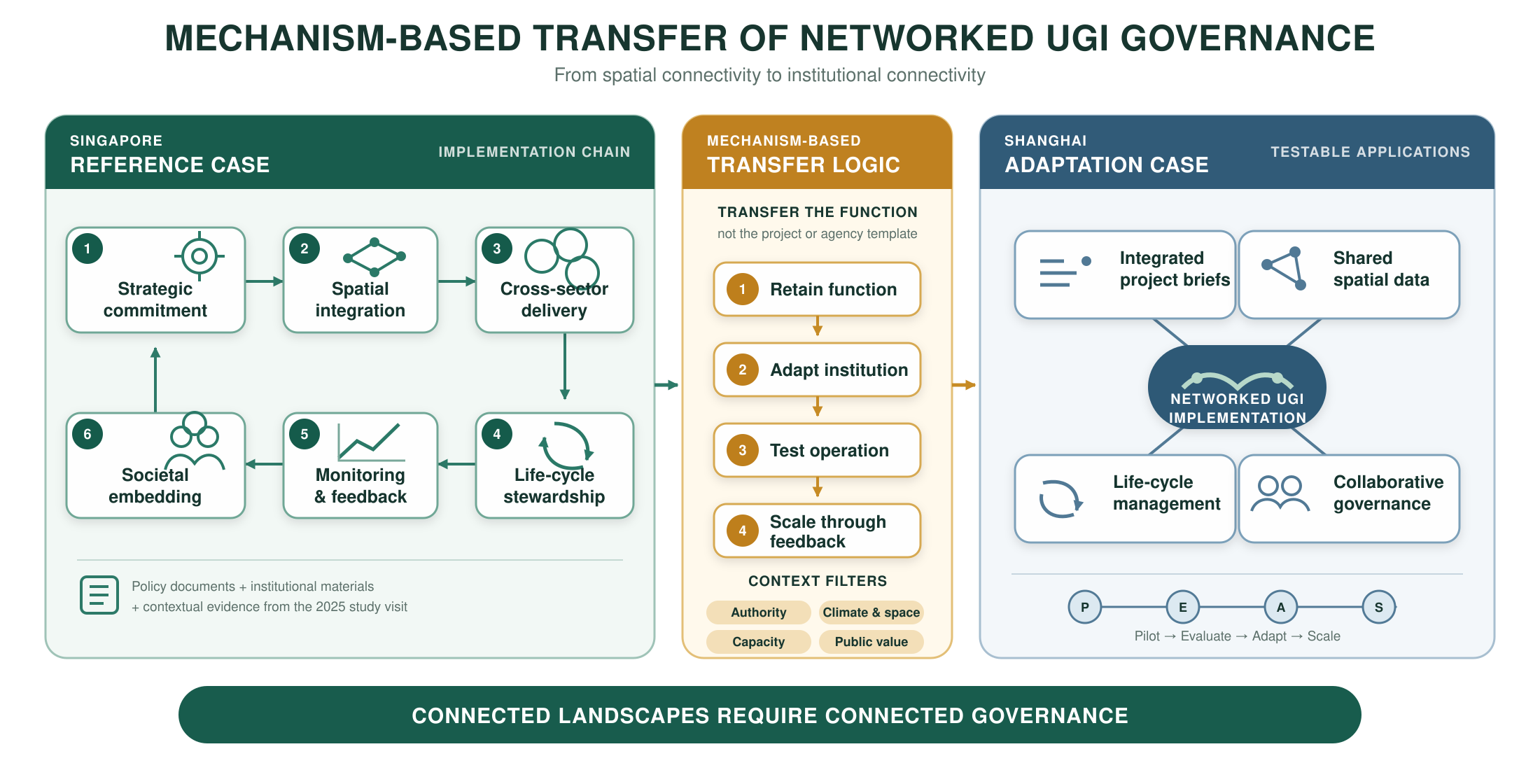
High-density cities increasingly treat parks, greenways, waterways, streetscapes, and urban landscapes as a connected green infrastructure (UGI) system supporting climate adaptation, biodiversity, health, and recreation. Yet these functions depend on how land-use planning, project delivery, and long-term management are connected. This study uses a qualitative, mechanism-oriented comparison to examine how Singapore governs networked urban landscapes and how these functions relate to Shanghai's policy transition. A 2025 professional study visit provided contextual evidence alongside policy and planning documents, statistics, institutional materials, and peer-reviewed research. Five interrelated mechanisms were identified in Singapore: nested planning and implementation rules; networked multifunctional land use; project-level interagency co-production; professional stewardship linked to operational data; and sustained participation combined with differentiated access. Shanghai's recent plans address several corresponding functions, including life-cycle park management, integrated spatial data, ecological monitoring, and collaborative governance, but published evidence does not establish how consistently they operate across districts, projects, and asset owners. The comparison supports conditional rather than direct transfer: governance functions should be adapted to local authority, spatial and climatic conditions, operating capacity, and accountability. The resulting implementation-chain framework links spatial connectivity with institutional continuity and helps diagnose where urban landscape and greenway objectives may become disconnected from long-term operation.
Keywords:
urban landscape
; urban green infrastructure
; blue-green infrastructure
; landscape governance
; policy transfer
; life-cycle management
; Singapore
; Shanghai
Copyright: This open access article is published under a Creative Commons CC BY 4.0 license, which permit the free download, distribution, and reuse, provided that the author and preprint are cited in any reuse.