

Submitted:
31 August 2026
Posted:
31 August 2026
You are already at the latest version
Abstract
Bacterial cells are richly endowed with different surface functional groups that are known to be very useful in the sorption of heavy metals for environmental remediation. One example is Escherichia coli. But, these bacterial cells need to be inactivated in order to offer prolonged shelf-life for practical applications in wastewater treatment, and these inactivation methods should not damage or remove substantial amount of the cell surface functional groups. In this work, E. coli DH5α was used as model organism for examining the effectiveness of freeze drying, dry heat, and autoclave treatment in protecting the cell surface functional groups while inactivating the bacterial cells. Measurement of E. coli zeta potential-pH profile after cell inactivation treatments revealed that all three treatments significantly changed the point of zero charge of E. coli with the likely loss of substantial amount of amine functional group. However, there seemed to be much less removal of carboxylic acid functional groups due to the maintenance of the buffering range between pH 5 and 10 for E. coli with similar zeta potential values across E. coli treated with the three inactivation methods. Data obtained in this work illustrated that freeze drying, dry heat, and autoclave treatment did not significantly remove the main heavy metal binding carboxylic acid functional groups, and the uptake capacity for heavy metals likely remained high after cell inactivation treatment. On the downside, substantial removal of amine functional groups by these cell inactivation methods meant that inactivated E. coli cells have reduced uptake capacity for anionic heavy metal pollutants such as arsenic compounds.
Keywords:
cell surface charge
; zeta potential
; Escherichia coli
; amine functional groups
; carboxylic acid functional groups
; microbiology
; biochemistry
; chemistry
; chemical engineering
; environmental engineering
Introduction
Biosorbents such as bacterial cells have been shown to be useful and effective in adsorbing heavy metals and removing them from wastewater stream.[1,2,3] To do this, bacterial cell surface functional groups such as amine and carboxylic acid groups help attract and adsorb the opposite charge heavy metal cations or anions.[1] Hence, heavy metals are thus adsorbed on the bacterial cell surface through electrostatic charge attraction.
However, bacterial cells need to be pre-treated to deliver a longer shelf-life for longer lasting operation as adsorbents in an industrial chromatography column designed to adsorb and remove heavy metals from a wastewater stream. One pre-treatment option is through cell inactivation. In this study, three different cell inactivation methods: (i) freeze drying, (ii) dry heat inactivation, and (iii) autoclave treatment, were studied. The objective here is to inactivate the model organism, Escherichia coli DH5α, to help preserve its shelf-life (particularly in tropical warm climate), but with the key goal of protecting the surface functional groups that help provide the binding sites for sorption of heavy metals. As the objective is to protect the bacterial cell surface functional groups, chemical reactant or preservatives were not used in this work.
Characterisation techniques used in this work was via zeta potential analysis. Zeta potential measures the cell surface charge under a particular pH value. In this study, the full zeta potential-pH profile across the pH range from 1 to 12 was obtained to understand how different cell inactivation methods affect the repertoire of cell surface functional groups. For example, certain cell inactivation method may remove the amine groups more as compared to the carboxylic acid groups.
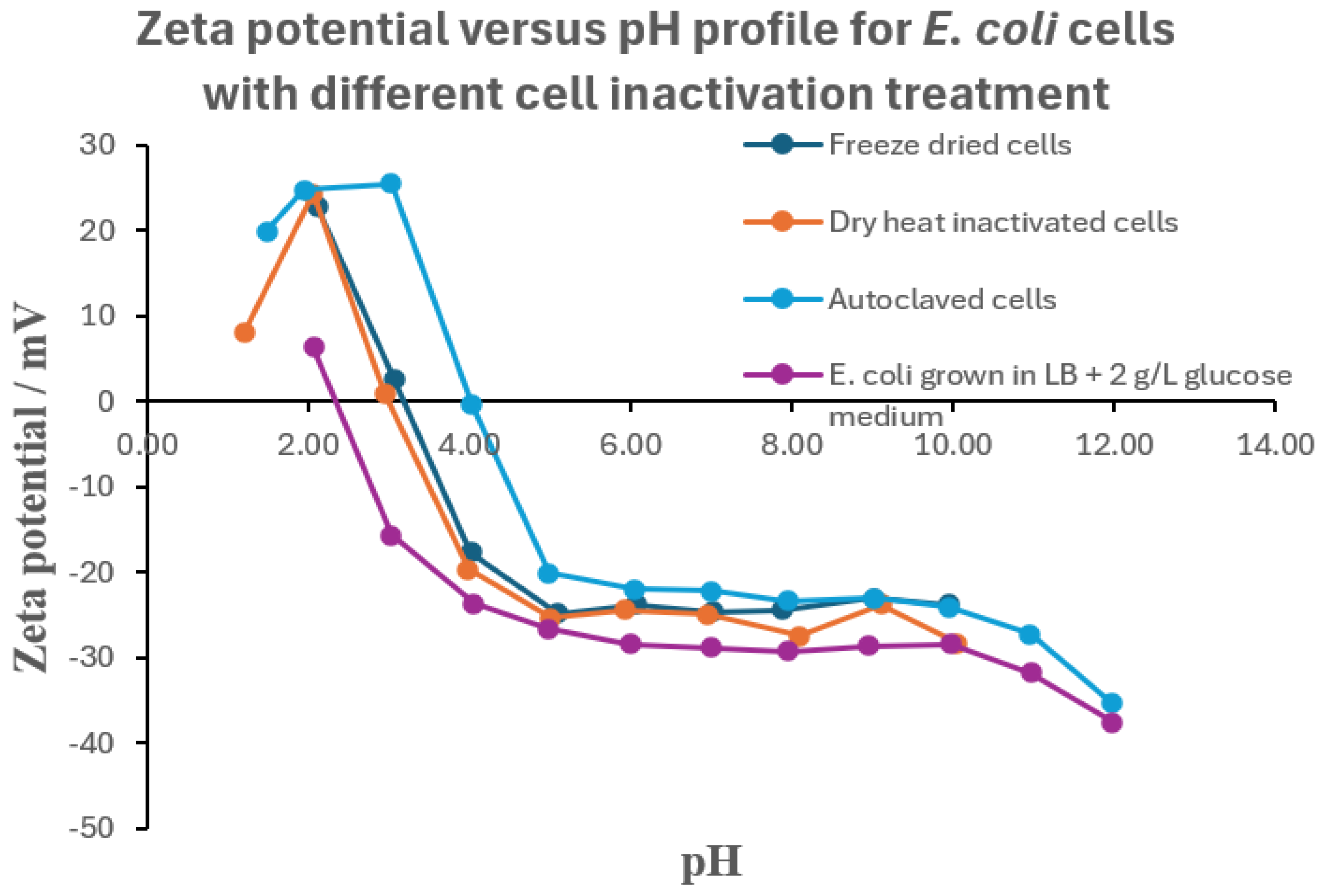
Data from this study indicated clearly that there was a shift in point of zero charge (pHzpc) for cells inactivated by dry heat treatment and freeze drying (pHzpc of 3) and autoclave treatment (pHzpc of 4) as compared to the pHzpc of 2.2 of the reference control cells grown in LB Lennox medium with 2 g/L glucose supplementation. This suggests that a significant fraction of amine groups was removed via dry heat treatment and freeze drying and autoclaved treatment. On the other hand, the buffering range of the zeta potential-pH profile between pH 5 and 10 remained the same for E. coli cells inactivated by the different methods, indicating that carboxylic acid groups (pKa of 5) were not significantly removed by cell inactivation.
Overall, different cell inactivation methods did have an effect on E. coli cell surface functional groups composition, particularly with regards to the removal of the amine functional groups. But, the major workhorse functional groups such as carboxylic acid groups that adsorb and remove heavy metal cations were not significantly removed by freeze drying, dry heat inactivation, and autoclave treatment, and thus, the uptake capacity of the E. coli biosorbent for heavy metal cations such as copper and nickel should not be significantly affected.
Materials and Methods
Cultivation of E. coli Cells for Inactivation Study
The original stock culture of Escherichia coli DH5α was thawed after storage at -80 oC, and used as inoculum in 100 mL LB Lennox medium in a 250 mL glass shake flask in aerobic culture mode on 230 rpm shaking at 37 oC in an incubator. This was known as the activate culture. After 8 hours of cultivation, 1 mL of this activate culture was used as inoculum for 100 mL of LB Lennox medium in 250 mL glass shake for the experiment culture at the same incubation conditions as described above. E. coli cells were isolated via centrifugation at 6000 rpm for 10 minutes in 50 mL centrifuge tubes after 20 hours of incubation.
Cell Inactivation Methods
For freeze drying, the E. coli pellet isolated in the 50 mL centrifuge tube was subjected to freeze drying in a freeze dryer for 24 hours. In the case of dry heat inactivation, the E. coli pellet in the 50 mL centrifuge tube was dried at 60 oC in a temperature-controlled oven for 24 hours. Finally, for autoclave treatment, the E. coli cells in the LB Lennox medium culture broth were subjected to autoclave treatment at 121 oC for 20 minutes in an autoclave. After autoclave treatment, the cellular residual was isolated at 6000 rpm for 10 minutes in a centrifuge. This autoclaved cellular residual was freeze dried in a freeze dryer for 24 hours. The freeze dried, dry heat inactivated, and autoclaved cells were stored at 25 oC in the centrifuge tube prior to use in experiments.
Zeta Potential Measurement
Approximately 0.03g of freeze dried, or dry heat inactivated, or autoclaved cells was added to 200 mL of non-sterile DI water. In a 800 mL glass (borosilicate 3.3) beaker, the mixture was stirred at 500 rpm for 15 minutes using a 3 cm magnetic stir bar on a stirring hot plate. The cell pellet was observed to be stuck to the wall of the glass beaker during the early stages of re-suspension. Heat was not used to re-suspend the cells. After the resuspension procedure, all the cells in the pellet were resuspended in the DI water after 15 minutes of stirring. The colour of the cell suspension changed from transparent to whitish with significant turbidity.
After the cell pellet was successfully resuspended, 2.5 mL of cell suspension from the cell suspension was diluted by adding it to 37.5 mL of non-sterile DI water in a 50 mL polypropylene centrifuge tube. The pH of the various samples was adjusted to the appropriate value with 1M nitric acid or 1M sodium hydroxide solution. The sample in the centrifuge tube was vortex vigorously before the measurement of pH values and shaken vigorously by hand before zeta potential and particle size distribution analysis on Malvern’s Zetasizer Nano ZS.
For the reference live cells, 2.5 mL of E. coli live cell broth cultivated in LB Lennox + 2 g/L glucose was added to 37.5 mL of DI water in a 50 mL polypropylene centrifuge tube. The contents were centrifuged at 6000 rpm for 10 minutes to remove the supernatant in what is a DI water washing step. Such washing was repeated for 2 more times, before the pH of the suspension was adjusted to designated values before zeta potential analysis. Prior to analysis, the cell suspension was shaken vigorously before being injected into the microelectrophoresis cell and analyzed by Malvern’s Zetasizer Nano ZS.
Results and Discussion
Figure 1 shows the zeta potential-pH profiles for E. coli DH5α cells inactivated by freeze drying, dry heat inactivation, and autoclave treatment. E. coli cells grown in LB + 2 g/L glucose medium, and used as is without any cell inactivation was used as reference in this dataset. Data in this Figure 1 shows that there were changes in the pHzpc for E. coli inactivated by freeze drying, dry heat, and autoclave treatment with respect to the reference live cells. Specifically, the pHzpc for live cells was 2.2, while that for dry heat inactivated and freeze dried cells were 3, and that for E. coli inactivated by autoclave treatment was 4. It is clear from this data that there was likely loss of amine functional groups from the E. coli cell surface during inactivation by freeze drying, dry heat, and autoclave treatment. With fewer amine group, the point of zero charge of the E. coli cell surface would move towards higher pH values.
Next, there was no significant changes in the buffering range of the zeta potential-pH profile for E. coli inactivated by freeze drying, dry heat, and autoclave treatment. Specifically, within the pH range from 5 to 10, the buffering range of the zeta potential-pH profiles for E. coli inactivated by the above three treatment methods shared similar zeta potential values, indicating that the relative abundance of carboxylic acid functional groups for E. coli inactivated by these methods remained similar. Considering that the pka of carboxylic acid groups is 5, it is likely that freeze drying, dry heat, and autoclave treatment did not significantly affect the carboxylic acid functional groups. Since heavy metal sorption on bacterial cells could be accounted for by carboxylic acid functional groups, it is clear that the carboxylic acid functional group uptake capacity of E. coli cells inactivated by freeze drying, dry heat, and autoclave treatment was not significantly affected. Finally, comparing the buffering range zeta potential values of E. coli inactivated by the above methods with the that of the reference live cells did show some removal of the carboxylic acid functional groups.
Conclusions
Bacterial cells have been shown to be good sorbents for heavy metals. But, to be practically useful, the bacterial cells such as E. coli needs to be inactivated in order to preserve their shelf-life from biodegradation. To do this, cell inactivation methods are needed, and these methods should not significantly remove or affect the repertoire of cell surface functional groups available on the E. coli surface. In this work, it was observed that freeze drying, dry heat, and autoclave treatment did remove significant amount of amine groups from the E. coli cell surface, making the point of zero charge more alkaline. However, at the buffering range of the zeta potential-pH profile, there was less removal of carboxylic acid functional groups with respect to the reference live E. coli cells. Comparing the zeta potential-pH profile of E. coli inactivated by the three methods revealed that there was comparable abundance of carboxylic acid functional groups. Thus, E. coli cells inactivated by freeze drying, dry heat, and autoclave treatment did show reduced amine functional group abundance, but it still retains substantial abundance of carboxylic acid functional group and uptake capacity for heavy metal cations.
Funding
The author thank National University of Singapore for financial support.
Conflicts of interest
The author declares no conflicts of interest.
References
- Churchill, S. A.; Walters, J. V.; Churchill, P. F. Sorption of Heavy Metals by Prepared Bacterial Cell Surfaces. J. Environ. Eng. 1995, 121, 706–711. [Google Scholar] [CrossRef]
- Peshkov, S. A.; Nikiyan, H. N.; Sizentsov, A. N.; Davydova, O. K. Sorption of Heavy Metals (Pb, Cd, Co, and Zn) by Bacteria of the Genus Bacillus: An Investigation of the Ability and Consequences of Bioaccumulation. Int. J. Microbiol. 2025, 2025, 4067880. [Google Scholar] [CrossRef] [PubMed]
- Hao, Likai; Li, Jianli; Kappler, Andreas; Obst, Martin. Mapping of Heavy Metal Ion Sorption to Cell-Extracellular Polymeric Substance-Mineral Aggregates by Using Metal-Selective Fluorescent Probes and Confocal Laser Scanning Microscopy. Appl. Environ. Microbiol. 2013, 79, 6524–6534. [Google Scholar] [CrossRef] [PubMed]
Figure 1.
Zeta potential-pH profiles for E. coli DH5α cells inactivated by different inactivation method, showing differences in point of zero charge (pHzpc).
Figure 1.
Zeta potential-pH profiles for E. coli DH5α cells inactivated by different inactivation method, showing differences in point of zero charge (pHzpc).
Disclaimer/Publisher’s Note: The statements, opinions and data contained in all publications are solely those of the individual author(s) and contributor(s) and not of MDPI and/or the editor(s). MDPI and/or the editor(s) disclaim responsibility for any injury to people or property resulting from any ideas, methods, instructions or products referred to in the content. |
© 2026 by the authors. Licensee MDPI, Basel, Switzerland. This article is an open access article distributed under the terms and conditions of the Creative Commons Attribution (CC BY) license (http://creativecommons.org/licenses/by/4.0/).
Copyright: This open access article is published under a Creative Commons CC BY 4.0 license, which permit the free download, distribution, and reuse, provided that the author and preprint are cited in any reuse.