
Submitted:
28 August 2026
Posted:
31 August 2026
You are already at the latest version
Abstract
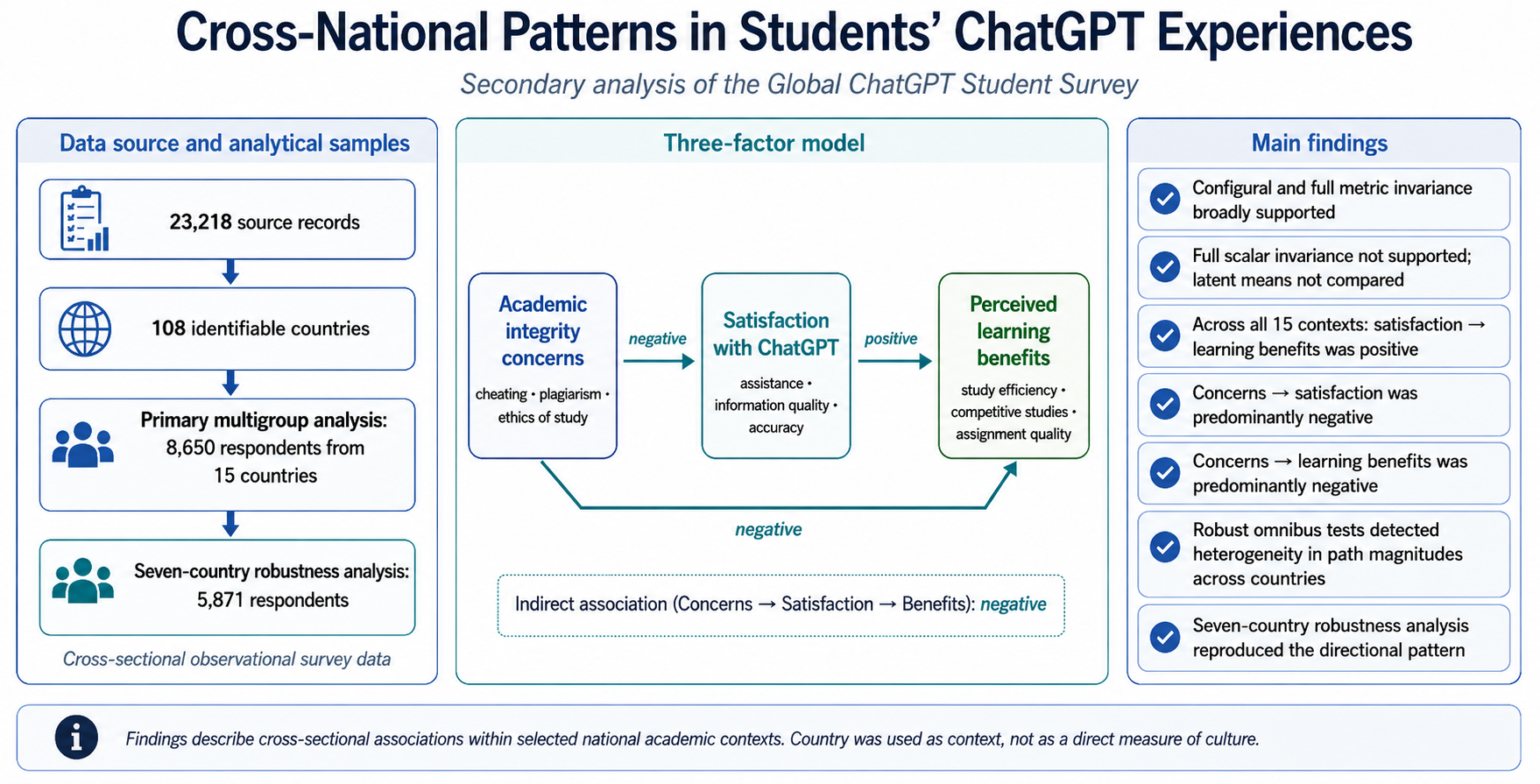
Generative artificial intelligence is becoming embedded in academic practice as students and institutions negotiate acceptable assistance, originality, authorship, and academic integrity. We analyzed Global ChatGPT Student Survey data to examine relationships among academic-integrity concerns, satisfaction, and perceived learning benefits across national academic settings. The source dataset contained 23,218 records from 108 identifiable countries; the primary multigroup analysis included 8,650 respondents from 15 countries meeting prespecified sample-size, completeness, and model-feasibility criteria. A nine-indicator model assessed the three constructs. Configural and full metric invariance were broadly supported, allowing comparison of structural associations; full scalar invariance was not supported, so latent means were not compared. Satisfaction was positively associated with perceived learning benefits in all 15 countries, whereas associations involving academic-integrity concerns were predominantly negative. Robust omnibus tests detected heterogeneity in path magnitudes, although equality constraints produced only trivial deterioration in global fit. A seven-country robustness analysis (N = 5,871) reproduced the directional pattern and heterogeneity evidence. By evaluating measurement comparability before cross-national structural comparison, the study shows that broadly shared relational patterns can coexist with contextual variation in emerging digital academic cultures.
Keywords:
digital academic cultures
; generative artificial intelligence
; ChatGPT
; academic integrity
; student satisfaction
; perceived learning benefits
; measurement invariance
; cross-national higher education
Copyright: This open access article is published under a Creative Commons CC BY 4.0 license, which permit the free download, distribution, and reuse, provided that the author and preprint are cited in any reuse.