
Submitted:
28 August 2026
Posted:
30 August 2026
You are already at the latest version
Abstract
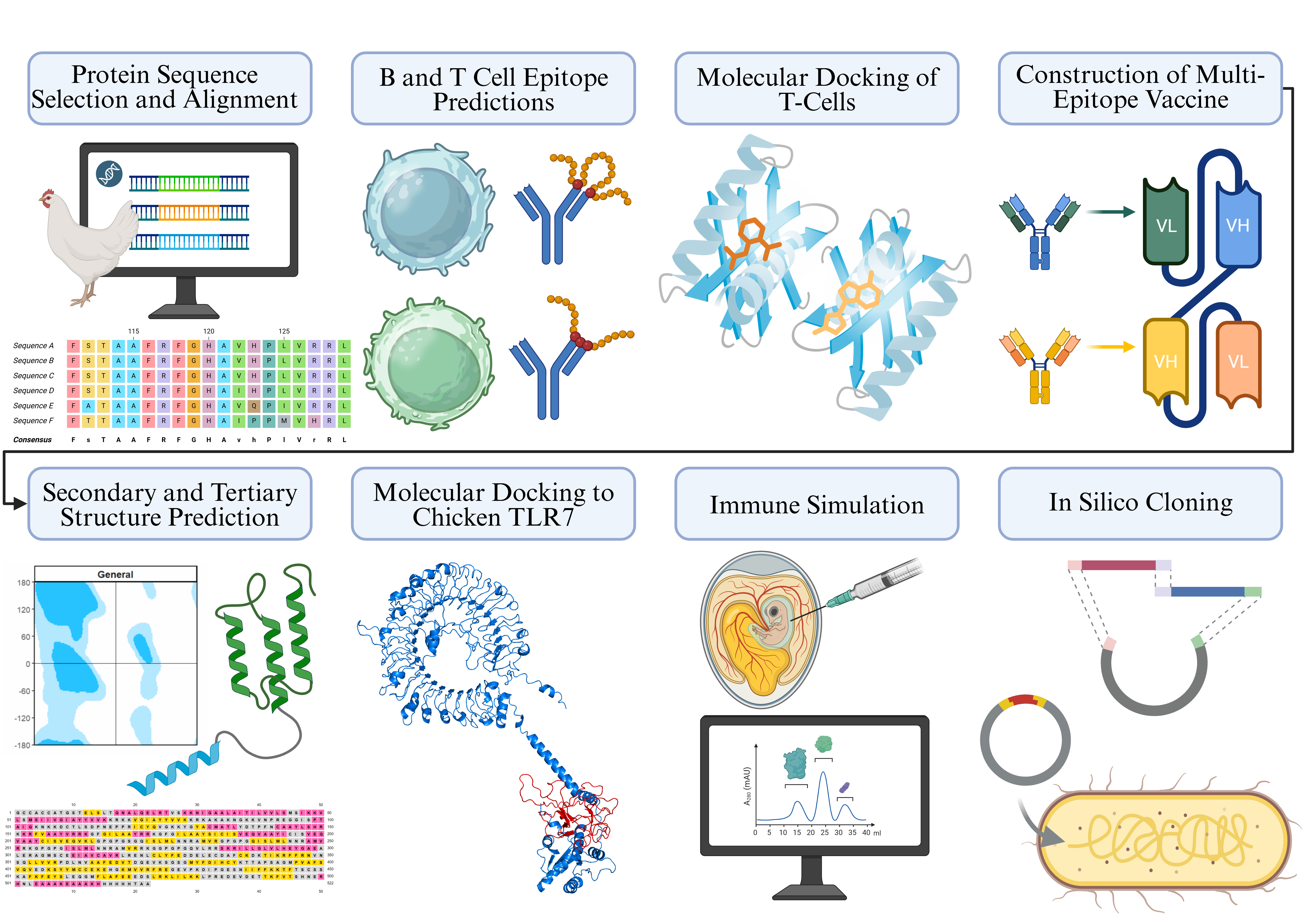
Avian Metapneumovirus (aMPV) is an emerging viral pathogen causing many outbreaks in chickens all over the world. There are several subtypes of the MPV circulating in chickens in the US. The current circulating subtypes of the virus in the US chicken are (A, B, and C). Despite the availability of some aMPV vaccines in the US, most of these vaccines are based on foreign strains, particularly European aMPV-A/B strains. Their protective efficacy against contemporary U.S. aMPV isolates has not been fully established. The main goal of this study is to integrate the most recent aMPV genome sequencing data and the machine learning tools to design a novel aMPV. The machine learning tools such as epitope mapping, molecular docking, and immune simulation were used to design the multiepitope DNA vaccine based on the top ranked epitopes of two major surface proteins of the virus (F and G). The top ranked seventeen epitopes representing B cells, CD4 and CD8 epitopes were linked using linkers, with IL-18 added as an adjuvant. The selected epitopes showed high antigenicity, no toxicity and no allergenicity values among the screened epitopes. The molecular docking analysis of the designed vaccine construct showed a high binding affinity to the MHC class I and II epitopes to chicken alleles. The immune simulation analysis of this vaccine construct showed the potential to induce robust immune response including the humoral and the cell mediated immunity. Further functional studies are required to test the immunogenicity and the efficacy of this novel vaccine before applications using chickens and turkey.
Keywords:
avian metapneumovirus
; aMPV
; DNA vaccine
; epitope mapping
; machine learning
; in silico prediction
; molecular docking
Copyright: This open access article is published under a Creative Commons CC BY 4.0 license, which permit the free download, distribution, and reuse, provided that the author and preprint are cited in any reuse.