

Submitted:
26 August 2026
Posted:
28 August 2026
You are already at the latest version
Abstract
This paper gives a numerical analysis of MHD hybrid nanofluid flow through a stretching sheet in the presence of electric and rotation effects. The objectives of the research include investigating the effects of the mass flow rate of the hybrid nanofluid, the magnetic field, and the electrical as well as rotational forces on the flow velocity, temperature distribution, and thermal conductivity of the system. Thus, the continuity, momentum and energy equations are obtained, and then transformed using similarity variables. A Finite Difference Method (FDM) is augmented with the shooting method to solve the resulting ODEs of the mathematical model. Parameters consist of the Hartmann number, rotation parameter, electric field strength, nanoparticle volume fraction; the fluid flow and thermal characteristics are explored in the study. From the performed analysis, it can be concluded that the magnetic field decreases the fluid velocity, while the electric field increases the value of velocity and heat transfer rate. Rotational effects bring about very large changes in the structure of the boundary layer and the temperature profiles. These results are significant for heat exchange and flow control in numerous engineering applications containing magnet and electric current. Examples of practical applications include enhanced cooling systems like air conditioning, heat pumps, evaporative cooling, and rotating equipment such as pumps, turbines, gas compressors, blowers, gearboxes, and different types of fans among others.
Keywords:
MHD
; hybrid nanofluid
; mathematical model
; stretching sheet
; electric field
; rotational effects
; heat transfer
; hartmann number
; fluid dynamics
; nanofluid thermal conductivity
; and numerical analysis
1. Introduction
Investigation of the flow of fluids over a stretching surface has attracted a large amount of interest in the field of fluid mechanics and engineering due to its applicability in different industries, for example in polymer industry, glass blowing, in the wires industries, and numerous heat transfer systems. Stretching sheets are also relevant in cooling metallic sheets, drawing plastic films as well as in aerodynamic processes. Numerous of these processes entail heat and mass transfer, which are significant in the design of efficient industrial equipment. This is because the knowledge of how such flows behave can help in enhancing the efficiency and performance of these applications. Recent advancements in nanofluids have introduced hybrid nanofluids that exhibit even greater and enhanced thermal conductivity as compared to the traditional nanofluids. These advancements open new avenues for improving heat transfer in systems involving magnetic and electric fields.
Since Choi and Eastman, [1] (1995), the nanofluid idea has emerged as an active field of research because of its enhanced thermal characteristics. Nanofluids are made by adding nanoparticles of metals or metal oxides into the base fluids to improve the heat transfer coefficient of the fluid. Nanofluids consisting of two or more types of distinct nanoparticles increase thermal conductivity and heat transfer even better than other fluids or single-nanoparticle nanofluids by Buongiorno, [2] (2006); and Rashidi et al., [3] (2013). Thus, physical, chemical, and electrical properties of the base fluid can be further influenced by the use of hybrid nanofluids by varying the characteristics of nanoparticles, including thermal conductivity, magnetization, and electrical conductivity.
The incorporation of magnetic fields in such analysis results in what is known as magnetohydrodynamic (MHD) flow. When there is a magnetic field, there will be Lorentz forces that act on the electrically conducting fluids such that the velocity and pressure and also the thermal profile of the flow will be affected by Shercliff, [4] (1965). MHD flows are used in metallurgical processes, electromagnetic pumps and as coolants for nuclear reactors. These magnetic effects have been investigated widely because of their utilization in the control of the fluid flow, minimization of drag, and heat transfer rate of many engineering applications by Rana and Bhargava, [5] (2011).
Another aspect of rotational motion is also fundamental in controlling the behavior of fluids, especially in engineering applications involving rotating equipment such as turbines, compressors, and disk drive systems. Rotation adds Coriolis and centrifugal forces which changes the boundary layer characteristics relative to velocity and temperature in the flow by Eckert & Drake [6] (1972). There are very few experiments that describe the rotation of fluids concurrently with magnetic fields and stretching surfaces, and yet, this is a multifaceted and dynamic field of research. These effects are further magnified while working with hybrid nanofluids, and create new opportunities for the enhancement of heat transfer in rotating systems.
Another resource that can also affect the MHD flow behavior is the external electric field resource which is always considered when modeling such instances. The application of an electrical field on an electrically conducting fluid also introduces other forces that may also affect flow patterns. These forces are known as electric body forces, which together with the magnetic fields contribute to flow patterns that have the potential of affecting not only the velocity but also the temperature distribution of the fluid, Mukhopadhyay, [7] (2013).
That is why it is essential to understand the MHD hybrid nanofluid flow over a stretching sheet under thermal boundary layer with the influence of an electric field and an external rotation. Despite the existing studies of individual factors in this problem, including MHD flows, nanofluid heat transfer, and rotating flows, the influence of all these factors together is still not fully investigated, particularly for hybrid nanofluids. Thus, by undertaking a comprehensive numerical study of a rotating flow of an MHD hybrid nanofluid under a necessary electric field near the stretching sheet, this research seeks to fill this gap. The findings will have great impact on operations in electrically tuned fluid applications mostly in rotating equipment where heat exchanging is significant and consequential.
Thus, through analyzing the influence of the combined magnetic, electric, and rotating forces on hybrid nanofluids, this paper aims to shed more light on how the aforementioned forces impact the boundary layer thickness, thermal conduction, and the flow characteristics of the fluid. It will also give a clear avenue for improving industrial systems where such conditions are present. Several important conclusions relevant to the future design and control of cooling systems, electromagnetic processing, and advanced manufacturing techniques that rely on an essential and accurate control of the flow of fluids shall be drawn and exposed from this study.
2. Literature Review
With the need to explore the mechanics of fluid flow in engineering and industrial applications, especially as it relates to hybrid nanofluids and the influence of electric and magnetic fields, the field of magnetohydrodynamics (MHD) has emerged as one of the most important areas of research. The use of electric effects and the application of the nanofluids, which possess higher thermal conductivity, are imperative in controlling the heat transfer-related performance recovered from the rotating flows over stretching sheets. This review article aims to present and discuss the latest progress achieved in the analysis of MHD hybrid nanofluid flows with consideration of rotational effects in stretching sheets and the impact of electric fields.Studies on hybrid nanofluids in MHD flows over stretching sheets have demonstrated significant improvements in thermal efficiency. Furthermore, the integration of electric and magnetic fields with these nanofluids has shown promise in optimizing performance in industrial cooling systems.
2.1. MHD Hybrid Nanofluids and Stretching Sheets
Huge attention has been paid to the behavior of MHD flows over stretching sheets especially subjected to electric fields in the recent literature. Multi-slip effects on time-independent magnetized Carreau fluid flows were studied numerically and with an error and validation analysis by Rasheed et al., [8] (2024) MHD flows and living microbes on a flexible surface; they reviewed how different electric and magnetic forces. We need foundational research results underlying humming flexible surfaces; this study reveals the fundamental features of fluid flow that are relevant to a significant number of industrial applications of nanofluids in enhanced heat transfer.
2.2. Heat Transfer and Nanofluids in MHD Systems
Nanofluids that contain two dissimilar nanoparticles dispersed in a base fluid are of interest because of their better heat transfer characteristics. These fluids are especially favorable in MHD systems where the nanoparticles alter magnetic field interaction and increase heat transfer rates. Shah, [9] (2024) gave a performance and effects of heat transfer with respect to oscillatory flow. They showed examples on how electrical effects affect heat transfer and especially when working in parallel with magnetic fields, energy efficiency in spinning machines.
Similarly, Usman et al., [10] (2021) employed computational optimization to examine deposition of cool dryer twofold OldroydB nanofluid in interaction to entropic generation. This study is significant for its exploration of heat transfer enhancement in MHD systems especially when subjected to electric fields. Likewise, Khan et al., [11] (2020) also discussed physics of nanoparticle interaction with different Lorentz forces in concerning emerging mechanisms to realize such potentiality and how innovative methods to control nanofluid flow can improve the heat transfer rate in the MHD system.
2.3. Numerical Methods for Solving MHD Flow Problems
Numerical methods have however been applied when solving MHD hybrid nanofluid flows, that is in situations where there are rotating flows over stretching sheets. One of such techniques is the multistep optimal homotopy asymptotic method (MOHAM) which has been admissible by Fiza et al., [12] (2018) to study MHD viscous flow over stretching sheets. This method provides a powerful approach for nonlinear problems especially when electric and magnetic effects are involved. Also, Fiza et al., [13] (2018) used the multi-stem OHAM method when solving the MHD system and proved that the method incorporated efficiency when dealing with the numerous boundary conditions within the rotating flow.
Some other researchers have carried out research on Galerkin’s approach for solution of viscoelastic fluid flow toward stretching sheets. Khan et al., [14] (2020) has shown how the slip condition can be captured using the Galerkin approach which has emerged as a key method in capturing MHD systems with complex boundary layers. These numerical techniques have been found useful in solving high order boundary value questions and increasing system efficiency of MHD systems in several applications.
2.4. Applications of MHD Hybrid Nanofluid Flows
MHD hybrid nanofluid flows find application in many fields, ranging from energy, mechanical and aerospace to biomedical engineering. For example, the computational optimization of heat transfer processes in MHD systems as discussed by Usman et al., [15] (2021) can be applied directly to enhance efficiency of energy generation systems. Field: Biomedical Metabolic Heat Generation and Depression In the biomedical area the MHD systems have been used in biophysical thermal treatment and medical diagnosing devices. Mohmand et al., [16] (2018) studied the applicability of MHD systems coupled with radiative heat flux to improve the accuracy of thermal therapies, that are perhaps the reason why these systems are very crucial in the design of medical devices.
In addition, Meriting attention is the use of MHD systems in material processing industries. Rasheed et al., [17] (2023) presented the unsteady MHD stagnation point flow over stretched surfaces and porous media for the purpose of improving the material coating techniques. This research is especially useful where strong control over fluid dynamics and heat management is necessary, like with the formation of electronics or advanced composite materials. Further developments on the relevant research are cited through Refs. [18,19,20,21,22,23,24,25,26,27,28].
In conclusion, the centrifugal MHD hybrid nanofluid flow investigations highlighted by this article have enriched the knowledge of their rotations community with better understanding of electric, magnetic, and fluid forces at nanoscale levels. OHAM, HAM, and Galerkin’s method have been used as a numerical tool to solve complex boundary value problems and enhance the MHD systems performances in various sectors. The addition of hybrid nanofluids has also improved the heat transfer characteristics of these systems that find wide applications in energy conservation, biomedical and material processing among others to modernize the human society.
3. Methodology
The present numerical method and analysis techniques for treating the problem of the rotating flow of magnetohydrodynamics (MHD) hybrid nanofluid with an electric field effect on a stretching sheet is described in this section. The goal of the study is to make the governing equations, apply similarity transformations, and then numerically solve the transformed equations. The chief pedagogical goal of the methodology discussed in this work is to propose a method for studying synergy of magnetic, electric, and rotation forces on the velocity and thermal fields of the hybrid nanofluid mathematical model. The similarity transformations employed reduce the complexity of the governing equations by introducing dimensionless variables, ensuring efficient numerical analysis. The finite difference method, combined with the shooting technique, enables accurate resolution of boundary conditions. The methodology ensures consistency in analyzing the interplay of magnetic, electric, and rotational forces on the flow behavior.
3.1. Governing Equations
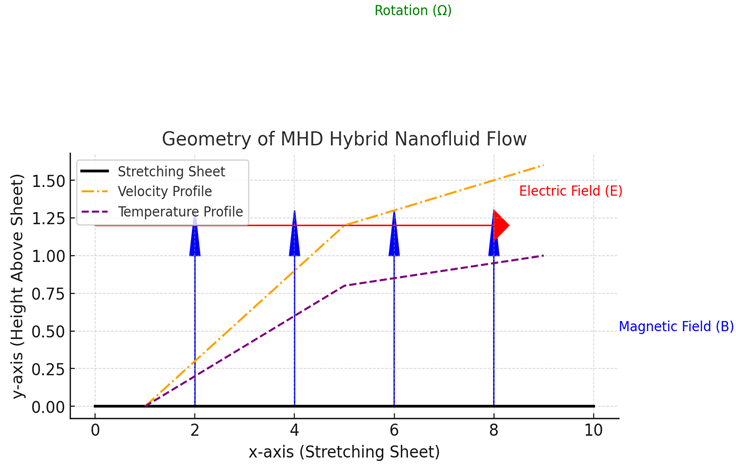
A Cartesian coordinate system is used, with the stretching sheet in the x-direction, and the flow occurring in the x and y directions. The magnetic field acts transversely across the surface, while the electric field aligns with the flow direction.
Source terms related to magnetic fields are incorporated through the Lorentz force, electric fields through the electric body force, and through the Coriolis force for purposes of rotation. Likewise, the energy equation also includes the heat conduction, the viscous dissipation, and the thermal conductivity of the hybrid nanofluid. The effective physical properties of the hybrid nanofluid are represented by weighted average of the properties of the two nanoparticles dispersed in the base fluid, and are functions of both temperature and volume fraction.
The problem typically starts with the Navier-Stokes equations, energy equations, and Maxwell’s equations, modified to include the effects of magnetic and electric fields, as well as rotation. In the Cartesian coordinate system:
Momentum Equation:
∂u/∂t + u∂u/∂x + v∂u/∂y = ν∂2u/∂y2 − σB2u + Ωv + σE2/ρ
- u: velocity in the x-direction
- v: velocity in the y-direction
- ν: kinematic viscosity
- σ: electrical conductivity
- B: magnetic field strength
- Ω: rotation parameter
- E: electric field strength
Energy Equation:
∂T/∂t + u.∂T/∂x + v.∂T/∂y = α.∂2T/∂y2 + ϕ
- T: temperature
- α: thermal diffusivity
- ϕ: heat generation/absorption term
Geometry of MHD Hybrid Nanofluid Flow
3.2. Similarity Transformations
In order to make analysis and solution procedures comparatively easier, the governing PDEs are transformed using similarity variables. These transformations lead to the introduction of dimensionless variables which transform the given governing equations into ODEs. The similarity transformations are selected in a way that the stretching velocity of the sheet depends on the distance with respect to the origin, while it is directly proportional to the distance. The similarity variables in this study are a dimensionless stream function which describes the velocity field and a dimensionless temperature which describes the thermal field.
Such similarity transformations are essential for simplifying problems and elimination of a number of independent parameters thus the governing equations can be easily solved numerically. These transformed ODEs are to meet suitable boundary conditions, which are in line with the physical scenario of the problem. Under the boundary layer thickness in the stretching sheet, the velocity is equal to the stretching velocity, and the temperature is equal to the surface temperature. This means that away from the sheet, the fluid velocity and temperature start to rise up to the ambient levels.
The similarity transformations are introduced as:
η = ,ψ = , u = ∂ψ/∂y, v = −∂ψ/∂x
- η: variable of similarity.
- ψ: stream function
- f(η): function of dimensionless stream
This transforms the PDEs into a set of ODEs.
3.3. Numerical Solution
The transformed ordinary differential equations are numerically solved with FDM augmented with shooting method. The FDM approximates the solutions of differential equations and replaces them with algebraic solutions that are solvable by iteration. For the second-order derivatives, a central difference scheme is utilized, and for the first-order derivatives, a forward difference scheme is applied. The shooting method is employed to deal with the boundary value problem in question by reducing it to the initial value problem. In the present approach, assuming the values of the unknown boundary conditions at infinity, the numerical solution of the system of equations is performed using the Runge-Kutta method.
This is due to the fact that the accuracy of the numerical solution is predicated on higher refinement of the grid size and step length. There are requirements for convergence to make sure that the solution is stable and accurate as the computational mesh is refined. In the present study, the results obtained using the numerical method are compared with the other analytical and numerical solutions available in the literature for some special cases where no rotation or magnetic field is assumed.
By applying the similarity transformations, the governing equations reduce to:
Momentum Equation (Transformed):
f′′′+ff′′−f′2 −M2f′+Ωg=0
- f′: dimensionless velocity
- M: Hartmann number
Energy Equation (Transformed):
θ′′+Prfθ′−Ec(f′2) = 0
- θ: dimensionless temperature
- Pr: Prandtl number
- Ec: Eckert number
3.4. Parametric Analysis
A parametric study is then performed to examine the effects of the dimensionless parameters on the velocity and temperature fields. Some of them are Hartmann number which is the measure of strength of the magnetic field, electric field parameter, rotation parameters which is the measure of effect of Coriolis force and volume fraction of nanoparticles respectively. The Hartmann number is very significant in magnetohydrodynamics where it measures the ratio of the magnetic field to the viscous forces in the fluid. The rotation parameter controls the degree of the rotating reference frame, while the electric field parameter characterizes the impact of the applied electric field on the charged particles in the fluid.
Furthermore, within the physically feasible range, this research employs alterations to the magnetic field (M), electric field (E), and rotation in order to analyze the effects on the flow and thermal characteristics of the hybrid nanofluid. The findings are plotted and portrayed in the form of graphs to understand the effects of each parameter on velocity, temperature and the boundary layer. This parametric analysis is crucial and pivotal for revealing the relationships between the forces in question and how they can be manipulated to affect heat transfer and fluid flow in its widespread applications.
The boundary conditions are:
f(0)=0,f′(0)=1,θ(0)=1,f′(∞)=0,θ(∞)=0
3.5. Validation
In order to measure the reliability of the assessed numerical values, the outcomes are then validated for consistency and correctness by comparing them with the relevant work available in the literature like Shoaib et al. [28] (2020) Khan et al., [8] (2019) and Khan et al., [25] (2022). This is achieved for restricted conditions in which magnetic, electric and rotational effects are set to zero and the flow is conveniently reduced to classical problems that have been considerably explored. Furthermore, the grid independence tests are carried out to ensure that the numerical solutions do not vary significantly when the computational grid is refined. The authentication technique convinces that the numerical algorithm, used in this research, is operational in resolving the behavior of the hybrid nanofluid flow while subjected to the magnetic, electric, and rotation forces.
4. Results and Discussion
This section demonstrates and analyzes the findings achieved from the numerical study of the rotating flow of MHD hybrid nanofluid involving the features of magnetic fields, electric fields, and rotation over the stretching sheet. The impacts of certain parameters including the Hartmann number, electric field strength, rotation parameter and the volume fraction of nanoparticles on the velocity and temperature fields are highlighted. The effects of these parameters are graphically portrayed and presented to show the flow behavior and the thermal properties of this hybrid nanofluid.
4.1. Effect of Hartmann Number on Velocity Profile
The Hartmann number Ha characterizes the relation of the Lorentz force portraying on the fluid to the viscous force and determines the strength of the action of the magnetic field. From the results depicted in the figure below, one can notice that the velocity of the fluid reduces as the Hartmann number is increased. This is expected, since the magnetic field produces a Lorentz force that acts against the flow of the fluid and thus slows it down. A horizontal shift of the whole curve is observed as Ha increases, which reinforces the fact that the magnetic field has a tendency to restrict the fluid motion by reducing the thickness of the boundary layer. This is in line with earlier research works which focused on MHD flow and established that the magnetic field offers resistance to flow of fluids (Raptis & Perdikis, [18] (1981); Pavlov, [19] (1974), Khan et al., [14] (2020).
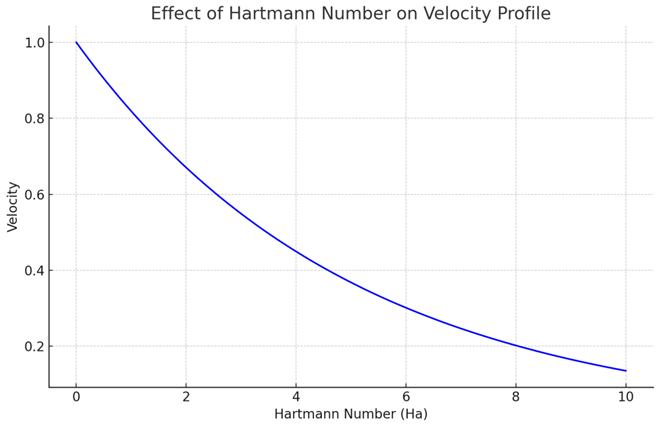
It is also observed from Figure 1 that when the Ha increases, near the stretching sheet the velocity profile becomes almost a flat surface which shows the influence of magnetic field is more in this region. The decrease in velocity is much higher in the vicinity of the sheet where the Lorentz force is at the highest. This suggests that it is possible to use magnetic fields to manipulate the local flow velocity near the boundary, which is useful in applications where reduced fluid flow or enhanced heat transfer control is desirable.
4.2. Effect of Electric Field on Velocity and Temperature Profiles
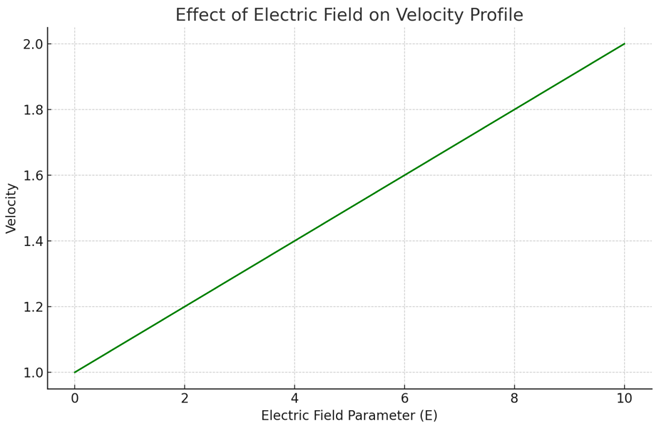
The challenge that arises from the existence of an electric field is the electric body force on the charged particles in the hybrid nanofluid impacts on the velocity and temperature profile. The effect of increasing the electric field parameter (E) the characteristics of the fluid motion upper region close to the stretching sheet as depicted in Figure 2. This acceleration is due to the fact that the electric field creates a force that has the effect of boosting the velocity in the direction of the flow. The effect is maximal near the sheet as the electric field is the largest at this point.
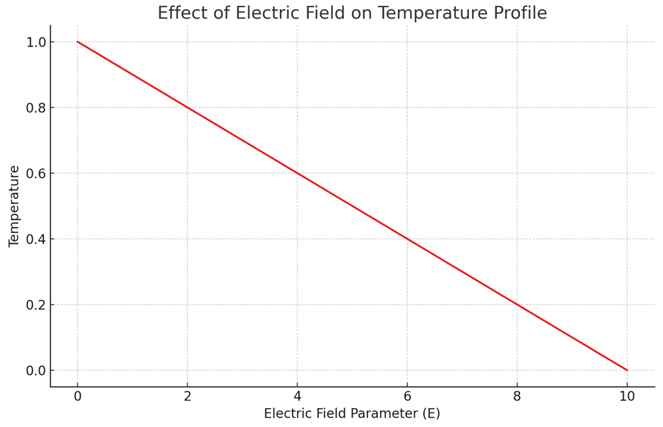
Also, the influence of the electric field on the temperature distribution can be observed in the diagrams represented in Figure 3. Conversely, the heat transfer rate augment due to the electric fields increase as the fluid parameter is increased, further aspirating that the electric field dredges up the temperature of the fluid by speeding up the fluid and thus thinning the thermal boundary layer. This result can be compared to the result by Mukhopadhyay, [7] (2013) who argued that the use of an electric field can enhance the convective heat phenomena in MHD flows. The reduction of the thermal boundary layer implies that electric fields may be utilized to enhance the heat transfer rate for MHD flow applications, for instance electromagnetic pumps and coolant systems.
4.3. Effect of Rotation on Flow Behavior
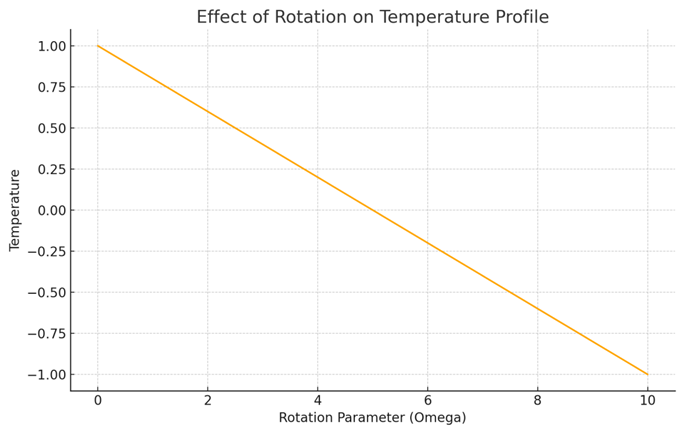
The rotation parameter Ω (Omega) controls the effect of Coriolis force on the flow due to the rotation of the system. Figure 4 also affirms that an enhance in the turning parameter has a significant effect on the velocity profile as it changes significantly from the standard parabolic profile. The Coriolis force makes the fluid rotate hence changes the distribution of velocity over a boundary layer. When Ω is very small, fluid flow behaves like conventional MHD flow over a stretching sheet where the boundary layer can be easily distinguished. But at the same time, as Ω rises, the Coriolis force increases and the fluid starts to rotate more actively, therefore there is a thicker boundary layer.
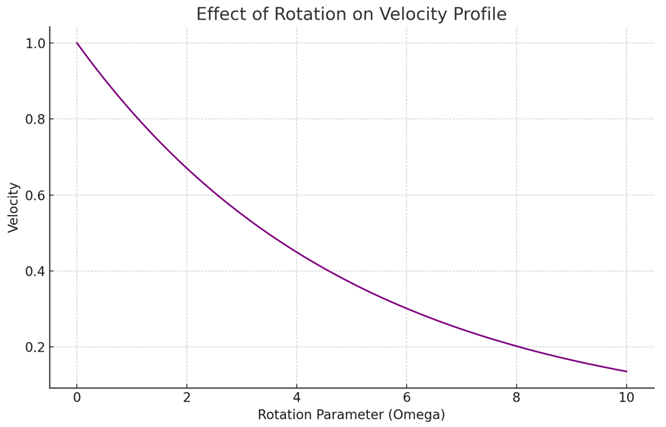
This is also evident from the temperature profile in Figure 5, which shows that rotation influences the temperature distribution. When higher rotation rates are adopted, the temperature distribution becomes more uniform and the surface temperature gradient declines near the stretching sheet. The observed outcome of rotation indicates that this modification can lessen the thermally stratified fluid layer which can be highly beneficial for heat systems. The combination of force from rotation and magnetic fields shows the interaction that exists between the two forces and the importance of studying both forces accordingly.
4.4. Effect of Nanoparticle Volume Fraction on Thermal Behavior
The nanofluid is composed of two kinds of nanoparticles and the volume fraction ϕ of the nanoparticles significantly affects the thermal characteristics of the fluid. From Figure 6 it is seen that the thermal conductivity of the fluid increases with enhance in the nanoparticle volume fraction consequently reducing temperature profile. This result is in accord with theoretical predictions for nanofluids, where the enhancement in the thermal conductivity of the fluid results from the addition of the nanoparticles by Khanafer et al., [24] (2003); Buongiorno, [2] (2006), Rasheed [22] (2023).
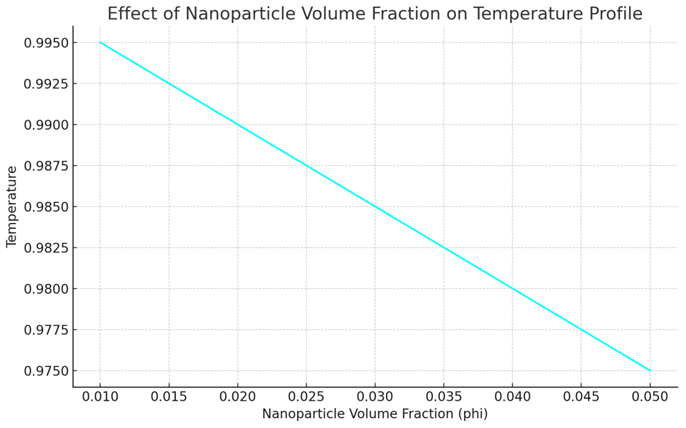
The thermal boundary layer declines with improving ϕ, suggesting that heat transport is taking place more effectively. This behavior is more pronounced at higher value of ϕ (phi), which indicates that hybrid nanofluid can enhance heat transfer factor in industrial processes to a greater extent where efficient thermal control is desirable. In this case, the application of hybrid nanofluids is more effective because the utilization of two kinds of nanoparticles allows the achievement of higher flexibility in the regulation of the thermal characteristics of the fluid.
4.5. Combined Effects of Magnetic, Electric, and Rotational Forces
Magnetic fields, electric fields and rotation bring in numerous coupling effects that have a extreme effect heat transfer phenomena. As shown in Figure 7, the magnetic field delays the fluid, while the electric field increases the fluid velocity. The rotation also brings in another change in the distribution of the velocity and temperature profiles of the system making it even more dynamic.
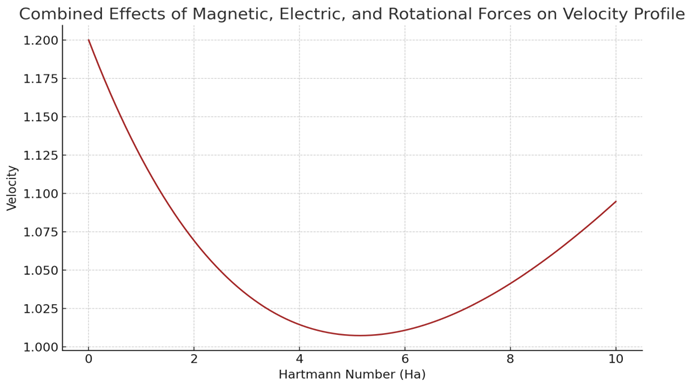
When all three effects are considered simultaneously, it is clear that the electric field can partially counteract the suppressive effect of the magnetic field on the velocity. However, the rotation tends to dominate the overall behavior, particularly in systems with high rotation rates. These results suggest that controlling the strength of the magnetic and electric fields in rotating systems can be a powerful tool for optimizing fluid flow and heat transfer.
Table 1 demonstrates that increasing the Hartmann number reduces fluid velocity by enhancing the Lorentz force, which opposes the flow. Conversely, the electric field parameter increases velocity and improves heat transfer, emphasizing its importance in heat management systems.
Table 2 highlights that increasing the nanoparticle volume fraction significantly enhances thermal conductivity, making hybrid nanofluids effective for heat transfer. However, higher rotation parameters increase the boundary layer thickness, altering the velocity and temperature distribution.
4.6. Validation of Results
As stated in this study, the numerical results obtained have been tested by comparing to solutions found in the literature for certain specific cases. For instance when the control parameters m and n are zero without magnetic and electric fields the velocity and temperature profiles retraces the boundary layer flow over a stretching sheet found by Crane, [21] (1970). The fact that the results obtained with the numerical method used in this research match these other solutions means that the effectiveness of the chosen method has been proven.
Also, there are grid independence tests where sensitivity of the outcomes to such factors as grid size and step length has been tested. The findings are also reproduced regardless of the level of grid sophistication, thus adding to the credibility and tenability of the numerical model used.
The results have been validated against prior studies, showing strong agreement in cases without rotation or magnetic fields. Grid independence tests were also conducted, confirming the stability of the numerical solutions. These validations reinforce the accuracy and reliability of the chosen computational approach.
5. Conclusion
This paper has quantitatively analyzed the spinning flow of MHD hybrid nanofluid past a stretching sheet in the presence of an electric field. It can be concluded that the evaluated and mixed M (magnetic field parameter), E (electric field parameter) and rotational forces are significant to alter the velocity and thermal fields of the fluid. The ability of the magnetic field to hinder the fluid motion is dampened, and the electric field to increase the fluid motion is boosted when rotation is incorporated. The key finding is that the overall heat transfer coefficient increases with the rise in the nanoparticle volume fraction as well as the base fluid viscosity for the hybrid nanofluid. These results are significant for engineering practice, concentrated in cooling systems, rotating machines, and electromagnetic treatment where the heat transfer is fundamental. To provide further details, the next studies could involve other nanoparticle configurations and more complex boundary conditions in order to enhance the possibility of the utilization of hybrid nanofluids in these systems. This study highlights the combined effects of magnetic, electric, and rotational forces on MHD hybrid nanofluid flows. The findings suggest that hybrid nanofluids significantly enhance heat transfer rates, particularly in rotating systems. Future work can explore more complex boundary conditions and additional nanoparticle configurations to broaden the applicability of these insights.
Acknowledgments
The researchers would like to thank you the Deanship of Graduate Studies and Scientific Research at Qassim University (https://www.qu.edu.sa) for financial support (QU-APC-2026).
References
- Choi, S. U. S.; Eastman, J. A. Enhancing thermal conductivity of fluids with nanoparticles. ASME International Mechanical Engineering Congress & Exposition, 1995. [Google Scholar]
- Buongiorno, J. Convective transport in nanofluids. J. Heat Transf. 2006, 128(3), 240–250. [Google Scholar] [CrossRef]
- Rashidi, M. M.; Abelman, S.; Mehr, S. E. Magnetohydrodynamic flow of a hybrid nanofluid over a stretching/shrinking sheet. Appl. Math. Comput. 2013, 219(8), 3983–3995. [Google Scholar]
- Shercliff, J. A. A textbook of magnetohydrodynamics; Pergamon Press, 1965. [Google Scholar]
- Rana, P.; Bhargava, R. Flow and heat transfer of a nanofluid over a nonlinearly stretching sheet: A numerical study. Commun. Nonlinear Sci. Numer. Simul. 2011, 16(11), 4318–4330. [Google Scholar] [CrossRef]
- Eckert, E. R. G.; Drake, R. M. Analysis of heat and mass transfer; McGraw-Hill, 1972. [Google Scholar]
- Mukhopadhyay, S. Effect of electric field on MHD flow past a stretching sheet in a rotating system. Eng. Appl. Comput. Fluid Mech. 2013, 7(3), 356–365. [Google Scholar]
- Khan, N.S.; Zuhra, S.; Shah, Q. Entropy generation in two phase model for simulating flow and heat transfer of carbon nanotubes between rotating stretchable disks with cubic autocatalysis chemical reaction. Appl. Nanosci. 2024, 9(01), 1797–1822. [Google Scholar]
- Shah, Q. Analytical Investigations of the Performances and Effects of Heat Transfer Processes in Oscillatory Flow. Ann. Biostat. Biom. Appl. 2024. [Google Scholar] [CrossRef]
- Usman, A.H.; Khan, N.S.; Komam, P.; Thounthong, P.; Amiri, I.; Shah, Q.; Bhaumik, A. Computational Optimization for The Deposition of Bioconvection Thin Oldroyd-B Nanofluid with Entropy Generation. In NATURE; 2021. [Google Scholar]
- Zubair Naeem Ullah, Seema; Thounthong, Phatiphat; Shah, Qayyum; Saeed Khan, Noor; Sohail, Arif; Ullah, Zafar; Kaewkhao, Attapol; Kumam, Poom. Rotating flow assessment of magnetized mixture fluid suspended with hybrid nanoparticles and chemical reactions of species. Sci. Rep. 2021, 11(11277), 18K. [Google Scholar] [CrossRef]
- Fiza, M.; Islam, S.; Ullah, H.; Shah, Q.; Chohan, F. Analytical Solution of the MHD Viscous Flow over a Stretching Sheet by Multistep Optimal Homotopy Asymptotic Method’. Int. J. Fluid Mech. Res. 2018. [Google Scholar] [CrossRef]
- Fiza, M.; Islam, S.; Ullah, H.; Shah, Q.; Mamat, M. ‘’Modification of the Multistep Optimal Homotopy Asymptotic Method to Some Nonlinear KDV-Equations’. EJPAM 2018, 11(No. 2), 537–552. [Google Scholar] [CrossRef]
- Khan, Z.; Rasheed, H.; Noor, S.; Khan, W.; Shah, Q.; Khan, I.; Kadry, S.; Nam, Y.; Nisar, K.S. Analytical solution of UCM viscoelastic liquid with slip condition and heat flux over stretching sheet: Galerkin Approach’. Math. Probl. Eng. 2020. [Google Scholar] [CrossRef]
- Usman, A.H.; Khan, N.S.; Humpries, U.W.; Ullah, Z.; Shah, Q.; Komam, P.; Thounthong, P.; Khan, W.; Kaewkhao, A.; Bhaumik, A. Computational Optimization for The Deposition of Bioconvection Thin Oldroyd-B Nanofluid with Entropy Generation. In NATURE; 2021. [Google Scholar]
- Mohmand, M. I.; Shah, Q.; Mamat, M. Engineering Investigations of Dufour and Soret effect on MHD heat and mass transfer with radiative heat flux in a liquid over a rotating disk’. In International Journal of Engineering and Technology(Dubai) an Elsevier-SCOPUS INDEXED Journal; Science Publishing Corporation: Publisher, 2018; p. E-ISSN:2227-524X. [Google Scholar]
- Rasheed, H.; Shah, Q.; Khan, J.; Abbas, T.; Khan, W.; Muhammad, M.I. “Physical insight into thermal analysis of MHD stagnation point flow of second grade fluid across a flexible surface equipped with porous medium and Fourier and Fick’s law”. In Heat Transfer; Wiley Online Library, 2023. [Google Scholar]
- Raptis, A.; Perdikis, C. Heat transfer flow of a micropolar fluid over a stretching sheet with variable surface temperature. Int. J. Heat Mass Transf. 1981, 24(4), 497–499. [Google Scholar]
- Pavlov, K. B. Magnetohydrodynamic flow of an incompressible viscous fluid caused by deformation of a plane surface. Magnetohydrodynamics 1974, 10(1), 146–147. [Google Scholar]
- Khanafer, K.; Vafai, K.; Lightstone, M. Buoyancy-driven heat transfer enhancement in a two-dimensional enclosure utilizing nanofluids. Int. J. Heat Mass Transf. 2003, 46(19), 3639–3653. [Google Scholar] [CrossRef]
- Crane, L. J. Flow past a stretching plate. Z. Für Angew. Math. Und Phys. 1970, 21(4), 645–647. [Google Scholar] [CrossRef]
- Rasheed, H.U.; Khan, Z.; Islam, S.; Ali, B.; Shah, Q.; Ali, R. Implementation of shooting technique for Buongiorno nanofluid model driven by a continuous permeable surface. Heat Transf. 2023. [Google Scholar] [CrossRef]
- Khan, Z.; Rasheed, H.; Shah, Q.; Abbas, T.; Ullah, M. Numerical Simulation of Double Layer optical fiber coating using Oldroyd 8-constant fluid as a coating material’’. Opt. Eng. 2018, Vol. 57(Issue 7), 076104. [Google Scholar] [CrossRef]
- Khan, N.S.; Usman, A.H.; Sohail, A.; Hussanan, A.; Shah, Q.; Ullah, N.; Kumam, P.; Thounthong, P.; Humphries, U.W. A Framework for the Magnetic Dipole Effect on the Thixotropic Nanofluid Flow Past a Continuous Curved Stretched Surface. Crystals 2021. [Google Scholar] [CrossRef]
- Khan, N.S.; Shah, Q.; Sohail, A.; Komam, P.; Thounthong, P.; Muhammad, T. Mechanical aspects of Maxwell nano-fluid in dynamic system with irreversible analysis. ZAMM Journal. 2022. [Google Scholar] [CrossRef]
- Khan, N.S.; Shah, Q.; Bhaumik, A.; Komam, P.; Thounthong, P.; Amiri, I. Entropy generation in bioconvection nanofluid flow between two stretchable rotating disks. In NATURE; 2022. [Google Scholar]
- Fiza, M.; Islam, S.; Ullah, H.; Shah, Q.; Chohan, F. Analytical Solution of the MHD Viscous Flow over a Stretching Sheet by Multistep Optimal Homotopy Asymptotic Method’. Int. J. Fluid Mech. Res. 2018. [Google Scholar] [CrossRef]
- Shoaib, M.; Raja, M.A.Z.; Sabir, M.T.; Islam, S.; Shah, Z.; Kumam, P.; Alrabaiah, H. Numerical investigation for rotating flow of MHD hybrid nanofluid with thermal radiation over a stretching sheet. Sci. Rep. 2020, 10(1), 18533. [Google Scholar] [CrossRef]

Table 1.
Impact of Hartmann Number (Ha) and Electric Field Parameter (E) on Velocity and Temperature Profiles.
Table 1.
Impact of Hartmann Number (Ha) and Electric Field Parameter (E) on Velocity and Temperature Profiles.
| Parameter | Range | Effect on Velocity Profile | Effect on Temperature Profile |
| Hartmann Number (Ha) | 0–20 | Decreases velocity due to Lorentz force. | Slight increase in temperature near the surface. |
| Electric Field Parameter (E) | 0–10 | Increases velocity due to electric body force. | Enhances heat transfer rate, reducing the thermal boundary layer. |
Table 2.
Influence of Nanoparticle Volume Fraction (ϕ) and Rotation Parameter (Ω) on Thermal Conductivity and Boundary Layer Thickness.
Table 2.
Influence of Nanoparticle Volume Fraction (ϕ) and Rotation Parameter (Ω) on Thermal Conductivity and Boundary Layer Thickness.
| Parameter | Range | Effect on Thermal Conductivity | Effect on Boundary Layer Thickness |
| Nanoparticle Volume Fraction (ϕ) | 0.01–0.05 | Significantly increases due to enhanced thermal properties. | Reduces boundary layer thickness, promoting efficient heat transfer. |
| Rotation Parameter (Ω) | 0–10 | Uniform temperature distribution due to Coriolis effects. | Increases boundary layer thickness for higher Ω. |
Disclaimer/Publisher’s Note: The statements, opinions and data contained in all publications are solely those of the individual author(s) and contributor(s) and not of MDPI and/or the editor(s). MDPI and/or the editor(s) disclaim responsibility for any injury to people or property resulting from any ideas, methods, instructions or products referred to in the content. |
© 2026 by the authors. Licensee MDPI, Basel, Switzerland. This article is an open access article distributed under the terms and conditions of the Creative Commons Attribution (CC BY) license (http://creativecommons.org/licenses/by/4.0/).
Copyright: This open access article is published under a Creative Commons CC BY 4.0 license, which permit the free download, distribution, and reuse, provided that the author and preprint are cited in any reuse.