
Submitted:
27 August 2026
Posted:
28 August 2026
You are already at the latest version
Abstract
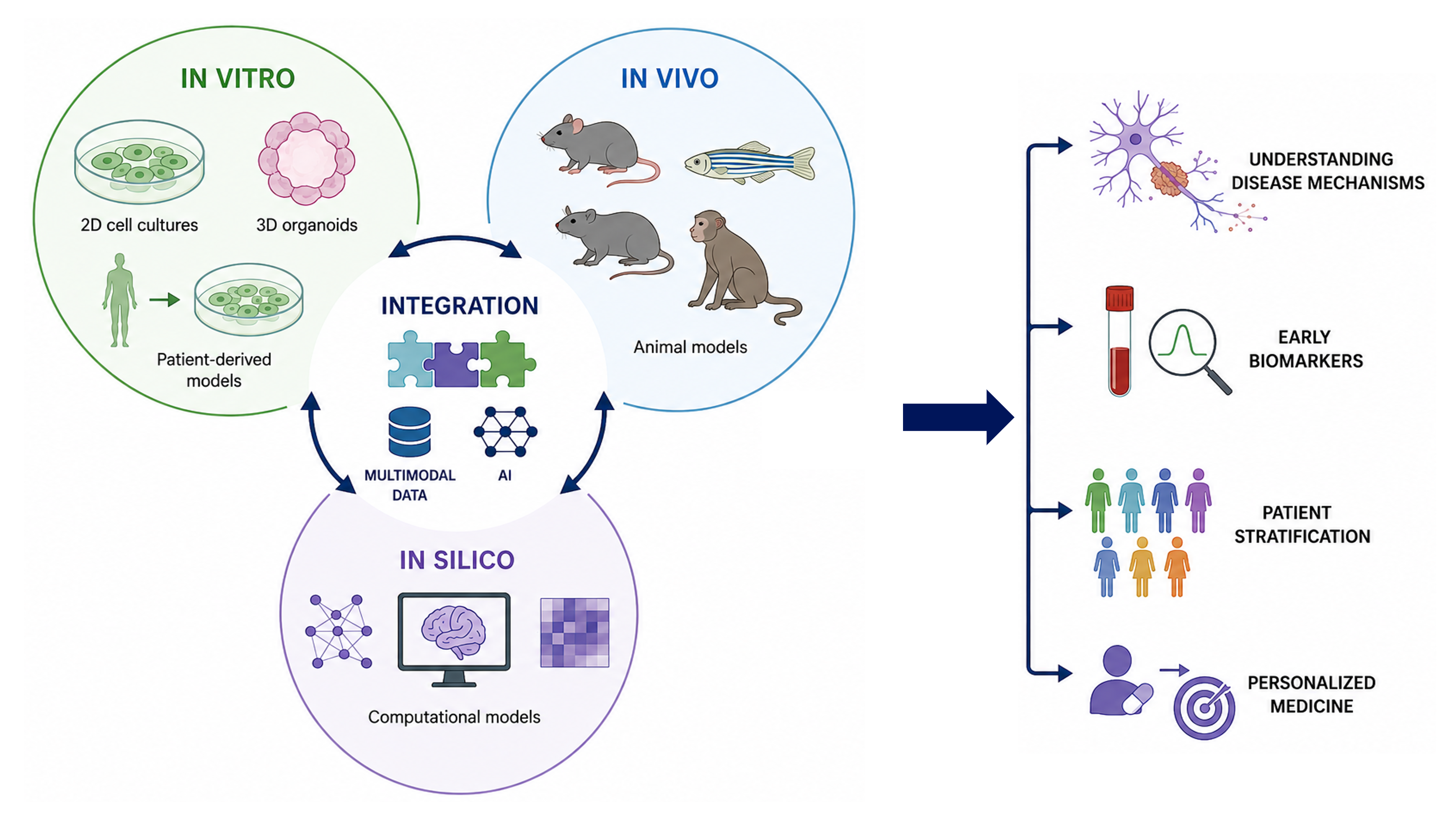
Neurodegenerative diseases (NDs) comprise a heterogeneous group of disorders characterized by complex etiologies, multifactorial pathogenic mechanisms, and remarkable clinical and molecular variability. Their increasing prevalence poses an important challenge to healthcare systems, society and global economy. Despite decades of research, effective disease-modifying therapies remain elusive, highlighting the urgent need for reliable disease models capable of unraveling pathogenic mechanisms and supporting the development of personalized therapeutic strategies. Modeling NDs remains inherently challenging, since disease onset and progression arise from the interplay among genetic factors, environmental exposures, aging, and individual pathological conditions. Consequently, similar insults may lead to distinct molecular trajectories and clinical outcomes in different subjects. Reproducing this heterogeneity, together with the prolonged temporal evolution that characterizes NDs over decades in humans, represents a major limitation of current experimental models. Here we provide a comprehensive overview of the modeling strategies currently available for the study of NDs, spanning conventional two-dimensional cellular systems, advanced patient-derived three-dimensional organoids, complementary in vivo animal models, and rapidly evolving in silico approaches. For each model category, we discuss its historical development, current applications, future perspectives, and, critically, principal strengths and limitations in reproducing disease biology and supporting translational research. We emphasize that the growing synergy between in vitro, in vivo, and in silico methodologies, empowered by multimodal data integration and artificial intelligence, is expected to accelerate biomarker discovery, improve disease modeling, reduce experimental burden, and ultimately foster the development of personalized disease-modifying therapies for NDs.
Keywords:
neurodegeneration
; disease modeling
; personalized medicine
Copyright: This open access article is published under a Creative Commons CC BY 4.0 license, which permit the free download, distribution, and reuse, provided that the author and preprint are cited in any reuse.