

Submitted:
27 August 2026
Posted:
28 August 2026
You are already at the latest version
Abstract
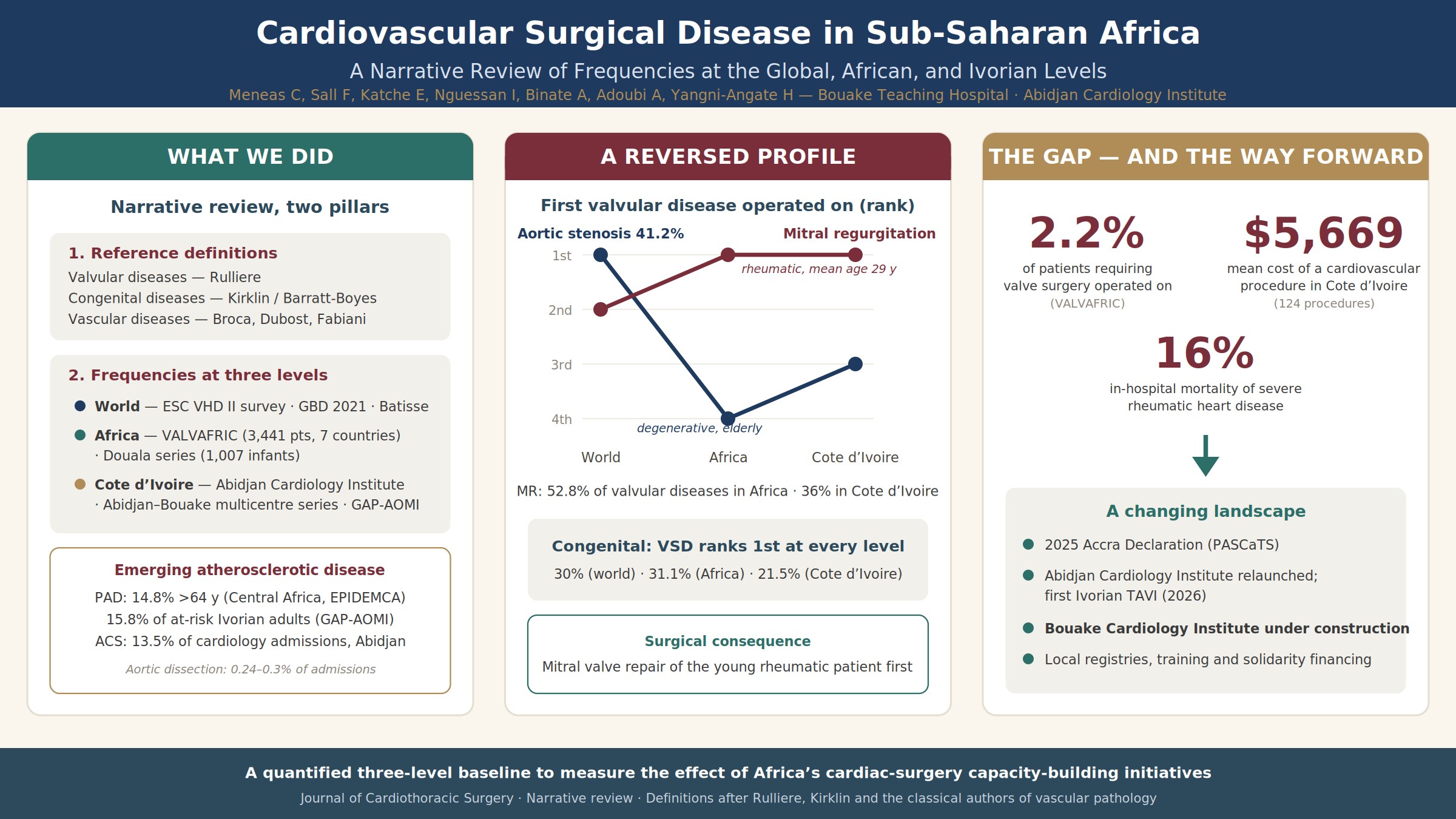
Background. Cardiovascular surgery addresses a heterogeneous group of acquired and congenital diseases whose precise definition and epidemiological magnitude condition teaching, research and health planning. Sub-Saharan Africa displays a disease spectrum that differs profoundly from that of high-income countries, yet no synthesis has combined a rigorous nosological framework with disease frequencies at the global, African and national (Ivorian) levels. This review aimed to restate the reference definitions of the main cardiovascular surgical diseases and to quantify their frequency at these three geographical levels. Methods. Narrative review based on the classical didactic references (Rulliere; Kirklin/Barratt-Boyes; Batisse; the French medical-surgical encyclopaedia; the French vascular surgery curriculum reporting the definitions of Broca, Dubost, Fabiani, and Cabanne and Bonenfant), on contemporary global datasets (European Society of Cardiology EURObservational VHD II survey; Global Burden of Disease 2021 analyses), and on the major African and Ivorian hospital series: the VALVAFRIC registry, the Abidjan Cardiology Institute echocardiographic series, and the Douala neonatal and infant series. Results. The classical definitions remain fully operational at the bedside and in the echocardiography laboratory. Epidemiologically, valvular heart disease displays a reversed profile: degenerative aortic stenosis dominates in Western countries (41.2% of valvular diseases in the ESC survey), whereas rheumatic mitral regurgitation dominates in sub-Saharan Africa (52.8% in VALVAFRIC) and in Cote d’Ivoire (36%). Ventricular septal defect is the leading congenital heart disease at all three levels (30% worldwide; 31.1% in Africa; 21.5% in Cote d’Ivoire). Emerging atherosclerotic disease completes the picture: peripheral artery disease affects 14.8% of Central Africans over 64 years and 15.8% of at-risk Ivorian adults in a recent national screening programme. Access to surgery remains marginal: only 2.2% of patients requiring valve surgery were operated on in VALVAFRIC, and the mean cost of a cardiovascular procedure in Cote d’Ivoire (USD 5,669) remains out of reach of most households. Conclusions. The burden of surgical cardiovascular disease in sub-Saharan Africa is heavy, young and rheumatic, while surgical capacity remains scarce. The relaunch of the Abidjan Cardiology Institute, the construction of the Bouake Cardiology Institute and the 2025 Accra Declaration open a credible path towards closing the gap, provided that local epidemiological registries, training and solidarity-based financing follow.
Keywords:
definitions
; epidemiology
; valvular heart disease
; congenital heart disease
; cardiovascular surgery
; sub-Saharan Africa
; Cote d’Ivoire
Background
Cardiovascular surgery encompasses a wide nosological spectrum: acquired valvular heart disease, congenital heart disease, diseases of the pericardium and endocardium, coronary insufficiency, cardiac trauma, cardiac tumours, and arterial and venous vascular diseases. Any pedagogical or scientific endeavour in this discipline rests on two prerequisites: defining each entity without error, from the reference authors and textbooks, and measuring its epidemiological magnitude at the relevant geographical scales.
This double requirement is particularly acute in sub-Saharan Africa (SSA), where the profile of surgical cardiovascular disease differs profoundly from that of Western countries: predominance of rheumatic aetiology in young subjects, a growing share of congenital heart disease diagnosed through the diffusion of echocardiography, emergence of atherosclerotic disease, all in a context of very limited access to cardiac surgery [1,2,3]. Reviews from high-income settings note that the surgical pathology encountered in SSA—advanced rheumatic disease, endomyocardial fibrosis, late-presenting congenital disease—is one that few surgeons trained elsewhere have mastered [2], which makes the nosological groundwork anything but academic. The Pan-African Society for Cardiothoracic Surgery formalised the continental response in the 2025 Accra Declaration on upskilling and cost-effective cardiac surgery in Africa [4].
Global Burden of Disease (GBD) analyses provide the world level of this picture, African multicentre registries provide the continental level, and Ivorian institutional series provide the national level; however, to our knowledge, no publication has combined the three levels across the whole surgical spectrum—valvular, congenital and vascular—on an explicit nosological basis. The objective of this review was therefore to restate the reference definitions of the main diseases of cardiovascular surgery and to specify their frequency in the world, in Africa and in Cote d’Ivoire.
Methods
This is a narrative review. Definitions were extracted from the reference didactic works: Rulliere’s classical cardiology handbook for acquired valvular diseases [5], the Kirklin/Barratt-Boyes Cardiac Surgery textbook for congenital heart disease and infective endocarditis [6], the French medical-surgical encyclopaedia (EMC) for chronic pericardial and endocardial disease [7], and the French surgical curriculum volume on vascular pathology (Deloche, Fabiani, Elberg, Menasche), which reports the definitions of Broca, Dubost, Fabiani, and Cabanne and Bonenfant [8].
Frequency data were collected at three levels. For the world: the EURObservational Research Programme Valvular Heart Disease II survey of the European Society of Cardiology (ESC) [9], GBD 2021 analyses of valvular and congenital heart disease [10,11], and Batisse’s practical paediatric cardiology textbook for the distribution of congenital lesions [12]. For Africa: the multicentre VALVAFRIC registry of 3,441 patients hospitalised for rheumatic valvular disease in twelve cardiology departments of seven Western and Central African countries [13], and the Douala echocardiographic series of 1,007 neonates and infants for congenital heart disease [14]. For Cote d’Ivoire: the Abidjan Cardiology Institute (ACI) series of severe organic valvular disease reported by Niamkey, Anzouan-Kacou et al. [15], the ACI echocardiographic series of 1,053 congenital heart diseases collected over seven years by Allawaye, Guikahue et al. [16], the national peripheral artery disease screening programme [17], and the thirty-five-year Ivorian open-heart surgery experience [18]. Whenever no reliable figure was available for a geographical level, this absence was explicitly reported rather than imputed.
Definitions
Acquired Valvular Heart Disease [5]
Mitral stenosis (MS). Mitral stenosis is a permanent reduction of the mitral valve orifice area below its normal value of 4 to 6 cm2.
Mitral regurgitation (MR). Mitral regurgitation is an abnormal backflow of blood from the left ventricle into the left atrium during ventricular systole.
Aortic stenosis (AS). Aortic stenosis is a permanent reduction of the aortic valve orifice area below its normal value of 3 to 4 cm2.
Aortic regurgitation (AR). Aortic regurgitation is an abnormal backflow of blood from the aorta into the left ventricle during ventricular diastole.
Tricuspid stenosis (TS). Tricuspid stenosis is a permanent reduction of the tricuspid valve orifice area below its normal value of 7 to 9 cm2.
Tricuspid regurgitation (TR). Tricuspid regurgitation is an abnormal backflow of blood from the right ventricle into the right atrium during ventricular systole.
Congenital Heart Disease [6]
Atrial septal defect (ASD). An atrial septal defect is characterised by an abnormal orifice in the interatrial septum connecting the two atria.
Ventricular septal defect (VSD). A ventricular septal defect is characterised by an abnormal orifice in the interventricular septum connecting the two ventricles.
Patent ductus arteriosus (PDA). Patent ductus arteriosus is defined by the failure of the arterial duct to close three weeks after birth.
Atrioventricular septal defect (AVSD). An atrioventricular septal defect is defined by a deficiency or absence of the atrioventricular septum, realising at its maximum a single common atrioventricular valve orifice.
Tetralogy of Fallot (TOF). Tetralogy of Fallot is defined by the association of four malformative anomalies: pulmonary stenosis, ventricular septal defect, overriding aorta, and right ventricular hypertrophy.
Coarctation of the aorta (CoA). Coarctation of the aorta is a congenital narrowing of the upper part of the descending thoracic aorta.
Pulmonary stenosis (PS). Pulmonary stenosis is a congenital narrowing of the right ventricular outflow tract.
Other Cardiac Diseases of Surgical Interest [6,7,8]
Infective endocarditis (IE). Infective endocarditis is an invasion and multiplication of micro-organisms on the surface of, or within, the endocardium, the native valves and valvular prostheses [6].
Chronic constrictive pericarditis (CCP). Chronic constrictive pericarditis is a chronic inflammatory disease of the pericardium, which becomes a rigid, inextensible, fibrocalcific shell limiting diastolic expansion of the cardiac chambers [7].
Chronic parietal endocarditis (endomyocardial fibrosis). Chronic parietal endocarditis is a chronic inflammatory disease of the endocardium, which becomes a rigid, retractile, inextensible fibrous sheath limiting diastolic expansion of the cardiac chambers [7].
Coronary insufficiency. Coronary insufficiency is a syndrome defined by a coronary blood flow too low to meet the metabolic requirements of the cardiac muscle [7].
Cardiac wounds. A cardiac wound is any partial or complete breach of continuity of the cardiac wall [8].
Cardiac tumours. Cardiac tumours are any outgrowth developed from the cardiac wall and due to abnormal cellular proliferation [6].
Vascular Diseases [8]
Arterial aneurysm. After Broca, an arterial aneurysm is a tumour full of blood, liquid or clotted, communicating directly with the lumen of an artery and limited by a membrane called the sac. After Dubost, it is a localised and permanent dilatation of an artery, showing an increase of at least 50% of the normal diameter, with loss of parallelism of the arterial walls.
Aortic dissection (AD). After Fabiani, aortic dissection is a longitudinal cleavage of the aortic wall by sudden intramural irruption of part of the aortic blood flow.
Arterial trauma. Arterial trauma covers any arterial lesion of mechanical origin: an arterial wound, a breach of continuity of the artery, or an arterial contusion, a subadventitial rupture combining rupture of the intima and media with preservation of the adventitia.
Acute limb ischaemia (ALI). After Cabanne and Bonenfant, acute ischaemia is the complete arrest of blood flow in an arterial territory (from the Greek ischein, to stop, and haima, blood). According to the trans-Atlantic inter-society recommendations, ischaemia is termed acute when symptoms appear abruptly and have evolved for less than two weeks.
Lower-extremity artery disease (LEAD/PAD). Lower-extremity artery disease is a progressive obstruction of the lumen of the arteries supplying the lower limbs, due to thickening of their arterial wall.
Varicose veins. After Briquet, varicose veins are any permanent dilatation of the veins due to alteration of their wall.
Arteriovenous fistula (AVF). An arteriovenous fistula is an abnormal communication between an artery and a vein.
Three-Level Frequencies: World, Africa, Cote d’Ivoire
Acquired Valvular Heart Disease
The epidemiological profile of valvular disease opposes two worlds. In Western countries, the ESC survey places aortic stenosis—essentially degenerative and age-related—first (41.2% of valvular diseases), ahead of mitral regurgitation (21.3%), aortic regurgitation (5.3%) and mitral stenosis (4.5%) [9]. In sub-Saharan Africa, the VALVAFRIC registry reverses this hierarchy: mitral regurgitation dominates (52.8%), followed by aortic regurgitation (32.1%), mitral stenosis (13.4%) and aortic stenosis (1.8%) [13]. In Cote d’Ivoire, the ACI series of severe organic valvular disease confirms the predominance of regurgitant lesions: mitral regurgitation 36%, aortic regurgitation 32%, aortic stenosis 16.4% and mitral stenosis 15.6% [15]. Mitral regurgitation is thus the leading valvular disease in Cote d’Ivoire, rheumatic fever remaining everywhere the first aetiology in the young: at the ACI, 69% of severe primary mitral regurgitations were rheumatic, with a predominant Carpentier type III restrictive mechanism (79%) [15]. At the global scale, GBD 2021 estimated 54.8 million prevalent cases of rheumatic heart disease, 13.3 million of non-rheumatic calcific aortic valve disease and 15.5 million of degenerative mitral valve disease, sub-Saharan Africa carrying the highest age-standardised rheumatic prevalence [10]. Table 1 summarises the three-level frequencies and Table 2 the corresponding rankings. Organic tricuspid lesions (TS, TR) were not individualised in these registries and their specific frequencies are not available in the sources consulted.
Congenital Heart Disease
Ventricular septal defect is, at every level, the leading congenital heart disease: 30% of congenital heart diseases worldwide according to Batisse [12], 31.1% in Africa in the Douala series of 1,007 neonates and infants [14], and 21.5% in Cote d’Ivoire in the ACI series of 1,053 congenital heart diseases collected over seven years [16]. In Cote d’Ivoire, patent ductus arteriosus (11.4%) and atrial septal defect (11%) rank second and third, tetralogy of Fallot (10.6%) being the fourth congenital heart disease and the first cyanotic one [16]. Left-to-right shunt lesions dominate the whole, accounting for 51% of congenital heart diseases in Abidjan [16] and 57.9% in Douala [14]. At the global scale, GBD 2021 shows a stable age-standardised prevalence of congenital heart anomalies with declining mortality, but the fastest growth of incidence and rising disability burden are recorded in Western sub-Saharan Africa [11]. Table 3 ranks the congenital lesions at each level, and Figure 1 visualises the rank shifts across the three levels for both disease groups.
Other Cardiac Diseases of Surgical Interest
For these entities, aggregated worldwide figures are not reported in the sources consulted; African and Ivorian hospital frequencies are, however, eloquent. At the Abidjan Cardiology Institute, infective endocarditis accounted for 1.1% of admissions over ten years (78 of 7,090 hospitalisations), affecting young patients (mean age 24.4 years), with a predominantly dental portal of entry (56.3% of identified portals) and an in-hospital case-fatality rate of 21.8% [19]. Comparable frequencies are reported in Dakar (1.04% of admissions; 39 of 3,746) [21] and in children in Ouagadougou (1.7%) [22]. At the Abidjan Cardiology Institute, pericardial effusion accounted for 9.4% of cardiology admissions in a prospective series of 45 tapped effusions; infectious causes ranked first (31%), tuberculosis leading among them (73%), and no cause was identified in 49% of cases [28]. Coronary insufficiency, in its acute presentation, is progressing rapidly: acute coronary syndromes accounted for 13.5% of admissions at the Abidjan Cardiology Institute over 2010–2013 (425 of 3,152 patients) [23]. Cardiac wounds and cardiac tumours remain the subject of case reports and short series—including, in Bouake, an internal carotid artery pseudoaneurysm complicating severe cervico-facial cellulitis, illustrating the post-infectious vascular spectrum encountered in our practice [29]—and no consolidated hospital frequency is available in the sources consulted for the world, Africa or Cote d’Ivoire.
Vascular Diseases
Aortic dissection has a hospital frequency of 0.24% in Dakar (19 cases among 7,842 admissions over eleven years; mean age 53.6 years) [24]; no published Ivorian hospital frequency could be identified. Lower-extremity artery disease illustrates the epidemiological transition of the continent: its prevalence reaches 14.8% after 64 years of age in Central Africa in the EPIDEMCA study [27], 12.1% in the general Senegalese population aged 40 and over in the Saint-Louis ankle-brachial index screening survey [26] and, in Cote d’Ivoire, 22.1% among type 2 diabetics screened by ankle-brachial index (68 of 308 patients) [25]. To these hospital data, the national GAP-AOMI screening programme now adds population-level Ivorian evidence: among 474 diabetic patients screened with ankle-brachial index measurement, the prevalence of peripheral artery disease was 15.8%, with a limb-salvage rate of about 90% among those managed [17]. For arterial aneurysms, acute limb ischaemia, arterial trauma, varicose veins and arteriovenous fistulas, no consolidated frequency figure is available in the sources consulted at the three geographical levels; the corresponding Ivorian hospital series remain to be built.
Discussion
Three lessons emerge from this review. The first is the enduring pedagogical value of the classical definitions: those of Rulliere for valvular diseases and of Kirklin for congenital heart disease provide simple, anatomo-functional criteria that are immediately usable at the bedside and in the echocardiography laboratory, and remain the backbone of Francophone teaching in West Africa. They also remain surgically relevant: precise anatomical knowledge, down to the surgical anatomy of the conduction system—the location of the sinus node in Black Africans has been specifically documented by our team [30]—conditions the safety of the very operations these definitions call for.
The second lesson is the reversal of the aetiological profile between North and South. Where Western countries operate on degenerative aortic stenosis of the elderly, sub-Saharan Africa faces rheumatic regurgitant lesions of the young: the mean age of VALVAFRIC patients was 29.3 years, with a clear female predominance and a strong correlation between poverty, lack of schooling and lesion severity [13]. GBD 2021 confirms that sub-Saharan Africa carries the highest age-standardised prevalence of rheumatic heart disease while high-income regions concentrate the degenerative burden [10]. This profile has direct surgical consequences: mitral valve repair, which spares the young patient lifelong anticoagulation, should be the priority objective of African valve-surgery programmes, notably in Cote d’Ivoire where the Carpentier type III restrictive mechanism dominates [15].
The third lesson is the gulf between the magnitude of needs and the surgical offer. In VALVAFRIC, 1,200 of the 1,334 patients assessed required valve repair or replacement, but only 27 were operated on—2.2%—with financial constraints explaining 84.7% of the abstentions, and an in-hospital mortality of 16% [13]. Cost data from our own country quantify the barrier: in a retrospective analysis of 124 cardiovascular procedures performed outside humanitarian programmes at the ACI and at Bouake Teaching Hospital, the mean cost per procedure was USD 5,669 (range 1,696–9,643), pharmacy fees alone absorbing half of the bill, in a setting where social coverage is nearly non-existent [31]. The same mismatch holds for congenital heart disease, whose diagnosed incidence grows with the diffusion of echocardiography [14,16] while surgical management remains marginal.
Yet the Ivorian and continental context is changing. Cote d’Ivoire was a pioneer: open-heart surgery has been practised in Abidjan since 1978, and the thirty-five-year national experience has been documented [18]. After a period of slowdown, the Abidjan Cardiology Institute has been relaunched since 2024 with international surgical missions, and performed the country’s first transcatheter aortic valve implantations in June 2026, asserting the ambition of a regional interventional hub. A second national centre, the Bouake Cardiology Institute, is currently under construction, which will anchor cardiac surgery in the centre of the country, alongside the Bouake Teaching Hospital where surgical capacity—including simulation-based coronary surgery training and ex vivo skill development [32]—is being built. At the continental level, the 2025 Accra Declaration of the Pan-African Society for Cardiothoracic Surgery has set the agenda of upskilling and cost-effective cardiac surgery [4]. This review provides the quantified, three-level baseline against which the effect of these initiatives on the Ivorian population should be measured.
This work has limitations inherent to its design: most reported figures are hospital frequencies from referral centres and do not reflect community prevalence; study periods and methodologies differ across series; the Ivorian congenital column combines two series with different recruitment (the ACI echocardiographic series and the Abidjan–Bouake multicentre paediatric series), so its internal hierarchy should be interpreted with caution; and several vascular entities remain without consolidated data, which outlines, in negative, an epidemiological research agenda for Ivorian teams.
Conclusions
The reference definitions of the diseases of cardiovascular surgery, inherited from Rulliere, Kirklin and the great authors of vascular pathology, remain the foundation of teaching and practice. Their epidemiological magnitude draws, in Africa and singularly in Cote d’Ivoire, a specific picture: predominance of rheumatic mitral regurgitation in the young, constant first place of the ventricular septal defect among congenital heart diseases, rapid emergence of coronary and peripheral atherosclerotic disease. The disproportion between these needs and effective access to surgery calls for the development of national cardiovascular surgery—now under way with the relaunch of the Abidjan Cardiology Institute and the construction of the Bouake Cardiology Institute—supported by local epidemiological registries that it falls to Ivorian teams to build.
List of Abbreviations
ACI: Abidjan Cardiology Institute; AD: aortic dissection; ALI: acute limb ischaemia; AR: aortic regurgitation; AS: aortic stenosis; ASD: atrial septal defect; AVF: arteriovenous fistula; AVSD: atrioventricular septal defect; CCP: chronic constrictive pericarditis; CoA: coarctation of the aorta; EMC: French medical-surgical encyclopaedia (Encyclopedie Medico-Chirurgicale, reference 7); ESC: European Society of Cardiology; GBD: Global Burden of Disease; IE: infective endocarditis; LEAD/PAD: lower-extremity/peripheral artery disease; MR: mitral regurgitation; MS: mitral stenosis; PDA: patent ductus arteriosus; PS: pulmonary stenosis; SSA: sub-Saharan Africa; TOF: tetralogy of Fallot; TR: tricuspid regurgitation; TS: tricuspid stenosis; VSD: ventricular septal defect.
Ethics approval and consent to participate
Not applicable (literature review).
Consent for publication
Not applicable.
Availability of data and materials
All data supporting this review are contained in the cited publications.
Competing interests
The authors declare that they have no competing interests.
Funding
None.
Authors’ contributions
CM conceived the review, collected and analysed the sources and drafted the manuscript. FS, EK, IN, AB, AA and HYA contributed to the interpretation of the data and critically revised the manuscript. All authors read and approved the final manuscript.
Acknowledgments
The authors thank the teams of the Department of Thoracic and Cardiovascular Surgery of Bouake Teaching Hospital and of the Abidjan Cardiology Institute.
References
- Effiom, V.B.; Alassiri, A.K.; Femi-Lawal, V.; Genda, E.E.; Ibekwe, J.L.; Anyinkeng, A.B.S.; Victor, O.K.; Peter, E.C. Challenges to Open-Heart Surgery in Sub-Saharan Africa: A Narrative Review. Braz. J. Cardiovasc Surg. 2026, 41(1), e20240351. [Google Scholar] [CrossRef] [PubMed]
- Cardiac surgery in sub-Saharan Africa: anthills of the savannah. JACC Adv. 2024, 3, 101223. [CrossRef]
- Rheumatic heart disease burden in Africa and the need to build robust infrastructure. JACC Adv. 2024, 3, 101347. [CrossRef] [PubMed]
- Yankah, A.C.; Nwiloh, J.; Mestres, C.A.; Bouzid, A.; Mwambu, T.P.; Duncan, A.J.; Debieche, M.; Omokhodion, S.I.; Onakpoya, U.U.; Angres, M.; Nademo, S.M.; Oburu, G.; Yao, N.A.; Entsua-Mensah, K.; Reddy, D.; Antunes, M.; Gomes, W.J.; Akamah, J.A.; Yigitbasi, M.; Buys, D.G.; Bokenkamp, R.; Koen, W.; Smit, F.E.; Chikwe, J. The 2025 Accra Declaration on Upskilling and Cost-Effective Cardiac Surgery in Africa. Eur. J. Cardiothorac. Surg. 2026, 68(2), ezag036. [Google Scholar] [CrossRef] [PubMed]
- Rulliere, R. Abrege de cardiologie; Masson et Cie: Paris, 1971. [Google Scholar]
- Kouchoukos, N.T.; Blackstone, E.H.; Hanley, F.L.; Kirklin, J.K. Kirklin/Barratt-Boyes Cardiac Surgery, 4th ed.; Elsevier Saunders: Philadelphia, 2013. [Google Scholar]
- Encyclopedie Medico-Chirurgicale (EMC). Traite de Cardiologie; Elsevier Masson: Paris.
- Deloche, A.; Fabiani, J.N.; Elberg, J.F.; Menasche, P. Internat chirurgie 5: Pathologie vasculaire, pathologie osseuse. In Dissections aortiques aigues: signes, diagnostic, traitement; p. 49; Fabiani, J.N., Ed.; Editions Medicales Heures de France: Paris.
- Iung, B.; Delgado, V.; Rosenhek, R.; Price, S.; Prendergast, B.; Wendler, O.; De Bonis, M.; Tribouilloy, C.; Evangelista, A.; Bogachev-Prokophiev, A.; Apor, A.; Ince, H.; Laroche, C.; Popescu, B.A.; Pierard, L.; Haude, M.; Hindricks, G.; Ruschitzka, F.; Windecker, S.; Bax, J.J.; Maggioni, A.; Vahanian, A. EORP VHD II Investigators. Contemporary presentation and management of valvular heart disease: the EURObservational Research Programme Valvular Heart Disease II Survey. Circulation 2019, 140(14), 1156–69. [Google Scholar] [PubMed]
- Global, regional, and national burden of valvular heart disease, 1990 to 2021: an analysis of the Global Burden of Disease Study 2021. J. Am. Heart Assoc. 2025. [CrossRef] [PubMed]
- Global, regional, and national burdens of congenital heart anomalies from 1990 to 2021, and projections to 2050. Front Pediatr. 2025, 13, 1601620. [CrossRef] [PubMed]
- Batisse, A.; Fermont, L.; Levy, M. Cardiologie pediatrique pratique: du foetus a l’adulte, 4th ed.; Doin: Paris, 2013. [Google Scholar]
- Kingue, S.; Ba, S.A.; Balde, D.; Diarra, M.B.; Anzouan-Kacou, J.B.; Anisubia, B.; Damorou, J.M.; Ndobo, P.; Menanga, A.; Kane, A.; Kakou-Guikahue, M.; Kenfack, M.; Metogo, B.; Chelo, D.; Yangnigni, E.; Tantchou, C.; Bertrand, E.; Monsuez, J.J. for the Working Group on Tropical Cardiology of the Societe francaise de cardiologie. The VALVAFRIC study: a registry of rheumatic heart disease in Western and Central Africa. Arch. Cardiovasc Dis. 2016, 109(5), 321–9. [Google Scholar] [PubMed]
- Kamdem, F.; Noukeu, D.; Jingi, A.M.; Afane Elono, E.; Barla, E.; Akazong, C.; Nemwa Tchiegang, L.; Mouto, R.; Megne Boudjeka, P.; Eloumou Bissassa, P.; Mouliom, S.; Kingue, S. Profil echocardiographique des cardiopathies congenitales chez les nouveau-nes et les nourrissons a Douala. Health Sci. Dis. 2020, 21(2), 33–8. [Google Scholar]
- Niamkey, J.T.; Traore, F.; Koffi, F.; Angoran, I.; Djoma, H.; Gbassi, C.; Kadio, M.; Anzouan-Kacou, J.B. Mecanismes et etiologies des insuffisances mitrales primaires severes a l’Institut de Cardiologie d’Abidjan. J. Rech. Sci. Univ. Lome 2020, 22(4), 131–5. [Google Scholar]
- Allawaye, L.; Anzouan-Kacou, J.B.; N’Goran, Y.N.K.; Koffi, J.; Dominique, N.O.; Kramoh, E.; N’Guetta, R.; Niamkey, J.T.; Ncho-Mottoh, M.P.; Madjirangar, M.; Naibe, D.T.; Guikahue, M.K. Profil et evolution de la pathologie cardiaque de l’enfant en Afrique subsaharienne: aspects echocardiographiques des cardiopathies congenitales a l’Institut de Cardiologie d’Abidjan sur une periode de 7 ans. Cardiol. Trop. 2016, 143. [Google Scholar]
- Meneas, C.; Sall, F.; Dere, L.; Manhan, N.; Abro, S.; Binate, A.; N’Guessan, I.; M’Bra, I.; Assere, A.; Acho, K.; Kee, C.; Kone, S.; Kouassi, L.; Gnazegbo, A.; Koffi, R.; Gonan, Y.; Pkan, J.; Kouakou, B.; Karidioula, E.; Dido, J.A.; Teh, K.S.; Edoukou, J.N. Protocol of Peripheral Artery Disease Screening: The Phase -1 of the Global Artery Project (GAP) [version 1; peer review: awaiting peer review]. F1000Research 2025, 14, 976. [Google Scholar] [CrossRef]
- Yangni-Angate, K.H.; Meneas, C.; Diby, F.; Adoubi, K.A. Cardiac surgery in Africa: a thirty-five year experience on open heart surgery in Cote d’Ivoire. Cardiovasc Diagn. Ther. 2016, 6 (Suppl 1), S44–63. [Google Scholar] [CrossRef] [PubMed]
- Niamkey, T.; Yao, H.; Ekou, A.; Gbokou, K.D.; Angoran, I.; Adoubi, A.; Anzouan-Kacou, J.B.; N’Guetta, R. Caracteristiques epidemiologiques, cliniques et evolution des endocardites infectieuses a l’Institut de Cardiologie d’Abidjan (Cote d’Ivoire). Cardiol. Trop. 2019, 155. [Google Scholar]
- Diby, K.F.; Azagoh-Kouadio, R.; Yao, K.C.; Yeboua, K.R.; Aka-Tanoh, A.H.; Avi, C.; Gnaba, A.; Cisse, L.; Asse, K.V. Profil epidemiologique, clinique et evolutif des cardiopathies congenitales en Cote d’Ivoire: etude retrospective multicentrique. Rev. Int. Sc. Med. Abj (RISM) 2019, 21(4), 293–300. [Google Scholar]
- Ndiaye, M.B.; Diao, M.; Kane, Ad; Bodian, M.; Mbaye, A.; Dia, M.M.; Sarr, M.; Kane, A.; Ba, S.A. Endocardite infectieuse en milieu cardiologique dakarois: etude descriptive a propos de 39 cas. Pan Afr. Med. J. 2010, 7, 12. [Google Scholar] [CrossRef]
- Yameogo, N.V.; Kologo, K.J.; Yameogo, A.A.; Yonaba, C.; Millogo, G.R.C.; Kissou, S.A.; Toguyeni, B.J.Y.; Samadoulougou, A.K.; Pignatelli, S.; Simpore, J.; Zabsonre, P. Les endocardites infectieuses chez l’enfant africain subsaharien, etude transversale a propos de 19 cas a Ouagadougou au Burkina Faso. Ann. Cardiol. Angeiol. 2014, 63(1), 7–10. [Google Scholar] [CrossRef] [PubMed]
- N’Guetta, R.; Yao, H.; Ekou, A.; N’Cho-Mottoh, M.P.; Angoran, I.; Tano, M.; Konin, C.; Coulibaly, I.; Anzouan-Kacou, J.B.; Seka, R.; Adoh, A.M. Prevalence et caracteristiques des syndromes coronariens aigus dans une population d’Afrique subsaharienne. Ann. Cardiol. Angeiol. 2016, 65(2), 59–63. [Google Scholar] [CrossRef] [PubMed]
- Diao, M.; Ndiaye, M.B.; Kane, A.D.; Mbaye, A.; Doucoure, I.; Sarr, M.; Diop, I.B.; Kane, A.; Ba, S.A. Aspects diagnostiques, therapeutiques et evolutifs de la dissection aortique a Dakar: etude retrospective a propos de 19 cas. Med. Afr. Noire 2010, 57, 8–9. [Google Scholar]
- Konin, C.; Essam N’loo, A.S.; Adoubi, A.; Coulibaly, I.; N’Guetta, R.; Boka, B.; N’Djessan, J.J.; Koffi, J.; Yao, H.; Angoran, I.; Adoh, M. Arteriopathie des membres inferieurs du diabetique noir africain: aspects ultrasoniques et facteurs determinants. J. Mal. Vasc. 2014, 39(6), 373–81. [Google Scholar] [CrossRef] [PubMed]
- Pessinaba, S.; Mbaye, A.; Kane, Ad; Guene, B.D.; Mbaye Ndour, M.; Niang, K.; Jobe, M.; Cazaubon, M.; Mathieu, J.B.S.; Kane, M.; Diagne Sow, D.; Diack, B.; Kane, A. Depistage de l’arteriopathie obliterante asymptomatique des membres inferieurs par la mesure de l’index de pression systolique dans la population generale de Saint-Louis (Senegal). J. Mal. Vasc. 2012, 37(4), 195–200. [Google Scholar] [CrossRef] [PubMed]
- Desormais, I.; Aboyans, V.; Guerchet, M.; Ndamba-Bandzouzi, B.; Mbelesso, P.; Dantoine, T.; Mohty, D.; Marin, B.; Preux, P.M.; Lacroix, P. EPIDEMCA Investigators. Prevalence of peripheral artery disease in the elderly population in urban and rural areas of Central Africa: the EPIDEMCA study. Eur. J. Prev. Cardiol. 2015, 22(11), 1462–72. [Google Scholar] [CrossRef] [PubMed]
- Yao, H.; N’Guetta, R.; Angoran, I.; Yao, R.; Ekou, A.; Bamba-Kamagate, D.; Konin, C.; Coulibaly, I.; Anzouan-Kacou, J.B.; Adoh, A.M. Etiologies des pericardites liquidiennes a Abidjan. Cardiol. Trop. 2016, 143. [Google Scholar]
- Meneas, C.; Sall, F.; Abro, S.; Zegbeh, E.; Binate, A.; N’Guessan, I.; Koffi, N.; Kohi, N.; Doumbia, M.L.; Ouattara, P.; Diby, F.; Adoubi, A. Internal carotid artery pseudoaneurysm secondary to severe cervico-facial cellulitis: a case report. Health Res. Afr. 2024, 2(11), 91–3. [Google Scholar]
- Meneas, G.C.; Yangni-Angate, K.H.; Abro, S.; Adoubi, K.A. Location of the human sinus node in Black Africans. Anat. Physiol. 2017, 7(5), 279. [Google Scholar]
- Meneas, C.; Sall, F.; Katche, E.; Abro, S.; Binate, A.; N’Guessan, I.; Ayegnon, G.; Kirioua-Kamenan, A.; Amani, A.; Souaga, A.; Adoubi, A.; Kendja, F.; Yangni-Angate, H. Financial cost of cardiovascular surgery in Cote d’Ivoire: a retrospective analysis of 124 procedures. Health Sci. Dis. 2026. [Google Scholar] [CrossRef]
- Meneas, C.; Binate, A.; Sall, F.; Nguessan, I.; Abro, S.; Ayegnon, G.; Adoubi, A.; Yangni-Angate, H. Impact of a Structured Ex Vivo Training on Performance Improvement in the Acquisition of Vascular and Cardiac Suturing Fundamental Skills Among Novice Trainees in Surgery: A Prospective Experimental Study [version 1; peer review: 1 approved with reservations]. F1000Research 2026, 15, 826. [Google Scholar] [CrossRef]
Figure 1.
Rank shifts of cardiovascular surgical diseases across the three geographical levels. A: acquired valvular heart disease—aortic stenosis falls from first place worldwide to fourth in Africa, while rheumatic mitral regurgitation rises to first place in Africa and Cote d’Ivoire. B: congenital heart disease—the ventricular septal defect holds first place at every level. Worldwide ties share an intermediate position. Sources as in Table 1.
Figure 1.
Rank shifts of cardiovascular surgical diseases across the three geographical levels. A: acquired valvular heart disease—aortic stenosis falls from first place worldwide to fourth in Africa, while rheumatic mitral regurgitation rises to first place in Africa and Cote d’Ivoire. B: congenital heart disease—the ventricular septal defect holds first place at every level. Worldwide ties share an intermediate position. Sources as in Table 1.
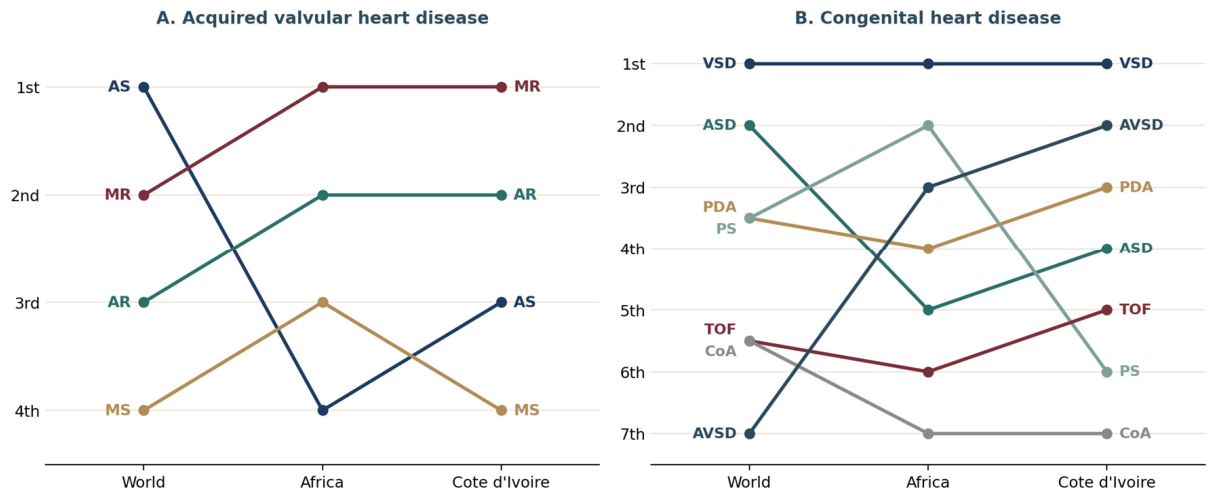

Table 1.
Frequency of acquired valvular heart disease (as a percentage of valvular diseases).
| Disease |
World [9,12] |
Africa [13,14] |
Cote d’Ivoire [15,16,20] |
| Mitral regurgitation (%) | 21.3 | 52.8 | 36 |
| Aortic regurgitation (%) | 5.3 | 32.1 | 32 |
| Aortic stenosis (%) | 41.2 | 1.8 | 16.4 |
| Mitral stenosis (%) | 4.5 | 13.4 | 15.6 |
| Ventricular septal defect (%) | 30 | 31.1 | 21.5 |
| Patent ductus arteriosus (%) | 7 | 9 | 11.4 |
| Atrial septal defect (%) | 8 | 8.8 | 11 |
| Tetralogy of Fallot (%) | 6 | 6.3 | 10.6 |
| Atrioventricular septal defect (%) | 4 | 11.2 | 12.4 |
| Pulmonary stenosis (%) | 7 | 21.5 | 7.5 |
| Coarctation of the aorta (%) | 6 | 0.6 | 1.3 |
Table 2.
Ranking of acquired valvular heart diseases by geographical level (percentage of valvular diseases in brackets).
Table 2.
Ranking of acquired valvular heart diseases by geographical level (percentage of valvular diseases in brackets).
| Rank | World | Africa | Cote d’Ivoire |
| 1st | Aortic stenosis (41.2) | Mitral regurgitation (52.8) | Mitral regurgitation (36) |
| 2nd | Mitral regurgitation (21.3) | Aortic regurgitation (32.1) | Aortic regurgitation (32) |
| 3rd | Aortic regurgitation (5.3) | Mitral stenosis (13.4) | Aortic stenosis (16.4) |
| 4th | Mitral stenosis (4.5) | Aortic stenosis (1.8) | Mitral stenosis (15.6) |
Table 3.
Ranking of congenital heart diseases by geographical level (percentage of congenital heart diseases in brackets).
Table 3.
Ranking of congenital heart diseases by geographical level (percentage of congenital heart diseases in brackets).
| Rank | World | Africa | Cote d’Ivoire |
| 1st | VSD (30) | VSD (31.1) | VSD (21.5) |
| 2nd | ASD (8) | Pulmonary stenosis (21.5) | AVSD (12.4) |
| 3rd | PDA / PS (7 each) | AVSD (11.2) | PDA (11.4) |
| 4th | TOF / CoA (6 each) | PDA (9) | ASD (11) |
| 5th | AVSD (4) | ASD (8.8) | TOF (10.6) |
| 6th | — | TOF (6.3) | PS (7.5) |
| 7th | — | CoA (0.6) | CoA (1.3) |
Worldwide ties (PDA/PS at 7%; TOF/CoA at 6%) share a rank. Sources as in Table 1.
Disclaimer/Publisher’s Note: The statements, opinions and data contained in all publications are solely those of the individual author(s) and contributor(s) and not of MDPI and/or the editor(s). MDPI and/or the editor(s) disclaim responsibility for any injury to people or property resulting from any ideas, methods, instructions or products referred to in the content. |
© 2026 by the authors. Licensee MDPI, Basel, Switzerland. This article is an open access article distributed under the terms and conditions of the Creative Commons Attribution (CC BY) license (http://creativecommons.org/licenses/by/4.0/).
Copyright: This open access article is published under a Creative Commons CC BY 4.0 license, which permit the free download, distribution, and reuse, provided that the author and preprint are cited in any reuse.