

Submitted:
27 August 2026
Posted:
28 August 2026
You are already at the latest version
Abstract
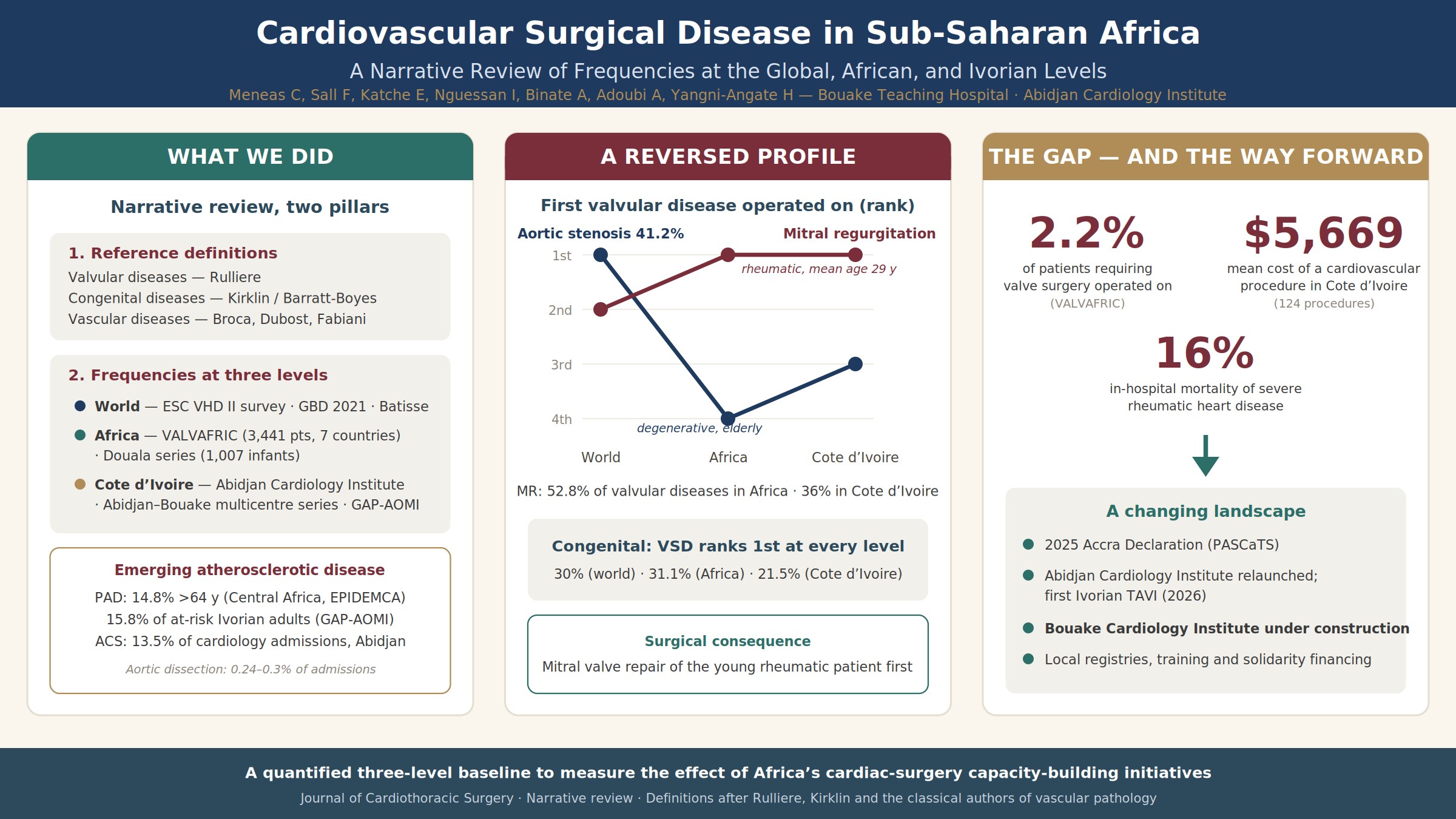
Background. Cardiovascular surgery addresses a heterogeneous group of acquired and congenital diseases whose precise definition and epidemiological magnitude condition teaching, research and health planning. Sub-Saharan Africa displays a disease spectrum that differs profoundly from that of high-income countries, yet no synthesis has combined a rigorous nosological framework with disease frequencies at the global, African and national (Ivorian) levels. This review aimed to restate the reference definitions of the main cardiovascular surgical diseases and to quantify their frequency at these three geographical levels. Methods. Narrative review based on the classical didactic references (Rulliere; Kirklin/Barratt-Boyes; Batisse; the French medical-surgical encyclopaedia; the French vascular surgery curriculum reporting the definitions of Broca, Dubost, Fabiani, and Cabanne and Bonenfant), on contemporary global datasets (European Society of Cardiology EURObservational VHD II survey; Global Burden of Disease 2021 analyses), and on the major African and Ivorian hospital series: the VALVAFRIC registry, the Abidjan Cardiology Institute echocardiographic series, and the Douala neonatal and infant series. Results. The classical definitions remain fully operational at the bedside and in the echocardiography laboratory. Epidemiologically, valvular heart disease displays a reversed profile: degenerative aortic stenosis dominates in Western countries (41.2% of valvular diseases in the ESC survey), whereas rheumatic mitral regurgitation dominates in sub-Saharan Africa (52.8% in VALVAFRIC) and in Cote d’Ivoire (36%). Ventricular septal defect is the leading congenital heart disease at all three levels (30% worldwide; 31.1% in Africa; 21.5% in Cote d’Ivoire). Emerging atherosclerotic disease completes the picture: peripheral artery disease affects 14.8% of Central Africans over 64 years and 15.8% of at-risk Ivorian adults in a recent national screening programme. Access to surgery remains marginal: only 2.2% of patients requiring valve surgery were operated on in VALVAFRIC, and the mean cost of a cardiovascular procedure in Cote d’Ivoire (USD 5,669) remains out of reach of most households. Conclusions. The burden of surgical cardiovascular disease in sub-Saharan Africa is heavy, young and rheumatic, while surgical capacity remains scarce. The relaunch of the Abidjan Cardiology Institute, the construction of the Bouake Cardiology Institute and the 2025 Accra Declaration open a credible path towards closing the gap, provided that local epidemiological registries, training and solidarity-based financing follow.
Keywords:
definitions
; epidemiology
; valvular heart disease
; congenital heart disease
; cardiovascular surgery
; sub-Saharan Africa
; Cote d’Ivoire
Copyright: This open access article is published under a Creative Commons CC BY 4.0 license, which permit the free download, distribution, and reuse, provided that the author and preprint are cited in any reuse.