
Submitted:
24 August 2026
Posted:
28 August 2026
You are already at the latest version
Abstract
Abstract Smallholder farming systems in sub-Saharan Africa are highly heterogeneous, resulting in differences in farmers’ capacities, priorities, and responses to sustainable intensification (SI) innovations. This study assessed farmers’ perceptions of six SI innovations and evaluated their suitability across four farm typologies in Mtunthama Extension Planning Area, Central Malawi. A mixed-methods participatory approach involving focus group discussions, key informant interviews, and farmer-led innovation ranking was used across 44 trial farmers. Qualitative data were analysed using thematic content analysis, while preference rankings were converted into weighted standardised scores for comparison across farm types. Kruskal-Wallis tests were applied to assess whether maize grain yield differed significantly across farm typologies by treatment. Farmers generally perceived SI innovations positively, identifying improved yields, soil fertility, food security, dietary diversity, and climate resilience as major benefits. Labour requirements, input constraints, management complexity, and limited training were identified as key barriers. Innovation preferences differed across farm typologies, reflecting variations in household resource endowment and livelihood strategies. Although conventional ridging with continuous sole maize received the highest proportion of first-choice rankings, conservation agriculture incorporating legumes, particularly maize-cowpea double-row strip cropping, achieved the highest overall preference scores across farm types. Yield analysis revealed significant differences across farm typologies for CA Maize-Lablab Rotation (H = 9.823, p = 0.020) and Conventional Maize (H = 12.834, p = 0.005), with resource-constrained farmers consistently recording lower yields. Field days attended by 253 independent observers confirmed community-level preference for cowpea-based CA innovations, with maize-cowpea strip cropping receiving the highest vote share at both sites. Post-project follow-up revealed that 68 out of 253 field day observers (26.9%) independently adopted cowpea-based conservation agriculture in the following season, of whom 58.8% were women. Adoption was driven by the early maturity of the cowpea variety under climate variability and access to a ready vendor market. These findings demonstrate that integrating farm typology analysis with participatory innovation assessment and post-project tracking improves the targeting of SI interventions and supports the design of context-specific innovation packages more likely to achieve sustained adoption than blanket technology recommendations.
Keywords:
conservation agriculture
; legume integration
; participatory evaluation
; innovation adoption
; food security
; climate resilience
; mixed farming systems
1. Introduction
Smallholder farming systems in sub-Saharan Africa are inherently heterogeneous, differing substantially in landholding size, livestock ownership, labour availability, access to capital, market participation, and livelihood objectives (Tittonell et al., 2009; Alvarez et al., 2018). This diversity shapes how farming households allocate resources, respond to production constraints, and evaluate agricultural innovations. Rather than representing a single farming population, smallholder agriculture consists of multiple farm types with distinct capacities, priorities, and production strategies, requiring interventions that recognise this variability (Garrity et al., 2012; Franke et al., 2014).
Agriculture remains the foundation of rural livelihoods in Malawi, where the majority of households depend on rain-fed maize-based mixed farming systems for food security and income generation. However, agricultural productivity remains constrained by declining soil fertility, small landholdings, climate variability, and limited access to productive resources (Mango et al., 2018; Bhatti et al., 2021). Climate projections further suggest that increasing temperatures and uncertain rainfall patterns will continue to threaten maize production and increase production risk unless farming systems become more resilient and adaptive (Warnatzsch & Reay, 2020). These challenges have intensified interest in production systems capable of increasing productivity while simultaneously strengthening resilience and maintaining natural resource quality.
Sustainable Intensification (SI) has emerged as one of the leading frameworks for addressing these challenges by increasing agricultural productivity without causing unacceptable environmental degradation while improving the resilience of farming systems (Pretty et al., 2011; Pretty, 2018; Vanlauwe et al., 2014). Rather than relying on a single technology, sustainable intensification promotes complementary practices that improve resource-use efficiency and strengthen interactions between crops, livestock, soils, and natural resources. Within smallholder farming systems these practices commonly include conservation agriculture, legume integration, crop diversification, crop rotation, integrated crop–livestock systems, and improved soil fertility management.
In Malawi, sustainable intensification has increasingly been promoted through initiatives such as Africa Research in Sustainable Intensification for the next Generation (Africa RISING) and the Sustainable Intensification of Mixed Farming Systems (SI-MFS) programme to improve productivity, restore soil fertility, and strengthen resilience among smallholder farmers (TerAvest & Reganold, 2012; Homann-Kee Tui et al., 2025). Evidence from long-term experiments and participatory on-farm research demonstrates that integrating legumes into maize-based systems can improve soil fertility, maintain maize productivity, increase dietary diversity, and reduce production risks (Snapp et al., 2002; Smith et al., 2017; Franke et al., 2014). Similarly, conservation agriculture and integrated crop–livestock systems have been shown to improve soil moisture conservation, nutrient cycling, and long-term system sustainability when appropriately adapted to local farming conditions (Giller et al., 2021; Valbuena et al., 2012).
Despite these documented benefits, adoption and sustained implementation of sustainable intensification practices remain uneve across smallholder farming systems (Ngoma et al., 2021; Takahashi et al., 2019). Research increasingly shows that adoption decisions are influenced not only by the agronomic performance of technologies but also by farmers’ perceptions of labour requirements, input availability, profitability, risk, compatibility with existing farming systems, and expected livelihood benefits (Rogers, 2003; Alomia-Hinojosa et al., 2018; Zeweld et al., 2017). Farmers therefore evaluate innovations within the broader context of household objectives and resource constraints rather than solely on their technical performance.
Participatory research has demonstrated that direct farmer involvement in technology evaluation can substantially improve understanding of adoption behaviour. For example, Alomia-Hinojosa et al. (2018) found that participatory evaluation of maize–legume innovations in Nepal improved farmers’ perceptions of new technologies, yet final adoption decisions continued to depend on labour availability, access to inputs, and compatibility with existing farming systems. Similar findings have been reported across sub-Saharan Africa, where labour scarcity, seasonal cash shortages, and competing household priorities frequently limit adoption even when technologies are perceived positively (White et al., 2005; Leonardo et al., 2015; Takahashi et al., 2019).
An increasing body of literature also recognises that differences among farming households strongly influence which innovations are technically suitable and economically feasible. Farm typology approaches have therefore become important tools for understanding farming system diversity and for designing interventions that better match technologies to household characteristics (Alvarez et al., 2018; Franke et al., 2014). Rather than recommending identical technology packages to all farmers, typologies provide a basis for identifying innovations that align with differences in resource endowment, labour availability, market orientation, and production objectives.
The farming system typology developed in the previous chapter identified substantial diversity among households in Mtunthama Extension Planning Area, including differences in crop–livestock integration, landholding size, labour availability, asset ownership, and market participation. Four distinct farm types were identified, ranging from resource-endowed households with relatively diversified enterprises to resource-constrained households facing greater labour and capital limitations. These differences suggest that the suitability of sustainable intensification innovations is unlikely to be uniform across households and that farmer-centred targeting may improve both adoption and long-term sustainability.
Understanding farmers’ perceptions of sustainable intensification innovations is therefore important for several reasons. First, perceptions influence both the initial acceptance and the sustained implementation of agricultural innovations (Rogers, 2003). Second, farmers’ evaluations provide valuable insight into the practical trade-offs they consider when balancing productivity, labour, food security, and livelihood objectives (Alomia-Hinojosa et al., 2018; Pannell et al., 2006). Third, identifying how these perceptions vary across farm typologies can support the development of more targeted extension strategies and context-specific innovation packages that better reflect the diversity of smallholder farming systems.
This study therefore aimed to assess farmers’ perceptions of selected sustainable intensification innovations and evaluate their suitability across different farm typologies in Mtunthama Extension Planning Area, Central Malawi. Specifically, the study sought to (i) identify and describe major sustainable intensification innovations promoted within mixed farming systems; (ii) assess farmers’ perceptions of the advantages and risks associated with the selected innovations; (iii) evaluate sustainable intensification innovations using farmer-defined criteria; and (iv) examine farmer-centred targeting of sustainable intensification innovations across different household typologies.
2. Methodology
2.1. Study Area
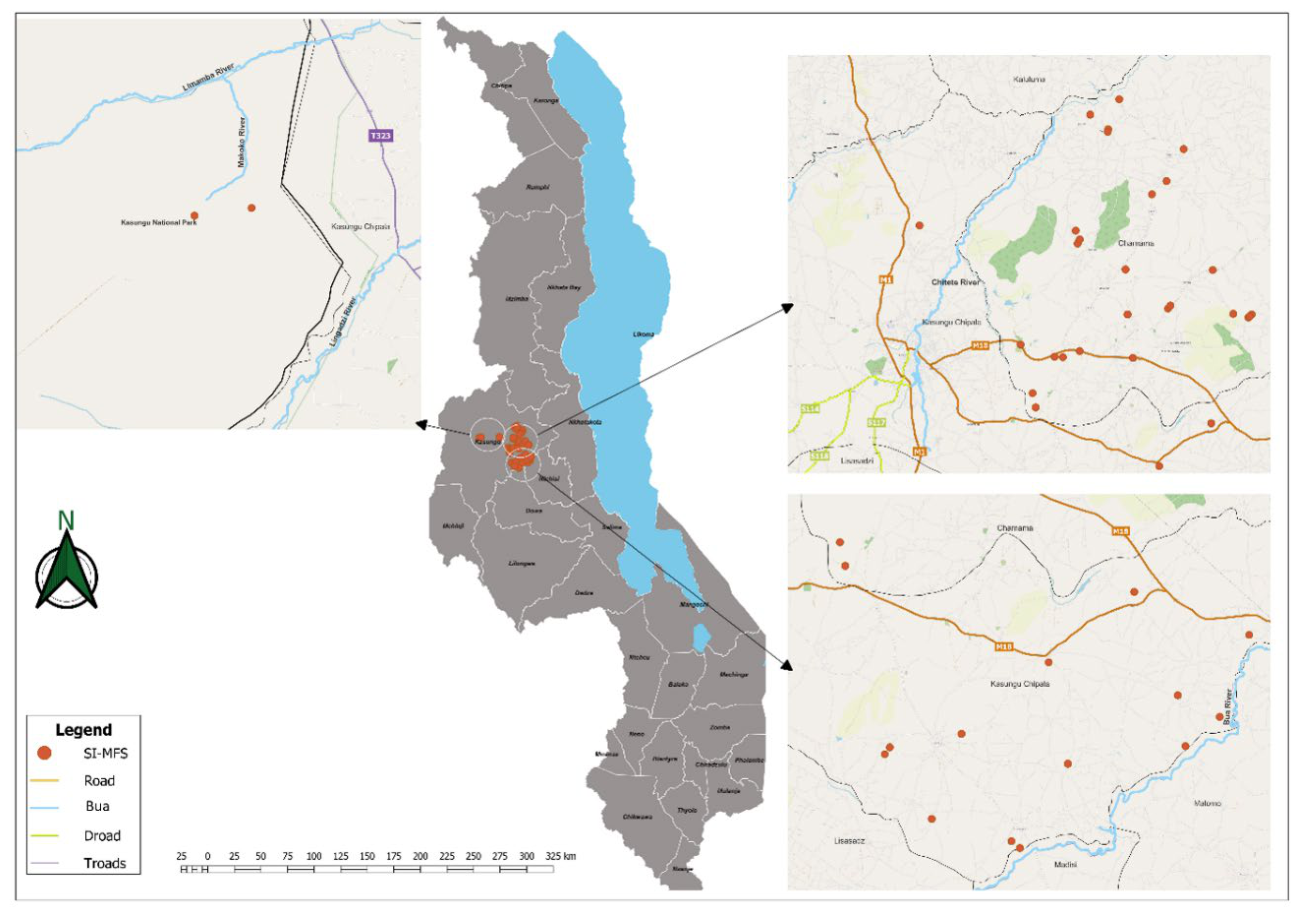
The study was conducted in Mtunthama Extension Planning Area, located in Kasungu District in the Central Region of Malawi (Figure 1). The area is characterised by mixed crop–livestock farming systems in which maize-based production is integrated with legumes, tobacco, and small livestock enterprises. Agriculture in the area is rain-fed and forms the primary livelihood source for rural households (Nyamayevu et al., 2024). Sustainable intensification (SI) innovations have increasingly been promoted within the area by government extension services, research institutions, and development organisations to address declining productivity, soil degradation, and climate-related production risks among smallholder farmers.
Figure 1.
Map of Malawi showing Kasungu district, Mtunthama EPA, and farms of the study marked with red dots.
Figure 1.
Map of Malawi showing Kasungu district, Mtunthama EPA, and farms of the study marked with red dots.
Kasungu District experiences a tropical sub-humid climate with distinct seasonal variations. The cool dry season extends from May to August, with mean daily temperatures ranging from 17 to 27°C, followed by a hot dry season from September to October, during which temperatures range from 25 to 37°C. The rainy season occurs from November to April and contributes the majority of annual precipitation, averaging between 800 and 1,000 mm annually. Rainfall is concentrated between December and March and supports the main cropping season. However, increasing temperatures and growing uncertainty in rainfall distribution have heightened production risks for rain-fed maize systems in Central Malawi, with projected climate change expected to increase yield variability and the risk of maladaptation if appropriate adaptation strategies are not implemented (Warnatzsch & Reay, 2020).
The district is dominated by medium-textured sandy loam soils that are susceptible to erosion and nutrient depletion, although patches of relatively fertile clay loam soils are also present. Continuous cultivation, monocropping, and limited use of soil conservation practices have contributed to declining soil fertility and land degradation in many farming areas (Thierfelder et al., 2013). These production constraints have contributed to the promotion of sustainable intensification approaches such as conservation agriculture, legume integration, intercropping, fertiliser micro-dosing, and crop–livestock integration within the district.
Cropping systems in the study area are dominated by maize, which serves as the primary staple crop and occupies the largest proportion of cultivated land. Tobacco is the major cash crop and represents an important income source for many households in Kasungu District (Thabbie, 2004; Mwasikakata, 2003). Legumes, particularly soybean, groundnut and pigeonpea, are widely promoted because they improve biological nitrogen fixation, diversify household food production and enhance long-term soil fertility within maize-based systems (Franke et al., 2014; Smith et al., 2017). Cassava and sweet potatoes are also cultivated as supplementary food and climate-resilient crops, although they occupy relatively smaller land areas.
Livestock production forms an important component of rural livelihood systems in the area. Farmers commonly rear cattle, goats, pigs, sheep, poultry, and rabbits for income generation, manure production, asset accumulation, and household nutrition (Homann-Kee Tui et al., 2025). Although livestock are important for nutrient cycling, income generation and household resilience, many resource-constrained households own relatively small herds, creating competition between crop residues used as livestock feed and those retained as soil mulch (Valbuena et al., 2012). The farming systems in the area therefore exhibit considerable diversity in terms of landholding size, livestock ownership, labour allocation, market orientation, and enterprise combinations.
Smallholder farmers in Kasungu, Malawi, particularly in the Mtunthama EPA, face interconnected agricultural challenges including severe soil nutrient depletion, high input costs, labour shortages, and poor market access (Phiri et al., 2012). These factors, combined with increasing climate variability, severely restrict livelihood stability and technology adoption (Bhatti et al., 2021). Most households rely on smallholder rain-fed agriculture and operate under resource-constrained conditions, which influence their production decisions and ability to adopt agricultural innovations. These conditions make the area particularly relevant for examining how farmers perceive different sustainable intensification options within diverse livelihood systems.
The research was conducted across eight sections within Mtunthama EPA. Previous farm typology analysis conducted in the area revealed substantial heterogeneity among households in terms of resource endowment, productivity orientation, labour use, and sustainable practice adoption, providing an appropriate context for assessing farmer perceptions and farmer-centred targeting of SI innovations.
2.2. Selection of Sustainable Intensification Innovations
Six sustainable intensification (SI) innovations promoted within mixed farming systems in Mtunthama Extension Planning Area were selected for evaluation. The innovations were identified through a combination of literature review, consultations with agricultural extension personnel, and preliminary discussions with farmers during field exploration activities. Selection was guided by the relevance of the innovations to key production challenges in the study area, including declining soil fertility, low agricultural productivity, climate variability, limited resource availability, and livelihood diversification needs (Table ).

Table 1.
Sustainable Intensification Innovations Evaluated.
| Innovation | Description |
| Conservation Agriculture | Farming approach based on minimum soil disturbance, permanent soil cover, and crop diversification |
| Legume–Maize Rotation | Sequential cultivation of legumes and maize to improve soil fertility and nitrogen cycling |
| Strip Cropping (Maize–Cowpea) | Cultivation of maize and cowpea in alternating strips to improve land productivity and reduce risk |
| Small Livestock Integration | Integration of goats, poultry, or pigs into cropping systems for nutrient cycling and livelihood diversification |
| Fertilizer Micro-Dosing | Application of small, targeted quantities of fertilizer to improve nutrient use efficiency |
| Intercropping | Simultaneous cultivation of two or more crops on the same plot to enhance productivity and resilience |
The selected innovations represented a range of agronomic, ecological, and livelihood-oriented intensification strategies that are widely promoted within Malawi and across sub-Saharan Africa as complementary strategies for improving productivity, soil fertility and resource-use efficiency (Pretty et al., 2011; Vanlauwe et al., 2014; Takahashi et al., 2019). In addition, the innovations differed in terms of labour requirements, input intensity, management complexity, and expected livelihood benefits, making them appropriate for evaluating farmer perceptions across heterogeneous farm types. Table 1 presents the sustainable intensification innovations evaluated in this study.
2.3. Research Design and Data Collection
The study adopted a participatory research design consistent with farmer-centred innovation evaluation approaches that actively engage farmers in assessing technologies under their own production conditions (Alomia-Hinojosa et al., 2018). The approach also recognises farm heterogeneity through the use of farm typologies to support context-specific evaluation of agricultural innovations (Alvarez et al., 2018).
Data collection involved focus group discussions (FGDs), key informant interviews (KIIs), and participatory innovation evaluation exercises conducted four times for each, among the forty-four farming households within the previously identified farm typologies. The integration of multiple methods allowed triangulation of farmer perspectives and enhanced understanding of how perceptions differed across heterogeneous farming systems.
The multi-criteria decision analysis (MCDA) scores used to evaluate innovation suitability across farm typologies are reported in a companion paper elsewhere (Kamwana-Ngwira et al., 2025), and are not reproduced here. The present study builds on those findings by examining farmer perceptions of the same innovations through participatory ranking.
Participants were purposively selected from households previously classified into the four farm typologies developed in Kamwana-Ngwira et al., 025. The typologies represented contrasting resource endowment levels, livelihood strategies, labour allocation patterns, and production orientations. This enabled an assessment of how perceptions of SI innovations varied according to household characteristics and farming system context.
2.3.1. Focus Group Discussions
A total of four focus group discussions were conducted with farmers representing different farm typologies to explore perceptions of the advantages, risks, constraints, and suitability of selected SI innovations. Separate discussions were organised to encourage open interaction among households with relatively similar production conditions and resource endowments. Discussions focused on perceived productivity benefits, labour requirements, profitability, implementation challenges, risk exposure, compatibility with existing livelihood systems, and long-term sustainability considerations.
The FGDs also explored how household resource availability, livestock ownership, labour access, and market participation influenced farmer preferences for different SI options.
2.3.2. Key Informant Interviews
For four times key informant interviews (KIIs) were conducted with agricultural extension officers, lead farmers, and representatives of agricultural development organisations operating within Mtunthama EPA. The interviews provided contextual information regarding the promotion history of SI innovations, observed adoption patterns, extension challenges, and perceived suitability of innovations under different farming conditions.
The KIIs also helped validate farmer-reported constraints and targeting considerations identified during focus group discussions.
2.3.3. Participatory Innovation Evaluation
Participatory innovation evaluation exercises were conducted to assess farmers’ perceptions of the selected SI innovations using farmer-defined evaluation criteria. The criteria reflected both technical and livelihood-oriented dimensions influencing innovation suitability within smallholder farming systems.
Farmers collectively discussed and scored each innovation against the selected criteria using a participatory ranking approach. The evaluation process encouraged farmers to compare innovations based on practical experiences, perceived trade-offs, and expected livelihood outcomes under real farming conditions. Table presents the criteria used for evaluating sustainable intensification innovations.
Table 2.
Farmer Evaluation Criteria for Sustainable Intensification Innovations.
| Criterion | Description |
| Productivity Potential | Perceived ability of the innovation to improve crop or livestock productivity |
| Feasibility of Adoption | Ease of implementation considering labour, skills, and resource requirements |
| Economic Viability | Potential to increase income or reduce production costs |
| Resource Use Efficiency | Efficient utilisation of land, labour, nutrients, and water resources |
| Scalability and Replicability | Potential for wider adoption and applicability among farming households |
The evaluation criteria were selected because previous research has shown that farmers evaluate agricultural innovations not only according to expected productivity gains but also according to labour requirements, compatibility with existing farming systems, profitability, implementation feasibility and perceived usefulness (Alomia-Hinojosa et al., 2018; Zeweld et al., 2017; Arsil et al., 2022).
2.3.4. Ethical Consideration
All participants were informed about the objectives of the study, the nature of their participation, and the intended use of the information collected. Participation was entirely voluntary, and informed consent was obtained from all respondents before focus group discussions, key informant interviews, and participatory evaluation exercises commenced. Participants were assured that they could decline to answer any question or withdraw from the study at any stage without any negative consequences. To ensure confidentiality and privacy, no personal identifiers were included in the analysis or reporting of results, and all information collected was used solely for academic research purposes.
2.4. Data Analysis
Qualitative data obtained from focus group discussions (FGDs) and key informant interviews (KIIs) were analysed using thematic content analysis. An inductive coding approach was applied, whereby farmer responses were systematically coded and grouped into major themes related to perceived benefits, production risks, labour demands, profitability, resource constraints, climate resilience, compatibility with livelihood systems, and adoption feasibility. Thematic comparisons were subsequently conducted across farm typologies to identify differences and similarities in farmer perceptions and innovation experiences.
In addition, farmers’ participatory ranking data were analysed using a structured ordinal-to-interval transformation approach. Farmers were asked to rank the six sustainable intensification (SI) innovations from 1 (most preferred) to 6 (least preferred). These ordinal rankings were converted into weighted preference scores using an inverse weighting system, where higher-ranked innovations received higher scores (1st choice = 6, 2nd = 5, 3rd = 4, 4th = 3, 5th = 2, and 6th = 1). The weighted preference score for each innovation was calculated as:
where WPSi is the weighted preference score for innovation i, wj is the weight assigned to ranking position j (6, 5, 4, 3, 2, and 1 for first to sixth choice, respectively), and fij is the number of farmers who assigned innovation i to ranking position j. The resulting scores were aggregated by innovation and disaggregated by farm typology to assess variation in preferences across household groups.
To facilitate comparison across farm types with different sample sizes, weighted preference scores were subsequently standardised by dividing the observed weighted score by the maximum possible score for each farm type:
where SPSi is the standardised preference score for innovation i, WPSi is the observed weighted preference score, n is the number of respondents within the respective farm typology, and 6 represents the maximum possible weight a single respondent can assign. The standardised scores ranged from 0 to 1, with values closer to 1 indicating stronger overall farmer preference for a particular innovation.
To enable cross-innovation comparison and visual representation, composite preference scores were normalised as a proportion of the maximum achievable score. This standardisation facilitated the construction of comparative visual outputs, including radar plots, to illustrate multidimensional preference patterns across farm types.
Participatory innovation evaluation responses were further summarised using descriptive statistics, and mean scores were computed for each innovation across the evaluation criteria (productivity potential, feasibility of adoption, economic viability, resource use efficiency, and scalability). These composite indices were used to compare perceived suitability of SI options across heterogeneous farming systems.
Finally, quantitative and qualitative findings were triangulated to strengthen interpretation of results. The analysis emphasised understanding how farm heterogeneity shapes farmer perceptions, innovation preferences, and targeting pathways rather than identifying universally superior technologies. This analytical approach aligns with contemporary sustainable intensification research that recognises the importance of farm heterogeneity, participatory evaluation and context-specific targeting of innovations rather than assuming universal suitability across farming households (Alvarez et al., 2018; Franke et al., 2014; Alomia-Hinojosa et al., 2018).
3. Results
3.1. Farmers’ Perceptions of Sustainable Intensification Innovations Across Farm Typologies
Farmers across all farm typologies expressed generally positive perceptions towards the sustainable intensification (SI) innovations evaluated in the study (Table). All respondents in the study expressed willingness to participate in future research trials. At the same time, most reported that participation in the innovation trials had improved their ability to make farm management decisions.
Table 3.
Percentage of farmers reporting selected perceptions, benefits, and challenges of sustainable intensification (SI) innovations across farm resource typologies.
Table 3.
Percentage of farmers reporting selected perceptions, benefits, and challenges of sustainable intensification (SI) innovations across farm resource typologies.
| Perception domain | Indicator | Low-resource (%) (n = 6) | Medium-resource (%) (n = 8) | High-resource (%) (n = 8) |
| Research participation and learning | Willing to participate in future research trials | 100.0 | 100.0 | 100.0 |
| Reported improved farm decision-making after participation | 100.0 | 75.0 | 100.0 | |
| Received sufficient training to independently implement innovations | 50.0 | 25.0 | 25.0 | |
| Willing to participate without externally provided inputs | 66.7 | 50.0 | 37.5 | |
| Perceived productivity benefits | Identified yield improvement as the main benefit | 66.7 | 50.0 | 50.0 |
| Identified soil improvement as the main benefit | 0.0 | 12.5 | 25.0 | |
| Believed intercropping produces higher yields than sole cropping | 100.0 | 100.0 | 87.5 | |
| Perceived resilience and livelihood benefits | Innovations help cope with unpredictable weather | 100.0 | 87.5 | 100.0 |
| Innovations contribute to more stable income | 100.0 | 100.0 | 100.0 | |
| Crop–livestock integration improves farm productivity | 100.0 | 100.0 | 100.0 | |
| Livestock integration reduces dependence on external inputs | 100.0 | 100.0 | 100.0 | |
| Perceived implementation challenges | Innovations require additional inputs and resources | 100.0 | 100.0 | 87.5 |
| Innovations require more labour | 100.0 | 12.5 | 100.0 | |
| Innovations are easier to maintain | 100.0 | 12.5 | 12.5 | |
| Innovations are harder to maintain | 0.0 | 0.0 | 50.0 | |
| Pest and disease perceptions | Observed lower pest and disease pressure on innovation plots | 50.0 | 62.5 | 50.0 |
| Observed higher pest and disease pressure on innovation plots | 50.0 | 37.5 | 25.0 | |
| Crop residue management preferences | Prefer residues for mulching | 100.0 | 25.0 | 12.5 |
| Prefer residues for livestock feeding | 0.0 | 12.5 | 12.5 | |
| Crop diversification preferences | Prefer growing diverse crop enterprises | 100.0 | 100.0 | 100.0 |
| Mixed farming system challenges | Reported challenges balancing crop and livestock enterprises | 0.0 | 0.0 | 0.0 |
Perceptions regarding the primary benefits of the innovations were broadly similar across typologies. Yield improvement was most frequently identified as the principal benefit, followed by improvements in soil fertility. Furthermore, all respondents from the low- and medium-resource groups and the majority of respondents from the high-resource group reported that intercropping resulted in higher yields compared with sole cropping.
Most respondents perceived the innovations as contributing to improved resilience against climatic variability. Nearly all farmers agreed that the innovations helped them cope with unpredictable weather conditions and contributed to more stable household incomes. Similarly, positive perceptions were observed regarding crop–livestock integration, with respondents across all typologies indicating that integrating livestock into farming systems improved overall farm productivity and reduced dependence on external inputs such as inorganic fertilisers.
Despite these positive perceptions, several implementation challenges were reported. Across all typologies, most respondents indicated that successful implementation of the innovations required additional inputs and resources. Perceptions regarding labour requirements differed among farm types. All low-resource and high-resource farmers reported that the innovations required additional labour, whereas most medium-resource farmers perceived the innovations as requiring less labour. Likewise, perceptions of management complexity varied across typologies, with low-resource farmers generally reporting that innovation plots were easier to maintain, while a larger proportion of high-resource farmers considered them more difficult to manage throughout the growing season.
Responses regarding the adequacy of training were mixed. Only half of the low-resource farmers reported receiving sufficient training to implement the innovations independently, whereas most medium- and high-resource farmers either disagreed or were neutral. Interest in participating in future research trials without external input support was lower than overall willingness to participate in trials, particularly among high-resource households.
Regarding residue management, clear differences were observed among farm typologies. Most low-resource households preferred using crop residues for mulching, whereas livestock feeding was more frequently preferred among medium- and high-resource households. Nevertheless, the majority of respondents across all typologies agreed that retaining crop residues in the field was an effective management practice.
Overall, the results indicate widespread positive perceptions of sustainable intensification innovations across farm typologies, although differences were observed in perceived labour requirements, management complexity, training adequacy, and residue use preferences.
3.2. Farmer Preference Ranking of Sustainable Intensification Innovations Across Farm Typologies
Farmers from the four farm typologies ranked six sustainable intensification (SI) innovation options according to their overall preference. The ranking exercise revealed substantial variation in preferences both within and across farm types, indicating that innovation attractiveness was strongly influenced by household characteristics and farming contexts.
3.2.1. First-Choice Preferences Across Farm Typologies
The distribution of first-choice rankings revealed distinct preference patterns among farm types (Table).
Table 4.
Distribution of first-choice rankings (%) for sustainable intensification innovations across farm typologies.
Table 4.
Distribution of first-choice rankings (%) for sustainable intensification innovations across farm typologies.
| Innovation | Farm Type I (n = 3) | Farm Type II (n = 20) | Farm Type III (n = 6) | Farm Type IV (n = 14) | Overall (n = 43) |
| CA with cowpea–maize rotation | 33.3 | 10.0 | 0.0 | 14.3 | 11.6 |
| CA with lablab–maize rotation | 33.3 | 5.0 | 16.7 | 0.0 | 7.0 |
| CA with maize/cowpea double-row strip cropping | 0.0 | 25.0 | 16.7 | 28.6 | 23.3 |
| CA with maize/lablab double-row strip cropping | 0.0 | 30.0 | 16.7 | 7.1 | 18.6 |
| Conservation Agriculture with continuous sole maize | 33.3 | 10.0 | 0.0 | 14.3 | 11.6 |
| Conventional ridging with continuous sole maize | 0.0 | 20.0 | 50.0 | 35.7 | 27.9 |
Among HRE households, preferences were evenly distributed among CA with cowpea–maize rotation, CA with lablab–maize rotation, and CA with continuous sole maize, each selected by 33.3% of respondents as their most preferred innovation. Although the sample size was small (n=3), these results suggest the absence of a dominant innovation preference within this farm type.
MDV households showed the strongest preference for diversified conservation agriculture systems. CA with maize–lablab double-row strip cropping was the most frequently selected first-choice innovation (30.0%), followed by CA with maize–cowpea double-row strip cropping (25.0%). Conventional ridging with continuous sole maize accounted for 20.0% of first-choice rankings, while rotational CA systems received comparatively lower support.
A contrasting pattern was observed among MCL households, where conventional ridging with continuous sole maize emerged as the dominant first-choice innovation, selected by 50.0% of respondents. The remaining first-choice rankings were equally distributed among CA with lablab–maize rotation, CA with maize–cowpea double-row strip cropping, and CA with maize–lablab double-row strip cropping (16.7% each).
Similarly, RCM households exhibited a relatively strong preference for conventional ridging with continuous sole maize (35.7%), followed by CA with maize–cowpea double-row strip cropping (28.6%). Other innovations received considerably lower levels of first-choice support.
Across all farm types combined, conventional ridging with continuous sole maize was the most frequently selected first-choice innovation (27.9%), followed by CA with maize–cowpea double-row strip cropping (23.3%) and CA with maize–lablab double-row strip cropping (18.6%).
3.2.2. Preference Distribution Across Ranking Positions
Analysis of rankings across all six preference positions revealed notable differences in the consistency of farmer preferences. Conventional ridging with continuous sole maize received the largest proportion of first-choice rankings (27.9%), but it was also the innovation most frequently ranked last (32.6%). This indicates substantial variation in farmer perceptions of the practice across farm types.
In contrast, CA with maize–cowpea double-row strip cropping consistently appeared among the highest-ranked innovations while rarely appearing in the lowest preference category. Similarly, CA with cowpea–maize rotation generally received favourable rankings across multiple preference positions. Innovations involving lablab, particularly CA with lablab–maize rotation, appeared more frequently in lower-ranking categories and were less commonly selected as first-choice options.
These findings suggest that while some innovations generated broad support across farm types, others elicited more polarised responses, reflecting differences in household priorities, production objectives, and resource endowments.
3.2.3. Standardised Preference Scores Across Farm Typologies
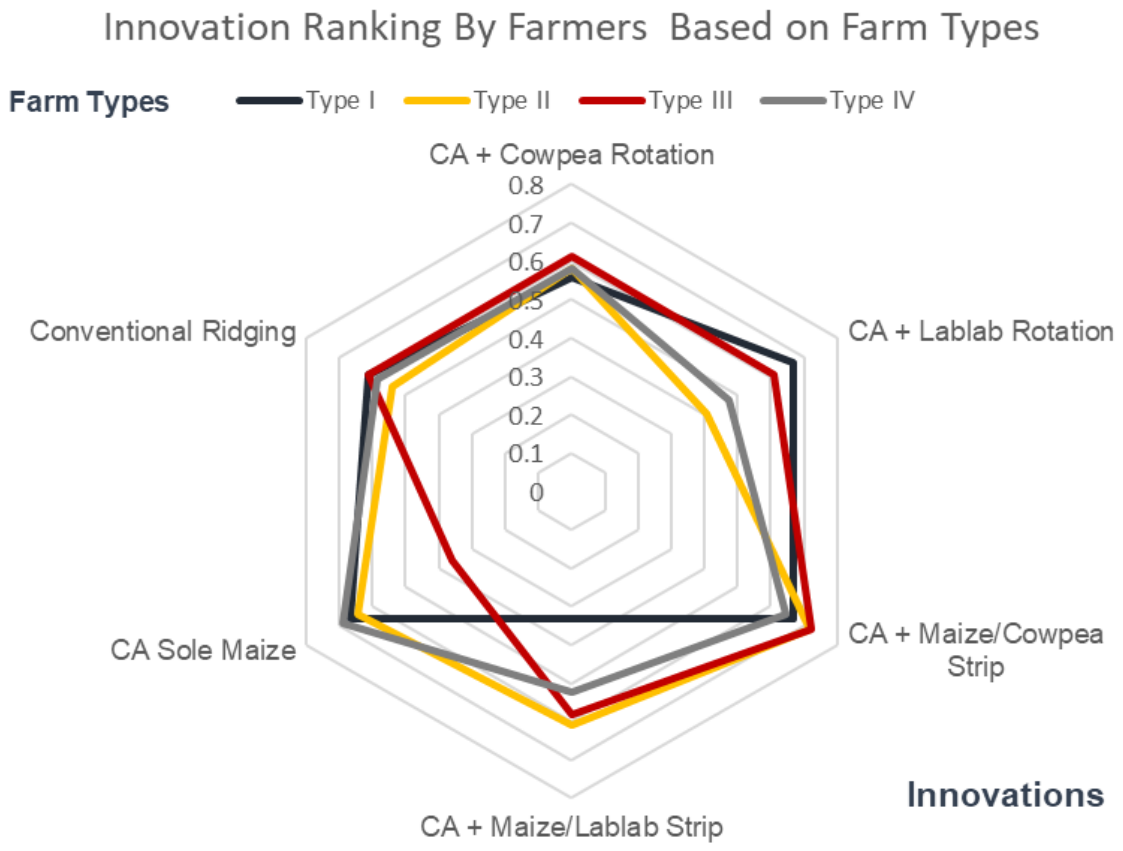
To facilitate comparison across farm types with different sample sizes, ranking responses were converted into weighted preference scores and standardised. The resulting scores revealed broadly similar patterns to those observed in the first-choice rankings (Table;Figure).
Table 5.
Standardised weighted preference scores for sustainable intensification innovations across farm typologies.
Table 5.
Standardised weighted preference scores for sustainable intensification innovations across farm typologies.
| Innovation | Farm Type I (n=3) | Farm Type II (n=20) | Farm Type III (n=6) | Farm Type IV (n=14) |
| CA with cowpea–maize rotation | 0.556 | 0.583 | 0.611 | 0.583 |
| CA with lablab–maize rotation | 0.667 | 0.408 | 0.611 | 0.476 |
| CA with maize/cowpea double-row strip cropping | 0.667 | 0.717 | 0.722 | 0.643 |
| CA with maize/lablab double-row strip cropping | 0.333 | 0.608 | 0.583 | 0.524 |
| Conservation Agriculture with continuous sole maize | 0.667 | 0.642 | 0.361 | 0.69 |
| Conventional ridging with continuous sole maize | 0.611 | 0.542 | 0.611 | 0.583 |
CA with maize–cowpea double-row strip cropping recorded the highest preference scores among Farm Types II, III, and IV, with standardised scores of 0.717, 0.722, and 0.643, respectively. HRE showed relatively similar preference scores for CA with lablab–maize rotation, CA with maize–cowpea strip cropping, and CA with continuous sole maize (0.667 each).
MDV generally favoured diversified conservation agriculture systems, particularly strip-cropping arrangements involving legumes. MCL displayed strong preferences for maize–cowpea strip cropping and legume rotations, despite the relatively high proportion of respondents selecting conventional ridging as their first-choice innovation. RCM recorded the highest score for CA with continuous sole maize (0.690), although maize–cowpea strip cropping remained highly preferred (0.643).
Figure 2.
Radar plot showing standardised weighted preference scores for sustainable intensification innovations across farm typologies. Scores were standardised on a 0–1 scale, where values closer to 1 indicate stronger farmer preference for an innovation and v.
Figure 2.
Radar plot showing standardised weighted preference scores for sustainable intensification innovations across farm typologies. Scores were standardised on a 0–1 scale, where values closer to 1 indicate stronger farmer preference for an innovation and v.
3.2.4. Overall Ranking of Sustainable Intensification Innovations
When rankings from all farm types were aggregated, CA with maize–cowpea double-row strip cropping emerged as the most preferred innovation overall, followed by conservation agriculture with continuous sole maize and CA with cowpea–maize rotation (Table). The least preferred innovations were CA with maize–lablab double-row strip cropping and CA with lablab–maize rotation.
Notably, although conventional ridging with continuous sole maize received the highest proportion of first-choice rankings, its overall ranking was reduced because many farmers also ranked it among their least preferred options. This suggests that the innovation generated highly divergent responses among farmers compared with the more consistently favoured maize–cowpea strip-cropping system.
Table 6.
Overall ranking of sustainable intensification innovations based on weighted farmer preference scores.
Table 6.
Overall ranking of sustainable intensification innovations based on weighted farmer preference scores.
| Innovation | Overall Preference Score | Rank |
| CA with maize/cowpea double-row strip cropping | 31.99 | 1 |
| Conservation Agriculture with continuous sole maize | 28.98 | 2 |
| CA with cowpea-maize rotation | 26.99 | 3 |
| Conventional ridging with continuous sole maize | 25.99 | 4 |
| CA with maize/lablab double-row strip cropping | 24.99 | 5 |
| CA with lablab-maize rotation | 22.99 | 6 |
Overall, the results indicate that farmers generally favoured conservation agriculture systems incorporating legumes, particularly cowpea-based strip-cropping arrangements. However, the substantial variation in rankings across farm typologies demonstrates that innovation preferences are context-specific, reinforcing the importance of targeted rather than uniform sustainable intensification recommendations.
Innovations across farm typologies. The responses revealed interrelated agronomic, socio-economic, and institutional factors shaping preferences. Five dominant themes emerged: (i) perceived productivity and food security benefits, (ii) climate and soil moisture effects, (iii) labour requirements, (iv) input and implementation constraints, and (v) knowledge, training, and institutional support needs.
3.2.5. Perceived Productivity and Food Security Benefits
Across all farm typologies, the strongest driver of innovation preference was expected or observed increases in yield and household food availability. Farmers frequently associated higher-ranked innovations with: increased maize yields per unit area, ability to harvest multiple crops from the same plot, improved household food diversity (maize + legumes), and potential surplus for income generation.
Typical responses included references to “high yield on small piece of land,” “more harvest per acre,” and “variety of food items for household consumption and sale.” Intercropping and conservation agriculture systems were often preferred for their perceived productivity advantages over sole maize or conventional ridging systems.
3.2.6. Climate Resilience and Soil Moisture Conservation
A second dominant theme was the ability of SI innovations to buffer climate variability, particularly dry spells and erratic rainfall. Farmers across all farm types highlighted improved soil moisture retention under mulching and cover crops, reduced crop stress during drought periods, protection against rainfall variability and improved soil fertility over time as some of their reasons for their ranking.
Intercropping systems (especially maize-legume combinations) and conservation agriculture practices were consistently described as “good during dry spells” or “helpful when rains are insufficient.” Farmers linked legume cover and mulch to soil protection and moisture conservation, reinforcing the perceived ecological benefits of SI systems.
3.2.7. Labour Requirements and Workload Trade-Offs
Labour demand emerged as a major determinant of ranking, particularly for lower-ranked innovations or initial adoption stages. While some farmers acknowledged long-term labour savings (e.g., reduced weeding under mulch), most emphasised high labour demand during land preparation and planting, ridge modification or flat-planting requirements, increased weeding and management complexity in intercrops, and the need for hired labour in some cases.
Many respondents explicitly described SI innovations as “labour demanding,” particularly in early implementation stages. However, some also noted that labour requirements may decline over time once systems are established.
3.2.8. Input Constraints and Implementation Challenges
Across all farm types, farmers consistently reported input-related and operational constraints that influenced their ranking decisions. Key issues included late delivery of seed and inputs, insufficient quantities of fertilizer and herbicides, lack of sprayers and farm tools, pest and disease pressure and drought and erratic rainfall during trial periods.
These constraints were often cited as reasons for lower ranking of certain innovations or reduced performance of trial plots. Farmers frequently attributed challenges to poor timing of project implementation and limited logistical coordination.
3.2.9. Knowledge Gaps, Training, and Institutional Support
A final major theme was the role of capacity building and extension support in shaping farmer perceptions. Farmers repeatedly emphasized the need for more training on application rates and field management, lack of initial orientation before implementation, desire for continuous extension support and supervision, need for knowledge on manure production and soil fertility management and importance of farmer groups and peer learning.
Farmers indicated that better training would improve both understanding and performance of SI innovations, and several linked adoption willingness directly to skills acquisition and confidence building.
3.2.10. Integrated Interpretation Across Themes
Overall, farmers’ ranking decisions were not based on a single factor but on a combined evaluation of yield potential, risk exposure, labour burden, and resource availability. Innovations that simultaneously offered higher productivity, improved moisture retention, and food security benefits were ranked higher, while those requiring higher labour inputs or constrained by input shortages tended to be ranked lower.
3.3. Perceived Contribution of Sustainable Intensification Innovations to Food Security, Dietary Diversity, Income, and Climate Resilience
Farmers across all resource endowment groups and farm typologies consistently reported that the Sustainable Intensification (SI) innovations positively contributed to household food security, dietary diversity, income generation, and resilience to climate variability. Responses were highly convergent across farm types, with only minor variation in emphasis.
3.3.1. Contribution to Household Food Security
Across all farm types, farmers indicated that the SI innovations improved household food security primarily through increased yields per unit area. The most frequently cited explanation was that innovations such as intercropping, strip cropping, and conservation agriculture enabled farmers to obtain “more harvest from a small piece of land.” Farmers also highlighted that reduced planting spacing and improved crop performance contributed to higher productivity compared to conventional practices.
A second dominant theme was reduced risk of food shortages, with farmers noting that higher and more stable yields reduced reliance on food purchases and improved year-round availability of staple foods.
3.3.2. Contribution to Dietary Diversity
Respondents from all farm types reported that the innovations improved dietary diversity through crop diversification. Farmers consistently noted that mixed cropping systems (maize combined with cowpea, lablab, soybean, and pigeon pea) enabled households to access a wider range of foods.
The main explanatory pattern was that the same plot produced multiple food types simultaneously, allowing households to consume different crops within the same season. Several farmers also highlighted that legumes provided both food and relish, improving meal variety at household level.
3.3.3. Contribution to Income Generation
Across all farm categories, farmers reported that the innovations enhanced income generation through the sale of surplus produce. The dominant explanation was that increased yields led to “more food than needed for household consumption,” with the excess being sold.
Farmers also identified inclusion of cash-generating legumes (especially cowpea and lablab) as an important income pathway. In addition, reduced labour demands in some cases (particularly where mulching suppressed weeds) were reported to free time for other income-generating activities.
3.3.4. Contribution to Climate Resilience
Farmers consistently reported that the innovations improved resilience to drought and rainfall variability. The most prominent explanation was moisture retention, particularly through mulching, cover crops, and intercropping systems.
Across all farm types, farmers stated that these practices helped crops “withstand dry spells” and maintain growth during periods of rainfall scarcity. Additional explanations included improved soil structure and fertility from manure and crop residues, early maturing crop varieties escaping drought periods and reduced crop failure compared to sole cropping systems.
These factors were collectively associated with improved ability of crops to cope with both drought and erratic rainfall.
3.3.5. Willingness to Adopt Innovations
A near-universal trend across all farm types was a strong willingness to adopt the innovations after the experiment. Farmers justified this primarily by observed benefits during the trial period, particularly higher yields, improved food availability, income from surplus sales and improved soil moisture and soil health.
However, farmers also noted that continued adoption would depend on addressing constraints such as:
- Labour demands, especially during land preparation and planting
- Timely access to inputs (seed, fertilizer, herbicides)
- Need for training and technical support
- Access to equipment and livestock manure for scaling practices
Despite these constraints, most respondents indicated willingness to continue adopting at least parts of the innovations, particularly mulching, intercropping, and legume integration.
3.4. Yield Performance Across Farm Typologies
Kruskal-Wallis tests were conducted to determine whether maize grain yield differed significantly across the four farm typologies (HRE, MCL, MDV, RCM) for each of the six treatments evaluated in the on-farm trials (Table).
Table 7.
Kruskal-Wallis test results for maize grain yield differences across farm types by treatment.
Table 7.
Kruskal-Wallis test results for maize grain yield differences across farm types by treatment.
| Treatment | H statistic | df | p-value | Significance |
| CA Maize-Cowpea Rotation | 4.792 | 3 | 0.1877 | ns |
| CA Maize-Cowpea Strip | 4.801 | 3 | 0.1869 | ns |
| CA Maize-Lablab Rotation | 9.823 | 3 | 0.0201 | * |
| CA Maize-Lablab Strip | 1.378 | 3 | 0.7106 | ns |
| CA Sole Maize | 3.731 | 3 | 0.2920 | ns |
| Conventional Maize | 12.834 | 3 | 0.0050 | ** |
Note: ns = not significant; * p < 0.05; ** p < 0.01. df = degrees of freedom (farm types: HRE, MCL, MDV, RCM).
Significant differences across farm types were detected for CA Maize-Lablab Rotation (H = 9.823, df = 3, p = 0.020) and Conventional Maize (H = 12.834, df = 3, p = 0.005). The remaining four treatments did not show statistically significant yield differences across farm types (p > 0.05), suggesting relatively consistent performance across household resource endowment categories for these innovations.
Mean maize grain yields by treatment and farm type are presented in Table. Across all treatments, MDV households recorded the highest mean yields, particularly under CA Maize-Cowpea Strip (2,023 kg/ha) and CA Maize-Lablab Strip (1,924 kg/ha). HRE households recorded comparatively lower yields under CA Maize-Cowpea Rotation (1,148 kg/ha) and Conventional Maize (820 kg/ha), suggesting yield performance under trial conditions was not exclusively determined by resource endowment. RCM households consistently recorded lower mean yields across most treatments, reflecting constraints associated with limited land, labour, and capital.
Table 8.
Mean maize grain yield (kg/ha) by treatment and farm type (SD in parentheses).
| Treatment | HRE (n=6) | MCL (n=12) | MDV (n=40) | RCM (n=28) |
| CA Mz-Cowpea Rotation | 1148 (195) | 1182 (577) | 1464 (590) | 1191 (420) |
| CA Mz-Cowpea Strip | 1333 (672) | 1426 (608) | 2023 (948) | 1709 (800) |
| CA Mz-Lablab Rotation | 1691 (392) | 1403 (420) | 1375 (522) | 1141 (448) |
| CA Mz-Lablab Strip | 1581 (151) | 1683 (474) | 1924 (790) | 1703 (860) |
| CA Sole Maize | 1030 (314) | 1293 (550) | 1410 (590) | 1189 (525) |
| Conventional Maize | 820 (610) | 1188 (293) | 1448 (506) | 1096 (412) |
Note: HRE = High Resource Endowment; MCL = Medium Crop-Livestock; MDV = Medium Diversified; RCM = Resource Constrained Maize-based.
Dunn post-hoc pairwise comparisons with Bonferroni correction (Table 1) identified specific farm type pairs driving the significant Kruskal-Wallis results. For CA Maize-Lablab Rotation, yields differed significantly between HRE and RCM households (Z = -2.65, p-adj = 0.048), with HRE farmers recording higher mean yields (1,691 kg/ha) compared to RCM farmers (1,141 kg/ha). For Conventional Maize, MDV households yielded significantly more than RCM households (Z = -2.93, p-adj = 0.020), with mean yields of 1,448 kg/ha versus 1,096 kg/ha respectively. These findings reinforce the importance of farm-type-specific targeting of sustainable intensification innovations.
Table 1.
Dunn post-hoc pairwise comparisons for treatments with significant Kruskal-Wallis results.
| Treatment | Comparison | Z statistic | p-adj (Bonferroni) | Significance |
| CA Mz-Lablab Rotation | HRE vs RCM | -2.65 | 0.048 | * |
| Conventional Maize | MDV vs RCM | -2.93 | 0.020 | * |
Note: Only significant pairwise comparisons shown. p-values Bonferroni corrected. * p < 0.05.
3.5. Field Day Innovation Preferences Among Independent Observers
Field days were conducted at two sites (Sarai Mkanasi and Charles Kanyenda), attended by a total of 253 independent observers who were not participants in the on-farm trials. Each observer cast up to three preference votes across demonstration plots. A total of 758 votes were cast across both sites (360 at Sarai Mkanasi and 398 at Charles Kanyenda). Vote distributions by plot and gender are summarised in Table 2.
Table 2.
Field day vote distribution by plot and gender across both sites (Sarai Mkanasi and Charles Kanyenda).
Table 2.
Field day vote distribution by plot and gender across both sites (Sarai Mkanasi and Charles Kanyenda).
| Plot and Innovation | Total Votes | Male Votes | Female Votes |
| Plot 3 (CA Mz-Cowpea Strip) | 91 | 33 | 58 |
| Plot 8A (CA Mz-Cowpea Strip demo) | 62 | 34 | 28 |
| Plot 5B (CA Mz-Lablab Rotation) | 58 | 22 | 36 |
| Plot 6B (Intercrop variant) | 58 | 35 | 23 |
| Plot 1 (Conventional Maize) | 56 | 27 | 29 |
| Plot 4 (CA Mz-Lablab Strip) | 55 | 28 | 27 |
| Plot 6A (CA Mz-Cowpea/Lablab mix) | 53 | 23 | 30 |
| Plot 5A (CA Mz-Cowpea Rotation) | 41 | 23 | 18 |
| Plot 2 (CA Sole Maize) | 22 | 15 | 7 |
Note: Each observer cast up to 3 preference votes. Total attendees: 253 (120 at Sarai Mkanasi; approximately 133 at Charles Kanyenda).
At Sarai Mkanasi, Plot 3 (CA Maize-Cowpea Strip cropping) received the highest number of votes (77 total; 24 male, 53 female), making it the most preferred innovation among independent observers at that site. At Charles Kanyenda, Plot 8A (CA Maize-Cowpea Strip demonstration) received the most votes (47 total; 24 male, 23 female), followed closely by Plot 6B (40 votes) and Plot 4 (CA Maize-Lablab Strip, 42 votes). Across both sites, CA Maize-Cowpea Strip cropping consistently attracted the highest observer preference, corroborating the ranked preference findings from the 44 trial farmers. Female observers showed a notably stronger preference for Plot 3 at Sarai Mkanasi (53 female vs 24 male votes), suggesting that cowpea-based strip cropping may hold particular appeal for women farmers, possibly due to cowpea’s dual role in household nutrition and income generation.
3.6. Post-Project Innovation Adoption
Post-project follow-up tracking conducted after the USAID-supported project phase ended revealed that 68 out of 253 field day observers (26.9%) independently adopted at least one sustainable intensification innovation in the season following the field days, without any external project support. Of the 68 adopters, 40 were women (58.8%) and 28 were men (41.2%). The primary innovation adopted was cowpea-based conservation agriculture, including CA Maize-Cowpea Strip cropping and cowpea-maize rotation. Two key drivers underpinned this uptake: first, the early-maturing cowpea variety used in the trials was perceived as well-suited to increasingly unpredictable rainfall patterns associated with climate variability in the region; and second, farmers identified a ready market for cowpea grain through local vendors, providing a direct economic incentive for adoption independent of subsistence motivations.
4. Discussion
4.1. Overview of Key Findings and Novelty of the Study
The study demonstrates that farmers across heterogeneous farm typologies generally hold strongly positive perceptions of sustainable intensification (SI) innovations, particularly conservation agriculture (CA) systems that integrate legumes and crop diversification. Across all farm types, innovations were primarily valued for their ability to increase yields, enhance dietary diversity, generate surplus income, and improve resilience to climate variability. This finding agrees with Alomia-Hinojosa et al. (2018), who showed that farmers participating in innovation trials valued technologies that combined productivity gains with compatibility to local farming conditions, while Garrity et al. (2012) emphasise that African farming systems are inherently heterogeneous and therefore require context-specific intensification strategies.
A key finding is that while positive perceptions are widespread, farmer preferences are not uniform. Instead, they are strongly shaped by farm typology, with distinct differences in preferred innovation packages across resource-constrained and better-endowed households. Maize–cowpea strip cropping consistently emerged as the most broadly preferred innovation, while conventional ridging and lablab-based systems elicited more polarised responses.
Importantly, the study contributes novel evidence that farmer decision-making is not driven solely by agronomic performance, but by an integrated assessment of labour requirements, risk exposure, input availability, and livelihood compatibility. This reinforces the argument that SI technologies must be understood as socio-technical systems rather than standalone agronomic interventions (Vanlauwe et al., 2014).
4.2. Yield Variation Across Farm Types
The finding that maize yield responses to sustainable intensification innovations varied across farm typologies underscores the heterogeneity of smallholder farming systems in the study area, consistent with broader evidence from sub-Saharan Africa showing that technology performance is conditioned by household resource endowment (Vanlauwe et al., 2010; Giller et al., 2011). The significant yield advantage recorded by MDV households under strip cropping treatments suggests that medium-resource households with diversified enterprises may be better positioned to exploit the complementarities between maize and legume intercrops, potentially due to more flexible labour allocation and greater experience with crop diversification. In contrast, the consistently lower yields among RCM households across most treatments point to structural constraints that limit the expression of innovation benefits even under supported trial conditions. The differential performance of CA Maize-Lablab Rotation between HRE and RCM households further highlights the role of resource endowment in mediating the agronomic benefits of conservation agriculture, particularly where soil preparation, residue management, and legume establishment demand higher upfront labour and capital investment.
4.3. Field Day Observer Preferences and Adoption Potential
The strong and consistent preference for CA Maize-Cowpea Strip cropping among field day observers across both sites reinforces findings from the trial farmers and aligns with the broader literature on legume-cereal intercropping in smallholder systems of sub-Saharan Africa (Rusinamhodzi et al., 2012; Franke et al., 2014). The concentration of female votes on cowpea-based innovations is noteworthy and reflects documented patterns of women’s preference for food security and nutritionally diverse crop options in Malawi (Snapp et al., 2019). Field day observers represent a wider community beyond the trial participants, and their convergent preferences suggest potential for broader voluntary uptake of CA Maize-Cowpea Strip cropping if extension and input support were made available. This is consistent with the adoption intention findings reported among the 44 trial farmers, and together these findings provide complementary evidence that cowpea-based conservation agriculture represents the most contextually appropriate innovation for scaling across the study area.
4.4. Post-Project Adoption and Scaling Implications
The voluntary adoption of cowpea-based conservation agriculture by 26.9% of field day observers in the season immediately following exposure is encouraging and compares favourably with reported first-season adoption rates for similar innovations in smallholder systems across sub-Saharan Africa, which typically range from 15% to 35% (Kassie et al., 2015; Oyetunde-Usman et al., 2021). The higher proportion of women among adopters (58.8%) is consistent with evidence that women smallholders in Malawi are more likely to adopt legume-based innovations due to their dual role in household food security and market participation (Ragasa et al., 2014). The convergence of climate adaptation motivation and market access as adoption drivers is particularly significant: it suggests that cowpea-based CA addresses multiple livelihood constraints simultaneously, which is a key criterion for sustainable technology uptake in resource-constrained farming systems (Giller et al., 2011). The vendor market channel identified by adopters also points to an existing value chain that could be leveraged by extension services and NGOs to accelerate scaling without requiring heavy input subsidies. These findings collectively strengthen the case for prioritising cowpea-based strip cropping as the lead innovation for farmer-centred targeting across the farm typologies identified in this study.
4.5. Farm Typology and Targeting of Sustainable Intensification Innovations
The variation in innovation preferences across farm typologies demonstrates that farmers do not evaluate sustainable intensification technologies using a common set of criteria. Instead, each household appears to assess innovations according to its own resource availability, labour capacity, production objectives, and tolerance for risk. This explains why no single innovation was consistently preferred across all farm types despite farmers generally recognising the benefits of sustainable intensification. The findings therefore suggest that technology suitability is determined less by its agronomic potential alone than by its compatibility with the realities of individual farming systems.
The preference shown by MDV households for diversified conservation agriculture systems, compared with the greater reliance on conventional systems among Farm Types III and IV, illustrates how differences in household circumstances shape technology choices. Although diversified systems may offer greater long-term productivity and resilience, they also require additional labour, management skills, and timely access to inputs. Households with greater capacity to meet these requirements are therefore more likely to value such innovations, whereas those facing labour or resource constraints may favour familiar practices that involve lower implementation risks. This demonstrates that farmers make pragmatic decisions aimed at balancing expected benefits against the costs and uncertainties associated with adopting new practices.
These findings provide empirical evidence that blanket recommendations are unlikely to achieve widespread adoption because they ignore the diversity that exists within smallholder farming systems. Similar conclusions have been reported by Alvarez et al. (2018), who argue that farm typologies provide an effective basis for matching agricultural interventions to household characteristics. Franke et al. (2014) similarly showed that opportunities to benefit from grain legumes differed markedly among Malawian farm types because labour availability, soil fertility and financial resources varied considerably across households. The recent CGIAR Mixed Farming Systems Initiative in Malawi likewise advocates tailoring socio-technical innovation bundles to different farming system typologies rather than promoting uniform technology packages (Homann-Kee Tui et al., 2025).
From a practical perspective, the results indicate that farm typology should become an integral component of extension planning and technology targeting. Rather than recommending identical innovation packages to all households, extension programmes should prioritise technologies that match the specific labour availability, resource endowment, and production goals of different farmer groups. Such an approach is more likely to improve adoption, enhance farmer satisfaction, and increase the long-term sustainability of sustainable intensification interventions.
4.6. Participatory Evaluation and Farmer-Led Innovation Assessment
A notable contribution of this study is that it evaluates sustainable intensification innovations from the farmers’ perspective rather than relying solely on agronomic performance. The ranking exercises revealed that farmers simultaneously considered productivity, labour demand, food security, risk, and implementation feasibility when judging the suitability of innovations. This demonstrates that technologies regarded as technically superior by researchers may not necessarily be perceived as the most appropriate under real farming conditions. Farmer-generated rankings therefore provided a more holistic assessment of innovation performance by capturing practical trade-offs that influence day-to-day management decisions.
The findings also suggest that participatory evaluation can identify potential adoption barriers before technologies are promoted at scale. For example, while several conservation agriculture options were recognised for their agronomic benefits, concerns regarding labour requirements and management complexity reduced their attractiveness for some households. Such insights would have been difficult to obtain from conventional yield assessments alone because they emerge from farmers’ lived experiences rather than experimental measurements.
These observations support the argument that farmer participation should be viewed as a source of scientific evidence rather than simply a mechanism for stakeholder engagement. These findings closely resemble those of Alomia-Hinojosa et al. (2018), who found that participatory on-farm evaluation not only improved researchers’ understanding of farmer decision-making but also changed farmers’ perceptions of agricultural innovations by allowing them to evaluate technologies under realistic farming conditions. Similarly, Lacombe et al. (2018) show that involving farmers in technology assessment improves the relevance of innovations by accounting for the diversity of local farming situations. The present findings reinforce these perspectives by demonstrating that farmer-led evaluations provide valuable information for predicting both technology acceptance and potential scaling challenges.
From a practical standpoint, incorporating participatory evaluation into innovation development could improve the design of technologies before large-scale dissemination. This would enable researchers and extension services to refine innovations in response to farmer priorities, thereby increasing their relevance and likelihood of sustained adoption.
4.7. Conservation Agriculture Adoption Dynamics in Malawi
Although farmers generally expressed positive perceptions of conservation agriculture (CA) and related sustainable intensification practices, the findings indicate that favourable attitudes alone are unlikely to ensure long-term adoption. Farmers consistently recognised the benefits of conservation agriculture for improving productivity, soil moisture retention, and resilience to climate variability, yet many also identified labour requirements, input availability, and implementation complexity as major constraints. This suggests that farmers clearly distinguish between recognising the value of an innovation and possessing the resources required to implement it consistently.
The coexistence of enthusiasm and caution observed in this study reflects the realities of decision-making within smallholder farming systems. Rather than accepting or rejecting CA outright, farmers appeared to weigh its expected long-term benefits against immediate household demands on labour, capital, and management capacity. This balancing process was particularly evident for practices involving residue retention and diversified cropping, where the perceived agronomic benefits competed with existing demands for crop residues as livestock feed and for other household uses. Such findings indicate that conservation agriculture is evaluated as part of a broader whole-farm livelihood strategy rather than as an isolated production technology.
This interpretation is supported by Chinseu et al. (2019), who found that conservation agriculture in Malawi is frequently discontinued once external project support ends because institutional and input constraints remain unresolved. Similarly, Ward et al. (2016) demonstrated that farmer preferences for conservation agriculture differ substantially according to household circumstances and available incentives. Beyond Malawi, Valbuena et al. (2012) showed that mixed crop–livestock households often face unavoidable trade-offs between retaining crop residues as mulch and using them for livestock feed, limiting adherence to one of conservation agriculture’s core principles. More broadly, Pannell et al. (2006) argue that farmers adopt conservation practices only when they perceive a clear advantage relative to their own objectives and when innovations are sufficiently compatible with existing farming systems and easy to trial. Erenstein (2011) further demonstrated that crop residue retention in conservation agriculture frequently conflicts with farmers’ competing needs for livestock feed, illustrating why full implementation of conservation agriculture remains difficult within mixed crop–livestock systems.
Taken together, these findings suggest that conservation agriculture promotion should move beyond demonstrating agronomic benefits towards creating an enabling environment that addresses the practical constraints affecting implementation. Recent reviews further emphasise that sustained adoption in developing countries depends on integrated extension services, complementary input support, and continuous farmer learning rather than technology dissemination alone (Takahashi et al., 2019). Strengthening these institutional and advisory systems is therefore likely to be as important as improving the technical performance of conservation agriculture itself.
4.8. Linking Farmer Preferences to Food Security, Resilience, and Livelihoods
Farmers consistently evaluated sustainable intensification (SI) innovations according to their contribution to household well-being rather than agricultural production alone. Innovations receiving the highest preference rankings were those perceived to improve food availability, diversify diets, generate marketable surplus, and reduce vulnerability to climatic shocks. This suggests that farmers assess technologies using multiple livelihood criteria simultaneously, with productivity representing only one component of a broader decision-making process.
The strong preference for maize–cowpea systems illustrates this integrated evaluation. Farmers valued these systems not simply because they increased maize production, but because they combined staple food production with nutritious legumes, opportunities for household income, and improvements in soil fertility within the same production system. The results therefore indicate that innovations offering several complementary benefits are more attractive than those delivering gains in only a single dimension. This finding reinforces the importance of designing SI interventions that respond to the multiple objectives of smallholder households rather than focusing exclusively on yield improvement.
This interpretation is consistent with Kerr et al. (2007), who demonstrated that legume diversification in Malawi simultaneously improves household nutrition and soil fertility through participatory farmer-managed systems. Likewise, Smith et al. (2017) showed that diversified legume rotations can maintain maize productivity while improving soil quality and increasing the likelihood of meeting household calorie and protein requirements under variable climatic conditions. Franke et al. (2014) further demonstrated that grain legumes generate different livelihood benefits across farm typologies, with improvements in food self-sufficiency, profitability, and soil fertility depending on household resource endowment. Together, these studies support the finding that farmers value SI innovations because they contribute to multiple livelihood outcomes rather than productivity alone. These livelihood considerations are particularly important in Malawi, where increasing climatic uncertainty threatens maize productivity and household food security, reinforcing the need for innovations that simultaneously improve resilience and production stability (Warnatzsch & Reay, 2020).
The findings also suggest that resilience is interpreted by farmers as both an ecological and socio-economic concept. While practices such as legume integration and conservation agriculture were recognised for improving soil moisture conservation and reducing climate-related production risks, farmers also considered whether these practices could be maintained with their available labour, capital, and management capacity. Similar conclusions have been reported by Matita et al. (2022), who found that improved legume technologies contribute to dietary resilience in Malawi, and by Giller et al. (2021), who emphasise that regenerative and conservation-oriented farming practices deliver sustainable benefits only when they remain feasible within the realities of smallholder farming systems.
4.9. Labour Constraints and the Limits of SI Scalability
Labour emerged as one of the most influential factors shaping farmers’ evaluations of sustainable intensification (SI) innovations. Across farm typologies, respondents consistently recognised the long-term benefits of conservation agriculture and diversified cropping systems, yet many expressed concern about the additional labour required during land preparation, planting, residue management, and weeding. These findings suggest that labour availability functions as a critical threshold determining whether technically attractive innovations can be implemented under real smallholder conditions.
The findings further indicate that labour constraints are not experienced uniformly across farm types. Households with limited labour resources generally favoured practices that could be accommodated within existing household capacities, whereas innovations requiring intensive management were often considered less feasible despite their recognised agronomic advantages. This pattern implies that farmers evaluate technologies in relation to seasonal labour availability and competing household responsibilities rather than expected productivity gains alone. Consequently, labour availability appears to influence not only whether innovations are adopted but also which components of an innovation package are considered practical.
This interpretation is supported by Leonardo et al. (2015), who identified labour availability as the principal constraint to agricultural production in maize-based smallholder farming systems in Mozambique, exceeding land limitations in importance. Similarly, White et al. (2005) demonstrated that technologies offering positive economic returns may nevertheless be rejected when they impose high labour demands during peak agricultural periods. In mixed crop–livestock systems, Valbuena et al. (2012) further showed that farmers frequently face trade-offs between competing uses of labour and crop residues, limiting the feasibility of implementing conservation agriculture according to recommended practices. More broadly, Ngoma et al. (2021) conclude that labour bottlenecks remain one of the most persistent barriers to conservation agriculture adoption across Eastern and Southern Africa.
Taken together, these findings suggest that improving the scalability of sustainable intensification will require interventions that address labour constraints alongside agronomic performance. Labour-saving technologies, appropriate mechanisation, improved weed management, and extension approaches that promote gradual or phased implementation of SI practices may therefore enhance adoption more effectively than simply promoting technically superior innovations.
4.10. Adoption Intentions Versus Likely Behavioural Outcomes
One of the most encouraging findings of the study was the strong willingness expressed by farmers to continue using sustainable intensification (SI) innovations after participating in the trials. Direct exposure to the innovations appeared to increase farmers’ confidence in their potential to improve crop productivity, household food availability, and resilience to climate variability. Nevertheless, respondents consistently indicated that sustained adoption would depend on overcoming practical constraints, particularly labour shortages, limited access to inputs, and continued technical support. These findings suggest that positive perceptions alone are insufficient to ensure long-term behavioural change.
The results further indicate that adoption is likely to occur incrementally rather than through immediate implementation of complete innovation packages. Many households appeared more willing to adopt individual practices that fit their available resources and existing farming systems than to implement the full suite of recommended SI components. This gradual approach reflects farmers’ efforts to minimise production risks while gaining experience with unfamiliar practices, illustrating that adoption is better understood as a progressive learning process than as a single decision.
This interpretation is consistent with Rogers (2003), who describes innovation adoption as a staged process through which individuals move from awareness and persuasion to implementation and confirmation. Likewise, Pannell et al. (2006) argue that favourable attitudes do not necessarily translate into adoption unless innovations provide a clear advantage, are compatible with farmers’ circumstances, and can be tested with acceptable levels of risk. The findings also support Zeweld et al. (2017), who showed that positive attitudes increase farmers’ behavioural intentions towards sustainable practices but do not necessarily guarantee implementation unless farmers perceive sufficient control over labour and resource requirements. Empirical evidence from Abay et al. (2019) further demonstrates that technology adoption depends on complementary inputs, extension support, and interactions among technologies, while substantial differences exist in adoption behaviour even among households with similar observable characteristics. Similarly, Ward et al. (2016) showed that Malawian farmers exhibit heterogeneous preferences for conservation agriculture, with adoption strongly influenced by household characteristics and incentive structures. Recent reviews by Takahashi et al. (2019) likewise conclude that sustained technology adoption in developing countries depends on integrated extension services and continued institutional support rather than exposure to technologies alone. Recent longitudinal evidence further confirms that an intention–action gap exists among farmers. Byfuglien et al. (2025) found that although almost half of surveyed farmers intended to adopt cover crops, only a small proportion subsequently implemented the practice, illustrating how favourable intentions may fail to translate into behaviour when practical constraints remain.
These findings suggest that successful scaling strategies should focus not only on creating positive perceptions of sustainable intensification but also on strengthening the conditions that enable farmers to convert favourable intentions into sustained practice. Improving access to inputs, providing continuous advisory support, and promoting gradual adoption pathways that match household capacities are therefore likely to produce more durable adoption outcomes than one-off technology promotion campaigns.
4.11. Implications for Targeting Sustainable Intensification Interventions
The findings demonstrate that improving the effectiveness of sustainable intensification (SI) programmes requires greater emphasis on matching innovations to the diversity of farming households. The clear differences in innovation preferences observed across farm typologies indicate that uniform technology recommendations are unlikely to achieve widespread adoption because farmers differ in labour availability, resource endowment, production objectives, and tolerance for production risk. These findings reinforce the argument by Garrity et al. (2012) that successful agricultural development in Africa depends on designing interventions around the diversity of farming systems rather than assuming that technologies perform equally well across all households.
The consistently high preference for maize–cowpea systems across several farm types suggests that such innovations could serve as effective entry points for broader SI interventions. However, the variation observed for other innovations indicates that extension programmes should retain sufficient flexibility to adapt recommendations to local household circumstances rather than promoting identical technology packages. This implies that successful targeting should focus on offering farmers a portfolio of complementary options from which they can select combinations that best match their production goals and resource capacities.
This interpretation is supported by Franke et al. (2014), who demonstrated that the benefits of grain legume technologies differ substantially across farm types in Malawi because household resource endowments shape both profitability and adoption opportunities. Likewise, Alvarez et al. (2018) argue that farm typologies provide an effective basis for targeting agricultural interventions by capturing differences in household assets, objectives, and production constraints. More recently, Homann-Kee Tui et al. (2025) advocate designing sustainable intensification as integrated bundles of complementary innovations that address multiple constraints simultaneously rather than promoting individual technologies in isolation.
Overall, the findings reinforce the need for extension systems that move beyond technology dissemination towards integrated support strategies. Evidence suggests that technology adoption is more successful when extension services are combined with timely access to complementary inputs, practical farmer training, and advisory services that enable households to adapt innovations to their own circumstances (Abay et al., 2019; Takahashi et al., 2019). Strengthening these institutional support systems is therefore likely to enhance both the adoption and long-term sustainability of sustainable intensification interventions.
4.12. Future Research Directions
Future research should move beyond cross-sectional perception studies towards longitudinal assessment of adoption trajectories to determine whether favourable perceptions translate into sustained behavioural change over time. Future studies should also quantify the economic and labour trade-offs associated with different sustainable intensification components across farm typologies. In addition, greater attention should be given to gendered labour allocation, behavioural drivers of technology adoption, and evaluation of integrated innovation bundles under farmer-managed conditions. Finally, further refinement of farm typology approaches and decision-support tools would improve the targeting of sustainable intensification interventions across heterogeneous smallholder farming systems.
5. Conclusions
The study demonstrates that sustainable intensification (SI) innovations are widely perceived by smallholder farmers as beneficial for improving food security, dietary diversity, income generation, and climate resilience. Across all farm typologies, farmers consistently associated SI practices, particularly conservation agriculture systems integrated with legumes, with higher yields, improved soil moisture retention, and greater household food availability. However, preferences for specific innovations were not uniform, with clear differences emerging across farm types. Maize–cowpea strip cropping and other diversified conservation agriculture systems were generally the most preferred, while conventional systems and some lablab-based options elicited more mixed or polarised responses. These findings highlight that farmer decision-making is shaped not only by perceived productivity gains but also by labour requirements, input availability, management complexity, and compatibility with household resource endowments.
In general, the study concludes that sustainable intensification interventions cannot be effectively promoted through uniform recommendations, as farm heterogeneity strongly influences both farmer preferences and likely adoption pathways. Instead, agricultural policies and development programmes should incorporate farm typology approaches to guide the targeting of innovation packages, extension services, and investment support to households with differing resource capacities. Maize–cowpea-based conservation agriculture systems provide a promising entry point for scaling sustainable intensification across diverse farm types, but widespread adoption will depend on complementary investments in timely access to quality seed and other inputs, labour-saving technologies, farmer training, and strengthened extension services. Greater collaboration among government agencies, research institutions, extension providers, and development partners will be essential for designing context-specific socio-technical innovation bundles that respond to local farming realities rather than relying on blanket technology recommendations. Future research should evaluate the long-term adoption, economic performance, and resilience impacts of these targeted innovation packages across different farming systems to inform evidence-based policy and sustainable agricultural development in Malawi.
Author Contributions
Kamwana-Ngwira Florence: Conceptualisation, Methodology, Formal analysis, Investigation, Writing – original draft. Chiduwa Mazvita: Supervision/Writing – review & editing/Data curation. Mabhaudhi Tafadzwanashe: Methodology/Writing – review & editing/Supervision. Groot Jeroen: Writing – review & editing/Methodology/Funding acquisition. Santiago Lopez-Ridaura: Writing – review & editing/Conceptualisation/Funding acquisition. All authors have read and agreed to the published version of the manuscript.
Funding
This research was initiated under the Sustainable Intensification of Mixed Farming Systems (SIMFS) project coordinated by International Maize and Wheat Improvement Center. Initial field activities were supported during the first season of project implementation. However, following premature discontinuation of project funding associated with the United States government funding cuts and Trump administration directives affecting international development programs, additional data collection and completion of the study were largely financed by the corresponding author using personal resources.
Institutional Review Board Statement
This study was conducted in accordance with ethical principles governing research involving human participants. Institutional endorsement and permission to undertake the research within the Sustainable Intensification of Mixed Farming Systems (SIMFS) project and to publish resulting manuscripts was granted by the Chitedze Agricultural Research Station, Department of Agricultural Research Services, Ministry of Agriculture, Malawi (Ref. No. CZ/ADM/1/1, dated 22 July 2026), through the Senior Deputy Director of Agricultural Research Services. The study was conducted with the full knowledge and cooperation of relevant agricultural authorities, extension personnel, local leaders, and participating farmers in Mtunthama Extension Planning Area, Kasungu District, Malawi. Participation by smallholder farmers in household surveys, focus group discussions, and on-farm research activities was entirely voluntary. The researcher observed appropriate ethical principles throughout the study, including informed consent, confidentiality, privacy, and respect for all participants.
Informed Consent Statement
Informed consent was obtained from all individual participants involved in the study prior to data collection. The study involved voluntary participation of smallholder farmers in household surveys, focus group discussions, and participatory evaluations. Informed consent was obtained from all The study involved voluntary participation of smallholder farmers in household surveys, focus group discussions, and participatory evaluations. Informed consent was obtained from all participants prior to data collection, and participants were assured of confidentiality and anonymity of the information provided.
Data Availability Statement
The datasets generated and analyzed during our study are not publicly available because they contain information obtained from participating farming households and are subject to confidentiality agreements. However, anonymized data supporting the findings of this study are available from the corresponding author upon reasonable request.
Acknowledgments
We gratefully acknowledge the financial and technical support provided by the One CGIAR Initiative on Sustainable Intensification of Mixed Farming Systems (SI-MFS) under the International Maize and Wheat Improvement Center (CIMMYT). We also extend our appreciation to the Department of Agricultural Research Services (Malawi) for their valuable technical assistance.Our sincere gratitude goes to the School of Agricultural, Earth and Environmental Sciences, University of KwaZulu-Natal (South Africa), and Wageningen University & Research (The Netherlands) for their academic support and guidance. Additionally, we thank the Department of Agricultural Extension for their collaboration and for facilitating the participation of their extension workers, who played a crucial role in data collection throughout the project.Finally, we extend our deepest appreciation to the farmers for their time, insights, and willingness to share their experiences and expertise, which were instrumental to the success of this research project.
Conflicts of Interest
This manuscript is original unpublished work, read and approved by all authors, and not being considered for publication elsewhere. All those listed as authors have contributed to the development of this paper and have approved the manuscript and this submission. We have no conflicts of interest to declare.
References
- Abay, K.A.; Berhane, G.; Taffesse, A.S.; Koru, B.; Abay, K. Understanding farmers’ technology adoption decisions: Input complementarity and heterogeneity. Gates Open Research 3 2019, 1386. [Google Scholar] [CrossRef]
- Alomia-Hinojosa, V.; Speelman, E.N.; Thapa, A.; Wei, H.E.; McDonald, A.J.; Tittonell, P.; Groot, J.C.J. Exploring farmer perceptions of agricultural innovations for maize–legume intensification in the mid-hills region of Nepal. International Journal of Agricultural Sustainability 2018, 16(1), 74–93. [Google Scholar] [CrossRef]
- Alvarez, S.; Timler, C.J.; Michalscheck, M.; Paas, W.; Descheemaeker, K.; Tittonell, P.; Andersson, J.; Groot, J.C.J. Capturing farm diversity with hypothesis-based typologies: An innovative methodological framework for farming system typology development. PLOS ONE 2018, 13(5), e0194757. [Google Scholar] [CrossRef] [PubMed]
- Arsil, P.; Tey, Y.S.; Brindal, M.; Ardiansyah, A.; Sumarni, E.; Masrukhi. Perceived attributes driving the adoption of system of rice intensification: The Indonesian farmers’ view. Open Agriculture 2022, 7(1), 217–225. [Google Scholar] [CrossRef]
- Bhatti, M.A.; Godfrey, S.; Ip, R.H.L.; Kachiwala, C.; Hovdhaugen, H.; Banda, L.J.; Limuwa, M.; Wynn, P.; Ådnøy, T.; Eik, L.O. Diversity of sources of income for smallholder farming communities in Malawi: Importance for improved livelihood. Sustainability 2021, 13(17), 9599. [Google Scholar] [CrossRef]
- Byfuglien, A.; van Valkengoed, A.M.; Innocenti, S. Good intentions, limited action: When do farmers’ intentions to adopt sustainable farming practices turn into actual behaviour? Journal of Environmental Psychology 102 2025, 102522. [Google Scholar] [CrossRef]
- Chinseu, E.L.; Stringer, L.C.; Dougill, A.J. An empirically derived conceptual framework to assess dis-adoption of conservation agriculture: Multiple drivers and institutional deficiencies. Journal of Sustainable Development 2019, 12(5), 48. [Google Scholar] [CrossRef]
- Erenstein, O. Cropping systems and crop residue management in the Trans-Gangetic Plains: Issues and challenges for conservation agriculture from village surveys. Agricultural Systems 2011, 104(1), 54–62. [Google Scholar] [CrossRef]
- Franke, A.C.; van den Brand, G.J.; Giller, K.E. Which farmers benefit most from sustainable intensification? An ex-ante impact assessment of expanding grain legume production in Malawi. European Journal of Agronomy 58 2014, 28–38. [Google Scholar] [CrossRef]
- Garrity, D.; Dixon, J.; Boffa, J.-M. Understanding African farming systems: Science and policy implications; Food Security in Africa: Bridging Research into Practice, 2012. [Google Scholar]
- Giller, K.E.; Corbeels, M.; Nyamangara, J.; Triomphe, B.; Affholder, F.; Scopel, E.; Tittonell, P. A research agenda to explore the role of conservation agriculture in African smallholder farming systems. Field Crops Research 2011, 124(3), 468–472. [Google Scholar] [CrossRef]
- Giller, K.E.; Hijbeek, R.; Andersson, J.A.; Sumberg, J. Regenerative agriculture: An agronomic perspective. Outlook on Agriculture 2021, 50(1), 13–25. [Google Scholar] [CrossRef] [PubMed]
- Homann-Kee Tui, S.; Tufa, A.; Manda, J.; Sseguya, H.; Liben, F.; Omondi, J.O. Informing an inclusive scaling strategy for bundled whole-farm innovations in Malawi’s maize-based mixed farming systems; CGIAR Sustainable Farming Science Program, 2025. [Google Scholar]
- Kamwana-Ngwira, F.; Chiduwa, M.; Mabhaudhi, T.; Groot, J.; Lopez-Ridaura, S. Assessing sustainable intensification options for maize across diverse farm types in central Malawi; Research Square, 2025. [Google Scholar] [CrossRef] [PubMed]
- Kassie, M.; Teklewold, H.; Jaleta, M.; Marenya, P.; Erenstein, O. Understanding the adoption of a portfolio of sustainable intensification practices in eastern and southern Africa. Land Use Policy 42 2015, 400–411. [Google Scholar] [CrossRef]
- Kerr, R.B.; Snapp, S.S.; Chirwa, M.; Shumba, L.; Msachi, R. Participatory research on legume diversification with Malawian smallholder farmers for improved human nutrition and soil fertility. Experimental Agriculture 2007, 43(4), 437–453. [Google Scholar] [CrossRef]
- Lacombe, C.; Couix, N.; Hazard, L. Designing agroecological farming systems with farmers: A review. Agricultural Systems 165 2018, 208–220. [Google Scholar] [CrossRef]
- Leonardo, W.; van de Ven, G.; Udo, H.; Kanellopoulos, A.; Sitoe, A.; Giller, K.E. Labour not land constrains agricultural production and food self-sufficiency in maize-based smallholder farming systems in Mozambique. Food Security 2015, 7(4), 857–874. [Google Scholar] [CrossRef]
- Mango, N.; Makate, C.; Mapemba, L.; Sopo, M. The role of crop diversification in improving household food security in central Malawi. Agriculture & Food Security 2018, 7, Article 7. [Google Scholar] [CrossRef]
- Matita, M.; Chiwaula, L.W.; Chirwa, E.W.; Mazalale, J.; Walls, H. Subsidizing improved legume seeds for increased household dietary diversity: Evidence from Malawi’s Farm Input Subsidy Programme with implications for addressing malnutrition in all its forms. Food Policy 113 2022, 102309. [Google Scholar] [CrossRef]
- Mwasikakata, M. Tobacco: An economic lifeline? The case of tobacco farming in the Kasungu Agricultural Development Division, Malawi; (Working Paper No. 184); International Labour Organization, 2003. [Google Scholar]
- Ngoma, H.; Angelsen, A.; Jayne, T.S.; Chapoto, A. Understanding adoption and impacts of conservation agriculture in Eastern and Southern Africa: A review. Frontiers in Agronomy 3 2021, 671690. [Google Scholar] [CrossRef]
- Nyamayevu, D.; Nyagumbo, I.; Chiduwa, M.; Liang, W.; Li, R. Understanding crop diversification among smallholder farmers: Socioeconomic insights from central Malawi. Sustainability 2024, 16(20), 9078. [Google Scholar] [CrossRef]
- Oyetunde-Usman, Z.; Olagunju, K.O.; Ogunpaimo, O.R. Determinants of adoption of multiple sustainable agricultural practices among smallholder farmers in Nigeria. International Soil and Water Conservation Research 2021, 9(2), 241–248. [Google Scholar] [CrossRef]
- Pannell, D.J.; Marshall, G.R.; Barr, N.; Curtis, A.; Vanclay, F.; Wilkinson, R. Understanding and promoting adoption of conservation practices by rural landholders. Australian Journal of Experimental Agriculture 2006, 46(11), 1407–1424. [Google Scholar] [CrossRef]
- Phiri, A.T.; Mhango, W.G.; Njoloma, J.P.; Kanyama-Phiri, G.-Y.; Lowole, M.W. Farmers’ evaluation of integrated soil fertility management methods in Northern Kasungu, Central Malawi. Journal of Agricultural Extension and Rural Development 2012, 4(11), 340–346. [Google Scholar] [CrossRef]
- Pretty, J. Intensification for redesigned and sustainable agricultural systems. Science 2018, 362(6417), eaav0294. [Google Scholar] [CrossRef] [PubMed]
- Pretty, J.; Toulmin, C.; Williams, S. Sustainable intensification in African agriculture. International Journal of Agricultural Sustainability 2011, 9(1), 5–24. [Google Scholar] [CrossRef]
- Ragasa, C. Improving gender responsiveness of agricultural extension. In Gender in agriculture: Closing the knowledge gap; Quisumbing, A.R., Meinzen-Dick, R., Raney, T.L., Croppenstedt, A., Behrman, J.A., Peterman, A., Eds.; Springer, 2014; pp. 411–430. [Google Scholar] [CrossRef]
- Rogers, E.M. Diffusion of innovations, 5th ed.; Free Press, 2003. [Google Scholar]
- Rusinamhodzi, L.; Corbeels, M.; Nyamangara, J.; Giller, K.E. Maize-grain legume intercropping is an attractive option for ecological intensification that reduces climatic risk for smallholder farmers in central Mozambique. Field Crops Research 136 2012, 12–22. [Google Scholar] [CrossRef]
- Smith, A.; Snapp, S.S.; Chikowo, R.; Thorne, P.S.; Bekunda, M.; Glover, J. Measuring sustainable intensification in smallholder agroecosystems: A review. Global Food Security 12 2017, 127–138. [Google Scholar] [CrossRef]
- Snapp, S.S.; Rohrbach, D.; Simtowe, F.; Freeman, H.A. Sustainable soil management options for Malawi: Can smallholder farmers grow more legumes? Agriculture, Ecosystems & Environment 2002, 91(1–3), 159–174. [Google Scholar] [CrossRef]
- Snapp, S.S.; Bezner Kerr, R.; Ota, V.; Kane, D.; Shumba, L.; Dakishoni, L. Unpacking a crop diversity hotspot: Farmer practice and preferences in northern Malawi. International Journal of Agricultural Sustainability 2019, 17(3), 172–188. [Google Scholar] [CrossRef]
- Takahashi, K.; Muraoka, R.; Otsuka, K. Technology adoption, impact, and extension in developing countries’ agriculture: A review of the recent literature. Agricultural Economics 2019, 51(1), 31–45. [Google Scholar] [CrossRef]
- TerAvest, D.; Reganold, J.P. Sustainable intensification and diversification of maize-based farming systems in Malawi: Final report for the period 1 April 2012–31 March 2013 [Final report; Washington State University, 2012. [Google Scholar]
- Thabbie, C. An assessment of smallholder farmers’ access to produce markets in Malawi: The case of Kasungu RDP. In Agricultural and rural development in Malawi: Macro and micro perspectives; Takane, T., Ed.; Institute of Developing Economies, 2004; pp. 141–164. [Google Scholar] [CrossRef]
- Thierfelder, C.; Chisui, J.L.; Gama, M.; Cheesman, S.; Jere, Z.D.; Bunderson, W.T.; Eash, N.S.; Rusinamhodzi, L. Maize-based conservation agriculture systems in Malawi: Long-term trends in productivity. Field Crops Research 142 2013, 47–57. [Google Scholar] [CrossRef]
- Tittonell, P.; van Wijk, M.T.; Herrero, M.; Rufino, M.C.; de Ridder, N.; Giller, K.E. Beyond resource constraints: Exploring the biophysical feasibility of options for the intensification of smallholder crop–livestock systems in Vihiga District, Kenya. Agricultural Systems 2009, 101(1–2), 1–19. [Google Scholar] [CrossRef]
- Valbuena, D.; Erenstein, O.; Homann-Kee Tui, S.; Abdoulaye, T.; Claessens, L.; Duncan, A.J.; Gérard, B.; Rufino, M.C.; Teufel, N.; van Rooyen, A.; et al. Conservation agriculture in mixed crop–livestock systems: Scoping crop residue trade-offs in Sub-Saharan Africa and South Asia. Field Crops Research 132 2012, 175–184. [Google Scholar] [CrossRef]
- Vanlauwe, B.; Bationo, A.; Chianu, J.; Giller, K.E.; Merckx, R.; Mokwunye, U.; Ohiokpehai, O.; Pypers, P.; Tabo, R.; Shepherd, K.D.; et al. Integrated soil fertility management: Operational definition and consequences for implementation and dissemination. Outlook on Agriculture 2010, 39(1), 17–24. [Google Scholar] [CrossRef]
- Vanlauwe, B.; Coyne, D.; Gockowski, J.; Hauser, S.; Huising, J.; Masso, C.; Nziguheba, G.; Schut, M.; van Asten, P. Sustainable intensification and the African smallholder farmer. Current Opinion in Environmental Sustainability 8 2014, 15–22. [Google Scholar] [CrossRef]
- Ward, P.S.; Bell, A.R.; Parkhurst, G.M.; Droppelmann, K.; Mapemba, L. Heterogeneous preferences and the effects of incentives in promoting conservation agriculture in Malawi. Agriculture, Ecosystems & Environment 222 2016, 67–79. [Google Scholar] [CrossRef]
- Warnatzsch, E.A.; Reay, D. Assessing climate change projections and impacts on Central Malawi’s maize yield: The risk of maladaptation. Science of the Total Environment 711 2020, 134845. [Google Scholar] [CrossRef] [PubMed]
- White, D.; Labarta, R.; Leguía, E.J. Technology adoption by resource-poor farmers: Considering the implications of peak-season labor costs. Agricultural Systems 2005, 85(2), 183–201. [Google Scholar] [CrossRef]
- Zeweld, W.; van Huylenbroeck, G.; Tesfay, G.; Speelman, S. Smallholder farmers’ behavioural intentions towards sustainable agricultural practices. Journal of Environmental Management 187 2017, 71–81. [Google Scholar] [CrossRef] [PubMed]
Disclaimer/Publisher’s Note: The statements, opinions and data contained in all publications are solely those of the individual author(s) and contributor(s) and not of MDPI and/or the editor(s). MDPI and/or the editor(s) disclaim responsibility for any injury to people or property resulting from any ideas, methods, instructions or products referred to in the content. |
© 2026 by the authors. Licensee MDPI, Basel, Switzerland. This article is an open access article distributed under the terms and conditions of the Creative Commons Attribution (CC BY) license.
Copyright: This open access article is published under a Creative Commons CC BY 4.0 license, which permit the free download, distribution, and reuse, provided that the author and preprint are cited in any reuse.