
Submitted:
27 August 2026
Posted:
28 August 2026
You are already at the latest version
Abstract
The increasing specialization of crop and livestock production has disrupted traditional nutrient cycling in agricultural systems, creating a dual challenge of excessive dependence on synthetic fertilizers and inefficient utilization of livestock manure. Crop–livestock circular agriculture offers a promising pathway to address these interconnected problems by recoupling animal production, manure management, and crop cultivation within an integrated nutrient-recycling framework. This review critically synthesizes recent advances in crop–livestock circular agriculture, with particular emphasis on manure valorization, nutrient recovery and reuse, enabling treatment technologies, crop–livestock nutrient matching, and regionally adapted implementation models. Current evidence demonstrates that appropriately managed manure recycling can partially substitute synthetic fertilizers, improve soil fertility and structure, enhance nutrient-use efficiency, and reduce nutrient losses and associated environmental pressures. Technologies including solid–liquid separation, aerobic composting, anaerobic digestion, and emerging resource-recovery approaches further expand the potential for converting livestock waste into fertilizers, energy, and other value-added agricultural inputs. However, the environmental and agronomic benefits of these systems depend strongly on balancing manure-derived nutrient supply with crop demand and local land carrying capacity. This requirement is particularly important in the hilly agricultural regions of Southwest China, where fragmented farmland, dispersed livestock production, complex terrain, and high transportation costs constrain the direct adoption of large-scale centralized models. Locally adapted strategies integrating decentralized manure treatment, nearby land application, and coordinated regional nutrient allocation may therefore provide more practical solutions. Despite substantial progress, broader implementation remains limited by spatial mismatches between manure production and cropland demand, insufficient technological adaptation, economic constraints, and a lack of long-term system-level assessments. Future research should move beyond individual waste-treatment technologies toward integrated crop–livestock management that combines nutrient budgeting, precision manure application, resource recovery, digital decision support, and region-specific governance. Such advances are essential for transforming livestock manure from an environmental liability into a strategic nutrient resource and for accelerating the transition toward resource-efficient, low-impact, and resilient agricultural systems.
Keywords:
crop–livestock integration
; circular agriculture
; livestock manure valorization
; nutrient recycling
; fertilizer substitution
; agricultural sustainability
1. Introduction
To meet the growing demand for food production, modern agriculture worldwide has become increasingly intensive and specialized. However, this trend has also brought a range of practical challenges, including imbalanced nutrient supply, low resource-use efficiency, and increasing environmental pressures on farmland [1,2]. Traditional crop production relies heavily on chemical fertilizers, which can gradually degrade soil quality, reduce soil organic matter, and increase nutrient losses and agricultural pollution [3,4]. Excessive fertilizer application allows large amounts of nitrogen and phosphorus to enter surrounding soil and water environments, contributing to water eutrophication, greenhouse gas emissions, and other ecological risks [5].
These problems are particularly evident in China because of its highly intensive agricultural production systems. The average fertilizer application rate in China is more than twice the global average, while fertilizer-use efficiency remains relatively low, resulting in substantial nutrient losses and persistent environmental pressures [6]. At the same time, the rapid development of intensive livestock production has generated large quantities of animal manure, placing considerable pressure on manure treatment and resource utilization. China generates more than 3 billion tons of livestock manure annually [7]. Although the overall manure utilization rate has improved in recent years, many small-scale farms still lack adequate treatment capacity. Improper manure management not only causes pollution of soil, water, and air but also results in the loss of substantial amounts of nitrogen and phosphorus that could otherwise be recycled into agricultural production [8].
The long-term separation of crop production and livestock production has disrupted traditional nutrient cycling within agricultural systems. This has created a common dilemma in which farmland increasingly depends on chemical fertilizers, while valuable nutrients contained in livestock manure remain underutilized. Crop–livestock circular agriculture provides a practical approach to addressing this problem by reconnecting crop and livestock production through manure recycling. By integrating livestock production, manure treatment, and crop cultivation, this approach can promote nutrient cycling, improve resource-use efficiency, reduce environmental pollution, and support sustainable agricultural development.
Many countries have explored circular agricultural systems adapted to their local conditions. In North America, large-scale farms have developed integrated crop–livestock systems through coordinated crop and livestock production, appropriate nutrient management, supporting infrastructure, and policy guidance [9,10]. These practices can improve soil fertility, increase crop productivity, and reduce environmental impacts. In Europe, anaerobic digestion and other manure-processing technologies are widely used to convert livestock manure into biogas and nutrient-rich products for agricultural reuse [11].
However, these established circular systems also have limitations. They often involve relatively high transportation and storage costs, while some regions face nutrient surpluses and insufficient land capacity for manure application [12]. In addition, many mature circular models have been developed for large-scale farming systems in relatively flat agricultural areas, making their direct application difficult in regions characterized by fragmented farmland, dispersed farming households, and hilly or mountainous terrain [13].
In China, particularly in the hilly areas of Southwest China, the development of crop–livestock circular agriculture faces additional challenges due to fragmented farmland, dispersed livestock production, insufficient supporting infrastructure, and complex terrain. Previous studies have demonstrated that manure recycling and crop–livestock integration can reduce chemical fertilizer use, improve soil quality, enhance crop productivity, and mitigate agricultural pollution. Nevertheless, differences in environmental effects, economic benefits, and long-term stability among different circular models have not yet been fully clarified [14,15].
Accordingly, this review systematically summarizes recent research progress in crop–livestock circular agriculture, focusing on its practical mechanisms, key technologies, and field-scale applications. The contributions of manure recycling to nutrient cycling, fertilizer reduction, soil improvement, and sustainable agricultural development are discussed. Typical practices in the hilly areas of Southwest China are also analyzed to explore feasible strategies for regional adaptation. Finally, existing challenges and future research directions are summarized to promote better integration of crop and livestock production systems and support the sustainable development of agriculture and rural areas.
2. Crop–Livestock Circular Agriculture: Concepts, Mechanisms, and Comprehensive Effects
2.1. Concept and Basic Logic of Crop–Livestock Circular Agriculture
Crop–livestock circular agriculture has developed from the concepts of circular agriculture, ecological agriculture, and green agriculture. Its core is to use livestock manure recycling as a link between crop production and livestock production, thereby establishing a closed agricultural cycle of “crop production–livestock production–manure–crop production” [16]. Through this approach, agricultural wastes can be reduced, safely treated, and reused as resources, promoting the circulation of materials and energy within agricultural systems. The main objective is to improve resource utilization and environmental management while maintaining agricultural productivity and economic benefits.
Figure 1.
Framework of crop-livestock circular agriculture.
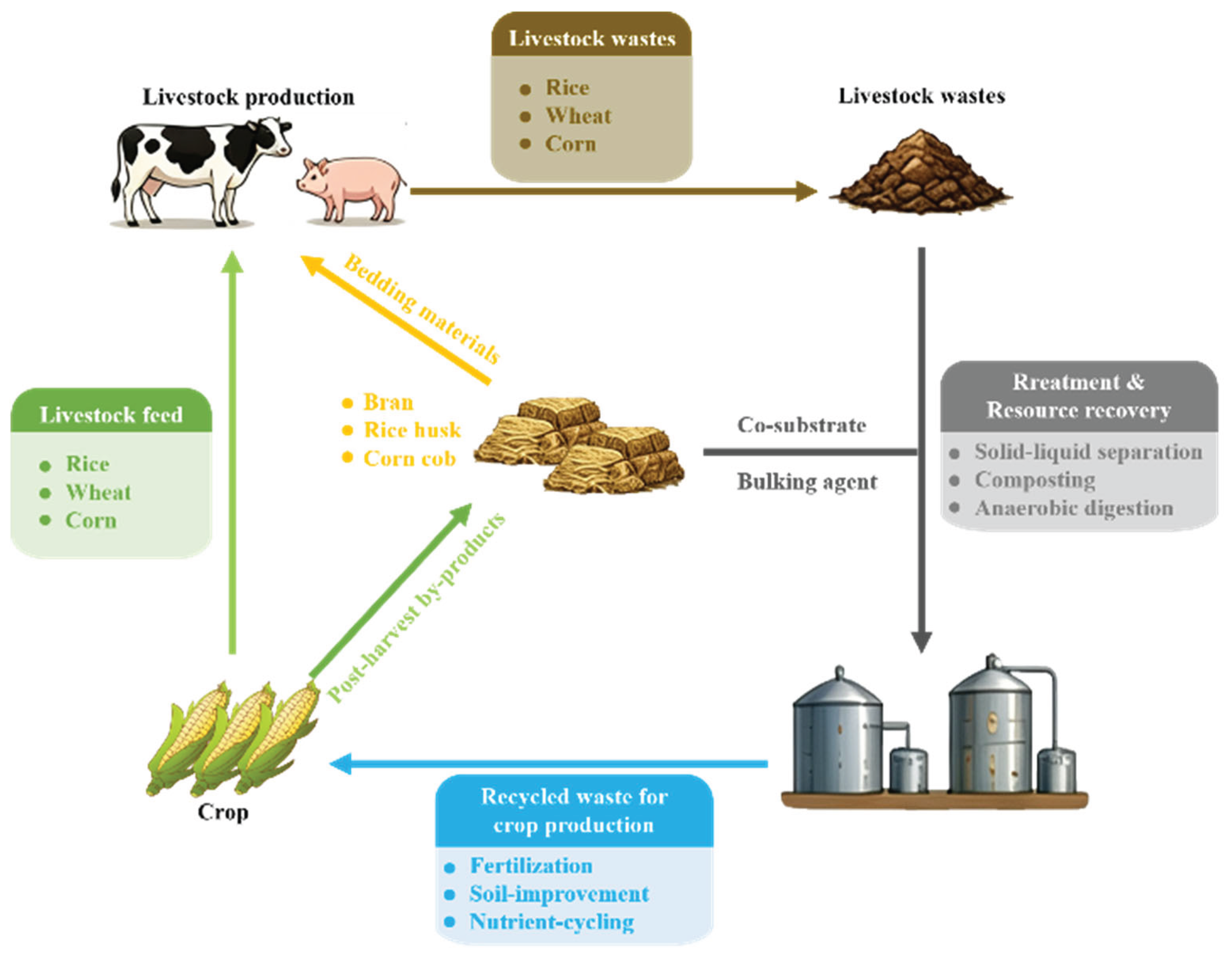
Crop–livestock circular agriculture differs substantially from conventional agricultural production systems. In conventional crop production, maximizing yield per unit area has traditionally depended on continuous and intensive inputs of chemical fertilizers and pesticides. Such an open production system can result in soil degradation, nutrient losses, and agricultural pollution [17]. Similarly, conventional livestock production focuses primarily on increasing production scale and efficiency and therefore requires large amounts of high-quality feed inputs. The resulting livestock manure is often treated as waste rather than as a recoverable resource. Simple storage, uncontrolled discharge, or inadequate treatment of manure can cause environmental pollution while resulting in the loss of valuable organic matter and nutrients [18].In contrast, crop–livestock circular agriculture changes the role of livestock manure from an environmental burden into a useful agricultural resource. After appropriate treatment, manure can be returned to farmland as a source of nutrients and organic matter, thereby reconnecting crop and livestock production. Crop production provides feed and other biomass resources for livestock production, while livestock manure is treated through composting, anaerobic digestion, or other appropriate processes to produce organic fertilizers, digestate, or other usable products for agricultural application. At the same time, crop residues such as straw can be further utilized as feed, bedding materials, or composting substrates and subsequently returned to the agricultural system. In this way, a relatively complete cycle of “crop–livestock–manure–crop” can be established [19].
Therefore, crop-livestock circular agriculture is far more than a standalone manure-treatment technology or a simple combination of cropping and livestock raising. Instead, it functions as an integrated agricultural strategy that balances resource recycling, environmental conservation, and crop-livestock coordination. Its primary goal is to enhance the internal recycling of agricultural resources and gradually transform agriculture from a high-input, high-waste production mode into a resource-efficient and environmentally sustainable system.
2.2. Nutrient Recycling and Resource Utilization Mechanisms
The basic operation of crop–livestock circular agriculture depends on the recycling and reuse of nutrients and other resources between crop and livestock production. Through manure treatment, nutrient recovery, biomass reuse, and energy recovery, agricultural wastes can be converted into useful inputs for crop production, thereby improving resource utilization and reducing environmental pressures.
2.2.1. Nutrient Recycling
Nutrient recycling is the fundamental basis of crop–livestock circular agriculture. Livestock manure contains considerable amounts of nitrogen, phosphorus, potassium, and organic matter. After appropriate treatment such as composting or anaerobic digestion, these nutrients can be returned to agricultural soils and used for crop production [20,21]. Compared with synthetic fertilizers, nutrients in treated manure are generally released more gradually, which can provide a relatively sustained nutrient supply and may improve nutrient-use efficiency and reduce nutrient losses under appropriate management conditions [22].
Nitrogen recycling mainly involves the microbial decomposition and mineralization of organic nitrogen in manure into forms that can be taken up by crops [23]. Phosphorus can be recycled through the decomposition of organic phosphorus and changes in soil phosphorus availability. Potassium is generally released relatively rapidly after manure application and can contribute to soil potassium supply and nutrient balance [24,25]. In addition to supplying nutrients, manure introduces substantial amounts of organic matter into the soil. This can promote soil aggregation, improve water and nutrient retention, and contribute to the improvement of soil structure and quality [26].
Over the long term, replacing part of the chemical fertilizer input with properly treated manure can reduce dependence on external fertilizer inputs and decrease the risk of nitrogen and phosphorus losses. Therefore, manure recycling can contribute not only to fertilizer substitution but also to the reconstruction of nutrient cycling within agricultural systems. However, the effectiveness of nutrient recycling depends strongly on manure quality, treatment methods, application rates, soil properties, crop nutrient requirements, and local environmental conditions.
2.2.2. Energy Recovery and Utilization
In addition to nutrient recycling, crop–livestock circular agriculture can recover energy from agricultural residues and livestock manure. Crop residues and livestock manure contain considerable amounts of organic matter that can be further utilized through different treatment pathways. Composting mainly focuses on stabilizing organic matter and producing organic fertilizer, whereas anaerobic digestion can recover energy from organic wastes in the form of biogas [27,28].
Anaerobic digestion is an important approach for the energy recovery of livestock manure and other agricultural organic wastes. Under oxygen-limited conditions, microorganisms decompose organic matter and produce biogas, which contains methane and can be used as an energy source for agricultural production or rural households [29,30]. At the same time, the digestate remaining after anaerobic digestion still contains nutrients and organic matter and can be further processed or applied to farmland as a nutrient source. This creates a combined pathway of “energy recovery–nutrient recycling,” improving the overall utilization of agricultural wastes [31,32].
The utilization of crop residues can also complement manure management. Straw and other agricultural by-products can be used as livestock feed, bedding materials, or raw materials for composting and anaerobic digestion, depending on their composition and local production systems [33]. Integrating these pathways can increase the utilization of agricultural biomass and reduce the environmental pressures associated with direct disposal or burning of agricultural residues.
2.3. Comprehensive Effects of Crop–Livestock Circular Agriculture
By connecting crop and livestock production, crop–livestock circular agriculture can generate multiple benefits in agricultural production, environmental protection, and rural economic development. These benefits are closely related to the effective recycling of manure, crop residues, nutrients, and other agricultural resources.
At the crop production level, the application of treated manure can replace part of the chemical fertilizer input and reduce fertilizer demand and production costs. At the same time, the organic matter supplied by manure can improve soil quality, soil structure, and water and nutrient retention. Long-term manure application under appropriate nutrient management can help alleviate soil degradation and improve soil fertility, potentially contributing to improvements in crop yield and quality [34,35,36].
At the livestock production level, crop–livestock circular agriculture provides a relatively stable pathway for manure utilization, thereby reducing the pressure associated with manure storage and disposal. By recovering nutrients and organic matter from manure, livestock production can be more closely connected with crop production, while the environmental risks associated with uncontrolled manure discharge can be reduced. Thus, manure can be transformed from a potential pollution source into a useful agricultural input.
From an environmental perspective, crop–livestock circular agriculture can reduce the demand for chemical fertilizers and, under appropriate management, decrease nitrogen and phosphorus losses and the risk of agricultural non-point source pollution. Proper manure treatment and utilization can also reduce the environmental impacts associated with untreated manure. In addition, the incorporation of organic matter into agricultural soils may contribute to soil organic carbon accumulation and improved soil quality, while appropriate manure management and energy recovery can help reduce greenhouse gas emissions [37,38].
From an economic and industrial perspective, crop–livestock circular agriculture can strengthen the connection between crop and livestock production and improve the overall efficiency of agricultural systems. Manure recycling can reduce fertilizer costs and, in some cases, manure treatment and disposal costs. The production of environmentally friendly agricultural products and the development of related circular agricultural activities may also increase the added value and market competitiveness of agricultural products. Therefore, crop–livestock circular agriculture is consistent with the broader goals of sustainable agricultural development and rural revitalization and can contribute to the development of more resource-efficient and environmentally friendly agricultural production systems.
3. Key Technologies for Crop–Livestock Circular Agriculture
The development of crop–livestock circular agriculture depends not only on the connection between crop and livestock production but also on a series of technologies for manure treatment, nutrient recovery, and agricultural reuse. Livestock manure is generally characterized by high moisture content, complex compositions, and the potential presence of pathogens and other harmful substances [7,39]. In addition, manure production is often unevenly distributed across regions. Without appropriate treatment and reasonable agricultural application, manure recycling may be difficult to achieve and may even cause secondary pollution and environmental risks. Therefore, the key technological processes of crop–livestock circular agriculture include source reduction, safe treatment, resource recovery, and appropriate land application. These processes aim to transform livestock manure from a potential pollutant into a useful agricultural resource while establishing a recycling system that is compatible with local crop production, livestock production, and land capacity.
At present, various technical pathways have been developed for manure recycling, including source reduction, solid–liquid separation, aerobic composting, anaerobic digestion, and manure application to farmland [40,41]. These technologies differ considerably in treatment efficiency, operating costs, nutrient recovery, applicable farm size, and regional adaptability. Therefore, the selection of manure treatment technologies should consider not only treatment performance but also local production conditions and the subsequent utilization pathway.
3.1. Livestock Manure Treatment and Resource Recovery Technologies
Source reduction and pretreatment are important first steps in livestock manure management. Traditional water-flushing systems are convenient for manure collection but generally produce manure with high moisture content, which dilutes nutrients and increases subsequent treatment, storage, and transportation costs. In contrast, dry manure collection and separation of rainwater from wastewater can reduce the amount of wastewater generated and improve manure collection efficiency [42]. Solid–liquid separation has also become an important pretreatment technology for manure from intensive livestock farms. Mechanical pressing, centrifugation, and other separation methods can divide manure into solid and liquid fractions, facilitating subsequent composting, anaerobic digestion, storage, transportation, and agricultural utilization [43,44]. These pretreatment approaches can reduce the treatment burden, improve nutrient recovery, and lower environmental risks during subsequent processing.
Aerobic composting is one of the most widely used approaches for manure treatment and agricultural reuse. During composting, microorganisms decompose organic matter under aerobic conditions, and the temperature increases sufficiently to reduce pathogens and promote the stabilization of organic matter. Compared with untreated manure, mature compost generally has more stable organic matter and lower risks associated with pathogens and odor, making it more suitable for agricultural application [45,46]. Aerobic composting is relatively simple to operate, has moderate investment requirements, and can be adapted to small- and medium-scale livestock farms and dispersed crop–livestock systems. However, nitrogen loss through ammonia volatilization, relatively long processing periods, and odor emissions remain important limitations. Recent studies have therefore investigated measures such as microbial inoculants, carbon-to-nitrogen ratio adjustment, and improved aeration management to accelerate composting and reduce nutrient losses [47,48].
Anaerobic digestion is another important pathway for manure treatment and resource recovery. Under oxygen-limited conditions, microorganisms decompose organic matter and produce biogas, which can be used as an energy source for agricultural production and rural households [16]. The digestate remaining after anaerobic digestion still contains nitrogen, phosphorus, organic matter, and other nutrients and can be further processed or applied to farmland. Therefore, anaerobic digestion can combine energy recovery with nutrient recycling [49]. Compared with conventional composting, anaerobic digestion has advantages in energy recovery, odor control, and large-scale manure treatment and is therefore widely used in intensive livestock farms and centralized treatment facilities. However, it generally requires relatively high investment, appropriate infrastructure, and stable operation and management [50]. In addition, the storage and transportation of liquid digestate can be costly, which may limit its application in hilly and mountainous areas and in smallholder farming systems.
In addition to conventional treatment methods, several emerging technologies have attracted increasing attention in recent years. Biochar, for example, has a strong adsorption capacity and can be used to reduce nitrogen losses during composting and decrease the mobility of some potentially harmful substances [51]. Functional microbial inoculants may accelerate organic matter decomposition and improve compost maturity [52]. Insect-based conversion, including the use of black soldier fly larvae, can reduce manure volume while recovering valuable protein and biomass resources [53]. These technologies show potential for improving resource recovery and environmental safety. However, their economic feasibility, technological stability, and large-scale applicability still require further evaluation.
Overall, different manure treatment technologies have distinct advantages and limitations in terms of investment, operating costs, nutrient conservation, environmental performance, and regional adaptability. Consequently, the development of crop–livestock circular agriculture is gradually shifting from reliance on a single treatment technology toward the integrated use of multiple technologies. Appropriate treatment pathways should be selected according to local livestock production scale, crop structure, available land, manure characteristics, infrastructure, and subsequent utilization requirements. Such integrated approaches can improve the overall efficiency of manure recycling while reducing the environmental and economic costs of the system.
3.2. Manure Application and Crop–Livestock Matching
The ultimate purpose of manure recycling is not simply to dispose of livestock manure but to safely return recovered nutrients to agricultural land and establish a balanced nutrient cycle. Therefore, manure application is a key link connecting manure treatment with crop production. As discussed in the previous section, appropriately treated manure generally releases nutrients more gradually than chemical fertilizers and can provide a relatively sustained nutrient supply. It can also increase soil organic matter, improve soil structure, and enhance soil water- and nutrient-holding capacity . Numerous studies have shown that partial substitution of chemical fertilizers with manure can reduce fertilizer dependence, increase soil microbial activity, and improve soil quality, thereby contributing to the mitigation of farmland degradation [54,55,56].
However, manure application should not be regarded simply as a method for disposing of agricultural waste. Its fundamental requirement is to maintain a balance between nutrient supply and crop demand. Excessive manure application can lead to the accumulation of nitrogen and phosphorus in agricultural soils and increase the risk of nutrient losses and water pollution [57,58]. Therefore, appropriate manure application requires consideration of soil fertility, crop nutrient requirements, manure nutrient composition, application timing, and local climatic conditions. The objective is to determine an appropriate application rate and timing so that manure-derived nutrients can be effectively utilized by crops while minimizing nutrient losses [59,60].
Regional differences further complicate manure utilization. Areas with high livestock densities may generate more manure than the surrounding farmland can safely absorb, resulting in nutrient surpluses. In contrast, areas dominated by large-scale crop production may have insufficient access to organic fertilizer resources, creating a spatial mismatch between manure supply and crop nutrient demand [61]. Therefore, the balance between livestock production scale, crop production, and available land has become a key factor determining the effectiveness of crop–livestock circular agriculture.
A suitable crop–livestock matching system should consider regional land resources, crop nutrient requirements, livestock production scale, manure production, and transportation conditions. Based on these factors, manure application rates, transportation distances, and manure allocation pathways can be optimized to reduce regional nutrient imbalances and improve the efficiency of resource recycling [62]. This issue is particularly important in the hilly and mountainous areas of Southwest China, where fragmented farmland, dispersed agricultural households, and limited transportation infrastructure increase the cost of centralized manure treatment and long-distance transportation. Under these conditions, small-scale and locally adapted circular systems, including decentralized manure treatment and nearby farmland utilization, may provide more feasible solutions [63].
With the increasing emphasis on sustainable and low-carbon agriculture, manure application is gradually moving beyond its traditional role as a fertilizer source toward a more comprehensive role in nutrient recycling, soil improvement, pollution reduction, and greenhouse gas mitigation. Future technological development should therefore focus not only on improving manure treatment efficiency but also on establishing more accurate systems for matching manure nutrient supply with crop demand and land capacity. Long-term environmental risks associated with manure application should also be carefully evaluated. The integration of manure treatment, nutrient management, and regional crop–livestock matching will be essential for improving the overall performance and long-term sustainability of crop–livestock circular agriculture.
4. Typical Circular Models, Regional Practices, and Comprehensive Benefits
4.1. Typical Crop–Livestock Circular Models in China and Abroad
Crop–livestock circular agriculture has developed into various models in different countries and regions. These models differ mainly in production scale, resource allocation, technological pathways, land conditions, and regional economic characteristics.
In Europe and North America, crop–livestock circular agriculture has developed relatively mature systems, particularly in regions characterized by large-scale farms, mechanized production, and well-developed agricultural infrastructure. Representative practices in countries such as the United States, the Netherlands, and Germany generally integrate livestock production, manure treatment, and crop production through coordinated farm management and nutrient planning [64,65]. These systems commonly rely on mechanized manure collection, centralized or on-farm treatment, and standardized manure application. Technologies such as anaerobic digestion, biogas production, manure processing, and precision fertilization can be combined to establish an integrated pathway linking livestock production, energy recovery, nutrient recycling, and crop production. Such systems can improve resource-use efficiency and contribute to pollution reduction and greenhouse gas mitigation. However, they generally require substantial infrastructure, investment, mechanization, and land resources and therefore are more suitable for relatively large-scale agricultural operations and areas with relatively concentrated farmlan [14,66].
In China, crop–livestock circular agriculture has developed in a more diverse manner because of substantial differences in agricultural production structure, farm size, terrain, and regional resource conditions. Two relatively common approaches can be identified. The first is a centralized treatment model, in which manure from multiple livestock farms is collected and transported to centralized treatment facilities for processing and fertilizer production, after which the resulting organic fertilizer or other products are applied to surrounding farmland. This approach is particularly suitable for regions with concentrated livestock production and relatively developed agricultural infrastructure [67,68]. The second is a localized recycling model, which is more common in hilly and mountainous areas with dispersed farms and fragmented farmland. In these systems, manure is generally treated and reused within or near individual farming units through relatively simple technologies such as composting and digestate application. Although the level of standardization and technical sophistication may be relatively limited, short transportation distances can reduce manure utilization costs and improve the feasibility of local recycling [63,69].
These different models have their own advantages and limitations. Large-scale integrated systems can achieve relatively high resource-use efficiency and more systematic nutrient management but generally depend on substantial infrastructure, capital investment, and centralized management. In contrast, localized small-scale systems are more adaptable to fragmented farmland and dispersed agricultural households but may face limitations in treatment efficiency, standardization, technical management, and long-term operational stability. Therefore, there is no single circular model that can be directly applied to all regions. The appropriate model should be determined according to local livestock and crop production, land availability, transportation conditions, technical capacity, and economic factors.
4.2. Practices and Characteristics in the Hilly Agricultural Areas of Southwest China
The hilly agricultural areas of Southwest China, particularly the Sichuan Basin and surrounding regions, represent an important area for the development of crop–livestock circular agriculture. These regions have substantial livestock production, abundant agricultural biomass resources, and relatively developed coexistence of crop and livestock production [70]. However, they also face considerable practical constraints, including fragmented farmland, a high proportion of small- and medium-sized farming households, dispersed livestock production, high manure collection and transportation costs, and uneven spatial distribution of land resources. Unlike the large-scale circular systems developed in the relatively flat agricultural regions of northern and northeastern China, the terrain and agricultural structure of Southwest China make large-scale centralized recycling more difficult. Consequently, localized treatment and nearby agricultural utilization are often more feasible for this region [71].
In recent years, considerable efforts have been devoted to improving manure treatment and resource recovery technologies in Southwest China. Research has gradually shifted from simply reducing the pollution potential of manure toward improving nutrient recovery while controlling environmental risks. For example, high-temperature composting has been shown to reduce pathogens and antibiotic resistance genes in pig manure and improve the biological safety of compost products [72,73]. In addition, measures such as the use of functional microorganisms and optimization of fermentation conditions have been investigated to reduce ammonia emissions and nitrogen losses during the treatment and utilization of liquid manure and digestate [74]. These studies indicate a gradual transition from conventional end-of-pipe manure treatment toward integrated approaches that combine resource recovery, pollution control, and improvement of manure-derived product quality.
The development of manure recycling has also been supported by crop production systems that can provide suitable pathways for nutrient reuse. In Southwest China, grain–legume intercropping and crop–livestock integration has received increasing attention. For example, maize–soybean strip intercropping can utilize biological nitrogen fixation by soybean and maintain or improve system productivity while reducing dependence on external nitrogen inputs under appropriate management conditions [75,76,77]. Long-term studies in rice–wheat rotation systems and other cropping systems in Southwest China have also shown that straw return, green manure cultivation, and organic fertilizer application can improve soil nutrient cycling, soil fertility, and crop productivity [78,79,80,81]. These crop production practices can increase the capacity of farmland to utilize organic nutrient resources and therefore provide a useful foundation for manure recycling.
Crop residues can also be incorporated into the circular system. Maize straw and other crop by-products can be used as livestock feed, bedding materials, or composting substrates, while manure generated by livestock production can be treated and returned to farmland as organic fertilizer [33]. Through these connections, crop production, feed supply, livestock production, manure treatment, and fertilizer application can be linked into a relatively complete cycle of “crop production–feed supply–livestock production–manure recycling–crop production.” Such integration can improve the utilization of agricultural by-products while strengthening the connection between crop and livestock production systems.
Overall, crop–livestock circular agriculture in the hilly agricultural areas of Southwest China has not simply replicated the large-scale closed-loop systems commonly observed in highly mechanized farming regions. Instead, it has gradually developed toward a more localized approach characterized by small-scale recycling, multiple participating stakeholders, and nearby manure utilization. Its development depends on the combination of local livestock production, available farmland, manure treatment capacity, and nutrient demand. Existing practices indicate that such systems have considerable potential to improve resource utilization, reduce chemical fertilizer dependence, improve soil quality, and mitigate environmental risks. However, fragmented farmland, high transportation costs, limited infrastructure, and dispersed production remain important constraints on large-scale implementation and long-term stability. Future efforts should therefore focus on improving regional nutrient balance, optimizing manure application, strengthening coordination among crop and livestock producers, and developing more standardized and economically viable circular models adapted to hilly and mountainous regions.
5. Conclusions and Future Perspectives
Crop–livestock circular agriculture has emerged as an important agricultural production approach in the context of sustainable agricultural development. Its core objective is to reconnect crop and livestock production through the recycling of livestock manure, thereby restoring nutrient cycling within agricultural systems and improving resource utilization and environmental performance. Existing studies indicate that crop–livestock circular agriculture can help address two major challenges of conventional agriculture: the high dependence of crop production on chemical fertilizers and the environmental pressure associated with livestock manure. After appropriate treatment, livestock manure can be returned to farmland as a source of nutrients and organic matter, partially replacing chemical fertilizers, improving soil fertility, and reducing the risk of nutrient losses and agricultural pollution. At the same time, manure recycling, energy recovery, and improved soil management can contribute to pollution mitigation, greenhouse gas reduction, and the improvement of overall agricultural resource efficiency.
A variety of technologies and practical models have been developed to support crop–livestock circular agriculture. Key technologies include source reduction, solid–liquid separation, aerobic composting, anaerobic digestion, manure application, and nutrient management. Different implementation models have also emerged, including large-scale integrated systems, localized recycling by small-scale farms, and regional manure allocation and utilization. International experience has provided relatively mature examples of nutrient management, standardized manure treatment, and supporting policies, while China has developed diverse approaches adapted to different agricultural and regional conditions. However, existing research and practices remain unevenly distributed, and systematic understanding of long-term nutrient cycling, regional adaptability, environmental effects, and overall system performance is still limited.
Several challenges therefore need to be addressed to further promote the development of crop–livestock circular agriculture. First, many existing studies focus on short-term changes in crop yield, soil properties, or fertilizer use, while long-term effects on soil health, nutrient accumulation, nutrient losses, and environmental risks remain insufficiently evaluated. Second, the matching between livestock manure production, crop nutrient demand, and available farmland needs to be improved, particularly in regions with fragmented farmland and complex terrain. More accurate manure application and regional nutrient management strategies are needed to avoid both nutrient deficits and excessive nutrient accumulation. Third, high transportation and treatment costs, differences in technical standards, and insufficient mechanisms for distributing costs and benefits among participating stakeholders continue to limit the large-scale adoption of circular systems.
Future research should therefore move beyond improving individual manure treatment technologies and place greater emphasis on the coordinated operation of the entire crop–livestock system. Regional nutrient balances should be assessed by integrating manure production, crop nutrient demand, land capacity, and transportation conditions, thereby supporting more appropriate crop–livestock matching and manure allocation. Long-term field experiments and comprehensive environmental assessments are also needed to evaluate the sustainability and potential risks of repeated manure application. At the same time, the integration of manure treatment, nutrient management, energy recovery, and digital or precision agriculture technologies may improve the efficiency and stability of circular systems. Finally, stronger technical standards, economic incentives, and benefit-sharing mechanisms are needed to support the wider adoption of regionally adapted circular models. These efforts will help promote the transition from individual waste treatment and fertilizer substitution toward more integrated and sustainable crop–livestock systems, contributing to sustainable agricultural development and rural revitalization.
Data Availability Statement
No new data were created or analyzed in this study. Data sharing is not applicable to this article.
Author Contributions
Bing Xiang : Conceptualization; Jianghai Xiao: literature search and analysis, original draft writing; Lin Bai: manuscript revision. The author has read and approved the final published version of the manuscript.
Funding
This research was supported by the Social-Science Association of Sichuan Agricultural University, Grant No. 2018ZT02.
Acknowledgments
During the preparation of this manuscript, the authors used DeepSeek -V4 for the purpose of analyzing and processing a large volume of literature data. The authors have reviewed and edited the output and take full responsibility for the content of this publication.
Conflicts of Interest
The authors declare no conflict of interest.
References
- Penuelas, J.; Coello, F.; Sardans, J. A better use of fertilizers is needed for global food security and environmental sustainability. Agric. Food Secur. 2023, 12, 5. [Google Scholar] [CrossRef]
- Prabhakar, S.V.R.K. A succinct review and analysis of drivers and impacts of agricultural land transformations in Asia. Land Use Policy 2021, 102, 105238. [Google Scholar] [CrossRef]
- Bijay, S.; Craswell, E. Fertilizers and nitrate pollution of surface and ground water: an increasingly pervasive global problem. SN Appl. Sci. 2021, 3, 518. [Google Scholar] [CrossRef]
- Iqbal, A.; He, L.; Ali, I.; Ullah, S.; Khan, A.; Akhtar, K.; Wei, S.; Fahad, S.; Khan, R.; Jiang, L. Co-incorporation of manure and inorganic fertilizer improves leaf physiological traits, rice production and soil functionality in a paddy field. Sci. Rep. 2021, 11, 10048. [Google Scholar] [CrossRef] [PubMed]
- Mogollón, J.M.; Hadjikakou, M.; Taherzadeh, O.; Ngumbi, E.N.; van Zanten, H.H.E.; Basu, N.B.; Kortleve, A.J.; Behrens, P. Broad bidirectional effects of global food production on the environment. Nat. Rev. Earth Environ. 2026, 7, 280–293. [Google Scholar] [CrossRef]
- Chen, X.; Wang, Z.; Muneer, M.A.; Ma, C.; He, D.; White, P.J.; Li, C.; Zhang, F. Short planks in the crop nutrient barrel theory of China are changing: Evidence from 15 crops in 13 provinces. Food Energy Secur. 2023, 12, e389. [Google Scholar] [CrossRef]
- Rout, P.R.; Pandey, D.S.; Haynes-Parry, M.; Briggs, C.; Manuel, H.L.C.; Umapathi, R.; Mukherjee, S.; Panigrahi, S.; Goel, M. Sustainable Valorisation of Animal Manures via Thermochemical Conversion Technologies: An Inclusive Review on Recent Trends. Waste Biomass Valorization 2022. [Google Scholar] [CrossRef]
- Yoo, J. Transition from composting to solid fuel production: A review on the sustainable management of livestock manure in Korea. Biomass Bioenergy 2025. [Google Scholar] [CrossRef]
- Kumar, S.; Sieverding, H.; Lai, L.; Nleya, T.; Wienhold, B.; Redfearn, D.; Archer, D.; Ussiri, D.; Faust, D.; Landblom, D.; et al. Facilitating Crop–Livestock Reintegration in the Northern Great Plains. Agron. J. 2019, 111. [Google Scholar] [CrossRef]
- Peterson, C.A.; Deiss, L.; Gaudin, A.C.M. Commercial integrated crop-livestock systems achieve comparable crop yields to specialized production systems: A meta-analysis. PLoS ONE 2020, 15, e0231840. [Google Scholar] [CrossRef] [PubMed]
- Salomon, E.; Tidåker, P.; Bergström Nilsson, S. Flows and budgets of nutrients and potentially toxic elements on four Swedish organic farms using digestate from agricultural residues. Org. Agric. 2022, 12, 279–292. [Google Scholar] [CrossRef]
- Karki, R.; Chuenchart, W.; Surendra, K.C.; Shrestha, S.; Raskin, L.; Sung, S.; Hashimoto, A.; Kumar Khanal, S. Anaerobic co-digestion: Current status and perspectives. Bioresour. Technol. 2021, 330, 125001. [Google Scholar] [CrossRef] [PubMed]
- Kang, J.; Ding, W.; Chang, N.; Yi, X.; Zhang, J.; Li, H. Optimized crop-livestock coupling to reduce agricultural manure-N surplus and greenhouse gas emissions in China. J. Clean. Prod. 2024. [Google Scholar] [CrossRef]
- Delandmeter, M.; Basso, B.; Fettweis, X.; Lacroix, C.; Aubry, P.; Bindelle, J.; Dumont, B. Livestock Integration Into Cropping Systems Enhances Their Climate Change Resistance and Mitigation While Reducing Their Environmental Impacts. Glob. Change Biol. 2026. [Google Scholar] [CrossRef] [PubMed]
- Gu, B. Recoupling livestock and crops. Nat. Food 2022. [Google Scholar] [CrossRef] [PubMed]
- Li, Z.; Li, D.; Cheng, S.; Ma, Y.; Liu, F.; Gao, X.; Zhang, K.; Liu, R.; Yang, J.; Du, L. Unveiling the synergy of volatile fatty acids and ammonia nitrogen in optimizing methane production during dry anaerobic digestion of pig manure and corn straw. Chem. Eng. J. 2024, 496. [Google Scholar] [CrossRef]
- Lyu, N.Z., H. H.; Cheng, W. M. Study on the Feasibility of Chemical Fertilizer Reduction and Bio-fertilizer Substitution in Agriculture: Evidence from Survey Data of Xinjiang Cotton-growing Area. Geogr. Res. 2022, 41, 1459–1480.
- Zhang, Z.Q.L., X. Study on the Current Situation and Control Countermeasures of Livestock and Poultry Breeding Pollution in China. Sci. Technol. Inf. 2010, 384+386.
- Lei, W.Y.T., P. J.; Li, N. Exploration of Crop-Livestock Integrated Circular Agriculture Model in Black-soil Region: A Case Study of Hailun City. Soil Crops 2023, 12, 363–372.
- Meng, X.; Sørensen, P.; Møller, H.B.; Petersen, S.O. Greenhouse gas balances and yield-scaled emissions for storage and field application of organic fertilizers derived from cattle manure. Agriculture, Ecosystems & Environment 2023. [Google Scholar] [CrossRef]
- Qi, J.; Yang, H.; Wang, X.; Zhu, H.; Wang, Z.; Zhao, C.; Li, B.; Liu, Z. State-of-the-art on animal manure pollution control and resource utilization. J. Environ. Chem. Eng. 2023. [Google Scholar] [CrossRef]
- Santolin, J.; Vlaeminck, S.E.; Appiah-Twum, H.; Van Winckel, T.; Spiller, M. Consequential LCA of NPK fertilizers from microbial, animal, plant, and mineral origin highlights resource constraints and environmental impacts. J. Clean. Prod. 2024, 457, 142312. [Google Scholar] [CrossRef]
- Sun, C.; Chen, L.; Zhai, L.; Liu, H.; Wang, K.; Jiao, C.; Shen, Z. National assessment of nitrogen fertilizers fate and related environmental impacts of multiple pathways in China. J. Clean. Prod. 2020, 277, 123519. [Google Scholar] [CrossRef]
- Sun, R.; Niu, J.; Luo, B.; Wang, X.; Li, W.; Zhang, W.; Wang, F.; Zhang, C.; Ye, X. Substitution of manure for mineral P fertilizers increases P availability by enhancing microbial potential for organic P mineralization in greenhouse soil. Front. Bioeng. Biotechnol. 2022. [Google Scholar] [CrossRef] [PubMed]
- Wei, L.; Chen, S.; Cui, J.; Ping, H.; Yuan, C.; Chen, Q. A meta-analysis of arable soil phosphorus pools response to manure application as influenced by manure types, soil properties, and climate. J. Environ. Manag. 2022. [Google Scholar] [CrossRef] [PubMed]
- Ma, S.; Cao, Y.; Lu, J.; Ren, T.; Cong, R.; Lu, Z.; Zhu, J.; Li, X. Response of soil aggregation and associated organic carbon to organic amendment and its controls: A global meta-analysis. Catena 2023. [Google Scholar]
- Adnane, I.; Taoumi, H.; Elouahabi, K.; Lahrech, K.; Oulmekki, A. Valorization of crop residues and animal wastes: Anaerobic co-digestion technology. Heliyon 2024. [Google Scholar] [CrossRef] [PubMed]
- Awasthi, M.K.; Sindhu, R.; Sirohi, R.; Kumar, V.; Ahluwalia, V.; Binod, P.; Juneja, A.; Kumar, D.; Yan, B.; Sarsaiya, S.; et al. Agricultural waste biorefinery development towards circular bioeconomy. Renew. Sustain. Energy Rev. 2022. [Google Scholar] [CrossRef]
- Jiang, M. Review on the Resource-oriented Utilization of Anaerobic Digestate from Agricultural Wastes. Anhui Agric. Sci. Bull. 2026, 32, 114–118. [Google Scholar]
- Wang, Z.X.A., G. X.; Ge, J. P.; Sun, S. S.; Ling, H. Z. Application Status of Anaerobic Digestion Technology in the Treatment of Organic Wastes. Chin. Agric. Sci. Bull. 2024, 40, 84–91.
- Malhotra, M.; Aboudi, K.; Pisharody, L.; Singh, A.; Banu, J.R.; Bhatia, S.K.; Varjani, S.; Kumar, S.; González-Fernández, C.; Kumar, S.; et al. Biorefinery of anaerobic digestate in a circular bioeconomy: Opportunities, challenges and perspectives. Renew. Sustain. Energy Rev. 2022. [Google Scholar] [CrossRef]
- Samoraj, M.; Mironiuk, M.; Izydorczyk, G.; Witek-Krowiak, A.; Szopa, D.; Moustakas, K.; Chojnacka, K. The challenges and perspectives for anaerobic digestion of animal waste and fertilizer application of the digestate. Chemosphere 2022. [Google Scholar] [CrossRef] [PubMed]
- Shinde, R.; Shahi, D.K.; Mahapatra, P.; Singh, C.S.; Naik, S.K.; Thombare, N.; Singh, A.K. Management of crop residues with special reference to the on-farm utilization methods: A review. Ind. Crops Prod. 2022. [Google Scholar] [CrossRef]
- Yang, K.W., K. Y.; Sun, R.; Zhang, Y. M.; Liu, X. P.; Dong, W. X.; Li, X. X.; Hu, C. S. Effects of Partial Substitution of Chemical Fertilizer With Organic Fertilizer on Nitrogen Loss and Nitrogen Balance in Wheat-Maize Farmland of North China. Chin. J. Eco-Agric. 2025, 33, 484–497.
- Zhang, K.Q.D., L. Z.; Du, H. Y.; Shen, S. Z. Research Progress on the Utilization of Livestock and Poultry Manure Returning to Farmland at Home and Abroad. J. Agro-Environ. Sci. 2021, 40, 2472–2481+2591.
- Zhang, Q.G., M. Q.; Guo, H. L.; Li, W. Y.; Su, Y.; Yang, G. D.; Wang, C. Effects of Partial Replacement of Inorganic Fertilizer by Organic Manure Water Returning to Field on Rice Yield Benefit and Soil Physicochemical Properties. Anhui Agric. Sci. 2025, 53, 145–148.
- Alam, M.A.; Huang, J.; Daba, N.A.; Han, T.; Shen, Z.; Li, J.; Tadesse, K.A.; Liu, L.; Ntagisanimana, G.; Hayatu, N.G.; et al. Long-term substitution of synthetic fertilizer by cattle manure: Effects on carbon footprint, carbon sequestration, and yield in a double rice system. Environ. Technol. Innov. 2025, 38. [Google Scholar] [CrossRef]
- Liu, W.C.X., S. H.; Liang, S. S.; Feng, X. W.; Lu, P.; Zhang, H. L.; Cao, L. K.; Sha, Z. M. Carbon Footprint and Nitrogen Flow Analysis of an Integrated Crop-Livestock Ecological Farm in Shanghai. Chin. J. Eco-Agric. 2025, 33, 1732–1747.
- Ge, M.; Shen, Y.; Ding, J.; Meng, H.; Zhou, H.; Zhou, J.; Cheng, H.; Zhang, X.; Wang, J.; Wang, H.; et al. New insight into the impact of moisture content and pH on dissolved organic matter and microbial dynamics during cattle manure composting. Bioresour. Technol. 2021. [Google Scholar] [CrossRef] [PubMed]
- Deng, L.; Zheng, D.; Zhang, J.; Yang, H.; Wang, L.; Wang, W.; He, T.; Zhang, Y. Treatment and utilization of swine wastewater—A review on technologies in full-scale application. Science of the Total Environment 2023. [Google Scholar] [CrossRef] [PubMed]
- Jia, X.; Yu, C.; Mou, S. Sustainable livestock and poultry manure management considering carbon trading. Energy 2025. [Google Scholar] [CrossRef]
- Zhang, L.; E, R.; Ali, M.M.; Lin, H.; Zhang, S.; Jin, S.; Zhu, Z.; Hu, J.; Yao, Y.; Sun, Y.; et al. LIVESTOCK AND POULTRY MANURE MANAGEMENT FROM THE PERSPECTIVE OF CARBON NEUTRALITY IN CHINA. Eng. Agric. 2023, 10, 341–362. [Google Scholar] [CrossRef]
- Grell, T.; Marchuk, S.; Williams, I.; McCabe, B.K.; Tait, S. Resource recovery for environmental management of dilute livestock manure using a solid-liquid separation approach. J. Environ. Manag. 2022. [Google Scholar] [CrossRef] [PubMed]
- Lyons, G.A.; Cathcart, A.; Frost, J.P.; Wills, M.; Johnston, C.; Ramsey, R.; Smyth, B. Review of Two Mechanical Separation Technologies for the Sustainable Management of Agricultural Phosphorus in Nutrient-Vulnerable Zones. Agronomy 2021. [Google Scholar] [CrossRef]
- Matiz-Villamil, A.; Méndez-Carranza, K.J.; Pascagaza-Pulido, A.F.; Rendón-Rendón, T.; Noriega-Noriega, J.; Pulido-Villamarín, A. Trends in the management of organic swine farm waste by composting: A systematic review. Heliyon 2023. [Google Scholar] [CrossRef] [PubMed]
- Yang, Y.; Kong, Y.; Wang, G.; Shen, Y.; Tang, R.; Yin, Z.; Yang, J.; Li, G.; Yuan, J. Temporal succession and spatial heterogeneity of humification, pathogens and bacterial community in facultative heap composting. Process Saf. Environ. Prot. 2023. [Google Scholar] [CrossRef]
- Ma, R.; Liu, Y.; Wang, J.; Li, D.; Qi, C.; Li, G.; Yuan, J. Effects of oxygen levels on maturity, humification, and odor emissions during chicken manure composting. J. Clean. Prod. 2022. [Google Scholar] [CrossRef]
- Shan, G.; Li, W.; Gao, Y.; Tan, W.; Xi, B. Additives for reducing nitrogen loss during composting: a review. J. Clean. Prod. 2021. [Google Scholar] [CrossRef]
- Chojnacka, K.; Moustakas, K. Anaerobic digestate management for carbon neutrality and fertilizer use: A review of current practices and future opportunities. Biomass Bioenergy 2023. [Google Scholar] [CrossRef]
- Khoshnevisan, B.; Duan, N.; Tsapekos, P.; Awasthi, M.K.; Liu, Z.; Mohammadi, A.; Angelidaki, I.; Tsang, D.C.W.; Zhang, Z.; Pan, J.; et al. A critical review on livestock manure biorefinery technologies: Sustainability, challenges, and future perspectives. Renewable and Sustainable Energy Reviews 2020. [Google Scholar] [CrossRef]
- Lan, Y.M., J.; Han, X. R.; Chen, W. F. Research Progress of Biochar-based Products and Their Effects on Soil Fertility Improvement. J. Plant Nutr. Fertil. 2024, 30, 1396–1412.
- Chen, X.L., C. N.; Chao, Y.; Li, P.; Yao, T.; Sun, Y. P. Effects of Microbial Agent on Humus and Enzyme Activities During Composting of Crop-Livestock Wastes. J. Plant Nutr. Fertil. 2024, 30, 1568–1579.
- Li, Q.Q., W. J.; Cao, X. F.; Hou, D. J.; Jiang, H. Research Progress on Resource Utilization of Livestock Manure Transformed by Black Soldier Fly. J. Huazhong Agric. Univ. 2022, 41, 169–175.
- Iqbal, A.; He, L.; Ali, I.; Yuan, P.; Khan, A.; Hua, Z.; Wei, S.; Jiang, L. Partial Substation of Organic Fertilizer With Chemical Fertilizer Improves Soil Biochemical Attributes, Rice Yields, and Restores Bacterial Community Diversity in a Paddy Field. Front. Plant Sci. 2022. [Google Scholar] [CrossRef] [PubMed]
- Liu, H.; Du, X.; Li, Y.; Han, X.; Li, B.; Zhang, X.; Li, Q.; Liang, W. Organic substitutions improve soil quality and maize yield through increasing soil microbial diversity. J. Clean. Prod. 2022. [Google Scholar] [CrossRef]
- Tang, Q.; Cotton, A.; Wei, Z.; Xia, Y.; Daniell, T.; Yan, X. How does partial substitution of chemical fertiliser with organic forms increase sustainability of agricultural production? Sci. Total Environ. 2021. [Google Scholar] [CrossRef] [PubMed]
- Flynn, K.C.; Spiegal, S.; Kleinman, P.J.A.; Meinen, R.J.; Smith, D.R. Manureshed management to overcome longstanding nutrient imbalances in US agriculture. Resour. Conserv. Recycl. 2022. [Google Scholar] [CrossRef]
- Tian, K.; Xing, Z.; Kalkhajeh, Y.K.; Zhao, T.; Hu, W.; Huang, B.; Zhao, Y. Excessive phosphorus inputs dominate soil legacy phosphorus accumulation and its potential loss under intensive greenhouse vegetable production system. J. Environ. Manag. 2021. [Google Scholar] [CrossRef] [PubMed]
- Masmoudi, S.; Magdich, S.; Rigane, H.; Medhioub, K.; Rebai, A.; Ammar, E. Effects of Compost and Manure Application Rate on the Soil Physico-Chemical Layers Properties and Plant Productivity. Waste Biomass Valorization 2018. [Google Scholar] [CrossRef]
- Saha, A.; Cibin, R.; Veith, T.L.; White, C.; Drohan, P. Water quality benefits of weather-based manure application timing and manure placement strategies. J. Environ. Manag. 2023. [Google Scholar] [CrossRef] [PubMed]
- Xu, K.; Zhang, Q.-Q.; Cai, Y.-Y.; Luo, X.-J.; Zhai, Y.-Q.; Liu, W.-R.; Ying, G.-G. Diagnosing spatial decoupling of manure and crop nutrients in China: drivers and multi-objective optimization for sustainable redistribution. npj Sustain. Agric. 2026, 4, 11. [Google Scholar] [CrossRef]
- Zeng, L.; Zhang, Q.; Ding, J.; Feng, Q.; Wu, F. Re-coupling crop and livestock through spatial analysis and site selection of manure transfer hubs for sustainable agriculture. Agronomy for Sustainable Development 2023. [Google Scholar] [CrossRef]
- Zheng, S.H.C., S. H.; Chen, H. L.; Wan, K. J.; Ao, Y. Q.; Liu, D. H. Research on the Development Path of Ecological Circular Agriculture in Hilly Area of Eastern Sichuan: A Case Study of Resource Utilization Model of Planting-breeding Wastes in Pengxi County, Sichuan Province. Chin. Agric. Sci. Bull. 2022, 38, 95–99.
- Antonius, G.T.S.; Emily, C.C.; Marc, M.; Gerrie, W.J.V.D.; Davey, L.J.; David, R.C. REINTEGRATION OF CROP-LIVESTOCK SYSTEMS IN EUROPE: AN OVERVIEW. Eng. Agric. 2021, 8, 111–129. [Google Scholar] [CrossRef]
- Schoof, N.; Kirmer, A.; Hörl, J.; Luick, R.; Tischew, S.; Breuer, M.; Fischer, F.; Müller, S.; von Königslöw, V. Sheep in the Vineyard: First Insights into a New Integrated Crop–Livestock System in Central Europe. Sustainability 2021. [Google Scholar] [CrossRef]
- Hou, Y.; Velthof, G.L.; Lesschen, J.P.; Staritsky, I.G.; Oenema, O. Nutrient Recovery and Emissions of Ammonia, Nitrous Oxide, and Methane from Animal Manure in Europe: Effects of Manure Treatment Technologies. Environ. Sci. Technol. 2017, 51, 375–383. [Google Scholar] [CrossRef] [PubMed]
- Dong, F.X. Discussion on Ecological-circulation Development Model of Crop-Livestock Integration in Large-scale Pig Farms — A Case Study of Shantian Ten-thousand-head Standardized Pig Farm in Baoshan, Yunnan Province. Anim. Breed. Feed 2025, 24, 121–124. [Google Scholar]
- Wu, W.G., Q.; Lu, Y. Z.; Hu, W. J.; Zhang, D. L.; Feng, X.; Luo, X. S. Study on Resource Utilization Technology of Livestock and Poultry Manure Pollution in Different Regions. Environ. Eng. 2025, 43, 18–26.
- Wang, Y.W., F. Q.; Peng, X. Y.; Tong, X. G. Energy Flow Characteristics and Economic Benefit Analysis of Three-dimensional Planting-breeding Circular Production in Mountainous Areas of Loess Hilly Region. Trans. Chin. Soc. Agric. Eng. 2016, 32, 199–206.
- Zhang, Z.W.L., J. Q. Spatial-temporal Pattern Evolution and Influencing Factors of Pig Breeding in Sichuan Province: Based on Panel Data from 2011 to 2021. Chin. J. Agric. Resour. Reg. Plan. 2024, 45, 189–198.
- Zhao, L.X.M., H. B.; Shen, Y. J.; Ding, J. T.; Zhang, X. Investigation and Development Analysis of Planting-breeding Circular Agriculture in Northern Plain Areas of China. Trans. Chin. Soc. Agric. Eng. 2017, 33, 1–10. [CrossRef]
- Liu, Z.L.B., L.; Hu, H. W. Research Progress on Hyper-thermophilic Composting and Its Resource Utilization and Harmless Treatment. Chin. Agric. Sci. Bull. 2021, 23, 119–127.
- Xing, R.Z.A., C. F.; Wang, M. Y.; Tang, R.; Yang, Z. M.; Qin, S. P.; Chen, Z.; Zhou, S. G. Engineering Case of Hyper-thermophilic Aerobic Composting for Livestock and Poultry Manure. J. Agro-Environ. Sci. 2021, 40, 2405–2411.
- Lin, S.; Han, X.; Chen, S.; Shen, F.; Zhao, K.; Zou, L. Recombinant glutamine synthetase originating from high ammonium-assimilating Bacillus subtilis effectively reduces NH(3) emissions and enhances the conversion into amino acids in liquid manure. Environ. Int. 2025, 204, 109844. [Google Scholar] [CrossRef] [PubMed]
- Liu, X.M.Y., T. W.; Su, B. Y.; Liu, W. Y.; Zhou, L.; Song, C.; Yang, F.; Wang, X. C.; Yang, W. Y. Effects of Reduced Nitrogen Application on Crop Yield in Maize-Soybean Intercropping System. Acta Agron. Sin. 2014, 40, 1629–1638. [CrossRef]
- Yong, T.W.L., X. M.; Liu, W. Y.; Su, B. Y.; Song, C.; Yang, F.; Wang, X. C.; Yang, W. Y. Effects of Reduced Nitrogen Application on Crop Yield and Nutrient Uptake and Utilization in Maize-Soybean Intercropping System. Chin. J. Appl. Ecol. 2014, 25, 474–482.
- Yong, T.W.L., X. M.; Liu, W. Y.; Zhou, L.; Song, C.; Yang, F.; Jiang, L.; Wang, X. C.; Yang, W. Y. Effects of Reduced Nitrogen Application on Nitrogen Uptake and Utilization Efficiency of Crops in Maize-Soybean Intercropping System. Acta Ecol. Sin. 2015, 35, 4473–4482. [CrossRef]
- Liu, M.C., Y. X.; Chen, Q.; Peng, D.; Yu, X.; Yang, J. W.; Xu, K. W. Effects of Incorporation of Rhizobium-inoculated Purple Vetch on Soil Fertility in Tobacco-planting Fields. Acta Prataculturae Sin. 2019, 28, 162–169.
- Liu, Y.C.Z., X. Z.; Feng, W. Q.; Qin, Y. S.; Wang, C. Q.; Tu, S. H.; Chen, D. Q. Effects of Long-term Straw Returning and Fertilization on Crop Yield and Soil Physicochemical Properties Under Rice-Rapeseed Rotation. J. Plant Nutr. Fertil. 2014, 20, 1450–1459.
- Peng, Z.Y.L., X.; Wu, Z. R. Q.; Shu, C. H.; Zhan, J.; Xiang, K. H.; Yang, Z. Y.; Ma, J. Effects of Straw Returning and Nitrogen Fertilizer Management on Soil Nitrogen Supply and Yield of Direct-seeded Rice Under Wheat (Rapeseed)-Rice Rotation. J. Zhejiang Univ.-Agric. Life Sci. 2022, 48, 45–56.
- Zhang, R.L.H., R.; Zhao, C.; Wang, S. Y.; Li, G.; Li, Z.; Bai, G. C.; Wang, C. Q.; Li, B. Responses of Soil Organic Nitrogen Fractions and Rice Yield to Straw Returning in Paddy Field. Chin. J. Soil Sci. 2025, 56, 1664–1672.
Disclaimer/Publisher’s Note: The statements, opinions and data contained in all publications are solely those of the individual author(s) and contributor(s) and not of MDPI and/or the editor(s). MDPI and/or the editor(s) disclaim responsibility for any injury to people or property resulting from any ideas, methods, instructions or products referred to in the content. |
© 2026 by the authors. Licensee MDPI, Basel, Switzerland. This article is an open access article distributed under the terms and conditions of the Creative Commons Attribution (CC BY) license (http://creativecommons.org/licenses/by/4.0/).
Copyright: This open access article is published under a Creative Commons CC BY 4.0 license, which permit the free download, distribution, and reuse, provided that the author and preprint are cited in any reuse.