

Submitted:
26 August 2026
Posted:
27 August 2026
You are already at the latest version
Abstract
Contemporary adults report declining social excitement, weakening conversational motivation and a sense of emotional flattening within peer groups, even with the sheer amount of experiential currency available around. This paper argues that this paradox arises not from individual habituation alone, but from what this paper proposes as Collective Hedonic Adaptation (CHA). Experiential homogenization (EH) across social groups systematically depletes the Interpersonal Information Utility (IIU) of shared narratives. This paper introduces the Avocado Paradox framework, integrating Hedonic Adaptation Prevention (HAP) theory, Optimal Distinctiveness Theory (ODT) and Socioemotional Selectivity Theory (SST) into a unified conceptual model linking Experiential Saturation (ES) to declining Conversational Novelty (CN), Social Engagement Quality (SEQ), Perceived Life Excitement (PLE) and Subjective Well-Being (SWB). Six propositions are advanced including Algorithmic Curation as a historically novel accelerant of narrative capital collapse. Implications for consumer experience design, brand differentiation strategy, and well-being research are discussed.
Keywords:
collective hedonic adaptation
; avocado paradox
; algorithmic curation
; optimal distinctiveness theory
; socioemotional selectivity theory
; interpersonal information utility
1. Introduction
The gradual attenuation of emotional intensity and social excitement across the course of adult life represents one of the most pervasive yet theoretically under-studied phenomena in consumer psychology. Despite increased access to measurable improvements in material living standards, diverse consumption experiences and overall, a better objective quality of life, a substantial body of evidence indicates that adulthood is characterized by declining perceived novelty, weakening conversational motivation and a broadening sense of emotional flattening coupled with a general boredom (Diener et al., 2006; Lyubomirsky, 2011). The dominant theoretical account for this trajectory, i.e. hedonic adaptation, posits that individuals progressively return to affective baselines following positive changes in circumstances, rendering initially stimulating experiences emotionally neutral over time (Diener et al., 2006; Lyubomirsky, 2011)
However, existing hedonic adaptation models are fundamentally intrapersonal, meaning they conceptualize the individual’s hedonic adaptation and account for the individual’s own exposure history.
But the models are silent on a structurally distinct and potentially more powerful force: the convergence of experiential portfolios across entire peer groups. When an experience loses novelty not only for one individual but simultaneously for every member of a community, the social informational value of that experience collapses collectively. The individual no longer simply habituates; the experience itself loses its function as a vehicle of social distinction, narrative engagement, and interpersonal curiosity. This paper argues that this social-level mechanism, termed Collective Hedonic Adaptation (CHA), constitutes a previously unidentified driver of emotional flattening in adulthood.
To anchor this argument in an accessible way and a conceptual metaphor, consider the social function of a rare, previously inaccessible experience within a peer group, which is symbolized here by the avocado. It is a food item that is now transitioning from exotic rarity to a more ubiquitous commodity. Within a peer group where only one individual had encountered this experience, that individual possessed Narrative Capital (NC), or the capacity to generate genuine social curiosity and memorable interpersonal exchange.
As the experience became universally accessible, this Narrative Capital was not merely reduced, it was structurally eliminated. The social value of the experience did not erode gradually through repetition. It collapsed at the point of saturation. This dynamic, which this paper formalizes as the Avocado Paradox, represents the decline of shared social excitement, produced by the similarities of experiential capital producing individual or consumer dissatisfaction, as its unintended aggregate outcome.
This is the central theoretical contribution of this paper. The paper also introduces Algorithmic Curation (AC) as an accelerant of this process. Pre-digital age Narrative Capital accumulated within smaller geographic distances and socio-economic access. Rare experiences carried social value in part because their diffusion across peer networks was slower. Contemporary platform architectures and easier access to global information (Nguyen et al., 2014; Pariser, 2011) collapse these gradients by delivering curated experiences and content, simultaneously to entire cohorts, compressing the exclusivity of novel experiences from months to hours. The post-digital era is, in a way, a structurally different regime for Narrative Capital formation and any adequate model of adulthood experiential decline must account for it. Critically, this paper positions the resulting depletion of Conversational Novelty (CN) as an antecedent of consumer dissatisfaction, a form of experiential dissatisfaction arising not from product or service failure but from the structural erosion of the social informational value that consumption experiences once carried - a result of gaining too many similar experiences.
This paper makes three original contributions to the literatures on hedonic adaptation, consumer identity and social engagement: -
- First, it formalizes Collective Hedonic Adaptation as a group level construct completely distinct from Individual Hedonic Adaptation as popularized by the research of Brickman (Brickman, 1971), with a distinct unit of analysis (the peer group rather than the individual) and a distinct governing mechanism (Social Novelty Erosion rather than subjective well-being).
- Second, it introduces Conversational Novelty (CN), the uniqueness of interpersonal conversations, as the central mediating construct linking experiential homogenization to Interpersonal Information Utility (IIU) and social disengagement and decline of subjective well-being.
- Third, it synthesizes Hedonic Adaptation Prevention theory (Lyubomirsky, 2011), Optimal Distinctiveness Theory (Leonardelli et al., 2010), and Socioemotional Selectivity Theory (Carstensen et al., 1999) into a unified life-course model, generating six propositions for future empirical investigation.
The remainder of this paper is structured as follows: Section 2 reviews the theoretical foundations and identifies the explanatory gap addressed by the framework. Section 3 presents the Avocado Paradox framework, including formal construct definitions along with the conceptual model. Section 4 develops the six propositions.
2. Literature Review & Theoretical Basis
The Avocado Paradox is supported by four different literatures, which are arranged in this review:
- hedonic adaptation and fatigue of novelty;
- variety-seeking, accessibility and the emerging paradox of sameness across demographic groups;
- scarcity, exclusivity, and the management of differentiation; and
- the social self and the waning distinctiveness with age
Every subsection combines traditional and modern research, demonstrating how the literatures agree that greater ownership and experience similarity among ageing populations can hasten adaptation and lower "perceived" well-being.
2.1. Hedonic Adaptation and Novelty Fatigue
It has been previously documented that in psychological research that positive changes in circumstances tend to boost happiness but only temporarily. People adapt to new baselines of happiness and well-being (the hedonic treadmill) (Diener et al., 2006).
The Hedonic Adaptation Prevention (HAP) framework provides a prescriptive logic for how novelty can be sustained for longer by exploring ways to slow adaptation, primarily through variety, surprise and active savouring. Hedonic benefits from purchases, status enhancements or life events keep diminishing over time. According to experimental and longitudinal data (Sheldon and Lyubomirsky, 2012; Lyubomirsky, 2011) intentional actions (such as adding variety or altering the context) are the only ways to halt or slow this adaptation process.
The Avocado Paradox has two significant implications. First, adaptation involves more than just repeated exposure. It also involves relative novelty and contextual contrast. Whether an experience remains unique in relation to a consumer’s past experiences, i.e. whether an experience continues to be distinctive relative to a consumers set of prior experiences (meaning if the individual has "lived" a similar experience or not). Second, interventions that maintain perceived novelty intermittent surprise or variation in hedonic spending actually lessen adaptation (Gladstone et al., 2024). This directly relates to managerial levers that brands can use to change the hedonic trajectory of consumers, such as limited releases or rotating product assortments; basically "holding back" on deliverable experiences to make adaptation slower.
2.2. Accessibility, Variety-Seeking and the Paradox of Similarity
The current environment in which adaptation is taking place is influenced by two trends: rapidly expanding access (through global distribution and rising incomes of consumers) and convergent tastes brought about by globalisation and digital platforms. The numerous studies on variety-seeking behaviour show that consumers actively seek out new options to keep hedonic returns high and counteract boredom. But these mechanisms only work when there is genuine variety available (Zhang, 2022; Yang et al., 2024). Genuine surprises become less common as categories become saturated and consumers’ desire for variety results in less hedonic benefit. This is because many formerly scarce goods are now accessible to large segments of the population (Zhang, 2022; Gladstone et al., 2024). This also forms one of the bases of the Avocado Paradox. While previous research talks on intra-individual hedonic adaptation, this conceptual theory talks on the collective convergence of hedonic profiles across social groups.
Globalisation of markets reduces variation in consumption options, as evidenced by empirical work documenting preference convergence across nations and demographic groups (Gielens et al., 2023). This convergence suggests that as people get older, their lived experiences and owned goods portfolios gradually resemble those of their peers; a phenomenon the author would like to refer to as increasing interpersonal similarity of experiential portfolios. The subjective "surprise" value that novelty produced during an earlier stage of life diminishes both at the individual and social levels when the majority of members of a community have experienced similar sensations, such as similar gadgets, subscription services or travel experiences.
An even stronger hedonic adaptation is the practical result since the social contrast that increases subjective value has been erased or rather converged into similarity. Furthermore, neuroscience and lifespan research shows aging related changes in dopaminergic systems involved in novelty and reward processing (Shan et al., 2023; Nussenbaum et al., 2023). This means that the brain feels "less rewarded" in finding novelty, which in-turn diminishes exploratory drive as we grow older. The effect of socioeconomic hedonic convergence is heightened by this lesser exploration. Older adults may be less inclined to seek out options even when they are available, further limiting their experiential arsenals and promoting similarity. Similarity in ownership and experience becomes normative for older individuals due to a combination of shifting supply (ubiquitous access) and shifting demand (reduced exploration), which speeds up adaptation and lowers satisfaction.
2.3. Scarcity, Exclusivity and the Management of Differentiation
If increased accessibility and converging similarity reduce the hedonic returns of ordinary goods, then scarcity and exclusivity can act as counter forces. Across contexts, marketing research, especially recent meta-analyses, have demonstrated that scarcity cues (limited quantity, limited time offers, exclusivity) have strong positive effects on desirability, perceived value and purchase intentions (Barton et al., 2022). In order to reclaim social contrast and enhance the hedonic experience for consumers seeking differentiation, scarcity serves as a signal of uniqueness and status. Scarcity effects vary noticeably: supply-based scarcity (authentic limited production) and demand-based scarcity (low stock due to popularity) have distinct psychological profiles and follow-up reputational effects on brands (Ladeira et al., 2023).
Current empirical research distinguishes between three types of scarcity and exclusivity: constructed (or forced/created) limited editions, virtual or time-limited scarcity (such as fleeting drops or digital scarcity) and natural rarity (intrinsic scarcity). It also demonstrates how these types of scarcity map onto various perceived value types (social, functional and emotional) (Wang et al., 2024). However, the literature also cautions about reputational and ethical boundaries: perceived deceptive or artificial scarcity can accelerate negative social signaling and backfire (Lynn, 1991; Ladeira et al., 2023). Scarcity as a novelty-preservation strategy must therefore be genuine and consistent with brand narratives.
2.4. The Social Self, Distinctiveness and Aging
The enduring consumer desire to set oneself apart from others as well as all the while also maintaining a sense of group belonging is described by social psychology theories of distinctiveness such as Optimal Distinctiveness (Brewer, 2012) and Need for Uniqueness (Tian et al., 2001). Because experiences and goods are also social signals, these factors influence consumption. When people have similar possession repertoires (Tian et al., 2001), signaling value or distinctiveness decreases. By demonstrating how older adults value intimate relationships and emotionally meaningful goals over information exploration, Socioemotional Selectivity Theory (SST) adds a lens which enables a view over an individual’s course of life (Carstensen et al., 1999; Carstensen and Hershfield, 2021).
This combination suggests that older consumers may be (a) less exploratory and (b) more appreciative of emotionally meaningful distinction, preferring exclusives that fit with their identities over those that are merely novel. This is also backed up by empirical work on uniqueness and status consumption, which shows that consumers with higher needs for uniqueness shift towards rarer or symbolic consumption to re-establish their sense of self differentiation as previously "distinguishing" products become more accessible and diffuse cross-cultural validations (Tian et al., 2001; subsequent studies). The Avocado Paradox combines these results into a life-course mechanism: consumers are pushed towards exclusivity-seeking as a coping mechanism when personal and social sources of novelty are diminished by greater accessibility and cohort-level similarity. The theory additionally demonstrates that this response is not consistent, with the strength and form of differentiation-seeking varying by age and cultural context.
2.5. Synthesis and the Explanatory Gap
When considered collectively, the reviewed literature presents a convincing argument: perceived novelty is significantly altered by the social context (who else has had access to the same goods/experiences) and adaptation is a dynamic process sensitive to the relative novelty of experiences. An accelerated hedonic adaptation and a decline in subjective returns are the results of a life path created by rising access, global convergence of preferences, diminished exploratory drives with age and the psychological power of scarcity.
Moreover, according to the literature, scarcity and exclusivity are the main market-level strategies that are being used to rebuild social contrast and hedonic value. However, in order to prevent brand reputation damage, their use must be believable and connected to authenticity and meaning. This synthesis points to a theoretical gap that the Avocado Paradox aims to address: while adaptation, scarcity, uniqueness and aging have all been studied separately, their eventual and causal integration into a life-course model that connects accessibility, similarity of experience, accelerated adaptation and differentiation seeking has not been fully articulated.
3. Thematic Framework
The literature reviewed in Section 2 collectively establishes that hedonic adaptation is extremely sensitive to relative novelty and that social actors are motivated by the tension between belonging and distinctiveness (Leonardelli et al., 2010). People want to belong to a peer group while simultaneously keeping their own distinctiveness. It has also been established in the SST (Carstensen et al., 1999) that people tend to look for more meaningful interactions as they grow older. Existing frameworks, however, have not integrated these theoretical pillars into a single account of how experiential convergence driven by consumer democratization, globalization and the reach given by digital platforms, systematically depletes the social informational currency that sustains interpersonal excitement, conversational uniqueness and perceived life quality.
This section presents the Avocado Paradox framework as that integrating account. We first state the paradox formally, define its core constructs, and establish the transition from Individual Hedonic Adaptation to Collective Hedonic Adaptation as the paper’s primary theoretical contribution.
3.1. The Avocado Paradox: Formal Statement
The Avocado Paradox is defined as the following theoretical tension: the progressive democratization of luxury consumption and the reduction of socioeconomic, geographic and informational barriers to accessing formerly scarce experiences and goods produces a systematic depletion of the shared social excitement that scarcity originally generated. As an experience becomes universally and more easily accessible within a reference group, its capacity to serve as a vehicle of social curiosity, narrative differentiation and interpersonal engagement for conversation and discussion approaches zero, not because the experience is less enjoyable in itself, but because it ceases to carry Interpersonal Information Utility (IIU) within that group.
The individual is objectively wealthier in experience yet subjectively poorer in experiential differentiation. The avocado metaphor conceptualizes this tension at the level of everyday social experiences. For example, within a peer group in which only one member had encountered a then-rare culinary experience, that member possessed distinctive Narrative Capital: the ability to initiate a genuinely novel social exchange, differentiate their experiential biography from those of peers, and generate interpersonal curiosity. As the experience diffused across the group driven by rising incomes, expanding retail access, and globalized supply chains this Narrative Capital was not gradually depleted but structurally eliminated at the point of saturation. The same dynamic, the paper argues, characterizes the broader experiential landscape of contemporary adulthood: across domains as varied as international travel, streaming media consumption, technology adoption, and culinary experience, the peer group’s experiential portfolios have converged to a degree that renders formerly distinctive narratives socially redundant.
As we grow older, we find that we have become less happy. We have less to talk about and find that everyone has the same things to say. This is the paradox working on the human mind. The more means people have to gain goods or experiences, the less they become different from their contemporary peer. This causes a rapid increase in the differentiation deficit. Peer groups have less and less to talk about that seems novel, which gives rise to increased boredom and a less-than-ideal perceived quality of life.
3.2. Theoretical Architecture: Three Pillars
The Avocado Paradox framework is supported by three complementary theoretical pillars, each contributing a distinct explanatory layer to the overall model.
3.2.1. Pillar 1: Hedonic Adaptation Prevention (HAP)
The underlying foundational mechanism is Hedonic Adaptation, the upward shift in baseline expectations after being subjected to positive experiences. Studies on hedonic adaptation have shown that the emotional (‘happiness’) impact of pleasurable stimuli is reduced after repeated exposure (Lyubomirsky, 2011). However, current theories mainly view hedonic adaptation as an intrapersonal, individual mechanism. According to the Avocado Paradox, hedonic adaptation is even more enhanced when people repeatedly experience a stimulus not only for themselves but also for everyone else. The Avocado Paradox framework retains hedonic adaptation as its individual-level substrate but argues that the HAP model’s prescriptive interventions (variety, surprise) are themselves subject to social-level depletion. By diminishing an experience’s social significance, a collective hedonic adaptation speeds up the emotional flattening and produces a feedback loop that causes novelty to keep dwindling on both a personal and societal level.
The framework also takes inspiration from contemporary and traditional research on consumer identity, which suggests that people use consumption to distinguish themselves (Berger and Heath, 2007), but they are paradoxically pushed in the direction of the same symbols and experiences. More simply, people want to be different in what they want but ultimately end up ‘wanting’ similar things.
3.2.2. Pillar II: Optimal Distinctiveness Theory (ODT)
The Optimal Distinctiveness Theory (ODT) (Brewer, 2012) identifies two competing social needs: distinctiveness and similarity, working at the same time. The theory posits that individuals have both needs, the need to feel unique and different (distinctiveness) and yet similar at the same time to have a sense of belonging to a peer group.
ODT provides the motivational architecture for the EH to DD to CN pathway in the Avocado Paradox model. The higher the uniqueness of the experience, the better is the novelty of conversation that arises out of discussing the experience. Individuals not only share stories and experiences as knowledge or fact sharing but also to distinctly differentiate themselves within a peer group. As Experiential Saturation rises and inter-group experiences start to converge, the conditions required for satisfying distinctiveness through experiential narrative and conversations are eliminated. The result is a state in which an individual’s desire for experiential distinctiveness cannot be satisfied through the mainstream consumption available to their peer group. ODT thus explains not only why individuals value Conversational Novelty but why its depletion produces overall social disengagement rather than mere conversational boredom.
3.2.3. Pillar III: Socioemotional Selectivity Theory (SST)
Socioemotional Selectivity Theory (Carstensen et al., 1999; Carstensen and Hershfield, 2021) posits that social motivation evolves as individuals perceive their time remaining on this earth. Young adults perceive their remaining time as expansive and hence are curious for knowledge gathering. At this age, individuals are more into building their experiential capital. This is the age at which individuals "flex" their life.
Mid-adulthood and late-adulthood are more about stabilising life and consolidating the knowledge gained. This forms the trajectory why Conversational Novelty as a construct is felt more objectively as life progresses. The sheer volume of information to be gathered makes for each individual having slightly different life trajectories, fueling different individual experiential capitals. The same unit reduction in CN is thus experienced as a more significant loss in mid-to-late adulthood not merely reduced social stimulation but perceived deterioration in the relational fabric that SST positions as the primary hedonic resource of later life.
This is the mechanism by which Collective Hedonic Adaptation produces accelerating perceived well-being decline across the adult life-course.
3.3. Definitions of Core Constructs
3.3.1. Collective Hedonic Adaptation (CHA)
Distinct from individual hedonic adaptation (Brickman, 1971), collective hedonic adaptation is the decay of social informational reward from an experience. Here, the unit of analysis is the peer group instead of the individual. The governing mechanism is the decreasing variance in inter-group experiences.
Formally, CHA may be conceptualized as a function of Individual Hedonic Adaptation and Social Novelty Erosion Index (SNEI), where SNEI is the proportion of people within a peer group that have an overlap of experiences. As SNEI reaches 100%, the experience becomes universal within the peer group and the Narrative Capital gets depleted and the experience loses its function as a social differentiator. This framework differentiates CHA from the process described within the HAP model (Lyubomirsky, 2011; Sheldon and Lyubomirsky, 2012).
This is akin to a group of peers having watched the same movie. As long as a portion of the group has not seen the movie, that portion still draws curiosity to experience the movie from the conversations of the portion that has seen the movie. As more and more peers watch the movie, the ability of the said movie to awaken that curiosity keeps falling until everyone has seen the movie. At that threshold, the movie loses its grounding as a conversational topic. This is the collective or inter group hedonic adaptation at work.
3.3.2. Conversational Novelty (CN) as Interpersonal Information Utility (IIU)
Conversational Novelty (CN) is conceptualized in this paper as the Interpersonal Information Utility (IIU) of an experience, i.e. the ability of personal experience to generate engaging information exchange within two people upon being disclosed. CN is higher when the said experience is previously unknown within a peer group.
CN is a relative construct, not an absolute one. The same experience may carry a different IIU when compared to two different individuals or two different peer groups. An international vacation will appeal much more to a group whose individuals have not yet experienced one, as compared to a group of people who have. This means CN is inherently different from established constructs in the literature.
First, CN differs from informational surprise (Shannon, 1948), which is an individual construct and content-dependent. Shannon (1948) identified that some information is universally surprising and engaging (an alien appearing and making contact with humans for the first time). Second, CN differs from gossip (Dunbar, 2004) and third, CN differs from status signaling experiences (Berger & Heath, 2007), which requires only perceived social rank rather than the specific experiential rarity that generates IIU. CN is uniquely constituted by the intersection of experiential scarcity within a reference group and the emotional value attached to disclosing that experience to group members who have not shared it.
3.3.3. Differentiation Deficit (DD)
Differentiation Deficit is defined as the state that arises when the structural conditions for satisfying distinctiveness needs through experiential narratives is progressively eliminated by Experiential Saturation. As society becomes more experientially similar driven by Geographic Market Convergence, McDonaldization (Ritzer, 2018), consumer democratization and Algorithmic Curation, individual assets, accomplishments and experiences lose their capacity to generate meaningful social contrast within peer groups.
Drawing on Optimal Distinctiveness Theory, ODT (Leonardelli et al., 2010) and the identity-signaling literature (Berger & Heath, 2007), as formerly distinctive consumption symbols diffuse across reference groups, their capacity to signal unique social identity collapses. The avocado ceases to function as a marker of distinction and loses its ability to generate conversational curiosity, even paradoxically becoming a marker of conformity, the social inversion of its original function.
3.3.4. Experiential Homogenization (EH) and Geographic Market Convergence (GMC)
Experiential Homogenization (EH) is the process of accumulation of similar (homogenous) experiences by individuals from diverse backgrounds. It is the aggregate outcome of two drivers. The first is Global Market Convergence (Levitt, 1983). It is the systematic reduction in the experiential distance between previously segmented consumers. Empirical evidence for GMC is well established (Levitt, 1983; Gielens et al., 2023)
The second is what is known as McDonaldization of society (Ritzer, 2018). It is the standardization of consumption options across cohorts in culturally, geographically and socioeconomically diverse settings. The term can be attributed to the expansion and availability of McDonalds outlets in all parts of the world in modern times.
Together, GMC and McDonaldization reduce the geographic and cultural gradients that historically generated inter-individual variation in experiential portfolios, driven by global logistics infrastructure, e-commerce platform diffusion, and culturally homogenizing media ecosystems.
4. Propositions
Based on the theoretical framework developed in Section 3, this paper advances six propositions. Together, these propositions specify the directional relationships, functional forms, and moderating conditions of the Avocado Paradox conceptual model. The propositions move from the antecedents of Conversational Novelty (P1–P2a) through its downstream consequences (P3–P5) to a boundary condition regarding the economics of differentiation-seeking behaviour in saturated markets (P6).
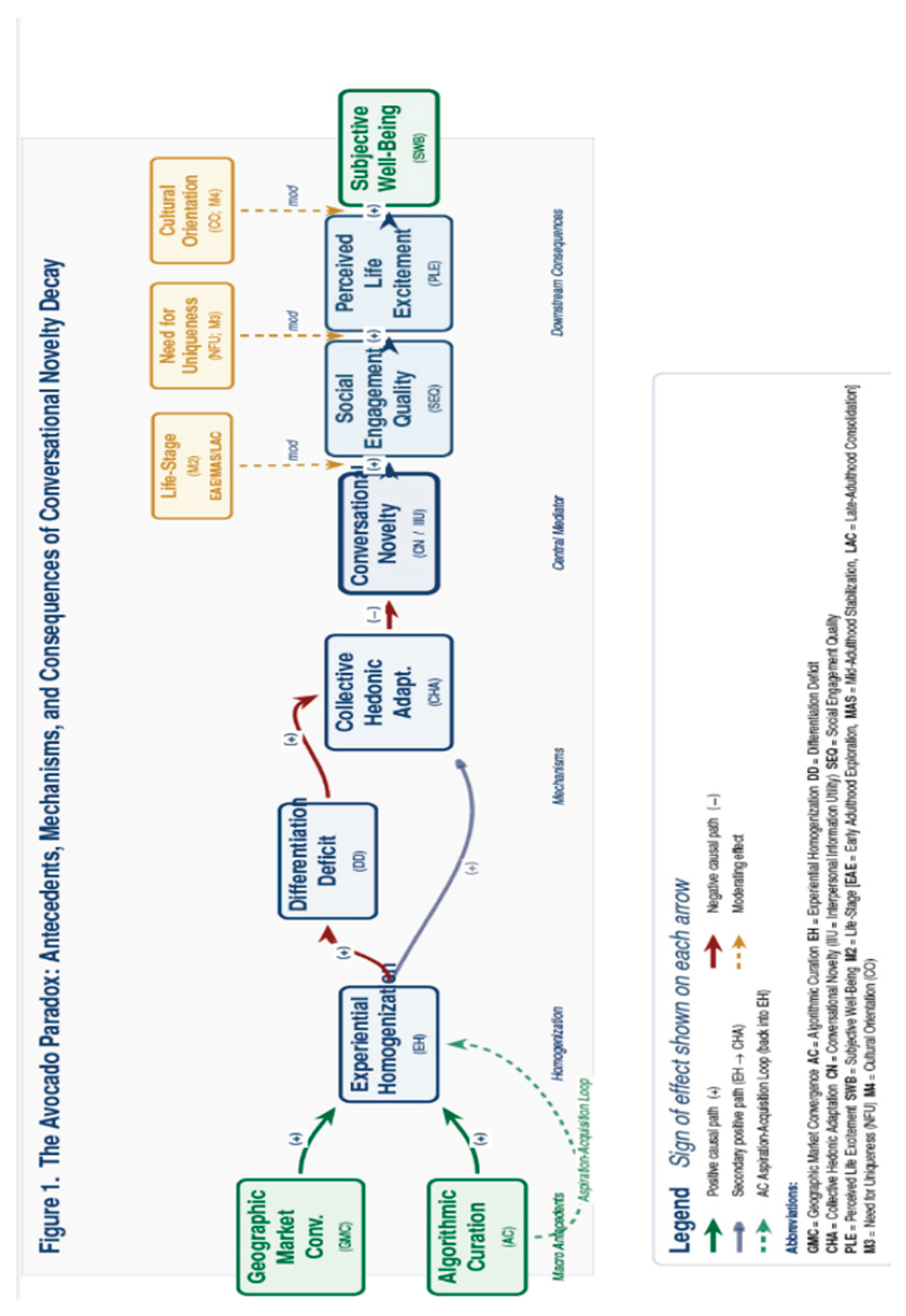
P1: The relationship between the antecedents GMC and Algorithmic Curation (AC) and Experiential Homogenization (EH) is positive. That means as GMC and AC increase, experiences across groups will keep on getting similar, thereby increasing EH. Another effect of AC is the Aspirational Acquisitional Loop (refer Figure 1) that causes individuals to deliberately look for curated experiences.
P2: The relationship between Experiential Homogenization (EH) and Differentiation deficit (DD) is also positive. Increasing EH will increase the DD at individual as well as inter-group level. This also means that GMC has a flipside that causes individuals to lose the interest to accumulate similar experiences.
P2a: A similar positive relationship is also observed between EH and Collective Hedonic Adaptation (CHA). Increasing similar experiences lead to faster hedonic adaptation among individuals. Since the reference of this conceptual proposition is inter group collective hedonic adaptation, it is important to note that this positive relationship between EH and CHA is in reference to inter-cohort experiential homogenization.
P3: The negative effect of Collective hedonic adaptation (CHA) on Conversational Novelty (CN), i.e. increasing CHA leads to decreasing conversational novelty (CN). With everyone having adapted to experiencing the same things, there is fewer and fewer new things to talk about.
The direction of this relationship follows directly from the IIU conceptualization of CN: experiences that are rare within a peer group carry high marginal informational value and satisfy the differentiation motive identified by ODT (Leonardelli et al., 2010). Once an experience is effectively common knowledge within a reference group, its marginal IIU approaches zero regardless of the individual's own enthusiasm for the experience. This leads to no motivation to discuss it within the peer group.
P4: The relationship between Conversational Novelty (CN) and Social Engagement Quality (SEQ) is positive and moderated by life-stage as a moderator: the positive CN → SEQ effect is stronger in Mid-Adulthood (Stabilization) and Late-Adulthood (Consolidation) than in Early Adulthood Exploration, consistent with SST's prediction that emotionally meaningful social exchange becomes the dominant social motivation as perceived temporal horizons contract. Early adults are more likely to “look” for diverse and different experiences.
P5: The effect of SEQ is seen positively on PLE (Perceived Life Excitement). This direct SEQ to PLE relationship follows from the well-established link between social connectedness and subjective vitality (Ryan & Deci, 2000). Individuals evaluate the quality of social engagement through the lens of distinctiveness. High-CN social exchanges, in which they function as the bearer of novel narratives, are affectively rewarding beyond their informational content because they satisfy the distinctiveness motive. The practical consequence is that individuals and consumers with a higher-than-average Need for Uniqueness (NFU) are more vulnerable to the Avocado Paradox mechanism. Their Perceived Life Excitement is more tightly coupled to the social informational environment, making CN depletion a more significant driver of PLE decline for this population.
P6: Higher levels of Perceived Life Excitement (PLE) are positively associated with Subjective Well-Being (SWB), consistent with the hedonic component of the SWB literature (Diener, 1984). The PLE to SWB pathway is stronger in individualistic cultural contexts than in collectivist ones (Triandis, 1995), where relational harmony and group embeddedness constitute stronger SWB drivers than personal stimulation or experiential vitality. The direct PLE to SWB relationship is well established in the subjective well-being literature (Diener, 1984; Diener et al., 2006) and requires no extended justification.
Here, solid arrows indicate primary hypothesized causal relationships; dashed arrows indicate moderating effects; dashed green curved arrow indicates the Aspiration-Acquisition Loop, an effect of algorithmic curation, where individuals aim to accumulate experiences they see others doing. Arrow signs (+/−) denote the hypothesized effect of each antecedent on the subsequent construct. Geographic Market Convergence (GMC) and Algorithmic Curation (AC) jointly predict Experiential Homogenization (EH) as macro-level antecedents; AC additionally contributes an Aspiration-Acquisition Loop through which platform-driven desire for novel experiences reinforces EH from the demand side. EH positively predicts Differentiation Deficit (DD), which in turn positively predicts Collective Hedonic Adaptation (CHA); EH also directly predicts CHA through a secondary pathway. CHA negatively predicts Conversational Novelty (CN), operationalized as Interpersonal Information Utility (IIU). CN positively predicts Social Engagement Quality (SEQ), which predicts Perceived Life Excitement (PLE), which predicts Subjective Well-Being (SWB).
5. Discussions
The Avocado Paradox provides an integrated explanation for why subjective excitement, perceived novelty and interpersonal curiosity tend to decline as individuals progress through adulthood. While hedonic adaptation, materialism and social comparison have each been studied independently, the theory brings them together through the mechanisms of Conversational Novelty (CN) and Experiential Homogenization (EH). The key insight here is that emotional decline is not only intrapersonal (a person getting “too used to things”), but also interpersonal, i.e. people lose interest not merely because they have repeated experiences, but also because everyone else around them has repeated them too.
This paper intends to comprehensively summarize prior research. For instance, earlier studies show that increasing income and rising material access do not reliably predict higher happiness. Similarly, research on globalization indicates greater cross-cultural exposure but does not fully explain why such exposure isn’t able to generate a lasting sense of collective content. The Avocado Paradox explains this gap: when the portfolio of experiences becomes universally common, the social value of the experiences collapses, leading to what the model conceptualizes as a Differentiation Deficit.
This framework also tries to explore contemporary adult life. Many adults report a general sense of emotional flattening, lower curiosity, lower motivation for social gathering, losing friends over time and fewer exciting conversational topics compared to childhood or adolescence. Common explanations like the monotony of routine, adult responsibilities or aging are all valid yet incomplete within themselves. The Avocado Paradox suggests that the weakening of conversational novelty and the convergence of life experiences may be equally powerful contributors. When individuals can no longer surprise one another, the conversational motivation diminishes and the emotional highs that come from sharing distinct stories dim down.
Additionally, the theory also highlights a sense of well-being that existing models underemphasize. Happiness is conceptualized not only as a function of internal satisfaction but also of engagement that is generated externally to the self. The spark of hearing something new, the curiosity induced by the unfamiliar and the social stimulation that occurs when differences exist between people and the conversational fuel it provides. By establishing the concept of collective well-being as a function of a shared experiential portfolio, the Avocado Paradox strengthens the argument that subjective happiness is a deeply social construct, even when measured individually. From a consumer satisfaction perspective, the Avocado Paradox identifies a novel form of experiential dissatisfaction, one that operates independently of product quality, service delivery or expectation disconfirmation. Consumer dissatisfaction in this model is structural rather than transactional: it arises from the progressive convergence of experiential portfolios across peer groups, which eliminates the social informational value that consumption experiences previously generated. This form of dissatisfaction is particularly resistant to conventional satisfaction-restoration strategies because its cause is systemic rather than firm-specific. No single brand or service provider can resolve a dissatisfaction rooted in the collective homogenization of consumer experience. It is a systematic dissatisfaction that arises due to too similar product quality, or too standardized service delivery. Hence, a “paradox”.
6. Implications of the Findings
6.1. Theoretical Implications
The Avocado Paradox may be extended to multiple theoretical domains:
- Hedonic Adaptation: The theory proposes a collective form of hedonic adaptation, a ‘social’ hedonic model, which causes emotional flattening amplified by social similarity. This expands hedonic adaptation beyond the individual, or the idea of ‘habituation’ described in classical psychology.
- Identity and Consumption: Past work shows people use consumption to signal uniqueness. The Avocado Paradox advances this by demonstrating how rising access structurally collapses the identity- signaling value of experiences, not just products.
- Novelty Research: The model introduces Conversational Novelty (CN) as a measurable construct that regulates the emotional value drawn from experiences. Novelty can also turn out to be an interpersonal currency, not merely a personal stimulus.
- Cultural Standardization: The theory consolidates separate streams of research on globalization of consumption (Gielens et al., 2023), McDonaldization (Ritzer, 2018) and standardization by showing how uniformity of experiences creates a monotonous uniformity of emotional life.
Overall, the Avocado Paradox reframes that adulthood is not an inherently dull stage of life. But as it turns into a period where income, wealth and accessibility reduces the variance of lived experience. This results in lowering curiosity, engagement and excitement.
6.2. Practical Implications
The theory may also be accounted for several implications for organizations, individuals and social groups as a whole:
6.2.1. For Individuals:
Recognizing the role of differentiation in feelings of happiness can encourage people to deliberately pursue ‘non-standard’ activities, take the road less travelled or cultivate niche hobbies that can increase conversational narrative capital. Volunteering or engaging with mixed age groups can also provide a distinctness in experiential diversity. In essence, the prescriptive logic shifts from 'do/own more of what you enjoy' to 'do/own more of what differentiates you'.
6.2.2. For Organisations and Experience Designers:
Brands are increasingly offering standardized experience packages to avoid customers feeling left out. But the Avocado Paradox warns that too much uniformity also tends to diminish long-term consumer excitement. This may reduce word-of-mouth potential as customers may even try to restrict experiential homogenization. This leads to weakening of brand-based narratives. So, experience designers and organizations alike may need to incorporate scarcity, unpredictability and greater sense of personalization to maintain novelty.
6.2.3. Future Research Directions
This theory opens up several avenues and opportunities of research, such as:
- Empirical measurement of Conversational Novelty as a construct by using data from Natural Language Processing (NLP).
- Experiments can be done to analyse the effect of shared vs unique experiences on happiness.
- Cross-Cultural testing and comparing homogenization effects across countries would reveal whether standardization has a universal effect on reducing emotional excitement.
-
Future work needs to examine:
- personality (openness to novel experience accumulation)
- variation of digital environment
- economic and social constraints
- life period and transition across ages
These may help test, amplify or weaken the theory’s relevance.
7. Conclusion
The Avocado Paradox intends to offer a novel explanation for adulthood related emotional flattening and declining social excitement. Grounded on research on hedonic adaptation, consumer identity, globalization and social comparison, the theory proposes conversational novelty as a determinant of social engagement. The decreasing experiential uniqueness leads to weaker engagement motivation and ultimately lower perceived life excitement.
The theory shifts the focus from purely internal psychological processes to the shared experiential environment in which people exist. Happiness is shown to be consisting of the thrill of hearing new stories, encountering new differences and engaging with diverse experiences is central to sustained well-being.
As experiences become increasingly standardized the emotional richness of life may decline not because people change too much but because their experiences become too similar. The Avocado Paradox therefore invites scholars, policy designers, brands, marketers and individuals to rethink how the distribution of novelty and the restoration of experiential diversity may help rekindle curiosity, excitement, and happiness.
Conflicts of Interest
The Author declares no known conflict of interest with any existing research, literature or person.
Ethics Declaration: Not applicable.
AI Acknowledgement: Generative AI has been used for language and grammar correction.
References
- Abdrabbo, T.; Omeish, F.; Kokash, F.; Alghizzawi, M.; Alfaiza, S.A. The impact of scarcity and uniqueness on luxury products purchasing intention moderated by FoMO and social comparison. Discov. Sustain. 2025, 6(1), 1–26. [Google Scholar] [CrossRef]
- Barton, B.; Zlatevska, N.; Oppewal, H. Scarcity tactics in marketing: A meta-analysis of product scarcity effects on consumer purchase intentions. J. Retail. 2022, 98(4), 741–758. [Google Scholar] [CrossRef]
- Berger, J.; Heath, C. Where consumers diverge from others: Identity signaling and product domains. J. Consum. Res. 2007, 34(2), 121–134. [Google Scholar] [CrossRef]
- Brewer, M.B. Optimal distinctiveness theory: Its history and development. Handb. Theor. Soc. Psychol. 2012, 2, 81–98. [Google Scholar] [CrossRef]
- Brickman, P. Hedonic relativism and planning the good society. In Adaptation level theory; Academic Press, 1971; pp. 287–301. [Google Scholar]
- Carstensen, L.L.; Hershfield, H.E. Beyond stereotypes: Using socioemotional selectivity theory to improve messaging to older adults. Curr. Dir. Psychol. Sci. 2021, 30(4), 327–334. [Google Scholar] [CrossRef] [PubMed]
- Carstensen, L.L.; Isaacowitz, D.M.; Charles, S.T. Taking time seriously: a theory of socioemotional selectivity. Am. Psychol. 1999, 54(3), 165. [Google Scholar] [CrossRef] [PubMed]
- Coleman, J.S. Social capital in the creation of human capital. Am. J. Sociol. 1988, 94, S95–S120. [Google Scholar] [CrossRef] [PubMed]
- Diener, E. Subjective well-being. Psychol. Bull. 1984, 95(3), 542. [Google Scholar] [PubMed]
- Diener, E.; Lucas, R.E.; Scollon, C.N. Beyond the hedonic treadmill: revising the adaptation theory of well-being. Am. Psychol. 2006, 61(4), 305. [Google Scholar] [CrossRef] [PubMed]
- Dunbar, R. I. Gossip in evolutionary perspective. Rev. General. Psychol. 2004, 8(2), 100–110. [Google Scholar] [CrossRef]
- Gielens, K.; Dekimpe, M.G.; Mukherjee, A.; Tuli, K. The future of private-label markets: A global convergence approach. Int. J. Res. Mark. 2023, 40(1), 248–267. [Google Scholar] [CrossRef]
- Gladstone, J.J.; Ruberton, P.M.; Margolis, S.; Lyubomirsky, S. Does variety in hedonic spending improve happiness? Testing alternative causal mechanisms between hedonic variety and subjective well-being. BMC Psychol. 2024, 12(1), 98. [Google Scholar] [CrossRef] [PubMed]
- Ladeira, W.J.; Lim, W.M.; de Oliveira Santini, F.; Rasul, T.; Perin, M.G.; Altinay, L. A meta-analysis on the effects of product scarcity. Psychol. Mark. 2023, 40(7), 1267–1279. [Google Scholar] [CrossRef]
- Leonardelli, G.J.; Pickett, C.L.; Brewer, M.B. Optimal distinctiveness theory: A framework for social identity, social cognition, and intergroup relations. Adv. Exp. Soc. Psychol. 2010, Vol. 43, 63–113. [Google Scholar]
- Levitt, T. The globalization of markets. Harv. Bus. Rev. 1983, 61(3), 92–102. [Google Scholar]
- Lynn, M. Scarcity effects on value: A quantitative review of the commodity theory literature. Psychol. Mark. 1991, 8(1), 43–57. [Google Scholar] [CrossRef]
- Lyubomirsky, S. Hedonic adaptation to positive and negative experiences. In Oxford Handbook of Stress, Health, and Coping; Folkman, S., Ed.; Oxford University Press, 2011; pp. 200–224. [Google Scholar]
- Nguyen, T. T.; Hui, P.-M.; Harper, F. M.; Terveen, L.; Konstan, J. A. Exploring the filter bubble: The effect of using recommender systems on content diversity. In Proceedings of the 23rd International Conference on World Wide Web, 2014; ACM; pp. 677–686. [Google Scholar]
- Nussenbaum, K.; Martin, R. E.; Maulhardt, S.; Yang, Y.; Bizzell-Hatcher, G.; Bhatt, N. S.; Hartley, C. A. Novelty and uncertainty differentially drive exploration across development. Elife 2023, 12, e84260. [Google Scholar] [CrossRef] [PubMed]
- Pariser, E. The filter bubble: What the Internet is hiding from you. In Penguin Press; 2011. [Google Scholar]
- Putnam, R.D. Bowling alone: America’s declining social capital. In Culture and politics: A reader; Springer, 2000; pp. 223–234. [Google Scholar]
- Radón, A. Luxury brand exclusivity strategies-an illustration of a cultural collaboration. J. Bus. Adm. Res. 2012, 1(1), 106. [Google Scholar] [CrossRef]
- Ritzer, G. The McDonaldization of society: Into the digital age. In Sage publications; 2018. [Google Scholar]
- Ryan, R. M.; Deci, E. L. Self-determination theory and the facilitation of intrinsic motivation, social development, and well-being. Am. Psychol. 2000, 55(1), 68–78. [Google Scholar] [CrossRef] [PubMed]
- Sakaki, M.; Yagi, A.; Murayama, K. Curiosity in old age: A possible key to achieving adaptive aging. Neurosci. Biobehav. Rev. 2018, 88, 106–116. [Google Scholar] [CrossRef] [PubMed]
- Schomaker, J.; Baumann, V.; Ruitenberg, M.F. Effects of exploring a novel environment on memory across the lifespan. Sci. Rep. 2022, 12(1), 16631. [Google Scholar] [CrossRef] [PubMed]
- Shan, Q.; Tian, Y.; Chen, H.; Lin, X.; Tian, Y. Reduction in the activity of vta/snc dopaminergic neurons underlies aging-related decline in novelty seeking. Commun. Biol. 2023, 6(1), 1224. [Google Scholar] [CrossRef] [PubMed]
- Shannon, C. E. A mathematical theory of communication. Bell Syst. Tech. J. 1948, 27(3), 379–423. [Google Scholar]
- Sheldon, K.M.; Lyubomirsky, S. The challenge of staying happier: Testing the hedonic adaptation prevention model. Personal. Soc. Psychol. Bull. 2012, 38(5), 670–680. [Google Scholar]
- Tian, K.T.; Bearden, W.O.; Hunter, G.L. Consumers’ need for uniqueness: Scale development and validation. J. Consum. Res. 2001, 28(1), 50–66. [Google Scholar] [CrossRef]
- Triandis, H. C. Individualism and collectivism. In Westview Press; 1995. [Google Scholar]
- Wang, X.; Sung, B.; Phau, I. How rarity and exclusivity influence types of perceived value for luxury. J. Brand Manag. 2024, 31(6), 576–592. [Google Scholar] [CrossRef]
- Yang, Y.w.; Liu, J.; Wang, Y. Consumers’ variety-seeking behaviors under time pressure: Based on regulatory focus and excitement levels. PsyCh. J. 2024, 13(3), 440–455. [Google Scholar] [CrossRef] [PubMed]
- Zhang, Y. Variety-seeking behavior in consumption: a literature review and future research directions. Front. Psychol. 2022, 13, 874444. [Google Scholar] [CrossRef] [PubMed]
Figure 1.
The Avocado Paradox: Antecedents, Mechanisms and Consequences.
Disclaimer/Publisher’s Note: The statements, opinions and data contained in all publications are solely those of the individual author(s) and contributor(s) and not of MDPI and/or the editor(s). MDPI and/or the editor(s) disclaim responsibility for any injury to people or property resulting from any ideas, methods, instructions or products referred to in the content. |
© 2026 by the authors. Licensee MDPI, Basel, Switzerland. This article is an open access article distributed under the terms and conditions of the Creative Commons Attribution (CC BY) license (http://creativecommons.org/licenses/by/4.0/).
Copyright: This open access article is published under a Creative Commons CC BY 4.0 license, which permit the free download, distribution, and reuse, provided that the author and preprint are cited in any reuse.