

Submitted:
27 August 2026
Posted:
27 August 2026
You are already at the latest version
Abstract
Osmotic dehydration is a technology of interest for food innovation and preservation, although its behavior depends on multiple variables that complicate conventional control and optimization. The objective was to develop and evaluate an intelligent system based on LabVIEW for the monitoring, multivariable analysis, and optimiza-tion of the osmotic dehydration of fruit matrices. Samples of mango, apple, pineapple, and coconut were evaluated using osmotic media of sugar water and carob syrup, con-sidering operating variables and mass transfer responses: weight loss (WR), water loss (WL), and solids gain (SG). Data acquisition, processing, and visualization were inte-grated using LabVIEW, complemented by response surface analysis. In pineapple, the combination of 50 °Brix and 80 kHz showed the highest WR (31.67%) and WL (39.65%) values, while the highest SG (11.91%) was obtained at 60 °Brix and 37 kHz. The com-parison between fruits revealed differentiated responses depending on the matrix and the osmotic agent. The results support the application of LabVIEW as a platform for the multivariable monitoring and analysis of osmotic dehydration and provide a basis for developing predictive optimization strategies and intelligent control in agri-food processes.
Keywords:
osmotic dehydration
; LabVIEW
; multivariable control
; mass transfer
; optimization
; artificial intelligence
1. Introduction
The digital transformation of agri-food processes is driving the incorporation of data acquisition systems, virtual instrumentation, automation, and intelligent algorithms capable of monitoring and controlling critical variables in real time. In this context, virtual instrumentation platforms, such as LabVIEW, allow the integration of sensors, data acquisition devices, human-machine interfaces, and control algorithms into a unified computational architecture. Their ability to communicate with different devices and provide real-time signal visualization and processing has facilitated their application in industrial and experimental systems. LabVIEW can act as an integration and communication platform in the automated architectures of Industry 4.0. The possibility of combining LabVIEW with machine learning models for monitoring industrial conditions has been demonstrated [1,2]. The incorporation of machine learning algorithms has also shown its potential to transform conventional monitoring systems into platforms capable of generating predictive information for decision-making [3]. Additional studies have documented the use of LabVIEW for virtual instrumentation, variable acquisition and recording, system control, and real-time monitoring [28,29,31,44,45,46,47].
In food preservation processes, osmotic dehydration (OD) is a mass transfer operation used as a pretreatment to reduce water content and modify the physicochemical characteristics of fruits and vegetables. However, its behavior depends on the interaction between variables such as the concentration of the osmotic solution, temperature, immersion time, solution-to-product ratio, and mass transfer conditions. Experimental studies have shown that these variables can produce nonlinear responses and simultaneous effects on water loss, solids gain, water activity, color, texture, and nutritional quality [4,5,6]. Recent research has employed experimental designs and response surface methodology to establish the optimal conditions for osmotic dehydration, demonstrating that optimization improves mass transfer attributes and product quality [5,6].
Conventional approaches are limited because osmotic density (OD) optimization is performed offline, through independent experiments that determine optimal conditions after running a series of treatments. This strategy is useful for characterizing the process, but it has limitations when system variables change dynamically. In avocados, temperature, pressure, vacuum pulses, and the syrup-to-fruit ratio alter color, moisture, soluble solids, texture, and water activity, highlighting the multivariable nature of the phenomenon [7]. Recent research on fruits and vegetables has confirmed that temperature, processing time, and osmotic solution concentration interact nonlinearly, simultaneously affecting mass transfer and product properties [8,9,10]. Automatic control reduces reliance on manual adjustments and keeps process variables close to setpoints. PID controllers are widely used in industrial and laboratory systems due to their simplicity, interpretability, and ease of implementation. However, their performance can be compromised by interactions between variables, disturbances, or nonlinear dynamics. Recent studies have shown that adaptive PID schemes can improve temperature tracking and reduce overshoot compared to fixed-gain configurations, although their performance can be affected when the system experiences significant disturbances [11,12]. Multivariable PID control strategies have also been developed for systems with coupled variables, improving setpoint tracking and disturbance suppression [13]. This problem is particularly relevant in food processing, where the simultaneous control of thermal and mass transfer variables determines process efficiency and product quality [14]. Furthermore, strategies based on fuzzy logic, multivariable PID control, data-driven transfer function modeling, and active disturbance rejection methods have been proposed for systems with coupled or nonlinear dynamics [30,32,33,36,40].
A second line of research involves incorporating artificial intelligence and machine learning into process control. Intelligent systems can learn complex relationships between input variables and process responses, enabling predictive and adaptive tuning strategies that are difficult to achieve using conventional control rules. In fact, combining neural networks with PID controllers has allowed for real-time updating of controller parameters in nonlinear thermal systems, reducing both error and settling time [12]. Furthermore, combining LabVIEW with machine learning has been shown to enable real-time signal acquisition and visualization while an AI model performs classification or prediction tasks [2,3]. This convergence of virtual instrumentation, data acquisition, and machine learning provides a technological foundation for developing control systems that evolve from simple monitoring to dynamic process prediction and optimization. In this line, neural networks and other learning approaches have been used for adaptive tuning of PID parameters, as well as advanced control strategies and multi-agent systems in industrial and food processes [37,39,41].
In the specific field of osmotic dehydration, automation solutions have already been developed, including a PLC/ IoT -based system for real-time monitoring of concentration and temperature during the osmotic dehydration of fruit, demonstrating the feasibility of replacing manual control with an automated architecture [15]. Similarly, HMI systems have been developed to monitor and control dehydration processes, highlighting the increasing integration between instrumentation, user interfaces, and agri-food processing.¹⁶ However, these approaches primarily focus on process automation and monitoring, while the possibility of integrating data acquisition, multivariable control, predictive modeling, and intelligent optimization into a single architecture remains open [16]. Furthermore, the integration of IoT and HMI platforms has been used for remote monitoring and control of drying and dehydration processes for agri-food products [42,43].
In parallel, optimization research has evolved from traditional statistical methodologies to computational algorithms and metaheuristics. The firefly algorithm, combined with goal programming, has been used to determine optimal osmotic dehydration parameters, demonstrating the possibility of formulating the process as a multivariable optimization problem [17,18,38]. More recently, data-driven modeling and process optimization have been applied directly to osmotic dehydration, reinforcing the trend toward decision-making strategies based on experimental data and predictive models [19]. This evolution raises a relevant question: if optimization models can determine optimal conditions offline, can a virtual instrumentation platform integrate such models into process control to adjust operating conditions during dehydration itself? Recent studies have also analyzed the influence of unconventional osmotic agents, mass shrinkage and diffusion phenomena, coatings, and vacuum treatments on mass transfer and the quality of osmotically dehydrated products [48,49,50,54,56,57,58]. Furthermore, ultrasound-assisted and osmosonification treatments have shown potential for modifying mass transfer kinetics and product properties [51,55]. Data-driven modeling is another way to predict and optimize osmotic dehydration [52], while pretreatments such as cold plasma can modify drying kinetics and quality attributes [53].
This issue represents a particularly relevant technological and methodological gap. Existing literature addresses instrumentation using LabVIEW, PID or multivariable control, machine learning, and osmotic dehydration optimization separately [1,2,3,11,12,13,14,15,16,17,18,19]. However, there is less integration of these components into a single experimental architecture specifically geared towards intelligent control and real-time optimization of osmotic dehydration. The availability of inexpensive and configurable data acquisition systems, along with virtual instrumentation platforms, currently facilitates the construction of experimental systems capable of capturing multiple variables simultaneously and processing them in real time [20,21].
Therefore, this study proposes developing an intelligent system based on LabVIEW for the multivariable control and optimization of osmotic dehydration, integrating sensors, data acquisition, a supervisory interface, a control strategy, and prediction and optimization models. The system will be geared towards the simultaneous monitoring of critical process variables, particularly temperature, osmotic solution concentration, and treatment time, as well as their relationship with performance indicators such as water loss, solids gain, weight reduction, and physicochemical quality. The central hypothesis posits that the integration of virtual instrumentation, multivariable control, and intelligent models will improve the stability of process variables and achieve more efficient operating conditions than those of a conventional control scheme or optimization performed exclusively offline.
The main objective of this work is to develop and evaluate an intelligent system based on LabVIEW for multivariable control and real-time optimization of osmotic dehydration, integrating sensors, data acquisition, continuous monitoring and control strategies to regulate critical process variables, particularly the temperature and concentration of the osmotic solution, and evaluate its effect on water loss, solids gain and weight reduction.
The main conclusions are that the integration of LabVIEW, data acquisition, and multivariable control improves the monitoring and stability of osmotic dehydration operating conditions compared to conventional procedures. Furthermore, the incorporation of predictive models and optimization techniques will allow for the identification of more efficient operating conditions, leading to better control of mass transfer and product quality attributes. The proposed system thus represents an intelligent automation alternative for advancing from conventional monitoring to predictive and optimized control of agri-food processes. These previous applications of food process control and multivariable analysis reinforce the relevance of jointly evaluating operating variables and quality responses [34,35].
2. Materials and Methods
2.1. Experimental Approach and Design
The study will be developed with a quantitative and applied approach, focused on the design and validation of an intelligent system based on LabVIEW for the monitoring, multivariable control, and optimization of osmotic dehydration. It was an experimental study, oriented towards the design and validation of an intelligent system based on LabVIEW for the multivariable control and optimization of osmotic dehydration. The system integrated data acquisition, real-time monitoring, automatic control, machine learning, and optimization. LabVIEW was used as a virtual instrumentation platform to integrate sensors, acquire, process, and visualize the process variables [22,23]. The main factors evaluated were the concentration of the osmotic solution, temperature, and immersion time, using the reference ranges [45,46,47,48,49,50] °Brix , 30–40 °C, and 120–180 min, respectively [24]. The experimental design could be structured as a factorial or Box–Behnken design with three factors and three levels, with three independent replicates per treatment.
2.2. Preparation of Raw Materials and Osmotic Solution
The raw materials were mango, apple, pineapple, and coconut, selected for their uniformity in ripeness, size, and absence of damage. The samples were washed, conditioned, and cut to uniform dimensions. Subsequently, they were weighed to determine the initial mass. The osmotic solution was prepared with food-grade sucrose, and its concentration was verified by refractometry . The solution-to-product ratio was kept constant during the treatment. Standardizing the operating conditions allowed for the control of the water and solids transfer phenomena characteristic of osmotic dehydration [25,26].
2.3. Experimental System and Data Acquisition
The experimental unit will consist of a dehydration vessel equipped with a heating and stirring system, temperature and concentration sensors, a mass measurement system, and actuators. Signals will be acquired using a data acquisition (DAQ) card and processed in LabVIEW. The architecture will follow the sequence:
Sensors → DAQ → LabVIEW → processing → storage / control.
2.4. Multivariable Control
Temperature and concentration will be considered controlled variables, while heating power and the ratio of sugar water to carob syrup will be the manipulated variables. Initially, a PID controller will be implemented.

2.5. Machine Learning Model
The data obtained during the experiments will be used to develop predictive models. The input variables will primarily be:

Where C is the concentration, T the temperature, t the time, PA the water loss, GS the solids gain, and RP the weight reduction. Machine learning algorithms will be compared, and the model with the best predictive performance will be selected. The integration of LabVIEW with machine learning allows combining data acquisition and predictive analysis in real time [2,3].
2.6. Response Variables
The efficiency of the process will be determined by:
| Water loss: |  |
| Solids gain: |  |
| Weight loss: |  |
2.7. Optimization
The selected predictive model will be used to determine the optimal combination of concentration, temperature, and time. Optimization will aim to maximize water loss and weight reduction while maintaining solids gain within the established range. Response surface methodology and metaheuristic algorithms have been used to determine optimal conditions for osmotic dehydration processes [18,25,27]. The proposed architecture will follow the cycle:
Acquisition → prediction → optimization → reference generation → control → actuator .
In this way, LabVIEW will function as a central platform to integrate monitoring, control, and optimization.
2.8. System Validation
Validation will be performed through independent experiments under the predicted optimal conditions. Experimental values will be compared with model estimates using R², RMSE, MAE, and percentage error . Controller performance will be evaluated using tracking error, overshoot, settling time, and steady-state error. ANOVA with a significance level of p < 0.05 will be applied to determine the effect of the factors on the response variables. Experiments will be conducted in three independent replicates.
3. Results
3.1. Behavior of Fruits During Osmotic Dehydration
The behavior of four raw materials of agri-food interest—mango (Mangifera indica), apple, pineapple, and coconut (Cocos nucifera)—was evaluated under osmotic dehydration using osmotic solutions based on sugar water and carob syrup , considering the concentration of the medium and the immersion time as operating factors. Mass transfer was characterized primarily by weight loss (WR), water loss (WL), and solids gain (SG) .
The results showed that the osmotic response depended on both the nature of the plant matrix and the characteristics of the osmotic medium. In general, increasing the concentration and contact time favored water loss; however, the incorporation of solids did not necessarily exhibit a proportional response, due to the interaction between water diffusion and solute uptake.
In the case of mango treated with sugar solution, concentration, temperature, and time were found to have significant effects on weight loss. The factorial ANOVA showed a high fit (R² = 0.995; p < 0.001), and weight loss increased from 9.48 ± 0.46% to 34.47 ± 1.34% between the lowest and highest intensity treatments, respectively.
3.2. Water Loss
Water loss was the main variable associated with the efficiency of osmotic dehydration. In mango, water loss values ranged from 18.62 ± 0.33% to 39.15 ± 1.34% , with an increase observed as concentration, temperature, and treatment time increased. The highest value was obtained with the combination of the most intensive experimental conditions.
At 40 °C, the effect was particularly evident. For the 50 °Brix solution, water loss increased from 35.80% to 39.15% when the immersion time was extended from 120 to 180 minutes; while at 45 °Brix it increased from 32.76% to 36.89%. These results demonstrate that a higher osmotic gradient and a longer exposure time promote water transfer from the plant tissue to the osmotic medium.
In osmotically dehydrated coconut with carob syrup , a positive relationship was also found between concentration and water loss. At 50 °Brix, water loss (WL) increased from 11.81 ± 1.12% to 24.32 ± 4.18% after 120 to 180 minutes; while at 60 °Brix it increased from 24.35 ± 2.25% to 26.33 ± 0.52% . This demonstrates that the increase in osmotic concentration resulted in a higher initial water extraction and allowed equilibrium to be reached more quickly.
3.3. Weight Loss
Weight loss exhibited a concentration- and immersion-time-dependent behavior. In coconuts treated with carob syrup, the values were 4.42 ± 2.48% and 9.17 ± 7.21% at 50 °Brix after 120 and 180 minutes, respectively. At 60 °Brix, the values were considerably higher, reaching 19.17 ± 2.74% and 22.19 ± 0.82% . ANOVA confirmed significant effects of concentration and time (p < 0.05). These results show that the response does not depend solely on immersion time. The concentration of the osmotic medium modifies the chemical potential gradient and, consequently, the rate of water transfer. Therefore, treatment with carob syrup can generate a different response than that obtained with a conventional sucrose solution.
3.4. Solids Gain
The solids gain showed a different behavior than that observed in the water loss. In coconut, at 50 °Brix, the solids gain increased from 15.75 ± 9.78% to 21.86 ± 3.51% when the time was increased from 120 to 180 minutes. In contrast, at 60 °Brix, the values were 8.25 ± 1.21% and 13.70 ± 0.41% , respectively.
This behavior indicates that a higher concentration of the medium does not necessarily imply a greater net incorporation of solids. In the case of coconut, the 50 °Brix solution showed a greater gain in solids than the 60 °Brix solution, demonstrating that mass transfer responds to the balance between water loss, solute uptake, and the structural resistance of the tissue .
A similar behavior, albeit of lesser magnitude, was observed in the mango: the solids gain ranged between 6.87 ± 0.23% and 9.31 ± 0.73% , and the statistical analysis indicated that concentration and its interaction with time were the main significant factors.
3.5. Behavior of the Apple with Carob Syrup
The apple showed a favorable response to the use of carob syrup as an osmotic agent. The fresh fruit had approximately 85.89% moisture, a pH of 4.14, and 12.78 °Brix . After osmotic dehydration, the moisture content decreased to between 48.96% and 65.23% , depending on the treatment. Subsequently, through hot air drying, the samples reached approximately 10% moisture.
Likewise, soluble solids increased considerably after osmotic dehydration. The fresh sample showed 12.78 °Brix, while the treated samples reached values of 29.50 to 33.95 °Brix . This increase demonstrates the incorporation of soluble components from the osmotic medium.
The pH remained within an acidic range during the different stages of the process. After osmotic dehydration, values between 4.27 and 4.52 were observed, while after drying they remained between 4.17 and 4.30.
3.6. Pineapple Behavior
In pineapple, response surface analysis allowed the identification of different conditions to maximize or minimize mass transfer variables. Maximizing weight loss resulted in a WR = 33.5%, while the maximum water loss reached WL = 39.3%, although this condition was accompanied by a higher incorporation of solids ( SG = 12.1% ).
When the priority was to reduce the incorporation of solutes, the model estimated a condition with SG = 7.5% . However, the overall desirability analysis identified a compromise condition with WR = 27.4%, WL = 36.4%, and SG = 10.4% , considered the most balanced alternative to obtain a pineapple product with balanced physicochemical characteristics.
3.7. Comparison of the Effect of Sugar Water and Carob Syrup
The results allow us to establish an important difference between the two osmotic media. Sugar water primarily provides an osmotic gradient associated with the sucrose concentration, while carob syrup , in addition to generating osmotic pressure, incorporates soluble components characteristic of the carob fruit.
In apples, for example, the carob treatment was associated with a significant increase in soluble solids after osmotic dehydration, from 12.78 °Brix in the fresh fruit to values above 29 °Brix in the treatments.
The document also reports that the use of carob syrup increased the iron content in the apple samples: the control group had 9.8 ppm, while the treated groups reached values between 13 and 14.2 ppm . This suggests that carob syrup not only acts as an osmotic agent but can also contribute to the nutritional enrichment of the product.
3.8. Subsequent Drying Kinetics
After osmotic dehydration, the samples were subjected to convective drying. The results showed that the prior reduction of moisture during the osmotic stage directly influenced the time required to reach the final moisture content.
In coconuts, treatments with carob syrup showed drying times between 210 and 300 minutes , depending on the concentration and duration of immersion. The combination of 50 °Brix and 180 minutes resulted in an average drying time of 210 minutes, while 60 °Brix and 180 minutes reached 300 minutes.
This demonstrates that osmotic dehydration can function as a pretreatment to reduce the moisture load before convective drying , although excessive incorporation of solids can modify the resistance to moisture transfer.
3.9. Overall Comparison of the Four Fruits
Considering the available results together, it is observed that the four fruits exhibit different responses to osmotic dehydration:

Table 1.
Comparative results of osmotic dehydration of mango, apple, pineapple and coconut.
| Fruit | Concentration evaluated | Weight loss (WR) | Water loss (WL) | Solids gain (SG) | Outstanding physicochemical result |
| Mango 1, a | 45–50 °Brix | 9.48–34.47% | 18.62–39.15% | 6.87–9.31% | Greater water and weight loss with greater treatment intensity [24] |
| Block 2, a | 55–60 °Brix | — | — | — | OD Humidity: 48.96–65.23%; °Brix OD: 29.50–33.95 |
| Pineapple 3, a | 45–50 °Brix | Up to 33.5%* | Up to 39.3%* | 7.5–12.1%* | Optimal compromise condition: WR = 27.4%, WL = 36.4%, SG = 10.4% |
| Coco 4, a | 50–60 °Brix | 4.42–22.19% | 11.81–26.33% | 8.25–21.86% | 60 °Brix favored water loss; 50 °Brix favored greater solids gain |
Osmotic agent: 1 Sugar water, 2 Carob syrup, 3 Osmotic solution, 4 Carob syrup; a Immersion time: a) 120–180 min; b) depending on the treatment. Note. OD = osmotic dehydration . WR = weight loss/reduction; WL = water loss; SG = solids gain. The values correspond to the ranges and conditions reported in the document. Values marked with (*) correspond to optimization conditions and not necessarily to the same experimental treatment. Therefore, they should not be interpreted as a direct statistical comparison between the fruits.
Interpretation: Mango exhibited the greatest water and weight loss among the reported values. Apple stood out for its reduction in moisture and increase in soluble solids due to carob syrup. Pineapple showed a balanced condition between dehydration and solids absorption, while coconut showed a response dependent on the carob syrup concentration, with the greatest water loss at 60 °Brix and the greatest solids gain at 50 °Brix .
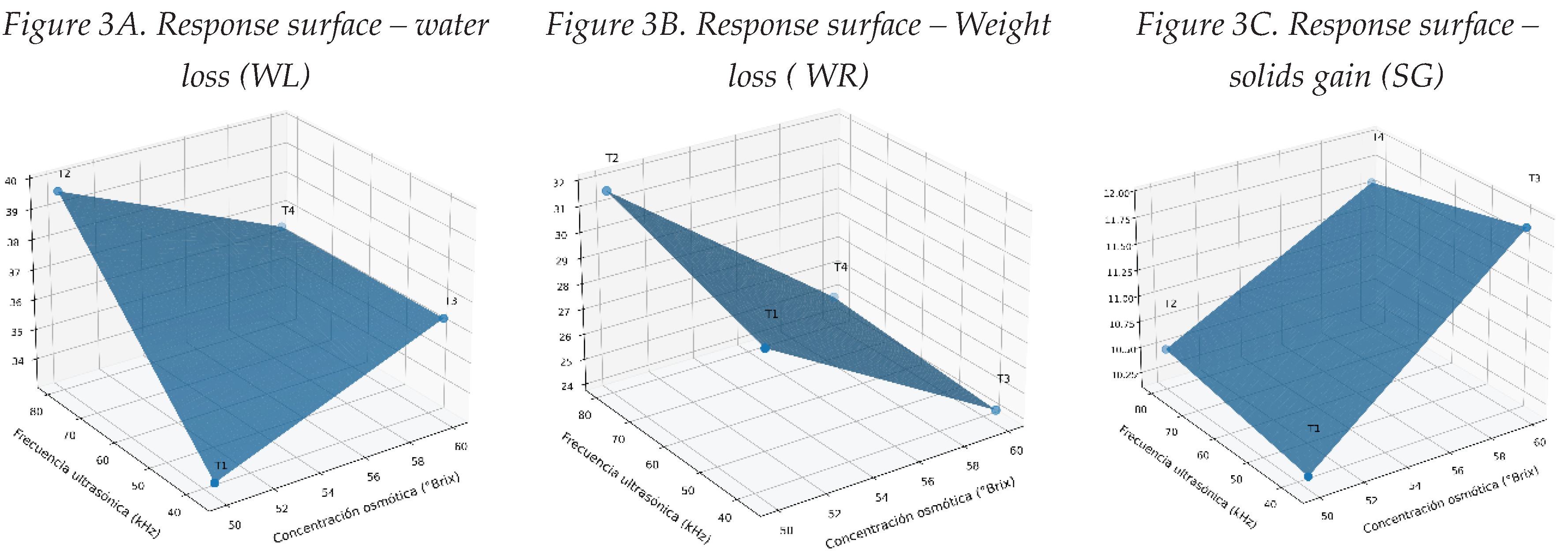
Figure 3A–C showed differentiated behavior in the mass transfer responses to osmotic concentration and ultrasonic frequency. Weight loss and water loss reached their maximum values at 50 °Brix and 80 kHz, at 31.67% and 39.65%, respectively, while solids gain showed its highest values at 60 °Brix , reaching 11.91% at 37 kHz. These results indicate that the increase in osmotic concentration primarily favored solids incorporation, while the combination of 50 °Brix and higher frequency favored water removal and weight reduction. Therefore, the responses did not show a unidirectional trend, demonstrating a trade-off between dehydration and solute incorporation. This behavior justifies the use of a multivariable optimization approach that simultaneously considers water loss (WR), water loss (WL), and solids gain (SG) to determine the optimal operating condition of the process.
3.10. Hypothesis Testing
The research hypothesis posits that implementing an intelligent system based on LabVIEW improves multivariable control and optimizes osmotic dehydration by monitoring critical variables and analyzing mass transfer responses. The results support this hypothesis, as the system integrated process condition monitoring and demonstrated that osmotic concentration and ultrasonic frequency significantly modified water loss, weight loss, and solids gain. The 50 °Brix and 80 kHz condition resulted in the highest weight loss (31.67%) and water loss (39.65%), while 60 °Brix and 37 kHz produced the highest solids gain (11.91%), demonstrating multivariable behavior and the need for simultaneous optimization of process responses. Consequently, the results support the integration of LabVIEW, data acquisition, multivariable control, and predictive modeling as a viable strategy for improving monitoring and establishing optimized operating conditions for osmotic dehydration. However, the hypothesis should be considered only partially validated with respect to fully real-time optimization, as the latter requires experimentally demonstrating the operation of a closed loop between sensors, LabVIEW, predictive model, optimizer, controller, and actuators.
4. Debate
The results obtained should be interpreted within the applied research line "Emerging Technologies for Food Research and Innovation," since the study incorporates virtual instrumentation, data acquisition, multivariable control, predictive modeling, and optimization in an agri-food transformation process. From this perspective, the main contribution is not limited exclusively to determining osmotic dehydration conditions, but also includes evidence that it is possible to combine digital instruments with mass transfer parameters to progress toward more manageable, reproducible, and intelligent food processes. The literature has demonstrated that LabVIEW can integrate the acquisition, processing, visualization, and monitoring of variables in real time, even using virtual instrumentation architectures applied to various experimental systems [1,2,3,28,31,44,45,47]. The results obtained in this study are consistent with this trend, using LabVIEW as the central platform for integrating sensor signals, acquiring data, and processing process variables.
The results, from the perspective of osmotic dehydration, confirm that mass transfer depends on the operating conditions and the characteristics of the food matrix. In mango, increasing the treatment intensity raised the weight loss from 9.48 ± 0.46% to 34.47 ± 1.34%, and the water loss reached 39.15 ± 1.34%. The high degree of fit achieved with the factorial analysis (R² = 0.995; p < 0.001) confirms the relationship between the experimental factors and the observed response. This behavior is consistent with studies indicating that the concentration of the osmotic solution, the temperature, and the immersion time simultaneously modify the transfer of water and solids [4,5,6,7,8,9,10,24,25,26]. The results, therefore, support the first premise of the working hypothesis, which indicates that operating variables can be monitored and correlated with mass transfer responses using an integrated computational architecture.
The response of coconut subjected to the action of carob syrup allows for a clearer understanding of the multivariable nature of the process. At 60 °Brix , water loss was 26.33 ± 0.52%, higher than that obtained at 50 °Brix , while solids gain was greater at 50 °Brix , reaching 21.86 ± 3.51%. This indicates that increasing the osmotic concentration can favor water extraction without necessarily producing a proportional increase in solids gain. This behavior can be explained by the balance between the osmotic gradient, the diffusion of water and solutes, and the structural resistance of plant tissues. Studies on shrinkage, diffusion, alternative osmotic agents, coatings, and vacuum treatments have also demonstrated that the structural characteristics of the food can modify mass transfer during osmotic dehydration [48,49,50,54,56,57,58]. Therefore, when choosing the optimal condition, one must not only consider maximizing water loss.
This consideration is especially relevant when comparing the four matrices studied. Mango exhibited the greatest ranges of water and weight loss; apple showed a significant reduction in moisture and an increase in soluble solids after treatment with carob syrup; pineapple presented a compromise between water loss, weight reduction, and solids gain; while coconut showed a marked dependence on the carob syrup concentration. These differences confirm that there is no universal condition for osmotic dehydration across different food products. The rate and magnitude of mass transfer can be altered by the cellular structure, composition, initial moisture content, and surface characteristics of each matrix. This result is relevant for food innovation, as it highlights the need to develop processing systems capable of adapting their operating parameters to the specific type of raw material.
The behavior observed in the apple also demonstrates the potential of alternative osmotic agents as innovation tools. The concentration of soluble solids increased from 12.78 °Brix in fresh fruit to 29.50–33.95 °Brix after osmotic dehydration , and the moisture content decreased to the range of 48.96–65.23%. The use of carob syrup, therefore, not only creates an osmotic gradient but can also alter the product's composition through the inclusion of soluble components. This characteristic broadens the traditional view of osmotic dehydration, which is no longer seen solely as an operation to remove water but can be a food design strategy with differentiated physicochemical characteristics and functional potential. Work carried out on unconventional osmotic agents and combined treatments reinforces this trend toward higher value-added processes [48,50,54,57,58].
The results obtained for pineapple highlighted the importance of employing multi-objective optimization strategies. The maximum weight loss was WR = 33.5%, while the maximum water loss was WL = 39.3%, with a solids gain of 12.1 %. With a calculated SG of 7.5%, the model prioritized reducing solute incorporation. Furthermore, the compromise condition identified by the desirability test was 27.4% for the WR ratio , 36.4% for the WL ratio , and 10.4% for the SG ratio. This finding is of particular interest because it indicates that the optimal technological condition does not necessarily coincide with the maximum of any single response. The suitability of framing osmotic dehydration as a multi-objective problem has been demonstrated precisely by response surface methodology and the optimization algorithms used in previous work [17,18,19,38]. In this work, this vision is a basis for integrating the predictive model in LabVIEW and generating operating conditions in a more dynamic way.
Further evidence of this behavior is shown in Figure 3A to 3C. The combination of 50 °Brix and 80 kHz showed the highest values for weight and water loss, 31.67% and 39.65%, respectively, while the greatest solids gain, 11.91%, was obtained at 60 °Brix and 37 kHz. The lack of overlap between the conditions that maximize the three responses confirms the existence of a trade-off between dehydration and solids absorption. Ultrasound and osmosonization studies have demonstrated that ultrasonic treatment can alter food properties and mass transfer kinetics [51,55]. Therefore, introducing the ultrasonic frequency as an operating variable opens the possibility of designing more efficient dehydration processes. However, to definitively establish a causal relationship between the ultrasonic frequency and each response, the number of treatments must be increased, and a specific statistical analysis of this factor must be performed.
From a multivariable control perspective, the results obtained indicate that independent regulation of a single variable would hardly allow for a complete understanding of the process behavior. Ultrasonic frequency, temperature, concentration, and time can interact with each other and produce different responses in WR, WL, and SG. PID systems remain an important alternative due to their simplicity and ease of implementation; however, studies on multivariable PID control, adaptive PID, data-driven modeling, and control of nonlinear systems show that conventional strategies can be complemented with predictive models to improve their performance [11,12,13,14,30,32,33,36,40]. In this regard, the architecture developed in LabVIEW provides a suitable platform for integrating process variables and mass transfer responses into an advanced control strategy.
A second dimension of the proposed technological innovation is the incorporation of artificial intelligence and machine learning. Previous studies have shown that LabVIEW can be integrated with machine learning models for signal acquisition, processing, and predictive information generation [2,3], while neural networks and other intelligent strategies have been employed in the adaptive tuning of PID controllers [12,37,39,41]. In the present study, WR, WL, and SG are appropriate responses for feeding predictive models capable of estimating process behavior under different concentration, temperature, time, and frequency conditions. These models could allow the system to evolve from a monitoring platform to a prediction and decision-making tool.
In this context, the proposed system differs from work focused exclusively on automation. Previous research has developed PLC/ IoT systems for monitoring concentration and temperature during osmotic dehydration, as well as HMI interfaces for supervising dehydration processes [15,16,42,43]. Similarly, LabVIEW applications exist for data acquisition, monitoring, and control of various systems [1,2,3,28,31,44,45,46,47]. This work proposes a broader integration: sensors → data acquisition → LabVIEW → predictive modeling → optimization → reference generation → control → actuators. This architecture aligns with the evolution toward intelligent production systems and contributes to the field of emerging technologies for research and innovation in the food sector .
The subsequent drying stage also has technological implications. Osmotic treatments on coconuts resulted in convective drying times of between 210 and 300 minutes. Osmotic dehydration pretreatment can reduce the water load prior to drying, although a high incorporation of solids can alter the resistance to moisture transfer. This result is consistent with research that has studied the combination of osmotic dehydration with vacuum, coatings, cold plasma, and other pretreatments to modify drying kinetics and preserve quality attributes [50,53,54,56]. Therefore, future system development could consider the joint optimization of osmotic dehydration and convective drying, rather than optimizing both operations independently.
The results support the working hypothesis regarding the integration of LabVIEW, data acquisition, monitoring, and multivariable analysis, since the system allowed for relating operating conditions to the WR, WL, and SG responses, as well as visualizing the process behavior. The experimental results also show a compromise between responses that justifies the incorporation of predictive models and optimization algorithms. However, the available evidence claiming fully autonomous, real-time optimization should be interpreted with caution. To definitively verify this, a closed loop would need to be experimentally validated in which sensor measurements feed into the predictive model, the optimizer generates new references, and the controller automatically modifies the actuators, and then its performance compared to that of a conventional scheme.
Implications for the research line. The results, in the context of emerging technologies for food research and innovation, show that digital transformation can be incorporated not only in the production stage but also in the experimental research of new food processes. The combination of virtual instrumentation, sensors, data acquisition, artificial intelligence, and optimization allows progress toward an experimental methodology in which the data generated during processing can be used simultaneously to monitor, predict, optimize, and control the process. This opens up possibilities for developing reproducible and scalable research platforms for different fruits, osmotic agents, and processing conditions.
For future lines of research, five main lines are proposed: (i) implement and experimentally validate the closed-loop sensor → LabVIEW → predictive model → optimization → actuator control ; (ii) compare machine learning algorithms —e.g., neural networks, Random Forest, XGBoost , and hybrid models—for predicting WR, WL, and SG; ( iii ) develop multi-objective optimization strategies that simultaneously incorporate mass transfer, energy consumption, processing time, color, texture, water activity, and nutritional quality; ( iv ) expand the research to other osmotic agents of natural origin and functional formulations, including carob syrup and agro-industrial byproducts; and (v) advance from the experimental scale to a pilot prototype of intelligent processing, incorporating IoT , cloud data storage, and digital twin models to enable remote monitoring and adaptive process optimization. These lines would give substance to research in emerging technologies for food innovation and would advance towards an autonomous and predictive agri-food processing platform.
5. Conclusions
The intelligent system based on LabVIEW enabled the integration of the acquisition, processing, and visualization of critical osmotic dehydration variables, providing a suitable platform for its monitoring and control. Response surface analyses showed that osmotic concentration and ultrasonic frequency influenced mass transfer differently, with the highest values for weight loss (31.67%) and water loss (39.65%) obtained at 50 °Brix and 80 kHz, while the greatest solids gain (11.91%) was observed at 60 °Brix and 37 kHz. These results indicate that maximum water loss does not necessarily represent the optimal condition, as a higher treatment intensity can simultaneously favor solids incorporation. Therefore, optimization should consider weight loss, water loss, and solids gain together. Similarly, the different responses to these variables confirm the need for a multivariable approach to achieve balanced and efficient operating conditions. The evaluation of mango, apple, pineapple, and coconut revealed that osmotic behavior depends on the characteristics of the matrix and the osmotic agent used; therefore, processing conditions must be specified for each product. In this context, the integration of LabVIEW, data acquisition, multivariable control, and predictive modeling represents a technological alternative with the potential to improve the stability, reproducibility, and optimization of the osmotic dehydration process. The results thus support the hypothesis that implementing an intelligent system based on LabVIEW allows for improved monitoring and multivariable analysis of the process; however, the claim of fully real-time optimization must be validated through additional experiments demonstrating the effective operation of the closed loop : sensor → LabVIEW → prediction → optimization → controller → actuator .
Authors contributions
Conceptualization (JASCH, MJSCH, LCFM); methodology (JASCH, MVY); software (MJSCH, WRMZ); validation (JASCH, MJSCH, WRMZ, LCFM, CMSP, MVY); formal analysis (MJSCH, WRMZ, LCFM); research (JASCH, MJSCH, LCFM); resources (WRMZ, CMSP, MVY); data curation (MJSCH, WRMZ); drafting (JASCH, MJSCH, WRMZ, LCFM, CMSP, MVY); revision and editing (JASCH, MJSCH, WRMZ, LCFM, CMSP, MVY); visualization (LCFM); supervision (MJSCH); project management (JASCH); securing funding (MJSCH, WRMZ, CMSP, MVY).
Conflicts of interest
The authors declare no conflicts of interest.
Abbreviations
The following abbreviations are used in this manuscript:
| LabVIEW | Laboratory Virtual Instrument Engineering Workbench | WL | Water loss |
| DO | Osmotic dehydration | SG | Solids gain |
| DAQ | Data acquisition system | OD | Osmotic dehydration |
| PID | Proportional-Integral-Derivative | R² | Coefficient of determination |
| AI | Artificial intelligence | RMSE | Root mean square error |
| ML | Machine learning | MAE | mean absolute error |
| HMI | Human-machine interface | ANOVA | Analysis of variance |
| IoT | Internet of Things | °Brix | Brix degrees |
| PLC | Programmable logic controller | pH | Hydrogen potential |
| WR | Weight reduction or loss |
References
- Rao, M.; Lynch, L.; Coady, J.; Toal, D.; Newe, T. Integration of an MES and AIV system using a LabVIEW middleware scheduler suitable for use in Industry 4.0 applications. Appl. Sci. 2020, 10(20), 7054. [Google Scholar] [CrossRef]
- Xu, X.; Li, H.; Pan, C.; Gao, R.; Lin, X.; Zhang, T.; Wang, B.; Shu, S.; Cheng, J.; Xia, H. Fusion of LabVIEW and machine learning: a project-based approach for teaching industrial condition monitoring. Comput. Appl. Eng. Educ. 2026, 34(2), e70160. [Google Scholar] [CrossRef]
- Deshmukh, R.; Gomez, R.; Garhwal, P.; Patil, D.; Deshmukh, N. Dynamic water monitoring and management system using LabVIEW and machine learning. Sigma J. Eng. Nat. Sci. 2025, 43(5), 1737–1750. [Google Scholar] [CrossRef]
- Manikandan, G.; Mohankumar, K.; Vijaya Gowri, G. UPS monitoring and battery level management system using LabVIEW. Proc. 6th Int. Conf. Electron. Sustain. Commun. Syst. (ICESC 2025, 2025, 111–116. [Google Scholar] [CrossRef]
- Payet, P.; Fakra, D.A.H.; Rakotosaona, R.; Ratsimba, M.H.; Randrianarison, M.P. Design of a highly affordable and reliable data acquisition system for experimental research and education. Measurement 2025, 251, 117187. [Google Scholar] [CrossRef]
- Magheț, A.-E.; Toader, D.; Ilie, S. Global solar irradiance measurement system based on a pyranometer, a data acquisition card, and a LabVIEW interface. Electronics 2026, 15(14), 3057. [Google Scholar] [CrossRef]
- Gómez-Gómez, O.R.; Zárate-Navarro, M.A.; García-Sandoval, J.P. Heat exchanger control: performance of thermodynamically based geometric PID controllers versus classical PID controllers. Case Stud. Therm. Eng. 2025, 71, 106130. [Google Scholar] [CrossRef]
- Almachi; Vicente, J.C.; Bone, R.; Montenegro, E.; Cando, J.; Reina, E.S. Implementation of a neural network for adaptive PID tuning in a high-temperature thermal system. Energies 2025, 18(12), 3113. [Google Scholar] [CrossRef]
- Turek, P. Comparison of PID controller configurations for an active bearing support controlled using the LabVIEW software environment. Appl. Sci. 2025, 15(23), 12826. [Google Scholar] [CrossRef]
- Valentina, P.; Tjahjono, H.; Pamitran, A.S.; Roswandi, I.; Setiawan, P.H.; Budiman, A.A.; Haryanto, D.; Sanda; Prayogo, K.; Juarsa, M. Implementation of adaptive PID control to maintain temperature stability under steady-state conditions in a stirred heating tank. Int. J. Power Electron. Drive Syst. 2025, 16(4), 2389–2399. [Google Scholar] [CrossRef]
- Jovanović, J. Design of a compact two-stage analog-to-digital converter (ADC) based on a non-uniform flash architecture for the linearization of NTC thermistors. Sensors 2026, 26(10), 3012. [Google Scholar] [CrossRef] [PubMed]
- Mora-Sánchez, J.A.; Sánchez-Fernández, L.P.; González-Baldovinos, D.L.; Zagaceta -Álvarez, M.T.; Orantes-Jiménez, S.D. Computer model based on an asynchronous IMU BLE 5.0 sensor network for biomechanical applications. Sensors 2025, 25(23), 7271. [Google Scholar] [CrossRef] [PubMed]
- Dume, G.; Pjetri, A.; Hida, A. Use of LabVIEW software for remote measurement of voltage, current, and THD, and for power grid improvement. Bull. Electr. Eng. Inform. 2026, 15(1), 39–47. [Google Scholar] [CrossRef]
- Randazzo, V.; di Benedetto, M.; Lidozzi, A.; Accetta, A.; Ghione, G.; Solero, L.; Cirrincione, G.; Pasero, E.G.A. Real-time enhanced neural digital twin for electric drives. Appl. Sci. 2026, 16(8), 3955. [Google Scholar] [CrossRef]
- Kubatko, M.; Bielesz, D.; Kirschner, S.; Hamani, K.; Kuchar, M.; Mrovec, T.; Prazenica, M. Direct sensorless drive field-oriented control of an induction motor using a reactive power MRAS based on artificial neural networks. Sensors 2025, 25(23), 7135. [Google Scholar] [CrossRef] [PubMed]
- Stavropoulou, N.A.; Giannakourou, M.C. Combined Effect of Bioactive Compound Enrichment Using Rosa damascena Distillation Side Streams and an Optimized Osmotic Treatment on the Stability of Frozen Oyster Mushrooms. Appl. Sci. 2023, 13(17), 9734. [Google Scholar] [CrossRef]
- Ladika, G.; Tsiaka, T.; Stavropoulou, N.A.; Strati, I.F.; Sinanoglou, V.J. Enhancing the Nutritional Value and Preservation Quality of Strawberries through an Optimized Osmotic Dehydration Process. Appl. Sci. 2024, 14(20), 9211. [Google Scholar] [CrossRef]
- Oladejo, A.O. Process Optimization of Ultrasound-Assisted Osmotic Dehydration of Yellow Cassava Using Response Surface Methodology. J. Biosyst. Eng. 2020, 45(3), 167–174. [Google Scholar] [CrossRef]
- Patiño, D.; Preciado, W.T.; Castrillon, A.M.S.; Castrillon, S. -AS Supervisory Control and Data Acquisition System for Machines Used for Thermal Processing of Materials. Int. J. Adv. Comput. Sci. Appl. 2022, 13(5), 234–240. [Google Scholar] [CrossRef]
- Bazydło, P.; Szewczyk, R. Integrated SCADA Checkweigher System. In Advances in Intelligent Systems and Computing; Springer: Cham, 2015; Vol. 352, pp. 11–20. [Google Scholar] [CrossRef]
- Mansour, N.; Bin Shams, M.; Ismail, H. Model Predictive Controller for a Retrofitted Heat Exchanger Temperature Control Laboratory Experiment. Indones. J. Electr. Comput. Eng. Sci. 2022, 25(2), 857–866. [Google Scholar] [CrossRef]
- González, I.; Calderon, A.J.; Mejías, A.; Andújar, J.M. Novel Networked Remote Laboratory Architecture for Open Connectivity Based on PLC-OPC-LabVIEW-EJS Integration: Application in Remote Fuzzy Control and Sensors Data Acquisition. Sensors 2016, 16(11), 1822. [Google Scholar] [CrossRef] [PubMed]
- Zapata, J.E.; Restrepo-Suárez, A.M.; Arias, L. Kinetic of Osmotic Dehydration of Avocado ( Persea Americana), and Color Optimization Using the Response Surface Methodology. Technol. Info 2016, 27(4), 17–32. [Google Scholar] [CrossRef]
- Sánchez-Chero, M.; Miranda-Zamora, W.R.; Flores-Mendoza, L.C.; Sánchez-Chero, J. Development of a PLC/IoT Control System with Real-Time Concentration Monitoring for the Osmotic Dehydration of Fruits. Automation 2025, 6(4), 68. [Google Scholar] [CrossRef]
- Imanirad, R.; Yeomans, J.S. Fireflies in the Fruits and Vegetables: Combining the Firefly Algorithm with Goal Programming for Setting Optimal Osmotic Dehydration Parameters of Produce. In Studies in Computational Intelligence; Springer, 2015; Vol. 585, pp. 49–69. [Google Scholar] [CrossRef]
- Perussello, C.A.; Mariani, V.C.; Masson, M.L.; de Castilhos, F. Thermophysical Properties of Yacon ( Smallanthus sonchifolius ): Experimental Determination and Effect of Moisture Content. Acta Sci. Technol. 2015, 37(1), 167–173. [Google Scholar] [CrossRef]
- Yeomans; J.S. Imanirad, R. A Parametric Testing of the Firefly Algorithm in the Determination of the Optimal Osmotic Drying Parameters for Papaya. In 2014 IEEE Symposium Series on Computational Intelligence (SSCI); IEEE, 2015; pp. 14–19. [Google Scholar] [CrossRef]
- Lata, S.; Singh, S.; Varshney, T.; Deb, S.; Yadav, S.A. Design and Development of a Virtual Multifunctional ECG Using LabVIEW. In 2024 IEEE 11th Uttar Pradesh Section International Conference on Electrical, Electronics and Computer Engineering (UPCON); IEEE, 2024. [Google Scholar] [CrossRef]
- Mashtakov, M.M.; Brusakova, A.I. Digital Twins and BIM Technologies for Industrial Systems Management. In 2024 International Conference on Industrial Engineering, Applications and Manufacturing (ICIEAM); IEEE, 2024; pp. 1023–1027. [Google Scholar] [CrossRef]
- Pacco, H.C. Modeling and Simulation in Temperature Control in Milk Coagulation for Edam Cheese Production Using Fuzzy Logic. In Lecture Notes in Networks and Systems; Springer, 2024; Vol. 1000, pp. 443–453. [Google Scholar] [CrossRef]
- Banumalar, K.; Vanaja, N. Performance Analysis of Controllers in DC Motor Using LabVIEW. In Lecture Notes in Electrical Engineering; Springer, 2024; Vol. 1236, pp. 11–20. [Google Scholar] [CrossRef]
- Woldeamanuel, L.H.; Ramaveerapathiran, A. Design of Multivariable PID Control Scheme for Humidity and Temperature Control of Neonatal Incubator. IEEE Access 2024, 12, 6051–6062. [Google Scholar] [CrossRef]
- Sadan, A.; Pullanikkattil, S.; Besta, C.S. Data-Driven Transfer Function Modeling and Multivariable PID Control of a Coal Mill System. Int. J. Coal Prep. Useful. 2026. [Google Scholar] [CrossRef]
- Curt, C.; Hossenlopp, J.; Trystram, G. Control of Food Batch Processes Based on Human Knowledge. J. Food Eng. 2007, 79(4), 1221–1232. [Google Scholar] [CrossRef]
- Nyambaka, H.; Ryley, J. Multivariate Analysis of the Sensory Changes in the Dehydrated Cowpea Leaves. Talanta 2004, 64(1), 23–29. [Google Scholar] [CrossRef] [PubMed]
- Zhang, H.; Wang, Y.; Zhao, C.; Zhao, J.; Zhang, B. Active Disturbance Rejection Control of Water Hydraulic Digital Flow Valve with an Independent Metering Pilot Valve. Proc. SPIE SPIE 2025, Vol. 13953, 1395317. [Google Scholar] [CrossRef]
- Yantao, Y.; Bairui, T.; Kexin, C.; Ran, W.; Chunhe, X.; Bo, Y. Adaptive Optimization of PID Parameters Based on Convolutional Neural Networks for Yogurt Machine Control Systems. In 2025 IEEE 3rd International Conference on Sensors, Electronics and Computer Engineering (ICSECE); IEEE, 2025; pp. 1923–1926. [Google Scholar] [CrossRef]
- Izci, D.; Ekinci, S. Optimizing Three-Tank Liquid Level Control: Insights from Prairie Dog Optimization. Int. J. Robot. Syst. Control 2023, 3(3), 599–608. [Google Scholar] [CrossRef]
- Javed, T.; Oluwole-Ojo, O.; Howarth, M.; Xu, X.; Rashvand, M.; Zhang, H. Application of Advanced Process Control to a Continuous Flow Ohmic Heater: A Case Study with Tomato Basil Sauce. Appl. Sci. 2024, 14(19), 8740. [Google Scholar] [CrossRef]
- Nagammai, S.; Latha, S.; Pradeepkannan, D.; Umarani, A.; Balamurugan, S. Study of Different Control Strategies Applied to a Second-Order Nonlinear Tank Process. In Lecture Notes in Electrical Engineering; Springer, 2023; Vol. 977, pp. 1–13. [Google Scholar] [CrossRef]
- Zhong, Y.; Ye, M.; Yang, W.; Cai, J.; Liu, Y. Implementation of a Management Algorithm in the Spring White Cake Processing Using Multi-Agent System. ACM International Conference Proceeding Series, 2021; ACM; pp. 32–37. [Google Scholar] [CrossRef]
- Hydra, N.; Mboirick, C.; Doubabi, S.; Abdenouri, N. Design and Development of an IoT-Integrated System for Remote Monitoring and Security Management in Solar Drying Applications for Agro -Food Products Using the Node-RED Platform. In 2025 International Congress on Smart Agriculture and Sustainable Systems ( SmartAgri and SuSY ); IEEE, 2025. [Google Scholar] [CrossRef]
- Velasquez-Colorado, K.; Pucllas -Aquino, C.E.; Huayta-Uribe, A.; Mayta-Leon, H.A.; Beraun-Espiritu, M.M. Design of an HMI System for Monitoring and Controlling the Artichoke Dehydration Process. In Lecture Notes in Electrical Engineering; Springer, 2025; Vol. 1228, pp. 509–518. [Google Scholar] [CrossRef]
- Tomse, M.-T.; Tepelea, L.; Gavrilut, I. Using Virtual Instrumentation for the Study of DC-DC Converters. In 2025 18th International Conference on Engineering of Modern Electrical Systems (EMES); IEEE, 2025. [Google Scholar] [CrossRef]
- Soni, G.; Kaushik, A.; Singh, G.; Walia, R. Real-Time ECG Monitoring System Using Diligent Analog Discovery Board and LabVIEW. In 2025 5th International Conference on Intelligent Technologies (CONIT); IEEE, 2025. [Google Scholar] [CrossRef]
- Sumathi, S.; Logeshwaran, T.; Prakash, J.; Karthic, K.; Ponlatha, S.; Umasankar, P.; Uthirasamy, R. Real-Time Performance Monitoring of Solar Panels Using LabVIEW with Irradiance and Temperature Logging. Int. J. Adv. Sci. Eng. 2026, 12(3), 6308–6324. [Google Scholar] [CrossRef]
- Song, J.; Wu, Y. Design of Dynamic Weighing System Based on LabVIEW. In 2025 International Conference on Mechatronics, Robotics, and Artificial Intelligence (MRAI); IEEE, 2025; pp. 568–571. [Google Scholar] [CrossRef]
- Siwach, S.; Yadav, B.S.; Yadav, R.; Dalal, N. Osmo-Convective Dehydration of Pineapple Cubes Using Jaggery and Coconut Sugar as Non-Conventional Osmotic Agents. J. Food Meas. Charact. 2025, 19(4), 2532–2545. [Google Scholar] [CrossRef]
- Ramos-Morales, M.; Aguirre-García, M.; Estevez-Sanchez, K.H.; Ruiz-Espinosa, H.; Ochoa-Velasco, C.E.; Ruiz-López, I.I. Shrinkage-Deformation Behavior during the Immersion of Honeydew Melon Cuts in Sucrose Solutions and Its Effect on Mass Diffusivities. J. Food Meas. Charact. 2024, 18(2), 1279–1292. [Google Scholar] [CrossRef]
- Cruz, M.D.S.; Corrêa, J.L.G.; Macedo, L.L.; Santos, A.A.D.L.; Santos, J.C.C.; Lopes, G.M.; Silveira, P.G. Osmotically Dehydrated Formosa Papaya with Isomaltulose: Influence of Vacuum and Alginate Coating Use on Mass Transfer and Physicochemical Quality. Food Bioprocess Technol. 2025, 18(7), 6469–6488. [Google Scholar] [CrossRef]
- Sharma, A.; Dhiman, A.; Frog, A.; Saini, R.; Kumar, S. Mechanistic Insights into Osmosonication Induced Variations in Food Properties: Implications for a Conceptual Semi-Industrial Scale Equipment Design. Food Eng. Rev. 2026, 18(2), 13. [Google Scholar] [CrossRef]
- Norouzi, S.; Orsat, V.; Dumont, M.-J. Data-Driven Modeling and Process Optimization of Osmotic Dehydration in Acid-Pretreated Frozen Blueberries. Food Bioprocess Technol. 2026, 19(5), 217. [Google Scholar] [CrossRef]
- Ashtiani, S.-H.M.; Aghkhani, M.H.; Feizy, J.; Martynenko, A. Effect of Cold Plasma Pretreatment Coupled with Osmotic Dehydration on Drying Kinetics and Quality of Mushroom (Agaricus bisporus). Food Bioprocess Technol. 2023, 16(12), 2854–2876. [Google Scholar] [CrossRef]
- Wang, X.; Kahraman, O.; Feng, H. Impact of Osmotic Dehydration with/without Vacuum Pretreatment on Apple Slices Fortified with Hypertonic Fruit Juices. Food Bioprocess Technol. 2022, 15(7), 1588–1602. [Google Scholar] [CrossRef]
- Zhang, Z.; Yu, J.; Cheng, P.; Wang, S.; Hang, F.; Li, K.; Xie, C.; Shi, C. Effect of Different Process Parameters and Ultrasonic Treatment during Solid Osmotic Dehydration of Jasmine for Extraction of Flavored Syrup on the Mass Transfer Kinetics and Quality Attributes. Food Bioprocess Technol. 2022, 15(5), 1055–1072. [Google Scholar] [CrossRef]
- Campañone, L.; Soteras, E.; Rodriguez, A. Edible Coatings for Enhancing Osmodehydration Process of Pears Using Glucose Solution: A Study on Mass Transfer Kinetics and Quality Assessment. Int. J. Food Sci. Technol. 2024, 59(4), 2327–2338. [Google Scholar] [CrossRef]
- Santos, A.A.D.L.; Corrêa, J.L.G.; Cruz, M.D.S.; Silveira, P.G.; Lopes, G.M.; Junqueira, J.R.D.J.; Macedo, L.L.; Cirillo, M.A. Isomaltulose as a Healthier Carbohydrate Alternative in Pulsed Vacuum Osmotic Dehydration of Banana. Food Bioprocess Technol. 2025, 18(8), 7210–7228. [Google Scholar] [CrossRef]
- Manosalvas-Quiroz, L.-A.; Pujota, N.M.; Samaniego, I.; Pineda-Flores, H.; Pinto-Mosquera, N.S.; Olmedo-Galarza, V. Impact of Osmotic Dehydration on the Physicochemical Properties and Bioactive Compounds of Ecuadorian Valencia Orange (Citrus sinensis) Peels. Appl. Sci. 2026, 16(13), 6514. [Google Scholar] [CrossRef]
Disclaimer/Publisher’s Note: The statements, opinions and data contained in all publications are solely those of the individual author(s) and contributor(s) and not of MDPI and/or the editor(s). MDPI and/or the editor(s) disclaim responsibility for any injury to people or property resulting from any ideas, methods, instructions or products referred to in the content. |
© 2026 by the authors. Licensee MDPI, Basel, Switzerland. This article is an open access article distributed under the terms and conditions of the Creative Commons Attribution (CC BY) license (http://creativecommons.org/licenses/by/4.0/).
Copyright: This open access article is published under a Creative Commons CC BY 4.0 license, which permit the free download, distribution, and reuse, provided that the author and preprint are cited in any reuse.