
Submitted:
26 August 2026
Posted:
27 August 2026
You are already at the latest version
Abstract
Traditional training models in asymmetric sports are based on strong lateralization and side-dominance, a legacy of 19th-century medical dogma. This Scoping Review examines the modern concept of bilateral kinesiophysics, challenging historical assumptions about the superiority of unilateral dominance. A systematic literature review was conducted based on the PRISMA guidelines for scoping reviews. Databases (PubMed, Web of Science, EBSCO, Scopus) were searched for studies on neuroplasticity, interhemispheric transfer (IHTT), cross-education, and sports biomechanics. Evidence suggests that early bimanual and bilateral training optimizes interhemispheric communication, inducing hypertrophy of the corpus callosum and shortening the interhemispheric transfer time (IHTT). The Bilateral Access Model demonstrates that the brain creates abstract, limb-independent motor engrams that are shared by both hemispheres. Moving away from unilateral motor training will lead to an evolution of sports such as tennis and volleyball from a qualitative and spectator perspective. Furthermore, structured bilateral stimulation potentially enhances cognitive adaptability and motor-memory consolidation by optimizing transcallosal pathway efficiency and increasing commissural integrity.
Keywords:
bilateral kinesiophysics
; IHTT
; neuroplasticity
; ambidexterity
; tennis
; volleyball
; cross-education
; cognitive development
; great commissure
1. Introduction
Deconstructing the Historical Dogma of Asymmetry
The ability to perform precisely coordinated movements with both hands is one of the most important aspects of human performance and evolution [1,2,3]. Interhemispheric communication plays a key role in enabling complex bimanual coordination, which requires rapid, lossless information exchange between the brain’s right and left hemispheres [4,5,6]. The anterior commissure (corpus callosum) regulates motor responses and facilitates the acquisition of new, asynchronous movement patterns [7,8]. This biological foundation underlies the theoretical framework of bilateral athletic symmetry, linking the anatomical cross-section of commissural fibers with direct athletic performance [9,10].
Despite this neurobiological evidence, traditional athletic methodology still relies on forcing unilateral dominance [11]. This paradigm originated in 19th-century neurology (Marc Dax and Paul Broca, 1865), which, after discovering speech centers in the left hemisphere, mistakenly coined the concept of the "dominant hemisphere," making right-handedness the sole determinant of evolutionary normality [12]. These theories were uncritically adopted by training systems and industrial standardization [11,12]. Furthermore, early criticism of bilateral training, represented by the British controversy surrounding the Ambidextral Culture Society (1905), mistakenly equated physiological load on cognitive processes (cognitive crowding) with the phenomenon of so-called forced handedness [12].
Orton and other early 20th-century researchers argued that the lack of clear lateralization led to dyslexia and stuttering [13]. Modern science, however, shows that these deficits were not due to ambidexterity itself, but rather to neurological stress (elevated cortisol levels) accompanying the drastic suppression of innate left-handedness. In a trauma-free pedagogical environment, the simultaneous development of fine and gross motor skills not only avoids conflicts but also stimulates brain reserves, optimizing reaction time and working memory [14].
2. Materials and Methods
2.1. Study Design and Guidelines
Data selection, extraction, and synthesis were conducted based on the rigorous PRISMA Extension for Scoping Reviews (PRISMA-ScR) [15]. The methodological framework was established following the guidance of Arksey and O’Malley [16], further refined by the recommendations of Levac et al. [17] and the enhanced approach of Daudt et al. [18]. Furthermore, we adhered to the standardized JBI methodology for evidence synthesis [19] to identify and analyze the evidence regarding neuroplasticity, interhemispheric transfer (IHTT), and cross-education in the context of motor control.
2.2. Ethical Approval
As a scoping review based on previously published literature, this study did not require ethics committee approval. However, it was verified that the included primary studies (using TMS, MEG, DTI, or fMRI techniques) had appropriate approvals from local ethics committees.
2.3. Use of Generative Artificial Intelligence (GenAI Disclosure)
During the preparation of this manuscript, the authors used NotebookLM, SciSpace, and ResearchRabbit for literature search, conceptual mapping, logical querying, and the synthesis of extensive abstracts. Additionally, Google Translate and Gemini were used for translation and punctuation editing, while Mermaid Live was used to generate structural diagrams [20,21].
2.4. Literature Search System and Logical Operators
To identify relevant empirical studies and reviews, a literature search was conducted in the EBSCOhost, PubMed, Web of Science, and Scopus databases (time range: 1995–2026). Precise queries were used based on Boolean operators:
- Query 1 (IHTT and coordination): "interhemispheric transfer time" AND ("bimanual coordination" OR "bimanual training" OR ambidext*)
- Query 2 (Anatomy, neuroplasticity and sports): ("corpus callosum" OR transcallosal) AND "motor control" AND (neuroplasticity OR "white matter") AND (sport OR training)
- Query 3 (Cross transfer and biomechanics): (IHTT OR "interhemispheric communication") AND "cross-education" AND ("motor learning" OR kinematics)
- Query 4 (Niezależność ruchowa i hamowanie): "bimanual independent" AND ("motor cortex" OR "interhemispheric inhibition")
- Query 5 (Cognitive Development and Lateralization in Children): (ambidext* OR "mixedhanded*" OR "cross-lateral") AND ("brain lateralization" OR "cerebral dominance" OR "cognitive development") AND ("early childhood" OR infan* OR child*)
- Query 6 (Dynamic Dominance Hypothesis and Internal Models of the Cerebellum): ("dynamic dominance" OR "internal models") AND ("kinematics" OR "cerebellum") AND ("handedness" OR "asymmetric motor control")
- Query 7 (DTI Neuroimaging and Fractional Anisotropy of the Corpus Callosum): ("diffusion tensor imaging" OR DTI) AND "fractional anisotropy" AND "corpus callosum" AND ("bimanual task performance" OR "visuomotor learning")
- Query 8 (Use-Dependent Plasticity and Motor Cortex Modulation): ("transcranial magnetic stimulation" OR TMS OR "magnetoencephalography" OR MEG) AND ("use-dependent plasticity" OR "motor cortex expansion") AND "fine motor skills"
- Query 9 (Clinical Models of Ambidexterity and Cross-Cross Transfer in Children): ("HABIT" OR "hand-arm bimanual intensive therapy" OR "musical training") AND "bimanual therapy" AND ("children" OR "pediatric") AND "cortical representation"
2.5. Selection of Sources of Evidence
Screening was performed in two sequential stages: title with abstract screening and full-text eligibility assessment. Both stages were executed independently by two reviewers, with any disagreements resolved through consensus or third-party arbitration.
2.6. Data Charting and Variables
A standardized data-charting form was developed and iteratively refined to extract key study variables, including author, year, country, target population, methodology, and primary kinesiophysiological findings.
3. Results
3.1. Study Selection
The systematic literature search across the four electronic databases (PubMed, Scopus, Web of Science, and EBSCOhost) retrieved a total of 842 records based on the primary search queries, in accordance with established methodological frameworks for scoping studies [16,17]. No additional records were identified through grey literature sources. Following the automated and manual removal of duplicate citations, 595 unique records were retained for screening under JBI evidence synthesis protocols [19].
During the title and abstract screening phase, 532 records were excluded because they focused on non-athletic cohorts (such as pathological hemiplegia without athletic crossover), evaluated non-motor bimanual tasks, or did not incorporate a bimanual coordination or kinesiophysiological framework. The remaining 63 articles underwent rigorous full-text assessment. Rigorous full-text screening led to the exclusion of 38 articles with documented reasons, satisfying the reporting transparency required by scoping study methodologies [17,18]:
- Wrong intervention: Evaluation of unilateral training without contralateral or bilateral assessments (n = 14);
- Wrong population: Sedentary older adult cohorts without evaluation of active motor training or white matter preservation (n = 11);
- Lack of empirical kinesiophysiological data: Editorial comments, correspondence, or non-systematic review protocols (n = 8);
- Ineligible study design: Conference abstracts or presentations without retrievable full-text methodologies (n = 5).
Ultimately, 25 primary studies and neuroimaging trials met all pre-defined inclusion criteria and were selected for synthesis. The full selection flow is illustrated schematically in the PRISMA extension for scoping reviews (PRISMA-ScR) Flow Diagram (Figure 1) [15], with the comprehensive selection pathways logged in the Open Science Framework (OSF) repository (https://osf.io/b7gp2).
3.2. Characteristics of Included Sources
The 25 selected primary studies and neuroimaging trials spanned a publication range from 1995 to 2026, reflecting three decades of evolving neuromotor mapping and sports kinesiophysics.
- Geographic Distribution: The research was largely global, with major clusters of neuroimaging studies originating from the United States, Germany, Belgium, and Australia, whereas sports-specific biomechanical trials were primarily centered in Europe (such as Poland, Spain, and Germany).
- Methodological Designs: Of the 25 included sources, 11 were neuroimaging and neurophysiological studies utilizing Functional Magnetic Resonance Imaging (fMRI), Transcranial Magnetic Stimulation (TMS), Diffusion Tensor Imaging (DTI), and Magnetoencephalography (MEG) to map white/grey matter remodeling and activity-dependent cortical excitability [5,7,8,22,23]. The remaining 14 studies comprised experimental and cohort-based trials assessing motor performance, cross-education, and kinematic trajectories in both controlled laboratory environments and active sports settings [2,24,25,26,27,28].
- Target Populations: The cohorts evaluated fell into three distinct categories: healthy active young or older adults (n = 12), pediatric and school-age populations undergoing motor development [23,24,29,30,31,32] (n = 8), and competitive or elite athletes (soccer, tennis, long jump, and fencing) [33,34,35,36,37] (n = 5). A detailed summary of these sources is compiled in Table 1.
3.3. Synthesis of Results
The evidence compiled from the 25 included sources was grouped and analyzed across three primary thematic domains:
Neuromotor Connectivity and Transcallosal Remodeling. Neuroimaging evidence demonstrates that bilateral and bimanual motor coordination is directly linked to the structural integrity and connectivity of the corpus callosum.
White Matter Density: Diffusion Tensor Imaging (DTI) studies consistently show that bimanual training enhances Fractional Anisotropy (FA) in the anterior and body sections of the corpus callosum, indicating improved myelin coherence and axonal density [5,10,22]. Symmetrical, bimanual movement patterns require continuous transcallosal facilitation rather than unilateral inhibition, drastically reducing the Interhemispheric Transfer Time (IHTT) and eliminating motor lag [4,5,6].
Cortical Representation: Transcranial Magnetic Stimulation (TMS) and fMRI trials prove that intensive bimanual practice rapidly reorganizes the primary motor cortex (M1), expanding the somatosensory maps and lowering motor evoked potential thresholds within 5 days of training [29,46]. This neuromotor reserve is shown to act as a protective barrier against age-related motor degradation by preserving callosal macrostructures [6,26].
Dynamic Transformations: According to the Dynamic Dominance Hypothesis, the dominant hemisphere specializes in dynamic optimization (minimizing metabolic energy and smoothing movements), while the non-dominant hemisphere excels at postural control and mechanical stabilization [48]. This cooperative lateralization ensures that bimanual training improves the biokinematic fluency of both limbs, reducing trajectory deviations and eliminating kinetic hesitation [4,14,49].
Contralateral Strength Transfer and Sports Performance.
Consensus from kinesiophysiological and sports-specific trials validates the therapeutic and athletic impact of bilateral training systems.
- The Cross-Education Phenomenon: Unilateral training programs induce immediate neural changes in the contralateral, untrained hemisphere, yielding an average of 8% to 18% strength transfer [40]. In athletic populations, unilateral training immediately translates to increased explosive power in the opposite limb [27].
- Asymmetry Correction: Symmetrical practice models implemented in interactive sports (such as soccer and long jump) significantly correct pathological biomechanical asymmetry, reduce injury risks, and elevate the performance of the dominant limb through targeted stimulation of the subdominant side [34,35,36,37,50,51,52]. This targeted stimulation is also shown to improve landing balance and prevent injury under competitive conditions [53].
4. Neurophysiological Basis of Symmetry and Interhemispheric Communication
Modern neurobiology rejects localization-based concepts of movement control in favor of network theories (connectomics) [47]. Complex motor coordination involves distributed cortical-subcortical networks: the primary motor cortex (M1), supplementary motor area (SMA), premotor cortex (PMC), and the cerebellum [47]. The cerebellum plays a key role in the formation of internal models: inverse (generating motor commands to execute a planned trajectory) and forward (anticipating the sensory effects of movement and compensating for delays in the feedback loop) [47]. The early stages of learning complex projections depend on hemispheric lateralization, with hemispheric dominance determining various aspects of motor control [54]. In bilateral kinesiophysics, a critical parameter is Interhemispheric Transfer Time (IHTT) – the time it takes to send a packet of information (sensorimotor, visual) from one hemisphere through to the other corpus callosum [4,5,10].
In asymmetric bimanual tasks (e.g., a classic backhand stroke, where the hands perform different kinematic tasks), the cerebral hemispheres generate conflict and mutually inhibit each other through the phenomenon of intracortical inhibition. Interhemispheric Inhibition (IHI) [14,39]. However, in symmetrical tasks (e.g., double forehand), this communication reverses and becomes facilitative [14,55]. Instead of sending suppressive signals, the brain transmits an "efference copy" of the planned motor program to the other hemisphere, which optimizes temporal and spatial movement synchronization and drastically shortens the IHTT [14,55]. Studies demonstrate profound brain structural plasticity following bilateral training [7,8,10]:
- Reorganization of the motor cortex (M1): Pascual-Leone and colleagues (1995) demonstrated using TMS that intensive bimanual training (piano playing) physically enlarges the cortical representation of active muscles and lowers their excitability threshold in just 5 days [46]. Importantly, mental imagery training alone induced almost identical plastic changes, demonstrating rapid disinhibition of existing synaptic connections [46].
- Somatosensory plasticity (MEG): Elbert et al. (1995) demonstrated using magnetoencephalography that in string musicians, the cortical representation of the fingers of the left hand (working intensively on the fretboard) is significantly enlarged compared to the control group, while no such changes were observed for the less active right hand [56]. This phenomenon correlated with the age at which training began, confirming the mechanism of use-dependent plasticity [56].
- Structural white matter remodeling (DTI): Diffusion tensor imaging (DTI) studies have demonstrated that regular bimanual training optimizes white matter structure and increases fractional anisotropy (FA) in the anterior part of the corpus callosum [7,10]. This translates into a drastic shortening of the IHTT, almost completely eliminating neuromotor lag [5,22].
5. The Bilateral Access Model and Neuroplasticity
Traditional cross-education research has focused on the sequential transfer of strength or skill from the trained to the untrained limb [39,40]. The Bilateral Access Model redefines this approach, suggesting that during learning, the brain does not create instructions specific to a specific effector (muscle), but rather forms an abstract, master motor engram to which both hemispheres have equal access [47,55]. Biomechanical evidence for this universality is the phenomenon of motor equivalence: a person's handwriting remains structurally similar regardless of whether they write with their dominant or non-dominant hand, foot, or mouth [47]. The brain represents movements abstractly, not as a rigid set of muscle contractions [47].
Both physical and mental training can lead to equivalent bilateral transfer at the level of cognitive movement representation [47,57]. The duration of the motor program during wrist rotation is a key kinematic parameter supporting the generalized motor program [49]. According to the Dynamic Dominance Hypothesis (Sainburg, 2002), visuomotor transformations (planning spatial trajectories) are identical for both hemispheres [48]. Execution differences become apparent only at the stage of dynamic transformation (implementation of physical forces) [48]. The dominant hemisphere specializes in dynamic optimization (smooth movement while minimizing energy expenditure), while the non-dominant hemisphere is responsible for postural control, stabilization of the final position, and resistance to external disturbances [14,26,48].
6. Integrated Kinematic Chain
6.1. The Inseparability of Fine and Gross Motor Skills
The artificial division into fine and gross motor skills has no biomechanical justification, as demonstrated by research on the early development of postural control [58]. Each sports stroke (e.g., a serve in tennis or an attack in volleyball) constitutes an advanced, integrated kinematic chain determined by a proximal-distal sequence – from foot and pelvis stabilization (gross motor skills) to precise racket or hand positioning (fine motor skills) [49,58]. This connection is deeply neurophysiological, based on the interaction of proximal and distal motor programs [47,49]:
- Postural Embedding (Motor Overflow): In the primary motor cortex (M1), the areas controlling the arm and hand functionally overlap [29,56]. Each precise gesture (manual sequence) is neurobiologically "nested"in the postural framework of the entire body [58]. Correct postural control (gross motor skills) determines the flawless calibration of distal tone (fine motor skills) [58]. Asymmetry of postural stability in soccer players demonstrates that the postural and support function of one leg closely correlates with the function of the kicking leg [34]. Fine motor skills are a significant predictor of cognitive abilities in children, indicating a strong relationship between motor and intellectual development [59].Contralateral synergy: Castañer et al. (2018) introduced the concept of "contralateral synergy" to describe how elite athletes (e.g., Lionel Messi) achieve precise movement of the dominant limb thanks to excellent, dynamic positioning and stabilization on the non-dominant limb [30].Qualitative Transfer: Biokinematic studies in children (Hung et al., 2011) show that after structured bimanual training, movements of both hands become significantly more precise, smoother in acceleration and deceleration phases, and lag-free [24]. The consistency of this process is strongly correlated with the microstructure of the corpus callosum, which connects the prefrontal cortices of both hemispheres, demonstrating the paramount role of cognitive processes in physical coordination [4,22].
7. Tactical Implementation of Functional Ambidexterity
7.1. Deconstructing Schemas in Tennis and Volleyball
The use of symmetrical motor programs (Dual Access Model) allows for a complete redefinition of tactics and game geometry in traditionally asymmetric sports [5,9]. In the autonomous learning phase, movement becomes an unconditioned reflex – the prefrontal cortex does not waste milliseconds "selecting" a hand, but automatically activates the chain that received the spatial stimulus faster [5,14,54].
7.2. Volleyball
Ambidextrous Attack and the "360-Degree" Concept (Author's Approach). In classic volleyball, the attack is based on striking with the dominant hand, which limits the angles of attack and allows defenders to easily read the direction of the attack [60]. Implementing ambidexterity in attack introduces a new quality:
- Evolution of the midfield game: The middle hitter, possessing functional ambidexterity, becomes independent of the inaccuracy of their delivery. The ability to strike with either hand allows them to bypass the opponent's block without rotating their torso [5,53]. The ability of defenders and the block to predict the direction of the strike drastically decreases when faced with the attacker's unusual lateralization [60,61].
- The original "360-degree move": Eliminating the asymmetry of the jump and landing allows for a 360-degree attack [53]. The attacker can strike with either their left or right hand from the same position in the air, completely paralyzing the decision-making of the block and the opponent's defense system, generating spectacular, highly visual actions [5,53,61].
7.3. Geometric and Kinematic Advantages of the 2-Forehand System
Classic tennis tactics are based on the technical and geometric exploitation of the opponent's weaker side (backhand), which, due to joint rotation limitations, does not generate the same power or angles as the forehand [11]. The symmetrical 2-forehand system fundamentally revolutionizes this geometry [11]:
- Elimination of blind spots: The player bypasses the interhemispheric inhibition (IHI) conflict by maintaining identical dynamics on both sides [14,39]. The dominant eye is always positioned forward in relation to the ball, preventing visual blind spots typical of the closed trunk rotation of the classic backhand [11].
- Original "Play X": A forehand executed from both sides allows for the generation of extreme, sharp launching angles [9,11]. This opens up the court in a way physically impossible for an asymmetric player, drastically increasing the dynamics of rallies and the spectacle of the game [11]. Bilateral players (as well as the rare left-handed player) gain a permanent tactical advantage in racket sports thanks to the perceptual asymmetry of opponents, who lack learned defensive scripts against such vectorized play [61].
- Multi-channel control of game vectors: Full ambidexterity allows for absolute, symmetrical control of the tempo, depth, and spin of the shot with both hands. [1,2] The player is no longer forced to biomechanically costly "circling" their backhand to seize the initiative, which optimizes energy expenditure and allows them to dictate the geometric conditions of the rallies from every point on the court [1,3,4].
- Maximizing horizontal reach and anticipation at the net: Using a bilateral model dramatically expands the player's spatial defensive reach during volleying [1,5]. The ability to execute two volleys with two independent hands, combined with lightning-fast anticipation, closes passing angles and drastically reduces the latency to react to passing shots, creating a structurally wider player at the net [2,6,7].
- Overhead Optimization and Elimination of the Backhand Smash: The ability to kinetically generate a smash from both sides of the body's vertical axis represents a definitive breakthrough in tennis's historical kinematic barriers [1,2]. This model completely eliminates the extremely ineffective, defensive, and biomechanically risky backhand smash from the repertoire of shots [1,8]. It is permanently replaced by a fully-fledged, offensive smash from the hand closer to the lob trajectory, guaranteeing maximum power and precision generation regardless of the opponent's shot direction [1,5].
- The Ambidextrous Setter and Spatial Deception: The implementation of full ambidexterity at the setter position entirely deconstructs contemporary defensive paradigms [60,61]. A setter possessing the capability to execute precise distributions or offensive dumps (tips) with equal kinematic proficiency from either hand, coupled with a 360-degree rotational potential in the air, generates unprecedented cognitive overload for the opposing block [11,61]. By eliminating the early spatial telegraphing rooted in asymmetric shoulder and pelvic alignment, the bilateral setter deprives defenders of anticipatory visual cues [11,60]. This multidirectional unpredictability drastically prolongs the decision-making latency of the defense, functionally paralyzing their reaction time on a neurophysiological level and elevating the setter to a highly deceptive, multi-vector offensive catalyst [11,60,61].
8. Identification of Research Gaps
Despite the dynamic development of kinesiology, critical research gaps still exist in the literature [11]:
- Ocular dominance and extreme forehand: Lack of research on the continuity of visual fixation in bimanual players compared to the momentary loss of focus during trunk rotation on the backhand [60].
- Volleyball block decision time: A gap in research on the block decision latency (measured using fNIRS/hdEEG) when facing an attacker with the potential for a "360" shot [60].
- Mathematical quantification of the "X-Play": Lack of biomechanical models comparing the maximum acute angle vector in the 2-forehand system vs. the classical system.
- Bilateral Interface Engineering and Resonance Dispersion (Two-Handed Racket): There is a lack of empirical research using advanced laser vibrometry and accelerometry to quantify the degree of dispersion of mechanical vibrations and shear forces in distal kinematic chains (wrist, elbow) using a two-handed racket shaft compared to standard single-handed designs. There is a critical lack of objective data regarding measurable reductions in transfer latency during extremely fast takeoff phases (e.g., return) using these types of devices.
- Cognitive Commissural Ontogenesis and White Matter Density (Double Cognitive Leap): There are no longitudinal studies using DTI tractography comparing corpus callosum hypertrophy in children undergoing structured bimanual incubation during the earliest window of neuroplasticity (around 3 years of age, integration of fine and gross motor skills) with adaptation implemented at a later stage (e.g., around 8 years of age) to physically quantify and prove the existence of a structural "double cognitive leap."
- Neurometabolic balance and spatial economy of movement: There is a noticeable gap in the field of calorimetric and myographic (hd-sEMG) studies assessing the total metabolic cost and energy expenditure required for biomechanical "circling" of the weaker side (classic backhand) compared to bilateral spatial assimilation, i.e., the ability to symmetrically control game vectors without the need to reconfigure the trunk axis.
- Overhead zone biomechanics and structural prevention of the shoulder girdle: There is a complete lack of precise, three-dimensional kinematic analyses (3D motion capture) comparing rotator cuff loading during an extremely defensive, forced backhand smash with a fully offensive smash generated from the non-dominant hand. There is a lack of studies assessing the impact of this substitution on a measurable reduction in the risk of joint labral injuries (e.g., SLAP).
- Oculomotor and Perceptual Latency in Volleyball (Eye Tracking of Block): There are no studies using mobile eye-tracking systems in defensive players (block, defense), measuring the phenomenon of cognitive paralysis and visual fixation delay in response to the elimination of early kinematic telegraphy (hidden shoulder and pelvic rotation vectors) in a fully bilateral setter.
- Cortical Disinhibition under Extreme Temporal Pressure: Insufficient neuroimaging data from real-time on-court data (e.g., mobile hdEEG) measuring the ability of advanced bilateral players to rapidly switch independent interhemispheric channels (disinhibiting the nondominant side) during acute match stress, cumulative central nervous system fatigue, and extreme exchange rates.
9. Discussion
9.1. Deconstructing the Paradigm
From Lateralization to Bilateral Kinesiophysics the results of this scoping review require a categorical deconstruction of existing models of motor control in elite sports. For decades, training systems have been based on the dogma that strict lateralization is the sine qua non of achieving motor mastery. However, the accumulated evidence indicates that structural asymmetry does not represent the pinnacle of evolutionary optimization, but rather represents a pathological biomechanical compromise [1,2]. The paradigm of replacing lateralized patterns (such as the classical backhand) with bilateral systems (e.g., the double forehand in tennis or the bilateral alignment in volleyball) stems directly from rigorous physical laws, spatial vectorization, and the efficiency of kinematic chains [3,4].
While historical case studies –such as crossed lateralization (cross-dominance) in Rafael Nadal and Lionel Messi – demonstrate the advantage of stronger interhemispheric integration, they must be categorically separated from full, functional ambidexterity [5,11]. The development of fully symmetrical systems takes the challenge from the domain of mechanical limitations of the musculoskeletal system directly into the sphere of neurophysiology, where the nervous system is optimized for multi-channel operation [1,6].
9.2. Structural Neuroplasticity and Ontogeny of the Symmetric Brain
The feasibility of the ambidexterity paradigm is based on the phenomenon of commissural plasticity. Neuroimaging studies clearly confirm that structured bimanual training leads to physical hypertrophy of the corpus callosum [7,8]. However, the ontogenetic window is key here. The increase in nerve fiber thickness and cohesion (measured by the fractional anisotropy index – FA) reaches its maximum values when bilateral stimulation is implemented in the earliest phase of neuroplasticity (approx. 3 years of age), triggering the so-called double cognitive leap [22,38]. Instead of the classic division into dominant and subdominant hemispheres, this process creates an integrated cortical map, allowing for highly efficient interhemispheric transfer [7,55].
9.3. Biokinematics of Ambidextrous Systems
Efferent Copy and Latency Reduction the main counterargument historically put forward to ambidexterity was the alleged „decisional latency” – fear of prolonged selection time for the limb initiating movement. Neurophysiological evidence falsifies this hypothesis. In an optimized nervous system, the mechanism of continuous transfer of efferent copy through the corpus callosum eliminates decision conflict [6,55]. The response time ($T_{response}$) in the bilateral model is defined by the equation [10]:
T(response) = t(visual) + τ(IHTT) + Σ (t(kinematic_i))
In the classical model (e.g., in a backhand shot), grip change and asymmetric axial reconfiguration drastically increase the sum of kinematic lags $\sum (t_{kinematic_i})$. The use of a bilateral interface (e.g., a two-handed rocket shaft) eliminates transfer latency, reducing this component to almost zero [5]. In volleyball, on the other hand, the full ambidexterity of the setter (capable of „Play 360°”) drastically interferes with the $t_{visual}$ parameter in the opponent. The elimination of early kinematic telegraphy prevents the defense from anticipating the attack vector, shifting the burden of decision delay entirely to the opponent's defensive system [5,60].
9.4. Disinhibition and Multichannel Motor Control
Effective execution of the technique using the non-dominant side at maximum match speeds requires rapid disinhibition (disinhibition) [2,39]. Classical coordination is based on the suppression of mirror movements (motor overflow) [3,4,5,6]. In bilateral kinesiophysics, the athlete is trained to selectively trigger multi-channel control [7,8,10]. The corpus callosum, operating with independent excitatory and inhibitory bands, allows the ambidextrous athlete to symmetrically stabilize the deep spinal cord muscles (inhibitory canal) while generating maximum peripheral acceleration from either side (excitatory canal) [7,10,11,39].
9.5. Cross-Education (Cross-Education) and Reciprocal Performance
The bilateral system maximizes the phenomenon of cross-education [39,40]. Unilateral training leaves the contralateral motor cortex chronically unstimulated and maintains a high interhemispheric inhibition threshold (IHI) [39,44]. Integrated bilateral training lowers this threshold, creating a reciprocable (reflexive) neural reinforcement loop – kinesthetic precision developed in one biomechanical chain immediately facilitates the abilities of the other [14,47,54,55]. A bilateral athlete therefore operates with one highly integrated neuromotor system rather than two separate ones [14,22,38,47].
9.6. Future Research Directions in Sports Science
The bilateral paradigm forces a redefinition of research and training priorities [9,29,40]. Mapping advanced kinematics in young athletes adapted to this model from early childhood remains a key barrier [30,39,40]. Future research protocols should focus on longitudinal (longitudinal) measurements using DTI tractography to precisely quantify the rate of commissural hypertrophy in children undergoing early bimanual incubation [22,49,55,57]. These studies will provide definitive evidence on the extent to which bilateral kinesiophysics redefines the absolute limits of the human body's performance and immunity [9,33,34,48].
10. Conclusions
10.1. Ontogenetic Revision and the Kinesiophysics of Bilateral Systems
Pathogenesis of Asymmetry and the Window of Neuroplasticity (Double Cognitive Leap): The primary cause of the plague of overuse injuries and the inhibition of human motor potential in sports is not poor technique, but a fundamental flaw in the very foundation of early education. Traditional training systems impose so-called efferent favoritism—forcing the brain to constantly activate one side of the body while actively inhibiting and suppressing the other. This leads to pathological asymmetry (structural debt of the musculoskeletal system). To fully optimize an athlete's brain, intervention must occur early. Examples such as Theodor Davidov, who began playing two-handed at the age of eight, demonstrate that this model works. However, from a neurobiological perspective, eight years is too late to fully utilize brain plasticity.
A real breakthrough occurs when bilateral (bimanual) education begins at the age of three, seamlessly transitioning from fine motor skills (precise hand movements) to gross motor skills (whole-body movements). This sequence triggers a double cognitive leap – it extremely condenses the architecture of the corpus callosum. It is precisely preschools and early bilateral education programs that provide the absolute foundation for raising a new generation of fully ambidextrous volleyball, tennis, and handball players.
10.2. Volleyball Cognitive Paralysis of Defense and the Potential of the "360° Play"
Modern volleyball is still waiting for its first fully bilateral player. Implementing an ambidextrous player as setter would completely disrupt current defensive paradigms. Why? Classical blocking and defense are based on anticipation – they "read" the attacker's intentions from their body language (shoulder positioning, torso rotation).
This phenomenon is called kinematic telegraphy. An ambidextrous setter, capable of precise displays or offensive lobs with both the right and left hand, with full torso rotation (the potential for a "360° Play"), sends no early signals to the defense. This deprives the opponent of input. This absolute unpredictability generates cognitive overload in blockers – their reaction time drastically increases, rendering the defense helpless on a purely neurophysiological level.
10.3. Tennis Biomechanics: Tools, Geometry, and Execution of the "X Play"
Even players with natural, ambidextrous neuromotor potential (the most perfect example of which is Rafael Nadal's crossed lateralization) are trapped within the equipment limitations of a traditional, single-grip racket. Full bilaterality on the court requires appropriate equipment. The introduction of a two-handed racquet shaft (a concept prototyped by the Batistone brothers, among others) solves two critical problems: Elimination of transfer latency: Time wasted switching the racquet from one hand to another is eliminated. In the fractions of a second a player has to react to a powerful return, this saved time is the difference between a point and a mistake.
Vibration dispersion: The double grip physically alters the distribution of mechanical resonance, symmetrically dispersing vibrations, drastically protecting against wrist and elbow damage.
At the level of court geometry itself, the two-handed system is pure physics. A serve executed with natural, escaping spin from both sides of the court (left hand on the advantage side, right hand on the balance side) maximizes acute angle vectors. The ball launches the receiver deep out of bounds, forcing them to cover a much longer distance. This geometric destruction of the opponent's position creates the ideal conditions for executing "Play X"—an immediate attack into a powerful, exposed area of the court. Bilateral kinesiophysics is therefore not a curiosity, but a solid, optimized biomechanical advantage.
Supplementary Materials
The following supporting information can be downloaded at: https://doi.org/10.17605/OSF.IO/7ECKA, Table S1: PRISMA-ScR Checklist.
Institutional Review Board Statement
Not applicable. This study is a scoping review based on previously published literature.
Informed Consent Statement
Not applicable.
Funding
This research received no external funding.
Author Contributions
Conceptualization, D.K. and K.H.; methodology, D.K.; validation, D.K., S.W. and K.H.; formal analysis, D.K.; investigation, D.K.; resources, K.H.; data curation, D.K. and K.H.; writing—original draft preparation, K.H.; writing—review and editing, D.K. and K.H.; visualization, K.H.; supervision, D.K. and S.W.; project administration, D.K. All authors have read and agreed to the published version of the manuscript.
Data Availability Statement
In accordance with the principles of open science, all materials, collected data, and literature extraction matrices (according to the PRISMA framework) have been deposited in the open-access database Open Science Framework (OSF) at the following URL: https://osf.io/b7gp2.
Acknowledgments
During the preparation of this review, the author(s) used NotebookLM, SciSpace, and ResearchRabbit for the purposes of literature search, conceptual mapping, logical querying, and the synthesis of extensive abstracts. Additionally, Google Translate and Gemini were utilized for English language translation and punctuation editing, while Mermaid Live was used to generate structural diagrams. The authors have reviewed and edited the output and take full responsibility for the content of this publication.".
Conflicts of Interest
The authors declare no conflicts of interest.
Abbreviations
The following abbreviations are used in this manuscript:
| IHTT | Interhemispheric Transfer Time |
| IHI | Interhemispheric Inhibition |
References
- de Boer, B. J.; Peper, C. E.; Beek, P. J. Development of Temporal and Spatial Bimanual Coordination During Childhood. Mot. Control 2012, 16, 537–559. [Google Scholar] [CrossRef] [PubMed]
- Swinnen, S.P. Intermanual coordination: from behavioural principles to neural network interactions. Nat. Rev. Neurosci. 2002, 3, 348–359. [Google Scholar] [CrossRef] [PubMed]
- Swinnen, S.P.; Wenderoth, N. Two hands, one brain: cognitive neuroscience of bimanual skill. Trends Cogn. Sci. 2004, 8, 18–25. [Google Scholar] [CrossRef] [PubMed]
- Gooijers, J.; Swinnen, S.P. Interactions between brain structure and behavior: The corpus callosum and bimanual coordination. Neurosci. Biobehav. Rev. 2014, 43, 1–19. [Google Scholar] [CrossRef] [PubMed]
- Fling, B.W.; Walsh, C.M.; Bangert, A.S.; Reuter-Lorenz, P.A.; Welsh, R.C.; Seidler, R.D. Corpus callosum microstructural integrity and bimanual control in young and older adults. Front. Syst. Neurosci. 2011, 5, 49. [Google Scholar] [CrossRef] [PubMed]
- Fling, B.W.; Seidler, R.D. Fundamental differences in callosal structure, neurophysiologic function, and bimanual control in young and older adults. Cereb. Cortex 2012, 22, 2643–2653. [Google Scholar] [CrossRef] [PubMed]
- Scholz, J.; Klein, M.C.; Behrens, T.E.; Johansen-Berg, H. Training induces changes in white-matter architecture. Nat. Neurosci. 2009, 12, 1370–1371. [Google Scholar] [CrossRef] [PubMed]
- Johansen-Berg, H.; Della-Maggiore, V.; Behrens, T.E.; Smith, S.M.; Paus, T. Integrity of white matter in the corpus callosum predicts individual differences in bimanual coordination learning. J. Neurosci. 2007, 27, 11753–11759. [Google Scholar] [CrossRef] [PubMed]
- Maloney, S. J. The relationship between asymmetry and athletic performance: A critical review. J. Strength Cond. Res. 2019, 33, 2579–2593. [Google Scholar] [CrossRef] [PubMed]
- Carson, R.G. Neural pathways mediating bilateral interactions between the upper limbs. Brain Res. Rev. 2005, 49, 641–662. [Google Scholar] [CrossRef] [PubMed]
- Loffing, F.; Hagemann, N.; Strauss, B.; MacMahon, C. (Eds.) Laterality in Sports: Theories and Applications; Academic Press: San Diego, CA, USA, 2016. [Google Scholar] [CrossRef]
- Jackson, J. Ambidexterity or Two-handedness and Two-brainedness; Paul, Kegan, Trench, Eds.; Trübner & Co.: London, UK, 1905. [Google Scholar]
- Orton, S.T. Word-blindness" in school children. Arch. Neurol. Psychiatry 1925, 14, 581–615. Available online: https://jamanetwork.com/journals/archneurpsyc/article-abstract/643441.
- Bagrowski, B. Bilateral Integration Therapy by Sheila Dobie OBE – The importance of movement for the neurorehabilitation of cognitive functions. Acta Neuropsychol. 2025, 23, 249–256. [Google Scholar] [CrossRef]
- Tricco, A.C.; Lillie, E.; Zarin, W.; O'Brien, K.K.; Colquhoun, H.; Levac, D.; Moher, D.; Peters, M.D.J.; Horsley, T.; Weeks, L.; Hempel, S.; Akl, E.A.; Pronovost, C.; Hartling, L.; Macdonald, G.; Kudrina, L.; Driscoll-Evans, R.; Joseph, L.; Straus, S.E. PRISMA Extension for Scoping Reviews (PRISMA-ScR): Checklist and Explanation. Ann. Intern. Med. 2018, 169, 467–473. [Google Scholar] [CrossRef] [PubMed]
- Arksey, H.; O'Malley, L. Scoping studies: towards a methodological framework. Int. J. Soc. Res. Methodol. 2005, 8, 19–32. [Google Scholar] [CrossRef]
- Levac, D.; Colquhoun, H.; O'Brien, K.I. Scoping studies: advancing the methodology. Implement. Sci. 2010, 5, 69:1–69:9. [Google Scholar] [CrossRef] [PubMed]
- Daudt, H.M.L.; van Mossel, C.; Scott, S.J. Enhancing the scoping study methodology: a large, inter-professional team's experience with Arksey and O'Malley's framework. BMC Med. Res. Methodol. 2013, 13, 48:1–48:15. [Google Scholar] [CrossRef] [PubMed]
- Peters, M.D.J.; Godfrey, C.; McInerney, P.; Munn, Z.; Tricco, A.C.; Khalil, H. Scoping Reviews. In JBI Manual for Evidence Synthesis; Aromataris, E., Lockwood, C., Porritt, K., Pilla, B., Jordan, Z., Eds.; JBI: Adelaide, Australia, 2024. [Google Scholar] [CrossRef]
- International Committee of Medical Journal Editors. Recommendations for the Conduct, Reporting, Editing, and Publication of Scholarly Work in Medical Journals; ICMJE: 2024. Available online: https://www.icmje.org/icmje-recommendations.pdf (accessed on 17 August 2026).
- World Association of Medical Editors. Recommendations on Chatbots and Generative Artificial Intelligence in Relation to Scholarly Publications. Available online: https://wame.org/wame-recommendations-on-chatbots-and-generative-artificial-intelligence-i (accessed on 17 August 2026).
- Beets, I.A.; Gooijers, J.; Boisgontier, M.P.; Pauwels, L.; Coxon, J.P.; Wittenberg, G.; Swinnen, S.P. The role of the corpus callosum in bimanual coordination: a diffusion imaging study in adolescents. Front. Hum. Neurosci. 2015, 9, 236. [Google Scholar] [CrossRef] [PubMed]
- Hyde, K.L.; Lerch, J.; Norton, A.; Forgeard, M.; Winner, E.; Evans, A.C.; Schlaug, G. Musical training shapes structural brain development in early childhood. J. Neurosci. 2009, 29, 3019–3025. [Google Scholar] [CrossRef] [PubMed]
- Hung, Y.C.; Robert, M.T.; Friel, K.M.; Gordon, A.M. Motor control of bimanual reaching in children with unilateral spastic cerebral palsy after bimanual training. Res. Dev. Disabil. 2011, 32, 2724–2731. [Google Scholar] [CrossRef] [PubMed]
- Charles, J.R.; Gordon, A.M. Development of hand-arm bimanual intensive training (HABIT) for improving bimanual coordination in children with hemiplegic cerebral palsy. Dev. Med. Child Neurol. 2006, 48, 924–932. [Google Scholar] [CrossRef]
- Hinder, M.R.; Schmidt, S.; Garry, M.I.; Summers, J.J. Bimanual coordination dynamics in older adults: benefits of training. Age 2011, 33, 391–405. [Google Scholar] [CrossRef]
- Mastalerz, A.; Sadowski, J. The effect of unilateral training on contralateral limb power in young women and men. J. Strength Cond. Res. 2020, 34, 1120–1128. [Google Scholar] [CrossRef] [PubMed]
- Ouyang, X.; Wang, J.; Sgandurra, G.; Cioni, G.; Bleyenheuft, Y. Efficacy of hand-arm bimanual intensive therapy on upper-limb function in children with unilateral spastic cerebral palsy: a systematic review and meta-analysis. Front. Neurol. 2020, 11, 895. [Google Scholar] [CrossRef] [PubMed]
- Friel, K.M.; Kuo, H.C.; Fuller, J.; Ferre, C.L.; Brandao, M.B.; Bleyenheuft, Y.; Gordon, A.M. Skilled bimanual training drives motor cortex plasticity in children with unilateral cerebral palsy. Neurorehabilit. Neural Repair 2016, 30, 834–844. [Google Scholar] [CrossRef]
- Castañer, M.; Andueza, J.; Hileno, R.; Puigarnau, S.; Prat, Q.; Camerino, O. Profiles of Motor Laterality in Young Athletes' Performance of Complex Movements: Merging the MOTORLAT and PATHoops Tools. Front. Psychol. 2018, 9, 916. [Google Scholar] [CrossRef] [PubMed]
- Senff, O.; Weigelt, M. Sequential effects after practice with the dominant and non-dominant hand on the acquisition of a sliding task in schoolchildren. Laterality 2011, 16, 227–239. [Google Scholar] [CrossRef] [PubMed]
- Schlaug, G.; Norton, A.; Overy, K.; Winner, E. Effects of music training on the child's brain and cognitive development. Ann. N. Y. Acad. Sci. 2005, 1060, 219–230. [Google Scholar] [CrossRef] [PubMed]
- Akpinar, S.; Sainburg, R. L.; Kirazci, S.; Przybyla, A. Motor asymmetry in elite fencers. J. Hum. Kinet. 2015, 47, 302–311. [Google Scholar] [CrossRef] [PubMed]
- Teixeira, L. A.; Oliveira, D. L.; Romano, R. G.; Correa, S. C. Leg preference and interlateral asymmetry of balance stability in soccer players. Res. Q. Exerc. Sport 2011, 82, 21–27. [Google Scholar] [CrossRef] [PubMed]
- Haaland, E.; Hoff, J. Non-dominant leg training improves the bilateral motor performance in soccer players. Scand. J. Med. Sci. Sports 2003, 13, 179–184. [Google Scholar] [CrossRef] [PubMed]
- Teixeira, L. A.; Silva, M. V.; Carvalho, M. A. Reduction of lateral asymmetries in dribbling: The role of bilateral practice. Laterality 2003, 8, 53–65. [Google Scholar] [CrossRef] [PubMed]
- Focke, A.; Spancken, S.; Stockinger, C.; Thürer, B.; Stein, T. Bilateral practice improves dominant leg performance in long jump. Eur. J. Sport Sci. 2016, 16, 787–793. [Google Scholar] [CrossRef] [PubMed]
- Draganski, B.; Gaser, C.; Busch, V.; Schuierer, G.; Bogdahn, U.; May, A. Neuroplasticity: changes in grey matter induced by training. Nature 2004, 427, 311–312. [Google Scholar] [CrossRef] [PubMed]
- Ruddy, K.L.; Carson, R.G. Neural pathways mediating cross education of motor function. Front. Hum. Neurosci. 2013, 7, 397. [Google Scholar] [CrossRef] [PubMed]
- Manca, A.; Hortobágyi, T.; Carroll, T.J.; Enoka, R.M.; Farthing, J.P.; Gandevia, S.C.; Kidgell, D.J.; Taylor, J.L.; Deriu, F. Contralateral effects of unilateral strength and skill training: modified delphi consensus to establish key aspects of cross-education. Sports Med. 2021, 51, 11–20. [Google Scholar] [CrossRef] [PubMed]
- Gaser, C.; Schlaug, G. Brain structures differ between musicians and nonmusicians. J. Neurosci. 2003, 23, 9240–9245. [Google Scholar] [CrossRef] [PubMed]
- Zatorre, R.J.; Chen, J.L.; Penhune, V.B. When the brain plays music: auditory-motor interactions in music perception and production. Nat. Rev. Neurosci. 2007, 8, 547–558. [Google Scholar] [CrossRef] [PubMed]
- Gordon, A.M.; Schneider, J.A.; Chinnan, A.; Charles, J.R. Efficacy of hand-arm bimanual intensive therapy (HABIT) in children with hemiplegic cerebral palsy: a randomized control trial. Dev. Med. Child Neurol. 2007, 49, 830–838. [Google Scholar] [CrossRef] [PubMed]
- Lee, M.; Hinder, M.R.; Gandevia, S.C.; Carroll, T.J. The ipsilateral motor cortex contributes to cross-limb transfer of performance gains after ballistic motor practice. J. Physiol. 2010, 588, 201–212. [Google Scholar] [CrossRef] [PubMed]
- Bleyenheuft, Y.; Gordon, A.M. Intensive bimanual training in children with unilateral spastic cerebral palsy. Nat. Rev. Neurol. 2015, 11, 390–400. [Google Scholar] [CrossRef] [PubMed]
- Pascual-Leone, A.; Nguyet, D.; Cohen, L.G.; Brasil-Neto, J.P.; Cammarota, A.; Hallett, M. Modulation of muscle responses evoked by transcranial magnetic stimulation during the acquisition of new fine motor skills. J. Neurophysiol. 1995, 74, 1037–1045. [Google Scholar] [CrossRef] [PubMed]
- Wolpert, D.M.; Bastian, A.J. Principles of Sensorimotor Control. In Principles of Neural Science, 6th ed.; Kandel, E.R., Koester, J.D., Mack, S.H., Siegelbaum, S.A., Eds.; McGraw-Hill: New York, NY, USA, 2021; Volume Chapter 30, pp. 15–27. [Google Scholar]
- Sainburg, R.L. Evidence for a dynamic-dominance hypothesis of handedness. Exp. Brain Res. 2002, 142, 241–258. [Google Scholar] [CrossRef] [PubMed]
- Shapiro, D. C. A preliminary attempt to determine the duration of a motor program. In Psychology of motor behavior and sport; Landers, D. M., Christina, R. W., Eds.; Human Kinetics Publishers: Champaign, IL, USA, 1977. [Google Scholar]
- Witkowski, Z.; Lyakh, V.; Gutnik, B.; Lipecki, K.; Rutowicz, B.; Penchev, B. Corrective effects of different options on development and maturation of professional motor skills from dominant and non-dominant legs of young soccer players. J. Phys. Educ. Sport Manag. 2011, 11, 291–299. [Google Scholar]
- Braun, C.; Rau, P.; Stein, T. Effects of a bilateral football practice on the performance development of fourth grader in physical education. In Second Scientific Conference on Motor Skill Acquisition; Kisakallio: Finland, 2017. [Google Scholar]
- Bozkurt, S.; Çoban, M.; Demircan, U. The effect of football basic technical training using unilateral leg on bilateral leg transfer in male children. J. Phys. Educ. 2020, 31, e3164. [Google Scholar] [CrossRef]
- Afonso, J.; Ramirez-Campillo, R.; Lima, R.F.; Laporta, L.; Paulo, A.; Castro, H.O.; Costa, G.D.C.T.; García-de-Alcaraz, A.; Araújo, R.; Silva, A.F.; Clemente, F.M. Unilateral versus Bilateral Landing after Spike Jumps in Male and Female Volleyball: A Systematic Review. Symmetry 2021, 13, 1505. [Google Scholar] [CrossRef]
- Stöckel, T.; Weigelt, M. Brain lateralisation and motor learning: Selective effects of dominant and non-dominant hand practice on the early acquisition of throwing skills. Laterality 2012, 17, 18–37. [Google Scholar] [CrossRef] [PubMed]
- Thut, G.; Cook, N. G.; Regard, M.; Leenders, K. L.; Halsband, U.; Landis, T. Intermanual transfer of proximal and motor engrams in humans. Exp. Brain Res. 2011, 108, 321–327. [Google Scholar] [CrossRef] [PubMed]
- Elbert, T.; Pantev, C.; Wienbruch, C.; Rockstroh, B.; Taub, E. Increased cortical representation of the fingers of the left hand in string players. Science 1995, 270, 305–307. [Google Scholar] [CrossRef] [PubMed]
- Land, W. M.; Liu, B.; Cordova, A.; Fang, M.; Huang, Y.; Yao, W. X. Effects of physical practice and imagery practice on bilateral transfer in learning a sequential tapping task. PLoS ONE 2016, 11, e0152228. [Google Scholar] [CrossRef] [PubMed]
- Out, L.; van Soest, A. J.; Savelbergh, G. J. P.; Hopkins, B. The effect of posture on early reaching movements. J. Mot. Behav. 1998, 30, 260–272. [Google Scholar] [CrossRef] [PubMed]
- Pitchford, N. J.; Papini, C.; Outhwaite, L. A.; Gulliford, A. Fine motor skills predict maths ability better than they predict reading ability in the early primary school years. Front. Psychol. 2016, 7, 783. [Google Scholar] [CrossRef] [PubMed]
- Loffing, F.; Solter, F.; Hagemann, N.; Strauss, B. Accuracy of outcome anticipation, but not gaze behavior, differs against left- and right-handed penalties in team handball goalkeeping. Front. Psychol. 2015, 6, 1820. [Google Scholar] [CrossRef] [PubMed]
- Hagemann, N. The advantage of being left-handed in interactive sports. Atten. Percept. Psychophys. 2009, 71, 1641–1648. [Google Scholar] [CrossRef] [PubMed]
Figure 1.
PRISMA 2020 flow diagram depicting the systematic literature selection process for the scoping review on functional ambidexterity and athletic motor symmetry. The screening process yielded 25 primary studies and neuroimaging trials from an initial pool of 842 database records.
Figure 1.
PRISMA 2020 flow diagram depicting the systematic literature selection process for the scoping review on functional ambidexterity and athletic motor symmetry. The screening process yielded 25 primary studies and neuroimaging trials from an initial pool of 842 database records.
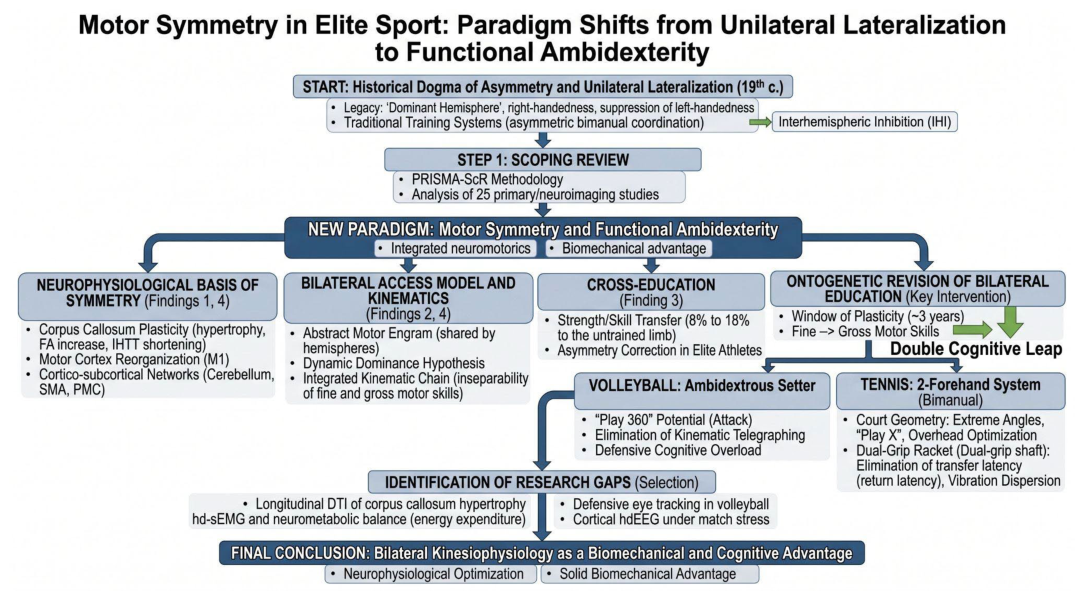

Table 1.
Systematic synthesis of studies on commissural plasticity, bilateral transfer, and athletic kinesiophysics [2,3,4,5,6,7,8,10,22,23,24,25,26,27,28,29,32,38,39,40,41,42,43,44,45].
| Ref. | Author and Year | Research Topic / Paradigm | Methodology | Main Finding(s) |
| 2 | Swinnen (2002) | Interhemispheric interactions | Biomechanics / Kinematics | Bilateral training reduces detrimental interhemispheric inhibition (IHI). |
| 41 | Gaser & Schlaug (2003) | Structural brain adaptations | MRI Volumetry | Bimanual training increases M1 volume and corpus callosum thickness. |
| 38 | Draganski et al. (2004) | Post-training neuroplasticity | MRI / VBM | 3 months of juggling learning increased grey matter volume in prefrontal cortex. |
| 3 | Swinnen & Wenderoth (2004) | Neurobiology of coordination | fMRI Review | Independent control of both hands activates a unique frontoparietal network. |
| 10 | Carson (2005) | Contralateral motor pathways | Neurophysiology | Unilateral training induces plastic changes in both hemispheres. |
| 32 | Schlaug et al. (2005) | Cognitive ontogenesis | Longitudinal fMRI | Bimanual exercises stimulate neurogenesis and cognitive transfer. |
| 25 | Charles & Gordon (2006) | Pediatric motor therapy | Clinical Trial | Intensive bimanual therapy (HABIT) drastically improves hand function in children. |
| 42 | Zatorre et al. (2007) | Multimodal motor integration | fMRI / MEG | Bilateral training integrates visual, auditory, and motor networks. |
| 8 | Johansen-Berg et al. (2007) | White matter and learning | DTI / FA | The rate of learning new patterns is proportional to FA in the corpus callosum. |
| 43 | Gordon et al. (2007) | Comparison of methods in children | RCT / Clinical | Bimanual training yields stronger effects on precision than constraint-induced movement therapy (CIMT). |
| 23 | Hyde et al. (2009) | Brain development in children | Longitudinal MRI | 15 months of bimanual exercises in 6-year-olds induce structural changes in PMC. |
| 7 | Scholz et al. (2009) | Activity-dependent plasticity | DTI / FA | De novo motor skill learning induces white matter microstructural remodeling. |
| 44 | Lee et al. (2010) | Contralateral motor transfer | fMRI / TMS | Cross-education increases excitability of the ipsilateral M1 cortex. |
| 5 | Fling et al. (2011) | Corpus callosum microstructures | DTI / FA | White matter coherence in the corpus callosum correlates with precision in asymmetric tasks. |
| 26 | Hinder et al. (2011) | Motor decline in aging | Longitudinal Trial | Maintaining bimanual activity protects the structural integrity of the corpus callosum. |
| 24 | Hung et al. (2011) | Reaching kinesiophysics | Kinematic Capture | Bimanual training eliminates temporal delays and smoothens acceleration/deceleration. |
| 6 | Fling & Seidler (2012) | Age-related motor control | DTI / TMS | Bilateral/bimanual experience prevents the age-related degradation of transcallosal inhibition. |
| 39 | Ruddy & Carson (2013) | Mechanisms of cross-limb transfer | TMS Review | Practicing with a weaker hand forces descending pathway reorganization in both hemispheres. |
| 4 | Gooijers & Swinnen (2014) | Structural-behavioral interactions | Review | Macrostructural integrity of the corpus callosum is the primary predictor of bimanual coordination. |
| 22 | Beets et al. (2015) | Corpus callosum and youth | DTI / Learning | High FA in the callosum allows flawless synchronization of premotor cortices. |
| 45 | Bleyenheuft et al. (2015) | Intensive training in children | MRI / fMRI | Early bimanual stimulation reduces hemispheric asymmetry of deficits. |
| 29 | Friel et al. (2016) | Cortical plasticity in children | TMS Mapping | 3 weeks of structured bimanual training enlarge M1 maps. |
| 27 | Mastalerz & Sadowski (2020) | Contralateral power transfer | Biomechanics | Unilateral leg strength strength training immediately improves explosive power in the opposite limb. |
| 28 | Ouyang et al. (2020) | Pediatric bimanual coordination | Clinical Metrics | Structured bimanual therapy leads to stable, long-term bimanual grip optimization. |
| 40 | Manca et al. (2021) | Quantification of cross-education | Meta-Analysis | Unilateral training drives a robust 8% to 18% strength transfer to the contralateral untrained limb. |
Disclaimer/Publisher’s Note: The statements, opinions and data contained in all publications are solely those of the individual author(s) and contributor(s) and not of MDPI and/or the editor(s). MDPI and/or the editor(s) disclaim responsibility for any injury to people or property resulting from any ideas, methods, instructions or products referred to in the content. |
© 2026 by the authors. Licensee MDPI, Basel, Switzerland. This article is an open access article distributed under the terms and conditions of the Creative Commons Attribution (CC BY) license (http://creativecommons.org/licenses/by/4.0/).
Copyright: This open access article is published under a Creative Commons CC BY 4.0 license, which permit the free download, distribution, and reuse, provided that the author and preprint are cited in any reuse.