
Submitted:
25 August 2026
Posted:
27 August 2026
You are already at the latest version
Abstract
High-entropy alloys (HEAs) extend alloy design beyond conventional solvent-based systems into vast multicomponent compositional spaces, enabling unusual combinations of structural and functional properties. This review connects the physical metallurgy of HEAs with the data-driven approaches increasingly used to accelerate their design and discovery. First, the thermodynamic and kinetic foundations of HEAs are examined, including configurational entropy, lattice distortion, diffusion behavior, and synergistic elemental interactions, while also considering the limitations of the classical core-effect framework. Liquid-state, solid-state, vapor-state, and emerging synthesis routes are then reviewed, with emphasis on how processing controls phase formation, chemical homogeneity, microstructure, defects, and contamination. The resulting mechanical, corrosion, thermal, electrical, and magnetic properties are discussed through processing–structure–property relationships. The second part evaluates artificial-intelligence and machine-learning approaches for phase classification, property prediction, interpretable modeling, active learning, Bayesian optimization, CALPHAD-assisted screening, and machine-learned interatomic potentials. Particular attention is given to the ability of these methods to reduce the experimental burden associated with the enormous HEA design space, as well as to persistent challenges involving data scarcity, class imbalance, inconsistent measurements, and inadequate representation of processing history and microstructure. Finally, emerging opportunities in transfer learning, generative models, physics-informed learning, and self-driving laboratories are discussed. By integrating physical metallurgy with data-driven design, this review provides a unified perspective on the transition from empirical alloy development toward accelerated HEA discovery.
Keywords:
multi-principal-element alloys
; physical metallurgy
; phase prediction
; active learning
; Bayesian optimization
1. Introduction
The historical development of metallurgy is illustrated by simple binary and ternary systems, from the Bronze Age to the complex superalloys of the 20th century. Most alloys are based on a single principal element and a number of minor elements which are added in order to change certain properties. In 2004, Cantor et al. [1] and Yeh et al. [2] independently reported that simple solid solutions are formed by alloys with five or more principal elements, in near-equiatomic ratios. These alloys are called multicomponent alloys by the former and high-entropy alloys by the latter.
The HEAs were defined by their near equimolar compositions (5–35 at.% per element) and their simple random solid solutions (RSS) character as opposed to typical brittle intermetallics.
Differing from the conventional alloys, which are based on a single principal element, HEAs are positioned at the multi-component centers of the phase diagrams [1,3,4,5]. High configurational entropy of the HEAs leads to low Gibbs free energy of the system. As a result, HEAs form stable single-phase solid solutions, which are far from intermetallic brittle phases. The HEAs exhibit unique properties, such as high cryogenic toughness, high thermal stability, and high resistance to deformation and to corrosion [3,6,7].
Refractory high-entropy alloys (RHEAs) are a class of HEAs containing mostly elements such as Nb, Ta, Mo, and W. These alloys have a high melting point and are characterized by a unique microstructure, due to the high-entropy effect. To date, HEAs are very promising for a number of industrial applications, and these are primarily due to their unique properties, such as high strength and good ductility [8,9,10,11,12,13,14]. These materials also retain their properties at very low temperatures [15,16,17,18], and at very high temperature [19,20,21,22]. They also have high thermal stability [23,24,25], and good corrosion resistance [26,27,28].
HEAs can also withstand radiation damage. This is due to the combination of chemical complexity and structural complexity found in the multi-principal element matrices of HEAs [25,29,30]. The severe compositional disorder found in HEAs results in a number of altered energy dissipation mechanisms, due to the reduced energy propagation mean free path for energy carrying species (e.g. electrons and phonons) in these systems [25,31]. The severe local lattice distortions found in HEAs impact on the generation and subsequent recombination of radiation-induced vacancies and interstitials [32,33]. Increased recombination rate and reduced defect mobility result in a number of beneficial effects including reduced dislocation growth, associated hardening and volume swelling in radiation damage sensitive nuclear environments [34]. The ability of HEAs to possess a `self-healing’ capability, and as such their potential use as structural alloys in advanced nuclear reactors is of great interest [35].
While promising the development of novel materials, the high dimensionality of the compositional space of multi-principal elements creates huge problems for their ` `discoveries’ ’ [6,36,37,38,39]. In fact, while the number of possible quinary systems (i.e., systems with 5 components) is already greater than 17 million (for 75 stable elements) [40]. The introduction of non-equimolar compositions, of multi-phase systems, and of processing history variables in the search space causes an enormous increase of the number of variables within an exponentially increasing search space [6,39,41]. Consequently, experimental as well as computational investigations are still limited. While trial-and-error approaches in experimental metallurgy fail rather quickly, first-principles quantum calculations, such as DFT, are even more severely limited by the so-called ` `precision-cost’ ’-problems in multi-component systems [40,41,42,43].
Data-driven materials science and, in particular, the application of AI and ML has become a transformative accelerant for materials science research overcoming current research barriers [36,40,44,45] (Figure 1). By using advanced physical and elemental descriptors, trained on public databases of materials as well as on high-throughput literature, ML methods can predict within seconds the phase stability, the structural as well as the mechanical properties of a material [40].
The review will be presented in two parts. In the first part a summary of the materials background will be given. This includes relevant thermodynamic and kinetic principles, different ways of entropy-based classification of HEAs, established methods of HEA synthesis, and the resulting mechanical, corrosion, thermal, electrical and magnetic properties. In the second part the application of AI and ML to design and to predict new HEAs will be presented and the existing limitations due to the inherent data limitations of the materials background established in the first part will be discussed.
2. Thermodynamic and Kinetic Principles
2.1. The Four Core Effects
The four “core effects” first proposed by Yeh et al. [46] for HEAs explain their unique mechanical and physical properties. These four core effects are: the high entropy effect, the sluggish diffusion effect, the lattice distortion effect, and the cocktail effect. These four core effects explain why multicomponent systems, such as HEAs, behave so differently from traditional solvent-based alloys.
2.1.1. The High Entropy Effect
2.1.2. The High Entropy Effect
The high-entropy effect is the most defining characteristic of this alloy class, proposing that high configurational entropy ( ) effectively lowers the system’s Gibbs free energy. According to the fundamental relation, eq. 1, the total Gibb’s free energy is
Where is the enthalpy, is the entropy and T is the temperature.
A sufficiently high entropy value promotes phase stability by minimizing the total free energy.
By approximating purely as the configurational entropy of mixing for a random solid solution (RSS), Boltzmann’s relationship can be used to correlate thermodynamic stability directly to the total number of constituent elements (n). This relationship is expressed in Equation (2):
where R represents the gas constant and denotes the atomic fraction (concentration) of the ith component. The above expression for the configurational entropy term in a multi-component system shows a systematic increase with an increasing number of principal components. For a multi-component configuration, even reaches a maximum value, which is large enough to counterbalance the formation enthalpy of competing phases, like pure elemental and/or brittle intermetallic compounds. Therefore, favors the formation of a disordered random solid solution (RSS) phase. In contrast to the early work, which focused on single phase stability, recent studies found that this effect even increases solubility limits for a variety of elements, even for systems that form multiple phases [25,46]. This effect is critical for the design of RHEAs and of High-Entropy Functional Materials (HEFMs) [25], which are required to exhibit structural symmetry and phase stability over wide temperature ranges.
2.1.3. The Sluggish Diffusion Effect
The sluggish diffusion in HEAs is associated with slow atomic migration compared to conventional alloys. The local bonding environments in HEAs are highly diverse, and accordingly, the fluctuations in the lattice potential energy (LPE) are substantial [25,47,48]. As atoms migrate through a multi-element lattice, they encounter "deep traps" (low-energy sites) that retard their motion, while jumps into high-energy sites often lead to immediate "rebounding" to original positions [46,49,50]. The sluggish diffusion effect significantly affects the phase transformations as well as the formation of nanostructures in HEAs. While it hinders the phase transformations, it at the same time enables high-temperature structural stability and creep resistance [25,49]. Recently, the sluggish diffusion effect is also used for high-entropy oxides (HEOs) [25] in order to maintain nanocrystalline structures during processing and application. Even though the sluggish diffusion effect is not universally applicable for all systems, it is a central pillar for the explanation of the exceptional thermal stability of HEAs [49,51].
2.1.4. The Lattice Distortion Effect
The severe lattice distortion effect in HEAs is caused by the large size difference between atoms of different species occupying equivalent sites in a random solid solution of the HEA [46,47,50,52]. While in conventional alloys solute atoms occupy only a small fraction of lattice sites, in HEAs every atom can be considered as a solute atom, leading to a highly strained lattice. The atoms are severely deviated from their ideal positions [25]. Severe lattice distortion leads to intrinsic lattice friction that hinders dislocation motion. This results in increased yield strength and hardness of the material [25,46]. Phonon and electron scattering increase with severe lattice distortion, leading to decrease in thermal and electrical conductivity, which is critical for high-entropy alloys used for thermoelectric applications.
2.1.5. The Cocktail Effect
The term `cocktail effect’ which refers to the synergistic interaction between multiple principal elements to produce unexpected composite properties, was first introduced by Professor S. Ranganathan [53]. The unique property of an HEA is not a simple average of the individual component’s physical properties, but rather a complex sum of all the individual and collective interactions between all of the components [49]. For example, the introduction of specific transition metals can have non-linear effects, i.e. it can increase magnetic values, improve corrosion resistance and allow for high-entropy stabilization of advanced catalysts. The cocktail effect enables the precise tuning of functional behaviors, such as achieving negative thermal expansion or optimizing selectivity in electrocatalytic reactions, by selecting the elemental "ingredients" of the multi-metallic mixture [25,46].
3. Classification of HEAs Based on Entropy
The entropy-based definition classifies alloys based on their total mixing entropy [54]. Alloys can be broadly classified into three classes on the basis of total mixing entropy:
- Low-Entropy Alloys (LEAs):
- Medium-Entropy Alloys (MEAs):
- High-Entropy Alloys (HEAs):
Here, R is the ideal gas constant. In an equimolar alloy, typically 5 or more elements are required to exceed the 1.5R threshold () [49]. In the early days of these alloys, most work focused on single-phase, solid solutions. However, more recently, the Complex Concentrated Alloys (CCAs) and MPEAs have gained considerable interest, which may possess multiphase microstructures including intermetallics [55,56].
4. Production of HEAs
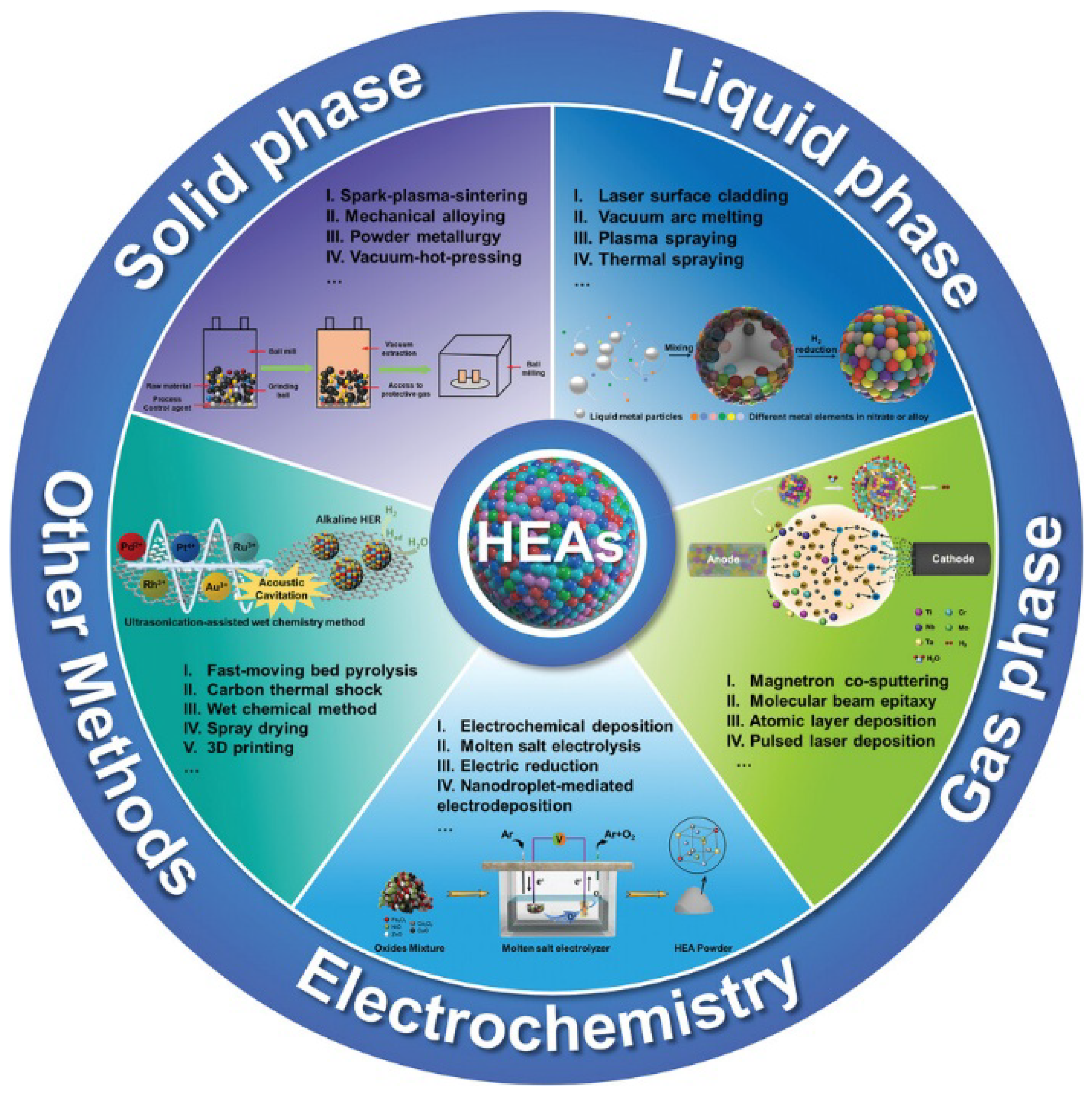
Methods for HEA synthesis can be classified in four categories: liquid-state, solid-state, gas-state and novel synthesis methods [57]. he choice of a method for HEA synthesis is critical, because it determines the alloy’s phase constitution, the homogeneity of its microstructure, and its mechanical, magnetic and corrosion properties. An overview of the different methods for HEA processing is presented in
Figure 2.
Various processing routes of HEAs. (Adapted from Wang et al. [57]).
Figure 2.
Various processing routes of HEAs. (Adapted from Wang et al. [57]).
4.1. Liquid-State Synthesis
Liquid-state synthesis in bulk form of HEAs is by far the most common method. Most of these well-established techniques for other alloy systems are directly applied to HEAs. These methods are arc melting, induction melting, electric resistance melting, laser cladding, Bridgman solidification, and laser enhanced net shaping (LENS) [58,59,60]. Arc melting is the most common process to produce compounds by high temperature melting of refractory elements under homogenous mixing of all elements within a controlled atmosphere of inert gases. The process of casting has several inherent difficulties, such as elemental segregation, and the formation of dendritic structures. The homogeneous composition, which is required, can be obtained by long high-temperature homogenization treatment.
Wan et al. (2022) [61] used vacuum arc melting to produce WReTaMo RHEA. That material showed exceptionally high softening resistance and high compressive strength of 244 MPa at 1600 °C, far exceeding the performance of conventional Ni-based superalloys used for aviation and nuclear applications. At high temperature, the main deformation mode is grain boundary sliding. Surface carburizing after annealing in graphite at temperatures above 1800 °C leads to the formation of an FCC solid solution with enhanced hardness by solid-solution hardening.
Hou et al. (2019) [62] fabricated a series of AlFeCoNiBx (x = 0, 0.05, 0.10, 0.15, 0.2) alloys using vacuum arc melting. The resultant alloys were characterized for their microstructures and mechanical properties. The results showed that the fracture strength increased from 850 MPa for x = 0 to 2293 MPa for x = 0.2. The corresponding plastic strain increased from 0.07 to 0.27. The increase in yield strength was due to interstitial solid solution hardening and fine-grain refinement induced by the B atoms. The formation of beneficial face-centered cubic (FCC) eutectic matrix structure were attributed for the increase in ductility and plasticity.
Wang et al. (2025) [63] studied the effect of titanium additions on the microstructure and mechanical properties of a CoCrFeNiMn HEA. The CoCrFeNiMnTix (x = 0, 0.2, 0.4, 0.6, 0.8) HEA were prepared by vacuum arc melting. A single FCC phase was found to exist in the initial alloy. However, the FCC phase transforms to a dual-phase FCC + BCC matrix with increasing Ti content and the precipitation of the hard and brittle Laves phase occurs. Consequently, this microstructural shift successfully enhanced both the overall hardness and mechanical strength of the multi-principal element system.
4.2. Solid State Synthesis
The solid-state route uses mechanical alloying (MA) [64,65,66] and subsequent consolidation by spark plasma sintering (SPS), hot pressing sintering (HPS), or hot isostatic pressing (HIP) [67,68,69]. MA is a high-energy ball milling process, during which Powder particles experience repeated cold welding, fracturing, and re-welding, resulting in formation of nanocrystalline and amorphous phases, which are difficult to be formed by conventional liquid-state processes. A major advantage of MA is its ability to alloy elements with vastly different melting points or those that are immiscible in the liquid state. Planetary ball milling can be used for solid-state synthesis of HEAs on a large scale. Subsequent consolidation of the milled powder by SPS is preferred, because the high heating rates and short holding times at SPS processing prevent grain growth, and the resulting nanocrystalline powder structure is preserved.
Varalakshmi et al. (2008) [64] pioneered the synthesis of nanostructured, equiatomic AlFeTiCrZnCu high entropy alloy, tracing phase evolution from binary to hexanary configurations via mechanical alloying. The resulting mechanical alloys were found to solidify into a body-centered cubic (BCC) crystal structure with extremely small crystallite sizes below 10 nm. The as-sintered AlFeTiCrZnCu alloy has a density of 99% and high hardness of 2 GPa. The alloy exhibited high thermal stability without any phase separation even after 1 hour annealing at 800 °C.
Wang et al. (2014) [70] favricated an equiatomic CoCrFeNiMnAl HEA via MA process. They achieved a highly refined solid-solution matrix with a 20 nm grain size after 30 hours of milling. Annealing the as-milled powder above 500 °C transformed the powder into a FCC phase. The bulk alloy was subsequently consolidated by means of SPS at 800 °C, to form a FCC + BCC dual-phase structure. The resulting alloy had high hardness of 662 HV and high compressive strength of 2142 MPa.
Joo et al. (2017) [71] fabricated the CoCrFeMnNi HEA using MA and SPS method, demonstrating that processing duration, sintering temperature, and interstitial impurities significantly affect the resulting microstructure and mechanical properties. A nanocrystalline FCC matrix was retained at 900 °C and 1100 °C for sintering. However, carbon contamination formed localized Cr carbides on the surface of the alloy. In addition, ZrO2 contaminants were introduced from the milling media.
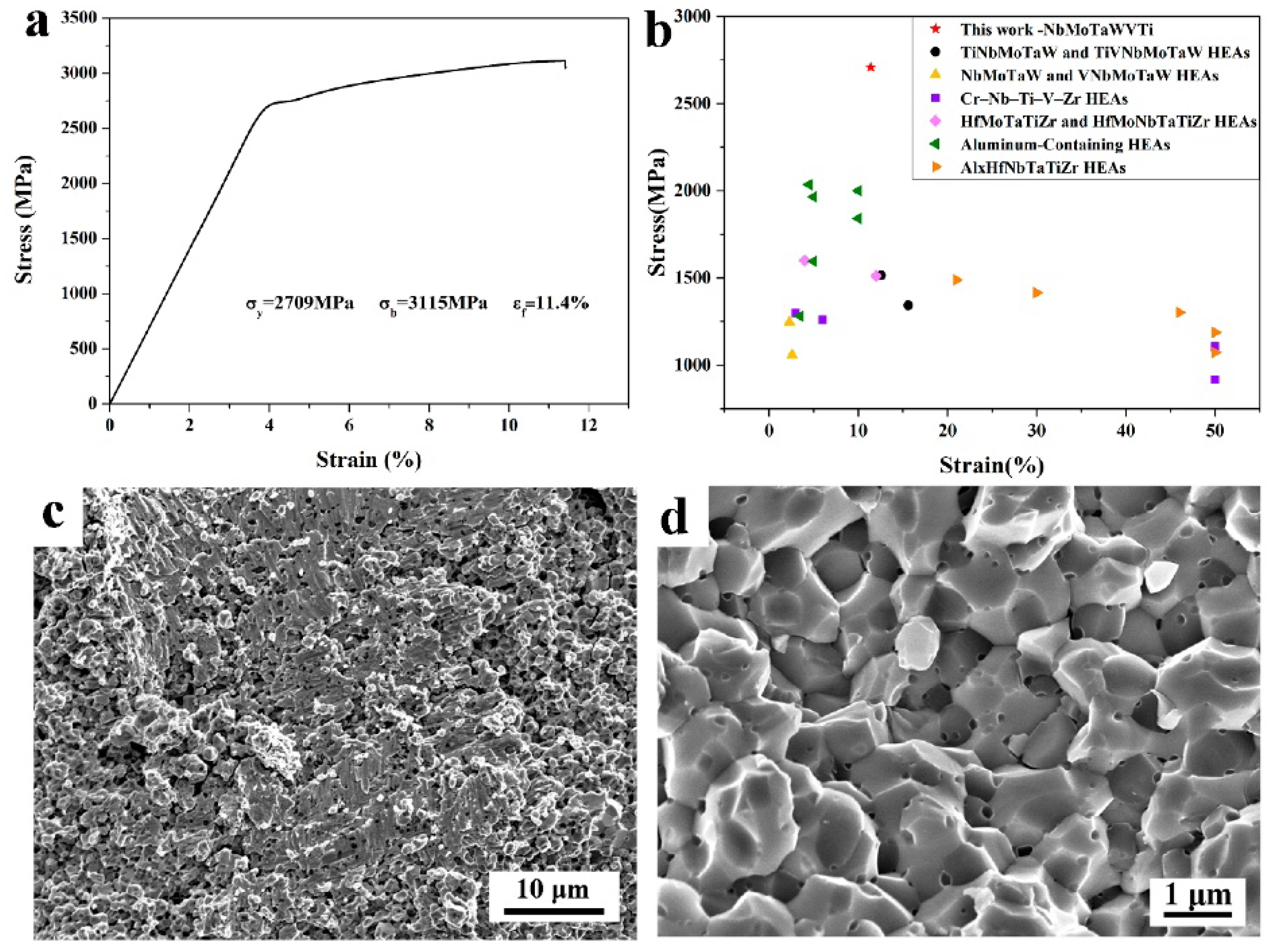
Long et al. (2018) [65] successfully synthesized an equiatomic NbMoTaWVTi RHEA by a combination of MA and spark SPS. The alloy showed exceptional mechanical properties in compression with high yield strength of 2709 MPa, high ultimate fracture strength of 3115 MPa, and high fracture strain of 11.4%. Moravcik et al. (2020) [72] evaluated investigated interstitial contamination in a CoCrFeNi HEA and a 316L stainless steel reference processed by MA and spark plasma sintering in argon and in nitrogen atmospheres. The results showed that milling time, nitrogen atmosphere processing and the use of an ethanol process control agent (PCA) in the ethanol-based processing significantly increased the contamination by carbon, oxygen, and nitrogen.
Figure 3.
Mechanical behavior and microstructural characteristics of bulk NbMoTaWVTi HEA. (a) Representative compressive engineering stress-strain curve. (b) Comparison of compressive yield strength versus fracture strain between the current HEA and previously reported literature values. (c) Low-magnification SEM micrograph of bulk HEA showing overall fracture morphology. (d) High magnification showing intergranular fracture features. (Adapted from Long et al., [65]).
Figure 3.
Mechanical behavior and microstructural characteristics of bulk NbMoTaWVTi HEA. (a) Representative compressive engineering stress-strain curve. (b) Comparison of compressive yield strength versus fracture strain between the current HEA and previously reported literature values. (c) Low-magnification SEM micrograph of bulk HEA showing overall fracture morphology. (d) High magnification showing intergranular fracture features. (Adapted from Long et al., [65]).
This progressive pickup of interstitials, driven by atmospheric exposure and the wear of high-carbon steel milling media, directly triggered the formation of unwanted contaminant phases during subsequent consolidation.
Razumov et al. (2021) [73], successfully synthesized the new HEA CrMoNbWV in bulk form using MA followed by SPS at temperatures between 1200 °C and 1400 °C. While the as-milled powders initially exhibited a single BCC solid solution, sintering led to partial decomposition into a mixture of oxides and Laves phases. The as-milled powders were a single BCC solid solution. On sintering, partial decomposition into different oxides and Laves phases took place. BCC grain growth and grain boundary precipitation of Laves phase with temperature up to 1400 °C were observed. The sintered samples showed high mechanical integrity with high hardness and compressive strengths at room temperature up to 2800 MPa.
Lv et al. (2026) [74] studied the high-temperature corrosion behavior of the CrMnFeCoNi HEA, which was fabricated by HIP method and then tested in the NaCl-KCl molten salt environment. The processed alloy consists of a fully single-phase FCC structure. The alloy has very homogeneous distribution of elements. No chemical segregation was found in the alloy.
4.3. Gaseous State Synthesis
Gas or vapor-state synthesis methods like magnetron sputtering, pulsed laser deposition (PLD), and molecular beam epitaxy (MBE) are used for the synthesis of HEA thin films and coatings [75,76,77,78,79,80,81,82,83]. Magnetron sputtering allows atomic-level control over composition and thickness by bombarding a multi-element target with high-energy ions in a vacuum environment. Although thin films of high quality and uniform surface are produced by these methods, films of this high quality are very expensive. Special equipment is required to produce thin films. For production of bulk material on a large scale these methods are not suitable.
Chang et al. (2008) [75] utilized direct current magnetron sputtering to deposit multi-principal element films from an Al20Cr20Mo20Si21Ti19 alloy target across various reactive argon/nitrogen atmospheres. While pure Argon or lower nitrogen flow rates yielded amorphous thin films, higher nitrogen concentrations successfully stabilized a single-phase FCC (AlCrMoSiTi)N solid solution, suppressing the formation of immiscible binary nitrides regardless of the substrate bias or temperature. Furthermore, films deposited under a -50V bias at 573 K achieved peak hardness values of 22 to 25 GPa at specific N2/(Ar + N2) ratios of 50% and 67%, respectively.
Cheng et al. (2011) [84] deposited (AlCrMoTaTiZr)Nx films on silicon and cemented carbide substrates via reactive RF magnetron sputtering, with nitrogen flow ratio governing the structural evolution from amorphous to single-phase FCC. Nitride films with ≥37 at.% N had the NaCl-type FCC structure and the phase remained stable up to 1000 °C. The film deposited at RN = 40% reached a peak hardness of 40.2 GPa. Grain-size and solid-solution hardening were identified as the dominant hardening mechanisms.
Shaginyan et al. (2016) [77] reported that magnetron-sputtered Al–Cr–Fe–Co–Ni–Cu–V HEA coatings adopted a nanocrystalline, textured dual-phase structure comprising BCC (a = 2.91 Å) and FCC (a = 3.65 Å) solid solutions. Applying a substrate bias voltage (0 to –200 V) reduced the deposition rate and shifted coating composition away from the target stoichiometry, selectively depleting Al, Cu, and Ni while increasing microhardness. The coatings additionally exhibited structural anisotropy dependent on deposition conditions.
Liao et al. (2019) [85] prepared ~4 m thick nanocrystalline Al0.3CoCrFeNi HEA thin films by magnetron sputtering technique that displayed a smooth surface with roughness below 5 nm and a chemically homogeneous, single-phase FCC structure. The mechanical testing showed that the hardness and yield stress of the printed material were about 3 times higher than for the corresponding bulk material.
Yu et al. (2021) [86] deposited CrNbSiTiZr HEA films on 304 stainless steel and Si substrates via RF magnetron sputtering at substrate bias voltages ranging from 0 to –200 V. Increasing the bias voltage progressively eliminated the columnar morphology due to re-sputtering effects and densification of the film. The highest hardness of 12.4 ± 0.3 GPa was obtained for the film deposited at –50 V with a corresponding residual compressive stress of –0.82 ± 0.04 GPa.
4.4. Novel Synthesis Methods
Beyond these established routes, several novel synthesis methods have been developed to improve HEA properties and enable the production of nanoparticles. Electrochemical synthesis, including electrodeposition and molten salt electrolysis, offers a simple and energy-efficient way to grow HEA nanoparticles and coatings with controllable morphologies [87,88,89,90,91,92]. Carbothermal shock (CTS) or thermal shock synthesis is a process that uses rapid Joule heating (>2000 K) followed by ultrafast quenching. The resulting atoms of the constituents are frozen in a disordered high-entropy state, leading to the formation of ultrasmall uniform nanoparticles (often < 5 nm) [93].
Further unconventional approaches include plasma-related synthesis, such as spark discharge in water and plasma arc discharge, which are effective for fabricating spherical HEA powders and quantum dots [94,95]. Microwave-assisted synthesis is based on selective and volumetric heating of a reaction mixture of metal precursors to start up the reaction within a short time frame. This allows for avoiding the typical processing time and related defects as encountered in furnace-based synthesis [59,96,97]. Various cost-effective methods for the synthesis of nanocrystalline HEAs and HEA-matrix composites, such as combustion-assisted synthesis (e.g., sol-gel auto-combustion) and high-gravity combustion, utilizing exothermic aluminothermic reactions have been developed [98]. These various routes of high-temperature metallurgy and mild solution chemistry form the basis for the design of high- performance high-entropy materials.
5. Properties of HEAs
5.1. Mechanical Properties
HEAs have superior mechanical properties which are basically dependent on the unique local chemical ordering and microstructures, which can be engineered using the specific control of alloy compositions and processing parameters. The overall hardness and strength of these multi-component matrices are primarily dictated by three critical microstructural factors: the intrinsic hardness and strength of each individual constituent phase, the relative volume fraction of these coexisting phases, and the morphology and spatial distribution of the constituent phases throughout the microstructure [3].
Among the earliest systematically studied HEA families, the 3d transition metal alloys-particularly the equiatomic CoCrFeMnNi (Cantor alloy) and its derivatives such as CoCrFeNi and CoCrNi-emerged as model systems for understanding structure–property relationships. Characterization of the CoCrFeMnNi alloy by Otto et al. [99] revealed that its FCC solid solution exhibited excellent tensile ductility alongside moderate strength. Transmission electron microscopy (TEM) showed that at small strains (< 2.4%), plasticity was governed by planar slip of 〈110〉-type dislocations on {111} planes. At 77 K, deformation twinning becomes the dominant deformation mechanism at higher strains. In contrast, at room temperature (293 K), the material deforms by the formation of dislocation cell structures. Texture analysis following 90% cold rolling revealed a predominantly brass-type texture, indicative of a low stacking fault energy (SFE) in these alloys [99]. Bhattacharjee et al. [100] later attributed this low SFE to the elevated free energy of the perfect crystal in HEAs, demonstrating that the high energy level of the distorted matrix combined with strain energy relief from in situ atomic position adjustments significantly lowers the SFE.
The significance of cryogenic mechanical behavior in FCC HEAs was reported by Gludovatz et al. (2014) [4]. They reported that the CoCrFeMnNi alloy exhibited fracture toughness values exceeding 200 MPa·m1/2 at 77 K-among the highest ever recorded for any metallic alloy-while simultaneously exhibiting increased tensile strength relative to room-temperature performance. Normally the toughness degrades at low temperatures in conventional metals. The anomalous behavior of this novel alloy is due to the activation of multiple deformation mechanisms such as dislocation slip and twinning-induced plasticity (TWIP) which are facilitated by the alloy’s low SFE. The ternary CoCrNi alloy had an exceptionally high tensile strength of approximately 1.3 GPa, tensile ductility of ~90%, and a crack extension and crack initiation toughness, KJIc = 273 MPa·m1/2 at 77 K [101].
Single-phase FCC HEAs exhibit outstanding toughness and ductility but low yield strength at room temperature. Thus, achieving strength-ductility synergy for these alloys is of considerable interest. A pivotal advance was reported by Li et al. (2016) [102], who developed a metastable dual-phase FCC+HCP HEA that overcame the strength–ductility trade-off by exploiting transformation-induced plasticity (TRIP). Subsequently, Lei et al. (2018) [8], an ordered oxygen-complex mechanism to introduce interstitial oxygen atoms into the TiZrHfNb refractory matrix. The resulting alloy exhibited not only increased yield strength but also improved tensile ductility, a finding that underscored the potential of interstitial alloying in HEAs.
Lv et al. (2024) [103], studied the combined effect of C and Mo microalloying in as-cast and hot-rolled [Co40Cr25(FeNi)35-yMoy]100-x Cx HEAs, showing that a 0.5 at.% C addition stabilized a single FCC phase and refined the grains to give the Mo4C0.5 alloy a yield strength of 757 MPa, tensile strength of 1186 MPa, and 69% elongation which together exceed the strength-ductility balance of most reported HEAs and conventional alloys as shown in Figure 4 [103].
In parallel, the RHEA family have now emerged as a distinct class of materials targeted at high-temperature structural applications. Senkov et al. (2010) [104], pioneered this field by developing NbMoTaW and NbMoTaWV alloys via vacuum arc melting. These alloys, with BCC structures, demonstrated room-temperature yield strengths of 1058 MPa and 1246 MPa, respectively, and retained strengths of 405 MPa and 477 MPa at 1600 °C - substantially exceeding those of nickel-based superalloys such as Inconel 718 at comparable temperatures [104,105]. However, these early RHEAs exhibited negligible room-temperature plasticity, a critical limitation for practical deployment. To address this, Han et al. (2017) [106], explored titanium additions to NbMoTaW and VNbMoTaW alloys, reporting that Ti incorporation enhanced ductility from 1.9% to 11.5% while increasing yield strength to up to 1455 MPa. The enhanced ductility and yield strength was attributed to the microstructural refinement and solid solution softening of the BCC matrix. The dual-phase eutectic HEAs are of particular interest for structural applications, because they combine high strength, high ductility, and good castability [107]. Their mechanical properties can be further optimized by means of microstructural tuning through thermomechanical processing [108] or by adding second phase or heterostructures [109,110].
5.2. Corrosion Properties
Corrosion remains one of the most economically significant forms of materials degradation. According to the 2016 National Association of Corrosion Engineers (NACE) study, global corrosion-related costs total approximately USD 2.5 trillion annually, corresponding to nearly 3.4 % of world GDP [111]. Consequently, the search for alloys with superior corrosion resistance is a major driver of HEAs research, as they are promising alternatives to conventional stainless steels [112,113]. Among refractory systems, Zhou et al. (2019) [114], examined the Hf0.5Nb0.5Ta0.5Ti1.5Zr RHEA in 3.5 wt.% NaCl solution. They reported a corrosion current density roughly one-fifth that of 316L stainless steel, together with a pitting potential of +8.36 V, the highest reported among RHEAs at the time. The superior corrosion resistance was due to two main factors: a single-phase solid solution with evenly distributed passivity-promoting elements, and a passive film containing metallic Ta and OH- species that prevent film degradation.
Motallebzadeh et al. (2019) [115], compared TiZrTaHfNb and Ti1.5ZrTa0.5Hf0.5Nb0.5 RHEAs in phosphate-buffered saline and found both alloys to exhibit markedly higher pitting and general corrosion resistance than 316L, CoCrMo, and Ti6Al4V, with the Ti-rich Ti1.5ZrTa0.5Hf0.5Nb0.5 composition performing best, supporting the suitability of these RHEAs for biomedical applications. More recently, Chen et al. (2026) [116], reported that single-phase Nb25Mo25Ta25Ti20W5Cx (x = 0.1, 0.3, 0.8 at.%) RHEAs retain excellent corrosion resistance even in high-concentration (up to 23.5 wt.%) NaCl solution, with corrosion current densities nearly two orders of magnitude lower than 304L stainless steel, owing to the formation of passive films containing less defects and thermodynamically stable passive oxides. Zhao et al. (2024) [117], combined experiments and first-principles simulations on TiNbTa-based RHEAs and demonstrated that prolonged annealing increases chemical heterogeneity and work-function mismatch between regions, which lowers corrosion potential (Ecorr) and degrades corrosion resistance, highlighting that annealing effects on RHEA corrosion are composition dependent. Bamisaye et al. (2024) [118], further showed that TiNbTaVW RHEAs maintain stable passive behavior in both 3.5 wt.% NaCl and 1 M H2SO4, underscoring the versatility of body-centered cubic RHEAs across both chloride and acidic environments.
Corrosion behavior has also been studied extensively for FCC HEAs based on the Co–Cr–Fe–Ni system, as summarized in the review by Shi et al. and Liang et al. [119,120]. The addition of Cu in HEAs has detrimental effect on the corrosion properties [121,122]. Hsu et al. [121] investigated the corrosion properties of FeCoNiCrCux HEAs in 3.5% NaCl solution. Additions of Cu promote the formation of a Cu-rich interdendrites phase that is susceptible to galvanic corrosion and forms a poorly protective passive film, narrowing the passivation region and hence increases the corrosion tendency. Ren et al. [122] investigated the influence of Cu content and elemental segregation on the corrosion properties of CuCrFeNiMn alloys. They found that high Cu content and elemental segregation degrades the corrosion resistance as shown in Figure 5. Among the tested compositions, the CuCr2Fe2Ni2Mn2 alloy exhibited better corrosion resistance, a performance directly tied to its low Cu content and minimal elemental segregation. Conversely, the Cu2Cr2Fe2Ni2Mn2 having high amount of Cu and elemental segregation had the lowest corrosion resistance.
Similarly, the Al content also affects the corrosion resistance of HEAS [54,123,124,125,126,127]. Lee et al. [123] studied the AlxCrFe1.5MnNi0.5 alloys and their corrosion properties in H2SO4 and NaCl solutions. They found that corrosion resistance improves as Al content decreases. Furthermore, SEM analysis confirmed that higher Al concentrations increase susceptibility to both general and pitting corrosion, indicating that minimizing aluminum content is critical for optimizing the corrosion resistance of these high-entropy alloys. Shi et al. [124] investigated AlxCoCrFeNi alloys and found that high-temperature homogenization at 1250 °C significantly reduced elemental segregation and simplified multi-phase microstructures. This microstructural refinement stabilized local work functions and suppressed micro-galvanic coupling, thereby markedly improving the alloys’ localized corrosion resistance. A study on AlFeNiCoCuCr HEAs in 3.5% NaCl [125] revealed that thermal processing markedly enhances corrosion resistance, ranking from annealed (highest) to remelted and as-cast (lowest). The enhancement in corrosion resistance is attributed to microstructural transformations within the alloy.
Shi et al. [126] investigated the microstructure and corrosion behavior of Alx(CoCrFeNi)100-x alloy fabricated by magnetron co-sputtering. The thin films’ crystal structure changed from face-centered cubic (FCC) to body-centered cubic (BCC) with increasing Al concentration, all the while preserving a uniform elemental distribution in both phases. While the Alx(CoCrFeNi)100-x alloy thin film showed excellent corrosion resistance, electrochemical analyses in a 3.5 wt.% NaCl solution showed that their corrosion performance systematically decreased at higher Al concentrations. The composition and constitution of the passive film were directly responsible for this deterioration in corrosion resistance.
Recent comparative electrochemical work on gradient-structured and laser-surface-treated CoCrFeMnNi alloys [128] further showed that grain refinement and surface engineering, can be used to tune passive film performance relative to austenitic stainless steels. Collectively, these studies indicate that corrosion resistance in HEAs is governed by an interlinked set of factors - single-phase homogeneity, the identity and distribution of passivity-promoting elements (Cr, Ta, Nb, Mo, Ti), and processing-induced microstructural segregation - that can be deliberately engineered to outperform conventional stainless steels in both chloride and acid-bearing environments.
5.3. Thermal Properties
Earlier studies by Chou et al. [129] on the AlxCoCrFeNi system and Lu et al. [130] on AlxCrFe1.5MnNi0.5Moy established that thermal conductivity and thermal diffusivity in these alloys typically increase with temperature (between 293 and 573 K), a trend that is opposite to that observed in pure metals but similar to highly alloyed stainless steels and nickel-based superalloys. Both thermal conductivity and thermal diffusivity of the alloys increase with increasing temperature between 293 and 573 K, spanning in the range of 10-27 W.m-1K-1 and 2.8-3.5 mm2s-1, respectively. This behavior is primarily attributed to severe lattice distortion and phonon scattering. FCC-structured HEAs with low Al content (x < 0.375) generally exhibit only half the thermal conductivity of BCC-structured HEAs with high Al content (x > 0.375). They found that with increase in Al content in the single-phase regions, the thermal conductivity decreases.
Laplanche et al [131] fabricated equiatomic CoCrFeMnNi HEA by vacuum induction melting and drop casting process. They found that the coefficient of thermal expansion () of the single-phase, FCC CoCrFeMnNi HEA exhibits a non-linear temperature dependence similar to that of austenitic steels, increasing monotonically from approximately 15 x 10-6 K-1 to 23 x 10-6 K-1 across the 300-1270 K range according to the empirical relation: . Laplanche et al. [132] also investigated the thermal expansion coefficients (TECs) of FCC-based transition metal HEAs between 100 K and 673 K. These alloys have similar thermal expansion behavior to austenitic steels [133] and pure metals.
He et al. [134] investigated Co25Ni25(HfTiZr)50 alloy that shows an extraordinary Elinvar effect, maintaining a constant elastic modulus from room temperature up to 900 K, a performance that surpasses all previously reported conventional alloys. More recently, Arun et al. (2026) [135] investigated the effect of entropy engineering via Ag alloying on the thermal and electrical transport properties of the CoCrFeNi system for thermoelectric applications. They observed that the CoCrFeNiAg0.2 alloy exhibited a low lattice thermal conductivity of about 1.34 Wm-1K-1 at 700 K, which is an 8.6-fold reduction compared to the parent matrix - driven by severe lattice distortions from mass and size disorder.
5.4. Electrical Properties
The electrical properties of HEAs have emerged as a critical area of functional materials research, offering a unique combination of high resistivity, low temperature sensitivity, and superconductivity that often surpasses traditional alloys. Chou et al. [129] studied the electrical properties of AlxCoCrFeNi (0 < x< 2) alloys prepared by arc melting method. Electrical resistivity rises linearly with temperature for each of these alloys. The usual range of electrical resistivity is between 100 and 200 -cm. The alloy transforms from a single FCC phase to a single BCC phase with a transition duplex FCC/BCC region as x increases. In single-phase regions, both thermal and electrical conductivity values decrease as x increases [129].
Figure 6.
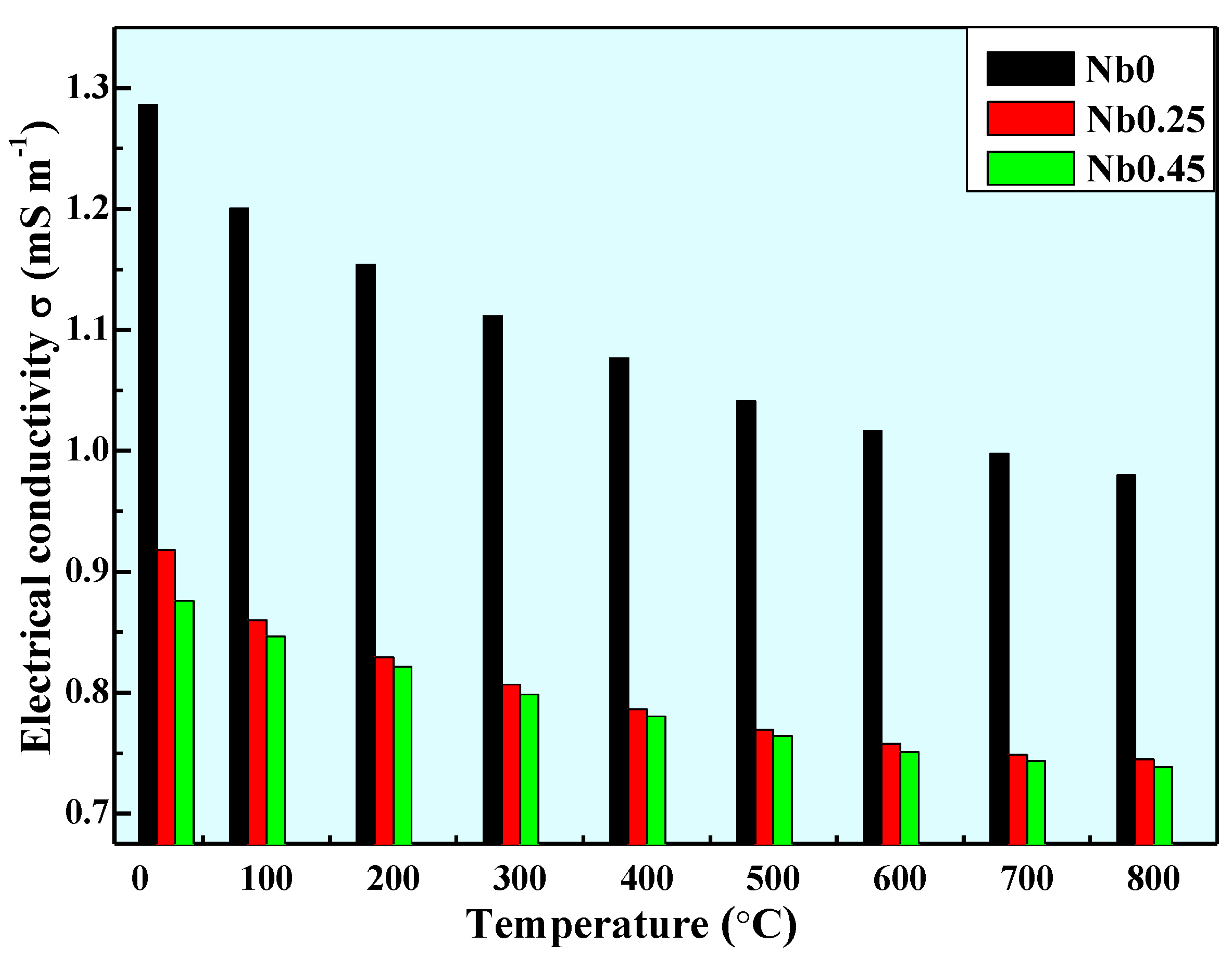
Electrical conductivity measured as a function of temperature for CoCrFeNiNbx (x = 0, 0.25, 0.45). (Adapted from Han et al., [137]).
Figure 6.
Electrical conductivity measured as a function of temperature for CoCrFeNiNbx (x = 0, 0.25, 0.45). (Adapted from Han et al., [137]).
Kao et al. [136] also investigated the electrical, magnetic, and Hall properties of AlxCoCrFeNi HEAs in 4.2 to 300 K temperature range and found electrical resistivity in 100-220 -cm range. Due to the onset of ferromagnetism at 5 K, all compositions in this system exhibit a pronounced anomalous Hall effect (AHE). The anomalous Hall coefficient in these alloys is significantly larger than the ordinary Hall coefficient. While the carrier densities (1022 - 1023 cm-3) are comparable to those of conventional alloys, the carrier mobility (0.40-2.61 cm2V-1s-1) is notably lower, likely as a consequence of high lattice defect density. In some alloys, Kondo-like behavior was also reported at low temperatures; the causes of these phenomena are still not fully understood [136].
Han et al. [137] observed that the electrical conductivity of CoCrFeNiNbx (x =0, 0.25, 0.45) systematically decreased with increasing Nb content. The Nb-free CoCrFeNi alloy exhibited the highest conductivity. They attributed this trend to microstructural changes, since a higher Nb content increased the volume fraction of the eutectic structure. Increasing the concentration of both Al and Si in FeCoNi(AlSi)x (0 ≤ x ≤ 0.8) alloys, results in resistivities near 80 -cm, which increases sharply to 264 -cm at peak concentrations [138]. It was observed that the electrical resistivity generally rises from x = 0 to x = 0.8, with a slight deviation between 0.3 < x ≤ 0.5. Notably, while XRD identifies only a BCC phase at these higher content of Al and Si, microstructural analysis clearly reveals a dual-phase structure characterized by significant elemental segregation. Similarly, Zuo et al. [139] investigated a series of AlxCoFeNi and CoFeNiSix (x = 0, 0.25, 0.5, 0.75 and 1) HEAs to study the effects of Al and Si addition on the electrical and magnetic properties. Adding Al or Si to the alloy significantly increases the electrical resistivity, with Si driving a sharper rise from 16.7 -cm to a peak of 82.89 -cm. Both alloys reach their maximum electrical resistivity at x = 0.5, a peak that is likely driven by the nature of their multiphase microstructures. Ultimately, Si proves to be the more effective alloying element than Al for increasing resistance, making it highly favorable for minimizing eddy current losses in the material.
Huang et al [140] studied the effect of Cu addition on the electrical, mechanical, and corrosion properties of AlCuxNiTiZr0.75 HEA films prepared by magnetron co-sputtering. Microstructural analysis revealed that the sputtered films were amorphous, exhibiting either a homogeneous or columnar microstructures. There was a sharp decrease in electrical resistivity to 66 -cm at x = 1.4. Nanocrystalline NbMoTaW HEA films [141] exhibit excellent hardness, thermal stability, and a grain-size-independent resistivity of 170 -cm. Driven by pronounced lattice distortion, this resistivity is significantly higher than that of its constituent elements. While conventional metals (e.g., Nb, Ta, Mo) suffer from increased resistivity at reduced grain sizes, these HEAFs maintain a constant value, making them highly promising diffusion barriers for nano-devices [141].
5.5. Magnetic Properties
HEAs exhibit a diverse range of magnetic behaviors-including ferromagnetism, paramagnetism, and antiferromagnetism-governed primarily by alloy composition, crystal structure, and microstructural features. These materials have attracted considerable attention as candidates for next-generation soft magnetic materials (SMMs) used in motors, generators, and transformers, where core losses account for approximately 9% of generated electricity [25,138]. Ideal SMMs require high saturation magnetization (Ms), low coercivity (Hc), high electrical resistivity, and a favorable balance of mechanical properties. HEAs magnetic research has largely centered on Al-Co-Cr-Cu-Fe-Ni-Ti systems, which typically contain more than 50 at.% of ferromagnetic elements (Fe, Co, and Ni) [136,138,142,143,144,145,146,147]. Crystal structure of the HEAs affects the magnetic response: BCC-structured phases are predominantly ferromagnetic, whereas single-phase FCC alloys such as CoCrFeNi remain paramagnetic at room temperature [138].
An analysis of a compositionally graded AlCoxCr1-xFeNi alloy fabricated via laser engineered net shaping (LENS) technology showed that every composition across the gradient formed either a single B2 phase or a duplex BCC + B2 microstructure [148]. While the coercivity (Hc) exhibits a non-monotonic profile, first increasing seven times up to x = 0.4 and then dropping fourteen times from x = 0.4 to x = 1.0, the saturation magnetization (Ms) rises monotonically by a factor of six as the Co content increases from x = 0 to x = 1. Duan et al. [149] reported the development of a unique BCC high-entropy alloy, (Fe2.25Co1.25Cr)94Al6, that successfully optimizes soft magnetic properties, mechanical integrity, and corrosion resistance. Exhibiting a superior Ms of 141.88 emu g-1 and a minimal Hc of 2.9 Oe. This HEA surpasses most previously reported magnetic HEAs and traditional alloys.
Developed by Zhang et al. [150], the compositional optimization of (Fe0.3Co0.5Ni0.2)100-x(Al1/3Si2/3)x (x= 0, 5, 10, 15, 25) was evaluated at room temperature. For alloys with X ≤ 10, the face-centered cubic (FCC) structure is preserved, and Hc rises from 888 A.m-1 to 1194 A.m-1 alongside increasing Al and Si content. Higher concentrations induce a transition to a body-centered cubic (BCC) dominant phase; under this structure, Hc initially falls to 921 A.m-1 at X = 15 before rising to 990 A.m-1 at X = 25 as shown in Figure 7. Within a single phase region, the addition of Al and Si expands atomic size mismatches, driving lattice strain and elevating coercivity. The optimized (Fe0.3Co0.5Ni0.2)95(Al1/3Si2/3)5 alloy annealed at 1000 °C retains a stable, single-phase FCC structure. In its annealed condition, the alloy exhibits a yield strength of 235 MPa, ultimate tensile strength of 572 MPa, 38% elongation, Hc of 96 A.m-1 and Ms of 1.49 T. Offering easier fabrication and processing, and superior thermal stability than commercial silicon steel and amorphous magnetic materials, this alloy holds strong potential for next-generation industrial soft magnets.
A landmark advance was reported by Han et al. (2022), who designed a Fe–Co–Ni–Ta–Al multicomponent alloy with a ferromagnetic matrix and coherent paramagnetic nanoparticles (~91 nm, ~55% volume fraction) [151]. The nanoparticles impeded dislocation motion without pinning magnetic domain walls, because their sub-domain-wall interaction volume and low coherency strain minimized magnetostatic pinning. The resulting alloy achieved a tensile strength of 1,336 MPa at 54% elongation, Hc of ~78 Am-1 (<1 Oe), Ms of 100 A.m2.kg-1, and high resistivity of 103 -cm [151], fundamentally challenging the long-standing trade-off between mechanical strengthening and soft magnetic performance. Building on this concept, Han et al. (2023) [152] introduced Widmanstätten-type ferromagnetic precipitate arrays in a soft ferrimagnetic matrix, sustaining high Ms and low Hc at temperatures exceeding 600 °C and addressing thermal stability requirements for electric drive application. A 2024 study by the same group further demonstrated that optimized nanoprecipitate coherency enables tensile strengths above 2 GPa while retaining ductile soft magnetic behavior [153].
Mechanical alloying has also proven effective for producing soft magnetic HEAs. A nanocrystalline, single-phase FCC Fe30Co20Ni20Mn20Al10 alloy obtained after 50 h of milling exhibited Hc of 8 A·m-1 and Ms of 165 emu/g, attributed to the stability of the nanocrystalline FCC phase (crystallite size ~12 nm) [154]. Jiang et al fabricated Ni40Co19.5Cr19.5Fe19.5Y1.5 HEA nanopowders by liquid-phase reduction. The fabricated high-entropy alloy nanopowders comprised spherical FeNi and NiFeCoCrY alloy particles, both averaging approximately 100 nm in size. It has a Ms of ~17.3 emu/g and low high-frequency losses across 0.3–8.5 GHz, indicating potential for electromagnetic shielding applications [155].
Collectively, the literature demonstrates that the magnetic properties of HEAs are highly sensitive to phase constitution, elemental interactions, and microstructural scale.
6. Artificial Intelligence and Machine Learning Approaches to HEAs Design and Discovery
The design space of HEAs is virtually unlimited. With five or more principal elements combined across a near-equiatomic compositional range, the number of candidate alloys easily exceeds 1050 even for systems confined to a few dozen elements [41]. Traditional alloy design strategies - including empirical rules based on mixing enthalpy (Hmix), atomic size difference (), valence electron concentration (VEC), and thermodynamic modeling via CALPHAD-are poorly suited to navigate this landscape. CALPHAD yields equilibrium phase diagrams but cannot reliably capture non-equilibrium or disordered states, while density functional theory (DFT) remains computationally prohibitive beyond small unit cells [36,156]. Combinatorial experimental synthesis provides an alternative but is inherently labor-intensive and can cover only a narrow slice of compositional space [156].
Against this backdrop, ML and AI have emerged as transformative tools for accelerating HEA discovery. By learning structure–property relationships from existing experimental and computational datasets and extending them to unexplored compositions, ML methods can reduce the number of experimental iterations by orders of magnitude while guiding synthesis toward specific target properties [36,37]. Recent reviews highlight how ML has been applied across the full HEA design pipeline: from phase prediction and property estimation to closed-loop active learning and autonomous materials discovery [37,38,41]. This section provides a structured overview of the major ML approaches used in HEA research, with emphasis on supervised learning for property prediction, active and Bayesian optimization strategies, interpretability tools, and ML interatomic potentials (MLIPs) for atomistic simulation.
6.1. Supervised Learning for Phase Prediction
Phase identification is foundational to alloy design, determining whether an HEA forms a single-phase solid solution (FCC, BCC, or B2), a multiphase mixture, or intermetallic compounds. Because structure dictates performance, most ML studies in this area focus on predicting structural outcomes rather than properties directly. Beyond phase type, models are also trained to predict phase fractions, which govern how strength, ductility, and corrosion resistance vary across a compositional series.
Li et al. (2019) [157] trained a support vector machine on 322 as-cast HEAs to distinguish BCC, FCC, and other phases, achieving over 90% cross-validation accuracy. They then applied the trained model prospectively across a 16-metallic elements, predicting 369 FCC and 267 BCC equiatomic HEAs an order of magnitude more than the available experimental data at the time. They further screened dozens of refractory HEAs with high melting temperature to density ratios. Eleven of the predicted compositions agreed with recent experiments [106,158,159,160,161,162,163], and the twenty highest-melting-temperature quinary candidates were validated using first-principles calculations. Gao et al. (2023) [164] predicted the formation of FCC, BCC, and dual-phase FCC+BCC solid solutions. A base learner and four ensemble ML models were employed to classify the phases of high-entropy alloys from a database of 511 labeled data points. Feature importance analysis using XGBoost identified VEC, melting point, bulk modulus, atomic size difference, and the standard deviation of bulk modulus as the dominant descriptors as shown in Figure 8. They compared 5 different ML algorithms - Decision Tree, Random Forest, XGBoost, Voting, and Stacking. Voting and Stacking achieved the highest predictive accuracy, over 92%. A decision tree was additionally employed to visualize the alloy design process, yielding a new criterion for distinguishing BCC, FCC, and FCC + BCC phases in HEAs.
Singh et al. (2023) [165] compiled a dataset of 1200 HEAs synthesized exclusively via melting and casting routes, to avoid the spurious effects of mixing synthesis methods, and used five robust algorithms (KNN,
SVM, Decision Tree, Random Forest, XGBoost) to predict FCC, BCC, FCC+BCC, and mixture of intermetallic-phases (MIP) formation from five thermophysical parameters (VEC, , Hmix, Smix, ). Random Forest performed best, reaching 84% test accuracy (87.5% after tuning). The authors also tested SMOTE-Tomek synthetic data augmentation and found that although it raised nominal accuracy to 92%, confusion-matrix analysis showed no real improvement in phase-discrimination quality, cautioning against synthetic oversampling for HEA data. They then used the Random Forest model to design a novel HEA, Ni25Cu18.75Fe25Co25Al6.25, whose predicted FCC phase was confirmed experimentally by XRD. Similarly, Bobbili et al (2023) [166] focused specifically on predicting intermetallic (IM) and amorphous (AM) phase formation in HEAs, using seven algorithms: XGBoost, Random Forest, AdaBoost, Decision Tree, Logistic Regression, SVM, and KNN. XGBoost provided better accuracy (90%) in predictions of IM/AM phases.
Peivaste et al. (2023) [167] built one of the largest HEA phase-prediction datasets used in this literature, comprising 5692 experimental records spanning 50 elements and 11 distinct phase categories. To address class imbalance, they used data augmentation to bring each phase category up to 1500 records, then compared multiple ML models; XGBoost and Random Forest consistently outperformed the others, achieving 86% accuracy in predicting all phases across this substantially larger and more compositionally diverse dataset than most prior studies (Figure 9). Beyond simple prediction, the work quantifies the specific contributions of various elements and features to the stability of individual phases. A key conclusion is the necessity of application-specific model selection, as feature significance varies depending on the chosen algorithm and target phase. This methodology significantly enhances the predictability of HEA microstructures, providing a robust tool for the HEAs design.
Li et al. (2024) [168] applied phase-prediction machine learning specifically to light-weight HEAs containing aluminum, magnesium, and lithium. A Gradient Boosting Classifier emerged as the top-performing model following systematic feature and model evaluation, demonstrating high predictive accuracy (0.9166) and F1-score (0.8923). They designed Al28Li35Mg15Zn10Cu12 LHEA having 90% solid solution phase, confirming the reliability of the ML predictions. By combining machine learning predictions with research experience, the alloy composition was refined to Al24Li15Mg26Zn9Cu26, which successfully formed a single-phase solid solution that maintained a high phase fraction of 90% following heat treatment. Thampiriyanon et al. (2025) [169] introduced a machine learning framework to predict phase selection in HEAs by encoding multiphase states via a Boolean vector technique. Among four evaluated algorithms: SVM, KNN, Random Forest, and Neural Networks - the Neural Network and KNN models demonstrated higher performance, achieving 84.85% test accuracy. Valence electron concentration and melting temperature were identified as the most primary governing factors for phase formation for HEAs.
Zhao et al. (2025) [40] provided a broad review of machine-learning-based computational design methods for HEAs, with phase prediction as a central application. This review provides a comprehensive framework for ML applications in HEA design, spanning data acquisition, feature engineering, and model deployment. The authors detail strategies for expanding sparse datasets through text mining (TM) and data augmentation while critically evaluating data quality, reliability, and error sources. Alongside standard algorithms (e.g., SVM, XGBoost, and deep learning), the work explores semi-supervised, reinforcement, and active learning strategies, as well as transfer learning, inverse design, and quantum ML. Beyond traditional phase stability and mechanical property predictions, this survey uniquely emphasizes ML-driven modeling of oxidation and corrosion behavior, model interpretability, and future challenges in AI-accelerated alloy discovery.
6.2. Mechanical Property Prediction
Over the past several years, the combination of atomistic simulation and ML has become a central strategy for forecasting the mechanical behavior of HEAs, largely because it allows researchers to bypass the cost and time demands of exhaustive experimental campaigns. An early example of this approach was reported by Zhang et al., who paired molecular dynamics (MD) simulations with eight different ML algorithms to estimate yield stress and Young’s modulus in a non-equiatomic CuFeNiCrCo system [170]. Among the models tested, a kernel-based extreme learning machine (KELM) produced the most accurate results when the model was extended to large-size polycrystalline samples of ten million atoms. The findings indicate that while the estimate for Young’s modulus is less accurate, the prediction for yield stress is essentially consistent with the simulation results. Grain boundaries in the polycrystal sample are the primary cause of the prediction results’ deviation [170]. A related but distinct strategy was taken by Bundela et al., who built an ML framework specifically for microhardness prediction and found that compressing the feature space with principal component analysis (PCA) improved model accuracy [171]. Testing eight algorithms, they found that XGBoost and Random Forest both surpassed a test of 0.89, while an artificial neural network (ANN) performed better for new experimental data [171].
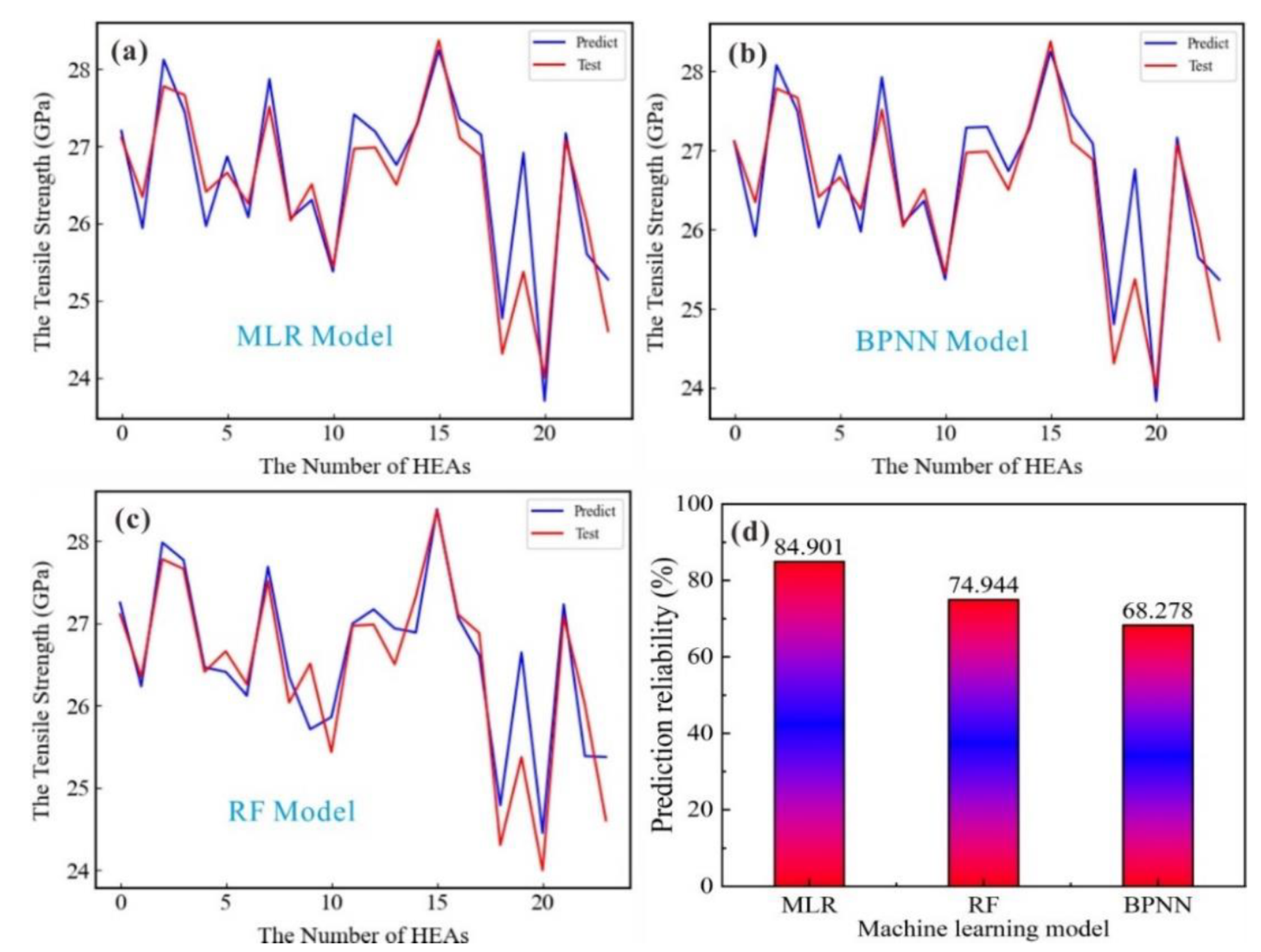
Yu et al. [172] combined ML and MD to study FeNiCrCoCu HEAs. They used three ML algorithms: multiple linear regression (MLR), a back-propagation neural network (BPNN), and random forests, and found that the MLR model offered the greatest prediction confidence of 84.9% in forecasting an optimal tensile strength of 28.25 GPa for a Fe33Ni32Cr11Co11Cu13 composition; this prediction was subsequently confirmed by MD simulation with less than 0.5% error [172]. The learning performance and test accuracy of the three models are compared in Figure 10. Ren et al. pursued a complementary, more interpretable strategy for hardness prediction, integrating ML with classical solid-solution-strengthening (SSS) theory [173]. Their final feature set required only three descriptors - valence electron concentration, shear modulus, and Young’s modulus mismatch and reached an of 0.9716; a particle-swarm-optimization (PSO) routine then inverted the model to design high-hardness alloys, with experimental verification confirming hardness values above 700 HV [173]. Interest in more complex material systems and larger datasets has continued to grow. Wu et al. applied ML to HEA/graphene nanocomposites, building a 700-sample dataset from MD simulations and finding that XGBoost and LGBoost were the best performers for Young’s modulus and toughness, achieving values above 0.85 and 0.90, respectively [174]. Jain et al. took on the problem of bulk modulus prediction across 647 HEA compositions using five regression models, and reported that XGBoost gave the highest accuracy, with an of 95.2% [175].
Zhao et al. [176] developed an interpretable stacking ensemble for HEA mechanical property prediction using 1,713 database entries described by 17 empirical descriptors, where a hierarchical clustering model-driven hybrid feature selection strategy (HC-MDHFS) grouped correlated parameters into six clusters and weighted them by base-learner performance to suppress the severe multicollinearity of the initial feature set. XGBoost, random forest, and gradient boosting were combined as base learners with support vector regression as the meta-learner, giving test-set values of 0.749 for yield strength and 0.755 for elongation and outperforming all individual models. SHapley Additive Explanations (SHAP) analysis attributed yield strength mainly to the standard deviation of bulk modulus, configurational entropy, and mean melting temperature, and elongation to the standard deviations of mixing enthalpy and electronegativity together with the mean bulk modulus [176]. Shen et al. [177] coupled MD simulations with ML to predict the Young’s modulus and ultimate tensile strength of AlCoCrFeNi HEAs, while tracking microstructural evolution and phase transformations across a range of temperatures and strain rates. Six algorithms were benchmarked, and ensemble methods proved most accurate, with LightGBM reaching an of 0.991 for Young’s modulus and CatBoost an of 0.975 for tensile strength. Taken together, this body of work illustrates a clear trajectory in the field: from early single-system demonstrations that a given ML algorithm could reproduce MD-derived mechanical properties, toward increasingly sophisticated frameworks that combine physics-based descriptors, interpretability tools such as SHAP, and ensemble or stacking architectures to achieve both higher predictive accuracy and genuine design capability.
Figure 10.
Test set predictions compared with measured values for the (a) MLR, (b) BPNN, and (c) RF models; (d) prediction confidence of the three models. (Adapted from Yu et al., [172]).
Figure 10.
Test set predictions compared with measured values for the (a) MLR, (b) BPNN, and (c) RF models; (d) prediction confidence of the three models. (Adapted from Yu et al., [172]).
6.3. Active Learning and Bayesian Optimization
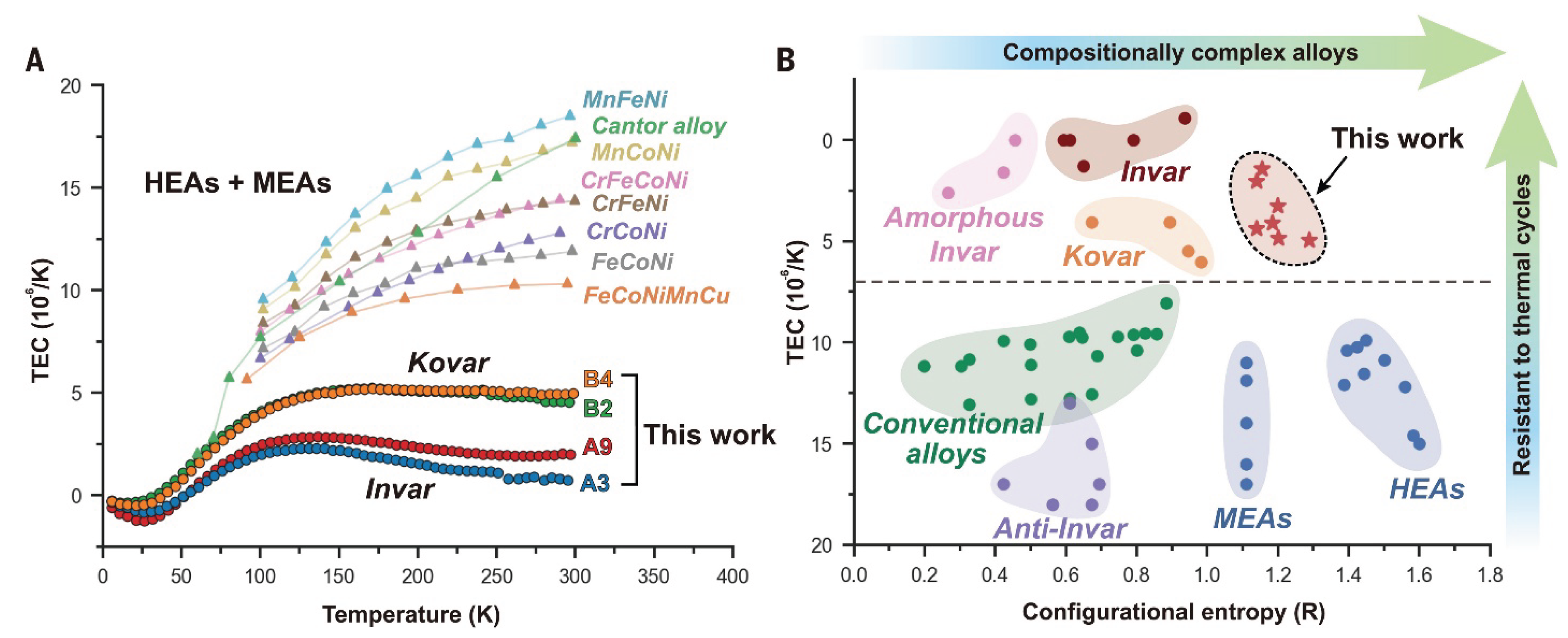
A major limitation of standard supervised ML is its reliance on existing data distributions: predictions may be unreliable in compositional regions far from training examples, precisely where the most novel compositions lie. Active learning (AL) addresses this by iteratively querying the most informative compositions, reducing the experimental budget required to explore new regions of property space. The most influential demonstration of active learning in HEA research was reported by Rao et al. [41] (2022). They developed a closed-loop active learning framework combining a generative model, a regression ensemble, physics-driven learning, density functional theory, and thermodynamic calculations with experimental feedback for compositional design of HEAs. Applied to high-entropy Invar alloys, only 17 candidates were cast from millions of possible compositions, yielding two alloys with extremely low thermal expansion coefficients (TEC) near 2 × per degree kelvin at 300 K within a few months rather than years (Figure 11). The work established iterative model–experiment feedback as a practical alternative to serendipity for discovering HEAs with tailored thermal, magnetic, and electrical properties [41].
Bayesian optimization (BO) with Gaussian process (GP) surrogate models is particularly well suited for iterative materials design because it provides principled uncertainty estimates alongside property predictions, enabling a balance between exploiting known high-performing regions (exploitation) and sampling poorly understood regions (exploration) [178,179]. Alvi et al. [178] compared Bayesian optimization (BO) schemes for multi-objective HEA discovery, benchmarking a conventional single-output Gaussian process against multi-task (MTGP-BO) and deep Gaussian process variants, including a newly proposed hierarchical model (hDGP-BO). By learning the interdependencies among thermal, mechanical, and structural properties, these models outperformed the conventional approach, with hDGP-BO proving most efficient and robust and its heterotopic querying allowing correlated properties to be inferred rather than evaluated. Both hDGP-BO and MTGP-BO remained reliable under added noise, showing that exploiting property correlations rather than optimizing objectives independently substantially accelerates the search for HEAs with targeted property combinations [178].
Figure 11.
(a) Temperature dependence of the thermal expansion coefficient for the ML-designed alloys alongside reported HEAs and MEAs; the A3 and A9 FeNiCoCr alloys reached Invar-like values near 2 × K-1 at 300 K, and the B2 and B4 FeNiCoCrCu alloys showed Kovar-like values near 5 × K-1. (b) Configurational entropy versus TEC for known and newly discovered alloys, highlighting the efficiency of the ML-guided search for new alloys (Adapted from Rao et al., [41]).
Figure 11.
(a) Temperature dependence of the thermal expansion coefficient for the ML-designed alloys alongside reported HEAs and MEAs; the A3 and A9 FeNiCoCr alloys reached Invar-like values near 2 × K-1 at 300 K, and the B2 and B4 FeNiCoCrCu alloys showed Kovar-like values near 5 × K-1. (b) Configurational entropy versus TEC for known and newly discovered alloys, highlighting the efficiency of the ML-guided search for new alloys (Adapted from Rao et al., [41]).
Vela et al. [180] addressed the difficulty of predicting high-temperature yield strength in refractory HEAs, where the compositional space is vast and tensile testing is expensive, by using Bayesian updating to combine three sources of information: machine-learning models, simple physics-based models, and low-cost proxy experimental data. Cross-validation, extrapolation tests, and benchmarking against standard Gaussian process regressors in a BO exercise confirmed its reliability, making the model suitable for integrated computational materials engineering (ICME) based screening of RHEAs for high-temperature service.
Chen et al. [181] developed a machine-learning framework for HEA phase prediction that addresses data scarcity by pairing a Conditional generative adversarial network (CGAN) with active learning, expanding an initial set of 1016 multicomponent alloys described by nine domain-knowledge-selected features to 1616 synthetic-augmented samples. An artificial neural network whose initial weights were tuned by the arithmetic optimization algorithm (AOA) avoided entrapment in local minima and converged in fewer iterations, and entropy-based sample selection raised the classification accuracy from 94.77% to 96.08% while requiring only 932 training instances rather than 1132. The work shows that combining generative data augmentation with active sampling can offset limited experimental data, offering a transferable route to classification and property prediction in materials systems where datasets are inherently small.
6.4. High-Throughput Computation and ML Interatomic Potentials
High-throughput calculation strategies - particularly CALPHAD coupled with ML, provide a route to generating large, computationally validated datasets for subsequent ML training. Lu et al. (2024) reviewed the materials genome strategy for HEA discovery, showing how high-throughput synthesis, automated characterization, and data-driven ML can be integrated into a coherent alloy design pipeline [179]. A combined CALPHAD–ML study by Zeng et al. [182] on FeMnCoCrAl and related systems used CALPHAD-calculated phase diagrams to generate phase labels for thousands of virtual compositions, then trained RF classifiers on those labels, achieving reliable phase predictions across the Al-Co-Cr-Fe-Mn-Ni space with validated experimental confirmation. Equilibrium temperature emerged as a critical variable, and the five-feature criteria distinguished single FCC and BCC phases with over 90% success, surpassing existing phase selection rules [182]. A subsequent analysis relating the elemental compositions to the five key features revealed the relative sensitivity of each constituent element in promoting the formation of the desired phases.
A critical bottleneck in atomistic simulation of HEAs is the absence of accurate interatomic potentials for systems containing five or more distinct elements. ML interatomic potentials (MLIPs), including deep neural network potentials (DeePMD), Gaussian approximation potentials (GAP), and moment tensor potentials (MTP), have emerged as the leading solution [183,184]. These potentials are trained on DFT-computed energies and forces across a diverse set of configurations and can reproduce near-DFT accuracy at a fraction of the computational cost, enabling molecular dynamics (MD) simulations at length and time scales inaccessible to ab initio methods [183,184]. For refractory HEAs, MLIPs based on symmetry-adapted descriptors have enabled MD simulations of radiation damage cascades, revealing defect formation and recovery mechanisms in MoNbTaVW that would be computationally inaccessible to standard DFT [183]. An MLIP trained on ab initio MD (AIMD) trajectories for CrFeCoNiPd HEA achieved > 0.92 for atomic force prediction on a dedicated test set [184].
6.5. Challenges and Future Directions
Despite rapid progress, several challenges constrain the maturation of ML-assisted HEA design. Data scarcity remains the foremost limitation: most published HEA datasets contain only a few hundred to a few thousand compositions with experimentally measured properties, far fewer than are needed to train deep models without overfitting [185,186]. Work to date has centered on phase classification and mechanical properties, leaving structure-sensitive quantities such as formation energy and magnetic moment relatively unaddressed; predicting these reliably requires descriptors that encode crystal structure, including its translational and rotational symmetries. Because generating such structural training data is computationally expensive, balancing descriptor sophistication against cost remains an open problem [187].
Inconsistencies in measurement protocols, processing routes, and alloy purity between literature sources introduce label noise that degrades model reliability [188]. Feature selection- determining which thermophysical, electronic, or structural descriptors to include as inputs, is non-trivial and model-dependent [189]. Finally, models trained on as-cast data extrapolate poorly to alloys produced by powder metallurgy, additive manufacturing, or severe plastic deformation, because processing history governs segregation, texture, and porosity in ways composition alone does not encode; encoding the fabrication route explicitly as an input feature measurably reduced prediction error [190].
Several directions are emerging in response. Transfer learning addresses small-dataset limits by fine-tuning models pre-trained on large computational repositories such as the Materials Project; benchmarking across seven property datasets showed that such models consistently outperformed equivalents trained from scratch, even on out-of-domain targets [191]. Generative models including variational autoencoders (VAEs) and large language models adapted for materials informatics are emerging as promising tools for proposing novel HEA compositions not represented in training data [192]. Self-driving laboratories combining robotic synthesis, automated characterization, and closed-loop ML optimization represent the frontier of autonomous materials discovery and have demonstrated acceleration of synthesis workflows in related materials systems [193]. Combined, these innovations establish ML and AI as crucial drivers in searching through high-entropy alloy compositions, bridging the gap between computational concepts and real-world material design.
Author Contributions
Conceptualization, M.M. and M.B.K.; methodology, M.M. and M.B.K.; investigation, M.M. and M.B.K.; formal analysis, M.M. and M.B.K.; writing—original draft preparation, M.M. and M.B.K.; writing—review and editing, M.B.K. and M.M. All authors have read and agreed to the published version of the manuscript.
Data Availability Statement
No new data were created or analyzed in this study. Data sharing is not applicable to this article.
Conflicts of Interest
The authors declare no conflicts of interest.
References
- Cantor, B.; Chang, I.T.H.; Knight, P.; Vincent, A.J.B. Microstructural development in equiatomic multicomponent alloys. Mater. Sci. Eng. A 2004, 375–377, 213–218. [Google Scholar] [CrossRef]
- Yeh, J.-W.; et al. Nanostructured High-Entropy Alloys with Multiple Principal Elements: Novel Alloy Design Concepts and Outcomes. Adv. Eng. Mater. 2004, 6, 299–303. [Google Scholar] [CrossRef]
- Tsai, M.-H.; Yeh, J.-W. High-Entropy Alloys: A Critical Review. Mater. Res. Lett. 2014, 2, 107–123. [Google Scholar] [CrossRef]
- Gludovatz, B.; Hohenwarter, A.; Catoor, D.; Chang, E.H.; George, E.P.; Ritchie, R.O. A fracture-resistant high-entropy alloy for cryogenic applications. Science 2014, 345, 1153–1158. [Google Scholar] [CrossRef] [PubMed]
- Zhang, Y.; et al. Microstructures and properties of high-entropy alloys. Prog. Mater. Sci. 2014, 61, 1–93. [Google Scholar] [CrossRef]
- Luo, L.; et al. Critical review of high-entropy alloys for catalysts: Design, synthesis, and applications. Int. J. Hydrog. Energy 2024, 90, 885–917. [Google Scholar] [CrossRef]
- Sun, Y.; Dai, S. Synthesis of high-entropy materials. Nat. Synth. 2024, 3, 1457–1470. [Google Scholar] [CrossRef]
- Lei, Z.; et al. Enhanced strength and ductility in a high-entropy alloy via ordered oxygen complexes. Nature 2018, 563, 546–550. [Google Scholar] [CrossRef] [PubMed]
- Wu, M.; Yuan, J.; Diao, G.; Li, D. Achieving a Combination of Higher Strength and Higher Ductility for Enhanced Wear Resistance of AlCrFeNiTi0.5 High-Entropy Alloy by Mo Addition. Metals 2022, 12, 1910. [Google Scholar] [CrossRef]
- Sabban, R.; Dash, K.; Suwas, S.; Murty, B.S. Strength–Ductility Synergy in High Entropy Alloys by Tuning the Thermo-Mechanical Process Parameters: A Comprehensive Review. J. Indian Inst. Sci. 2022, 102, 91–116. [Google Scholar] [CrossRef] [PubMed]
- Zhang, Q.; Chen, Z.; Dong, Y.; Li, C.; Wang, Y. High strength and ductility eutectic high entropy alloy with unique core-shell structure. J. Alloys Compd. 2024, 976, 173141. [Google Scholar] [CrossRef]
- Gao, S.; et al. Unveiling the mechanisms of strength–ductility synergy in an additively manufactured nanolamellar high-entropy alloy. Nat. Commun. 2025, 16, 9934. [Google Scholar] [CrossRef] [PubMed]
- Chen, Z.; et al. Enhancing the strength and ductility of a medium entropy alloy through non-basal slip activation. Nat. Commun. 2025, 16, 6480. [Google Scholar] [CrossRef] [PubMed]
- Egole, C. P.; et al. Strength–ductility enhancement in high-entropy alloys: Dislocation mechanisms and hybrid pathways — a comprehensive review. J. Alloys Compd. 2026, 1053, 186202. [Google Scholar] [CrossRef]
- Jo, Y. H.; et al. Cryogenic strength improvement by utilizing room-temperature deformation twinning in a partially recrystallized VCrMnFeCoNi high-entropy alloy. Nat. Commun. 2017, 8, 15719. [Google Scholar] [CrossRef] [PubMed]
- Gao, X.; et al. High-entropy alloys: a review of mechanical properties and deformation mechanisms at cryogenic temperatures. J. Mater. Sci. 2022, 57, 6573–6606. [Google Scholar] [CrossRef]
- Yin, Y.; Ren, W.; Tan, Q.; Chen, H.; Huang, H.; Zhang, M.-X. A cost-effective cryogenic high-entropy alloy with high strength-ductility synergy and strain hardenability. Mater. Sci. Eng. A 2023, 865, 144607. [Google Scholar] [CrossRef]
- Yi, H.; Tao, C.; Chen, C.; Fan, J.; Wang, S. Enhanced cryogenic tensile properties in a Fe-high-entropy alloy. J. Alloys Compd. 2025, 1017, 179052. [Google Scholar] [CrossRef]
- Zou, Y.; Wheeler, J.M.; Ma, H.; Okle, P.; Spolenak, R. Nanocrystalline High-Entropy Alloys: A New Paradigm in High-Temperature Strength and Stability. Nano Lett. 2017, 17, 1569–1574. [Google Scholar] [CrossRef] [PubMed]
- Chen, J.; et al. A review on fundamental of high entropy alloys with promising high–temperature properties. J. Alloys Compd. 2018, 760, 15–30. [Google Scholar] [CrossRef]
- Xi, R.; Li, Y. Recent Advances in the Performance and Mechanisms of High-Entropy Alloys Under Low- and High-Temperature Conditions. Coatings 2025, 15, 92. [Google Scholar] [CrossRef]
- Pan, W.; Huang, D.; Wang, W.; Dou, G.; Lyu, P. Recent Advances in High-Temperature Properties of High-Entropy Alloys. High-Temp. Mater. 2025, 2, 10011. [Google Scholar] [CrossRef]
- Hamdi, H.; Abedi, H.R.; Zhang, Y. A review study on thermal stability of high entropy alloys: Normal/abnormal resistance of grain growth. J. Alloys Compd. 2023, 960, 170826. [Google Scholar] [CrossRef]
- Hashimoto, N.; et al. Thermal Stability of High-Entropy Alloy Nanoparticles Evaluated by In Situ TEM Observations. Nano Lett. 2024, 24, 7063–7068. [Google Scholar] [CrossRef] [PubMed]
- Dewangan, S.K.; Mangish, A.; Kumar, S.; Sharma, A.; Ahn, B.; Kumar, V. A review on High-Temperature Applicability: A milestone for high entropy alloys. Eng. Sci. Technol. Int. J. 2022, 35, 101211. [Google Scholar] [CrossRef]
- Qiu, Y.; Thomas, S.; Gibson, M.A.; Fraser, H.L.; Birbilis, N. Corrosion of high entropy alloys. npj Mater. Degrad. 2017, 1, 15. [Google Scholar] [CrossRef]
- Shi, Y.; Yang, B.; Liaw, P.K. Corrosion-Resistant High-Entropy Alloys: A Review. Metals 2017, 7, 43. [Google Scholar] [CrossRef]
- Cheng, H.; et al. Review—Corrosion-Resistant High-Entropy Alloy Coatings: A Review. J. Electrochem. Soc. 2021, 168, 111502. [Google Scholar] [CrossRef]
- Koochaki-Abkenar, A.; Bozorg, M. Elemental Additions on Corrosion Resistance of High Entropy Alloy Coatings on Stainless Steel Fabricated via Laser-Based Methods: A Review. Met. Mater. Int. 2025, 31, 1169–1203. [Google Scholar] [CrossRef]
- Zhang, W.; et al. Frontiers in high entropy alloys and high entropy functional materials. Rare Met. 2024, 43, 4639–4776. [Google Scholar] [CrossRef]
- Li, J.; Huang, Y.; Meng, X.; Xie, Y. A Review on High Entropy Alloys Coatings: Fabrication Processes and Property Assessment. Adv. Eng. Mater. 2019, 21, 1900343. [Google Scholar] [CrossRef]
- El Atwani, O.; et al. A quinary WTaCrVHf nanocrystalline refractory high-entropy alloy withholding extreme irradiation environments. Nat. Commun. 2023, 14, 2516. [Google Scholar] [CrossRef] [PubMed]
- Gao, M.C.; Miracle, D.B.; Maurice, D.; Yan, X.; Zhang, Y.; Hawk, J.A. High-entropy functional materials. J. Mater. Res. 2018, 33, 3138–3155. [Google Scholar] [CrossRef]
- Jin, K.; et al. Effects of Fe concentration on the ion-irradiation induced defect evolution and hardening in Ni-Fe solid solution alloys. Acta Mater. 2016, 121, 365–373. [Google Scholar] [CrossRef]
- He, M.-R.; et al. Enhanced damage resistance and novel defect structure of CrFeCoNi under in situ electron irradiation. Scr. Mater. 2016, 125, 5–9. [Google Scholar] [CrossRef]
- El-Atwani, O.; et al. Outstanding radiation resistance of tungsten-based high-entropy alloys. Sci. Adv. 2019, 5, eaav2002. [Google Scholar] [CrossRef] [PubMed]
- Xia, S.; Wang, Z.; Yang, T.; Zhang, Y. Irradiation Behavior in High Entropy Alloys. J. Iron Steel Res. Int. 2015, 22, 879–884. [Google Scholar] [CrossRef]
- Wang, J.; Zhang, Y. Artificial intelligence in high-entropy materials. Mater. 2025, 9, 100993. [Google Scholar] [CrossRef]
- Kumar, A.; Mukhopadhyay, N.K.; Yadav, T.P. Recent progresses on high entropy alloy development using machine learning: A review. Comput. Mater. Today 2025, 8, 100038. [Google Scholar] [CrossRef]
- Peivaste, I.; Belouettar, S. From Phase Prediction to Phase Design: A ReAct Agent Framework for High-Entropy Alloy Discovery. arXiv 2026, arXiv:2603.11068. [Google Scholar] [CrossRef]
- George, E.P.; Raabe, D.; Ritchie, R.O. High-entropy alloys. Nat. Rev. Mater. 2019, 4, 515–534. [Google Scholar] [CrossRef]
- Zhao, Y.M.; Zhang, J.Y.; Liaw, P.K.; Yang, T. Machine Learning-Based Computational Design Methods for High-Entropy Alloys. High Entropy Alloys Mater. 2025, 3, 41–100. [Google Scholar] [CrossRef]
- Rao, Z.; et al. Machine learning–enabled high-entropy alloy discovery. Science 2022, 378, 78–85. [Google Scholar] [CrossRef] [PubMed]
- Xie, E.; Yang, C. AI Design for High Entropy Alloys: Progress, Challenges and Future Prospects. Metals 2025, 15, 1012. [Google Scholar] [CrossRef]
- Wang, J.; Kwon, H.; Kim, H.S.; Lee, B.-J. A neural network model for high entropy alloy design. npj Comput. Mater. 2023, 9, 60. [Google Scholar] [CrossRef]
- Yang, N.; Zhou, J.; Huang, H.; Sun, Z. Machine learning-assisted high-entropy alloy discovery: a perspective. J. Mater. Inform. 2026, 6. [Google Scholar] [CrossRef]
- Yeh, J.-W. Physical Metallurgy of High-Entropy Alloys. JOM 2015, 67, 2254–2261. [Google Scholar] [CrossRef]
- MacDonald, B. E.; et al. Recent Progress in High Entropy Alloy Research. JOM 2017, 69, 2024–2031. [Google Scholar] [CrossRef]
- Tsai, K.-Y.; Tsai, M.-H.; Yeh, J.-W. Sluggish diffusion in Co–Cr–Fe–Mn–Ni high-entropy alloys. Acta Mater. 2013, 61, 4887–4897. [Google Scholar] [CrossRef]
- V, B.; M, A.X. Development of high entropy alloys (HEAs): Current trends. Heliyon 2024, 10, e26464. [Google Scholar] [CrossRef] [PubMed]
- Tokarewicz, M.; Grądzka-Dahlke, M. Review of Recent Research on AlCoCrFeNi High-Entropy Alloy. Metals 2021, 11, 1302. [Google Scholar] [CrossRef]
- Li, M.; Zhang, H.; Zeng, Y.; Liu, J. A perspective on investigating transition metal high-entropy alloys for high-temperature applications. Acta Mater. 2022, 240, 118313. [Google Scholar] [CrossRef]
- Ranganathan, S. Alloyed pleasures: Multimetallic cocktails. Available online: https://cir.nii.ac.jp/crid/1873680966313818496 (accessed on 25 June 2026).
- Kumari, P.; Gupta, A.K.; Mishra, R.K.; Ahmad, M.S.; Shahi, R.R. A Comprehensive Review: Recent Progress on Magnetic High Entropy Alloys and Oxides. J. Magn. Magn. Mater. 2022, 554, 169142. [Google Scholar] [CrossRef]
- Miracle, D.B.; Senkov, O.N. A critical review of high entropy alloys and related concepts. Acta Mater. 2017, 122, 448–511. [Google Scholar] [CrossRef]
- Morley, N.A.; Lim, B.; Xi, J.; Quintana-Nedelcos, A.; Leong, Z. Magnetic properties of the complex concentrated alloy system CoFeNi0.5Cr0.5Alx. Sci. Rep. 2020, 10, 14506. [Google Scholar] [CrossRef] [PubMed]
- Mukherjee, S. Complex Concentrated Alloys (CCAs)—Current Understanding and Future Opportunities. Metals 2020, 10, 1253. [Google Scholar] [CrossRef]
- Kunce, I.; Polanski, M.; Bystrzycki, J. Microstructure and hydrogen storage properties of a TiZrNbMoV high entropy alloy synthesized using Laser Engineered Net Shaping (LENS). Int. J. Hydrog. Energy 2014, 39, 9904–9910. [Google Scholar] [CrossRef]
- Veronesi, P.; Colombini, E.; Rosa, R.; Leonelli, C.; Rosi, F. Microwave assisted synthesis of Si-modified Mn25FexNi25Cu(50-x) high entropy alloys. Mater. Lett. 2016, 162, 277–280. [Google Scholar] [CrossRef]
- Fujieda, T.; et al. Mechanical and corrosion properties of CoCrFeNiTi-based high-entropy alloy additive manufactured using selective laser melting. Addit. Manuf. 2019, 25, 412–420. [Google Scholar] [CrossRef]
- Wan, Y.; et al. WReTaMo Refractory High-Entropy Alloy with High Strength at 1600 °C. Adv. Eng. Mater. 2022, 24, 2100765. [Google Scholar] [CrossRef]
- Hou, L.; Hui, J.; Yao, Y.; Chen, J.; Liu, J. Effects of Boron Content on microstructure and mechanical properties of AlFeCoNiBx High Entropy Alloy Prepared by vacuum arc melting. Vacuum 2019, 164, 212–218. [Google Scholar] [CrossRef]
- Wang, D.; et al. Effect of Ti on microstructure and properties of vacuum arc melting CoCrFeNiMn high entropy alloy. J. Phys. Conf. Ser. 2025, 3026, 012011. [Google Scholar] [CrossRef]
- Varalakshmi, S.; Kamaraj, M.; Murty, B.S. Synthesis and characterization of nanocrystalline AlFeTiCrZnCu high entropy solid solution by mechanical alloying. J. Alloys Compd. 2008, 460, 253–257. [Google Scholar] [CrossRef]
- Long, Y.; Su, K.; Zhang, J.; Liang, X.; Peng, H.; Li, X. Enhanced Strength of a Mechanical Alloyed NbMoTaWVTi Refractory High Entropy Alloy. Materials 2018, 11, 669. [Google Scholar] [CrossRef] [PubMed]
- Moravcikova-Gouvea, L.; et al. High-strength Al0.2Co1.5CrFeNi1.5Ti high-entropy alloy produced by powder metallurgy and casting: A comparison of microstructures, mechanical and tribological properties. Mater. Charact. 2020, 159, 110046. [Google Scholar] [CrossRef]
- Afolabi, A.E.; Popoola, A.P.I.; Popoola, O.M. Spark Plasma Sintered High-Entropy Alloys: An Advanced Material for Aerospace Applications. In Recent Advancements in the Metallurgical Engineering and Electrodeposition; IntechOpen, 2019. [Google Scholar] [CrossRef]
- Ujah, C.O.; Kallon, D.V.V.; Aigbodion, V.S. High entropy alloys prepared by spark plasma sintering: Mechanical and thermal properties. Mater. Today Sustain. 2024, 25, 100639. [Google Scholar] [CrossRef]
- Ron, T.; Leon, A.; Bassis, M.; Chen, Z.; Shirizly, A.; Aghion, E. Effect of Hot Isostatic Pressing Treatment on Refractory High-Entropy Alloy WTaMoNbV Produced by Laser Powder Bed Fusion Process. Metals 2025, 15, 243. [Google Scholar] [CrossRef]
- Wang, C.; Ji, W.; Fu, Z. Mechanical alloying and spark plasma sintering of CoCrFeNiMnAl high-entropy alloy. Adv. Powder Technol. 2014, 25, 1334–1338. [Google Scholar] [CrossRef]
- Joo, S.-H.; et al. Structure and properties of ultrafine-grained CoCrFeMnNi high-entropy alloys produced by mechanical alloying and spark plasma sintering. J. Alloys Compd. 2017, 698, 591–604. [Google Scholar] [CrossRef]
- Moravcik, I.; et al. The Origins of High-Entropy Alloy Contamination Induced by Mechanical Alloying and Sintering. Metals 2020, 10, 1186. [Google Scholar] [CrossRef]
- Razumov, N.; et al. Refractory CrMoNbWV High-Entropy Alloy Manufactured by Mechanical Alloying and Spark Plasma Sintering: Evolution of Microstructure and Properties. Materials 2021, 14, 621. [Google Scholar] [CrossRef] [PubMed]
- Lv, J.; et al. The corrosion behavior and mechanism of hot isostatically pressed CrMnFeCoNi high-entropy alloy in high-temperature molten salt environments. Intermetallics 2026, 188, 109074. [Google Scholar] [CrossRef]
- Chang, H.-W.; Huang, P.-K.; Davison, A.; Yeh, J.-W.; Tsau, C.-H.; Yang, C.-C. Nitride films deposited from an equimolar Al–Cr–Mo–Si–Ti alloy target by reactive direct current magnetron sputtering. Thin Solid Films 2008, 516, 6402–6408. [Google Scholar] [CrossRef]
- Lin, C.H.; Duh, J.G. Corrosion behavior of (Ti–Al–Cr–Si–V)xNy coatings on mild steels derived from RF magnetron sputtering. Surf. Coat. Technol. 2008, 203, 558–561. [Google Scholar] [CrossRef]
- Shaginyan, L.R.; Gorban’, V.F.; Krapivka, N.A.; Firstov, S.A.; Kopylov, I.F. Properties of coatings of the Al–Cr–Fe–Co–Ni–Cu–V high entropy alloy produced by the magnetron sputtering. J. Superhard Mater. 2016, 38, 25–33. [Google Scholar] [CrossRef]
- Kim, Y. S.; et al. Investigation of structure and mechanical properties of TiZrHfNiCuCo high entropy alloy thin films synthesized by magnetron sputtering. J. Alloys Compd. 2019, 797, 834–841. [Google Scholar] [CrossRef]
- Ling, Y.; et al. Epitaxial growth of high-entropy alloy thin film with spontaneous exchange bias. J. Appl. Phys. 2022, 131, 233904. [Google Scholar] [CrossRef]
- Padamata, S.K.; Yasinskiy, A.; Yanov, V.; Saevarsdottir, G. Magnetron Sputtering High-Entropy Alloy Coatings: A Mini-Review. Metals 2022, 12, 319. [Google Scholar] [CrossRef]
- Sobetkii, A.; et al. Deposition and Characterization of Cu-Enhanced High-Entropy Alloy Coatings via DC Magnetron Sputtering. Appl. Sci. 2025, 15, 1917. [Google Scholar] [CrossRef]
- Saqat, R. S. H.; et al. Multiple transition-driven magnetocaloric effect of nanoscale Ni48Mn37In15 thin films grown by molecular beam epitaxy. Mater. Today Commun. 2025, 49, 113868. [Google Scholar] [CrossRef]
- Ledieu, J.; et al. Epitaxial Growth of Rare-Earth High-Entropy Alloy Thin Films. ACS Nano 2025, 19, 26400–26410. [Google Scholar] [CrossRef] [PubMed]
- Cheng, K.-H.; Lai, C.-H.; Lin, S.-J.; Yeh, J.-W. Structural and mechanical properties of multi-element (AlCrMoTaTiZr)Nx coatings by reactive magnetron sputtering. Thin Solid Films 2011, 519, 3185–3190. [Google Scholar] [CrossRef]
- Liao, W.-B.; et al. High Strength and Deformation Mechanisms of Al0.3CoCrFeNi High-Entropy Alloy Thin Films Fabricated by Magnetron Sputtering. Entropy 2019, 21, 146. [Google Scholar] [CrossRef] [PubMed]
- Yu, X.; Wang, J.; Wang, L.; Huang, W. Fabrication and characterization of CrNbSiTiZr high-entropy alloy films by radio-frequency magnetron sputtering via tuning substrate bias. Surf. Coat. Technol. 2021, 412, 127074. [Google Scholar] [CrossRef]
- Kamaruddin, H.; Jianghong, Z.; Yu, L.; Yuefan, W.; Yizhong, H. A review of noble metal-free high entropy alloys for water splitting applications. J. Mater. Chem. A 2024, 12, 9933–9961. [Google Scholar] [CrossRef]
- Xu, J.; et al. Recent Advances in Electrochemical Preparation and Deposition of Alloys. ACS Omega 2026, 11, 17079–17100. [Google Scholar] [CrossRef] [PubMed]
- Sure, J.; Vishnu, D.S.M.; Schwandt, C. Direct electrochemical synthesis of high-entropy alloys from metal oxides. Appl. Mater. Today 2017, 9, 111–121. [Google Scholar] [CrossRef]
- Sure, J.; Sri Maha Vishnu, D.; Kim, H.-K.; Schwandt, C. Facile Electrochemical Synthesis of Nanoscale (TiNbTaZrHf)C High-Entropy Carbide Powder. Angew. Chem. 2020, 132, 11928–11933. [Google Scholar] [CrossRef]
- Sure, J.; Sri Maha Vishnu, D.; Schwandt, C. Single-step electrochemical synthesis of nano-crystalline CoCrFeNi high-entropy alloy powder. Electrochem. Commun. 2022, 143, 107392. [Google Scholar] [CrossRef]
- Reddy, K.S.K.J.; Chokkakula, L.P.P.; Dey, S.R. Strategies to engineer FeCoNiCuZn high entropy alloy composition through aqueous electrochemical deposition. Electrochimica Acta 2023, 453, 142350. [Google Scholar] [CrossRef]
- Chen, J.; Wu, A.; Zhang, Y.; Xie, Y.; Zheng, H.; Teng, W. A mini-review on high-entropy alloy nanomaterials for electrocatalysis: advances and prospects. Front. Mater. 2025, 12, 1613997. [Google Scholar] [CrossRef]
- Xia, A.; Glushko, O.; Cordill, M.J.; Franz, R. Electromechanical properties of cathodic arc deposited high entropy alloy thin films on polymer substrates. J. Vac. Sci. Technol. A 2018, 37, 010601. [Google Scholar] [CrossRef]
- Mao, A.; et al. Plasma arc discharge synthesis of multicomponent Co-Cr-Cu-Fe-Ni nanoparticles. J. Alloys Compd. 2019, 775, 1177–1183. [Google Scholar] [CrossRef]
- Lee, W.-H.; et al. Synthesis of Spherical V-Nb-Mo-Ta-W High-Entropy Alloy Powder Using Hydrogen Embrittlement and Spheroidization by Thermal Plasma. Metals 2019, 9, 1296. [Google Scholar] [CrossRef]
- Park, J.-M.; et al. Preparation of spherical WTaMoNbV refractory high entropy alloy powder by inductively-coupled thermal plasma. Mater. Lett. 2019, 255, 126513. [Google Scholar] [CrossRef]
- Mohanty, G.C.; Gowda, C.C.; Suriyakumar, S.; Shaijumon, M.M.; Tiwary, C.S. A Comprehensive Review of High-Entropy Alloys for Supercapacitor Application. Energy Technol. 2025, 13, 2500323. [Google Scholar] [CrossRef]
- Otto, F.; Dlouhý, A.; Somsen, Ch.; Bei, H.; Eggeler, G.; George, E.P. The influences of temperature and microstructure on the tensile properties of a CoCrFeMnNi high-entropy alloy. Acta Mater. 2013, 61, 5743–5755. [Google Scholar] [CrossRef]
- Bhattacharjee, P. P.; et al. Microstructure and texture evolution during annealing of equiatomic CoCrFeMnNi high-entropy alloy. J. Alloys Compd. 2014, 587, 544–552. [Google Scholar] [CrossRef]
- Gludovatz, B.; et al. Exceptional damage-tolerance of a medium-entropy alloy CrCoNi at cryogenic temperatures. Nat. Commun. 2016, 7, 10602. [Google Scholar] [CrossRef] [PubMed]
- Li, Z.; Pradeep, K.G.; Deng, Y.; Raabe, D.; Tasan, C.C. Metastable high-entropy dual-phase alloys overcome the strength–ductility trade-off. Nature 2016, 534, 227–230. [Google Scholar] [CrossRef] [PubMed]
- Senkov, O.N.; Wilks, G.B.; Miracle, D.B.; Chuang, C.P.; Liaw, P.K. Refractory high-entropy alloys. Intermetallics 2010, 18, 1758–1765. [Google Scholar] [CrossRef]
- Senkov, O.N.; Wilks, G.B.; Scott, J.M.; Miracle, D.B. Mechanical properties of Nb25Mo25Ta25W25 and V20Nb20Mo20Ta20W20 refractory high entropy alloys. Intermetallics 2011, 19, 698–706. [Google Scholar] [CrossRef]
- Han, Z. D.; et al. Effect of Ti additions on mechanical properties of NbMoTaW and VNbMoTaW refractory high entropy alloys. Intermetallics 2017, 84, 153–157. [Google Scholar] [CrossRef]
- Lu, Y.; et al. Promising properties and future trend of eutectic high entropy alloys. Scr. Mater. 2020, 187, 202–209. [Google Scholar] [CrossRef]
- Wu, Q.; He, F.; Li, J.; Kim, H.S.; Wang, Z.; Wang, J. Phase-selective recrystallization makes eutectic high-entropy alloys ultra-ductile. Nat. Commun. 2022, 13, 4697. [Google Scholar] [CrossRef] [PubMed]
- Yang, T.; et al. Multicomponent intermetallic nanoparticles and superb mechanical behaviors of complex alloys. Science 2018, 362, 933–937. [Google Scholar] [CrossRef] [PubMed]
- Pan, Q.; et al. Gradient cell–structured high-entropy alloy with exceptional strength and ductility. Science 2021, 374, 984–989. [Google Scholar] [CrossRef] [PubMed]
- Srikanth, M.; Annamalai, A.R.; Muthuchamy, A.; Jen, C.-P. A Review of the Latest Developments in the Field of Refractory High-Entropy Alloys. Crystals 2021, 11, 612. [Google Scholar] [CrossRef]
- Chen, Y.Y.; Duval, T.; Hung, U.D.; Yeh, J.W.; Shih, H.C. Microstructure and electrochemical properties of high entropy alloys—a comparison with type-304 stainless steel. Corros. Sci. 2005, 47, 2257–2279. [Google Scholar] [CrossRef]
- Chen, Y.Y.; Hong, U.T.; Shih, H.C.; Yeh, J.W.; Duval, T. Electrochemical kinetics of the high entropy alloys in aqueous environments—a comparison with type 304 stainless steel. Corros. Sci. 2005, 47, 2679–2699. [Google Scholar] [CrossRef]
- Zhou, Q.; Sheikh, S.; Ou, P.; Chen, D.; Hu, Q.; Guo, S. Corrosion behavior of Hf0.5Nb0.5Ta0.5Ti1.5Zr refractory high-entropy in aqueous chloride solutions. Electrochem. Commun. 2019, 98, 63–68. [Google Scholar] [CrossRef]
- Shi, Y.; Yang, B.; Xie, X.; Brechtl, J.; Dahmen, K.A.; Liaw, P.K. Corrosion of AlxCoCrFeNi high-entropy alloys: Al-content and potential scan-rate dependent pitting behavior. Corros. Sci. 2017, 119, 33–45. [Google Scholar] [CrossRef]
- Zhao, Q.; Pan, Z.; Wang, X.; Luo, H.; Liu, Y.; Li, X. Corrosion and passive behavior of AlxCrFeNi3-x (x = 0.6, 0.8, 1.0) eutectic high entropy alloys in chloride environment. Corros. Sci. 2022, 208, 110666. [Google Scholar] [CrossRef]
- Yan, X.; et al. Al0.3CrxFeCoNi high-entropy alloys with high corrosion resistance and good mechanical properties. J. Alloys Compd. 2021, 860, 158436. [Google Scholar] [CrossRef]
- Shi, Y.; et al. Homogenization of AlxCoCrFeNi high-entropy alloys with improved corrosion resistance. Corros. Sci. 2018, 133, 120–131. [Google Scholar] [CrossRef]
- Li, B.; Peng, K.; Hu, A.; Zhou, L.; Zhu, J.; Li, D. Structure and properties of FeCoNiCrCu0.5Alx high-entropy alloy. Trans. Nonferrous Met. Soc. China 2013, 23, 735–741. [Google Scholar] [CrossRef]
- Muangtong, P.; Rodchanarowan, A.; Chaysuwan, D.; Chanlek, N.; Goodall, R. The corrosion behaviour of CoCrFeNi-x (x = Cu, Al, Sn) high entropy alloy systems in chloride solution. Corros. Sci. 2020, 172, 108740. [Google Scholar] [CrossRef]
- Shi, Y.; Yang, B.; Rack, P.D.; Guo, S.; Liaw, P.K.; Zhao, Y. High-throughput synthesis and corrosion behavior of sputter-deposited nanocrystalline Alx(CoCrFeNi)100-x combinatorial high-entropy alloys. Mater. Des. 2020, 195, 109018. [Google Scholar] [CrossRef]
- Liang, J.; Wang, W.; Cao, Z.; Guo, J.; Sun, Z.; Hai, Y. Corrosion resistance and mechanism of high-entropy alloys: A review. Mater. Corros. 2024, 75, 424–432. [Google Scholar] [CrossRef]
- Motallebzadeh, A.; Peighambardoust, N.S.; Sheikh, S.; Murakami, H.; Guo, S.; Canadinc, D. Microstructural, mechanical and electrochemical characterization of TiZrTaHfNb and Ti1.5ZrTa0.5Hf0.5Nb0.5 refractory high-entropy alloys for biomedical applications. Intermetallics 2019, 113, 106572. [Google Scholar] [CrossRef]
- Chen, S.; Liu, X.; Li, C.; Wang, W.; Yue, X. Sustainable High Corrosion Resistance in High-Concentration NaCl Solutions for Refractory High-Entropy Alloys with High Strength and Good Plasticity. Entropy 2026, 28, 105. [Google Scholar] [CrossRef] [PubMed]
- Zhao, X.; Huang, H.; Su, Y.; Qiao, L.; Yan, Y. Exploring high corrosion-resistant refractory high-entropy alloy via a combined experimental and simulation study. npj Mater. Degrad. 2024, 8, 77. [Google Scholar] [CrossRef]
- Bamisaye, O.S.; Maledi, N.; Van der Merwe, J.; Bodunrin, M.O. Microstructure, hardness, oxidation, and corrosion behavior of TiNbTaVW refractory high entropy alloy in 3.5 wt% NaCl and 1 M H2SO4. J. Alloys Compd. 2024, 983, 173803. [Google Scholar] [CrossRef]
- Hsu, Y.-J.; Chiang, W.-C.; Wu, J.-K. Corrosion behavior of FeCoNiCrCux high-entropy alloys in 3.5% sodium chloride solution. Mater. Chem. Phys. 2005, 92, 112–117. [Google Scholar] [CrossRef]
- Ren, B.; Liu, Z.X.; Li, D.M.; Shi, L.; Cai, B.; Wang, M.X. Corrosion behavior of CuCrFeNiMn high entropy alloy system in 1 M sulfuric acid solution. Mater. Corros. 2012, 63, 828–834. [Google Scholar] [CrossRef]
- Shi, Y.; Yang, B.; Liaw, P.K. Corrosion-Resistant High-Entropy Alloys: A Review. Metals 2017, 7, 43. [Google Scholar] [CrossRef]
- Lee, C.P.; Chang, C.C.; Chen, Y.Y.; Yeh, J.W.; Shih, H.C. Effect of the aluminium content of AlxCrFe1.5MnNi0.5 high-entropy alloys on the corrosion behaviour in aqueous environments. Corros. Sci. 2008, 50, 2053–2060. [Google Scholar] [CrossRef]
- Zhang, X.; et al. Influence of remelting and annealing treatment on corrosion resistance of AlFeNiCoCuCr high entropy alloy in 3.5% NaCl solution. J. Alloys Compd. 2019, 775, 565–570. [Google Scholar] [CrossRef]
- Li, J.; et al. Enhanced corrosion resistance of gradient structured CoCrFeMnNi high entropy alloy by laser surface heat-treatment process. Intermetallics 2025, 178, 108635. [Google Scholar] [CrossRef]
- Chou, H.-P.; Chang, Y.-S.; Chen, S.-K.; Yeh, J.-W. Microstructure, thermophysical and electrical properties in AlxCoCrFeNi (0 ≤ x ≤ 2) high-entropy alloys. Mater. Sci. Eng. B 2009, 163, 184–189. [Google Scholar] [CrossRef]
- Lu, C.-L.; Lu, S.-Y.; Yeh, J.-W.; Hsu, W.-K. Thermal expansion and enhanced heat transfer in high-entropy alloys. J. Appl. Crystallogr. 2013, 46, 736–739. [Google Scholar] [CrossRef]
- Laplanche, G.; Gadaud, P.; Horst, O.; Otto, F.; Eggeler, G.; George, E.P. Temperature dependencies of the elastic moduli and thermal expansion coefficient of an equiatomic, single-phase CoCrFeMnNi high-entropy alloy. J. Alloys Compd. 2015, 623, 348–353. [Google Scholar] [CrossRef]
- Laplanche, G.; et al. Elastic moduli and thermal expansion coefficients of medium-entropy subsystems of the CrMnFeCoNi high-entropy alloy. J. Alloys Compd. 2018, 746, 244–255. [Google Scholar] [CrossRef]
- van Bohemen, S.M.C. The nonlinear lattice expansion of iron alloys in the range 100–1600 K. Scr. Mater. 2013, 69, 315–318. [Google Scholar] [CrossRef]
- He, Q. F.; et al. A highly distorted ultraelastic chemically complex Elinvar alloy. Nature 2022, 602, 251–257. [Google Scholar] [CrossRef] [PubMed]
- Arun, K.; Senthil Kumar, K.; Mani, N.; Eswaran, S.K. Entropy engineered p-type Ag-alloyed CoCrFeNi metallic high entropy alloys with low lattice thermal conductivity. Vacuum 2026, 247, 115130. [Google Scholar] [CrossRef]
- Kao, Y.-F.; Chen, S.-K.; Chen, T.-J.; Chu, P.-C.; Yeh, J.-W.; Lin, S.-J. Electrical, magnetic, and Hall properties of AlxCoCrFeNi high-entropy alloys. J. Alloys Compd. 2011, 509, 1607–1614. [Google Scholar] [CrossRef]
- Zhang, Y.; Zuo, T.; Cheng, Y.; Liaw, P.K. High-entropy Alloys with High Saturation Magnetization, Electrical Resistivity and Malleability. Sci. Rep. 2013, 3, 1455. [Google Scholar] [CrossRef] [PubMed]
- Zuo, T.T.; Li, R.B.; Ren, X.J.; Zhang, Y. Effects of Al and Si addition on the structure and properties of CoFeNi equal atomic ratio alloy. J. Magn. Magn. Mater. 2014, 371, 60–68. [Google Scholar] [CrossRef]
- Huang, K.; Wang, G.; Qing, H.; Chen, Y.; Guo, H. Effect of Cu content on electrical resistivity, mechanical properties and corrosion resistance of AlCuxNiTiZr0.75 high entropy alloy films. Vacuum 2022, 195, 110695. [Google Scholar] [CrossRef]
- Feng, X.; et al. Stable nanocrystalline NbMoTaW high entropy alloy thin films with excellent mechanical and electrical properties. Mater. Lett. 2018, 210, 84–87. [Google Scholar] [CrossRef]
- Zhang, Y.; et al. Microstructures and properties of high-entropy alloys. Prog. Mater. Sci. 2014, 61, 1–93. [Google Scholar] [CrossRef]
- Zhang, K. B.; et al. Annealing on the structure and properties evolution of the CoCrFeNiCuAl high-entropy alloy. J. Alloys Compd. 2010, 502, 295–299. [Google Scholar] [CrossRef]
- Wang, X.F.; Zhang, Y.; Qiao, Y.; Chen, G.L. Novel microstructure and properties of multicomponent CoCrCuFeNiTix alloys. Intermetallics 2007, 15, 357–362. [Google Scholar] [CrossRef]
- Singh, S.; Wanderka, N.; Kiefer, K.; Siemensmeyer, K.; Banhart, J. Effect of decomposition of the Cr–Fe–Co rich phase of AlCoCrCuFeNi high entropy alloy on magnetic properties. Ultramicroscopy 2011, 111, 619–622. [Google Scholar] [CrossRef] [PubMed]
- Ma, S.G.; Zhang, Y. Effect of Nb addition on the microstructure and properties of AlCoCrFeNi high-entropy alloy. Mater. Sci. Eng. A 2012, 532, 480–486. [Google Scholar] [CrossRef]
- Liu, L.; Zhu, J.B.; Li, J.C.; Jiang, Q. Microstructure and Magnetic Properties of FeNiCuMnTiSnx High Entropy Alloys. Adv. Eng. Mater. 2012, 14, 919–922. [Google Scholar] [CrossRef]
- Zhang, K.; Fu, Z. Effects of annealing treatment on properties of CoCrFeNiTiAlx multi-component alloys. Intermetallics 2012, 28, 34–39. [Google Scholar] [CrossRef]
- Borkar, T.; et al. A Combinatorial Approach for Assessing the Magnetic Properties of High Entropy Alloys: Role of Cr in AlCoxCr1–xFeNi. Adv. Eng. Mater. 2017, 19, 1700048. [Google Scholar] [CrossRef]
- Duan, J.; et al. A novel high-entropy alloy with an exceptional combination of soft magnetic properties and corrosion resistance. Sci. China Mater. 2023, 66, 772–779. [Google Scholar] [CrossRef]
- Zhang, Y.; et al. Compositional Design of Soft Magnetic High Entropy Alloys by Minimizing Magnetostriction Coefficient in (Fe0.3Co0.5Ni0.2)100-x(Al1/3Si2/3)x System. Metals 2019, 9, 382. [Google Scholar] [CrossRef]
- Han, L.; et al. A mechanically strong and ductile soft magnet with extremely low coercivity. Nature 2022, 608, 310–316. [Google Scholar] [CrossRef] [PubMed]
- Han, L.; et al. Strong and ductile high temperature soft magnets through Widmanstätten precipitates. Nat. Commun. 2023, 14, 8176. [Google Scholar] [CrossRef] [PubMed]
- Han, L.; et al. Two-gigapascal-strong ductile soft magnets. Nat. Commun. 2024, 15, 10119. [Google Scholar] [CrossRef] [PubMed]
- Ammar, C. B.; et al. Properties of High-Entropy Fe30Co20Ni20Mn20Al10 Alloy Produced by High-Energy Ball Milling. Materials 2024, 17, 234. [Google Scholar] [CrossRef] [PubMed]
- Jiang, D.; Yuan, Z.; Zhu, Z.; Yao, M. NiCoCrFeY High Entropy Alloy Nanopowders and Their Soft Magnetic Properties. Materials 2024, 17, 534. [Google Scholar] [CrossRef] [PubMed]
- Eldabah, N.M.; Pratap, A.; Pandey, A.; Sardana, N.; Sidhu, S.S.; Gepreel, M.A. Design Approaches of High-Entropy Alloys Using Artificial Intelligence: A Review. Adv. Eng. Mater. 2025, 27, 2402504. [Google Scholar] [CrossRef]
- Li, Y.; Guo, W. Machine-learning model for predicting phase formations of high-entropy alloys. Phys. Rev. Mater. 2019, 3, 095005. [Google Scholar] [CrossRef]
- Yao, H. W.; et al. NbTaV-(Ti,W) refractory high-entropy alloys: Experiments and modeling. Mater. Sci. Eng. A 2016, 674, 203–211. [Google Scholar] [CrossRef]
- Yao, H.; Qiao, J.-W.; Gao, M.C.; Hawk, J.A.; Ma, S.-G.; Zhou, H. MoNbTaV Medium-Entropy Alloy. Entropy 2016, 18, 189. [Google Scholar] [CrossRef]
- Todai, M.; Nagase, T.; Hori, T.; Matsugaki, A.; Sekita, A.; Nakano, T. Novel TiNbTaZrMo high-entropy alloys for metallic biomaterials. Scr. Mater. 2017, 129, 65–68. [Google Scholar] [CrossRef]
- Chen, S.Y.; Yang, X.; Dahmen, K.A.; Liaw, P.K.; Zhang, Y. Microstructures and Crackling Noise of AlxNbTiMoV High Entropy Alloys. Entropy 2014, 16, 870–884. [Google Scholar] [CrossRef]
- Chen, H.; et al. Contribution of Lattice Distortion to Solid Solution Strengthening in a Series of Refractory High Entropy Alloys. Metall. Mater. Trans. A 2018, 49, 772–781. [Google Scholar] [CrossRef]
- Yao, H.W.; Qiao, J.W.; Hawk, J.A.; Zhou, H.F.; Chen, M.W.; Gao, M.C. Mechanical properties of refractory high-entropy alloys: Experiments and modeling. J. Alloys Compd. 2017, 696, 1139–1150. [Google Scholar] [CrossRef]
- Gao, J.; et al. Phase Prediction and Visualized Design Process of High Entropy Alloys via Machine Learned Methodology. Metals 2023, 13, 283. [Google Scholar] [CrossRef]
- Singh, S.; Katiyar, N.K.; Goel, S.; Joshi, S.N. Phase prediction and experimental realisation of a new high entropy alloy using machine learning. Sci. Rep. 2023, 13, 4811. [Google Scholar] [CrossRef] [PubMed]
- Bobbili, R.; Ramakrishna, B. Prediction of phases in high entropy alloys using machine learning. Mater. Today Commun. 2023, 36, 106674. [Google Scholar] [CrossRef]
- Peivaste, I.; Jossou, E.; Tiamiyu, A.A. Data-driven analysis and prediction of stable phases for high-entropy alloy design. Sci. Rep. 2023, 13, 22556. [Google Scholar] [CrossRef]
- Li, S.; et al. Machine Learning Phase Prediction of Light-Weight High-Entropy Alloys Containing Aluminum, Magnesium, and Lithium. Metals 2024, 14, 400. [Google Scholar] [CrossRef]
- Thampiriyanon, J.; Khumkoa, S. Machine Learning–Based Prediction of Complex Combination Phases in High-Entropy Alloys. Metals 2025, 15, 227. [Google Scholar] [CrossRef]
- Zhang, L.; Qian, K.; Schuller, B.W.; Shibuta, Y. Prediction on Mechanical Properties of Non-Equiatomic High-Entropy Alloy by Atomistic Simulation and Machine Learning. Metals 2021, 11, 922. [Google Scholar] [CrossRef]
- Bundela, A.S.; Rahul, M.R. Machine learning-enabled framework for the prediction of mechanical properties in new high entropy alloys. J. Alloys Compd. 2022, 908, 164578. [Google Scholar] [CrossRef]
- Yu, J.; et al. Combining Machine Learning and Molecular Dynamics to Predict Mechanical Properties and Microstructural Evolution of FeNiCrCoCu High-Entropy Alloys. Nanomaterials 2023, 13, 968. [Google Scholar] [CrossRef] [PubMed]
- Ren, W.; Zhang, Y.-F.; Wang, W.-L.; Ding, S.-J.; Li, N. Prediction and design of high hardness high entropy alloy through machine learning. Mater. Des. 2023, 235, 112454. [Google Scholar] [CrossRef]
- Wu, Q.; Gao, T.; Liu, G.; Ma, Y. Machine learning–assisted prediction of mechanical properties of high-entropy alloy/graphene nanocomposite. Mater. Today Commun. 2024, 40, 109663. [Google Scholar] [CrossRef]
- Jain, S.; Jain, R.; Kumar, V.; Samal, S. Data-driven design of high bulk modulus high entropy alloys using machine learning. J. Alloys Metall. Syst. 2024, 8, 100128. [Google Scholar] [CrossRef]
- Zhao, S.; et al. An interpretable stacking ensemble model for high-entropy alloy mechanical property prediction. Front. Mater. 2025, 12. [Google Scholar] [CrossRef]
- Shen, B.; Gao, T.; Wu, Q.; Song, H.; Wang, B.; Huang, J. Predicting Mechanical Properties of AlCoCrFeNi High-Entropy Alloys Using Machine Learning and Molecular Dynamics. Adv. Eng. Mater. n/a, e20250. [CrossRef]
- Zhichao, L.; Dong, M.; Xiongjun, L.; Lu, Z. High-throughput and data-driven machine learning techniques for discovering high-entropy alloys. Commun. Mater. 2024, 5, 76. [Google Scholar] [CrossRef]
- Alvi, S.M.A.A.; Janssen, J.; Khatamsaz, D.; Perez, D.; Allaire, D.; Arróyave, R. Hierarchical Gaussian process-based Bayesian optimization for materials discovery in high entropy alloy spaces. Acta Mater. 2025, 289, 120908. [Google Scholar] [CrossRef]
- Vela, B.; Khatamsaz, D.; Acemi, C.; Karaman, I.; Arróyave, R. Data-augmented modeling for yield strength of refractory high entropy alloys: A Bayesian approach. Acta Mater. 2023, 261, 119351. [Google Scholar] [CrossRef]
- Chen, C.; Zhou, H.; Long, W.; Wang, G.; Ren, J. Phase prediction for high-entropy alloys using generative adversarial network and active learning based on small datasets. Sci. China Technol. Sci. 2023, 66, 3615–3627. [Google Scholar] [CrossRef]
- Zeng, Y.; Man, M.; Bai, K.; Zhang, Y.-W. Revealing high-fidelity phase selection rules for high entropy alloys: A combined CALPHAD and machine learning study. Mater. Des. 2021, 202, 109532. [Google Scholar] [CrossRef]
- Esfandiarpour, A.; et al. Machine Learning Applied to High Entropy Alloys under Irradiation. Adv. Eng. Mater. 2025, 27, e202402280. [Google Scholar] [CrossRef]
- Wu, L.; Li, T. A machine learning interatomic potential for high entropy alloys. J. Mech. Phys. Solids 2024, 187, 105639. [Google Scholar] [CrossRef]
- Xu, P.; Ji, X.; Li, M.; Lu, W. Small data machine learning in materials science. npj Comput. Mater. 2023, 9, 42. [Google Scholar] [CrossRef]
- Liu, X.; Zhang, J.; Pei, Z. Machine learning for high-entropy alloys: Progress, challenges and opportunities. Prog. Mater. Sci. 2023, 131, 101018. [Google Scholar] [CrossRef]
- Sun, Y.; Ni, J. Machine Learning Advances in High-Entropy Alloys: A Mini-Review. Entropy 2024, 26, 1119. [Google Scholar] [CrossRef] [PubMed]
- Wang, A. Y.-T.; et al. Machine Learning for Materials Scientists: An Introductory Guide toward Best Practices. Chem. Mater. 2020, 32, 4954–4965. [Google Scholar] [CrossRef]
- Li, S.; Li, S.; Liu, D.; Zou, R.; Yang, Z. Hardness prediction of high entropy alloys with machine learning and material descriptors selection by improved genetic algorithm. Comput. Mater. Sci. 2022, 205, 111185. [Google Scholar] [CrossRef]
- Zhu, W.; et al. Machine Learning-Based Hardness Prediction of High-Entropy Alloys for Laser Additive Manufacturing. JOM 2023, 75, 5537–5548. [Google Scholar] [CrossRef]
- Devi, R.; Butler, K.T.; Sai Gautam, G. Optimal pre-train/fine-tune strategies for accurate material property predictions. npj Comput. Mater. 2024, 10, 300. [Google Scholar] [CrossRef]
- Lee, C.-Y.; Jui, C.-Y.; Yeh, A.-C.; Chang, Y.-J.; Lee, W.-J. Inverse design of high entropy alloys using a deep interpretable scheme for materials attribution analysis. J. Alloys Compd. 2024, 976, 173144. [Google Scholar] [CrossRef]
- Abolhasani, M.; Kumacheva, E. The rise of self-driving labs in chemical and materials sciences. Nat. Synth. 2023, 2, 483–492. [Google Scholar] [CrossRef]
Figure 1.
Evolution of HEAs design, from experimentation to ML accelerated alloy discovery. (Adapted from Zamzu et al. [45]).
Figure 1.
Evolution of HEAs design, from experimentation to ML accelerated alloy discovery. (Adapted from Zamzu et al. [45]).
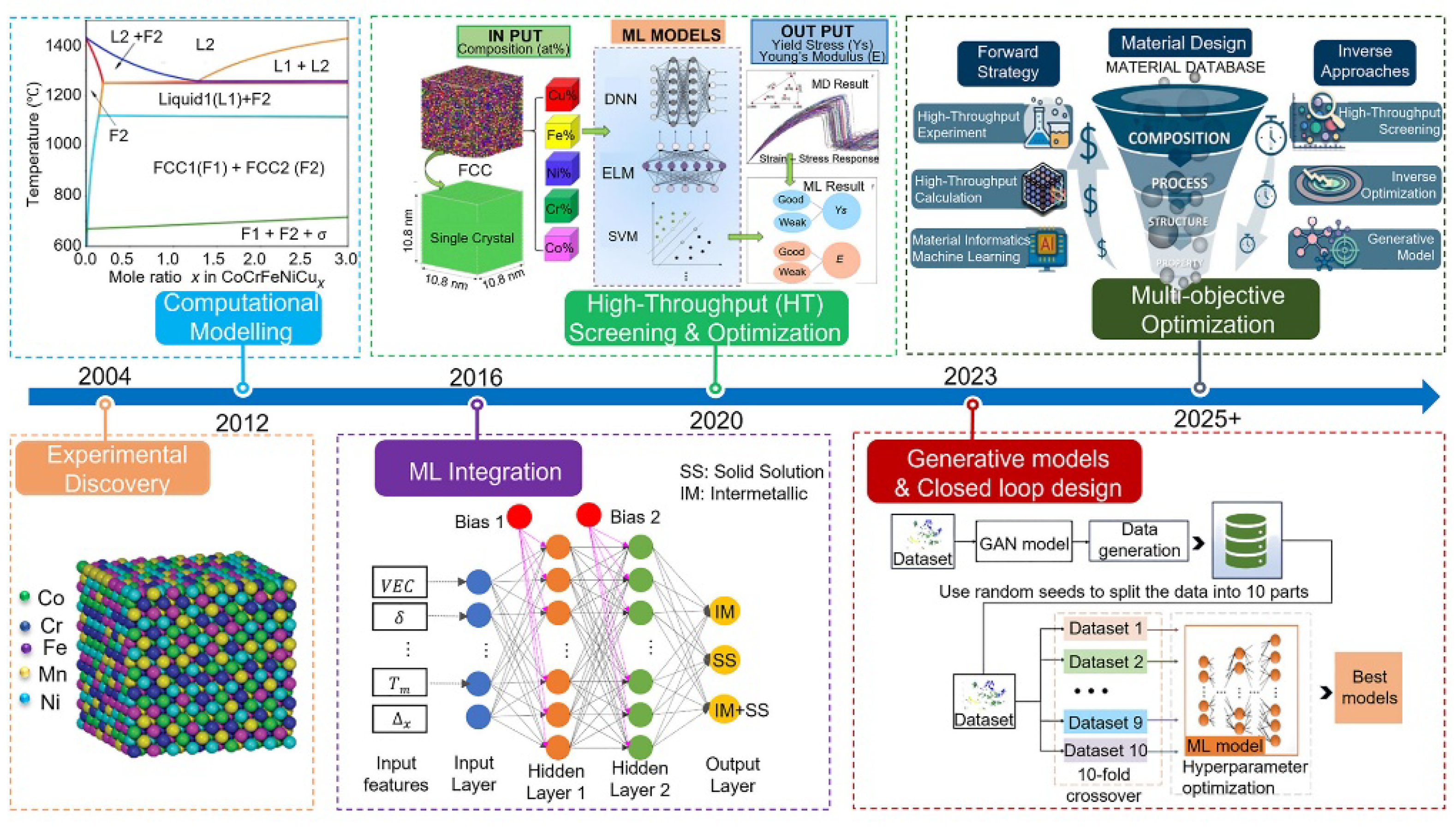
Figure 4.
Ultimate tensile strength plotted against ductility for HEAs, shown alongside data for traditional alloys. (Adapted from Lv et al., [103]).
Figure 4.
Ultimate tensile strength plotted against ductility for HEAs, shown alongside data for traditional alloys. (Adapted from Lv et al., [103]).
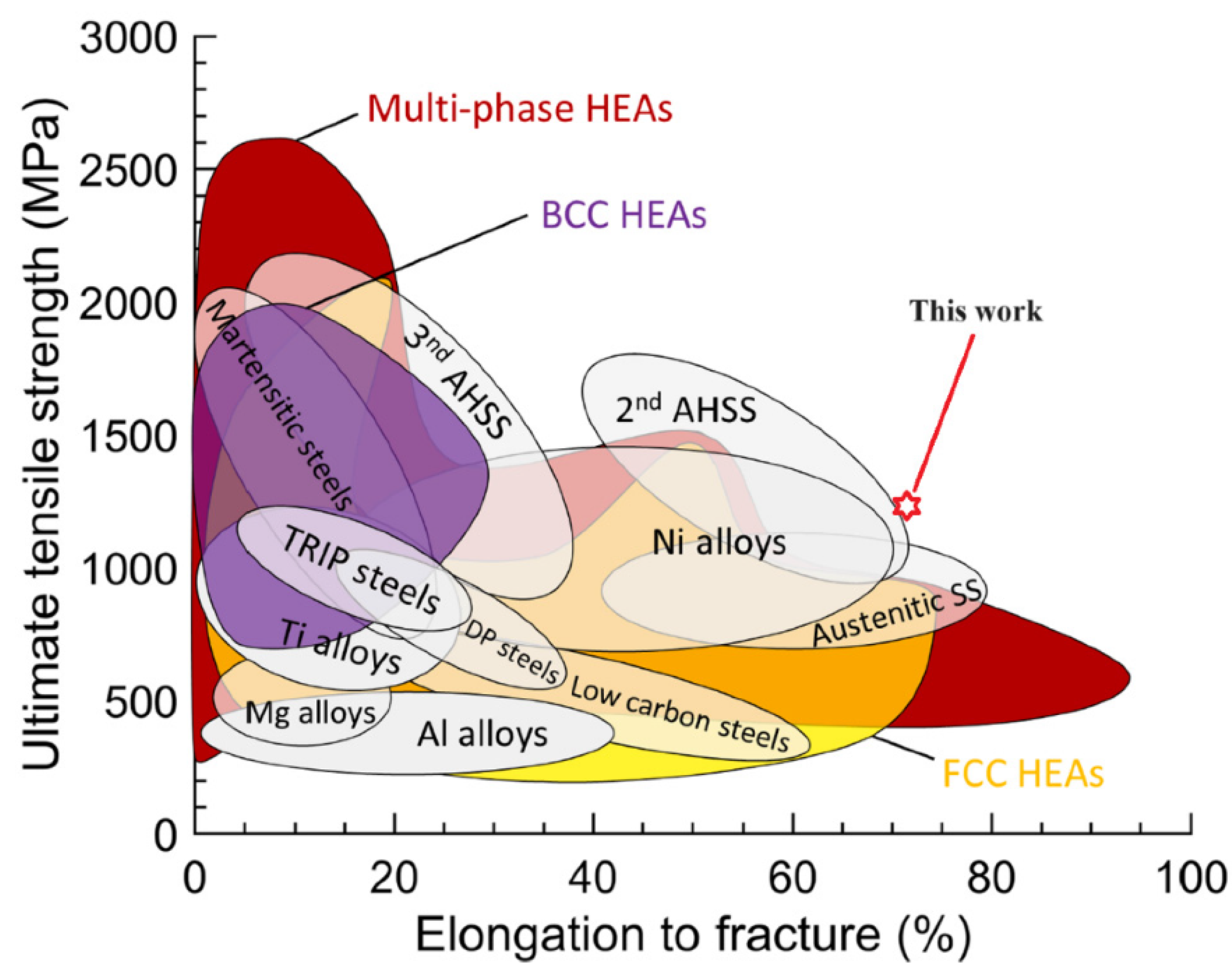
Figure 5.
Corrosion rate of the CuCrFeNiMn alloy system as a function of Cu content, determined from immersion tests. (Adapted from Ren et al., [122]).
Figure 5.
Corrosion rate of the CuCrFeNiMn alloy system as a function of Cu content, determined from immersion tests. (Adapted from Ren et al., [122]).
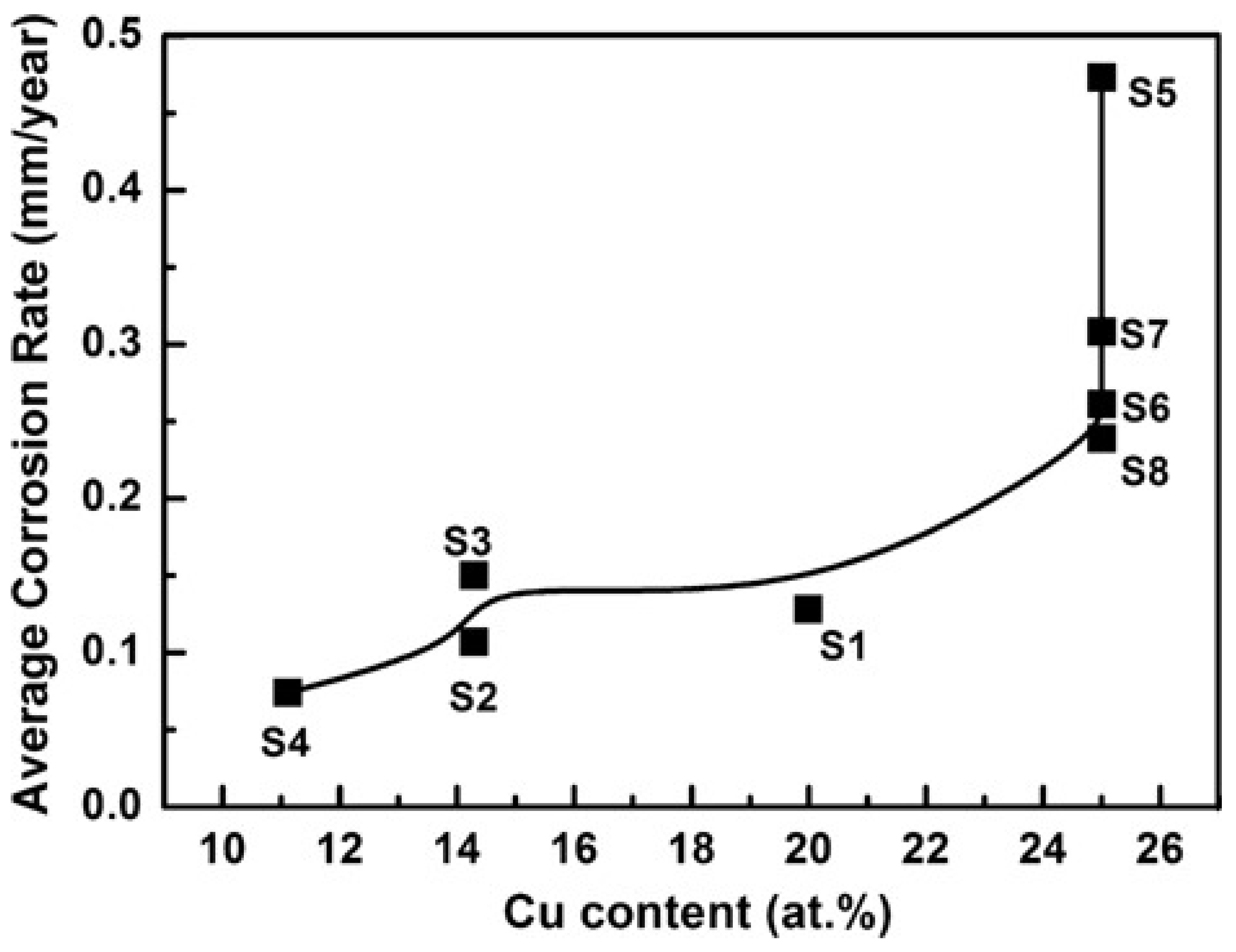
Figure 7.
Effect of Al and Si addition (x) on the coercivity and saturation magnetization of (Fe0.3Co0.5Ni0.2)100-x(Al1/3Si2/3)x HEAs. (Adapted from Zhang et al., [150]).
Figure 7.
Effect of Al and Si addition (x) on the coercivity and saturation magnetization of (Fe0.3Co0.5Ni0.2)100-x(Al1/3Si2/3)x HEAs. (Adapted from Zhang et al., [150]).
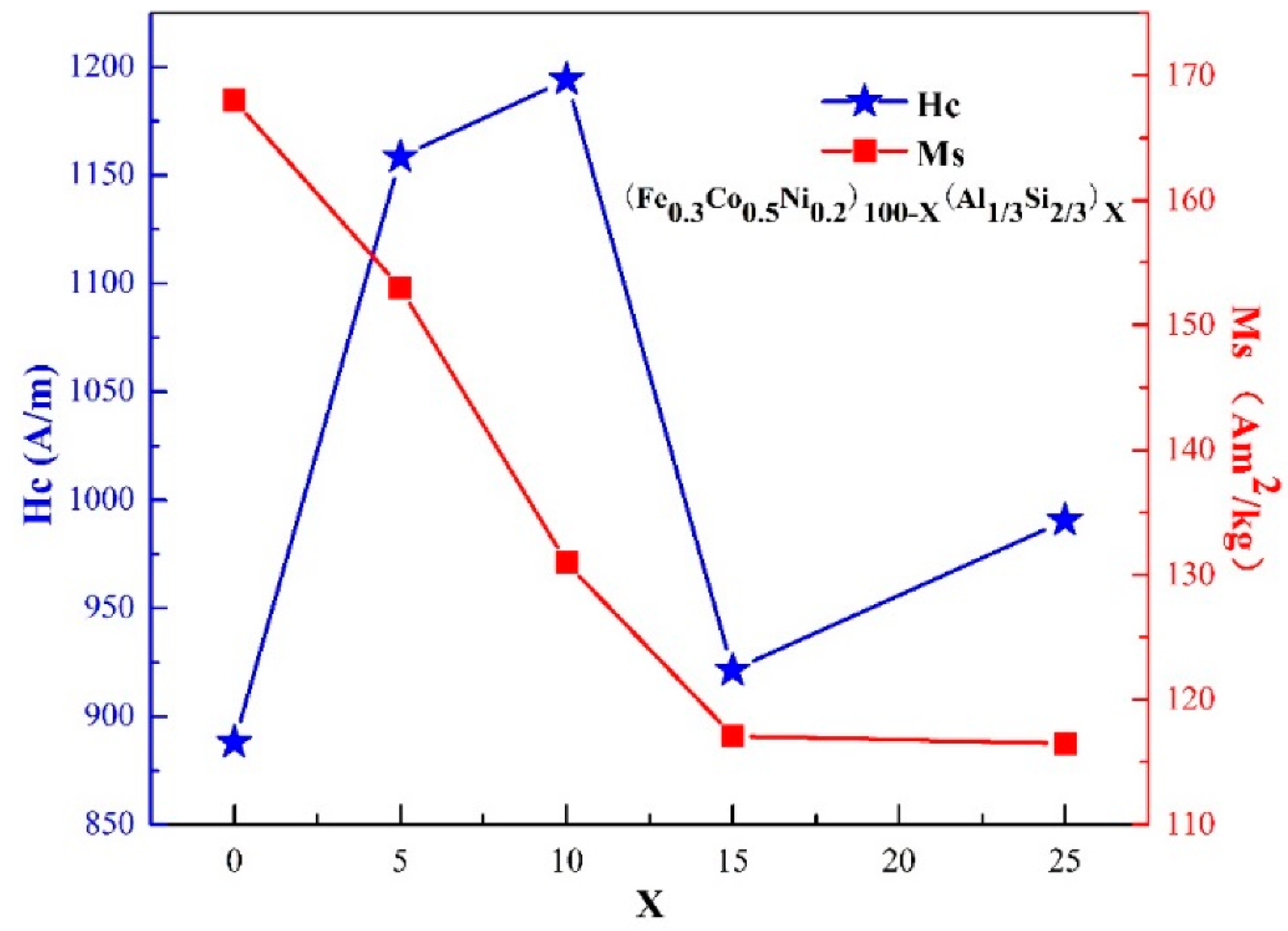
Figure 8.
Scatter plot of the five key features for the three phase types. The scatter plots map the distribution of each phase against a given pair of the five features, while the histograms show the distribution of the three phases along individual features. Blue denotes FCC, green BCC, and orange FCC + BCC. (Adapted from Gao et al., [164]).
Figure 8.
Scatter plot of the five key features for the three phase types. The scatter plots map the distribution of each phase against a given pair of the five features, while the histograms show the distribution of the three phases along individual features. Blue denotes FCC, green BCC, and orange FCC + BCC. (Adapted from Gao et al., [164]).
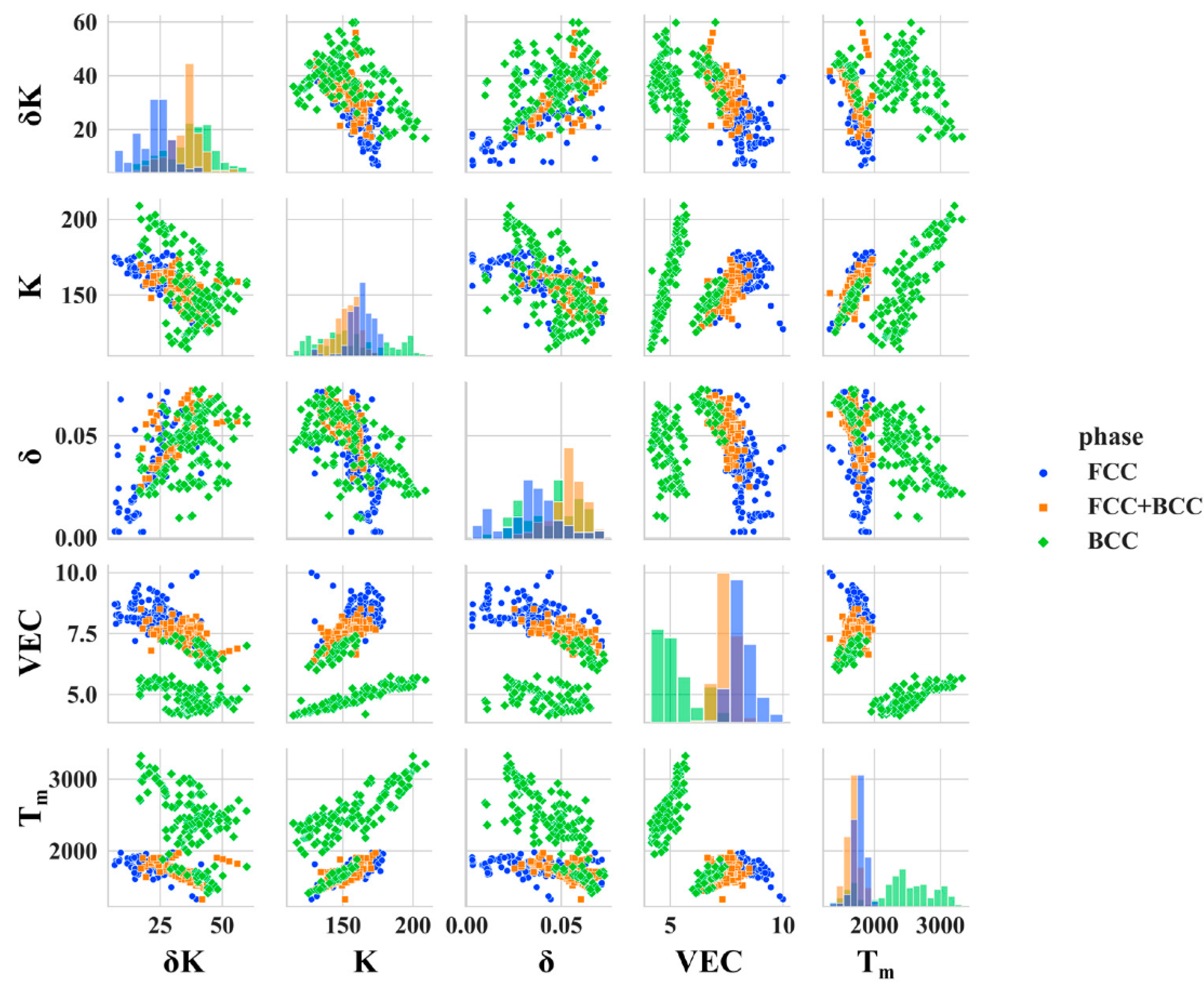
Figure 9.
(a) Comparison of machine learning models for phase prediction in high-entropy alloys and (b) the corresponding accuracies with standard deviations obtained from 5-fold cross-validation. Accuracy varied across phase categories, with XGBoost giving the highest values throughout and SVC the lowest, while RF and ANN performed strongly for several phases (Adapted from Peivaste et al., [167]).
Figure 9.
(a) Comparison of machine learning models for phase prediction in high-entropy alloys and (b) the corresponding accuracies with standard deviations obtained from 5-fold cross-validation. Accuracy varied across phase categories, with XGBoost giving the highest values throughout and SVC the lowest, while RF and ANN performed strongly for several phases (Adapted from Peivaste et al., [167]).
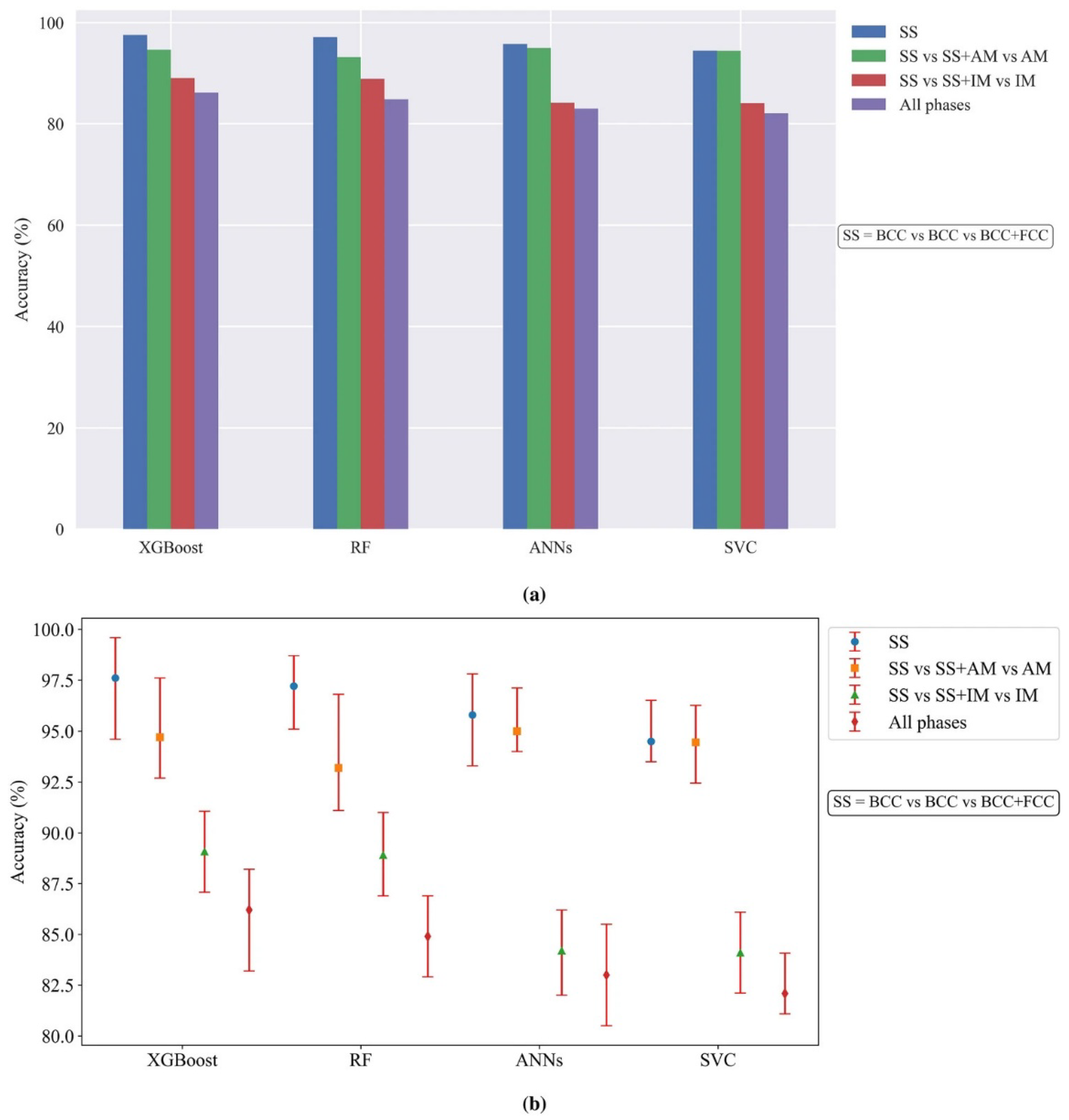
Disclaimer/Publisher’s Note: The statements, opinions and data contained in all publications are solely those of the individual author(s) and contributor(s) and not of MDPI and/or the editor(s). MDPI and/or the editor(s) disclaim responsibility for any injury to people or property resulting from any ideas, methods, instructions or products referred to in the content. |
© 2026 by the authors. Licensee MDPI, Basel, Switzerland. This article is an open access article distributed under the terms and conditions of the Creative Commons Attribution (CC BY) license (http://creativecommons.org/licenses/by/4.0/).
Copyright: This open access article is published under a Creative Commons CC BY 4.0 license, which permit the free download, distribution, and reuse, provided that the author and preprint are cited in any reuse.