

Submitted:
06 August 2026
Posted:
27 August 2026
You are already at the latest version
Abstract
This article reconstructs the central methodological idea of Ukrainian philosopher of science Dmytro T. Krivenko (1941–1994): dialectics is not a universal algorithm governing the development of physical knowledge, whereas a multilevel hierarchical organization can be traced both in the gradual refinement of concepts and in radical changes of models. The source base comprises Krivenko’s published works on the formation of quantitative concepts, informational levels of physical knowledge, and the coarse-graining of complex systems, together with the author’s clearly identified personal recollections. The abandonment of the substantial theory of caloric and the successive transformation of atomic models show that a new theoretical level need not form a symmetrical ‘synthesis’ of thesis and antithesis: it may reject the ontological core of the preceding model while retaining part of its empirical or mathematical content. Dialectics is interpreted as one local mechanism of transition between levels, and hierarchical methodology as a more general framework for organizing such transitions. The article also demonstrates the integrity of Krivenko’s philosophical project: the hierarchical principle extends from the methodology of physics to the ontology of the human being in Prynat i prynatyka and to the analysis of political positions, where democracy appears not as a compromise between extremes but as a higher level of freedom, dignity, and responsibility. This reconstruction is applied to contemporary physics: from experimental observables and nuclear models through hadronic and mesonic effective descriptions to QCD, and to the cautious formulation of preon hypotheses. Hierarchical philosophy does not establish the existence of a deeper level of matter; rather, it specifies requirements for a model: retention of validated content, an explicit domain of applicability, new independent consequences, and a route back to experiment.
Keywords:
Dmytro Krivenko
; hierarchical logic
; dialectics
; methodology of physics
; ontology of the human being
; political philosophy
; levels of explanation
; effective theories
; QCD
; preon models
; experimental testing
1. Introduction
In Soviet philosophy, dialectical materialism was regarded not merely as one possible way of analyzing change, but as the normative and ideologically privileged foundation of the scientific worldview. The history of science was therefore often portrayed as a sequence of contradictions, their intensification, and their subsequent ‘sublation’ in a new unity. Such a scheme could be fruitful as a heuristic, yet it could easily become a universal template imposed on episodes in the development of knowledge that differed markedly in structure [9].
Dmytro Tarasovych Krivenko, an engineer by initial training and later a mathematician and philosopher-methodologist, observed that the actual history of physics does not always fit this template. According to the recollection of the present author, his son, Krivenko considered especially revealing those cases in which an earlier ontological model was not ‘reconciled’ with its negation but rejected, while the new construction simultaneously performed the functions of negation and of a new generalization. This suggested that dialectics may describe some transitions, but should not be treated as the sole logic of the development of knowledge.
Physics instead consistently displays a multilevel organization: from measurement procedures to empirical quantities, from these to laws and models, and onward to theories with broader domains of applicability and to metatheoretical generalizations. An earlier level may be incorporated as a limiting case, confined to a particular scale, partly reinterpreted, or even ontologically rejected. What remains is the transition between levels and the requirement that a new theory be related to prior experience.
The purpose of this article is to reconstruct this idea on the basis of Krivenko’s published works and the author’s personal intellectual recollection, to clarify the relationship between hierarchical and dialectical methods, and to demonstrate the possible practical use of this methodology in contemporary nuclear and subnuclear physics. The aim is not to attribute a completed formal logical system to Krivenko, but to identify a coherent methodological program that can be developed with contemporary tools.
2. Sources and Limits of the Reconstruction
The reconstruction is based primarily on Krivenko’s works devoted directly to the methodology of physics: the article ‘On the Logic of the Formation of Quantitative Concepts’ (1973), the dissertation abstract ‘The Logic of the Formation of Basic Quantitative Concepts in Physics’ (1976), the article ‘Informational Levels of Physical Concepts’ (1977), the monograph The Formation of Basic Quantitative Concepts in Physics (1979), his study of the informational levels of physical concepts (1984), and the joint studies of the coarse-graining of complex systems with V. S. Koroliuk [1,2,3,4,5,6,7]. His later book Prynat i prynatyka is important for the broader ontological and anthropological context, but it should not replace the earlier specialized texts on the philosophy of physics [8]. The political dimension of the system is represented, in particular, in De-Imperialization and Defascization [24]; the specific hierarchy of political positions discussed here is also reconstructed from the author’s personal recollections.
The second source is the author’s personal recollection. Its role is limited: it helps reconstruct the motivation and oral formulation of the project, but it is not used as the sole evidence for the authorship of particular concepts or as a basis for the exact reconstruction of unpublished disputes. Where the conflict with the official philosophical establishment is concerned, one must distinguish between (a) a methodological incompatibility of positions that can be demonstrated from the texts and (b) specific biographical consequences, whose establishment would require archival documents, correspondence, and independent testimony.
This distinction is especially important because the current reference page on Dmytro Krivenko in the Ukrainian Wikipedia contains a useful bibliography but is itself marked as unverified and in need of additional reliable sources [25]. It may therefore serve as a finding aid, but not as the basis for the principal historical and philosophical conclusions.
3. Informational Levels of Physical Concepts
In his early works, Krivenko treated a physical theory as a system of concepts in which physical quantities occupy a central place. A quantitative concept does not emerge immediately in a finished form. It passes through successive stages: from the differentiation and classification of objects, through comparison and the selection of a standard and a scale, to the incorporation of the quantity into a network of empirical and theoretical relations [3,4].
Krivenko distinguished several interrelated aspects within the structure of a quantitative concept: factual content, a practical or cognitive task, the logic of the relations realized, and conventional elements—the choice of notation, standard, or scale. A physical quantity is therefore not simply a number read from an instrument. Its meaning is determined by the mode of measurement, its role within a theory, its network of relations with other quantities, and the domain in which those relations hold.
The 1977 article describes a progression from less informative to more informative levels: conditionally conventional, logical-schematic, factual, pragmatic, empirical, theoretical, and generalized-theoretical [3]. Concepts need not pass through all these stages linearly, but the scheme captures an important idea: theoretical content increases as a concept is incorporated into an increasingly comprehensive system of relations.
This yields the principle of informational inheritance. A theory at a higher degree of generality must retain the rational information obtained at the preceding level, but it need not preserve all of that level’s images, entities, or explanatory metaphors. This distinction—between retaining validated content and retaining an old ontology—is central to understanding the limits of the dialectical scheme.
In the works on the coarse-graining of complex systems, this logic acquires another aspect. A transition between levels of description may be achieved by combining elements, selecting collective variables, filtering out inessential details, and constructing a new description suited to a different scale [6,7]. In contemporary terms, this can be compared with coarse-graining and effective theories, although the comparison is our interpretation rather than a claim that Krivenko employed the later apparatus of the renormalization group.
4. The Dialectical Method and the Problem of Its Universalization
It should first be clarified that the familiar formula ‘thesis—antithesis—synthesis’ is a simplified textbook image of dialectics, not an exhaustive account of Hegel’s logic. Historians of philosophy have repeatedly warned against identifying the Hegelian method with a mechanical triad [10]. The object of criticism here is not the entire dialectical tradition, but its dogmatized version, in which every change in scientific theory was represented in advance as the necessary unfolding of a contradiction and the synthesis of opposites.
A physical theory may change in at least four different ways. First, the earlier theory may be retained as a limiting case of the new one. Second, its mathematical result may be preserved while its physical interpretation changes. Third, the old model may remain an effective description within a restricted domain. Fourth, its central entity may be rejected even though accumulated observations and measurement procedures pass into the succeeding theory. Only some of these cases are naturally described as ‘synthesis.’
The hierarchical approach does not require the type of transition to be specified in advance. It asks different questions: What level of objects does a theory describe? Which quantities are defined at that level? Where is its boundary of applicability? What exactly does the next level inherit? Which new testable claims does it add? Hierarchical methodology is therefore broader not because it denies contradiction, but because it allows for different mechanisms of change in knowledge, including dialectical ones.
5. Two Examples from Physics
5.1. From Caloric to Thermodynamics and Statistical Physics
According to family recollection, one of Krivenko’s preferred examples was the formation of the concept of temperature and the abandonment of caloric. A historical qualification is required: the concept of temperature, thermometric scales, the substantial theory of caloric, thermodynamics, and the molecular-kinetic explanation of heat did not arise all at once. Caloric theory treated heat as a special weightless substance; during the nineteenth century, investigations of the conversion of work into heat and the formulation of energy conservation undermined this ontology [11,12].
Not all earlier knowledge was lost. Some phenomenological results, including those concerning heat engines, survived the change of interpretation. Temperature remained a measurable macroscopic quantity but acquired a deeper explanation in statistical physics. Caloric as an entity was therefore rejected, whereas empirical regularities and operational procedures for working with temperature entered the new level of knowledge.
This case does not require a symmetrical synthesis between the existence and nonexistence of caloric. The new theory rejects the old ontology while inheriting part of its rational content. In the simplified terminology preserved in family recollection, the ‘antithesis’ here also becomes a new level of generalization. The hierarchical scheme describes the change more precisely: the set of fundamental objects changes, while the chain from measurements to theoretically reinterpreted quantities is retained.
5.2. From Thomson’s Model to the Nuclear Atom and Quantum Mechanics
The second example concerns models of the atom. J. J. Thomson’s model distributed positive charge throughout the volume of the atom and treated electrons as negative charges embedded within it [13]. The results of alpha-particle scattering led Rutherford to the nuclear model, in which almost all the mass and positive charge are concentrated in a small nucleus [14]. Bohr’s model subsequently combined the nuclear structure with quantum conditions [15], and quantum mechanics replaced classical electron orbits with a description in terms of states and observables.
It is therefore more accurate physically to speak not of a direct replacement of Thomson’s model by quantum mechanics, but of the sequence Thomson—Rutherford—Bohr—quantum mechanics. Krivenko’s methodological intuition nevertheless remains valid: the positively charged ‘substance’ of Thomson’s model was not incorporated into the new theory as an equal component of a future synthesis. Its spatial picture was rejected. The concepts of the electron and electric charge, and the experimental results themselves, did not disappear; they were reorganized within a new system of concepts.
This example also shows that hierarchy is not simply a ladder of truths. Rutherford’s model explained scattering but could not ensure the stability of a classical atom; Bohr’s model produced spectral results but had a limited domain; quantum mechanics transformed the very language of description. Each level solved particular problems and generated new ones. Development occurred not only through logical contradiction, but through the interaction of experiment, mathematical structure, domain of applicability, and changing ontological assumptions.
6. The Hierarchical Method as a More General Methodological Framework
In the formulation preserved in family recollection, Krivenko proposed making dialectics complementary to what he called ‘hierarchics’ (ierarkhika). The term hierarchics is understood here as a method for investigating multilevel structures of being and knowledge, not as a justification of social inequality or administrative subordination. Its subject is the relation among scales, languages of description, systems of concepts, and degrees of generality.
The relationship between the two methods can be formulated as follows. Dialectics analyzes tensions, negations, and transformations within a transition. The hierarchical method locates that transition within a system of levels, specifies the conditions under which information is transferred, and relates the new description to experience. Dialectical ‘sublation’ is one possible type of interlevel relation, alongside a limiting transition, an effective approximation, reinterpretation, coarse-graining, the emergence of new degrees of freedom, or the rejection of a false entity.
Accordingly, the priority assigned to the hierarchical method does not imply that every theory is automatically true ‘at its own level.’ A level does not excuse an error. A theory must be empirically adequate within its stated domain and must have a specified relation to other levels. Hierarchical pluralism differs from relativism because descriptions are assessed by common observables, precision, internal consistency, and predictive power.
7. A Contemporary Operationalization of the Hierarchical Approach
For contemporary applications, it is useful to represent a model at level Lₙ as an ordered structure:
Mₙ = (Eₙ, Qₙ, Rₙ, Dₙ),
where Eₙ denotes the accepted entities or degrees of freedom, Qₙ the physical quantities and observables, Rₙ the laws and relations, and Dₙ the domain of applicability. This notation is the present author’s formalization, inspired by Krivenko’s works, rather than a formula taken from his texts.
A transition Mₙ → Mₙ₊₁ is methodologically justified not when the new model merely appears ‘deeper,’ but when it satisfies a set of testable requirements. These are summarized in Table 1.
These criteria protect the hierarchical approach from two opposing errors. The first is the reductionist conviction that a more fundamental level automatically invalidates effective models. The second is the uncontrolled multiplication of ‘levels,’ each declared self-sufficient and exempt from testing. Krivenko’s requirement of increasing informativeness entails both continuity and an increase in content.
8. From Experiment to Nuclear, Hadronic, and Quark-Level Models
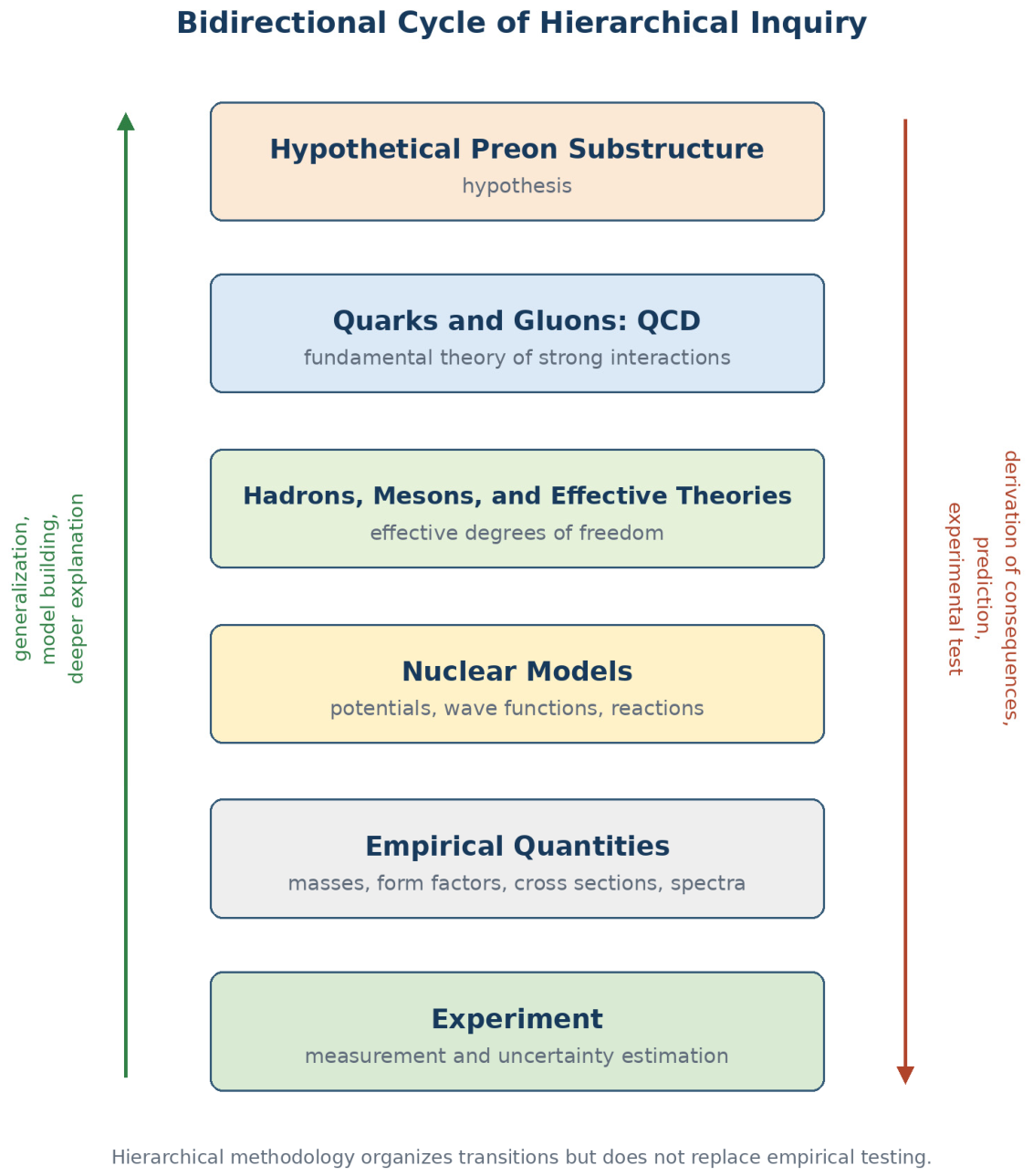
The hierarchical structure is especially clear in the modern physics of strong interactions. Experiments do not directly deliver ‘quarks inside the nucleus,’ but detector signals from which cross sections, spectra, polarization characteristics, form factors, and other observables are extracted after calibration and statistical analysis. Nuclear models with nucleons, wave functions, potentials, and reaction mechanisms constitute the next level. At low energies, mesonic and chiral effective descriptions are useful, whereas the fundamental theory of strong interactions—QCD—operates with quarks and gluons [19,20,21].
These descriptions should not be arranged in a naive linear sequence in which every succeeding level simply renders the preceding one obsolete. Mesons are composite quark-antiquark states, but in a low-energy theory they may be the most convenient effective degrees of freedom. A nucleonic model of the nucleus does not become false merely because nucleons possess quark-gluon structure. It remains valid within its domain if it reproduces the observables correctly and controls the relevant corrections.
In the author’s own research, this movement proceeds from measured characteristics of elastic electron-deuteron scattering to models of form factors, the deuteron wave function, two-photon-exchange corrections, and possible manifestations of short-range structure [22]. Importantly, the choice of model is determined not by its philosophical attractiveness but by quantitative comparison with data and analysis of its domain of applicability. Here philosophical hierarchy performs a navigational function: it identifies which objects and parameters belong to which level and where a bridge between descriptions is required.
Figure 1.
Bidirectional cycle of hierarchical inquiry in physics. Author’s diagram.
9. The Preon Hypothesis as a Test of Methodological Discipline
The conjecture that quarks and leptons possess a preon substructure is a natural example of movement toward a possible deeper level. Yet this is precisely where it is easy to confuse a hierarchical heuristic with evidence for a new layer of matter. The argument ‘if nuclei, nucleons, and hadrons are composite, then quarks must also be composite’ is not a logical inference. Nature is not obliged to repeat the same structural pattern indefinitely.
Hierarchical methodology should therefore strengthen, rather than relax, the requirements imposed on a preon model. Such a model must be consistent with the validated structure of the Standard Model, respect compositeness bounds, reproduce known masses and quantum numbers, and—most importantly—yield independent consequences that are not products of arbitrary fitting. If the free choice of coordinate origin, scale, or additional parameters makes it possible to reproduce almost any dataset with near-perfect accuracy, this indicates not the discovery of a deeper level but an underdetermined model.
In his study of the charged-fermion mass spectrum, the author uses a rank audit of the model matrix, counts independent parameters, and searches for parameter-independent relations [23]. This approach accords with the spirit of Krivenko’s informational levels: exact interpolation of a set of points is not, by itself, a prediction. Scientific content arises when a shared structure across different sectors produces constraints that were not introduced through a separate parameter for every observation.
The appropriate formulation must therefore remain cautious: all physical models in the author’s work are compared with experimental data within their stated domains, but their degrees of validation differ. Nuclear and hadronic descriptions can be tested directly against observables. QCD has broad experimental support. The preon model remains a hypothesis that can currently be constrained only indirectly—through its internal consistency, parameter-independent consequences, and compatibility with established physics.
10. The Integrity of the Philosophy: From Physics to Ontology and Politics
Dmytro Krivenko’s philosophical project was an integrated one: he applied the hierarchical principle not only to the methodology of physics, but also to ontology, philosophical anthropology, and the analysis of political positions. Its unity did not consist in directly transferring physical concepts to the human being and society, but in a common requirement to distinguish levels of organization, forms of dependence, and degrees of subjecthood. His early works on scientific methodology and his later philosophical and political books should therefore be read as parts of a single project.
10.1. Prynat i Prynatyka: Ontology and a Typology of the Human Being
The book Prynat i prynatyka: Fundamental Ontology of the Human Being and a Typology of People [8] extends the level-sensitive approach from the methodology of knowledge to the analysis of human existence. In the reconstruction proposed here, the concept of prynat denotes the essential, agential core of the human being, whereas prynatyka encompasses the forms of its manifestation, activity, and embeddedness in concrete social and historical relations. This interpretation should be understood as an analytical reconstruction of the book’s conceptual architecture, not as the attribution of a completed formal lexicon to its author.
From this perspective, a human being cannot be reduced to a flat aggregate of properties or to an assigned social function. Human existence may be viewed as a hierarchically organized unity of bodily, psychic, social, rational, and spiritual dimensions. Lower levels are necessary, but they should not become the ultimate measure of the person; higher levels do not destroy them, but integrate them and give them meaningful and moral direction. The methodological intuition developed from physics recurs here: levels must be distinguished and related at the same time.
10.2. A Hierarchy of Political Positions
Krivenko applied the same principle to a system of political views developed in the context of his work on the de-imperialization and defascization of Ukraine [24]. According to the present author’s recollection, he regarded political positions not as points on a one-dimensional axis, but as a hierarchy of degrees of human subjecthood. At the lower levels, political self-definition is governed primarily by collective-biological impulses, fear, submission to the group, and the search for a simple enemy.
In this reconstruction, the far-right position absolutizes ethnic or national belonging, places it above the dignity of the individual, and opens the way to the exclusion of those deemed ‘alien.’ The far-left position replaces justice with compulsory leveling, in which individuality, freedom, and personal responsibility dissolve into an impersonal mass. The point is not to reject the nation or equality as values, but to criticize two reductions of the human being: to a biologized collective on the right and to a homogenized mass on the left.
According to this reconstruction, Krivenko associated the highest, spiritually reflective level with the democratic position. Democracy is not an arithmetic midpoint between left- and right-wing extremes, but a qualitatively different mode of political existence: recognition of personal dignity and freedom, pluralism, responsibility, the right to national and cultural identity without xenophobia, and social justice without compulsory leveling. The hierarchical method therefore performs not only a descriptive but also a normative function: it marks a transition from instinctive group reactions to the conscious cooperation of free subjects.
11. Methodological Conflict with Official Philosophy
According to the author’s recollection, the proposal to treat dialectics as complementary to the hierarchical method was one source of Dmytro Krivenko’s conflict with the official philosophical establishment. In the context of Soviet science, this was not a neutral terminological refinement. If dialectics was proclaimed the universal method for understanding nature, then the claim that there was a broader methodological framework effectively limited its privileged status.
The intellectual substance of the conflict can be reconstructed with reasonable clarity: Krivenko began from the concrete history of physical concepts and required the methodological scheme to correspond to the actual structure of science. The stronger claim that this disagreement directly caused a particular dismissal, prohibition, or persecution would, however, require a separate documentary basis. A scholarly article should speak of methodological opposition and biographical tension without turning family recollection into an unverified archival fact.
In our view, such caution is more faithful to Krivenko’s position than an apologetic account would be. Hierarchical methodology requires levels of evidence to be distinguished: a published text, an archival document, a participant’s recollection, and a later interpretation. They may complement one another, but they are not interchangeable.
12. Relation to Contemporary Philosophy of Science
Krivenko’s hierarchical approach has substantive parallels with several currents in contemporary philosophy and methodology of science. T. Kuhn’s account of scientific revolutions shows that theory change cannot be reduced to the simple accumulation of facts [16]. P. Anderson’s thesis that ‘more is different’ emphasizes the emergence of new regularities at levels of complex organization [17]. The renormalization group demonstrates how different microscopic systems may flow toward common effective behavior at large scales [18]. Effective field theory formalizes the construction of a description appropriate to a specified energy domain [19,20].
These parallels should not be presented as claims of direct influence or priority. Krivenko’s originality lies elsewhere: he developed the problem of levels through an analysis of the formation of physical quantities, the informational structure of concepts, and methods for coarse-graining complex systems, while opposing this program to the dogmatic universalization of dialectics. Comparison with later concepts helps make his project intelligible to a contemporary reader, but it should not erase the historical specificity of his language.
13. Limitations of the Reconstruction
First, the available published sources do not contain a completed formal calculus that could, without qualification, be called ‘hierarchical logic’ in the narrow technical sense. It is therefore more accurate to speak of a hierarchical methodology or a program of reconstruction. Any contemporary formulas, categorical mappings, or criteria for model selection must be clearly identified as developments introduced by the present author.
Second, the claim that hierarchy can ‘always’ be traced in cognition has the status of a broad methodological hypothesis, not that of a proven logical theorem. Its strength lies in its capacity to organize a considerable range of cases, but it must also remain open to criticism.
Third, the historical examples should not be oversimplified. Temperature did not arise only after caloric was abandoned, and quantum mechanics did not replace Thomson’s model in a single step. Clarifying these historical details does not weaken Krivenko’s idea; it makes it more persuasive, because the hierarchical approach is precisely what enables us to describe the multistage character of the actual development of physics.
Fourth, philosophical methodology cannot select a specific physical model without quantitative analysis. It defines the discipline of questioning and the criteria for transition, while the final decision remains with the data, statistics, internal consistency, and reproducibility of results.
Fifth, the account of the political hierarchy combines Krivenko’s published works with the author’s personal recollection. A complete textual reconstruction would require a separate study of the entire corpus of political writings, manuscripts, and archival materials.
14. Conclusions
Dmytro Krivenko’s central methodological intuition can be formulated as follows: the development of science need not pass each time through a universal triad of thesis, antithesis, and synthesis. An earlier ontology may be rejected, its mathematical or empirical results partly retained, and a new description constructed upon a different system of concepts. What remains invariant is not the dialectical form of transition, but the multilevel organization of knowledge and the requirement that its levels be related to one another.
Dialectics should therefore be treated as one possible mechanism of change within a broader hierarchical methodology. The hierarchical method describes not only negation, but also inheritance, limiting transitions, effective approximations, coarse-graining, the emergence of new degrees of freedom, and changes in the language of theory.
For contemporary physics, this position has a practical consequence. Movement from experiment to nuclear models, from those models to hadronic and quark-gluon descriptions, and onward to possible preon hypotheses must be accompanied by movement in the reverse direction: from a deeper construction to independent consequences, observables, and experimental tests. No ‘higher’ level acquires truth merely by virtue of its depth.
The integrity of this philosophy is evident in Krivenko’s application of the same principle of distinguishing and relating levels across different fields: in physics, to the structure of knowledge; in the ontology of Prynat i prynatyka, to forms of human existence and subjecthood; and in political philosophy, to degrees of freedom and responsibility. The democratic position appears here as a higher integrative level capable of combining personal dignity, cultural identity, social justice, and the rejection of coercion.
In this sense, Dmytro Krivenko’s legacy can function as a living methodology rather than merely an object of historical and philosophical commemoration. It teaches us to recognize the structure of knowledge, not to confuse a model with reality, to distinguish levels of evidence, and to require every theoretical deepening to return to experiment.
Author Positionality: The author is the son of Dmytro Tarasovych Krivenko. This relationship is a source of personal recollection and of the motivation for the study. Historical claims not supported by published sources are identified in the text as recollections or reconstructions.
Data Availability Statement
No new experimental datasets were generated in this study. The publications used are listed in the References.
Use of Artificial Intelligence
ChatGPT (OpenAI) was used for language editing, manuscript structuring, and preparation of a working draft. The author is responsible for the final text, verification of sources, historical claims, and physical content.
Conflicts of Interest
The author declares no conflicts of interest.
References
- Krivenko, D. T. On the Logic of the Formation of Quantitative Concepts. Philos. Probl. Mod. Nat. Sci. in Ukrainian. 1973, 31, 76–84. [Google Scholar]
- Krivenko, D. T. The Logic of the Formation of Basic Quantitative Concepts in Physics. Abstract of a dissertation for the Candidate of Philosophical Sciences degree, in Russian. Moscow, 1976. [Google Scholar]
- Krivenko, D. T. Informational Levels of Physical Concepts. Filos. Dumka in Ukrainian. 1977, 3, 92–98. [Google Scholar]
- Krivenko, D. T. The Formation of Basic Quantitative Concepts in Physics; 144 pp. [in Ukrainian; Naukova Dumka: Kyiv, 1979. [Google Scholar]
- Krivenko, D. T. Informational Levels of Physical Concepts and the Problem of Levels of Cognition. In The Theoretical and the Empirical in Contemporary Scientific Knowledge; in Russian; Nauka: Moscow, 1984. [Google Scholar]
- Koroliuk, V. S.; Krivenko, D. T. Logical and Methodological Aspects of the Coarse-Graining of Complex Systems. Bull. Acad. Sci. Ukr. SSR in Ukrainian. 1982, 9, 17–24. [Google Scholar]
- Koroliuk, V. S.; Krivenko, D. T. Coarse-Graining as a Method for Studying Complex Systems. In Dialectics of the Cognition of Complex Systems; in Russian; Mysl: Moscow, 1988; pp. 89–106. [Google Scholar]
- Krivenko, D. T. Prynat i prynatyka: Fundamental Ontology of the Human Being and a Typology of People; in Ukrainian; Folio: Kharkiv, 1996; p. 270 pp. ISBN 966-03-0041-7. [Google Scholar]
- Graham, L. R. Science, Philosophy, and Human Behavior in the Soviet Union; Columbia University Press: New York, 1987. [Google Scholar]
- Mueller, G. E. The Hegel Legend of ‘Thesis–Antithesis–Synthesis’. J. Hist. Ideas 1958, 19, 411–414. [Google Scholar] [CrossRef]
- Carnot, S. Réflexions sur la puissance motrice du feu et sur les machines propres à développer cette puissance; Bachelier: Paris, 1824. [Google Scholar]
- Joule, J. P. On the Mechanical Equivalent of Heat. Philos. Trans. R. Soc. Lond. 1850, 140, 61–82. [Google Scholar] [CrossRef]
- Thomson, J. J. On the Structure of the Atom. Philos. Mag. 1904, 7, 237–265. [Google Scholar] [CrossRef]
- Rutherford, E. The Scattering of α and β Particles by Matter and the Structure of the Atom. Philos. Mag. 1911, 21, 669–688. [Google Scholar] [CrossRef]
- Bohr, N. On the Constitution of Atoms and Molecules, Part I. Philos. Mag. 1913, 26, 1–25. [Google Scholar] [CrossRef]
- Kuhn, T. S. The Structure of Scientific Revolutions, 2nd ed.; University of Chicago Press: Chicago, 1970. [Google Scholar]
- Anderson, P. W. More Is Different. Science 1972, 177, 393–396. [Google Scholar] [CrossRef] [PubMed]
- Wilson, K. G. The Renormalization Group and Critical Phenomena. Rev. Mod. Phys. 1983, 55, 583–600. [Google Scholar] [CrossRef]
- Georgi, H. Effective Field Theory. Annu. Rev. Nucl. Part. Sci. 1993, 43, 209–252. [Google Scholar] [CrossRef]
- Machleidt, R.; Entem, D. R. Chiral Effective Field Theory and Nuclear Forces. Phys. Rep. 2011, 503, 1–75. [Google Scholar] [CrossRef]
- Weinberg, S. Nuclear Forces from Chiral Lagrangians. Phys. Lett. B 1990, 251, 288–292. [Google Scholar] [CrossRef]
- Krivenko-Emetov, Y. D. Investigation of the Internal Structure of the Deuteron against the Background of Two-Photon Exchange Effects in Elastic Electron–Deuteron Scattering. Nucl. Phys. At. Energy 2024, 25, 309–315. [Google Scholar] [CrossRef]
- Krivenko-Emetov, Y. D.; Lytvynenko, O. M. Rank and Scale Tests of Shell-Motivated Fermion-Mass Ansätze with a Constrained Neutrino Extension. arXiv [hep-ph. 2026, arXiv:2608.02701. [Google Scholar]
- Krivenko, D. T. De-Imperialization and Defascization: Toward an Ideology of Ukraine’s Third Revival; 160 pp. [in Ukrainian; Prosvita: Kyiv, 1992. [Google Scholar]
- Krivenko, Dmytro Tarasovych. Wikipedia, the Free Encyclopedia Used solely as a bibliographic finding aid. Available online: https://uk.wikipedia.org/wiki/Кривенкo_Дмитрo_Тарасoвич (accessed on 6 August 2026).

Table 1.
Criteria for transition to a deeper level of physical description. Author’s formalization.
| Criterion | Guiding question | Indicator of methodological weakness |
| Empirical contact | Against which measurable quantities is the model tested? | The link to data is replaced by a merely qualitative analogy. |
| Domain of applicability | At what energy, length, and precision scales does the description work? | The model is declared universal without specifying its boundaries. |
| Retention of validated content | Which tested results from the preceding level are reproduced? | The deeper description conflicts with reliable data without explanation. |
| New information | Which independent relations or predictions are added? | Only the number of parameters and the quality of fit increase. |
| Interlevel relation | Through which approximation, mapping, or procedure are the descriptions related? | The levels are merely placed side by side, with no mechanism of transition. |
| Falsifiability | What conceivable observational result would rule out the model? | Any result can be accommodated after retuning. |
Disclaimer/Publisher’s Note: The statements, opinions and data contained in all publications are solely those of the individual author(s) and contributor(s) and not of MDPI and/or the editor(s). MDPI and/or the editor(s) disclaim responsibility for any injury to people or property resulting from any ideas, methods, instructions or products referred to in the content. |
© 2026 by the authors. Licensee MDPI, Basel, Switzerland. This article is an open access article distributed under the terms and conditions of the Creative Commons Attribution (CC BY) license (http://creativecommons.org/licenses/by/4.0/).
Copyright: This open access article is published under a Creative Commons CC BY 4.0 license, which permit the free download, distribution, and reuse, provided that the author and preprint are cited in any reuse.