

Submitted:
25 August 2026
Posted:
26 August 2026
You are already at the latest version
Abstract
Antimicrobial resistance is usually treated as a hospital problem, yet much of the resistance reaching a patient's bedside begins in the food chain. This review follows resistance from the breeding farm to the domestic kitchen, asking at every step what happens there to make resistant bacteria more likely to survive, multiply or move into a new host. Literature from 2010 to 2026 was drawn from five databases and from EFSA, WHO, FAO and WOAH surveillance outputs; 118 sources were retained. Primary production emerges as the main amplifier, because that is where antimicrobials are given in bulk and where copper, zinc and quaternary ammonium biocides quietly co-select for the same mobile elements. Slaughter and processing act as mixers rather than filters, redistributing a few resistant clones across a day of production. Retail and household handling add little selection but a great deal of exposure. Beneath all of it sits an environmental compartment that stores resistance genes and returns them months later. Three contributions are offered. Stage-specific amplification profiling separates stages that create resistance from those that merely carry it. An AMR-Critical Control Point framework adapts HACCP logic to a hazard that is a transferable gene rather than a bacterial count. An intervention hierarchy ranks controls by effectiveness rather than by ease of adoption. The review closes critically: the retail prevalence survey has reached diminishing returns, surveillance built separately in each sector cannot detect the linkages it was meant to find, and consumer messaging has been asked to carry more responsibility than it can bear. The limitations of our own frameworks are stated alongside those criticisms. For countries where antimicrobials are sold without prescription and most meat moves through informal markets, the order of reform matters more than its content: diagnostic capacity first, sentinel surveillance second, sales restriction third, consumer education last.
Keywords:
anti-bacterial agents
; drug resistance
; bacterial
; food chain
; food safety
; one health
1. Introduction
It is easy to picture antimicrobial resistance as something that happens in intensive care units. The picture is not wrong, but it is badly cropped. The bacteria that cause treatment failure in a hospital ward frequently carry resistance genes that were assembled elsewhere, in gut communities under selection on farms, in slurry lagoons, in the water used to wash salad leaves, and in the biofilm on a poorly cleaned conveyor belt. Murray et al. (2022) estimated that bacterial antimicrobial resistance was directly responsible for 1.27 million deaths in 2019 and associated with nearly five million, and a large fraction of those deaths involved organisms, Escherichia coli, Klebsiella pneumoniae, non-typhoidal Salmonella, Campylobacter, that spend part of their life cycle in food animals or in food itself. Framing resistance as a clinical problem alone therefore removes most of the places where something useful could be done about it. O’Neill (2016) put the same point in economic terms, projecting ten million annual deaths and a cumulative economic loss of one hundred trillion US dollars by 2050 if the trajectory is not altered, and it explicitly identified agricultural use as one of the areas where intervention was both possible and neglected.
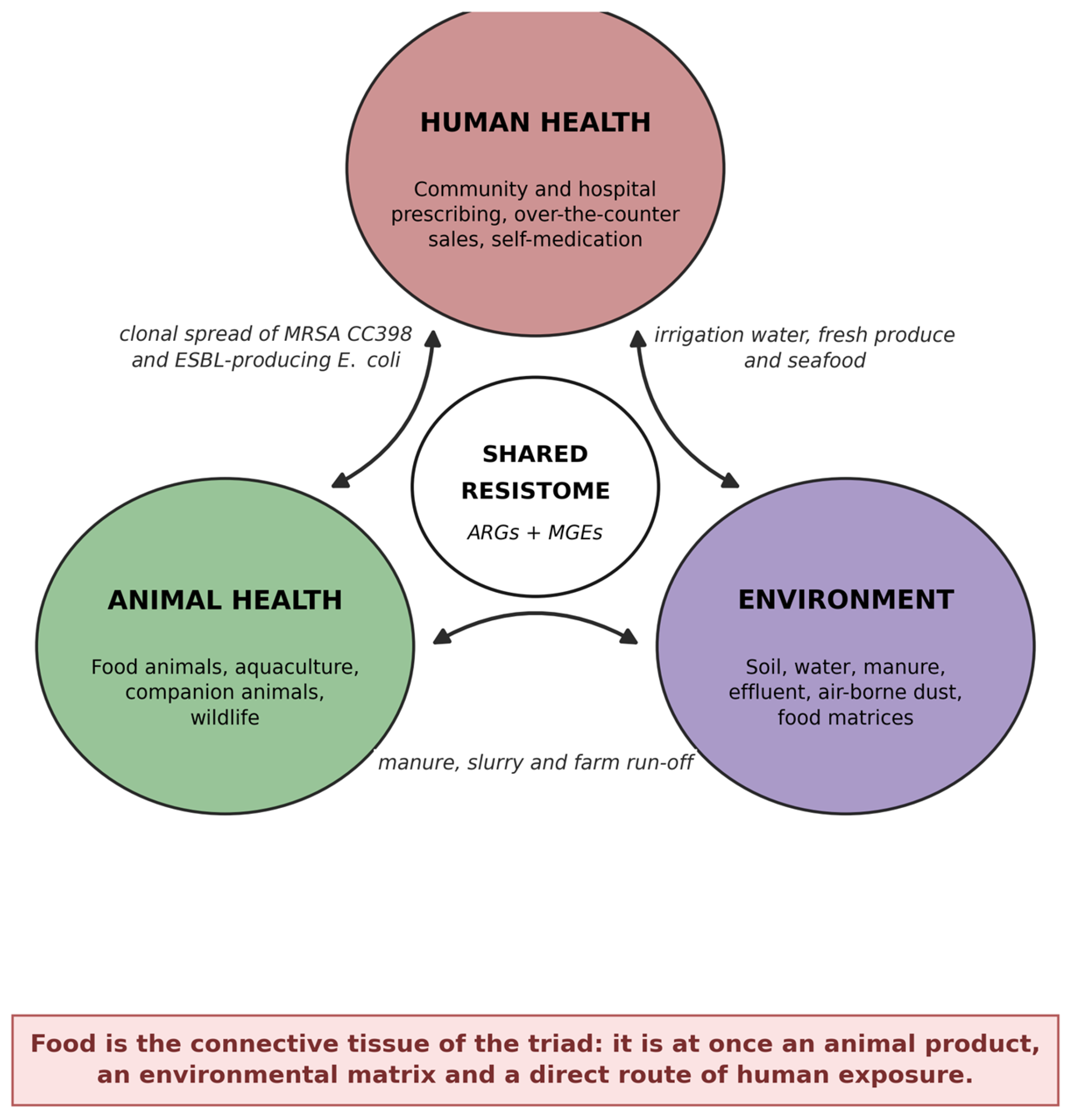
The farm-to-fork continuum is a convenient phrase but a real biological pathway. A broiler chick hatched in a commercial hatchery may already carry an extended-spectrum beta-lactamase-producing E. coli acquired vertically from the breeder flock (Dahms et al., 2015). Over the next five weeks that bird receives feed, water and, in many production systems, antimicrobials, all of which shape its gut flora. At slaughter it enters a scald tank shared with thousands of other birds. Its carcass is chilled in water or air alongside carcasses from several farms. It is portioned, packed, transported, displayed at a retail counter that may or may not hold four degrees Celsius, bought, carried home in a warm bag, and finally handled on a cutting board that will also be used for a salad. At each of those steps something happens to the resistant population it carries, and at each of those steps a control could in principle be applied. The problem is that responsibility for those steps is split between veterinary authorities, food safety authorities, environmental regulators and nobody at all, which is the gap the One Health framing was invented to close (McEwen and Collignon, 2018; Woolhouse et al., 2015). Figure 2 sets out that framing in the form used throughout this review, with food placed at the centre rather than treated as an appendix to the animal sector.
The volume of antimicrobial use in animals makes the scale of the issue clear. Van Boeckel et al. (2015) projected global consumption in food animals rising from roughly 63,000 tonnes in 2010 to over 105,000 tonnes by 2030, with most of the growth in middle-income countries where regulation of veterinary drug sales is weakest. Van Boeckel et al. (2019) later mapped resistance itself rather than use, and found that the proportion of antimicrobial compounds with resistance above fifty percent nearly doubled in chickens and pigs across low- and middle-income countries between 2000 and 2018. Human consumption rose over the same period, by around sixty-five percent between 2000 and 2015, and again the increase was concentrated in low- and middle-income settings (Klein et al., 2018). These two curves are not independent. They share drivers, they share bacteria, and in many countries they share the same unregulated pharmacy counter. Laxminarayan et al. (2013) argued more than a decade ago that solutions would have to be global and cross-sectoral, and Collignon et al. (2018) subsequently showed in a multivariable analysis across 103 countries that governance quality, sanitation and public health expenditure predicted national resistance levels at least as strongly as antibiotic consumption itself. That is an uncomfortable result for strategies built on stewardship alone.
Reviews of resistance in the food chain already exist, and several are excellent. Verraes et al. (2013) provided the reference description of transmission routes; Capita and Alonso-Calleja (2013) examined the food-industry angle; Founou et al. (2016) brought a developing-country perspective; Oniciuc et al. (2019) focused specifically on processing; Hudson et al. (2017) reviewed the agri-food chain as a whole; and Thanner et al. (2016) and Manyi-Loh et al. (2018) surveyed agricultural use and its environmental consequences. Xu et al. (2022) provided a recent account of current resistance patterns in food animals. What these treatments largely share is a compartment-by-compartment structure: a section on farms, a section on food, a section on humans. That structure is faithful to how the literature is generated but it obscures the thing that matters most, which is the difference between a stage that creates new resistance and a stage that simply transports what already exists. Those two kinds of stages call for completely different interventions, and conflating them is one reason why control programmes so often target the visible step, the retail counter, rather than the influential one, the grow-out shed.
This review therefore takes a deliberately sequential approach. It walks the continuum in order, and at every stage it separates three questions: is selection occurring here, is amplification occurring here, and is transfer occurring here. From that analysis three things are developed that we believe are new, or at least newly assembled. The first is a set of stage-specific resistance amplification factors, a semi-quantitative way of saying how much a given stage adds to the resistance burden it receives. The second is an AMR-Critical Control Point framework that borrows the discipline of HACCP but redefines the hazard as a transferable determinant rather than a pathogen count, which changes what has to be measured and where the critical limits sit. The third is an intervention hierarchy modelled on occupational-hygiene logic, ranking controls from elimination through to individual behaviour, which makes explicit the uncomfortable fact that the interventions most often promoted to consumers are the weakest ones available.
Figure 1.
The farm-to-fork continuum for antimicrobial resistance. Selection pressures act principally at the upper band; the shared environmental reservoir at the lower band both receives and returns resistance determinants at every stage, which is why linear control strategies applied at a single point tend to underperform.
Figure 1.
The farm-to-fork continuum for antimicrobial resistance. Selection pressures act principally at the upper band; the shared environmental reservoir at the lower band both receives and returns resistance determinants at every stage, which is why linear control strategies applied at a single point tend to underperform.
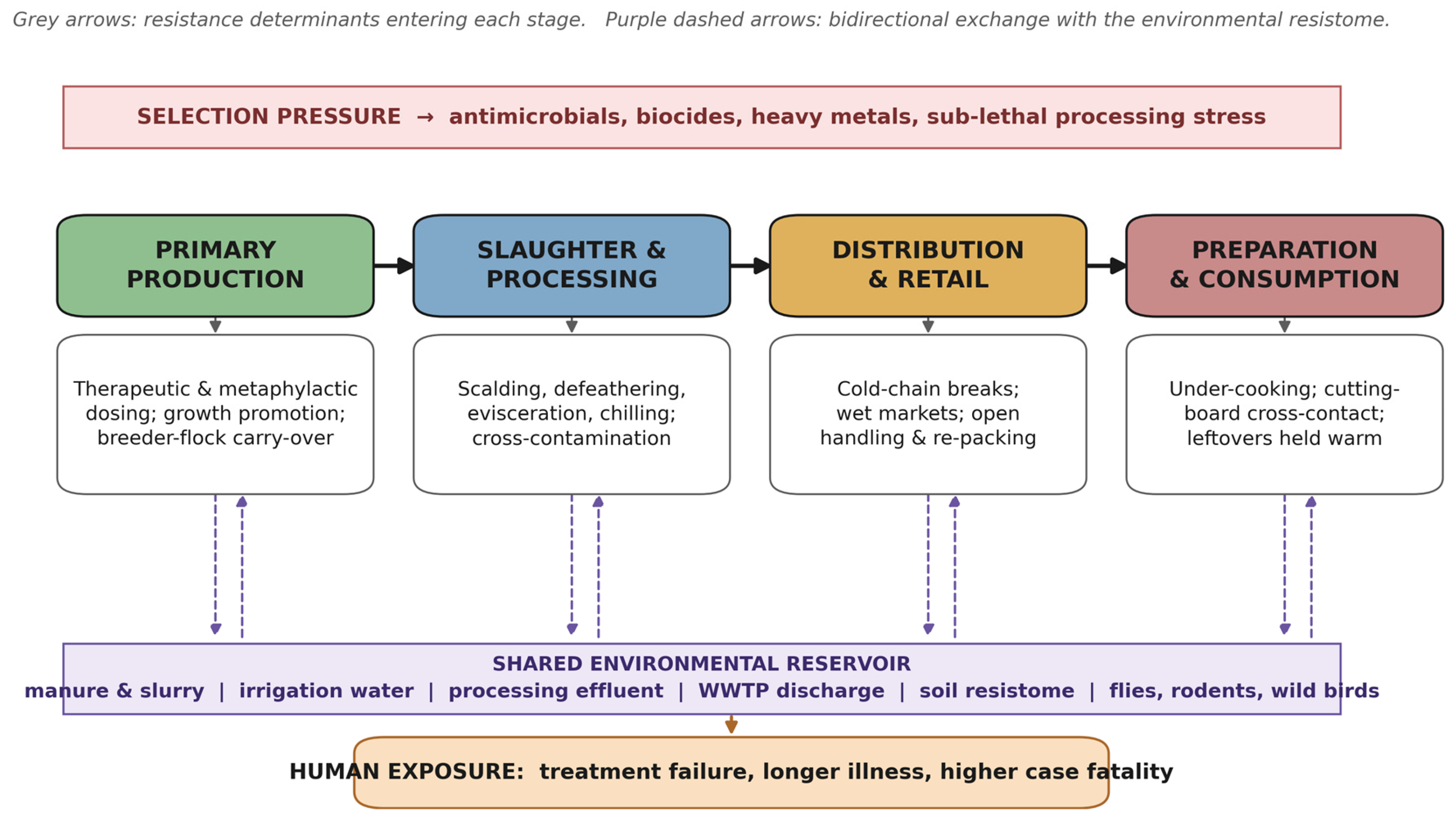
Figure 2.
The One Health triad applied to antimicrobial resistance, with food positioned as the connecting matrix rather than as a subordinate category of the animal sector. Bidirectional arrows indicate documented exchange routes; the central compartment represents the shared pool of resistance genes and mobile genetic elements accessible to all three sectors.
Figure 2.
The One Health triad applied to antimicrobial resistance, with food positioned as the connecting matrix rather than as a subordinate category of the animal sector. Bidirectional arrows indicate documented exchange routes; the central compartment represents the shared pool of resistance genes and mobile genetic elements accessible to all three sectors.
The intended readership is deliberately mixed. Food scientists tend to know their processing steps and their hurdle technology but are less comfortable with plasmid biology and veterinary prescribing practice. Veterinarians know the farm intimately but rarely see what happens to the animal after it leaves the gate. This review was written by one of each, and the sections reflect that division of labour.
2. Approach to the Literature
This is a narrative review, not a systematic one, and it makes no claim to the completeness that a systematic review would demand. It does, however, follow a documented search so that a reader can judge what was and was not looked at. PubMed, Scopus, Web of Science, ScienceDirect and Google Scholar were searched for the period January 2010 to June 2026 using combinations of the terms shown in Figure 3. Grey literature was drawn from the European Food Safety Authority and European Centre for Disease Prevention and Control joint summary reports, the WHO Global Antimicrobial Resistance and Use Surveillance System, FAO documents and the WOAH ANIMUSE database. Reference lists of retrieved reviews were hand-searched.
Records were kept if they reported phenotypic or genotypic resistance data from a defined point in the food chain, or if they addressed policy, surveillance or intervention with reference to that chain. Records were dropped if they dealt only with clinical isolates without a food or animal link, if no full text could be obtained, or if they existed only as conference abstracts. After removal of duplicates and two rounds of screening, 118 sources were retained. Because the review is narrative, no formal risk-of-bias scoring was applied, but studies with fewer than thirty isolates, or without a stated susceptibility-testing standard, are described as indicative rather than definitive wherever they are cited.
One limitation deserves stating at the outset. The published record is heavily skewed towards Europe, North America and China. Data from South Asia, sub-Saharan Africa and much of Latin America are thinner, more likely to come from single markets or single abattoirs, and more likely to use disc diffusion without confirmatory minimum inhibitory concentration testing. Where prevalence figures are quoted in this review they should be read as an indication of order of magnitude rather than as a precise estimate, and the pooled values shown in Figure 6 carry that caveat throughout.
3. What Resistance Actually Is, and Why Food Matters to It
3.1. Mechanisms, Briefly
Bacteria resist antimicrobials in a small number of ways, and the same handful of strategies appears again and again across genera. Figure 4 summarises them together with the routes by which they move between organisms. Enzymatic inactivation is the most familiar: beta-lactamases hydrolyse the beta-lactam ring, and the CTX-M family in particular has spread so widely through Enterobacteriaceae that it is now the default extended-spectrum enzyme in both clinical and food isolates (Munita and Arias, 2016). Target modification covers methicillin resistance in staphylococci through mecA and mecC, macrolide resistance through erm methylases, and fluoroquinolone resistance through point mutations in gyrA and parC. Efflux pumps such as AcrAB-TolC push a chemically diverse range of compounds out of the cell, so they tend to produce multidrug phenotypes rather than resistance to one agent. Reduced permeability, usually through loss or down-regulation of porins, works alongside efflux. Target protection proteins such as Qnr and Tet(M) shield the ribosome or the gyrase without altering it (Kumar and Varela, 2013; Schwarz et al., 2017). Argudin et al. (2017) emphasised that bacteria of animal origin are better regarded as a standing pool of resistance genes available to human pathogens, rather than simply as carriers of resistant phenotypes, and Bhatia and Zahoor (2007) illustrated for staphylococcal species how virulence and resistance determinants can be maintained together in food-associated lineages.
None of this is new biology. Resistance determinants are ancient, present in soils that have never seen a clinical antibiotic, and the environmental resistome is far larger than the clinical one (Wright, 2010; Davies and Davies, 2010). What is new is the rate at which particular determinants move out of that background reservoir and into organisms that infect people and animals. Martinez et al. (2015) made the useful point that a resistance gene sitting in a soil actinomycete and the same gene sitting on a conjugative plasmid in E. coli represent completely different levels of risk, and that risk ranking should be based on mobility and host range rather than on abundance alone. Larsson and Flach (2022) developed the same argument for environmental settings, and Li et al. (2015) used metagenomic network analysis to show how widely resistance genes co-occur across otherwise unrelated habitats.
3.2. Mobility Is the Real Problem
Horizontal gene transfer converts a local resistance event into a global one. Conjugation is the dominant route in Gram-negative food-chain organisms, and a limited set of plasmid incompatibility groups does most of the work: IncF plasmids carrying blaCTX-M-15, IncI1 plasmids carrying blaCTX-M-1 in poultry, IncHI2 plasmids carrying multiple determinants including mcr-1, and IncX4 plasmids that appear to be the most efficient vehicle for colistin resistance (Partridge et al., 2018; Liu et al., 2016). Transformation matters wherever extracellular DNA accumulates and persists. Biofilms and slurry both qualify. Transduction, long treated as a curiosity, is increasingly recognised in Gram-positive transfer. Insertion sequences and class 1 integrons then shuffle cassettes between replicons, and the integrase gene intI1 has become a widely used proxy for anthropogenic resistance pollution largely because it travels with so much else (Gillings et al., 2015; Gaze et al., 2011). Jiang et al. (2019) demonstrated the point concretely for food, recovering conjugally transferable sul1, sul2 and sul3 genes on diverse mobile elements from E. coli isolated from shrimp and pork sold in Chinese markets.
Von Wintersdorff et al. (2016) reviewed transfer across microbial ecosystems and made a point that is directly relevant to food: transfer rates measured in laboratory broth badly underestimate what happens in structured, nutrient-rich, high-density environments. A minced meat matrix at eight degrees Celsius, a raw milk cheese during ripening, or the mucus layer of a chicken caecum are all far better conjugation reactors than a shaking flask. Food is not a passive carrier of resistant bacteria. It is a habitat in which resistance genes are actively exchanged. Bengtsson-Palme et al. (2018) reviewed the environmental factors governing this process and concluded that nutrient availability, cell density and the presence of selective agents jointly determine transfer rates, all three of which are elevated in most food matrices.
3.3. Co-Selection, the Quiet Driver
If antimicrobial use were the only selective pressure, removing antimicrobials would solve the problem. It does not, and co-selection is the main reason. Resistance genes for antibiotics, biocides and heavy metals frequently sit on the same mobile element, so exposure to any one of them can maintain all three. Pal et al. (2015) analysed several thousand bacterial genomes and plasmids and found systematic co-occurrence of antibiotic and metal resistance genes, with plasmids showing the strongest associations. In practical terms this means that the copper and zinc added to piglet feed as growth promoters and diarrhoea control agents, and the quaternary ammonium compounds used to sanitise processing plants, continue to select for antibiotic resistance long after the antibiotics themselves have been withdrawn (Baker-Austin et al., 2006; Seiler and Berendonk, 2012).
This has a direct bearing on how interventions should be judged. A country that bans growth promoters but leaves zinc oxide and quaternary ammonium sanitiser use untouched has removed one selective pressure out of three. Denmark’s experience after the avoparcin ban, where glycopeptide resistance in enterococci from pigs persisted while copper use remained high, is the standard illustration (Aarestrup, 2015). Cully (2014) documented how bitterly such withdrawals are contested politically. Part of the reason co-selective agents have escaped comparable scrutiny is that nobody has had the appetite for a second fight.
3.4. Sub-Inhibitory Concentrations
The concentrations of antimicrobials found in manure-amended soil, in irrigation water and in processing effluent are almost always far below the minimum inhibitory concentration of the organisms present. It was assumed for a long time that such concentrations were biologically irrelevant. Andersson and Hughes (2014) demonstrated otherwise: sub-inhibitory levels select for resistance, and they do so at concentrations several hundred-fold below the MIC, because at those levels the fitness cost of carrying a resistance determinant is smaller than the fitness cost of not carrying it. They also increase mutation rates and stimulate horizontal transfer through SOS induction. This finding reframes the entire environmental compartment. Residue levels that comfortably pass a food safety limit may still be perfectly adequate to maintain a resistant population. Berglund (2015) reviewed the correlation between environmental antibiotic contamination and resistance gene abundance and reached a consistent conclusion, and Singer et al. (2016) set out what this implies for environmental regulators, who currently have no resistance-based standard to enforce against.
3.5. Why the Food Chain Is a Special Case
Three features distinguish the food chain from other resistance transmission settings. The first is scale and mixing. A single processing plant may handle animals from dozens of farms in one shift, so a resistance determinant that existed on one farm can be distributed across an entire day’s production. The second is the sheer number of exposure events. Nearly everyone eats several times a day, so even a low per-meal probability of ingesting a resistant organism becomes a substantial population-level exposure. The third is that food crosses borders in a way that patients generally do not. Ellis-Iversen et al. (2020) found resistant E. coli and enterococci in pangasius and prawns imported into Denmark from Asia, which is a neat demonstration that a national antimicrobial stewardship policy can be undermined by a container ship. Ryu et al. (2012) reported comparable findings for commercial fish and seafood in Korea, and Hammerum and Heuer (2009) had earlier made the general case that E. coli of animal origin constitutes a direct human health hazard rather than a merely theoretical one.
4. Primary Production: Where Most of the Selection Happens
4.1. How Much Is Used, and What For
Antimicrobials are given to food animals for three broadly different purposes, and lumping them together has confused the policy debate for decades. Therapeutic use treats sick animals. Metaphylactic use treats a whole group when some members are sick, on the reasonable veterinary grounds that the rest are probably incubating the same infection. Prophylactic use treats healthy animals in anticipation of disease. Growth promotion, historically the fourth category, uses sub-therapeutic doses to improve feed conversion, an effect discovered accidentally in the 1940s and never satisfactorily explained (Landers et al., 2012). The first is uncontroversial. The last is now banned across the European Union and restricted in a growing number of other jurisdictions, though enforcement varies widely (WHO, 2017). Nhung et al. (2016) documented how blurred these categories become in Southeast Asian production, where the same product may be sold for treatment, prevention and growth promotion depending on who is asked.
The quantities involved dwarf human medicine in most countries. Van Boeckel et al. (2015) estimated that food animals accounted for roughly two-thirds of global antimicrobial consumption by mass. The composition of that use is skewed towards older, cheaper classes, tetracyclines and penicillins together account for over half of reported veterinary sales in most reporting countries, but the fraction represented by fluoroquinolones, third and fourth generation cephalosporins and colistin, all classified as critically important for human medicine, remains stubbornly non-trivial (Collignon et al., 2016; WHO, 2019). Alonso et al. (2017) noted that in much of Africa even this basic accounting is unavailable, because veterinary sales data are simply not collected. Figure 5b shows the indicative pattern.
Sector-specific patterns matter, and Table 1 sets out the main ones alongside the resistance problem most closely associated with each. In broiler production, medication is usually delivered through drinking water to an entire house, so the effective unit of selection is tens of thousands of birds (Mehdi et al., 2018; Nhung et al., 2017). In pig production, in-feed medication at weaning is the dominant route, and Lekagul et al. (2019) found in a systematic review that prophylactic in-feed use around weaning was reported in the great majority of production systems studied. In dairy, dry-cow therapy and intramammary treatment concentrate selection in the udder but also deliver residues into waste milk. That milk is then commonly fed to calves. Thames et al. (2012) showed that calves fed antibiotic-containing milk replacer excreted markedly more resistance genes. It is a short amplification loop, and an avoidable one. Ahmed et al. (2017) added a further complication by showing that commensal E. coli populations differ substantially between age groups even in animals that receive no antimicrobials at all, so baseline flora shapes what a resistance survey finds, alongside treatment history. In beef, use is generally lower per animal but feedlot metaphylaxis on arrival remains standard practice in North America (Cameron and McAllister, 2016).
4.2. Aquaculture
Aquaculture deserves separate treatment because its selective environment differs in kind from terrestrial farming, not merely in degree. Antimicrobials are delivered in feed into an open or semi-open water body, so a large fraction never enters a fish at all and instead reaches sediment and the surrounding water column directly. Cabello et al. (2013) argued that this makes aquaculture an unusually efficient generator of environmental resistance, and the point is supported by the recovery of tet(M) and tet(S) from marine sediments around culture sites (Kim et al., 2004). Watts et al. (2017) reviewed sources and sinks in the sector and highlighted the additional problem that many aquaculture species are farmed in countries where veterinary oversight of drug sales is minimal. Soonthornchaikul and Garelick (2009) recovered resistant Campylobacter from bivalve molluscs sold in Bangkok markets, illustrating that filter feeders concentrate whatever is in the water, including resistant bacteria. Yang et al. (2019) reviewed the parallel situation in United States broiler systems, where the dissemination pathways are terrestrial but the underlying ecology is much the same.
4.3. The Farm as an Ecosystem
Koch et al. (2017) made the case that food-animal production should be analysed as an ecological system rather than as a series of drug-administration events, and that framing explains several otherwise puzzling observations. High stocking density raises contact rates and therefore transmission. Genetic uniformity within a flock removes the heterogeneity that would normally slow an epidemic. Continuous production with overlapping age groups prevents the population bottleneck that an all-in all-out cycle would impose. Feed, water, bedding, dust, flies, rodents and farm workers all move bacteria between houses. Davis et al. (2011) described industrial poultry systems in exactly these terms, as anthropogenic ecosystems whose structure favours the emergence and persistence of resistant lineages independent of any particular drug. Graham et al. (2019) cautioned, however, that the interactions between animal, human and environmental compartments in such systems are complex enough that simple causal narratives are frequently wrong, and that intervention studies rather than cross-sectional surveys are needed to distinguish them.
Occupational exposure closes another loop. Smith (2015) reviewed the United States experience with livestock-associated Staphylococcus aureus and found carriage concentrated in workers with direct animal contact rather than in the surrounding community, which locates the risk precisely and makes it addressable through protective equipment and hygiene rather than through drug policy alone. Vertical transmission closes a second loop. Dahms et al. (2015) documented ESBL-producing E. coli in livestock and in the farm workers handling them; Alt et al. (2011) identified the herd-level factors associated with MRSA CC398 in German fattening pigs, and Schmithausen et al. (2015) showed on a model pig farm that eradication of both MRSA and ESBL-producing Enterobacteriaceae is technically achievable but demands a level of intervention few commercial operations would sustain. Hatchery-level studies have repeatedly recovered resistant Enterobacteriaceae from day-old chicks before any on-farm medication could have been given. If the chick arrives already colonised, no amount of prudent use during grow-out will produce a resistance-free flock, which is why the framework proposed later in this review places its first control point in the hatchery rather than on the farm.
4.4. Manure and the Return Path
Between forty and ninety percent of an administered antimicrobial dose leaves the animal unmetabolised, together with the resistant bacteria selected during treatment (Jechalke et al., 2014). Manure and slurry therefore concentrate both the selective agent and the organisms carrying resistance to it. Zhu et al. (2013) applied high-throughput qPCR to Chinese swine farms and found 149 distinct resistance genes, some at abundances up to 28,000-fold above control soils, with strong correlation to transposase abundance, so the genes were not sitting inert; they were mobile. Heuer et al. (2011) described how field application then spreads that load across agricultural soil, where it can persist for months, and Chen et al. (2007) tracked erm genes through manure management systems. Ghosh and LaPara (2007) demonstrated persistence of the resulting soil resistance long after amendment ceased. Jia et al. (2017) followed the same load through livestock breeding wastewater into the receiving river and found that resistance gene profiles tracked bacterial community composition downstream of the discharge point.
The practical significance is that manure connects animal production to crop production. Irrigation water abstracted downstream of livestock operations, and vegetables grown on manure-amended land, provide a route by which resistance selected in a pig house can appear on a plate of salad without ever passing through meat. Abdalla et al. (2021) traced E. coli from an intensive South African pig operation through to the product and found high resistance to agents classified as critically important for both human and animal medicine. Few studies have followed the pathway end to end within one design. Of all the routes described in this review, this one receives the least monitoring.
5. Slaughter and Processing: A Mixer, Not a Filter
5.1. Transport and Lairage
The journey to the abattoir is short but consequential. Animals are mixed with animals from other groups, held in crates or pens that may not have been effectively cleaned, and subjected to a level of stress that reliably increases shedding of enteric organisms. Crates in particular have been repeatedly identified as a vehicle: wooden or damaged plastic surfaces resist cleaning, and turnaround times in commercial poultry logistics rarely allow proper drying. The consequence is that a batch arriving from a low-prevalence farm may be contaminated before it reaches the shackle line. For that reason the framework in Section 10 treats transport and lairage as a control point in its own right rather than folding it into slaughter.
5.2. What the Plant Does to a Resistant Population
Processing is generally described in terms of reducing microbial load, and it does reduce total counts substantially. The question relevant here is different: does it reduce the proportion of the surviving population that is resistant? The evidence suggests it often does not, and may occasionally do the reverse. Oniciuc et al. (2019) reviewed food processing as a risk factor for resistance spread and identified several specific concerns. Scalding tanks operate at temperatures that are lethal to many cells but sub-lethal to others, and sub-lethal stress induces the SOS response, which upregulates recombination and mobile element activity. Defeathering machines aerosolise material and redistribute it across carcasses. Evisceration remains the step at which gut contents most often contaminate the carcass surface. Immersion chilling creates a common water bath through which every carcass passes.
Cross-contamination in this setting is not a hygiene failure but a structural feature of the process. Its effect on resistance epidemiology is that a small number of resistant clones from one or two source farms can be distributed across a full day’s production. Hence the description of the plant as a mixer rather than a filter: it lowers the average count while spreading the resistant fraction more widely. From a risk perspective, broadening the distribution may matter more than lowering the count. Table 2 summarises what is reported at each of the main operations, separating the effect on total count from the effect on the resistant fraction, since the two frequently move in different directions.
5.3. Biofilms and Sanitiser Pressure
Food-contact surfaces support biofilms, and biofilms are about as good a setting for gene transfer as a bacterium could ask for. Cell density is high, extracellular DNA accumulates in the matrix, and the diffusion gradient means that cells at depth experience sanitiser at sub-inhibitory concentrations even when the applied dose is correct. Quaternary ammonium compounds, the most widely used sanitiser class in food plants, select for qacE and qacEdelta1, which are commonly located on class 1 integrons alongside antibiotic resistance cassettes (Pal et al., 2015; Gillings et al., 2015). Rotating biocide chemistries is therefore a co-selection control, not only a way of preventing tolerance to the sanitiser itself. Plant managers are rarely told this. Berendonk et al. (2015) argued for exactly this kind of reframing at the level of environmental and industrial policy, treating resistance selection rather than sanitiser efficacy as the endpoint of interest.
5.4. Hurdle Technology and Its Limits
Modern preservation relies on hurdles: mild heat, acidification, reduced water activity, modified atmosphere, refrigeration, applied in combination so that no single hurdle needs to be severe. The logic is sound for pathogen control. For resistance it introduces an unintended consequence, because a bacterium that survives repeated sub-lethal stress is by definition stress-adapted, and stress adaptation in Gram-negative organisms frequently involves the same global regulators, marRAB and the efflux systems they control, that confer multidrug tolerance. The organisms that come through a well-designed hurdle process are therefore enriched for the same physiology that lowers antimicrobial susceptibility. This does not argue against hurdle technology, which prevents far more disease than it could ever cause, but it does argue for validating hurdle systems against resistant strains rather than against laboratory reference strains alone.
6. Retail, Distribution and the Consumer
6.1. What Is on the Shelf
Retail surveys are the most abundant category of published data in this field, partly because they are the easiest to conduct. Their consistent finding is that resistant organisms are common in raw animal products worldwide, with poultry meat carrying the highest burden (Doyle, 2015). EFSA and ECDC (2023) reported high occurrence of ESBL and AmpC-producing E. coli in broiler meat across the European Union, and comparable or higher figures come from Bangladesh, Egypt, China and Ecuador (Sarker et al., 2019; Rahman et al., 2020; Peng et al., 2022; Sanchez-Salazar et al., 2020). Jans et al. (2018) took the useful additional step of converting Swiss retail data into consumer exposure estimates rather than leaving them as prevalence figures. More of the field should follow. EFSA and ECDC (2023) remain the most methodologically consistent source for such comparisons because sampling and testing are harmonised across member states, a condition met almost nowhere else.
Two findings from retail surveillance deserve more attention than they usually receive. The first is that products carrying ‘raised without antibiotics’ claims do not consistently show lower resistance. Vikram et al. (2018) compared US food-service ground beef with and without such a claim and found similar levels of resistance in both, which is consistent with resistant lineages persisting in a production environment long after drug use has stopped and with contamination occurring downstream of the farm. The second is that fresh produce is not a low-risk category simply because it is not an animal product. Eggs occupy a similar blind spot: Adesiyun et al. (2014) surveyed layer farms across three Caribbean countries and recovered Salmonella at rates that would not be tolerated in a broiler survey, yet layer flocks attract far less monitoring attention than meat birds. Resistant Enterobacteriaceae are also recovered from leafy vegetables at meaningful frequencies, and the plausible sources are irrigation water and manure amendment rather than anything that happens after harvest (Iwu et al., 2020; Wellington et al., 2013).
6.2. Wet Markets and Informal Retail
In much of South Asia, Southeast Asia and sub-Saharan Africa, the majority of animal protein is sold through live-bird markets and open wet markets rather than through cold-chain retail. These settings compress several risk factors into a small space: live animals from many sources held together, slaughter conducted on site with shared equipment, no refrigeration, ambient temperatures that permit growth throughout the day, and direct contact between vendors, customers and animals. Sarker et al. (2019) reported extremely high resistance in E. coli from broilers in live-bird markets in Chattogram, Bangladesh, and Carrique-Mas et al. (2015) documented the antimicrobial use patterns in the Mekong Delta that feed into such systems. Any control framework that assumes a cold chain and a packaged product is simply not applicable to the majority of the world’s meat transactions, and this review has tried to keep that constraint visible.
6.3. The Domestic Kitchen
The final stage is the one over which regulators have least control and consumers have most. Adequate cooking kills resistant bacteria just as efficiently as susceptible ones. Resistance confers no thermal advantage. The risk at this stage is therefore almost entirely about cross-contamination before cooking and about undercooking. Cutting boards, knives, hands, cloths and refrigerator drip are the classic vehicles, and the resistant organism transferred from a raw chicken to a salad ingredient does not need to cause disease to matter, because transient gut colonisation is sufficient for the resistance gene to reach the consumer’s own microbiota and potentially transfer there.
This is also the stage at which public health messaging is most often concentrated, and Section 11 argues that this reflects institutional convenience rather than effectiveness. Consumer hygiene is a genuine control, but it is the last and weakest one in the hierarchy, and placing disproportionate emphasis on it shifts responsibility from actors who can eliminate the hazard to actors who can only avoid it.
7. The Environmental Compartment
7.1. Soil and Water
The environment is often described as a passive sink for resistance. It is better understood as a reactor with a long residence time. Manure-amended soil receives both residues and resistant organisms, and the resulting perturbation persists well beyond the growing season (Heuer et al., 2011; Jechalke et al., 2014). Surface waters receiving farm run-off and wastewater treatment plant effluent carry elevated resistance gene loads, and Ju et al. (2019) showed that treatment plant resistomes are shaped by bacterial community composition and by active genetic exchange within the plant rather than simply reflecting what arrives in the influent. At larger scales, Zhu et al. (2017) documented continental-scale pollution of Chinese estuaries with resistance genes, and Walsh et al. (2011) found NDM-1-positive bacteria in New Delhi drinking water and seepage, which remains one of the most direct demonstrations that an environmental compartment can hold a clinically critical determinant. Larsson and Flach (2022) synthesised this literature and made the important distinction between environments that merely receive resistant bacteria and those that actively select for them, the latter being far fewer and far more tractable as regulatory targets.
7.2. Wildlife as a Mobile Reservoir
Wild birds acquire resistant bacteria from landfill, sewage and farm environments and then move them across distances that no regulatory boundary can accommodate. Guenther et al. (2011) described ESBL-producing E. coli in wildlife as a form of environmental pollution, and Wang et al. (2017) reviewed the role of wild birds in global dissemination. Gulls and corvids feeding at waste sites are the most frequently implicated, and their presence around open-sided poultry houses and feed stores creates a direct route back into production. Flies and rodents do the same job over shorter distances. They are also much easier to control, so they are the more practical target.
7.3. Quantifying the Environmental Contribution
The honest position is that the size of the environmental contribution to human resistance burden is not known with confidence. Manaia (2017) argued that abundance in the environment is not proportional to risk to humans, because most environmental resistance genes sit in organisms that will never colonise a person and on elements that will never reach a human pathogen. Stanton et al. (2022) produced a systematic map of the available evidence on environmental exposure and transmission and concluded that direct evidence remains sparse relative to the volume of descriptive resistome data. Ashbolt et al. (2013) set out what a proper human health risk assessment for this pathway would require and the list is long. This is not a reason to ignore the environment, but it is a reason to be careful about attributing specific human infections to it, and a reason to prioritise studies that track determinants through to colonisation rather than studies that count genes in water. Singer et al. (2016) reached a similar conclusion from the regulator’s side, noting that no environmental quality standard for resistance currently exists because the dose-response relationship needed to set one has not been established.
8. Attribution: How Much Human Resistance Comes from Food?
This is the question that determines how much of a country’s limited resistance budget should be spent on agriculture, and it has no settled answer. The positions in the literature range widely. Silbergeld et al. (2008) and Marshall and Levy (2011) argued for a substantial food-animal contribution. Scott et al. (2018) conducted a rapid systematic review and concluded that the direct evidence for harm to human health from food-animal antimicrobial use, while suggestive, was weaker than commonly asserted. Hoelzer et al. (2017) reached a middle position, finding the evidence sufficient to justify action without being sufficient to quantify the effect precisely. Table 3 sets the main positions against one another, with the strongest evidence and the principal weakness of each. Hammerum and Heuer (2009) and Thanner et al. (2016) had each concluded that the animal reservoir contributes materially even where the fraction cannot be pinned down.
Source-attribution modelling has produced the most useful numbers. Mughini-Gras et al. (2019) modelled community carriage of E. coli carrying beta-lactam resistance genes in the Netherlands and attributed the majority of carriage to human-to-human transmission, with food animals contributing a smaller but real share. Boysen et al. (2014) attributed human campylobacteriosis in Denmark predominantly to chicken. The apparent contradiction between these results dissolves once the distinction between organism and gene is made: Campylobacter is a food-associated pathogen whose resistance travels with the organism, whereas ESBL genes circulate through multiple hosts and vehicles and cannot be attributed to a single source. Attribution must therefore be done determinant by determinant, not sector by sector.
There is one line of evidence that requires no modelling. Where use has been reduced, resistance has fallen. Tang et al. (2017) meta-analysed studies of restricted antimicrobial use in food animals and found consistent reductions in resistance in animals, with smaller but detectable reductions in humans with direct animal contact. Dorado-Garcia et al. (2016) quantified the response in the Netherlands during a national reduction programme, where livestock antimicrobial use fell by around sixty percent and resistance in indicator organisms declined in parallel. Chantziaras et al. (2014) had already shown a correlation between national veterinary use and resistance across seven countries. Whatever the exact attributable fraction, the intervention works in the expected direction, and that is sufficient basis for policy.
9. Stage-Specific Resistance Amplification
Almost every review of this subject describes the food chain as a linear sequence of contamination events. That description is incomplete in a way that has real consequences for control. Some stages generate new resistance because selection is occurring there. Other stages generate no new resistance at all but redistribute what they receive across a much larger product mass. A third group of stages does neither and simply carries the burden forward. Interventions that would work well at a selecting stage are largely wasted at a redistributing one, and vice versa.
To make this distinction usable we propose describing each stage by three separate properties. Selection intensity is the strength of the pressure favouring resistant over susceptible organisms at that stage. Amplification potential is the extent to which a resistance determinant entering the stage is multiplied or spread across additional product units. Transfer opportunity is the likelihood that a determinant present in one organism moves into another during the stage. These three properties are not correlated. Grow-out has extreme selection intensity and moderate amplification. Immersion chilling has almost no selection intensity and very high amplification. A biofilm on a slicing blade has low selection intensity, low amplification and extremely high transfer opportunity. Table 4 sets out the resulting profile, and the composite index in the final column is intended as a prioritisation aid rather than as a measurement.
Reading the table row by row produces some conclusions that differ from conventional practice. Manure management ranks alongside grow-out as a top priority, yet it attracts a small fraction of the regulatory attention. Slaughter ranks high on amplification despite contributing nothing to selection, which means the correct intervention there is engineering and segregation rather than anything to do with antimicrobials. Packaged retail distribution, which is where a great deal of monitoring effort is currently spent because it is the easiest place to take a sample, ranks low on all three properties. Convenience of sampling and importance to the outcome are close to inversely related in this system.
10. An AMR-Critical Control Point Framework
HACCP transformed food safety because it replaced end-product testing with the identification and control of the specific steps at which a hazard can be prevented. Applying that logic to antimicrobial resistance is attractive but requires three substantive modifications, because the hazard behaves differently from a conventional microbiological one.
The first modification concerns the definition of the hazard. In classical HACCP the hazard is an organism or a toxin, and the critical limit is a count or a concentration. Here the hazard is a transferable determinant, and the relevant quantity is not how many resistant cells are present but whether the determinant is mobile and whether it can reach a human pathogen. A carcass carrying a thousand resistant commensals with chromosomal mutations may pose less risk than one carrying ten cells bearing a conjugative IncI1 plasmid. Critical limits therefore have to be expressed genetically, for example as the presence of intI1 or of a target plasmid replicon above a defined detection threshold, rather than purely as colony counts.
The second modification concerns reversibility. A conventional HACCP system assumes that a controlled hazard stays controlled. Resistance does not behave this way, because the environmental compartment returns determinants to the chain at points upstream of where they were removed. A control point in the plant can be undermined by irrigation water at the farm. This means an AMR-CCP system cannot be drawn as a line; it has to include the environmental return path explicitly, as Figure 1 does.
The third modification concerns ownership. HACCP operates within the boundary of a single business. The determinants at issue here cross those boundaries routinely. An AMR-CCP framework therefore requires a chain-level coordinating body with authority to set and verify limits at points that no single operator controls, which in most countries does not currently exist. Retailer procurement specifications are, in practice, the nearest functioning substitute, and their leverage should not be underestimated.
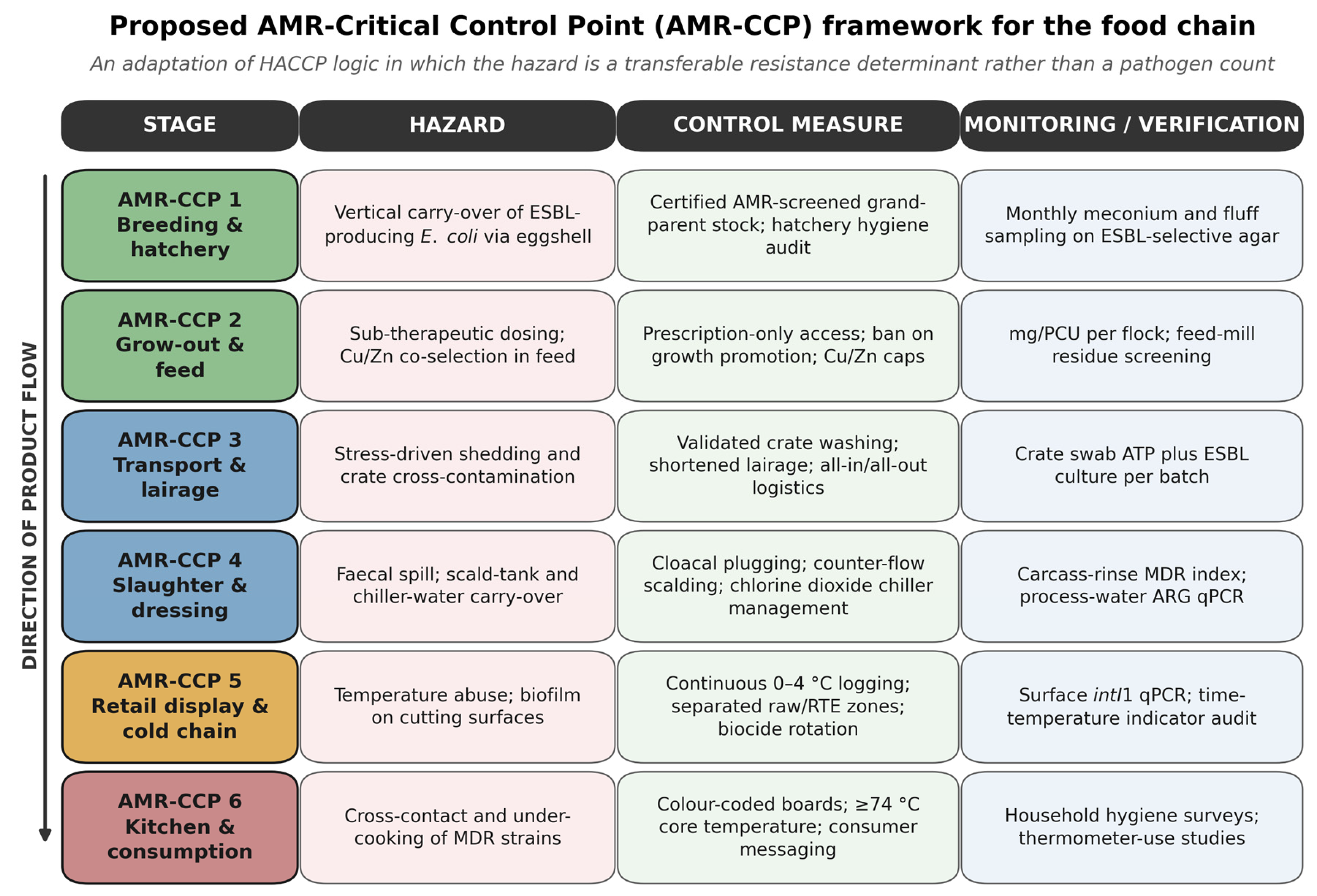
With those modifications, six control points can be defined across the continuum, shown in Figure 6 with hazard, control measure and verification for each. The framework is offered as a structure for discussion and for pilot implementation, not as a validated system; validation would require demonstrating that control at each point produces a measurable reduction in downstream determinant load, and that work has not been done for any of the six.
Figure 6.
Proposed AMR-Critical Control Point framework. Each control point is defined by a hazard expressed in terms of transferable determinants, a control measure that is technically achievable with existing infrastructure, and a verification procedure that can be conducted with methods available in a well-equipped national reference laboratory.
Figure 6.
Proposed AMR-Critical Control Point framework. Each control point is defined by a hazard expressed in terms of transferable determinants, a control measure that is technically achievable with existing infrastructure, and a verification procedure that can be conducted with methods available in a well-equipped national reference laboratory.
11. Interventions, Ranked Honestly
11.1. Why a Hierarchy Is Needed
Discussions of intervention options usually present a list. Lists imply that the items are alternatives of comparable value, which they are not. Occupational hygiene solved this problem decades ago with the hierarchy of controls, which ranks elimination above substitution, substitution above engineering, engineering above administrative measures, and administrative measures above personal protection. The ranking is based on how much the control depends on someone doing the right thing every time. Applying the same logic here produces Figure 7, and the ranking it generates is uncomfortable, because the measures that receive the most public attention sit at the bottom.
11.2. Elimination and Substitution
Eliminating growth promotion is the clearest example of a tier-one control, and its effects have been measured. Tang et al. (2017) found consistent reductions in animal resistance following use restrictions. The Dutch programme achieved a national reduction of roughly sixty percent in veterinary antimicrobial sales with parallel declines in resistance in indicator organisms, and did so without the collapse in productivity that had been predicted (Dorado-Garcia et al., 2016). The key lesson from the Dutch experience is that reduction succeeded because it was accompanied by mandatory farm-level benchmarking, veterinary-farmer treatment agreements and transparent reporting, not because a ban was announced.
Substitution covers the alternatives to antimicrobials, and the honest summary is that they are individually modest and collectively useful. Vaccination has the strongest evidence base because preventing the disease removes the reason to treat. Probiotics, synbiotics and competitive exclusion cultures show consistent but small effects on colonisation. Organic acids in feed and water improve gut health and reduce Salmonella carriage. Bacteriophage therapy is attractive in principle, highly specific, self-amplifying, but faces regulatory and resistance-evolution problems of its own. Essential oils and antimicrobial peptides show promise in trials that are frequently underpowered. Mehdi et al. (2018) reviewed the poultry options and reached broadly this conclusion. No single alternative replaces antimicrobials; a package of them, combined with better husbandry, does.
11.3. Engineering and Administration
Engineering controls include biosecurity, ventilation, stocking density limits, all-in all-out production, manure composting and anaerobic digestion, and the processing controls described in Section 5. Thermophilic composting and anaerobic digestion both reduce resistance gene loads in manure substantially, though not completely, and they are the most direct available intervention on the highest-priority stage identified in Table 4 (Pruden et al., 2013). Administrative controls include prescription-only dispensing, which is the single most important structural reform available in countries where antimicrobials are sold over the counter, mg/PCU benchmarking, herd health planning, and procurement standards imposed by retailers and processors.
Rousham et al. (2018) and Nadimpalli et al. (2018) both stress that in low-resource settings these administrative controls cannot be transplanted wholesale. Where a veterinary service reaches a small fraction of smallholders, prescription-only dispensing without an accessible prescriber does not reduce use; it drives it underground and towards lower-quality product. Sequencing matters: build the diagnostic and advisory capacity first, then restrict the sales channel.
11.4. Consumer Measures
Table 5 assesses the full range of options against evidence strength, cost and feasibility where veterinary services are thin. Kitchen hygiene, adequate cooking and separation of raw and ready-to-eat foods are genuine controls and should continue to be promoted. They are also the weakest tier, they depend on correct behaviour at every single meal, they cannot reduce the resistance burden entering the kitchen, and they place the responsibility on the person with the least ability to change the system. A national strategy whose most visible component is a consumer awareness campaign has, in effect, chosen the least effective available option.
12. Surveillance: The Binding Constraint
Every recommendation in this review depends on being able to see what is happening, and in most of the world that visibility does not exist. The problem runs deeper than surveillance being absent in many countries. Where it does exist, the components were built separately. Human clinical isolates are collected by health ministries, animal isolates by agriculture ministries, food isolates by food safety agencies, and environmental samples by nobody in particular. The sectors use different sampling frames, different breakpoints, different reporting periods and different laboratory methods. A system built this way cannot detect a link between sectors even when the link is strong, because there is no shared denominator against which to compare.
Integrated systems exist and demonstrate what is possible. DANMAP, NARMS and the EU harmonised monitoring programme all sample humans, animals and food using coordinated methods, and the clearest evidence on use-resistance relationships comes, unsurprisingly, from the countries running them. Bortolaia et al. (2020) showed that whole-genome sequencing with tools such as ResFinder can predict phenotype reliably enough to serve as the analytical backbone, and sequencing costs have now fallen to the point where the barrier is bioinformatics capacity and sample logistics rather than reagents. WHO (2021) reported through GLASS that participation has grown steadily but that data quality remains highly uneven, with many countries reporting from a small number of urban tertiary hospitals that cannot represent national patterns, let alone food-chain ones.
For countries starting from a low base, we would suggest four practical priorities. Choose a small number of sentinel indicator organisms, E. coli and Enterococcus faecium as commensals, Salmonella and Campylobacter as pathogens, and sample them at matched points across all sectors on the same schedule. Adopt a single breakpoint standard nationally and apply it everywhere, since inconsistent breakpoints have made large volumes of published data uncomparable. Include at least one environmental matrix, ideally irrigation water downstream of livestock, because that is the compartment that connects sectors and the one nobody currently monitors; Berendonk et al. (2015) set out a workable framework for how such environmental monitoring could be standardised. And publish the data, including the uncomfortable parts, because Dutch and Danish experience suggests that transparent benchmarking changes prescriber behaviour more reliably than regulation alone.
13. What Is Missing from the Evidence
Several gaps recur throughout this review and are worth collecting in one place. Longitudinal studies that follow a defined cohort of animals through slaughter, processing, retail and, ideally, into consumers are almost absent; nearly all published work is a cross-sectional snapshot of one point in the chain. Quantitative microbial risk assessment models that carry resistance determinants rather than pathogen counts through the chain are at an early stage. The relative importance of plasmid transfer within the food matrix, as opposed to transfer within the animal or human gut, has not been measured under realistic conditions. Data from informal retail systems, which handle most of the world’s meat, are scarce compared with data from packaged retail. The environmental attribution question described in Section 7 remains open, and Manyi-Loh et al. (2018) and Bengtsson-Palme et al. (2018) both identified the same gap from different directions.
There is also a methodological gap that the field should confront. A large fraction of published prevalence studies use disc diffusion with clinical breakpoints on isolates recovered on selective media, then report the proportion resistant without reporting the sampling frame. Such studies tell us that resistance exists in a matrix but cannot support the comparisons between matrices, countries or years that they are routinely used for. Adopting epidemiological cut-off values and reporting sampling frames explicitly would improve the usefulness of this literature at essentially no additional cost.
14. Critical Conclusions
Reviews of this subject usually end by calling for a One Health approach, more surveillance and better stewardship. Nobody disagrees with any of that, which is part of the problem: a conclusion that no one can argue with is rarely a conclusion that changes anything. We want to end more awkwardly, by saying what we think the evidence actually supports, what it does not support, and where we think the field, including our own contribution here, is on shaky ground.
14.1. What the Evidence Will Bear
Three claims in this review rest on firm ground. Selection is concentrated in primary production and in the manure leaving it, and no amount of downstream hygiene will undo what happens in a grow-out shed. Slaughter and processing do not select but they redistribute, taking the output of one or two contaminated farms and spreading it across a day of production. And where use has been cut, resistance has fallen; the Dutch and Danish programmes settled that question, whatever remains unsettled about attribution.
That last point deserves emphasis because it is often lost in the attribution debate. One can argue indefinitely about what proportion of human resistance originates in food animals, and Section 8 shows how far apart reasonable people remain on that question. But the policy decision does not actually depend on resolving it. Reducing use reduces resistance in animals, reliably and measurably; it is cheap relative to almost any clinical intervention; and the productivity losses that industry predicted did not materialise in the countries that tried it. An intervention that is cheap, effective in the compartment where it is applied, and plausibly beneficial elsewhere does not require a precise attributable fraction before it is worth doing. Waiting for that number has itself become a way of deferring action.
14.2. Where We Think the Field Is Getting It Wrong
Our sharpest criticism is aimed at the literature we have just spent this review summarising. The field has produced an enormous volume of retail prevalence surveys, and they have reached the point of diminishing returns. One more study reporting that sixty percent of chicken carcasses in one more city carry ESBL-producing E. coli adds very little; we already knew that, in every country where anyone has looked. These studies persist because they are cheap, publishable and require no coordination between institutions, and not because they answer a question anyone still has. The comparison in Section 9 between where sampling effort goes and where the risk actually sits is, in our view, the most damning single observation in this review.
What is missing is harder work: longitudinal studies that follow defined batches through the chain, intervention trials with resistance rather than productivity as the endpoint, and economic evaluations that would let a ministry rank options by cost per unit of resistance averted. None of these exists in adequate quantity. Funders share responsibility here, because such studies are slow, expensive and unlikely to produce a clean result, which makes them unattractive against the metrics research is currently judged by.
We would also argue that consumer-facing messaging has been allowed to carry more weight than it can bear. Kitchen hygiene is a genuine control and we are not against it. But when a national action plan’s most visible component is a public awareness campaign, something has gone wrong in the allocation of responsibility. The consumer cannot reduce the resistance burden arriving in the kitchen; only the actors upstream can, and campaigns aimed at the household quietly shift the moral weight away from them. Figure 7 was drawn specifically to make that displacement visible.
14.3. Where Our Own Arguments Are Weakest
It would be poor practice to criticise the field and exempt ourselves. The three frameworks proposed here have real limitations and we would rather state them than have a reviewer discover them.
The amplification profiling in Table 4 is qualitative. The ratings are our considered reading of the evidence in Sections 4 to 7, but they are judgements, and a different pair of authors would rate some rows differently. Weighting the three properties equally in the composite column is a convenience with no empirical justification; we suspect transfer opportunity should carry more weight than selection intensity at the downstream stages, but we cannot demonstrate it. The table should be treated as a way of organising an argument, not as a measurement instrument.
The AMR-CCP framework in Figure 6 has a harder problem. HACCP works because critical limits are validated: one can show that a given time and temperature achieves a defined log reduction. No equivalent validation exists for any of our six control points. We do not know what level of intI1 on a food-contact surface constitutes a breach, because the dose-response relationship between an environmental gene load and a human colonisation event has never been established. Until it is, our critical limits are educated guesses in the shape of critical limits, and a framework with unvalidated limits is a checklist rather than a control system. We think the structure is still worth piloting, because it directs attention to the right stages, but it should not be presented to a regulator as ready for adoption.
The intervention hierarchy is the most defensible of the three, since it borrows a logic already validated in occupational health. Its weakness is that it ranks interventions by intrinsic effectiveness while saying nothing about political feasibility, and the two are close to inversely related. Elimination sits at the top precisely because it removes discretion, and that is also why it is fought hardest. A hierarchy that ignores this may be honest and still be of limited use to someone who has to get a measure through a ministry.
14.4. What We Would Actually Do
If we were advising a country like Pakistan, where antimicrobials are sold across the counter without prescription, veterinary services reach a minority of producers, and most meat moves through informal markets, we would resist the temptation to copy a European action plan. The sequencing matters more than the content.
Diagnostic and advisory capacity has to come first. Restricting the sales channel before there is an accessible prescriber does not reduce use; it pushes purchasing into informal channels and towards substandard product, and it penalises the smallholder while leaving the large integrator untouched. Second, build a small integrated sentinel system: two commensal and two pathogenic indicator organisms, one national breakpoint standard, matched sampling in humans, animals, food and irrigation water. Small and consistent beats large and fragmented. Third, target manure and irrigation water, which Table 4 identifies as top-priority and which almost no national plan addresses, and where composting offers a genuinely low-cost intervention. Fourth, use procurement leverage: export-oriented processors respond to buyer specifications far faster than to regulation, and that lever is available now. Consumer messaging comes last, not because it is worthless, but because putting it first has been tried and has not worked.
A final observation from writing this review as a food scientist and a veterinarian together. We began with different assumptions about where the problem sits. One of us came in thinking of the abattoir and the cold chain, the other of prescribing and husbandry, and each of us initially underestimated the other’s compartment. That disagreement was more productive than the review would have been without it, and it makes us sceptical of One Health documents written entirely within a single discipline. The framing is not difficult to endorse in the abstract. Doing it properly means allowing someone from the other sector to tell you that your part of the chain matters less than you thought.
Author Contributions
Study conception and design: both authors. Literature search and screening: the first author covered the food science, processing, retail and consumer sections; the second author covered the veterinary, primary production, aquaculture and antimicrobial use sections. Development of the amplification profiling concept, the AMR-CCP framework and the intervention hierarchy: both authors jointly. Preparation of figures and tables: the first author. Drafting of the manuscript: both authors. Critical revision for intellectual content and approval of the final version: both authors. Both authors accept responsibility for the integrity of the work. Initials will be substituted at acceptance.
Funding
This study did not receive any specific grant from funding agencies in the public, commercial, or not-for-profit sectors.
Conflicts of Interest
The authors declare that they have no conflicts of interest, financial or otherwise, relating to the subject matter of this review.
Ethical Consideration
Not applicable. This review is based entirely on previously published literature and publicly available surveillance reports, and involved no human participants, animal subjects or identifiable personal data. Institutional review board approval was therefore not required.
Data Availability
All data discussed in this review are contained within the cited publications and the publicly accessible surveillance reports listed in the reference section. No new datasets were generated.
Use of Artificial Intelligence
The authors confirm that the scientific content of this manuscript, including its conception, the interpretation of the literature, the frameworks proposed and the conclusions drawn, is their own intellectual work.:
References
- Aarestrup F.M. (2015). The livestock reservoir for antimicrobial resistance: a personal view on changing patterns of risks, effects of interventions and the way forward. Philosophical Transactions of the Royal Society B: Biological Sciences. 370 (1670): 20140085. [CrossRef]
- Abdalla S.E., Abia A.L.K., Amoako D.G., Perrett K., Bester L.A., Essack S.Y. (2021). From farm-to-fork: E. coli from an intensive pig production system in South Africa shows high resistance to critically important antibiotics for human and animal use. Antibiotics. 10 (2): 178. [CrossRef]
- Adesiyun A., Webb L., Musai L., Louison B., Joseph G., Stewart-Johnson A., Samlal S., Rodrigo S. (2014). Survey of Salmonella contamination in chicken layer farms in three Caribbean countries. Journal of Food Protection. 77 (9): 1471-1480. [CrossRef]
- Ahmed S., Olsen J.E., Herrero-Fresno A. (2017). The genetic diversity of commensal Escherichia coli strains isolated from non-antimicrobial treated pigs varies according to age group. PLoS ONE. 12 (5): e0178623. [CrossRef]
- Alonso C.A., Zarazaga M., Ben Sallem R., Jouini A., Ben Slama K., Torres C. (2017). Antibiotic resistance in Escherichia coli in husbandry animals: the African perspective. Letters in Applied Microbiology. 64 (5): 318-334. [CrossRef]
- Alt K., Fetsch A., Schroeter A., Guerra B., Hammerl J.A., Hertwig S., Senkov N., Geinets A., Mueller-Graf C., Braeunig J., Kaesbohrer A., Appel B., Hensel A., Tenhagen B.A. (2011). Factors associated with the occurrence of MRSA CC398 in herds of fattening pigs in Germany. BMC Veterinary Research. 7: 69. [CrossRef]
- Andersson D.I., Hughes D. (2014). Microbiological effects of sublethal levels of antibiotics. Nature Reviews Microbiology. 12 (7): 465-478. [CrossRef]
- Argudin M.A., Deplano A., Meghraoui A., Dodemont M., Heinrichs A., Denis O., Nonhoff C., Roisin S. (2017). Bacteria from animals as a pool of antimicrobial resistance genes. Antibiotics. 6 (2): 12. [CrossRef]
- Ashbolt N.J., Amezquita A., Backhaus T., Borriello P., Brandt K.K., Collignon P., Coors A., Finley R., Gaze W.H., Heberer T., Lawrence J.R., Larsson D.G.J., McEwen S.A., Ryan J.J., Schonfeld J., Silley P., Snape J.R., Van den Eede C., Topp E. (2013). Human health risk assessment (HHRA) for environmental development and transfer of antibiotic resistance. Environmental Health Perspectives. 121 (9): 993-1001. [CrossRef]
- Baker-Austin C., Wright M.S., Stepanauskas R., McArthur J.V. (2006). Co-selection of antibiotic and metal resistance. Trends in Microbiology. 14 (4): 176-182. [CrossRef]
- Bengtsson-Palme J., Kristiansson E., Larsson D.G.J. (2018). Environmental factors influencing the development and spread of antibiotic resistance. FEMS Microbiology Reviews. 42 (1): fux053. [CrossRef]
- Berendonk T.U., Manaia C.M., Merlin C., Fatta-Kassinos D., Cytryn E., Walsh F., Burgmann H., Sorum H., Norstrom M., Pons M.N., Kreuzinger N., Huovinen P., Stefani S., Schwartz T., Kisand V., Baquero F., Martinez J.L. (2015). Tackling antibiotic resistance: the environmental framework. Nature Reviews Microbiology. 13 (5): 310-317. [CrossRef]
- Berglund B. (2015). Environmental dissemination of antibiotic resistance genes and correlation to anthropogenic contamination with antibiotics. Infection Ecology and Epidemiology. 5 (1): 28564. [CrossRef]
- Bhatia A., Zahoor S. (2007). Staphylococcus aureus enterotoxins: a review. Journal of Clinical and Diagnostic Research. 3 (2): 188-197. Available at: https://www.jcdr.net/article_fulltext.asp?id=1152.
- Bortolaia V., Kaas R.S., Ruppe E., Roberts M.C., Schwarz S., Cattoir V., Philippon A., Allesoe R.L., Rebelo A.R., Florensa A.F., Fagelhauer L., Chakraborty T., Neumann B., Werner G., Bender J.K., Stingl K., Nguyen M., Coppens J., Xavier B.B., Aarestrup F.M. (2020). ResFinder 4.0 for predictions of phenotypes from genotypes. Journal of Antimicrobial Chemotherapy. 75 (12): 3491-3500. [CrossRef]
- Boysen L., Rosenquist H., Larsson J.T., Nielsen E.M., Sorensen G., Nordentoft S., Hald T. (2014). Source attribution of human campylobacteriosis in Denmark. Epidemiology and Infection. 142 (8): 1599-1608. [CrossRef]
- Cabello F.C., Godfrey H.P., Tomova A., Ivanova L., Dolz H., Millanao A., Buschmann A.H. (2013). Antimicrobial use in aquaculture re-examined: its relevance to antimicrobial resistance and to animal and human health. Environmental Microbiology. 15 (7): 1917-1942. [CrossRef]
- Cameron A., McAllister T.A. (2016). Antimicrobial usage and resistance in beef production. Journal of Animal Science and Biotechnology. 7: 68. [CrossRef]
- Capita R., Alonso-Calleja C. (2013). Antibiotic-resistant bacteria: a challenge for the food industry. Critical Reviews in Food Science and Nutrition. 53 (1): 11-48. [CrossRef]
- Carrique-Mas J.J., Trung N.V., Hoa N.T., Mai H.H., Thanh T.H., Campbell J.I., Wagenaar J.A., Hardon A., Hieu T.Q., Schultsz C. (2015). Antimicrobial usage in chicken production in the Mekong Delta of Vietnam. Zoonoses and Public Health. 62 (S1): 70-78. [CrossRef]
- Chantziaras I., Boyen F., Callens B., Dewulf J. (2014). Correlation between veterinary antimicrobial use and antimicrobial resistance in food-producing animals: a report on seven countries. Journal of Antimicrobial Chemotherapy. 69 (3): 827-834. [CrossRef]
- Chen J., Yu Z., Michel F.C., Wittum T., Morrison M. (2007). Development and application of real-time PCR assays for quantification of erm genes conferring resistance to macrolides-lincosamides-streptogramin B in livestock manure and manure management systems. Applied and Environmental Microbiology. 73 (14): 4407-4416. [CrossRef]
- Collignon P., Beggs J.J., Walsh T.R., Gandra S., Laxminarayan R. (2018). Anthropological and socioeconomic factors contributing to global antimicrobial resistance: a univariate and multivariable analysis. The Lancet Planetary Health. 2 (9): e398-e405. [CrossRef]
- Collignon P.J., Conly J.M., Andremont A., McEwen S.A., Aidara-Kane A. (2016). World Health Organization ranking of antimicrobials according to their importance in human medicine. Clinical Infectious Diseases. 63 (8): 1087-1093. [CrossRef]
- Cully M. (2014). Public health: the politics of antibiotics. Nature. 509 (7498): S16-S17. [CrossRef]
- Dahms C., Hubner N.O., Kossow A., Mellmann A., Dittmann K., Kramer A. (2015). Occurrence of ESBL-producing Escherichia coli in livestock and farm workers in Mecklenburg-Western Pomerania, Germany. PLoS ONE. 10 (11): e0143326. [CrossRef]
- Davies J., Davies D. (2010). Origins and evolution of antibiotic resistance. Microbiology and Molecular Biology Reviews. 74 (3): 417-433. [CrossRef]
- Davis M.F., Price L.B., Liu C.M., Silbergeld E.K. (2011). An ecological perspective on U.S. industrial poultry production: the role of anthropogenic ecosystems on the emergence of drug-resistant bacteria from agricultural environments. Current Opinion in Microbiology. 14 (3): 244-250. [CrossRef]
- Dorado-Garcia A., Mevius D.J., Jacobs J.J.H., Van Geijlswijk I.M., Mouton J.W., Wagenaar J.A., Heederik D.J. (2016). Quantitative assessment of antimicrobial resistance in livestock during the course of a nationwide antimicrobial use reduction in the Netherlands. Journal of Antimicrobial Chemotherapy. 71 (12): 3607-3619. [CrossRef]
- Doyle M.E. (2015). Multidrug-resistant pathogens in the food supply. Foodborne Pathogens and Disease. 12 (4): 261-279. [CrossRef]
- EFSA and ECDC (2023). The European Union summary report on antimicrobial resistance in zoonotic and indicator bacteria from humans, animals and food in 2020/2021. EFSA Journal. 21 (3): e07867. [CrossRef]
- Ellis-Iversen J., Seyfarth A.M., Korsgaard H., Bortolaia V., Munck N., Dalsgaard A. (2020). Antimicrobial resistant E. coli and enterococci in pangasius fillets and prawns in Danish retail imported from Asia. Food Control. 114: 106958. [CrossRef]
- Founou L.L., Founou R.C., Essack S.Y. (2016). Antibiotic resistance in the food chain: a developing country perspective. Frontiers in Microbiology. 7: 1881. [CrossRef]
- Gaze W.H., Zhang L., Abdouslam N.A., Hawkey P.M., Calvo-Bado L., Royle J., Brown H., Davis S., Kay P., Boxall A.B.A., Wellington E.M.H. (2011). Impacts of anthropogenic activity on the ecology of class 1 integrons and integron-associated genes in the environment. The ISME Journal. 5 (8): 1253-1261. [CrossRef]
- Ghosh S., LaPara T.M. (2007). The effects of subtherapeutic antibiotic use in farm animals on the proliferation and persistence of antibiotic resistance among soil bacteria. The ISME Journal. 1 (3): 191-203. [CrossRef]
- Gillings M.R., Gaze W.H., Pruden A., Smalla K., Tiedje J.M., Zhu Y.G. (2015). Using the class 1 integron-integrase gene as a proxy for anthropogenic pollution. The ISME Journal. 9 (6): 1269-1279. [CrossRef]
- Graham D.W., Bergeron G., Bourassa M.W., Dickson J., Gomes F., Howe A., Kahn L.H., Morley P.S., Scott H.M., Simjee S., Singer R.S., Smith T.C., Storrs C., Wittum T.E. (2019). Complexities in understanding antimicrobial resistance across domesticated animal, human, and environmental systems. Annals of the New York Academy of Sciences. 1441 (1): 17-30. [CrossRef]
- Guenther S., Ewers C., Wieler L.H. (2011). Extended-spectrum beta-lactamases producing E. coli in wildlife, yet another form of environmental pollution? Frontiers in Microbiology. 2: 246. [CrossRef]
- Hammerum A.M., Heuer O.E. (2009). Human health hazards from antimicrobial-resistant Escherichia coli of animal origin. Clinical Infectious Diseases. 48 (7): 916-921. [CrossRef]
- Heuer H., Schmitt H., Smalla K. (2011). Antibiotic resistance gene spread due to manure application on agricultural fields. Current Opinion in Microbiology. 14 (3): 236-243. [CrossRef]
- Hoelzer K., Wong N., Thomas J., Talkington K., Jungman E., Coukell A. (2017). Antimicrobial drug use in food-producing animals and associated human health risks: what, and how strong, is the evidence? BMC Veterinary Research. 13: 211. [CrossRef]
- Hudson J.A., Frewer L.J., Jones G., Brereton P.A., Whittingham M.J., Stewart G. (2017). The agri-food chain and antimicrobial resistance: a review. Trends in Food Science and Technology. 69: 131-147. [CrossRef]
- Iwu C.D., Korsten L., Okoh A.I. (2020). The incidence of antibiotic resistance within and beyond the agricultural ecosystem: a concern for public health. MicrobiologyOpen. 9 (9): e1035. [CrossRef]
- Jans C., Sarno E., Collineau L., Meile L., Stark K.D.C., Stephan R. (2018). Consumer exposure to antimicrobial resistant bacteria from food at Swiss retail level. Frontiers in Microbiology. 9: 362. [CrossRef]
- Jechalke S., Heuer H., Siemens J., Amelung W., Smalla K. (2014). Fate and effects of veterinary antibiotics in soil. Trends in Microbiology. 22 (9): 536-545. [CrossRef]
- Jia S., Zhang X.X., Miao Y., Zhao Y., Ye L., Li B., Zhang T. (2017). Fate of antibiotic resistance genes and their associations with bacterial community in livestock breeding wastewater and its receiving river water. Water Research. 124: 259-268. [CrossRef]
- Jiang H., Cheng H., Liang Y., Yu S., Yu T., Fang J., Zhu C. (2019). Diverse mobile genetic elements and conjugal transferability of sulfonamide resistance genes (sul1, sul2, and sul3) in Escherichia coli isolates from Penaeus vannamei and pork from large markets in Zhejiang, China. Frontiers in Microbiology. 10: 1787. [CrossRef]
- Ju F., Beck K., Yin X., Maccagnan A., McArdell C.S., Singer H.P., Johnson D.R., Zhang T., Burgmann H. (2019). Wastewater treatment plant resistomes are shaped by bacterial composition, genetic exchange, and upregulated expression in the effluent microbiomes. The ISME Journal. 13 (2): 346-360. [CrossRef]
- Kim S.R., Nonaka L., Suzuki S. (2004). Occurrence of tetracycline resistance genes tet(M) and tet(S) in bacteria from marine aquaculture sites. FEMS Microbiology Letters. 237 (1): 147-156. [CrossRef]
- Klein E.Y., Van Boeckel T.P., Martinez E.M., Pant S., Gandra S., Levin S.A., Goossens H., Laxminarayan R. (2018). Global increase and geographic convergence in antibiotic consumption between 2000 and 2015. Proceedings of the National Academy of Sciences. 115 (15): E3463-E3470. [CrossRef]
- Koch B.J., Hungate B.A., Price L.B. (2017). Food-animal production and the spread of antibiotic resistance: the role of ecology. Frontiers in Ecology and the Environment. 15 (6): 309-318. [CrossRef]
- Kumar S., Varela M.F. (2013). Molecular mechanisms of bacterial resistance to antimicrobial agents. In: Mendez-Vilas A. (ed.) Microbial pathogens and strategies for combating them: science, technology and education. Formatex Research Center, Badajoz, Spain, pp. 522-534. Available at: https://www.formatex.info/microbiology4/vol1/522-534.pdf.
- Landers T.F., Cohen B., Wittum T.E., Larson E.L. (2012). A review of antibiotic use in food animals: perspective, policy, and potential. Public Health Reports. 127 (1): 4-22. [CrossRef]
- Larsson D.G.J., Flach C.F. (2022). Antibiotic resistance in the environment. Nature Reviews Microbiology. 20 (5): 257-269. [CrossRef]
- Laxminarayan R., Duse A., Wattal C., Zaidi A.K.M., Wertheim H.F.L., Sumpradit N., Vlieghe E., Hara G.L., Gould I.M., Goossens H., Greko C., So A.D., Bigdeli M., Tomson G., Woodhouse W., Ombaka E., Peralta A.Q., Qamar F.N., Mir F., Cars O. (2013). Antibiotic resistance: the need for global solutions. The Lancet Infectious Diseases. 13 (12): 1057-1098. [CrossRef]
- Lekagul A., Tangcharoensathien V., Yeung S. (2019). Patterns of antibiotic use in global pig production: a systematic review. Veterinary and Animal Science. 7: 100058. [CrossRef]
- Li B., Yang Y., Ma L., Ju F., Guo F., Tiedje J.M., Zhang T. (2015). Metagenomic and network analysis reveal wide distribution and co-occurrence of environmental antibiotic resistance genes. The ISME Journal. 9 (11): 2490-2502. [CrossRef]
- Liu Y.Y., Wang Y., Walsh T.R., Yi L.X., Zhang R., Spencer J., Doi Y., Tian G., Dong B., Huang X., Yu L.F., Gu D., Ren H., Chen X., Lv L., He D., Zhou H., Liang Z., Liu J.H., Shen J. (2016). Emergence of plasmid-mediated colistin resistance mechanism MCR-1 in animals and human beings in China: a microbiological and molecular biological study. The Lancet Infectious Diseases. 16 (2): 161-168. [CrossRef]
- Manaia C.M. (2017). Assessing the risk of antibiotic resistance transmission from the environment to humans: non-direct proportionality between abundance and risk. Trends in Microbiology. 25 (3): 173-181. [CrossRef]
- Manyi-Loh C., Mamphweli S., Meyer E., Okoh A. (2018). Antibiotic use in agriculture and its consequential resistance in environmental sources: potential public health implications. Molecules. 23 (4): 795. [CrossRef]
- Marshall B.M., Levy S.B. (2011). Food animals and antimicrobials: impacts on human health. Clinical Microbiology Reviews. 24 (4): 718-733. [CrossRef]
- Martinez J.L., Coque T.M., Baquero F. (2015). What is a resistance gene? Ranking risk in resistomes. Nature Reviews Microbiology. 13 (2): 116-123. [CrossRef]
- McEwen S.A., Collignon P.J. (2018). Antimicrobial resistance: a One Health perspective. Microbiology Spectrum. 6 (2). [CrossRef]
- Mehdi Y., Letourneau-Montminy M.P., Gaucher M.L., Chorfi Y., Suresh G., Rouissi T., Brar S.K., Cote C., Ramirez A.A., Godbout S. (2018). Use of antibiotics in broiler production: global impacts and alternatives. Animal Nutrition. 4 (2): 170-178. [CrossRef]
- Mughini-Gras L., Dorado-Garcia A., van Duijkeren E., van den Bunt G., Dierikx C.M., Bonten M.J.M., Bootsma M.C.J., Schmitt H., Hald T., Evers E.G., de Koeijer A., van Pelt W., Franz E., Mevius D.J., Heederik D.J.J. (2019). Attributable sources of community-acquired carriage of Escherichia coli containing beta-lactam antibiotic resistance genes: a population-based modelling study. The Lancet Planetary Health. 3 (8): e357-e369. [CrossRef]
- Munita J.M., Arias C.A. (2016). Mechanisms of antibiotic resistance. Microbiology Spectrum. 4 (2). [CrossRef]
- Murray C.J.L., Ikuta K.S., Sharara F., Swetschinski L., Robles Aguilar G., Gray A., Han C., Bisignano C., Rao P., Wool E., Naghavi M. (2022). Global burden of bacterial antimicrobial resistance in 2019: a systematic analysis. The Lancet. 399 (10325): 629-655. [CrossRef]
- Nadimpalli M., Delarocque-Astagneau E., Love D.C., Price L.B., Huynh B.T., Collard J.M., Lay K.S., Borand L., Ndir A., Walsh T.R., Guillemot D. (2018). Combating global antibiotic resistance: emerging one health concerns in lower- and middle-income countries. Clinical Infectious Diseases. 66 (6): 963-969. [CrossRef]
- Nhung N.T., Chansiripornchai N., Carrique-Mas J.J. (2017). Antimicrobial resistance in bacterial poultry pathogens: a review. Frontiers in Veterinary Science. 4: 126. [CrossRef]
- Nhung N.T., Cuong N.V., Thwaites G., Carrique-Mas J. (2016). Antimicrobial usage and antimicrobial resistance in animal production in Southeast Asia: a review. Antibiotics. 5 (4): 37. [CrossRef]
- O’Neill J. (2016). Tackling drug-resistant infections globally: final report and recommendations. Review on Antimicrobial Resistance, London. Available at: https://amr-review.org/sites/default/files/160518_Final%20paper_with%20cover.pdf.
- Oniciuc E.A., Likotrafiti E., Alvarez-Molina A., Prieto M., Lopez M., Alvarez-Ordonez A. (2019). Food processing as a risk factor for antimicrobial resistance spread along the food chain. Current Opinion in Food Science. 30: 21-26. [CrossRef]
- Pal C., Bengtsson-Palme J., Kristiansson E., Larsson D.G.J. (2015). Co-occurrence of resistance genes to antibiotics, biocides and metals reveals novel insights into their co-selection potential. BMC Genomics. 16: 964. [CrossRef]
- Partridge S.R., Kwong S.M., Firth N., Jensen S.O. (2018). Mobile genetic elements associated with antimicrobial resistance. Clinical Microbiology Reviews. 31 (4): e00088-17. [CrossRef]
- Peng Z., Hu Z., Li Z., Zhang X., Jia C., Li T., Dai M., Tan C., Xu Z., Wu B., Chen H., Wang X. (2022). Antimicrobial resistance and population genomics of multidrug-resistant Escherichia coli in pig farms in mainland China. Nature Communications. 13: 1116. [CrossRef]
- Pruden A., Larsson D.G.J., Amezquita A., Collignon P., Brandt K.K., Graham D.W., Lazorchak J.M., Suzuki S., Silley P., Snape J.R., Topp E., Zhang T., Zhu Y.G. (2013). Management options for reducing the release of antibiotics and antibiotic resistance genes to the environment. Environmental Health Perspectives. 121 (8): 878-885. [CrossRef]
- Rahman M.M., Husna A., Elshabrawy H.A., Alam J., Runa N.Y., Badruzzaman A.T.M., Banu N.A., Al Mamun M., Paul B., Das S., Rahman M.M., Mahbub-E-Elahi A.T.M., Khairalla A.S., Ashour H.M. (2020). Isolation and molecular characterization of multidrug-resistant Escherichia coli from chicken meat. Scientific Reports. 10: 21999. [CrossRef]
- Rousham E.K., Unicomb L., Islam M.A. (2018). Human, animal and environmental contributors to antibiotic resistance in low-resource settings: integrating behavioural, epidemiological and One Health approaches. Proceedings of the Royal Society B: Biological Sciences. 285 (1876): 20180332. [CrossRef]
- Ryu S.H., Park S.G., Choi S.M., Hwang Y.O., Ham H.J., Kim S.U., Lee Y.K., Kim M.S., Park G.Y., Kim K.S., Chae Y.Z. (2012). Antimicrobial resistance and resistance genes in Escherichia coli strains isolated from commercial fish and seafood. International Journal of Food Microbiology. 152 (1-2): 14-18. [CrossRef]
- Sanchez-Salazar E., Gudino M.E., Sevillano G., Zurita J., Guerrero-Lopez R., Jaramillo K., Calero-Caceres W. (2020). Antibiotic resistance of Salmonella strains from layer poultry farms in central Ecuador. Journal of Applied Microbiology. 128 (5): 1347-1354. [CrossRef]
- Sarker M.S., Mannan M.S., Ali M.Y., Bayzid M., Ahad A., Bupasha Z.B. (2019). Antibiotic resistance of Escherichia coli isolated from broilers sold at live bird markets in Chattogram, Bangladesh. Journal of Advanced Veterinary and Animal Research. 6 (3): 272-277. [CrossRef]
- Schmithausen R.M., Kellner S.R., Schulze-Geisthoevel S.V., Hack S., Engelhart S., Bodenstein I., Al-Sabti N., Reif M., Fimmers R., Korber-Irrgang B., Harlizius J., Hoerauf A., Exner M., Bierbaum G., Petersen B., Bekeredjian-Ding I. (2015). Eradication of methicillin-resistant Staphylococcus aureus and of Enterobacteriaceae expressing extended-spectrum beta-lactamases on a model pig farm. Applied and Environmental Microbiology. 81 (21): 7633-7643. [CrossRef]
- Schwarz S., Loeffler A., Kadlec K. (2017). Bacterial resistance to antimicrobial agents and its impact on veterinary and human medicine. Veterinary Dermatology. 28 (1): 82-e19. [CrossRef]
- Scott A.M., Beller E., Glasziou P., Clark J., Ranakusuma R.W., Byambasuren O., Bakhit M., Page S.W., Trott D., Del Mar C. (2018). Is antimicrobial administration to food animals a direct threat to human health? A rapid systematic review. International Journal of Antimicrobial Agents. 52 (3): 316-323. [CrossRef]
- Seiler C., Berendonk T.U. (2012). Heavy metal driven co-selection of antibiotic resistance in soil and water bodies impacted by agriculture and aquaculture. Frontiers in Microbiology. 3: 399. [CrossRef]
- Silbergeld E.K., Graham J., Price L.B. (2008). Industrial food animal production, antimicrobial resistance, and human health. Annual Review of Public Health. 29: 151-169. [CrossRef]
- Singer A.C., Shaw H., Rhodes V., Hart A. (2016). Review of antimicrobial resistance in the environment and its relevance to environmental regulators. Frontiers in Microbiology. 7: 1728. [CrossRef]
- Smith T.C. (2015). Livestock-associated Staphylococcus aureus: the United States experience. PLoS Pathogens. 11 (2): e1004564. [CrossRef]
- Soonthornchaikul N., Garelick H. (2009). Antimicrobial resistance of Campylobacter species isolated from edible bivalve molluscs purchased from Bangkok markets, Thailand. Foodborne Pathogens and Disease. 6 (8): 947-951. [CrossRef]
- Stanton I.C., Bethel A., Leonard A.F.C., Gaze W.H., Garside R. (2022). Existing evidence on antibiotic resistance exposure and transmission to humans from the environment: a systematic map. Environmental Evidence. 11: 8. [CrossRef]
- Tang K.L., Caffrey N.P., Nobrega D.B., Cork S.C., Ronksley P.E., Barkema H.W., Polachek A.J., Ganshorn H., Sharma N., Kellner J.D., Ghali W.A. (2017). Restricting the use of antibiotics in food-producing animals and its associations with antibiotic resistance in food-producing animals and human beings: a systematic review and meta-analysis. The Lancet Planetary Health. 1 (8): e316-e327. [CrossRef]
- Thames C.H., Pruden A., James R.E., Ray P.P., Knowlton K.F. (2012). Excretion of antibiotic resistance genes by dairy calves fed milk replacers with varying doses of antibiotics. Frontiers in Microbiology. 3: 139. [CrossRef]
- Thanner S., Drissner D., Walsh F. (2016). Antimicrobial resistance in agriculture. mBio. 7 (2): e02227-15. [CrossRef]
- Van Boeckel T.P., Brower C., Gilbert M., Grenfell B.T., Levin S.A., Robinson T.P., Teillant A., Laxminarayan R. (2015). Global trends in antimicrobial use in food animals. Proceedings of the National Academy of Sciences. 112 (18): 5649-5654. [CrossRef]
- Van Boeckel T.P., Pires J., Silvester R., Zhao C., Song J., Criscuolo N.G., Gilbert M., Bonhoeffer S., Laxminarayan R. (2019). Global trends in antimicrobial resistance in animals in low- and middle-income countries. Science. 365 (6459): eaaw1944. [CrossRef]
- Verraes C., Van Boxstael S., Van Meervenne E., Van Coillie E., Butaye P., Catry B., de Schaetzen M.A., Van Huffel X., Imberechts H., Dierick K., Daube G., Saegerman C., De Block J., Dewulf J., Herman L. (2013). Antimicrobial resistance in the food chain: a review. International Journal of Environmental Research and Public Health. 10 (7): 2643-2669. [CrossRef]
- Vikram A., Miller E., Arthur T.M., Bosilevac J.M., Wheeler T.L., Schmidt J.W. (2018). Similar levels of antimicrobial resistance in U.S. food service ground beef products with and without a raised without antibiotics claim. Journal of Food Protection. 81 (12): 2007-2018. [CrossRef]
- von Wintersdorff C.J.H., Penders J., van Niekerk J.M., Mills N.D., Majumder S., van Alphen L.B., Savelkoul P.H.M., Wolffs P.F.G. (2016). Dissemination of antimicrobial resistance in microbial ecosystems through horizontal gene transfer. Frontiers in Microbiology. 7: 173. [CrossRef]
- Walsh T.R., Weeks J., Livermore D.M., Toleman M.A. (2011). Dissemination of NDM-1 positive bacteria in the New Delhi environment and its implications for human health: an environmental point prevalence study. The Lancet Infectious Diseases. 11 (5): 355-362. [CrossRef]
- Wang J., Ma Z.B., Zeng Z.L., Yang X.W., Huang Y., Liu J.H. (2017). The role of wildlife (wild birds) in the global transmission of antimicrobial resistance genes. Zoological Research. 38 (2): 55-80. [CrossRef]
- Watts J.E.M., Schreier H.J., Lanska L., Hale M.S. (2017). The rising tide of antimicrobial resistance in aquaculture: sources, sinks and solutions. Marine Drugs. 15 (6): 158. [CrossRef]
- Wellington E.M.H., Boxall A.B.A., Cross P., Feil E.J., Gaze W.H., Hawkey P.M., Johnson-Rollings A.S., Jones D.L., Lee N.M., Otten W., Thomas C.M., Williams A.P. (2013). The role of the natural environment in the emergence of antibiotic resistance in Gram-negative bacteria. The Lancet Infectious Diseases. 13 (2): 155-165. [CrossRef]
- WHO (2017). Guidelines on use of medically important antimicrobials in food-producing animals. World Health Organization, Geneva. Available at: https://www.who.int/publications/i/item/9789241550130.
- WHO (2019). Critically important antimicrobials for human medicine. 6th revision. World Health Organization, Geneva. Available at: https://www.who.int/publications/i/item/9789241515528.
- WHO (2021). Global antimicrobial resistance and use surveillance system (GLASS) report 2021. World Health Organization, Geneva. Available at: https://www.who.int/publications/i/item/9789240027336.
- Woolhouse M., Ward M., van Bunnik B., Farrar J. (2015). Antimicrobial resistance in humans, livestock and the wider environment. Philosophical Transactions of the Royal Society B: Biological Sciences. 370 (1670): 20140083. [CrossRef]
- Wright G.D. (2010). Antibiotic resistance in the environment: a link to the clinic? Current Opinion in Microbiology. 13 (5): 589-594. [CrossRef]
- Xu C., Kong L., Gao H., Cheng X., Wang X. (2022). A review of current bacterial resistance to antibiotics in food animals. Frontiers in Microbiology. 13: 822689. [CrossRef]
- Yang Y., Ashworth A.J., Willett C., Cook K., Upadhyay A., Owens P.R., Ricke S.C., DeBruyn J.M., Moore P.A. (2019). Review of antibiotic resistance, ecology, dissemination, and mitigation in U.S. broiler poultry systems. Frontiers in Microbiology. 10: 2639. [CrossRef]
- Zhu Y.G., Johnson T.A., Su J.Q., Qiao M., Guo G.X., Stedtfeld R.D., Hashsham S.A., Tiedje J.M. (2013). Diverse and abundant antibiotic resistance genes in Chinese swine farms. Proceedings of the National Academy of Sciences. 110 (9): 3435-3440. [CrossRef]
- Zhu Y.G., Zhao Y., Li B., Huang C.L., Zhang S.Y., Yu S., Chen Y.S., Zhang T., Gillings M.R., Su J.Q. (2017). Continental-scale pollution of estuaries with antibiotic resistance genes. Nature Microbiology. 2: 16270. [CrossRef]
Figure 3.
Identification and selection of literature. Of 4,414 records retrieved, 118 were retained for narrative synthesis. Exclusion reasons are shown on the right.
Figure 3.
Identification and selection of literature. Of 4,414 records retrieved, 118 were retained for narrative synthesis. Exclusion reasons are shown on the right.
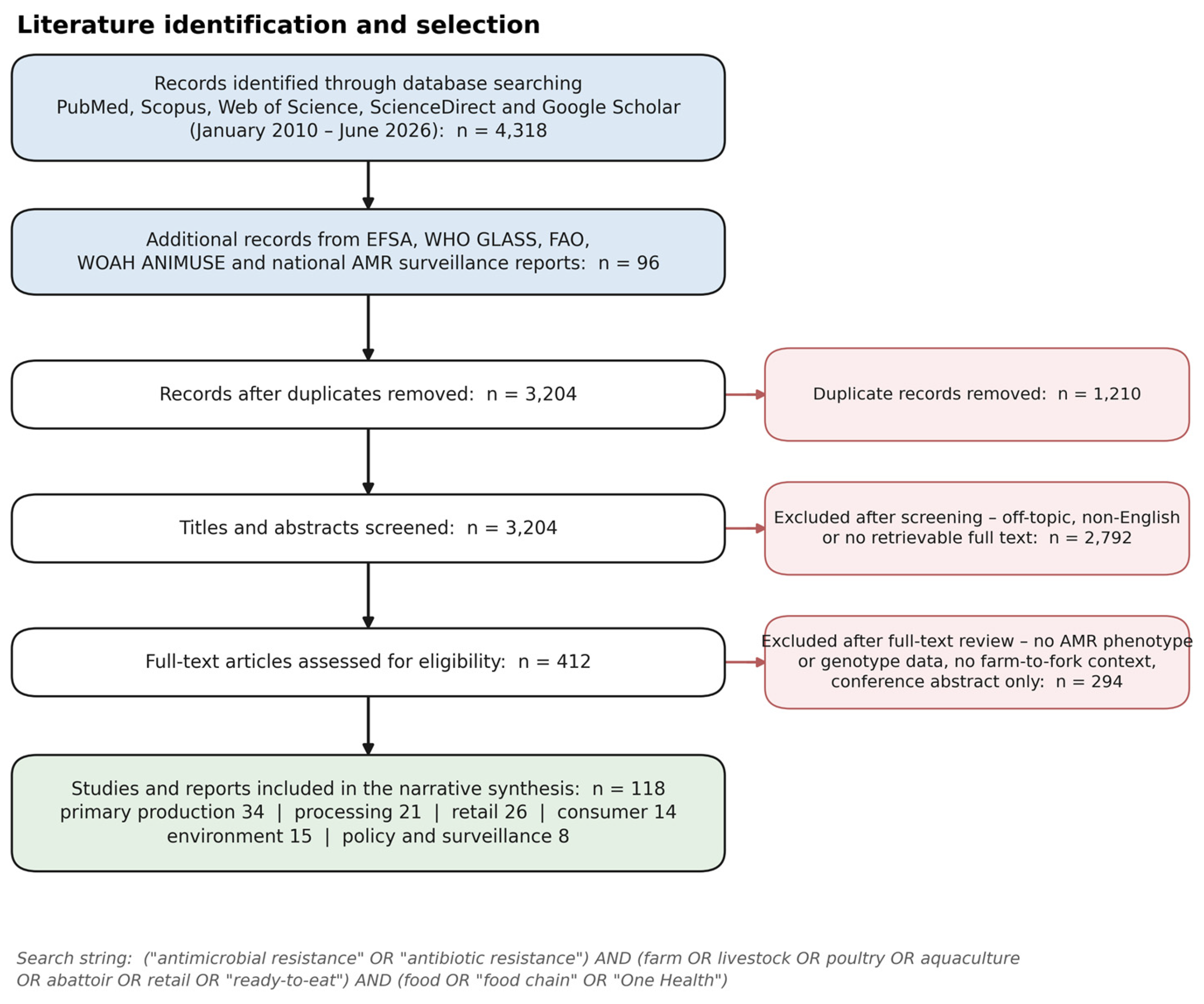
Figure 4.
Resistance mechanisms, their mobilisation through horizontal gene transfer, and the co-selective and stress-related pressures that operate along the food chain. Mechanisms (upper row) become epidemiologically important only when linked to the mobilisation routes shown in the central band.
Figure 4.
Resistance mechanisms, their mobilisation through horizontal gene transfer, and the co-selective and stress-related pressures that operate along the food chain. Mechanisms (upper row) become epidemiologically important only when linked to the mobilisation routes shown in the central band.
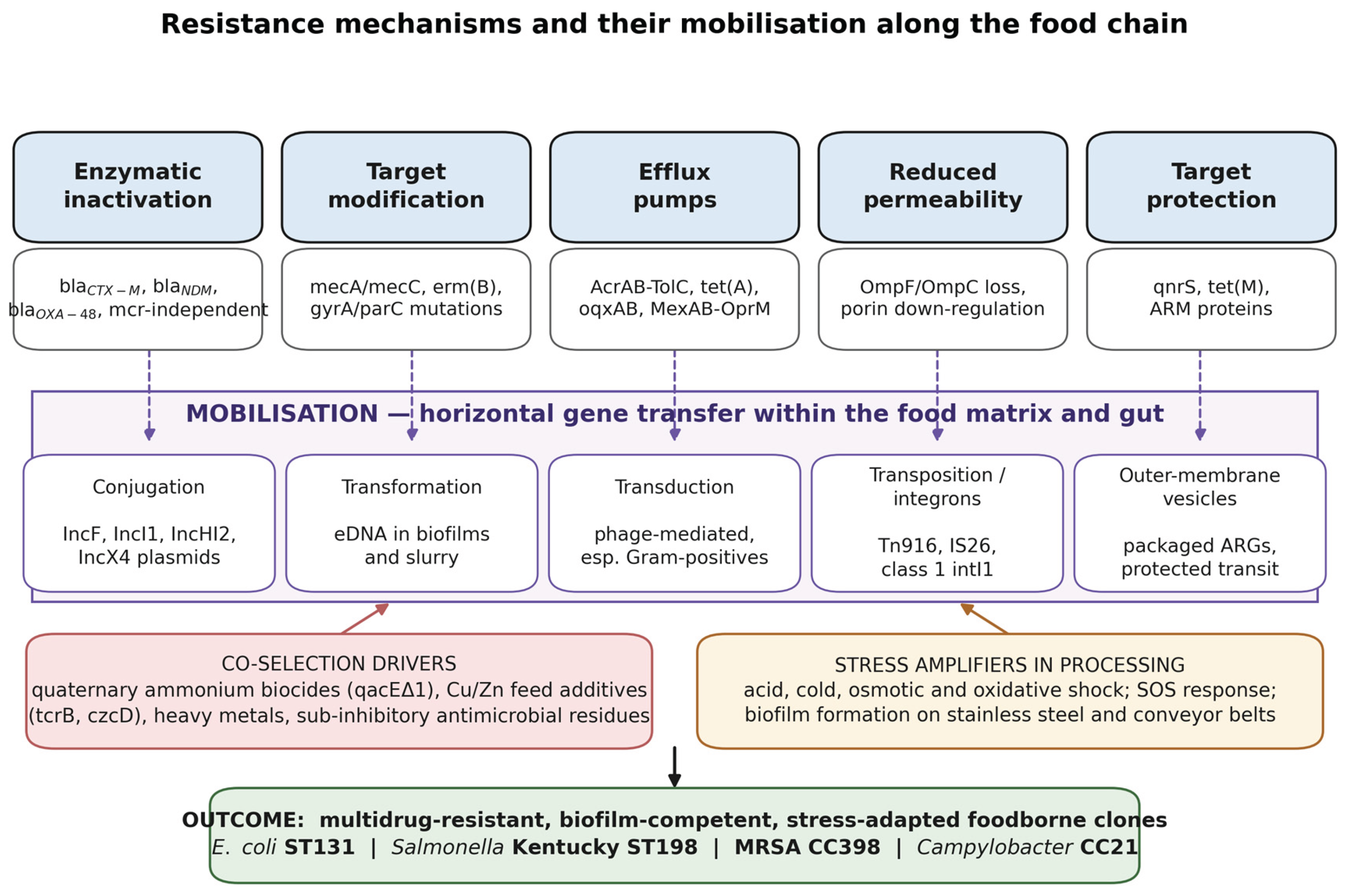
Figure 5.
(a) Indicative prevalence of extended-spectrum beta-lactamase-producing Escherichia coli and of multidrug-resistant isolates across food matrices, pooled from the studies discussed in Sections 4 to 6; error bars indicate the approximate range across studies rather than a formal confidence interval. (b) Indicative composition of antimicrobial use in food animals by class. Both panels should be read as illustrations of pattern, not as precise estimates, for the reasons set out in Section 2.
Figure 5.
(a) Indicative prevalence of extended-spectrum beta-lactamase-producing Escherichia coli and of multidrug-resistant isolates across food matrices, pooled from the studies discussed in Sections 4 to 6; error bars indicate the approximate range across studies rather than a formal confidence interval. (b) Indicative composition of antimicrobial use in food animals by class. Both panels should be read as illustrations of pattern, not as precise estimates, for the reasons set out in Section 2.
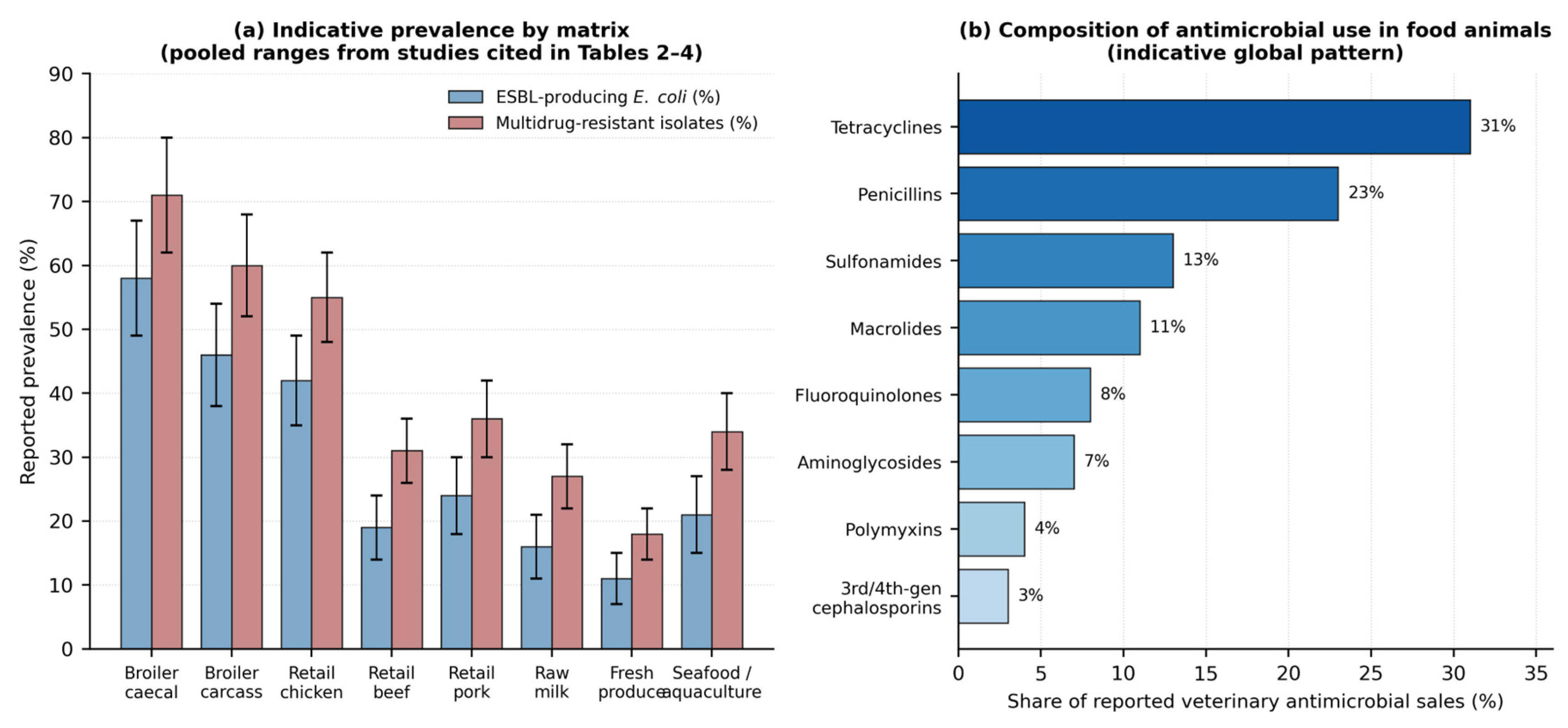
Figure 7.
Intervention hierarchy for antimicrobial resistance in the food chain, ranked by intrinsic effectiveness rather than by ease of implementation, together with the governance cycle required to sustain it. Measures towards the base depend increasingly on consistent individual behaviour and are correspondingly less reliable.
Figure 7.
Intervention hierarchy for antimicrobial resistance in the food chain, ranked by intrinsic effectiveness rather than by ease of implementation, together with the governance cycle required to sustain it. Measures towards the base depend increasingly on consistent individual behaviour and are correspondingly less reliable.
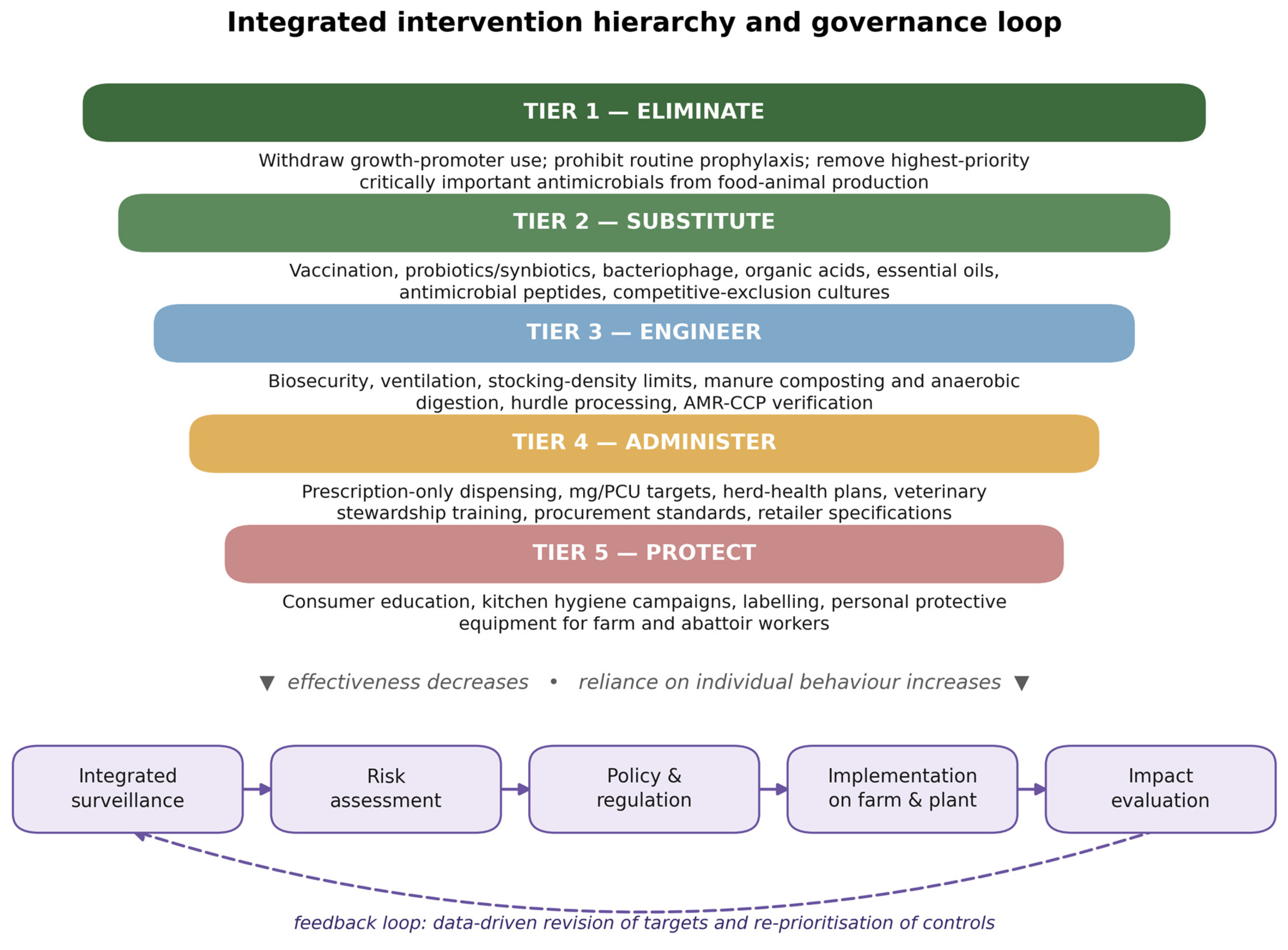

Table 1.
Patterns of antimicrobial use by production sector and the resistance concerns most closely associated with each.
Table 1.
Patterns of antimicrobial use by production sector and the resistance concerns most closely associated with each.
| Sector | Dominant route of administration | Classes most frequently reported | Principal resistance concern | Key references |
|---|---|---|---|---|
| Broiler poultry | Mass medication in drinking water; in-feed | Tetracyclines, fluoroquinolones, aminopenicillins, colistin in some regions | ESBL-producing E. coli; fluoroquinolone-resistant Campylobacter; mcr-mediated colistin resistance | Mehdi et al. (2018); Nhung et al. (2017) |
| Layer poultry | Water medication; individual treatment rare | Tetracyclines, sulfonamides, macrolides | Resistant Salmonella entering the egg supply | Adesiyun et al. (2014); Sanchez-Salazar et al. (2020) |
| Pigs | In-feed medication, concentrated around weaning | Tetracyclines, macrolides, pleuromutilins, zinc oxide as co-selector | Livestock-associated MRSA CC398; multidrug-resistant E. coli; metal co-selection | Lekagul et al. (2019); Peng et al. (2022); Smith (2015) |
| Dairy cattle | Intramammary; dry-cow therapy | Beta-lactams, cephalosporins, aminoglycosides | Resistant mastitis pathogens; waste milk fed to calves amplifies excretion | Thames et al. (2012) |
| Beef cattle | Injectable; in-feed metaphylaxis on feedlot arrival | Macrolides, tetracyclines, beta-lactams | Resistant respiratory pathogens; feedlot run-off | Cameron and McAllister (2016); Vikram et al. (2018) |
| Aquaculture | Medicated feed released into open water | Tetracyclines, quinolones, sulfonamides, florfenicol | Direct environmental release; sediment reservoirs; imported product as a transboundary route | Cabello et al. (2013); Watts et al. (2017) |
| Small-scale mixed holdings | Over-the-counter purchase, owner-administered | Whatever is locally available and affordable | Unrecorded use; sub-therapeutic dosing; no withdrawal period observed | Carrique-Mas et al. (2015); Rousham et al. (2018) |
Routes and classes reflect the predominant pattern reported in the cited literature and vary considerably between countries and between production tiers within a country.
Table 2.
Reported behaviour of resistant bacteria at principal processing operations.
| Operation | Physical effect on total count | Effect on resistant fraction | Principal concern |
|---|---|---|---|
| Transport and lairage | Increase | Increase | Stress-induced shedding; crate carry-over between batches |
| Scalding (poultry) | Marked reduction | Neutral to increase | Sub-lethal heat stress; SOS induction; tank water as shared matrix |
| Defeathering | Increase on surface | Increase | Aerosolisation and mechanical redistribution across carcasses |
| Evisceration | Increase on surface | Increase | Faecal spill; caecal contents are the richest resistance reservoir |
| Immersion chilling | Reduction | Neutral | Common water bath; chlorine demand rises through the shift |
| Air chilling | Modest reduction | Neutral | Surface drying selects for desiccation-tolerant survivors |
| Carcass decontamination | Marked reduction | Neutral to reduction | Efficacy depends on organic load; not permitted in all jurisdictions |
| Cutting and deboning | Increase | Increase | Surface biofilm; equipment as persistent reservoir |
| Mincing and comminution | Increase | Increase | Homogenisation distributes a point contamination through the batch |
| Packaging and storage | Static to reduction | Neutral | Cold-tolerant resistant clones persist and may dominate |
Directions are qualitative and synthesised from Verraes et al. (2013), Capita and Alonso-Calleja (2013), Doyle (2015) and Oniciuc et al. (2019). ‘Neutral’ indicates that the resistant proportion of survivors is not consistently altered, which for a step that reduces total count means resistant organisms are reduced no more efficiently than susceptible ones.
Table 3.
Contrasting positions on the food-animal contribution to human antimicrobial resistance.
| Position | Principal argument | Strongest supporting evidence | Principal weakness |
|---|---|---|---|
| Substantial contribution | Volume of veterinary use exceeds human use; identical determinants recovered from both sectors | Ecological correlation between national use and resistance; occupational carriage studies | Correlation does not establish direction; occupational cohorts are not the general population |
| Modest contribution | Human-to-human transmission dominates community carriage in modelled populations | Source-attribution modelling of ESBL carriage in high-income settings | Models are parameterised on high-income data and may not transfer to settings with informal retail |
| Determinant-specific | Attribution differs by organism and by gene; no single figure is meaningful | Divergent attribution for Campylobacter versus ESBL genes in the same country | Requires genomic surveillance that most countries do not have |
| Intervention-based | Reductions in use produce measurable reductions in resistance regardless of the attributable fraction | National reduction programmes; systematic review and meta-analysis of restriction studies | Effect on the general human population is smaller and slower than on animals |
Synthesised from Silbergeld et al. (2008), Marshall and Levy (2011), Chantziaras et al. (2014), Dorado-Garcia et al. (2016), Tang et al. (2017), Hoelzer et al. (2017), Scott et al. (2018) and Mughini-Gras et al. (2019).
Table 4.
Stage-specific profile of selection, amplification and transfer along the food chain.
| Stage | Selection intensity | Amplification potential | Transfer opportunity | Composite priority |
|---|---|---|---|---|
| Breeding and hatchery | Low | High | Moderate | High |
| Grow-out and feeding | Very high | High | High | Very high |
| Aquaculture pond or cage | Very high | High | Very high | Very high |
| Manure storage and land application | Moderate | Very high | Very high | Very high |
| Transport and lairage | Low | Moderate | Moderate | Moderate |
| Slaughter and dressing | Negligible | Very high | Moderate | High |
| Chilling | Negligible | High | Low | Moderate |
| Cutting, mincing, further processing | Low | High | High | High |
| Sanitation of food-contact surfaces | Moderate | Low | Very high | High |
| Distribution and cold chain | Negligible | Low | Low | Low |
| Retail display, packaged | Negligible | Low | Low | Low |
| Wet market and informal retail | Low | High | High | High |
| Domestic storage and preparation | Negligible | Moderate | Moderate | Moderate |
| Consumption | Not applicable | Not applicable | High | Moderate |
Ratings are qualitative judgements derived from the evidence reviewed in Sections 4 to 7 and are intended to support prioritisation, not to substitute for quantitative risk assessment. Selection intensity refers to pressure favouring resistant over susceptible organisms; amplification potential to the spread of an entering determinant across additional product units; transfer opportunity to the likelihood of horizontal gene transfer during the stage. Composite priority weights the three properties equally.
Table 5.
Intervention options assessed against effectiveness, cost and feasibility in low-resource settings.
Table 5.
Intervention options assessed against effectiveness, cost and feasibility in low-resource settings.
| Intervention | Tier | Evidence strength | Relative cost | Feasibility where veterinary services are limited |
|---|---|---|---|---|
| Ban on growth-promoter use | Eliminate | Strong | Low to moderate | Moderate: enforcement rather than legislation is the constraint |
| Withdrawal of highest-priority critically important agents | Eliminate | Strong | Low | Moderate: substitution products must be available and affordable |
| Prohibition of routine group prophylaxis | Eliminate | Moderate | Moderate | Low: requires diagnostic capacity to distinguish treatment from prophylaxis |
| Vaccination programmes | Substitute | Strong | Moderate to high | Moderate: cold chain and delivery are the limiting factors |
| Probiotics, synbiotics, competitive exclusion | Substitute | Moderate | Low to moderate | High: no prescription infrastructure needed |
| Organic acids in feed and water | Substitute | Moderate | Low | High |
| Bacteriophage preparations | Substitute | Emerging | High | Low at present |
| Improved biosecurity and stocking density | Engineer | Strong | Moderate | Moderate: capital cost is the barrier |
| Manure composting and anaerobic digestion | Engineer | Strong | Moderate | High for composting; low for digestion |
| Crate and vehicle sanitation programmes | Engineer | Moderate | Low | High |
| Biocide rotation in processing plants | Engineer | Emerging | Low | High |
| Prescription-only dispensing | Administer | Strong | Low | Low without prescriber access |
| mg/PCU benchmarking and public reporting | Administer | Strong | Moderate | Low: requires a functioning sales data system |
| Retailer procurement standards | Administer | Moderate | Low to the regulator | Moderate: effective only for export-oriented chains |
| Veterinary stewardship training | Administer | Moderate | Low | High |
| Consumer hygiene campaigns | Protect | Weak for resistance outcomes | Low | High but least effective |
Evidence strength refers to the quality of published evaluation for resistance outcomes specifically, not for productivity or general food safety outcomes. Feasibility ratings reflect conditions typical of South Asian and sub-Saharan African production systems.
Disclaimer/Publisher’s Note: The statements, opinions and data contained in all publications are solely those of the individual author(s) and contributor(s) and not of MDPI and/or the editor(s). MDPI and/or the editor(s) disclaim responsibility for any injury to people or property resulting from any ideas, methods, instructions or products referred to in the content. |
© 2026 by the authors. Licensee MDPI, Basel, Switzerland. This article is an open access article distributed under the terms and conditions of the Creative Commons Attribution (CC BY) license.
Copyright: This open access article is published under a Creative Commons CC BY 4.0 license, which permit the free download, distribution, and reuse, provided that the author and preprint are cited in any reuse.