

Submitted:
24 August 2026
Posted:
26 August 2026
You are already at the latest version
Abstract
The isochoric heat capacity of supercritical fluids is a key thermodynamic property for investigating the asymptotic behavior of the Widom line in the vicinity of the critical point. In this wrk, the experimentally determined loci of the isochoric heat capacity maxima along supercritical isotherms are analyzed for a variety of molecular fluids. The experimental results show that the Widom line originates at the critical point, initially shifts toward lower densities with increasing temperature, subsequently reverses direction, and finally approaches the critical density again. Consequently, the Widom line crosses the critical isochore twice. The observed behavior is compared with the predictions of complete and incomplete scaling theories. It is demonstrated that the experimental data are accurately described by the asymptotic relation derived from complete scaling theory, for which the leading coefficient (\(\propto t^{2\beta}\), complete scaling term) is negative, \(D_{\mathrm{CS}} < 0\). This prediction is in excellent agreement with the experimental observations. In contrast, incomplete scaling predicts a different asymptotic behavior (\(\propto t^{1-\alpha}\)) along supercritical isotherms and therefore fails to reproduce the experimentally observed evolution of the Widom line over a wide temperature range. The predictive capability of widely used multiparameter reference equations of state (NIST/REFPROP) is also examined. Although these equations of state accurately represent thermodynamic properties over broad regions of the fluid phase diagram, they fail to reproduce the correct asymptotic behavior of the Widom line in the immediate vicinity of the critical point. This deficiency arises because conventional non-scaling equations of state do not correctly capture the critical anomalies associated with long-range density fluctuations. The present results provide the first experimental confirmation of the asymptotic behavior of the Widom line predicted by complete scaling theory and demonstrate the necessity of incorporating scaling behavior into equations of state intended for accurate description of critical and supercritical fluids thermodynamic behavior.
Keywords:
critical point
; equation of state
; isochoric heat capacity
; Widom line
; scaling-type crossover equation of state
; supercritical fluids
1. Isochoric Heat Capacity as a Fundamental Thermodynamic Property for Investigating the Asymptotic Behavior of the Widom Line in Supercritical Fluids
The isochoric heat capacity () of supercritical fluids represents a key thermodynamic property of significant importance for both scientific research and technological applications [1,2,3,4]. In particular, plays an important role in studies of critical anomalies in thermodynamic properties, which are induced by large-scale fluctuations of the order parameter (density) and “supercritical phase transitions” between “liquid-like” and “gas-like” states [5]. These transitions are closely associated with the behavior of Widom lines. Among all thermodynamic properties, the isochoric heat capacity exhibits the highest sensitivity to microscopic changes within the system, thereby establishing its theoretical significance as a key thermodynamic characteristic of supercritical fluids.
The thermodynamic properties of supercritical fluids undergo anomalously sharp variations in the vicinity of the Widom line [6], where the transition from a “liquid-like” to a “gas-like” state occurs. Near this line, a crossover between “liquid-like” and “gas-like” regimes take place, resulting in pronounced changes in both thermodynamic and transport properties over narrow temperature intervals [6]. These transitions are driven by strong critical density (order parameter) fluctuations, which lead to significantly elevated heat transfer coefficients (critical enhancement).
This phenomenon has important practical implications. In the vicinity of the Widom line, supercritical fluids exhibit exceptionally high heat capacities, resulting in unusually large energy densities. Consequently, the enthalpy change along an isobar between two isotherms is significantly greater than in other regions of the supercritical state, as clearly illustrated in enthalpy–pressure (h–P) diagrams. This enhanced heat-transfer capability enables substantially more thermal energy to be exchanged per unit mass of fluid, allowing significant reductions in reactor wall thickness and the overall size of high-pressure process equipment, thereby promoting more compact, energy-efficient, and cost-effective process designs.
The present study has two main objectives. First, we experimentally characterize the asymptotic behavior of the isochoric heat capacity maxima loci for chemically and molecularly diverse liquids over a wide range of supercritical conditions. The resulting dataset represents one of the most extensive experimental databases currently available for investigating thermodynamic crossover behavior and the evolution of the Widom line beyond the critical point.
Second, the experimental results are used to critically assess the predictive capabilities of different classes of equations of state (EoS), including conventional multiparameter reference EoS, non-classical crossover EoS, and models based on complete and incomplete scaling theories of critical phenomena. Particular attention is devoted to the asymptotic behavior of the Widom line in the immediate vicinity of the critical point, where long-range density fluctuations dominate the thermodynamic response and conventional EoS often fail to reproduce the correct asymptotical critical behavior.
The obtained experimental database provides a reliable benchmark for validating advanced thermodynamic models and improving predictions of supercritical fluid behavior near the Widom line. Accurate determination of the Widom line is essential for optimizing operating conditions in technologies based on supercritical fluids, including supercritical Brayton power cycles, heat exchangers, compressors, nuclear reactor cooling systems, lithium-ion battery thermal management systems, and other advanced energy-conversion processes [5,6].
The reliability of an EoS should ultimately be evaluated by its ability to reproduce both volumetric () and caloric () properties, as well as to accurately describe thermodynamic crossover phenomena associated with the Widom line, where maxima of thermodynamic and transport properties occur. In this work, the behavior of the isochoric heat capacity () maxima loci is predicted using non-classical theories of critical phenomena based on crossover scaling EoS, including incomplete and complete scaling approaches. The theoretical predictions are then systematically compared with directly measured experimental ()-maximum loci for various supercritical fluids.
2. Experimental
2.1. High-Temperature and High-Pressure Apparatus
The experimental methodology, including the theoretical background, calorimeter design, calibration procedures, and uncertainty analysis, has been described in detail elsewhere [1,7,8,9,10,11,12,13,14,15]. The same high-temperature and high-pressure (HTHP) adiabatic calorimeter has been successfully employed for accurate measurements of the isochoric heat capacity of numerous pure fluids and mixtures over wide temperature and pressure ranges, including the critical and supercritical regions [7,8,9,10,11,12,13,14,15,16,17,18,19,20,21]. Therefore, only a brief description is presented here.
Isochoric heat capacities were measured using a nearly constant-volume adiabatic calorimeter consisting of a thin-walled spherical inner vessel enclosed within a thick-walled outer pressure vessel. Adiabatic conditions were maintained by a highly sensitive Cu2O semiconductor layer located between the two spheres [22]. Owing to its exceptionally high thermoelectric power (approximately 1150 μV∙ K−1), the Cu2O layer acts as an integrated thermoelectric sensor capable of detecting temperature differences as small as 10−6–10−5 K between the inner and outer vessels. The resulting electrical signal is amplified and fed to a precision temperature controller, which continuously compensates for heat exchange with the surroundings, thereby maintaining true adiabatic conditions.
The Cu2O layer also transmits pressure from the inner vessel to the outer pressure shell while introducing negligible conductive heat losses because of its low thermal conductivity (≈2.09 W∙ m−1∙K−1). Unlike conventional vacuum adiabatic calorimeters, which monitor temperature differences only at discrete locations, the present design provides integrated control over the entire calorimeter surface. Consequently, the apparatus is suitable for accurate heat-capacity measurements at temperatures up to 1000 K and pressures exceeding 100 MPa [22]. The sample temperature was measured with a calibrated 10 Ω platinum resistance thermometer (PRT-10) installed inside the calorimetric vessel.
2.2. Measurement Principle and Calibration
The isochoric heat capacity was determined from the electrical energy supplied to the sample, the resulting temperature increment, the sample mass, and the heat capacity of the empty calorimeter using [7,8,9,10,11,12,13,14,15,16,17,18,19,20,21,22]
where m is the sample mass, is the electrical energy supplied by the heater, U and I are the voltage and current, respectively, τ is the heating time, ΔT is the temperature increment, and C0 is the heat capacity of the empty calorimeter.
The heat capacity of the empty calorimeter was determined by calibration with reference fluids with well-known isochoric heat capacities (water, propane, n-heptane, benzene, etc.) [7,8,9,10,11,12,13,14,15,16,17,18,19,20,21,22]
The average value of C0 was approximately 190 J∙K−1, which is much smaller than the total heat capacity of the filled calorimeter. Consequently, the contribution of the empty calorimeter to the overall measurement uncertainty is negligible.
The sample density at each temperature and pressure was calculated from as
where the pressure- and temperature-dependent calorimeter volume is
Here, cm3∙g-1 is the calorimeter volume at 298.15 K and atmospheric pressure, α is the thermal expansion coefficient of stainless steel (10Kh18N9T) [22,26], and β = (21.2 ± 2.4) × 10−4 cm3∙MPa−1 is the experimentally determined pressure-expansion coefficient [22]. The reference volume was calibrated using the IAPWS reference EoS for pure water [27], whereas the pressure dependence of the calorimeter volume was independently verified using the Love equation for a thick-walled sphere [22,28,29]. The uncertainty of the calibrated calorimeter volume was approximately 0.05%, ensuring accurate density determination throughout the investigated temperature and pressure ranges.
2.3. Experimental Procedure
Isochoric heat capacities were measured along quasi-isochores by continuously heating a sealed calorimeter containing a known mass (m) of the sample. Each experiment was started in the two-phase (liquid–vapor) region and continued into the single-phase liquid region. As the system crossed the liquid–vapor phase boundary at constant density, simultaneous measurements of the isochoric heat capacity and saturation properties (,,) were obtained.
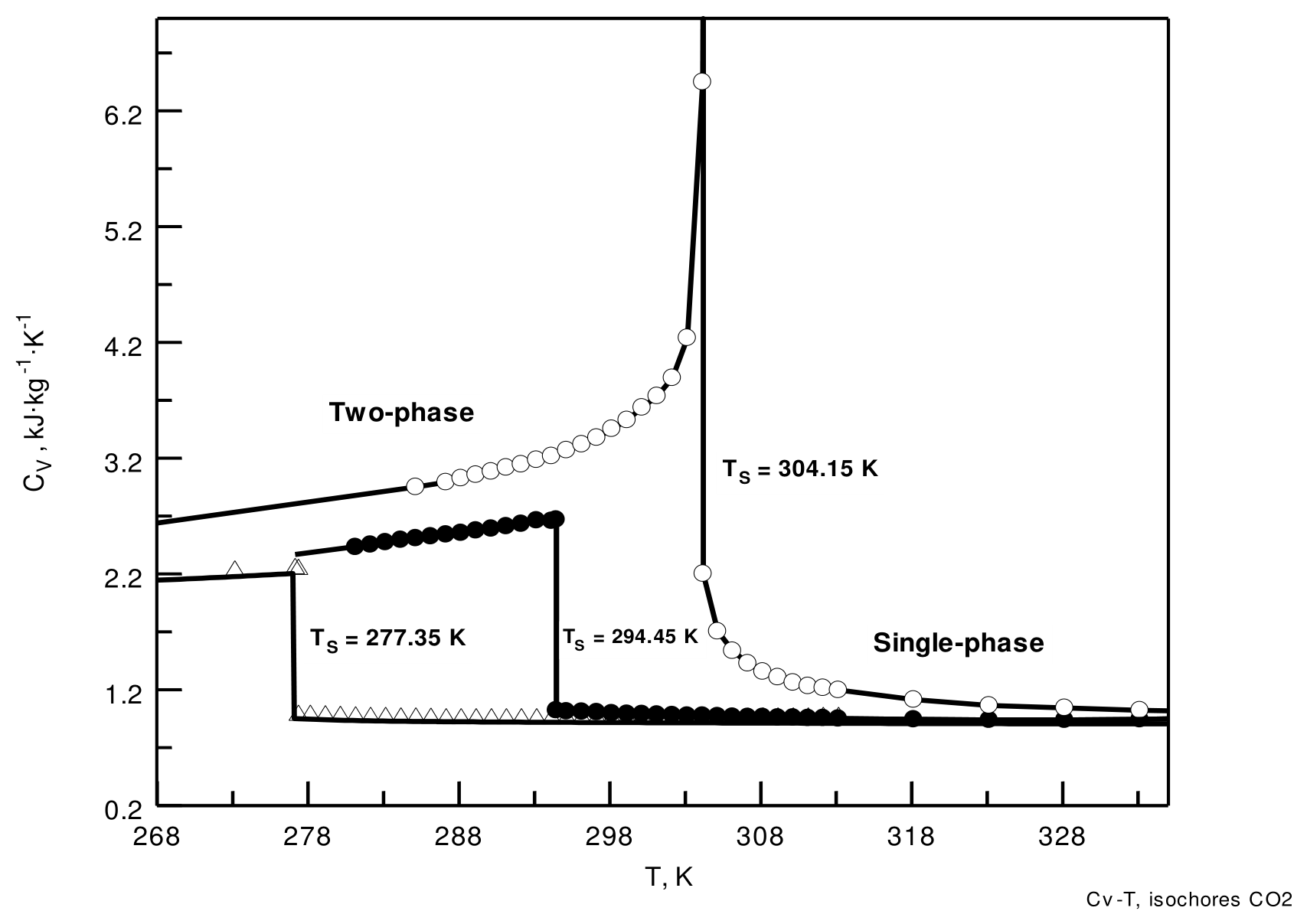
The phase-transition temperature, , was determined from the discontinuity in the isochoric heat capacity, , at saturation temperature crossing, corresponding to the abrupt change between the single-phase and two-phase heat capacities (, where andare the single- and two-phase heat capacities at saturation respectively, see Figure 1) [7,8,9,10,11,12,13,14,15,16,17,18,19,20,21,22], or from the corresponding discontinuity in pressure (P-T isochoric break point [16,26,30,40,41,42,43]). Consequently, a single calorimetric experiment provided simultaneous measurements of the single-phase and two-phase heat capacities together with the corresponding saturation properties (,,). When the calorimeter was equipped with a calibrated pressure transducer (piezo-calorimeter [2,13,16,22]), vapor pressure, single-phase PVT properties, and the thermal-pressure coefficient, , were measured simultaneously [2,13,16,22,31,32,33].
Figure 2.
Experimental single- and two-phase isochoric heat capacities, (), of CO2 as a function of temperature in the vicinity of the liquid–vapor phase transition along selected liquid and near-critical isochores [23,24,34]. Symbols denote the experimental data: ○, ( = 483.09) kg·m−3; ●, ( = 763.36) kg·m−3; △, (= 902.93) kg·m−3. Solid lines represent values calculated from the reference fundamental EoS calculated from the NIST/REFPROP [25].
Figure 2.
Experimental single- and two-phase isochoric heat capacities, (), of CO2 as a function of temperature in the vicinity of the liquid–vapor phase transition along selected liquid and near-critical isochores [23,24,34]. Symbols denote the experimental data: ○, ( = 483.09) kg·m−3; ●, ( = 763.36) kg·m−3; △, (= 902.93) kg·m−3. Solid lines represent values calculated from the reference fundamental EoS calculated from the NIST/REFPROP [25].
All measurements were performed under quasi-equilibrium conditions using slow continuous heating and cooling runs. The heating rate did not exceed 5×10⁻⁴ K ∙s−1, ensuring that the measured temperature and pressure closely approximated thermodynamic equilibrium.
2.4. Quasi-Static Thermogram and Barogram Techniques
The liquid–vapor phase-transition (,,) and critical (,,) properties were determined using the quasi-static thermogram and barogram techniques developed in our previous studies [2,13,16,22,31,32,33]. These methods are based on continuous recording of temperature (thermograms, T–τ) and pressure (barograms, P–τ) during slow isochoric heating or cooling.
2.4.1. Quasi-Static Thermograms
The thermogram technique utilizes the discontinuous change in the isochoric heat capacity at the liquid–vapor phase transition. Crossing the phase boundary produces a distinct change in the slope of the temperature–time curve,
where and are the thermogram slopes before () and after () the phase transition, respectively, and k depends on the heating power and sample mass. As the critical point is approached, the heat-capacity jump diverges according to asymptotical scaling power law,, where α=0.106 is the universal critical exponent [35,36]. Consequently, the thermogram technique provides highly accurate determination of coexistence curves and critical parameters [2,13,16,22,31,32,33]. It has also been successfully applied to detecting weak first-order phase transitions in complex thermodynamic systems [16,33,37,38,39,44,45].
2.4.2. Quasi-Static Barograms
Pressure was measured before each calorimetric experiment at constant temperature, after which temperature and pressure were recorded simultaneously during continuous heating or cooling. The barogram technique identifies phase transitions through the discontinuity in the slope of the P–T isochore. This method is particularly effective for liquid isochores far from the critical point, where the density difference between the coexisting phases is large. Near the critical point, however, the pressure signal becomes less sensitive because the density difference between the liquid and vapor phases approaches zero (). Therefore, the quasi-static thermogram technique was primarily employed for determining near-critical phase-transition properties, whereas the barogram method served as an independent verification of the saturation data.
Simultaneous measurements of temperature and pressure also enabled direct determination of the thermal-pressure coefficient, =, from the slopes of the thermograms () and barograms () as .
2.5. Uncertainty Analysis
A comprehensive uncertainty analysis of the experimental method, calibration procedure, correction methods, and propagation of measurement uncertainties has been reported previously [7,8,9,10,11,12,13,14,15,16,17,18,19,20,21,22,31,32,33]. Therefore, only a brief summary is presented here.
The combined uncertainty of the isochoric heat-capacity measurements was evaluated according to the Guide to the Expression of Uncertainty in Measurement (GUM) [46,47,48] using the working equation (Equation (1)). Assuming statistically independent input quantities, the combined standard uncertainty was calculated from
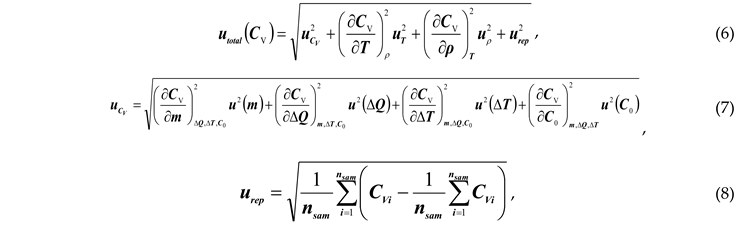 where , , , and are the standard uncertainties associated with the heat capacity, density, temperature, and repeatability, respectively; is the standard uncertainties of the independently measured variables, while the corresponding sensitivity coefficients were obtained from Equation (1). The required partial derivatives and were estimated from the experimental data.
The principal sources of uncertainty include the electrical energy supplied to the calorimeter, sample mass, temperature increment, empty-calorimeter heat capacity, and calorimeter volume. The uncertainty of the sample mass was 0.006%, whereas that of the calibrated calorimeter volume was approximately 0.05%. Temperature was measured with an uncertainty better than 15 mK. Thus, the total combined expanded uncertainty (coverage factor k=2 with 95% confidence level) was calculated as . Based on a detailed analysis of all uncertainty sources affecting the determination of , the combined expanded uncertainty of was estimated to be (3 to 4) % in the critical and supercritical regions (within Widom line range); 1.5% in the liquid phase, and 2-3% in the vapor phase. The corresponding expanded uncertainties of temperature and density were 15 mK and 0.15%, respectively.
3. Test Measurements: Validation of the Experimental Method
The design and operation of the experimental apparatus, together with the calibration and measurement procedures, have been validated extensively in our previous studies [2,3,7,8,9,12,19,20,21,34,49,50]. The present HTHPapparatus has been successfully tested using several reference fluids, including water, carbon dioxide, n-alkanes, and alcohols [2,3,7,8,9,12,19,20,21,34,49,50] (NIST/REFPROP [25] and TDE DataBase [51]). In all cases, the measured thermodynamic properties (PVT,, ,,, and ,,) were compared with high-accuracy literature data and the corresponding NIST REFPROP reference EoS [25], demonstrating excellent agreement within the experimental uncertainty.
Additional validation was recently performed for n-hexane [15], where simultaneous measurements of the isochoric heat capacity and saturation properties were compared with the NIST REFPROP reference EoS [25]. Excellent agreement was obtained over both the two-phase and single-phase regions, namely: in the two-phase region, AAD = 0.5%, (Max.Dev = 1.6%); in the single-phase region, AAD = 0.5%, (Max.Dev = 1.1%). These deviations are well within the estimated uncertainty of the reference EoS for n-hexane (approximately 1–2% for [25].
The excellent agreement between the present measurements and the reference EoS confirms the validity of the calorimeter design, calibration procedure, and experimental methodology, demonstrating that the apparatus provides highly accurate and reliable measurements of the isochoric heat capacity of molecular fluids in the supercritical region. This accuracy enables reliable determination of the -maximum loci (Widom line), including their asymptotic behavior in the immediate vicinity of the critical point.
3. Experimental Study of the Isochoric Heat Capacity Maxima Locus and Asymptotic Widom Line Behavior in Supercritical Fluids
The isochoric heat capacity, (), is one of the most sensitive thermodynamic properties for identifying phase-transition phenomena in fluids. During isochoric heating along the critical density, () diverges at the first-order liquid–vapor phase transition within the two-phase region (Figure 3, Figure 4, Figure 5, Figure 6 and Figure 7). In contrast, in the supercritical region, () exhibits a pronounced but finite maximum along supercritical isochores (Figure 8, Figure 9, Figure 10 and Figure 11). These maxima define the isochoric heat capacity maxima locus, which is commonly associated with the Widom line and provides valuable insight into the thermodynamic crossover from “liquid-like” to “gas-like” behavior in supercritical fluids.
These heat-capacity maxima (see Figure 8, Figure 9, Figure 10 and Figure 11) define the locus commonly referred to as the Widom line, which separates “liquid-like” and “gas-like” states in the supercritical region. Consequently, accurate measurements of the isochoric heat capacity, , provide a powerful experimental tool for identifying both the liquid–gas coexistence curve below the critical point and the supercritical crossover from “liquid-like” to “gas-like” behavior above the critical point. Moreover, these measurements provide stringent benchmarks for assessing the accuracy and reliability of EoS in describing thermodynamic properties in the critical and supercritical regions.
Unlike the liquid–gas coexistence curve below the critical point, the Widom line does not represent a true thermodynamic phase boundary. Instead, it corresponds to a continuous structural crossover between supercritical “liquid-like” and “gas-like” states. Although no first-order phase transition occurs across this line (Widom line), substantial changes in density, compressibility, heat capacity, transport properties, and microscopic structure take place over a relatively narrow temperature interval in its vicinity (see, for example, Ref. [6]). Consequently, supercritical fluids are commonly classified into “liquid-like” (high-density) and “gas-like” (low-density) states according to their density and local molecular structure [79,80,81].
Using fluctuation solution theory combined with an accurate EoS, Ploetz and Smith [82] established a physically meaningful criterion for distinguishing “liquid-like” and “gas-like” regimes in supercritical fluids. In their framework, the crossover is characterized by the skewness of particle-number fluctuations in an equivalent open system. “Liquid-like” states exhibit negative skewness, whereas “gas-like” states are characterized by positive skewness. This behavior reflects the continuous evolution of microscopic structure across the Widom line rather than the existence of two distinct thermodynamic phases [82,83]. There is currently no rigorous thermodynamic criterion for calculating or constructing a “liquid-like”+”gas-like” boundary analogous to the true liquid–gas coexistence curve below the critical point, which is uniquely defined by thermodynamic equilibrium conditions. To date, neither the existence of a quasi-two-phase “liquid-like” + “gas-like” region (often referred to as the Widom region) in the supercritical state nor its thermodynamic nature has been conclusively demonstrated experimentally. An equally important unresolved question is whether the so-called “liquid-like” and “gas-like” states can legitimately be regarded as distinct thermodynamic phases, or whether they should instead be interpreted simply as continuously evolving structural regimes within a single supercritical phase. In our previous work [5,6], we proposed a phenomenological interpretation of the Widom region as the domain in which critical fluctuations make a significant contribution to the total experimentally observed thermodynamic and transport properties of a supercritical fluid. For practical purposes, this region may be defined as the range where critical fluctuation effects remain appreciable, typically contributing on the order of 1–5% to the corresponding thermodynamic or transport property, for example, (). In the () plane, the resulting Widom region resembles the shape of the liquid–gas coexistence curve below the critical point. Although this representation does not imply the existence of a true thermodynamic phase boundary, it provides a physically meaningful framework for visualizing the extent of critical fluctuations and the crossover between “liquid-like” and “gas-like” behavior in the supercritical state.
The exceptional sensitivity of the isochoric heat capacity, (), to density fluctuations makes it one of the most informative thermodynamic properties for investigating critical and supercritical phenomena. Near the critical point, long-range density fluctuations give rise to pronounced anomalies in both thermodynamic and transport properties, including sharp maxima of (), enhanced thermal conductivity, and significantly increased heat-transfer coefficients [4,5,6]. These critical enhancements are of considerable technological importance because they improve heat-transfer performance and enable more compact and efficient designs of high-pressure equipment operating under supercritical conditions.
Among technologically important supercritical fluids, supercritical carbon dioxide (SC-CO2) has attracted particular attention because of its moderate critical parameters, high density, low viscosity, favorable transport properties, chemical stability, and environmental compatibility [6,84,85]. These characteristics make SC-CO2 an attractive working fluid for supercritical power cycles, carbon capture and storage, extraction processes, chemical processing, refrigeration, and advanced energy systems, for example, supercritical CO2 power cycle- Brayton cycle one of the next generation power conversion cycles, utilization of geothermal resources, thermal energy storage, heat transfer systems, and thermal modification of subsurface rock formation, Li- S cathode synthesis technologies, etc. [86,87,88,89,90,91,92,93,94,95,96,97]).
Despite its technological importance, reliable prediction of the thermodynamic properties of supercritical fluids in the vicinity of the Widom line remains a major challenge. Conventional analytical EoS (non-scaling EoS) generally lose accuracy in the critical and near-critical regions because they do not adequately account for the long-range density fluctuations that dominate fluid behavior. As a result, these models often fail to reproduce the characteristic critical anomalies of thermodynamic properties of supercritical fluids, particularly the loci of maxima of thermodynamic response functions. Accurate thermodynamic modeling in this region therefore requires both high-quality experimental measurements and physically based EoS incorporating critical scaling behavior.
Because experimental measurements are necessarily limited to discrete thermodynamic states, engineering design and process optimization rely primarily on predictions obtained from equations of state. The predictive capability of an EoS is determined not only by its ability to reproduce (PVT) properties but also by its accurate description of caloric properties ( and , the speed of sound (W), and the loci of extrema of thermodynamic response functions associated with the Widom line. Consequently, experimental () data provide one of the most stringent benchmarks for evaluating the accuracy and predictive capability of EoS in the critical and supercritical regions.
3.1. Experimental Maxima Loci (Widom Lines) of Supercritical Fluids
As is well known, the isochoric heat capacity, (), together with other thermodynamic properties, such as the isobaric heat capacity, (), isothermal compressibility (), speed of sound, (), and thermal expansion coefficient, (), as well as transport properties, including viscosity, thermal conductivity, and thermal diffusivity, exhibit pronounced anomalies in the near-critical and supercritical regions due to long-range critical density fluctuations [1]. These anomalies generally manifest themselves as pronounced maxima or minima along supercritical isotherms. The loci of maxima form characteristic lines in the supercritical region, commonly referred to as Widom lines. These lines can be regarded as extensions of the critical anomaly into the single-phase supercritical region. Along a Widom line, thermodynamic and transport properties undergo rapid, although continuous, changes associated with the crossover between predominantly “liquid-like” and “gas-like” behavior (see Figure 8, Figure 9, Figure 10 and Figure 11).
Most previous studies have described the Widom line either empirically or using classical multiparameter EoS based on mean-field critical behavior. Such approaches are unable to reproduce the experimentally observed critical anomalies accurately because they do not account for the dominant contribution of long-range density fluctuations in the vicinity of the critical point. Consequently, classical EoS generally fail to predict both the magnitude of the thermodynamic anomalies and the experimentally observed locations of their maxima (see Figure 1, Figure 4 and Figure 6, dotted curves). In contrast, crossover EoS based on the nonclassical scaling theory of critical phenomena explicitly incorporate the effects of critical fluctuations and provide a substantially more accurate description of the observed anomalies throughout the critical crossover region (see Figure 1, Figure 2, Figure 3, Figure 4, Figure 5, Figure 6, Figure 7, Figure 8, Figure 9, Figure 10 and Figure 11, solid curves).
Figure 8, Figure 9, Figure 10, Figure 11, Figure 12 and Figure 13 present representative experimental supercritical isotherms of the isochoric heat capacity for several molecular fluids. As shown, () exhibits well-defined maxima as a function of density along each supercritical isotherm. This behavior is observed for liquids with widely different molecular structures and intermolecular interactions [2,3,7,8,9,12,19,20,21,34,49,50]. The observed similarity reflects the universal character of critical phenomena. In the immediate vicinity of the critical point, the correlation length of density fluctuations becomes much larger than the characteristic molecular interaction distance, (). Consequently, the thermodynamic behavior is governed predominantly by universal scaling laws rather than by the microscopic details of the intermolecular potential. For example, the singular contribution to the heat capacity follows a power-law dependence characterized by universal critical exponents, , where , α = 0.106 [35].
The density corresponding to the () maximum at each fixed supercritical temperature shifts systematically with increasing temperature. The temperature dependence of these density maxima defines the Widom line in the and projections. In this work, we specifically define the experimental Widom line as the locus of the maxima of the isochoric heat capacity, (), along supercritical isotherms. This line characterizes the region of the most pronounced thermodynamic response and provides an experimentally accessible criterion for tracking the continuous crossover from predominantly “liquid-like” to “gas-like” behavior with increasing distance from the critical point.
The experimentally determined temperatures, densities, and pressures corresponding to the () maxima for the selected molecular fluids are summarized in Table 1. The resulting experimental Widom lines are presented in Figure 12, Figure 13, Figure 14 and Figure 15. Their characteristic behavior and asymptotic approach to the critical region are discussed in the following sections (see sec. 4 and 5).
Figure 12, Figure 13, Figure 14 and Figure 15 present the loci of the isochoric heat capacity maxima (Widom lines) for several molecular fluids in the andprojections, as determined from the experimental data. The figures also show the corresponding maximum loci predicted by the crossover scaling EoS, as discussed in Section 5, and by the classical multiparameter reference EoS, as discussed in Section 4, allowing direct comparison with the experimental results.
As can be seen from Figure 12, Figure 13, Figure 14 and Figure 15, the experimental maxima originate at the critical density on the critical isotherm and shift monotonically toward lower densities with increasing temperature, then increases sharply at higher supercritical temperatures, and finally approaches the critical isochore again. The minimum density along the Widom line is reached at reduced densities, (), ranging from approximately 0.92 for simple molecules, such as methane and propane, to about 0.98 for more complex molecules, such as water and heavy hydrocarbons. In addition, the reduced temperature, (), at which the Widom line crosses the critical density for the second time lies in the range 1.01–1.12. These two parameters, ( and ), characterize the main features of the asymptotic behavior of the Widom line associated with the maxima of the isochoric heat capacity in supercritical fluids. The same qualitative behavior is observed for all the fluids studied. However, the physical origin of this characteristic behavior of the Widom line remains unclear. In the projection, the asymptotic behavior of the Widom line is nearly linear (see Figure 15). This can be understood from the fact that, along supercritical isotherms, large changes in density correspond to relatively small changes in pressure. Therefore, most properties of the supercritical fluids less sensitive to the structural changes and cannot be detected in the projection, that is why details of the Widom line features near the critical point most pronounced in projection than in, i.e., maxima curve more sensitive to variation of density than pressure.
The prediction of the asymptotic behavior of the Widom line using classical multiparameter reference fundamental EoS and nonclassical scaling-type EoS based on the complete scaling theory is discussed below (flat behavior of the supercritical isotherm in projection).
Figure 16 shows the and phase diagrams of carbon dioxide, together with the loci of the isochoric heat-capacity maxima and minima lines where , and the region in which the effect of critical fluctuations on the thermodynamic properties is significant. In this region, the contribution of critical fluctuations is assumed to be within ().
The Widom line, defined by the loci of the () maxima, together with the loci of the () minima in the diagrams of CO2 and H2O, is presented in Figure 17. The extrema loci (maxima and minima), where , are directly related to the inflection points of the supercriticalisochores through the thermodynamic relation =0. Thus, Figure 17 simultaneously illustrates the maximum locus (CA), corresponding to the Widom line, and the minimum locus (AB). At point A, the two loci—the ()-maximum (Widom line) line and the ()-minimum line—coincide. At temperatures and pressures above point A, () no longer exhibits either a maximum or a minimum and shows regular, monotonic behavior.
It is difficult to identify the inflection points where of the isochores in the supercritical region from conventional (PVT) measurements, even when high-precision data are available, because the magnitude of the curvature of the isochores is very small ( ), for example, for carbon dioxide is varying within (from -5.3×10⁻⁹ to 1.45×10⁻⁴) MPa⋅K-2 at supercritical condition. This further demonstrates that the isochoric heat capacity is a highly sensitive thermodynamic property for investigating the qualitative behavior of the thermodynamic (PVT) surface, particularly for identifying Widom lines and characterizing supercritical phase-transition phenomena.
The second temperature derivative of the supercritical isochores, , exhibits very complex behavior (see Figure 18). The curvature of isochores is positive within the isochore inflection curve, and negative outside [155,156,157,158,159,160].
As shown in this figure, the density in the supercritical region of water at which the second temperature derivative of pressure vanishes, =0, and hence the () maxima occur for supercritical isotherms, does not coincide exactly with the critical density. With increasing temperature, the loci of these maxima progressively shift toward lower densities. The same behavior is observed for other supercritical fluids, as illustrated in Figure 19 for carbon dioxide. Figure 19 shows the corresponding or behavior of CO2 along critical isotherm.
Comparison of experimentally determined extrema of and their loci, , with predictions from an equation of state (EoS) provides a stringent test of the accuracy and reliability of the EoS. Numerous EoS have been developed that reproduce thermodynamic properties within their experimental uncertainties. Nevertheless, different EoS formulations can predict substantially different, and in some cases even qualitatively contradictory, behavior of the extrema of and their maxima loci in the vicinity of the critical point.
The extrema of the isochoric heat capacity have been investigated in a number of previous studies [56,155,156,157,158,159,160,161,162,163,164,165,166] using different type classical EoS. Most early investigations of the loci of maxima were performed for relatively simple fluids, including noble gases and other low-molecular-weight substances such as Ar, Kr, Xe, Ne, O2, F2, 4He, and p-H2. Stephenson [159,160] reported calculations of the maxima and minima of along isotherms for argon using an analytical EoS. Gaddy and White [163] analyzed the experimental data for CO2 reported by Amirkhanov et al. [23,24] to determine the behavior of the isothermal extrema loci in the vicinity of the critical point and to compare the experimental results with predictions based on a linear model of a scaling EoS.
The loci of extrema for the simple fluids Kr and Ar were investigated theoretically by Bearman et al. [158] using the Percus–Yevick equation. Amirkhanov et al. [162] performed a detailed analysis of experimental maxima and minima of the for several hydrocarbons along isotherms and isochores in both and representations. Theeuwes and Bearman [157] investigated the loci of maxima and minima by analyzing the behavior of Kr and Xe in the dense-gas and liquid regions. Magee and Kobayashi [155] and Magee [156] developed an empirical equation for isochores and fitted it to high-precision experimental data to investigate the behavior of the isochoric inflection loci, =0, for several fluids and fluid mixtures.
Diller [161] examined characteristic features of the temperature and density dependence of for several simple fluids at high densities (around ), including 4He, Ne, Ar, Kr, p-H2, O2, and F2, with particular emphasis on the behavior of the isothermal minima loci of near the . Gladun [164,165,166] reported systematic studies of the dependence of on molar volume for Ar, Kr, and Ne. In particular, Gladun [164] investigated the isothermal minima of for neon in the temperature range 37–43 K and found that the corresponding locus terminates at the coexistence curve. This observation is in very good agreement with the results obtained in the present study for more complex fluids (see Figure 16). Bagatskii et al. [181] and Voronel’ et al. [182] investigated critical enhancement in supercritical Ar and O2, respectively. These studies further demonstrate the importance of accurate characterization of the thermodynamic-property extrema in the critical and supercritical regions.
4. Classical Multiparameter Analytical and Non-Analytical Reference Equations of State
In recent years, accurate multiparameter reference fundamental EoS, such as those implemented in NIST/REFPROP [25], have become a standard database for the calculation of thermodynamic properties of technologically important fluids in both scientific and industrial applications (see also [27,68,72,76,102,103,104,105,106,107,108]). However, most multiparameter EoS, which are essentially analytical at the critical point, do not correctly represent the critical anomalies of supercritical fluids in the immediate vicinity of the critical point, i.e., within the asymptotic region, . Consequently, they also fail to reproduce the correct asymptotic behavior of the Widom line in the immediate vicinity of the critical point (asymptotic range). For example, as shown in Figure 20, the maximum of , and therefore the , loci, along the critical and supercritical isotherms shift considerably toward lower densities and do not turn toward the high-density region or cross the critical density at elevated temperatures, as observed experimentally (see Figure 12, Figure 13, Figure 14, Figure 15 and Figure 16 in projections).
However, in contrast most non-analytical multiparameter predict the originates of the Widom line at the critical density (along the critical isotherm). With increasing temperature, the line shifts toward lower densities, passes through a minimum in density, as shown in Figure 21, and then the density increases at higher supercritical temperatures, eventually crossing the critical density again.
As is well known, an EoS that is analytical at the critical point cannot reproduce the critical anomalous behavior of the isochoric heat capacity and other thermodynamic properties (,,, ) in the critical and supercritical regions. Classical (analytical) EoS fail to describe the critical anomalies of thermodynamic properties, which obey simple power-law dependencies along the critical isochore (for example, ) and critical isotherm (, where α and β are universal critical exponents), as rigorously predicted by the modern non-classical scaling theory of critical phenomena [35,109,110,111,112,113,114,115]. The fundamental limitation of classical analytical EoS is their inability to reproduce the non-analytic power-law singularities that characterize thermodynamic properties in the immediate vicinity of the critical point.
Common formulations for the residual Helmholtz energy in multiparameter EoS are given by Span [108]
where , , , andR=8.31451J⋅mol-1⋅ K-1.
When is used to reduce the density, the are usually equal to 1. The density exponents and have to be positive integer values to ensure that and all its derivatives vanish in the limit of zero density (). For values up to 8 have been used, and even higher values are common for . The are mostly positive and may be real numbers, resulting in infinite contributions to the Helmholtz energy at temperatures approaching zero. The main advantage of Equation (9) is that the derivatives required for calculating thermodynamic properties can be expressed analytically for any combination of and . To improve the representation of thermodynamic properties in the extended critical region, special terms have been introduced. The equation for pressure can be derived from Equation (9) using the general thermodynamic relation
Different functional forms of terms have been proposed for classical EoS to improve the representation of the critical behavior of the isochoric heat capacity and other thermodynamic properties of supercritical fluids (see, for example, [102,103,104,105,106,107,108]). Haar et al. [117] proposed two-dimensional Gaussian bell-shaped terms to improve the representation of in the supercritical region of pure water. However, these terms distorted the representation of other properties near the critical point. Setzmann and Wagner [72] modified the Gaussian bell-shaped term by introducing an additional parameter. This modification significantly improved the quality of the representation of near-critical behavior for all thermodynamic properties. The residual Helmholtz energy with the modified Gaussian bell-shaped term, introduced to improve the description of and near the critical point, can be written as [72]:
The isochoric heat capacity can be calculated from the reduced Helmholtz energy function as:
where and are the second temperature derivatives of the reduced Helmholtz energy of the ideal and real gases, respectively. For classical non-analytic EoS, the second temperature derivative of the reduced Helmholtz energy is infinite at the critical point, . The reduced Helmholtz energy with Gaussian bell-shaped terms, Equation (11), is able to represent experimental data in the critical and supercritical regions within their experimental uncertainties, except for the isochoric heat capacity and speed of sound in the very close vicinity of the critical point (<0.002 and <0.25, where and ), where these properties cannot be adequately described by analytical EoS [108].
Span [108] proposed introducing a non-analytical term to correctly represent the sharp anomalous increase (see Figure 1, Figure 2, Figure 3, Figure 4, Figure 5, Figure 6, Figure 7, Figure 8, Figure 9, Figure 10 and Figure 11) of the in the critical and supercritical regions. A modified form of the non-analytical terms in the EoS of Equation (11) was used by Span and Wagner [72] for CO2 and by Pruß and Wagner [27] for H2O. The modified reduced Helmholtz energy including the non-analytical term is:
where the following nonanalytic terms for the reduced Helmzotz energy were proposed by Span [108]:
where . The second temperature derivative of the nonanalytic terms is [108]:
where , The number of non-analytical terms in Equation (9) varies between 2 and 3. Unfortunately, the non-analytical terms introduced by Span [108] and Span and Wagner [72,98] still do not correctly reproduce the asymptotic critical behavior of near the critical point in the form of the theoretically predicted power law, with the universal critical exponent =0.106. Span 108] analyzed the functional form of the non-analytical term of the reduced Helmholtz energy and found that the non-analytical term in Equation (13) should satisfy the following conditions to correctly reproduce the scaling asymptotic power laws for : >0.5 and . The second temperature derivative of the non-analytical term in Equation (13) diverges at the critical point in the same manner as the isochoric heat capacity, as ), if the critical exponent of is = or =0.945 (=0.106 universal critical exponent [35,36]). The coefficients of the leading non-analytical terms must be negative (<0) to result in at the critical point. The isochoric heat capacities calculated from multiparameter EoS for various pure fluids are shown in Figure 1, Figure 2, Figure 3, Figure 4, Figure 5, Figure 6, Figure 7, Figure 8, Figure 9, Figure 10 and Figure 11. The uncertainties of the multiparametric reference EoS are approximately 0.2% (up to 0.5% at high pressures) in density, 1% (in the vapor phase) to 2% in heat capacity, 1% (in the vapor phase) to 2% in the speed of sound, and 0.2% in vapor pressure, except in the critical region [25].
To calculate in the critical and supercritical regions for pure water, the IAPWS-95 formulation [27] incorporates a special non-analytical term into the Helmholtz energy function that provides infinite values of the second temperature derivative at the critical point. The experimental basis of the fundamental EoS includes data measured by Baehr and Schomacker [118,119]. As the critical point is approached, this IAPWS formulation [27] exhibits singular behavior with regard to the →∞ (as and ). The non-analytical terms are explicit functions of density and temperature T, expressed as differences of parametric scaling functions, and can be evaluated analytically. This is an advantage of the IAPWS EoS for practical applications compared with parametric crossover EoS (see Section 5 below).
Therefore, the IAPWS-95 formulation [27] correctly represents the anomalous behavior of in the immediate vicinity of the critical point (t<0.001), although some problems may arise in the form of unphysical predictions [61,183]. Wyczalkowska and Sengers [183] reported an evaluation of the 1995 version of the equation developed by Wagner and Pruss [27] in the critical region. The leading asymptotic behavior of along the critical isochore for this equation is , which differs from the theoretically predicted power-law behavior of [35,36]. This prevents the equation from correctly representing the behavior of the isothermal compressibility and isobaric heat capacity in the asymptotic region, particularly at densities approximately ±0.5% around the at temperatures from up to 5 K above [183].
Thus, the Widom line (maximum loci) predicted by analytical multiparameter reference EoS in projection is inconsistent with the present experimental results (see Section 3), which demonstrate that the loci of the maxima exhibit fundamentally different behavior in the supercritical region. This discrepancy indicates that classical multiparameter reference EoS, despite their high accuracy over a wide range of supercritical conditions, do not qualitatively reproduce the behavior of the maxima line in projection associated with long-range density fluctuations. Consequently, they fail to predict the correct location and asymptotic behavior of the Widom line, although the corresponding difference is not noticeable in projection (see Figure 15 and Figure 16, right).
5. Nonclassical (Scaling -Type) Crossover Equations of State for Supercritical Fluids
As discussed above, classical EoS for supercritical fluids do not ensure a universal description of the thermodynamic behavior of real fluids, particularly , in the immediate vicinity of the critical point. In this section, we review scaling-type crossover EoS for pure supercritical fluids that are used to accurately calculate and other thermodynamic properties under near-critical and supercritical conditions, as predicted by the modern theory of critical phenomena based on complete- and incomplete-scaling models [120,121,122,123,124,125,126,127,128,129,130,131,132,133].
Figure 22 illustrates the maxima loci of n-butane and ammonia predicted using the analytical multiparameter reference EoS [25] (see also [70,135,136]) and crossover EoS [137,138].
As can be seen from Figure 22, the scaling-type crossover EoS qualitatively reproduces the experimentally observed asymptotic behavior of the Widom line (maxima curves; see Section 3). In projection, the difference between the multiparameter analytical reference EoS and the scaling-type crossover EoS is not noticeable because relatively small changes in pressure can produce large changes in density in the supercritical region due to the large compressibility, , where γ=1.24.
5.1. Extended Parametric Scaling Model of the Equation of State
To represent the thermodynamic properties of near-critical and supercritical fluids, an extended parametric scaling-type EoS is used [139,140,141,142,143,144,145,146], which is defined as
where , is the chemical potential, is the analytical background of the chemical potential, a and c are system-dependent parameters, β, δ, and are universal critical exponents, and r and θ are parametric variables. The transformation of the thermodynamic variables (T and ρ) to the parametric variables (r and θ) is defined as
where is the universal parameter (=1.359) defined by the universal critical exponents (β and γ), , , and , is the values of scaling variable on the coexistence curve. The EoS in terms of pressure is derived from Equation (16) as
where
and the analytical function of temperature is a regular function of temperature
The scaling behavior of the isochoric heat capacity calculated from this EoS is defined as
where and are analytical functions of the reduced temperature difference. This EoS has been successfully used to represent experimental and other thermodynamic properties (,, ,, etc.) of several pure fluids, including CO2, H2O, n-alkanes, and alcohols, in the critical and supercritical ranges [141,142,143,144,145,146].
As can be seen from Equation (21), the model correctly reproduces the asymptotic and non-asymptotic scaling laws for the (also other thermodynamic functions) along selected thermodynamic paths, including the critical isochore, critical isotherm, and coexistence curve, in the vicinity of the critical point, as predicted by the scaling theory of critical phenomena:
along the critical isochore, (,),
along the critical isotherm, (,),
along the coexistence curve, (,), ,
where and are the asymptotical critical amplitudes of along the critical isochore at (single –phase) and (two-phase), respectively. The isobaric heat capacity is defined as
where, and
, where , and are the universal constants [142].
Thus, these relations for and , derived from the parametric scaling EoS, correctly represent the characteristic critical anomalies of supercritical fluids predicted by the non-classical scaling theory of critical phenomena and, consequently, the behavior of the Widom lines.
5.2. Parametric Crossover Equation of State
The extended parametric scaling model of the EoS described above correctly represents the characteristic features of the critical anomalies of thermodynamic properties of supercritical fluids in the asymptotic critical region around the critical point, namely: (for CO2 this is 327.3 kg⋅m-3 ≤ ρ ≤ 607.9 kg⋅m-3) and (for CO2 this is 303.5 K≤ T ≤334.5 K). This range corresponds to pressures from (7.2 to 15.5) MPa. The scaling EoS provides an accurate description of the characteristic power-law behavior of pure fluids governed by universal critical exponents in the asymptotic vicinity of the critical point, as predicted by scaling theory. However, the experimentally observed region in which critical anomalies of the thermodynamic properties of supercritical fluids are significant extends over substantially wider temperature and pressure ranges (see Figure 23) than the range in which the extended parametric scaling model of the EoS is applicable. Far from the critical region, where thermodynamic properties exhibit predominantly regular behavior where the fluctuation contribution to the experimentally observed properties becomes negligible, this EoS does not naturally cross over to well-established classical theoretical EoS, such as the Landau or virial expansions. As discussed above, this limitation of the extended parametric scaling EoS can be overcome using the theory of crossover phenomena [64,78,109,110,111,112,115].
According to the theory of crossover phenomena, a crossover EoS smoothly transforms the thermodynamic behavior of supercritical fluids from the classical regime far from the critical region, where the effects of critical fluctuations can be neglected, to the non-classical (scaling-type) regime, where fluctuations make a significant contribution to the thermodynamic properties. In other words, the crossover describes the smooth transition from the background (mean-field or regular) contribution to the fluctuation (scaling or critical-enhancement) contribution to the thermodynamic properties. This type of crossover model therefore provides a description over the entire supercritical region.
In this section, we consider the parametric crossover model of EoS for pure fluids in the critical and supercritical regions. Within the crossover model based on a parametric EoS, the dimensionless Helmholtz free energy can be expressed as [61] (see also [21,52,64,78,147,148]):
where the scaling term includes the critical contribution (singular part) to the Helmholtz free energy arising from long-range critical fluctuations, while and are analytical functions of temperature represented by truncated Taylor expansions:
In Equations (26) and (27), is the Helmholtz free energy per mole, is the density, and is the temperature. The thermodynamic quantities are rendered dimensionless using the critical temperature, critical density , and critical pressure as
The scaling (fluctuation) part of the Helmholtz free energy, , which incorporates the contribution of long-range critical fluctuations, is represented in the form
where the parameters and are defined by
where α,β, and Δi are the universal critical exponents, is the universal linear-model parameter, k, ,and are system-dependent coefficients, while and are universal scaling functions [4,21,52,64,78,147].
The crossover function is defined by
where the crossover parameter is related to the parametric variable r by
The system-dependent coefficient g is proportional to the inverse Ginzburg number [109]. In the critical region at rg<<1 (or at the critical isochore and along the coexistence curve), =1 and Equation (29) reproduces a Wegner expansion for the three-dimensional Ising-like systems [149,150]:
For large values of the variable q at rg>>1 (), the crossover function modifies each term in Equation (29); consequently, all terms become analytical, and Equation (29) is transformed into the extended Landau expansion:
which corresponds to classical mean-field theory [151]. In the range where r≈g (), a crossover from singular critical behavior to analytic classical behavior takes place. A good description of experimental data using the parametric crossover model has been achieved for most technologically important supercritical fluids over the wide range of temperatures and densities bounded by
As can be seen from Figure 24, the range of applicability of the crossover EoS for СО2 extends very close to the fluctuation range (Widom range), where the effects of long-range fluctuations on the thermodynamic properties are significant.
For H2O and CO2, for example, this range extends up to T=808 K and T=380 K, respectively, along the critical isochores and, along the critical isotherms, covers densities within (for H2O) and (for CO2). Within this range, the crossover model accurately reproduces the scaling-type critical anomalies (critical enhancement) of the thermodynamic properties of supercritical fluids, including the behavior of the Widom line (see below), with uncertainties close to the experimental uncertainties.
This crossover model has been successfully applied to describe anomalous thermodynamic properties in near-critical and supercritical fluids, including СО2, H2О, methane, ethane, propane, toluene, benzene, methanol, ethanol, and other fluids [21,52,60,63,64,69,78,147,148,152,153,154]. Figure 1 and Figure 3–12 show comparisons between experimental data for pure СО2, H2О, and n-hexane and values calculated using the crossover model, Equation (29). The extrema curves calculated from the crossover EoS are also presented in Figure 15 and Figure 17–19.
6. Asymptotic Behavior of Isochoric Heat Capacity Maxima in Supercritical Fluids: A Scaling Theory Approach
6.1. Scaling-Type Equation of State for Near-Critical Fluids
Thermodynamic calculations in the near-critical region are most appropriately performed within the framework of a generalized EoS formulated specifically for near-critical fluids. A comprehensive description of the construction and application of such an EoS is provided in Refs. [167,168]. For a one-component fluid, the EoS can be represented in terms of asymptotic expansions of the thermodynamic variables with respect to the scaling fields of an underlying reference model. In general, the EoS is expressed through parametric relationships that relate the thermodynamic quantities to the characteristics of the scaling model:
where , ,,, and denote the deviations of the corresponding thermodynamic variables from their critical-point values, and is the universal gas constant. Equations (38) are derived within the framework of the complete scaling theory [120,121,122]. The expansion coefficients appearing in these equations are non-universal parameters whose values depend on the particular fluid under consideration.
The underlying thermodynamic model is formulated in terms of three scaling fields (intensive variables), , , and , together with their corresponding conjugate scaling densities, and . Hereafter, these quantities are referred to as the scaling variables. All scaling variables vanish at the critical point. Two of the fields, and , are treated as independent variables, whereas the field, , represents the thermodynamic potential of the model and is determined by the relation .
Fisher and Orkoulas [120] and Orkoulas et al. [122] extended the conventional incomplete scaling theory by incorporating pressure mixing into the ordering scaling field . In their formulation, the ordering scaling field is expressed as a linear combination of the physical thermodynamic variables, ,, and - temperature, pressure, and chemical potential [120,122]:
Similarly, the scaling field is formulated as a linear combination of the physical field variables ,, and [120,122]:
where denotes the pressure- mixing coefficient, representing the additional term introduced in the complete scaling theory, whereas b is the temperature -mixing coefficient, which is already present in the incomplete scaling formulation.
Equations (38) provide a general parameterization of the thermodynamic properties in terms of the scaling fields and . Because the present analysis is restricted to the immediate vicinity of the critical point (asymptotic range), it is convenient to adopt the Linear Parametric Model (LPM) as the fundamental representation [169,170]. This choice is motivated by the well-established theoretical basis and mathematical simplicity of the LPM. In addition, the model constitutes a phenomenological extension of the three-dimensional Ising model (Liu and Fisher [123,172] and Migdal [173,174]) and is fully consistent with the asymptotic predictions of renormalization-group theory [171].
The LPM is described in terms of two independent variables, and θ [169,170]. The parameter characterizes the generalized distance from the critical point, whereas specifies the thermodynamic state relative to the vapor–liquid coexistence curve. Along the coexistence curve, the condition () is satisfied. Because all non-universal behavior is incorporated into the expansion coefficients appearing in Equation (38), the LPM itself can be formulated in a universal form as
where , and are universal parameters defined in terms of the universal critical exponents , , and :
The universal critical exponents, =0.109, =0.326, and =1.239, are determined solely by the spatial dimensionality and universality class of the three-dimensional Ising model [169,170,172]. The transformation to the LPM changes the parameterization such that all thermodynamic quantities in Equation (38) become functions of the parameters and .
Furthermore, following Ref. [167], we employ an asymptotic EoS in the immediate vicinity of the critical point. According to Equation (38), this equation can be formulated for the characteristic thermodynamic variables by neglecting higher-order correction terms under the condition . Because the parameter is assumed to be small, it is convenient to explicitly separate its dependence.
The asymptotic form represented by Equation (43) encompasses both the complete- scaling and the conventional-scaling approaches, provided that . This formulation was also employed in Ref. [167] and therefore facilitates a direct comparison with the results obtained there. To derive an expression for the isochoric heat capacity, we use the asymptotic of
Since Equation (43) define the dependence of the thermodynamic quantities on the parameters and , the corresponding expression for the isochoric heat capacity can be obtained by substituting these relationships into Equation (44). In the immediate vicinity of the critical point, the parameter is small; consequently, it is sufficient to retain terms through the corresponding leading order, . Using Equations (41)–(43), we obtain
where . This parameter is therefore directly linked to the complete -scaling framework. In the conventional scaling approach, . Consequently, Equation (45) describes the asymptotic behavior of the isochoric heat capacity within both the complete- and conventional -scaling formalisms.
The loci of the extrema can now be determined. Along an isobar, is a function of temperature, , whereas along an isotherm its independent variable is pressure, . The conditions for the corresponding extrema are obtained by setting the derivatives, and , equal to zero. Substitution of the asymptotic expressions given by Equations (43) and (45), retaining only the leading-order terms in the parameter , yields the following condition for the extrema along both the isobar and the isotherm in the immediate vicinity of the critical point:
where the coefficient incorporates the effects associated with complete scaling, whereas the coefficients and are different for the two thermodynamic paths. As evident from Equation (46), the mathematical conditions defining the extrema of along isotherms and isobars are formally identical. The difference is contained only in the corresponding coefficients and , which have distinct physical meanings and originate from different thermodynamic constraints and underlying physical mechanisms.
Notably, Equations (45) and (46) are qualitatively consistent with the results reported in Ref. [167] for the extrema of other characteristic thermodynamic quantities, such as (, , etc.), in near-critical fluids. Consequently, the loci of heat capacity maxima coincide along the isochores and isobars in the asymptotic critical region.
If the coefficient vanishes, the loci of the heat- capacity maxima along an isobar and isotherm no longer coincide; nevertheless, they retain the same asymptotic functional form. Because the specific functional dependence determines the thermodynamic path of the corresponding variable in different thermodynamic paths, the characteristic loci of the isochoric heat capacity can be represented and in different thermodynamic planes thermodynamic planes.
6.2. Isochoric Heat Capacity Maxima Loci of Supercritical Fluids Along Isotherms in the Projection
Using the EoS, Equation (38), together with the LPM representation given by Equation (41), an analytical relationship between pressure and temperature can be derived for any characteristic line of a supercritical fluid. In the general case, this relationship can be expressed in the plane as a series expansion in terms of and :
where the coefficients are given by
By substituting the expression for from Equation (46) into Equation (47), the analytical pressure–temperature relationship for the loci of the isochoric heat-capacity maxima is readily obtained in the form
where is given by [167]
The coefficients , и are associated with the shape of the coexistence curve in the plane. The coefficient is proportional to the determinant , which vanishes within the framework of conventional scaling, where .
The expansion term in Equation (49) containing the coefficient is liquid-dependent and also depends on the thermodynamic path along which the isochoric heat capacity is evaluated. Consequently, the behavior of the - maxima loci along isobars and isotherms in the plane is qualitatively similar to that of the other characteristic lines of supercritical fluids reported in [167]. However, the situation is markedly different when these loci are considered in the coordinates.
6.3. Isochoric Heat-Capacity Maxima Loci of Supercritical Fluids Along Isotherms in the Projection
In Ref. [167], only the plane was considered because the Widom line is conventionally defined in these coordinates. The situation, however, is different in other thermodynamic representations, such as the plane. Moreover, experimental data formaxima are available in this representation in the plane (see Section 3 above, Figure 12, Figure 13, Figure 14, Figure 15 and Figure 16).
We first determine the region of the supercritical fluid in which and within the framework of complete scaling. In the plane, the condition follows directly. For the critical isobar, , the corresponding condition can be obtained from Equation (43). As a result, the asymptotic equation of the critical isobar in the coordinates take the form , where .
The loci of the maxima along isobars and isotherms are determined by the conditions given in Equation (46). Substitution of the asymptotic expressions from Equation (43) then yields
Here, , whereas the coefficient depends on the value of. Therefore, Equation (51) predicts that, within the framework of complete scaling theory, the loci of the isochoric heat- capacity extrema, , measured along both isobars and isotherms in the vicinity of the critical point exhibit the same asymptotic behavior, . This prediction is consistent with the experimental observations, which indicate that . In contrast, within the framework of incomplete scaling, for which , the asymptotic behavior of maxima loci, along isobars and isotherms differs, .Within the framework of complete scaling theory, the scaling equation for the isochoric heat capacity in the asymptotic critical region is expressed as [167]:
In the case of conventional (incomplete) scaling, the parameter is omitted. By applying the-extremum condition, , an expression for the asymptotic behavior of the Widom line in the projection was derived within the complete- scaling framework [168]:
The term involving arises specifically from the complete scaling concept; in the traditional (incomplete) scaling approach, . The mathematical form of Equation (53) is formally analogous to the equation describing the liquid–gas coexistence curve predicted by complete scaling theory [175,176,177,178,179]:
where is the universal non-asymptotic critical exponent (Wegner correction) [149,150].
Although Equations (53) and (54) have formally analogous mathematical structures, the physical meanings of their coefficients and are different. They describe different physical phenomena and therefore have distinct physical interpretations. In Equation (54), the critical amplitudes are related to the parameters of the crossover EoS as follows:
Here, is the asymptotic critical amplitude; is the nonasymptotic critical amplitude associated with Wegner’s correction term; is the singular- diameter amplitude associated with incomplete scaling; is the rectilinear- diameter amplitude; and is the complete -scaling correction term. The parameters a, c, and k are the parameters of the crossover EoS (see Section 5.2), whereas e, e1, e2, and b2 are universal parameters determined by the universal critical exponents (α, β). According to complete scaling theory, the liquid–gas coexistence-curve diameter is defined as [175,176]:
where ; and are the liquid and vapor saturated densities along the liquid-gas coexistence curve; is Boltzmann’s constant; is the fluctuation -induced “critical background” parameter; =0.106 and =0.326 are the universal asymptotic critical exponents [35] of and density , respectively; and are the asymptotical critical amplitudes of the coexistence curve and isochoric heat capacity, respectively, with the latter defined as [175,176]:
In Equation (56), the parameter is the system- dependent asymmetry coefficient of the liquid+gas coexistence curve and is related to the Yang-Yang anomaly strength parameter [120,122] as . The latter is defined through the two-phase isochoric heat capacity singularity at the critical point as , where and are the pressure and chemical- potential contributions, respectively, to the total measured two-phase isochoric heat capacity,, according to the well-known theory of Yang and Yang [180] concerning the singularity of the two-phase isochoric heat capacity near the critical point:
It follows directly from Equation (56) that, within the framework of incomplete scaling, the singular part of the coexistence-curve diameter is determined exclusively by the first nonanalytic contribution, , to the coexistence-curve asymmetry:
Within the framework of the EoS defined by Equations (38), (41), and (42), an analytical expression for the coexistence-curve diameter can be derived. Under the assumption that , it takes the form
As evident from Equation (60), the derived expression exactly reproduces the liquid–gas coexistence-curve diameter reported in Refs. [175,176,177,178,179]. Furthermore, its mathematical form is identical to that of the maxima locus given by Equation (51), with differences arising solely from the corresponding coefficients and their physical interpretations.
The experimentally determined loci of the isochoric heat- capacity maxima were fitted using Equation (51), derived within the framework of complete scaling theory, for a variety of molecular liquids. The optimized fitting parameters are listed in Table 2, and the quality of the correlations is demonstrated in Figure 12, Figure 13, Figure 14, Figure 15 and Figure 16. These results provide experimental support for the complete-scaling prediction of the loci of the experimentally observed isochoric heat-capacity maxima (Widom line) in supercritical fluids.
As can be seen from Table 2, the leading complete- scaling coefficient <0 negative for all the fluids studied, as predicted by the theory of complete scaling. The calculated Widom- line (-maxima loci) for several of the studied fluids are presented in Figure 12, Figure 13, Figure 14, Figure 15 and Figure 16 together with the present experimental data. As can be seen, the agreement between the theoretical predictions and experimental results is good, providing further evidence for the applicability of complete scaling theory to the description of (-maxima loci, widom-line) in supercritical fluids.
7. Conclusions
It was experimentally found that, along supercritical isotherms, the maximum originates at the critical point, initially shifts toward lower densities, then turns sharply toward higher densities as the temperature increases, and eventually crosses the critical isochore. The locus of the maxima (the asymptotic behavior of the Widom line) in supercritical fluids is very sensitive to variations in density (in projection) with increasing temperature, whereas some details of the asymptotic behavior of the Widom line are not noticeable in projection.
A detailed analysis of the classical analytical and non-analytical multiparameter reference EoS, widely used for engineering applications, shows that they incorrectly represent the critical-anomaly behavior of the maxima loci of supercritical fluids in the immediate vicinity of the critical point, i.e., in the asymptotic region around the critical point, and, consequently, incorrectly describe the asymptotic behavior of the Widom line near the critical point. In particular, the maxima along the critical and supercritical isotherms, calculated from multiparameter reference EoS in the plane, initially shift toward the low-density region and do not turn toward the high-density region at higher supercritical isotherms or cross the critical isochore. However, nonclassical (scaling-type) EoS predict that the Widom line starts at the critical point, initially shifts toward the low-density side, and then crosses the critical density again at higher supercritical temperatures.
An analytical expression describing the asymptotic behavior of the maxima locus along supercritical isotherms has been derived within the framework of complete scaling theory. The analysis demonstrates that, in the plane, the maxima locus obeys the asymptotic relation , with a negative coefficient . This result is consistent with the present experimental observations for numerous fluids with diverse molecular structures. Furthermore, the behavior of the maxima locus is determined by the signs of the coefficients and . The condition follows directly from the intrinsic asymmetry of the liquid–gas coexistence curve. The coefficient , while the coefficient depends on the value of . Therefore, within the framework of complete scaling theory, the loci of the extrema of the measured along both isobars and isotherms in the vicinity of the critical point exhibit the same asymptotic behavior, , which is in good agreement with the present experimental observations, which clearly indicate that . In contrast, within the framework of incomplete scaling, when , the asymptotic behavior of the maxima loci along isobars and isotherms is described by .
Mathematically, the asymptotic behavior of the maxima locus (Widom line) in the plane is very close to the relation for the liquid–gas coexistence curve predicted by complete scaling theory, . However, the physical meanings of the coefficients and (, , ) are different, and they describe different physical phenomena. In other words, the corresponding coefficients have different physical interpretations and represent different physical effects that depend on different microscopic characteristics of the liquid.
Author Contributions
N.V.I., formal analysis, validation and investigation; R.G.B., Conceptualization, methodology, writing—original draft preparation; R.S.M., data curation, project administration, writing—original draft preparation; I.M.A., writing—review and editing. All authors have read and agreed to the published version of the manuscript.
Funding
The research contributions of the I.M.A. were funded by the Ministry of Science and Higher Education of the Russian Federation (State Assignment № 075-00270-26-00).
Institutional Review Board Statement
Not applicable.
Informed Consent Statement
Not applicable.
Data Availability Statement
All generated and required physicochemical data are reported in this manuscript. The data that supports the findings of this study are available within the article.
Conflicts of Interest
The authors have no conflict of interest.
Abbreviations
The following abbreviations are used in this manuscript:
| EoS | Equation of State |
| LPM | Linear Parametric Model |
References
- Abdulagatov, I.M.; Magee, J.W.; Polikhronidi, N.G.; Batyrova, R.G. Yang-Yang Critical Anomaly. In Enthalpy and Internal Energy: Liquids, Solutions and Vapors; Letcher, T., Wilhelm, E., Eds.; Royal Society of Chemistry: Cambridge, UK, 2017; Chapter 15; pp. 380–410. [Google Scholar]
- Abdulagatov, I.M.; Polikhronidi, N.G.; Bruno, T.J.; Batyrova, R.G.; Stepanov, G.V. Measurements of the Isochoric Heat Capacity, the Critical Point and Vapor-Liquid Coexistence Curve of High-Purity Toluene near the Critical Point. Fluid Phase Equilib. 2008, 263, 71–84. [Google Scholar] [CrossRef]
- Polikhronidi, N.G.; Batyrova, R.G.; Abdulagatov, I.M.; Magee, J.W.; Wu, J.T. Saturated and Compressed Liquid Heat Capacity at Constant Volume for 1-Hexyl-3-methylimidazolium bis[(trifluoromethyl)sulfonyl]imide. Phys. Chem. Liq. 2014, 52, 657–679. [Google Scholar] [CrossRef]
- Abdulagatov, I.M.; Khabriev, I.S.; Khairutdinov, V.F.; Rasulov, S.M. Influence of Critical Fluctuations on the Thermodynamic and Transport Properties of Supercritical Fluids: Nonclassical Crossover Equations of State: A Review. Russ. J. Phys. Chem. B 2024, 18, 1655–1693. [Google Scholar] [CrossRef]
- Abdulagatov, I.M.; Skripov, P.V. Thermodynamic and Transport Properties of Supercritical Fluids: Review of Thermodynamic Properties (Part 1). Russ. J. Phys. Chem. B 2020, 14, 1178–1216. [Google Scholar] [CrossRef]
- Polikhronidi, N.G.; Batyrova, R.G.; Aliev, A.M.; Abdulagatov, I.M. Supercritical CO2. Properties and Technological Applications—Review. J. Therm. Sci. 2019, 28, 394–430. [Google Scholar]
- Polikhronidi, N.G.; Abdulagatov, I.M.; Magee, J.W.; Stepanov, G.V. Isochoric Heat Capacity Measurements for Light and Heavy Water near the Critical Point. Int. J. Thermophys. 2002, 23, 745–770. [Google Scholar] [CrossRef]
- Polikhronidi, N.G.; Abdulagatov, I.M.; Magee, J.W.; Stepanov, G.V.; Batyrova, R.G. Isochoric Heat Capacity Measurements for Pure Methanol in the Near-Critical and Supercritical Regions. Int. J. Thermophys. 2007, 28, 163–193. [Google Scholar] [CrossRef]
- Polikhronidi, N.G.; Batyrova, R.G.; Magee, J.W.; Abdulagatov, I.M. Isochoric Heat Capacity of Near- and Supercritical Benzene and Derived Thermodynamic Properties. J. Mol. Liq. 2020, 313, 113204. [Google Scholar] [CrossRef]
- Polikhronidi, N.G.; Batyrova, R.G.; Abdulagatov, I.M. Two-Phase Heat Capacity Measurements for Nitrogen Tetroxide in the Critical Region and Yang-Yang Relation. Int. J. Thermophys. 2000, 21, 1073–1096. [Google Scholar] [CrossRef]
- Polikhronidi, N.G.; Batyrova, R.G.; Abdulagatov, I.M. Isochoric Heat Capacity Measurements of Nitrogen Tetroxide System at Temperatures Between 410 and 484 K and Pressures up to 35 MPa. Fluid Phase Equilib. 2000, 175, 153–174. [Google Scholar] [CrossRef]
- Polikhronidi, N.G.; Abdulagatov, I.M.; Magee, J.W.; Batyrova, R.G. Isochoric Heat Capacity for Toluene Near Phase Transitions and the Critical Point. J. Chem. Eng. Data 2001, 46, 1064–1071. [Google Scholar] [CrossRef]
- Polikhronidi, N.G.; Abdulagatov, I.M.; Batyrova, R.G. Features of Isochoric Heat Capacity Measurements Near the Phase Transition Points. Fluid Phase Equilib. 2002, 201, 269–286. [Google Scholar] [CrossRef]
- Polikhronidi, N.G.; Batyrova, R.G.; Magee, J.W.; Abdulagatov, I.M. One- and Two-Phase Isochoric Heat Capacities and Saturated Densities of 2-Propanol in the Critical and Supercritical Regions. J. Chem. Thermodyn. 2019, 135, 155–174. [Google Scholar] [CrossRef]
- Nazarevich, D.A.; Orakova, S.M.; Ibavov, N.V.; Rasulov, S.M.; Wu, J.; Abdulagatov, I.M. Thermodynamic Properties of Ethylcyclohexane at Saturation: A Key Component for Bio-Jet Fuel Surrogate Mixtures. Fuel 2027, 429, 140530. [Google Scholar] [CrossRef]
- Polikhronidi, N.G.; Abdulagatov, I.M.; Batyrova, R.G.; Stepanov, G.V. Quasi-Static Thermo- and Baro-Grams Technique for Accurate Measurements of the Phase Boundary Properties of the Complex Fluids and Fluid Mixtures near the Critical Point. Bull. St. Petersburg Univ. 2013, 1.4, 154–186. [Google Scholar]
- Polikhronidi, N.G.; Batyrova, R.G.; Abdulagatov, I.M.; Stepanov, G.V.; Wu, J.T. PVT and Thermal-Pressure Coefficient Measurements of Diethyl Ether (DEE) in the Critical and Supercritical Ranges. J. Chem. Thermodyn. 2012, 53, 67–81. [Google Scholar] [CrossRef]
- Radzhabova, L.M.; Stepanov, G.V.; Abdulagatov, I.M. Experimental Study of the Isochoric Heat Capacity of tert-Butanol in the Critical and Supercritical Regions. Fluid Phase Equilib. 2011, 309, 128–144. [Google Scholar] [CrossRef]
- Abdulagatov, I.M.; Levina, L.N.; Zakaryaev, Z.R.; Mamchenkova, O.N. The Two-Phase Specific Heat at Constant Volume of Propane in the Critical Region. Fluid Phase Equilib. 1997, 127, 205–236. [Google Scholar] [CrossRef]
- Abdulagatov, I.M.; Dvoryanchikov, V.I.; Kamalov, A.N. Heat Capacities at Constant Volume of Pure Water in the Temperature Range 412–693 K at Densities from (250 to 925) kg·m−3. J. Chem. Eng. Data 1998, 43, 830–838. [Google Scholar] [CrossRef]
- Abdulagatov, I.M.; Kiselev, S.B.; Ely, J.F.; Polikhronidi, N.G.; Abdurashidova, A. Thermodynamic Properties of Methanol in the Critical and Supercritical Regions. Int. J. Thermophys. 2005, 26, 1327–1367. [Google Scholar] [CrossRef]
- Amirkhanov, K.I.; Stepanov, G.V.; Abdulagatov, I.M.; Buyi, O.A. Isochoric Heat Capacity of Propyl and Isopropyl Alcohols; Dagestan Scientific Center of the Russian Academy of Sciences Publ.: Makhachkala, Russia, 1989. [Google Scholar]
- Amirkhanov, K.I.; Polikhronidi, N.G.; Alibekov, B.G.; Batyrova, R.G. Isochoric Heat Capacity Cv of Carbon Dioxide. Teploenergetika 1971, 18, 59–62. [Google Scholar]
- Amirkhanov, K.I.; Polikhronidi, N.G.; Batyrova, R.G. Experimental Determination of the Specific Heat of Liquid Carbon Dioxide. Teploenergetika 1970, 17, 70–72. [Google Scholar]
- Lemmon, E.W.; Huber, M.L.; McLinden, M.O. NIST Standard Reference Database 23, NIST Reference Fluid Thermodynamic and Transport Properties, REFPROP, Version 10.0; Standard Reference Data Program; National Institute of Standards and Technology: Gaithersburg, MD, USA, 2018. [Google Scholar]
- Polikhronidi, N.G.; Abdulagatov, I.M.; Batyrova, R.G.; Stepanov, G.V. Experimental Study of the PVTx Properties of Aqueous Ammonia Mixture in the Critical and Supercritical Regions. Int. J. Refrig. 2009, 32, 1897–1913. [Google Scholar]
- Wagner, W.; Pruß, A. The IAPWS Formulation 1995 for the Thermodynamic Properties of Ordinary Water Substance for General and Scientific Use. J. Phys. Chem. Ref. Data 2002, 31, 387–535. [Google Scholar] [CrossRef]
- Keyes, F.G.; Smith, L.B. An Experimental Thermodynamic Investigation of Electrolyte Solutions. Proc. Am. Acad. Arts Sci. 1933, 68, 505–521. [Google Scholar]
- Zakaryaev, Z.R. Thermal and Barometric Deformation of High Pressure Vessel. Deposit at All-Union Institute of Scientific and Technical Information, No. 559-11. 1979.
- Bazaev, A.R.; Bazaev, E.A.; Dzhapparov, T.A.; Osmanova, B.K.; Abdulagatov, I.M. High-Temperature, High-Pressure PVTx Measurements and Related Thermodynamic Properties of the Binary 1-Propanol + n-Octane Mixtures in the Subcritical, Critical, and Supercritical Regions. J. Supercrit. Fluids 2026, 234, 106959. [Google Scholar]
- Shavandrin, A.M.; Potapova, N.M.; Chashkin, Y.R. Study of the Liquid-Gas Coexistence Curve of Argon in the Wide Range of Temperature by Quasi-Static Thermogram Method. In Thermophysical Properties of Substances and Materials; GSSSD: Moscow, Russia, 1976; Volume 9, pp. 141–146. [Google Scholar]
- Abdulagatov, I.M.; Polikhronidi, N.G.; Batyrova, R.G.; Dzida, M. Isochoric Heat Capacity, Phase Transition and Derived Key Thermodynamic Properties of Methyl Decanoate. Fuel 2022, 310, 122251. [Google Scholar] [CrossRef]
- Polikhronidi, N.G.; Abdulagatov, I.M.; Batyrova, R.G.; Stepanov, G.V. Experimental Study of the Critical Behavior of Isochoric Heat Capacity of Aqueous Ammonia Mixture. Int. J. Thermophys. 2009, 30, 737–781. [Google Scholar] [CrossRef]
- Abdulagatov, I.M.; Polikhronidi, N.G.; Batyrova, R.G. Measurements of the Heat Capacities CV of Carbon Dioxide in the Critical Region. J. Chem. Thermodyn. 1994, 26, 1031–1045. [Google Scholar] [CrossRef]
- Perkins, R.A.; Sengers, J.V.; Abdulagatov, I.M.; Huber, M.L. Critical Thermal-Conductivity Enhancement in Molecular Fluids. Int. J. Thermophys. 2013, 34, 191–212. [Google Scholar] [CrossRef]
- Guida, R.; Zinn-Justin, J. Critical Exponents of the N-Vector Model. J. Phys. A 1998, 31, 8103. [Google Scholar] [CrossRef]
- Kamilov, I.K.; Stepanov, G.V.; Abdulagatov, I.M.; Rasulov, A.R.; Milikhina, E.M. Liquid-Liquid-Vapor and Liquid-Vapor Phase Transitions in Aqueous n-Hexane Mixtures from Isochoric Heat Capacity Measurements. J. Chem. Eng. Data 2001, 46, 1556–1567. [Google Scholar]
- Radzhabova, L.M.; Stepanov, G.V.; Abdulagatov, I.M.; Shakhbanov, K.A. Experimental Study of the Isochoric Heat Capacity of Isobutanol in the Critical and Supercritical Regions. J. Supercrit. Fluids 2012, 63, 115–132. [Google Scholar] [CrossRef]
- Valyashko, V.M.; Abdulagatov, I.M.; Levelt-Sengers, J.M.H. Vapor–Liquid–Solid Phase Transitions in Aqueous Sodium Sulfate and Sodium Carbonate from Heat Capacity Measurements near the First Critical End Point. 2. Phase Boundaries. J. Chem. Eng. Data 2000, 45, 1139–1149. [Google Scholar] [CrossRef]
- Shmonov, V.M.; Sadus, R.J.; Franck, E.U. High-Pressure Phase Equilibria and Supercritical pVT Data of the Binary Water + Methane Mixture to 723 K and 200 MPa. J. Phys. Chem. 1993, 97, 9054–9059. [Google Scholar] [CrossRef]
- Lentz, H. A Method of Studying the Behavior of Fluid Phases at High Pressures and Temperatures. Rev. Sci. Instrum. 1968, 40, 371–372. [Google Scholar] [CrossRef]
- Levelt Sengers, J.M.H.; Hastings, J.R. Equation of State of Ethylene Vapor between 223 and 273 K by the Burnett Method. Int. J. Thermophys. 1981, 2, 269–288. [Google Scholar] [CrossRef]
- Bazaev, A.R.; Abdulagatov, I.M.; Bazaev, E.A.; Abdurashidova, A.A.; Ramazanova, A.E. PVT Measurements for Pure Methanol in the Near-Critical and Supercritical Regions. J. Supercrit. Fluids 2007, 41, 217–228. [Google Scholar] [CrossRef]
- Bezgomonova, E.I.; Abdulagatov, I.M.; Stepanov, G.V. Experimental Study of the One-, Two-, and Three-Phase Isochoric Heat Capacities of n-Hexane + Water Mixtures near the Lower Critical Line. Part II. Krichevskii Parameter and Thermodynamic and Structural Properties. J. Mol. Liq. 2012, 175, 12–23. [Google Scholar] [CrossRef]
- Bezgomonova, E.I.; Abdulagatov, I.M.; Stepanov, G.V. Experimental Study of the One-, Two-, and Three-Phase Isochoric Heat Capacities of n-Hexane + Water Mixtures near the Lower Critical Line. Part I. Experimental Results. J. Mol. Liq. 2012, 175, 121–134. [Google Scholar] [CrossRef]
- Taylor, J.R. An Introduction to Error Analysis: The Study of Uncertainties in Physical Measurements, 3rd ed.; University Science Books: Mill Valley, CA, USA, 2022. [Google Scholar]
- Chirico, R.D.; Frenkel, M.; Diky, V.V.; Marsh, K.N.; Wilhoit, R.C. ThermoML—an XML-Based Approach for Storage and Exchange of Experimental and Critically Evaluated Thermophysical and Thermochemical Property Data. 2. Uncertainties. J. Chem. Eng. Data 2003, 48, 1344–1359. [Google Scholar] [CrossRef]
- JCGM. Evaluation of Measurement Data—Guide to the Expression of Uncertainty in Measurement. Int. Organ. Stand. Geneva 2008, 50, 134. [Google Scholar]
- Polikhronidi, N.G.; Abdulagatov, I.M.; Stepanov, G.V.; Batyrova, R.G. Isochoric Heat Capacity Measurements for Pure Ethanol in the Near-Critical and Supercritical Regions. J. Supercrit. Fluids 2007, 43, 1–24. [Google Scholar] [CrossRef]
- Polikhronidi, N.G.; Abdulagatov, I.M.; Magee, J.W.; Stepanov, G.V. Isochoric Heat Capacity Measurements for Light and Heavy Water Near the Critical Point. Int. J. Thermophys. 2001, 22, 189–200. [Google Scholar] [CrossRef]
- Frenkel, M.; Chirico, R.; Diky, V.; Muzny, C.D.; Kazakov, A.; Magee, J.W.; Abdulagatov, I.M.; Kang, J.W. NIST ThermoDataEngine, NIST Standard Reference Database 103b—Pure Compound, Binary Mixtures, and Chemical Reactions, Version 5.0; National Institute of Standards and Technology: Boulder, CO, USA and Gaithersburg, MD, USA, 2010. [Google Scholar]
- Abdulagatov, I.M.; Bazaev, A.R.; Magee, J.W.; Kiselev, S.B.; Ely, J.F. PVTx Measurements and Crossover Equation of State of Pure n-Hexane and Dilute Aqueous n-Hexane Solutions in the Critical and Supercritical Regions. Ind. Eng. Chem. Res. 2005, 44, 1967–1984. [Google Scholar] [CrossRef]
- Abdulagatov, I.M.; Polikhronidi, N.G.; Batyrova, R.G. Isochoric Heat Capacity and Liquid-Gas Coexistence Curve of Carbon Dioxide in the Region of the Immediate Vicinity of the Critical Point. Ber. Bunsenges. Phys. Chem. 1994, 98, 1068–1072. [Google Scholar] [CrossRef]
- Adamov, S.P.; Anisimov, M.A.; Smirnov, V.A. Experimental Study of the Isochoric Heat Capacity of Carbon Dioxide over the Wide Range of the Critical Point. In Thermophysical Properties of Substances and Materials; GSSSD: Moscow, Russia, 1983; Volume 18, pp. 7–13. [Google Scholar]
- Kiselev, S.B.; Huber, M.L. Transport Properties of Carbon Dioxide-Ethane and Methane + Ethane Mixtures in the Extended Critical Region. Fluid Phase Equilib. 1998, 142, 253–280. [Google Scholar] [CrossRef]
- Abdulagatov, A.I.; Stepanov, G.V.; Abdulagatov, I.M.; Ramazanova, A.E.; Alisultanova, G.A. Extrema of Isochoric Heat Capacity of Water and Carbon Dioxide. Chem. Eng. Comm. 2003, 190, 1499–1520. [Google Scholar] [CrossRef]
- Amirkhanov, K.I.; Stepanov, G.V.; Alibekov, B.G. Isochoric Heat Capacity of Water and Steam; Amerind Publ. Co.: New Delhi, India, 1974. [Google Scholar]
- Wyczalkowska, A.; Abdulkadirova, K.S.; Anisimov, M.A.; Sengers, J.V. Thermodynamic Properties of H2O and D2O in the Critical Region. J. Chem. Phys. 2000, 113, 4985–5002. [Google Scholar] [CrossRef]
- Hill, P.G.; MacMillan, R.D.C.; Lee, V. A Fundamental Equation of State for Heavy Water. J. Phys. Chem. Ref. Data 1982, 11, 1–14. [Google Scholar] [CrossRef]
- Kiselev, S.B.; Abdulagatov, I.M.; Harvey, A.H. Equation of State and Thermodynamic Properties of Pure D2O and D2O + H2O Mixtures. Int. J. Thermophys. 1999, 20, 563–588. [Google Scholar] [CrossRef]
- Kiselev, S.B.; Friend, D.G. Revision of a Multiparameter Equation of State to Improve the Representation in the Critical Region: Application to Water. Fluid Phase Equilib. 1999, 155, 33–55. [Google Scholar] [CrossRef]
- Rasulov, S.M.; Radzhabova, L.M.; Abdulagatov, I.M.; Stepanov, G.V. Experimental Study of the PVT and CVVT Properties of n-Butanol in the Critical Region. Fluid Phase Equilib. 2013, 337, 323–353. [Google Scholar] [CrossRef]
- Mursalov, B.A.; Abdulagatov, I.M.; Dvoryanchikov, V.I.; Kamalov, A.N.; Kiselev, S.B. Isochoric Heat Capacity of Heavy Water at Sub- and Supercritical Conditions. Int. J. Thermophys. 1999, 20, 1497–1528. [Google Scholar] [CrossRef]
- Kiselev, S.B.; Ely, J.F.; Abdulagatov, I.M.; Huber, M.L. Generalized SAFT-DFT/DMT Model for the Thermodynamic, Interfacial, and Transport Properties of Associating Fluids: Application for n-Alkanols. Ind. Eng. Chem. Res. 2005, 44, 6916–6927. [Google Scholar] [CrossRef]
- Shmakov, N.G. Isochoric Heat Capacity of Pure Ethane and the Ethane–Carbon Dioxide and Ethane–Heptane Mixtures Near the Liquid–Gas Critical Points. In Thermophysical Properties of Substances and Materials; GSSSD: Moscow, Russia, 1973; Volume 7, pp. 155–167. [Google Scholar]
- Abdulagatov, I.M.; Kiselev, S.B.; Levina, L.N.; Zakaryaev, Z.R.; Mamchenkova, O.N. Experimental and Theoretical Studies of the Crossover of the Specific Heat CVX of Ethane, Propane, and Their Mixture at Critical Isochores. Int. J. Thermophys. 1996, 17, 423–440. [Google Scholar] [CrossRef]
- Anisimov, M.A.; Beketov, V.G.; Voronov, V.P.; Nagaev, V.B.; Smirnov, V.A. Experimental Study of the Isochoric Heat Capacity of Propane in the One- and Two-Phase Regions. In Thermophysical Properties of Substances and Materials; GSSSD: Moscow, Russia, 1982; Volume 16, pp. 48–59. [Google Scholar]
- Friend, D.G.; Ingham, H.; Ely, J.F. Thermophysical Properties of Ethane. J. Phys. Chem. Ref. Data 1991, 20, 275–347. [Google Scholar] [CrossRef]
- Kiselev, S.B.; Rainwater, J.C. Extended Law of Corresponding States and Thermodynamic Properties of Binary Mixtures in and Beyond the Critical Region. Fluid Phase Equilib. 1997, 141, 129–154. [Google Scholar] [CrossRef]
- Younglove, B.A.; Ely, J.F. Thermophysical Properties of Fluids. II. Methane, Ethane, Propane, Isobutane, and Normal Butane. J. Phys. Chem. Ref. Data 1987, 16, 577–798. [Google Scholar] [CrossRef]
- Amirkhanov, K.I.; Alibekov, B.G.; Vikhrov, D.I.; Mirskaya, V.A. Isochoric Heat Capacity and Other Caloric Properties of Hydrocarbons; Russian Academy of Sciences: Makhachkala, Russia, 1988. [Google Scholar]
- Span, R.; Wagner, W. A New Equation of State for Carbon Dioxide Covering the Fluid Region from the Triple-Point Temperature to 1100 K at Pressures up to 800 MPa. J. Phys. Chem. Ref. Data 1996, 25, 1509–1596. [Google Scholar] [CrossRef]
- Kerimov, A.M. Experimental Study of the Isochoric Heat Capacity of Pure Water Near the Critical Point. Ph.D. Dissertation, Azneftechim, Baku, Azerbaijan, 1964. [Google Scholar]
- Abdulagatov, I.M.; Mursalov, B.A.; Dvoryanchikov, V.I.; Kamalov, A.N. Vapor-Liquid-Solid Phase Transitions in Aqueous Sodium Sulfate and Sodium Carbonate from Heat Capacity Measurements Near the First Critical Endpoint: Part I. The Sodium Sulfate Data. J. Chem. Eng. Data 2000, 45, 1133–1138. [Google Scholar]
- Abdulagatov, I.M.; Mursalov, B.A.; Gamzatov, N.M. Pseudospinodal Phenomena and Scaling of the Isochoric Heat Capacity of the Water in the Vicinity of the Critical Point Including the Metastable Region. In Physical Chemistry of Aqueous Systems, Proceedings of the 12th International Conference on the Properties of Water and Steam; White, H., Sengers, J.V., Neumann, D.B., Bellows, J.C., Eds.; Begell House: New York, NY, USA, 1995; pp. 94–102. [Google Scholar]
- Tegeler, C.; Span, R.; Wagner, W. A New Equation of State for Argon Covering the Fluid Region for Temperatures From the Melting Line to 700 K at Pressures up to 1000 MPa. J. Phys. Chem. Ref. Data 1999, 28, 779–850. [Google Scholar] [CrossRef]
- Voronel, A.V.; Snigirev, V.G.; Chashkin, Y.R. Behavior of the Specific Heat Cv of Pure Substances near the Critical Point. Sov. Phys. JETP 1965, 48, 981–984. [Google Scholar]
- Kiselev, S.B.; Ely, J.F.; Abdulagatov, I.M.; Magee, J.W. Crossover SAFT Equation of State and Thermodynamic Properties of Propan-1-ol. Int. J. Thermophys. 2000, 21, 1373–1405. [Google Scholar] [CrossRef]
- Simeoni, G.G.; Bryk, T.; Gorelli, F.A.; Krisch, M.; Ruocco, G.; Santoro, M.; Scopigno, T. The Widom Line as the Crossover between Liquid-Like and Gas-Like Behavior in Supercritical Fluids. Nat. Phys. 2010, 6, 503–507. [Google Scholar] [CrossRef]
- Woodcock, L.V. Physical-Constant Equations-of-State for Argon Isotherms. Int. J. Thermophys. 2019, 40, 65. [Google Scholar] [CrossRef]
- Woodcock, L.V. Thermodynamics of Gas−Liquid Criticality: Rigidity Symmetry on Gibbs Density Surface. Int. J. Thermophys. 2016, 37, 24. [Google Scholar] [CrossRef]
- Ploetz, E.A.; Smith, P.E. Gas or Liquid? The Supercritical Behavior of Pure Fluids. J. Phys. Chem. B 2019, 123, 6554–6563. [Google Scholar] [CrossRef]
- Anisimov, M.A.; Longo, T.J. Mesoscopic Thermodynamics for Scientists and Engineers; John Wiley & Sons: Hoboken, NJ, USA, 2024. [Google Scholar]
- Brunner, G. Applications of Supercritical Fluids. Annu. Rev. Chem. Biomol. Eng. 2010, 1, 321–342. [Google Scholar] [CrossRef]
- Zhou, J.; Gullón, B.; Wang, M.; Gullón, P.; Lorenzo, J.M.; Barba, F.J. The Application of Supercritical Fluids Technology to Recover Healthy Valuable Compounds from Marine and Agricultural Food Processing By-Products: A Review. Processes 2021, 9, 357–379. [Google Scholar] [CrossRef]
- Dostal, V.; Driscoll, M.J.; Hejzlar, P. A Supercritical Carbon Dioxide Cycle for Next Generation Nuclear Reactors; MIT-ANP-TR-100; Massachusetts Institute of Technology: Cambridge, MA, USA, 2004. [Google Scholar]
- Imre, A.R.; Deiters, U.K.; Kraska, T.; Tiselj, I. The Pseudocritical Regions for Supercritical Water. Nucl. Eng. Des. 2012, 252, 179–183. [Google Scholar] [CrossRef]
- Banuti, D.T. Crossing the Widom-Line—Supercritical Pseudo-Boiling. J. Supercrit. Fluids 2015, 98, 12–16. [Google Scholar] [CrossRef]
- Mouahid, A.; Boivin, P.; Diaw, S.; Badens, E. Widom and Extrema Lines as Criteria for Optimizing Operating Conditions in Supercritical Processes. J. Supercrit. Fluids 2022, 186, 105587. [Google Scholar] [CrossRef]
- Shankar, L.S.; Ovc-Okene, D.; Székely, E.; Kőrösi, M.; Kun, R. Supercritical CO2 in the Development of Highly Efficient Composite Cathodes for Li-S Batteries. ChemSusChem 2025, e202401892. [Google Scholar] [CrossRef]
- Ganapathi, G.B.; Wirz, R.E. High Density Thermal Energy Storage with Supercritical Fluids. In Proceedings of the ASME 2012 International Mechanical Engineering Congress and Exposition, San Diego, CA, USA, 9–15 November 2012. [Google Scholar]
- Tse, L.; Ganapathi, G.; Wirz, R.; Lavine, A. System Modeling for a Supercritical Thermal Energy Storage System. In Proceedings of the ASME 2012 International Mechanical Engineering Congress and Exposition, San Diego, CA, USA, 9–15 November 2012. [Google Scholar]
- Furst, B.I.; Lavine, A.S.; Lakeh, R.B.; Wirz, R.E. Isobaric, Isochoric and Supercritical Thermal Energy Storage in R134a. In Proceedings of the ASME 2013 International Mechanical Engineering Congress and Exposition, San Diego, CA, USA, 15–21 November 2013. [Google Scholar]
- Ganapathi, G.B.; Berisford, D.; Furst, B.; Bame, D.; Pauken, M.; Wirz, R. A 5 kWht Lab-Scale Demonstration of a Novel Thermal Energy Storage Concept with Supercritical Fluids. In Proceedings of the ASME 2013 International Mechanical Engineering Congress and Exposition, Minneapolis, MN, USA, 15–21 November 2013. [Google Scholar]
- Lakeh, R.B.; Lavine, A.S.; Kavehpour, H.P.; Ganapathi, G.B.; Wirz, R.E. Effect of Natural Convection on Thermal Energy Storage in Supercritical Fluids. In Proceedings of the ASME 2013 International Mechanical Engineering Congress and Exposition, Minneapolis, MN, USA, 15–21 November 2013. [Google Scholar]
- Tse, L.A.; Stopin, A.; Ganapathi, G.B.; Garcia-Garibay, M.A.; Wirz, R.E. Thermal Testing of Organic Fluids for Supercritical Thermal Energy Storage Systems. In Proceedings of the ASME 2013 International Mechanical Engineering Congress and Exposition, Minneapolis, MN, USA, 15–21 November 2013. [Google Scholar]
- Tse, L.A.; Ganapathi, G.B.; Wirz, R.E.; Lavine, A.S. Spatial and Temporal Modeling of Sub- and Supercritical Thermal Energy Storage. Sol. Energy 2014, 103, 402–410. [Google Scholar] [CrossRef]
- Lemmon, E.W.; Harvey, A.H.; Hellmann, R. Alternative Fundamental Equation of State for Fluid Carbon Dioxide; NIST Interagency/Internal Report (NISTIR 8608); National Institute of Standards and Technology: Gaithersburg, MD, USA, 2026. [Google Scholar]
- Anisimov, M.A.; Beketov, V.G.; Voronov, V.P.; Nagaev, V.B.; Smirnov, V.A. Experimental Study of the T,ρ-Dependence Along the Coexistence Curve and the Isochoric Heat Capacity of Methane. In Thermophysical Properties of Substances and Materials; GSSSD: Moscow, Russia, 1982; Volume 16, pp. 124–135. [Google Scholar]
- Shmakov, M.G.; Gorbunova, V.G. Thermophysical Investigations at Low Temperatures; VNIIFTRI: Moscow, Russia, 1981; p. 89. [Google Scholar]
- Abdulagatov, I.M.; Levina, L.N.; Zakaryaev, Z.R.; Mamchenkova, O.N. In Proceedings of the Fourth Asian Thermophysical Properties Conference, Tokyo, Japan, 5–8 September 1995; pp. 635–638.
- Jacobsen, R.T.; Penoncello, S.G.; Lemmon, E.W.; Span, R. Multiparameter Equation of State. In Equation of State for Fluids and Fluid Mixtures; Sengers, J.V., Kayser, R.F., Peters, C.J., White, H.J., Jr., Eds.; IUPAC: Amsterdam, The Netherlands, 2000; pp. 849–881. [Google Scholar]
- Jahangiri, M.; Jacobsen, R.T.; Stewart, R.B.; McCarty, R.D. Thermodynamic Properties of Ethylene from the Freezing Line to 450 K at Pressures to 260 MPa. J. Phys. Chem. Ref. Data 1986, 15, 593–634. [Google Scholar] [CrossRef]
- Stewart, R.B.; Jacobsen, R.T.; Wagner, W. Thermodynamic Properties of R-22 (Chlorodifluoromethane). J. Phys. Chem. Ref. Data 1991, 20, 917–1013. [Google Scholar]
- Tillner-Roth, R.; Yokozeki, A. An International Standard Equation of State for Difluoromethane (R-32) for Temperatures from the Triple Point at 136.34 K to 435 K and Pressures up to 70 MPa. J. Phys. Chem. Ref. Data 1997, 26, 1273–1328. [Google Scholar] [CrossRef]
- Span, R.; Wagner, W. Equations of State for Technical Applications. III. Results for Polar Fluids. Int. J. Thermophys. 2003, 24, 111–162. [Google Scholar] [CrossRef]
- Lemmon, E.W.; Span, R. Short Fundamental Equations of State for 20 Industrial Fluids. J. Chem. Eng. Data 2006, 51, 785–850. [Google Scholar] [CrossRef]
- Span, R. Multiparametric Equations of State: An Accurate Source of Thermodynamic Property Data; Springer: Berlin, Germany, 2000; 385p. [Google Scholar]
- Anisimov, M.A.; Sengers, J.V. Critical Region. In Equation of State for Fluids and Fluid Mixtures; Sengers, J.V., Kayser, R.F., Peters, C.J., White, H.J., Jr., Eds.; IUPAC: Amsterdam, The Netherlands, 2000; pp. 381–434. [Google Scholar]
- Anisimov, M.A.; Sengers, J.V. Critical and Crossover Phenomena in Fluids and Fluid Mixtures. In Supercritical Fluids: Fundamentals and Applications; Kiran, E., Debenedetti, P.G., Peters, C.J., Eds.; Kluwer: Dordrecht, The Netherlands, 2000; pp. 89–120. [Google Scholar]
- Anisimov, M.A.; Kiselev, S.B.; Sengers, J.V.; Tang, S. Crossover Approach to Global Critical Phenomena in Fluids. Physica A 1992, 188, 487–525. [Google Scholar] [CrossRef]
- Sengers, J.V. Effects of Critical Fluctuations on the Thermodynamic and Transport Properties of Supercritical Fluids. In Supercritical Fluids; Kiran, E., Levelt Sengers, J.M.H., Eds.; Kluwer: Dordrecht, The Netherlands, 1994; pp. 231–271. [Google Scholar]
- Levelt Sengers, J.M.H.; Kamgar-Parsi, B.; Balfour, F.W.; Sengers, J.V. Thermodynamic Properties of Steam in the Critical Region. J. Phys. Chem. Ref. Data 1983, 12, 1–28. [Google Scholar] [CrossRef]
- Sengers, J.V.; Levelt Sengers, J.M.H. Thermodynamic Behavior of Fluids near the Critical Point. Annu. Rev. Phys. Chem. 1986, 37, 189–222. [Google Scholar] [CrossRef]
- Sengers, J.V.; Levelt Sengers, J.M.H. Critical Phenomena in Classical Fluids. In Progress in Liquid Physics; Croxton, C.A., Ed.; Wiley: New York, NY, USA, 1978; pp. 103–174. [Google Scholar]
- Setzmann, U.; Wagner, W. A New Equation of State and Tables of Thermodynamic Properties for Methane Covering the Range from the Melting Line to 625 K at Pressures up to 1000 MPa. J. Phys. Chem. Ref. Data 1991, 20, 1061–1155. [Google Scholar] [CrossRef]
- Haar, L.; Gallagher, J.S.; Kell, G.S. The Anatomy of the Thermodynamic Surface of Water: The Formulation and Comparisons with Data. In Proceedings of the 8th Symposium on Thermophysical Properties, Gaithersburg, MD, USA, 15–18 June 1981; Sengers, J.V., Ed.; American Society of Mechanical Engineers: New York, NY, USA, 1982; pp. 228–300. [Google Scholar]
- Baehr, H.D.; Schomäcker, H. Messungen der spezifischen isochoren Wärmekapazität in der Umgebung des kritischen Zustands von Wasser. Forsch. Ing.-Wes. 1975, 41, 43–51. [Google Scholar]
- Schomäcker, H. Messungen der inneren Energie und der spezifischen isochoren Wärmekapazität in der Umgebung des kritischen Zustands von Wasser. Ph.D. Thesis, Ruhr-Universität Bochum, Bochum, Germany, 1973. [Google Scholar]
- Fisher, M.E.; Orkoulas, G. The Yang-Yang Anomaly in Fluid Criticality: Experiment and Scaling Theory. Phys. Rev. Lett. 2000, 85, 696–699. [Google Scholar] [CrossRef]
- Cerdeiriña, C.A.; Orkoulas, G.; Fisher, M.E. Soluble Model Fluids with Complete Scaling and Yang-Yang Features. Phys. Rev. Lett. 2016, 116, 040601. [Google Scholar] [CrossRef]
- Orkoulas, G.; Fisher, M.E.; Ustun, C. The Yang-Yang Relation and the Specific Heats of Propane and Carbon Dioxide. J. Chem. Phys. 2000, 113, 7530–7545. [Google Scholar] [CrossRef]
- Liu, A.J.; Fisher, M.E. The Three-Dimensional Ising Model Revisited Numerically. Physica A 1989, 156, 35–76. [Google Scholar] [CrossRef]
- Wilson, K.G. The Renormalization Group: Critical Phenomena and the Kondo Problem. Rev. Mod. Phys. 1975, 47, 773–840. [Google Scholar] [CrossRef]
- Fisher, M.E.; Widom, B. Decay of Correlations in Linear Systems. J. Chem. Phys. 1969, 50, 3756–3772. [Google Scholar] [CrossRef]
- Fisher, M.E. Critical Phenomena. In Lecture Notes in Physics; Hahne, F.J.W., Ed.; Springer: Berlin, Germany, 1988; Volume 186, p. 1. [Google Scholar]
- Fisher, M.E. The Theory of Equilibrium Critical Phenomena. Rep. Prog. Phys. 1967, 30, 615–730. [Google Scholar] [CrossRef]
- Widom, B.; Rowlinson, J.S. New Model for the Study of Liquid–Vapor Phase Transitions. J. Chem. Phys. 1970, 52, 1670–1684. [Google Scholar] [CrossRef]
- Bagnuls, C.; Bervillier, C. Nonasymptotic Critical Behavior from Field Theory at d=3: The Disordered-Phase Case. Phys. Rev. B 1985, 32, 7209–7232. [Google Scholar] [CrossRef]
- Rehr, J.J.; Mermin, N.D. Revised Scaling Equation of State at the Liquid-Vapor Critical Point. Phys. Rev. A 1973, 8, 472–480. [Google Scholar] [CrossRef]
- Mermin, N.D. Solvable Model of a Vapor-Liquid Transition with a Singular Coexistence-Curve Diameter. Phys. Rev. Lett. 1971, 26, 169–172. [Google Scholar] [CrossRef]
- Fisher, M.E. The Renormalization Group in the Theory of Critical Behavior. Rev. Mod. Phys. 1974, 46, 597–616. [Google Scholar] [CrossRef]
- Kim, Y.C.; Fisher, M.E.; Orkoulas, G. Asymmetric Fluid Criticality. I. Scaling with Pressure Mixing. Phys. Rev. E 2003, 67, 061506. [Google Scholar] [CrossRef]
- Bücker, D.; Wagner, W. Reference Equations of State for the Thermodynamic Properties of Fluid Phase n-Butane and Isobutane. J. Phys. Chem. Ref. Data 2006, 35, 929–1019. [Google Scholar] [CrossRef]
- Gao, K.; Wu, J.; Bell, I.H.; Harvey, A.H.; Lemmon, E.W. A Reference Equation of State with an Associating Term for Thermodynamic Properties of Ammonia. J. Phys. Chem. Ref. Data 2023, 52, 023101. [Google Scholar] [CrossRef]
- Tillner-Roth, R.; Harms-Watzenberg, F.; Baehr, H.D. Eine neue Fundamentalgleichung für Ammoniak. DKV-Tagungsbericht 1993, 20, 167–181. [Google Scholar]
- Edison, T.A.; Sengers, J.V. Thermodynamic Properties of Ammonia in the Critical Region. Int. J. Refrig. 1999, 22, 365–378. [Google Scholar] [CrossRef]
- Kiselev, S.B. Prediction of the Thermodynamic Properties and the Phase Behavior of Binary Mixtures in the Extended Critical Region. Fluid Phase Equilib. 1997, 128, 1–28. [Google Scholar] [CrossRef]
- Berestov, A.T. Equation of State in the Critical Region with Inclusion of Non-Asymptotic Terms. Sov. Phys. JETP 1977, 72, 184–187. [Google Scholar]
- Anisimov, M.A.; Berestov, A.T.; Veksler, L.S.; Koval’chuk, B.A.; Smirnov, V.A. Scaling Theory and the Equation of State of Argon in a Wide Region around the Critical Point. Sov. Phys. JETP 1974, 66, 742–757. [Google Scholar]
- Berestov, A.T.; Kiselev, S.B. On the Possibility of Matching the Scaling Equation of State with the Virial Expansion. Teplofiz. Vys. Temp. 1979, 17, 1202–1207. [Google Scholar]
- Kiselev, S.B. Investigation of the Isomorphic Equation of State of Pure Components and Binary Mixtures in the Vicinity of the Liquid–Gas Critical-Point Line. Ph.D. Dissertation in Physics and Mathematics, Mendeleevo, Russia, 1980; 131 pp. [Google Scholar]
- Anisimov, M.A.; Berestov, A.T.; Kostyukova, I.G.; Nagaev, V.B. Equation of State of Methane, Ethane, and Propane in the Wide Vicinity of the Critical Point. Izv. Vyss. Uchebn. Zaved. Neft. Gaz. 1983, 3, 43–50. [Google Scholar]
- Grigor’ev, B.A.; Kurumov, D.S.; Abdulagatov, I.M.; Vasil’ev, Y.L. Density and Equation of State of n-Pentane in the Critical Region. High Temp. 1986, 24, 1096–1102. [Google Scholar]
- Grigor’ev, B.A.; Rastorguev, Y.L.; Kurumov, D.S.; Gerasimov, A.A.; Kharin, V.E.; Plotnikov, D.S. Thermodynamic Properties of n-Pentane. Int. J. Thermophys. 1990, 11, 487–502. [Google Scholar] [CrossRef]
- Anisimov, M.A.; Kiselev, S.B.; Kostukova, I.G. A Scaled Equation of State for Real Fluids in the Critical Region. Int. J. Thermophys. 1985, 6, 465–481. [Google Scholar] [CrossRef]
- Kiselev, S.B.; Ely, J.F.; Abdulagatov, I.M.; Bazaev, A.R.; Magee, J.W. Equation of State and Thermodynamic Properties of Pure Toluene and Dilute Aqueous Toluene Solutions in the Critical and Supercritical Regions. Ind. Eng. Chem. Res. 2002, 41, 1000–1016. [Google Scholar] [CrossRef]
- Kiselev, S.B.; Ely, J.F. Generalized Crossover Description of the Thermodynamic and Transport Properties in Pure Fluids. Fluid Phase Equilib. 2004, 222–223, 149–159. [Google Scholar] [CrossRef]
- Wegner, F.J. Corrections to Scaling Laws. Phys. Rev. B 1972, 5, 4529–4536. [Google Scholar] [CrossRef]
- Ley-Koo, M.; Green, M.S. Consequences of the renormalization group for the thermodynamics of fluids near the critical point. Phys. Rev. A 1981, 23, 2650–2659. [Google Scholar] [CrossRef]
- Landau, L.D.; Lifshitz, E.M. Statistical Physics. Part 1, 3rd ed.; Pergamon Press: Oxford, UK, 1980; 544 p. [Google Scholar]
- Abdulagatov, I.M.; Magee, J.W.; Kiselev, S.B.; Friend, D.J. Proceedings of the 13th International Conference on the Properties of Water and Steam; Tremaine, P.R., Hill, P.G., Irish, D.E., Balakrishnan, P.V., Eds.; NRC Research Press: Ottawa, ON, Canada, 2000; p. 374. [Google Scholar]
- Kiselev, S.B.; Rainwater, J.C. Enthalpies, Excess Volumes, and Specific Heats of Critical and Supercritical Binary Mixtures. J. Chem. Phys. 1998, 109, 643–657. [Google Scholar] [CrossRef]
- Belyakov, M.Y.; Kiselev, S.B.; Rainwater, J.C. Crossover Leung–Griffiths Model and the Phase Behavior of Binary Mixtures with and without Chemical Reaction. Fluid Phase Equilib. 1998, 150–151, 439–449. [Google Scholar] [CrossRef]
- Magee, J.W.; Kobayashi, R. Behavior of Isochoric Inflection Loci. In Proceedings of the 8th Symposium on Thermophysical Properties, Gaithersburg, MD, USA, 15–18 June 1981; Sengers, J.V., Ed.; ASME: New York, NY, USA, 1982; Volume 1, pp. 321–325. [Google Scholar]
- Magee, J.W. Ph.D. Thesis, Rice University, Houston, TX, USA, 1981.
- Theeuwes, F.; Bearman, R.J. The p, V, T Behavior of Dense Fluids. VI. The Shape of Dense Fluid Isochores for Krypton and Xenon. J. Chem. Thermodyn. 1970, 2, 513–521. [Google Scholar] [CrossRef]
- Bearman, R.J.; Theeuwes, F.; Bearman, M.Y.; Mandel, F.; Throop, G.J. Equation of State of Dense Fluids. VII. PY Theory of CV Extrema and Comparison with Experiment. J. Chem. Phys. 1970, 52, 5486–5487. [Google Scholar] [CrossRef]
- Stephenson, J. On the Critical Region of a Simple Fluid. II. Loci of Maxima and Minima of Thermodynamic Functions. Can. J. Phys. 1975, 53, 1367–1376. [Google Scholar]
- Stephenson, J. Loci of Maxima and Minima of Thermodynamic Functions of a Simple Fluid. Can. J. Phys. 1976, 54, 1282–1291. [Google Scholar] [CrossRef]
- Diller, D.E. The Specific Heats (CV) of Dense Simple Fluids. Cryogenics 1971, 11, 186–191. [Google Scholar] [CrossRef]
- Amirkhanov, K.I.; Abdulagatov, I.M.; Alibekov, B.G.; Vikhrov, D.I.; Mirskaya, V.A. Lines of extremums of isochoric heat capacity of hydrocarbons. High Temp. 1983, 22, 1116–1120. [Google Scholar]
- Gaddy, E.M.; White, J.A. Experimental and Linear-Model Behavior of (∂2P/∂T2)V and (∂2μ/∂T2)ρ near the Critical Point of Carbon Dioxide. Phys. Rev. A 1982, 26, 2218–2226. [Google Scholar] [CrossRef]
- Gladun, C. The Specific Heat at Constant Volume of Liquid Neon. Cryogenics 1966, 6, 27–30. [Google Scholar] [CrossRef]
- Gladun, C. The Specific Heat of Liquid Argon. Cryogenics 1971, 11, 205–209. [Google Scholar] [CrossRef]
- Gladun, C.; Menzel, F. The Specific Heat and Some Other Thermodynamic Properties of Liquid Krypton. Cryogenics 1970, 10, 210–213. [Google Scholar] [CrossRef]
- Belyakov, M.Y.; Kulikov, V.D. Asymptotic Widom Line of Supercritical Fluid within the Scaling Theory. J. Supercrit. Fluids 2025, 218, 106513. [Google Scholar] [CrossRef]
- Belyakov, M.Y.; Batyrova, R.G.; Ibavov, N.V.; Abdulagatov, I.M. Experimental Validation of the Complete Scaling Fundamental Principles in the Theory of Critical Phenomena. J. Mol. Liq. 2026, 418, 129035. [Google Scholar] [CrossRef]
- Schofield, P.; Lister, J.D.; Ho, J.F. Correlation between Critical Coefficients and Critical Exponents. Phys. Rev. Lett. 1969, 23, 1098–1101. [Google Scholar] [CrossRef]
- Hohenberg, P.C.; Barmatz, M. Gravity Effects near Gas-Liquid Critical Point. Phys. Rev. A 1972, 6, 289–303. [Google Scholar] [CrossRef]
- Agayan, V.A.; Anisimov, M.A.; Sengers, J.V. Crossover Parametric Equation of State for Ising-Like Systems. Phys. Rev. E 2001, 64, 026125. [Google Scholar] [CrossRef]
- Saul, D.M.; Wortis, M.; Jasnow, D. Confluent Singularities and the Correction-to-Scaling Exponent for the d=3 fcc Ising Model. Phys. Rev. B 1975, 11, 2571–2578. [Google Scholar] [CrossRef]
- Migdal, A.A. Doctoral Dissertation, Theoretical Physics Institute, Academy of Sciences of the USSR, Moscow, Russia, 1973.
- Migdal, A.A. Equation of State near a Critical Point. Sov. Phys. JETP 1972, 35, 816–822. [Google Scholar]
- Wang, J.; Anisimov, M.A. Nature of Vapor-Liquid Asymmetry in Fluid Criticality. Phys. Rev. E 2007, 75, 051107. [Google Scholar] [CrossRef]
- Anisimov, M.A.; Wang, J. Nature of Asymmetry in Fluid Criticality. Phys. Rev. Lett. 2006, 97, 025703. [Google Scholar] [CrossRef]
- Radzhabova, L.M.; Stepanov, G.V.; Abdulagatov, I.M.; Shakhbanov, K.A. Experimental Study of the Isochoric Heat Capacity and Coexistence-Curve Singular Diameter of sec-Butanol near the Critical Point and Yang-Yang Anomaly Strength. Phys. Chem. Liq. 2013, 51, 75–101. [Google Scholar] [CrossRef]
- Polikhronidi, N.G.; Abdulagatov, I.M.; Batyrova, R.G.; Stepanov, G.V.; Ustuzhanin, E.E.; Wu, J.T. Experimental Study of the Thermodynamic Properties of Diethyl Ether (DEE) at Saturation. Int. J. Thermophys. 2011, 32, 559–595. [Google Scholar] [CrossRef]
- Abdulagatov, I.M.; Polikhronidi, N.G.; Batyrova, R.G. Yang–Yang Critical Anomaly Strength Parameter from the Direct Two-Phase Isochoric Heat Capacity Measurements near the Critical Point. Fluid Phase Equilib. 2016, 415, 144–157. [Google Scholar] [CrossRef]
- Yang, C.N.; Yang, C.P. Critical Point in Liquid-Gas Transitions. Phys. Rev. Lett. 1964, 13, 303–305. [Google Scholar] [CrossRef]
- Bagatskii, M.I.; Voronel, A.V.; Gusak, V.G. Measurement of the Specific Heat CV of Argon Near the Critical Point. Sov. Phys. JETP 1963, 16, 517–520. [Google Scholar]
- Voronel, A.V.; Chashkin, Y.R.; Popov, V.A.; Simkin, V.G. Measurement of the Specific Heat CV of Oxygen Near the Critical Point. Sov. Phys. JETP 1964, 18, 568–570. [Google Scholar]
Figure 1.
Measured two- and single-phase isochoric heat capacity, (), of methanol as a function of temperature along selected near-critical isochores in the vicinity of the liquid–vapor phase transition, together with values calculated from the crossover EoS. Symbols denote the experimental data [8,21], while the solid lines represent the values calculated from the EoS [21,64].
Figure 1.
Measured two- and single-phase isochoric heat capacity, (), of methanol as a function of temperature along selected near-critical isochores in the vicinity of the liquid–vapor phase transition, together with values calculated from the crossover EoS. Symbols denote the experimental data [8,21], while the solid lines represent the values calculated from the EoS [21,64].
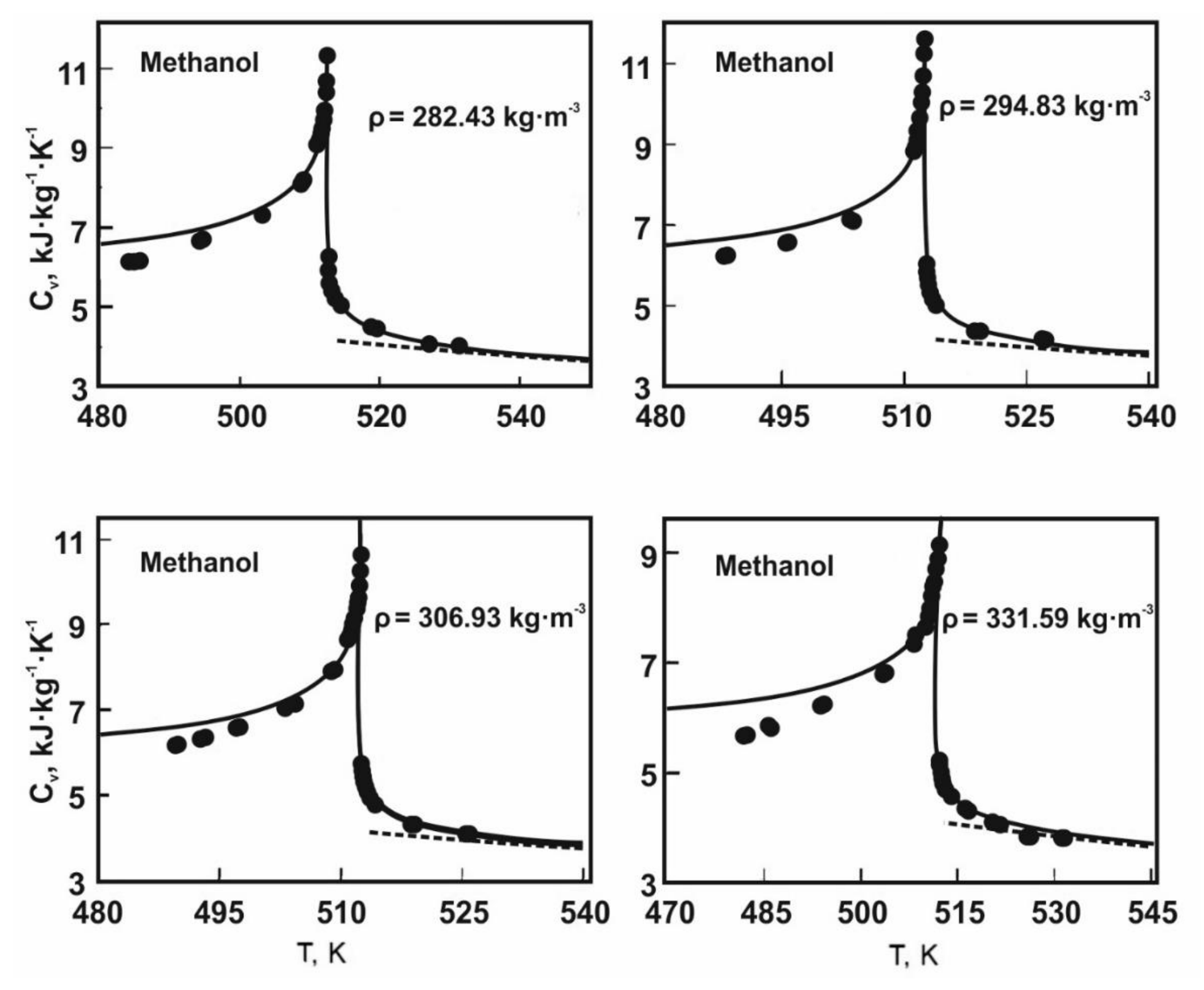
Figure 3.
Measured single- and two-phase isochoric heat capacities, (), of alcohols as a function of temperature along the critical isochores in the vicinity of the critical point, together with values calculated from the crossover EoS [21,64] (solid lines). Symbols represent the experimental data reported for methanol [8,21], ethanol [49], and butanol [62].
Figure 3.
Measured single- and two-phase isochoric heat capacities, (), of alcohols as a function of temperature along the critical isochores in the vicinity of the critical point, together with values calculated from the crossover EoS [21,64] (solid lines). Symbols represent the experimental data reported for methanol [8,21], ethanol [49], and butanol [62].
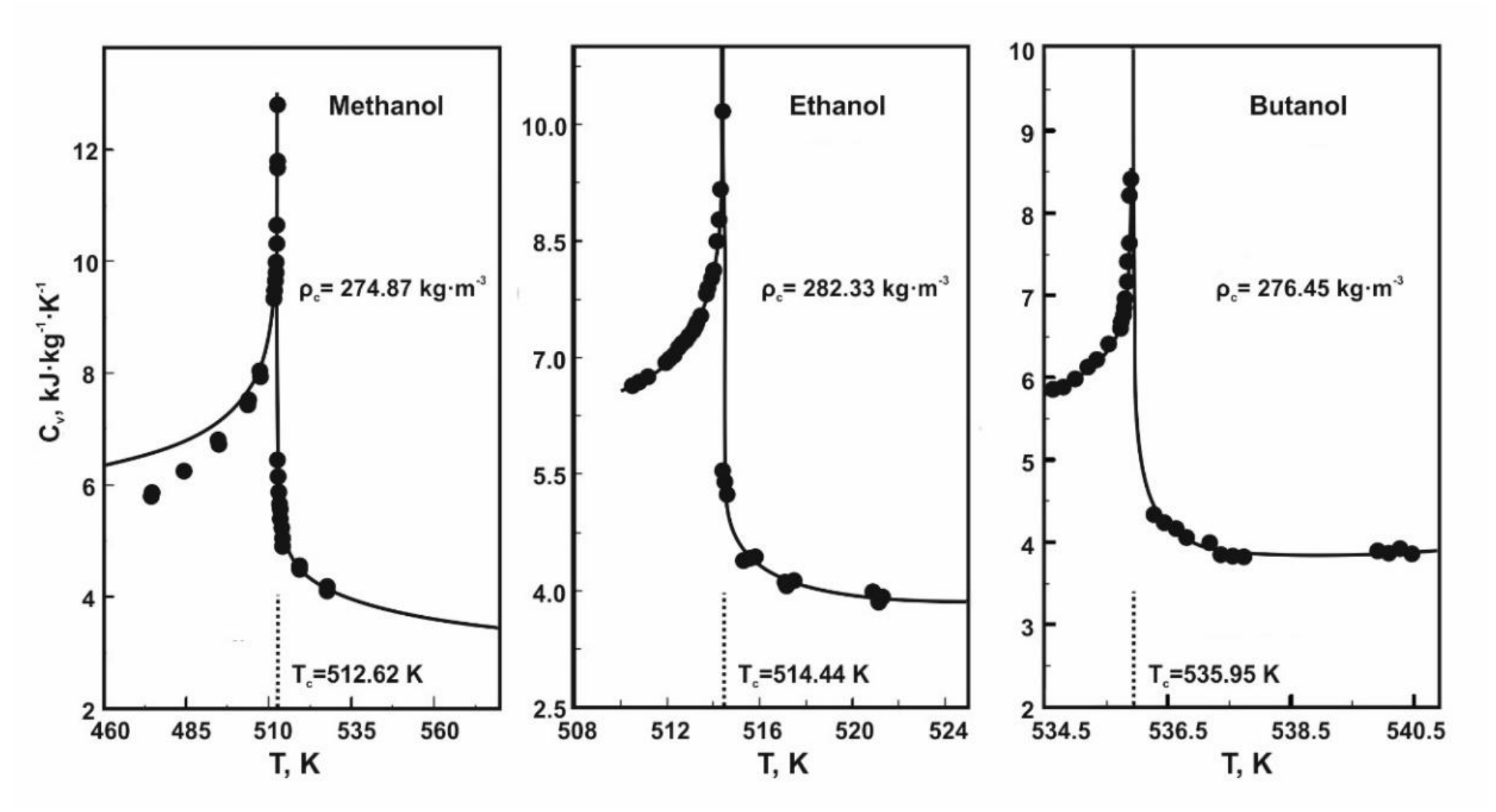
Figure 4.
Measured two- and single-phase isochoric heat capacity, (), of light water (left) and heavy water (right) as a function of temperature along the critical isochores in the vicinity of the critical point, together with values calculated from crossover models. Left (H2O, = 322.00 kg·m−3): symbols represent the experimental data: ●, Abdulagatov et al. [75]; ○, Amirkhanov et al. [57]. The solid line represents the parametric crossover EoS [61], while the dotted line corresponds to the classical (non-analytical) multiparameter reference EoS [27]. Right (D2O, = 356.08 kg·m−3): ●, Polikhronidi et al. [7,50,63]. The solid line represents the parametric crossover EoS [60], the dash-dotted line corresponds to the classical (analytical) multiparametric reference EoS [59], and the dashed line represents the crossover model based on the six-term Landau expansion by Wyczalkowska et al. [58].
Figure 4.
Measured two- and single-phase isochoric heat capacity, (), of light water (left) and heavy water (right) as a function of temperature along the critical isochores in the vicinity of the critical point, together with values calculated from crossover models. Left (H2O, = 322.00 kg·m−3): symbols represent the experimental data: ●, Abdulagatov et al. [75]; ○, Amirkhanov et al. [57]. The solid line represents the parametric crossover EoS [61], while the dotted line corresponds to the classical (non-analytical) multiparameter reference EoS [27]. Right (D2O, = 356.08 kg·m−3): ●, Polikhronidi et al. [7,50,63]. The solid line represents the parametric crossover EoS [60], the dash-dotted line corresponds to the classical (analytical) multiparametric reference EoS [59], and the dashed line represents the crossover model based on the six-term Landau expansion by Wyczalkowska et al. [58].
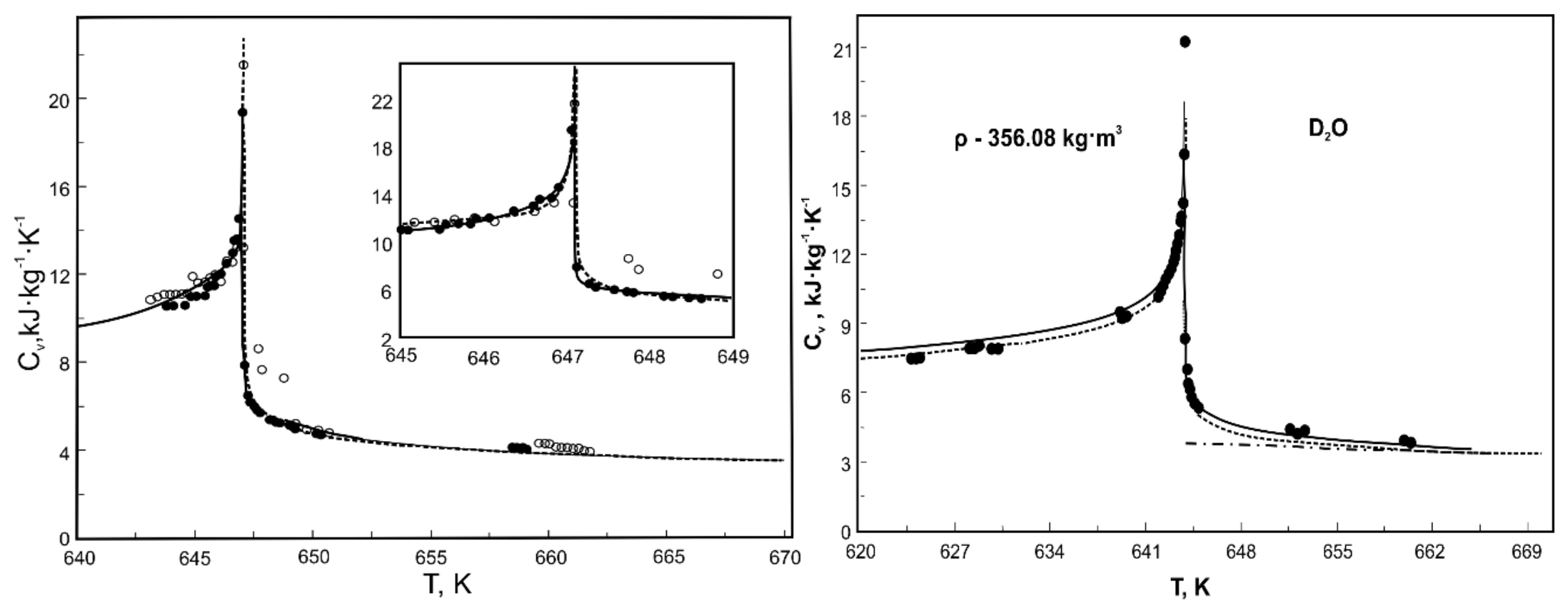
Figure 5.
Measured two- and single-phase isochoric heat capacity, (), of pure carbon dioxide (left) and benzene (right) as a function of temperature along the critical isochores in the vicinity of the critical point, together with values calculated from the parametric crossover models. Left (CO2, = 467.5 kg·m−3): symbols represent the experimental data: ●, Abdulagatov et al. [34,53]; ○, Adamov et al. [54]; △, Amirkhanov et al. [23,24]. The solid line represents the parametric crossover model EoS [55], while the dotted line corresponds to the reference multiparameter non-analytical fundamental EoS (NIST/REFPROP) [25]. Right (C6H6, near critical isochore,= 306.7 kg·m−3): symbols denote the experimental data [9] (open symbols –two-phase, full-single-phase); the solid line represents the parametric crossover model EoS [52], and the dotted line corresponds to the non-analytical reference EoS [25].
Figure 5.
Measured two- and single-phase isochoric heat capacity, (), of pure carbon dioxide (left) and benzene (right) as a function of temperature along the critical isochores in the vicinity of the critical point, together with values calculated from the parametric crossover models. Left (CO2, = 467.5 kg·m−3): symbols represent the experimental data: ●, Abdulagatov et al. [34,53]; ○, Adamov et al. [54]; △, Amirkhanov et al. [23,24]. The solid line represents the parametric crossover model EoS [55], while the dotted line corresponds to the reference multiparameter non-analytical fundamental EoS (NIST/REFPROP) [25]. Right (C6H6, near critical isochore,= 306.7 kg·m−3): symbols denote the experimental data [9] (open symbols –two-phase, full-single-phase); the solid line represents the parametric crossover model EoS [52], and the dotted line corresponds to the non-analytical reference EoS [25].
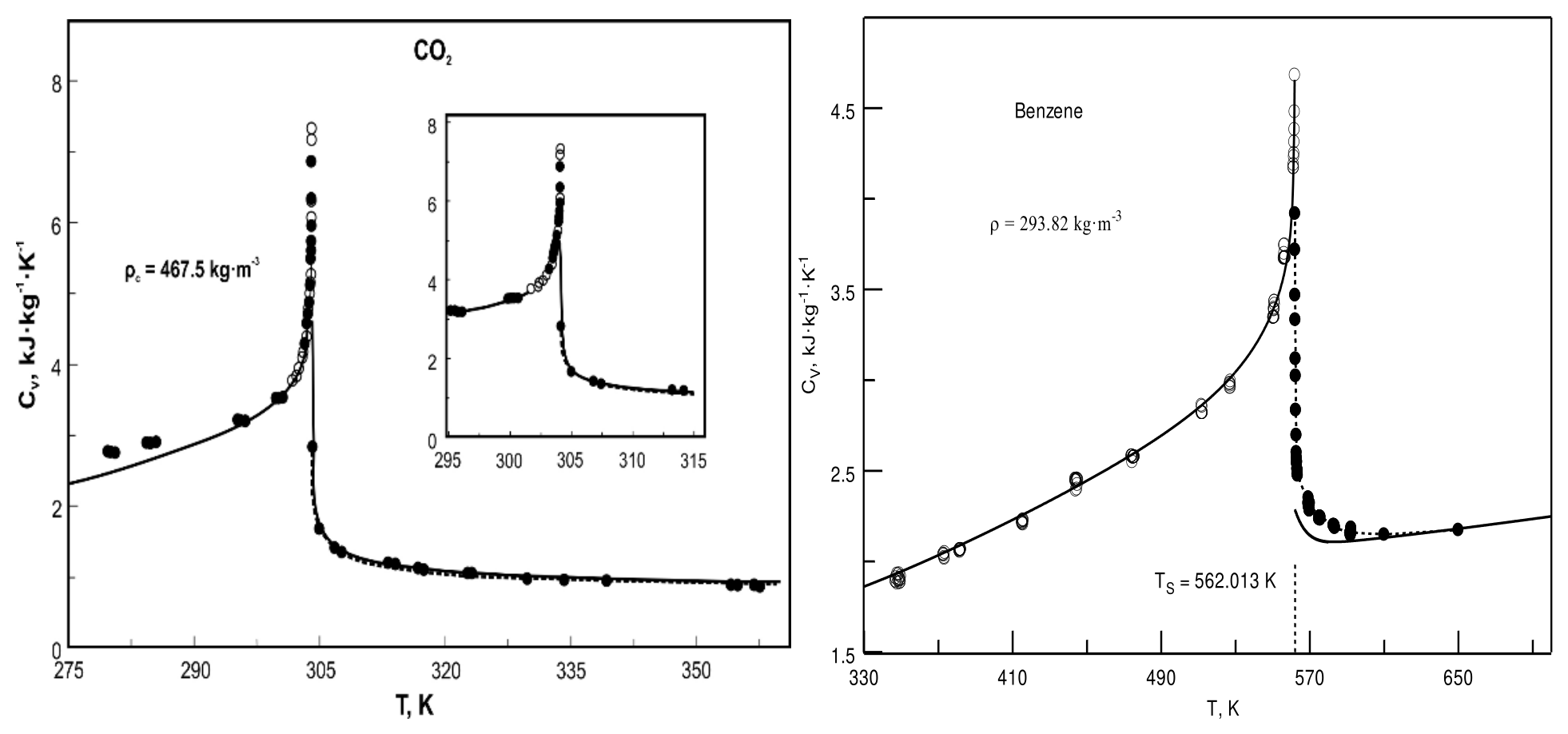
Figure 6.
Measured two- and single-phase isochoric heat capacity, (), of ethane (left) and propane (right) as a function of temperature along the critical isochore in the vicinity of the critical point, together with values calculated using the parametric crossover model. Left (C2H6, =205.0 kg·m−3): the solid line represents the parametric crossover model of Kiselev and Rainwater [69], while the dotted line corresponds to the multiparametric analytical reference EoS of Friend et al. [68]. Symbols: ○, Abdulagatov et al. [66]; ●, Shmakov et al. [65]. Right (C3H8, ( = 222.4 kg·m−3): the solid line represents the parametric crossover model [68], and the dotted line corresponds to the multiparametric analytical fundamental reference EoS [70]. Symbols denote the experimental data of Anisimov et al. [67].
Figure 6.
Measured two- and single-phase isochoric heat capacity, (), of ethane (left) and propane (right) as a function of temperature along the critical isochore in the vicinity of the critical point, together with values calculated using the parametric crossover model. Left (C2H6, =205.0 kg·m−3): the solid line represents the parametric crossover model of Kiselev and Rainwater [69], while the dotted line corresponds to the multiparametric analytical reference EoS of Friend et al. [68]. Symbols: ○, Abdulagatov et al. [66]; ●, Shmakov et al. [65]. Right (C3H8, ( = 222.4 kg·m−3): the solid line represents the parametric crossover model [68], and the dotted line corresponds to the multiparametric analytical fundamental reference EoS [70]. Symbols denote the experimental data of Anisimov et al. [67].
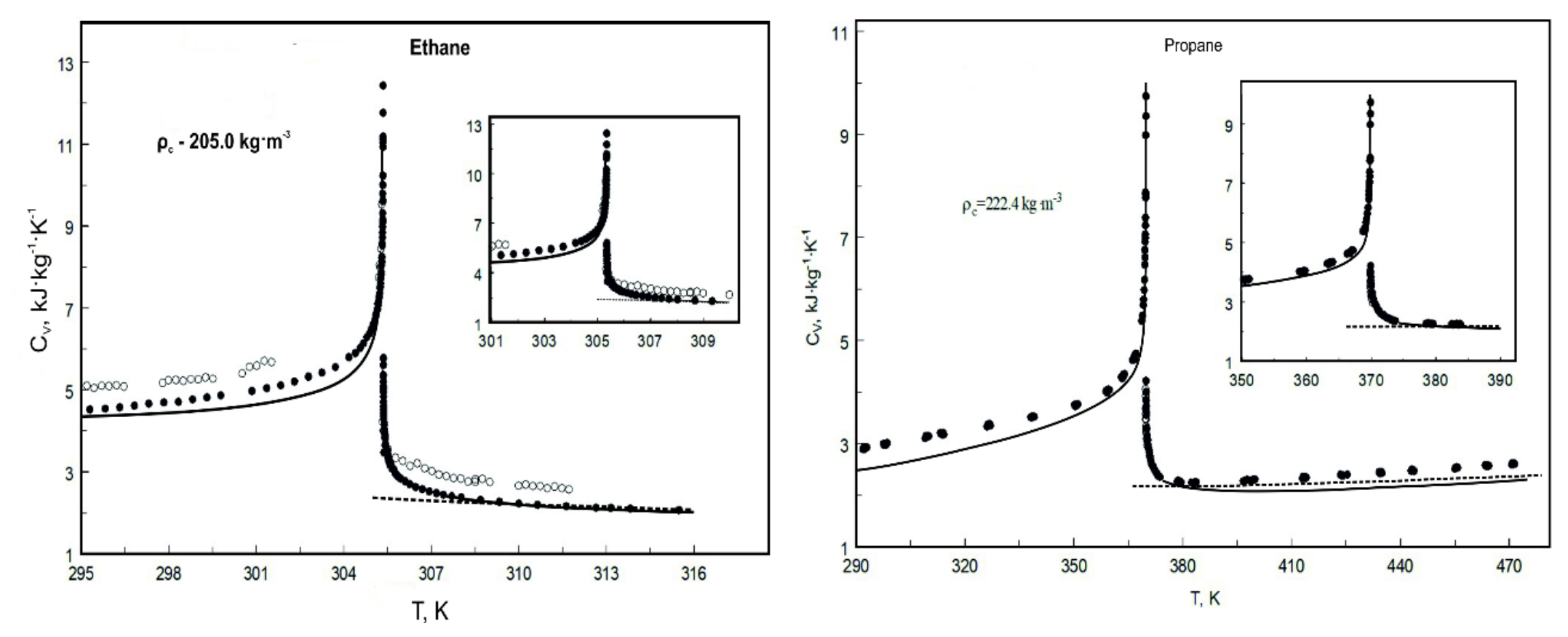
Figure 7.
Measured and calculated isochoric heat capacities of n-pentane and n-hexane along the critical isochores. Symbols: experimental data from Amirkhanov et al. [71]; solid lines: crossover model calculations [52].
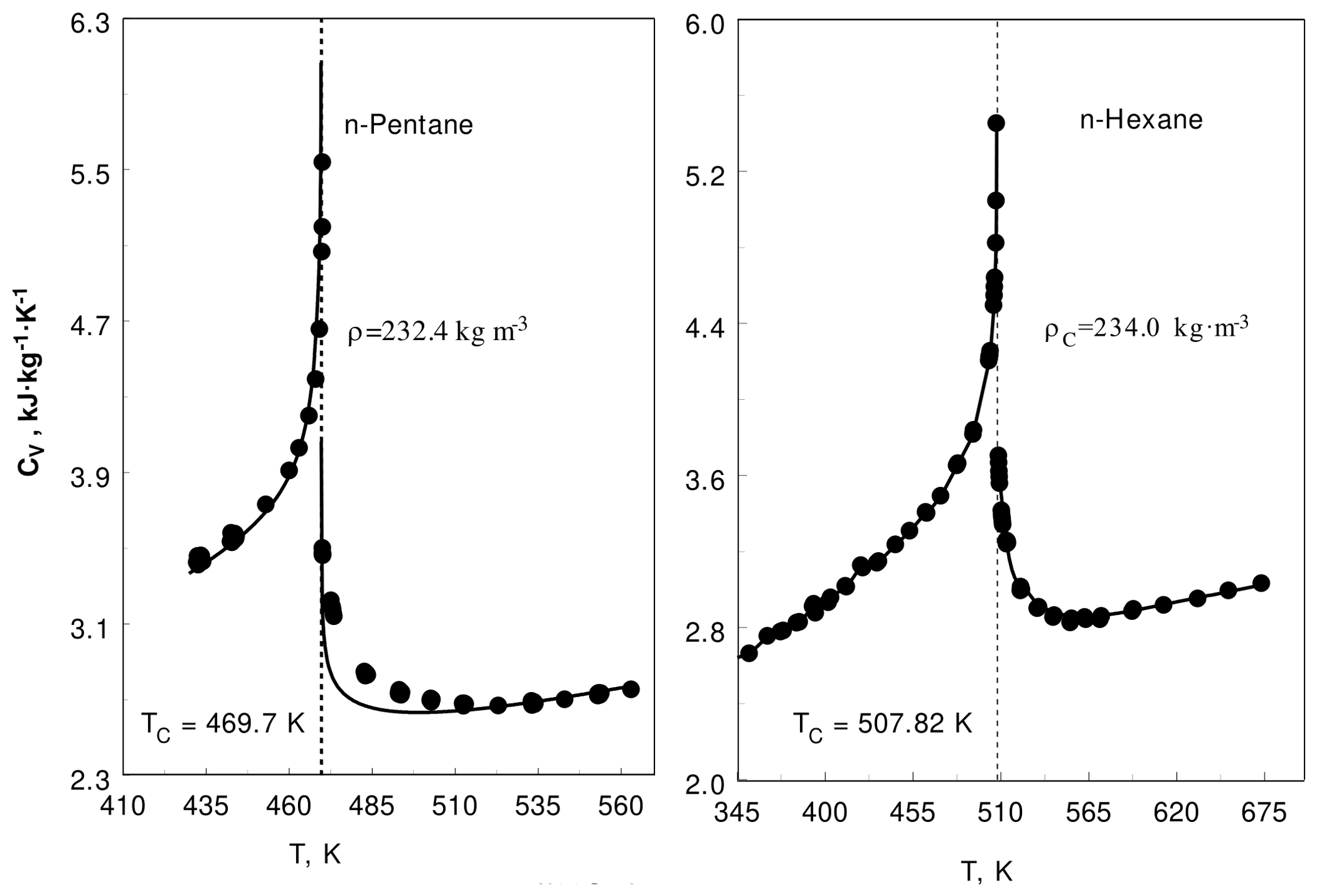
Figure 8.
Measured and calculated isochoric heat capacities of supercritical carbon dioxide as functions of density along selected supercritical isotherms. Symbols represent the experimental data of Amirkhanov et al. [23,24] and Abdulagatov et al. [34,53]. Solid lines denote calculations using the scaling-type crossover equation of state developed by Kiselev and Rainwater [55,69], while dotted lines represent calculations using the multiparameter fundamental reference equation of state of Span and Wagner [72,98] (see also NIST/REFPROP [25]).
Figure 8.
Measured and calculated isochoric heat capacities of supercritical carbon dioxide as functions of density along selected supercritical isotherms. Symbols represent the experimental data of Amirkhanov et al. [23,24] and Abdulagatov et al. [34,53]. Solid lines denote calculations using the scaling-type crossover equation of state developed by Kiselev and Rainwater [55,69], while dotted lines represent calculations using the multiparameter fundamental reference equation of state of Span and Wagner [72,98] (see also NIST/REFPROP [25]).
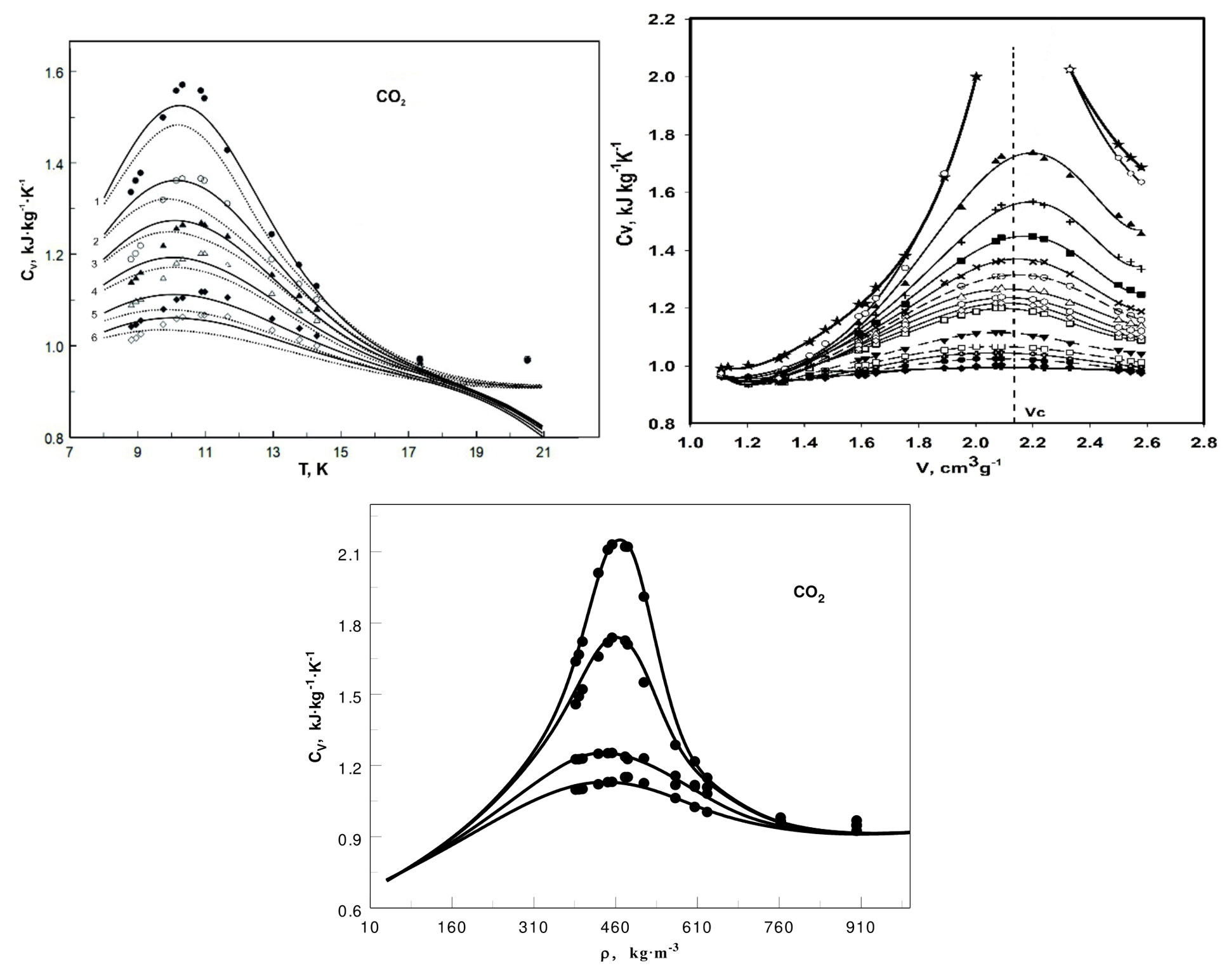
Figure 9.
Measured and calculated isochoric heat capacities of supercritical water as functions of density along selected supercritical isotherms. Left: Symbols represent the experimental data of Amirkhanov et al. [57]; solid lines denote calculations using the IAPWS fundamental EoS [27]. ▲, 660.7 K; ○, 651.69 K; ●, 648.00 K; ◆, 647.41 K. Right: Symbols represent the experimental data reported by Kerimov [73] and Abdulagatov et al. [74,75]; solid lines denote calculations using the IAPWS fundamental reference EoS [27], while dashed lines represent calculations using the scaling-type crossover EoS [61]. ▲, 651.99 K; ○, 649.75 K; ●, 648.40 K; ◆, 647.35 K; △, 661.89 K.
Figure 9.
Measured and calculated isochoric heat capacities of supercritical water as functions of density along selected supercritical isotherms. Left: Symbols represent the experimental data of Amirkhanov et al. [57]; solid lines denote calculations using the IAPWS fundamental EoS [27]. ▲, 660.7 K; ○, 651.69 K; ●, 648.00 K; ◆, 647.41 K. Right: Symbols represent the experimental data reported by Kerimov [73] and Abdulagatov et al. [74,75]; solid lines denote calculations using the IAPWS fundamental reference EoS [27], while dashed lines represent calculations using the scaling-type crossover EoS [61]. ▲, 651.99 K; ○, 649.75 K; ●, 648.40 K; ◆, 647.35 K; △, 661.89 K.
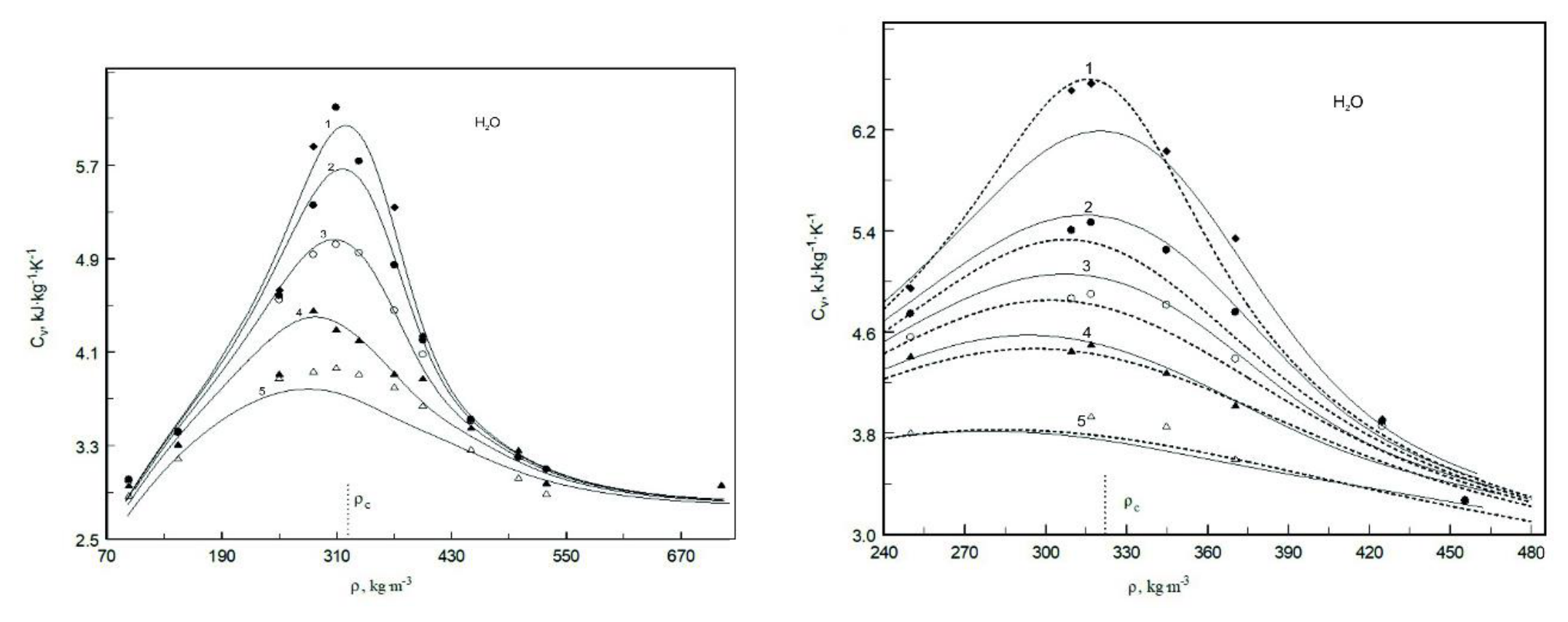
Figure 10.
Measured and calculated isochoric heat capacities of heavy water (left) and argon (right) as functions of density in the supercritical region along selected supercritical isotherms. Left: Symbols represent the experimental data of Polikhronidi et al. [7,50], solid lines denote calculations using the scaling-type crossover EoS [60], dotted line is the isothermal maximum loci (Widom line). ¯-650.37 K, ■-644.25 K, ∙-647.31 K, ▲ -652.94 K; Right: Symbols represent the experimental data of Voronel et al. [77,181], solid lines denote calculations using the multiparameter reference EoS of Tegeler et al. [76].
Figure 10.
Measured and calculated isochoric heat capacities of heavy water (left) and argon (right) as functions of density in the supercritical region along selected supercritical isotherms. Left: Symbols represent the experimental data of Polikhronidi et al. [7,50], solid lines denote calculations using the scaling-type crossover EoS [60], dotted line is the isothermal maximum loci (Widom line). ¯-650.37 K, ■-644.25 K, ∙-647.31 K, ▲ -652.94 K; Right: Symbols represent the experimental data of Voronel et al. [77,181], solid lines denote calculations using the multiparameter reference EoS of Tegeler et al. [76].
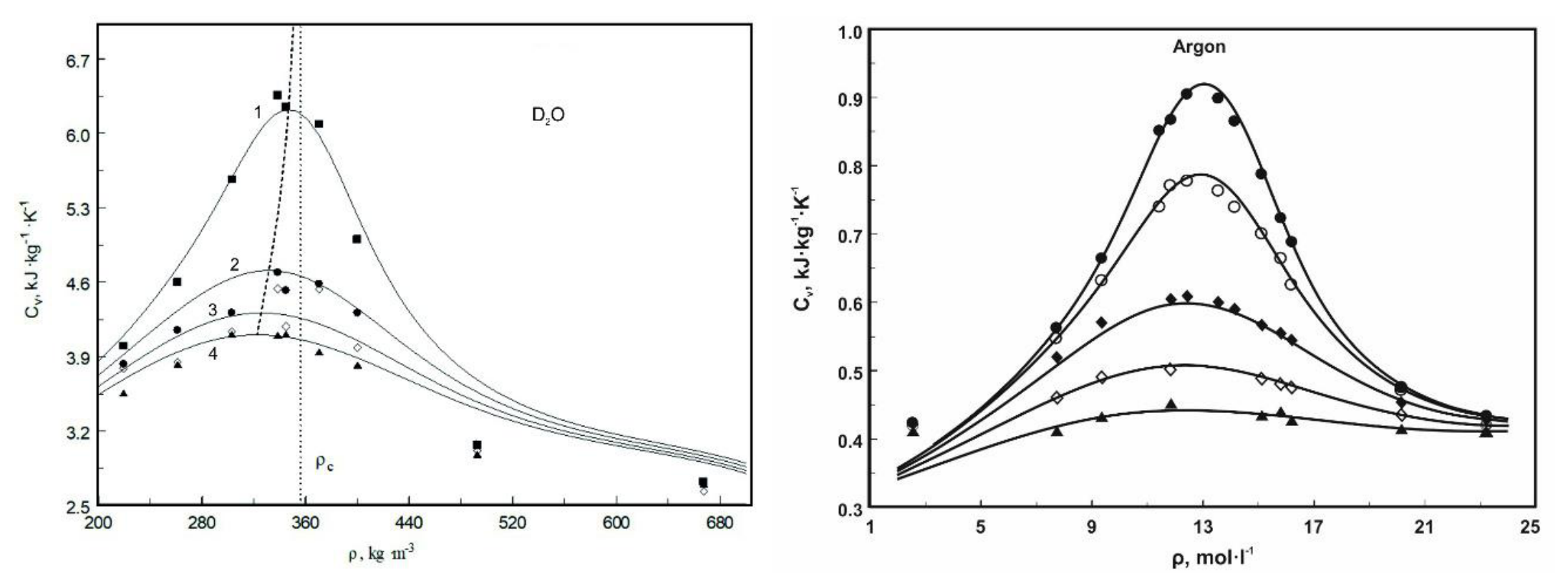
Figure 11.
Measured and calculated isochoric heat capacities of methanol (left) and 1-propanol (right) as functions of density in the supercritical region along selected supercritical isotherms. Left: Symbols represent the experimental data of Polikhronidi et al. [8]; solid lines denote calculations using the scaling-type crossover EoS [21]. Right: Symbols represent the experimental data reported in Ref. [22]; solid lines denote calculations using the scaling-type crossover SAFT EoS [78].
Figure 11.
Measured and calculated isochoric heat capacities of methanol (left) and 1-propanol (right) as functions of density in the supercritical region along selected supercritical isotherms. Left: Symbols represent the experimental data of Polikhronidi et al. [8]; solid lines denote calculations using the scaling-type crossover EoS [21]. Right: Symbols represent the experimental data reported in Ref. [22]; solid lines denote calculations using the scaling-type crossover SAFT EoS [78].
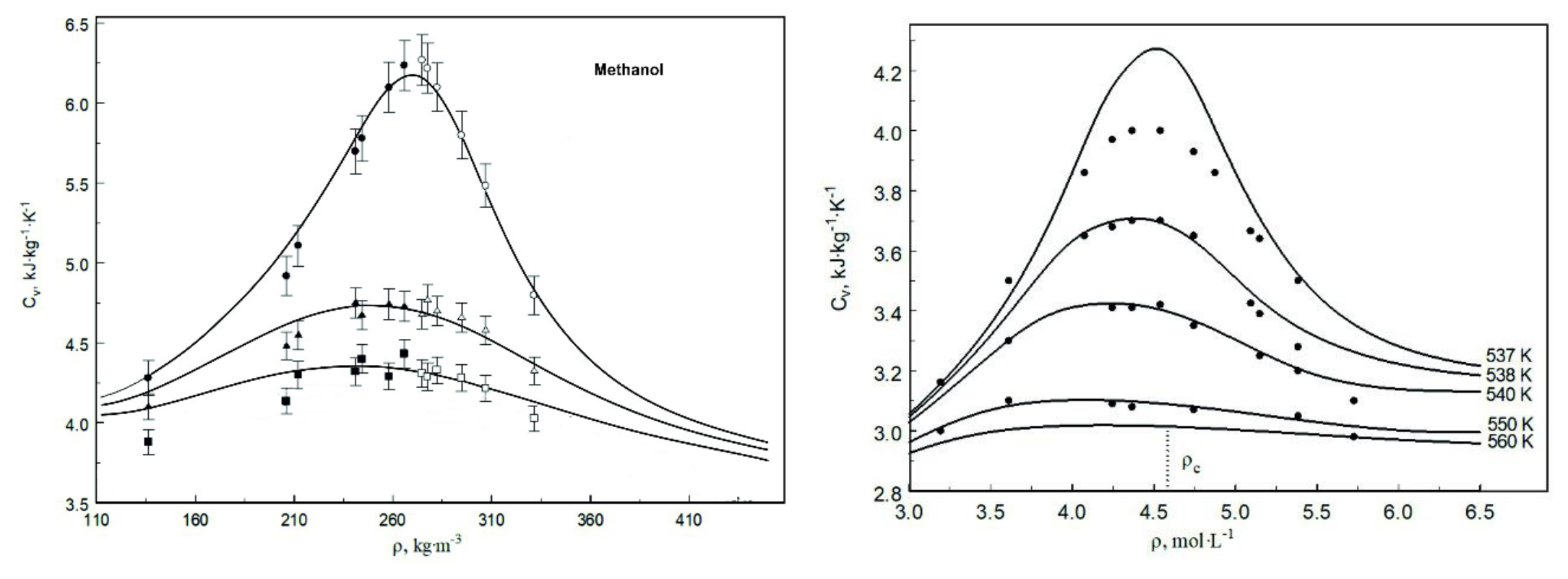
Figure 12.
Experimental and calculated loci of the isochoric heat-capacity maxima (Widom lines) for CO2 (left) and H2O (right) in the projection. Symbols represent the present experimental data (see Table 1). Left: The solid line is calculated from the complete scaling theory (see Equation (53), below), the dashed line from the crossover (scaling-type) EoS [55,69], and the dash-dotted line from the classical multiparameter nonanalytic EoS [25,98]. Right: The solid line is calculated from the IAPWS fundamental nonanalytic multiparameter EoS [27].
Figure 12.
Experimental and calculated loci of the isochoric heat-capacity maxima (Widom lines) for CO2 (left) and H2O (right) in the projection. Symbols represent the present experimental data (see Table 1). Left: The solid line is calculated from the complete scaling theory (see Equation (53), below), the dashed line from the crossover (scaling-type) EoS [55,69], and the dash-dotted line from the classical multiparameter nonanalytic EoS [25,98]. Right: The solid line is calculated from the IAPWS fundamental nonanalytic multiparameter EoS [27].
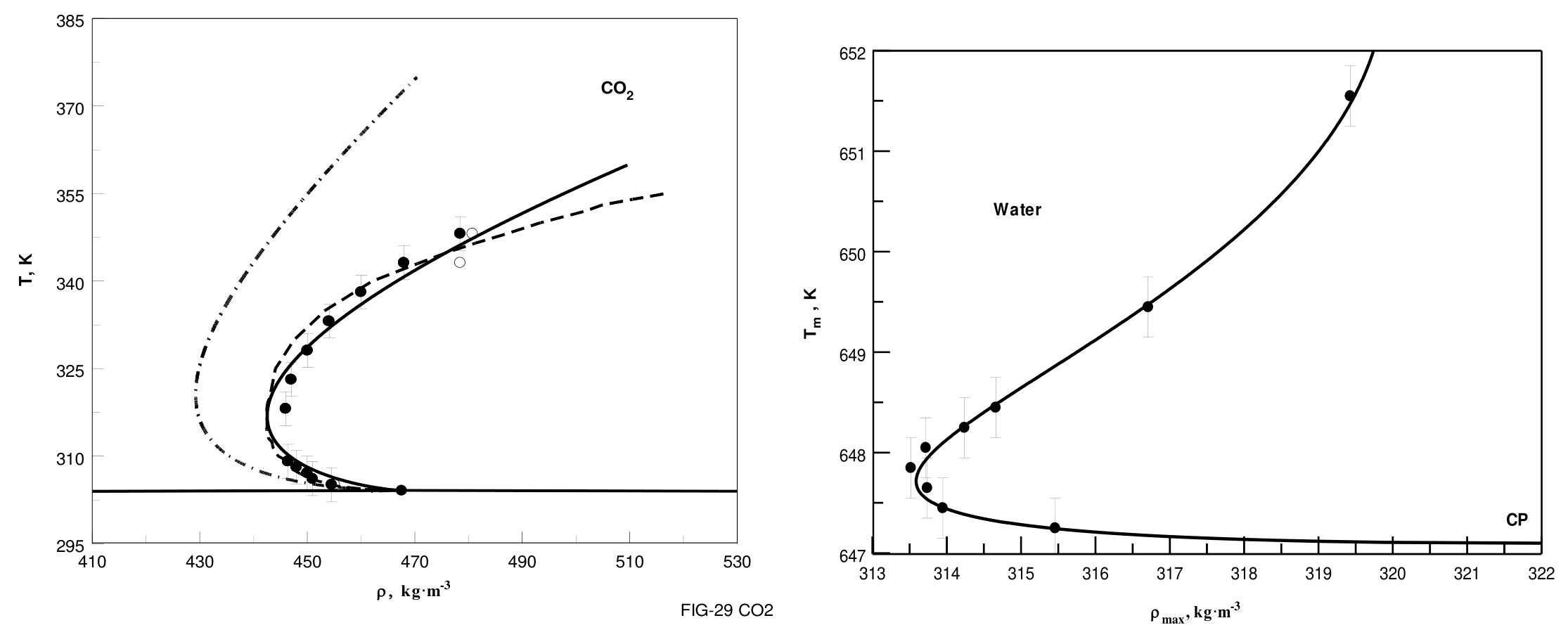
Figure 13.
Experimental and calculated loci of the isochoric heat-capacity maxima (Widom lines) for n-pentane (left) and benzene (right) in the projection. The maximum loci are calculated using the scaling-type correlation (Equation (53)) derived from the complete scaling theory (solid lines). Symbols represent the present experimental data (see Table 1).
Figure 13.
Experimental and calculated loci of the isochoric heat-capacity maxima (Widom lines) for n-pentane (left) and benzene (right) in the projection. The maximum loci are calculated using the scaling-type correlation (Equation (53)) derived from the complete scaling theory (solid lines). Symbols represent the present experimental data (see Table 1).
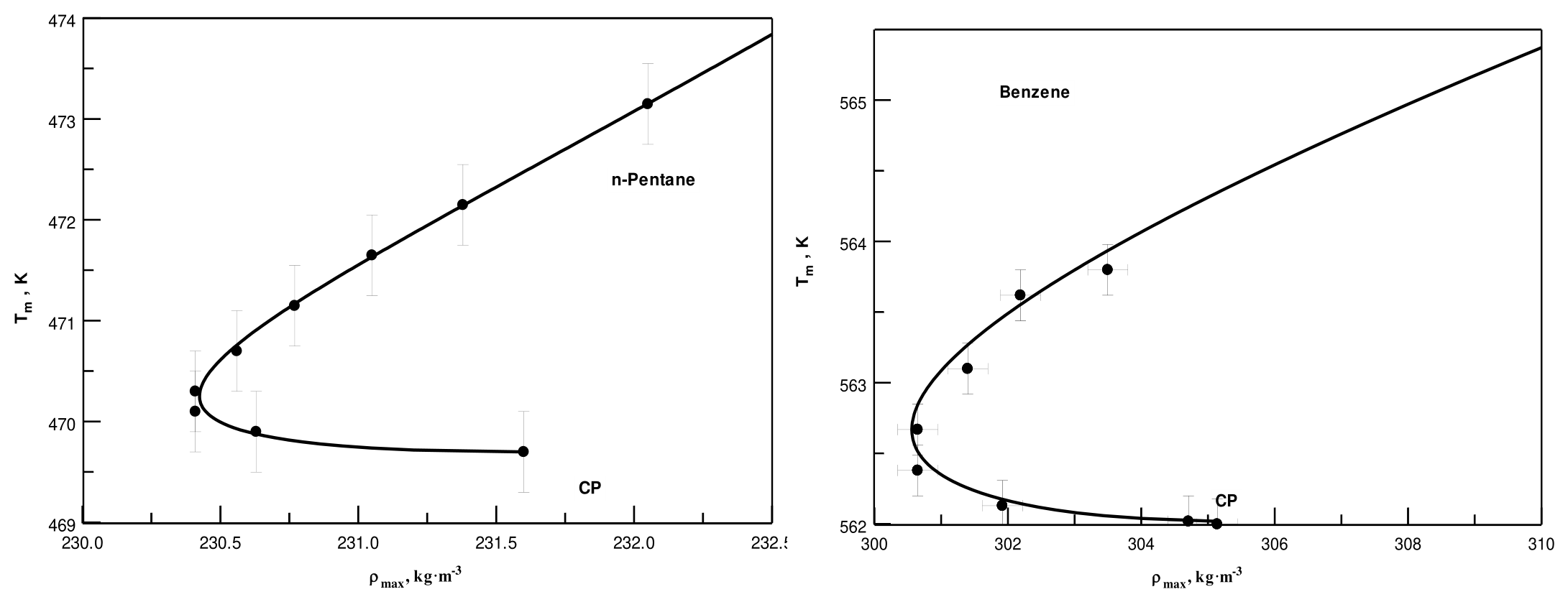
Figure 14.
Experimental and calculated loci of the isochoric heat-capacity maxima (Widom lines) for 1-propanol (left) and 2-propanol (right) in the projection. The maximum loci are calculated using the scaling-type correlation (Equation (51)) derived from the complete scaling theory (solid lines). Symbols represent the present experimental data (see Table 1).
Figure 14.
Experimental and calculated loci of the isochoric heat-capacity maxima (Widom lines) for 1-propanol (left) and 2-propanol (right) in the projection. The maximum loci are calculated using the scaling-type correlation (Equation (51)) derived from the complete scaling theory (solid lines). Symbols represent the present experimental data (see Table 1).
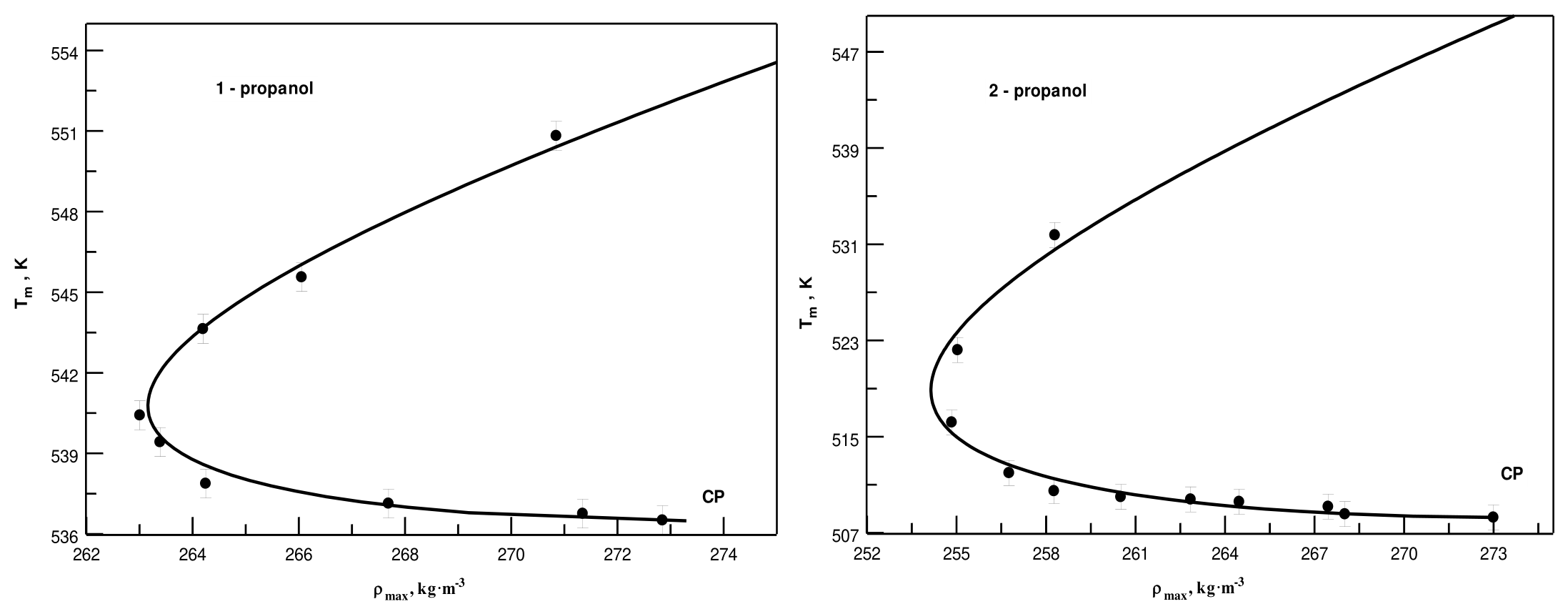
Figure 15.
Asymptotic behavior of the Widom line for CH4 and C3H8 predicted using the parametric crossover EoS [68] in the (left) and (right) projections. Solid curves represent the liquid–gas coexistence curve (left) and the vapor-pressure curve (right) calculated from the reference EoS (REFPROP [25]). Symbols represent experimental data [99,100,101].
Figure 15.
Asymptotic behavior of the Widom line for CH4 and C3H8 predicted using the parametric crossover EoS [68] in the (left) and (right) projections. Solid curves represent the liquid–gas coexistence curve (left) and the vapor-pressure curve (right) calculated from the reference EoS (REFPROP [25]). Symbols represent experimental data [99,100,101].
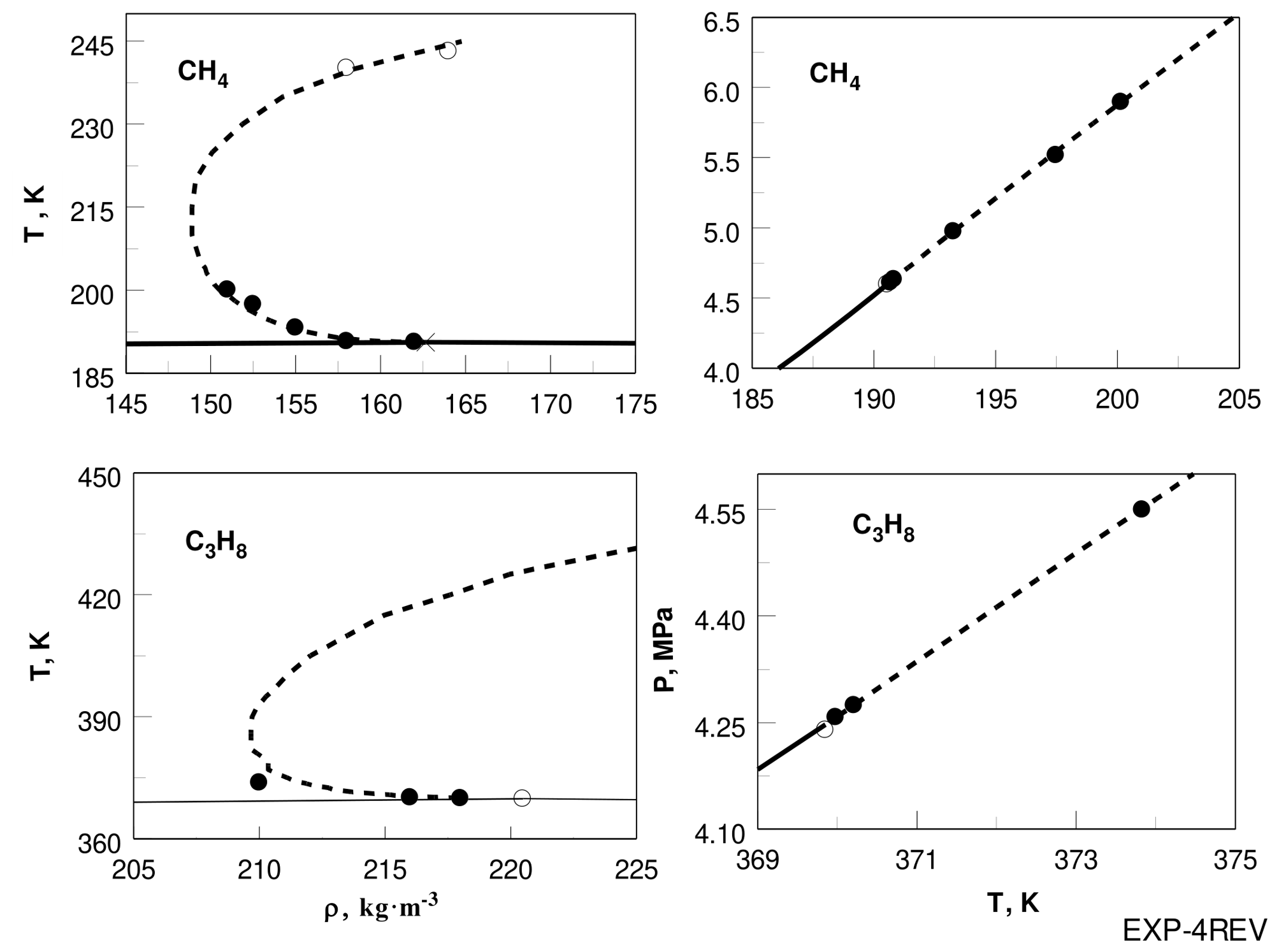
Figure 16.
and phase diagrams of supercritical carbon dioxide showing the Widom line, defined by the loci of the isochoric heat-capacity () maxima along supercritical isotherms, together with the loci of the () minima. The dashed lines delineate the Widom region, i.e., the supercritical quasi-two-phase (“liquid-like” + “gas-like”) region in which the contribution of critical fluctuations to the thermodynamic properties is significant, within the specified range, . The transition from “liquid-like” to “gas-like” behavior occurs continuously upon crossing the Widom line (red dotted line). The solid curves represent the liquid–vapor coexistence curve in the diagram (left) and the vapor-pressure (coexistence) curve in the diagram (right), calculated using the reference EoS [25]. AB denotes the locus of the () minima along supercritical isotherms, whereas CA represents the locus of the isochoric heat-capacity maxima (Widom line).
Figure 16.
and phase diagrams of supercritical carbon dioxide showing the Widom line, defined by the loci of the isochoric heat-capacity () maxima along supercritical isotherms, together with the loci of the () minima. The dashed lines delineate the Widom region, i.e., the supercritical quasi-two-phase (“liquid-like” + “gas-like”) region in which the contribution of critical fluctuations to the thermodynamic properties is significant, within the specified range, . The transition from “liquid-like” to “gas-like” behavior occurs continuously upon crossing the Widom line (red dotted line). The solid curves represent the liquid–vapor coexistence curve in the diagram (left) and the vapor-pressure (coexistence) curve in the diagram (right), calculated using the reference EoS [25]. AB denotes the locus of the () minima along supercritical isotherms, whereas CA represents the locus of the isochoric heat-capacity maxima (Widom line).
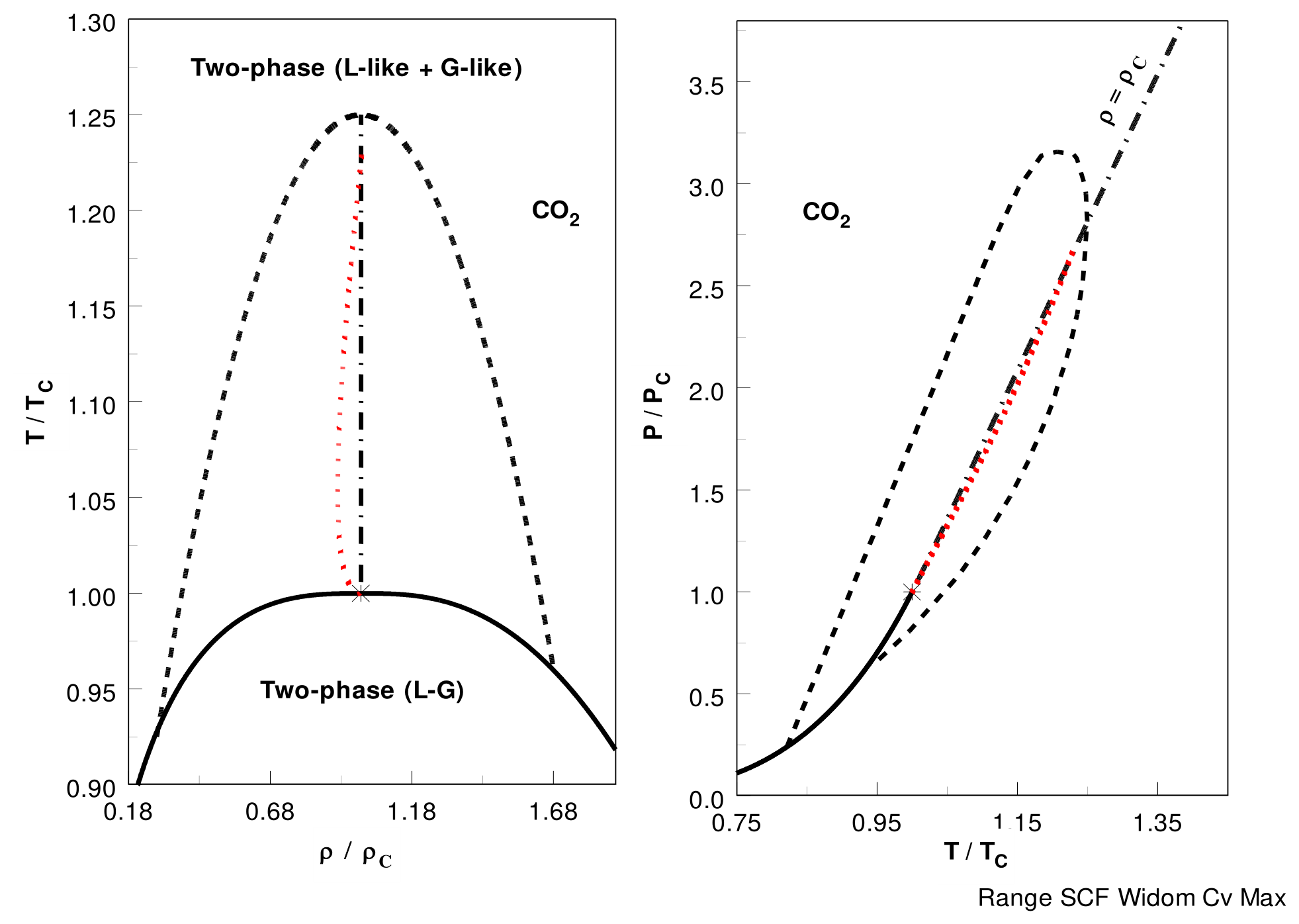
Figure 17.
phase diagrams of CO2 (left) and H2O (right) calculated using the crossover scaling EoS. CA represents the locus of the isochoric heat-capacity maxima (Widom line), whereas line AB denotes the locus of the () minima along supercritical isotherms, where . Along line AB, the second derivative of pressure with respect to temperature at constant density vanishes, =0, corresponding to the inflection points of the supercritical isochores.
Figure 17.
phase diagrams of CO2 (left) and H2O (right) calculated using the crossover scaling EoS. CA represents the locus of the isochoric heat-capacity maxima (Widom line), whereas line AB denotes the locus of the () minima along supercritical isotherms, where . Along line AB, the second derivative of pressure with respect to temperature at constant density vanishes, =0, corresponding to the inflection points of the supercritical isochores.
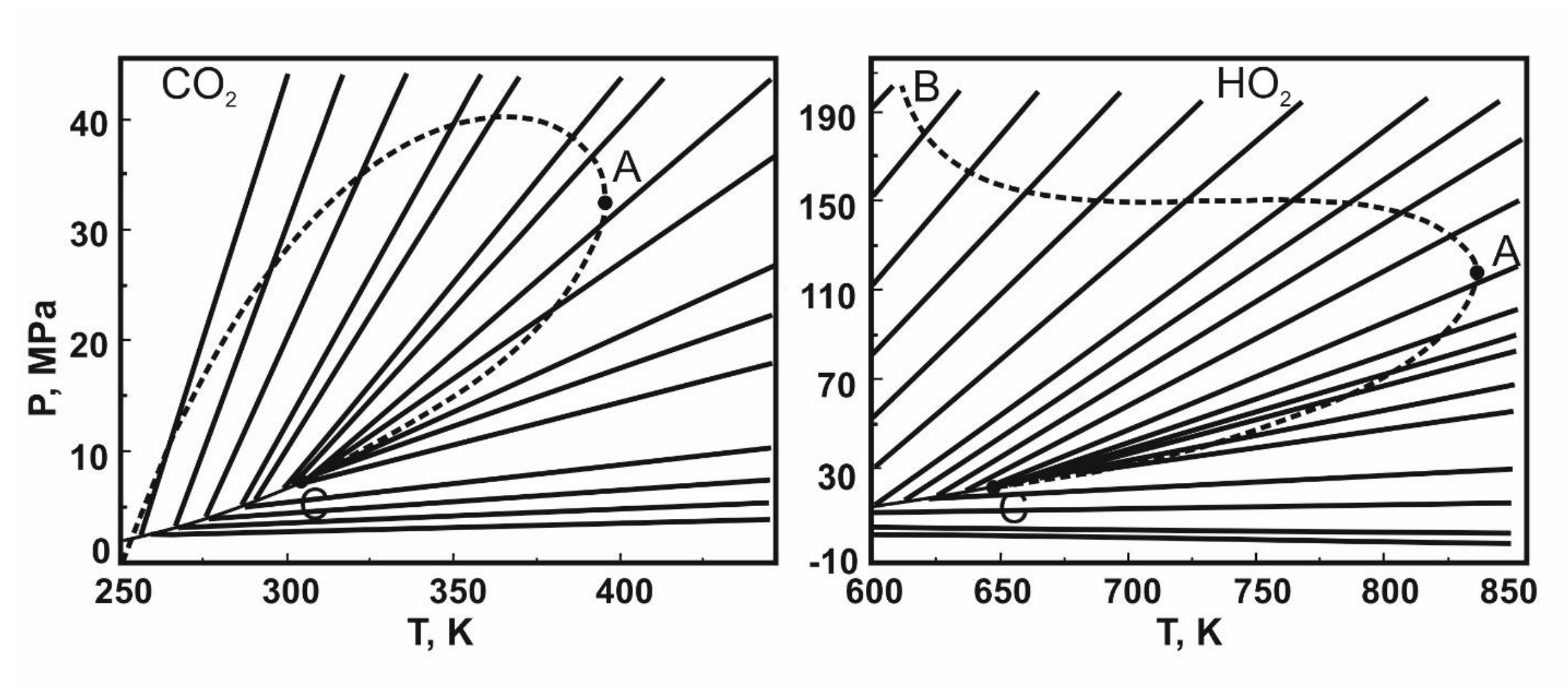
Figure 18.
Second temperature derivative of pressure, , for water along supercritical isotherms as a function of density. Solid lines are calculated from the crossover EoS [61]. Symbols represent values derived from experimental measurements [57,73,74,75].
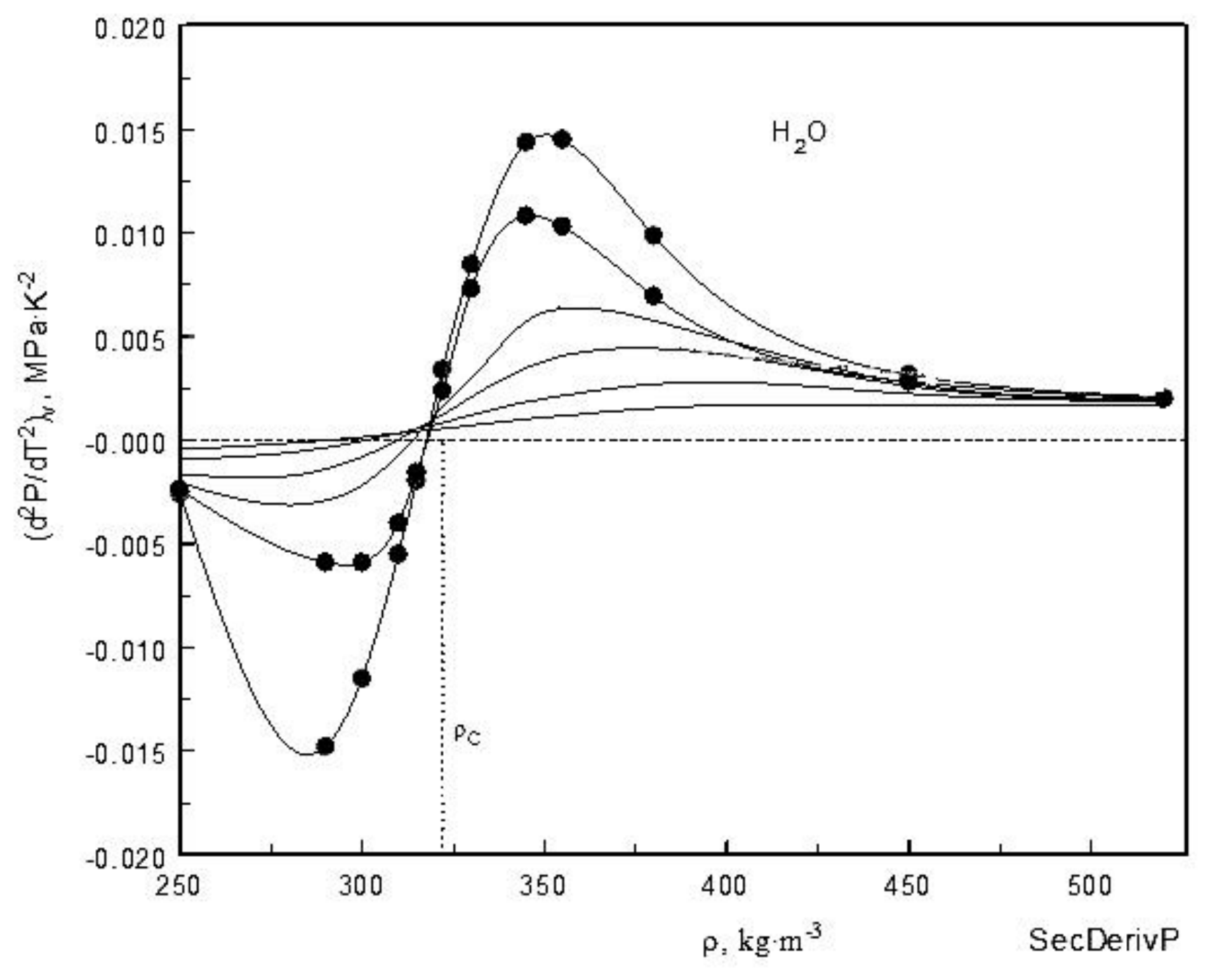
Figure 19.
Density derivative of the isochoric heat capacity, =, along the critical isotherm of CO2, ( = 304.13) K, in the vicinity of the critical density, as calculated using the crossover (scaling-type) EoS [55,69].
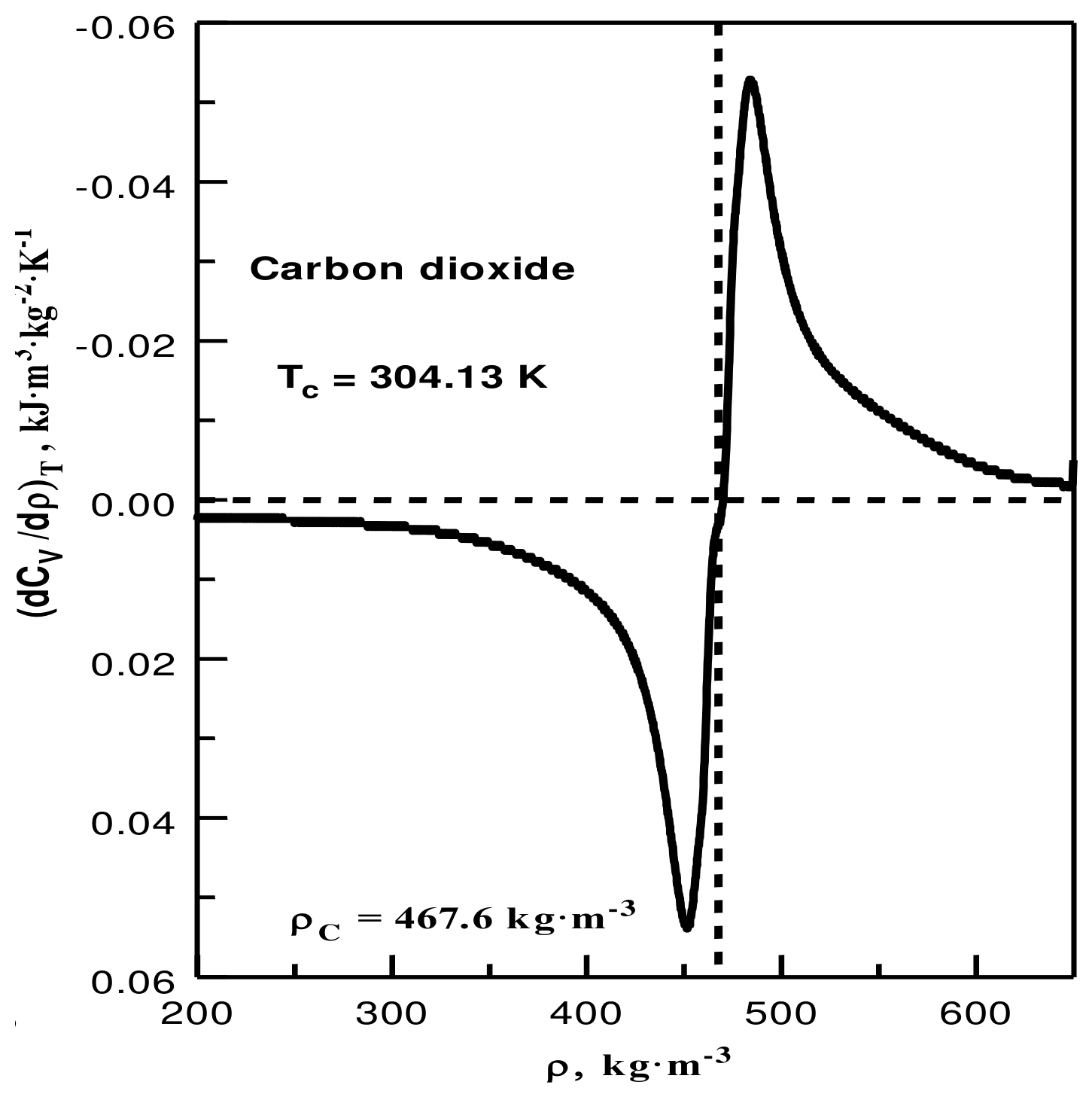
Figure 20.
Isochoric heat capacity maxima curve for light (left) and heavy (right) water in the supercritical region calculated using multiparameter analytical EoS (IAPWS) [27,59].
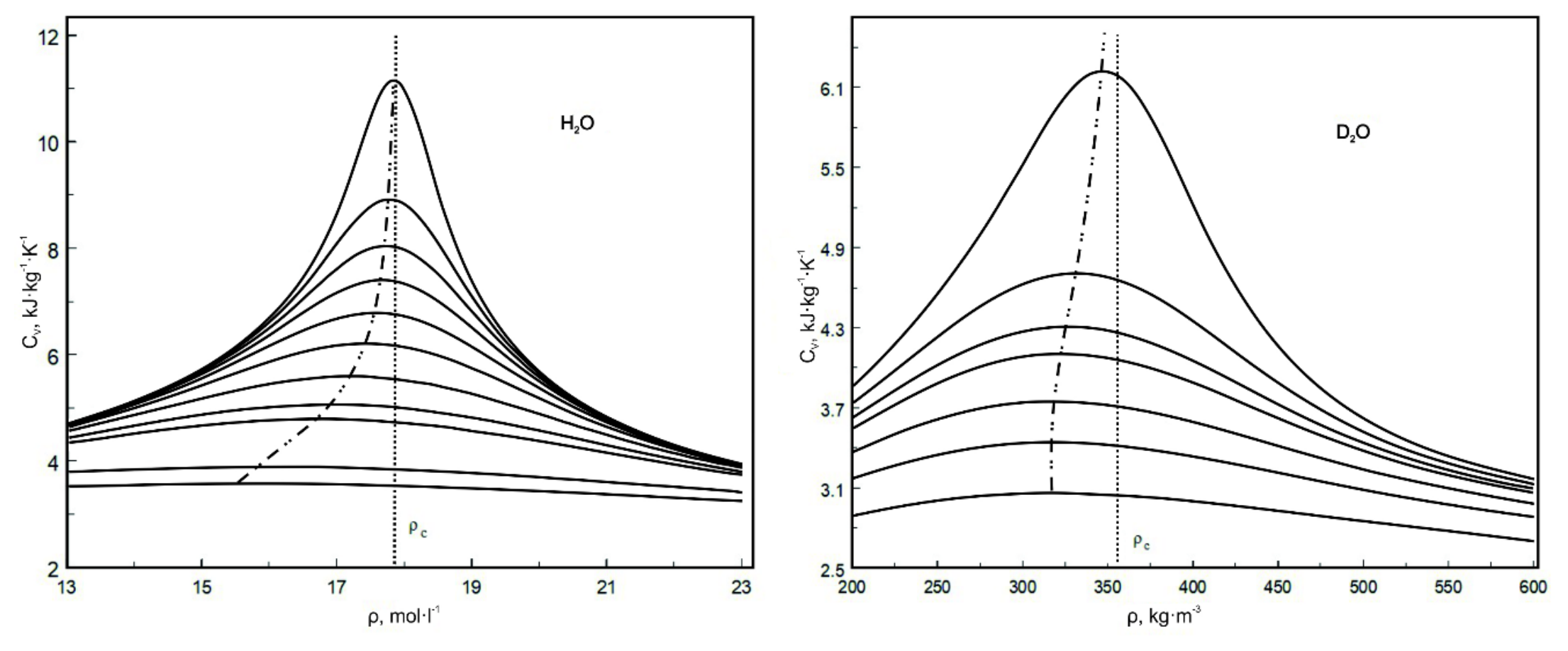
Figure 21.
Isochoric heat capacity maxima curve for CO2 (left) and CH4 (right) in the supercritical region calculated using multiparameter non-analytical reference EoS [72,98,116]. Dashed-dotted lines are the maximum curves.
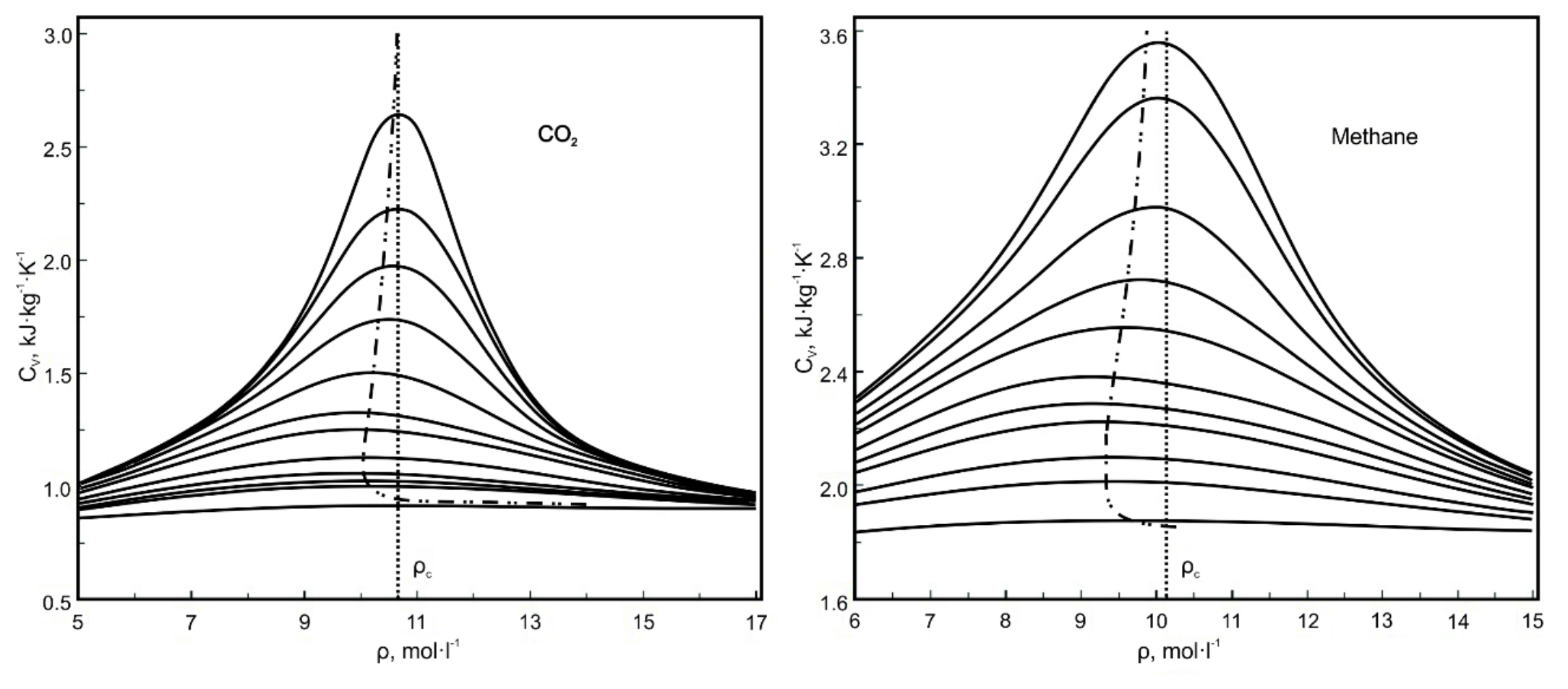
Figure 22.
Isochoric heat capacity maxima curves of supercritical n-butane and ammonia calculated using the crossover (scaling-type) and analytical multiparametric reference EoS in and projections. C—critical point; solid lines denote the coexistence and vapor-pressure curves [25]; dashed lines represent the isothermalmaxima curves calculated from the crossover (scaling-type) EoS [137,138]; dotted lines represent the corresponding curves calculated from the multiparameter analytical reference EoS [70,135,136].
Figure 22.
Isochoric heat capacity maxima curves of supercritical n-butane and ammonia calculated using the crossover (scaling-type) and analytical multiparametric reference EoS in and projections. C—critical point; solid lines denote the coexistence and vapor-pressure curves [25]; dashed lines represent the isothermalmaxima curves calculated from the crossover (scaling-type) EoS [137,138]; dotted lines represent the corresponding curves calculated from the multiparameter analytical reference EoS [70,135,136].
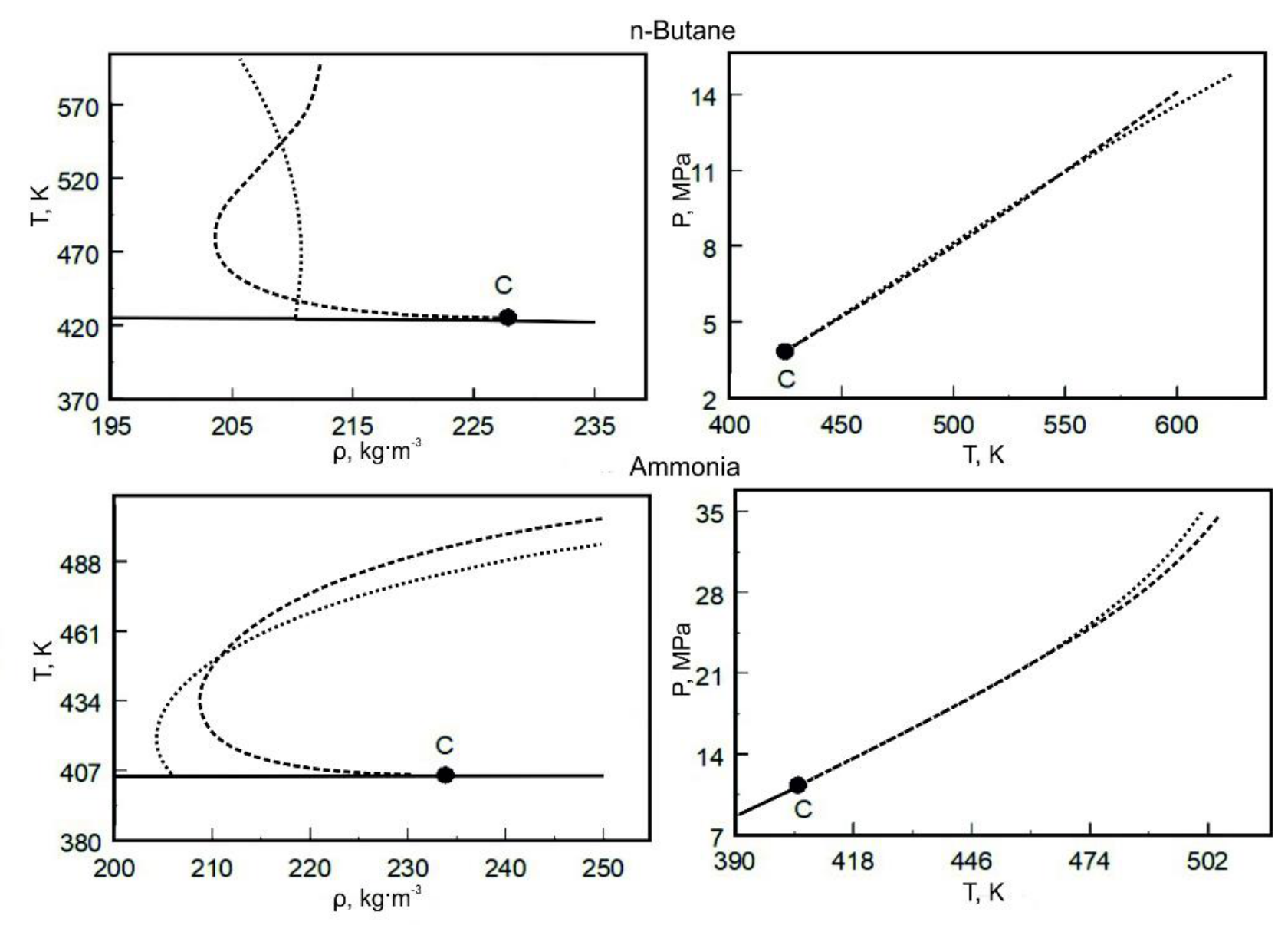
Figure 23.
Regions in the reduced density, temperature, and pressure diagrams where the effect of fluctuations on the thermodynamic properties of supercritical fluids is significant.
Figure 23.
Regions in the reduced density, temperature, and pressure diagrams where the effect of fluctuations on the thermodynamic properties of supercritical fluids is significant.
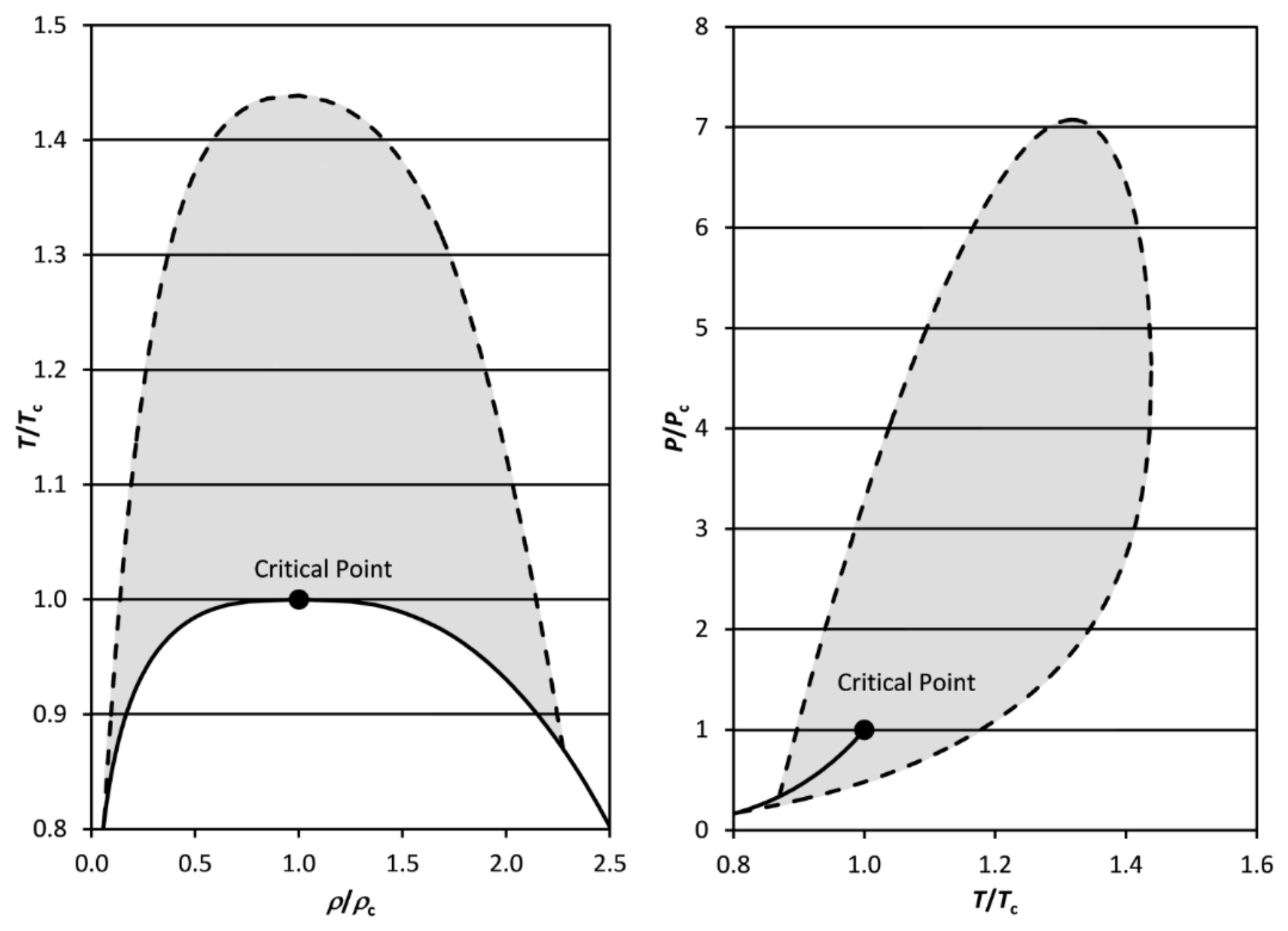
Figure 24.
Range of applicability of the crossover model for CO2 in the reduced density–temperature and pressure–temperature diagrams.
Figure 24.
Range of applicability of the crossover model for CO2 in the reduced density–temperature and pressure–temperature diagrams.
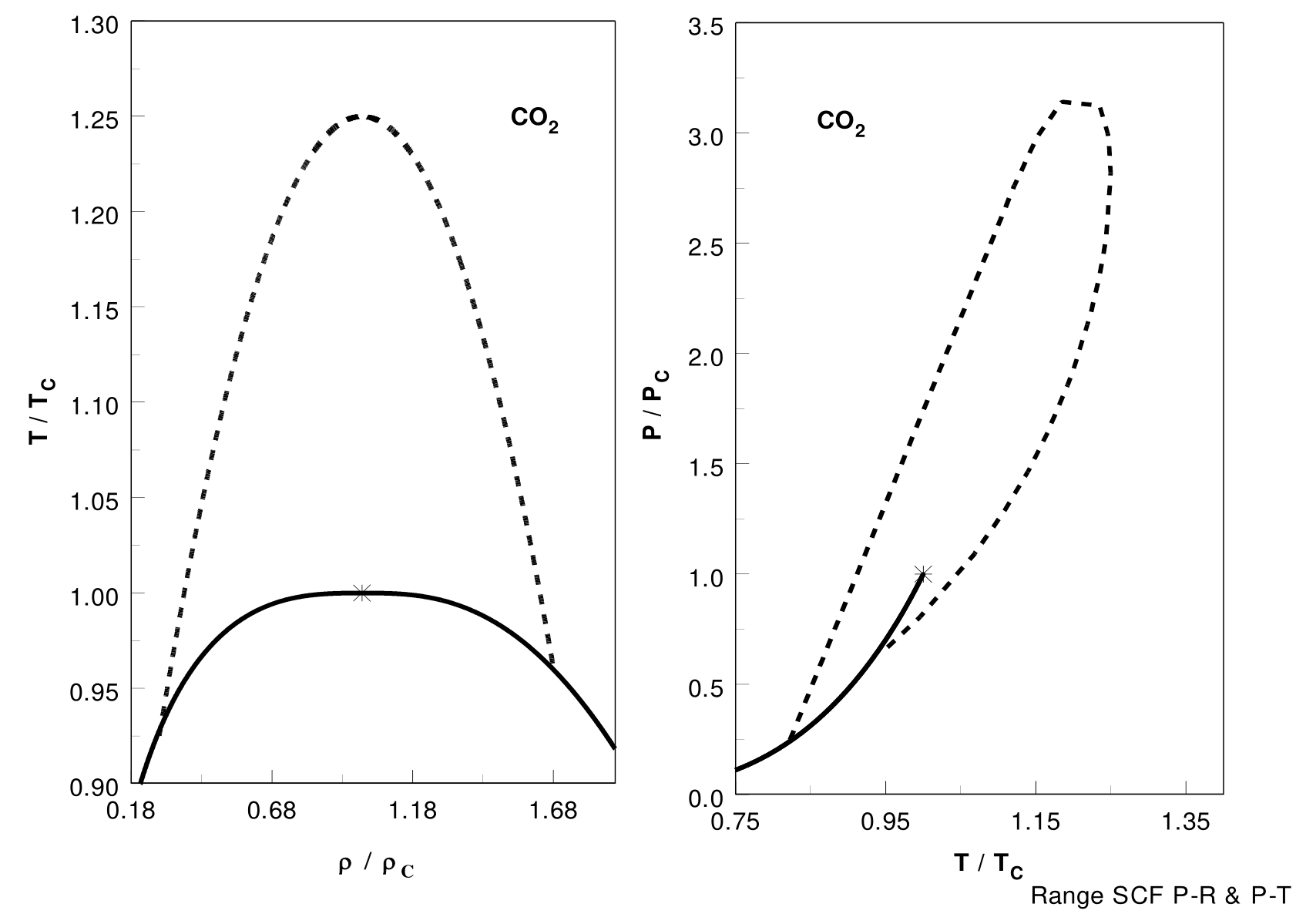

Table 1.
Experimental temperatures, densities, and pressures along the Widom line defined by the maxima of the isochoric heat capacity, (), for selected supercritical fluids.
Table 1.
Experimental temperatures, densities, and pressures along the Widom line defined by the maxima of the isochoric heat capacity, (), for selected supercritical fluids.
| T, K | ρ, kg⋅m-3 | P, MPa | T, K | ρ, kg⋅m-3 | P, MPa |
| Carbon dioxide | Water | ||||
| 305.15 | 454.55 | 7.548 | 647.25 | 315.46 | 22.11 |
| 306.15 | 451.00 | 7.712 | 647.45 | 313.95 | 22.16 |
| 307.15 | 450.00 | 7.877 | 647.65 | 313.74 | 22.21 |
| 308.15 | 448.00 | 8.040 | 647.85 | 313.52 | 22.26 |
| 309.15 | 446.43 | 8.202 | 648.05 | 313.72 | 22.32 |
| 318.15 | 446.02 | 9.681 | 648.25 | 314.24 | 22.37 |
| 323.15 | 447.07 | 10.51 | 648.45 | 314.66 | 22.42 |
| 328.15 | 450.11 | 11.37 | 649.45 | 316.71 | 22.69 |
| 333.15 | 454.13 | 12.26 | 651.55 | 319.43 | 23.25 |
| 338.15 | 460.06 | 13.20 | - | - | - |
| 343.15 | 468.01 | 14.22 | - | - | - |
| 348.15 | 478.47 | 15.34 | - | - | - |
| n-Hexane | n-Pentane | ||||
| 507.70 | 234.08 | 3.039 | 469.70 | 231.60 | 3.367 |
| 507.90 | 232.55 | 3.048 | 469.90 | 230.63 | 3.378 |
| 508.10 | 232.50 | 3.057 | 470.10 | 230.41 | 3.388 |
| 508.30 | 232.45 | 3.066 | 470.30 | 230.41 | 3.399 |
| 508.50 | 232.37 | 3.075 | 470.70 | 230.56 | 3.420 |
| 508.70 | 232.30 | 3.084 | 471.15 | 230.77 | 3.444 |
| 508.90 | 232.30 | 3.093 | 471.65 | 231.05 | 3.470 |
| 509.10 | 232.31 | 3.103 | 472.15 | 231.38 | 3.496 |
| 509.60 | 232.34 | 3.126 | 473.15 | 232.05 | 3.550 |
| 513.83 | 232.83 | 3.320 | 483.15 | 233.54 | 4.084 |
| 522.97 | 234.23 | 3.747 | - | - | - |
| 533.15 | 235.02 | 4.229 | - | - | - |
| Benzene | DEE | ||||
| 562.00 | 305.14 | 4.906 | 467.00 | 265.10 | 3.664 |
| 562.13 | 301.92 | 4.914 | 468.00 | 263.71 | 3.723 |
| 562.38 | 300.65 | 4.929 | 468.50 | 263.65 | 3.753 |
| 562.67 | 300.65 | 4.947 | 471.00 | 263.55 | 3.900 |
| 563.10 | 301.40 | 4.974 | 480.00 | 264.20 | 4.435 |
| 563.62 | 302.19 | 5.006 | 505.00 | 265.67 | 5.949 |
| 563.80 | 303.50 | 5.017 | |||
| Ethanol | 1-Propanol | ||||
| 514.44 | 283.70 | 6.237 | 536.52 | 272.85 | |
| 515.06 | 276.00 | 6.308 | 536.76 | 271.35 | |
| 516.30 | 272.52 | 6.450 | 537.14 | 267.69 | |
| 519.02 | 269.30 | 6.755 | 537.88 | 264.25 | |
| 521.90 | 267.80 | 7.076 | 539.43 | 263.39 | |
| 524.50 | 267.00 | 7.365 | 540.42 | 263.01 | |
| 529.30 | 267.51 | 7.902 | 543.64 | 264.20 | |
| 532.10 | 268.53 | 8.220 | 545.57 | 266.06 | |
| 540.33 | 275.05 | 9.200 | 550.83 | 270.85 | |
| 545.07 | 280.11 | 9.801 | |||
| 2-Propanol | |||||
| 508.57 | 268.02 | ||||
| 509.20 | 267.46 | ||||
| 509.60 | 264.48 | ||||
| 509.80 | 262.85 | ||||
| 510.00 | 260.51 | ||||
| 510.50 | 258.27 | ||||
| 512.00 | 254.76 | ||||
| 516.20 | 254.84 | ||||
| 522.22 | 255.04 | ||||
| 531.78 | 258.30 | ||||
Table 2.
Optimized fitting parameters of the complete-scaling theory, Equation (53), for the Widom line in various molecular fluids.
Table 2.
Optimized fitting parameters of the complete-scaling theory, Equation (53), for the Widom line in various molecular fluids.
| Fluid | , K | , kg⋅m-3 | |||
| CO2 | 304.13 | 467.60 | -8.498413 | 10.596703 | 0.248826 |
| Benzene | 562.03 | 305.14 | -3.408221 | 2.705480 | 18.542782 |
| n-Pentane | 469.70 | 231.60 | -2.306077 | 18.821139 | -18.671410 |
| 1-propanol | 536.50 | 273.30 | -3.242795 | 7.944360 | -0.487894 |
| 2-propanol | 508.30 | 273.00 | -3.570110 | 9.140768 | -3.360799 |
| DEE | 466.70 | 265.10 | -0.752086 | 4.086571 | -3.503862 |
Disclaimer/Publisher’s Note: The statements, opinions and data contained in all publications are solely those of the individual author(s) and contributor(s) and not of MDPI and/or the editor(s). MDPI and/or the editor(s) disclaim responsibility for any injury to people or property resulting from any ideas, methods, instructions or products referred to in the content. |
© 2026 by the authors. Licensee MDPI, Basel, Switzerland. This article is an open access article distributed under the terms and conditions of the Creative Commons Attribution (CC BY) license.
Copyright: This open access article is published under a Creative Commons CC BY 4.0 license, which permit the free download, distribution, and reuse, provided that the author and preprint are cited in any reuse.