
Submitted:
22 August 2026
Posted:
26 August 2026
You are already at the latest version
Abstract
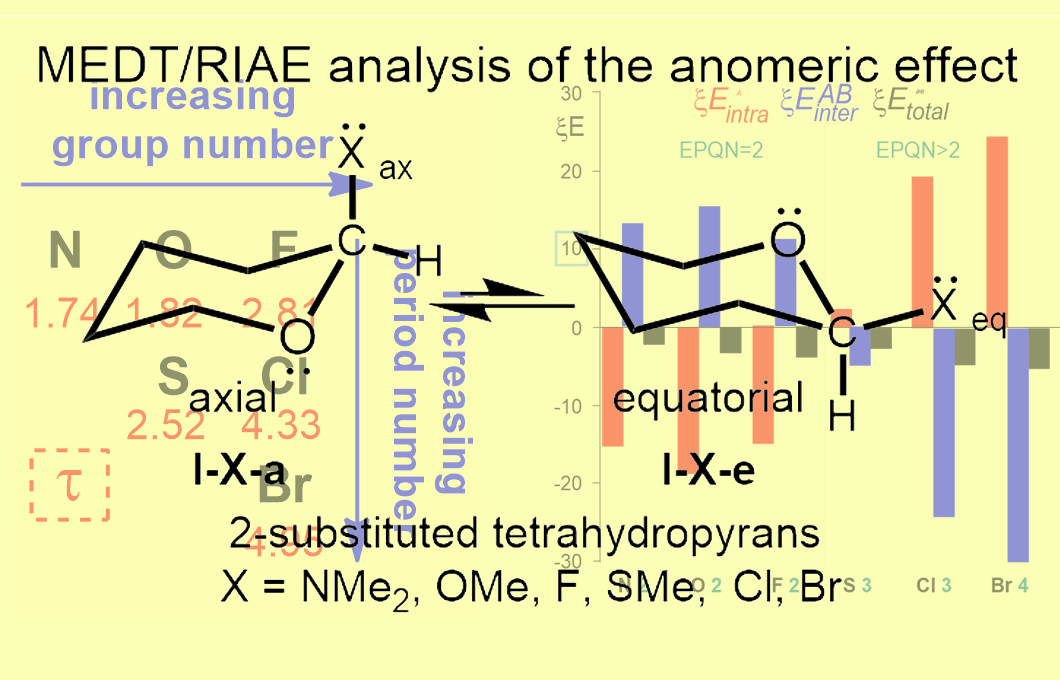
The conformational preferences of 2-substituted cyclic and acyclic ethers, caused by the anomeric effect, have been analyzed using the Relative Interacting Atomic Energy (RIAE) analysis within Molecular Electron Density Theory. Comparison of substituted tetrahydropyrans and cyclohexanes enables the proposal of the anomeric index, which isolates the electronic contributions of the O–C–X motif to axial stabilization in 2-substituted tetrahydropyrans. The RIAE analysis reveals two distinct patterns in the distribution of the atomic-energy contributions associated with anomeric stabilization, dominated by either intra-atomic or interatomic terms, which correlate with the period of the X atom. Accordingly, the studied compounds can be classified into two groups: Group I, comprising compounds with second-period X elements (X = N, O, and F), in which axial stabilization is dominated by favorable intra-atomic energy contributions within the basin of the anomeric C carbon; and Group II, comprising compounds with third- and fourth-period X elements (X = S, Cl, and Br), in which stabilization is primarily associated with favorable interatomic energy contributions between the ether O oxygen and the anomeric C carbon atoms. This atomic-energy based analysis accounts for the X-dependent conformational trends and provides a transferable description of the O–C–X motif across cyclic and acyclic molecular frameworks.
Keywords:
anomeric effect
; molecular electron density theory
; relative interacting atomic energy
; atomic interactions
; electron localization function
1. Introduction
The anomeric effect is one of the most extensively studied and debated stereoelectronic phenomena in organic chemistry [1]. First recognized in carbohydrate chemistry by Edward [2], and subsequently formalized by Lemieux and Chu [3], it describes the unexpected preference of an electronegative X atom attached to the anomeric carbon for the axial orientation in pyranoses (Pyrs), despite the expected steric preference for the equatorial form (Scheme 1a). This axial stabilization is not restricted to carbohydrates, and it is also observed in simpler heterocycles such as 2-substituted tetrahydropyrans (THPs) (Scheme 1b), and even in acyclic systems containing an O–C–X framework [1,4,5,6,7,8]. The magnitude of the anomeric effect is strongly dependent on the nature of the substituent X, with halogens and alkoxy groups often exhibiting markedly different axial–equatorial preferences [1].
Two main models have traditionally been proposed to rationalize the anomeric effect. The electrostatic model attributed axial stabilization to reduce dipole–dipole repulsion between the non-bonding electron densities of the endocyclic (O) and exocyclic (Cl) heteroatoms in the equatorial form, thereby favoring the axial conformation (see Figure 1) [8]. This approach successfully explained solvent effects, as polar solvents tend to stabilize the equatorial anomer. However, it does not account for the characteristic shortening of the O–C bond and elongation of the C–X bond typically observed in axial conformers [9].
In contrast, the stereoelectronic or hyperconjugative model suggested an interaction between a lone pair on O oxygen and the antibonding σC–O orbital (nO → σ*C–O), offering a reason for the geometric features related to the effect and its presence in nonpolar environments (see Figure 1) [9,10,11].
Over the past two decades, more sophisticated theoretical treatments have deepened this debate. Mo's block-localized wavefunction analysis demonstrated that hyperconjugation contributes far less than previously assumed, and that electrostatic and steric interactions play a dominant role [12]. However, these classical models capture only fragments of the underlying electronic behavior.
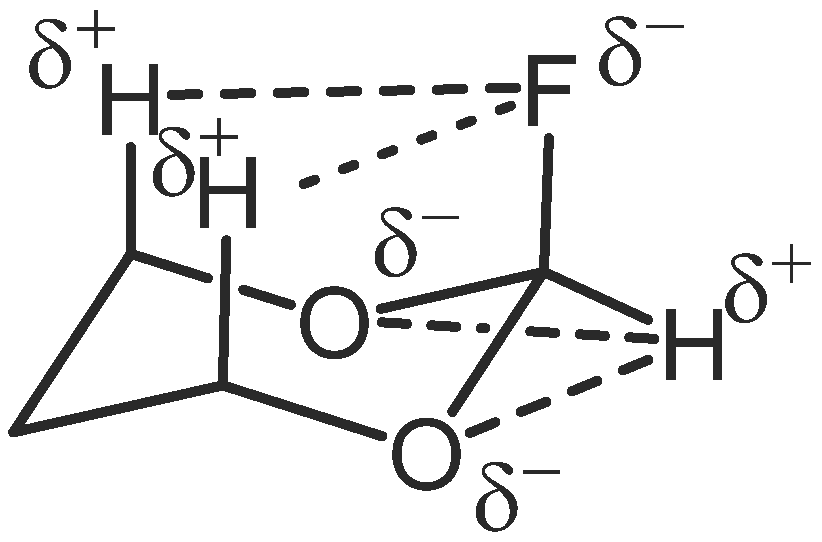
The conformational preferences of two model compounds of the O−CH₂−O anomeric unit were analyzed within the framework of the Quantum Theory of Atoms in Molecules [13,14] (QTAIM), finding that the stabilization of gauche conformers was accompanied by a progressive reduction in the electron population of the central methylene hydrogens as the number of gauche interactions with lone pairs increases, resulting in more negative molecular energy [15]. In 2-substituted 1,3-dioxanes, Wiberg et al., suggested that the anomeric effect is largely governed by two CH···X heteroatom Coulombic attractions rather than by hyperconjugation (Figure 2) [16].
Complementary, energy decomposition approaches emphasized the importance of exchange [17], as well as cooperative contributions from steric, electrostatic, and exchange-correlation terms [18]. Additional methods, such as Interacting Quantum Atoms [19] (IQA) and Relative Energy Gradient [20] (REG) analyses, have further explored these contributions, providing orbital-free views on how electrostatic, exchange, and kinetic factors combine to influence conformational bias. Recently, Popelier et al. [21] used IQA and REG on both dimethoxymethane and 2-fluorotetrahydropyran, observing an electronic charge shift along the higher-to-lower-energy pathways stabilized by the anomeric effect. This redistribution enhances intra-atomic stabilization at the anomeric carbon and increases Coulombic attraction between hydrogens and heteroatoms, indicating that these two energetic contributions are primarily responsible for the effect in both molecules.
Very recently, a multivariate analysis combining computational modeling and statistical methods to assess the origin of the anomeric effect has been reported [22]. On the basis of linear regression analyses, the authors concluded that the observed conformational preferences arise from the interplay of several factors, the most significant being: (i) stereoelectronic hyperconjugation interactions between the lone pair oxygen and the exocyclic σ* acceptor orbital; (ii) pyramidalization at the anomeric carbon; (iii) steric effects; and (iv) variations in total molecular surface area associated with dispersion interactions.
Despite these extensive efforts, a fundamental question remains unresolved: whether the anomeric effect originates from a single universal electronic mechanism or from distinct stabilization patterns that depend on the electronic nature of the X atom attached to the anomeric carbon [1,12,13,14,15,16,17,18,19,20]. Existing models, based on hyperconjugation, electrostatics, dipole minimization, or CH···X interactions, provide partial rationalizations but do not identify which atomic-level interactions are responsible for conformational preferences across different substituent families, nor do they fully explain why similar trends are observed in both cyclic and acyclic.
The Molecular Electron Density Theory [23] (MEDT) was proposed in 2016 to investigate chemical processes by studying changes in electron density rather than molecular orbital interactions. MEDT focuses on analyzing changes in electron density along a reaction path and the associated energy costs. Recently, the Relative Interacting Atomic Energy (RIAE) scheme [24,25], an energy decomposition analysis based on the IQA [19] partitioning of Kohn-Sham [26] (KS) Density Functional Theory [27] (DFT) energies, has enabled the analysis of intra- and interatomic energy contributions associated with these changes. Within MEDT, RIAE has proven to be a useful tool for studying the activation energies of relevant organic reactions, including Diels-Alder reactions [24,25,28], [3+2] cycloaddition reactions [29], and nucleophilic substitution reactions [30,31].
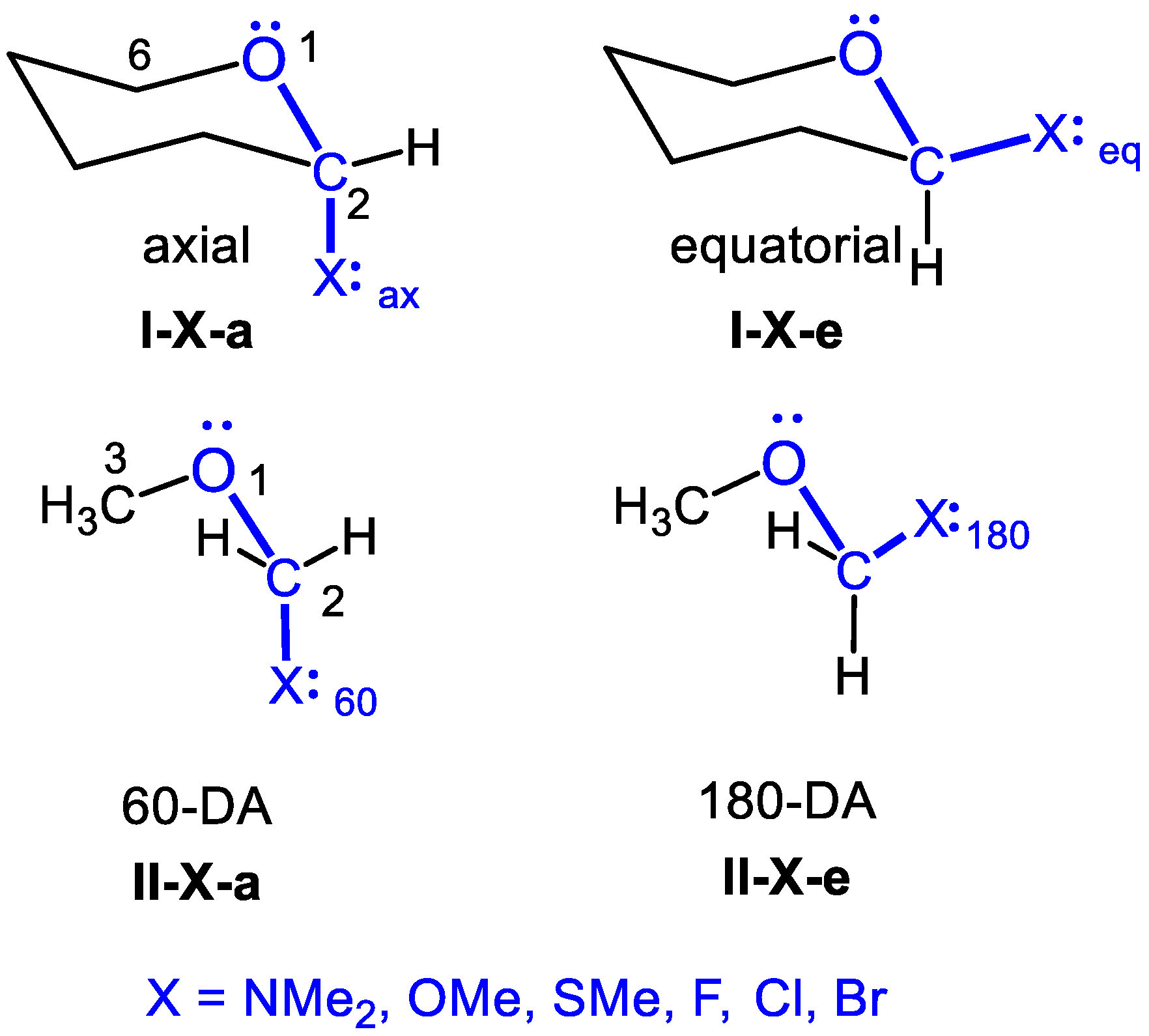
The present study addresses the anomeric effect within the framework of the MEDT by analyzing two representative families of 2-substituted ethers (Scheme 2): (a) six 2-substituted THPs I-X as cyclic models (the axial, I-X-a, and the equatorial, I-X-e, epimer conformations, with X = N, O, F, S, Cl and Br); and (b) six substituted methoxymethanes (MMs) as acyclic models (the 60-degree alternate (DA), II-X-a, and the 180-DA, II-X-e, conformations). These selected molecules contain the O−C−X motif found in pyranoses and substituted THPs, both of which experience the so-called anomeric effect (see Scheme 1). RIAE [24] analyses are used herein to identify the atomic-level electronic factors governing the anomeric effect. The relative intra- and interatomic energies [24,25] between the axial/60-DA and equatorial/180-DA conformations are analyzed to characterize the atomic-level energy changes responsible for the observed axial preference in Pyrs and THPs (see Scheme 1).
2. Results and Discussion
To elucidate the microscopic origin of the anomeric effect in both cyclic and acyclic systems, the relative conformational stabilities of six 2-substituted tetrahydropyrans, THPs, I–X, and six substituted methoxymethanes, MMs, II–X are first examined, considering their axial/equatorial or 60-/180-DA conformations. The contribution of the anomeric effect caused by the O–C–X motif to the axial stabilization of the THP I–X series is evaluated by comparison with the substituted cyclohexanes (Chs) III–X, which lack this structural feature. Solvent effects and thermodynamic calculations for the axial/equatorial stereoisomers of 2-methoxy THP I–O are performed. Finally, an RIAE analysis of the THPs I–X and MMs II–X series is carried out to identify the intra- and interatomic electronic interactions responsible at the atomic level for anomeric stabilization in each molecular family. This combined approach allows us to assess whether the anomeric effect arises from a single electronic behavior or from distinct stabilization patterns that depend on the electronic structure of the X atom attached to the anomeric C2 carbon.
Molecules such as Pyrs and THPs can exist in several stereoisomeric forms, each with different three-dimensional molecular geometries and total electronic energies. The corresponding geometries and their associated energies result from different interatomic electronic interactions. A detailed dissection of the IQA interatomic energies contributions associated with these interactions is shown in Section 1 of the Supplementary Material.
3.1. Energy analysis of the axial and equatorial conformations of cyclic 2-substituted THPs I-X.
A reliable interpretation of the anomeric effect requires first establishing the relative conformational energies, as any electronic behavior must ultimately account for the axial/equatorial stability differences. Therefore, the present study begins by establishing the energetic landscapes of both the cyclic THP and acyclic MM models, which provide the baseline that all geometric, charge, Electron Localization Function (ELF), and RIAE analyses should explain. Due to the great similarities between the axial/equatorial and 60-/180-DA stability gaps and geometrical parameters of both cyclic THP and acyclic MM models, the complete analysis of the acyclic MMs II-X is presented in Sections 2-4 of the Supplementary Material.
Importantly, the axial preference observed in 2-substituted Pyrs and THPs (Scheme 1) does not arise exclusively from the anomeric effect associated with the O–C–X motif, but also from additional interatomic electronic interactions involving the atoms belonging to the substituent and the atoms belonging to the cyclic framework. These interatomic electronic interactions can significantly influence the overall conformational stability. For this reason, the 2-substituted THPs I–X considered in this study were selected to minimize such additional interactions, providing a simplified framework in which the contribution of the O–C–X motif to the anomeric effect can be more clearly evaluated.
The axial and equatorial conformations of the six 2-substituted THPs I–X were optimized at the M06-2X/6-311G(d,p) level in the gas phase. The corresponding axial/equatorial relative energies, Δ, are summarized in Table 1, and the total energies of both conformations are provided in Table S7 in the Supplementary Material. For comparison, the 60- and 180-DA relative energies of the acyclic substituted MMs II-X (see Δ in Section 2 in the Supplementary Material) are also included in Table 1.
For the THP series, the axial conformers are consistently more stable than the equatorial ones, with stabilization energies ranging from 2.28 (I-S) to 4.94 (I-Br) kcal·mol-1. For the halogen series (X = F, Cl, and Br), the axial stabilization increases in the order 3.32 (F) < 4.26 (Cl) < 4.94 (Br) kcal·mol-1. This trend parallels the progression of X element from the second to the fourth period. This trend is reproduced identically in cyclic I–X, and acyclic MMs II–X (see Section 2 in the Supplementary Material), indicating that the electronic effects underlying the anomeric effect are associated with the O–C–X motif rather than with cyclic constraints. The axial stabilization of methoxy THP I–O computed at the B3LYP/6-311G(d,p) level in the gas phase, 4.06 kcal·mol-1, is 0.32 kcal·mol-1 less than that computed at the M06-2X/6-311G(d,p) level, showing that both functionals give the same axial trend. Note that both levels of theory are required for the IQA calculations [19] used in the subsequent RIAE analysis [24].
Importantly, the axial preference observed in 2-substituted Pyrs and THPs (Scheme 1) does not arise exclusively from the anomeric effect associated with the O–C–X motif, but also from additional electronic interactions involving the atoms in the substituent and those in the cyclic framework. To minimize these secondary contributions, the present THP I–X series was selected as a simplified model system of 2-substituted Pyrs. Nevertheless, residual electronic effects unrelated to the O–C–X motif may still contribute to the conformational preferences. To assess these contributions, the axial and equatorial conformations of eight substituted cyclohexanes, Chs, III–X, which lack the O–C–X motif (see Scheme 3), were also optimized. The corresponding relative energies Δ are included in Table 1, and total energies are reported in Table S8 in the Supplementary Material. The hydrocarbons methylcyclohexane III-Me and tert-butylcyclohexane III-tBu were also studied. Negative values of ΔEe-a in Table 1 indicate that the equatorial conformation is the most stable.
As expected, steric effects dominate in alkyl-substituted Chs: the axial conformations of methylcyclohexane III-Me-a and tert-butylcyclohexane III-tBu are 1.50 and 4.55 kcal·mol-1, respectively, higher in energy than the equatorial conformations. The conformational Gibbs free energies for Chs III-Me and III-tBu have been estimated in 1.8 and 4.7 kcal·mol-1, respectively [1], closer to the M06-2X/6-311G(d,p) gas-phase relative energies of these alkyl-substituted. Steric 1,3-diaxial interactions between the axial methyl and tert-butyl groups and the two axial hydrogens have been proposed to account for these relative energies in hydrocarbon systems (see III-X-a in Scheme 3) [1]. These unfavorable interactions are also present in the axial 2-methyl THP I-Me-a, which is 2.42 kcal·mol-1 higher in energy than the equatorial I-Me-e (see Table 1).
In contrast, the substituted Chs III–X exhibit X atom dependent electronic effects. For this series, the axial conformation of the N, O, and F heteroatoms III-X-a is between 0.42 and 2.56 kcal·mol-1 more stable than the equatorial conformation III-X-e. For the S atom, III-S, the axial conformation is 0.24 kcal·mol-1 less stable than the equatorial one, while for Cl and Br atoms, III-Cl and III-Br, both conformations have similar energies (see Table 2). These results suggest that the X atom-dependent electronic interactions within the cyclohexane framework, which are also present in the 2-substituted THPs I-X, vary significantly with the nature of the X element. Notably, Chs III-O and III-S exhibit opposite conformational preferences, with the former favoring the axial conformation and the latter the equatorial one.
Consequently, the axial/equatorial energy differences observed for THPs I–X (see Δ in Table 1) reflect not only the so-called anomeric effect associated with the electronic interaction at the O−C−X motif, but also additional electronic interactions, mainly between atoms belonging to the group attached to the anomeric C2 carbon and those of the cyclic hydrocarbon chain, which are also present in substituted Chs III–X.
The axial/equatorial energy differences observed between the THP I-X series, Δ, and those observed in the Ch III-X series, Δ, allow for an estimation of the anomeric effect caused by the X atom of the O–C–X motif present in the THP series. The corresponding energy difference permits the definition of the τ index as:
i.e., as the difference between the equatorial/axial relative energies of the C2 substituted THPs and the corresponding substituted Chs. This approach isolates the stabilizing contribution of the anomeric effect caused by the X atom in the O−C−X motif by subtracting the interatomic electronic interactions between the atoms of the X substituents and those of the cyclic framework. The resulting τ values for the X atom of the six 2-substituted THPs I-X are reported in Table 1. The positive τ values in Table 1 reflect a stabilizing anomeric effect caused by the X atom, which favors the axial conformation.
Figure 3 shows the relationship between the axial preference of the acyclic MMs II–X series, which minimizes interatomic electronic interactions not associated with the O–C–X motif present in THPs I–X, and the corresponding anomeric τ values obtained from equation 1. MM II-S deviates markedly from the trend observed in the other systems (red point in Figure 3). Excluding MM II–S from an exploratory linear regression yields a strong correlation for the remaining five compounds (R2 = 0.988, see Figure 3). This result suggests that, with the notable exception of the sulfur derivative, the proposed τ index captures the variation in the conformational stabilization associated with the 60 DA arrangement of the O–C–X motif in the acyclic MM II–X series.
Analysis of the computed τ values reported in Table 1 reveals three main trends: (i) the anomeric τ index increases in the order 1.74 (N) < 1.82 (O) < 2.52 (S) < 2.81 (F) < 4.33 (Cl) < 4.95 (Br) kcal·mol-1 (see Figure 4), showing a systematic dependence on the nature of the X element; (ii) within the second-period series, τ increases in the order 1.74 (N) < 1.82 (O) < 2.81 (F) kcal·mol-1, paralleling the increase in Pauling electronegativity, χ = 3.04 (N) < 3.44 (O) < 3.98 (F); and (iii) within the halogen series τ increases in the order, 2.81 (F) < 4.33 (Cl) < 4.95 (Br) kcal·mol-1, as X element progresses from the second to the fourth period, whereas electronegativity decreases in the opposite direction, χ = 3.98 (F) > 3.16 (Cl) > 2.96 (Br) [1] Note that this increase is also observed in the short series of the chalcogen group τ = 1.82 (O) < 2.52 (S). Thus, for the halogen derivatives, the increase in τ correlates with the period of X element rather than with its electronegativity. The largest τ value, 4.95 kcal·mol-1, is found for the bromine derivative I-Br-a, whereas the smallest value, 1.74 kcal·mol-1, is obtained for the nitrogen derivative I-N-a.
Interestingly, the strong axial stabilization of the ether-substituted Ch III-O, Δ = 2.56 kcal·mol-1, accounts for the strong stabilization of THP I-O, Δ= 4.38 kcal·mol-1 (see Table 1). Thus, except for THP I-O, where the intrinsic stabilization of the axial conformation exceeds the τ value of 1.82 kcal·mol-1, the τ index makes a major contribution to axial stabilization in the remaining THPs, indicating that the anomeric contribution dominates other electronic interactions. For comparison, the corresponding 60-DA stabilization of MMs I-O is 3.19 kcal·mol-1 (see Table 1). Therefore, excluding the electronic interactions present in the cyclohexane framework of the Ch III-X series from those of the THP I-X series allows the anomeric τ index to be estimated. These values can be used as an approximate estimation of the anomeric effect caused by the O−C−X motif present in 2-substituted Pyrs and THPs.
3.2. Solvent effects and thermodynamic calculations for the axial/equatorial stereoisomers of 2-methoxy THP I–O
Solvent effects on the anomeric effect were originally examined by Lemieux et al. [32], who showed that the population of the axial conformer in 2-methoxy THP decreases as solvent polarity increases. To analyze this behavior, the axial/equatorial conformational equilibrium of 2-methoxy THP I-O was studied in a series of solvents with increasing dielectric constant.
The relative solvation energies of the axial (Δ) and equatorial (Δ) conformations of THP I-O, together with the corresponding axial-equatorial energy differences, in the selected solvents, Δ, are summarized in Table 2 and represented in Figure 5.
Three main observations arise from Figure 5: (i) first, the equatorial conformer is increasingly stabilized relative to the axial one as the solvent dielectric constant increases. This behavior is consistent with the larger dipole moment of the equatorial stereoisomer, THP I-O-e, relative to the axial one, THP I-O-a, 2.13 and 0.35 Debyes, respectively; (ii) second, although both conformers are stabilized upon solvation, the magnitude of this stabilization becomes nearly constant for dielectric constants above ~20; and (iii) third, despite the preferential stabilization of the equatorial conformer, the axial–equatorial energy difference (Δ ) remains nearly unchanged at higher dielectric constants. This behavior suggests the electronic interactions responsible for the anomeric effect are only weakly modulated by solvation. These results indicate that, although polar solvents decrease the axial-equatorial energy difference through the greater solvation of the more polar and less stable equatorial conformation, the overall magnitude of the anomeric effect remains only weakly affected by the solvent environment.
The axial/equatorial relationships of 2-substituted Pyrs or THPs given in Scheme 1 are experimentally determined by spectroscopic techniques such as NMR, which provide the composition of the stereoisomeric mixture. From these data, the Gibbs free energy differences between the axial/equatorial stereoisomers can be determined. To correlate the computed relative axial/equatorial electronic energies Δ with the relative Gibbs free energies experimentally obtained, the thermodynamic calculations of the axial/equatorial equilibrium for 2-methoxy THP I-O in three selected solvents of increasing polarity were performed. The relative axial/equatorial electronic energies, enthalpies and Gibbs free energies, Δ , Δ and Δ in kcal·mol-1, and entropies, Δ in cal·mol-1·K-1, computed in the corresponding solvent at room temperature are given in Table 3.
Two main conclusions can be obtained from Table 3: (i) the relative axial/equatorial Gibbs free energies for the equilibrium of THP I-O are only 0.07 kcal·mol-1 less than the relative electronic energies. This behavior is consequence of two factors: (a) the variation between the relative electronic energies Δ and enthalpies Δ are lesser than 0.1 kcal·mol-1; and (b) the variation of entropies between the axial and equatorial conformations are negligible ( < 0.28 cal·mol-1·K-1); and (ii) the axial/equatorial relationships experimentally determined can be correlated with the inter- and intra-atomic electronic interactions present in the axial/equatorial stereoisomer, which include the so-called anomeric effects.
3.3. Geometrical and atomic charge analyses of cyclic 2-substituted THPs I-X
We next asked whether geometric parameters and the natural atomic charges of the O1−C2−X framework in the axial and equatorial conformations of cyclic 2-substituted THPs I-X correlate with the energetic trends observed in Section 2.1. The optimized geometries of substituted THPs I-X are given in Figure 6. The differences in the O1−C2 and C2−X bond lengths between the two conformations, Δlae are summarized in Table 4, while natural atomic charges of the O1−C2−X framework are reported in Table 5. The corresponding parameters for the acyclic MMs II-X series are given in Section 3 of the Supplementary Material.
Analysis of the O1–C2 and C2–X bond-length differences reported in Table 4 reveals several systematic trends: (i) first, the O1–C2 bond is consistently shorter in the axial conformers, with values Δla-e ranging from −0.001 to −0.029 Å, whereas the C2–X bond is elongated by 0.015–0.080 Å. The simultaneous O1–C2 contraction and C2–X elongation correspond to the structural pattern conventionally associated with anomeric stabilization; (ii) second, within the second-period series, the magnitude of these structural changes generally increases in the order N < O < F, although identical C2–X elongations are obtained for the N and O derivatives; (iii) within the halogen series, both the O1–C2 contraction and C2–X elongation increase markedly in the order F < Cl < Br. The sulfur derivative does not follow a simple period-dependent trend: its C2–S elongation is identical to that obtained for C2–F, whereas its O1–C2 contraction is intermediate between those of the O- and F-substituted derivatives. Thus, the observed structural changes depend on the identity of X and cannot be described solely in terms of its period. Finally, analogous O1–C2 contractions and C2–X elongations are obtained for the acyclic MMs II–X (Section S3 of the Supporting Information). These structural variations broadly parallel the corresponding conformational-energy trends, although they do not by themselves establish their electronic origin
The analysis of the atomic charges obtained by natural population analysis [33,34] (NPA) for the three atoms in the O–C–X motif provides additional information on the electronic polarization of the O1–C2–X framework (Table 5). The corresponding atomic charges for the 60- and 180-DA conformations of the substituted MMs II-X are given in Section S3 of the Supplementary Material. Several conclusions emerge from Table 5: (i) first, the net charge of the O1 oxygen remains nearly constant, ca. –0.60 e, across both conformations and throughout the substituent series, indicating that this quantity is relatively insensitive to the conformational change. In contrast, larger substituent- and conformation-dependent variations are observed at C2 and X atoms; (ii) second, the positive charge at the anomeric C2 carbon is considerably larger for the derivatives containing second-period X elements (X = N, O, and F; 0.34 – 0.58 e) than for those containing third- and fourth-period X elements (X = S, Cl, and Br; 0.02 – 0.21 e). Within the second-period series, the positive charge at C2 increases in the order N < O < F, paralleling the increase in the electronegativity of X; (iii) third, the C2–X bond is more strongly polarized in the second-period derivatives, for which X bears a substantial negative charge (−0.39 to −0.61 e). By contrast, S sulfur bears a positive charge, whereas Cl and Br carry comparatively small negative charges; and finally, (iv) the axial–equatorial charge differences occur predominantly at C2 and X and are larger for the S-, Cl-, and Br-substituted derivatives, particularly at X. Overall, the charge analysis results identify two distinct substituent-dependent polarization patterns: one for compounds containing second-period X elements and another for those containing third- and fourth-period X elements.
The net charges at the O1 oxygen in the axial conformation of THPs I–X (−0.61 e, Table 5) and in the 60-DA conformations of MMs II–X (−0.58 e, Table S4 in the Supplementary Material) are essentially the same as those found for the corresponding equatorial and 180-DA conformations. This indicates that the anomeric effect preference does not involve a significant change in the electron density localized at the ether O1 oxygen. Consequently, this charge analysis does not support the classical hyperconjugative interpretation in which stabilization of the axial/60-DA conformations would arise from a substantial depopulation of the oxygen lone-pair region through (nO → σ*C–O), donation [9,10,11]. Such a mechanism would be expected to produce a detectable decrease in the negative charge at O1 oxygen, or even the development of positive charge character at oxygen, as schematically proposed in Figure 1; this trend is not observed in the present atomic charge analysis.
Overall, the relative energies (Table 1), bond-length variations (Table 4), and atomic charge distributions at C2 and X (Table 5) reveal substituent-dependent patterns that correlate with the period and electronegativity of X. Nevertheless, these geometrical and charge descriptors do not by themselves establish the physical origin of the conformational-energy trends. The ELF and RIAE analyses presented below, therefore, provide complementary descriptions of the electron-density organization and of the distribution of the atomic-energy contributions associated with anomeric stabilization.
3.4. ELF topological analysis of the 60- and 180-DA conformations of MMs II-F and II-Cl
The topological analysis of ELF [35] provides a quantitative description of the electron density distribution within a molecule [36], offering direct insight into its electronic structure and reactivity. To examine the electron density changes between the axial/60-DA and equatorial/180-DA conformations of THPs I-X and MMs II-X, ELF analyses were performed for the 60- and 180-DA conformations of the acyclic MMs II-F and II-Cl. These compounds were selected as representative systems containing a second-period X element (F) and a third-period X element (Cl). The use of these acyclic models reduces the topological complexity associated with the cyclic THPs and facilitates comparison of the ELF basin populations directly associated with the O1–C2–X motif. The corresponding ELF valence basin distributions and the most relevant valence basins populations, are depicted in Figure 7.
In all four structures, the ELF topology consists of one V(C2,O1) basin integrating less than 1.48 e, and one V(C2,X) basin integrating less than 1.04 e for X = F or less than 1.38 e for X = Cl. These depopulated disynaptic basins correspond to the polarized C2–O1 and C2–X bonding regions. Each molecule also features two O1-centered monosynaptic basins, V(O1) and V′(O1), integrating less than 4.72 e in total, and two at II-F or two/three at II-Cl monosynaptic V(X) basins integrating a total of less than 6.67 e and 6.25 e, respectively. These highly populated V(X) monosynaptic basins represent the non-bonding electron density at the O, F, and Cl atoms, consistent with their higher electronegativity relative to the bonded C1 carbons.
ELF comparison of the two conformations of II-F and II-Cl reveals a similar pattern. In the more stable 60-DA conformer II-F-a, the C2–O1 single bond and the F non-bonding region are slightly more populated, whereas the C2–F single bond is slightly depopulated. In the favored 60-DA conformer II-Cl-a, the C2−O1 single bond and the O and Cl non-bonding regions show a small increase in population, while the C2−Cl single bond is slightly depopulated.
The depopulation of the V(C2,X) disynaptic basins in the 60-DA conformations accounts for the slightly longer C2−X distances observed in axial and 60-DA conformations. On the other hand, the slightly higher populations of the V(C2,O1) disynaptic basins at 60-DA conformations account for the shorter C2−O1 distances in axial and 60-DA conformations (see Figure 6 and Figure S1 in the Supplementary Material).
Finally, Figure 7 shows that the V(Cl) monosynaptic basins in II-Cl occupy a larger volume than the V(F) monosynaptic basins in II-F, consistent with Cl being a third-period element and F a second-period element.
3.5. RIAE analysis of the 2-substituted THPs I-X
In order to determine the electronic interactions at an atomic-level responsible for the anomeric effects, a RIAE [24,25] analysis for the 2-substituted THPs I–X and the substituted MMs II–X was performed. To our knowledge, stereoisomeric energy differences have not previously been examined using RIAE. In this approach, the relative ξintra-atomic and ξ interatomic energies between the two conformations were computed and analyzed. The relative ξ total energies obtained by summing the relative ξintra-atomic and ξ interatomic energies represent the RIAE relative energies between the two stereoisomers. This approach enables the energetic origin of the axial/equatorial stability differences to be examined in terms of atomic contributions, providing a complementary perspective to the structural and electron-density analyses discussed above.
The RIAE analysis is organized in three parts: (i) the six 2-substituted THPs I-X, (ii) the corresponding MMs II–X, and (iii) methoxycyclohexane III-O and methylcyclohexane III-Me, as reference systems lacking the O−C−X motif. Due to the similarity of the RIAE of MMs II–X with that of THPs I-X, the former RIAE analysis is presented in Section 4 in the Supplementary Material.
3.5.1. RIAE analysis of 2-substituted THPs I-X.
First, the RIAE analysis for the six 2-substituted THPs I-X was performed to identify, at the atomic-energy level, the electronic factors responsible for the preferred axial conformation. Taking advantage of the topological atoms [37], Popelier recently proposed an Interacting Quantum Fragment approach [38], which allows grouping the IQA energy terms into chemically meaningful fragments ƒ(X) of the molecular system.
To isolate the atomic energetic contributions associated with the O–C–X motif, the atoms of THPs I-X, were grouped into two fragments: (a) the three atoms defining the O−C−X motif; and (b) the remaining hydrocarbon framework, denoted as CH. The M06-2X/6-311G(d,p) axial/equatorial relative ξintra-atomic, ξ interatomic, and ξ total energies for the OCX and CH frameworks of THPs I-X are given in Table 6. The ξ values quantify the axial stabilization associated with the O–C–X framework, i.e., the energetic component attributed here to the anomeric effect, while the ξ corresponds to the total axial/equatorial stabilization obtained from the RIAE partition.
As shown in Table 6, the RIAE ξ total energies reproduce the stability trends obtained from the full M06-2X/6-311G(d,p) gas-phase optimizations (see Table 1). Within the halogen series, the axial stabilization becomes increasingly favorable as X progresses from the second to the fourth period, with the ξ values becoming more negative in the order –3.19 (F, second period) < –4.70 (Cl, third period) < –5.31 kcal·mol-1 (Br, fourth period). The methoxy derivative I-O, containing the second-period O element, exhibits a greater axial stabilization (–4.04 kcal·mol-1 than that dimethylamino derivative I-N, (–2.64 kcal·mol-1). By contrast, the sulfur derivative I-S-a displays the weakest axial stabilization within this series, –2.26 kcal·mol-1.
From Table 6, two main conclusions can be obtained: (i) first, the relative ξ total energies associated with the O−C−X framework are negative and therefore stabilizing, whereas ξ total energies associated with the remaining atoms are positive and destabilizing. Thus, the axial preference arises from the O−C−X motif, while the rest of the molecular framework partially counteracts this stabilization; and (ii) second, decomposition of the total ξ energies into its intra-atomic, ξ, and interatomic, ξ, components, associated with the O−C−X framework, reveals two distinct electronic regimes contributing to the relative ξ total energies associated with the anomeric effects in these THPs.
A central result emerges of the RIAE analysis of the ξ intra-atomic and ξ interatomic energies: the anomeric effect associated with the O–C–X framework displays two contrasting patterns that correlate with the period of the X element (see Table 6). For compounds containing second-period X elements (X = N, O, and F), the relative ξ intra-atomic energies are strongly stabilizing, ranging from −17.04 to −11.12 kcal·mol-1, while the corresponding relative ξ interatomic energies are destabilizing. In contrast, for compounds containing third- and fourth-period X elements (X = S, Cl, and Br), the interatomic relative ξ contributions are strongly stabilizing, ranging from −34.05 to −7.72 kcal·mol-1. In all six cases, the stabilizing contribution outweighs the destabilizing one, yielding a net axial stabilization of the O−C−X framework ranging from −10.70 to −4.31 kcal·mol-1. Thus, the RIAE decomposition identifies a period-dependent shift in the dominant stabilizing contribution: from intra-atomic terms for X = N, O, and F to interatomic terms for X = S, Cl, and Br.
A detailed analysis of IQA intra-atomic energies of the atoms contributing to the relative ξ intra-atomic energies of I-N, I-O and I-F (X elements second period), indicates that the relative intra-atomic energies at the anomeric C2 carbon, −9.25, −13.76, and −15.33 kcal·mol-1, respectively, is the dominant electronic factor at an atomic-level for the axial stabilization of these THPs (see Table 7 and Table S9 in in the Supplementary Material). Note that this stabilization increases with the electronegativity of the X atom. This intra-atomic energy stabilization at the anomeric C2 carbon was recently observed by Popelier using IQA and REG analyses in the fluorine derivative THP I-F [21]. Examination of the IQA components reveals that the relatively favorable nuclei-electron contributions between the axial and equatorial conformations, –58.56 (I-N), –79.36 (I-O), and –70.37 (I-F) kcal·mol-1 constitute the dominant contribution to this intra-atomic anomeric stabilization (see Table 7).
Conversely, for compounds containing third- and fourth-period X elements (X = S, Cl, and Br), analysis of the IQA interatomic energies of the atoms contributing to ξ interatomic energies of I-S-a, I-Cl-a and I-Br-a indicates that the interatomic energies associated with O1 and C2 atoms are stabilizing. The corresponding O1 and C2 contributions, −2.47 and −2.36 (I-S-a), –16.06 and –8.89 (I-Cl-a), and –20.94 and –12.14 (I-Br-a) kcal·mol-1, drive axial stabilization (see Table S9 in the Supplementary Material). A further analysis of the IQA terms shows that the energies between O1 and C2, –12.45 (I-S-a), –36.23 (I-Cl-a), and –48.90 kcal·mol-1 (I-Br-a), constitute the most favorable axial electronic interactions in these sulfur and halogenated systems. This O1 and C2 interatomic stabilization agrees with the reduction of the O1−C2 distance in the more favorable I-X-a compounds containing third- and fourth-period X elements.
The comparatively small ξ and ξ energy differences for the axial/equatorial conformations of the sulfur THP I-S (Table 6) may account for its pronounced deviation in Figure 3, suggesting that additional intramolecular interactions contribute with a magnitude comparable to that of the anomeric effect.
The RIAE analysis reveals a period-associated change in the distribution of the energy contributions responsible for the axial stabilization of THPs I–X. On this basis, the studied compounds can be classified into two groups: (i) Group I comprises THPs containing second-period X elements (X = N, O, and F), for which stabilization of the O–C–X framework is dominated by favorable intra-atomic contributions assigned to the anomeric C2 atom; and (ii) Group II comprises THPs containing third- and fourth-period X elements (X = S, Cl, and Br), for which the dominant stabilizing contribution is the interatomic interactions between the ether O1 oxygen and the anomeric C2 carbon. Thus, the RIAE decomposition identifies a shift in the dominant energy contribution from an intra-atomic C2 term in Group I to an interatomic O1–C2 term in Group II.
Comparison of the RIAE decomposition for the cyclic THPs I–X (Table 6) with that obtained for the acyclic MMs II–X (Table S4 in the Supporting Information) reveals the same qualitative period-associated pattern. This agreement shows that the two patterns of RIAE energy contributions are reproduced in both cyclic and acyclic O–C–X frameworks. The smaller axial stabilization obtained for THPs I–X relative to the 60- DA stabilization of MMs II–X is associated with the unfavorable relative total-energy contribution assigned to the hydrocarbon CH framework of the cyclic systems, ξ, which ranges from 1.57 to 5.39 kcal·mol-1 (Table 6). This positive contribution partially offsets the stabilization associated with the O–C–X framework in the THP series.
Finally, analysis of the relative axial/equatorial IQA intra-atomic and interatomic energies associated with the X element in the series of THPs I-X were analyzed (see Table S9 in the Supplementary Material). Except in the cases of I-N and in I-O, where the relative interatomic energies are stabilizing, the remaining systems show an axial intra-atomic stabilization at X, ranging from −3.05 (I-S) to −10.17 (I-Br) kcal·mol-1. Note that, in the case of the Br atom, which experiences the high intra-atomic stabilization, represents only ca. 25% of the interatomic stabilization associated with the O1 and C2 atoms. These intra-atomic stabilizations cannot be correlated with the atomic charges at X atom, which differ between compounds containing second-period and third- or fourth-period X elements (see Table 5). Note that at the THPs I-F and I-Cl the halogen X atoms experience an axial intra-atomic stabilization of ca. 5 kcal·mol-1, despite having markedly different atomic charges, −0.42 and −0.16 e, respectively (see Table 5). Consequently, while the stabilizations of the O1 and C2 atoms at an atomic level may be related to the period of the X element, that associated with the X atom, which has a minor contribution to the anomeric effect, shows less systematic behavior and has a lower weight in the axial stabilization.
Figure 8 shows a graphical representation of the gas-phase relative ξ and ξ total energies associated with the OCX and CH frameworks, and ξ total energies between the axial and equatorial conformations of 2-substituted THPs I-X given in Table 6. Several appealing conclusions can be obtained from the analysis of the graphical data shown in Figure 8; (i) in the series of the six THPs I-X, while the ξ total energies of the O−C−X framework associated with the anomeric effect are negative, and consequently stabilizing of the axial conformations, the ξ total energies associated with the CH framework are positive, and consequently, destabilizing; (ii) for the series of THPs I-X belonging Group I, the ξ total energies are ca. 2 kcal mol-1, while the ξ total energies depended on X element. As the O oxygen has the lower ξ total energy, 1.57 kcal mol-1, THP I-O presents the higher axial stabilization with a ξ = −4.04 kcal mol-1; (iii) for the series of THPs I-X belonging Group II, the ξ total energies increase in the order S < Cl < Br. Although the destabilizing ξ total energies also increase in the same order, as the stabilizing ξ total energies increase in a larger extension, the ξ total energies, which measure the axial stabilization, increase in the order S < Cl < Br; (iv) Figure 8 shows the different behaviors of the anomeric effect of the series of THPs I-X belonging to Groups I or II; and finally, (v) this figure clearly shows the role of the anomeric effect, linked to the atomic-level electronic factors associated with the O−C−X framework (shown in red), in the axial stabilization of the THP series I–X. Thus, Figure 8 reinforces the classification according to the period of the X element, as the characterizing behavior underlying the dual-regime origin of the anomeric effect.
This RIAE analysis reveals that the anomeric effect does not arise from a single universal electronic interaction but from two atomic electronic stabilizations, which could be related with the period of the X element. For Group I THPs, containing second-period X elements (X = N, O, and F), the axial stabilization is dominated by favorable intra-atomic contributions centered at the anomeric C2 carbon. Conversely, for Group II THPs, containing third- and fourth-period X elements (X = S, Cl, and Br), the axial stabilization is governed primarily by favorable interatomic interactions between the ether O1 oxygen and the anomeric C2 carbon. Together, these results demonstrate that the period of the X element could characterize the behavior underlying the dual-regime origin of the anomeric effect.
3.5.2. RIAE analysis of methoxycyclohexane III-O and methylcyclohexane III-Me
Methoxycyclohexane Ch III-O, which lacks the O−C−X motif, displays a significant axial stabilization of −2.56 kcal·mol-1, in contrast to the expected axial destabilization of methylcyclohexane III-Me, 1.50 kcal·mol-1 (Table 1). This intrinsic axial preference associated with the methoxy group also contributes to the concert with the anomeric effect, stabilizing the axial THP I–O and enhancing its overall axial stabilization to 4.38 kcal·mol-1. The corresponding τ value for oxygen is 1.82 kcal·mol-1(Table 1 and Figure 4), indicating that both intrinsic substituent effects and the anomeric contribution participate in the stabilization of THP I–O.
To identify the electronic interactions underlying the axial stabilization of methoxycyclohexane III–O, a RIAE analysis was performed for III–O and methylcyclohexane III–Me as reference systems. The M06-2X/6-311G(d,p) gas-phase relative intra-atomic, ξ intra-atomic, ξ interatomic and ξ total energy differences between the axial and equatorial conformations of Chs III-O and III-Me are given in Table 10.
Analysis of the relative ξ intra-atomic and ξ interatomic energies responsible for the axial and equatorial stabilizations of Chs III-O and III-Me indicate that in both CHs the ξ intra-atomic energies are destabilizing, while the ξ interatomic energies are stabilizing. However, while in Ch III-O the relative ξ interatomic energies are stabilizing by −3.75 kcal·mol-1, yielding an axial stabilization by −2.65 kcal·mol-1, in Ch III-Me, the relative ξ intra-atomic energies are more destabilizing by 4.13 kcal·mol-1, yielding an axial destabilization by 1.46 kcal·mol-1 (see Table 10). A detailed analysis of the relative interatomic energies of the atoms contributing to ξ interatomic energies of Ch III-O-a, indicates that the interatomic energies associated with ether O oxygen, −8.88 kcal·mol-1, drive axial stabilization.
Interestingly, the dominant energetic factors underlying axial stabilization in Ch III–O and THP I–O differ qualitatively. In Ch III–O, axial stabilization is dominated by favorable interatomic interactions associated with the ether O oxygen, whereas in THP I arises primarily from favorable intra-atomic contributions assigned to the anomeric C2 atom, consistent with the RIAE pattern identified for Group I compounds containing second-period X elements. This contrast shows that different distributions of atomic-energy contributions can lead to axial stabilization in related systems and helps distinguish the contribution associated with the O–C–X motif from the other electronic contributions involved in the overall stabilization.
3. Conclusions
The anomeric effect associated with the O−C−X motif in 2-substituted cyclic and acyclic ethers has been analyzed within the MEDT framework using the recently introduced RIAE analysis. This approach has been applied to two representative series of 2-substituted ethers: six cyclic THPs, I-X, and six acyclic MMs, II-X (X = N, O, S, F, Cl, Br).
The computed axial and 60-DA conformational energy preferences reproduce the well-established trend for both 2-substituted Pyrs and THPs. However, the axial preference of these cyclic ethers depends on several electronic interactions, including the named anomeric effect associated with the O–C–X motif. A comparative analysis of the relative conformational stability of the six substituted THPs and six substituted Chs permits the evaluation of the anomeric effect caused by the O–C–X motif in the former. This comparative analysis enables the definition of the anomeric τ index. The resulting τ values reveal a systematic dependence on the identity of X and allow their variation to be examined in relation to the group and period of the X element. The analogous stabilization patterns obtained for the cyclic THPs and acyclic MMs show that the energetic trends associated with the O–C–X motif are reproduced in both molecular frameworks.
Although geometrical descriptors, charges, and ELF analyses reveal systematic signatures associated with axial stabilization, these structural and electron-density features alone do not explain their energetic origin. Further insight into the distribution of the energetic contributions is provided by the RIAE analysis.
The RIAE analysis reveals that the anomeric effect does not arise from a single universal mechanism, but rather two different stabilizing atomic interactions can be correlated with the period of the X element. This finding has enabled the classification of the series of THPs I-X and MMs II-X into two clearly distinct groups: Group I, containing second-period X elements (X = N, O, and F), and Group II, containing third- and fourth-period X elements (X = S, Cl, and Br).
For compounds belonging to Group I the axial stabilization is dominated by favorable intra-atomic electronic interactions centered on the anomeric C2 carbon. In contrast, for compounds belonging to Group II the axial stabilization is governed primarily by favorable interatomic electronic interactions between the ether O oxygen and the anomeric C carbon atoms, whose magnitude increases markedly across the S-, Cl-, and Br-containing derivatives. The contribution to the axial stabilization of the X atom is smaller and less systematic.
RIAE analysis of Ch III-O shows that the axial stabilization of this methoxy cyclohexane differs from those operating in the axial stabilization of THP I-O at the atomic-level. In Ch III-O, the interatomic electronic interactions involving the ether O oxygen are responsible for the axial stabilization, while in THP I-O the stabilization arises primarily from favorable intra-atomic electronic interactions present at the anomeric C2 carbon. These results indicate that for, compounds containing second-period X elements, the anomeric effect is determined by an intra-atomic electronic stabilization of the anomeric C2 carbon in the axial conformation rather than by interatomic interactions such as dipole-dipole interactions as those invoked in classical dipolar interpretations [8].
Notably, the intra-atomic and interatomic energy components associated with the anomeric effect, which depend on the period position of the X element, contribute in opposite directions yet converge to the same overall conformational preference. Consequently, this MEDT/RIAE study provides a quantitative atomic-energy framework for understanding the anomeric effect, with the anomeric τ index emerging as an operational descriptor of X-dependent effects in O–C–X motifs across the cyclic THP and acyclic MM series.
4. Computational Details
The M06-2X [39] functional, together with the standard 6-311G(d,p) basis set [40], which incorporates d-type polarization for second-period elements and p-type polarization functions for hydrogens, was employed throughout this MEDT study. All electronic structure calculations were carried out using the Gaussian 16 suite of programs [41]. Solvent effects were incorporated by fully reoptimizing the gas-phase stationary points at the same theoretical level using the polarizable continuum model [42,43] (PCM) within the self-consistent reaction field (SCRF) framework [44,45,46]. ELF analyses [35] of the M06-2X/6-311G(d,p) monodeterminantal wavefunctions were performed with the TopMod [47] package employing a cubic grid with a step size of 0.1 Bohr. Molecular geometries and ELF basin attractors were visualized using the GaussView program [48]. The IQA analysis was performed using the AIMAll package [49] and the corresponding M06-2X/6-311G(d,p) monodeterminantal pseudo-wavefunctions.
Funding
This work has been supported by the Agencia Nacional de Investigación y Desarrollo (ANID), Chile, through Projects Nos. 1221383 and 1261636.
Supporting Information available:
The following supporting information can be downloaded at the website of this paper posted on Preprints.org. Dissection of the IQA interatomic energies. Energy analysis of the 60-/180-DA conformations of acyclic substituted MMs II-X. Geometrical and atomic charge analyses of acyclic substituted MMs II-X. RIAE analysis of the acyclic substituted MMs II-X. Table with the M06-2X/6-311G(d,p) gas-phase total energies of the axial and equatorial conformations of cyclic 2-substituted THPs I-X, and the 60- and 180-DA conformations of acyclic substituted MMs II-X. Table with the M06-2X/6-311G(d,p) gas-phase total energies of the axial and equatorial conformations of substituted CHs III-X. Table with the M06-2X/6-311G(d,p) gas-phase relative axial/equatorial intra-atomic and interatomic energies associated with associated with the O1, C2 and X atoms of THPs I-X. M06-2X/6-311G(d,p) computed total energies and Cartesian coordinates of the axial and equatorial conformations of cyclic 2-substituted THPs I-X, those of the 60- and 180-DA conformations of acyclic substituted MMs II-X, and those of the axial and equatorial conformations of substituted CHs III-X.
Acknowledgments
The authors gratefully acknowledge financial support from the Agencia Nacional de Investigación y Desarrollo (ANID), Chile, through Projects Nos. 1221383 and 1261636. The authors also acknowledge institutional support from Universidad San Sebastián through Grant No. USS-FIN-25-FIAC-02.
Conflicts of Interest
The authors declare no conflict of interest.
Data Availability Statement
The data that support the findings of this study are available in the supplementary material of this article.
References
- Carey, F.A.; Sundberg, R.J. Advanced Organic Chemistry. Part A: Structure and Mechanisms; Springer: New York, 2008. [Google Scholar]
- Edward, J.T. Stability of glycosides to acid hydrolysis. Chem. Ind. 1955, 1102–1104. [Google Scholar]
- Lemieux, R.U.; Chu, P. Abstract of Papers: 133rd National Meeting of the American Chemical Society, San Francisco, CA; American Chemical Society: Washington, DC, 1958. [Google Scholar]
- Lemieux, R.U. Effects of unshared pairs of electrons and their solvation on conformational equilibria. Pure Appl. Chem. 1971, 25, 527–548. [Google Scholar] [CrossRef]
- Juaristi, E.; Cuevas, G. Recent studies of the anomeric effect. Tetrahedron 1992, 48, 5019–5087. [Google Scholar] [CrossRef]
- Juaristi, E.; Cuevas, G. The Anomeric Effect; CRC Press: Boca Raton, FL, USA, 1995. [Google Scholar]
- Filloux, C.M. The Problem of Origins and Origins of the Problem: Influence of Language on Studies Concerning the Anomeric Effect. Angew. Chem. Int. Ed. 2015, 54, 8880–8894. [Google Scholar] [CrossRef] [PubMed]
- Lemieux, R.U.; Morgan, A.R. The Abnormal Conformations of Pyridinium -Glycopyranosides. Can. J. Chem. 1965, 43, 2205–2210. [Google Scholar] [CrossRef]
- Fuchs, B.; Ellencweig, A.; Tartakovsky, E.; Aped, P. Solvent Polarity and the Anomeric Effect. Angew. Chem. Int. Ed. 1986, 25, 287–289. [Google Scholar] [CrossRef]
- Carballeira, L.; Ferez-Juste, I. Ab Initio Study and NBO Interpretation of the Anomeric Effect in CH2(XH2)2 (X = N, P, As) Compounds. J. Phys. Chem. A 2000, 104, 9362–9369. [Google Scholar] [CrossRef]
- Takahashi, O.; Yamasaki, K.; Kohno, Y.; Ueda, K.; Suezawa, H.; Nishio, M. The origin of the generalized anomeric effect: possibility of CH/n and CH/pi hydrogen bonds. Carbohydr. Res. 2009, 344, 1225–1229. [Google Scholar] [CrossRef] [PubMed]
- Mo, Y. Computational evidence that hyperconjugative interactions are not responsible for the anomeric effect. Nat. Chem. 2010, 2, 666–671. [Google Scholar] [CrossRef] [PubMed]
- Bader, R.F.W.; Tang, Y.H.; Tal, Y.; Biegler-König, F.W. Properties of atoms and bonds in hydrocarbon molecules. J. Am. Chem. Soc. 1982, 104, 946–952. [Google Scholar] [CrossRef]
- Bader, R.F.W. Atoms in Molecules: A Quantum Theory; Oxford University Press: Oxford, New York, 1994. [Google Scholar]
- Vila, A.; Mosquera, R.A. Atoms in Molecules Interpretation of the Anomeric Effect in the O-C-O Unit. J. Comput. Chem. 2007, 28, 1516–1530. [Google Scholar] [CrossRef] [PubMed]
- Wiberg, K.B.; Bailey, W.F.; Lambert, K.M.; Stempel, Z.D. The Anomeric Effect: It’s Complicated. J. Org. Chem. 2018, 83, 5242−5255. [Google Scholar] [CrossRef] [PubMed]
- Bauerfeldt, G.F.; Cardozo, T.M.; Pereira, M.S.; da Silva, C.O. The anomeric effect: the dominance of exchange effects in closed-shell systems. Org. Biomol. Chem. 2013, 11, 299–308. [Google Scholar] [CrossRef] [PubMed]
- Huang, Y.; Zhong, A.-G.; Yang, Q.; Liu, S. Origin of anomeric effect: A density functional steric analysis. J. Chem. Phys. 2011, 134, 084103. [Google Scholar] [CrossRef] [PubMed]
- Blanco, M.A.; Martín Pendás, A.; Francisco, E. Interacting Quantum Atoms: A Correlated Energy Decomposition Scheme Based on the Quantum Theory of Atoms in Molecules. J. Chem. Theory Comput. 2005, 1, 1096–1109. [Google Scholar] [CrossRef] [PubMed]
- Thacker, J.C.R.; Popelier, P.L.A. The ANANKE relative energy gradient (REG) method to automate IQA analysis over configurational change. Theor. Chem. Acc. 2017, 136, 86. [Google Scholar] [CrossRef] [PubMed]
- Khan, D.; Duarte, L.J.; Popelier, P.L. An Interacting Quantum Atoms (IQA) and Relative Energy Gradient (REG) Analysis of the Anomeric Effect. Molecules 2022, 27, 5003. [Google Scholar] [CrossRef] [PubMed]
- Kuhn, L.; Chabuka, B.K.; Alabugin, I.V. Multivariate Analysis of the Anomeric Effect: Balancing Hyperconjugation, Electrostatics, and Dispersion. J. Org. Chem. 2025, 90, 17613−17625. [Google Scholar] [CrossRef] [PubMed]
- Domingo, L. R. Molecular Electron Density Theory: A Modern View of Reactivity in Organic Chemistry. Molecules 2016, 21, 1319. [Google Scholar] [CrossRef] [PubMed]
- Domingo, L.R.; Ríos-Gutiérrez, M.; Pérez, P. Understanding the Electronic Effects of Lewis Acid Catalysts in Accelerating Polar Diels-Alder Reactions. J. Org. Chem. 2024, 89, 12349–12359. [Google Scholar] [CrossRef] [PubMed]
- Domingo, L.R. Performing a Relative Interacting Atomic Energy Analysis of the Diels-Alder Reaction between Butadiene and Ethylene. Sci. Rad. 2025, 4, 287–306. [Google Scholar] [CrossRef]
- Kohn, W.; Sham, L.J. Self-consistent equations including exchange and correlation effects. Phys. Rev. 1965, 140, A1133–A1138. [Google Scholar] [CrossRef]
- Hohenberg, P.; Kohn, W. Inhomogeneous Electron Gas. Phys. Rev. 1964, 136, B864–B871. [Google Scholar] [CrossRef]
- Domingo, L.R.; Ríos-Gutiérrez, M. Revealing the Critical Role of Global Electron Density Transfer in the Reaction Rate of Polar Organic Reactions within Molecular Electron Density Theory. Molecules 2024, 29, 1870. [Google Scholar] [CrossRef] [PubMed]
- Domingo, L.R.; Pérez, P. How Different Are Nitrile Oxides from Nitrones in zw-type [3+2] Cycloaddition Reactions? A Molecular Electron Density Theory Study. J. Org. Chem. 2025, 90, 3936−3950. [Google Scholar] [CrossRef] [PubMed]
- Domingo, L.R.; Pérez, P.; Ríos-Gutiérrez, M.; José Aurell, M. Advanced Molecular Electron Density Theory Study of the Substituent Effects in Nucleophilic Substitution Reactions. ACS Omega 2025, 10, 30194–30206. [Google Scholar] [CrossRef] [PubMed]
- Domingo, L.R.; José Aurell, M.; Pérez, P. Unveiling the Electronic Effects of the Lewis Acids in Nucleophilic Substitution Reactions: A Molecular Electron Density Theory Study. J. Org. Chem. 2026, 91, 2669–2682. [Google Scholar] [CrossRef] [PubMed]
- Lemieux, R.U.; Pavia, A.A.; Martin, J.C.; Watanabe, K.A. Solvation effects on conformational equilibria. Studies related to the conformational properties of 2-methoxytetrahydropyran and related methylglycopyranoside. Can. J. Chem. 1969, 47, 4427–4514. [Google Scholar] [CrossRef]
- Reed, A.E.; Weinstock, R.B.; Weinhold, F. Natural population analysis. J. Chem. Phys. 1985, 83, 735–746. [Google Scholar] [CrossRef]
- Reed, A.E.; Curtiss, L.A.; Weinhold, F. Intermolecular interactions from a natural bond orbital, donor-acceptor viewpoint. Chem. Rev. 1988, 88, 899–926. [Google Scholar] [CrossRef]
- Becke, A.D.; Edgecombe, K.E. A simple measure of electron localization in atomic and molecular-systems. J. Chem. Phys. 1990, 92, 5397–5403. [Google Scholar] [CrossRef]
- Silvi, B.; Savin, A. Classification of chemical bonds based on topological analysis of electron localization functions. Nature 1994, 371, 683–686. [Google Scholar] [CrossRef]
- Martín Pendás, A.; Blanco, M.A.; Francisco, E. Chemical Fragments in Real Space: Definitions, Properties and Energetic Decompositions. J. Comput. Chem. 2007, 28, 161–184. [Google Scholar] [CrossRef] [PubMed]
- Triestram, L.; Falcioni, F.; Popelier, P.L. A Interacting Quantum Atoms and Multipolar Electrostatic Study of XH···π Interactions. ACS Omega 2023, 8, 34844–34851. [Google Scholar] [CrossRef] [PubMed]
Scheme 1.
Anomeric effect on 2-substituted (a) Pyrs and (b) THPs.
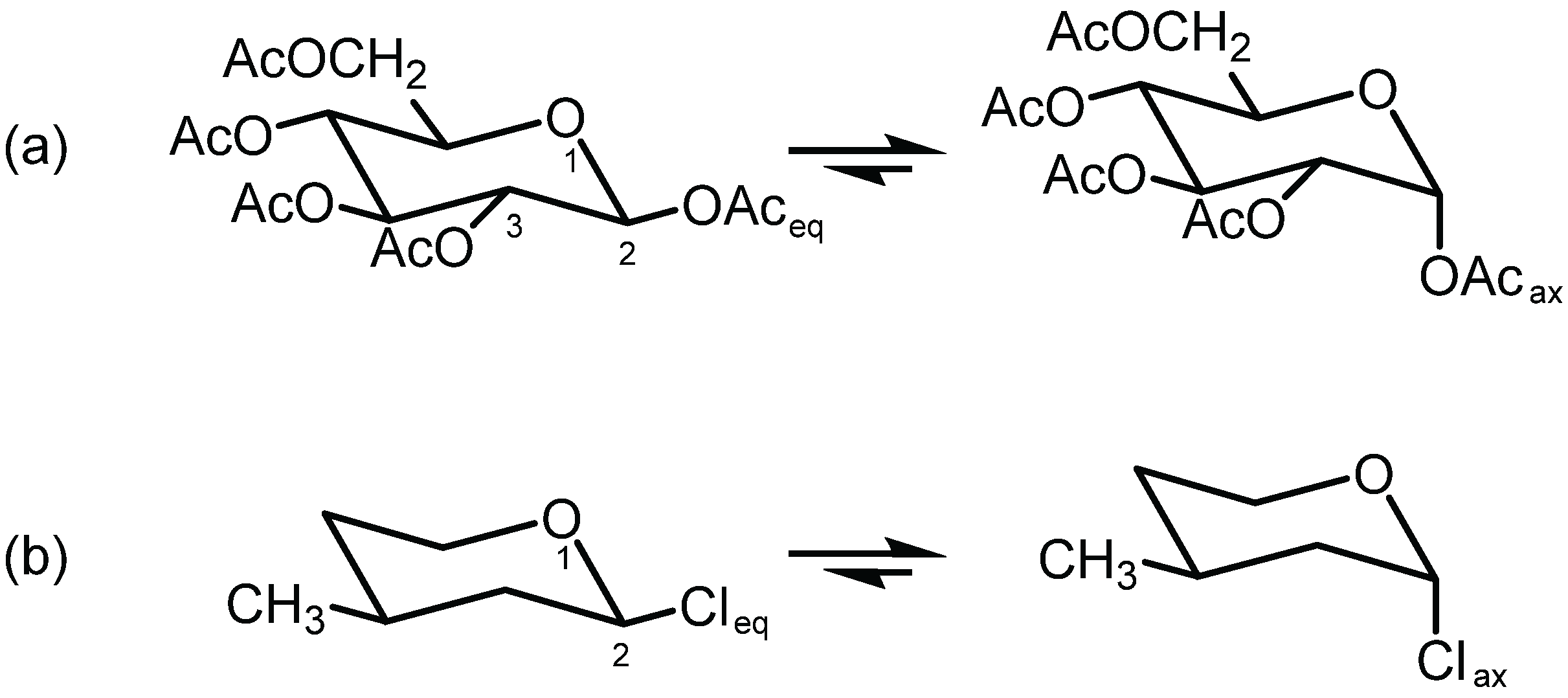
Figure 1.
Dipole interactions and hyperconjugation effect proposed in the anomeric effect. The bond dipole moments are marked in red, and the proposed electron delocalization in blue.
Figure 1.
Dipole interactions and hyperconjugation effect proposed in the anomeric effect. The bond dipole moments are marked in red, and the proposed electron delocalization in blue.
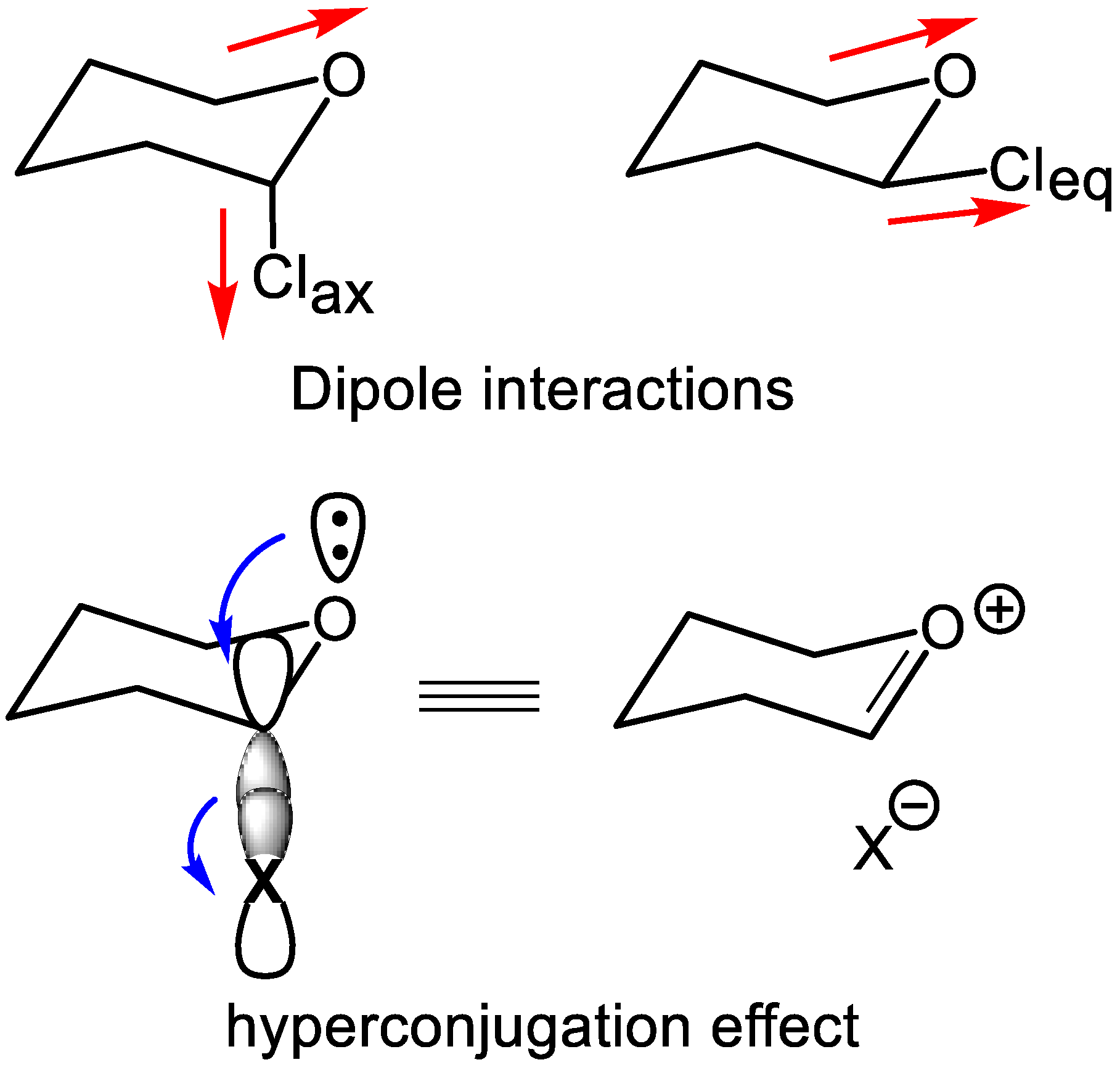
Figure 2.
Two major Coulombic attractions responsible for the anomeric effect in 2-substituted-1,3-dioxanes.
Figure 2.
Two major Coulombic attractions responsible for the anomeric effect in 2-substituted-1,3-dioxanes.
Scheme 2.
Two axial/equatorial conformations of six cyclic 2-substituted THPs I-X and the 60-/180-DA conformations of six acyclic substituted MMs II-X. The O−C−X motif involved in the anomeric effect is marked in blue.
Scheme 2.
Two axial/equatorial conformations of six cyclic 2-substituted THPs I-X and the 60-/180-DA conformations of six acyclic substituted MMs II-X. The O−C−X motif involved in the anomeric effect is marked in blue.
Scheme 3.
Axial III-X-a and equatorial III-X-e conformations of substituted Chs III-X.
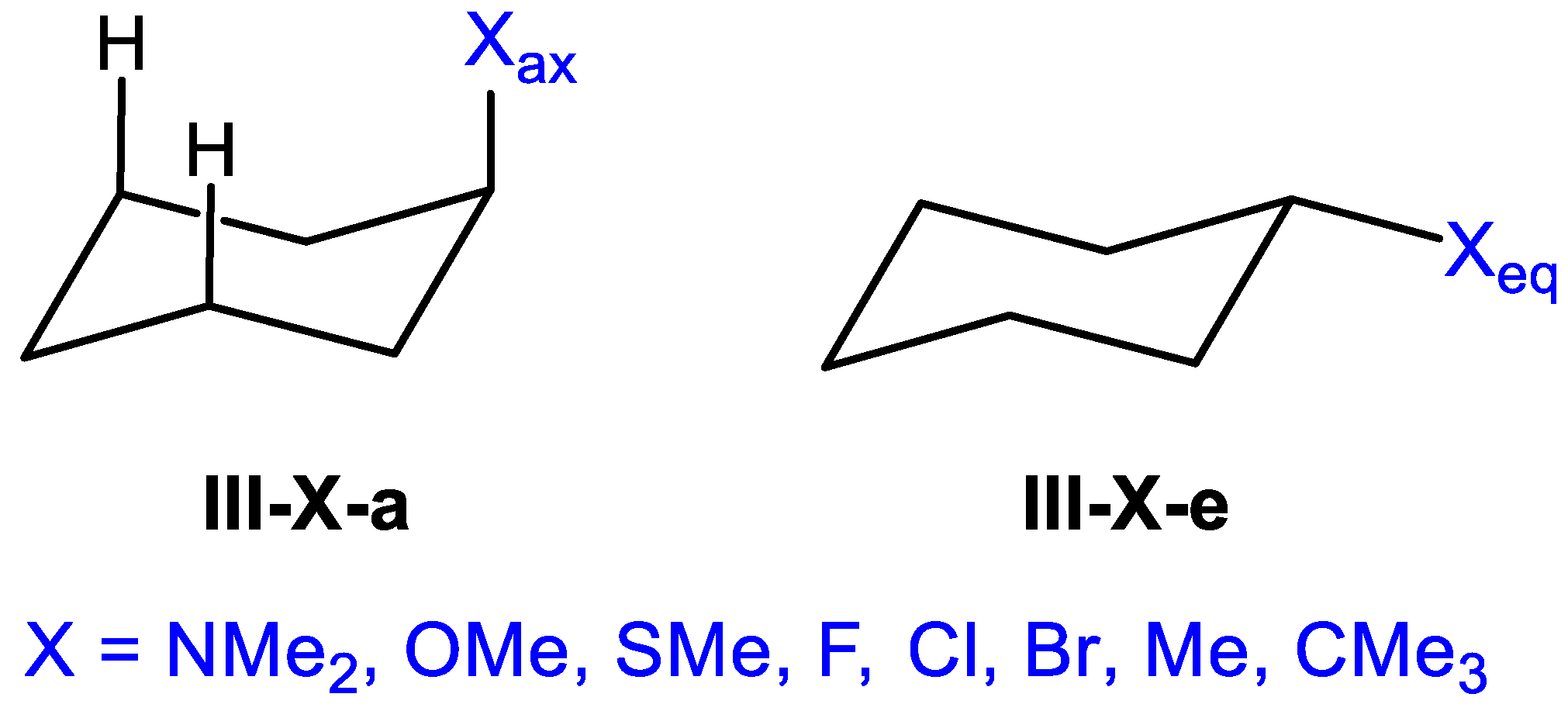
Figure 3.
Plot of the M06-2X/6-311G(d,p) gas-phase relative energies, ΔEe-a, between the corresponding 60- and 180-DA conformations of acyclic substituted MMs II-X versus the corresponding anomeric τ index (see Table 1). Energies are given in kcal·mol-1. MM II-S, which is shown in red, was excluded from the linear regression. Energies are given in kcal·mol⁻¹.
Figure 3.
Plot of the M06-2X/6-311G(d,p) gas-phase relative energies, ΔEe-a, between the corresponding 60- and 180-DA conformations of acyclic substituted MMs II-X versus the corresponding anomeric τ index (see Table 1). Energies are given in kcal·mol-1. MM II-S, which is shown in red, was excluded from the linear regression. Energies are given in kcal·mol⁻¹.
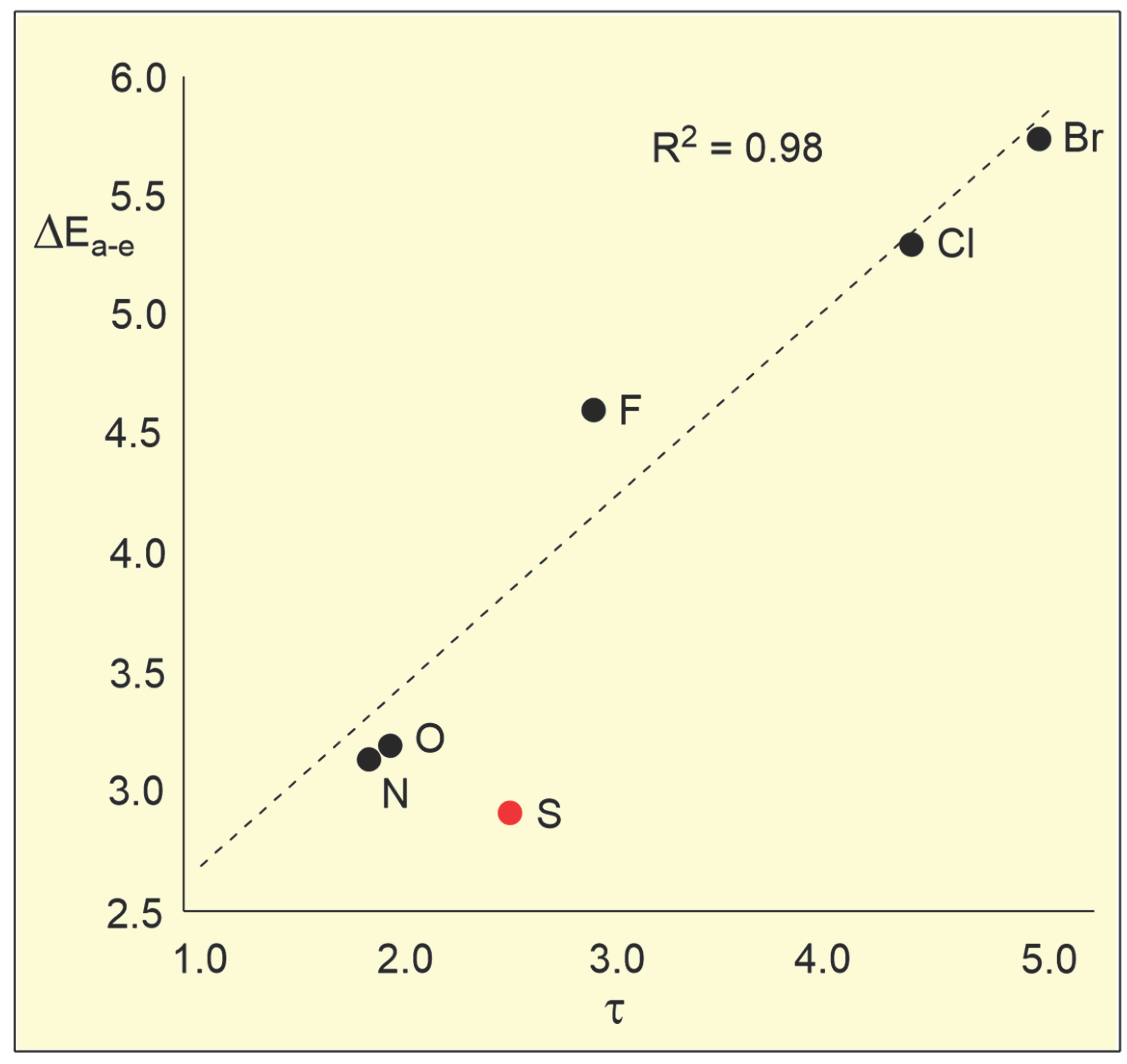
Figure 4.
Schematic representation of the proposed anomeric τ indices for the 2-substituted THPs I–X, arranged according to the group and period of the X atom in the periodic table. The τ values are given in kcal·mol-1.
Figure 4.
Schematic representation of the proposed anomeric τ indices for the 2-substituted THPs I–X, arranged according to the group and period of the X atom in the periodic table. The τ values are given in kcal·mol-1.
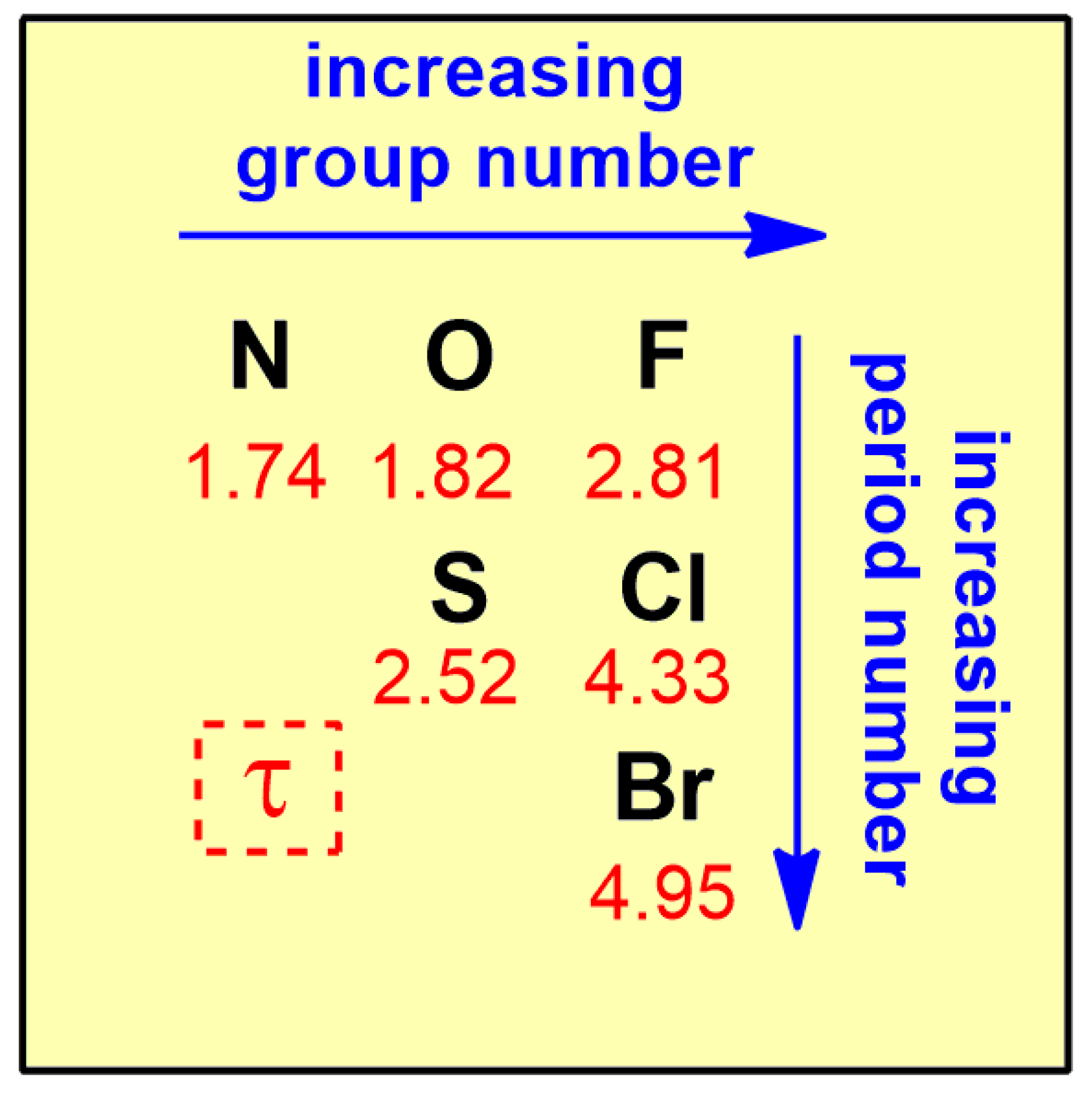
Figure 5.
Graphical representation of the Δ, in red, Δ, in blue, and Δ, in green, relative energies given in Table 2, in kcal·mol-1, with respect to the dielectric constant ε.
Figure 5.
Graphical representation of the Δ, in red, Δ, in blue, and Δ, in green, relative energies given in Table 2, in kcal·mol-1, with respect to the dielectric constant ε.
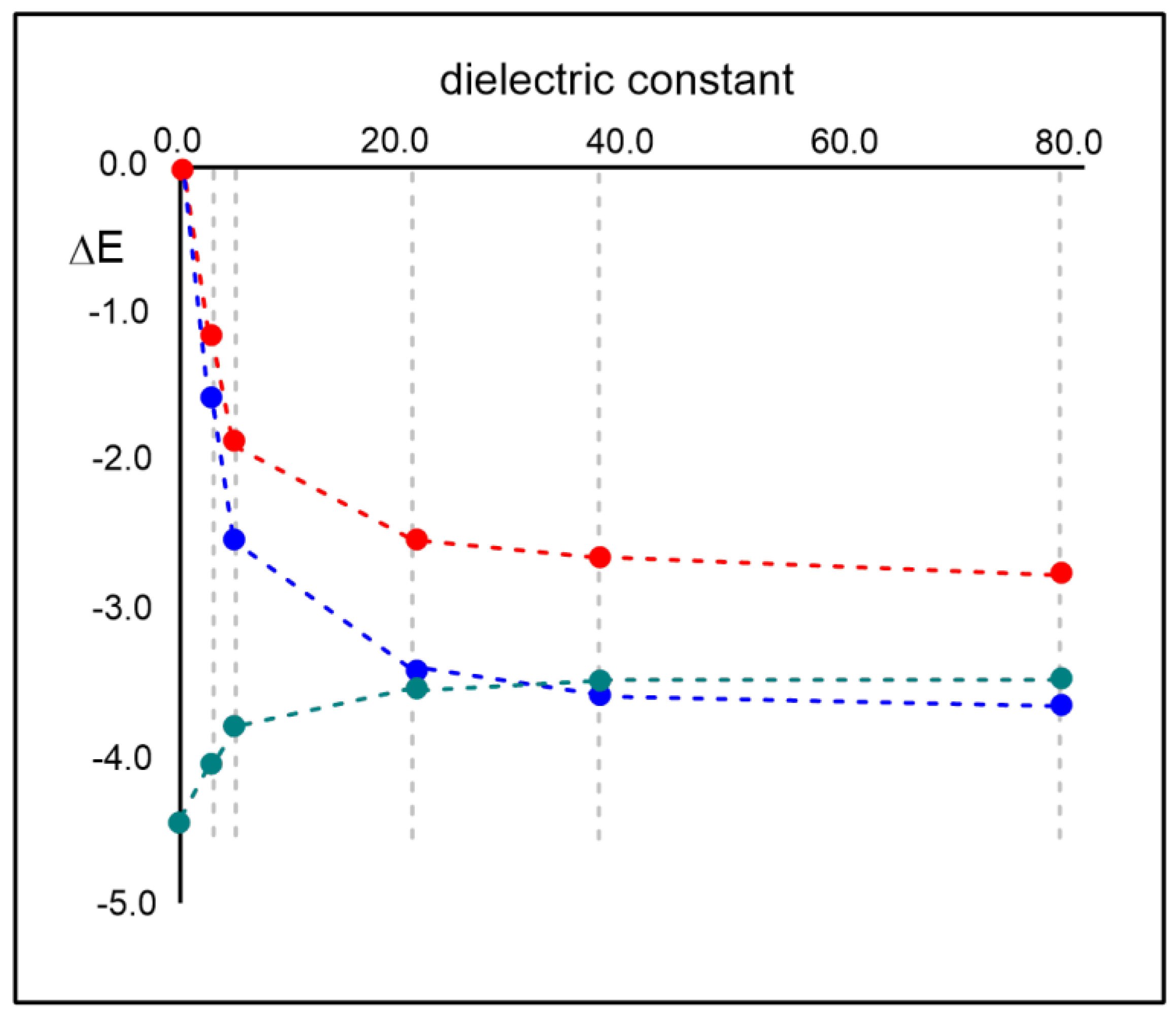
Figure 6.
M06-2X/6-311G(d,p) gas-phase optimized geometries of axial and equatorial conformations of THPs I-X. The bond lengths are given in angstroms, Å.
Figure 6.
M06-2X/6-311G(d,p) gas-phase optimized geometries of axial and equatorial conformations of THPs I-X. The bond lengths are given in angstroms, Å.
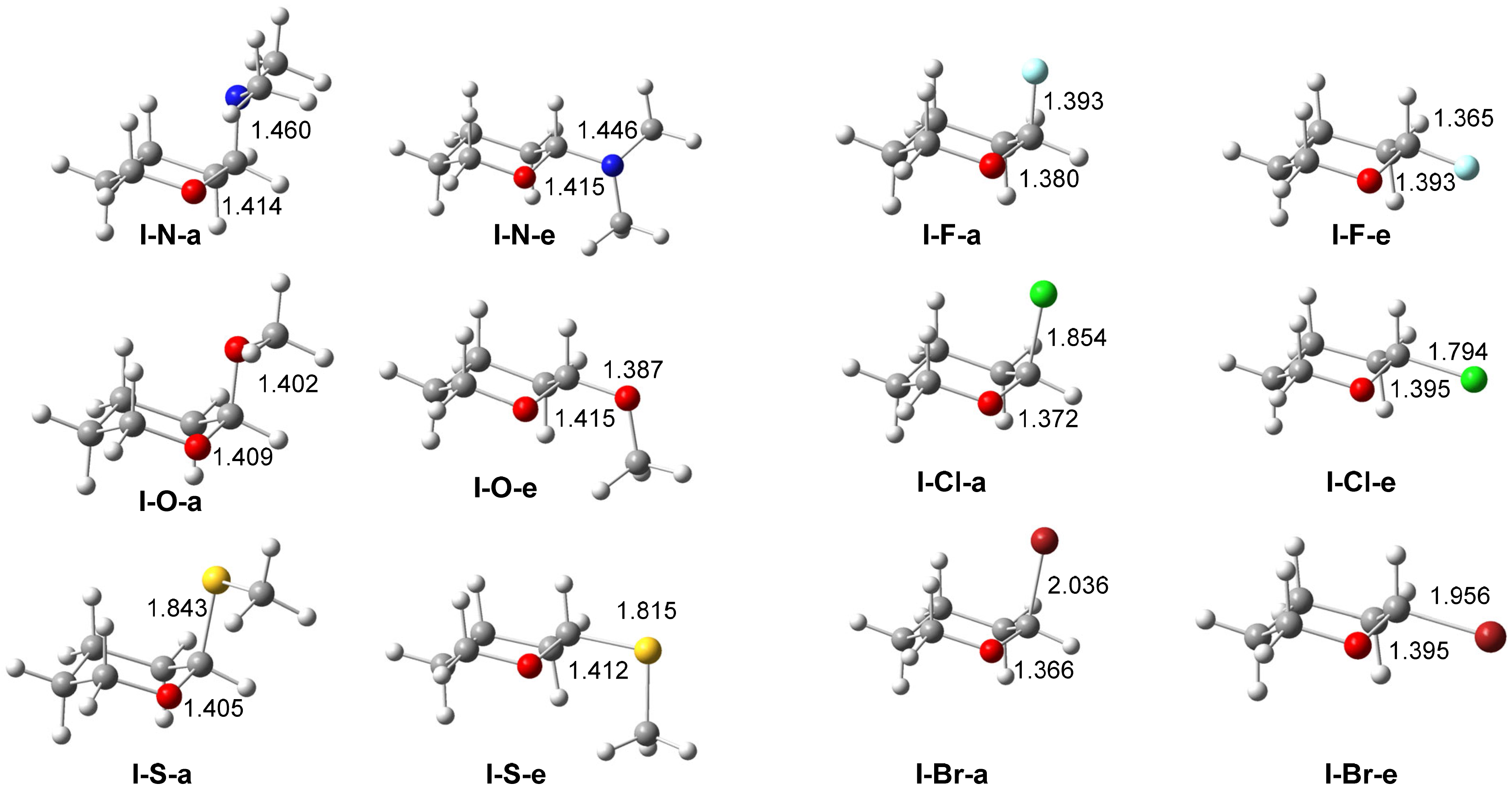
Figure 7.
M06-2X/6-311G(d,p) ELF valence basins at the 60- and 180-DA conformations of MMs II-F and II-Cl. The populations of the relevant V(C2,O1) and V(C2,X) disynaptic basins, in green, and V(O1) and V(X) monosynaptic basins, in red, are given in average number of electrons, e.
Figure 7.
M06-2X/6-311G(d,p) ELF valence basins at the 60- and 180-DA conformations of MMs II-F and II-Cl. The populations of the relevant V(C2,O1) and V(C2,X) disynaptic basins, in green, and V(O1) and V(X) monosynaptic basins, in red, are given in average number of electrons, e.
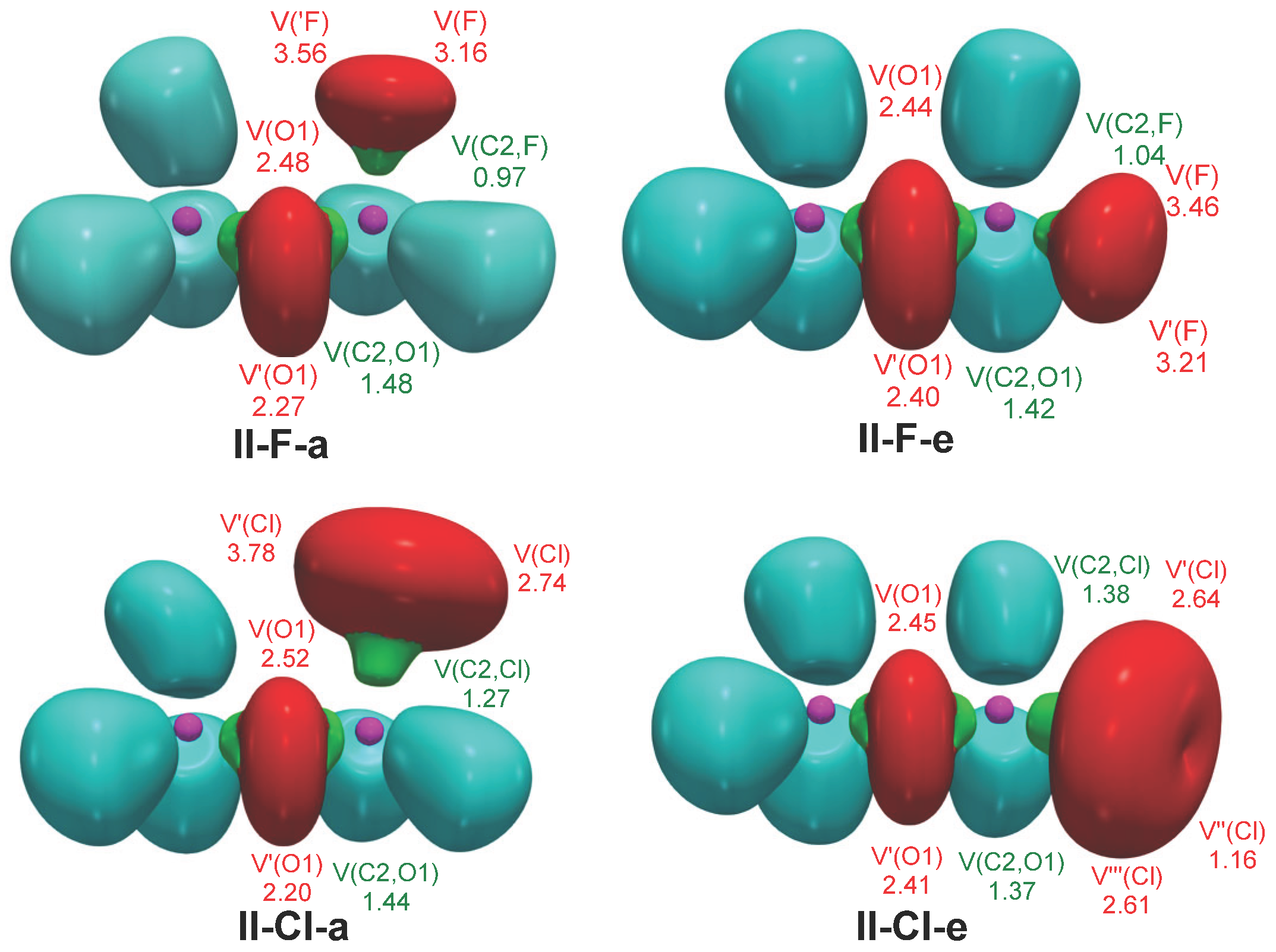
Figure 8.
Graphical representation of the sets of the M06-2X/6-311G(d,p) gas-phase relative ξ, ξ, and ξ total energies between the axial and equatorial conformations of 2-substituted THPs I-X. The relative ξ energies correspond to the RIAE activation energies between the two stereoisomers. Relatives ξ energies for the OCX and CH frameworks are shown in blue and red, respectively, while the black bar represents the relative ξ energies. All ξ energies are reported in kcal mol-1. The period position of X atom is shown in green.
Figure 8.
Graphical representation of the sets of the M06-2X/6-311G(d,p) gas-phase relative ξ, ξ, and ξ total energies between the axial and equatorial conformations of 2-substituted THPs I-X. The relative ξ energies correspond to the RIAE activation energies between the two stereoisomers. Relatives ξ energies for the OCX and CH frameworks are shown in blue and red, respectively, while the black bar represents the relative ξ energies. All ξ energies are reported in kcal mol-1. The period position of X atom is shown in green.
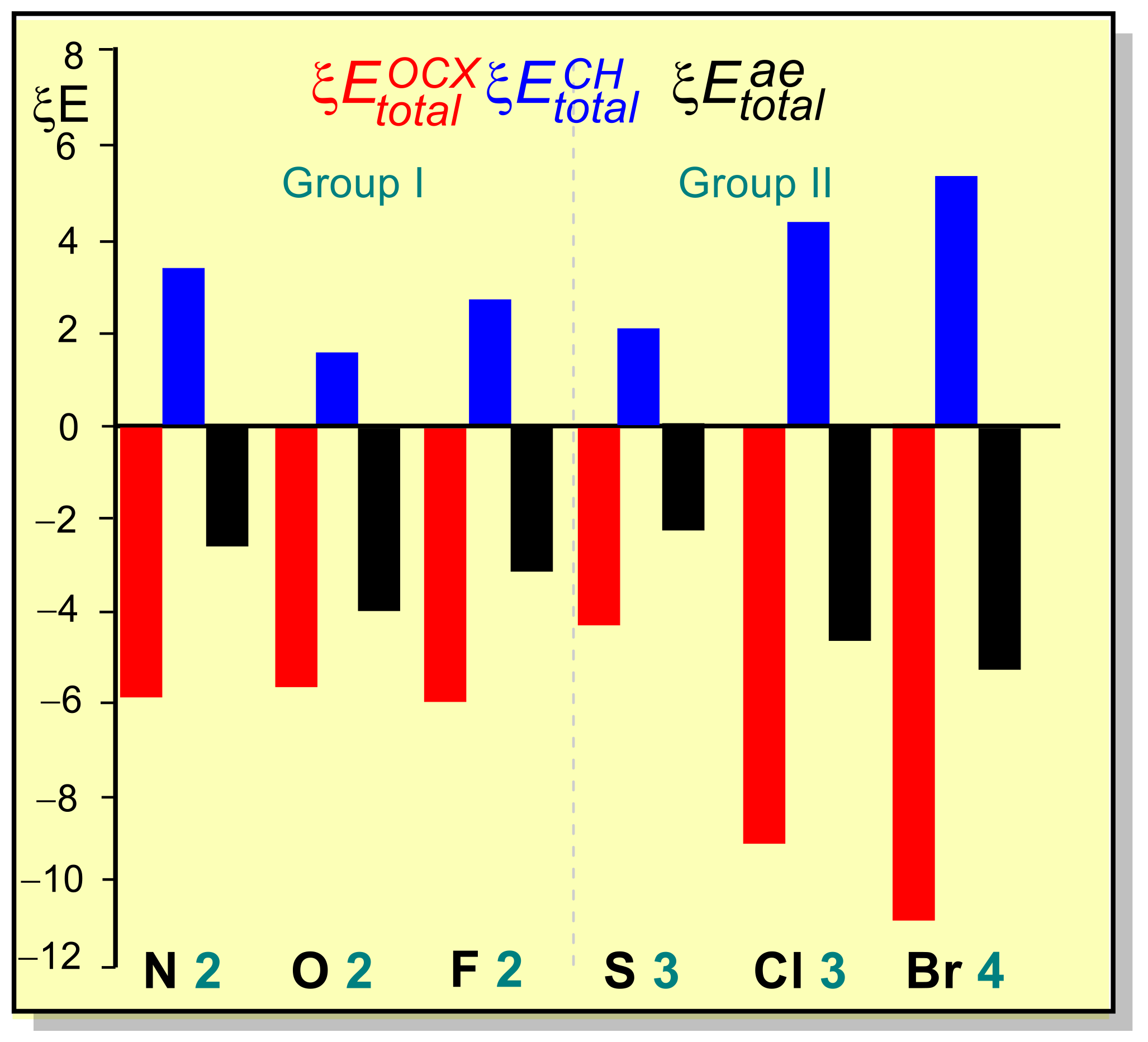

Table 1.
M06-2X/6-311G(d,p) gas-phase relative energies, ΔEe-a in kcal·mol-1, between the axial and equatorial conformations of cyclic 2-substituted THPs I-X, Δ, the 60- and 180-DA alternate conformations of acyclic substituted MMs II-X, Δ, and the axial and equatorial conformations of substituted Chs III-X, Δ. The anomeric τ index, in kcal·mol⁻¹, quantifies the contribution of the anomeric effect to the axial stabilization of 2-substituted THPs I–X.
Table 1.
M06-2X/6-311G(d,p) gas-phase relative energies, ΔEe-a in kcal·mol-1, between the axial and equatorial conformations of cyclic 2-substituted THPs I-X, Δ, the 60- and 180-DA alternate conformations of acyclic substituted MMs II-X, Δ, and the axial and equatorial conformations of substituted Chs III-X, Δ. The anomeric τ index, in kcal·mol⁻¹, quantifies the contribution of the anomeric effect to the axial stabilization of 2-substituted THPs I–X.
| THP-X | MM-X | Ch-X | ||||
|---|---|---|---|---|---|---|
| I-N | 2.80 | II-N | 3.14 | III-N | 1.06 | 1.74 |
| I-O | 4.38 | II-O | 3.19 | III-O | 2.56 | 1.82 |
| I-F | 3.23 | II-F | 4.59 | III-F | 0.42 | 2.81 |
| I-S | 2.28 | II-S | 2.79 | III-S | -0.24 | 2.52 |
| I-Cl | 4.26 | II-Cl | 5.28 | III-Cl | -0.07 | 4.33 |
| I-Br | 4.94 | II-Br | 5.74 | III-Br | -0.01 | 4.95 |
| I-Me | -2.42 | III-Me | -1.50 | |||
| III-tBu | -4.55 |
Table 2.
Dielectric constants ε of the solvents, relative energies of the axial and equatorial conformations with respect to the gas phase, Δ, and Δ, and relative axial-equatorial energies in the different solvents, Δ. Relative energies are given in kcal·mol-1.
Table 2.
Dielectric constants ε of the solvents, relative energies of the axial and equatorial conformations with respect to the gas phase, Δ, and Δ, and relative axial-equatorial energies in the different solvents, Δ. Relative energies are given in kcal·mol-1.
| Solvent | Dielectric constant | a | ||
|---|---|---|---|---|
| vacuo | 0.0 | 0.00 | 0.00 | -4.38 |
| benzene | 2.3 | -1.15 | -1.53 | -4.01 |
| chloroform | 4.7 | -1.85 | -2.48 | -3.76 |
| acetone | 20.7 | -2.50 | -3.39 | -3.50 |
| acetonitrile | 37.5 | -2.60 | -3.53 | -3.46 |
| water | 78.5 | -2.67 | -3.63 | -3.43 |
(a) values correspond to solvent-phase axial-equatorial energy differences defined by ΔΔΔ.
Table 3.
M06-2X/6-311G(d,p) relative axial/equatorial electronic energies, enthalpies and Gibbs free energies, Δ, Δ and Δ in kcal·mol-1,and entropies, Δ in cal·mol-1·K-1, computed in solvent at room temperature, for the axial/equatorial equilibrium of 2-methoxy THP I-O.
Table 3.
M06-2X/6-311G(d,p) relative axial/equatorial electronic energies, enthalpies and Gibbs free energies, Δ, Δ and Δ in kcal·mol-1,and entropies, Δ in cal·mol-1·K-1, computed in solvent at room temperature, for the axial/equatorial equilibrium of 2-methoxy THP I-O.
| solvent | -) | ||||
|---|---|---|---|---|---|
| benzene | -4.01 | -3.92 | 0.28 | -4.00 | -0.01 |
| acetone | -3.50 | -3.43 | 0.03 | -3.44 | -0.06 |
| water | -3.43 | -3.36 | 0.00 | -3.36 | -0.07 |
Table 4.
O1–C2 and C2–X bond-length differences, Δla-e = laxial - lequatorial, for the 2-substituted THPs I–X. Bond-length differences are given in Å.
Table 4.
O1–C2 and C2–X bond-length differences, Δla-e = laxial - lequatorial, for the 2-substituted THPs I–X. Bond-length differences are given in Å.
| O1 C2 | C2 X | |
| I-N | -0.001 | 0.015 |
| I-O | -0.006 | 0.015 |
| I-F | -0.013 | 0.028 |
| I-S | -0.007 | 0.028 |
| I-Cl | -0.023 | 0.060 |
| I-Br | -0.029 | 0.080 |
Table 5.
M06-2X/6-311G(d,p) natural atomic charges at the O1, C2, and X atoms of the axial and equatorial conformations of 2-substituted THPs I-X. Charges are given in average number of electrons, e.
Table 5.
M06-2X/6-311G(d,p) natural atomic charges at the O1, C2, and X atoms of the axial and equatorial conformations of 2-substituted THPs I-X. Charges are given in average number of electrons, e.
| I-N-a | I-O-a | I-F-a | I-S-a | I-Cl-a | I-Br-a | |
| O1 | -0.61 | -0.62 | -0.60 | -0.60 | -0.58 | -0.57 |
| C2 | 0.34 | 0.46 | 0.56 | 0.04 | 0.21 | 0.17 |
| X | -0.56 | -0.61 | -0.42 | 0.12 | -0.16 | -0.14 |
| I-N-e | I-O-e | I-F-e | I-S-e | I-Cl-e | I-Br-e | |
| O1 | -0.61 | -0.62 | -0.60 | -0.61 | -0.60 | -0.60 |
| C2 | 0.34 | 0.48 | 0.58 | 0.02 | 0.17 | 0.12 |
| X | -0.53 | -0.58 | -0.39 | 0.18 | -0.07 | -0.01 |
Table 6.
M06-2X/6-311G(d,p) gas-phase the axial/equatorial relative intra-atomic, interatomic, and total RIAE contributions ξ, ξ, and ξ, respectively, for the OCX and CH frameworks of 2-substituted THPs I-X. Energies are given in kcal·mol-1. The ξtotal energies provide axial stabilization associated with the energetic component of the anomeric effect, while the sum of the ξ energies of both frameworks, i.e., ξ, gives the total RIAE axial stabilization.
Table 6.
M06-2X/6-311G(d,p) gas-phase the axial/equatorial relative intra-atomic, interatomic, and total RIAE contributions ξ, ξ, and ξ, respectively, for the OCX and CH frameworks of 2-substituted THPs I-X. Energies are given in kcal·mol-1. The ξtotal energies provide axial stabilization associated with the energetic component of the anomeric effect, while the sum of the ξ energies of both frameworks, i.e., ξ, gives the total RIAE axial stabilization.
| I-X period | ƒ(X) | ξ | ξ | ξ | ξ |
|---|---|---|---|---|---|
| I-N 2 | OCX | -11.14 | 5.21 | -5.92 | -2.64 |
| CH | -4.75 | 8.03 | 3.28 | ||
| I-O 2 | OCX | -11.12 | 5.52 | -5.61 | -4.04 |
| CH | -3.99 | 5.56 | 1.57 | ||
| I-F 2 | OCX | -17.04 | 11.09 | -5.95 | -3.19 |
| CH | -1.64 | 4.40 | 2.76 | ||
| I-S 3 | OCX | 3.42 | -7.72 | -4.31 | -2.26 |
| CH | -1.38 | 3.43 | 2.05 | ||
| I-Cl 3 | OCX | 18.33 | -27.37 | -9.04 | -4.70 |
| CH | 1.01 | 3.34 | 4.34 | ||
| I-Br 4 | OCX | 23.35 | -34.05 | -10.70 | -5.31 |
| CH | 1.25 | 4.14 | 5.39 |
Table 7.
M06-2X/6-311G(d,p) gas-phase IQA intra-atomic energies, in a.u., and the relative intra-atomic energies, in kcal·mol-1, of C2 carbon of the axial and equatorial conformations of the nitrogen, fluorine and oxygen 2-substituted THPs I-X.
Table 7.
M06-2X/6-311G(d,p) gas-phase IQA intra-atomic energies, in a.u., and the relative intra-atomic energies, in kcal·mol-1, of C2 carbon of the axial and equatorial conformations of the nitrogen, fluorine and oxygen 2-substituted THPs I-X.
| T(A) | Vne(A) | Vee(A) | ||
|---|---|---|---|---|
| I-N-a | -37.2795 | 37.4094 | -86.7139 | 12.0249 |
| I-N-e | -37.2648 | 37.3969 | -86.6205 | 11.9589 |
| relative | -9.25 | 7.86 | -58.56 | 41.45 |
| I-O-a | -37.1487 | 37.2819 | -85.8739 | 11.4433 |
| I-O-e | -37.1268 | 37.2585 | -85.7474 | 11.3622 |
| relative | -13.76 | 14.70 | -79.36 | 50.90 |
| I-F-a | -37.0988 | 37.2438 | -85.6188 | 11.2762 |
| I-F-e | -37.0744 | 37.2244 | -85.5067 | 11.2079 |
| relative | -15.33 | 12.17 | -70.37 | 42.87 |
Table 10.
M06-2X/6-311G(d,p) gas-phase relative ξ intra-atomic, ξ interatomic and ξ total energies, in kcal·mol-1, between the axial and equatorial conformations of Chs III-O and III-Me.
Table 10.
M06-2X/6-311G(d,p) gas-phase relative ξ intra-atomic, ξ interatomic and ξ total energies, in kcal·mol-1, between the axial and equatorial conformations of Chs III-O and III-Me.
| ξ | ξ | ξ | |
|---|---|---|---|
| III-O | 1.10 | -3.75 | -2.65 |
| III-Me | 4.13 | -2.67 | 1.46 |
Disclaimer/Publisher’s Note: The statements, opinions and data contained in all publications are solely those of the individual author(s) and contributor(s) and not of MDPI and/or the editor(s). MDPI and/or the editor(s) disclaim responsibility for any injury to people or property resulting from any ideas, methods, instructions or products referred to in the content. |
© 2026 by the authors. Licensee MDPI, Basel, Switzerland. This article is an open access article distributed under the terms and conditions of the Creative Commons Attribution (CC BY) license.
Copyright: This open access article is published under a Creative Commons CC BY 4.0 license, which permit the free download, distribution, and reuse, provided that the author and preprint are cited in any reuse.