

Submitted:
25 August 2026
Posted:
25 August 2026
You are already at the latest version
Abstract
Background/Objectives: Suicidal ideation affects a considerable proportion of college students, and protective factors developed during childhood may mitigate it. We examined the relationship between benevolent childhood experiences (BCEs) and the frequency of suicidal ideation among Peruvian college students, as well as the moderating role of age, sex, and marital status. Methods: A total of 483 students from public and private universities in Peru (74.7% women; mean age 22.10 years) participated in the study and completed the BCEs scale and the Spanish version of the Suicide Ideation Frequency Inventory. Using a cross-sectional correlational-explanatory design, three moderation models were estimated via multiple linear regression. Results: EIBs were inversely and significantly associated with suicidal ideation (r = −.361, p < .001). Age moderated this relationship (ΔR² = .012, p = .026): the protective association persisted up to age 35 and faded in the group aged 36 and older. Neither sex nor marital status moderated the relationship, and the models explained between 14% and 20% of the variance. Conclusions: The findings support higher education as a protective factor that operates independently of sex and current relationship status and suggest incorporating its assessment into university mental health protocols, with a priority focus on emerging adulthood.
Keywords:
protective factors
; mental health
; suicide
; emerging adulthood
; multiple regression
; higher education
; Peru
1. Introduction
Suicidal ideation encompasses thoughts, cognitions, and plans related to the act of taking one’s own life and is the strongest predictor of suicide attempts and completed suicide [1,2]. Among the university population, the transition to higher education triggers a period of high psychosocial vulnerability characterized by simultaneous exposure to academic stressors, the reorganization of emotional bonds, and uncertainty regarding career and identity [3,4]. Mortier et al. [3] estimated that the prevalence of suicidal ideation among college students reaches 22.3% to over a lifetime and 10.6% in the past 12 months, with substantial variations depending on cultural context, gender, and the presence of psychopathology.
According to the World Health Organization (WHO) [5], suicidal ideation is one of the most relevant mental health indicators in the field of public health, and suicide is the fourth leading cause of death among people aged 15 to 29. It is estimated that for every completed suicide, there are between 10 and 20 prior nonfatal attempts, which highlight the magnitude of the phenomenon and the urgency of identifying risk and protective factors [2,5].
To understand how this phenomenon arises, Joiner’s psychological interpersonal model of suicide [6] proposes that suicidal ideation emerges when two psychological states converge: frustrated belonging—a sense of not being meaningfully connected to others—and the perception of being a burden to one’s environment [2,7,8]. Both states intensify in the face of loss, rejection, or failure during critical periods of development. Positive experiences act as structural support by providing cognitive-relational schemas of self-worth, identity, and hope. Emotional Regulation Theory [9] posits that individuals who had secure caregivers and school environments during childhood develop adaptive strategies for affect regulation, reducing the likelihood that college-related stressors will trigger suicidal ideation.
Among these early resources, benevolent childhood experiences (BCEs) encompass the protective resources acquired during childhood. They include positive experiences such as the presence of secure caregivers, stable friendships, support from significant adults outside the home, reassuring beliefs, and the availability of predictable household routines [10]. It has been demonstrated that higher levels of BCEs are associated with lower levels of perceived adversity, greater psychological resilience, and a reduced risk of psychopathology in adulthood [11,12,13]. Bethell et al. [14] propose that resilience functions within BCEs as a biopsychosocial buffer, modulating the negative impact of early adversity on mental health outcomes throughout the lifespan. BCEs are consistent with Bronfenbrenner’s ecological systems model [15], in which positive microsystems support socioemotional development and modulate vulnerability to subsequent stressors.
In specific area of suicide risk, Akbulut [16] and Kallapiran et al. [17] provided evidence of the association between benevolent childhood experiences and lower levels of suicidal ideation and behavior in adolescents and young adults [18,19]. These findings position benevolent childhood experiences as a highly valuable construct for preventive research in college mental health.
Despite these advances, studies examining the protective effect of benevolent childhood experiences on suicidal ideation among college students are scarce, especially in Latin America [7,8,20,21]. These studies focus on clinical samples or adolescents in developed countries, leaving a considerable gap in populations with sociodemographic diversity [22,23]. The prevalence of suicidal ideation varies significantly depending on gender, socioeconomic status, and the presence of stressful life events [24,25,26].
This gap also extends to the role of sociodemographic moderators. Age has a solid theoretical basis as a moderator: the early adult years (ages 16–25) are characterized by greater emotional lability and identity exploration processes that can amplify both the protective and risk effects of previous experiences [27,28]. Gender has been identified as a moderating variable in mental health studies: women have a higher prevalence of suicidal ideation, while men report a higher risk of completed suicide attempts, suggesting differences in symptomatic expression and coping [29,30,31,32]. Marital status is associated with perceived social support networks and the burden of responsibilities—factors that, in interaction with early life experiences, may influence vulnerability to suicidal ideation [2,3,33].
Considering the above, the general objective of this study is to examine the relationship between benevolent childhood experiences and the frequency of suicidal ideation in a sample of Peruvian college students, and to analyze whether this relationship varies according to age, gender, and marital status as sociodemographic moderators. The specific objectives are to determine the magnitude and direction of the association between benevolent childhood experiences and suicidal ideation; and to test moderation models for each sociodemographic variable to identify groups that are differentially protected or vulnerable. This study contributes to the body of evidence on early protective factors in college mental health in Latin America and offers concrete implications for the design of targeted preventive interventions [24,26,34].
1.1. Study Hypotheses
1.1.1. General Hypothesis
GH: Benevolent childhood experiences are inversely and significantly associated with the frequency of suicidal ideation among Peruvian college students, and this association varies according to sociodemographic moderators (age, gender, and marital status).
1.1.2. Hypotheses on the Main Relationship Between Benevolent Childhood Experiences and Suicidal Ideation
H1: Benevolent childhood experiences negatively and significantly predict the frequency of suicidal ideation among Peruvian college students, such that the greater the accumulation of protective childhood experiences, the lower the frequency of suicidal thoughts [14,16,17].
H2: Age moderates the relationship between benevolent childhood experiences and the frequency of suicidal ideation, such that the protective effect of BCEs is more pronounced in the young adult group (ages 16–25) than in older age groups [11,27,28].
H3: Gender moderates the relationship between benevolent childhood experiences and the frequency of suicidal ideation, such that the protective effect of BCEs differs between women and men [16,18,30,35].
H4: Marital status moderates the relationship between benevolent childhood experiences and the frequency of suicidal ideation, with the protective effect of BCEs being most pronounced among single college students, for whom the psychosocial capital internalized during childhood would compensate for the lack of support from a partner [2,6,36].
2. Materials and Methods
2.1. Study Design and Type
The study adopted a non-experimental cross-sectional design with a correlational-explanatory scope. A multiple moderation analysis model was employed to examine whether the association between benevolent childhood experiences (BCEs) and the frequency of suicidal ideation (FSI) varies according to sociodemographic variables (age, gender, and marital status) [37,38,39]. The cross-sectional design implies that all measurements were taken at a single point in time, which allows for the establishment of statistical associations [40,41].
2.2. Participants and Sampling Procedure
The sample consisted of 483 college students from public and private universities in Peru, mostly from institutions in the La Libertad and Áncash regions. The age range was between 16 and 66 years (M = 22.10, SD = 6.35), with a predominance of the emerging adulthood group aged 16 to 25 (82.4%). The sample was predominantly female (74.7%), unmarried (90.5%), and urban residents (81.8%). Regarding their field of study, 70.6% were majoring in psychology, followed by business administration (14.5%) and other disciplines.
A non-probabilistic convenience sampling method was used [42,43]. The inclusion criteria were being a college student, being enrolled in the 2025-I semester, and providing informed consent; for the 21 participants under the age of 18, parental or guardian consent and informed assent were also required. Of the 485 responses received, 2 questionnaires with omissions exceeding 10% of the items were excluded, resulting in a final sample of 483 cases.
The sample was predominantly female, young, single, and urban, with a significant proportion of participants who were not employed and were enrolled in the early stages of their programs (see Table 1).
2.3. Instruments
Benevolent Childhood Experiences Scale (BCEs). Throughout this article the construct is designated benevolent childhood experiences (BCEs), in accordance with the instrument administered; the literature uses this label interchangeably with positive childhood experiences (PCEs), and both terms are routinely searched as synonyms in systematic reviews of the field. The Benevolent Childhood Experiences Scale (BCEs) [10], administered in its Spanish version, consisting of 10 dichotomous response items (0 = No / 1 = Yes) that assess the cumulative presence of protective experiences during childhood, such as the availability of a secure caregiver, stable friendships, and access to predictable daily routines. The total score ranges from 0 to 10, with higher values indicating greater childhood protective capital. In the present sample, the scale obtained a KR-20 coefficient of .68, which is considered acceptable for dichotomous instruments with heterogeneous content [44]. Since the scale constitutes a cumulative index of heterogeneous experiences rather than a reflective construct, convergence indicators based on loadings (AVE or CR) were not estimated; evidence of validity is based on the instrument’s content and its theoretical relationship with suicidal ideation [10].
Suicidal Ideation Frequency Inventory (FSII). Suicidal ideation was measured using the Suicidal Ideation Frequency Inventory (FSII) [45], a five-item scale with a five-point Likert-type response format (1 = Never to 5 = Always) and scores ranging from 5 to 25, in its Spanish version [46]. The scale demonstrated excellent internal consistency (Cronbach’s α = .94), corrected item-total correlations ranging from .811 to .877, and an average extracted variance of .705 with a composite reliability of .923—indicators that meet psychometric standards for use in research [47,48]. The discriminant validity between BCEs and FIS was assessed using the HTMT index calculated from item correlations (HTMT = .449), which is below the strict threshold of .85 proposed by Henseler et al. [48]; both constructs are empirically distinguishable despite their theoretically inverse relationship (r = −.361, p < .001). Hereafter, FSII designates the measurement instrument by its original name, while BCEs and FIS refer to the constructs and their scores.
The descriptive statistics show that benevolent childhood experiences are concentrated primarily at the moderate and low levels, while the frequency of suicidal ideation exhibits a more heterogeneous distribution, with a still-significant percentage at the high level. In the descriptive comparison by gender, women report a higher mean score for suicidal ideation than men, although this observation should not be interpreted as inferential evidence on its own. At the item level, the most frequent positive experiences are related to enjoying school, the opportunity to have fun, and the presence of protective relationships, whereas, on the FIS, the highest average scores are associated with thoughts about ending one’s life and the perception of not deserving to live (see Table 2).
The results show that both scales function adequately. The BCEs exhibits acceptable reliability. The FIS exhibits adequate internal consistency and high item-total correlations, evidence that its items converge homogeneously toward a single construct. The borderline or acceptable discrimination indices of the BCEs reflect the very nature of the construct: benevolent childhood experiences are, by definition, diverse and do not necessarily converge with one another (see Table 3).
The indicators presented in Table 4 support the validity of the included measures. On the FIS scale, the AVE exceeds the recommended minimum threshold, and the composite reliability is high, indicating sufficient convergence of its indicators. The HTMT value between the BCEs and the FIS remains below both the strict and liberal cut-off points; thus, despite their inverse relationship, both variables retain satisfactory empirical differentiation.
2.4. Data Analysis
The analysis was organized into three stages. First, descriptive statistics and distribution indices were calculated to characterize the sample and describe the behavior of the study variables. The psychometric properties of the BCEs and FIS scales were examined using the KR-20 and Cronbach’s α reliability indices and the corrected item-total correlations (ritc); for the FIS, the average variance extracted (AVE) and composite reliability (CR) were also estimated, and the HTMT index was used as a criterion for discriminant validity [47,48]. Three independent moderation models were estimated for each sociodemographic variable—age, gender, and marital status—using multiple linear regression with an interaction term (BCEs × moderator) [37].
Age was entered as a multicategorical variable using two categories (26–35 years and 36 years or older; reference group: 16–25 years); gender was analyzed using a dummy variable (0 = female, 1 = male), excluding from the inferential analysis those who chose not to disclose it (n = 5) due to insufficient sample size, and marital status was dichotomized (0 = single, 1 = not single). As a sensitivity analysis, the age model was re-estimated with age as a centered continuous variable. For each model, the unstandardized coefficients (B), standard error (SE), t-statistic, p-value, 95% confidence intervals, and the change in R2 (ΔR2)—attributable to the interaction term—are reported. Finally, the simple regression slopes were plotted for each level of the moderator to facilitate the substantive interpretation of the significant interactions. All analyses were conducted at a significance level of α = .05. Statistical analysis was performed using SPSS version 28.0 [56] and JASP 0.18 [57]; moderation models were estimated using the PROCESS macro [37] via indicator coding.
2.5. Ethical Considerations
The study was conducted in full accordance with the ethical principles of the Declaration of Helsinki [58] and with the Code of Ethics and Professional Conduct of the Peruvian College of Psychologists [59]. Since the assessment included items related to suicidal ideation, a safety protocol was implemented that provided information on mental health resources at the end of the questionnaire, in accordance with recommendations for research involving vulnerable populations [60], in addition to informed consent. The data were stored in encrypted form, and only the research team had access to the database, always ensuring confidentiality [61]. This research was reviewed and approved by the Research Ethics Committee of the School of Psychology at César Vallejo University under Report No. 01807-2025/CEI-PSI.
3. Results
The bivariate association between BCEs and FIS was negative and significant (r = −.361, p < .001), supporting H1: the greater the accumulation of protective childhood experiences, the lower the frequency of suicidal ideation. The three moderation models are presented below.
3.1. Model 1. Age as a Moderator
Age moderated the relationship between BCEs and suicidal ideation (Table 5): the interaction term added a significant change in R2 (ΔR2 = .012, F (2, 477) = 3.67, p = .026), attributable to the difference in slope between the 36 years or older group and the reference group (b = 1.147, p = .007). The simple slopes show a clear protective association among those aged 16–25 (b = −0.993, p < .001) and between ages 26 and 35 (b = −0.821, p = .004), which disappears in the group aged 36 or older (b = 0.154, p = .708), supporting H2. This pattern should be interpreted with caution because the older group comprises only 23 cases and its slope is estimated to be low precision. As a sensitivity analysis, the model with centered continuous age yielded a consistent interaction (b = 0.056, SE = 0.017, p < .001, R2 = .217) (see Figure 1).
3.2. Model 2. Moderation by Gender
In the second model, summarized in Table 6 and presented in Figure 2, gender did not moderate the relationship between benevolent childhood experiences and the frequency of suicidal ideation, b = −0.083, p = .748; therefore, H3 is not supported. The slopes for women and men are nearly parallel: the difference between groups lies in the baseline level and not in the strength of the protective association. The “prefer not to say” group (n = 5) was excluded from the inferential comparison due to insufficient sample size; its scores are described in Table 2 and discussed further in the discussion section.
3.3. Model 3. Moderation by Marital Status
In the third model (Table 7), the interaction between BCEs and marital status also failed to reach statistical significance, b = 0.563, p = .110, with a marginal contribution to variance (ΔR2 = .004); therefore, H4 is not supported. The inverse association between benevolent childhood experiences and suicidal ideation is clearly maintained among single individuals (b = −0.946, p < .001), whereas the “non-single” category encompasses heterogeneous situations (cohabiting, married, divorced, and widowed; n = 46), so its slope should be interpreted descriptively (see Figure 3).
4. Discussion
The purpose of this study was to examine the relationship between benevolent childhood experiences and the frequency of suicidal ideation among Peruvian college students, considering age, gender, and marital status as potential sociodemographic moderators. The findings indicate a protective association between benevolent childhood experiences and suicidal ideation, which is consistent and statistically robust (r = −.361, p < .001), although its modulation by sociodemographic variables is selective, with varying degrees of effect depending on the moderator considered. The three regression models explain between 14% and 20% of the variance in suicidal ideation (R2 between .141 and .201). These percentages, while not accounting for the full variability of the phenomenon, are relevant given that these are moderation models involving complex psychosocial constructs assessed in non-clinical populations [37,38].
Regarding the main hypothesis, benevolent childhood experiences significantly and negatively predicted the frequency of suicidal ideation. This result is supported by the protective effect of early psychosocial capital against suicide risk. A recent meta-analysis documented that benevolent childhood experiences are associated with fewer mental health symptoms in adulthood [12]. Narayan et al. [11] found that benevolent childhood experiences predict lower levels of psychopathology even among individuals with a history of early adversity, suggesting that their protective effect is not limited to the absence of risk but rather reflects the active presence of resources that strengthen the individual’s regulatory capacity. The correlation coefficient obtained in the present study (r = −.361) is of moderate magnitude and is consistent with previous evidence on positive experiences and suicidal ideation among young people [16,33], which provides external consistency.
These results lend themselves to a direct theoretical interpretation. Joiner’s interpersonal-psychological model of suicide [6] identifies frustrated belonging and the perception of being a burden as the central psychological states underlying this behavior. Positive life events associated with the presence of secure caregivers (86.5%), stable friendships (86.5%), and the opportunity to engage in enjoyable activities (90.1%) act as structural antidotes to both states [11,14]. Turecki et al. [2] noted that early relational protective factors reduce suicide risk through mechanisms of affect regulation and meaning making, which are consolidated during sensitive periods of development and are difficult to reverse in the face of subsequent adversity. One finding that deserves special attention is that three-quarters of the participants in the present study (75.4%) reported low or moderate BCEs scores, while only 24.6% reached the high level. This distribution suggests that a considerable proportion of college students enter higher education with insufficient protective childhood capital, increasing their vulnerability to the academic and existential stressors characteristic of this stage of life.
The item-by-item analysis provides further insight into this picture. The experiences with the lowest frequency of affirmative responses were those linked to autonomy and self-knowledge: item 9 (self-acceptance, 68.9%) and item 10 (predictable daily routine, 66.5%) recorded the lowest affirmation rates, while items related to external social connections exceeded 86%. In the sample studied, protective experiences of the relational-external type are more accessible than those associated with positive self-concept and internal household stability. This has direct implications for the design of interventions: it is not enough to promote social integration on campus if, at the same time, the intrapsychic resources that enable students to translate these connections into schemas of self-worth are not addressed [7,9]. A similar pattern is observed on the FIS scale, where the item with the highest mean score was the one referring to the existential question of what would happen if one were to end one’s own life (M = 2.24), pointing to suicidal thoughts that are more reflective than impulsive in nature. This pattern has been identified in the literature as particularly prevalent in college samples with high levels of rumination [62,63].
Regarding moderators, the age model yielded a statistically significant interaction term (ΔR2 = .012, F (2, 477) = 3.67, p = .026) within a model explaining 20.1% of the total variance, indicating that age has a real, albeit modest, effect on the magnitude of the protective association of BCEs. The direction of the effect is theoretically consistent: the negative slope of BCEs on suicidal ideation persists in adults up to age 35, most notably in the 16–25 age group, which accounts for 82.4% of the sample, and disappears in the group aged 36 and older. This progression is consistent with Arnett [27], who explains that emerging adulthood is a period of maximum receptivity to resources internalized during childhood, insofar as the tasks of identity exploration and the consolidation of emotional bonds characteristic of this stage would reactivate the internal working models formed within the early family unit.
A complementary explanation comes from neurobiological evidence: Teicher and Samson [64] found that early protective experiences generate functional differences in neural circuits linked to stress regulation, such as the prefrontal cortex and the hypothalamic-pituitary-adrenal axis; these effects become apparent during late adolescence and emerging adulthood, a period in which synaptic plasticity still allows for some reorganization of stress response systems. In this regard, the protective effect of BCEs is more pronounced in the younger group: not only because these students are closer in time to their childhood experiences, but also because their affective regulation systems exert a greater influence on the cognitive-emotional response to current stressors. In Peru, college students in their first years of study report higher levels of suicidal ideation, especially during the first semesters of academic adjustment [24,65], making the moderating effect of age a finding with clear preventive relevance.
However, this finding must be considered with caution. The distribution of the moderator variable is markedly asymmetric, with 82.4% of participants concentrated in the young adult group and only 23 cases in the group aged 36 or older. This asymmetry compromises the statistical power needed to reliably estimate the slopes in the smaller groups and could also inflate the interaction term because of the differential weight that each category exerts on the calculation of the regression coefficients [37,38].
Unlike age, gender did not statistically significantly moderate the relationship between BCEs and suicidal ideation (b = −0.083, p = .748, ΔR2 < .001), and the regression slopes for women and men were visually nearly parallel. This finding represents a significant contribution: it indicates that the protective capital accumulated during childhood exerts a buffering effect on suicidal ideation in a similar manner for both genders, without the gender-differentiated socialization altering the intensity of this protection. Eagly and Wood’s social roles theory [66] would suggest that women, who are socialized to express emotions and actively seek interpersonal support, would be better able to capitalize on relational resources such as bonds with friends or the presence of supportive adults. The absence of moderation suggests that the mechanisms through which BCEs reduce suicidal ideation transcend the gender variable and operate via intrapsychic pathways that are relatively independent of gender [9,18,19].
This lack of moderation does not contradict the previously documented differences in levels between the sexes. Miranda-Mendizábal et al. [30] documented that sex does differentially predict the level of suicidal ideation, although they noted that early relational protective factors operate across both groups. Mortier et al. [3] found that sex differences in the prevalence of suicidal ideation are robust and replicable, but that their magnitude is reduced when early protective factors are controlled for. In the present sample, this same pattern is replicated with remarkable precision: women report a higher mean level of suicidal ideation than men (10.54 versus 8.70), but the slope of the relationship between BCEs and FIS does not differ between genders, indicating that early protective capital benefits both groups to a similar degree.
The group that identified as “I’d rather not say” (n = 5) deserves special attention, as its mean score for suicidal ideation was significantly higher than that of women and men (15.60 versus 10.54 and 8.70, respectively). Although the small size of this subgroup precludes any statistical inferences, the magnitude of the descriptive difference is clinically striking and points to a line of research that cannot be overlooked. The evidence consistently indicates that gender-diverse individuals face disproportionately high rates of suicidal ideation and behavior, associated with experiences of discrimination, family rejection, and a lack of institutional recognition [2,35]. In the Peruvian university context, where the visibility and protection of these identities are still in their infancy, this finding warrants further examination in future studies with sample sizes specifically designed for gender-diverse populations.
The third moderator showed a similar pattern: marital status was not a significant moderator of the relationship between protective childhood experiences and suicidal ideation (b = 0.563, p = .110, ΔR2 = .004), reaffirming that the inverse relationship between protective childhood experiences and suicidal ideation holds regardless of the student’s relationship status. Joiner’s interpersonal theory [6] and Cutrona and Russell’s social support compensation model [36] suggest that psychosocial resources internalized during childhood act as functional substitutes for adult relational support. The absence of moderation indicates that the protective effect of protective childhood experiences does not depend on the availability of external social support in adulthood but rather operates through mechanisms that are autonomous and intrinsic to the individual.
The mechanisms that would explain this independence are intrapersonal in nature. Narayan et al. [11] and Morris and Hays-Grudo [18] noted that early protective experiences operate by promoting adaptive emotional regulation strategies, consolidating a positive self-concept, and developing mentalization skills that allow the individual to interpret relational stressors without activating schemas of abandonment or worthlessness. These mechanisms are intrapersonal in nature and, therefore, relatively independent of the subject’s current relational conditions [9,14,67].
On the instrumental level, the Benevolent Childhood Experiences Scale yielded a KR-20 = .68, a value that falls at the lower limit of the acceptable range for dichotomous instruments and is to be expected given the heterogeneous nature of the construct: BCEs constitute, by design, an index of the accumulation of qualitatively diverse experiences [14]. The mean inter-item correlation value (r̄ij = .178) falls within the optimal range for broadly defined multidimensional constructs [50]. The corrected item-total correlations for the BCEs ranged from .221 to .438, with several items falling within the borderline range; far from undermining the instrument’s validity, this reflects the breadth of the protective domain that the scale aims to capture.
For its part, the Suicidal Ideation Frequency Inventory presented a homogeneous psychometric profile: α = .94, item-total correlations between .811 and .877, and a mean inter-item correlation of .759, slightly above the optimal range. The values for convergent validity (AVE = .705) and composite reliability (CR = .923) are robust and exceed the recommended thresholds [47], while the HTMT index = .449—which is below the strict threshold of .85 [48]—confirms the empirical distinguishability between BCEs and FIS, a necessary condition for the valid interpretation of a moderation model. These indicators are comparable to those reported in validation studies of suicide ideation scales among Latin American university students [24,26].
Three theoretical contributions emerge from the study. The first is evidence of the protective effect of BCEs on suicidal ideation in a Latin American university sample, which expands the cross-cultural scope of the benevolent experience accumulation model [10,14] and suggests that the mechanism of accumulating protective childhood capital operates according to a similar logic across different sociocultural settings, with variations attributable to the specific characteristics of each context. The second contribution relates to the significant moderating effect of age, which confirms that young adults are particularly sensitive to the effects of early resources, in line with Arnett’s model [27]. The third finding indicates an absence of moderation by both gender and marital status, suggesting that the protective effect of BCEs is cross-sectional in nature and not contingent on current sociodemographic factors.
Regarding the magnitude of the phenomenon, 29.2% of the sample scored in the high range on the empirical scales, and 23.6% reported having thought about suicide at least “sometimes” (item 4 of the FIS), figures that warrant preventive concern. Given this reality, the integration of systematic mental health assessments that consider both risk and protective factors into university admission protocols is a priority [3,4,26]. The inclusion of the brief BCEs scale, which has acceptable psychometric properties in the Peruvian sample, would enable the early identification of students with insufficient childhood protective capital, allowing for their referral to preventive psychological support services [9,27,34,68,69,70].
The descriptive data on high levels of suicidal ideation in the group that chose not to disclose their gender point to the need to create spaces for psychological care with a focus on gender diversity and inclusion, without waiting to have statistically sufficient samples to draw formal inferences [2,30].
4.1. Limitations
The main limitation is the cross-sectional design, which prevents the establishment of causal relationships between BCEs and suicidal ideation. Although life-course theory posits that childhood experiences temporally precede mental health outcomes in adulthood, this causal sequence cannot be verified with the data from the present study [11,13]. Added to this are the non-probability convenience sampling and the sample composition—with a predominance of psychology students (70.6%) and women (74.7%)—which limit the generalizability of the findings. The measures were self-reported, and recall of childhood experiences may be biased by current emotional state. The imbalance in age groups and marital status reduces the precision of slopes in the minority categories. The Spanish version of the BCEs scale has not yet undergone published psychometric validation in the Peruvian population, although its indicators in the present sample were acceptable. Finally, emotional regulation, cited as an explanatory mechanism, was not measured directly; therefore, it should be treated as a hypothesis to be tested in future studies.
5. Conclusions
The results of this study support the notion that benevolent childhood experiences act as a protective factor against suicidal ideation among Peruvian college students, with an association of moderate magnitude and a direction consistent with the postulates of the biopsychosocial model of resilience. This protective effect is moderated by age, although it does not vary by gender or marital status. This indicates that psychosocial capital internalized during childhood acts as a cross-cutting protective resource, independent of gender and the individual’s current relational status. These findings have direct implications for suicide prevention in university settings, as they identify benevolent childhood experiences as an assessable and intervenable domain that should be incorporated into university mental health protocols. The psychometric soundness of the instruments used, verified through indicators of reliability and discriminant validity, supports the feasibility of their use in both future research and clinical-preventive applications in the Peruvian and Latin American contexts. Continuing this line of research using longitudinal designs and more diverse and balanced samples is not only methodologically important but also ethically necessary, given the magnitude of the risk of suicide documented in the university population studied.
Author Contributions
Conceptualization, H.M.A.-A. and V.G.V.-C.; methodology, H.M.A.-A. and O.E.S.R.; software, M.A.A.B.; validation, M.A.A.B. and L.A.Y.-A.; formal analysis, L.A.Y.-A.; investigation, H.M.A.-A. and M.d.C.Q.V.; resources, V.G.V.-C.; data curation, M.A.A.B.; writing—original draft preparation, V.G.V.-C. and M.d.C.Q.V.; writing—review and editing, L.A.Y.-A. and O.E.S.R.; visualization, L.A.Y.-A.; supervision, V.G.V.-C.; project administration, H.M.A.-A. All authors have read and agreed to the published version of the manuscript.
Funding
This research received no external funding.
Institutional Review Board Statement
The study was conducted in accordance with the Declaration of Helsinki and approved by the Research Ethics Committee of the School of Psychology of César Vallejo University (protocol code 01807-2025/CEI-PSI, date of approval: 10 November 2025).
Informed Consent Statement
Informed consent was obtained from all adult participants; for participants under 18 years of age, informed consent was obtained from their parents or legal guardians, and informed assent was obtained from the participants themselves.
Data Availability Statement
The authors will provide, upon request, the raw data supporting the conclusions of this article.
Conflicts of Interest
The authors declare no conflicts of interest.
Abbreviations
The following abbreviations are used in this manuscript:
| AVE | Average variance extracted |
| BCEs | Benevolent Childhood Experiences (construct and scale) |
| CI | Confidence interval |
| CR | Composite reliability |
| FIS | Frequency of suicidal ideation (construct and score) |
| FSII | Suicidal Ideation Frequency Inventory |
| HTMT | Heterotrait–Monotrait ratio |
| KR-20 | Kuder-Richardson formula 20 |
| ritc | Corrected item-total correlation |
| WHO | World Health Organization |
References
- Mandel, A.A.; Kleiman, E.M.; Johnson, S.; Rogers, M.L.; Jobes, D.A.; Joiner, T. A test of invariance of the construct of suicidal ideation across three diverse samples. J. Affect. Disord. 2023, 329, 124–130. [Google Scholar] [CrossRef] [PubMed]
- Turecki, G.; Brent, D.A.; Gunnell, D.; O’Connor, R.C.; Oquendo, M.A.; Pirkis, J.; Stanley, B.H. Suicide and suicide risk. Nat. Rev. Dis. Prim. 2019, 5, 74. [Google Scholar] [CrossRef] [PubMed]
- Mortier, P.; Cuijpers, P.; Kiekens, G.; Auerbach, R.P.; Demyttenaere, K.; Green, J.G.; Kessler, R.C.; Nock, M.K.; Bruffaerts, R. The prevalence of suicidal thoughts and behaviors among college students: A meta-analysis. Psychol. Med. 2018, 48, 554–565. [Google Scholar] [CrossRef] [PubMed]
- Griffin, S.M.; Lebedová, A.; Cruwys, T.; McMahon, G.; Foran, A.M.; Skrodzka, M.; Gallagher, S.; Ginty, A.T.; Muldoon, O.T. Identity change and the transition to university: Implications for cortisol awakening response, psychological well-being, and academic performance. Appl. Psychol. Health Well-Being 2025, 17, e12608. [Google Scholar] [CrossRef] [PubMed]
- World Health Organization. Suicide Worldwide in 2019: Global Health Estimates. Available online: https://www.who.int/publications/i/item/9789240026643 (accessed on Day Month Year).
- Joiner, T. Why People Die by Suicide; Harvard University Press: Cambridge, MA, USA, 2005. [Google Scholar]
- Pérez, S.; Layrón, J.E.; Barrigón, M.L.; Baca-García, E.; Marco, J.H. Perceived burdensomeness, thwarted belongingness, and hopelessness as predictors of future suicidal ideation in Spanish university students. Death Stud. 2024, 48, 454–464. [Google Scholar] [CrossRef] [PubMed]
- Lin, C.-C.; Linscott, R.J. Longitudinal mediation by perceived burden of the pathway from thwarted belonging to suicidal ideation. Suicide Life-Threat. Behav. 2022, 52, 1193–1204. [Google Scholar] [CrossRef] [PubMed]
- Gross, J.J. Emotion regulation: Current status and future prospects. Psychol. Inq. 2015, 26, 1–26. [Google Scholar] [CrossRef]
- Narayan, A.J.; Rivera, L.M.; Bernstein, R.E.; Harris, W.W.; Lieberman, A.F. Positive childhood experiences predict less psychopathology and stress in pregnant women who experienced childhood adversity: A pilot study of the Benevolent Childhood Experiences (BCEs) Scale. Child Abus. Negl. 2018, 78, 19–30. [Google Scholar] [CrossRef] [PubMed]
- Narayan, A.J.; Lieberman, A.F.; Masten, A.S. Intergenerational transmission and prevention of adverse childhood experiences (ACEs). Clin. Psychol. Rev. 2021, 85, 101997. [Google Scholar] [CrossRef] [PubMed]
- Zhang, Y. Positive childhood experiences and adult mental health symptoms: A meta-analysis. Dev. Psychopathol. 2026, 38, 766–781. [Google Scholar] [CrossRef] [PubMed]
- Huang, C.X.; Halfon, N.; Sastry, N.; Chung, P.J.; Schickedanz, A. Positive childhood experiences and adult health outcomes. Pediatrics 2023, 152, e2022060951. [Google Scholar] [CrossRef] [PubMed]
- Bethell, C.; Jones, J.; Gombojav, N.; Linkenbach, J.; Sege, R. Positive childhood experiences and adult mental and relational health in a statewide sample: Associations across levels of adverse childhood experiences. JAMA Pediatr. 2019, 173, e193007. [Google Scholar] [CrossRef] [PubMed]
- Bronfenbrenner, U. The Ecology of Human Development: Experiments by Nature and Design; Harvard University Press: Cambridge, MA, USA, 1979. [Google Scholar]
- Akbulut, Ö.F. Positive Childhood Experiences, Suicide Cognitions, Subjective Happiness, and mental well-being in young adults: A half-longitudinal serial mediation study. Psychiatr. Q. advance online publication. 2025. [Google Scholar] [CrossRef] [PubMed]
- Kallapiran, K.; Suetani, S.; Cobham, V.; Eapen, V.; Scott, J. Impact of Positive Childhood Experiences (PCEs): A systematic review of longitudinal studies. Child Psychiatry Hum. Dev. advance online publication. 2025. [Google Scholar] [CrossRef] [PubMed]
- Morris, A.S.; Hays-Grudo, J. Protective and compensatory childhood experiences and their impact on adult mental health. World Psychiatry 2023, 22, 150–151. [Google Scholar] [CrossRef] [PubMed]
- Ion, A.; Bîlc, M.I.; Pițur, S.; Pop, C.F.; Szentágotai-Tătar, A.; Miu, A.C. Childhood maltreatment and emotion regulation in everyday life: An experience sampling study. Sci. Rep. 2023, 13, 7214. [Google Scholar] [CrossRef] [PubMed]
- Kritikou, M.; Giovazolias, T. Emotion regulation, academic buoyancy, and academic adjustment of university students within a self-determination theory framework: A systematic review. Front. Psychol. 2022, 13, 1057697. [Google Scholar] [CrossRef] [PubMed]
- Han, D.; Dieujuste, N.; Doom, J.R.; Narayan, A.J. A systematic review of positive childhood experiences and adult outcomes: Promotive and protective processes for resilience in the context of childhood adversity. Child Abus. Negl. 2023, 144, 106346. [Google Scholar] [CrossRef] [PubMed]
- Sousa, M.; Machado, A.B.; Pinheiro, M.; Pereira, B.; Caridade, S.; Almeida, T.C.; Cruz, A.R.; Cunha, O. The Impact of Positive Childhood Experiences: A Systematic Review focused on children and adolescents. Trauma Violence Abus. 2026, 27, 527–541. [Google Scholar] [CrossRef] [PubMed]
- Cunha, O.; Sousa, M.; Pereira, B.; Pinheiro, M.; Machado, A.B.; Caridade, S.; Almeida, T.C. Positive Childhood Experiences and Adult Outcomes: A Systematic Review. Trauma Violence Abus. 2025, 26, 991–1010. [Google Scholar] [CrossRef] [PubMed]
- Nicho-Almonacid, T.L.; Melendrez-Ugarte, D.S.; Olivas-Ugarte, L.O. An explanatory model of suicide risk among college students in Metropolitan Lima. Liberabit 2024, 30, e743. [Google Scholar] [CrossRef]
- Zhao, M.; Xin, Y.; Bai, X.; Zhang, S.; Liu, H.; Xu, W.; Duan, W.; Jin, Q.; Chen, Y.; Luo, Y.; et al. Risk factors for suicidality among college students: A systematic review and meta-. J. Affect. Disord. 2025, 382, 567–578. [Google Scholar] [CrossRef] [PubMed]
- Valladares-Garrido, D.; Zila-Velasque, J.P.; Santander-Hernández, F.M.; Guevara-Morales, M.A.; Morocho-Alburqueque, N.; Failoc-Rojas, V.E.; Pereira-Victorio, C.J.; Vera-Ponce, V.J.; León-Figueroa, D.A.; Valladares-Garrido, M.J. Association between romantic breakups and suicidal ideation in Peruvian medical students: A cross-sectional study during the COVID-19 pandemic. Front. Psychiatry 2024, 14, 1287036. [Google Scholar] [CrossRef] [PubMed]
- Arnett, J.J. Emerging adulthood: A theory of development from the late teens through the twenties. Am. Psychol. 2000, 55, 469–480. [Google Scholar] [CrossRef]
- Silvers, J.A.; Peris, T.S. Research Review: The neuroscience of emerging adulthood—Reward, ambiguity, and social support as building blocks of mental health. J. Child Psychol. Psychiatry 2023, 64, 989–997. [Google Scholar] [CrossRef] [PubMed]
- Haregu, T.; Cho, E.; Spittal, M.; Armstrong, G. The rate of transition to a suicide attempt among people with suicidal thoughts in the general population: A systematic review. J. Affect. Disord. 2023, 331, 57–63. [Google Scholar] [CrossRef] [PubMed]
- Miranda-Mendizábal, A.; Castellví, P.; Parés-Badell, O.; Alayo, I.; Almenara, J.; Alonso, I.; Blasco, M.J.; Cebrià, A.; Gabilondo, A.; Gili, M.; et al. Gender differences in suicidal behavior in adolescents and young adults: Systematic review and meta-analysis of longitudinal studies. Int. J. Public Health 2019, 64, 265–283. [Google Scholar] [CrossRef] [PubMed]
- Richardson, C.; Robb, K.A.; McManus, S.; O’Connor, R.C. Psychosocial factors that distinguish between men and women who have suicidal thoughts and attempt suicide: Findings from a national probability sample of adults. Psychol. Med. 2023, 53, 3133–3141. [Google Scholar] [CrossRef] [PubMed]
- Reeves, K.W.; Vasconez, G.; Weiss, S.J. Characteristics of suicidal ideation: A systematic review. Arch. Suicide Res. 2022, 26, 1736–1756. [Google Scholar] [CrossRef] [PubMed]
- Bunting, L.; McCartan, C.; Davidson, G.; Grant, A.; Mulholland, C.; Schubotz, D.; Hamill, R.; McBride, O.; Murphy, J.; Nolan, E.; et al. The influence of adverse and positive childhood experiences on young people’s mental health and experiences of self-harm and suicidal ideation. Child Abus. Negl. 2023, 140, 106159. [Google Scholar] [CrossRef] [PubMed]
- Kessler, R.C.; Luedtke, A. Pragmatic precision psychiatry—A new direction for optimizing treatment selection. JAMA Psychiatry 2021, 78, 1384–1390. [Google Scholar] [CrossRef] [PubMed]
- Li, R.; Zhang, X.; Liu, L.; Yu, Q.; Wang, W. Exploring the relationship between childhood maltreatment and suicidal ideation: Gender differences in the mediating roles of self-compassion and posttraumatic stress disorder. J. Interpers. Violence 2026, 41, 3587–3608. [Google Scholar] [CrossRef] [PubMed]
- Cutrona, C.E.; Russell, D.W. Type of social support and specific stress: Toward a theory of optimal matching. In Social Support: An Interactional View; Sarason, B.R., Sarason, I.G., Pierce, G.R., Eds.; Wiley: New York, NY, USA, 1990; pp. 319–366. [Google Scholar]
- Hayes, A.F. Introduction to Mediation, Moderation, and Conditional Process Analysis: A Regression-Based Approach, 3rd ed.; Guilford Press: New York, NY, USA, 2022. [Google Scholar]
- Frazier, P.A.; Tix, A.P.; Barron, K.E. Testing moderator and mediator effects in counseling psychology research. J. Couns. Psychol. 2004, 51, 115–134. [Google Scholar] [CrossRef]
- Preacher, K.J.; Rucker, D.D.; Hayes, A.F. Addressing moderated mediation hypotheses: Theory, methods, and recommendations. Multivar. Behav. Res. 2007, 42, 185–227. [Google Scholar] [CrossRef] [PubMed]
- Shadish, W.R.; Cook, T.D.; Campbell, D.T. Experimental and Quasi-Experimental Designs for Generalized Causal Inference; Houghton Mifflin: Boston, MA, USA, 2002. [Google Scholar]
- Montero, I.; León, O.G. A guide for naming research studies in psychology. Int. J. Clin. Health Psychol. 2007, 7, 847–862. [Google Scholar] [CrossRef]
- Hernández-Sampieri, R.; Mendoza, C. Research Methodology: Quantitative, Qualitative, and Mixed Methods Approaches; McGraw-Hill, 2018. [Google Scholar]
- Otzen, T.; Manterola, C. Sampling techniques for a study population. Int. J. Morphol. 2017, 35, 227–232. [Google Scholar] [CrossRef]
- Nunnally, J.C.; Bernstein, I.H. Psychometric Theory, 3rd ed.; McGraw-Hill: New York, NY, USA, 1994. [Google Scholar]
- Chang, E.C.; Chang, O.D. Development of the Frequency of Suicidal Ideation Inventory: Evidence for the validity and reliability of a brief measure of suicidal ideation frequency in a college student population. Cogn. Ther. Res. 2016, 40, 549–556. [Google Scholar] [CrossRef]
- Sánchez-Álvarez, N.; Extremera, N.; Rey, L.; Chang, E.C.; Chang, O.D. Frequency of Suicidal Ideation Inventory: Psychometric properties of the Spanish version. Psicothema 2020, 32, 253–260. [Google Scholar] [CrossRef] [PubMed]
- Hair, J.F.; Hult, G.T.M.; Ringle, C.M.; Sarstedt, M. A Primer on Partial Least Squares Structural Equation Modeling (PLS-SEM), 3rd ed.; Sage: Thousand Oaks, CA, USA, 2022. [Google Scholar]
- Henseler, J.; Ringle, C.M.; Sarstedt, M. A new criterion for assessing discriminant validity in variance-based structural equation modeling. J. Acad. Mark. Sci. 2015, 43, 115–135. [Google Scholar] [CrossRef]
- Nock, M.K.; Borges, G.; Bromet, E.J.; Cha, C.B.; Kessler, R.C.; Lee, S. Suicide and suicidal behavior. Epidemiol. Rev. 2008, 30, 133–154. [Google Scholar] [CrossRef] [PubMed]
- Clark, L.A.; Watson, D. Constructing validity: Basic issues in objective scale development. Psychol. Assess. 1995, 7, 309–319. [Google Scholar] [CrossRef]
- Felitti, V.J.; Anda, R.F.; Nordenberg, D.; Williamson, D.F.; Spitz, A.M.; Edwards, V.; Koss, M.P.; Marks, J.S. Relationship of childhood abuse and household dysfunction to many of the leading causes of death in adults: The Adverse Childhood Experiences (ACE) Study. Am. J. Prev. Med. 1998, 14, 245–258. [Google Scholar] [CrossRef] [PubMed]
- Dube, S.R.; Anda, R.F.; Felitti, V.J.; Chapman, D.P.; Williamson, D.F.; Giles, W.H. Childhood abuse, household dysfunction, and the risk of attempted suicide throughout the life span: Findings from the Adverse Childhood Experiences Study. JAMA 2001, 286, 3089–3096. [Google Scholar] [CrossRef] [PubMed]
- Rönkkö, M.; Cho, E. Reporting reliability, convergent, and discriminant validity using structural equation modeling: A review and best-practice recommendations. Asia Pac. J. Manag. 2023, 40, 1343–1385. [Google Scholar] [CrossRef]
- Roemer, E.; Schuberth, F.; Henseler, J. HTMT2—An improved criterion for assessing discriminant validity in structural equation modeling. Ind. Manag. Data Syst. 2021, 121, 2637–2650. [Google Scholar] [CrossRef]
- Hair, J.F.; Risher, J.J.; Sarstedt, M.; Ringle, C.M. When to use and how to report the results of PLS-SEM. Eur. Bus. Rev. 2019, 31, 2–24. [Google Scholar] [CrossRef]
- IBM Corp. IBM SPSS Statistics for Windows, Version 28.0. In Computer Software; IBM Corp.: Armonk, NY, USA, 2021. [Google Scholar]
- JASP Team. JASP, Version 0.18; Computer Software. 2023. Available online: https://jasp-stats.org (accessed on Day Month Year).
- World Medical Association. World Medical Association Declaration of Helsinki: Ethical principles for medical research involving human subjects. JAMA 2013, 310, 2191–2194. [Google Scholar] [CrossRef] [PubMed]
- Peruvian College of Psychologists. Code of Ethics and Professional Conduct of the Peruvian College of Psychologists. Available online: https://www.cpsp.pe/images/documentos/marco_legal/CPsP_CDN_codigo_de_etica_y_deontologia.pdf (accessed on Day Month Year).
- Call, C.C.; Eckstrand, K.L.; Kasparek, S.W.; Boness, C.L.; Blatt, L.; Jamal-Orozco, N.; Novacek, D.M.; Foti, D. Scholars for Elevating Equity and Diversity (SEED). An ethics and social justice approach to collecting and using demographic data for psychological researchers. Perspect. Psychol. Sci. 2023, 18, 979–995. [Google Scholar] [CrossRef] [PubMed]
- Israel, M.; Hay, I. Research Ethics for Social Scientists; Sage: London, UK, 2006. [Google Scholar] [CrossRef]
- Rosario-Williams, B.; Miranda, R. Prospective relationship between ruminative subtypes and suicidal ideation: The moderating role of problem solving. Cogn. Ther. Res. 2023, 47, 574–586. [Google Scholar] [CrossRef] [PubMed]
- Hallard, R.I.; Wells, A.; Aadahl, V.; Emsley, R.; Pratt, D. Metacognition, rumination, and suicidal ideation: An experience sampling test of the self-regulatory executive function model. Psychiatry Res. 2021, 303, 114083. [Google Scholar] [CrossRef] [PubMed]
- Teicher, M.H.; Samson, J.A. Annual research review: Enduring neurobiological effects of childhood abuse and neglect. J. Child Psychol. Psychiatry 2016, 57, 241–266. [Google Scholar] [CrossRef] [PubMed]
- Crisol-Deza, D.; Poma-Ramírez, D.; Pacherres-López, A.; Noriega-Baella, C.; Villanueva-Zúñiga, L.; Salvador-Carrillo, J.; Huarcaya-Victoria, J. Factors associated with suicidal ideation among medical students during the initial phase of the COVID-19 pandemic in Peru: A multicenter study. Death Stud. 2023, 47, 183–191. [Google Scholar] [CrossRef] [PubMed]
- Eagly, A.H.; Wood, W. Social role theory. In Handbook of Theories of Social Psychology; Van Lange, P.A.M., Kruglanski, A.W., Higgins, E.T., Eds.; Sage: London, UK, 2012; Volume 2, pp. 458–476. [Google Scholar] [CrossRef]
- Yan, L.; Wu, J. From childhood experience to stress resilience: Mechanisms and interventions. Curr. Opin. Behav. Sci. 2024, 58, 101405. [Google Scholar] [CrossRef]
- Guo, S.; O’Connor, M.; Mensah, F.; Olsson, C.A.; Goldfeld, S.; Lacey, R.E.; Slopen, N.; Thurber, K.A.; Priest, N. Measuring Positive Childhood Experiences: Testing the Structural and Predictive Validity of the Health Outcomes From Positive Experiences (HOPE) Framework. Acad. Pediatr. 2022, 22, 942–951. [Google Scholar] [CrossRef] [PubMed]
- Sege, R.D.; Aslam, M.V.; Peterson, C.; Bethell, C.; Burstein, D.; Niolon, P.H.; Jones, J.; Ettinger de Cuba, S.; Hannan, K.; Swedo, E.A. Positive Childhood Experiences and Adult Health and Opportunity Outcomes in 4 U.S. States. JAMA Netw. Open 2025, 8, e2524435. [Google Scholar] [CrossRef] [PubMed]
- Caro Delgado, A.G.; Ballesteros-Cabrera, M.d.P. Suicidal ideation among adolescents and young adults in Latin America and the Caribbean: A scoping review. Rev. Salud Pública 2022, 24(6). [Google Scholar] [CrossRef]
Figure 1.
Interaction between benevolent childhood experiences and age on the frequency of suicidal ideation. Note. The figure was generated using the unstandardized coefficients from the model.
Figure 1.
Interaction between benevolent childhood experiences and age on the frequency of suicidal ideation. Note. The figure was generated using the unstandardized coefficients from the model.
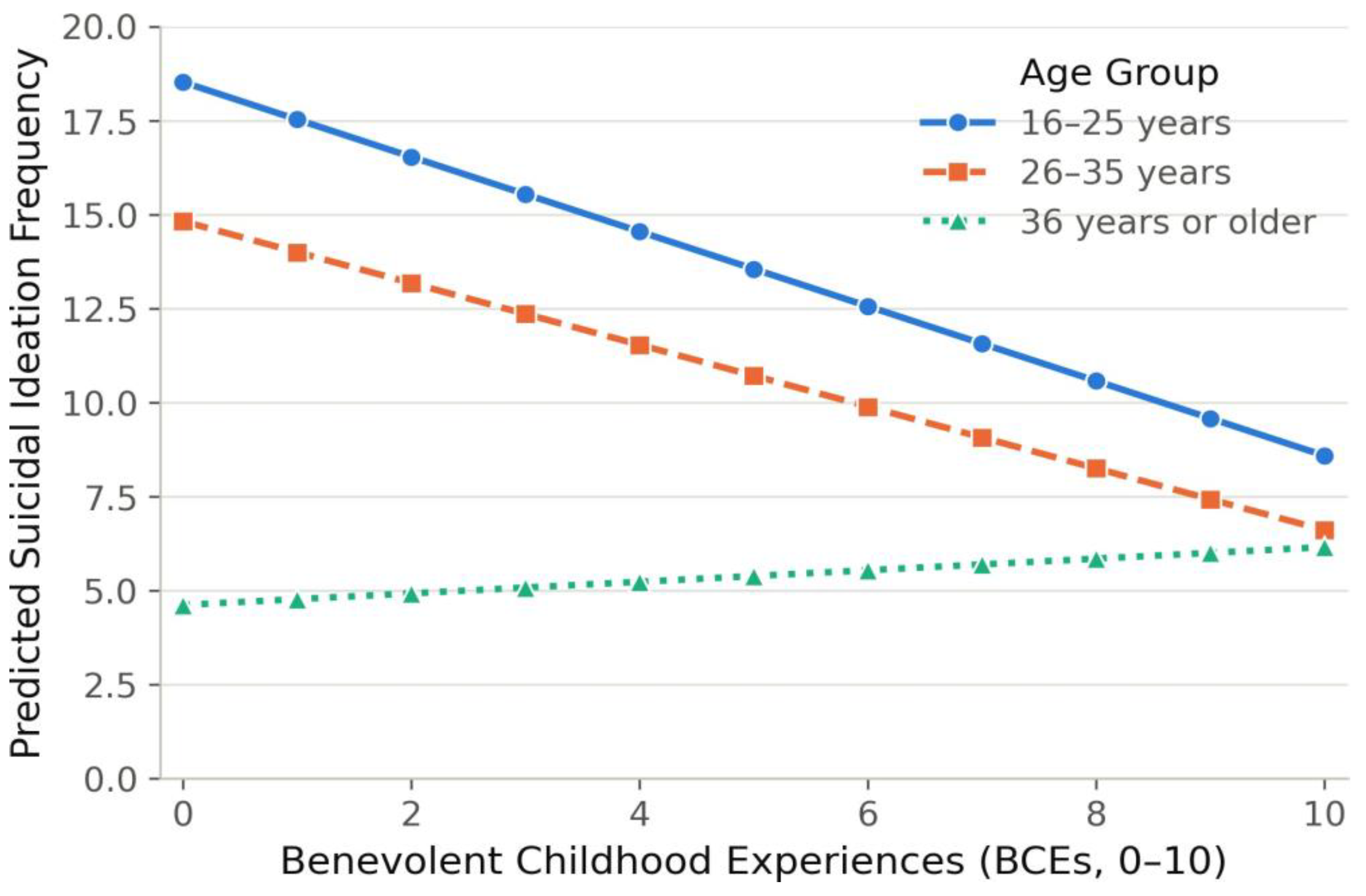
Figure 2.
Interaction between benevolent childhood experiences and gender on the frequency of suicidal ideation. Note. The figure was generated using the model’s unstandardized coefficients.
Figure 2.
Interaction between benevolent childhood experiences and gender on the frequency of suicidal ideation. Note. The figure was generated using the model’s unstandardized coefficients.
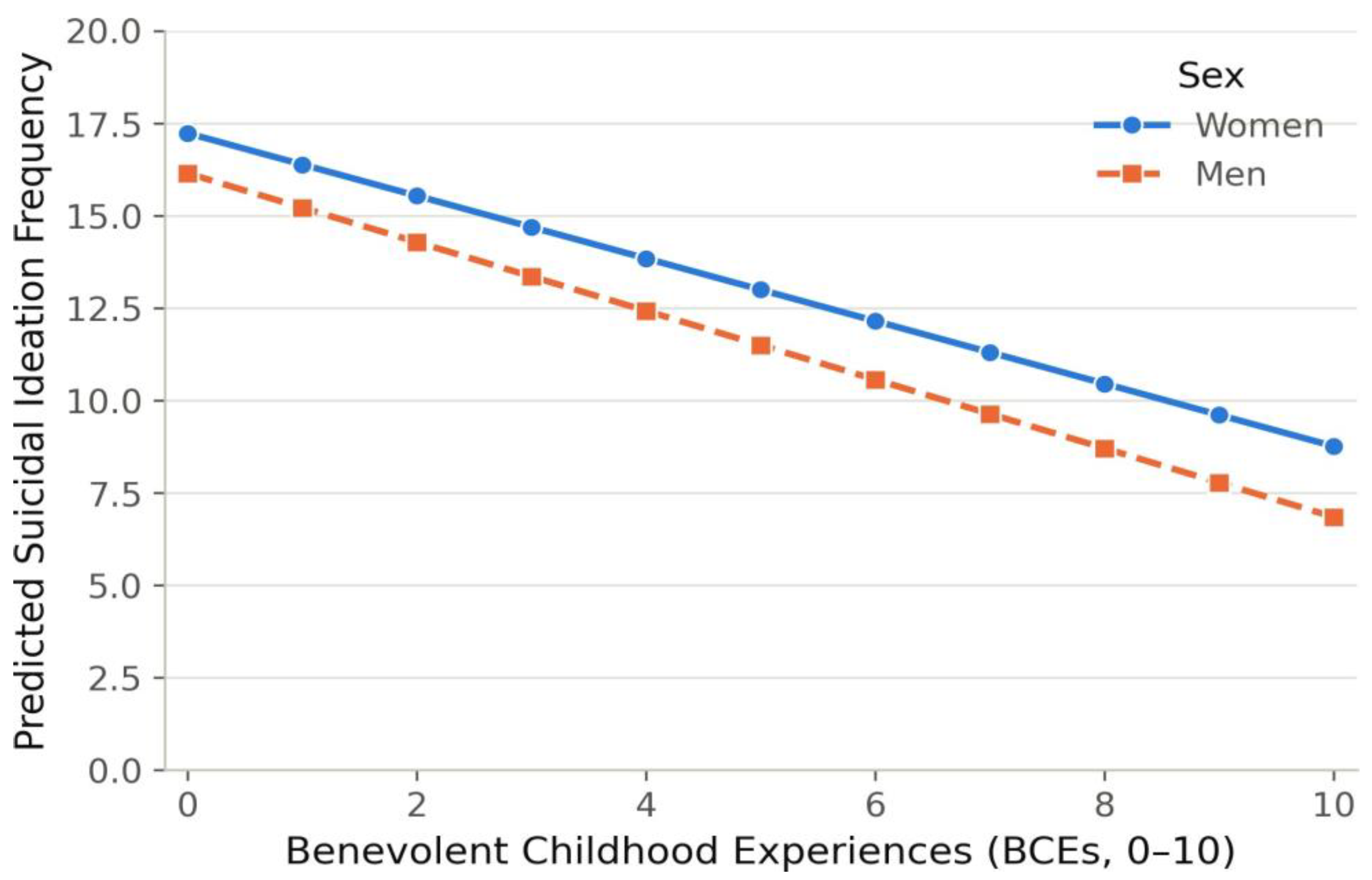
Figure 3.
Interaction between benevolent childhood experiences and marital status on the frequency of suicidal ideation. Note. The figure was generated using the model’s unstandardized coefficients.
Figure 3.
Interaction between benevolent childhood experiences and marital status on the frequency of suicidal ideation. Note. The figure was generated using the model’s unstandardized coefficients.
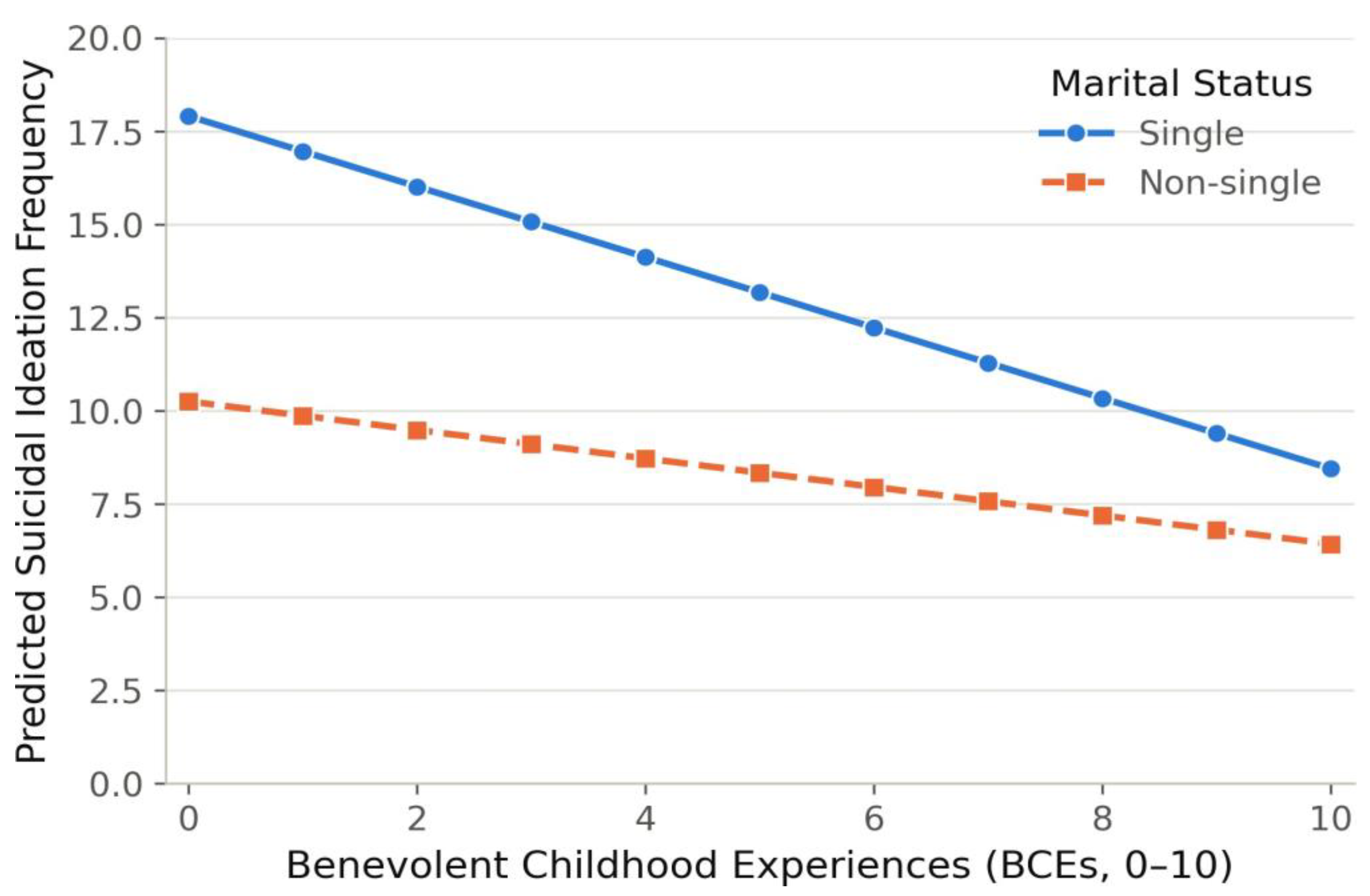

Table 1.
Sociodemographic characteristics of the participants (N = 483).
| Variable | Category | n | % |
|---|---|---|---|
| Age | 16–25 years (young adult) | 398 | 82.4 |
| 26–35 years (adult) | 62 | 12.8 | |
| 36 years or older (late adulthood) | 23 | 4.8 | |
| M = 22.10 SD = 6.35 Range: 16–66 | |||
| Gender | Female | 361 | 74.7 |
| Male | 117 | 24.2 | |
| I’d rather not say | 5 | 1.0 | |
| Marital Status | Single | 437 | 90.5 |
| Living with a partner | 24 | 5.0 | |
| Married | 19 | 3.9 | |
| Widowed | 2 | 0.4 | |
| Divorced | 1 | 0.2 | |
| Employment | Not working | 294 | 60.9 |
| Temporary employment | 78 | 16.1 | |
| Retail clerk | 41 | 8.5 | |
| Self-employed | 41 | 8.5 | |
| Full-time job | 29 | 6.0 | |
| College level | Cycles I–IV (early years) | 325 | 68.3 |
| Cycles V–VII (intermediate) | 54 | 11.3 | |
| Cycles VIII–X (final years) | 97 | 20.4 | |
| M = 4.96, SD = 2.51 (n = 476) | |||
| Residence Area | Urban | 395 | 81.8 |
| Rural | 88 | 18.2 | |
| Professional career | Psychology | 341 | 70.6 |
| Business Administration | 70 | 14.5 | |
| Human Medicine | 14 | 2.9 | |
| Early Childhood Education | 12 | 2.5 | |
| Accounting | 8 | 1.7 | |
| Civil Engineering | 7 | 1.4 | |
| Nursing | 7 | 1.4 | |
| Other majors | 24 | 5.0 |
Note. M = mean; SD = standard deviation. Percentages for the university cycle were calculated based on n = 476 cases (7 missing). Age categories: young adult = 16–25 years; adult = 26–35 years; late adult = 36 years or older. Other majors include Law (n = 5), Systems Engineering (n = 3), Business Administration (n = 3), Chemical Engineering (n = 1), Nursing (n = 7; listed separately), and other minors.
Table 2.
Scoring of Benevolent Childhood Experiences (BCEs) and Frequency of Suicidal Ideation (FIS) by gender.
Table 2.
Scoring of Benevolent Childhood Experiences (BCEs) and Frequency of Suicidal Ideation (FIS) by gender.
| a. Benevolent Childhood Experiences (BCEs): dichotomous scale, range 0–10. | ||||||||
|---|---|---|---|---|---|---|---|---|
| Level | Range | Total n (%) | Women n (%) | Men n (%) | Prefer not to say n (%) | |||
| Low | 0–7 | 169 (35.0) | 128 (35.5) | 37 (31.6) | 4 (80.0) | |||
| Moderate | 8–9 | 195 (40.4) | 145 (40.2) | 49 (41.9) | 1 (20.0) | |||
| High | 10 | 119 (24.6) | 88 (24.4) | 31 (26.5) | 0 (0.0) | |||
| M (SD) | — | 7.89 (2.02) | 7.89 (2.03) | 8.00 (1.95) | 5.60 (2.41) | |||
| b.Frequency of Suicidal Ideation (FIS): 1–5 Likert scale, range 5–25. | ||||||||
| Level | Range | Total n (%) | Women n (%) | Men n (%) | Prefer not to say n (%) | |||
| Low | 5–6 | 180 (37.3) | 121 (33.5) | 59 (50.4) | 0 (0.0) | |||
| Moderate | 7–13 | 162 (33.5) | 125 (34.6) | 35 (29.9) | 2 (40.0) | |||
| High | 14–25 | 141 (29.2) | 115 (31.9) | 23 (19.7) | 3 (60.0) | |||
| M (SD) | — | 10.15 (5.13) | 10.54 (5.17) | 8.70 (4.61) | 15.60 (6.35) | |||
| c.Frequency of affirmative responses by item — BCEs. | ||||||||
| Item | Description | n (Yes = 1) | % (Yes) | |||||
| 1 | Safe caregiver | 418 | 86.5 | |||||
| 2 | Good friend | 418 | 86.5 | |||||
| 3 | Comforting beliefs | 377 | 78.1 | |||||
| 4 | I liked school | 438 | 90.7 | |||||
| 5 | A teacher who cared | 389 | 80.5 | |||||
| 6 | Good neighbors | 335 | 69.4 | |||||
| 7 | External support adult | 348 | 72.0 | |||||
| 8 | Opportunities to have fun | 435 | 90.1 | |||||
| 9 | Self-satisfaction | 333 | 68.9 | |||||
| 10 | Predictable daily routine | 321 | 66.5 | |||||
| d. Descriptive statistics by item — FIS. | ||||||||
| Item | Description | M | SD | |||||
| 1 | Intended to cause harm | 1.97 | 1.07 | |||||
| 2 | Believed they didn’t deserve to live | 2.04 | 1.16 | |||||
| 3 | Asked what would happen if he ended his life | 2.24 | 1.23 | |||||
| 4 | Thought about committing suicide | 1.77 | 1.01 | |||||
| 5 | Wished not to exist | 2.13 | 1.23 | |||||
Note. Cut-off points were established using empirical percentiles (P33 and P67) calculated based on N = 483. BCEs: Low = 0–7, Moderate = 8–9, High = 10; range 0–10 (10 dichotomous items; 1 = presence of experience). FIS: Low = 5–6, Moderate = 7–13, High = 14–25; range 5–25 (5 Likert-scale items, 1–5). Gender was selected as a contrast variable due to its theoretical basis in suicidal ideation: women have higher mean ideation scores (10.54 vs. 8.70), while men exhibit a higher risk of completed attempts [5,49]. The “Prefer not to say” group (n = 5) is reported for descriptive purposes only; its sample size does not allow for inferences. Cell entries in panels 2a and 2b are n (%), except the last row, which reports M (SD). Group sizes: total N = 483; women n = 361; men n = 117; prefer not to say n = 5.
Table 3.
Psychometric properties of the BCEs and FIS scales: reliability and evidence of construct validity.
Table 3.
Psychometric properties of the BCEs and FIS scales: reliability and evidence of construct validity.
| a. Reliability. | ||||||
|---|---|---|---|---|---|---|
| Scale / Dimension | Number of Items | N | Coefficient | Value | Interpretation | |
| BCEs — Benevolent Childhood Experiences | 10 | 483 | KR-20 | 0.68 | Acceptable | |
| FIS — Frequency of Suicidal Ideation | 5 | 483 | Cronbach’s α | 0.94 | Excellent | |
| b. Corrected item-total correlations (ritc). | ||||||
| Scale | Item | Abbreviated Description | ritc | Discrimination | ||
| BCEs | 1 | Safe caregiver | 0.221 | Borderline | ||
| 2 | Good friend | 0.386 | Acceptable | |||
| 3 | Comforting beliefs | 0.239 | Borderline | |||
| 4 | I liked school | 0.299 | Borderline | |||
| 5 | A teacher who cared | 0.333 | Acceptable | |||
| 6 | Good neighbors | 0.438 | Good | |||
| 7 | External support adult | 0.356 | Acceptable | |||
| 8 | Opportunities to have fun | 0.415 | Good | |||
| 9 | Self-satisfaction | 0.395 | Acceptable | |||
| 10 | Predictable daily routine | 0.357 | Acceptable | |||
| FIS | 1 | Intent on hurting himself | 0.829 | Good | ||
| 2 | Didn’t deserve to live | 0.877 | Good | |||
| 3 | End his life | 0.824 | Good | |||
| 4 | Thought about committing suicide | 0.811 | Good | |||
| 5 | Wished not to exist | 0.854 | Good | |||
| c. Homogeneity: mean inter-item correlation (r̄ij). | ||||||
| Scale | r̄ij | Optimal Range [50] | Assessment | |||
| BCEs | 0.178 | .15 – .50 | Acceptable (expected multidimensionality) | |||
| FIS | 0.759 | .15 – .50 | Above the range (unitary construct) | |||
| d. Evidence of construct validity. | ||||||
| Type of Evidence | Indicator | Value | Direction | Interpretation | ||
| Relationship with other variables (external criterion) | r (BCEs × FIS) | −0.361 | Negative | Consistent with theory: more BCEs → less FIS | ||
| Internal structure of BCEs | ritc min – max | 0.22 – 0.44 | Positive | Items consistent with the general construct | ||
| Internal structure of FIS | ritc min – max | 0.81 – 0.88 | Positive | High internal cohesion; unitary construct | ||
Note. KR-20 = Kuder-Richardson 20 (reliability for dichotomous items); α = Cronbach’s alpha (polytomous items). ritc = corrected item-total correlation (the item score is subtracted from the total): ≥.40 = good, .30–.39 = acceptable, .20–.29 = borderline, <.20 = weak [44]. r̄ij = mean inter-item correlation; optimal range .15–.50 [50]. The negative correlation between the BCEs and the FIS (r = −.361, p < .001) provides evidence of validity based on relationships with other variables: benevolent childhood experiences act as a protective factor against suicidal ideation, consistent with the Resilience and Protective Factors model [51,52].
Table 4.
Construct validity: mean extracted variance, composite reliability, Fornell-Larcker criterion, and HTMT.
Table 4.
Construct validity: mean extracted variance, composite reliability, Fornell-Larcker criterion, and HTMT.
| a. Indicators of convergent validity and composite reliability by construct. | ||||||||||
|---|---|---|---|---|---|---|---|---|---|---|
| Construct | Scale Type | k | AVE | CR (ω) | √AVE | AVE ≥ .50 Criterion | ||||
| BCEs — Benevolent Childhood Experiences | Dichotomous (0/1) | 10 | — | — | — | Not applicable a | ||||
| FIS — Frequency of Suicidal Ideation | Likert (1–5) | 5 | 0.705 | 0.923 | 0.839 | Meets ✓ | ||||
| b. Heterotrait–Monotrait ratio (HTMT) [48]. | ||||||||||
| Pair of Constructs | HTMT | Strict Threshold < .85 | Lenient Threshold < .90 | Evaluation | ||||||
| BCEs ↔ FIS | 0.449 | Meets ✓ | Meets ✓ | Discriminant validity established ✓ | ||||||
Note. AVE = Average Variance Extracted; CR = Composite Reliability (equivalent to McDonald’s ω); √AVE = square root of AVE (diagonal element of the Fornell-Larcker matrix). HTMT = Heterotrait-Monotrait Ratio [48]; strict threshold < .85 [48,53], lenient threshold < .90 [54]. The AVE and CR values for the FIS scale were estimated using corrected item-total correlations (ritc) as a proxy for standardized loadings [55]. aFor the BCEs (Cumulative Index of Heterogeneous Experiences), these indicators are not applicable. The HTMT was calculated based on the correlations between the items of both scales. Diagonal values = √AVE of the construct.
Table 5.
Parsimonious summary of the age moderation model.
| Predictor | B | SE | t | p | 95% CI |
|---|---|---|---|---|---|
| Benevolent childhood experiences | −0.993 | 0.116 | −8.555 | < .001 | [−1.222, −0.765] |
| Age: 26–35 years (vs. 16–25) | −3.700 | 2.567 | −1.442 | = .150 | [−8.744, 1.343] |
| Age: 36 or older (vs. 16–25) | −13.900 | 3.495 | −3.977 | < .001 | [−20.769, −7.032] |
| BCEs × 26–35 years interaction | 0.172 | 0.307 | 0.561 | = .575 | [−0.430, 0.774] |
| BCEs × 36 years or older interaction | 1.147 | 0.426 | 2.692 | = .007 | [0.310, 1.984] |
Note. N = 483. R2 = .201, F (5, 477) = 24.00, p < .001. Reference group: 16–25 years. The change in R2 attributable to the interaction block was .012, F (2, 477) = 3.67, p = .026. Simple slopes of the BCEs: 16–25 years, b = −0.993 (p < .001); 26–35 years, b = −0.821 (p = .004); 36 years or older, b = 0.154 (p = .708).
Table 6.
Parsimonious summary of the gender moderation model.
| Predictor | B | SE | t | p | 95% CI |
|---|---|---|---|---|---|
| Benevolent childhood experiences | −0.847 | 0.123 | −6.882 | < .001 | [−1.089, −0.605] |
| Gender (male vs. female) | −1.086 | 2.113 | −0.514 | = .607 | [−5.238, 3.065] |
| BCEs × gender interaction | −0.083 | 0.257 | −0.322 | = .748 | [−0.588, 0.423] |
Note. N = 478 (the “prefer not to say” group, n = 5, was excluded). Coding: 0 = female, 1 = male. R2 = .141, F (3, 474) = 25.88, p < .001. The change in R2 attributable to the interaction was .0002, F (1, 474) = 0.10, p = .748.
Table 7.
Parsimonious summary of the marital status moderation model.
| Predictor | B | SE | t | p | 95% CI |
|---|---|---|---|---|---|
| Benevolent childhood experiences | −0.946 | 0.112 | −8.450 | < .001 | [−1.166, −0.726] |
| Marital status (married vs. single) | −7.654 | 2.985 | −2.564 | = .011 | [−13.519, −1.789] |
| BCEs × marital status interaction | 0.563 | 0.352 | 1.600 | = .110 | [−0.128, 1.255] |
Note. N = 483 (single: 437; not single: 46). Coding: 0 = single, 1 = not single. R2 = .164, F (3, 479) = 31.41, p < .001. The change in R2 attributable to the interaction was .004, F (1, 479) = 2.56, p = .110.
Disclaimer/Publisher’s Note: The statements, opinions and data contained in all publications are solely those of the individual author(s) and contributor(s) and not of MDPI and/or the editor(s). MDPI and/or the editor(s) disclaim responsibility for any injury to people or property resulting from any ideas, methods, instructions or products referred to in the content. |
© 2026 by the authors. Licensee MDPI, Basel, Switzerland. This article is an open access article distributed under the terms and conditions of the Creative Commons Attribution (CC BY) license (http://creativecommons.org/licenses/by/4.0/).
Copyright: This open access article is published under a Creative Commons CC BY 4.0 license, which permit the free download, distribution, and reuse, provided that the author and preprint are cited in any reuse.