

Submitted:
24 August 2026
Posted:
25 August 2026
You are already at the latest version
Abstract
The median conical process on the male fifth tergite of tachinid flies is a sexually dimorphic, homologous morphological character exhibiting stable continuous gradation; it reliably discriminates interspecific divergence and reconstructs evolutionary relationships. This study focuses on morphological evolution of the fifth tergite conical process in Dolichocoxys. A four state ordered character coding scheme (0-3) was formulated following the natural gradual evolutionary trajectory: flat tergite without projection > low obtuse bulge > short cone > slender elongated cone. Using standardized morphological grading criteria, we constructed a dichotomous identification key for all known male Dolichocoxys species. A deterministic morphological phylogenetic topology was further reconstructed under the logical framework of homologous gradient differentiation. Our results reveal a consistent unidirectional gradual evolutionary trend from plesiomorphic to highly apomorphic states. D. brevis, bearing the ancestral character state, is the basal species of the genus; D. rossica represents the transitional morphotype; D. flavibasis + D. femoralis form a moderately specialized clade, whereas D. obscurus and D. wangi compose the most derived sister group. The present work elucidates homologous evolutionary patterns of modified abdominal terminal structures within Dolichocoxys, provides robust morphological evidence for species delimitation and interspecific phylogenetic relationships, and supplements fundamental data on morphological evolution for the family Tachinidae.
Keywords:
Dolichocoxys
; Tachinidae
; morphological taxonomy
; homologous character
; gradual evolution
; phylogenetic topology
; Root Phylogenetic Systematics (RPS)
Introduction
Dolichocoxys Townsend, 1927, a small genus within the tribe Goniini of Tachinidae (Diptera), is mainly distributed across East Asia. Males of this genus exhibit remarkable interspecific modification on the terminal abdominal sclerites, which serve as key diagnostic characters for species delimitation and phylogenetic inference. Previous taxonomic works on Dolichocoxys mostly focused on species descriptions, whereas few studies have systematically addressed the graded-variation pattern and homologous evolutionary mechanism of its specialized abdominal structures. The conical process on male fifth tergite shows stable intraspecific morphology and continuous ordered interspecific variation, forming a complete evolutionary series from plesiomorphic to apomorphic states. Free from conspicuous homoplasy, this structure represents an excellent homologous marker for exploring morphological evolution and interspecific relationships within the genus.
Different from conventional cladistic workflows that rely on character matrices, outgroup comparison and statistical tree-building models, Root Phylogenetic Systematics (RPS) derives phylogenetic topology from the intrinsic graded-differentiation logic of homologous characters, without requiring character-matrix construction, outgroup rooting or iterative statistical modelling. To comply with common taxonomic-article conventions and to visualize the correspondence between character gradation and species evolution for reviewers, a standardized character-coding matrix is presented in this paper. It should be explicitly emphasized that this matrix is used only for data display and interpretative assistance; it does not participate in RPS topology reconstruction or evolutionary deduction. All phylogenetic outcomes in this study are directly inferred from the deterministic unidirectional evolutionary sequence of homologous morphological traits under the RPS theoretical framework. Based on the continuous graded variation of the male fifth-tergite conical process, the present study establishes a standardized morphological coding scheme, constructs a rigorous dichotomous key for males, and reconstructs deterministic morphological phylogenetic topologies. This work aims to uncover the evolutionary pattern of male terminal abdominal structures in Dolichocoxys, enrich morphological evidence for tachinid phylogeny, and provide reliable morphological support for species identification and relationship reconstruction of this genus.
Material and Methods
Definition of Homologous Morphological Character
Character variation of the male fifth abdominal tergite conical process was treated as a continuous, ordered morphocline following the natural evolutionary gradient of homologous structures (Brundin, 1966; Hennig, 1966; Maslin, 1952). According to the progressive evolutionary trajectory from flat to elongated states, a four-state ordered character scheme (0–3) was established for all known Dolichocoxys species. Ordered multistate coding was applied herein because the morphological transition series represents a biologically reasonable and non-arbitrary graded transformation, which is methodologically justified for homologous morphocline traits (Brady et al., 2024; Mickevich & Weller, 1990).
Root Phylogenetic Systematics (RPS) reconstructs deterministic morphological topology strictly based on the inherent gradient differentiation of homologous characters and theoretically requires neither outgroup polarization nor statistical matrix-based tree inference (De Pinna, 1991; Watrous & Wheeler, 1981). In the present study, a standard character matrix was still compiled solely for intuitive data visualization and reviewer comprehension. Importantly, this matrix was not used for topological calculation, model analysis, or tree searching. All phylogenetic relationships were directly derived from the unidirectional and irreversible morphological evolutionary sequence of the target abdominal trait under the RPS logical framework.
The graded evolutionary trend observed in Dolichocoxys is consistent with the classical morphological phylogenetic principle that continuous homologous variation can reflect authentic phyletic progression without ambiguous homoplasy (Farris, 1970, 1983; Brooks & McLennan, 1991). Based on the graded character states, a refined dichotomous identification key for male Dolichocoxys species was constructed, and the morphological evolutionary pathway of abdominal terminal structures was systematically clarified.
Ordered Character Grading and Coding Criteria
A four-state ordered character coding scheme (0-3) was formulated following the natural evolutionary trajectory of the conical process, encompassing the full spectrum of morphotypes from plesiomorphic to highly apomorphic. Character state 0 corresponds to the ancestral plesiomorphic condition, whereas states 1 to 3 represent sequentially derived apomorphic character grades.
| Character code | Character state | Morphological diagnostic criteria | Evolutionary attribute |
| 0 | Absent conical projection | Male fifth tergite with straight posterior margin; no median bulge or apical modified structure | Plesiomorphy (ancestral state) |
| 1 | Low obtuse median bulge | Low, rounded medial tergal bulge lacking clear tapering or pointed apex; bulge length < 1/6 tergite width | Transitional apomorphy |
| 2 | Short conical process | Well-defined medial short cone; cone length 1/4-1/3 tergite width, not surpassing apex of abdominal segment IV | Moderate apomorphy |
| 3 | Slender elongated cone | Thin, sharply pointed elongated cone; cone length ≥ 1/2 tergite width, distinctly extending beyond preceding abdominal segments | Highly apomorphic state |
Species Morphological Character Coding
Based on the above unified grading criteria, all six known species of Dolichocoxys were coded, forming a standardized morphological dataset for evolutionary analysis and phylogenetic deduction.
| Species | Character code | Morphological justification for scoring |
| Dolichocoxys brevis | 0 | Flat fifth tergite lacking any median projection; exhibits the plesiomorphic ancestral morphology of the genus |
| Dolichocoxys rossica | 1 | Bears only a low obtuse median bulge without a distinct conical process; represents the transitional evolutionary morphotype |
| Dolichocoxys flavibasis | 2 | Short, robust cone with pale basal region; corresponds to the moderately apomorphic character grade |
| Dolichocoxys femoralis | 2 | Uniformly dark short conical process, matching the moderate specialization state |
| Dolichocoxys obscurus | 3 | Stout, elongated cone covered with dense setae; highly apomorphic morphology |
| Dolichocoxys wangi | 3 | Exceptionally thin, needle-like elongated cone; the most derived character state within the genus |
Phylogenetic Deduction Principle
The morphological character examined herein forms a continuous, unidirectional, unambiguous plesiomorphy-apomorphy evolutionary gradient. Character polarity and topological differentiation are uniquely resolved, with no conflicting evolutionary signals or equivocal branching patterns. Accordingly, this study employs a deterministic morphological phylogenetic inference approach consistent with traditional systematic frameworks. The phylogenetic topology is reconstructed directly from graded character transformations and dichotomous identification key logic, eliminating unnecessary statistical model computation.
Results
Dichotomous Key to Males of Dolichocoxys
- Posterior margin of male fifth tergite straight, lacking median bulge and conical process ....................................................................................................................................... Dolichocoxys brevis
-. Posterior margin of male fifth tergite convex, bearing median bulge or conical modification ..................................................................................................................................................................... 1
- 2.
- Median tergal protuberance low, broadly rounded, without tapering pointed apex; bulge length less than 1/6 the maximum width of fifth tergite .................................................. Dolichocoxys rossica
-. Median tergal structure forming a well-defined tapering cone; cone length greater than 1/6 tergite width .......................................................................................................................................................... 2
- 3.
- Conical process short and stout, length 1/4-1/3 tergite width, apex not surpassing posterior margin of abdominal segment IV ..............................................................................................................
-. Conical process slender, sharply pointed, length ≥ 1/2 tergite width, apex distinctly extending past abdominal segment IV ............................................................................................................................. 4
- 4.
- Cone base pale yellow, entire process robust .................................................. Dolichocoxys flavibasis
-. Cone uniformly dark throughout, short and narrow, without pale basal region …………………............................................................................................................... Dolichocoxys femoralis
-. Cone stout, covered with dense setae ...................................................................... Dolichocoxys obscurus
-. Cone extremely thin, needle-like, bearing sparse setae ............................................. Dolichocoxys wangi
Figure 1.
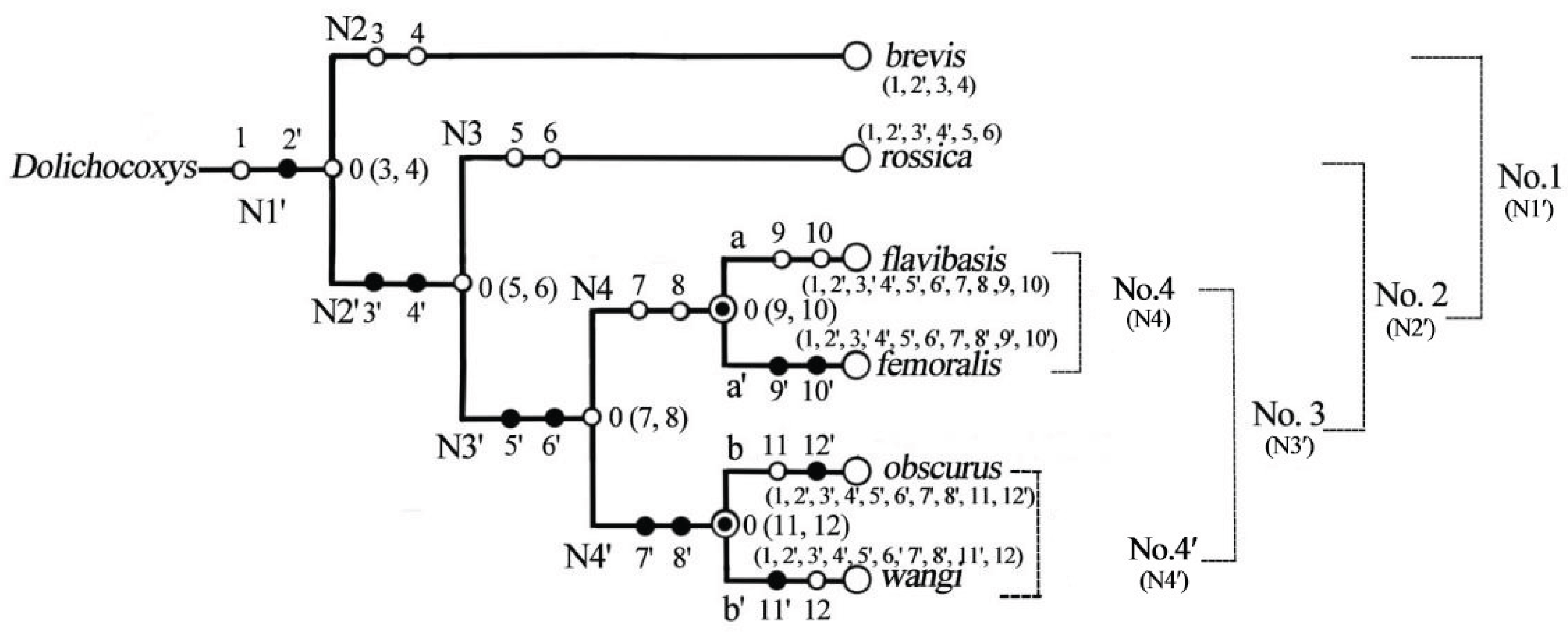
Topological reconstruction conducted under the framework of Root Phylogeny Systematics (RPS) illustrates node splitting, shared derived-character transmission, horizontal and vertical differentiation, monophyletic nesting, and paraphyletic group generated by the evolutionary mechanisms of peer co-framing (2-to-4) and inter-generation co-framing (2-to-3). 1. Terminal unit: brevis, flavibasis, femoralis, obscurus, rossica, wangi. 2. N′, N2 + N2′, N3 + N3′, N4 + N4′= solitary or paired stem branches. 3. a, a′ and b, b′= paired branches. 4. Nos 1–5 denote five distinct monophyletic groups. 5. Numerals in brackets under each monophyletic group represent synapomorphies borne by its stem branch. 6. Numbers in parentheses above or below terminal units denote hierarchical traits present in extant species. 7. Large hollow circles (◯): solitary/paired terminal nodes; 0 (3, 4), 0 (5, 6), 0 (7, 8): inner nodes; bullseye symbols (⦿): outer nodes; small hollow circles (○) and solid dots (●) mark synapomorphies: ○ = homomorphic homology (ancestral morphology, derived state); ● = heteromorphic homology (derived morphology, derived state).
Figure 1.
Topological reconstruction conducted under the framework of Root Phylogeny Systematics (RPS) illustrates node splitting, shared derived-character transmission, horizontal and vertical differentiation, monophyletic nesting, and paraphyletic group generated by the evolutionary mechanisms of peer co-framing (2-to-4) and inter-generation co-framing (2-to-3). 1. Terminal unit: brevis, flavibasis, femoralis, obscurus, rossica, wangi. 2. N′, N2 + N2′, N3 + N3′, N4 + N4′= solitary or paired stem branches. 3. a, a′ and b, b′= paired branches. 4. Nos 1–5 denote five distinct monophyletic groups. 5. Numerals in brackets under each monophyletic group represent synapomorphies borne by its stem branch. 6. Numbers in parentheses above or below terminal units denote hierarchical traits present in extant species. 7. Large hollow circles (◯): solitary/paired terminal nodes; 0 (3, 4), 0 (5, 6), 0 (7, 8): inner nodes; bullseye symbols (⦿): outer nodes; small hollow circles (○) and solid dots (●) mark synapomorphies: ○ = homomorphic homology (ancestral morphology, derived state); ● = heteromorphic homology (derived morphology, derived state).
Explanatory Notes
- A branch is a potential stem-branch; therefore, the characters of a stem-branch are paired synapomorphies that originate from a hypothetical stem-species and are generated through node-splitting events. In other words, the stem-branch serves as the carrier of these synapomorphies. Character-information is transmitted along the following path: stem-branch → internal node → stem-branch → external node → branch → terminal-generating node → terminal unit (extant or fossil species).
- Characters associated with an internal node are symplesiomorphies shared by the paired stem-branches transformed from former branches. Characters associated with an external node are symplesiomorphies shared by paired branches. Characters associated with all internal nodes at respective hierarchical levels correspond to the hypothetical ancestral stem-species of their respective levels. Characters associated with an external node correspond to its hypothetical maternal stem-species. Traits at a terminal-generating node belong exclusively to terminal units.
- Node-associated characters produce a pair of horizontally evolving derived characters via horizontal splitting, thereby forming sister groups. Node-associated characters constitute the symplesiomorphies of the sister groups. Any pair of horizontally evolving synapomorphies (e.g., 5 + 5′) possesses five properties: homology, pairedness, parallelism, mutual exclusivity, and ancestor-descendant mosaicism.
- Vertical splitting of node-associated characters generates two pairs of sister groups at distinct evolutionary hierarchical levels (Wei & Luo, 2023). This hierarchical mismatched lineage combination was termed pseudo-sister groups by Zhao (1995) and mother-daughter lineages by Burundin (1968).
- Trait differentiation at outer node 0 (3, 4) yields two pairs of vertically evolved derived trait sets: 3 → 3 (homologous and homomorphic traits) and 3 → 3' (homologous and heteromorphic traits). All other nodes follow the same differentiation rule.
- The evolutionary domain posterior to an external node records the extant evolutionary states of contemporary biological groups (present), whereas the evolutionary domain anterior to an external node preserves the historical evolutionary information of lineages (past). The terminal-generating node accommodates the potentially evolvable characters of terminal units, constitutes the starting point of continuous systematic evolution, and reflects the potential evolutionary directions of extant groups in the future.
- The entire evolutionary system forms a nested monophyletic group (No.1) that shares the homologous stem-branch N1′. This primary nested monophyletic group (No.1) consists of one paraphyletic group (D. brevis) and one secondary nested monophyletic group (No.2), both of which share the homologous stem-branch N1′. The nested monophyletic group (No.2) comprises one paraphyletic group (D. rossica) and a tertiary nested monophyletic group (No.3), sharing the homologous stem-branch N2′. The nested monophyletic group (No.3) contains two monophyletic groups (No.4 + No.5) with a sister-group relationship, which share the homologous stem-branch N3′. Monophyletic groups No.4 and No.5 correspond respectively to the homologous stem-branches N4 and N4′. Each independent stem-branch within the system corresponds to one independent node-splitting event.
- In terms of evolutionary developmental patterns, the system exhibits two developmental modes: symmetric disequilibrium development (corresponding to monophyletic groups No.1 and No.2) and symmetric equilibrium development (corresponding to monophyletic group No.3). A single node-splitting event of symmetric disequilibrium development simultaneously produces one paraphyletic group and one monophyletic group, whereas a single node-splitting event of symmetric equilibrium development generates a pair of sister monophyletic groups. It can be inferred that paraphyletic groups are exclusively produced by the symmetric disequilibrium developmental mode.
Morphological Phylogenetic Topology
The recovered phylogenetic topology perfectly aligns with morphological gradients and core character differentiation logic, accurately capturing the natural evolutionary relationships within the genus.
Discussion
The male fifth tergite cone process of Dolichocoxys forms a continuous, linear morphological evolutionary gradient that accurately recovers interspecific phylogenetic relationships. Character evolution exhibits consistent directional polarity: it starts with the plesiomorphic, unspecialized flat tergite of D. brevis, proceeds through the transitional low-protrusion morphotype of D. rossica, continues via moderately modified short-coned species (D. flavibasis, D. femoralis), and ends with the highly apomorphic sister pair defined by slender, elongated cone processes (D. obscurus, D. wangi).
This deterministic sequence of morphological evolution is exclusively governed by the polarity of homologous characters. For continuously graded morphological traits, such direct morphological evidence provides higher interpretive clarity and reliability than model-based statistical phylogenetic reconstructions. The morphological divergence patterns and phylogenetic topology recovered by the present study establish a robust morphological framework for species delimitation, generic systematics, and investigations into the adaptive evolution of modified abdominal sclerites within the Tachinidae.
In accordance with the core tenets of RPS theory, paraphyletic groups hold equivalent functional and inferential value relative to monophyletic groups. Both paraphyletic groups and monophyletic groups originate from a single nodal splitting event, share homologous stem lineages, represent authentic records of natural evolutionary history, and carry equal weight in the reconstruction and interpretation of phylogenetic processes. The present study therefore further corroborates that paraphyletic clades deserve equivalent analytical consideration alongside monophyletic clades in cladistic interpretations.
The present study also confirms that male-modified terminal abdominal structures serve as high-value homologous phylogenetic markers for Dolichocoxys within the Tachinidae. When character variation yields continuous gradients with unambiguous evolutionary polarity, these abdominal morphological traits should be treated as priority evidence for phylogenetic inference.
Concluding Remarks
The present study elucidates the directional evolutionary gradient of the male fifth tergite cone process among Dolichocoxys species and validates the utility of continuous morphological traits for resolving interspecific phylogenetic relationships of the genus. The documented morphological transformation series, ranging from plesiomorphic flat tergites to highly modified elongated cone processes, establishes a well-defined evolutionary scenario with stable character polarity. This morphological evidence effectively verifies phylogenetic results derived from RPS-based tree reconstructions.
The present study further underpins the core tenets of RPS theory. It confirms that paraphyletic clades possess equivalent phylogenetic informativeness and analytical value relative to monophyletic clades in standard cladistic interpretations. Additionally, it demonstrates that modified male terminal abdominal structures serve as reliable, high-priority homologous markers for systematic studies of Dolichocoxys within the Tachinidae.
Future systematic research on tachinid flies should fully integrate continuous morphological characters with unambiguous evolutionary polarity. Such integration will refine the accuracy of species delimitation, clarify generic phylogenetic relationships, and advance our understanding of the adaptive evolution underlying abdominal sclerite modification in Dolichocoxys (parasitic Diptera).
Supplementary Note
Stem branches represent latent evolutionary precursors of conventional terminal branches. The mechanistic transformation between conventional branches and stem branches is formalized as the Branch–Stem Transformation Theory. This theory is not elaborated in detail in the present manuscript and will be comprehensively addressed in a forthcoming independent publication.
Acknowledgments
This work utilizes specimen materials collected during the field surveys supported by the National Natural Science Foundation of China (No. 39260015): Investigation and systematic taxonomy of Dolichopodidae resources in Southwest China. That project was concluded many years ago. We thank relevant collectors for specimen material used in this study.
References
- Brady, P.; Castrellon Arteaga, A.; Keating, J.N.; Beck, R.M.D. The effects of ordered multistate morphological characters on phylogenetic analyses of eutherian mammals. Journal Mamm. Evol. 2024, 31, 379–402. [Google Scholar] [CrossRef]
- Brooks, D.R.; McLennan, D.A. Phylogeny, Ecology, and Behavior; University of Chicago Press: Chicago, 1991. [Google Scholar]
- Brundin, L. Transantarctic relationships and their significance, evidenced by chironomid midges, with a monograph of the subfamilies Podonominae and Aphroteniinae and the austral Heptagyiae. K. Sven. Vetensk.-Akad. Handl. 1966, 11, 1–472. [Google Scholar]
- Cerretti, P.; O’Hara, J.E.; Wood, D.M.; Shima, H.; Inclán, D.J.; Stireman, J.O. Signal through the noise? Phylogeny of the Tachinidae (Diptera) as inferred from morphological evidence. Syst. Entomol. 2014, 39, 335–353. [Google Scholar] [CrossRef]
- De Pinna, M.C.C. Concepts and tests of homology in the cladistic paradigm. Cladistics 1991, 7, 367–394. [Google Scholar] [CrossRef]
- Farris, J.S. Methods for computing Wagner trees. Syst. Zool. 1970, 19, 83–92. [Google Scholar] [CrossRef]
- Farris, J.S. The logical basis of phylogenetic analysis. In Advances in Cladistics; Platnick, N.I., Funk, V.A., Eds.; Columbia University Press: New York, 1983; Vol. 2, pp. 7–36. [Google Scholar]
- Hennig, W. Phylogenetic Systematics Ordnung Diptera (Zweiflügler). In Morphological criteria of phyletic relationships. Systematic Zoology; Hennig, W., Helmcke, J.G., Starck, D., Maslin, T.P., Eds.; University of Illinois Press: Urbana, 1966; Volume 1, pp. 49–70. [Google Scholar]
- McAlpine, J.F. Morphology and terminology-adults. In Manual of Nearctic Diptera; Agriculture Canada: Ottawa, 1981; p. 9-63. [Google Scholar]
- Mesnil, L.P. Notes sur quelques Tachinaires nouveaux ou peu connus de la région paléarctique (Diptera). Bull. De La Société Entomol. De Fr. 1963, 68, 112-118. [Google Scholar]
- Mickevich, M.F.; Weller, S.J. Evolutionary character transformation. Cladistics 1990, 6, 127–147. [Google Scholar] [CrossRef] [PubMed]
- Townsend, C.H.T. Fauna sumatrensis. (Beitrag Nr. 50). Diptera Muscoidea III. Suppl. Entomol. 1927, 16, 56–76. [Google Scholar]
- Watrous, L.E.; Wheeler, Q.D. The out-group comparison method of character analysis. Syst. Zool. 1981, 30, 1–11. [Google Scholar] [CrossRef]
- Zhi, B.J.; Liu, G.C.; Zhang, C.T. A new species and new records of Dolichocoxys from China (Diptera: Tachinidae) A new species and two new records of Goniini from China (Diptera, Tachinidae). In Entomotaxonomia;Acta Zootaxonomica Sinica; Zhang, C.T., Liu, J.Y., Yao, Z.Y., Eds.; 2016; Volume 38, 2) 33(3, p. 112-118 532-536. [Google Scholar]
- Zhou, Z.X.; Wei, L.M.; Luo, Q.H. Three new species of Dolichocoxys Townsend (Diptera: Tachinidae) from Guizhou, China. Entomotaxonomia 2012, 34(2), 329-339. [Google Scholar]
Disclaimer/Publisher’s Note: The statements, opinions and data contained in all publications are solely those of the individual author(s) and contributor(s) and not of MDPI and/or the editor(s). MDPI and/or the editor(s) disclaim responsibility for any injury to people or property resulting from any ideas, methods, instructions or products referred to in the content. |
© 2026 by the authors. Licensee MDPI, Basel, Switzerland. This article is an open access article distributed under the terms and conditions of the Creative Commons Attribution (CC BY) license (http://creativecommons.org/licenses/by/4.0/).
Copyright: This open access article is published under a Creative Commons CC BY 4.0 license, which permit the free download, distribution, and reuse, provided that the author and preprint are cited in any reuse.