

Submitted:
22 August 2026
Posted:
25 August 2026
You are already at the latest version
Abstract
Total post-harvest losses of fresh fruits and vegetables in tropical and subtropical agricultural systems frequently exceed 30 percent, driven by high crop perishability, limited cold-chain infrastructure, and the geographic concentration of conventional processing facilities far from production zones. This review examines the engineering principles, operational architecture, and applied performance of mobile aseptic processing platforms (MAPP) as a decentralized strategy for postharvest stabilization of perishable agricultural commodities. MAPP integrates in-line homogenization, high-temperature short-time (HTST) or ultra-high-temperature (UHT) thermal treatment, clean-in-place (CIP) and sterilization-in-place (SIP) cycles, and aseptic filling within transportable, modular units engineered for field deployment. Projected MAPP capacities reach up to approximately 11,300 kg (25,000 lb) per 8 h shift, while still complying with internationally recognized food-safety frameworks including HACCP, ISO 22000, and SQF. Comparative analysis with centralized processing infrastructure and earlier decentralized initiatives, including the EU Horizon 2020 FOX project, indicates that mobile aseptic systems uniquely combine field mobility with the production of ambient-stable shelf-life formats independent of refrigerated distribution. Conservative impact modeling suggests that single-unit deployments may recover on the order of 3,000 t of edible product annually, with corresponding water, fertilizer, and greenhouse-gas externality reductions. The review synthesizes the current state of the technology, identifies engineering and socio-economic knowledge gaps, and proposes research priorities for scaled adoption in tropical and subtropical food systems.
Keywords:
mobile food processing
; aseptic processing
; postharvest loss
; decentralized food systems
; shelf-stable foods
; tropical agriculture
; subtropical agriculture
; circular economy
; food waste reduction
; food engineering
1. Introduction
Post-harvest food loss is a persistent constraint on global food security, with the highest absolute and relative losses occurring in tropical and subtropical agricultural zones. Across Latin America, Sub-Saharan Africa, and South and Southeast Asia, an estimated 30–40 percent of fresh produce never reaches consumers, or is lost to microbial spoilage, mechanical damage, and logistical inefficiencies between farm and market [1,2,3].These losses translate directly into reduced farmer income, elevated consumer prices, embedded environmental costs from wasted water, fertilizer and energy inputs, and nutritional gaps in regions where horticultural diversity should be a strength [4,5].
Centralized processing infrastructure addresses some of these losses for staple and high-volume commodities. However, it’s poorly suited to spatially dispersed smallholder production. Long transport distances between farms and centralized facilities increases mechanical injury and microbial proliferation, excludes smallholders without contractual access to processing capacity, and concentrates value capture downstream of producers [2,6]. Cold-chain interventions are technically effective but are capital- and energy-intensive, with documented limitations in regions with unreliable electrical supply [7,8].
Decentralized and mobile food processing has therefore emerged as a complementary strategy. By relocating thermal stabilization closer to the point of harvest, mobile platforms reduce time-to-stabilization, decouple shelf-life from refrigerated logistics, and enable smallholder-led value addition [9,10]. Aseptic processing, the combination of rapid thermal microbial inactivation with sterile packaging, is particularly well suited to this context, as it produces ambient-stable products with shelf-lives of one to two years [11,12,13,14].
This review draws upon peer-reviewed engineering, food science, agricultural development, and sustainability literature relevant to mobile aseptic processing systems and related technologies. Although numerous studies have examined post-harvest losses, aseptic processing, decentralized manufacturing, and circular food systems independently, relatively few publications have focused specifically on novel mobile aseptic processing platforms (MAPP) and their role in decentralized food preservation. Consequently, this review seeks to provide an assessment of the historical evolution, engineering principles, applications, opportunities, and limitations associated with these novel, integrated systems. Particular attention is given to technical capabilities, regulatory considerations, implementation challenges, and future research needs.
2. Review Methodology
This manuscript represents a narrative review intended to synthesize the current state of knowledge regarding mobile aseptic processing platforms (MAPP) and related decentralized food processing technologies. Although the body of literature specifically addressing MAPP remains limited due to the novelty of the concept, relevant findings from previous decentralized processing generations, such as the EU Horizon 2020 Food Processing in a Box (FOX) initiative [10], and adjacent fields were considered to provide technical and contextual perspective. The review draws primarily upon peer-reviewed literature related to engineering principles, processing technologies, regulatory considerations, implementation challenges, and applications related to decentralized food preservation and circular food manufacturing, in addition to scenario-based projections for MAPP based on the cumulative context of the referenced data. Authoritative reports from international organizations and governmental agencies were also considered where appropriate.
This review was not conducted as a formal systematic review under PRISMA guidelines, nor was it intended to provide a quantitative meta-analysis. Rather, it represents an integrative narrative synthesis of the available literature and associated technological developments. Consequently, although every effort was made to provide balanced coverage of the subject matter, the possibility of selection bias and incomplete representation of all available literature cannot be entirely excluded.
Particular emphasis was placed on identifying both the opportunities and the limitations associated with MAPP, including technological maturity, regulatory considerations, implementation constraints, and future research priorities. Where quantitative scenario analyses and projected impacts are discussed, these should be interpreted as illustrative estimates intended to provide context rather than as universally predictive outcomes, as realized performance is expected to vary according to crop type, geography, infrastructure, operational practices, and market conditions.
3. Postharvest Challenges in Tropical and Subtropical Food Systems
3.1. Characteristics of Tropical and Subtropical Agricultural Zones
Tropical and subtropical agricultural zones span latitudes between approximately 0° and 35° in both hemispheres. This includes large portions of Latin America, Sub-Saharan Africa, South and Southeast Asia, and climatically analogous areas in the Mediterranean basin and the Balkans [15]. These regions are characterized by elevated mean temperatures, high relative humidity during portions of the cropping cycle, and pronounced seasonality in rainfall and harvest volume. Additionally, these zones collectively support a wide range of developing economies where agriculture is often a core livelihood. Smallholder and mid-scale farms dominate production, with a high proportion of perishable fruits, vegetables, and roots in the cropping mix [2,16].
3.2. Major Causes of Postharvest Loss and Infrastructure Limitations
Although many of the edible crops commonly cultivated across these agricultural zones are perishable, they are selected for their economic importance and regional relevance. However, total postharvest losses of fruits and vegetables in tropical and subtropical regions frequently exceed 30 percent and may approach 50 percent for highly perishable commodities such as mango, tomato, banana, leafy greens, and cassava [1,17]. Various loss drivers include rapid microbial and enzymatic deterioration under high ambient temperatures, oversupply during peak-harvest windows, exclusion from grading-compliant retail channels, mechanical damage during harvest and transport, and the absence of processing capacity near farmland [18,19].
Cold-chain coverage in many tropical and subtropical countries is fragmented and concentrated near urban centers. As reported by [8], refrigerated transport availability per capita in low- and middle-income tropical countries is roughly an order of magnitude lower than in high-income temperate economies. Reliable electrical supply is constrained, where outage frequency and duration are inversely correlated with cold-chain performance [7,20]. Similarly, water availability and quality, both required for hygienic processing, represent further infrastructure-related limitations [21]. Additionally, road networks frequently degrade during the wet season, therefore increasing transport time and mechanical injury [22].
3.3. Climate Change Effects on Supply-Chain Vulnerabilities and the Economic Implications
Currently, climate change imposes a significant threat to global food supply chains, increasing existing vulnerabilities to these systems’ performance, stability, and overall food security [23]. This is particularly true for tropical and subtropical food systems, where changes in temperature, precipitation variability, and the frequency of extreme weather events are projected [24]. Heat-stress events accelerate ripening and senescence, narrow harvest windows, and stress conventional supply chains designed around predictable logistics [25]. Furthermore, the inevitable postharvest losses suppress producer prices through cyclical oversupply, erode household income, and reduce the nutritional availability of micronutrient-dense horticultural crops that are central to dietary diversification [26,27]. The embedded environmental footprint of lost food, including approximately 24 percent of agricultural freshwater withdrawals attributable to food that is never consumed [28], represents a significant misallocation of natural resources. That said, decentralized processing infrastructure capable of rapid stabilization at the point of harvest is increasingly recognized as part of climate-resilient food-system designs [29,30].
4. Aseptic Processing and Mobile Food Manufacturing
4.1. Aseptic Thermal Processing and Microbial Inactivation
Aseptic processing is defined as the separate sterilization of product and packaging followed by their combination under sterile conditions [12,13,14,31]. This technology was first applied at commercial scale for dairy and homogeneous fluid products and has progressively expanded to include particulate and semi-solid matrices such as fruit purées, vegetable concentrates, soups, and dairy alternatives [32,33]. Microbial inactivation in aseptic systems is achieved by high-temperature short-time (HTST) or ultra-high-temperature (UHT) treatments. Process design is driven by the F-value required to achieve a 12-log reduction of Clostridium botulinum spores in low-acid foods, or by less severe targets for high-acid commodities [11,31]. Continuous tubular and scraped-surface heat exchangers are commonly used for particulate products, while residence-time distribution and the rate of heat transfer to the particle center determine sterilization adequacy [34,35]. Moreover, ohmic and microwave-assisted heating represent emerging alternatives with documented advantages in uniformity for particulate flows [36,37].
4.2. Sanitation, Sterilization, and Packaging for Aseptic Food Processing
Clean-in-Place (CIP) and Sterilization-in-Place (SIP) cycles enable repeated processing without disassembly of product-contact surfaces. Standard CIP protocols typically include alkaline detergent rinse, intermediate water rinse, acid rinse, and final sanitization [38,39]. Subsequently, SIP employs saturated steam or sterilant solution to achieve commercial sterility of internal surfaces [38,39]. The cycle design must balance microbial safety requirements with constraints related to chemical residue limits, water and energy consumption, and production changeover time. In mobile platforms, these production cycles must be executed with on-board water treatment and effluent management capacity.
Maintaining sterility after processing further depends on the selection of appropriate aseptic packaging technologies. The aseptic packaging formats compatible with field-deployable systems include bag-in-box, multi-layer pouch, and aseptic drum systems, which typically employ co-extruded barrier films and pre-sterilized fitments [40,41]. Film selection balances oxygen and moisture barrier requirements, mechanical durability for tropical distribution, and end-of-life recovery considerations under extended producer responsibility frameworks [42]. These sterilization and packaging requirements ultimately shape the engineering design, utility integration, and operational flexibility of both stationary and mobile aseptic processing systems.
4.3. Differences Between Stationary and Mobile Aseptic Systems
The design and operation of aseptic processing systems diverge significantly between stationary and mobile configurations due to differences in utility access, throughput requirements, and deployment environments. Stationary aseptic processing facilities are typically optimized for a narrow product portfolio, high throughput per shift, and integration with fixed utilities. MAPP relaxes throughput maximum in exchange for transportability, on-board utilities, off-grid energy compatibility, and product-changeover flexibility [9,10]. The engineering implications include reduced tubing diameters to limit residence-time variance, modular skid-based assembly to fit standardized container envelopes, structural reinforcement for road transport, and remote process supervision to compensate for distance from central engineering support. Collectively, these design trade-offs have catalyzed the development of increasingly flexible and modular mobile processing technologies.
5. Technological Evolution of Mobile Food Processing Platforms
5.1. Historical Development and Technological Progression of Mobile Food Processing Platforms
The conceptual basis for mobile food processing predates contemporary aseptic systems and includes mobile slaughter units, in-field grain drying and dehulling, and trailer-based juicing operations [9]. These early approaches were primarily designed to reduce post-harvest losses, improve logistical efficiency, and enable initial stages of processing closer to the point of production. However, they were not designed to achieve commercial sterility or produce shelf-stable products independent of cold-chain infrastructure. What distinguishes the current generation of MAPP is the combination of commercial thermal sterilization capability with full transportability, enabling shelf-stable formats that do not rely on downstream cold-chain distribution.
Early prototype platforms developed during the late 2000s and early 2010s were configured for proof-of-concept of aseptic stabilization of vegetable particulates and fruit purées outside conventional factory environments. These systems typically required multiple flat-bed platforms to accommodate utilities, preparation, processing, and packaging stages, and were limited by relatively large tubing diameters and limited automation [10]. Subsequent design generations consolidated unit operations onto fewer chassis using smaller-diameter tubing for homogeneous products, contained more compact heat exchangers, and integrated programmable logic controller (PLC)-based control systems.
Collectively, these advancements reflect a transition from distributed, multi-platform prototypes toward more compact, modular, and field-deployable aseptic processing systems with improved operational efficiency and process control. While the underlying principles of thermal processing and aseptic stabilization are well established, their adaptation to mobile and decentralized configurations remains an evolving area of engineering development. Published reports and demonstration programs suggest considerable promise for these systems; however, the degree of field validation, operational maturity, and long-term deployment experience varies among reported platforms. Consequently, additional multi-year performance data and broader commercial experience will be important for further evaluating reliability, scalability, and overall system performance under diverse operating conditions.
5.2. Integrated Mechanical and Digital Systems
Mobile aseptic processing platforms (MAPP) increasingly rely on the integration of high-performance mechanical design with advanced digital control architectures to achieve reliable operation under field-deployable conditions. Scenario-based contemporary mobile aseptic platforms report sustained throughputs on the order of 11,000 kg per 8 h shift for homogenized products such as fruit purées and tomato concentrate, with operational availability compatible with seasonal harvest windows [43,44]. These performance levels are enabled by a series of engineering advances, including scraped-surface and tubular heat exchanger combinations optimized for tropical product viscosities, redundant aseptic valve clusters to minimize unplanned changeover losses, modular skid-frame construction engineered for international containerized shipment, and structural reinforcement to maintain sanitary tolerances under repeated transport loading.
Beyond mechanical design, MAPP increasingly incorporates integrated digital control architectures to support operation under distributed and infrastructure-constrained conditions. The separation between field deployment and specialist engineering support has encouraged the adoption of embedded sensing, remote diagnostics, and cloud-enabled monitoring capabilities. Programmable logic controller (PLC)-based systems may incorporate real-time monitoring of sterilization F-values, holding-tube temperatures, fill-zone integrity, and CIP/SIP cycle compliance [45,46]. Such instrumentation can support regulatory traceability, facilitate preventive maintenance, and improve operational oversight. However, the extent of digital integration and remote support capabilities varies among manufacturers and deployment scenarios, reflecting differing levels of system complexity, automation, and operational maturity.
5.3. Lessons from Earlier Decentralized Processing Initiatives
Altogether, the development of mobile aseptic processing platforms (MAPP) has been strongly informed by lessons learned from earlier decentralized processing initiatives. Publicly funded research and demonstration programs have provided important reference points regarding the opportunities and limitations associated with distributed food processing. For example, the EU Horizon 2020 Food Processing in a Box (FOX) initiative (2019–2023) deployed container-based mobile units across six European food regions and documented the technical feasibility and short-supply-chain benefits of decentralized processing while identifying shelf-life extension, microbial safety, and export readiness as important next-generation engineering priorities [10,43]. These findings are consistent with broader engineering literature regarding the role of in-line thermal stabilization in extending the operational reach of decentralized systems [32,33]. At the same time, published experience with mobile processing systems remains comparatively limited, and additional long-term studies addressing reliability, economics, regulatory harmonization, and adoption dynamics would further strengthen understanding of their practical performance across diverse agricultural environments. A visual representation of a contemporary mobile aseptic processing platform is shown in Figure 1.
6. Engineering Design and Operational Architecture
6.1. Modular System Configuration and Utility Integration
Contemporary MAPP units are organized as integrated modular skids housed within transportable enclosures sized to ISO intermodal containers or flatbed envelopes. Principal modules include raw-material reception and preparation, pumping and homogenization, thermal processing (HTST or UHT), an aseptic surge tank, aseptic filling, CIP/SIP, and on-board utilities [33,39]. Modular separation of unit operations facilitates maintenance access, improves transportability, and enables configuration substitution to accommodate crop-specific or produce-specific processing requirements.
Since these systems are frequently intended for deployment in infrastructure-constrained environments, mobile platforms may be required to supply, condition, or store essential utilities depending on site conditions and operational requirements. Reported configurations include on-board diesel or hybrid power generation, water pre-filtration and demineralization systems, compact chilled-water circuits for fill-zone cooling, and integrated steam generation for SIP cycles [47]. Increasing emphasis has also been placed on compatibility with existing grid infrastructure and renewable energy sources, including photovoltaic and biomass systems, with the objective of improving operational flexibility and reducing fuel dependency. However, utility configurations and levels of energy autonomy vary among systems and are influenced by throughput requirements, product characteristics, deployment environments, and local infrastructure availability.
6.2. Flow Design and Operational Performance
The integration of modular processing and subsequent utility systems must be complemented by carefully engineered product flow pathways to maintain throughput efficiency and aseptic integrity. Material flow within mobile aseptic processing systems is engineered to minimize residence-time variance, stagnation, and product-product cross-contamination during changeover operations. For homogenized products, smaller-diameter tubing (on the order of 19–25 mm internal diameter) reduces required hold-tube length and facilitates a compact footprint, while for particulate matrices larger diameters are necessary to limit particle attrition and ensure representative residence-time distributions [34,35]. Aseptic filling stations are typically configured for bag-in-box, drum, or pouch formats compatible with downstream ambient distribution.
These material flow and packaging design considerations directly influence operational throughput and overall process efficiency. Throughput values for mobile aseptic processing systems vary considerably depending on system generation, product characteristics, packaging configuration, and operating conditions. Published examples range from approximately 2.5 t/day for early demonstration units [10] to approximately 11.3 t (25,000 lb) per 8 h shift for MAPP. Actual throughput is strongly influenced by factors including product viscosity, sterilization requirements, CIP/SIP cycle duration, packaging changeover, staffing, and input material quality. Consequently, system performance is more appropriately evaluated using operational metrics such as overall equipment effectiveness (OEE), specific energy consumption per kilogram of finished product, water-to-product ratio, and sustained availability over time [48]. Because long-term peer-reviewed operational datasets remain highly limited, additional field experience and comparative performance analyses would further improve understanding of the capabilities and constraints associated with MAPP technologies. In addition to internal process efficiency, these systems must also be engineered to withstand the logistical and operational demands associated with transport and field deployment.
6.3. Field Deployment Considerations
Mobility introduces engineering constraints distinct from those of fixed-facility design. For instance, sanitary tolerances must be maintained after repeated road and intermodal transport. Additionally, mobile systems typically incorporate structural reinforcement, shock-isolated mounting of sensitive instrumentation, and securement of fluid lines to maintain sanitary integrity during repeated transport and deployment. Field commissioning procedures commonly include leveling, utility connection, water-quality verification, CIP/SIP validation, and product-contact integrity testing [31]. Reported relocation and recommission times for compact platforms may be as short as one hour under favorable conditions when appropriate site infrastructure, utilities, and trained personnel are already available. However, commissioning requirements and deployment timelines are influenced by local conditions, regulatory requirements, water quality, operator experience, and the degree of site readiness. These operational considerations further emphasize the importance of robust food safety systems, quality assurance procedures, personnel training, and regulatory oversight in mobile aseptic processing operations.
7. Food Safety, Quality Assurance, and Regulatory Considerations
7.1. Food Safety Management and International Compliance Frameworks
MAPP operates under the same food-safety management expectations as fixed-facility commercial processors. Hazard Analysis and Critical Control Points (HACCP) principles provide the foundational framework for risk management, supported by prerequisite programs addressing sanitation, personnel hygiene, and equipment maintenance [49]. In aseptic systems, process validation requires thermal-distribution studies, microbiological challenge testing with appropriate surrogate organisms, and verification of packaging-system integrity [31]. Furthermore, internationally recognized certification frameworks applicable to mobile aseptic processing include ISO 22000 (food-safety management systems), the SQF (Safe Quality Food) code, the FSSC 22000 scheme, and the British Retail Consortium Global Standard (BRCGS) for Food Safety. Equipment-level standards include ISO 9001 (quality management), ISO 14001 (environmental management), ISO 45001 (occupational health and safety), and welding and pressure-vessel standards relevant to sanitary fabrication. For deployment in the United States, compliance with the FDA Food Safety Modernization Act and Code of Federal Regulations Title 21 Parts 113 and 114 is required, and for the European Union, Regulation (EU) 852/2004 and 853/2004 apply [50,51].
Although internationally recognized food-safety and quality frameworks provide the foundation for aseptic process validation, the regulatory treatment of mobile food-processing facilities varies among jurisdictions. In many tropical and subtropical regions, transportable processing systems are generally evaluated under existing food-processing regulations rather than under standards developed specifically for mobile facilities. Consequently, implementation often requires adaptation to national requirements governing sanitation, traceability, process validation, packaging integrity, operator training, and facility registration. Continued harmonization of regulatory approaches and the development of guidance specific to mobile aseptic processing may facilitate broader adoption and improve regulatory consistency across international markets.
7.2. Regulatory Barriers and Export Readiness
Furthermore, regulatory acceptance of mobile aseptic processors in international trade depends on dossier-level demonstration of process control, facility registration where required, and harmonization with importing-country requirements. Practical barriers include the absence of purpose-built guidance for mobile processors in many national regulatory codes, the need to register a peripatetic facility, and documentation language requirements [55]. Engagement with national competent authorities in the early phases of deployment, supported by independent third-party certification, is widely recommended. Despite these regulatory barriers, established pathways for certification and authority engagement enable the practical deployment of MAPP across a growing range of agricultural commodities, including in tropical and subtropical zones.
7.3. Validation, Monitoring, and Traceability Considerations
In addition to adherence to food safety management systems and regulatory standards, MAPP requires quantitative validation of microbial inactivation and product shelf-life stability. Validation of aseptic processes for low-acid foods requires demonstration of a minimum 12-log reduction of Clostridium botulinum spore equivalents under worst-case process conditions, whereas for high-acid products the target organism is typically a heat-resistant fungal or lactic acid bacterial species [12,52]. Building on microbial validation, shelf-life assessment integrates accelerated stability testing, real-time storage studies, and sensory evaluation to confirm quality over time. Reported ambient-stable shelf-lives for aseptically packaged fruit and vegetable products typically range between 12 and 24 months under tropical storage conditions, contingent on packaging barrier performance [41,53].
To support both validation and shelf-life assurance, digital process monitoring systems contribute to regulatory traceability and operational quality assurance through continuous logging of critical control parameters, including sterilization temperature, holding time, fill-zone pressure, and CIP conductivity [45,46]. Batch-level coding and remote audit capabilities may further facilitate documentation and oversight of decentralized operations. Emerging blockchain-based traceability frameworks have also been proposed for export documentation and supply-chain transparency [54]. However, the degree of digital integration and the regulatory acceptance of such approaches vary among jurisdictions and deployment scenarios. Consequently, continued validation and harmonization efforts remain important to ensure consistent implementation across diverse operating environments.
8. Applications Across Agricultural Commodities
8.1. Fruit and Vegetable Purées
Sterilized or pasteurized fruit and vegetable purées are the most extensively documented application of processing in mobile platforms. Commercially relevant matrices include mango, banana, guava, papaya, tomato, pumpkin, and carrot. Process conditions typically combine homogenization at 15–25 MPa with thermal treatment at 90–110 °C for 30–60 s, balancing microbial inactivation against thermal degradation of carotenoids, ascorbic acid, and polyphenols [56,57]. Field studies under European demonstration programs have reported daily throughputs of 2–5 t and shelf-life extensions of 30–40 percent relative to refrigerated-fresh formats [10,43].
8.2. Sauces, Concentrates, and Beverages
Aseptic stabilization of pasta-type sauces, tomato concentrate, fruit nectars, and shelf-stable juices represents an established commercial category for stationary plants and is technically transferrable to mobile platforms with appropriate residence-time design [33]. Acidified products benefit from less severe thermal treatment and correspondingly higher throughput, while low-acid concentrates require sterilization equivalent to that of dairy products.
8.3. Root Crops and Starch-Based Products
Root crops such as cassava, sweet potato, and yam present unique processing challenges including high starch content, gelatinization behavior, and the presence of cyanogenic glycosides in some varieties. That said, mobile platforms have been evaluated for the production of cassava purée and pre-gelatinized starches for downstream conversion [58,59]. However, successful processing requires precise temperature control and continuous mixing to avoid tube fouling.
8.4. Emerging Applications in Dairy and Alternative Proteins
UHT processing of cow, goat, and buffalo milk has a long commercial history [60] and is a natural extension of the MAPP concept, particularly in pastoralist contexts. Plant-based protein matrices, including soy, oat, and pea formulations, are increasingly processed using comparable equipment [61]. Mobile dairy-grade aseptic operation imposes additional sanitary standards, including dedicated milk-contact components, refrigerated raw-milk reception, and homogenization at pressures suitable for fat-globule size reduction.
8.5. Challenges with Oxidation-Sensitive and Particulate Commodities
Certain commodities present persistent technical challenges in decentralized aseptic processing. Avocado purée undergoes rapid enzymatic browning catalyzed by polyphenol oxidase, requiring blanching, antioxidant addition, or modified atmosphere strategies to maintain color stability [62,63]. Particulate products, such as diced tomato, peach pieces, and vegetable mixes, require tubing diameters and heat-transfer regimes that ensure adequate sterilization of particle centers while preserving structural integrity [34]. Additionally, attrition during pumping has historically been a key limitation of decentralized particulate aseptic processing. Collectively, these product-specific processing constraints prompt a broader assessment of environmental performance and circular economy implications.
9. Sustainability and Circular Economy Impacts
9.1. Food Waste Prevention and Resource Savings
Decentralized aseptic processing intervenes early in the postharvest value chain, before many of the principal microbial and mechanical loss events occur [2,6]. Scenario analyses based on representative throughput assumptions, annual operating schedules, and edible recovery rates suggest that MAPP may stabilize substantial quantities of agricultural product annually. Under illustrative assumptions consisting of 11.3 t per 8 h shift, 260 operating days per year, and 98 percent edible recovery, annual stabilization capacity approaches approximately 2,800 to 3,000 t of edible product (Table 1). Over extended operating periods, cumulative loss avoidance may be substantial, although realized outcomes are expected to vary according to crop type, harvest seasonality, equipment utilization, logistics, and local market conditions [1,4].
Avoided food loss is associated with corresponding reductions in embedded resource consumption. For example, global average water footprints for fruits and vegetables have been estimated to range from approximately 0.5–1.0 m3 per kg of harvested product [21]. Consequently, reductions in postharvest losses may translate into significant virtual water savings. Comparable relationships exist for fertilizer use and associated environmental externalities [64,65]. However, these values should be interpreted as indicative estimates rather than universally predictive outcomes, as actual resource savings depend upon commodity characteristics, agronomic practices, geography, and the extent to which avoided losses are realized in practice. Additional life-cycle analyses and field studies would further improve quantification of the environmental benefits associated with decentralized aseptic processing.
9.2. Carbon Footprint Reduction
In addition to potential water and fertilizer savings, reductions in postharvest losses may also contribute to lower greenhouse gas emissions associated with agricultural production and food waste. Food loss and waste have been estimated to account for approximately 8–10 percent of anthropogenic greenhouse gas emissions when both embedded production emissions and downstream decomposition are considered [66,67]. Consequently, technologies capable of preventing losses prior to spoilage may provide environmental co-benefits through avoided upstream inputs and reduced waste-related emissions.
Drawing upon published estimates of the carbon footprint associated with horticultural food losses [67], indicative calculations suggest that avoided emissions on the order of approximately 2 t CO2e per tonne of product loss prevented may represent a reasonable mid-range estimate under certain conditions (Table 1). However, actual values are highly dependent upon commodity type, cultivation practices, transportation requirements, regional energy mixes, waste-management pathways, and the extent to which losses are effectively avoided. Therefore, these estimates should be interpreted as illustrative rather than universally predictive. Further life-cycle assessment studies and long-term field evaluations would improve understanding of the carbon implications associated with decentralized aseptic processing and provide greater confidence in the environmental benefits achievable under diverse agricultural and geographic conditions.
9.3. Byproduct Valorization and Biomass Utilization
Mobile aseptic operation generates inedible side streams such as peels, seeds, fibrous residue, and processing water that may be suitable for valorization into compost, animal feed, bioactive ingredients, and bioenergy substrates (Table 1) [68,69]. These opportunities are consistent with broader circular-economy and biorefinery concepts that seek to maximize the utilization of agricultural biomass and reduce waste streams.
Co-location of byproduct utilization activities with decentralized processing may provide advantages that are more difficult to achieve with centralized systems, where side streams often require transport, additional handling, or disposal. Potential environmental and economic benefits include reductions in waste-management requirements, additional value streams, and improved resource efficiency. However, the technical and economic feasibility of byproduct valorization depends strongly on crop type, residue composition, local markets, infrastructure availability, and regulatory considerations. Consequently, the degree to which byproduct utilization contributes to the overall sustainability and economics of MAPP is expected to vary among deployment scenarios. Additional techno-economic analyses and long-term field studies would further improve understanding of the practical role of biomass valorization within decentralized circular food systems.
10. Socioeconomic and Development Impacts
10.1. Income, Employment, and Governance Effects
Decentralized stabilization of perishable crops shifts a portion of value capture upstream toward producers. Consequently, this is by reducing distress sales, buffering market oversupply, and enabling participation in higher-margin value-added product categories [26,71]. Empirical studies of cooperative and contract-based decentralized processing models in horticultural value chains report net producer income gains in the range of 25–70 percent, with the upper bound observed in cases of severe baseline postharvest loss [72,73].
Besides direct producer income effects, decentralized processing platforms also generate broader rural development impacts through employment creation and workforce diversification along the value chain. Documented deployments of decentralized processing platforms report the creation of direct technical roles such as operation, maintenance, and quality control, and indirect roles in aggregation, logistics, packaging, and extension services (Table 1) [74,75]. Operator training is typically aligned with HACCP, ISO 22000, and SQF prerequisites and is delivered through structured curricula combining classroom instruction and hands-on training. The magnitude of employment effects is context dependent. That is, published case studies report about 6 to 12 direct roles per deployment, with 15 to 30 indirect roles distributed across the served supply network [43,76]. Furthermore, women and youth are disproportionately engaged in postharvest handling and informal processing across tropical and subtropical food systems but are frequently underrepresented in formal value addition [77]. Decentralized processing platforms located close to production zones can lower barriers for formal participation when paired with intentional training, financing, and ownership-inclusion strategies (Table 1) [78].
Ownership and governance models for decentralized processing infrastructure influence its developmental impact. Cooperative ownership, contract-based shared use, and public-private partnership arrangements are documented in the development-finance literature as appropriate vehicles for scale and risk distribution [22,79]. Each model imposes distinct requirements for capacity building, financial management, and offtake aggregation. Altogether, these socioeconomic and institutional effects extend further to influence food security and nutrition outcomes.
10.2. Food Security and Nutrition Implications
Stabilization of horticultural commodities at the point of harvest extends the temporal and geographic availability of micronutrient-dense foods, particularly outside seasonal harvest windows. Studies linking horticultural availability to dietary diversity and micronutrient adequacy support the inclusion of decentralized stabilization in nutrition-sensitive food-system interventions [27,80]. Furthermore, aseptically packaged purées and concentrates are technically compatible with institutional feeding programs such as school nutrition schemes [81]. However, the realization of these food security and nutrition benefits is highly contingent on the deployment model, warranting a comparative evaluation of decentralized processing approaches.
11. Comparative Assessment of Decentralized Processing Models
11.1. Centralized vs Mobile Processing Systems
Centralized processing systems offer scale economies and the lowest unit production cost when transport and aggregation costs are minimal and operational utilization is high. Conversely, mobile and decentralized platforms accept higher unit costs in exchange for reduced transport losses, shorter time-to-stabilization, and improved smallholder inclusion [9,71]. In tropical and subtropical settings with weak cold-chain infrastructure, the avoided-loss benefit of decentralized stabilization can offset the unit-cost penalty when baseline loss rates exceed 20–30 percent [1].
Moreover, comparison among decentralized processing approaches requires consideration not only of mobility class and processing capability, but also of alternative preservation strategies. Conventional refrigerated storage and centralized processing generally offer lower unit costs when reliable infrastructure, aggregation networks, and cold-chain logistics are available. However, these approaches may become less advantageous in regions characterized by high ambient temperatures, weak transportation infrastructure, intermittent electricity supply, or elevated postharvest losses [1,9,71]. Under such conditions, decentralized aseptic stabilization may offset higher unit processing costs through reduced spoilage, shorter time-to-stabilization, and improved participation of geographically dispersed producers. Decentralized food-processing platforms reported in the literature differ along several technical dimensions, including the presence or absence of true aseptic capability, mobility class, throughput, utility autonomy, product flexibility, and certification scope. Table 2 summarizes representative platform classes reported in the literature, emphasizing engineering characteristics rather than commercial differentiation.
11.2. Scalability and Operational Flexibility
Mobile aseptic processing platforms (MAPP) principally scale through unit replication rather than through the expansion of a single processing facility. This distributed approach offers advantages in terms of geographical flexibility, operational redundancy, and proximity to raw material sources, but it also introduces challenges associated with engineering support, personnel training, validation, and quality assurance across multiple locations. Unlike centralized plants, where economies of scale are achieved through increased throughput at a single site, decentralized systems must balance flexibility against the additional complexity associated with maintaining multiple operating assets [33,39].
Scalability considerations include compatibility of unit footprint with available sites, standardization of operating procedures across replicated units, harmonization of validation and certification activities, availability of skilled personnel, and the capacity to provide maintenance and technical support over dispersed geographic regions. Moreover, utilization rates play an important role in economic performance, since underutilized assets may experience significantly longer payback periods and reduced operational efficiency.
Consequently, the scalability of MAPP is influenced not only by engineering considerations but also by institutional capacity, supply-chain coordination, operator training, and market access. These factors suggest that replication strategies should be evaluated within the broader context of local infrastructure and agricultural systems. Additional long-term studies examining fleet management, operational reliability, and organizational models would further improve understanding of the practical scalability of decentralized aseptic processing technologies. Taken together, scalability and operational flexibility considerations provide the basis for a broader evaluation of operational strengths, technical constraints, and unresolved knowledge gaps.
11.3. Strengths, Limitations, and Knowledge Gaps of Current Technologies
MAPP offers several technical advantages that have been documented in engineering studies and pilot-scale deployments. These include the ability to reduce postharvest losses through on-site stabilization, extend product shelf-life without reliance on refrigerated distribution, improve processing access for geographically dispersed producers, and provide operational flexibility across diverse crop production systems [10,13]. These characteristics position mobile aseptic processing as a potentially valuable complement to conventional centralized food-processing infrastructure, particularly where transportation distances and limited processing capacity contribute to food losses.
Despite these advantages, important technical limitations remain. Mobile systems generally operate at lower processing capacities than permanent industrial facilities and require consistent raw material quality, well-trained operators, reliable utilities, and rigorous aseptic validation procedures. Additional engineering challenges include processing particulate foods, minimizing oxidative degradation of sensitive products, validating low-acid food sterilization, and maintaining reliable operation under variable field conditions [10,13]. That said, scientific literature describing the long-term operational performance of MAPP remains relatively limited. Most published information is derived from engineering studies, pilot projects, and demonstration programs rather than multi-year commercial deployments. Consequently, several research priorities remain, including long-term equipment reliability, maintenance requirements, regulatory harmonization for transportable facilities, comparative life-cycle assessments, workforce training needs, and broader validation across different commodities and production environments [26,29]. Additionally, future multidisciplinary research integrating food engineering, economics, supply-chain management, and sustainability assessment will be essential for defining the operational conditions under which MAPP provides meaningful advantages over conventional preservation technologies.
12. Economic Feasibility and Investment Considerations
12.1. Return on Investment Considerations
The economic performance of MAPP depends largely on facility utilization, crop mix, regional market conditions, transportation costs, and the value recovered through reduced postharvest losses. Reported and modeled payback periods vary considerably across production systems. Published case studies involving decentralized processing in cooperative and regional settings indicate indicative payback periods ranging from approximately 1.5 to 4 years, with faster returns generally observed where baseline postharvest losses are high and stable market access exists [43,72].
Scenario analyses for tropical and subtropical production systems suggest that MAPP may achieve illustrative payback periods of approximately 24–36 months when operating at representative utilization rates of 200–260 processing days per year. These projections are based on assumed operating conditions and should not be interpreted as universally applicable, as economic performance depends on throughput, labor availability, logistics, maintenance costs, product pricing, and seasonal demand.
The modeled three- and fifteen-year economic scenarios presented in Table 3 and Figure 2 are intended to provide an order-of-magnitude assessment of the potential financial benefits associated with reduced losses, value addition, and improved market access. They should be interpreted as illustrative planning tools rather than guaranteed investment outcomes. Future longitudinal techno-economic studies using commercial-scale operating data will be important for refining investment models and supporting evidence-based decision-making for decentralized aseptic processing systems.
12.2. Operational Cost Drivers
Principal operational cost drivers documented in the engineering economics literature include energy consumption associated with thermal processing and CIP/SIP cycles, packaging consumables, specialty cleaning chemicals, aseptic spare parts, maintenance, and skilled labor requirements [33,48]. In tropical settings lacking reliable grid infrastructure, energy requirements frequently represent one of the largest operating expenditures. Packaging costs scale with product volume and barrier-film specifications, while maintenance and validation activities are necessary to preserve process integrity and regulatory compliance.
Process and packaging improvements that reduce specific energy consumption, material intensity, and downtime can exert first-order effects on unit economics. Consequently, operational efficiency metrics such as overall equipment effectiveness (OEE), energy consumption per kilogram of finished product, maintenance intervals, and utilization rates are important determinants of economic performance.
Compared with conventional refrigerated storage and centralized processing systems, the relative importance of cost drivers differs. Decentralized aseptic systems may incur higher costs associated with validation, specialized consumables, and technical support, whereas centralized systems typically benefit from economies of scale but may experience increased transportation, aggregation, and spoilage costs [71]. Accordingly, the economic attractiveness of decentralized processing depends upon local conditions and should be evaluated within the context of the intended operating environment.
The structure of these operational cost drivers has important implications for financing mechanisms, deployment strategies, and long-term system sustainability. Additional techno-economic studies examining maintenance requirements, spare-parts logistics, and lifecycle costs would further strengthen understanding of the economic performance of mobile aseptic systems under diverse operating conditions.
12.3. Financing and Development Mechanisms
MAPP infrastructure has been financed through a variety of mechanisms, including direct asset purchase, cooperative lending structures, public co-financing arrangements, and concessional facilities provided by development finance institutions. Documented programs have included grant-based and blended-finance approaches aligned with food-loss reduction, rural industrialization, climate adaptation, and agricultural value-chain development objectives [22,75,79].
Public-sector participation may include regulatory facilitation, technical assistance, site preparation, and infrastructure support, while private operators provide equipment, operational management, market access, and maintenance capabilities. Cooperative ownership structures and public-private partnerships have likewise been employed to distribute risk and improve access to capital.
Carbon-credit and environmental-finance mechanisms have been proposed as potential complementary revenue streams based on avoided emissions and resource-conservation benefits [83]. However, realization of these opportunities depends upon rigorous quantification methodologies, verification protocols, certification requirements, and evolving carbon-market frameworks. Consequently, revenues associated with environmental-finance instruments should presently be regarded as contingent rather than guaranteed.
The selection of financing mechanisms ultimately depends upon local institutional capacity, market conditions, risk allocation, and development priorities. Additional research examining blended-finance structures, ownership models, and long-term capital requirements would further improve understanding of how decentralized aseptic processing systems can be deployed and sustained across diverse operating environments.
12.4. Public-Private Partnerships
Furthermore, public-private partnership (PPP) models have been documented as a vehicle for scaling agri-food infrastructure under shared risk [22,84]. In the context of MAPP, PPP configurations have included public provision of sites, regulatory facilitation, technical assistance, and concessional finance, while private operators provide equipment, operational management, maintenance, and market access. Such arrangements may facilitate deployment in regions where infrastructure, financing, or institutional capacity remain constrained.
Robust PPP design requires explicit treatment of asset ownership, maintenance responsibilities, performance metrics, and conditions for ownership transfer. Governance frameworks, stakeholder alignment, and long-term financial sustainability are likewise important determinants of success. Consequently, partnership structures should be adapted to local institutional environments and development priorities rather than assuming a universally applicable model. That said, additional comparative studies examining ownership structures, governance mechanisms, and long-term outcomes would improve understanding of how collaborative frameworks can best support the responsible deployment and sustained operation of decentralized aseptic processing technologies.
13. Future Directions and Research Needs
13.1. Advances in Automation and Process Monitoring
Future engineering work is likely to extend the role of model-based and data-driven process monitoring in mobile aseptic processing platforms. Active research directions include soft-sensor estimation of microbial inactivation in real time, anomaly detection across multi-unit fleets, and adaptive control of CIP/SIP cycles to reduce water and energy consumption [45,46]. Moreover, closed-loop control between aseptic processing and packaging-line scheduling represents a realistic automation opportunity. A comparative summary of representative deployment performance across decentralized programs is shown in Figure 2.
13.2. Renewable Energy Integration
Integration of renewable energy with MAPP is an active research area. Photovoltaic and biomass-derived heat sources offer particular relevance in tropical and subtropical zones with high solar irradiance and locally available agro-residue streams [47]. Hybrid energy architectures that combine renewables with on-board generation and thermal storage warrant systematic techno-economic evaluation in operating contexts. While renewable energy integration addresses the operational sustainability of MAPP, complementary advances in packaging and preservation technologies extend their product capabilities and shelf-life performance.
13.3. Novel Packaging and Preservation Technologies
Emerging packaging materials, including bio-based barrier films, modified-atmosphere fitments, and antimicrobial-active packaging, may extend the product range accessible to mobile aseptic systems and improve end-of-life recovery [40,42]. Furthermore, pulsed-electric-field, ohmic, and microwave-assisted preservation technologies are also candidates for integration with future mobile platforms [36,37]. However, as novel packaging and preservation technologies expand the technical capabilities of mobile aseptic systems, corresponding advances in regulatory standardization and certification frameworks are required to enable their scalable and compliant deployment.
13.4. Standardization Harmonization and Future Research Priorities
The development of explicit regulatory guidance for transportable and peripatetic food-processing facilities would reduce the documentation burden currently encountered by individual deployments. Industry-wide efforts toward harmonized validation protocols, traceability frameworks, digital data architectures, and third-party audit schemes for mobile food processors represent recognized priorities for future development [49,55]. Greater harmonization among regulatory authorities could improve confidence in decentralized processing systems and facilitate broader commercial adoption.
Beyond regulatory standardization, several important knowledge gaps remain. Additional multi-year field studies are needed to characterize operational reliability, maintenance requirements, utilization patterns, and long-term economic performance under diverse climatic and agricultural conditions. Comparative life-cycle assessments between decentralized and centralized processing models would improve understanding of environmental tradeoffs and identify the operating conditions under which MAPP provides the greatest advantage.
Further research is also warranted for matrix-specific process validation, particularly for underutilized tropical commodities, particulate products, oxidation-sensitive matrices, and low-acid foods. Likewise, additional studies examining lifecycle costs, ownership structures, workforce development requirements, and financing mechanisms would strengthen understanding of sustainable deployment pathways.
Finally, longitudinal investigations of producer-income effects, food-security outcomes, and broader socioeconomic impacts would improve understanding of the role of decentralized aseptic processing within resilient food systems. Continued multidisciplinary collaboration among food scientists, engineers, economists, regulators, and industry stakeholders will be essential to support the responsible evolution and validation of mobile aseptic technologies.
14. Conclusions
MAPP represents a technically mature but operationally young intervention in the postharvest infrastructure of tropical and subtropical food systems. The combination of HTST/UHT thermal sterilization with aseptic filling, executed in transportable modular platforms with on-board utilities, addresses key engineering limitations of earlier decentralized initiatives. Most notably, the absence of ambient-stable shelf-life and the dependence on refrigerated distribution.
Comparative analysis with centralized processing infrastructure indicates that decentralized aseptic stabilization is most advantageous where baseline postharvest loss is high, cold-chain coverage is limited, and producer aggregation is weak. In these contexts, modeling and limited empirical evidence suggest meaningful reductions in food loss, embedded water and fertilizer use, and greenhouse-gas emissions. In addition to producer income gains and decentralized employment effects. These outcomes align with multiple Sustainable Development Goals, including SDGs 2, 6, 8, 9, 10, 12, and 13.
Significant engineering and socio-economic knowledge gaps remain. Documented long-term operational performance, validated life-cycle assessments, structured regulatory pathways for peripatetic facilities, and gender-disaggregated outcome data are limited in the peer-reviewed literature. Future research should address these gaps through coordinated engineering, economic, and food-systems studies. Ideally, in partnership with operators, producer cooperatives, regulators, and development-finance institutions. The maturation of mobile aseptic processing as a standard tool of decentralized food preservation will require advances in automation, renewable-energy integration, packaging, certification harmonization, and matrix-specific process optimization, combined with rigorous independent evaluation of operational outcomes.
Furthermore, there are strategic implications for distinct stakeholder groups. For researchers, the field offers a set of well-defined engineering and food-systems problems amenable to multi-disciplinary study. For policymakers, this is an opportunity for advancing decentralized value addition, food security, and climate adaptation, provided that regulatory frameworks evolve to accommodate mobile processing facilities. For industry and producer organizations, the technology offers an expansion of feasible product portfolios but imposes meaningful demands on training, validation, and quality assurance. Interdisciplinary collaboration across these groups is essential to align engineering capability with the agricultural, regulatory, and socio-economic realities of tropical and subtropical food systems.
Author Contributions
Conceptualization, investigation, content and data curation, writing-original draft preparation, writing-review and editing, supervision, project administration, M.M.; Investigation, content and data curation, writing-original draft preparation, writing-review and editing, J.S.; Investigation, content and data curation, writing-original draft preparation, writing-review and editing, E.A.; Investigation, content and data curation, writing-original draft preparation, A.K.; Conceptualization, investigation, content and data curation, writing-original draft preparation, P.C.; Conceptualization, investigation, R.H.; Conceptualization, investigation, content and data curation, writing-original draft preparation, C.M.
Funding
This research received no external funding.
Institutional Review Board Statement
Not applicable.
Informed Consent Statement
Not applicable.
Data Availability Statement
Not applicable.
Acknowledgments
During the preparation of this review manuscript, the authors used the AI tool Gemini, for the purposes of generating a visual representation of a mobile aseptic processing platform example (Figure 1).
Conflicts of Interest
The authors declare no conflicts of interest.
Abbreviations
The following abbreviations are used in this manuscript:
| MAPP | Mobile aseptic processing platforms |
| HTST | High-temperature short-time |
| UHT | Ultra-high-temperature |
| CIP | Clean-in-place |
| SIP | Sterilization-in-place |
| PLC | Programmable logic controller |
| FOX | Fox Processing in a Box |
| OEE | Overall equipment effectiveness |
| HACCP | Hazard Analysis and Critical Control Points |
| SQF | Safe Quality Food |
| BRCGS | British Retail Consortium Global Standard |
| EU | European Union |
| SDGs | Sustainable Development Goals |
| PPP | Public-private partnership |
References
- Affognon, H.; Mutungi, C.; Sanginga, P.; Borgemeister, C. Unpacking postharvest losses in sub-Saharan Africa: A Meta-Analysis. World Dev. 2015, 66. [Google Scholar] [CrossRef]
- FAO. The State of Food and Agriculture 2019. In Moving forward on food loss and waste reduction [Internet]; Rome, 2019; Available online: https://openknowledge.fao.org/items/ba08937f-4a41-4ff5-a4e7-e495e5f5f599 (accessed on 21 May 2026). [CrossRef]
- Kummu, M.; de Moel, H.; Porkka, M.; Siebert, S.; Varis, O.; Ward, P.J. Lost food, wasted resources: Global food supply chain losses and their impacts on freshwater, cropland, and fertiliser use. Sci. Total Environ. 2012, 438. [Google Scholar] [CrossRef]
- Gustavsson, J.; Cederberg, C.; Sonesson, U.; van Otterdijk, R.; Meybeck, A. Global food losses and food waste: extent, causes and prevention. In International Congress: Save Food! 2011. [Google Scholar]
- Porter, S.D.; Reay, D.S.; Higgins, P.; Bomberg, E. A half-century of production-phase greenhouse gas emissions from food loss & waste in the global food supply chain. Sci. Total Environ. 2016, 571. [Google Scholar] [CrossRef]
- HLPE. Food losses and waste in the context of sustainable food systems [Internet]. Rome, Jun 2014. Available online: https://www.fao.org/fileadmin/user_upload/hlpe/hlpe_documents/HLPE_Reports/HLPE-Report-8_EN.pdf (accessed on 21 May 2026).
- Defraeye, T.; Cronjé, P.; Verboven, P.; Opara, U.L.; Nicolai, B. Exploring ambient loading of citrus fruit into reefer containers for cooling during marine transport using computational fluid dynamics. Postharvest Biol. Technol. 2015, 108. [Google Scholar] [CrossRef]
- Mercier, S.; Villeneuve, S.; Mondor, M.; Uysal, I. Time–Temperature Management Along the Food Cold Chain: A Review of Recent Developments. Compr. Rev. Food Sci. Food Saf. 2017, 16(4). [Google Scholar] [CrossRef]
- Negi, S.; Anand, N. Cold Chain: A Weak Link in the Fruits and Vegetables Supply Chain in India. IUP J. Supply Chain Manag. 2015. [Google Scholar]
- Voglhuber-Slavinsky, A.; Derler, H.; Moller, B.; Dönitz, E.; Bahrs, E.; Berner, S. Measures to increase local food supply in the context of european framework scenarios for the agri-food sector. Sustainability 2021, 13(18). [Google Scholar] [CrossRef]
- Awuah, G.B.; Ramaswamy, H.S.; Economides, A. Thermal processing and quality: Principles and overview. Chem. Eng. Process. Process Intensif. 2007, 46(6). [Google Scholar] [CrossRef]
- David, J.R.D.; Graves, R.H.; Carlson, V.R. Aseptic Processing and Packaging of Food: A Food Industry Perspective; CRC Press: Boca Raton, 1996. [Google Scholar]
- Reuter, H. Asceptic processing of foods; Behr’s Verlag: Hamburg; Hamburg, Germany, 1993. [Google Scholar]
- Caldwell, D.G. Automation in Food Manufacturing and Processing. In Springer Handbooks; 2023. [Google Scholar] [CrossRef]
- Beck, H.E.; Zimmermann, N.E.; McVicar, T.R.; Vergopolan, N.; Berg, A.; Wood, E.F. Present and future köppen-geiger climate classification maps at 1-km resolution. Sci. Data 2018, 5. [Google Scholar] [CrossRef]
- HLPE. Investing in smallholder agriculture for food security; Rome, Jun 2013. [Google Scholar]
- Sibomana, M.S.; Workneh, T.S.; Audain, K. A review of postharvest handling and losses in the fresh tomato supply chain: a focus on Sub-Saharan Africa. In Food Security; 2016. [Google Scholar] [CrossRef]
- Kitinoja, L.; Kader, A.A. Measuring postharvest losses of fresh fruits and vegetables in developing countries. In The Postharvest Education Foundation; 2015. [Google Scholar]
- Porat, R.; Lichter, A.; Terry, L.A.; Harker, R.; Buzby, J. Postharvest losses of fruit and vegetables during retail and in consumers’ homes: Quantifications, causes, and means of prevention. Postharvest Biol. Technol. 2018. [Google Scholar] [CrossRef]
- IEA. Africa Energy Outlook 2022 [Internet]. Paris, Jun 2022. Available online: https://www.iea.org/reports/africa-energy-outlook-2022 (accessed on 21 May 2026).
- Mekonnen, M.M.; Hoekstra, A.Y. Sustainability: Four billion people facing severe water scarcity. Sci. Adv. 2016, 2(2). [Google Scholar] [CrossRef]
- World Bank. Enabling the business of agriculture 2019; Washington D.C., 2019. [Google Scholar] [CrossRef]
- Mirhosseini, S. Addressing climate change impacts on food supply chain operations: An integrated framework for sustainable optimization. J. Supply Chain Manag. Sci. 2025, 6, 1–2. [Google Scholar] [CrossRef]
- IPCC. Climate Change 2022 – Impacts, Adaptation and Vulnerability. In Climate Change 2022 – Impacts, Adaptation and Vulnerability; 2022. [Google Scholar] [CrossRef]
- Wheeler, T.; Von Braun, J. Climate change impacts on global food security. Science 2013. [Google Scholar] [CrossRef]
- Bellemare, M.F.; Çakir, M.; Peterson, H.H.; Novak, L.; Rudi, J. On the Measurement of Food Waste. In American Journal of Agricultural Economics; 2017. [Google Scholar] [CrossRef]
- HLPE. Nutrition and food systems, Report 12. Rome, Sep 2017.
- FAO. The state of food and agriculture 2013: Food systems for better nutrition; Food and Agriculture Organization of the United Nations (FAO): Rome, 2013. [Google Scholar]
- Béné, C.; Oosterveer, P.; Lamotte, L.; Brouwer, I.D.; de Haan, S.; Prager, S.D.; et al. When food systems meet sustainability – Current narratives and implications for actions. World Dev. 2019. [Google Scholar] [CrossRef]
- Vermeulen, S.J.; Campbell, B.M.; Ingram, J.S.I. Climate change and food systems. Annu. Rev. Environ. Resour. 2012. [Google Scholar] [CrossRef]
- Holdsworth, S.D.; Simpson, R. Thermal Processing of Packaged Foods; Food Engineering Series; 2016. [Google Scholar]
- Sastry, S.K.; Cornelius, B.D. Aseptic Processing of Foods Containing Solid Particulates, 1st ed.; Wiley-Interscience, 2002. [Google Scholar]
- Singh, R.P.; Heldman, D.R. Introduction to food engineering: Fifth edition. In Introduction to Food Engineering: Fifth Edition; 2014. [Google Scholar] [CrossRef]
- Palazoglu, T.K.; Sandeep, K.P. Effect of tube curvature ratio on the residence time distribution of multiple particles in helical tubes. LWT 2004, 37(4). [Google Scholar] [CrossRef]
- Jasrotia, A.K.S.; Simunovic, J.; Sandeep, K.P.; Palazoglu, T.K.; Swartzel, K.R. Design of conservative simulated particles for validation of a multiphase aseptic process. J. Food Sci. 2008, 73(5). [Google Scholar] [CrossRef]
- Ramaswamy, H.S.; Marcotte, M.; Sastry, S.; Abdelrahim, K. Ohmic Heating in Food Processing, 1st ed.; CRC Press: Boca Raton, 2014. [Google Scholar] [CrossRef]
- Tang, J. Unlocking Potentials of Microwaves for Food Safety and Quality. J. Food Sci. 2015, 80(8). [Google Scholar] [CrossRef]
- Bremer, P.J.; Fillery, S.; McQuillan, A.J. Laboratory scale Clean-In-Place (CIP) studies on the effectiveness of different caustic and acid wash steps on the removal of dairy biofilms. Int. J. Food Microbiol. 2006, 106(3). [Google Scholar] [CrossRef]
- Lelieveld, H.L.M.; Holah, J.; Napper, D. Hygiene in food processing: Principles and practice: Second edition. In Hygiene in Food Processing: Principles and Practice: Second Edition; 2014. [Google Scholar] [CrossRef]
- López-Rubio, A.; Almenar, E.; Hernandez-Muñoz, P.; Lagarón, J.M.; Catalá, R.; Gavara, R. Overview of active polymer-based packaging technologies for food applications. In Food Reviews International; 2004. [Google Scholar] [CrossRef]
- Robertson, G.L. Food Packaging: Principles and Practice. In Food Packaging, 3rd ed.; CRC Press, 2013. [Google Scholar]
- Geueke, B.; Groh, K.; Muncke, J. Food packaging in the circular economy: Overview of chemical safety aspects for commonly used materials. J. Clean. Prod. 2018. [Google Scholar] [CrossRef]
- Voglhuber-Slavinsky, A.; Lemke, N.; MacPherson, J.; Dönitz, E.; Olbrisch, M.; Schöbel, P.; et al. Valorization for Biodiversity and Ecosystem Services in the Agri-Food Value Chain. Env. Manag. 2023, 72(6). [Google Scholar] [CrossRef]
- Savoure, T.; Madoumier, M.; Rivier, M.; Dornier, M.; Collignan, A. Integrated, multi-scale and multi-objective design of batch food processing plants. Part 2: Application to a mobile fruit and vegetable processing unit. Food Bioprod. Process. 2024, 144. [Google Scholar] [CrossRef]
- Misra, N.N.; Dixit, Y.; Al-Mallahi, A.; Bhullar, M.S.; Upadhyay, R.; Martynenko, A. IoT, Big Data, and Artificial Intelligence in Agriculture and Food Industry. IEEE Internet Things J. 2022, 9(9). [Google Scholar] [CrossRef]
- Hassoun, A.; Aït-Kaddour, A.; Abu-Mahfouz, A.M.; Rathod, N.B.; Bader, F.; Barba, F.J.; et al. The fourth industrial revolution in the food industry—Part I: Industry 4.0 technologies. Crit. Rev. Food Sci. Nutr. 2023. [Google Scholar] [CrossRef]
- Mahmud, K.; Khan, B.; Ravishankar, J.; Ahmadi, A.; Siano, P. An internet of energy framework with distributed energy resources, prosumers and small-scale virtual power plants: An overview. Renew. Sustain. Energy Rev. 2020. [Google Scholar] [CrossRef]
- Wang, J.; Yue, H.; Zhou, Z. An improved traceability system for food quality assurance and evaluation based on fuzzy classification and neural network. Food Control 2017, 79. [Google Scholar] [CrossRef]
- Codex Alimentarius Commission. General Principles of Food Hygiene. In Codex Alimentarius - General Principles of Food Hygiene; 2020. [Google Scholar]
- FDA. U.S. Food and Drug Administration. Code of Federal Regulations, Title 21 Parts 113 and 114 — Thermally Processed Low-Acid Foods Packaged in Hermetically Sealed Containers. 2021. Available online: https://www.ecfr.gov/current/title-21/part-113 (accessed on 21 May 2026).
- European Union. Regulation (EC) No 852/2004 of the European Parliament and of the Council of 29 April 2004 on the hygiene of foodstuffs [Internet]. 2004, pp. 1–54. Available online: https://eur-lex.europa.eu/eli/reg/2004/852/oj/eng (accessed on 25 May 2026).
- Pflug, I.J.; Holcomb, R.G.; Gómez, M.M. Principles of the thermal destruction of microorganisms. In Disinfection, sterilization, and preservation; 2001; p. 3. [Google Scholar]
- Ahvenainen, R. Novel Food Packaging Techniques. In Novel Food Packaging Techniques; 2003. [Google Scholar] [CrossRef]
- Kamilaris, A.; Fonts, A.; Prenafeta-Boldύ, F.X. The rise of blockchain technology in agriculture and food supply chains. Trends Food Sci. Technol. 2019. [Google Scholar] [CrossRef]
- FAO; WHO. Codex Alimentarius — Code of Hygienic Practice for Low and Acidified Low Acid Canned Foods CAC/RCP 23-1979. 1979.
- Patras, A.; Brunton, N.P.; O’Donnell, C.; Tiwari, B.K. Effect of thermal processing on anthocyanin stability in foods; mechanisms and kinetics of degradation. Trends Food Sci. Technol. 2010. [Google Scholar] [CrossRef]
- Sant’Anna, V.; Gurak, P.D.; Ferreira Marczak, L.D.; Tessaro, I.C. Tracking bioactive compounds with colour changes in foods - A review. Dye. Pigment. 2013. [Google Scholar] [CrossRef]
- Falade, K.O.; Akingbala, J.O. Utilization of Cassava for food. Food Rev. Int. 2011, 27(1). [Google Scholar] [CrossRef]
- Tumwesigye, K.S.; Sousa, A.R.; Oliveira, J.C.; Sousa-Gallagher, M.J. Evaluation of novel bitter cassava film for equilibrium modified atmosphere packaging of cherry tomatoes. Food Packag Shelf Life 2017, 13. [Google Scholar] [CrossRef]
- Lewis, M.J.; Deeth, H.C. Milk Processing and Quality Management, Chapter 7: Heat Treatment of Milk. In Adnan Y. Tamime; 2008. [Google Scholar] [CrossRef]
- Pua, A.; Tang, V.C.Y.; Goh, R.M.V.; Sun, J.; Lassabliere, B.; Liu, S.Q. Ingredients, Processing, and Fermentation: Addressing the Organoleptic Boundaries of Plant-Based Dairy Analogues. Foods 2022. [Google Scholar] [CrossRef]
- Bates, R.; Morris, J.; Crandall, P. Principles and practices of small- and medium-scale fruit juice processing. In FAO Agricultural Services Bulletin; 2001; p. 146. [Google Scholar]
- Soliva, R.C.; Elez, P.; Sebastián, M.; Martín, O. Evaluation of browning effect on avocado purée preserved by combined methods. Innov. Food Sci. Emerg. Technol. 2000, 1(4). [Google Scholar] [CrossRef]
- Cassman, K.G.; Dobermann, A.; Walters, D.T.; Yang, H. Meeting cereal demand while protecting natural resources and improving environmental quality. Annu Rev. Env. Resour. 2003, 28. [Google Scholar] [CrossRef]
- FAO. The future of food and agriculture-trends and challenges [Internet]. Rome, 2017. Available online: https://openknowledge.fao.org/server/api/core/bitstreams/2e90c833-8e84-46f2-a675-ea2d7afa4e24/content (accessed on 17 May 2026).
- IPCC. Climate Change and Land-Special Report [Internet]. Geneva, 2019. Available online: https://www.ipcc.ch/srccl/ (accessed on 23 May 2026).
- Poore, J.; Nemecek, T. Reducing food’s environmental impacts through producers and consumers. Science (1979) 2018, 360(6392). [Google Scholar] [CrossRef]
- Carmona-Cabello, M.; Garcia, I.L.; Leiva-Candia, D.; Dorado, M.P. Valorization of food waste based on its composition through the concept of biorefinery. Curr. Opin. Green Sustain. Chem. 2018. [Google Scholar] [CrossRef]
- Lin, C.S.K.; Pfaltzgraff, L.A.; Herrero-Davila, L.; Mubofu, E.B.; Abderrahim, S.; Clark, J.H.; et al. Food waste as a valuable resource for the production of chemicals, materials and fuels. Current situation and global perspective. Energy Environ. Sci. 2013. [Google Scholar] [CrossRef]
- United Nations. Transforming our world: the 2030 Agenda for Sustainable Development [Internet]. New York, 2015. Available online: https://digitallibrary.un.org/record/3923923?v=pdf#files (accessed on 23 May 2026).
- Reardon, T.; Barrett, C.B.; Berdegué, J.A.; Swinnen, J.F.M. Agrifood Industry Transformation and Small Farmers in Developing Countries. World Dev. 2009, 37(11). [Google Scholar] [CrossRef]
- Rutten, M.; Achterbosch, T.J.; de Boer, I.J.M.; Cuaresma, J.C.; Geleijnse, J.M.; Havlík, P.; et al. Metrics, models and foresight for European sustainable food and nutrition security: The vision of the SUSFANS project. Agric. Syst. 2018, 163. [Google Scholar] [CrossRef]
- Trienekens, J.H. Agricultural value chains in developing countries a framework for analysis. Int. Food Agribus. Manag. Rev. 2011, 14(2). [Google Scholar]
- UNIDO. Industrial Development Report 2018. Demand for Manufacturing: Driving Inclusive and Sustainable Industrial Development [Internet]. Vienna, 2017. Available online: https://www.unido.org/sites/default/files/files/2017-11/IDR2018_FULL%20REPORT.pdf (accessed on 23 May 2026).
- IFAD. Rural Development Report 2021: Transforming food systems for rural prosperity. Sep 2021. [CrossRef]
- ILO. World Employment and Social Outlook: Trends 2015; Geneva, Jan 2015. [Google Scholar]
- Quisumbing, A.R.; Meinzen-Dick, R.; Raney, T.L.; Croppenstedt, A.; Behrman, J.A.; Peterman, A. Gender in agriculture: Closing the knowledge gap. In Gender in Agriculture: Closing the Knowledge Gap; 2014. [Google Scholar] [CrossRef]
- Njuki, J.; Parkins, J.R.; Kaler, A. Transforming gender and food security in the global south. In Transforming Gender and Food Security in the Global South; 2016. [Google Scholar] [CrossRef]
- Network, G.I.I. Annual Impact Investor Survey 2020 (10th edition); Global Impact Investment Network, 2020. [Google Scholar]
- Ruel, M.T.; Quisumbing, A.R.; Balagamwala, M. Nutrition-sensitive agriculture: What have we learned so far? Glob. Food Secur. 2018. [Google Scholar] [CrossRef]
- WFP. State of School Feeding Worldwide 2020; United Nations World Food Programme, 2020. [Google Scholar]
- World Bank. World Development Report 2016: Digital Dividends; Washington D.C., 2016. [Google Scholar]
- Verra. METHODOLOGY FOR REDUCING FOOD LOSS AND WASTE. 2023 Jul.
- IFC. Climate investment opportunities in emerging markets. International Finance Corporation [Internet]. Washington D.C. 2016. Available online: https://www.ifc.org/content/dam/ifc/doc/mgrt/3503-ifc-climate-investment-opportunity-report-dec-final.pdf (accessed on 23 May 2026).
Figure 1.
Visual representation of a contemporary mobile aseptic processing platform configured for field deployment. The image illustrates principal unit operations including reception, preparation, homogenization, thermal stabilization, aseptic filling, on-board utilities, and process control instrumentation.
Figure 1.
Visual representation of a contemporary mobile aseptic processing platform configured for field deployment. The image illustrates principal unit operations including reception, preparation, homogenization, thermal stabilization, aseptic filling, on-board utilities, and process control instrumentation.
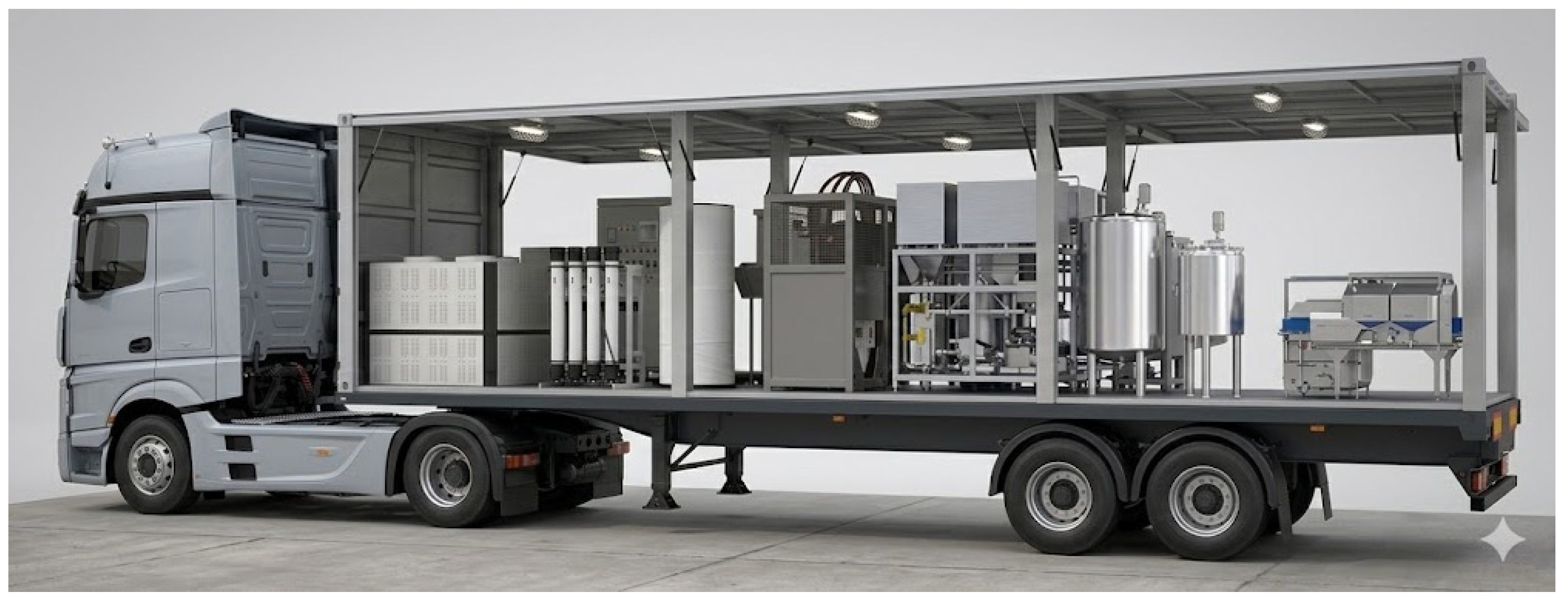
Figure 2.
Comparative performance summary across representative decentralized processing programs, illustrating differences in daily throughput, product shelf-life, and operational scope between earlier demonstration platforms (e.g., FOX, 2019–2023 [10]) and current mobile aseptic processing platforms (MAPP).
Figure 2.
Comparative performance summary across representative decentralized processing programs, illustrating differences in daily throughput, product shelf-life, and operational scope between earlier demonstration platforms (e.g., FOX, 2019–2023 [10]) and current mobile aseptic processing platforms (MAPP).
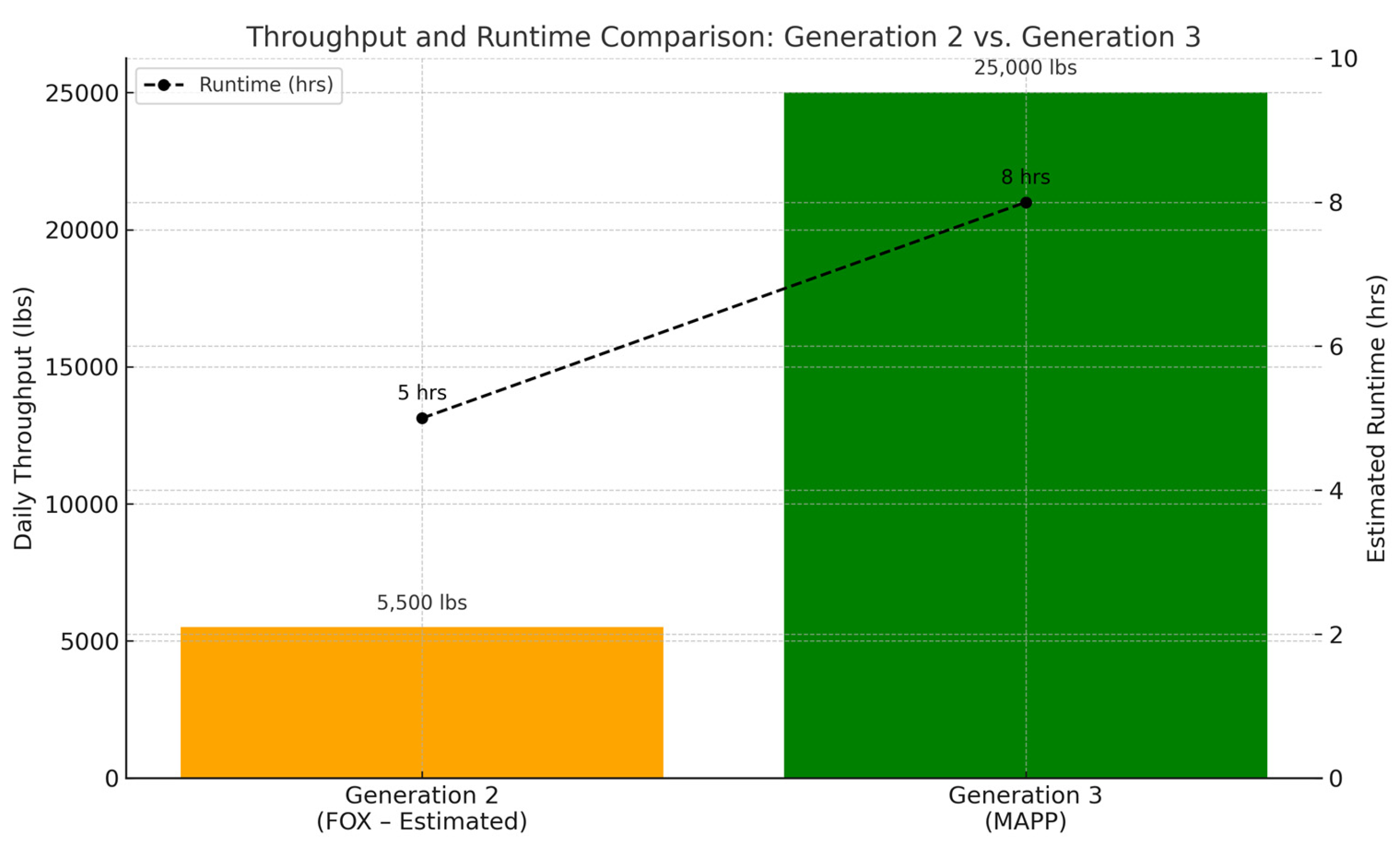

Table 1.
Representative impact categories associated Sustainable Development Goals (SDGs), illustrative metrics, and basis of assessment identified in the literature and scenario analyses.
Table 1.
Representative impact categories associated Sustainable Development Goals (SDGs), illustrative metrics, and basis of assessment identified in the literature and scenario analyses.
| Impact Category | Associated SDGs | Representative Metric | Basis of Assessment |
|---|---|---|---|
| Food-loss reduction | SDG 2, SDG 12 | Approximately 2,800–3,000 t of edible product stabilized annually per unit | Scenario analysis based on 11.3 t per 8 h shift, 260 operating days, and 98% edible recovery |
| Water-use efficiency | SDG 6 | Approximately 1.5–3 million m3 of embedded water preserved annually | Literature-derived water footprints applied to representative throughput assumptions |
| Climate-change mitigation | SDG 13 | Approximately 2 t CO2e avoided per tonne of horticultural product loss prevented | Mid-range estimate derived from published environmental assessments [67] |
| Fertilizer and nutrient conservation | SDG 6, SDG 12, SDG 13 | Approximately 240–360 t of fertilizer use avoided annually | Scenario analysis using representative fertilizer application rates [64,65] |
| Circular resource utilization | SDG 12 | Valorization of peels, seeds, fibrous residues, and process side streams | Crop-specific opportunities reported in biorefinery and food-waste literature [68,69] |
| Supply-chain resilience | SDG 2, SDG 9 | Shelf-life extension and reduced dependence on refrigerated distribution | Established characteristics of aseptic stabilization and ambient packaging |
| Food security and nutrition | SDG 2 | Increased availability of shelf-stable nutrient-dense foods | Literature linking horticultural availability and dietary diversity [27,80] |
| Employment and workforce development | SDG 8, SDG 10 | Direct employment, technical training, and secondary labor-market effects | Deployment-dependent estimates and workforce-development frameworks |
| Rural economic participation | SDG 8, SDG 10 | Increased producer participation and local value addition | Agricultural value-chain literature and decentralized processing studies [71,73] |
| Industrial development and innovation | SDG 9 | Deployment of modular processing infrastructure and distributed manufacturing capabilities | Engineering and industrial-development literature |
| Export readiness and quality assurance | SDG 8, SDG 9 | Traceability capability, packaging integrity, and regulatory compliance | International food-safety and quality-management frameworks |
| Resource efficiency | SDG 6, SDG 12, SDG 13 | Specific energy consumption, water-to-product ratio, and overall equipment effectiveness (OEE) | Process-engineering performance metrics |
Representative values are intended to illustrate potential impact pathways identified in the literature and scenario analyses. Reported values should be interpreted as indicative rather than normative, as realized outcomes are expected to vary according to crop type, geography, infrastructure availability, market conditions, utilization rates, and operational practices.
Table 2.
Comparisons of technical engineering characteristics of representative classes of decentralized food processing platforms reported in the literature. Values represent typical ranges observed in published case studies and are intended for comparative purposes only.
Table 2.
Comparisons of technical engineering characteristics of representative classes of decentralized food processing platforms reported in the literature. Values represent typical ranges observed in published case studies and are intended for comparative purposes only.
| Attribute | Mobile Aseptic Class | Mobile Minimally Processed Class | Educational/Demonstration Class |
|---|---|---|---|
| Aseptic capability | Yes (HTST/UHT with aseptic filling) | No | No |
| Typical throughput | Up to ~11.3 t per 8 h shift | ~1–5 t/day | <5 t/day |
| Energy autonomy | On-board generator; grid and renewable compatible | Variable | Variable |
| Water autonomy | Integrated treatment and utility support possible | Variable | Limited |
| Shelf-life of output | 12–24 months (ambient) | Days to weeks (refrigerated) | Days (fresh products) |
| Cold-chain dependence | Not required after packaging | Required | Required |
| Product flexibility | Purees, concentrates, sauces, selected beverages | Fresh or minimally processed products | Educational products |
| Packaging format | Aseptic flexible packaging | Refrigerated containers | Demonstration packaging |
| Regulatory scope | ISO 22000/SQF-aligned frameworks | HACCP prerequisite programs | Training certifications |
| Typical deployment environment | Commercial field operations | Pilot and regional operations | Research and educational settings |
| Mobility class | Trailer-mounted or transportable modular platforms | Containerized or transportable units | Fixed or semi-mobile systems |
| Utility requirements | High | Moderate | Low |
| Technical complexity | High | Moderate | Low |
| Capital intensity | High | Moderate | Low |
| Documented field history | Pilot to commercial deployments | Pilot and demonstration programs (e.g., FOX, 2019–2023) | Educational and proof-of-concept use |
| Principal strengths | Shelf-life extension, export readiness, reduced cold-chain dependence | Simplicity, lower cost, ease of operation | Training and technology demonstration |
| Principal limitations | Higher complexity, validation requirements, consumable dependence | Short shelf-life, refrigeration dependence | Limited commercial applicability |
| Most suitable operating context | High-loss environments with weak cold-chain infrastructure | Regions with existing refrigeration and short distribution distances | Research, extension, and training |
Cell values represent generalized characteristics reported in the literature and should not be interpreted as specifications for any individual commercial platform.
Table 3.
Illustrative three- and fifteen-year economic impact categories for a representative mobile aseptic processing platform under conservative deployment assumptions. Values are intended to indicate order-of-magnitude impacts and should not be interpreted as guaranteed financial outcomes.
Table 3.
Illustrative three- and fifteen-year economic impact categories for a representative mobile aseptic processing platform under conservative deployment assumptions. Values are intended to indicate order-of-magnitude impacts and should not be interpreted as guaranteed financial outcomes.
| Category | Indicative 3-Year Impact (US$ million) | Indicative 15-Year Impact (US$ million) | Basis of Estimate |
|---|---|---|---|
| Producer revenue uplift (value-added share) | 20–25 | 100–125 | Representative value-add assumptions applied to recovered product volumes and market-access scenarios |
| Avoided downstream waste costs | 10–15 | 50–75 | Scenario analyses based on reductions in spoilage and disposal losses |
| Productivity gains (land-use and yield retention) | 5–7 | 25–35 | Literature-derived relationships between avoided losses and agricultural productivity |
| Water and fertilizer externality savings | 5–8 | 30–40 | Embedded resource values derived from representative water-footprint and fertilizer-use estimates |
| Workforce development and labor-market earnings | 3–5 | 15–25 | Employment and skills-development impacts reported in rural industrialization literature |
| Indicative total economic impact | ~50 | ~250 | Aggregate of representative impact categories under conservative assumptions |
Illustrative values are based upon representative throughput assumptions, avoided-loss scenarios, and literature-derived externalities. Actual economic outcomes are expected to vary according to crop mix, operating utilization, market conditions, infrastructure availability, and local costs. Values are intended to provide comparative context rather than normative performance targets.
Disclaimer/Publisher’s Note: The statements, opinions and data contained in all publications are solely those of the individual author(s) and contributor(s) and not of MDPI and/or the editor(s). MDPI and/or the editor(s) disclaim responsibility for any injury to people or property resulting from any ideas, methods, instructions or products referred to in the content. |
© 2026 by the authors. Licensee MDPI, Basel, Switzerland. This article is an open access article distributed under the terms and conditions of the Creative Commons Attribution (CC BY) license.
Copyright: This open access article is published under a Creative Commons CC BY 4.0 license, which permit the free download, distribution, and reuse, provided that the author and preprint are cited in any reuse.