
Submitted:
24 August 2026
Posted:
25 August 2026
You are already at the latest version
Abstract
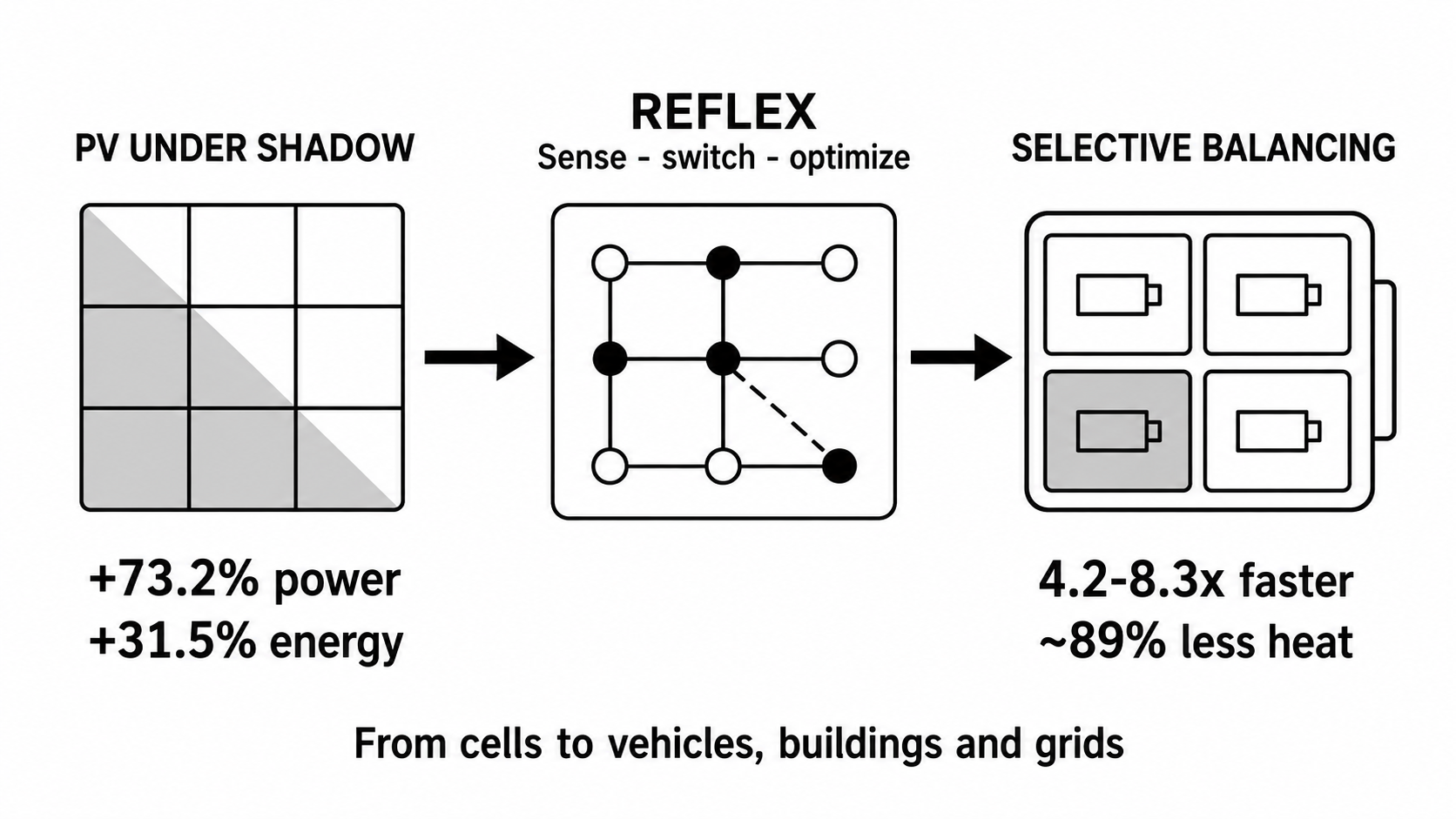
Energy research and automotive engineering often optimize individual components while leaving fixed system topology unchanged. This Communication argues that protected, real-time topology change within a Reflex-Policy architecture can act as a system-integration multiplier across energy harvesting, storage and use. Historical transitions from carburetion to electronic injection, turbocharging and regenerative braking show how sensing, actuation and control create value at the system level. Two illustrative cases quantify the opportunity. In a 3 x 3 photovoltaic proof-of-concept under partial and moving shadow, protected substring bypass followed by MPPT increased aggregate static power by 73.2% and representative dynamic energy by 31.5% in behavioural simulation. In a Model 3-class LFP battery extrapolation, selective non-dissipative charge injection could reduce correction time by 4.2-8.3 times and intentional balancing heat by approximately 89% relative to 240 mA passive balancing. These figures are simulations and engineering extrapolations, not final hardware measurements. The same local-evidence, bounded-action and supervisory-policy contract can scale from cells and micro-harvesters to vehicles, buildings, microgrids and utility assets.
Keywords:
Reflex-Policy
; system integration
; real-time topology change
; photovoltaic partial shading
; battery balancing
; energy harvesting
; energy storage
The Opportunity
The opportunity is to make system integration itself an enabling technology. The same architectural principle can be adapted at every scale - from embedded energy harvesters and individual storage elements to electric vehicles, stationary storage, photovoltaic plants, charging hubs and microgrids: observe the local physical condition, authorize a bounded first action, measure the result, and let higher-level policy optimize the whole asset. This creates leverage across very large markets because the core Reflex-Policy logic, observability and safety contract can be reused while the sensing models, power stage and permission envelopes are adapted to each technology, power level and application.
What the Past Teaches
History repeatedly shows that major innovations appear unnecessary or too complex when compared component by component, and become compelling when assessed as integrated systems:
Mechanical carburetors to electronic fuel injection: added sensors, pressurised delivery and electronic control enabled better combustion, emissions, drivability, diagnostics and adaptability.
Naturally aspirated engines to turbocharged downsizing: the turbocharger added hardware, but the integrated engine delivered higher specific power and better use of otherwise wasted exhaust energy.
Friction braking to regenerative braking: motor, inverter, battery and control integration converted part of a former loss into useful energy. Friction braking remained as a safety fallback and for conditions in which regeneration was unavailable.
The lesson is not that more electronics are automatically better. It is that selective sensing and actuation can reorganize energy flows and create value that cannot be seen in a component-only comparison. Reflex-Balance follows this established industrial pattern: introduce a useful first action while preserving proven protection and fallback functions.
System Integration Is the Value Multiplier
Batteries and renewable-energy systems now require the same change of perspective. A better material may store more energy, accept more power or tolerate a wider temperature range, while the surrounding fixed topology still prevents the system from using the full advantage. More accurate AI may identify a limiting element, yet create little physical value unless the architecture can assist, bypass, isolate or reroute it.
System integration must therefore move from the final verification stage to the beginning of innovation. Chemistry, sensing, packaging, thermal pathways, electrical segmentation, energy routing, galvanic isolation, fault containment, power electronics, repairability and lifetime management should be co-designed. The relevant comparison is not the price or efficiency of one component, but its effect on usable energy, thermal load, charging readiness, availability, service and total cost of ownership.
The Reflex-Balance Proposition
Reflex-Balance does not continuously redistribute energy among every cell. It uses the measurements already required by the BMS to identify the lowest eligible cell or electrical zone and inject charge only where and when it is useful. Within the wider Reflex-Policy architecture, the Reflex layer executes a bounded, pre-authorized local action; the Policy layer retains optimization, learning, planning, coordination and rule updates. Measured feedback and compact event-action traces make the response observable and auditable. This does not replace advanced AI, materials science or conventional protection. It ensures that their information and capabilities can produce an immediate, useful physical response. Passive balancing can remain as fallback or fine trim, enabling a gradual rather than disruptive transition [5,6,7].
Two Practical Examples: Reflex as Real-Time Topology Change
Two practical examples make the system-integration opportunity concrete.
PV under partial shadow: The proof-of-concept uses a compact photovoltaic panel made of nine cells, arranged as three series-connected, three-cell substrings, each with its own controllable bypass branch. Under uniform sunlight, the same current flows through all three substrings. When a moving shadow - from a cloud, pole, building edge, vegetation or another object - crosses one cell or substring, its lower current capability can throttle the entire series-connected panel, even though the other cells remain illuminated. A conventional maximum-power-point tracker (MPPT) can change the operating point, but it cannot remove this internal bottleneck. Reflex therefore reads the local substring voltages and panel current, identifies the limiting substring and, when safety conditions permit, commands the switch matrix to bypass only that substring. The MPPT then optimizes the newly settled configuration. In behavioural simulations covering representative static and moving-shadow conditions, this protected topology response increased aggregate power from 6.175 W to 10.697 W (+73.2%). For a representative dynamic sequence, captured energy rose from 53.636 J with conventional MPPT to 70.517 J with 20 ms of added inference/readout latency (+31.5%); the gain remained +29.0% at 100 ms and +26.6% at 200 ms [8,9].
Model 3-class LFP battery: for an illustrative approximately 55 kWh, 106-series, 160 Ah pack divided into four electrical zones, a 0.5% imbalance is about 0.80 Ah or 2.56 Wh. A 240 mA passive reference would require about 3.33 hours and dissipate approximately 2.56 Wh as balancing heat. Selective Reflex injection would take about 0.80 hours at 1 A (4.2x faster) or 0.40 hours at 2 A (8.3x faster); at 90% efficiency, calculated conversion loss is 0.284 Wh, approximately 89% less intentional balancing heat. The PV figures are proof-of-concept behavioural simulations and the battery figures are a demonstrator-grounded engineering extrapolation - not final hardware or Tesla production-pack measurements. Together, the cases show scale independence: the same protected topology-change contract can act on a cell or PV substring, a pack or array, a vehicle or building, and ultimately a microgrid or utility-scale asset; only the sensing, power stage and safety envelope change with scale.
Across sectors and scales
Embedded and distributed systems: energy-proportional response in sensors, IoT devices, portable systems and hybrid micro-harvesters with very limited power and computation budgets.
Electric mobility: more consistent usable energy and range, faster charging readiness, lower local heat generation, better fault information and improved second-life qualification.
Stationary storage: higher asset availability, lower auxiliary cooling demand, improved maintenance prioritisation and greater lifetime-energy delivery from large LFP installations.
Energy infrastructure: coordinated control of photovoltaic and other harvested sources, storage and load at buildings, charging hubs, microgrids, ports, industrial sites and utility-scale plants.
The research opportunity is to connect advanced materials, sensing, power electronics and AI through a common integration contract. A validated architecture could then support multiple technology families and pilot sites while preserving application-specific safety, qualification and supervisory control.
The Reflex Opportunity at Every Scale
The principle is scale-independent. At device level, the action may concern one storage element, converter channel, photovoltaic substring or micro-harvester. At asset level, it may coordinate a vehicle, machine, building or storage rack. At infrastructure level, the same contract between local evidence, bounded action and supervisory policy can support a microgrid, industrial energy system or utility-scale plant. The power stage and safety envelope change, but the architectural logic remains consistent.
An electric vehicle is one clear example: it should be understood as an integrated energy system, not as a battery connected to a motor. Battery cells and zones, regenerative braking, traction conversion, charging, thermal management, auxiliary loads and any onboard harvesting source continuously influence one another. A Reflex architecture can address the first useful local action - assist a limiting storage zone, contain a fault, adapt an energy path or preserve regenerative capability - while the Policy layer continues to optimize range, performance, charging and lifetime.
The same view applies to energy harvesting and storage. Photovoltaic, thermoelectric, thermophotovoltaic, piezoelectric and hybrid sources are variable and frequently mismatched; storage elements differ with ageing, temperature and state of charge. Considerable gains can arise when the integrated system can selectively bypass, connect, inject, isolate, reroute or wake the appropriate element instead of forcing every component through a fixed topology and a single centralized decision path. The achievable gain is application-dependent and must be measured, but the opportunity is systematic: improve the way energy is captured, routed, stored and used across the complete physical system.
A Practical Route to Adoption
The strongest path is a hybrid migration: retain proven protection and passive fallback functions, add selective Reflex actuation, and validate the complete integrated system against transparent KPIs - correction time, useful energy delivered, dissipated energy, temperature rise, wiring and isolation, component count, failure modes, service time and lifetime throughput. This makes the proposal auditable for automotive OEMs, battery manufacturers, utilities, renewable-energy developers and asset owners. Reflex Energy Management should be judged not as extra electronics, but as a system-integration architecture that converts material behaviour and existing measurements into faster local action and greater lifetime value.
The decisive change is methodological: do not optimize the cell, material, converter, controller or AI model separately and integrate them only at the end. Design the physical system from the outset so that local evidence can trigger a bounded, observable and energy-proportional action while higher-level intelligence continues to optimize the whole asset. The resulting opportunity is larger than an improved balancing circuit or PV switch: it is a reusable system architecture for energy harvesting, storage and use at every scale.
AI-Assisted Language and Document Preparation
Generative AI tools were used to assist with language editing and document formatting. The author reviewed and approved the entire manuscript and takes full responsibility for its content.
Author Contributions
P.P.: conceptualization, methodology, analysis, writing - original draft, and writing - review and editing.
Funding
The photovoltaic proof-of-concept evidence discussed here was developed within MultiSpin.AI (European Union grant no. 101130046). The author also gratefully acknowledges support from the European Commission projects URBANE (grant no. 101069782) and STEEL ALIVE (grant no. 101216680).
Data Availability Statement
The numerical examples reported here are based on proof-of-concept behavioural simulations and engineering calculations. Supporting benchmark data and calculation details are available from the corresponding author on reasonable request, subject to applicable project and intellectual-property constraints.
Conflicts of Interest
P.P. is employed by Interactive Fully Electrical Vehicles (IFEVS), which is developing the Reflex-Policy system-integration concept, and is an inventor on patent applications related to IFEVS energy and mobility technologies. The author declares no other conflicts of interest.
References
- International Energy Agency, Global EV Outlook 2026.
- International Energy Agency. Global Energy Review 2026 - Battery Storage. [CrossRef]
- Analog Devices, Active Battery Cell Balancing
- TIDA-00817: 16-Cell Li-Ion Battery Active Balance Reference Design; Texas Instruments.
- Perlo, P.; Dalmasso, M.; Biasiotto, M.; Penserini, D. Edge AI in Nature: Insect-Inspired Neuromorphic Reflex Islands for Safety-Critical Edge Systems. Symmetry 2026, 18, 175. [Google Scholar] [CrossRef]
- Perlo, P.; Dalmasso, M.; Penserini, D.; Pozzato, S. Physical AI as Seen from Nature: A Reflex-Policy Layered Architecture for Energy-Proportional Embodied Intelligence. Preprints. 2026.
- Perlo, P.; Dalmasso, M. Spatial AI Needs Reflex-Policy: Safe Local Action in Physical AI. Preprints. 2026. [Google Scholar]
- Deline, C. Photovoltaic Shading Testbed for Module-Level Power Electronics. NREL/TP-5200-54876, National Renewable Energy Laboratory (2012). Official institutional record: NLR Research Hub. NREL/TP-5200-54876. 2012.
- Mishra, V. L.; Chauhan, Y. K.; Verma, K. S. A novel reconfiguration of the solar array to enhance peak power and efficiency under partial shading conditions: experimental validation. Clean Energy 2023, 7, 824–842. [Google Scholar] [CrossRef]
Disclaimer/Publisher’s Note: The statements, opinions and data contained in all publications are solely those of the individual author(s) and contributor(s) and not of MDPI and/or the editor(s). MDPI and/or the editor(s) disclaim responsibility for any injury to people or property resulting from any ideas, methods, instructions or products referred to in the content. |
© 2026 by the authors. Licensee MDPI, Basel, Switzerland. This article is an open access article distributed under the terms and conditions of the Creative Commons Attribution (CC BY) license (http://creativecommons.org/licenses/by/4.0/).
Copyright: This open access article is published under a Creative Commons CC BY 4.0 license, which permit the free download, distribution, and reuse, provided that the author and preprint are cited in any reuse.